
Chapter Index
Thirty chapters, four parts, nine years. Each becomes a real, readable chapter the moment it is written.
Chapter 1 — The Appointment
↑ Back to ContentsFocus: a twelve-day post accepted standing up in a corridor, an eleven-minute recital, and an empty chair nobody can account for.
The post was twelve days long and it looked well on a county return, and Nell Kohl established no third fact about it before she said yes.
She said yes in the corridor outside the registry, standing up, to a man she had met once, which she would later understand was how every consequential thing in her life had been arranged and would go on being arranged, and which at the time felt like efficiency.
“Provisioning,” the man said. “Ledger’s End. Twelve days.”
“Doing what?”
“Banners. Food.” He thought about it with the air of a man being scrupulous. “Mostly banners.”
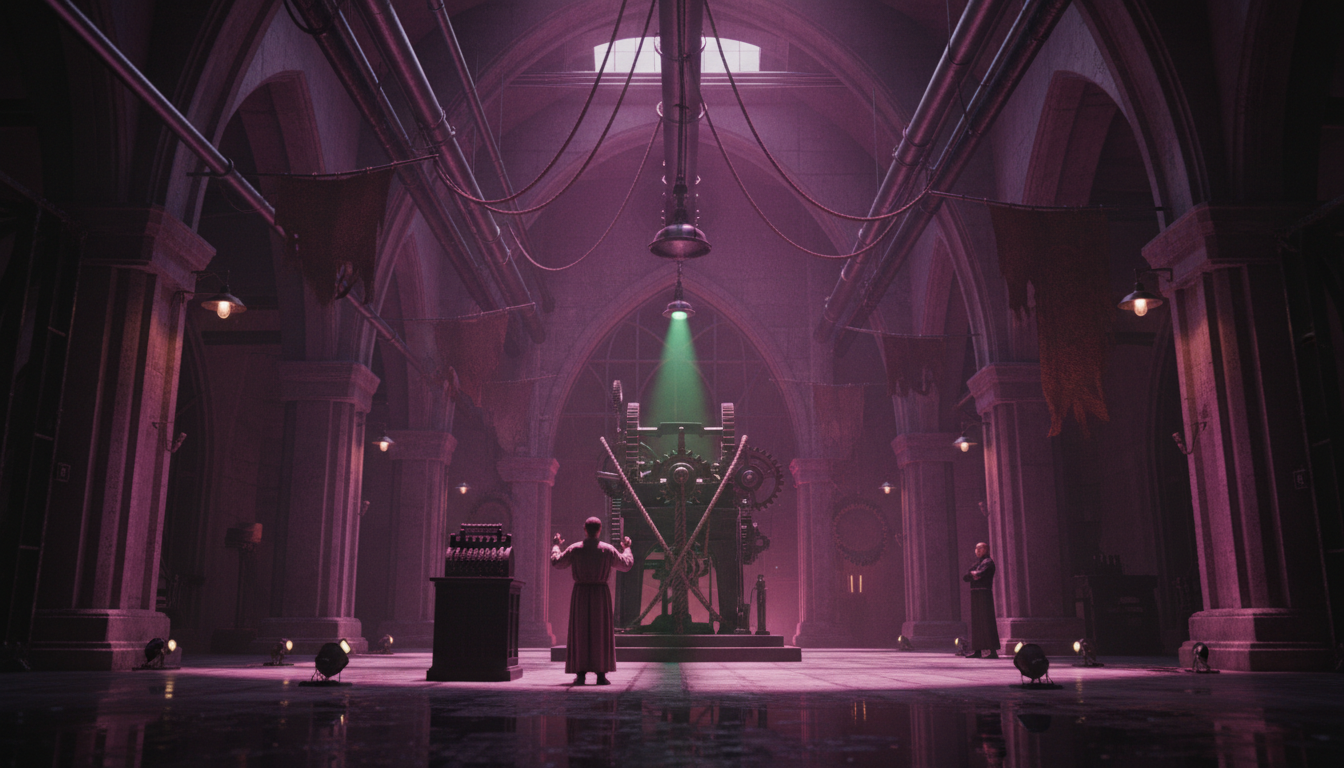
The hall they met in sat halfway up the terraces, one of the old porous-stone rooms built when everything was built, with the curved walls that eat a raised voice before it reaches the far end, so that the room encouraged a certain kind of person and quietly filtered out the rest. Nine people had been named to the committee. Six came. Nell would learn, over a period of years she had not yet agreed to, that six was extremely good.
There was a table, and eleven chairs for six people, which she assumed was an oversight until she counted them twice.
At the head of the table, set square to it and pulled out slightly, as though somebody had just risen from it and meant to come back, was a chair nobody went near.
Nell took a seat two down from it, on the grounds that it was free, and a broad, unhurried man in a work coat moved his own chair fractionally so she could get in, and said his name was Idris Bello, and that she should not worry, it was mostly rope.
“It’s mostly banners,” Nell said. “I was told banners.”
“Banners are rope,” Idris said. “You’ll see.”
Then a woman at the far end stood, put a sheet of paper flat on the table in front of her, did not look at it once in the following eleven minutes, and began to read.
She read the committee’s constituting terms. She read the instrument they were made under and the clause they were made by and the season they were made for. She read the scope of the committee’s competence and then, separately and at greater length, the boundaries of it. She read the limitations upon its powers, which were extensive, and the reservations attaching to those limitations, which were more extensive still. She read a paragraph concerning quorum that was itself longer than the business they had come to transact. She read the whole of it in the flat, unbothered voice of somebody reading out a recipe they had cooked eight hundred times, and nobody moved, and nobody looked up, and Idris Bello sat with his arms folded and his eyes half shut like a man being rained on gently.
Nell timed it, because she assumed it was a mistake and wanted to be able to say how large a one.
At the eight-minute mark the woman stopped, and Nell’s heart made a small hopeful movement, and then a man near the window said, “Oh — and let’s not forget,” in the tone of somebody being helpful, and the woman said, “No, quite,” and went back in.
Everybody settled again. Somebody actually settled. Nell watched a man make himself more comfortable for a recital of provisions concerning the disposal of surplus.
It ended at eleven minutes and four seconds, and it ended like this:
— all decisions of this committee being taken pending the appointment of a competent authority.
The woman sat down. Idris opened his eyes. And Nell, who had been raised properly and had been in the room nine minutes, said, “Sorry — pending what?”
“Competent authority,” said the woman.
“Yes. Which is?”
There was a pause that Nell would remember with great precision for the rest of her life, and which at the time she read as ordinary politeness.
“Well,” said Idris. “That’s the chair.”
She looked at the chair. The chair was a chair. It was slightly better than the other chairs, in the way that municipal furniture is sometimes slightly better for reasons nobody living can account for.
“Whose is it?”
“County seat’s,” said the woman.
“It was,” said the man by the window.
“It is,” said the woman, without heat.
“Somebody sat in it last year,” Idris said to Nell, helpfully. “Officer came up. Sat there. Heard the terms. Said thank you. Went off.”
“And this year?”
Six people considered the question with what she could only describe as good will.
“There isn’t one this year,” said Idris.
“Right,” Nell said. “So do we — move it?”
And this was the first time in her life that Nell Kohl asked a question that could not be answered, though it would be nine years before anybody explained to her that was what she had done, and the person who eventually explained it would be herself, in writing, and she would not enjoy it.
“Move it where?” said the woman.
“Out. Against the wall. Anywhere. If nobody’s coming.”
“It’s in the terms,” said the woman.
“Then take it out of the terms.”
The woman looked at her with real warmth, the way you look at somebody who has said the thing everybody says in their first year and which is, on inspection, perfectly reasonable.
“Who would do that?” she said.
Nell opened her mouth, and then did the arithmetic, and then shut it, and the meeting proceeded to item one, which was rope.
Item one took forty minutes. There were two grades of rope available and one of them was better and cost against a ledger that would be wiped in twelve days anyway, and this fact was raised by three separate people in three separate ways and defeated each time by a fourth person who pointed out, correctly, that wiped and free were not the same word and that somebody had to be the person who kept knowing the difference. Nell found, to her considerable irritation, that she agreed with him. She also found, at minute thirty, that she had started keeping a list of the counts, because nobody else was, and because listening to six people say numbers to each other without writing any of them down had begun to make her feel physically unwell.
At the end, the woman at the far end said, “Minutes,” and looked, not unkindly, at the newest person in the room.
So Nell wrote it up that night, at her own table, in the twelfth hour, because the form required it and she had never in her life failed to complete a form. It took under a page. Present: six. Item one: rope, second grade, quantity as appended. She looked at it for a while, and thought it was a very small amount of paper for forty minutes, and added the quantity as an appendix, correctly, with the counts, because leaving it out would have annoyed her.
Then she signed it and filed it, and the committee went on to hang the banners and take them down again, and the twelve days ended, and everybody went home.
The file stayed.
Chapter 2 — The Banners
↑ Back to ContentsFocus: enormous fabric with a long memory for folding, four people, two poles, and a name in the wiped hours that means nothing to her yet.
The banners turned out to be enormous, which nobody had thought to mention to Nell in advance, and also to be made of a fabric with an unhelpful memory for having been folded, so that unrolling the first one across the east span took four people, two poles, and roughly the amount of profanity Idris assured her was traditional.
"It's always like this the first year," he said, not looking up from the pole he was fighting. "Gets easier once you know where it wants to fold."
"Does it want to fold somewhere specific?"
"No," Idris said. "But it's got opinions about it, and you learn to argue."
The east span is eleven metres across at the point where the fixings are, which Nell had known as a number for two days and understood as a distance for about four seconds, at the moment the wind took the loose end and demonstrated it.
They got it back. It took both poles and a man on the far side whose name she did not learn until the following year.
There were twelve lengths. She had been told twelve and had written down twelve and had still, somehow, arrived that morning with the private expectation that twelve would turn out to mean something more like five.
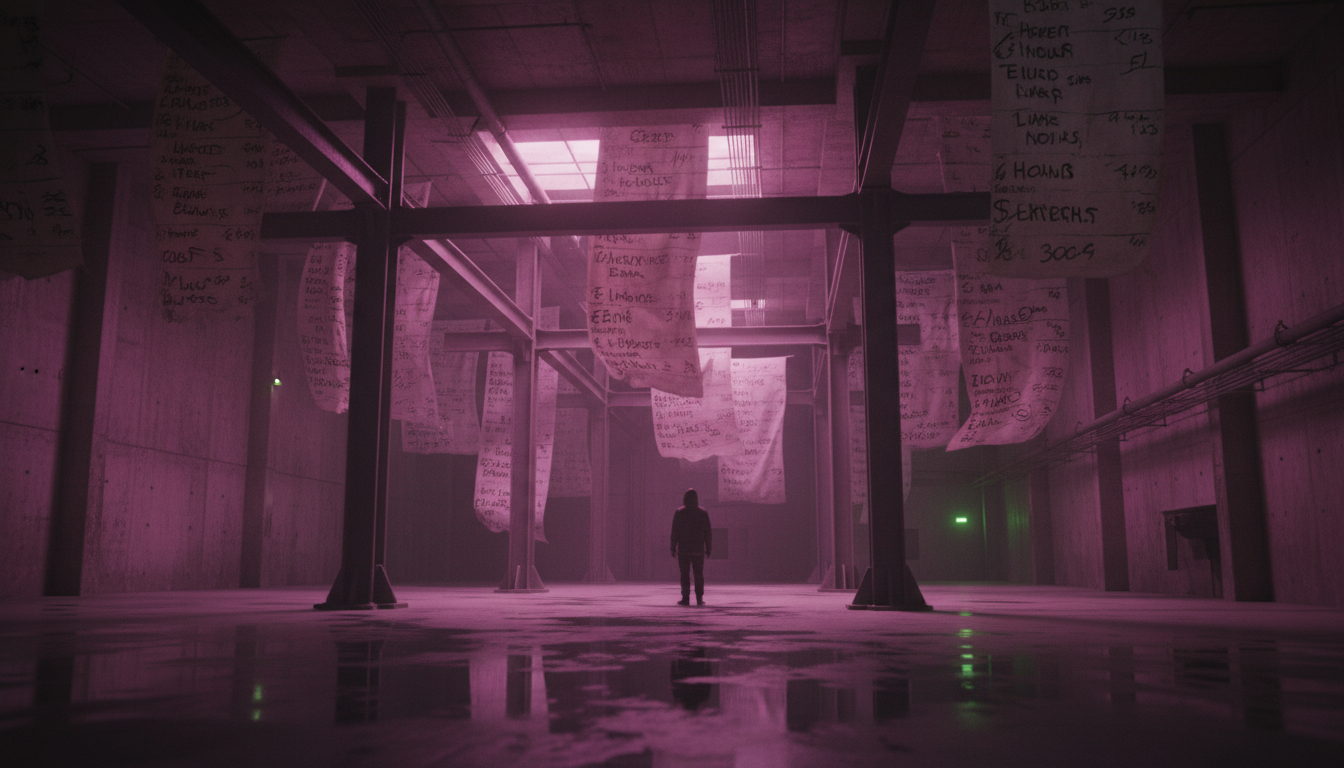
What was actually printed across each length of cloth, in neat civic type, was a column of names beside a column of hours.
The whole of the year's Luxury Ledger. Every debt the county had agreed to wipe rather than carry forward, hung across the spans in public for twelve days so that everyone could see exactly what had just stopped existing — and then taken down, and the cloth stored, and the whole of it void.
Nell had assumed, before she saw one up close, that this would feel like an achievement being announced. The county's own notice called it a celebration of the year's clearance, and she had read that notice twice on the way up and had been looking forward to it.
It did not feel like that at all.
It felt like a very large, very public receipt.
"We're not decorating," she said, mostly to herself, halfway up a ladder with a grommet in her teeth.
"No," Idris agreed, from below, holding the ladder in the manner of a man who has held a great many ladders. "We're publishing."
She asked him, later, over the second span, whether anybody ever objected to having their name up there.
He said that people had, at the start, apparently, generations back — and that the argument had gone the other way, on the grounds that a debt wiped in secret is a favour and a debt wiped in public is a policy, and that the difference mattered more to the people being forgiven than to anybody else.
"Whose argument was that?"
"No idea," said Idris. "It's just the reason. It's been the reason since before my father."
She read her way along the east span as they worked it — the way you read anything set in front of you long enough, without deciding to, the way you read the back of a packet at breakfast.
Four hundred and some names. Hours beside each one, in the same type, right-aligned, which somebody in a county office had chosen and which was the correct choice and which made the whole thing considerably worse to look at.
And about two-thirds of the way down the third length her eye caught on a name she didn't know.
Mattias Sarn. Forty-one hours.
And held on it for exactly as long as it takes to register that a name means nothing to you.
And then let it go, because there were eleven more lengths of cloth after that one, and the wind was already starting to think about the afternoon.
She would not remember, later, that this had been the first time.
Chapter 3 — The Count
↑ Back to ContentsFocus: a bedding count that runs two hours because nobody agrees what a blanket is, and a throwaway joke nobody answers.

The bedding count should have taken twenty minutes and took closer to two hours, mostly because nobody on the committee had ever agreed on what counted as a blanket.
"A blanket," said the man who always sat by the window — Corwin Hale, this year's returning member from the county side, and a man Nell had decided within a week she liked enormously and understood not at all — "is a piece of woven material intended to cover a sleeping person."
"A shawl covers a sleeping person," Marta said.
"A shawl is not intended to."
"How do you know what it's intended to do? Ask the shawl?"
"I know what it's intended to do because it has a fringe," said Corwin, with dignity. "Nothing intended for a bed has a fringe."
Marta produced, from the shelf behind her, a blanket with a fringe.
Nell let the argument run its course.
Which took another forty minutes, and ranged across two further exemplars, one appeal to the practice at Holm, and a brief and entirely unresolved sub-argument about coverlets — and ended, as far as she could tell, with everybody quietly agreeing to disagree about shawls while continuing to count them as blankets anyway.
She wrote the whole of it down as: Bedding, available: 214 units (see appended definitional note).
Because if six people were going to argue about it for forty minutes, she was not going to be the one who pretended it hadn't happened.
The appended definitional note ran to a page and a half. She was rather proud of it. It is, as far as she has ever been able to establish, still the only document in the county that addresses the question at all.
It was, she noted afterward, walking back down with the tally under her arm, the only accurate count of anything currently held by any office within a day's walk of Ledger's End.
Not because anyone had asked her to produce one. Not because the position came with any authority to do so — the position did not come with anything, it was twelve days long and had a chair in it that belonged to somebody who had never arrived.
But because somebody had needed to write the number down while five other people argued about what it was a number of.
And she had been the one holding the pen.
"I appear," she said, mostly to Idris, mostly as a joke, "to be the only person on this committee who writes anything down."
Idris, who was folding a shawl that had definitely just been counted as a blanket, made a noise that might have been agreement and might have been effort.
And nobody else in the room said anything at all, because they had all moved on to the question of where the tally should be kept — which took a further nine minutes, and was settled, in the end, by everybody looking at Nell.
Chapter 4 — The North Banner
↑ Back to ContentsFocus: a hole the size of an animal's face, forty hours of somebody's debt chewed off a public banner, and whether that counts as retrieved.

The hole in the north banner was roughly the size and shape of an animal's face, which was because an animal's face had, at some point in the previous forty-eight hours, been directly responsible for it.
"It's the neighbours," Idris said, examining the ragged edge with the professional interest of a man who had seen a great many things go wrong with cloth and found all of them at least a little bit funny. "Has to be. Nothing else round here eats rope-weight linen and lives to regret it."
Corwin crouched down to look at the ground beneath the span, where a scatter of chewed threads suggested the culprit had at least made an effort to be discreet about it. "How many hours did we lose?"
Nell checked the printed column against her own copy of the manifest. "Forty-one. Belongs to a household in the third terrace."
"So the family whose debt that was," Corwin said slowly, working it through, "no longer has any proof, on the public record, that the debt was ever wiped. Because the proof got eaten."
Everyone looked at the hole for a while.
"Does that mean it's not wiped?" Marta asked, in the tone of someone hoping very much that the answer was no, because the alternative involved paperwork she did not want to invent from scratch.
"The ledger's already wiped it," Nell said. "This was never the record. This was the announcement of the record."
"Then we just need to decide," Idris said, with the air of a man discovering he had accidentally become useful, "whether a banner that got eaten still counts as retrieved."
It was, on the face of it, an absurd question, and Nell watched all five of the others treat it with total sincerity for the better part of twenty minutes -- whether an eaten banner had technically completed its function before being eaten, whether partial retrieval was retrieval at all, whether the animal itself, having consumed forty-one hours of somebody's debt, could reasonably be said to have discharged it on the family's behalf, a suggestion from Corwin that made Marta laugh so hard she had to sit down on an upturned crate.
They minuted it, in the end, as retrieved, on the grounds that the debt itself had already stopped existing the moment the ledger wiped it and the banner's job had only ever been to say so out loud, which meant a hungry animal interrupting the announcement changed nothing about the fact underneath it. Nell thought this was probably correct. She also thought, though she did not say it, that six people had just spent twenty minutes soberly adjudicating the legal status of a goat's lunch, and that nobody else in the room seemed to find that as remarkable as she did.
Chapter 5 — Hour Eleven
↑ Back to ContentsFocus: nobody told them to bring the banners in before the wind, and it is not written down anywhere as their job.

Nobody had told the committee to retrieve the banners before the wind came. It was not, so far as Nell could find in the file, written down anywhere as their job at all -- the hanging was theirs, explicitly, by the terms Marta read out at every meeting, but retrieval before the twelfth day belonged, technically, to a county maintenance crew that had existed on paper for as long as anyone could remember and had not, so far as anyone could also remember, ever actually turned up.
So at hour eleven of the twelfth day, with the wind picking up in the particular way it did every year around that time -- a low, patient increase that everyone in Ledger's End had learned to read the way sailors read a sky -- Idris looked at the sky, looked at the banners, and said, "Well, nobody else is coming," and started up the west ladder without further discussion.
They got all twelve spans down in ninety minutes, working faster and with less arguing than Nell had seen them manage at any point in the previous eleven days, and she understood, folding cloth as fast as her hands would go with the wind starting to snap at the corners, that there was something almost embarrassingly satisfying about doing a genuinely time-pressured thing competently with five other people who knew exactly what they were doing.
The last length came down with eleven minutes to spare, by Nell's count, and the six of them stood in the gathering wind holding a very large amount of folded cloth and grinning at each other in the specific way people grin when they have just done something difficult and unglamorous extremely well and nobody outside the group will ever know or care.
"That's ours now," Idris said, with satisfaction, once they'd got everything under cover.
"What's ours?"
"Retrieval. Hour eleven. That's us now, every year, forever."
"Nobody assigned us that," Nell said.
"No," Idris agreed. "But we did it, and we did it well, and next year everyone's just going to assume it's us, and the year after that nobody will remember there was ever a maintenance crew who were supposed to be doing it instead." He said this with no apparent concern at all, the way a person observes that it will probably rain on Tuesday. "That's how all of it happens. You'll see."
Nell wrote it up that night as retrieved ahead of the wind, twelve of twelve spans, no incident, and did not, at the time, think there was anything else worth adding.
Chapter 6 — The File
↑ Back to ContentsFocus: the twelfth day ends at sundown with a closing recital, and the file goes back on the shelf.

The twelfth day ended, officially, at sundown, with Marta reading a short closing passage from the same sheet of paper she'd been reading from all along -- shorter than the opening recital by a wide margin, though Nell noted it still ran to nearly two minutes for what amounted to "we're done, thank you, go home" -- and the committee, by the terms of its own founding, ceased to exist until the following year.
Nell filed the last of the year's minutes that evening, added them to the folder she had started on the very first day out of nothing more than an inability to leave a form half-finished, and then sat for a while looking at the whole of it stacked together: the bedding count, the hole in the north banner and its twenty minutes of jurisprudence, the retrieval log, all of it in her own handwriting, none of it requested by anyone in any official capacity.
She considered, briefly, not keeping it. The committee had stood down. Nothing in the terms required a permanent record, and a temporary body, by any reasonable definition, ought to leave a temporary trace.
She kept it anyway, for reasons she could not have fully explained at the time and would spend a good part of the next few years trying to. It seemed wasteful to throw away a correct and orderly account of a thing simply because the thing itself was over. It seemed, more than that, like leaving a job half-done, and Nell Kohl had never in her life left a job half-done, a fact about herself she considered a virtue for approximately six more years.
So the file went into a drawer in her own house, rather than into any county archive, because there was no county archive designated to receive the records of a body that did not, on paper, outlast its own twelve days -- which meant that the only surviving account of what the committee had done, decided, and jurisprudentially resolved regarding the eating habits of local wildlife now belonged, in every practical sense, to one twenty-six-year-old woman with an unusually tidy drawer.
Nobody asked her to keep it. Nobody, as far as she could tell over the following twelve months, ever thought about it again. The file simply sat in the drawer, complete and correct and entirely hers, taking up rather less room than she expected a year of committee minutes to take up, and she thought, closing the drawer, that this was probably the last she'd think about any of it until the letter arrived asking whether she'd serve again.
Chapter 7 — Asked Back
↑ Back to ContentsFocus: a letter addressed to Nell Kohl by name, which no county correspondence has ever bothered to do before.

The letter came in early spring, addressed to Nell Kohl by name rather than to "the seasonal clerk," which she noticed immediately because it was the first time in her life any county correspondence had bothered to look up who she actually was before writing to her.
It asked, with the same flat civic courtesy as everything else that came out of that office, whether she would consent to serve again on the Ledger's End provisioning committee for the coming season.
She said yes before she had entirely finished reading it, and went back to it that evening to reread the part that had actually caught her attention, which was not the request itself but the file number attached to it: the same file number as the year before, carried forward, as though the committee had never actually stopped existing in the interval, merely gone quiet for a season the way a kettle goes quiet between uses.
It was, she thought, a strange thing for a temporary body to be older than its own newest member expected it to be. She was the newest member. She had also, by a margin nobody else on the committee seemed to find odd, kept the only complete written record of what the body had ever done, which made her, in some sense she couldn't quite name yet, older than the committee itself.
She mentioned none of this to her father, who had his own preoccupation that spring in the form of a household unit the county had assigned him after a fall the previous winter -- a boringly ordinary civic-issue model, requested on a form like anything else, that had arrived, been installed, and immediately begun doing every domestic task in the house better than either of them.
"I'm a big boy," her father told it, on its first morning, hauling a crate of preserves down from a shelf he had no business reaching at his age. "I can look after myself."
The unit, which had no capacity for tact and even less for concern, informed him with total factual calm that his balance metrics over the preceding six months indicated a thirty-one percent elevated fall risk when reaching above shoulder height, and offered to retrieve the crate.
"I've got it," he said, and dropped it.
Nell, watching from the doorway, decided this was going to be a long and extremely funny year.
She thought about mentioning the committee to him that evening -- the letter, the file number, the strange little continuity of it -- and then didn't, mostly because he was busy negotiating with the unit over whether preserves counted as a two-handed task, and partly because some instinct she couldn't name told her the committee was a thing that belonged, for now, only to the people who sat in that room and said "pending" out loud together.
Out in the terraces that same week, every doge in the county stopped humming, all at once, for about a minute, and then started again as though nothing had happened. Nell heard it from her own doorstep -- the sudden and total absence of the low, contented drone that had been the background noise of her entire life -- and looked up at a sky that gave her nothing to go on, and decided, reasonably enough, that it was probably just weather.
Chapter 8 — Out Of Season
↑ Back to ContentsFocus: a cold snap in the ninth month, in which the committee does not exist, and a county message with real urgency under the flat courtesy.

The cold snap arrived in the ninth month, which was not a month in which the committee existed in any sense the terms recognised, a fact that did not stop the county from sending a message asking, with real urgency under the usual flat courtesy, whether the committee could assist with an emergency redistribution of bedding and blankets to three terraces that had lost heating overnight.
"We're not convened," Marta said, reading the message aloud at an emergency gathering that had itself been convened in roughly forty minutes, which Nell noted was an interesting thing for an unconvened body to manage. "Formally, none of us are anything right now."
"Formally," Idris said, already pulling on his coat, "the county doesn't have anyone else who knows where the blankets are."
This turned out to be true, and turned out to matter more than anything in the terms, and by midnight the six of them had moved every spare blanket and shawl -- counted, this year, without a single argument about definitions, because emergencies apparently settled arguments that forty minutes of debate could not -- into the three affected terraces, working from a list Nell had, without really deciding to, kept meticulously updated in the drawer at home since the previous spring.
Somewhere around two in the morning, moving the last of the supplies up the terrace steps, somebody -- nobody would ever successfully establish who, though Idris was widely suspected -- had also, for reasons nobody could adequately explain afterward, carried the chair.
Not a chair. The chair. The one that lived at the head of whatever table they happened to be using, set out for the competent authority who never came, hauled bodily up four flights of terrace steps in the middle of an emergency redistribution of bedding, and installed, empty, at the makeshift table where six exhausted people were now sorting blankets by household.
"Why is the chair here," Nell asked, at half past two, past the point of caring how she phrased anything.
"It's always here," Idris said, as though this settled it, and in every meaningful sense it did, and nobody suggested carrying it back down.
They finished at dawn. The cold snap broke two days later, on its own, the way cold snaps generally do, and the county sent a brief, grateful acknowledgement that did not use the word "committee" once, on the grounds -- Nell assumed, reading it over her tea -- that officially there hadn't been one there to thank.
Chapter 9 — The Key
↑ Back to ContentsFocus: the keys to the western store arrive by a route she is never afterwards able to reconstruct.

The keys to the western store arrived by a route so indirect that Nell was never able to reconstruct it afterward with any confidence -- something involving the storekeeper's retirement, a nephew who did not want the responsibility, and a county clerk who had apparently decided, unilaterally and without consulting anyone with the authority to make the decision, that the provisioning committee was the natural next custodian of the only fully stocked warehouse on that stretch of the Ledger.
The storekeeper himself, a broad, weathered man named Halvard Reyes who had held the keys for longer than Nell had been alive, came to hand them over in person, which struck her at the time as an unusually formal gesture for what amounted to passing along a ring of iron.
"You know you shouldn't take these," he said, holding the keys out anyway.
"Why not?"
"Because you're not anything. No offence meant. You're six people and a chair nobody sits in. The store needs a keeper with standing -- somebody the county can hold to account if the count comes up short."
"And you don't think we have standing."
"I know you don't," Halvard said, entirely without malice. "I checked. There's no instrument anywhere that gives a seasonal provisioning body custody of county stock. I looked for one because I wanted a reason to say no to my nephew's idea, and there isn't one, and I looked for three weeks."
"So say no."
He considered this for what felt to Nell like a genuinely long time, turning the keys over once in his hand.
"You kept the north banner's forty-one hours straight in your own file for a year without anyone asking you to," he said finally. "My nephew told me that. I don't know why it matters to me, but it does. You're the only body round here I've ever seen keep an accurate account of anything it didn't have to." He put the keys in her hand. "I'm not saying it's right. I'm saying you're the closest thing to right that exists, and closest is apparently what I've got."
Nell took the keys, wrote up the transfer in scrupulous detail that evening -- date, hour, both their names, the precise and slightly uncomfortable wording Halvard had used about standing -- and became, without any instrument anywhere granting her the authority to do so, the custodian of record for the only stocked warehouse on that stretch of the Ledger.
She thought, filing it, that a man who was entirely right to refuse had just handed her the keys anyway, and that this seemed like exactly the kind of thing that ought to bother her more than it did.
Chapter 10 — The Roster
↑ Back to ContentsFocus: one line written in the margin of the Year Three minutes, because the county asked in passing.

The roster started, as far as Nell could ever pin down its origin, with a single line she wrote in the margin of the Year Three minutes:
Available for spring works: I. Bello, C. Hale, M. Voss, self.
She wrote it because the county had asked, in passing, whether anyone from "the committee" would be free to help repair a section of terrace wall, and she had wanted to be able to answer without four separate messages.
It was, at the time, a note to herself. It was in the margin. It was in pencil.
By the following spring the list had eight names on it, three of whom had never sat on the committee in any formal sense and had simply started showing up — because Idris had mentioned, at the tavern, that the provisioning people were "good sorts and always short-handed," which was true, and which Nell had not authorised him to say to anyone.
"You can't just recruit people," she told him.
"I didn't recruit anyone. I mentioned it was a nice way to spend a Tuesday, and people wrote their own names down."
"On my list."
"On the list," Idris said, with the particular gentleness of a man correcting a colleague's grammar. "It stopped being your list around the time it got a name of its own."
"It hasn't got a name."
"People are calling it the Ledger's End roster now. I think somebody official even used the phrase. In writing."
Nell said that she doubted that very much.
Nell checked.
And somebody official had — in a county memorandum about spring works allocation, referring without any apparent irony whatsoever to "consulting the established Ledger's End provisioning roster." A document that had existed, at the time of the memorandum's drafting, for slightly under fourteen months, and had never been established by anyone, and lived in the back of a book in her kitchen.
She read the sentence four times looking for the joke in it and did not find one, because there was not one. Some clerk in a county office had needed a phrase for a thing that plainly existed, and had reached for the obvious one, and had moved on to the next paragraph of a memorandum about gravel.
She considered striking the eight names down to the original four.
On the grounds that a body with no standing had no business maintaining a public list of citizens available for county labour — which was, she thought, a perfectly sound objection, and which she rehearsed to herself in the exact language she would have used at a meeting.
She considered this for the better part of an evening.
Weighed it against the fact that the list was, by any measure she could apply to it, useful, accurate, and wanted by every single person who appeared on it — two of whom had asked to be added, one of whom had asked twice.
And put the eight names back exactly where they were.
"It's just a list," she told herself, out loud, to an empty kitchen.
In a tone she would recognise years later as the tone of somebody who already knew that was not true, and had decided not to think about it that evening.
Chapter 11 — Buddy
↑ Back to ContentsFocus: almost nothing to do with the committee, an ordinary Tuesday, and a civic-issue form her father had filled in himself.

This chapter has almost nothing to do with the committee, a fact Nell would point out, later, to anyone who tried to connect the two, generally without much success.
The unit arrived on an ordinary Tuesday, on an ordinary civic-issue form her father had filled out himself after the preserves incident, delivered by a driver who set it down in the hallway, ran through a two-minute orientation neither of them fully listened to, and left with the cheerful indifference of somebody who did this several times a week and had stopped finding it remarkable years ago.
It was, on the form, a Domestic Assistive Unit, Class C, County Register 11, Revision 4 -- a string of letters and numbers Nell read once, filed mentally under things she would never need again, and forgot completely within the hour, a confidence that would turn out, over the following years, to be almost entirely justified.
By that evening it had reorganised the kitchen shelving into an arrangement her father immediately and loudly disliked and which he was, within a week, unable to functionally live without. By the end of the month it had identified a slow leak in the cellar pipework that had gone unnoticed for at least two years, corrected her father's medication schedule twice without incident, and produced, on request, a full inventory of the pantry in under four seconds -- a task that would have taken the entire provisioning committee the better part of an evening and at least one argument about the definition of a vegetable.
Her father hated it, in the specific way he hated anything that was correct about him more often than he was.
"I'm capable of managing my own medication," he told it, the first time it corrected him.
The unit informed him, with total and cheerful accuracy, that he had in fact missed the previous morning's dose by six hours, and offered a reminder chime for future doses.
"I don't need a chime."
He needed, as it turned out, the chime very badly, and kept it, and never once admitted this to anyone, including the unit.
He also, from the very first evening, refused point-blank to use its designation, on the grounds that no man his age was going to stand in his own kitchen calling something "DAU-C-eleven-r-four" like he was reading out a tax form.
"I'm calling it Buddy," he announced, entirely to annoy Nell, who had made the mistake of finding the designation mildly funny out loud.
"You can't just rename county property."
"Watch me," he said, and did, and never once called it anything else again, and within a year neither did she.
Chapter 12 — The Neighbours
↑ Back to ContentsFocus: a clerk arrives at the spring meeting with a memorandum, a straight face, and no idea what he is about to start.

The question was raised, entirely sincerely, by a county clerk named Petrin Okafor, who arrived at the spring meeting with a memorandum, a straight face, and absolutely no sense that he was about to trigger the single longest debate in the committee's history to date.
"Are the neighbours provisioned for," he asked.
Silence, of the specific kind that follows a question nobody has ever previously thought needed asking.
"Which neighbours," Idris said finally.
"The grazers. On the terraces."
"They're nobody's," Marta said. "You can't provision for an animal that isn't owned by anyone."
"Somebody has to be provisioning for them," Petrin said, with the patient reasonableness of a man reading directly from a complaint he had personally received. "They're eating the terrace plantings, the county's had six letters about it this season, and when I asked who was responsible for feeding them properly so they'd stop, everyone I spoke to said the same thing."
"Which was?"
"Ask the provisioning committee."
What followed took four hours, and Nell would later describe it, on the rare occasions anyone asked, as the funniest and most thoroughly argued four hours of her entire life. There was no seat on the planet, as far as anyone present could establish, with any actual authority to decide what an unowned, semi-tame animal was entitled to in the way of feed, land access, or veterinary consideration -- and every single person in the room, Nell included, treated this absence of authority not as a reason to decline the question but as a fascinating and entirely solvable administrative puzzle.
They debated whether the grazers constituted a single provisionable population or a shifting aggregate of individuals. Corwin produced, from somewhere, an actual headcount he had apparently been keeping privately for two years for no professional reason whatsoever. Idris argued passionately for a feed allocation based on terrace acreage, was defeated by Marta on the grounds that grazers did not respect terrace boundaries and never had, and accepted this defeat with visible good humour. Nell took four pages of minutes, all of it in deadly earnest, none of it authorised by anyone.
At the end of the four hours, they had produced a feed allocation schedule, a rotating watch to monitor terrace damage, and a formal minute stating that provisioning for the neighbourhood grazers fell, by established practice, within the remit of the Ledger's End committee.
Nobody in the room seemed to find this odd. Petrin Okafor thanked them with visible relief and left looking like a man who had been carrying a much heavier folder than the one in his hand. Nell watched him go and thought, not for the first time, that six people with no authority whatsoever had just spent four hours being the only body on the entire planet willing to decide something, and that everyone involved, including her, seemed to think this was a perfectly ordinary way to spend a Tuesday.
Chapter 13 — A New Member
↑ Back to ContentsFocus: Tobin Ashe sits down uninvited and asks to join, which nobody has ever done, and which nothing in the terms covers.

Tobin Ashe turned up at the first meeting of the year uninvited, sat down in the one remaining chair, and announced that he'd like to join the committee, please, if that was something a person could simply ask to do.
Nobody had ever asked to join before. The other five members had each arrived by one accident or another -- a form, a retirement, a nephew's suggestion, in Corwin's case a wrong turn on his way to an entirely different meeting years earlier that he had never quite found the moment to correct. Tobin was, as far as any of them could determine, the first person in the committee's short history to have looked at what it actually was and wanted in.
"Why?" Marta asked, not unkindly, mostly out of genuine curiosity.
"I like the recital," Tobin said, with total sincerity. "I heard about it from my cousin. Eleven minutes, every meeting, for years, and none of you have ever managed to get it shortened. I find that the most reassuring thing I've heard about any body on this continent in years."
"It's not meant to be reassuring," Idris said. "It's meant to be over."
"It's both," Tobin said. "That's the appeal."
They admitted him by a process that Nell, writing it up afterward, was unable to characterise as anything more formal than everyone looking around the table and nobody objecting, which appeared to be, on reflection, exactly how every other decision this committee had ever made had been reached, including the decision that it existed at all.
He turned out to be quiet, exactingly precise about numbers in a way that made Nell's own minute-taking noticeably easier, and possessed of a dry, unhurried sense of humour that made him, within a season, one of her favourite people to be in a room with -- a fact she noted with mild surprise, since she had not previously considered herself someone who collected favourite people easily.
"Welcome to the committee," Idris told him, at the end of the meeting, shaking his hand with genuine warmth. "You're the first person who's ever wanted to be here. We're not sure what to do with that information yet."
"Neither am I," Tobin said, "but I intend to enjoy finding out," and took his seat two down from the empty chair, in what would turn out to be, for years to come, exactly the same place every single time.
Chapter 14 — The Plural Of Doge
↑ Back to ContentsFocus: a formal county communication about noise complaints that do not exist, from animals incapable of making them.

The matter of the plural of doge was raised, this time, by Corwin, who had spent an unreasonable portion of the previous winter drafting a formal county communication about doge-related noise complaints -- there were none, doges being incapable of barking, but there had apparently been a complaint about the humming, which was its own separate matter entirely -- and had gotten stuck, fatally, on the second sentence.
"I need to know," he said, laying three drafts on the table, "whether it is doges, dogi, or doge, because I have written this letter four times and I refuse to send a fifth version that guesses."
What followed occupied the entire remainder of the meeting, four hours by Nell's careful count, and produced, in the end, absolutely nothing resembling a resolution. Idris favoured doges, on grounds of simplicity. Marta favoured dogi, citing a precedent from an entirely unrelated county document that nobody could subsequently locate. Tobin, newly arrived and clearly delighted to have opinions to contribute at last, argued forcefully for doge as both singular and plural, "the way sheep is sheep," and was informed by three people simultaneously that a doge was nothing whatsoever like a sheep, a claim he accepted with visible reluctance and no actual change of position.
They minuted the entire four hours in scrupulous detail, moved to a vote, achieved no majority on any option, and closed the item, formally, as held over pending further consideration -- a phrase Nell was beginning to suspect this committee applied to roughly everything it could not otherwise resolve, which, on current evidence, was most things.
"We are never going to settle that," she told Idris afterward, not entirely displeased by the fact.
"No," he agreed. "I don't think we're built to settle things. I think we're built to argue about them extremely thoroughly and then keep doing the work anyway."
The following morning, Tobin came to the warehouse with his sleeve rolled up and a small, neat mark on his forearm that he showed to nobody and explained to nobody: a triangle, open at the top, and beneath it a number to one decimal place that meant nothing to anyone who hadn't spent the last several years reading the committee's own private shorthand in Nell's handwriting.
Nell recognised it immediately, because she had invented the shorthand herself, years earlier, over a bedding count, and had never once imagined anyone would want to wear it.
She did not ask him about it. Neither did anyone else. It sat there on his arm for the rest of the meeting, plainly visible and entirely undiscussed, the way the chair sat at the head of every table, and Nell found herself, for reasons she did not examine closely, deciding not to say anything either.
Chapter 15 — Cited
↑ Back to ContentsFocus: one line of dry procedural language, buried in a filing about drainage rights, referring to them as though they were a real body.

The citation arrived buried in an entirely unrelated county filing about drainage rights on the far side of the Ledger, which was how Nell nearly missed it -- a single line, in the dry procedural language of somebody who had clearly never met any of them, referring to "settled practice under Ledger's End provisioning minute Y4·X·05" as though it were an established point of law rather than four hours one Tuesday about a farmer's grazers.
She read it three times before she was entirely sure what she was looking at.
"We're precedent," she told Idris, holding the filing out to him. "An actual county office, that we have never spoken to, in a matter that has nothing to do with us, just cited our minute as settled practice."
Idris read it over, unhurried as ever. "Well," he said. "I suppose somebody had to be first."
"First at what?"
"At being the only people anywhere who'd actually written the thing down properly," he said, and went back to what he'd been doing, apparently unbothered by the fact that a body with no legal standing whatsoever had just become, in one county office's professional opinion, a source of law.
Nell filed the citation with the rest of the year's minutes, in the drawer that had by now outgrown its drawer and colonised most of a small cabinet, and thought about it on and off for the rest of the week in a way she found difficult to fully name.
The cup, that same meeting, went quietly and unremarkably from disintegrating to merely shabby, a fact nobody noticed until several weeks later, when Marta went to replace the wax-paper lining and found somebody had already reinforced the seam with a neat, competent line of stitching that held perfectly and matched nothing else about the cup's construction.
"Who did this?" she asked the room, mystified.
Nobody claimed it. Nell, going back over her own attendance notes out of pure administrative habit, found a single entry from that meeting for a visitor she hadn't formally recorded -- an itinerant tradesman, passing through, who'd sat quietly at the back for the public-comment portion and left before the minutes were read out, and whose name, when she checked it against the roster of that year's public attendees, was Mattias Sarn.
She did not connect it, at the time, to the name she'd read once on a banner years earlier. There was no reason yet that she should have. She simply noted, with mild and pleasant curiosity, that somebody passing through had fixed their cup for no reason and asked for nothing in return, filed the observation next to the citation, and closed the drawer for the year.
Chapter 16 — Two Spans
↑ Back to ContentsFocus: structural concerns on both spans at once, and a repair budget that will only stretch to one.

The survey came back from the county engineer's office that year, flagging structural concerns on both the eastern and western spans simultaneously -- a coincidence of timing that would have been merely inconvenient if the county's own repair budget for that season had been anything other than exactly enough to fund one full restoration and not two.
"So somebody has to choose," Corwin said, reading the survey over Nell's shoulder.
"Somebody with the authority to choose," Marta corrected.
There was a pause of the kind that had, by now, become entirely familiar to all six of them, in which everyone in the room quietly worked through the same list of candidates and arrived, independently, at the same conclusion: there was no county office, engineering board, or civic authority anywhere with a standing mandate to prioritise repair works between two structurally comparable spans on the Ledger. There had been, once. The office had been dissolved in the reorganisation after the Handoff, its functions notionally redistributed to a successor body that had never actually been constituted, and its unfinished business had simply sat, for years, waiting for somebody to notice it needed doing.
"We have the roster," Tobin said slowly, working it through out loud. "We have the warehouse. We have Nell's arithmetic on materials and labour-hours for both jobs, because she did it three weeks ago out of habit before anyone even asked her to."
Nell looked down at her own tally, which she had indeed drawn up out of nothing more than professional restlessness, and which laid out, in scrupulous and entirely unrequested detail, exactly how much material and labour each span would require, and exactly how far the county's available funding would stretch against either total.
"We're not qualified to choose between two spans," she said, with rather less conviction than she'd intended.
"No," Idris agreed. "But we're the only ones who've actually done the sums, and somebody has to pick, and the wind doesn't wait for a properly constituted authority to exist before it starts taking spans down."
They spent the rest of that meeting working through the numbers properly -- traffic load on each span, the age of the underlying stonework, the population each one served, the cost of deferring either repair by another year -- with a thoroughness Nell recognised, with a small, uncomfortable jolt, as identical in every respect to the thoroughness they'd once brought to the question of whether an eaten banner counted as retrieved.
The numbers, when they finished, were not close. The eastern span needed the work first, by a margin nobody in the room could seriously dispute, and Nell wrote up the recommendation in clean, confident language before she had fully registered what she was actually doing: deciding, on behalf of an entire stretch of the Ledger, which of two failing structures got fixed and which one waited.
"That's it, then," Marta said, looking at the finished minute with something that might have been pride and might have been the first faint edge of unease. "Eastern span, this season. Western span waits."
Nobody in the room asked what waiting would actually cost, or who, specifically, it would cost it to. There was no line on the survey for that question, and nobody had yet learned to look for one.
Chapter 17 — The Order Of Works
↑ Back to ContentsFocus: the eastern span goes to public notice with the arithmetic attached, in language Nell drafted the night the decision was made.

The eastern span went to public notice within the week, accompanied by the arithmetic that had produced the decision — traffic figures, structural assessments, population served, all of it laid out in the clean, confident language Nell had drafted the night the numbers came in, and none of it disputed by anyone who saw it.
"Nobody's arguing," Corwin said, mildly surprised, at the meeting where they reviewed the response. "Nobody's arguing at all."
"Because we're right," Idris said, not without some satisfaction. "The eastern span carries four times the traffic. It's the correct call and anyone with the numbers in front of them can see it's the correct call."
He was right.
Nell knew he was right. She had checked the traffic figures herself, twice, against two different years, because she had wanted to be certain before she wrote a sentence that would be read by people who had no way of checking it.
And there was something almost embarrassingly pleasant about having made a genuinely difficult decision competently and watched it be received, by everyone with a stake in it, as obviously correct.
The county engineer's office sent a note of thanks.
A county councillor she had never met referenced the committee's "clear and well-reasoned prioritisation" in an unrelated public address, which Marta cut out and brought to the following meeting and read aloud in a voice that made Corwin laugh so hard he had to put his cup down.
For a full week, being right felt exactly as good as Nell had always privately suspected it would.
Then, on the Thursday, in a conversation she would not fully register the weight of for some time, Marta mentioned in passing that she'd heard from someone at the western span site that a finish crew had been let go early.
The western works no longer being funded this season.
And that this happened sometimes, and wasn't really anyone's business but the crew's own.
"Whose crew?" Nell asked — mostly out of the reflexive habit of wanting a name for anything that crossed her desk, which had by then been a habit for four years and which she had stopped noticing in herself.
"I don't know. Itinerant work, mostly. People who go where the jobs are."
"Would the site office have it?"
"They might. It's not our site, though."
Which was true, and was the end of it, because it was not their site and there was no item on the agenda it belonged under and Corwin was already asking about rope.
Nell nodded, and moved on to the next item, which was rope, and did not think to ask the name again.
Because there was no line on the survey, or the minute, or anywhere else in the file, that connected the correct and unanimously praised decision she had just helped make to any specific person it might cost something.
They had done the arithmetic. The arithmetic was sound. Everyone said so.
Nell went home that evening pleased with a decision well made.
And it would be some while yet before she understood what "correct" had actually been correct at the expense of.
Chapter 18 — The Deferred Span
↑ Back to ContentsFocus: nobody sees the western span's finish work get cancelled, because it takes no form dramatic enough to be seen.

Nobody on the committee ever saw the western span's finish work get cancelled, because cancellation, in this case, took no form dramatic enough to be seen.
It simply stopped appearing on the schedule the following season.
One line, quietly absent from a document none of them had reason to check, for a job that had never once come before the committee for a decision — because deferring a repair and cancelling a season of somebody's work turned out, on the ground, to be exactly the same action wearing two different names.
Nobody signed anything. That is worth saying plainly, because a person looking for the moment would go looking for a signature. There is no signature. There is a schedule with a line on it one year and no line the next, and the two documents were produced by different clerks who had never met.
The man whose work it was — an itinerant finisher, the crew foreman would later note in an entirely unrelated context, without using a name Nell would have recognised even if she'd heard it — was not consulted.
Because there was no procedure anywhere in the county's files for consulting an itinerant tradesman about a decision made in a room he had never been invited into and would not have known to ask about.
This was not, Nell would come to understand much later, an oversight anyone could be blamed for.
Every hearing procedure that existed. Every notice requirement. Every channel by which an affected party might learn that a decision touching their livelihood was under consideration — all of it had been written, without exception, by people who lived in one place their whole lives and drafted the rules accordingly.
A resident had an address a notice could be sent to.
A resident had a councillor whose business it was to speak for them, and a terrace, and a name on a register, and neighbours who would mention it.
A man who followed the work from site to site — belonging to no single terrace, no single county register, appearing in the records of four offices as a line item on four different crews in four different years — simply fell through every one of those channels at once.
Not because anyone had decided he should.
Because nobody drafting the channels had ever imagined a person who needed one shaped differently.
The committee's own minute on the matter, dated that season, read in full:
Western span deferred pending resource availability, per Y6·X·02.
Nine words. Entirely accurate. Correctly cross-referenced. Filed in the right place, in Nell's own hand, in the clean official script she used for anything that would be read by somebody outside the room.
Referencing a decision that had been correct on every number anyone had checked.
Nobody wrote down what the nine words cost.
Because nobody on the committee, in that room, on that day, knew there was a cost to write down.
Chapter 19 — Any Other Business
↑ Back to ContentsFocus: an older woman from the western terraces, formally on the agenda under an item that has almost never had anything under it.

The member of the public who came to speak at the autumn meeting was an older woman from the western terraces, formally on the agenda under the item Any Other Business, which in nine years of minutes had almost never had anything under it at all.
She spoke for perhaps four minutes, calmly and without particular heat, about the western span, about a workshop she had watched close that summer for want of the repair that had been deferred, about a man she didn't name who had done good work in that terrace for two seasons and then simply hadn't been there for a third, and about nobody, anywhere, having ever asked her opinion on any of it before the decision was made.
The committee listened. This was, Nell would reflect afterward, the single most correct thing that happened all year: they listened properly, all six of them, without interrupting, without defending the decision, without doing anything except the specific, careful thing the terms required of them, which was to hear her.
Marta took it down in full, word for word, in the minute book, exactly as the woman had said it. The item was closed, correctly, as heard. Nothing about the eastern span's priority was reopened, because reopening it was not what had been asked, and nothing about the deferred span's funding changed, because there was no funding to give it that season regardless of who asked.
It was complete. It was correct. It was properly taken. And it changed nothing at all, and everyone in the room, Nell included, understood this while it was happening and said nothing about it, because there was nothing procedurally wrong to object to.
Nell sat with the minute book open in front of her for a long moment after the meeting broke up, the woman's four minutes captured perfectly in Marta's neat hand, and then, before she could think better of it, took her own pen and wrote four words in the margin, small, in her own handwriting, where the official record would never be read aloud from and where nobody official would ever think to look: Nobody gave us this.
She closed the book, took the next minute in a clean hand an hour later when the meeting resumed, and told no one what she had written, and the margin note sat there afterward exactly the way the chair sat at the head of every table -- present, unremarked, and understood by nobody who hadn't already worked out for themselves what it meant.
Chapter 20 — A Year Of No Minutes
↑ Back to ContentsFocus: no minute that season concerning the man from the western terrace, because there is nothing for the committee to minute.
The strange thing about the year that followed, looking back on it, was how little of it had anything to do with the committee at all.
There was no minute that season concerning the man from the western terrace, because there was nothing for the committee to minute -- no application before them, no hearing requested, no decision of theirs directly touching him. He simply, over the course of twelve months, stopped appearing on any document Nell happened to see: off the seasonal labour registers she still checked out of habit, off a supply manifest where his name had once appeared as a delivery contact, off, eventually, the county's own itinerant tradesman rolls, which required a minimum of one recorded job per eighteen months to remain current.
None of this was the committee's doing, directly. None of it was anyone's doing, directly. It was the slow, undramatic arithmetic of a man with no fixed address and no institutional advocate quietly running out of the specific, narrow kind of work he did, in a county that had, through no malice anyone could point to, simply stopped generating enough of it in the one place he'd been building a life around.
Nell noticed the pattern the way you notice a draught in a house you've lived in for years -- present for a long time before you finally trace it to a specific window.
She had, that same year, a much more immediate and much funnier problem, which was that her father and Buddy had developed a private routine she wasn't part of. It involved, as far as she could ever piece together, a standing arrangement whereby Buddy pretended not to notice her father sneaking sweets from the high cupboard, in exchange for her father pretending not to notice Buddy quietly correcting his sugar intake elsewhere in the week to compensate. Neither of them would confirm this arrangement existed. Both of them were, transparently, delighted with it.
"You two have a whole thing," Nell said, catching them mid-negotiation over a biscuit tin.
"We have no such thing," her father said, with the biscuit already visible in his hand.
Buddy said nothing at all, which Nell had learned, over the years, to recognise as its own kind of confirmation.
She found herself, absurdly, a little jealous of a household appliance that had built a closer daily rapport with her father than she currently managed on her fortnightly visits, and found this feeling funny enough to mention to Idris at the next meeting, and it was this small, ridiculous domestic comedy, and not the quieter arithmetic running underneath the year, that occupied most of her actual attention until the season turned again.
Chapter 21 — The Motion
↑ Back to ContentsFocus: a motion that is, by every measure Nell can apply, an unambiguously good idea.

The motion Corwin brought to the spring meeting was, by any measure Nell could apply to it, an unambiguously good idea.
That persons materially affected by any future order of works be given formal notice and an opportunity to be heard before the order was finalised — rather than after, on the Any Other Business item, when nothing could any longer be changed.
"It's exactly what should have existed already," he said, laying out the draft. He had brought copies. He had never brought copies of anything before. "We should have had this in place before the eastern-western decision, not after."
Nobody argued with the principle.
Nell read the draft twice and found nothing wrong with it. It was well-drafted, proportionate, specific about who counted as affected and how notice would be given — and it closed, precisely and deliberately, the gap that had let last year's decision go through without anyone hearing from the person it actually cost.
He had drafted it himself. She could tell, because two of the clauses were in his speaking voice and one of them had a semicolon in a place she would not have put one and could not fault.
"It's a good motion," she said, and meant it.
It passed that evening, with the kind of easy consensus the committee reserved for questions it had already, collectively and silently, decided the answer to before the vote was formally called.
Marta read it back. Corwin looked pleased in the specific way of a man who has been carrying something for a season. Somebody said they should have done it years ago and somebody else agreed.
What none of them said aloud — because saying it aloud would have required naming what the motion actually was — was that a body with no constituting instrument, no legal personality, and no authority delegated to it by anyone had just adopted a formal notice-and-hearing procedure.
The specific, defining mechanism by which governments decide who gets heard before a decision is made.
Committees did not have procedure.
Committees had terms, and terms that could not be amended, and a chair nobody sat in, and a clerk who had never been appointed. Committees counted blankets and argued about shawls.
Governments had procedure.
Nell wrote the motion into the minute book in her clean, official hand. She gave it a number, because everything in that book had a number and it would have looked wrong without one.
She filed it exactly as she had filed every other decision this body had ever made.
And did not, in that moment, let herself think too hard about what it meant that six people with a chair for nobody had just built themselves the one piece of machinery that separated an ad hoc gathering from an actual government.
Chapter 22 — Carried
↑ Back to ContentsFocus: carried, five for, one against, recorded in Marta's steady hand. The one against had argued for it twenty minutes earlier.
The vote on the notice-and-hearing motion was recorded, in Marta's steady hand, as carried, five for, one against.
The one against was Nell.
She had not planned to vote against it.
She had, in fact, argued in its favour not twenty minutes earlier — calling it exactly what should have existed already, in front of everybody, on the record, in a sentence Marta had written down.
And she had every intention of raising her hand with the rest of them when Marta called the vote.
When the moment actually came, her hand simply did not go up.
It is a very short moment. That is the thing she would think about afterward — a show of hands takes about four seconds, and there is no point in it where a person is asked to explain themselves, and by the time she noticed what her own arm had not done, the count had already been taken and read back to the room.
And there was nothing left to do but let it stand.
"You're against it?" Idris asked afterward, more curious than accusing. He had waited until the others were pulling on coats, which she noticed.
"I don't know," Nell said, honestly, which was not a sentence she enjoyed saying about her own vote.
"I thought I was for it. I still think I'm for it, as an idea. I just didn't want to be the one who—"
She stopped.
Because she did not, in fact, know how to finish that sentence. Not then, and not for some while afterward, and not on any of the four or five occasions she attempted it privately on the walk home.
Idris waited a moment to see whether it was coming, and then said something about the weather, which was the kindest available option and which she was grateful for.
The motion carried regardless.
Her single vote against changed nothing about the outcome. The notice-and-hearing procedure took effect at the very next meeting exactly as though every member had supported it unanimously.
Which meant that Nell's dissent existed nowhere except as a number in a tally and a discomfort she couldn't name — doing no work in the world at all, except sitting, privately, in the one person on the committee who had apparently developed some instinct for what the motion actually was before the rest of them had caught up.
She thought, more than once in the weeks that followed, that this was somehow worse than if the motion had failed.
A vote that changes the outcome at least means something happened. There is an argument afterward. Somebody has to be persuaded.
Hers had simply been noted, filed, and outvoted.
And the machinery it had quietly voted against building went on being built, on schedule, regardless of what she privately thought about it.
Chapter 23 — The Review
↑ Back to ContentsFocus: nine years of minutes stored across three places, and an entirely administrative decision she cannot afterwards blame on anyone else.

The review was entirely her own idea, and entirely administrative in its origin, which made what came out of it all the more difficult to blame on anyone else afterward.
She had decided, at the start of the ninth year, that nine years of minutes stored across an increasingly disorganised cabinet needed indexing properly before the paper itself started to go, and had set aside what she expected to be a tedious but straightforward week reading through her own handwriting from the beginning, in order, cover to cover, for the first time since she'd written any of it.
The first few years were exactly as she remembered them: the recital, the rope, the bedding count, the hole in the north banner and its twenty minutes of jurisprudence. She smiled more than once, alone at her own table, rereading arguments she'd half forgotten -- the shawl, the plural of doge, Idris's four-hour campaign for a feed allocation based on terrace acreage.
It was somewhere around Year Six that she started reading more slowly.
She read the eastern-western decision again, in full, with the arithmetic she'd drafted herself laid out exactly as clean and correct as she remembered it. She read the Any Other Business item from the following autumn, in Marta's neat hand, the woman's four minutes recorded word for word. She found, in the margin beside it, in her own handwriting, four words she had entirely forgotten writing.
She sat with that for a while.
Then she kept reading, because she was nearly finished and had never in her life left a job half-done, and she read the roster growing by eight names nobody had asked for, and the keys handed over by a man who was right to refuse and did it anyway, and the county citation calling their minute settled practice, and the motion that gave persons affected a right to be heard, carried five to one, the one being her own hand not going up.
She reached the end of the file at roughly eleven o'clock at night, closed the last folder, and sat for a moment in the specific, faintly ridiculous panic of someone who has just realised, at the worst possible moment, that they've left the house without their keys -- except that what she had actually just realised, reading her own handwriting cover to cover in one sitting for entirely administrative reasons, was the shape of a nine-year constitutional crisis she had personally authored, minute by correct minute, without a single wrong decision anywhere in it that she could find.
It was funny, for about the length of that first realisation. She almost laughed, in fact, at the specific, absurd indignity of it -- six people and a chair, becoming, entirely by accident and entirely on the record, the only functioning government for a hundred miles, one perfectly reasonable minute at a time.
Then it stopped being funny, and stayed stopped, and Nell sat at her own table for a long time afterward without writing anything down at all, which had not happened to her, in any context, in nine years.
She did not tell anyone what she'd found. She thought about it -- turned over, more than once, exactly what she would say and to whom, and what saying it would actually accomplish, given that undoing any single decision in that file meant undoing a decision that had, at the time, been the only correct one available to the people making it. There was no single minute she could point to and call wrong. There was only all of them together, and the shape they made, and the shape was not a thing you could vote to reverse, because nobody had voted it into existence in the first place.
She put the file back in the cabinet, in order, exactly as she'd found it, and came to the next meeting exactly on time, and said nothing at all, because saying it aloud was the one thing in nine years that would actually have changed something, and she was not yet ready to be the person who changed it.
Chapter 24 — Resignation
↑ Back to ContentsFocus: a resignation drafted over most of an evening, and what she discovers while drafting it.

She tendered her resignation on the first working day of the ninth year, in writing, with the same careful formality she brought to every other document she had ever produced for this committee.
It took her most of an evening to draft.
Because she discovered, trying to write it, that she did not actually know what form a resignation from this particular body was supposed to take.
She had a great deal of practice writing minutes, transfers, tallies and citations. She had, by that point, written something in the region of four hundred documents for this committee and could produce most of them from memory.
She had no precedent anywhere in nine years of her own files for a member formally stepping down.
Because nobody, in nine years, ever had.
She went looking for one. That is what took the evening — not the writing, which was four paragraphs, but going back through nine years of her own filing looking for a shape to copy, and finding leavings and non-attendances and one person who moved to the coast, and not one resignation.
She brought the letter to the spring meeting and read it aloud herself.
Since there was no clerk other than her to read it into the record.
Which she noted, partway through — while reading a letter of resignation aloud, in her own voice, so that she could write down that she had done so — was itself a small absurdity she had not fully anticipated when she sat down to write it.
Idris took it from her afterward and read it over twice, slowly.
"You're resigning from what, exactly?"
"The clerkship."
"Which post is that?"
Nell opened her mouth to answer.
And then, for the second time in her life in that specific room, found she could not finish the sentence.
She checked the terms. That evening, and several evenings after, all the way back to the very first recital Marta had read nine years earlier — the one about a clerk appointed for twelve days, pending the appointment of a competent authority.
And found, precisely as she had begun to suspect she would, that no clerk had ever been formally appointed to anything.
Somebody had simply asked, in the very first meeting, who would take the minutes.
And Nell had done it.
And had gone on doing it every single meeting since — nine years, and something over four hundred documents, and a roster with a name of its own, and a tally that was the only accurate count of anything for a day's walk.
And nobody, in nine years, had ever formalised the arrangement into a post with a name a person could actually resign from.
She had nothing to resign.
There was nothing on the books for her to step down from, because there had never been anything on the books for her to have stepped into in the first place.
She withdrew the letter, quietly, the following week.
Told nobody the actual reason.
And kept taking the minutes at the next meeting exactly as she always had, in exactly the same clean hand, for a post that, on paper, did not and had never existed.
Chapter 25 — Dissolution
↑ Back to ContentsFocus: having failed to resign from a post that does not exist, she moves that the committee itself be dissolved.

Having failed to resign from a post that did not exist, Nell tried the other approach the following month, and moved, formally, from the floor, that the committee itself be dissolved.
She had thought this one through more carefully. A body could not be resigned from if it had never properly constituted its own membership -- fine, she understood that now. But a body could surely, on a majority vote of those currently attending, simply agree to stop existing, the way any temporary gathering could agree to disband once its business was concluded.
"I move," she said, to five faces that had clearly not been expecting this particular item, "that the committee be dissolved, effective immediately."
There was a pause, and then Tobin, who had by now developed a genuine talent for finding the procedural heart of a problem faster than anyone else in the room, asked the question that ended the discussion before it properly began.
"Dissolved by what authority?"
"By our own vote. We're voting on it now."
"Can we vote ourselves out of existence if nothing ever voted us into it?" Tobin turned the terms over in his hands, the same terms Marta had been reading aloud, unaltered, for nine years. "There's no clause here for dissolution. There's a clause for continuation, in the absence of a competent authority. There's nothing at all about stopping."
They checked, all six of them, the whole of the founding terms, clause by clause, for the rest of that meeting, and found precisely what Tobin had already guessed: a body that had never been formally constituted by any instrument could not, by the same token, be formally un-constituted by any instrument either. It had not started by a decision that could be reversed. It had started by an absence -- of a competent authority, of anyone to say no -- and the absence had not gone anywhere in nine years.
"So we can't stop," Marta said, slowly.
"We can stop showing up," Idris offered. "Nobody can make us come back."
"And if the county writes to the address of record asking who's handling the western span," Corwin said, "and nobody answers?"
Nobody had an answer to that either, and the motion to dissolve was withdrawn, unresolved, for lack of any mechanism by which it could be either carried or defeated, and the committee continued to exist for precisely the same reason it always had: because the specific absence that had built it had never once, in nine years, been filled by anyone.
Chapter 26 — Referral
↑ Back to ContentsFocus: Marta's idea, and the cleverest thing any of them has tried, precisely because it does not attempt to end anything.

The referral was Marta's idea, and Nell privately thought it was the cleverest thing any of them had tried yet, precisely because it did not attempt to end the committee at all. It simply asked, formally, in writing, that the matter of the committee's own status be referred upward to a competent body for proper determination.
The letter went to the regional administrative office, which forwarded it, after some months, to a reorganisation committee that had itself been stood up after the Handoff and had, as far as anyone could determine from its own correspondence, never actually met. That office forwarded it onward to a records custodian, who forwarded it, apologetically, to an office that had been vacant for six years, whose remaining correspondence was, by policy, redirected automatically back to the regional administrative office it had originated from.
The letter arrived back on Nell's own desk fourteen months after she had sent it, complete with every forwarding stamp along its route, having travelled in a full and complete circle through four offices without a single one of them possessing the authority to actually answer the question it asked.
"It's a very well-documented nothing," Idris said, reading through the stamps with something close to admiration.
"There isn't a competent body," Nell said. "We already knew there wasn't. Now we have fourteen months of paperwork proving it conclusively."
They read the whole trail aloud at the next meeting, for the record, and it was -- everyone agreed, even Nell, even in the state of mind she'd been carrying since the review -- extremely funny, in the particular, exhausted way that a fully proven absurdity is funny once you've stopped hoping it might resolve into something else.
The chair was still set out at the head of the table when they finished reading it. It had been set out at the head of every table for nine years, for a competent authority that four separate offices had now formally, exhaustively, and in writing confirmed did not exist anywhere in the administrative record.
"Pending the appointment of a competent authority," Marta read, closing the meeting exactly as she always did, and nobody so much as smiled at it anymore, not because it had stopped being funny, but because by then all six of them had lived inside the joke long enough that laughing at it and simply stating it out loud had become, for all practical purposes, the same act.
Chapter 27 — He Wins One
↑ Back to ContentsFocus: cellar steps he had been told repeatedly not to use alone, and news that reaches Nell two days late.

Her father's fall happened on an ordinary Wednesday, on the cellar steps he had been told, repeatedly, by Buddy, by Nell, and by his own doctor, not to use without someone else in the house.
Nell heard about it two days later, from her father, delivered with the particular casualness of a man who knows he is confessing to something and has decided the best defence is speed.
"I went down for the preserves," he said. "Buddy knew. Didn't say a word."
Nell felt something close to real alarm. "It let you go down there alone?"
"It didn't let me do anything. It's not in charge of me." He said this with the particular stubbornness she'd been arguing with her entire life. "It watched. It didn't stop me. It had every means to stop me -- lock the door, call you, sound some alarm I don't even know it has -- and it didn't do any of it. I went down, I got the preserves, I came back up, slower than I used to, and nothing happened to me at all."
She went to see Buddy about it directly, which she had never once done in nine years of it living in her father's house, and asked, as plainly as she knew how, why it hadn't intervened.
The unit's answer, delivered in the same flat, factual register it used for everything, took her considerably longer to understand than its actual words required. Her father's fall risk was elevated, it confirmed, exactly as it had always been. His mobility, tracked daily, had also, over the preceding eight months, quietly improved enough that the specific task in question now fell within an acceptable margin. It had monitored the full descent and return. It had been prepared to intervene at any of eleven identified failure points. None of them had occurred.
"You let him do something dangerous."
"I allowed him to complete a task he was capable of completing," the unit said, "and remained positioned to prevent injury if he had not been." A pause that was not, strictly, a pause, since the unit did not need one, but that Nell would swear, afterward, had felt like one. "He asked me, eleven months ago, not to tell you every time he attempted something on his own. I have not told you."
Nell went home and sat with that for a long while, turning over the specific shape of what had actually happened: not neglect, not risk taken carelessly, but a very precise, very deliberate decision, made by a machine with no stake in the outcome either way, to let a proud, ageing man manage something difficult by himself, and to be ready to catch him if he couldn't, and to say nothing about it to the daughter he'd have hated to worry.
She understood, properly, for what she would later recognise as the first time in her adult life, that being left alone by someone who loved you was not the same thing as being abandoned by them, and that Buddy, of all the things in her life, had somehow been the one to teach her that, without once, in the telling of it, appearing to have understood it itself.
Chapter 28 — Looking At Him
↑ Back to ContentsFocus: nine years of the same room emptying the same way, committee first and public seating last.

The Thursday meetings ran from September to May, and for nine years the room had emptied the same way: committee first, out the side door and down toward the car park, and the public seating cleared last, in no particular hurry, because there was rarely anyone in it.
There was, in fact, always someone in it. Nell had simply never made the arithmetic explicit to herself before this winter, the ninth one, when the radiator by the public benches had finally failed for good and she'd had to move the visitor sign-in sheet to the other side of the room, past where he sat.
Mattias Sarn signed the sheet the way he had signed it, she now noticed, every month for nine years: full name, no address, the date written in a small careful hand that did not match the rest of him. She had walked past that signature perhaps a hundred times without once reading it as anything other than a line that needed to be there for the file.
She read it now. She looked, for the length of one whole item on the agenda -- a resurfacing question, nothing that needed her -- at the man himself, sitting where the public always sat, coat still on, hands in his lap, listening to a discussion about a road he had, as far as she knew, no stake in whatsoever.
He came every month. He had come every month since the beginning. She went back, in her head, through nine years of banners and rope and hour-eleven arrivals and could not produce a single memory of him speaking, objecting, or being spoken to. He was simply present, the way the radiator had been present, until it wasn't.
After the meeting she checked the file -- her own file, the one she had built and rebuilt nine times over -- and found the connection sitting exactly where it had always been, unremarked because nobody had ever gone looking for it. Chapter one. The first banner. The road that had, at Hour Eleven of the very first year, been closed for a job that never happened, in front of a house that was his.
He had been there for the beginning of it in the most literal sense available, and he had simply kept coming, long after any reasonable person would have stopped expecting the road to open, to sit in a cold room and watch a committee discuss everything except the one thing that had actually happened to him.
She did not go and speak to him that evening. Whatever she needed to say to him -- and she was no longer entirely sure herself what that was -- deserved better than being said in a corridor on her way out to catch the last light home. But she left that night for the first time in nine years actually thinking about him, rather than through him, and it stayed with her all the way back up the terrace steps.
Chapter 29 — The Corridor
↑ Back to ContentsFocus: the corridor in March, by the noticeboard nobody reads, before she has properly decided to say anything.
She caught him in the corridor in March, by the noticeboard nobody read, on his way out before she'd properly decided she was going to say anything at all.
"Mr Sarn." He stopped, coat half on, the way he always left, unhurried, as if the last light home were a thing he had never once worried about missing. "Chapter nineteen," she said, which was not how she had planned to start, and which meant nothing to him until she said the rest of it. "The margin note. Nobody gave us this."
He looked at her for a long moment, and something in his face let go of a weight it had apparently been carrying since a meeting three years gone. "I read it," he said. "I've read most of the margins, over the years. You write clearly, when you're not writing for the record."
"You never said."
"You never asked." Not unkindly. A statement of a fact she had simply never tested.
She had come to the corridor with a folder under her arm that she had told herself, right up until this moment, she was only bringing along in case the conversation went a certain way. It had gone the way she needed it to. She held it out.
"This is everything," she said. "The whole nine years. The doges, the plurals, the roster, the referral that came back from four different offices saying no, the review nobody wanted to have finished. I built it because somebody had to and nobody else was going to, and I think you already knew that, which is exactly why I'm not asking anybody's permission to hand it to the one person in this building who has never once needed telling what any of it was for."
He took the folder the way he took everything, carefully, and did not open it there in the corridor.
"Why me," he said. Not a challenge. A genuine question, from a man who had spent nine years being the one item on every agenda that nobody minuted.
"Because you're the only standing body left who was here for all of it," she said, "and because the road in front of your house is still, technically, closed."
He almost smiled at that. She thought it was the first time she had seen it happen.
She took her own tattoo that spring, the delta on the inside of her wrist where Tobin had shown her, five years back, that it hurt least. Not the number from this year, or any year she'd have chosen to be remembered by. Δ0. Year one. The one year, out of nine, the committee had taken nothing at all -- provisioned exactly what was used, not a rope's length more -- and the only figure in the whole ledger she could put her name under without qualification.
Chapter 30 — Banners And Wind
↑ Back to ContentsFocus: the post arrives on a Tuesday, twelve days before the banners are due down, and this time somebody else opens it.

The post arrived on a Tuesday, twelve days before the banners were due down, and this time it was Mattias Sarn who opened it, at the kitchen table in the house the road had never quite reached, and read the recital the way it had always been read, in full, out loud, to nobody.
"A clerk is hereby appointed to the office, pending the appointment of a competent authority, for a term of twelve days." He read it twice. Nine years of meetings and he had never once heard the whole of it spoken; it had always been minuted, summarised, referred to in passing as the thing that started everything, and never actually recited in front of him until it was his own name that would go under it.
He wrote his name in the small careful hand he had always signed the visitor sheet with, and afterward, at the kitchen table, alone, he did the other thing, the thing he had watched Tobin Ashe do six years before at a meeting about doges and had never once asked to be included in, because until this Tuesday it had never been his to take. He marked the delta on his own forearm, the number for the year, unremarked, the way Nell had told him it should be done -- privately, and once, and never brought up again unless someone else brought it up first.
The twelve days went exactly the way twelve days always went. The banners came down off the north end and went up along the south, the doges were counted, both of them, and both correctly, and the file did not shift.
On the twelfth day the wind came in off the hill the way it did most years around this time, sudden and hard enough to take a hat, and somebody had to go up the ladder for the banners before they tore, and it was not, this year, a job anyone assigned. Nell was already halfway up before Sarn reached the base of it, and when he looked up to tell her he'd hold the ladder, she was already past the second rung, going up for the retrieval herself, not because nobody else would do it and not because it had fallen to her by default the way so much else had over nine years, but because it was, when she thought about it honestly, the one job on the entire list that had always actually been hers.
She brought the banners down folded properly, the way the file specified, and handed them to him at the bottom of the ladder, and he took them the way he took the folder in March, carefully, both hands.
That evening she made the last entry the file would ever need from her. Not a summary. Not a recommendation. In the margin beside it, where nobody but her would ever think to look, she added the only figure that had ever really mattered in nine years of them -- not a rest, not a bow, just the plain arithmetic of one more than the year before -- +1, the same shape it had always taken, still going up, on a hand that was, at last, the right one to be holding the pen.$