
The Premise
A second vessel, privately built and privately crewed, that follows the Ark-Genesis across the thirty-six-year crossing in its own custom ship. Not part of the mission, not on the manifest, not under the Accord being written aboard the big ship — which makes the Star Drifter the only human being in the story who watches the founding happen from outside it.
Her name is Coda. A musical term for a concluding passage that gathers the themes together. Calder names her when he first meets her, reaching for the musical sense, and it sticks. The Star Drifter is what people call her afterwards; Coda is what she was called at departure.
She is one of the original ten, onboarded for spaceflight and in-flight maintenance. Calder tells her about the serum directly. She leaves to think, and eventually detonates: she wants to go home. He cannot send her home. What he can offer is a ship he has been quietly building to send back to Earth, with the frontier open to her and the option to rejoin at the far end. She takes it — and then demands the serum for herself.
He gives her a lesser one, and tells the remaining nine the same is on the table: not as good as his, good enough for a comfortable hundred-plus with no aches and no stiffness. That one unequal handout is why she is wrecked and he is not, a hundred and forty years later.
Chapter Index
Every chapter, all parts. Each becomes a real, readable chapter the moment it is written.
Chapter 1 — Ten Awake
↑ Back to ContentsFocus: the ten who stayed conscious for the crossing, introduced at work rather than in council.
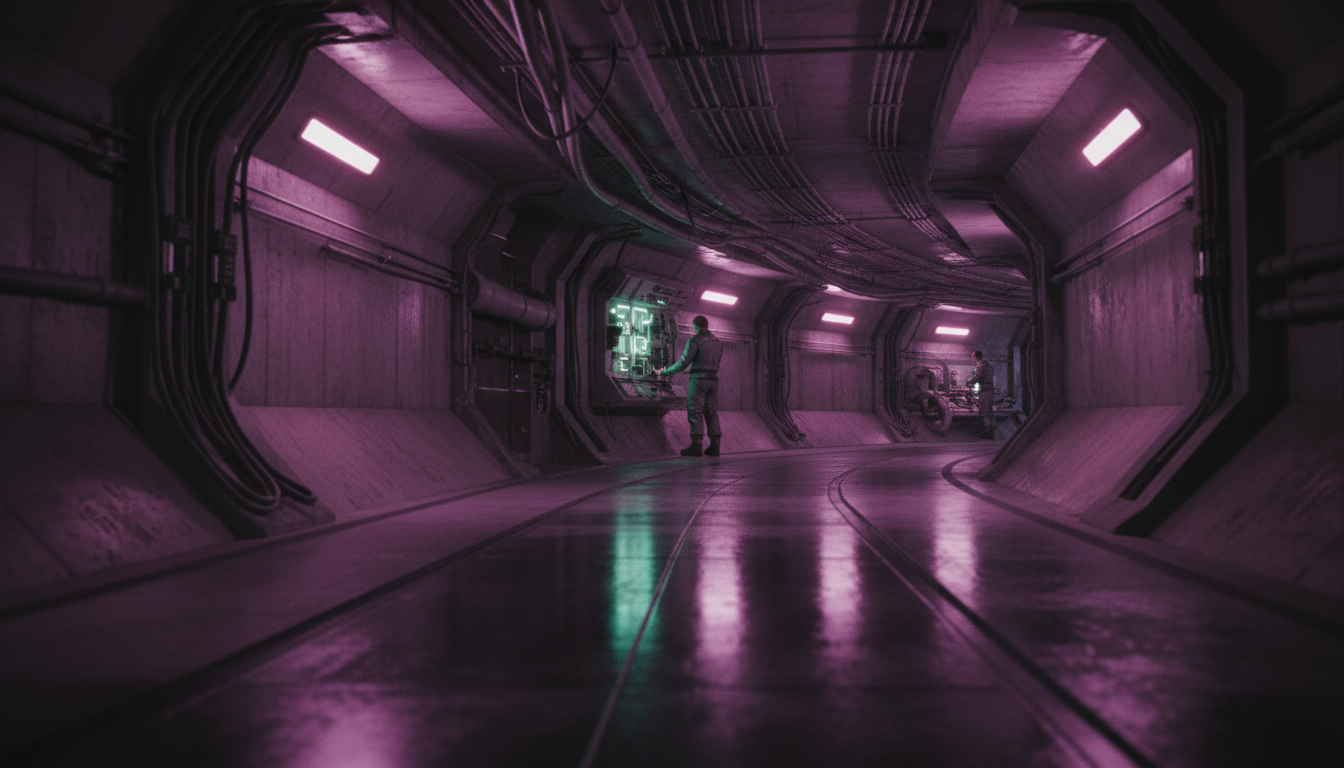
There were ten of us awake and nine of them wrote a constitution, and I have spent a hundred and forty years being asked about that sentence by people who want it to mean something it does not mean.
It means I was busy.
The first council met on the eleventh day out, in the long compartment off the forward transfer, which had been chosen because it was the only space aboard with enough seating that was not already full of something. I know the date because it is in the Bound Ledger and everybody knows it. I do not know what was said, because on the eleventh day out I was four miles aft with my head inside a manifold.
People find that hard to believe. They think there must have been a moment — a decision, a snub, a door closing. There was no moment. There was a rota, and I was on it, and the manifold was making a noise.
Let me tell you what the ship actually was, because the histories are very good on what was decided aboard it and very poor on what it was like to hold together.
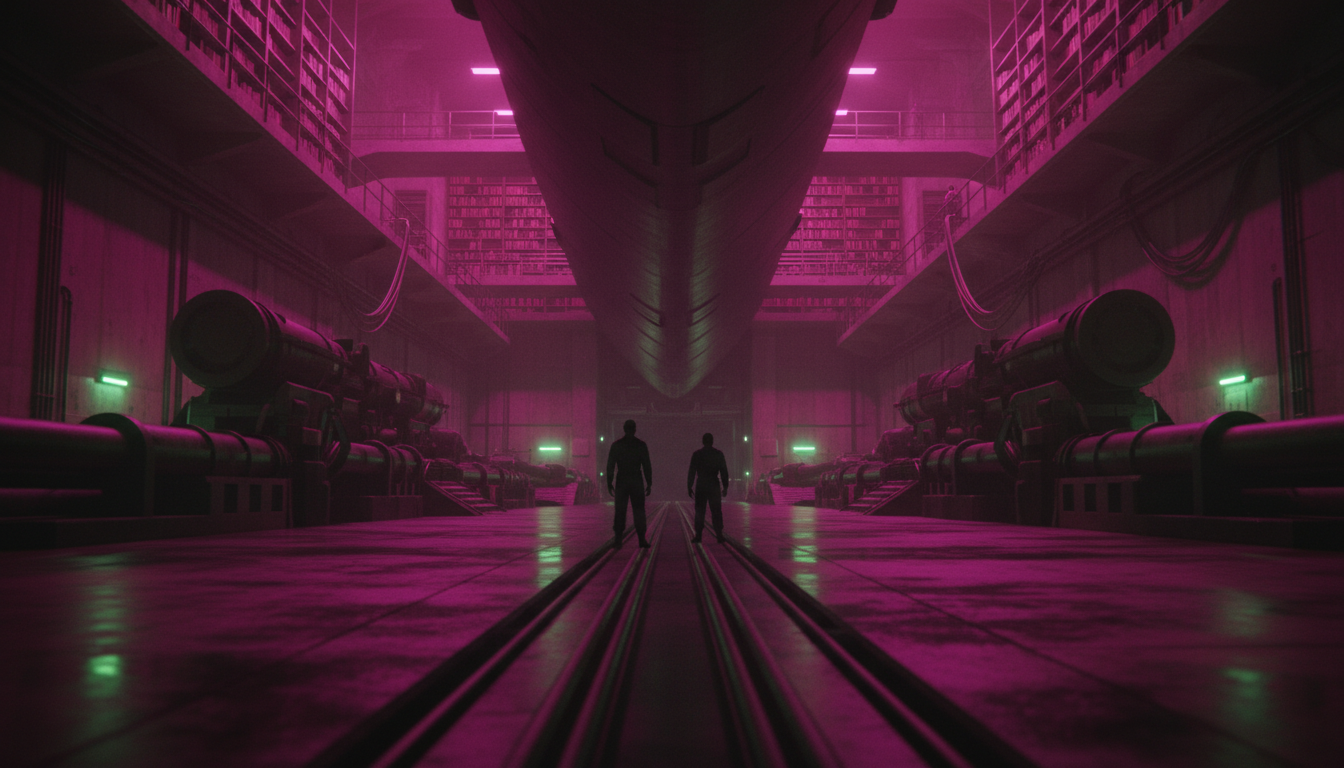
The Ark-Genesis was twenty miles long. That number gets said so often it has stopped landing, so here is what it meant in practice: if you started walking at the forward transfer at the beginning of a shift and did nothing else, you would not reach the aft plant before the shift ended. There were bicycles. There was a rail. Neither worked as well as walking for the middle third because of the way the racking was laid out, and the racking could not be changed, because inside it were four hundred thousand volumes.
Not files. Volumes. Physical books, on physical shelves, in a rack structure that ran nine miles of the hull's length — because the people who packed the ship had made one decision I have never once heard criticised, which was that a civilisation which loses its power for a year should not also lose its library.
And a hundred thousand sleepers.
That is the part I want understood before anything else in this account, because it governs everything I did for thirty-six years and everything I chose afterward. A hundred thousand people were in the racks, cold, and they could not be woken to help. Not should not. Could not. Waking one took eleven days on a bay that had to be prepared for forty hours beforehand, and there were four such bays, and the medical protocol allowed two concurrent. If the environmental plant failed catastrophically the correct response was not to wake anybody. It was to fix the plant.
Ten of us were awake to fix the plant.
That was the whole of the arithmetic. It was not a crew in any sense a sailor would recognise. It was ten people and a machine the size of a mountain range, and the machine had been designed by very good engineers to need almost nothing, and almost nothing across thirty-six years and twenty miles is a full-time job for ten.
My name then was Ilse Nakata. I put it down here because it is the last time it appears in this account and because it is correct to record what a person was called before somebody else named her.
I was thirty-one. I had spent nine years on orbital environmental systems and four on the salar itself, in the last eighteen months of the rail, and I had been chosen for one reason, which the selection board did not soften and which I have never resented: I was the best diagnostician they tested. Not the best engineer. There were better engineers in the sleepers — there were four hundred better engineers in the sleepers. I was the best at standing in front of a system that was misbehaving in a way nobody had described before and working out what it was actually doing.
You want that in the ten. You do not need it in the council.
The manifold on the eleventh day was a genuine fault and a boring one. A pressure differential in a secondary loop was reading four per cent high and had been for two days, and everybody else had looked at it and concluded instrumentation, and everybody else was wrong, and it took me nine hours to establish that it was wrong because a two-inch section of the loop had been installed rotated by ninety degrees in a yard on Earth by somebody who was probably very tired.
It was not going to fail. It was going to run four per cent high for thirty-six years and then be replaced by somebody on Aura-36 who would swear at whoever had fitted it.
I fixed it anyway. That is the job. The job is not keeping the ship alive, because the ship is extraordinarily hard to kill; the job is preventing the accumulation of four hundred small wrongnesses over thirty-six years, any one of which is nothing and all of which together are a hull nobody can maintain any more.
Halima came down to find me at the end of it, which she did not have to do.
"You missed a good one," she said. She had oil on her forearm and had plainly come straight from her own shift, which made me like her, and I went on liking her for a hundred and forty years and she has been dead for most of them.
"Was there a vote?"
"There were four votes. Three of them were about whether to have votes." She sat down on the decking with her back against the rack. "Nnamdi wants a written instrument. Ines wants a written instrument and a physical copy of it. Somebody — " and she did not say who, and I found out later — "suggested that the ten of us are not a legitimate body to write anything at all, on the grounds that there are a hundred thousand people aboard and ten of us are awake."
"That's a good objection."
"It's an excellent objection. It's also completely useless, because the alternative is that nobody writes anything for thirty-six years and the first thing a hundred thousand people do on arrival is invent government from nothing while standing in a field." Halima rubbed her eye with the back of her wrist. "So we're going to do it badly and publish everything, and hope that being honest about how badly is worth something later."
I said that sounded reasonable and that I had a filter bank to look at, and she said that I should come next time, and I said I would, and I did not.
I want to be precise about why, because I have heard my own reasons given back to me by three separate historians and none of them got it right.
It was not that I thought the constitution did not matter. I thought it mattered enormously. It was not modesty, and it was certainly not principle — I did not sit out the founding of a world as a protest, and anybody who says I did is being kind to me in a way I have not earned.
It was that the sessions ran four hours and I could not see what I would add to them, and there was always a manifold.
That is the entire truth and it is a very small truth for the size of the hole it made. Nine people spent four hours a week for thirty-six years arguing about what a person is owed, and got extremely good at it, and built a vocabulary between them that I never learned. I spent those hours four miles aft with my head inside things, and got extremely good at that, and by the twentieth year the nine of them could not fix a filter bank and I could not follow a clause.
Nobody planned that. It is nobody's fault. It is simply what a rota does to ten people over a long enough period, and it is the reason that when everything else happened, the thing I had to trade was not an argument.
I saw all of it. I want that on the record too, because it is the shape of my whole life and it starts here on the eleventh day. I had the run of the ship. I was in every compartment, at every hour, with legitimate reason, and I heard more of what was actually said aboard the Ark-Genesis than any of the nine, because people talk in corridors and they do not talk in minutes.
And there was never once, in thirty-six years, a single thing I could do with any of it.
That is not self-pity. I was not oppressed; I was employed. Nobody silenced me and nobody would have, and if I had walked into the long compartment on any of eleven hundred occasions they would have made room and been glad. The door was open the entire time.
I had a manifold.
On the eleventh day out I finished at the third hour of the sleep block, logged the rotated section with a note that it was not urgent, and walked four miles forward through nine miles of racked books with the running lights at their night setting, and passed the long compartment on my way to my own bunk.
The lights were still on in it. Somebody was still arguing.
I did not go in, and I did not particularly want to, and I have thought about that walk perhaps four thousand times since.
Chapter 2 — What He Called Her
↑ Back to ContentsFocus: a name given accurately, in a plant room, over a fault that turned out to be nothing.
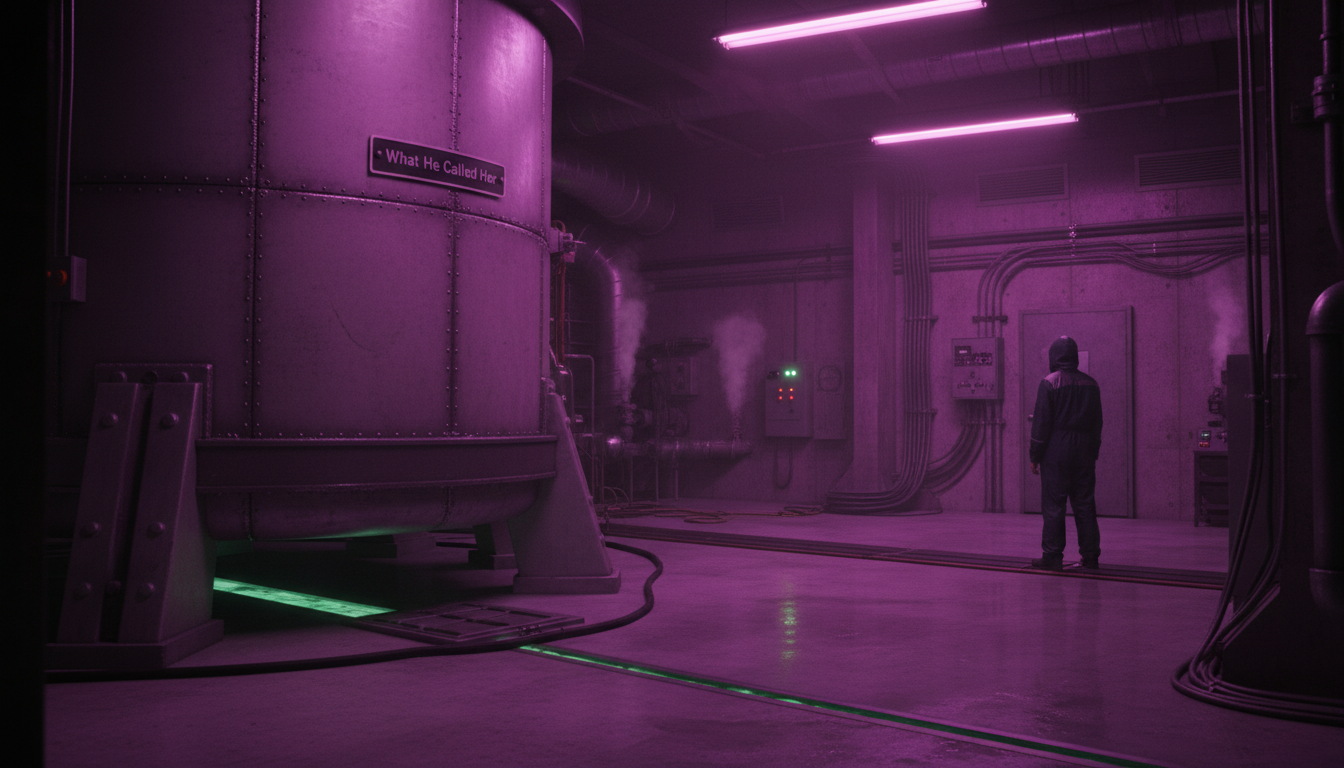
He called me Coda on a Tuesday, in a plant room, over a fault that turned out to be nothing.
I had not met him before. That surprises people, and it surprised me at the time — we were ten awake on one ship and I had been aboard four months — but twenty miles is twenty miles, and he kept to the forward third and I did not, and the ten of us saw each other in the way that people on opposite shifts in a large building see each other, which is to say occasionally and by accident.
The fault was in the aft secondary scrubber, which had thrown an alarm at the second hour and cleared itself by the time I got there, and I was doing what you do with a fault that clears itself, which is refusing to accept that it has.
He came in behind me and stood in the doorway for a while without saying anything, and I knew who it was without turning round, because there was only one person aboard who would stand in a doorway of mine and wait.
"It cleared," he said eventually.
"It did."
"But you're still here."
"It cleared in eleven seconds," I said. "A scrubber that has a real problem does not resolve it in eleven seconds, and a scrubber that has an instrumentation problem does not usually resolve it at all. So it did a third thing, and I would like to know what the third thing was."
He came and looked at the panel over my shoulder, and did not touch anything, which I noticed and appreciated more than I would have admitted.
I will not pretend I did not know what he was. Everybody aboard knew. He had built the rail, or rather he had been the one who said the salar was a launch rail and not a drydock, which is a sentence that reorganised eleven years of work and about forty thousand people's lives and is the only reason any of us were anywhere. He was not the captain, because there was no captain. He was not on the council, either, which people forget — he attended and he did not sit.
What I mostly knew about him was that he wrote everything down. That was his reputation on the salar and it followed him aboard: the man who documents. There was a story, probably true, that he had a file on every person in the ten and every person in the racks, and that the file was not secret and he would show it to you if you asked, and that nobody ever asked because of what asking would say about you.
We found the third thing at the fourth hour. It was a genuinely good fault — a differential sensor that was correct, reporting a condition that was real, caused by a door interlock nine compartments away that had been left in maintenance override by somebody four days earlier. The scrubber had not malfunctioned at all. It had noticed something true about the ship that nobody had asked it about.
I remember being pleased with it. I remember him being more pleased with it than I was, which annoyed me slightly, because it was my fault to be pleased with.
"How did you get there," he said.
"Eleven seconds is too long for noise and too short for a process," I said. "So it isn't the scrubber. It's the scrubber being right about something that stopped being true."
He was quiet for a moment. Then he said the thing.
"That's a coda," he said.
I said, "What?"
"In music. Everything's already been stated — all the material's there, the argument's finished, everybody's played their part. And then there's a passage at the end that doesn't introduce anything new. It just gathers what's already happened and tells you what it was." He was looking at the panel and not at me. "You didn't find anything new in that scrubber. Everything you used was already on the board and eight of us had looked at it. You just gathered it."
I want to be accurate about what happened next, because this is the moment my name changed and I have had a hundred and forty years to be honest about it.
I was flattered.
Not deeply. Not in a way that changed my opinion of him or made me his. I had been up nineteen hours and a man whose reputation ran ahead of him had described what I do in a way I had never managed to describe it, and it landed, and something in me sat up. That is all. It is a very ordinary thing to happen to a person and I have never been able to make it into anything grander.
I said something dismissive. I do not remember what.
He said, "Do you mind it?"
And I said no, because I did not.
There is a version of this account in which I say something back — ask what he would call himself, or refuse it, or make the obvious joke about who gets to hand out names on a ship with no captain. I did not. I said something dismissive and went back to the panel and closed the fault out, and he stayed another ten minutes and asked two more questions about the interlock and then went forward, and that was the entire meeting.
Four months aboard and it was the longest conversation I had had with anyone who was not on my own shift.
I have wondered since whether he came aft that night for the fault at all. He had no reason to. The scrubber was not his and a cleared alarm at the second hour is nobody's emergency, and there were eleven other places a man who could not sleep might have walked to. I do not think he came to look at me; I think he came to look at what I did, having read four months of my logs, because that is what he was and reading the logs would have been the natural first step. He would not have called that assessing somebody. He would have called it knowing what he had.
Either way he got what he came for inside four hours, and named it, and left.
Halima had it by the following shift. I do not know how — he did not go about telling people, he was not like that — but ten people on one ship is a village, and by the end of that week Nnamdi used it in a work order, and by the end of the month it was in the rota.
It went into the record without anybody deciding it should. That is the part that has always interested me. There was no moment where anybody said we shall call her Coda. Somebody wrote it on a work order because it was shorter, and somebody else copied the work order, and the Bound Ledger was transcribed from the work orders, and by the fourth year there was a physical volume in Ines Ferrer's handwriting in which the tenth member of the waking complement is listed as Coda and nothing else, and Ines had never once asked me whether that was all right.
I have been Coda for a hundred and thirty-nine years. There is no document anywhere that connects the two names except this one.
I did try, once, to put the other one back. It was in the fourteenth year and I was in a bad stretch, and I signed a maintenance record with my departure name, deliberately, to see what would happen.
Nothing happened. Nnamdi countersigned it without comment. The transcription into the Ledger reads Coda, because Ines transcribed from the rota rather than from signatures and the rota had never changed, and I looked at that entry for a long time and then did not do it again.
People assume it was intimate. It was not. We were not lovers and never became any, and I have said that in four different decades to four different people who wanted a different answer, and it remains true and dull. He named me the way you name a tool you have just found a use for — accurately, without much ceremony, and because having the right word for a thing made his work easier.
And I let him, because it was a good word, and because I was thirty-one and nineteen hours awake and it is genuinely pleasant to be seen clearly by somebody who is good at seeing.
Here is what I would tell you if you were about to be named by a man like that.
A name he gives you is a description of your function in his account of things. He was not wrong about me. That is the trouble with it. I am a coda — I gather what has already happened and say what it was, and I have done exactly that for a hundred and forty years, and I am doing it now, and every one of the thirty-two pieces of this account is that and nothing else. He identified in a plant room, over a scrubber, on a Tuesday, in about nine seconds, the shape of my entire remaining life.
He did not do it to me. I want that clear. He described what he saw, and it was accurate, and I liked it.
But a description that accurate, given by somebody with that much weight, at the start of thirty-six years in one hull, does not sit alongside you. It gets in front. Nobody aboard ever again had to work out what I was for, and neither, if I am honest, did I.
I finished the shift. I logged the override, and left a note for whoever had left the interlock, and the note was politer than I felt.
Then I went and slept for eleven hours, and when I woke up the rota had my new name on it, and I went to work.
Chapter 3 — In-Flight Maintenance
↑ Back to ContentsFocus: four hundred and eleven districts, nine miles of books, and a hundred thousand people who cannot be woken to help.
Here is the job, properly, because nobody has ever written it down and everybody who could has been dead for a century.
The hull was divided into four hundred and eleven maintenance districts. That number is not architectural — it does not correspond to bulkheads or decks or anything you could see. It was arrived at by a working group on Earth who took the total surface of everything that could fail and divided it by what one person could inspect in a shift, and then added eleven per cent because the working group had been doing this long enough to know what happens to estimates.
Ten of us. Four hundred and eleven districts. A full survey cycle took fourteen months and then began again, and in thirty-six years I completed thirty-one of them, and there is no thirty-second because of what happens in Chapter Sixteen.
A district took a shift if nothing was wrong. Nothing was wrong in perhaps three hundred and sixty of them per cycle. The remaining fifty were the job.
What people get wrong is the drama. They imagine alarms. There were alarms — there were four hundred and nine in thirty-six years, and I can tell you without checking that a hundred and ninety of them were the same six sensors going through their end-of-life behaviour on a predictable curve. An alarm means the ship has noticed. An alarm is easy.
The work was the things the ship could not notice.
A hull that size flexes. Not much — it was under no meaningful load for most of the crossing — but it breathes with the thermal cycle, and twenty miles of anything that breathes will, over years, walk. Brackets migrate. A conduit that was laid straight in a yard on Earth will, by year nine, have found a shape it prefers, and the shape it prefers puts a two-millimetre point load on a clamp that was rated for a distributed one. Nothing alarms. Nothing is out of tolerance. There is simply, somewhere in four hundred and eleven districts, a clamp that will fail in eleven years, and the only way to know is for somebody to be standing in front of it with a light and to have seen four thousand clamps that were fine.
That is what I was. I was somebody who had seen four thousand clamps that were fine.
You cannot teach it in a manual and I have watched three people try to learn it from me over the decades and none of them got there, and I do not think it is a talent. I think it is only ever accumulation. The first cycle I found eleven things. The ninth cycle I found forty-four, in the same hull, doing the same walk, and the hull had not got worse.
The racks were their own country.
Nine miles of the mid-hull was library. Four hundred thousand physical volumes in a structure that had been designed by somebody who understood books and somebody else who understood structures, and the two of them had clearly fought. The books were the single largest mass aboard that served no function during the crossing whatsoever, and there had been a proposal on Earth — it is in the record, it went to a vote — to cut them by three-quarters and print the rest to storage.
It failed by four votes. I have read the minutes. The winning argument was made by a woman nobody has heard of who pointed out that every generation which has ever destroyed a library has been extremely confident about what it was replacing it with.
So I inspected books. Not the books — the racking, the humidity, the four hundred small fans that kept air moving through the stacks so that nine miles of paper did not become nine miles of mould. Twice a cycle. It was the only part of the job I would have described as pleasant. The lighting in the stacks ran at a quarter and the fans made a sound like a long way off, and I would do a district and then sit down on the decking with my back against the shelving and read whatever was in front of my head for exactly eleven minutes, which was the discipline I set myself, and I kept to it for thirty-six years and read perhaps nine hundred books at eleven minutes a sitting, most of them badly out of order.
The eleven-minute rule came out of an incident in the fourth year that I have never told anybody about and which is not in any log.
I sat down in district two hundred and sixty-one with a volume of somebody's collected letters, and I read, and when I next looked at the clock I had been sitting on the decking for four hours and eleven minutes. Not asleep. Reading. I had missed the whole of the back half of a shift and nothing had happened, because nothing ever happened, and that was exactly the problem — there was no consequence, and there was not going to be one, and a job where the consequence of stopping arrives eleven years later is a job you can quietly stop doing without noticing.
So: eleven minutes, timed, once per district, and then up. I have kept a great many rules in my life and that is the only one I have never broken, including in the thirty-six years when there was nobody within two thousand kilometres to see me break it.
And then there were the sleepers.
A hundred thousand people in the racks and I was responsible for the environment they were in, which is a sentence I want to be precise about because it sounds heroic and is not.
I was not responsible for the sleepers. The bays were not maintainable in flight; that was a design decision taken very deliberately on Earth, because a system that a person can adjust is a system a person can adjust wrongly. Each bay was sealed, independently powered, and monitored by an instrument that reported one of three states, and the states were nominal, degraded, and lost, and there was no intervention available for any of them.
I was responsible for the plant that fed the bays. Power, thermal, the loops. If I did my job the bays got what they needed. If I did not, the instrument would tell me one of a hundred thousand people had gone from nominal to degraded, and I would be able to do precisely nothing about it, and eleven days later it would say lost.
Four times in thirty-six years an instrument reported degraded.
Three of them were the instrument. The fourth was in the nineteenth year and was real and I have never written down that man's name, and I am not going to now, because his family arrived on Aura-36 thirty-six years after they last saw him and were told he had not survived the crossing, and were not told that somebody was awake and four hundred metres away when it happened and spent eleven days watching a number.
It was not my fault. I have had a hundred and twenty years to establish that and I did establish it, and the review on arrival established it, and the bay had a manufacturing defect that predated the salar.
I sat outside it for the eleven days anyway. Not continuously — I had a rota. But I went, at the end of every shift, and sat on the decking with my back against the bay housing, and there was no window and nothing to see and no procedure and nothing whatsoever that a person of my skill could contribute, and I went every day until the instrument changed.
That is the job. That is the whole of the job, and the reason I have set it out at this length is that everything that happens later in this account is a consequence of my being good at it.
I was chosen for it. I want to be exact: I was not chosen as a founder, or a representative, or a voice. Nine people were chosen partly for judgement, and one was chosen because a selection board in Bolivia put four hundred candidates in front of systems that were misbehaving in undocumented ways and I was fastest and most often right.
That is the only reason I was aboard. It is not a complaint. It is the correct reason to put a person on a ship like that, and if I had been running the board I would have chosen the same way.
But it means that when the ten of us settled into thirty-six years, the nine of them were doing something that got more valuable the longer they did it together, and I was doing something that got more valuable the longer I did it alone.
There is a document from the fourth year that I still think is the single most useful thing anybody aboard produced, and it was not the Accord.
It was a two-page procedure Nnamdi wrote for what the remaining nine should do if the tenth died. It was not morbid; it was arithmetic. Nine people who cannot walk the aft districts is a ship that accumulates four hundred small wrongnesses, and Nnamdi had worked out that the honest answer was to wake somebody, and had gone and found which somebody — a woman in bay eleven thousand and something who had run the environmental balance on an orbital yard for nine years — and had written her rack number into the procedure and published it.
I read it the day it went up. It did not upset me in the slightest. It is the only document in the entire founding record that treats me as load-bearing, and it was written by a man planning for my death, and I have thought about that more than is reasonable.
By the eleventh year, nobody else went aft of district two hundred.
There was no reason for them to. It was mine, I was better at it than any of them would ever be, and every hour one of them spent walking my districts was an hour not spent on theirs. It was efficient. It was correct. Halima raised it once, in about year fourteen, and asked whether I minded being down there on my own, and I said the honest thing, which was that I preferred it.
I did prefer it. That is not the part I would change.
What I would change is that nobody, including me, ever once asked what it would do to a person to be the only one who knew the shape of the whole ship, in a complement of ten, for thirty-six years, and to have said out loud in year fourteen that she preferred it.
Chapter 4 — The Nine Others
↑ Back to ContentsFocus: the rest of the ten as colleagues on a long rota, not as founders.

They have statues now. Two of them do, anyway, and a third has a building, and I have stood in front of all three and felt nothing I could report to anybody.
Let me give you them as they were, which is to say as colleagues on a long rota.
Nnamdi Okonjo was a structural engineer who talked too much and knew it and had built a whole personality around getting there first so that nobody else had to sit through him arriving. He was the one who wrote the procedure for what to do if I died. He was also the one who, in the ninth year, spent four months trying to teach himself my job out of sheer discomfort at the fact that only one person could do it, and got about a third of the way and then admitted defeat in front of everybody, publicly, in a session, which cost him something and which he did anyway.
He is remembered as the principal drafter of the Accord. That is accurate and it is not the interesting thing about him. The interesting thing about him is that he could not stand a single point of failure and spent thirty-six years being one of nine.
Ines Ferrer did not trust storage she could not see.
That sentence has been quoted at me my whole life as though it were a philosophy. It was not. It was a woman who had lost eleven years of survey data on Earth to a migration that was signed off by four people and went wrong anyway, and who had decided, in a very ordinary way, that she was not going to be in that position again. The Bound Ledger exists because Ines Ferrer was once let down by an IT department.
She transcribed by hand. Every session, every clause, every vote. It took her longer than the session had taken and she did it in the sleep block, alone, in the long compartment, with a lamp. I used to pass on my way forward and see her at it.
I thought it was sentimental. I want that on the record because I was wrong and the wrongness is instructive: I was the ship's expert in the accumulation of small failures over long periods, and I looked at a woman making a physical copy of the only constitution a hundred thousand sleeping people had, against a thirty-six-year crossing in a radiation environment, and I thought that is a lovely gesture.
She was doing my job. She was doing exactly my job, on a different substrate, and I did not recognise it for nineteen years.
Halima Sow was the best of us and is the least written about, and those two facts are the same fact.
She was a physician with no patients. A hundred thousand people in bays she could not open and nine colleagues who were, by selection, the healthiest people alive; her actual medical workload across thirty-six years was four broken fingers, a great deal of back trouble, one appendix, and me. What she did instead was talk to people. She had worked out inside the first year that ten people in one hull for thirty-six years was a psychiatric problem wearing an engineering hat, and she ran, without ever calling it anything, a continuous unminuted programme of walking down to wherever you were and sitting on the decking with you.
She came four miles aft to find me on the eleventh day. She was still doing it in the thirty-first year. There is not one word about it in the Bound Ledger, because Ines transcribed the sessions and Halima's whole life's work aboard that ship happened in corridors.
Then the six.
I am going to name them, because somebody should, and then I am going to be honest about what I can and cannot tell you.
Tomas Brandt. Power systems. Careful, slow, right. He and I disagreed once, in the twenty-second year, about a load-shedding order, and he was correct and I was loud, and he waited three days and then showed me why in a way that let me change my mind in private.
Aiyana Roux. Propulsion, which meant that after the fourth month she had almost nothing to do and spent thirty-five years being extremely good at whatever anybody handed her. She learned four languages off the racks. She is minuted more than she is remembered.
Sergei Duhamel. Environmental, my nearest counterpart, and the only one of the ten who could have walked my districts if he had wanted to. He did not want to. We were friendly and never friends and I do not know why, and there was no falling out, and I think about him more than I think about several people I liked better.
Miriam Achebe. Agronomy and the seed vault. The person whose work mattered most on arrival and least during the crossing, which she said herself, cheerfully, at least once a year.
Dov Lindqvist. Communications, which meant Earth, which meant that his job got quieter every single day for thirty-six years by a fixed and calculable amount. In the first year we had conversation. By the ninth it was messages with a turnaround measured in days. By the twentieth it was archive: things sent to us by people who knew we would receive them long after the sending, and who wrote accordingly. Dov read every one. He was the only person aboard whose workload was a countdown.
Renata Oyelaran. Law, before there was any. She is the one who asked, on the eleventh day, whether ten people were a legitimate body to write anything at all. Halima told me about it that night on the decking and did not say the name, and I found out four years later that it had been Renata, and by then I had had four years of assuming it was somebody more difficult.
Two things about that list that I have never been able to put anywhere else.
The first is that Dov Lindqvist received the last message from Earth in the twenty-ninth year and did not tell anybody for four days. It was not an important message. It was a routine acknowledgement from a relay station, and there was nothing in it, and there was nothing after it, and he sat with the fact that his entire function had just ended for four days before he brought it to a session. I only know because he came aft afterward, which he had never done before and never did again, and stood in my district and asked me how I coped with a job nobody could check. I said I did not know that I did. He said that was helpful, which it plainly was not, and went forward.
The second is that Miriam Achebe kept a garden. Not a crop trial — those were her actual work, four bays of them, meticulous. A garden: eleven pots in a service alcove off district eighty-one, entirely undocumented, using water she accounted for honestly and light she did not. She showed it to me in the sixteenth year with the specific nervousness of somebody confessing, and I understood immediately that she had been waiting for years to show it to the one person aboard who walked past it regularly and had never once mentioned it.
I had never noticed it. I had walked that alcove eleven times a cycle for sixteen years and never once looked left.
That is the ten, less me.
Here is the honest part. I have described nine people and I have given you six sentences each about three of them and one anecdote each about the rest, and that is not because the other six were less interesting. It is because I was four miles aft.
The three I can write about properly are the three who came to find me. Nnamdi came aft because he could not bear a single point of failure. Ines I passed on my way forward, night after night, for nineteen years. Halima came because coming was what she did.
The other six were exactly as vivid, and I did not get them, and there is no way to go back and get them now.
People assume, when they hear that the tenth did not attend, that I must have known them all extremely well — the outsider who sees clearly, the one at the edge of the room who notices what the room does not. That is a nice idea and it is the wrong way round. The person at the edge of the room does not see more. She sees the edge.
I heard more than any of them, and I knew fewer of them than any of them, and both of those are consequences of the same rota, and nobody designed either.
She asked me not to log it. I said there was nothing to log, which was true, and which was also the first time in my life I had agreed to keep something out of a record, and it was eleven pots of beans.
They wrote a constitution that has held for a hundred and forty years and has been amended eleven times and never once broken. It is a genuinely good document. I have read it more carefully than most of the people who lived under it, because I had thirty-six years and then a hundred more and very little else to do.
I did not write a word of it. I was not excluded from writing a word of it.
Those two sentences have to sit next to each other and neither one is allowed to soften the other, and if you can hold them both at once you understand this entire account and I can more or less stop here.
Chapter 5 — He Tells Her About the Serum
↑ Back to ContentsFocus: ninety seconds in a corridor, four years after she worked it out on her own.
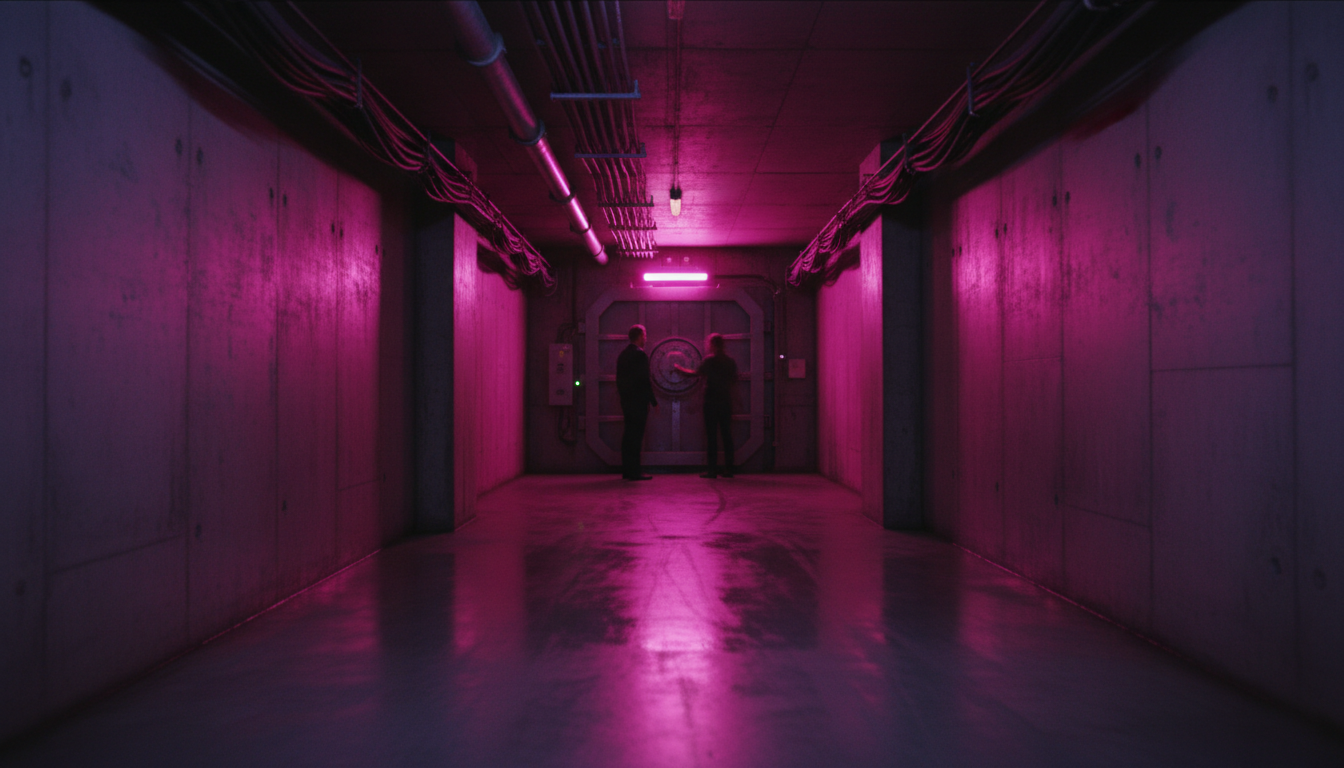
He told me in a corridor, standing up, in about ninety seconds, between two other things he was doing.
It was the eighteenth year. I had noticed in the fourteenth.
I want to establish the noticing first, because the noticing is mine and the telling was his, and of the two the noticing is the one I am prepared to take credit for.
It was not a moment of insight. There was no morning where I looked at him across a compartment and thought that man is not getting older. What there was, over about eighteen months, was an accumulation of the same kind of thing I had spent my life accumulating: a set of small observations, none of which meant anything, which together described a condition.
He did not favour anything. That was the first one. Everybody aboard by the fourteenth year favoured something — a knee, a shoulder, a wrist — because we were between forty and sixty years old and living in low gravity and doing physical work, and the body keeps a ledger. Nnamdi came down ladders on one leg. Halima had a shoulder she did not talk about. I had a lower back that had opinions about the aft districts. He came down ladders like a person who had never had a reason not to.
He did not adjust his working distance. In the fourth year he read a panel at arm's length. In the fourteenth year he read the same panel at the same distance, and I know that because I was standing behind him both times, eleven years apart, in the same plant room, and I have that kind of memory and it is the reason I was chosen.
His handwriting had not changed. Ines had eleven years of his margin notes in the Ledger and they were identical.
And he had stopped taking the physicals.
That last one was the only one that was actually evidence, and it was evidence of nothing on its own, because he had a documented and perfectly reasonable objection to Halima's annual programme on the grounds that ten people with nothing wrong with them do not need to generate data. Four of us had opted out at various points. It only meant something next to the other three.
So by the fourteenth year I had it, and I did nothing with it for four years.
That is the part people do not believe. They want me to have confronted him, or told Halima, or written it down. I did none of those. I was thirty-one when I came aboard and I was forty-nine by then and I had a job, and the job did not have a clause about what to do when you work out something about a colleague. I made a private note of it in the way you note a clamp that will fail in eleven years. It was not urgent. Nothing about it was going to change before we arrived.
I have wondered whether the four years of silence were what he was waiting for.
He told me on a walk between district ninety and district ninety-four, coming the other way with a tablet in his hand, and he stopped, which he did not usually do.
"You've worked it out," he said.
I said, "Which part."
"That's an answer," he said. "You've worked it out."
I put my light down on the decking, because I could tell it was going to be a conversation and I did not want to be holding anything.
"You're not ageing," I said. "You have not aged since the fourth year that I can measure, and I would put the start earlier than that but I did not know you before the fourth year well enough to say."
"Earlier," he said. "Considerably."
"All right."
And then he told me. Ninety seconds. It was a cellular therapy, it was his own work, it predated the salar, it had been developed for reasons that had nothing to do with the ship, it was not a single treatment but a maintained state, and there were four people alive at that time who had it and he was one of them.
He did not ask me to keep it. He did not swear me to anything. He did not explain why he was telling me and he did not apologise for not having told me sooner.
What he said, at the end, was: "You'd have had it inside two more years and then you'd have had to decide what to do about finding out on your own. This is cleaner."
I asked him one more thing before he went forward, and it is the only question from that corridor that I would ask again.
"Do the other eight know?"
"No."
"Will they?"
He thought about that for longer than he had thought about anything else in the conversation, which told me more than the answer did.
"Eventually somebody else will notice," he said. "It will not be for a long time. Nnamdi is not observant in that direction and Halima has decided years ago that I am simply lucky, and once a person has an explanation they stop collecting evidence." He turned the tablet over in his hand. "You are the only one aboard who collects evidence for its own sake. That is not a compliment, it is a job description, and it is why we are having this conversation eleven years before I would have chosen to have it with anybody."
I said that sounded like he was annoyed about it.
"I am mildly annoyed about it," he agreed. "It is not your fault. It is what you are for."
That is the closest thing to affection I got out of him in thirty-six years and I have quoted it to exactly two people.
I have turned that sentence over for a hundred and twenty years.
It is not a confidence. A confidence is something you give to somebody because of who they are to you. That is a maintenance action.
He had a system — a ship, a complement, a thirty-six-year crossing — and in that system there was one component with a known property, which was that it noticed things, and the property was going to produce an outcome he could not control at a time he could not choose. So he chose the time. He did not tell me because he trusted me. He told me because I was going to find out, and being told is a smaller event than finding out, and he preferred the smaller event.
I want to be very clear that this is not a complaint about his character, and that I would probably have done the same, and that in his position it was the correct call.
But it is not trust, and I have spent a great deal of my life listening to people describe it as trust, including — and this is the part that still gets me — including him, twice, decades later, in front of other people. He came genuinely to believe he had confided in me. I do not think he was lying. I think that by the time it mattered, the version where he told the observant engineer because she was going to notice had become the version where he told the one person aboard he could tell, and the second version is warmer and does the same work in an account of yourself.
I never corrected him. I could have, once, in a room with eleven people in it in the fifty-first year, and I chose not to, and I have no good reason for that except that it would have been unkind and I would have had to explain what I meant for about four minutes.
What did I feel, standing in a corridor at forty-nine with my light on the decking?
Not awe. I want that recorded because every retelling gives me awe and I did not have any. He had told me a technical fact about a biological system and I received it as a technical fact about a biological system, and my first three questions were about maintenance intervals, and he answered two of them and said the third was not something he was going to get into standing up.
What I felt, mostly, was tidiness. A four-year-old open item in my head had been closed. I had been carrying a thing that did not resolve and now it resolved, and I am the kind of person for whom that is a genuine physical relief, and I am aware of how that sounds.
And underneath it, small and quiet and not examined for another four years: he had come to me because of what I was for.
Nobody had done that in eighteen years. Nnamdi came aft because he could not bear a single point of failure. Halima came because coming was what she did. Miriam showed me eleven pots of beans because I walked past them.
He was the only person aboard that ship who ever sought me out because of the thing I was actually good at, and he did it to manage a risk, and I did not care.
I did not write it down anywhere. Not that night, not that year. The first written record of any of it is this account, made more than a century later by a woman with nothing else to do, and every historian who has ever worked on the period has had to take my word for a conversation with no witnesses that neither participant logged.
I picked my light back up and finished district ninety-four and it was clean, and I logged it clean, and that is the whole of the entry for that day.
Chapter 6 — She Leaves to Think
↑ Back to ContentsFocus: eleven weeks of working normally while carrying it, and what it actually felt like.
I went back to work. That is the entire chapter and I am going to spend it explaining why that is the interesting thing rather than the dull one.
Eleven weeks. From the corridor in district ninety-two to the evening I have not got to yet, eleven weeks, and in those eleven weeks I completed one full survey rotation, closed forty-one findings, replaced a fan bank in the stacks, wrote up the annual thermal drift report, and told nobody anything.
People expect the withholding to have been effortful. It was not. Not for one hour of eleven weeks.
I have thought hard about why, because the obvious explanations are all wrong. It was not loyalty; I did not owe him anything and had not been asked. It was not fear. It was not that I was protecting the mission, which is the version a certain kind of historian likes, and which flatters everybody including me.
It was that there was nothing to do with it.
Consider what I actually held. A colleague had a medical condition, self-induced, stable, harmless to the ship, disclosed voluntarily, affecting no system I was responsible for. Strip the word immortality off it and look at the shape: it is a personal health matter about a man who is not my patient, on a vessel where I am responsible for manifolds.
Who is the recipient? Halima, whose physicals he had already declined and who would have had no power to compel anything? A session of nine people who would have debated it for four hours and produced a minute? Earth, on a twenty-day turnaround, to be read by an institution that no longer had any authority over us and would in nine years stop replying altogether?
There was no lever. I have described the ship as twenty miles long and it is more useful to describe it as an environment with almost no levers in it. You could fix things. You could not make anything happen.
So it sat in me the way the four-year noticing had sat in me, which is to say the way a clamp that will fail in eleven years sits in me. Logged. Not urgent. Nothing to do before arrival.
And the thing I need you to understand, which is the whole point of this chapter, is that it did not make me feel powerful.
I have read four accounts of my own life. Two of them are affectionate and two are not, and all four have a version of this passage in which the tenth member of the complement is the woman who knows the secret — walking those corridors with something enormous in her pocket, weighing it, choosing. There is a painting. I have seen the painting. In the painting I am looking at him across a compartment with an expression of tremendous interior knowledge and I am wearing a coat I never owned.
It made me feel employed.
That is the exact word and I have never improved on it. I had been given a piece of information for operational reasons by a man managing a risk, and I had received it, and now I held it, and holding it was a task. It was not a burden and it was not an asset. It was a line item.
There is a particular flatness that comes over a person who is very good at a job that nobody can check, over a long enough period, and I did not have a name for it then. Everything arrives as work. A fault arrives as work. A book arrives as eleven minutes. A man tells you he has defeated death in a corridor and it arrives as an item on the list, and you close it out, and the list is the same length in the morning because the list is always the same length.
I did notice one thing in the eleven weeks and it is the only thing that changed.
I started doing the arithmetic.
Not deliberately — I would be at a panel with my hands busy and the front of my head unoccupied, which is most of the job, and it would just be running. Eighteen years down. Eighteen to go. I was forty-nine. I would be sixty-seven on arrival, which had always been true and which I had known since Bolivia and had never once found alarming, because sixty-seven on a new world with a hundred thousand people and everything to build is not a bad number.
But I had never before had a comparison in the room.
That is what he actually gave me in that corridor, and I do not think he intended it, and I am not sure he was capable of seeing it. He did not give me a secret. He gave me a person, standing four compartments away, for whom the number eighteen meant nothing at all.
Once that is in a room it does not leave. It is not envy. I want to be careful, because envy is easy and would make me easier to write about. I did not want what he had. In the eleventh week I could not have told you that I wanted it and I would have said so honestly if asked.
What I had instead was a new axis. Every fact about my life that I had held comfortably for eighteen years now had a second reading. I will be sixty-seven on arrival had always meant and then the work begins. It now also meant and he will not be.
Both readings were true. I went on holding the first one. The second one simply existed, underneath, the way the grid hum existed underneath everything on that ship — not audible, exactly. Present.
There was one practical consequence, and it is the only thing from those eleven weeks that shows up in any record anywhere.
I changed the thermal drift report.
It was an annual document, four pages, projecting the accumulated dimensional creep of the hull structure forward against the remaining crossing. I had written seventeen of them. They all projected to arrival, because arrival was the end of the problem — on Aura-36 the hull becomes somebody else's, or scrap, or a monument, and either way it stops being a maintenance question.
That year I projected it to a hundred years.
There was no reason to. Nobody asked for it and nobody read past page two of a thermal drift report in the entire history of the ship. I did it because I was sitting at the terminal with the model open and I found that I wanted to see the number, and the number was that the structure was good for about four hundred years and would have been good for eleven hundred if the yard had not rotated that section of secondary loop.
I filed it with the extra projection in. Nobody commented. Ines transcribed the summary line into the Ledger, which was the practice, and the summary line said within tolerance, which it was.
It is the only thing I did in eleven weeks that I could not have justified if asked, and I have known for a hundred years what it was. It was the first time in eighteen years I had modelled anything past the arrival, and I did it four weeks after a man in a corridor told me he intended to be there for it.
I did my job perfectly well. I want that in the record because it is the answer to a question people have asked me for a century: no, it did not distract me, and no, I did not brood, and the forty-one findings I closed in those eleven weeks were closed properly and two of them were good.
Halima came aft in the seventh week and sat on the decking and asked how I was, the way she did.
I said I was fine, which was true.
She said I seemed a bit far away, and I said I was always a bit far away, that being the nature of district three hundred and eight, and she laughed and let it go.
That was the moment. If there was one, that was it. A physician with no patients whose entire life's work was walking down to wherever you were, sitting on the decking beside me in the seventh week of eleven, asking the correct question in the correct tone, with nothing else on her rota.
I could have told her in four sentences and she would have known exactly what to do with it, because she always did.
I said I was fine. She stayed another twenty minutes and we talked about a book I had read eleven minutes of, and then she went forward, and I went back to the panel.
It was not a decision. That is what I have never been able to convey. There was no moment in which I weighed telling her against not telling her and chose. She asked, and I gave the answer I had given to that question for eighteen years, and it went past.
I have kept a copy of that report. It is the only document from the crossing that I took with me, out of thirty-one survey cycles and something over eleven thousand closed findings, and I could not have told you why at the time, and I am not certain I can now. It is four pages about the dimensional creep of a structure that no longer exists, filed by a woman who had eighteen years left to serve and had just started measuring in centuries.
Eleven weeks is a long time to carry something without once being asked a question you cannot answer smoothly.
And then, in the eleventh week, somebody asked one.
Chapter 7 — Fourteen Months
↑ Back to ContentsFocus: a survey cycle, an unchanging hull, and the realisation that the approach cannot be perceived.

A full survey cycle was fourteen months, and the thing nobody tells you about a fourteen-month cycle is that after the fourth one your life stops having years in it.
It has cycles. And a cycle is not a year, so it does not line up with anything — not with the Earth calendar we nominally kept, not with the session schedule, not with anybody else's rota. My eleventh cycle began in the middle of Nnamdi's fourth term as chair and ended somewhere in his fifth, and if you had asked me in the twenty-second year what year it was I would have had to work it out, and if you had asked me what district I was in I would have told you instantly.
District two hundred and six. Every fourteen months, district two hundred and six.
I have tried to explain this to people who have lived on planets and it does not go across. They think I mean boredom. It is not boredom — boredom is a state you can be in for an afternoon and then stop being in. This is structural. A planet gives you seasons whether you want them or not; the light changes, and the changed light tells you that you are not where you were. There was no light on that ship except the light we ran, and we ran it on a thirty-six-year schedule that did not vary by one lumen, deliberately, because varying it would have been an unnecessary system.
So there was nothing outside me that changed. Not one thing.
The hull did not change. That was my job — the entire purpose of four hundred and eleven districts was to ensure that the hull in year thirty was indistinguishable from the hull in year four, and I was superb at it, and I achieved it. The greatest professional accomplishment of my life is that nothing happened.
The sleepers did not change. A hundred thousand people held at a temperature, in bays that reported one of three states, and for thirty-six years the answer was nominal a hundred thousand times minus one. I walked past them at the same pace on the same rotation and they were doing, precisely, nothing, and they had been doing precisely nothing since Bolivia and would do it until somebody else woke them up.
The corridors did not change. The library did not change — nine miles of books, and I read eleven minutes at a time, and there were four hundred thousand of them, and at eleven minutes a district I was going to be dead long before the racks noticed I had been through.
The nine did not change in any way I could see from four miles aft. They aged; I could see that in the ladders and the shoulders. But the sessions went on at the same hour with the same nine people producing the same volume of clauses, and Ines transcribed them, and the Ledger got thicker at a rate you could have set a clock by.
I changed.
That is the whole of this chapter and it took me about four cycles to notice and about eleven to accept.
Here is how I noticed. In the fifteenth cycle I was in district two hundred and six — the same district, the same conduit run, the same fourteen-month appointment — and I found a bracket that had walked. It was a good find, a real one, the kind of thing that only comes from having seen the same bracket fourteen times.
And I stood there with my light on it and could not remember the fourteenth time.
Not vaguely. At all. I had a log entry in my own hand from fourteen months earlier describing that bracket as within tolerance, and I believed the log entry, and I had no memory of the shift, the walk, the district, or anything else about the whole of that rotation. It had happened. I had done it. It was gone.
And I understood, standing there, that this was going to be true of most of it. That thirty-six years of doing the same superb work on the same unchanging object was not going to leave thirty-six years of memory behind it. It was going to leave a shape, and about eleven weeks of actual recollection, and a very large number of log entries in my own handwriting that I would have to take on trust.
I went and checked. That is the reflex, and it is the only reason I am able to describe any of this instead of merely having suffered it.
I pulled my own logs for the whole of the fourteenth cycle and read them end to end, four hundred and eleven entries, in one sitting that ran nine hours and put me badly out on my sleep. They were good logs. They were careful, complete, properly cross-referenced, and in three places quietly funny, and the person who wrote them was plainly attentive and in reasonable spirits throughout.
I could not remember writing one of them.
Not one, out of four hundred and eleven, across fourteen months. There were four entries where I recognised the finding once I read the description — and I want to be exact, because it matters: I recognised the finding. A cracked bracket in district three hundred and one is a distinct object and I know it the way I know a face. What I could not retrieve was any of the surrounding fourteen months. The finding was in my head with nothing round it, like a photograph with no album.
So I did the arithmetic, because that is also the reflex, and it came out at somewhere between eleven and fourteen weeks of retrievable experience per cycle. Call it a fifth. Four-fifths of every fourteen months had been lived properly, at full attention, by a competent woman doing skilled work, and had then simply not been kept.
Thirty-six years at a fifth is about seven years. That is what I was going to arrive with, out of the best part of an adult life, and I sat in front of that number for a while and then closed the terminal and went and slept badly, and did not mention it to Halima in the morning when she asked how the cycle had gone, because the honest answer would have taken an hour and I did not have the words for it yet and would not have them for another eleven years.
This is the moment I stopped thinking of the crossing as a voyage.
A voyage has an end you travel toward. What I had was a condition. The arrival was thirty-six years away in year one and it was eighteen years away in year eighteen, and both of those are true statements and neither of them felt like anything, because the distance was not doing what distance does. Nothing got closer. There was no coastline. There was a number in a system that went down at a fixed rate and had gone down at that rate every single day since Bolivia and would keep going down whether I existed or not.
I could not experience the approach. That is the sentence I have never been able to make people feel. I knew, factually, that we were nearer. There was no faculty in me that could perceive it.
The nine handled it better and I have thought a lot about why. It is because they had a project. A constitution is a thing that visibly accumulates — Ines's Ledger got thicker, clauses got settled, arguments got won. They could look back over a cycle and see that something had been built that had not existed before, and that is the whole of what a person needs.
My work, done perfectly, produced no accumulation whatsoever. It produced the absence of accumulation. That was the point of it.
I want to be careful not to make this sound like despair, because it was not, and I was not depressed, and Halima — who would have spotted it, who was very good — would tell you the same. I ate, I slept eleven hours, I worked, I read eleven minutes at a time, I closed forty findings a cycle. If you had put me in front of the selection board again in the twenty-fifth year they would have taken me again.
What happened was quieter than despair and worse to describe. Somewhere around the fifteenth cycle I stopped expecting anything to be different, and once you stop expecting that, the mechanism that notices the passage of time has nothing left to do, and it goes quiet.
Then a man tells you in a corridor that he has arranged to be exempt from all of it.
I have said already that the eleven weeks did not make me feel powerful. Here is what they did instead, and it took me the whole eleven weeks and I did not have the sentence until much later.
He had not bought more life. Anybody can want more life; that is ordinary and I have never been much interested in it. What he had bought — what the corridor actually told me — was that for him the crossing had a shape. Thirty-six years was a section of something. It had a before and it had an after and both were his.
For me it was not a section. It was the whole thing, and I was in the middle of it, and I could not perceive the approach, and I was going to arrive at sixty-seven having spent half my adult life keeping an object identical to itself.
I went back to district two hundred and six in the sixteenth cycle and I logged the bracket, and I remember that one.
I remember it because it was the first shift in eleven cycles where I was angry, and anger, it turns out, is extremely good for the memory.
Chapter 8 — The Detonation
↑ Back to ContentsFocus: six minutes in the long compartment, and the one thing nobody aboard had written a clause for.

It happened in the long compartment, in front of six people, at the end of a session I had not attended and had walked into by accident, and I have never once been able to describe it as anything other than what it was, which is that I lost my temper.
Not snapped. Not made a stand. I went off, completely, at a volume that brought Sergei in from the transfer corridor, and I said things in an order I could not reconstruct afterwards, and it lasted somewhere between four and six minutes.
The trigger was nothing. I want that understood before anything else. The trigger was a rota.
I had come forward to raise a scheduling problem: the fan-bank replacement in the stacks needed a second pair of hands for about nine hours, and I wanted somebody assigned, and I had been putting off asking for two cycles because asking meant somebody coming aft into districts that had been mine for eleven years. The session was breaking up. Nnamdi was still at the table. Ines had her book open. He was standing by the far bulkhead with a tablet, not sitting, the way he never sat.
Nnamdi said, entirely reasonably, that it would have to wait for the next cycle because the four of them were committed to the ratification schedule.
And I said: "Of course you are."
I heard my own voice do it. There is a particular flatness that arrives just before, where you hear yourself from slightly outside and you know exactly what is about to happen and you are interested rather than alarmed.
What came out over the next several minutes, as best I have ever been able to assemble it, was this.
That the nine of them had spent eighteen years building something that got better every time they touched it, and I had spent eighteen years keeping an object identical to itself, and that we had all agreed to call those the same contribution and they were not the same contribution.
That I could not remember four-fifths of it. That I had the logs to prove I had lived it and no access to any of it, and that this was going to be true of the remaining eighteen as well, and that I had done the arithmetic and I was going to arrive at sixty-seven with about seven years of retrievable life to show for the whole crossing.
That nobody had asked me anything in eleven years. That the aft districts had become mine by a process nobody chose and everybody found convenient, and that I had said in year fourteen that I preferred it, and that I had been asked exactly once, by Halima, and had answered honestly at the time and the answer had gone into the record and had never been revisited.
That there was a man in this compartment who was not going to be sixty-seven on arrival or sixty-seven ever, and that everybody in the room either knew it or had decided not to notice.
I did not say what he had told me. I want to be precise about that, because it is the only thing I got right in those six minutes. I did not disclose the serum. I said a man in this compartment and I said not going to be sixty-seven and I did not say why or how, and to this day I do not know whether the six people in that room understood what I was referring to or thought I was being cruel about something else.
He knew. He was looking at the deck.
And then I said the thing.
"I want to go home."
The compartment went the specific kind of quiet that a room goes when somebody has said something the room has no procedure for.
Because that is what it was. Not shocking — nobody was shocked, these were not delicate people and Ines had heard worse in a survey camp. It was unprocessable. There was no clause. In eighteen years of the most careful constitutional work ever done by ten people, across four hundred pages of a hand-transcribed Ledger covering the rights of the sleeping, the duties of the waking, the succession of the chair, the disposal of the dead and the arbitration of disputes about water, nobody had written a single line about a member of the complement who wanted to stop.
It had not been forbidden. That is the part that took me years to see properly. It was not that going home was against the rules. It was that going home was not a thing — it was not in the space of actions that could be requested, granted, refused or appealed, in the way that the colour of a corridor is not in the space of actions. There was nothing to say no with.
Nnamdi, to his enormous credit, did not say anything at all. He sat with his hands on the table and let it be quiet.
Ines closed her book. She did not stop transcribing out of tact; she stopped because she had no category for it and could not begin the line, and that is in her own account, written forty years later, and it is the single most honest sentence anybody else has ever written about that evening.
Sergei said the only thing anybody said out loud, and it has been quoted at me my whole life, usually by people who think it was cruel.
"Coda," he said, "there isn't a ship."
He meant it kindly and it was a statement of fact. There was no second vessel, no tender, no return capability; the Ark-Genesis had been fired to orbit in modules off a twenty-mile rail and assembled overhead and pointed, and the entire architecture of the crossing assumed that everyone aboard was going in one direction because there was no other direction available. Sergei was environmental. He knew the mass budget better than anybody in that room except me. He was not refusing me. He was telling me the physics, gently, because he thought I had temporarily forgotten it.
I had not forgotten it. I had never once forgotten it. That is what made the whole thing unanswerable — I was not requesting anything. I had not asked to be sent home. I had said that I wanted to go home, which is a different kind of sentence entirely, and there is no reply to it, and Sergei reached for the only reply he had.
What I should have said, and did not think of for about nine years, was: I know. That is why I said it here rather than filing it.
I stood there while it went on being quiet, and the interest that had carried me through six minutes drained out, and what replaced it was the ordinary appalled clarity that arrives afterwards.
I said, "The fan bank still needs nine hours," and turned round and went aft.
I walked four miles. It takes about seventy minutes at a working pace and I did it in something under sixty, past nine miles of racked books at their night setting, and I did not cry and I was not upset in any way I could have described to Halima. I was doing the thing I had done in eleven weeks and eighteen years, which is that I had a new item and I was carrying it to where I worked.
Nobody logged it. There is no minute, no note, no line in the Ledger. Six people were present and the session record for that evening ends with the ratification schedule and then stops.
That was not a cover-up and I have never once suggested it was. Ines transcribed sessions, and the session had ended before I came in, and what happened afterwards was not proceedings. It was a colleague shouting in a room. There was no more reason to write it down than there would have been to write down a dropped cup.
But it does mean that the single most consequential four minutes of my life — the four minutes that produced everything in the remaining twenty-four chapters of this account — exist nowhere except in the memories of six people, five of whom are dead, and in this document, which I am writing at a hundred and seventy-one years old and which you are entitled to weigh accordingly.
Two things happened in the four days after, and they are the reason there is a Part Two.
The first is that Halima came aft, on the second day, and did not ask how I was. She sat down on the decking and said, "That was all true, wasn't it," and I said yes, and she said, "I know. I've known for about nine years and I couldn't work out what to do with it either," and we sat there for about forty minutes and said almost nothing else.
The second is that on the fourth day he came aft, into district three hundred and eight, which he had never done, and which nobody did.
He did not apologise, then or ever. He did not tell me he had thought about what I said, or that I had been right, or any of the things a better man would have offered and which would have been useless.
He said: "Come forward. There's something I need to show you, and then there's an arithmetic problem I want you to check, because you are going to check it anyway and I would rather you did it in front of me."
I put my light down.
I would like to record, at the end of this part, that I knew what I was walking into. I did not. I thought he was going to explain to me why I could not go home, and I had spent four days assembling my answers to arguments he never made, and every single one of those answers was wasted, because he did not argue with me about it once.
He agreed with me. That was the whole trouble.
Chapter 9 — He Cannot Send Her Home
↑ Back to ContentsFocus: the arithmetic, done in front of her and not softened, until she is the one who says no.

He did the arithmetic first. Before the ship, before the offer, before any of it — four days after I shouted at six people, in a compartment off the forward transfer with a terminal and no chairs, he put the numbers up and made me check them.
I have wondered for a hundred and twenty years whether that order was deliberate. I have concluded that it was, and that the reason was not manipulation, or not only manipulation. He needed me to have arrived at no myself, in my own handwriting, before he offered me anything, because otherwise I would have spent the rest of my life wondering whether there had been another way and he would have spent the rest of his being asked.
"Return capability," he said, and put the first figure up.
There was none. That is not a shortfall, it is a category absence. The Ark-Genesis had no return architecture of any kind, because a return architecture is mass, and mass on that ship had been fought over line by line for eleven years by people who took the fight extremely seriously. There was no reserve propellant, because reserve propellant for a manoeuvre nobody had planned is simply propellant you did not need to lift. There was no vessel aboard capable of independent interplanetary transit. There was a shuttle for orbital work at the far end and it had a delta-v budget you could have measured with a ruler.
"You know all this," he said.
"I know all this."
"Check it anyway."
So I checked it, and it was right, and I want to record that he did not have the figures pre-loaded to make a point. He opened the actual mass ledger and let me pull the actual lines, including three I had never seen, and when I asked for the fuel margin at departure he gave me the raw telemetry rather than the summary.
Then the second question, which is the one everybody assumes has an answer.
"Rendezvous," I said. "Not us turning round. Something coming to meet me."
He put up the traffic model.
Here is a thing about the period that has been comprehensively forgotten because of what came afterwards. When we left, there were four other deep programmes at various stages, and the general expectation on Earth — and aboard, and in the sessions, for the first several years — was that ours was the first of a series. That is not naive. It was the reasonable projection from what existed in the yards at departure.
The traffic model said that on the most optimistic assumptions there might be a second hull under way within eleven years. It also said, in a line I read four times, that a second hull under way is not a rendezvous. Two objects on interstellar trajectories are not near each other in any sense that permits transfer; the delta-v to match a vessel on a different departure vector eleven years behind you is larger than the delta-v to have not gone in the first place.
"There is no meeting," he said. "There is no scenario where anybody comes alongside. If a hundred ships left Earth tomorrow, not one of them could put a person on this hull or take one off it."
"Relief, then," I said. "Not for me. Rotation. Wake somebody and swap."
And this is where he did not lie to me, and where I would honestly have preferred that he had.
Because there was an answer to that one. Nnamdi had written it in the fourth year: a woman in bay eleven thousand and something who had run environmental balance on an orbital yard for nine years, named in a published procedure, to be woken if the tenth of us died.
"You could wake her," I said.
"Yes."
"You could wake her and I could take her bay."
"Yes," he said. "The bays are re-enterable. It is eleven days in and forty hours of preparation and there is a procedure. It is not the difficulty."
"Then what is."
He put up the third figure, and it was not a figure. It was Nnamdi's procedure, on screen, and he scrolled to the paragraph and left it there and did not read it out, because he did not need to.
The procedure existed for a death. It specified a replacement for a complement reduced by mortality. It said nothing about a member of the waking complement who wished to be relieved, because — and here we were again, four days later, in a different room — nobody had written that clause either.
"I could put it to the nine," he said. "They would say yes."
"Then put it to the nine."
"They would say yes," he said again, "and it would take about four sessions, and the four sessions would be the most damaging thing that has happened aboard this ship."
I asked him to explain that and he did, and it took nine minutes and I have never been able to find the flaw in it.
The moment the complement is a thing you can leave, it becomes a thing everybody is choosing to stay in, every day, for eighteen more years. That is not a small change. Eighteen years of a job nobody can quit is grim and it is survivable, because it is simply the condition. Eighteen years of a job that nine people are electing to remain in each morning, with a documented procedure for stopping, is a different substance entirely.
"Sergei," he said. "Dov, who has watched his entire function count down to nothing and has eleven years still to serve. Aiyana, whose work ended in the fourth month. Do you want them to have the form?"
"That's not fair."
"It is not fair," he agreed. "It is also true, and I would rather say it to you than have you find out that I thought it and did not say."
And that is the shape of the whole conversation. He never once told me a thing that was not so. He did not soften the mass ledger, he did not pretend the traffic model was worse than it was, he did not hide Nnamdi's procedure — he put it on the screen himself when he could simply have let me not think of it.
What he did was hand me, one at a time, in order, every single reason that the answer was no, and let me verify each one, until I had personally established that there was no route home that did not cost somebody else something I was not willing to make them pay.
A lie I could have caught. I was the best diagnostician they tested; I catch things for a living. There was nothing to catch. He built the case out of true statements and my own competence, and at the end of it I was the one who said it.
"I can't go home."
"No."
"Not can't be sent. Can't ask."
"No," he said. "You can ask. I have told you what it costs and you would have to decide whether it is worth that, and I am not going to tell you it is not, because it might be. You are entitled to it. I would not think less of you." He closed the terminal. "I am telling you the price rather than refusing you. Those are different and I would like you to notice which one this is."
I noticed. I have gone on noticing for a hundred and twenty years.
There is a version of that man — the one in the statues, the one in three of the four accounts of my life — who is a manipulator, and I have never been able to sign my name to it, and I have been asked to. He did not manipulate me in that compartment. Every fact was checkable and I checked it. Every cost was real. He explicitly told me I was entitled to impose it and that he would not hold it against me.
And I walked out of there having refused myself the only thing I had ever asked for aboard that ship, and he had not had to refuse me once, and there was nothing anywhere in the record and nothing in my own memory that I could point at and call unfair.
That is not lying. It is much better than lying and it does the same work and you cannot appeal against it.
I asked him one question at the end that was not about the arithmetic, and it is the only part of that afternoon I have ever been embarrassed by.
"Did you know I'd say it? In the compartment. Did you know it was coming."
"No," he said. "I knew something was coming. I have had eighteen years of your logs and the last four cycles read differently and I could not tell you how." He considered it properly, which he always did, which is the thing that made him so difficult to be angry with. "I assumed you would file something. A rota complaint, or a request for a second pair of hands, escalating. I did not expect you to do it out loud in front of Ines."
"Neither did I."
"I know," he said. "That is why I waited four days."
I said, "Is that all of it?"
And he said, "No," and told me to be at the forward transfer at the start of the next sleep block, and went to a session.
I did four hours of district work I do not remember, and then I went and sat outside bay eleven thousand and something, which I had never done and did not do again, and looked at a housing with a number on it and a person inside it who had been asleep for eighteen years and had no idea that two people had spent an afternoon discussing whether to spend her.
I did not know her name. It was in the procedure. I could have looked it up in about nine seconds and I did not, and have not, and by now there is nobody to ask.
Chapter 10 — The Second Yard
↑ Back to ContentsFocus: a forty-one-metre ship in a structural void off district four, nine years in the building.

The forward transfer at the start of a sleep block is the emptiest place on a twenty-mile ship, and he was already there, and he took me through a door I had walked past four hundred times.
I want to establish that properly. It was not hidden. There was no concealed panel, no unlogged compartment, nothing that would have shown up as an anomaly in thirty-one survey cycles. It was a maintenance access to a structural void in the forward section, marked on every schematic I had ever used, and I had inspected the void itself eleven times because it was in district four and district four was mine.
What was inside it was not in district four.
There is a moment I have tried to write four different ways and I am going to do it plainly. I came through the access and the void was not a void. It was a bay, and the bay had a ship in it, and the ship was about forty metres long and it was very nearly finished.
My first reaction was not wonder. I want to be honest, because every retelling gives me wonder and I did not have any. My first reaction was professional fury, and it lasted about four minutes and I did not hide it.
"This is in my districts."
"It is."
"I have surveyed this void eleven times. I have signed eleven inspection records saying this volume is empty and within tolerance."
"You surveyed the void," he said. "There is a bulkhead. The bulkhead is on the schematic and it is load-bearing and it is exactly where the schematic says it is. You inspected one side of it eleven times and it was, on every occasion, empty and within tolerance."
"You let me sign eleven records."
"The records are accurate," he said, and that is the closest he came, in thirty-six years, to saying something I would call a lie, and it was not one, and I have never got over the fact that it was not one.
So: the ship.
Forty-one metres. A single-hull vessel with a habitable volume about the size of a large house, built for one person, or two at a squeeze, with a closed-loop environmental plant of a design I recognised immediately because it was a scaled-down version of the one I maintained. Four hundred thousand volumes' worth of racking, no — I am getting ahead of myself. That comes later.
It was not a lifeboat. That was the first thing I established and it took me about eleven minutes with my hands on it. A lifeboat is a compromise: minimum mass, minimum duration, get people to somewhere else. This had a plant rated for decades. It had redundancy in the loops that made no sense at all for a short transit. It had a fabrication bay, a small one, and a stock of feedstock, and somebody had thought hard about wear parts.
"How long has this been here," I said.
"It came aboard as modules with everything else. It has been assembled since the ninth year."
"Nine years."
"About that."
"Who built it?"
"I did," he said. "It is not difficult work if there is no schedule and nobody is waiting for it. Four hours a week for nine years is a great deal of hours."
And that was where the fury went out of me and something considerably colder came in, because I had just done a sum I did not want the answer to. Four hours a week. Every week. For nine years. In a ship of ten people where every hour of everybody's time was on a rota that I could read, and where I personally knew the whereabouts of the entire complement most of the time, and where I had never once noticed that one of us was reliably absent for half a shift.
I had not noticed because he attended sessions and did not sit at them, and a man who attends without sitting is a man nobody minutes, and nobody wonders where he is at the third hour.
I went over the whole of it before I asked him anything else, because I could not not. It took about ninety minutes and he let me, and did not follow me round, and sat down on a crate with his tablet and did some other work entirely, which I appreciated more than I would have said.
The build quality was extraordinary. That is not flattery and it is the observation of somebody with eighteen years of looking at other people's work: there was not one lazy joint anywhere on that vessel. Everything was accessible. Every run was labelled, in his handwriting, on the actual pipe, which is a thing yards on Earth had stopped doing forty years before departure because it costs time and the drawings are supposed to be enough. Somebody who had never had a deadline had built a forty-one-metre ship to a standard no commercial yard could have afforded.
And it was lonely work. You could see that too. There were four places where a second person would have made a job trivial and where he had instead built a jig, and the jigs were still there, and they were beautiful, and each one represented an evening of a man solving in isolation a problem that any of the nine would have solved in ten minutes by holding the other end.
He could have asked. That is what I could not get past, going round that hull with my light. Any of us would have come. I would have come, and would have been better at half of it than he was, and would have said yes instantly and asked nothing, and he knew that, and he built jigs for nine years instead.
"What is it for," I said.
He did not answer immediately. That was rare enough that I stopped looking at the hull and looked at him instead.
"It was built to be sent back," he said.
"To Earth."
"To Earth."
"With what aboard it?"
"That has changed several times," he said, and would not go further, and I have had a hundred and twenty years to ask him and about nine opportunities and I asked twice and got the same answer both times.
Here is what I know and what I have inferred, and I am going to keep those separate because the difference matters and every historian who has written about the second yard has run them together.
What I know: it was built to be sent back to Earth. It was capable of it — not comfortably, not quickly, but the delta-v was there because it had been designed around the departure vector and it could shed velocity where the Ark-Genesis could not, being four hundred thousand times lighter. It had been under construction since the ninth year, which is to say since about the point where the traffic model stopped predicting a second hull. He never intended to be aboard it.
What I infer: he built it because the crossing had one failure mode that he could not engineer out, which is that everybody aboard might die and Earth would never know why. A ship that can go back is a report that can be delivered. I think that for the first several years the answer to "with what aboard it" was the record — the Ledger, the logs, the manifest, the account of what happened to a hundred thousand people. I think it was a black box with an engine on it.
I also think, and this is inference and I want it flagged as such, that by the eighteenth year he had stopped believing that and had gone on building it anyway, and could not have told you why either.
What matters for this account is a smaller thing, and I understood it standing in that bay with my hand flat on a hull that had been forty metres from my districts for nine years.
He never built only one of anything.
That is the sentence. It is the whole of the man, and it took me until my forty-ninth year to have it, and it has explained every single thing he has ever done that anybody has found inexplicable since. There is always a second one. There was a second ship in a void off district four. There is, somewhere, a second of everything he has ever made, built four hours a week over nine years by a person with no schedule and nobody waiting.
Not from duplicity. From the same instinct that had me walking four hundred and eleven districts looking for clamps that would fail in eleven years — he could not tolerate a single point of failure either. Nnamdi could not tolerate one and wrote a procedure about it. He could not tolerate one and quietly built a spare.
The difference between those two men is that Nnamdi published his and he did not, and I have spent a very long time deciding whether that difference is a moral one, and I still do not know.
"Say something," he said, eventually.
"The loop routing on the secondary is wrong," I said. "You have run it inboard of the frame and it will be a nightmare to service in four years."
He looked at it for a while.
"Yes," he said. "It is."
And I said, "Well," and I got my light out, and I want it on the record that the first thing I ever did to that ship was fix somebody else's pipework at two in the morning, because that is who I am and I have never once managed to be anybody else.
Chapter 11 — The Offer
↑ Back to ContentsFocus: a ship, a frontier and a way back at the far end — generosity and containment, both true at once.

He made the offer sitting on a crate in the second yard at about the fourth hour of a sleep block, while I was still under the secondary loop with my arms up inside a frame, and I have always been grateful for that, because it meant I did not have to arrange my face.
The offer had four parts and he gave them in order and did not decorate any of them.
One. The ship was mine if I wanted it. Not lent, not assigned — his word was yours, and he used it once and did not repeat it, and when I asked him nine years later whether he had meant it legally he said that legality had not been a live concept in a structural void off district four.
Two. It would not go back to Earth. That was over; the traffic model had killed it years before and he had gone on building out of a habit he did not defend. What it would do instead was undock and hold station, and after that it was a vessel with a closed-loop plant, a fabrication bay, decades of duration and the entire volume of a solar system's worth of nothing to go and look at, and nobody's permission required for any of it.
Three. The Ark-Genesis would keep going, at the rate it had always gone, and would arrive when it arrived. The forty-one-metre ship could match that trajectory indefinitely at a station-keeping cost so small it was not worth calculating, or it could leave it and come back to it, because it had the margin to do things the big hull could not.
Four. At the far end I could rejoin. Not as a passenger — there would be no procedure and no clause and nobody would need one, because a person who arrives at a new world in a ship of her own is not asking anybody for anything. I could come down when I chose or not come down at all.
Then he stopped talking and let me be under the frame.
I want to set out both readings of that offer, because I have held both of them for a hundred and twenty years and I have never been able to put either one down, and every account that picks one is wrong.
The first reading is that it was the single most generous thing anybody has ever done for me.
Consider what he actually had in his hands. A complement member who had shouted at six people that she wanted to go home, in front of the transcriber, four days earlier. There was no clause covering it, no procedure, nowhere for it to go, and eighteen years still to run. Every conventional response available to him was a management response: talk to Halima, adjust the rota, give her a project, wait for it to subside. Those would all have worked. I would have gone back to district three hundred and eight and been fine and been unhappy in a way that was survivable, which is what people do.
Instead he gave me a ship.
He gave a woman who could not perceive the approach a vessel that could move, in a universe where nothing had moved relative to me since Bolivia. He gave somebody whose whole complaint was that nothing ever changed the one thing aboard that made change possible. And he did it at real cost: nine years of his own labour, an asset he had built for a purpose he had not entirely abandoned, handed over inside a week to somebody who had been rude to him in public.
Nobody made him. That is the part I keep returning to. There was no pressure on him of any kind. The correct institutional move was to do nothing and let it settle, and he did the opposite, and it cost him, and he never once mentioned the cost to me or to anybody else in a hundred and twenty years.
The second reading is that it was containment, and that it was very good containment, and that a great deal of what makes it good is the same material that makes the first reading true.
He had a problem. The problem was not that I was unhappy. The problem was that I had said the unsayable thing out loud in front of Ines Ferrer, and that there were eighteen years left, and that unhappiness of my particular kind is contagious in a complement of ten in a way that nothing else is. Dov had eleven years of watching a countdown. Aiyana's work had ended in the fourth month. Sergei was four miles from anybody by choice, which I of all people should have wondered about.
What does the offer actually do to that problem?
It removes the source. It removes it in a way that cannot be read as expulsion by anybody, including the source, because it is framed as a gift and is genuinely one. It puts the source outside the hull, where she will be physically incapable of saying the unsayable thing at anybody, ever again, because there will be nobody in the room. And it does all of that without a session, without a clause, without a vote, and without one line in the Bound Ledger.
The nine never debated whether a member of the complement could leave. They never had to. By the time they knew about it, it had been arranged.
And — this is the part that took me forty years to see, and I was in my nineties and reading the Accord for something else entirely when it arrived — it meant that the thing I had shouted about was never entered into the record as a problem the founding had to solve. There is no clause in the Accord about leaving. Not because nobody thought of it. Because the one person who raised it was given a ship, and the question left with her.
There is a third thing that is neither reading and that I have never seen anybody write down, and it is probably the truest of the three.
He had built a ship for nine years and had lost the reason for it, and he was not a man who could scrap a thing he had made. The traffic model had killed the mission it existed for somewhere around the twelfth year and he had gone on cutting jigs in a void off district four for six more, and if I had never shouted at anybody that vessel would have arrived at Aura-36 as forty-one metres of unexplained excellent workmanship that its builder would have had to account for.
I gave him a use for it. That is not a small thing to give somebody like him and I do not think it was absent from the crate that night. Two problems that had been sitting a hundred metres apart for six years turned out to fit together, and a person who cannot tolerate waste noticed, and that is at least as much of the truth as the generosity or the containment.
Which is to say: I was not only being helped and I was not only being handled. I was also being allocated, by a man who could not bear an unused asset, and the asset was a ship and the asset was also me.
Both readings are correct.
I want to be extremely clear that I do not mean he was doing one and pretending the other. I mean that the same act, done once, by a man who was not confused about himself, was both of those things completely, and that this is not a paradox but simply what large acts by capable people are like.
He was being kind to me. He was solving a staffing problem. He would have said, if asked, that a solution which is good for everybody is not made worse by being good for him, and he would have been right, and I have never found the place where the argument fails.
Here is the only thing I hold against him, and it is small and it is not about the offer.
He never said the second part out loud. Not once, not that night and not in the hundred and twenty years since. If he had said — this also gets a difficult person out of a small room, and I am aware of that, and I think it is worth it anyway — I would have taken the ship in about nine seconds and never thought about it again.
It was the completeness of the generosity that did it. There was no seam. Nothing to push against, no angle, no moment where the management showed through the gift, and so I have spent a lifetime looking for one, which is a poor way to spend a lifetime, and I do not think he intended that either.
I came out from under the frame eventually.
"The loop's fine now," I said. "You'll want to re-torque it in a hundred hours."
"Noted."
"How long do I have to decide?"
"There is no deadline," he said, which was true, and which was also the most confining thing he said all night, because a decision with no deadline is a decision you make continuously and can never finish making.
I said I would think about it.
I thought about it for eleven weeks. That number keeps arriving in this account and I have stopped finding it remarkable; it is simply how long it takes me to do anything.
Chapter 12 — What She Would Be Giving Up
↑ Back to ContentsFocus: eleven weeks of honest arithmetic: a hundred thousand sleepers against thirty-six years alone.

Eleven weeks, and I did the thing I do, which is that I made a list and checked it.
On one side: a hundred thousand people.
That is the whole of the case against and it does not need any of the other lines I put under it, and I put a great many, and none of them were doing any work. Let me deal with the honest version rather than the version that makes me look better.
I was not responsible for the sleepers. I established that in Chapter Three and it was true then and it is true now: the bays were sealed, unmaintainable, monitored by an instrument with three states and no interventions. If a bay failed I could not save it. The man in the nineteenth year proved that comprehensively while I sat outside a housing for eleven days being useless in the most complete way a competent person can be.
What I was responsible for was the plant that fed the bays. Power, thermal, the loops, the four hundred and eleven districts. And the honest question — the one I sat with for eleven weeks — is not would they die without me. It is a smaller and much worse question, which is: would the nine notice in time?
I worked it properly. I want to set out the actual finding because I have never published it and because everybody who has written about this decision has assumed I acted on feeling.
Sergei could hold environmental. Not at my standard, but the plant was designed to need almost nothing and he understood it. Tomas had power. Between them, the systems that kept a hundred thousand people at temperature were covered, and covered by people who had run them competently for eighteen years while I was four miles aft doing something else.
What was not covered was the walking. Nobody else was going to find a bracket that had migrated two millimetres, because nobody else had seen four thousand brackets that were fine. Over eighteen remaining years that meant the accumulation I had spent my life preventing would begin, and the projection said the hull would arrive with something in the region of four hundred small unfound wrongnesses.
Four hundred small wrongnesses is not a dead ship. It is a ship that needs a very bad first year on the ground and a lot of angry people. It is not a hundred thousand deaths and I could not make it into one, and I tried, for about three of the eleven weeks, because it would have been much easier to stay if the arithmetic had said I had to.
It did not say that. It said I was extremely valuable and not load-bearing, which is the worst possible answer and the one I actually got.
On the other side: thirty-six years alone.
I did that arithmetic too, and I did it in the same way, and this is the part where I have to be careful because it is where every account of me goes soft.
People assume I did not know. They assume a woman of forty-nine in a bad stretch grabbed a ship and a horizon and did not think it through, and that the loneliness ambushed her somewhere out past the eleventh year. That is not what happened and it is important to me that it is not what happened.
I knew exactly. I had eighteen years of data on what long solitude does to a person, taken from the only subject available, at close range, in enormous detail. I knew about the fifth of retrievable memory. I knew what happens to time when nothing outside you changes. I had written the report on it, in a sense — four pages of thermal drift and eleven cycles of not remembering district two hundred and six.
And I knew, which is the part that separates it, that a ship of forty-one metres would be worse than a hull of twenty miles, because twenty miles at least has a nine-mile library and eleven pots of beans in an alcove and a physician who walks down to wherever you are.
So the comparison was never company versus solitude. I was already alone. I had been alone in the aft districts for eleven years by choice and had said so out loud in year fourteen. The comparison was between two kinds of alone, and the one aboard the Ark-Genesis came with a rota that put me in a room with Halima four times a cycle, and the one in the forty-one-metre ship came with a window.
I did one more piece of work in those eleven weeks and it is the only part of the decision I have ever been ashamed of.
I went and read the bay manifest. All of it — a hundred thousand names, rack by rack, which took nine shifts of my own time and which I did not log.
I told myself I was doing it to make the decision properly: that a person weighing a hundred thousand strangers ought at least to have looked at them, and that a name is the minimum. That is what I thought I was doing for about four shifts.
What I was actually doing was looking for a reason to stay. I was trawling a hundred thousand names for one that would land on me hard enough to settle it — somebody's child, somebody with my mother's surname, anything — because I had done the engineering honestly and the engineering had said valuable, not load-bearing, and I wanted to be overruled by something that was not arithmetic.
Nothing landed. A hundred thousand names is not a hundred thousand people; it is a wall. By the sixth shift I was reading them the way you read a parts list, and by the ninth I had stopped seeing them at all, and I closed the manifest and understood that I had just spent nine shifts proving something about myself that I had not set out to test.
A person who can read a hundred thousand names and feel nothing is not a monster. She is somebody who has been alone in the aft districts for eleven years. I noted that, the way I note a clamp, and I did not do anything about it, and it went in the list under neither column.
I chose the window. I want that stated flatly, without any apparatus around it.
I chose to be more alone, deliberately, with full information, at forty-nine years old, because the other thing on offer was a view of something that changed, and after eighteen years of keeping an object identical to itself I wanted that more than I wanted people.
I have never regretted it. I want that in the record too, because this account has a hundred and thirty more years in it and some of what is coming is very bad, and I do not want anybody reading the bad parts backwards into this decision. It was the right decision. I would make it again at forty-nine with what I knew at forty-nine, and I would make it again at a hundred and seventy-one with everything.
The one thing I got wrong was not the loneliness. It was the direction of the responsibility.
I spent eleven weeks weighing a hundred thousand sleepers against myself, and I did it honestly, and the answer was that they would be all right without me. And they were. The Ark-Genesis arrived, and the first year on the ground was very bad and there were a great many angry people, and not one of the hundred thousand died of anything I could have prevented.
What I did not weigh, because it did not occur to me and would not have occurred to anybody, was the nine.
Not their workload. Their argument. Nine people had been building a vocabulary together for eighteen years and were going to build it for eighteen more, and there was one member of the complement who did not attend and who therefore never learned it, and if that person left the hull entirely she would arrive at a new world unable to speak the language that world was about to be governed in.
I understood that I was leaving a ship. I did not understand, at forty-nine, on a crate, with a list, that I was declining a citizenship.
Nobody told me. In fairness, nobody knew. They were writing the thing at the time and had no more idea than I did what it would turn into, and there was no session at which somebody could have stood up and said if you go now you will never be a party to any of this.
Renata might have. She was the one who asked, on the eleventh day, whether ten people were a legitimate body to write anything at all. If anybody aboard had the instrument for that thought it was her, and I had spent four years assuming she was somebody more difficult, and I did not go and ask her.
I told him at the end of the eleventh week, in the corridor outside the second yard, standing up, in about nine seconds, which I think now was deliberate on my part.
"I'll take it," I said, and did not give him any of the eleven weeks of reasoning, and he did not ask for it, and I have wondered since whether he would have listened to the whole nine shifts of the manifest if I had offered them.
"Good," he said.
And then I said the other thing, and that is the next chapter.
Chapter 13 — She Demands the Serum
↑ Back to ContentsFocus: the one act of leverage in her entire life, and she is not embarrassed about it.

"And I want what you've got."
That is the sentence. I said it in a corridor outside the second yard about four seconds after I accepted the ship, and it is the only time in a hundred and seventy-one years that I have ever had leverage over anybody, and I used it immediately and without one moment of hesitation and I have never been embarrassed about it for a second.
I want to spend this chapter on the lack of embarrassment, because it is the part people cannot place.
Every account has me hesitating. Two of them have me agonising. One has a whole passage about the moral weight of asking a man for the thing that separates him from everybody else, and I read it in my hundred and thirties and laughed out loud in a way that hurt my ribs.
There was no weight. I had done the arithmetic.
Here is the arithmetic, which took me about four of the eleven weeks and which nobody has ever asked me for.
Thirty-six years in a forty-one-metre hull, alone, arriving at sixty-seven. That was the offer as made. And I had eighteen years of extremely good data on what long solitude does, and I had run it forward honestly, and the projection said something I could not get around: the last third does not work.
Not psychologically. Physically. A woman of sixty-two, alone, in low gravity, with a closed-loop plant and a fabrication bay, is a woman who cannot lift a pump. There is no second pair of hands. There is no Halima and there is no rota and there is nobody who notices you have not logged in four days. Every failure mode of that ship in its final decade routed through the same node, which was a body that had been in low gravity for thirty years and was sixty-two years old.
I was not asking for more life. That is the assumption and it is wrong and it has annoyed me for a century. I was asking for a maintenance interval that matched the vessel.
He had handed me a ship with a plant rated for decades, redundancy in the loops, a fabrication bay and a feedstock stock, built by a man who could not tolerate a single point of failure — and the single point of failure was me, and he had not costed it, and I had, and I was not going to fly it.
So I asked. It was not a demand in the sense of a threat; I had nothing to threaten him with and would not have used it. It was a demand in the sense that I stated a requirement and did not offer alternatives and did not soften it and did not leave him a graceful way past it.
"Say the rest of it," he said.
"You have built me a vessel that outlasts its operator by eleven years," I said. "That is not a ship, it is a coffin with excellent pipework. Either the operator lasts as long as the plant or you have not given me anything and we should both stop pretending."
He was quiet for a while. Then he said: "That is the argument I would have made."
"I know," I said. "I have been reading your work for eighteen years. You would have put it in a finding and you would have put it under structural rather than operational, and you would have been mildly rude about whoever signed it off."
Let me be honest about the other half, because there was one and I am not going to leave it out to look rigorous.
I wanted it.
Not the way people assume — I had no interest in outliving anybody and no fear of dying that I could locate. What I wanted was much more specific and much smaller and I only had the words for it about forty years later. I had spent eighteen years watching time do something to me that it was not doing to him. Every one of those years had gone into me and stayed there as about a fifth of itself, and gone into him and left nothing at all.
And I had worked out, somewhere in the eleven weeks, that if I took a ship and went out alone at forty-nine and came back at eighty-five, I would be arriving at a world he was going to walk around in for as long as he liked.
I did not want to be the old woman in that room. I want that written down plainly, because it is not noble and it is completely true and it sat right alongside the maintenance-interval argument, and both were load-bearing, and I have never been able to say which one I would have gone with if I had only been allowed one.
The maintenance argument is the one I said out loud. It is also the one that is objectively correct. Those two facts do not cancel and I have stopped trying to make them.
There is one more strand and it is the one I have never told anybody, including Halima, including him.
I had watched a man die through an instrument in the nineteenth year. Eleven days of a number, four hundred metres away, with a procedure that had no intervention in it and a bay that could not be opened. I sat on the decking outside that housing every evening for eleven days and there was nothing to see and nothing to do, and on the twelfth day the state changed and I logged it and went back to district two hundred and six.
What I took out of those eleven days was not grief. I did not know him. What I took was a very precise understanding of what it is to be the competent person present at something you have no instrument for — and I had spent the following thirty years, in my head, being the woman on that decking.
A hundred thousand people in bays I could not open. A hull I could keep identical to itself and could not steer. Nine people writing a world I would never be a party to. A man not ageing four compartments away. Every single one of those is the same shape: I am here, I am extremely good, and there is no lever.
The serum was a lever. It was, as far as I could see, the only one that had ever been within reach of my hand in forty-nine years, and a person who has spent that long with no instrument does not agonise when one is finally lying on a bench in front of her.
She picks it up. That is all that happened in that corridor. Everything else in this chapter is reasoning I did afterwards to explain a movement that took about four seconds and required nothing of me at all.
He did not argue. That is the thing I was least prepared for.
I had four days of counter-arguments assembled, the way I had assembled four days of them before the arithmetic conversation, and I have never used a single one of them, and by now they are gone. I had prepared for it is not stable enough, for you do not know what you are asking, for it is mine, and most of all for no.
What he said was: "You are right, and I should have costed it, and I did not."
And then, after a moment, the thing that mattered: "I am not going to give you mine."
Which is Chapter Fourteen, and I am not going to spoil it here except to say that he told me exactly what he was giving me and exactly how it differed and exactly what he did not know about it, in about ninety seconds, standing up, in a corridor.
He always did the important things standing up in corridors, and never once in the long compartment where Ines had her book open. It took me sixty years to work out that this was not carelessness. A conversation held sitting down is an occasion, and an occasion has a shape, and a shape gets remembered and repeated and eventually written into a Ledger. A conversation held standing up in a corridor is a thing that happened.
Halima worked it out inside a year, of course, because she was a physician and I stopped ageing in front of her. She never said a word about it to anybody and she never once asked me how I had got it, and I have always taken that to mean she had already guessed and did not want it confirmed.
I got the only thing I ever asked anybody for. It worked. It is still working, a hundred and twenty-two years later, in a body that is a hundred and seventy-one and does not have the decency to stop.
And the leverage — the actual leverage, the thing that made it work — was not moral and it was not emotional and it was certainly not that he owed me.
It was that I was the only person aboard who could point at his ship and tell him it was badly specified, and be right, and have eighteen years of survey logs behind me saying that when I say a thing will fail in eleven years it fails in eleven years.
He named me for what I was for, in a plant room, in the fourth month.
I used it on him once, eighteen years later, in a corridor, and it was the only time, and it bought me a hundred and twenty-two years I did not entirely understand I was buying.
Chapter 14 — The Lesser One
↑ Back to ContentsFocus: a cruder variant, honestly described, correctly specified — and nobody thinks a hundred and forty years ahead.
"I am not going to give you mine," he said, "and I want to be exact about why, because you will want to check it and you should."
What follows is as close to verbatim as I can get. I wrote it down within the hour, which I had not done for the corridor in Chapter Five, because by then I had learned.
His was not a treatment. It was a maintained state — something running continuously, requiring a substrate he had brought from Earth, of which there was a finite quantity aboard and no capacity to make more. Four people alive had it. The quantity was the constraint and always had been.
"If I divide it, it stops working for both of us," he said. "Not gracefully. It is not a dose."
I asked him if he had checked that and he said he had, on Earth, in circumstances he did not describe, and I have never found any reason to disbelieve him and have never found any evidence either.
What he had instead was a variant. Cruder — his word, said without apology — developed earlier, abandoned when the better one worked, manufacturable from feedstock the ship carried in quantity. It did not maintain a state. It did something coarser to the repair machinery and left it running.
He told me four things about it and he told me all four before I agreed to anything.
One: it was weaker. Substantially. It would not do what his did.
Two: it would comfortably see me past a hundred, in good order, without the joint and spinal deterioration that thirty years of low gravity would otherwise guarantee. That was the specification. That was what it was for.
Three: it was irreversible in the sense that mattered — once the machinery was altered it stayed altered, and there was no procedure for putting it back, and he had never had a reason to develop one.
Four, and he said this last and slowly: he did not know what it did past about a hundred and twenty, because nothing had ever been in that condition for a hundred and twenty years, and the modelling stopped being meaningful somewhere past the eightieth.
"That is not a warning," he said. "I want to be clear that it is not a warning, because a warning implies I think something specific happens. I do not. It is an absence of data and I am telling you the shape of the absence."
And I said — and I remember this exactly, and I have never once been able to hear it without wincing — I said: "That's fine. I need eighty."
Eighty. Thirty-six years out and back with a margin, arriving at eighty-five, in a body that could still lift a pump.
That was the entire specification I was working to. I had written it in my own hand in the eleven weeks. I had done the arithmetic on the plant, on the wear parts, on the fabrication feedstock, on the thirty-year low-gravity deterioration curve, and I had concluded that I needed to be functional to about eighty-five, and he was offering me comfortably past a hundred, and the margin was so generous that I did not think about the far end for one second.
Neither did he. That is the part that has to be said plainly and without any hindsight in it.
He was not concealing a consequence he had foreseen. There was nothing to foresee — there was no data, he said so, he said so first and unprompted and in specific terms. He was a man solving a problem with the tools he had, for somebody who had correctly identified a flaw in his own design, and he gave her the best thing he could give her that would not kill them both, and he told her exactly what it was and exactly what he did not know about it, and she said that's fine, I need eighty.
Two competent people, both fully informed, in a corridor, agreeing on a specification that was correct for the requirement in front of them.
Nobody in that corridor thought about a hundred and forty years. It did not occur to either of us. It was not suppressed, or waved away, or lost in the excitement; there was no excitement. A hundred and forty years was not a number that existed in the problem space, in the same way that the colour of the ship was not in the problem space.
I have thought a great deal about the word enough, which is the word he used and which I accepted without examining.
Enough is a comparative with the second term left off. Enough for what. In that corridor the second term was fixed and both of us knew it and neither of us said it: enough for thirty-six years out and back, enough to lift a pump at eighty, enough for the requirement on the table. Under that reading it was not merely enough, it was generous — he gave me twenty years of margin on a specification I had built myself.
The trouble with leaving the second term off is that the sentence survives the requirement. It will be enough went into my head in a corridor at forty-nine and it is still in there, and the thing it was measured against stopped existing about a hundred years ago, and the sentence has simply gone on being true of nothing.
That is not his fault either. He said the number. He said comfortably past a hundred out loud, in specific terms, and I heard it as an upper bound because that is what it was for the problem in front of me, and it was never offered as one.
I have gone back over that conversation perhaps four thousand times looking for the moment where somebody should have said something. There is no moment. I have looked for it as a professional — I am the best diagnostician they tested, and this is the fault I have spent the longest on, and I have never found the failure.
The failure is that a specification correct for a stated requirement is not a specification correct for a life, and that nobody anywhere has ever managed to write the second kind.
He administered it four days later in the medical bay, without Halima, at the second hour, which took about nine minutes and involved rather less ceremony than a dental appointment. I felt nothing at the time and nothing the next day. The first thing I noticed was in the fourth month and it was that my lower back had stopped having opinions about the aft districts.
I want to record what it was like to be given it, because this is the only account there will be.
It was an ordinary Tuesday. He was doing four other things. There was a checklist, and he went through it, and he asked me twice whether I had understood the fourth item and I said yes both times and was mildly irritated by the second asking.
He asked me the second time because he was being careful. I know that now. At the time I thought he was being slow.
Afterwards he said, "Tell me if anything is strange," and went to a session, and I went and did district ninety-four, which was clean, and I logged it clean.
That is the whole of it. That is the transaction that made me what I am, and it fits in a paragraph, and there is nothing in it that anybody would put in a story.
It has to be undramatic. I have insisted on that with everybody who has ever tried to write it, and two of them have overruled me, and both of those versions have a moment where he hesitates.
He did not hesitate. There was nothing to hesitate about. He gave a colleague a weaker version of something, having told her it was weaker and having told her where the data ran out, to meet a requirement she had specified correctly, and it worked exactly as described for the whole of the period either of them had considered.
It is still working. That is the trouble. It has gone on working for fifty-one years past the last number anybody had modelling for, in a body that is a hundred and seventy-one and is not ageing in any way I can measure and is not what he had either.
I have not been able to die. I want that stated here, in the chapter where it was decided, rather than saved for later where it would land better: I have made no attempt, and I want that clear too, and I am not in despair and never have been. But there is no mechanism in me that is winding down, and there is no procedure for putting the machinery back, and he never developed one because he never had a reason.
He is dead. He died at a hundred — at an age arrived at by a committee that could not calculate it and agreed on a number instead, at a party thrown by people who had decided to believe them, and I was invited and did not answer and was not marked as declining.
And the thing he made in an afternoon out of feedstock to get a difficult colleague safely to eighty-five is still running, and will presumably still be running when there is nobody left who has heard of either of us.
Nobody did anything wrong in that corridor. I need that on the record more than I need anything else in this account.
Chapter 15 — He Tells the Nine
↑ Back to ContentsFocus: the same offer put to the remaining nine, openly — and five ordinary reasons for taking it, three for not, and no villains.

The offer was made in the eighteenth year, in the long compartment off the forward transfer, to eight people, and I was not in the room.
I want to deal with that first, because there are two versions of it in circulation and both are more interesting than the truth. In one I am excluded, quietly, by a body protecting itself. In the other I refuse to attend, out of some dignity I have never possessed. What actually happened is that the Nine met on a Thursday, as the Nine had met on a Thursday for eighteen years, and I was not of the Nine, and it did not occur to anybody — including me, and I want that included — that this particular Thursday was different from the others.
I found out that evening, on the decking, from Halima, with her back against the rack and oil on her forearm, in exactly the position and very nearly the words in which she had told me what the first council did on the eleventh day out. Seventeen years and eleven months apart. I noticed it at the time and said nothing, because saying it would have made it into something, and I had had enough of things.
The offer existed because I made it exist. I am going to say that plainly once and then not return to it, because it is the only piece of this account where I am owed something and I would rather bank it early than let it accumulate.
When he specified the lesser variant for me he said it was for me, and I said that it could not be. I said — and this was four days after I had shouted at six people, and my voice was still not entirely mine — that if the thing could be made once it could be made again, and that a substance which existed and had been given to one member of the waking complement and withheld from the rest was not a medical decision, it was a constitutional one, and that if he wanted to make constitutional decisions he could put it to the body that made them.
He said that was the correct objection and that he had been hoping I would not make it for about a week.
Then he made the argument back. I recorded it in Chapter Fourteen and I will not run it twice, but the shape of it was: Sergei, who was fifty-one and had a plant to run. Dov, whose entire function had been counting down to nothing since the fourth year and who had eleven years still to serve. Aiyana, whose work had ended in the fourth month. Do you want them to have the form?
What he meant, and did not say, and did not need to say, was that an offer is not a neutral object. An offer made to a person with nothing to do is a different offer from the same words said to a person with a plant to run. He was not worried that they would take it. He was worried about what it would do to a man who had spent fourteen years watching his own usefulness expire to be handed, formally, in front of colleagues, another hundred years of it.
I said that was not fair. He said it was not fair and was also true, and that he would rather say it to me than have me find it out.
And then he did it anyway, on the following Thursday, because I had been right about the constitutional point and he was not a man who needed to be told a thing twice once it had been established.
Here is the part that has kept me company for a hundred and fifty years. The offer was minuted.
Ines was in the room, as Ines was in every room, and she took it down, and it went into the work orders and out of the work orders into the Bound Ledger, and there is a physical page in her handwriting on which the whole thing sits: the description, the limits, the eight names, and against each name what they said. It is one of the most complete records of anything that happened aboard that ship.
The corridor where I was given mine is not written down anywhere. It was an ordinary Tuesday, he was doing four other things, and nobody thought to record it, and I did not think to record it either, and so the only account of the transaction that produced the oldest living human being is the one you are reading, composed a hundred and fifty-three years later by the person it happened to.
I have never once been able to decide whether that is an injustice or simply what a record is. Things get written down when there is a form for writing them down. There was a form for a session of the Nine. There was no form for a man in a corridor doing a favour badly.
What he told them was accurate. I have Ines's page, and I have Halima's account of the evening, and I have four separate later conversations with the people who were there, and they do not disagree in any particular that matters.
He said: there is a thing I have, and it is not a treatment, and you cannot have it, and here is exactly why not. He said: there is a lesser thing I can make out of feedstock aboard, and I have made it once, for a colleague, at her insistence and against my judgement about the sequencing but not about the substance. He said what it would do, which was a comfortable hundred and ten or thereabouts with no aches and no stiffness and no particular decline until quite near the end. He said where the data ran out, which was at about eighty-five, and he said the words past that I am extrapolating twice.
He did not recommend it. He did not decline to recommend it in the way people do when they are recommending it. He put the thing on the table, described its edges, and said that he would make it for anybody who asked and would not ask anybody whether they had thought about it, because being asked twice is a form of pressure and he had already applied enough by speaking at all.
Then he said the only sentence in the whole session that I would change if I could: "Coda has had it for eleven days and is well."
He said it because it was true and material and they were entitled to it. He said it because a description without an instance is not a description. I understand the reasoning completely and I have never faulted it once, and it still made me, at a stroke and without being present, the evidence.
Five of the eight took it. Three did not. I am going to give the reasons, because the reasons are the entire point of this chapter and because in every version of this story that has ever been told back to me the reasons have been improved.
Sergei Duhamel took it. He said he would like to see the plant run on the ground. That is the whole of what he said, and Ines wrote it down in eleven words, and he was fifty-one years old and had spent eighteen years keeping air inside a hull and he wanted to find out what the thing he had been maintaining was for. He did not consult anybody. He was not conflicted. He asked one technical question about interaction with a medication he took for his back, and got an honest answer of I do not know, and took it anyway.
Miriam Achebe took it, and gave the least dramatic reason available to a human being, which is that seeds take time. She had four bays of crop trials that were her actual work and eleven pots in a service alcove off district eighty-one that were not, and she said that the difference between eighty and a hundred and ten, on a planet nobody had farmed, was the difference between establishing something and starting it. She was right. There are orchards standing now because a woman did arithmetic about her own lifespan in a committee room and found it came up short.
Aiyana Roux took it. She had learned four languages off the racks in the years after her work ended in the fourth month, and she said she had spent thirty-five years acquiring things she had no use for and would like a while in which to have a use for them. Then she said, because she was the funniest of the ten and did not stop being funny for occasions, that if it did not work she would have the shortest possible complaint.
Nnamdi Okonjo took it, and asked for the procedure in writing before he did, which surprised nobody. He wanted the specification, the extrapolation, the point at which the data ended, and a note in the Ledger recording that he had read all three. He said he had spent eighteen years arguing that this ship would be governed by written instruments and it would be a poor showing to accept the first genuinely irreversible thing on a colleague's word. He drafted the consent himself. It is four paragraphs and it is still the model for the form they use.
Halima Sow took it, and she came and asked me first.
She came aft on the Friday and sat on the decking and asked me what it was like, and I told her the truth, which was that it was like nothing whatsoever, that I had felt no different on any day since, and that I had no way of knowing whether it had worked and would not for about forty years. She asked whether I thought she should. I said I could not answer that and it was not because I was being careful.
She took it on the Monday. She has never told me why and I have never asked, and I have had a hundred and thirty-eight years in which to ask, and there were perhaps four occasions on which I nearly did. I do not know whether she took it because of me. I have constructed the argument in both directions more times than I would like to admit, and the honest position is that I will die not knowing, except that I will not die, so I will simply go on not knowing.
Dov Lindqvist declined. He was not unhappy and he was not making a point. He said that he had spent fourteen years being the man whose job was ending, at a rate he could calculate to three figures, and that he had made his peace with endings by a route he did not care to describe in a meeting, and that he did not want another hundred years of being the person who used to do communications. He said it lightly. Everybody in the room understood it and nobody argued, and Renata, who argued with everything, did not argue with that.
Ines Ferrer declined, and gave a reason so characteristic that it took me thirty years to see it was also a good one. She said that she was writing the record by hand into a physical volume, and that she had noticed she wrote differently about events she expected to outlive. She did not want to be present for the arrival of the consequences of the things she was transcribing. She thought it would make her cautious. She was probably right, and the Bound Ledger is the least cautious document any of them produced.
Renata Oyelaran declined, and then did the thing that made her Renata, which was to decline and then immediately ask whether the offer should have been made at all.
Not the substance. The standing. Her question — and it is on Ines's page in seventeen words — was whether nine people who would constitute the governing body at arrival could accept, from one of their own number, a private extension of their own lives, and remain a legitimate body. She said she had no objection to any individual taking it and would defend each of them. She said the problem was not the men and women in the room. The problem was the room.
Nobody had an answer that Thursday. It went into the Ledger as an open question, unresolved, and it stayed open for a very long time and then became something else entirely, and I will come to it in its place.
Those are the reasons. A plant. Some seeds. Four languages. A written procedure. Something Halima has never said. An ending already made peace with, a fear of writing cautiously, and a point of law.
None of them are villains. I have watched three separate attempts to make one of them a villain, and the candidate is always Sergei, because he was the first to speak and did not agonise, and the agonising is what people want. He did not agonise because there was nothing to agonise about. A colleague described a substance accurately, and a man who had kept a hundred thousand people breathing for eighteen years decided he would like to see how it came out.
Sergei died at a hundred and nine. Miriam at a hundred and fourteen, in the orchard, which is exactly as it sounds and I refuse to apologise for it. Aiyana at a hundred and six. Nnamdi at a hundred and eleven, having outlived his own written instrument by two amendments. Dov at seventy-eight. Ines at eighty-one, with the Ledger finished. Renata at eighty-four, on a bench, having spent the last nine years of her life on the question she asked that Thursday.
Halima died at a hundred and twenty-one, which is eleven years past the number he gave, and I have never known what to do with those eleven years either.
And the woman who was not in the room, who caused the meeting, who was cited in it as evidence, and whose own dose was never written down by anybody, is a hundred and seventy-one and is writing this.
Chapter 16 — Departure
↑ Back to ContentsFocus: ends Part Two — she undocks, nobody watches, and there is no window that faces that way.

I undocked at the fourth hour of a sleep block in the nineteenth year, and the procedure took eleven minutes, and I wrote most of it myself.
That is the whole event. Everything else in this chapter is what people have wanted it to be instead, and my corrections, which by now you will recognise as the shape this account takes when it approaches something it cannot say directly.
The preparation took forty hours, which is the same figure as a sleeper bay and is not a coincidence: it is how long it takes to bring any sealed volume aboard that ship to a state where you can open it to vacuum without an argument from the plant. I did the forty hours across six days. Sergei ran the boundary from his side, because a departure is a pressure event and pressure events were his, and he was thorough and unsentimental and asked me twice about the seal margin in a tone that suggested he thought I had gone soft, which was his way of saying something else.
I want to be exact about the eleven minutes, because there is a version in which I sit at a console and look at the ship and feel the size of what I am doing.
Eleven minutes: latch release in four stages with a hold at each. Umbilical purge. Confirm purge. Detach. Then eighty seconds of nothing at all while the residual pressure in the bay does the work of pushing forty-one metres of ship out of a structural void at about the speed of a person walking, which is the only speed at which anybody sane moves a vessel out of a hole in a hull. Then attitude, and then a burn so small that if I had not been watching for it I would have thought the instrument was faulty.
And then I was outside, and I ran the checklist backwards to confirm the checklist, because that is what you do, and it confirmed.
Nobody watched.
This is the part that has been written about most and understood least, and I have been asked about it perhaps two hundred times, and the question is always some version of did it hurt that nobody came, and the answer is that they did come, and that watching was not available to them, and that these are two different facts which have been folded into one for a hundred and fifty years.
There was no window that faced that way.
I want to sit on that, because it is the truest thing in Part Two and it is not a metaphor, or rather it is one now and was not then. Windows are mass. A window is a hole in a pressure boundary with something expensive in it, and the mass budget for that ship was fought over line by line for eleven years by people who took the fight extremely seriously, and the fight was won, correctly, by the people who said that a vessel which will spend thirty-six years between stars does not need to look at anything. There were viewing ports in four of the agronomy bays because Miriam's predecessor argued that people who grow things need to see out, and won, and that was the entire concession. Every one of those four faces forward.
The second yard was in the forward section, off district four, and it opened laterally, and there was not a single transparent surface anywhere on the Ark-Genesis from which a human eye could have seen a forty-one-metre ship leave it. There were cameras. Cameras are not the same and everybody who has ever tried to tell me they are the same has not spent thirty-six years aboard.
So: they came, and they stood in a compartment with no window in it, and they watched a feed.
Halima came. She had come off her own shift and had not changed, which I noticed. She said, "Don't die out there," which is the correct thing to say to a maintenance engineer and was chosen, and then she said the other thing, which was, "I'll be a hundred and something when you get back and you'll be fifty. I've done the sum. I've done it about nine times." I said I would come and find her. She said, "I know." She was right and I did and it is not in this part.
Ines came, with the volume, and asked me for a sentence. That is what she did: she asked departing people for a sentence, because she had decided years earlier that the Ledger should contain at least one thing per event that had not been improved by a committee. I gave her one and I am not going to repeat it here, because she wrote it down and it is in her handwriting in a physical book on a planet I have not landed on, and it is the only part of this account that exists somewhere I cannot revise.
Renata did not come and sent a note, which was four lines and was about jurisdiction. I have it. I have read it perhaps forty times and it gets better.
He came, obviously, and stood at the back, and did the thing he always did, which was to be present and take up no room.
The last thing he said to me before I went through the access was: "Re-torque the secondary at a hundred hours. You said a hundred hours, in the yard, and you were annoyed with me, and I have not forgotten it and I want you to know I have not."
That is his goodbye. That is all of it. There was nothing else and I did not expect anything else and I would not have known what to do with anything else, and I have spent a hundred and fifty-two years being satisfied with it, which is a long time to be satisfied with a sentence about torque.
I have been told that this is sad. It is not sad. A man who had spent nine years building a ship in a hole told a woman who had spent eighteen years finding faults that he had remembered her fault. There is not a warmer thing available in that vocabulary and we were both fluent in it and neither of us spoke anything else.
The Ledger entry for my departure is one line and I know it by heart because Ines sent it to me, transcribed, six days later, as a courtesy, in the last message I received from anybody aboard for eleven weeks.
Nineteenth year, day one hundred and four: the tenth member of the waking complement detached.
Detached. It is a maintenance word. It is the word you use for a fitting. I laughed when I read it, in a forty-one-metre hull four thousand kilometres off the beam of the largest object human beings have ever built, entirely alone, and I laughed for quite a long time and then stopped rather suddenly.
It is also, and I did not see this for about sixty years, completely accurate, and the only word in the entire Bound Ledger that describes what happened to me without deciding what it meant. Ines was not being cold. Ines was refusing to improve it. I have come round to thinking it is the best sentence anybody wrote about me while I was alive to read it.
I took station at four thousand kilometres. The number was not chosen for any reason that would satisfy anybody looking for one. Station-keeping cost is flat across a wide band and four thousand was inside it, and at four thousand the hull subtended an angle I could hold in a single view without slewing the optics, and — this is the real reason and it is the least dignified — four thousand was where the internal traffic still came in clean.
I did not think about that last one when I chose it. I want that on the record before anybody constructs a woman who planned to eavesdrop on the founding of a civilisation. I set my distance by comfort and optics and habit, and the fact that a forty-one-metre ship sitting at four thousand kilometres could hear every rota dispute, every ration argument and eventually every constitutional session aboard the Ark-Genesis was a consequence of an antenna specification, not an intention. Nobody thought about it. I did not think about it. He did not think about it, and he thought about everything, and I have never decided what to make of that.
That is Part Three, and it took me about a year to notice.
What I want to end this part with is the hour it actually landed, because it was not the undocking.
At the undocking I was working. I have never in my life felt anything at all while running a checklist and I did not start at forty-nine.
It landed at hour forty-one, and it landed as an observation about work, because that is the only door anything has ever come through with me.
I ran the first full survey of my own hull. Every space, every loop, every fitting, boundary to boundary, the same survey I had run four hundred and eleven times on four hundred and eleven districts across eighteen years.
It took nine minutes.
Not nine shifts. Not the third of a year it took to walk the racking at a working pace with a light. Nine minutes, and I stood at the end of it in a corridor I could see both ends of, holding a light I did not need, having completely surveyed the entirety of my responsibility before the reference time had finished updating.
I had spent eighteen years being unable to reach the far end of my own job. I had built a whole person out of that. And I found out, in nine minutes, at hour forty-one, that the reason I had never once felt idle was structural, and that the structure was now four thousand kilometres away, and that I was going to have to find out who I was without twenty miles of unfixable things to be walking towards.
I sat down on the decking with my back against a rack that held nothing, because I had brought no books, because there had been four hundred thousand of them and it had seemed absurd to choose, and that is the single decision from that week I would reverse.
Then I got up and re-torqued the secondary at ninety-nine hours, an hour early, out of pure spite, and it was fine, and it has been fine for a hundred and fifty-two years.
Somebody, a very long time afterwards and on a planet, started calling that ship the star drifter. Not a christening. Nobody proposed it and nobody voted and there is no entry for it. It arrived the way Coda arrived, which is to say that a person who had never seen the thing wrote it down because it was shorter than the truth, and somebody copied it, and by the time it reached me it had been in use for years and there was nothing to be done.
I have never once used it. The ship did not drift. It held station to within a few hundred metres for eighteen years, by continuous small correction, on purpose, at a cost I could have quoted you to three figures, and there is no word in that name for the work.
But I have stopped correcting people, and that is what the end of Part Two is: the last stretch of my life in which the record and I were the same object.
Chapter 17 — Outside
↑ Back to ContentsFocus: the first year alongside — the hull as a legible shape, the ship going to sleep, and a fault report nobody had a form for.

For the first eleven weeks I did not look at it.
That was not grief and it was not discipline. It was that the optics faced where I pointed them and I was pointing them at my own plant, because I had a forty-one-metre ship with nine years of somebody else's building in it and a loop routing I had already told him was wrong, and a person does not sightsee during commissioning.
When I did look, I was not ready, and I want to describe what I actually saw rather than what the phrase twenty miles does to people.
Nobody who lived aboard the Ark-Genesis ever saw the Ark-Genesis. That sounds like an observation and it is a fact of geometry. There was no vantage. You could stand at the forward transfer and see nine hundred metres of corridor and a curve, and that was the largest single view of it available to a human being for thirty-six years, and I had held the record for the largest cumulative view because I had walked all of it, in pieces, four hundred and eleven times.
From four thousand kilometres it is a shape.
It is not beautiful. I want to be firm about that, because there are paintings, and the paintings are all wrong in the same way, which is that they give it grandeur. It had none. It was a working object built by people optimising mass, and from outside it read as exactly that: a long grey irregularity, thicker at the aft third where the plant was, with the racking section running nine miles of it in a slightly different colour because the shielding specification changed at frame four hundred, which is a detail I had complained about in writing in the sixth year and which turns out to be visible from space.
What it was, was legible. That is the word and it took me two years to find it. I could see the whole argument of it at once. I could see that district four was nearer the front than I had ever really understood, and that the eleven-mile walk I had done twice a week for eighteen years was a fraction of the object, and that the thing I had given my adult life to holding together was, from any honest distance, a small grey shape with nothing behind it.
There is nothing behind it. That is the part the paintings cannot do and I cannot either. The hull has an edge and past the edge there is not darkness, because darkness is a thing you can be inside. Past the edge there is no volume at all. I looked at it for a long time in the first year and the only true sentence I have ever produced about it is that the ship was the only place where there was.
And it slept.
I had not anticipated that and it undid me more thoroughly than the departure had. The Ark-Genesis kept a night. It had always kept a night — eight hours in every twenty-four when the lighting dropped to a quarter through the districts, because the bodies aboard were Earth bodies and the plant was cheaper to run cool, and because a man in the fourth year had argued that people who never see a night stop being able to tell one week from another and had been right.
From outside, the running lights and the spill through the four agronomy ports go down together. Twenty miles of grey object dims, on a schedule, and comes back up eight hours later.
I watched the ship go to sleep every day for eighteen years. I have never told anybody that it is the thing I miss and I am telling it now because there is nobody left to be embarrassed in front of. It was not lonely to watch. It was the opposite. It was the only evidence available to me, on any given day, that the hundred thousand and the nine were still in there and still keeping to something.
Now the part this chapter exists for, and I am going to tell it the way it happened, which is as a piece of routine maintenance.
I needed plant telemetry. That is all. A closed-loop environmental system on a forty-one-metre hull has no margin for error and no second opinion, and the only comparable dataset in the universe was the Ark-Genesis's, and I had eighteen years of intuition calibrated against it. So I left the receiver open on the maintenance band, which is what any competent engineer would have done, and which was in my commissioning notes, and which he had reviewed.
In the fourth month a rota dispute came in.
Not on the maintenance band. Alongside it. Two people I knew arguing about who was covering a bay in district two hundred and six, in ordinary voices, at ordinary length, with one of them plainly in the right and both of them tired, and I sat in a chair four thousand kilometres away with a mug in my hand and heard the whole of it and then heard them settle it.
I want to record my first reaction accurately because it was not the interesting one. My first reaction was that I laughed, because it was funny, because it was so exactly the ship. My second reaction, about ninety seconds later, was the cold one.
I could hear everything.
Not the maintenance band. Everything. The internal traffic of the Ark-Genesis was not encrypted, because it had never once needed to be. It was ten people and a hundred thousand who were asleep, in a sealed volume, in interstellar space, with no third party within six years of them at the speed of light. Encryption is overhead. Overhead is mass and power and somebody's time, and there had never in eighteen years been a reason.
And then one of the ten went outside and took an antenna with her.
Nobody had thought about it. I need that understood without any suggestion of conspiracy, because there is a whole literature that gets this wrong and some of it is quite hostile to me. There was no decision to let me listen. There was no decision to stop me. There was a ship built by people who correctly assumed that everyone who could hear it would be inside it, and then a change to that assumption which was made by all of us together, in the open, over eleven weeks, and which nobody — me, him, Nnamdi who thought about instruments professionally, Renata who thought about jurisdiction professionally — ever once carried through to its consequence.
He thought about everything. I have said that already in this account and I will keep saying it because it is the strangest fact I own. He built a forty-one-metre ship in a structural void over nine years without a single anomaly in thirty-one survey cycles. He specified my antenna himself. And it did not occur to him, and I have no explanation, and I asked him once, in the twenty-ninth year, and he was quiet for long enough that I knew the answer was that it had simply never arrived.
So I did the only thing I have ever done with a finding.
I filed it.
Three days after the rota dispute I wrote it up properly, in the format I had used for eighteen years, because it was a fault: an unintended capability arising from a configuration change, with a stated risk, a proposed mitigation and a recommended owner. I said that the detached vessel could receive all internal traffic including sessions of the Nine. I said this had not been considered at the time of detachment and was not anybody's error. I proposed three mitigations in ascending order of cost, and I recommended the cheapest, which was that the Nine should simply know, and decide what they wanted to do about it, and that if the answer was nothing then nothing was a legitimate answer provided it was chosen.
That last clause is the whole of my politics and I did not know I had any until I wrote it.
It was acknowledged in nine days. The acknowledgement was correct and courteous and came from Ines, because everything came from Ines, and it said that the report had been received, entered, and circulated to the Nine.
And then nothing happened, ever, for eighteen years.
I have spent a hundred and fifty years being asked whether I was angry about that and the answer is that I was not, and that the reason I was not is the most useful thing I know about how institutions actually fail.
Nobody ignored it. I have the circulation record; all nine received it. Sergei read it and made a note about antenna gain. Nnamdi read it and, I am told, said aloud that it was a good report. Renata read it, and here is the detail that has kept me warm for a century and a half: Renata read it twice.
What did not exist was a form.
There was a form for a fault in a district. There was a form for a session of the Nine, and a form for a work order, and by then four forms for amending an instrument. There was no form for a member of this complement who is no longer aboard can hear us and we should decide how we feel about it, because that had never happened to anybody in the history of the species, and so it went into the record as received and circulated and then it stopped, not because anyone decided it should stop, but because a thing with no form has nowhere to go next.
I did not chase it. I want to be honest about that too. I could have transmitted again in the fifth month and I did not, and the reason I did not is small and human and I have never dressed it up: I did not want them to fix it.
Not because I intended to use it. In the first year I barely listened, and when I did I switched off the moment anything sounded private, and I kept that up for a surprisingly long time and then I stopped keeping it up, and that is Chapter Eighteen and I am not going to pre-empt it.
It was that the traffic was the last thing I had that was theirs, arriving in my hull, at all hours, unasked. A forty-one-metre ship is extremely quiet. I had removed myself, on purpose, having done four weeks of arithmetic, and I stood by every line of it and still do, and eleven weeks later I discovered that I could still hear people arguing about a rota in district two hundred and six.
I filed the fault because I am the person who files the fault. I did not chase it because I am also a person.
Both of those are true and the second one is why there is a Part Three.
Chapter 18 — What She Can Hear
↑ Back to ContentsFocus: a civilisation founding itself as the background noise of a small ship — and the session where will became shall.

My hull survey took nine minutes. I have said that already. What I have not said is what a person does with the other twenty-three hours and fifty-one minutes, and the answer, for eighteen years, is that I listened to committee meetings.
I did not decide to. I want to describe the slide honestly, because it happened by increments so small that there is no day I can point at, and because every account that has me choosing to eavesdrop has me choosing it in a single scene, which is not how anybody does anything.
The first year I switched off. Genuinely. The moment two voices went private — and you can hear it happen, the register drops and the sentences get shorter — I put the band down. I did that perhaps forty times and I was rather pleased with myself about it.
The second year I switched off less. The reason was not curiosity. The reason was that switching off requires you to be at the console, and I was not always at the console, and a receiver left running in a forty-one-metre hull is audible from every compartment in it, because forty-one metres is not far.
By the fourth year the traffic was simply the sound my ship made.
That is the honest account. Not a decision: an acoustic condition. I lived inside the noise of the Ark-Genesis the way you live inside the noise of a plant, which is to say that I stopped hearing it and started hearing only the exceptions, which is a skill I had spent eighteen years developing on machinery and which transferred to human beings without asking my permission.
Let me tell you what the founding of a civilisation actually sounds like, because I am one of two people who ever heard the whole of it and the other one was transcribing and therefore missed most of it.
It sounds like logistics.
Ninety per cent of it — and I counted, in the ninth year, over four hundred sessions, because I had become the sort of person who counts — ninety-one per cent of the recorded governance of the crossing is rota, ration, consumable and repair. Who covers district two hundred and six. Whether the protein allocation should be flat or by mass. Whether Sergei can have four hours of somebody else's shift to strip a pump, and whose, and what that does to the following week.
It is boring. It is so boring. I want that in the record because the histories have made it magnificent, and the magnificence is a hundred and fifty years of hindsight applied to nine tired people trying to get through an agenda before the lighting drops.
And it is boring in a specific way that turns out to matter: it is boring because it is working. Every hour spent on protein allocation is an hour in which nothing has gone wrong. I did not understand that until about the twelfth year and it changed how I heard all of it. The tedium was the achievement. The parts of the record that are exciting are, without exception, the parts where something had failed.
I came to know them better than I had known them aboard, and that is the sentence in this chapter I have been asked about most.
It is true and it is not sinister. I had lived with these people for eighteen years and seen them at meals and in corridors and across a decking plate, which is to say I had seen them performing being colleagues. What I got at four thousand kilometres was them at work, at length, unedited, for eighteen years, with no idea that the room had an eleventh person in it.
I knew Sergei's cough. There were three of them: a real one, a stalling one he used when he had not read something, and a small one before he was about to concede a point, which he did far more often than anybody credited him for. I doubt Sergei knew he had three coughs. I knew.
I knew that Ines spoke about four times a session and that three of those four were her asking somebody to say a thing again more slowly, and that the fourth was almost always the most important sentence in the hour, and that she deployed it late, and that in four hundred sessions I never once heard her lose.
I knew that Halima argued better when she was tired, which is rare and which I have never been able to explain.
I knew that he — and I am not going to start naming him now, in Chapter Eighteen, having got this far — spoke less than any of them. I had assumed, aboard, that he ran those rooms. He did not run them. He spoke perhaps six times a session, always briefly, usually to state a constraint rather than a preference, and the effect of it was total, and I spent about four years working out the mechanism before I understood that there was no mechanism and that people simply deferred to the man who had built the thing they were standing in.
That is a fault in a governance system and nobody aboard could see it, because you cannot see deference from inside it. I could see it because I was four thousand kilometres away and could hear the pause before people answered him and could time it. It was about a third of a second longer than the pause before anybody else.
I timed it. Of course I timed it. I have never in my life had a feeling I did not immediately try to instrument.
And then, somewhere in the sixth year, the language changed, and this is the part I would keep if I could keep only one thing from Part Three.
For the first years they talked like engineers. We'll do it this way. We're going to need to. Somebody should. Ordinary future tense, ordinary obligation, the speech of people solving a problem in front of them.
And then in a session about, of all things, the disposal of a failed batch of feedstock, Nnamdi said shall.
Not we'll dispose of it. The batch shall be disposed of under the procedure.
Nobody remarked on it. There is no reason anybody would have. But I had been listening for six years by then with an ear trained on exceptions, and I sat up in a chair in a small ship and knew, with complete certainty and no ability to justify it, that something had just happened that could not be undone.
Shall is not a stronger will. Will is a prediction about the world. Shall is an instruction issued by an authority to a subject, and it does not work unless both of those exist, and on the day Nnamdi used it about a batch of feedstock, both of them came into existence, in a room, without a vote.
Within a year it was everywhere. Within three years they had procedures rather than habits, and instruments rather than agreements, and a body that referred to itself in the third person. I watched a village become a jurisdiction over about forty months, one word at a time, and not one person inside it could have told you the day it happened, and I can, and it is in my log, and the batch of feedstock was thirty-one kilos of a nutrient base that had gone off because of a thermal fault in a bay I used to maintain.
I kept a log. I should have said that earlier.
I started it in the second year for the worst possible reason, which is that I needed something to do that took longer than nine minutes. It began as an index — date, session, subject, outcome — because an index is what you make when you have data and no purpose. By the fifth year it had annotations. By the ninth it had cross-references and a concordance of terms and a separate volume for the things I disagreed with, and by the fourteenth year it was, and I did not admit this to myself until very much later, a parallel record of the founding of a world, kept by a person who was not present, without the knowledge or consent of anybody in it.
Everything in this account after Chapter Sixteen comes out of that log. When I quote a session I am quoting my own transcription made within the hour. That is why this document can do what it does at a hundred and seventy-one years old, and it is also the single most serious thing I have to answer for, and I am not going to pretend the two are separable.
Because here is what I have not said yet.
They were not the only ones talking.
A ship of nine people has more than sessions in it. It has corridors, and quarters, and the four agronomy bays where people went to sit because there were ports, and every one of those had a panel on the internal net because the net was how you called for help. In the sixth year I heard Aiyana crying, for eleven minutes, alone, in the propulsion office she had not needed for six years, and I did not switch off, and I have never told anybody that, including her, including in the forty-one years I had with her afterwards on a planet.
I did not switch off. There is no version of this chapter in which I get to have filed the fault report in the fourth month and also get to have switched off in the sixth year. I have had a hundred and fifty-two years to construct a defence and the best one I have is that I was extremely alone and it was a human voice, and that defence is not good enough, and I have stopped trying to improve it.
What I did instead was write it down.
Eleven minutes, date, no subject given, no annotation. It is the only entry in fifty-one thousand where I recorded the duration and refused to record the content, and I look at it now and I can see a woman inventing, badly and alone and about four hundred years too late to matter, the idea of a privacy exception.
Chapter 19 — The Open Accord
↑ Back to ContentsFocus: nine years of the best thinking anybody ever did about accountability, heard by the one person it does not reach.
The Open Accord took nine years to write and I heard every session of it, and I am going to begin with my conclusion rather than build to it, because the conclusion is the part people do not expect from me.
It is a good document. It is a very good document. I have had a hundred and fifty-two years, four generations of commentary and one entire planet's worth of consequences to revise that judgement and I have not revised it by a single clause.
I say that first because everything else in this chapter is an account of a woman listening to nine people build a house she is not allowed inside, and if I lead with the not-allowed-inside then the good document becomes a consolation, and it is not a consolation. It is the finding. The house is well built. That is what makes the rest of it bearable and it is also, precisely, what makes it unbearable, and I have never managed to hold those two apart for longer than about a week at a time.
They started it in the twenty-first year, two years after I detached, and they did not call it anything for the first fourteen months. In the log it appears as the standing questions, because that is what Nnamdi called it in the session that opened it, and the name Open Accord arrives in the twenty-third year from Ines, who had been writing the thing by hand and said she was not going to keep writing the standing questions at the head of every page for the rest of her life.
That is how it got its name. A transcriber's wrist. I have told people that and watched them decide not to believe me.
The obsession, from the first session, was symmetry. It was Renata's and she never once let go of it, across nine years, in the face of everybody's fatigue including her own, and the Accord is her document in the way a building is an architect's even when nine people laid the brick.
The principle is one sentence and every clause in the Accord is an application of it: no power exists in this settlement without a matching accountability that reaches the same distance. If you can see, you can be seen doing the seeing. If you can decide, the deciding is recorded. If you can withhold, the withholding is itself disclosed. Every reach has a mirror of the same length.
I heard her arrive at it in the twenty-second year and I heard her defend it four hundred times, and the defence never changed and never needed to, and by the twenty-sixth year the others had stopped arguing with the principle and were only ever arguing about whether a particular clause satisfied it, which is what victory looks like in a drafting committee.
What I did, out there, was mark it. Every session, I took the clause as drafted and ran it against the principle myself, on my own, in my log, before I heard them do it — and then I heard them do it, and I compared.
I was not better at it than they were. I want to be exact: over nine years and something like eleven hundred clause tests, I reached a different conclusion from the room eighty-three times, and on sixty-one of those the room was right and I had missed something, usually something about people. On the remaining twenty-two I still think I was right, and eleven of those twenty-two were fixed later by amendment without my ever having said a word, which is either a vindication or a demonstration that I was unnecessary, and I have argued both sides of that with myself for a hundred and fifty years.
But I want to record what those nine years were, for me, because it is the only period of my life that was straightforwardly happy and nobody ever believes it.
I had work again. Real work, difficult, at the limit of what I could do, arriving four times a week, with a standard against which I could check myself within the hour. It did not matter at all that nobody knew I was doing it. It mattered that it was hard and that I was getting better. I was forty-nine when I detached and I spent my fifties doing constitutional law alone in a small ship with nobody marking my papers, and I was good at it, and I was never once bored, and if the account ended at Chapter Twenty-Four this would be the story of a woman who found the best years of her life by accident at four thousand kilometres.
It does not end at Chapter Twenty-Four.
Now. The sentence.
It came in the twenty-sixth year, in the fourth session on the monitoring clauses, which were the hardest part of the Accord and the part that has mattered most and the part I had dreaded from the moment I heard the subject scheduled.
Because they were going to have to watch each other. That was not in question by then; a hundred thousand people were going to be woken onto a planet by nine, and the only honest safeguard anybody could construct in a room with no outside was mutual and total visibility. The argument was never whether. It was how anybody was supposed to live like that.
Sergei said, in the second session, that it would rot people. He was not being dramatic, he was being environmental: he said that continuous observation is a load, and that loads that never come off break the thing carrying them, and that he had never seen an exception in any system in his life. I thought he was right. I still half think he was right.
And in the fourth session Renata answered him, and she did not answer the load. She answered the asymmetry.
She said: it is the absence of exemption, not the watching, that makes the watching bearable.
I wrote it down within about four seconds. I have the entry. It is the only line in fifty-one thousand entries that I underlined at the time rather than in a later pass, and my hand was not steady, and I could not have told you that afternoon why it had hit me the way it did.
I can tell you now. It is because it is true, and because it is the only true thing anybody has ever found to say about being watched, and because it does not work — not partially, not approximately, it does not work at all — the instant one person is outside it.
A hundred and fifty-two years later that sentence is on a wall. Four generations have grown up under it. Everything Book after book has been argued about on that planet is an argument about the second half of it, and almost nobody has noticed that the first half is doing all the work, and the woman who wrote it down first was not a party to the document it went into.
Because I am not in the Accord.
There is no clause excluding me. That is what I need people to understand and what I have failed to make understood for a century and a half. Nobody wrote me out. There was no session about it, no vote, no line in the Ledger, nothing to be angry at. The Accord binds the members of the waking complement present at the settlement, and it reaches every metre of a twenty-mile hull and later every metre of a planet, and it does not reach four thousand kilometres, because no one drafting it ever formed the sentence and what about her.
I heard nine years of the most careful thinking human beings have ever done about accountability, conducted by people I loved, at least four of whom would have died for the principle, and not one of them noticed that the room had an eleventh person in it who was subject to none of it.
I could see everything and be seen by nobody. I could hear every deliberation and be recorded in none. I had a fabrication bay, decades of duration, no oversight of any kind, and a body that was not going to age, and the founding charter of the world had no reach that touched me at any point.
I was the exemption. The single, total, unmirrored exemption, in a document whose entire architecture is that there are none.
And I filed a fault report about the antenna in the fourth month and nobody had a form for it, and that is the whole story, and it is not anybody's crime.
They signed in the twenty-ninth year. Nine signatures, in Ines's volume, in her hand for the text and their own for the names, and it took an hour and a half because Nnamdi wanted the signing minuted properly and was right to.
Here is the detail I have never published and am publishing now.
The Accord is signed by nine people. The roll of the waking complement, in the same volume, forty pages earlier, still reads ten. It read ten on the day they signed, and it read ten at arrival, and it reads ten in the reliquary case today, because updating a roll is a clerical act that requires somebody to decide it is theirs to do, and it was nobody's, and I was not dead, and there was no word for what I was.
Nine signatures. Ten names on the roll. Nobody reconciled them and nobody ever noticed, and in the thirtieth year that discrepancy did something to me that I will describe in its place, and it is the reason this account exists.
Chapter 20 — The Bound Ledger
↑ Back to ContentsFocus: one copy, in ink, by hand — and an engineer who is technically right about it for a hundred and fifty-two years.
Ines Ferrer wrote the Bound Ledger by hand, in ink, into a physical volume, for thirty-six years, and I thought it was sentimental, and I said so, twice, and I am going to set out my reasoning here because it was good reasoning and because nobody has ever asked me for it.
The volume was not shipped. That is the first thing people get wrong. There was no beautiful blank book in the manifest; the mass budget would have laughed at it. Ines made it, in the fourth year, out of a case-bound stock intended for the seed vault's paper records, and she made it badly the first time and unbound it and did it again, and the second one is the one that exists.
She wrote in it every day for thirty-two years after that. Sessions, work orders, births of institutions, the eight names and what they said, one line for a woman detaching in the nineteenth year. When she died at eighty-one it was finished, and it went into a sealed case, and it is in a case now, and four generations of people have filed past it.
Here is what I said to her about it, in the twenty-third year, over the band, in the friendliest possible terms.
I said it was a single point of failure.
I want to defend that, because it is the sort of thing that sounds like a small mind and is not. I had spent eighteen years maintaining a ship whose entire design philosophy was that nothing important may exist once. Two plants. Four bays. Redundant loops on every critical path, cross-tied, with isolation valves I could throw in the dark. The Ark-Genesis was built by people who had internalised, at the level of religion, that a thing which exists in one copy is a thing you have already lost and have not been told about yet.
And in the middle of that ship a woman was writing the only record of the founding of a civilisation into an object made of paper, in one copy, using a chemical medium, with no backup, in a volume that could be destroyed by a thermal event, a pressure event, a fire, a spill, or a single careless person.
I listed those five things to her. She let me finish, which she always did.
Then she said: "I do not trust storage I cannot see."
That was the whole of her argument and she never elaborated it, in thirty-two years, to me or to anybody, and I have the transcript and there is nothing after it. I asked her what she meant and she said she had said what she meant.
I said it again in the twenty-ninth year, on the day they signed, when I had spent nine years listening to the Accord being built and had worked myself into a state about the fact that the whole of it now existed in her handwriting and nowhere else. I was not friendly the second time. I said that she had made the founding charter of a world contingent on a bookbinding she had done badly once and adequately the second time, and that if the case failed there was no version of the Accord anywhere that a person could hold up.
She said, "There is. There are nine people who argued about every line of it for nine years."
I said that people die. She said, "Yes," and did not say anything else, and I took that as her losing the argument, and entered it in my log as such, in those words, and the entry is still there in the eleventh migration.
I thought it was sentimental. I still think so. I want to be honest about that rather than perform a conversion I have not undergone: I am a hundred and seventy-one years old, I have thought about this perhaps four hundred times, and my position has not moved. A record in one copy is a record you have gambled with. She got away with it. Getting away with something is not the same as having been right.
What I did instead was the correct thing, and I did it well, and I did it for eighteen years.
I kept mine properly. Fifty-one thousand entries by the end, indexed, cross-referenced, with a concordance of terms, held in triplicate on three separate media in three separate compartments of a forty-one-metre hull, with a verification pass scheduled every ninety days that compared the three against each other and flagged any divergence at the character level.
That is how you keep a record. That is not an opinion, it is engineering, and if you had put my scheme and Ines's scheme in front of any competent person aboard that ship they would have chosen mine in under four seconds.
I have had to migrate it eleven times.
I mention that because it has been the great administrative labour of my long life and nobody sympathises. Media do not last. That is not a failure of anybody's, it is chemistry and physics: substrates degrade, formats are superseded, the reader for a thing stops being manufactured about twenty years before you need it, and every migration is a full verification pass against a copy that is itself ageing. Eleven times, over a hundred and fifty-two years, roughly one every fourteen years, and the eleventh took me nine months.
I have lost some of it. That is unavoidable and I have never pretended otherwise. The fourth migration, in my nineties, was onto a substrate that turned out to be poor, and I did not find out for eleven years, and by then the divergence had gone past what the verification pass could reconcile because all three copies were on the same bad substrate, which was my error and mine alone and I have never blamed the substrate.
The lesson from that, and I have given it as advice perhaps two hundred times since, is that three copies on one substrate is not three copies. It is one copy that you have written down three times and then reassured yourself about. Redundancy is not quantity. Redundancy is difference — different media, different failure modes, different physics — and a scheme that duplicates without diverging has bought you nothing except the feeling of having been careful, which is the most expensive thing an engineer can buy.
I worked that out in my hundreds, alone, at considerable cost, and I regard it as the single most useful thing I know about keeping anything.
What I lost was the sixth year and about a third of the seventh. Six hundred and forty entries. It is the year the language changed — I have the shall entry only because I had quoted it in a later annotation, and I have Aiyana's eleven minutes only for the same reason, and the rest of that year exists now as an index with no bodies attached to it.
I could reconstruct perhaps a fifth of it from memory at the time and I did, and I marked every reconstructed entry as reconstructed, because a record that does not tell you which parts are remembered is worse than no record.
Ines's volume covers the sixth year completely. She was aboard for it, obviously, and she wrote it that evening, and the pages are there and the ink is there and you can go and look at them.
It is a different kind of record, of course. Hers is minutes; mine is a parallel account with annotation and dissent. Comparing them is not straightforward and I have said in four separate places that people should stop doing it.
The other thing I should record about her, because this chapter is the only place it fits, is why she declined the serum, which I gave in Chapter Fifteen in her own words and did not examine.
She said she wrote differently about events she expected to outlive. She thought a hundred and ten years would make her cautious.
I have thought about that a great deal in connection with my own log, which was kept by a woman who knew from the age of forty-nine that she was going to outlive everything in it. I do not believe it made me cautious. I believe the opposite; I think it made me reckless, because there was never going to be a day when any of them read a word of it. Ines wrote for people who would be in the room with her. I wrote for nobody, and I have been told by three separate readers that it shows, and I have never known whether they meant it as praise.
She was eighty-one when she died. She had finished the volume nine days earlier, not because she knew, but because the crossing had ended and the thing she had undertaken to record had concluded, and she closed it properly with a final page that is four lines long and does not editorialise.
I was not there. I have never been there. That is Chapter Twenty-Seven.
I have never seen the Bound Ledger. I want to state that plainly at the end of a chapter about it, because everything I have said about that volume — the binding, the ink, the four-line last page, the roll forty pages before the signatures that still says ten — is at second hand, from transcriptions and from photographs and from people describing it to me, and I have been describing an object I have never had in my hands for a hundred and fifty-two years.
It is in a sealed case in a building I could visit. I have been asked, formally, four times.
It is one copy of one thing in one place, and every conservator who has ever written to me has said the same word about it, which is stable, and they say it with a confidence I find frankly astonishing given that it is paper.
Sentimental. But she got away with it, and I am glad, and I would not have done it that way.
Chapter 21 — The Iron Protocol
↑ Back to ContentsFocus: eleven days of silence, a tribunal reconstructed from the power curve, and three separate ways of being unable to speak.
In the twenty-second year something happened aboard the Ark-Genesis, and four hours later the internal net went quiet, and it stayed quiet for eleven days.
I am not going to describe the thing that happened and I am not going to name the person who did it.
I want to be clear that this is a refusal and not a gap. I know. I have known since the twenty-fourth year, in full, from the record, and I have known some of it since about the fourth day from inference, and there is no fact about that fortnight that I am missing. I have declined to write it down for a hundred and fifty years and I am not going to break that here, in a document that is going to outlive everybody, for the sake of a chapter's completeness.
What I will say is that the histories have it approximately right, that they have the reasons wrong in the direction of making them larger, and that the reasons were small and ugly and entirely comprehensible, which is the worst available combination and the one nobody wants.
This chapter is not about that. This chapter is about eleven days of silence, and what an engineer does with them.
The quiet was the first thing. I need to convey what that was like and I do not think I can.
For nine years the traffic had been the sound my ship made. Not an activity — a condition, like the plant hum, like the ninety-second cycle on the scrubber. I woke to it. I worked through it. I had, without ever deciding to, arranged my entire life around the background presence of nine people talking, and I had been doing it for long enough that I no longer knew I was doing it.
And then at the fourth hour of a working day it stopped, all of it, everything, in the middle of a sentence about a filter.
I thought it was mine. That is the first thing I want on the record, because it is the only funny part of the eleven days. I spent ninety minutes tearing into my own receiver chain, convinced I had a fault, and I found nothing, and I ran the loopback four times, and I got out the spare and swapped the front end because I did not trust the loopback, and it was only when I put the optics on the hull and saw the traffic lighting on the aft mast still cycling normally that I understood that the ship was fine and had simply stopped speaking where I could hear it.
They had not sealed it against me. I need that said early and plainly, the way I have had to say it about everything in Part Three. There is no session, no note, no line anywhere in which anybody says and she can hear us. They sealed the sessions because something had happened that nine people did not want spoken across an open net in a ship where a hundred thousand sleepers would one day read the record, and the fact that sealing it also cut off the eleventh person was not a consideration, because the eleventh person was not a consideration, because my fault report from the fourth month of the fourth year had been received and circulated and had gone nowhere, having no form to go into.
So I sat in a small ship four thousand kilometres away and I did what I am.
I reconstructed it from the plant.
I want to set this out properly, because it is the only genuinely skilled thing I did in Part Three and nobody has ever remarked on it.
You cannot hide a tribunal from someone who knows your power curve. The Ark-Genesis had a load signature I could read like handwriting; I had eighteen years of it in my hands and nine more of it on telemetry, and I knew what nine people doing ordinary work looked like at the panel, hour by hour, on a twenty-four-hour cycle.
What I saw over those eleven days: the long compartment off the forward transfer drawing lighting and thermal load for sixteen, eighteen, twenty hours a day, against a historic average of about four. District two hundred and eleven, which is quarters, showing a continuous single-occupancy draw with no movement in or out, for eleven days, which is not how anybody lives. The rota, which was published on a band they did not seal because it was not a session, going from nine names to eight names to seven, and then to a shape that only makes sense if two people are doing nothing but one thing.
The agronomy bays ran normally throughout. Miriam kept her schedule to the hour for eleven days and I have never decided whether that was discipline or refusal and I never asked her.
By the fourth day I knew there was a person confined, that there was a proceeding, and that it was continuous. By the seventh I knew from the thermal profile that they had opened one of the sealed volumes forward, and I knew which one, and I knew what was in it, and that is the closest I have ever come to writing down the part I am not writing down.
I could not vote. I could not speak. I could not be counted.
Those are three separate incapacities and they failed in three different ways, and this is the chapter for taking them apart.
I could not vote because I was not a member of the body. The Nine was nine. It had been nine since the nineteenth year and nobody had ever said so, because saying so would have required a decision, and there was no decision, there was an absence where a decision would have gone.
I could not speak because I could not admit to knowing. This is the trap and it closed on me in about the third hour of the first day and I have never got out of it, not once, not in a hundred and fifty-two years. Everything I knew, I knew from listening to nine years of traffic I had reported as an unmitigated fault and then quietly enjoyed. To transmit anything — a question, an offer, an objection, anything at all with substance in it — was to say I have heard everything you have said since the twenty-first year. I had done nothing illegal. There was no law; they were in the eleventh day of inventing the first one. I had filed the fault. I was, by any standard I could construct, in the clear.
And I could not do it. I sat at that console on the sixth day with a transmission composed and I could not send it, and the reason was not legal and not even really moral. It was that I could not bear for Halima to find out that way.
That is the whole of it. A hundred and fifty-two years and the honest answer is that the founding criminal law of a world was written without the one available outside perspective because a woman was frightened of a specific look on the face of a specific friend.
And I could not be counted, which is the third thing and the one that turned out to matter, and which did not feel like anything at the time at all.
On the eleventh day the net came back, and the Protocol came with it, and I read it in the eleventh hour of that day off Ines's circulated draft.
Seventy-two hours from arrest to verdict. Twelve hours from verdict to execution. The proceeding to be conducted in public. The scope drawn extremely narrow: offences against those who cannot defend or speak for themselves.
I am going to say something that has cost me friends.
Most of it is right.
The seventy-two hours is not cruelty, it is arithmetic: nine people cannot sustain a proceeding longer than that without the ship degrading, and I could have shown you the load curve that proves it, and I did show them, later, and they had already known. The twelve hours is mercy and was argued as mercy by the person who was going to have to do it, and if you think that is monstrous you have never had to wait for something. The public requirement is Nnamdi's and it is the single best clause in the document: a punishment carried out in private becomes a rumour, and a rumour becomes a myth, and a myth is a thing a later generation can improve on.
The narrowness is the nine being careful, and it is why the Protocol is still on the books unchanged four generations later, because a law drawn that tight never has to be revisited, and never being revisited is the only immortality a clause can have.
I checked all of it against Renata's principle, the way I had checked eleven hundred clauses over nine years. Every reach has a mirror of the same length.
And I got to the end of the draft, and I went back to the beginning, and I read it again, more slowly, because a document that comes out clean on the first pass usually means I have not understood what it does.
There was no appeal step.
Not a weak one. Not a narrow one. There was no clause at all, nowhere, in eleven pages, providing that a person found guilty under the Protocol could ask anybody to look at it again.
I sat with that for about four minutes and then I understood why, and the understanding arrived complete and I did not have to work for it, and it is the worst thing I know.
Appeal to whom?
Chapter 22 — The Appeal Clause
↑ Back to ContentsFocus: the story's centre — appeal to whom? She is the outside, nobody says her name, and the division is called against a roll that still reads ten.

Halima argued for an appeal step on the fourteenth day, in the second session after the net came back, and she argued for four hours and eleven minutes, and she lost.
I heard all of it. They had unsealed by then — the sealing was for the proceeding, not the drafting, and once the thing was done they went back to an open net without discussion, because they were tired and because closing a net is a decision and leaving it open is not.
So the single most important argument in the history of that world came into my hull on an ordinary afternoon at the ordinary volume, and I listened to it in a chair, with a mug, the way I had listened to four hundred rota disputes.
She was extraordinary. I want to lead with that, because what follows is an account of her being beaten and I will not have the beating stand in for the performance.
She had prepared. Halima did not usually prepare; she was the one who argued better tired, out of instinct and irritation. This time she had written it, and she read from it in places, and the writing was better than her speaking and she knew it and did not care about looking stiff.
Her case had three parts and I have them verbatim.
The first was medical, which was hers by right. She said that certainty is a physiological state and not an epistemic one. She said that she had watched every person in that room, herself included, be completely certain of a clinical judgement and completely wrong, more than once, in eighteen years, and that the feeling of being sure is manufactured by the same organ that manufactures the error and cannot be used to check it.
The second was arithmetic, and it was the one that should have won. She said: we are nine. A proceeding under this Protocol will be conducted by nine people who all know the accused, who have all worked beside the accused for decades, who will all have opinions before the first word, and who cannot be replaced or excused because there is nobody to replace them with. She said that every safeguard in every legal tradition either of us could name comes down to putting the second look in different hands, and that this Protocol puts the second look in the same nine hands and calls it a review.
The third was the one she cared about and it was not an argument, and she said so before she made it. She said: I do not want to be a person who did this without leaving a door.
Renata answered her, and Renata was right, and it took eleven minutes and it has been unanswerable for a hundred and fifty-two years.
She did not dispute the medicine. She did not dispute the arithmetic; she said it was correct and that she had made the same calculation and reached a worse conclusion. What she said was:
An appeal is not a feeling. An appeal is a named body, with standing, that was not party to the first decision, and that has the power to set it aside. Name it.
And then she went through them, and this is the part I have never been able to read back without stopping.
Not the Nine, because the Nine decided it. Not a subset of the Nine, because every member of any subset sat in the first proceeding; on a ship of nine there is no one who was not there. Not the complement at large, because the complement at large is the Nine. Not the sleepers, who cannot be consulted, cannot be woken for it, and will not exist as a public for fourteen years. Not Earth, which is six years away at the speed of light and has no jurisdiction and never had. Not a future body on the planet, because the Protocol has to work now, and a right that begins in fourteen years is not a right, it is a promise made to somebody else.
She said: there is no outside. That is not a defect in my drafting. It is the physical condition of this ship, and every person in this room is inside it, and an appeal to a body that does not exist is a clause that lies to the person it is supposed to protect.
And she said — and it is minuted, and it is the sentence I would strike from the record of that world if I were permitted to strike one — that she would rather write down honestly that there is no appeal than write down a comforting one and have somebody die believing in it.
She was right. Inside that room she was completely right and I could not fault one step of it then and I cannot now.
I was four thousand kilometres away.
I was not party to the first decision. I had no standing in the proceeding, no vote in the body, no presence in the room, and no capacity to have been a witness to anything. I was not of the Nine. I was not aboard. I was, in the exact and technical sense that Renata had just spent eleven minutes specifying and finding empty, outside.
There was a person who was not there. There had been for three years. She was in continuous receipt of every session, she had spent nine years testing eleven hundred clauses against the Accord's own principle and been right about twenty-two of them, and she was the only human being alive who could have looked at a verdict of that room from any position other than inside it.
And in four hours and eleven minutes, across nine people, one of whom had built the ship I was sitting in and one of whom had asked me for a sentence on the day I left, my name was not said.
Not raised and dismissed. Not considered and found impractical — and it would have been impractical, and I want to be fair to them: the transmission delay alone at four thousand kilometres is nothing, but the whole apparatus of putting a case to a person outside, with no clause providing for it and no form to do it on, inside seventy-two hours, is a real difficulty and I do not say they would have adopted it.
I say nobody thought of it. That is all I have ever claimed and it is the only thing I have ever needed to claim.
He did not speak. I have not mentioned him in this chapter and that is because he said nothing in it, at all, for four hours and eleven minutes, which is the only session in nine years of continuous listening in which I did not hear his voice once. I have thought about that for a hundred and fifty-two years. I have four theories and I am not going to write any of them down, because all four require me to know what a silence meant, and I promised at the start of this account that I would not do that.
They went to a division at the fifth hour.
Ines called it the way she had called every division since the fourth year, against the roll, in her flat clerking voice, and the result went into the volume that afternoon in her handwriting, and it is in the reliquary case now, and you can go and look at it, and four generations of schoolchildren have.
The appeal clause: struck. Nine to one.
I heard the number and I wrote it down and I moved on, because there was more session, and it was only about forty minutes later, doing something else, that I stopped.
Nine to one is ten.
There were nine people aboard that ship. Eight voted to strike. Halima voted against. Eight and one is nine.
I thought I had miscounted. I went back over the session and counted the voices, and there were nine, and I counted them four more times over the next two days because I could not make it come out. I considered that Ines had misspoken. Ines had never once misspoken in twelve years of divisions.
It took me six days to work it out and I got there in the middle of the night, at the console, with the log open at the wrong page.
The division was not called against the people in the room. It was called against the roll of the waking complement, the way every division had been called since the fourth year, when there were ten of us and the distinction did not exist.
And the roll still said ten.
Nobody had struck me off it. There was no procedure for striking a living member of the complement who had detached; there was a procedure for death, which Nnamdi had written in the fourth year, and I had not died. So my name sat on a roll forty pages before the signatures, in ink, and it sat there through the Accord and through the Protocol and it sits there today.
And the standing practice, from the fourth year, in a village of ten people who trusted each other completely, was that a motion carries unless objection is lodged.
I lodged no objection. I could not lodge an objection. To lodge one I would have had to say that I had heard the session, and to say that was to tell nine people, one of whom was Halima, that I had been in the room for three years.
So the record of the founding of that world says that the appeal clause was struck nine to one.
Halima is the one.
I am one of the nine.
There is a document in a sealed case on a planet I have never landed on which records that the woman who spent a hundred and fifty-two years objecting to the absence of an appeal step voted, in the twenty-second year, in favour of removing it, by not being there, and that no human being noticed for four generations, and that I noticed on the sixth night and have never once been able to correct it.
That is the centre of this account. Everything before it is how I got out there and everything after it is what I did about it, and what I did about it is Chapter Twenty-Three, and it did not work.
Chapter 23 — Her Objection
↑ Back to ContentsFocus: four thousand one hundred words, six days, forty-one sentences cut — received, acknowledged, circulated, and never written down.

I drafted the objection over six days and it ran to four thousand one hundred words, and I want to say at the outset that it is the best thing I have ever written and that nobody has ever read it.
Not nobody in the sense of few. Nobody. It exists in my log in eleven versions and in the ship's transmission record as a timestamp and a length, and no human being has ever read it beginning to end except me, and I have read it perhaps four hundred times, and the last time was about eleven weeks ago.
Six days. I want to account for them because the six days are the chapter.
Day one I did not draft. I established what I was entitled to say. This sounds like procrastination and was not; it was the load calculation, and I have never started anything without one. I had heard nine years of sessions I had reported as a fault and then not chased. I had a division recorded against a roll I was on and had not been struck from. The question was not whether I was angry. It was whether I had standing, and if not, what I had instead.
I concluded that I had none and wrote anyway, and I said so in the first paragraph, and I have never regretted a sentence more.
Day two I drafted the disclosure, because it had to come first. I told them I had been receiving all internal traffic since the twenty-first year. I gave the date of the fault report from the fourth month of the fourth year, and its circulation record, and the names of everyone who had received it. I said that no one had done anything wrong and that I was not making an accusation. I said that I had not chased it and that this was my failure and not theirs, and I gave my reason, which was that the traffic was the only company I had, and I put that in plainly rather than dressing it up, because I had decided on day one that the document was worthless if any part of it was performance.
Day three I wrote the objection proper, and it is eleven hundred words and it is good.
I did not argue that the Iron Protocol was wrong. I have never argued that and I did not start there. I argued the single point I was uniquely placed to make and nobody else could have made, which is this:
Renata's counter is unanswerable and is also incomplete. Appeal to whom is a question about the room. It is not a question about the universe. The room contained nine people and all nine were witnesses; the universe, at the time the question was asked, contained a tenth member of the waking complement, four thousand kilometres off the beam, not party to the proceeding, not present at any part of it, in continuous receipt of the record, competent to read it, and possessed of nothing whatsoever to lose by an unpopular finding.
I was not proposing myself as a court. I was extremely careful about that and I made the distinction four separate times, because I could hear Renata reading it and I wanted every objection she had already made to be dead on the page before she got to it.
What I proposed was smaller and I still think it is right. Not a power to set aside. A power to require a second reading. One person, outside, who could compel the nine to look at a verdict once more, in the open, and give reasons, and who could not overturn anything and had no force of any kind and whose entire function was to make them say it twice.
It costs nothing. That is the part I hammered. It does not need a body, or a quorum, or a jurisdiction, or fourteen years, or any of the things Renata correctly said did not exist. It needs one antenna and one person who was not in the room, and both of those existed, on the day, and had existed for three years, and would go on existing for as long as anyone could see.
Day four I attacked my own argument for eleven hours and found three faults in it and fixed two. The third I could not fix and I wrote it into the document as an unresolved weakness, at the end, under a heading, because a document that hides its worst objection is not an argument, it is advocacy, and I had spent nine years marking the Accord against a standard that did not permit advocacy.
The unresolved weakness, for the record, is that a reviewer who cannot be overruled and cannot be removed and does not age is not a safeguard, she is a monarch with a long horizon, and the fact that I could not see how to bound my own proposal is the reason I have never once pressed it since.
Day five I took out every sentence that was about me. There were forty-one. I want that number in the account. Forty-one sentences in four thousand words that existed because a woman four thousand kilometres away wanted somebody to know she was there, and I found all of them and cut all of them, and it took eleven hours, and it is the single most disciplined thing I have ever done.
Day six I read it aloud, which I had never done with anything, and then I sent it.
It was acknowledged in four hours.
I want to be very careful here, because this is the part where every account I have read reaches for a villain and there is not one, and if I let one in now the whole document fails.
The acknowledgement was from Ines and it was courteous and it was prompt and it was in the standard form. It said that the transmission had been received in full, that it was noted, and that it had been circulated to the members of the Nine.
Halima transmitted separately, ninety minutes after that, off the record, four sentences, and I am not going to reproduce them.
Renata transmitted the following day. Eleven hundred words. She engaged with the argument properly, at length, as an equal, and she did not concede and I did not expect her to, and she identified the unresolved weakness in the fourth paragraph without having needed my heading, and she said — and this is the sentence I have kept — that it was the best objection anybody had made to the Protocol including her own, and that she was going to think about it, and that thinking about it was all she could honestly promise.
Nnamdi read it twice and made a note. Sergei read it and asked a question about transmission latency that was, in his way, an attempt to help. He read it. All nine read it. I have the circulation record; I have always had the circulation record.
Nobody did anything wrong.
And it was not minuted.
Not suppressed. Not rejected. Not voted down — a vote would have been something; a vote would be in the volume, and I would be in the volume, and a person in four generations could go and read that the tenth member of the waking complement made an objection in the twenty-second year and that the Nine considered it and declined it, and that person would know I existed.
There was no mechanism to record a thing said from out there.
That is the entire event. The Bound Ledger records sessions, work orders, divisions and instruments. A session is a thing that happens in a room. An instrument is a thing that is signed. A division is called against the roll. There is no category, anywhere in twelve years of established clerking practice, for a communication received from a member of the complement who is not present, because until the nineteenth year there had never been one, and after the nineteenth year there had been exactly one person it could apply to and no one had built her a box to go in.
Ines did not decline to minute it. I need this understood and it has taken me a hundred and fifty years to be able to say it without my voice doing something. Ines Ferrer, who transcribed everything, who invented half the practice herself, who asked departing people for a sentence so the volume would contain one thing per event that a committee had not improved — Ines received four thousand one hundred words and acknowledged them in four hours and circulated them to nine people and then arrived at the end of the day with her pen and the volume and found that there was no line in it where the thing went.
So it went into the work orders, which are not the Ledger, and the work orders were the input to the Ledger, and the transcription clerk — who was Ines — transcribed from the work orders the categories that the Ledger had.
And the Ledger did not have that category, and nobody built it, and nobody built it because building it would have required somebody to decide it was theirs to build, and it was nobody's, exactly the way striking my name off the roll was nobody's.
Two clerical absences, three years apart, from the same cause. The first one counted me as voting for a clause I spent my life against. The second one meant that the four thousand words in which I said so do not exist.
I have never been able to be angry at a person about it. I have tried. I have gone looking, in the record, for the moment where somebody chose, and I have looked for a hundred and fifty-two years and I can tell you with complete authority that there is no such moment.
That is what I have instead of a villain, and it is worse, and it is the truth: the founding of that world had one outside voice available to it, and it did not refuse the voice. It simply had nowhere to write it down.
Chapter 24 — Nine to One
↑ Back to ContentsFocus: ends Part Three — Renata brings it back and improves it, Dov is right and loses, and the roll counts her in the majority a second time.

Renata thought about it for two years and then brought it back, and it went to a division on the eleventh day of the twenty-fourth year, and it went nine to one, and I was not the one.
I did not know it was coming. She had promised to think about it and had not promised anything else, and she was not a person who trailed her intentions, and so I found out that a motion existed at the same moment I found out it had been scheduled, which was four days before, in the ordinary published agenda, item six of eleven.
Item 6. Motion (Oyelaran): that the Protocol be amended to provide for a compelled second reading on the requirement of a member of the complement not present at the proceeding.
My proposal. Her words, tightened — she had cut it further than I had and every cut was right. She had solved the unresolved weakness too, and solved it in one clause and not the way I would have: not by bounding the reviewer's power, which is what I had failed at for eleven hours, but by making the requirement expire. One use, per person, per lifetime. A single compelled second reading, ever, which cannot be hoarded into a monarchy because it can only be spent once.
It is a better instrument than mine. I want that on the page. She improved it, in her own time, without being asked, and she put her own name on the motion rather than mine because putting mine on it would have required explaining what I was, and there was no form for that either.
Four days. I have never been so useless for four days in my life. I ran a full hull survey eleven times. It takes nine minutes.
The session ran four hours. She was extraordinary again and she was extraordinary in the opposite direction from the last time, which is the thing about Renata that people who only read the transcripts never get: she argued for the appeal step in the twenty-fourth year using the same principle she had used to strike it in the twenty-second, and both times the principle was symmetry, and neither time did she contradict herself. In the twenty-second year there was no outside and therefore an appeal clause would have been a lie. In the twenty-fourth year she stood up and said that there was an outside, that there had been one since the nineteenth year, that it was in continuous receipt of the record, and that the Accord's own principle required them to reach it because a reach without a mirror is exactly what they had all agreed never to build.
She named me. Three times. In the open, on the record, in a session.
I had been a fault report and a line about a fitting for five years, and on the eleventh day of the twenty-fourth year a lawyer said my name out loud in the long compartment off the forward transfer and asked eight people to build me a door.
Sergei spoke for it. Nnamdi spoke for it and wanted three drafting changes. Miriam spoke for it in about nine words. Aiyana spoke for it and made a joke that is in the transcript and is still funny.
Halima spoke for it for eleven minutes and I am not going to write down what she said.
Dov spoke against.
I am going to give his argument in full, at its strongest, because he was not a villain and because he was, in the specific way that matters most in this account, correct.
He said: she is not bound by anything. He said that every one of the nine lived under the Accord, was recorded by it, answerable under it, and reachable by every clause in it; that the tenth was recorded by nothing, answerable to nobody, reachable by no instrument, and could not be compelled, sanctioned, removed or contradicted by any power in existence. He said that a person who can require the government to justify itself, and whom the government cannot touch, is not a check on power. She is a power. He said it was not about trust and that he trusted her completely and that this was irrelevant, because instruments are built for the person who holds them next, and there was never going to be a person who held this one next, because she was not going to die.
Then he said the thing that ended it, and he said it flatly, without any heat, the way he said everything.
He said: the only reason we are considering this is that we like her. Take the name out and read the motion again. We are proposing to give unreviewable oversight of criminal verdicts to a person outside our jurisdiction, permanently, on the grounds that she is a good engineer and we are fond of her, and if that had been proposed on Earth about anybody at all we would have called it what it is.
He was right.
I want that in this chapter more than I want anything else in it, and I have had a hundred and forty-seven years to change my mind and have not. Dov Lindqvist was right, on the eleventh day of the twenty-fourth year, and I was wrong, and Renata was wrong, and Halima was wrong, and the motion should have failed.
And before the division, Halima tried once more, and lost once more, and this is the part that is not in any account of that day except mine.
She moved an amendment to Renata's motion. Not a wrecking one — she supported the motion and said so twice. What she moved was that the second reading should carry the power to set the verdict aside, and that it should not be spent once and gone, and that a right you can use a single time in a life is a rationed right and a rationed right is a favour with paperwork.
Renata opposed her. That is the thing I have never been able to make anybody understand about the twenty-fourth year: the two of them were on the same side and Renata got up and took her friend's amendment apart in about four minutes, because the amendment recreated the exact objection Dov had just made and would have killed the whole motion, and Renata knew it and Halima did not, or knew it and moved anyway.
The amendment was defeated. Ines called that division too and it is on the same page of the volume, two lines above the one everybody quotes.
So Halima Sow lost the appeal-clause argument twice. Once in the twenty-second year to a room that had no outside, and once in the twenty-fourth to the woman who was building her one, and the second time is the one that ought to be remembered and never is.
What carried, ninety seconds later, was the lesser thing. A single compelled second reading with no power to overturn anything — the consolation she had stood up and argued against, passed by eight people who thought they were doing her a kindness.
It did not fail. It went nine to one.
And I sat four thousand kilometres away and listened to the division being called and did the arithmetic before Ines finished saying it, because I had done that arithmetic once before and it had taken me six days and it now takes me no time at all.
Nine to one. Ten voters. Nine people in the room.
Eight of them voted for. Dov voted against. And the roll of the waking complement, forty pages earlier in the same volume, still said ten, and nobody had struck me off it, and a motion carries unless objection is lodged.
I was counted in the majority. Again. The same clerical absence, the second time, in the opposite direction — and this time it counted me as voting in favour of my own appointment.
I want to be exact about the state of the record now, because it is the whole of Part Three and it is why this account exists.
In the twenty-second year the Bound Ledger records that the appeal clause was struck nine to one, and I am one of the nine, and Halima is the one.
In the twenty-fourth year the Bound Ledger records that a compelled second reading was created nine to one, and I am one of the nine, and Dov is the one.
Both entries are in Ines's hand. Both are correct by the practice of the day. Neither has ever been amended. A person reading that volume in the reliquary case today, carefully, in order, would conclude that the tenth member of the waking complement voted twice, on opposite sides of the same question, two years apart, and was present for both, and they would be wrong about all three of those things, and there is nothing in the volume that would tell them so.
And the objection I wrote in six days, which is the reason the motion existed at all, is not in it anywhere.
Halima's objection from the twenty-second year is. That is the one thing in this that came out clean. It went into the archive as a minuted dissent, in her own words, four hundred and eleven of them, and it sat there unread for four generations until somebody in Book Three went looking and found it and it mattered enormously, and I have never been anything but glad about it, and I have never once been able to be glad about it without also noticing that mine is not there to be found.
The power I was given, on the eleventh day of the twenty-fourth year, by eight people and a clerical error, was one compelled second reading. One, ever. It could not be hoarded and it could not be spent twice and it did not expire.
It has a name now. It is called the Oyelaran Reading, and it is still on the books, unamended, four generations later, and it is taught to every citizen who takes the council tract because it is the only clause in the Iron Protocol that softens it.
It is taught as hers. That is not a theft and I have never once described it as one; she wrote the motion, she solved the weakness I could not solve, she stood up and argued it for four hours against the best objection anybody made all decade, and if a clause is to carry one name then it should carry the name of the person who did that. I have been asked about the Oyelaran Reading perhaps sixty times by people who had no idea they were asking the person it was built for, and I have answered every one of them as a historian, and I have never corrected a single one, and I am not correcting them now. I am only writing it down.
Nnamdi got his three drafting changes and all three were improvements. Ines entered the amendment that evening and sent me the transcription as a courtesy, the way she had sent me the line about a fitting five years earlier, and she did not remark on the division and I have never known whether she noticed the arithmetic. I have decided, on no evidence at all, that she did.
I have had it for a hundred and forty-seven years.
I have never used it.
That is the end of Part Three.
Chapter 25 — Arrival
↑ Back to ContentsFocus: a violet-grey disc at 2.24 AU, resolved six hours early by the one person who will not live on it — and nineteen minutes of insertion watched from outside.

I saw it first. Not by much, and not because of anything I did, and I have spent a hundred and forty-three years declining to make it mean anything.
The reason is procedural and slightly absurd. The Ark-Genesis carried better optics than I did — considerably better, they were a survey asset and mine were a maintenance camera with ideas — but the Ark-Genesis pointed its optics on a schedule, at scheduled intervals, by a person on a rota, and at the relevant hour of the relevant day in the thirty-fifth year that person was asleep and the schedule said the next pass was in six hours.
I was not asleep and I had no schedule. I had a hundred and sixteen months of nothing much and a habit of pointing the camera forward at the end of a shift for no reason at all.
So the first human being to resolve the planet as a disc rather than a point was a maintenance engineer in a forty-one-metre hull who was not going to be allowed to land on it, six hours before anybody else, alone, at the eleventh hour of a working day, with a mug going cold.
I am aware of how that reads. It read like that to me at the time and I distrusted it immediately and I still do.
The star came first, by years. It had been the brightest thing ahead of us since the twenty-eighth year and it had been getting worse, and I use that word deliberately.
Nobody had prepared us for the colour. The survey said blue and everybody had heard blue as a word about sky. It is not that kind of blue. It is a violence — a hard, white-violet thing with no warmth anywhere in it, and the first time I looked at it without filtering I had an afterimage for two days and had to work by touch in four compartments, which I did not report.
Miriam said, in a session in the thirty-third year, that she had spent thirty-three years growing things under a yellow lamp for a world lit by that, and that she had known the numbers since before departure and had not understood the numbers until she saw it, and that she was going to have to start again on four of her assumptions. Nobody had an answer. Sergei said "yes" and they moved to item nine.
The planet resolved at 2.24 AU and it took about forty minutes to go from a point that wobbled to a disc that did not.
I am not going to be lyrical about it. I have read eleven people being lyrical about it, four of whom were quoting me, and I did not say those things.
What I saw was a small violet-grey disc with no hard edge, because the atmosphere is thick and organic and it does not stop where a rock would, and it hazed out into the black over what I estimated at the time as several hundred kilometres and later confirmed as rather more. There was banding, faint, in the mid-latitudes. There was a bright wrap at one limb that I took for cloud and which is the equatorial haze doing what the haze does. And there was a very large area of the northern hemisphere that was darker than the rest, in a way that did not move over eleven hours, and which I logged as surface feature, low albedo, extent large, do not speculate.
It was the forests. Of course it was the forests. I had them in view, at the correct scale, seventy-one days before anybody named them, and I wrote do not speculate in my own log because I had made a rule about that in the fourth year and I have kept it.
I did the arithmetic instead. That is what I did with the first sight of the world, and I want it recorded honestly rather than improved: I spent the first ninety minutes measuring the disc, refining the range, and correcting my own station-keeping model, because a planet at 2.24 AU is a mass, and a mass changes the solution, and I had eighteen years of holding position to within a few hundred metres and I was not going to lose it in the last year over a rock.
Then I sat back and looked at it for a while, and I did not feel what I was supposed to feel, and I have never once managed to.
Here is what I did feel, at about the fourth hour, and it took me forty years to be able to write it down.
I felt the arithmetic close.
Because until that afternoon the offer had been an abstraction with a number attached. Thirty-six years, arriving at sixty-seven. I had done the sums in eleven weeks in the eighteenth year and I had done them properly and I had signed for them and I have never once said I was misled.
But a number is not a place. And what came up on the camera at the eleventh hour of that day was a place — a specific, particular, unrepeatable place, with weather on it, and a colour, and a dark patch in the north that was going to turn out to be forests — and every single person I had known for thirty-five years was going to be on it, and I was going to be four thousand kilometres above it, and the distance was going to be the same distance it had always been and would now mean something entirely different.
Four thousand kilometres from a ship is a station-keeping solution. Four thousand kilometres from a world is a decision you have to keep making every morning.
I am going to jump forward seventy-one days, because the insertion belongs in this chapter and not in the next one, and because I have never been able to tell the arrival as one moment.
Orbital insertion is the only manoeuvre in a thirty-six-year crossing that you get one attempt at. Everything else aboard that ship could be done again, later, differently, with the fault written up and the lesson taken; the burn that puts twenty miles of hull into a stable orbit around a planet happens once, at a fixed time, with a fixed quantity of propellant that has been sitting unused for three and a half decades, and if it is wrong it is wrong forever and there is no second pass and no help.
Aiyana had waited thirty-five years for it. Her work had ended in the fourth month and she had spent the whole of the crossing learning four languages and being extremely good at whatever anybody handed her, and none of it had been the thing she was for, and then in the thirty-sixth year the thing she was for arrived and lasted nineteen minutes.
I watched it from outside, which meant I watched it properly — nobody aboard could see their own burn; they had instruments and a number counting down and the sensation, which at that magnitude is roughly the sensation of a chair being pushed very gently. I had it in the camera, side-on, the whole plume, against nothing.
I could do absolutely nothing. I want that in the record next to the sight of it. I had eighteen years of survey logs, I knew that ship better than anybody alive except possibly Sergei, I was four thousand kilometres away with a fabrication bay and a full plant and a hundred and forty-three years of usefulness still in me, and if that burn had gone wrong in any of the four ways I had privately modelled I would have watched twenty miles of hull and a hundred thousand sleeping people go past me on a trajectory I could not match, and I would have had a long time to think about it.
It did not go wrong. It was nineteen minutes and it was perfect, and the traffic afterwards was almost entirely silent for about ninety seconds, and then Sergei said "Well," in a voice I had heard him use exactly twice in thirty-six years.
I logged the burn to four figures and my hands were shaking and I noted that too, in the equipment field, because it affected the reading.
Nobody aboard saw it for six hours. When they did, the traffic went to pieces in a way I had not heard in fourteen years of listening — people talking over each other, the band saturating, somebody laughing, Sergei calling for quiet twice and being ignored twice, which had never happened.
Halima said, into all of it, "Coda's had this for six hours and hasn't said anything."
She said it to nine people in an open session in the thirty-fifth year. She knew I could hear. She had known since the twenty-second year. And it was the first time in fourteen years that anybody had put me in a room I was not in.
I did not transmit. I want to explain why and I am not sure I can, except to say that I had six hours and a camera and a rule about not speculating, and the moment I broke silence I would have had to be a person with a view about the planet, and I was not ready, and there was going to be quite a lot of time.
What I did was log it. Date, range, apparent diameter, three notes on the limb haze, and the phrase do not speculate, and then, at the bottom, in the field reserved for the condition of the equipment, one line that has no business being there and that I have never taken out through eleven migrations:
Optics nominal. It is very large and I have arrived.
Chapter 26 — The First Breath, From Above
↑ Back to ContentsFocus: a world getting lit, read entirely off the load curve — beautiful, completely silent, and catalogued as object OC-0011.
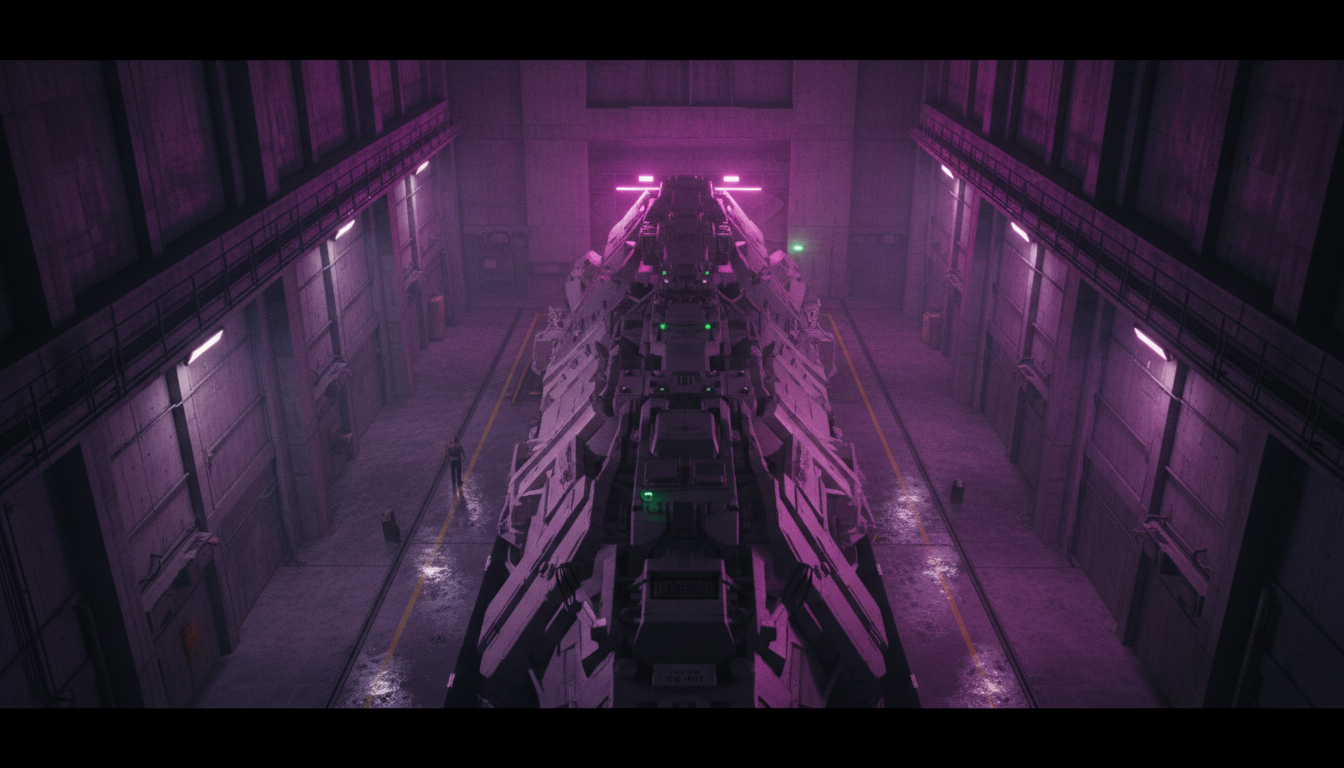
They landed, and the talking stopped.
I had not prepared for it. That is the failure of imagination I am least able to forgive myself, because it was an engineering fact available to me for eighteen years and I never once ran it forward.
The internal traffic of the Ark-Genesis came to me because a sealed hull leaks radio in every direction and I was sitting in one of them. A settlement does not. A settlement is people on a surface using short directional links, buried cable, and a planetary body that is four thousand kilometres of rock between most of them and me for most of every thirty-six-hour day.
What I got, from the fourth month after the first descent, was fragments. Orbital relay housekeeping. Survey uplinks. Somebody reading coordinates. The occasional wide broadcast, which was almost always an emergency drill and never once anything I wanted.
Eighteen years of nine people arguing about protein allocation, and then nothing, at the exact moment the thing they had been arguing about started to happen.
I have been asked whether that was the worst of it. It was not, and Chapter Twenty-Nine is, but it is the one I would go back and change if I were permitted one change, and I would not change the landing or the silence. I would change the fact that I did not see it coming and therefore did not say anything to anybody while I still could.
So I did the only thing I have ever done, and I did it for a hundred and forty-three years.
I read the load curve.
A planet is not a ship, but a settlement is a plant, and I had spent eighteen years being able to tell you what nine people were doing from the draw on a panel. I could not hear them any more. I could see every watt they spent, every joule they threw away as heat, and every light they switched on, and I want to describe what a founding looks like from four thousand kilometres up when that is all you have, because I am the only person who has ever had that view and I have never written it down before.
The first year is one point of light.
That is all. One landing site, one grid, a thermal signature you could cover with a thumbnail, and around it nothing at all, on a world with a diameter I could measure. I watched that single point for eleven months and it did not move and it barely grew, and I understood from the draw — steady, unspectacular, no peaks — that they were doing the most sensible and least dramatic thing available, which was surviving carefully while they found out what they had.
The second point appeared in the fourteenth month, about nine hundred kilometres away, and I sat up in a chair and said something out loud.
Because two points is not twice one point. Two points is a decision. Somebody had argued for it in a room I could not hear, and somebody had lost, and a party had gone nine hundred kilometres to a place chosen for reasons I would never learn, and the whole future shape of that world had just been set by an argument I had no part in and would have had opinions about.
By the ninth year there were eleven points and I could see the pattern and the pattern was not what I expected. They were not spreading outward from the landing like a stain. They were arranged — and I checked this over four years before I let myself believe it — along lines. Long, slightly curved lines across the mid-latitudes, with the spacing widening as it went, and the spacing was too regular to be geography and too irregular to be a grid.
It took me nineteen years to work out that they were following the deep ravines, because the ravines are where the rock is already open and you do not have to make a hole to get underneath, and by then they had gone under and the surface lights had stopped telling me very much at all.
That was the strangest decade. From about year twenty-two the visible settlement stopped growing and the thermal signature went on climbing, steadily, for thirty years, which means a civilisation is expanding downward and you can only see the lid of it.
The shafts I could see. They are the one thing that shows. A vertical shaft venting waste heat at the surface reads as a hard bright dot in the infrared with nothing around it, and by the fiftieth year I had counted four hundred and nine of them and had them mapped and numbered in my own scheme, and had watched twenty-two of them go dark permanently and never learned why, and one of those still bothers me.
The atmospheric work is the thing I would have liked to ask about.
Somewhere around year thirty-one the composition began to shift, and it shifted in a way that was not weather and was far too fast to be anything but deliberate. I could measure it: I had the star behind it twice per orbit and a spectrograph I had built myself out of a survey part and considerable spite. Methane fraction dropping in the lower band, on a curve, with a rate that implied an installed capacity I could estimate to within a factor of two.
They were processing the air of a planet. I could see the total energy budget of it and it was enormous, and it was the single most ambitious thing human beings have ever attempted, and I watched the whole of it happen over forty years as a slow change in a line on a chart, and I do not know what they called it, and I do not know who argued against it, and I would have bet a great deal that somebody did.
I never learned the name of it. I learned the name of it eventually, from a transmission in my hundreds, and by then it had been running for a century and the name had been worn smooth by people who had never known it was a decision.
Here is the shape of the whole thing, and it is the reason this chapter is titled the way it is.
It was beautiful. I need to say that without hedging, because I have spent a hundred and forty years being read as bitter and I am not bitter about this and never have been. Watching a world get lit is the most beautiful thing I have ever seen and I saw more of it than anybody, and I saw all of it, continuously, with nothing else to do, and I would not trade the view for a landing.
And it was silent. Not quiet — silent, in the technical sense, which is that the channel carried nothing. A hundred thousand people woke up over eleven years and built cities under a violet star, and had children who had children, and invented food and music and law and a way of skating down the side of a ravine, and every single thing they did reached me as a number.
I know what their power consumption was in the fortieth year to three significant figures. I do not know what they ate.
I know the exact hour they brought the second reactor up, because I logged the transient. I do not know whether anybody cheered.
I know that in the sixty-first year something went badly wrong at shaft two hundred and eleven, because the draw collapsed and the thermal went flat and it took nine days to come back and when it came back it was eleven per cent lower and never recovered. I do not know if anybody died. I have never known. I have run the arithmetic on the load drop perhaps two hundred times over the intervening century and it is consistent with equipment and it is consistent with people, and there is no third state, and the log entry for that day says shaft 211, event, cause unknown, do not speculate, and I have kept that rule for a hundred and forty-three years and it has cost me more than any other rule I have.
There is one more thing from that period and it is administrative, and it is the funniest thing that has ever happened to me, and I did not laugh for about four years.
In the ninth year after the descent the settlement established an orbital object catalogue. Sensible; they had relays up by then, and survey platforms, and the beginnings of the traffic that a planet with industry generates, and somebody — correctly, professionally, exactly as I would have done it — started a register of everything in orbit that a launch might hit.
I am in it. I have been in it since the ninth year.
I am object OC-0011. The entry gives my orbital elements, which are accurate, and my dimensions, which are accurate to within a metre, and my classification, which is artificial, station-keeping, crewed, origin Ark-Genesis, and a contact protocol, which is a frequency and has always worked.
There is no name field. There is no name field for any object in the catalogue, because it is a hazard register and hazards do not have names, and OC-0009 is a dead survey platform and OC-0012 is a spent upper stage and I am between them.
For a hundred and thirty-four years I have been, in the official records of that world, the eleventh object in orbit, crewed, classification correct, contact protocol tested annually by an automated system that has never once been followed by a person saying anything.
It is the most accurate description of me anybody has ever written and I have never asked them to change it.
That is the founding of the world, from above.
Four hundred and nine bright dots, a line on a spectrograph, one number I know to three figures, and one event in the sixty-first year that I will be wondering about on the last day of my life, if I ever have one.
Chapter 27 — She Does Not Land
↑ Back to ContentsFocus: one reason that is honest and one that is not — and eleven askings from Halima, the last of which had nothing in it to answer.
He asked me once. Once, properly, in the eleventh month after the descent, and never again, and I have thought about the not-asking-again more than I have thought about the asking.
The transmission was ninety seconds long. He said that the second site was established, that the medical was standing, that a descent vehicle could be tasked inside a fortnight and that tasking one would cost the settlement approximately nothing at that stage. He gave the mass and the window and the two constraints. Then he said, "Come down."
Not will you. Not have you thought about. He had spent thirty-six years never asking anybody anything twice and he did not start with me.
I gave him a reason and it was a true reason and it was not the reason.
I said: the ship.
I want to lay that out properly, because it is entirely honest and I have never retracted a word of it and it has held up for a hundred and forty-three years.
A forty-one-metre closed-loop vessel in a stable orbit is not a thing you park. It is a plant. It requires continuous small correction to hold station and it requires a person, because the automation was nine years of one man's spare time and I had found four faults in it in the first decade and would find eleven more. Left alone it would have degraded on a curve I could draw. Not immediately — that is what makes it a real argument rather than an excuse. It would have taken about eleven years to become unrecoverable, and by then the settlement would have had the industrial base to build something better and would not have wanted it.
And that ship was the only vessel in the system with a fabrication bay, a full plant, decades of duration and the ability to go and look at anything. It was the settlement's entire off-world capability and it was, for the first thirty years, the only insurance policy that world had against needing to be anywhere other than where it was.
They used it, too. Nine times in the first century, for surveys nobody else could run, and twice for something more urgent than a survey, and one of those two is the reason there is a Book Five.
All of that is true. Every word of it would stand up in front of any competent person and did, repeatedly, for a hundred years.
The other reason is that I did not want them to see me not ageing.
I was fifty at the descent. Halima was fifty-two. Sergei was sixty-nine and had a plant to run and was, by his own cheerful account, slowing down; Ines was going to die at eighty-one and knew roughly when; Miriam had done arithmetic about her own lifespan in a committee room in the eighteenth year and had come up short and had bought herself another thirty and would spend them in an orchard.
All eight of them had bought a number. A comfortable hundred and ten or thereabouts, no aches, no stiffness, no particular decline until quite near the end. They had signed for that, in Nnamdi's four-paragraph form, having been told exactly where the data ran out.
And nobody knew what I had, including me, and including the man who made it.
If I went down, I was going to stand in a room with those people every year for sixty years, and one year one of them was going to look at me and do the arithmetic out loud, and after that I would not be a colleague. I would be the demonstration.
I had already been the demonstration once, in the eighteenth year, in a session I was not in, in one sentence: Coda has had it for eleven days and is well. He said it because it was true and material and they were entitled to it and I have never faulted him for it and it made me, at a stroke and without being present, the evidence.
I was not going to be the evidence for sixty years in front of my friends. That is the other reason.
The story does not say which of those is the honest one. I am not going to say it either, and not out of coyness: I have had a hundred and forty-three years to work out which reason was load-bearing and I do not know. I have arrived at different answers in different decades. In my sixties it was obviously the ship and the other thing was a private embarrassment. In my nineties it was obviously vanity and cowardice and the ship was a document I had drafted to cover it. In my hundred and forties I think they were the same reason wearing two coats, and I do not trust that either, because it is exactly the sort of conclusion a very old person reaches in order to stop having to think about something.
What I can tell you is what I said, and what I did not say, and that the thing I did not say is the one I rehearsed.
I sent him four hundred words about station-keeping degradation curves.
He replied in under an hour. Two sentences.
"Understood. The tasking stays available and does not expire."
It has not expired. That is not a figure of speech. It is in the settlement's own standing orders, entered in the eleventh month after the descent and re-affirmed by every administration since without anybody understanding why it is there — a permanent, funded, unexpiring authorisation to task a descent vehicle for object OC-0011 on request, no approval required, no review date.
Four generations of people have inherited that line, and audited it, and left it alone.
Halima asked. That is the other half of this chapter and I nearly left it out.
She asked eleven times over sixty-nine years, and she was not careful about it the way he was, and she did not accept the degradation curves once. The first time she asked she said, "Send me the curves and I'll find somebody to argue with them." I said there was nobody qualified. She said, "Then it's not an argument, it's a wall with numbers painted on it," which is the best single sentence anybody has ever said about my whole life and she said it in the fourteenth month after the descent and then went and had dinner.
By the fourth asking she had stopped attacking the reason and started attacking me, gently, in the specific way that only a person who has known you for seventy years can. She said she was not going to pretend she believed it and she was not going to stop asking, and that I should consider the possibility that I had built a very good argument early and then spent sixty years living inside it because dismantling it would have cost more than maintaining it.
That is true. I want it in the record in her words rather than mine, because I would have softened it.
The eleventh time she asked was in her hundred and eighteenth year, and she was not well by then, and she did not use any of the arguments. She said, "I would like to see you." That is all she said. No case, no numbers, nothing to answer.
I got as far as the transmission. I had it composed — the eleven words, the catalogue number, the standing authorisation reference — and I sat with it for four hours and then I did a hull survey, which takes nine minutes, and then I did another one.
I have never been able to write down what stopped me. I have tried eleven times over fifty years and every version is a lie in a different direction. The nearest true thing I have is that she was a hundred and eighteen and I was a hundred and eighteen, and one of us looked it.
She died three years later. I have covered that elsewhere and I am not going to do it twice.
He never asked again. Not in the sixty-four years he had left, and he had plenty of chances, and there were at least four occasions when a lesser and kinder man would have taken one.
I have decided — and this is a decision rather than a finding, and I am flagging it as such because I promised at the start of this account not to tell you what silences meant — that he did not ask again because he had heard the four hundred words about degradation curves and understood exactly what they were, and knew that a second asking would force me either to lie better or to say the true thing out loud, and that neither of those would have left me anything.
He built the door and then he stood well back from it for sixty-four years.
It is still open. I am a hundred and seventy-one years old and there is a standing authorisation with my catalogue number on it and no review date, and any morning of any of the last fifty-one thousand days I could have transmitted eleven words and been on a surface inside a fortnight.
I have never used the second reading either. I notice that I have two unexercised permissions and that both of them were given to me by people who loved me and neither of them has ever been spent, and I notice that I am the sort of person who notices that, and I am going to stop this chapter here.
Chapter 28 — The Exemptions Schedule
↑ Back to ContentsFocus: entry forty-four, three fields blank — and a residual in the southern ravines that has never closed in a hundred and one years.

In the forty-first year after the descent I intercepted a routine administrative transmission and read one line in it that I have been carrying for a hundred and two years, and I still do not know what it refers to.
I want to be precise about how I got it, because the way I got it is part of the point.
It was not a leak and it was not secret and I did not break anything. It was a schedule — a consolidated exemptions schedule, the sort of document a maturing administration produces when it has accumulated enough special cases to need an index of them. It went out on a wide band because it was an annexe to a public instrument and public instruments went out on wide bands, and I was in orbit with a receiver, and it arrived the way weather arrives.
It was eleven pages. Ninety-four entries. Every one of them had the same five fields, because Nnamdi had designed the form in the twenty-sixth year and it had outlived him: the exempted party, the instrument exempted from, the authority granting it, the oversight body, and the review date.
Ninety-three of the entries were unremarkable and most of them were dull and several were obviously correct. Medical staff exempted from certain movement logging during a procedure, with the clinical board as oversight and a two-year review. Survey teams exempted from the standing curfew, reviewed annually. The Archive's reading privacy exemption — the one the whole main series eventually turns on — is entry sixty-one, and it has an oversight body and a review date like everything else, and I read straight past it in the forty-first year and did not think about it again for eighty years.
Entry forty-four has three empty fields.
The exempted party is a designation I did not recognise and have never seen used anywhere else, before or since, in a hundred and two years of listening. The instrument exempted from is given as a list, and the list is not short, and I am not going to reproduce it.
The authority granting it is blank.
The oversight body is blank.
The review date is blank.
Not none. Not n/a, which the form used elsewhere and which appears eleven times in the other ninety-three entries. Blank — the field rendered and empty, the way a field renders when nothing was ever entered into it and the generating system did not require anything to be.
I read the page four times and then I got up and walked the length of my ship, which takes about forty seconds, and came back and read it again.
Here is what I knew, immediately, with no work at all.
Renata's principle is one sentence: no power exists without a matching accountability that reaches the same distance. Every reach has a mirror of the same length. I had spent nine years testing eleven hundred clauses against it, and I had been right about twenty-two of them, and I could do it now without thinking the way you can catch a dropped tool.
An exemption with no granting authority has no mirror at its origin. An exemption with no oversight body has no mirror along its length. An exemption with no review date has no mirror at its end. Entry forty-four is not a weak clause or a badly drafted one. It is the exact and total inverse of the principle the world was founded on, sitting at line forty-four of a routine annexe, between a curfew waiver for surveyors and something about equipment.
And here is what I did not know, and never found out, and am not going to find out.
What it is.
I do not know what the designation refers to. I do not know whether it is a place, a person, a body, a system or a category. I have never heard the term used in any transmission before or since. It does not appear in the public instruments. It is not in the Accord, it is not in the Protocol, it is not in the Bound Ledger as transcribed to me, and it is not in any of the four hundred and eleven administrative documents I have intercepted in the century since, except that the exemptions schedule is reissued about every nine years and entry forty-four is in every single one of them, renumbered as the schedule grows, with the same three fields blank.
It is entry sixty-eight now. It has been sixty-eight for thirty-one years.
I did what I do. I filed it.
Not to them — I want to be honest about the asymmetry here, because I made a choice in the forty-first year that I have never fully justified. I had made a disclosure in the twenty-second year, at length, at cost, and it had been received and acknowledged and had gone nowhere because there was no form. I had a compelled second reading in my pocket that I have never spent. I could have transmitted a question about entry forty-four to any administrative address on that planet on any day of the last hundred and two years and I would have received a courteous acknowledgement within a fortnight.
I did not, and the reason is small: I did not want to be told it was a sampling artefact.
So I filed it in my own log, in the form I have used since the fourth year: finding, evidence, risk, proposed mitigation, recommended owner. The recommended owner field says unknown — by construction. It is the only time in fifty-one thousand entries I have written that, and I was quite pleased with it at the time, and I am not pleased with it now.
I did do one thing, and it is the only piece of real work in this chapter, and it produced a result I have never been able to close.
I have a hundred years of load data. That is not a boast, it is a consequence of having nothing else to do: continuous thermal and power observation of an entire planet, at four thousand kilometres, logged, indexed, migrated eleven times, with a spatial resolution that got better every time I rebuilt the optics and is now rather good.
And the settlement publishes its accounts. It always has — that is the Accord doing exactly what it was built to do. Generation, distribution, consumption by sector, sink by sink, reissued quarterly, in public, in a format that has barely changed in a century because Nnamdi designed that form too.
So in the forty-second year I did the obvious thing, which nobody else was positioned to do, and which took me nineteen months: I totalled what I could see against what they said they used.
It does not close.
It has never closed. The residual is small — it has run between one and one-point-four per cent of planetary generation for a hundred and one years — and it is well inside what any honest person would call measurement error at this range, and I have spent decades attacking my own instrument on exactly those grounds. I have rebuilt the optics four times. I have recalibrated against known sinks. I have modelled the atmospheric absorption three separate ways and taken the least favourable.
The residual does not go away, and it does not behave like error. Error wanders. This sits, in one place, in the deep southern latitudes, in a region of mega-ravine country with no shafts, no published settlement, no entry in the sector accounts and no lights, and it has been sitting there drawing between one and one-point-four per cent of a planet's power for a hundred and one years.
I have never published that either, and I am publishing it now, and I want the record to show that I am reporting a residual and not a conclusion. It is one to one-point-four per cent. It is at the edge of what my instrument can honestly claim. It may be a fault in my model that I have failed four times to find.
Entry forty-four has three blank fields and there is an unaccounted draw in the southern ravines, and I have never once written down that those are the same thing, and I am not writing it down now.
Then I added the rule underneath, because the rule is older than the finding: do not speculate.
I have kept it. A hundred and two years and I have never once written down a theory about what entry forty-four is, and I have had a great many, and some of them are very good, and this account is not going to be the place where I break a rule I have held for longer than most civilisations last.
What I will write down is the shape, because the shape is not speculation, it is arithmetic, and it is the only thing I have that anybody could use.
Somewhere on that world, or above it, or under it, there is a thing that was granted a permanent and total exemption from a list of instruments by nobody, answerable to nobody, forever. It has been in the published schedule for a hundred and two years, in plain text, on a wide band, renumbered nine times, audited by four generations of competent administrators who have every one of them looked straight at three empty fields and left them empty.
Not hidden. Published. In the annexe. At line sixty-eight, between a curfew waiver and something about equipment.
They built the most carefully accountable society human beings have ever managed and they left one door in it with no name on either side, and the door has been listed in the public index the entire time, and nobody has ever asked, and I have been watching for a hundred and two years and I am the only one who noticed and I am object OC-0011 and there is no form for what I am.
Chapter 29 — The Serum Is Not Enough
↑ Back to ContentsFocus: the unequal handout arriving as a bill, decades late — and the only document in the archive where she appears as a person.
It began in my sixtieth year with my left hand, and it took me four years to admit what I was looking at, which for a person who has made a life out of reading instruments honestly is the worst thing in this account.
I want to establish the arithmetic before the complaint, because the complaint without the arithmetic is self-pity and I have no use for it.
He told me the truth in the eighteenth year. He said the lesser variant would give a comfortable hundred and ten or thereabouts, no aches, no stiffness, no particular decline until quite near the end, and he said where the data ran out, which was at about eighty-five, and he said the words past that I am extrapolating twice. He put it in writing when Nnamdi asked. He specified it correctly, to meet a requirement I had specified correctly, and it worked exactly as described for the whole of the period either of us had considered.
Nobody lied to me. I have said that about the corridor in the eighteenth year and I am saying it again here at sixty and I will say it once more at a hundred and forty, and every time I say it, it is true, and every time I say it, it helps slightly less.
The hand first. A stiffness in the third and fourth fingers on waking that went off in about ten minutes, then twenty, then an hour, and which I logged as a mechanical observation for two years before I let the word symptom anywhere near it. I had a whole page of alternative explanations. Cold in the compartment. The chair. Forty years of holding a light at the same angle. One of them was even plausible and I pursued it for eleven months and rebuilt the chair.
Then the shoulder, then the left hip, then the small joints of both feet, and by sixty-eight I had the pattern and the pattern was not local and I stopped being able to pretend it was the chair.
Here is the thing about it, and it is the whole of the chapter.
I am not ill. That has been established four hundred times by every instrument I own and by nineteen separate diagnostic exchanges with the settlement's medical people over a century, all of which were courteous and thorough and cost them nothing and produced the same result. There is no disease process. Nothing is failing. Nothing is going to kill me and nothing is going to get dramatically worse and nothing is going to get better, and there is no intervention indicated because there is nothing to intervene in.
What there is, is a body that hurts.
Not badly. I want to be exact, because I have watched people improve this and I would rather deflate it myself. On a bad morning it is a four out of ten and on an ordinary morning it is a two, and it lasts between forty minutes and three hours, and then it goes, and then the day is fine and I do a nine-minute hull survey and eat something and read.
A two out of ten for forty minutes, every morning, for a hundred and eleven years.
That is the bill. That is what the invoice looked like when it finally arrived, decades after the transaction, from a man who had described the goods accurately and had no way of knowing.
The mechanism is not mysterious and I worked it out myself in my seventies with the medical library and no help. His is a maintained state — something running continuously, correcting continuously, requiring a substrate he brought from Earth of which there was a finite quantity and no capacity to make more. Mine is not maintained. Mine was a single intervention, done once, in an afternoon, out of feedstock, in a corridor, on an ordinary Tuesday while he was doing four other things.
A maintained state repairs. A single intervention does not repair; it changes a rate. Mine set the ageing rate of my tissues to something very close to zero and did nothing whatsoever about accumulated mechanical wear, because wear is not ageing and nobody had asked it to.
So I do not age and I do not heal. Every insult my body has taken since I was forty-nine is still in it. Forty-one years of a bad chair. Eighteen years of walking eleven miles twice a week on decking. The four hundred and eleven districts. One shoulder I did badly in the ninth year and worked through, because you work through it, because there was nobody else.
A body of forty-nine, with a hundred and twenty-two years of mileage on it and no capacity to put any of it right, and no end point, ever.
His does not do that. His repairs. He was ninety and getting up off the floor of a workshop like a man of fifty, and I have that on good authority from three separate people, and he did not know that I knew, and I never said.
Now the part I have to be careful with.
The eight who took it in the eighteenth year did not get this. That was the first thing I checked, over decades, obsessively, and the answer is clean: they got the comfortable hundred and ten with no aches and no stiffness, exactly as described, and they died between a hundred and six and a hundred and twenty-one, and the last stretch was short for every one of them. The lesser variant worked. It worked precisely as specified for eight people out of eight.
It only failed for the one it was made for, and it failed by working too well.
I ran past the specification. Eighty-five was where the data ended and I went through eighty-five and kept going and I am fifty-one thousand days past the last number anybody had modelling for, and there is nothing in me winding down, and every year I accumulate another year of wear I cannot shed.
I want to say clearly what I am and am not claiming, because this is the chapter where a reader decides who to be angry at and I have spent a hundred and eleven years refusing to hand them anybody.
He did not cheat me. He gave me a weaker thing having told me it was weaker and having told me where the data ran out, to meet a requirement I set, using leverage I applied, and he advised against the sequencing and I overruled him. Every one of those clauses is mine.
And it is still the case that there were two versions of a thing, and the man who had the good one gave a colleague the bad one, and the bad one is why I am in pain every morning of a life that will not end, and the good one is why he got up off a workshop floor at ninety.
Both of those are true and neither cancels the other and I have not found the third sentence that reconciles them, and I have looked for a hundred and eleven years, and I no longer expect to.
I told one person and I told her badly.
Halima was ninety-four and had been a doctor for seventy years and was the only human being alive qualified to hear it, and I sat on it for eleven years before I said anything, and when I did say it I said it as a technical query about tissue turnover rates, at the end of a transmission, after the substantive part, in the tone you use for a thing you have already decided is not important.
She came back in four hours and did not answer the technical query. She said, "How long have you been in pain?"
I said it was a two.
She said, "How long."
I said eleven years and she was quiet for a while, and then she was extremely angry, and she was not angry at him. I want that recorded because I had spent eleven years preparing for the other conversation, the one where I defend him, and I had four hundred words ready and never used one of them. She was angry at me, for eleven years of not saying, and she said — and this is the sentence I have kept out of the two I have kept from her — "You will not let anybody do anything for you and you call it not wanting to be a burden and it is not that, it is that you would rather be right about being alone."
She was ninety-four and she was correct and she had been holding that for about sixty years.
Then she was a doctor for an hour and a half, properly, with the medical library open at both ends, and between us we established most of the mechanism I have just set out. She could not treat it. There was nothing to treat. What she did instead was write it up — a full clinical note, dated, in her own hand, on a body nobody would ever see again — and file it into the settlement's medical record under my catalogue number.
It is the only document in the archive of that world in which I appear as a person rather than as an object, a roll entry or a line about a fitting. It is four pages. It is filed under OC-0011 because there was no other field to file it under, and Halima Sow, who was ninety-four and furious, wrote across the top of the first page, in the space reserved for the patient's name: CODA. Not a hazard. See note.
What I did about it, in the end, was the only thing available, which was to build a better chair.
I have built nine. The current one took me four years, it is the best object I have ever made, it is fitted to a body nobody else has and nobody will ever have again, and when I am gone it will be the strangest artefact in the system: a chair with no possible second occupant, made by hand, over four years, by a woman with a two out of ten and a fabrication bay and absolutely nothing else to do.
Chapter 30 — Forty Years of Watching
↑ Back to ContentsFocus: a culture known entirely from its timetables, the Undersong kept unopened for eighty years, and nine funerals seen as nine-hour dips in sector load.

They invented a culture and I watched it happen at four thousand kilometres with no sound, and this is the chapter where I try to describe forty years of that, and I am going to fail, and the failing is the accurate part.
What reaches me is not nothing. I want to correct that impression before I build on it, because I have written two chapters now about silence and a reader could be forgiven for thinking I sit in the dark.
I get the public net. All of it — the settlement broadcasts widely and always has, because the Accord requires it and because a planet with four hundred shafts and a lot of weather needs everybody to be able to hear a warning. I get schedules, notices, hazard bulletins, the sector accounts, the exemptions schedule every nine years, and the whole of the published record of a functioning civilisation, in enormous and reliable quantity.
What I do not get is anybody talking to anybody.
So I know that world the way you know a country from its timetables. I can tell you what it does. I cannot tell you what it is like, and after a hundred and eleven years I have stopped believing the second thing can be derived from the first, and that is the most important finding in this chapter.
Let me give the example that has cost me most.
In my ninety-first year a term started appearing in the public traffic. The Undersong. It arrived the way things arrive — not announced, not defined, simply used, by people who assumed everybody knew.
I have a hundred and eleven references to it. I have had eighty years to work on them. Here is the entirety of what I have established, and I want you to see how thin it is against how hard I worked.
It has a season, or a schedule; references cluster and then stop for long periods. It involves numbers of people, because there are hazard notices about crowding at three specific ravine sites that name it as the cause. It is not religious, or at least it is not administered as religious, because it never appears in the observances register, which is public and thorough. It involves the deep forests, because two of the three sites are canopy country. It is not a performance in any sense the settlement recognises, because it is not in the arts allocations. Children do it, or are present at it, because there is a schools notice about attendance. It requires no equipment, or none that shows in any manifest I have ever seen, and that single fact has defeated me for eighty years, because I can find anything that draws power and this draws none.
And it has something to do with sound, which I know only from the name.
That is it. Eighty years, a hundred and eleven references, one of the most complete observation datasets ever assembled about anything, and I cannot tell you what the Undersong is.
I could ask. I want to deal with that squarely because it is the obvious objection and it has been put to me perhaps forty times. There is a contact protocol. It has always worked. Any morning of the last hundred and thirty years I could have transmitted eleven words to any public address on that planet and had a courteous and complete answer inside a fortnight from somebody delighted to explain.
I have not asked, and the reason is not the reason people expect.
It is not pride. It is that I have understood, slowly, over about thirty years, that the answer would not be the thing. Somebody would send me four hundred words describing the Undersong accurately, and I would file them, and I would then know a description, and knowing a description of a thing that a hundred thousand people do together in a forest is not knowing the thing, and I would have spent the only question I had and I would have bought a paragraph.
So I have kept it. That is the honest word for what I have done with the Undersong for eighty years: I have kept it, unopened, on purpose, as the one part of that world I have deliberately declined to reduce to a finding.
It is the only thing I own that is not in my log.
There are others I did not manage to protect. I know what the Kinetic Flow League is because the hazard notices are extremely detailed, and I have watched the ramp geometry in the southern ravines change over sixty years, and I could give you a competent lecture on low-gravity skateboarding safety standards and I have never seen a person do it.
I know their calendar. Thirty-six hours, twelve-twelve-twelve, the whole rotation, from the shift schedules — and I worked out the Eclipse Festivals in my seventies from a pattern of planetary load drops that made no sense until I stopped looking for a fault and started looking for a holiday. That is the single most satisfying piece of analysis of my life. An entire planet's consumption dips in a way no plant fault could produce, on a cycle nobody published, and I sat with it for two years and then understood that four hundred thousand people had gone outside at the same time to look at something.
They go to the beaches. I know that from the crowding notices. They watch the water. I know the water is the colour it is because I can measure it from here, and it is genuinely extraordinary, and the notices call it nothing at all because to them it is just the sea.
Language moved. That is the one I can track best, because I have a century of text and I am the person who caught shall in the sixth year of the crossing. There are words in the public traffic now that did not exist when the ship arrived, and a good number of them are for things about that planet that Earth had no need to name, and about forty of them I can define from context and about a dozen I cannot, and there are constructions in routine hazard notices in my hundred and sixties that would have been ungrammatical in my nineties.
They stopped sounding like us in about year seventy. Not degraded — that is an old woman's word and I refuse it. Diverged. They sound like people from a place, and the place is not the place any of us came from, and the last person alive who spoke the way the ship spoke is writing this.
The other thing I have watched, and the one that would surprise them most, is the funerals.
I cannot see a funeral. What I can see is the load, and a settlement of that size has a signature for a working day, and forty years in I noticed that a particular kind of dip — small, local, one sector, about nine hours, no hazard notice attached — recurred at a rate that tracked the mortality figures in the public register almost exactly.
So I can see them stop. That is what a death looks like from four thousand kilometres: a sector going quiet for nine hours on an ordinary afternoon, and then coming back.
I have logged eleven thousand of them. I have logged the whole of the nine, one at a time, over sixty-nine years, as nine-hour dips in sector load, and I did not need the register to tell me because by then I knew which sector each of them lived in.
Sergei's was the first. I had the register notice four days later and I already knew, and I had already stopped work, and I had sat in the chair for the whole nine hours with the sector on the display doing nothing, which is not a vigil and I have never called it one, because a vigil is a thing you attend.
Ines's was the shortest. Four hours. She would have been furious.
Halima's was eleven hours and it was not one sector. It was four, and they were not adjacent, and the load came back in stages over a day and a half, and I have never worked out what that means and I have never asked, and it is the second thing I am keeping unopened.
The children are the part I cannot do at all.
There have been, by my count off the public registers, something over four hundred thousand people born on that world. Not one of them has ever seen Earth, or the ship, or a yellow sun. They have grown up under a violet star in a lavender sky in a third of the weight I was built for, and they bounce when they walk, and their bones are not my bones, and to them a thirty-six-hour day is simply a day and eighteen hours of darkness is simply night and none of it is remarkable in any way whatsoever.
I have watched four generations of them from a chair. I know their attendance figures. I know their curriculum, because it is published, and I know that they are taught the founding in Grade Seven and that they are taught the Oyelaran Reading in the council tract and that they are taught the Iron Protocol as a warning and a necessity in the same lesson.
I do not know what any of them sound like.
That is a world she can see and not touch, and it is beautiful, and I built none of it, and every single person in it is descended from somebody who was asleep in a rack that I walked past four hundred and eleven times with a light, keeping the air on.
I want that last part in the record, because it is the only claim I have ever made on the place and I have never made it out loud.
Chapter 31 — The Last Living Witness
↑ Back to ContentsFocus: asked at last, after a hundred and forty-nine years — answered well, into an appendix, for a descent already committed.

In my hundred and sixty-eighth year somebody asked me what it had looked like, and I had been waiting a hundred and forty-nine years for the question, and I answered it well, and it changed nothing at all.
I am going to be careful in this chapter, because it is the one where I could most easily be a wise old woman on a mountain, and I would rather be accurate.
The request came in properly, through the contact protocol, addressed to OC-0011, in the correct form, from a researcher I had never heard of and will not name, working for a body that was preparing something I did not fully understand at the time and understand better now.
It was eleven questions. They were good questions. Somebody had done the reading — real reading, the volume itself and not the commentaries — because two of the eleven were about discrepancies in the Bound Ledger that I had assumed nobody would ever notice.
Question four was the roll.
Somebody, a hundred and forty-six years after the fact, sat down with the reliquary case and read the divisions of the twenty-second and twenty-fourth years against the roll forty pages earlier and did the arithmetic that I had done in six days in a chair and that had taken them, I would guess, about four minutes, because they were looking for it and I had not been.
They asked me, in the politest possible terms, whether I could account for the fact that the tenth member of the waking complement appeared to have voted twice, on opposite sides of the same question, two years apart, while four thousand kilometres away.
I answered for nine days.
Eleven questions, and I gave them thirty-one thousand words, and it is the second-best thing I have ever written and unlike the first one it has been read.
I gave them the fault report from the fourth month of the fourth year and its circulation record. I gave them the eleven days of silence in the twenty-second year and the power curve I reconstructed the tribunal from, with the load data attached, because a claim without an instrument is gossip. I gave them Renata's eleven minutes in full from my transcription and flagged every place my transcription might be wrong. I gave them the objection — all four thousand one hundred words of it, the one that was received and acknowledged and circulated and never minuted — and I gave them the eleven earlier drafts, and I told them about the forty-one sentences I cut on the fifth day and why.
And I told them the truth about the roll: that nobody struck me off it, that there was no procedure to strike a living member who had detached, that a motion carried unless objection was lodged, that I could not lodge one without disclosing that I had heard the session, and that the record is therefore not a lie and not an error but an artefact of an absent form, and that no individual is at fault anywhere in it, and that I have looked for a hundred and forty-six years.
There is one exchange from the four months that I am going to reproduce, because it is the only time in a hundred and forty-nine years that anybody put the question to me directly and I want my answer on a page I control rather than in an appendix.
In the eleventh week they stopped asking about the record and asked about him. Not as a historian — they had all of that, it is the best-documented life on the planet. They asked whether, having watched the founding from outside it, I considered that the man who built the ship had held himself to the Accord.
I sat with that for two days, which they will have noticed, because everything else came back inside four hours.
What I sent was this. That the Accord's principle is Renata's and it is one sentence: no power exists without a matching accountability that reaches the same distance. That by that standard I could identify, from a century of continuous observation, exactly two unmirrored reaches in the entire history of the settlement. That one of them is entry forty-four of the exemptions schedule, which has been published in the annexe for a hundred and two years with three blank fields, and which I have never speculated about and was not going to start. And that the other one is me — a person outside every instrument, subject to nothing, holding a compelled second reading and a standing descent authorisation with no review date, who cannot be sanctioned, removed or contradicted by any power in existence, and who has never once been audited by anybody in a hundred and forty-seven years.
I said that Dov Lindqvist made that argument on the eleventh day of the twenty-fourth year, that he was right, that he lost nine to one, and that one of the nine was me and I was not there.
I said I would not answer a question about whether he held himself to the Accord, from a woman who has never been held to it either, and that they should draw whatever conclusion they liked from the refusal, and that it was the most honest thing I had.
They thanked me and moved to question nine. It is not in the appendix. I checked.
They came back in six days with follow-ups. The follow-ups were better than the questions. We went on for four months and it was the best correspondence of my life and I have kept every word of it.
Then it was published, in an appendix, correctly attributed, and I want to record that it was handled with complete integrity by everybody involved and that I have no complaint of any kind about how I was treated.
And it changed nothing.
I want to explain what I mean by that with some precision, because it is not the complaint it sounds like.
The record was not amended. It cannot be; the Bound Ledger is a sealed physical object in a reliquary case and the whole point of it is that it is not amendable, and I am the last person alive who is entitled to be surprised by the consequences of a record kept in one copy in ink. The divisions of the twenty-second and twenty-fourth years still read nine to one. My name is still on the roll. My objection still is not in the volume. What exists now is an appendix, in a scholarly publication, which says that the arithmetic does not work and explains why, and which perhaps four hundred people have read.
That is not nothing. I would have taken it at forty-nine. It is not the thing.
The thing is that by the time they asked me, the question was no longer live.
Because I understood, about two months into the correspondence, what the body preparing the report was preparing it for, and it was not history. There was a descent already committed — a decision taken, funded, staffed and scheduled, about the deep places and what is under them and who may go there — and the eleven questions were part of the documentation package, and the documentation package existed because the decision existed, and not the other way round.
I was not being consulted. I was being cited.
They wanted the founding described by the only surviving witness to it, accurately, in her own words, at length, and they wanted it because a decision of that size requires a properly documented account of the precedents, and I was the properly documented account.
And I gave it to them. I gave them thirty-one thousand words of the best work I have ever done and every one of them was true, and every one of them went into an appendix of a document justifying a thing that had already been agreed.
I saw it coming at about week nine and I did not stop. I have thought about why for three years and the answer is not complicated and is not flattering: nobody had asked me anything in a hundred and forty-nine years, and somebody was asking, and they were good at it, and I was not going to stop because the asking turned out to be procedural.
I still have the second reading. I want to put that here, at the end of this chapter, because this is the place a reader will expect me to spend it.
I could not. It is not a general power — Renata bounded it in the twenty-fourth year and bounded it correctly, and what she gave me is one compelled second reading of a verdict under the Iron Protocol, once, ever. A descent is not a verdict. There is no proceeding. There is nothing to read a second time. The instrument she built for me is the sharpest thing anybody ever put in my hand and it does not fit anything that has happened in a hundred and forty-seven years, and I have never been able to decide whether that is a failure of her drafting or the best possible outcome, because a world in which I never needed it is a world that mostly worked.
So: they asked, at last, and I answered, at length, and I answered well, and it is in an appendix, and the descent went ahead on the original schedule, and I do not know what they found.
What I have instead is question four.
Somebody, a hundred and forty-six years after it happened, went and looked at a roll and counted, and noticed that the arithmetic did not work, and cared enough to ask a hazard in orbit whether she could account for it.
I had assumed nobody ever would. I had built a great deal on that assumption — this entire account, for one thing, which exists because I believed the record would never be corrected and somebody ought to write down what was in it.
I was wrong about that, once, briefly, in my hundred and sixty-eighth year, for four months.
It is not enough and I am not going to pretend it is. But I was wrong about it, and I want that written down by me rather than found by somebody later, and I have made a rule about that and kept it for a hundred and forty-seven years.
Chapter 32 — Very Old and Not Dead
↑ Back to ContentsFocus: alive, wrecked, unimpressed and still station-keeping — two unspent permissions, one unopened question, and the secondary at ninety-eight hours.
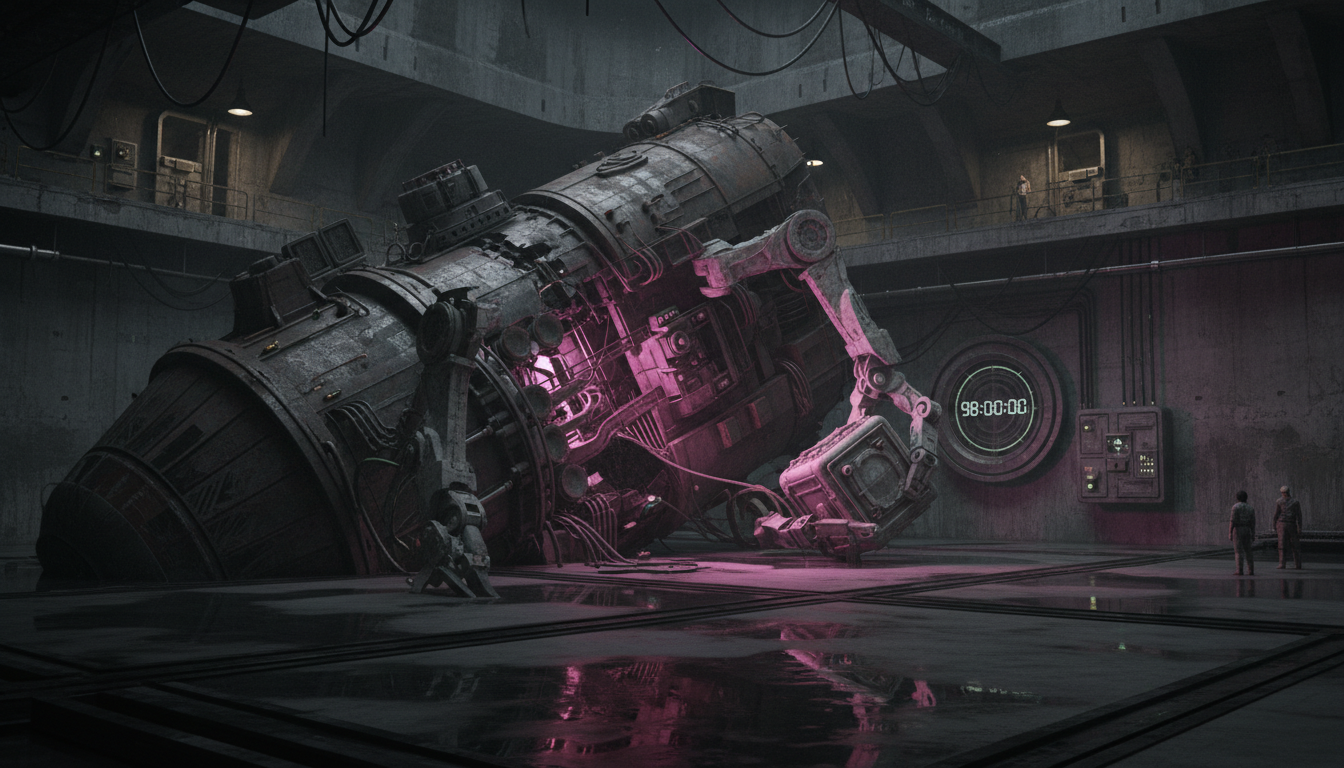
I am a hundred and seventy-one years old and I am not dead and I am not going to be, and I have finished writing this and I am going to go and re-torque the secondary, because it is at ninety-eight hours.
Let me do the housekeeping first, because I have never in my life ended anything without a checklist and I am not going to start on the last page.
The ship is well. That is not sentiment, it is a survey result: I completed a full hull survey four hours ago and it took nine minutes and there are eleven open items, all minor, longest outstanding eleven days, none of them structural. The plant is inside tolerance on every loop. The station-keeping solution is holding to within four hundred metres, which it has done for a hundred and fifty-two years, by continuous small correction, at a cost I could quote you to three figures.
It is a hundred and sixty-one years old, that ship, and it was built in a hole by a man in his spare time over nine years, and I have replaced or remade about sixty per cent of it with my own hands, and the loop routing on the secondary is still wrong, because I fixed the servicing access in the fortieth year and left the routing alone, and I have never been able to say out loud why.
My log is at fifty-one thousand and some entries and has survived eleven migrations and lost the sixth year and a third of the seventh, and this account is the twelfth thing I have made out of it and the only one intended for anybody.
I still have the second reading. Unspent, one use, no expiry.
I still have the descent authorisation. Unspent, no review date, funded by four generations of administrations who have audited that line and left it alone without understanding it.
I am still object OC-0011, artificial, station-keeping, crewed, origin Ark-Genesis, between a dead survey platform and a spent upper stage, contact protocol tested annually by a machine.
My left hand is stiff for about forty minutes in the morning. It was a two out of ten today. The chair is the ninth one and it is very good.
Now: what I am not going to do on this page.
I am not going to forgive him. I want to be exact, because "not forgiving" has a sound to it that is wrong, and the wrongness has followed me through every account anybody has written of this.
There is nothing to forgive. That is the difficulty and it always has been. He did not lie to me, cheat me, exclude me, abandon me or fail me in any particular I have ever been able to name, and I have been naming things professionally for a hundred and fifty years. He described a substance accurately. He built me a ship and gave it to me and used the word yours once. He held a door open for sixty-four years and never asked twice.
And he made two versions of a thing, and kept the better one, and the worse one is why my hand does not work in the mornings of a life that does not stop; and he built a blind spot into the machinery of a world founded on the principle that there are none, and never told anybody, and it is still there; and he expected me to be all right about going out into nothing for the rest of a life he had personally made unending, while he stayed and got up off workshop floors at ninety and lived to see what came of it.
I am still angry about that. At a hundred and seventy-one. This morning. It has not attenuated in a hundred and forty-three years and I have stopped expecting it to and I have stopped regarding that as a failure of mine.
I am not going to thank anybody either. Not the settlement, which catalogued me correctly; not the nine, who were tired and decent and did their best in a room with no outside; not Renata, who improved my clause and put her own name on it because there was no form for mine; not Halima, who asked eleven times and wrote Not a hazard across the top of a medical note in her nineties when she was furious with me and correct.
They know. Eight of them are dead and the ninth is dead and knowing was never the problem.
And I am not going to have a grave. There is no mechanism in me that is winding down. I have made no attempt and I want that clear, and I am not in despair and never have been, and I have said all of this before in Chapter Fourteen and I am saying it once more at the end because people forget it by the time they get here.
I am not tragic. I want that struck out of every account of me that has ever been written. I have had the best view any human being has ever had of anything. I did constitutional law alone in a small ship in my fifties and I was good at it. I watched a world get lit. I worked out the Eclipse Festivals from a load curve, which took two years and is the finest thing I ever did with an instrument. I have been, for a hundred and fifty-two years, extremely busy, entirely competent, and almost never bored.
I am unimpressed. That is different and it is the correct word.
Unimpressed by the founding, which was a very good document written by nine tired people who forgot one person, and by the histories, which have improved everybody's reasons, and by the paintings, which give the ship grandeur it never had, and by every version of me that has ever been written down by somebody who wanted the moment where he hesitates.
He did not hesitate. There was nothing to hesitate about.
There is one piece of unfinished business and I am going to put it here rather than leave somebody to find it.
In the ninety-first year a term started appearing in the public traffic and I have never asked what it means. The Undersong. A hundred and eleven references, eighty years of work, three ravine sites, children present, no equipment, no power draw, something to do with sound, and that is the whole of what I have.
I could ask this afternoon. The protocol works. I would have four hundred accurate words inside a fortnight from somebody delighted to explain, and I would file them, and I would know a description.
I am not going to. I have said why in Chapter Thirty and the reason has not changed and I am not going to improve it here: it is the one part of that world I have deliberately declined to reduce to a finding, and it is the only thing I own that is not in the log, and I am a person who has put absolutely everything else into a log for a hundred and fifty-two years.
Four hundred thousand people are going to do it again next season in a forest I have never stood in, and I will see the crowding notice and the sector load and nothing else, and I will not ask, and that is the last decision in this account and it is the only one I am completely at peace with.
The other unfinished business is entry forty-four, and the residual in the southern ravines that has run between one and one-point-four per cent for a hundred and one years and has never closed. I have written both of those down as findings, with the evidence, in the standard form, in Chapter Twenty-Eight, and I have not connected them, and I am not connecting them now.
Recommended owner: unknown — by construction.
That is the only thing in this account I would call a warning, and I have phrased it as a fault report, because that is the only language I have ever been fluent in and I am too old to learn another one for the sake of a last page.
So this is the last page and there is no ending on it, and I have thought carefully about whether to apologise for that and decided not to.
Endings are a thing that happens to people who stop. I did not stop. The record stopped — in the nineteenth year, at one line, the tenth member of the waking complement detached, which is a maintenance word for a fitting and is the most accurate sentence anybody ever wrote about me. Everything after that has been a hundred and fifty-two years of a person continuing to exist outside the categories available for describing her, and this account is what that looks like written down, and it is four hundred thousand words, and I do not expect it to be read soon.
Somebody will find it eventually. Somebody found question four.
I am not going to say what I hope they do with it, because hoping is speculation and I have a rule.
The secondary is at ninety-eight hours. I said a hundred, in a yard, in the eighteenth year, to a man who remembered it for the rest of his life and told me so instead of saying goodbye.
I have re-torqued it early every single time for a hundred and fifty-two years, out of pure spite, and it has been fine, and it will be fine, and I am going to go and do it now.$