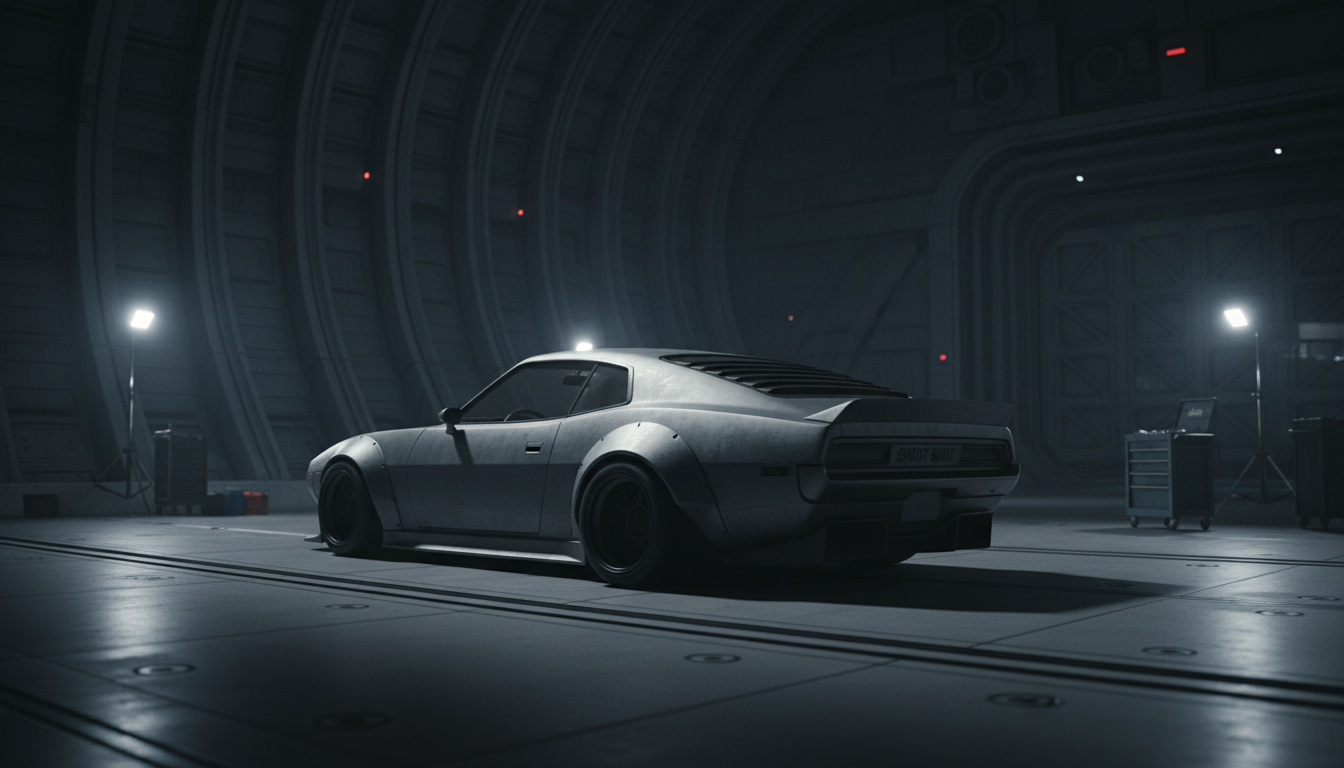
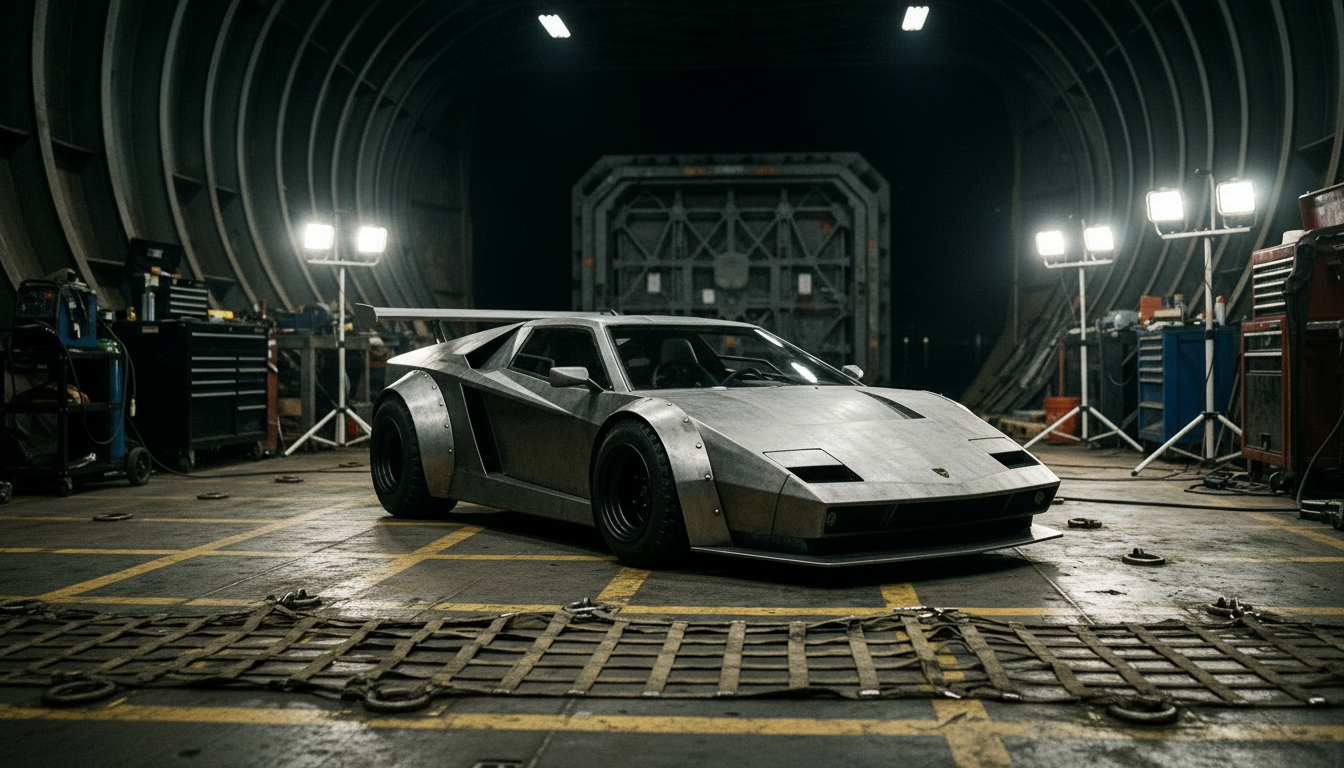
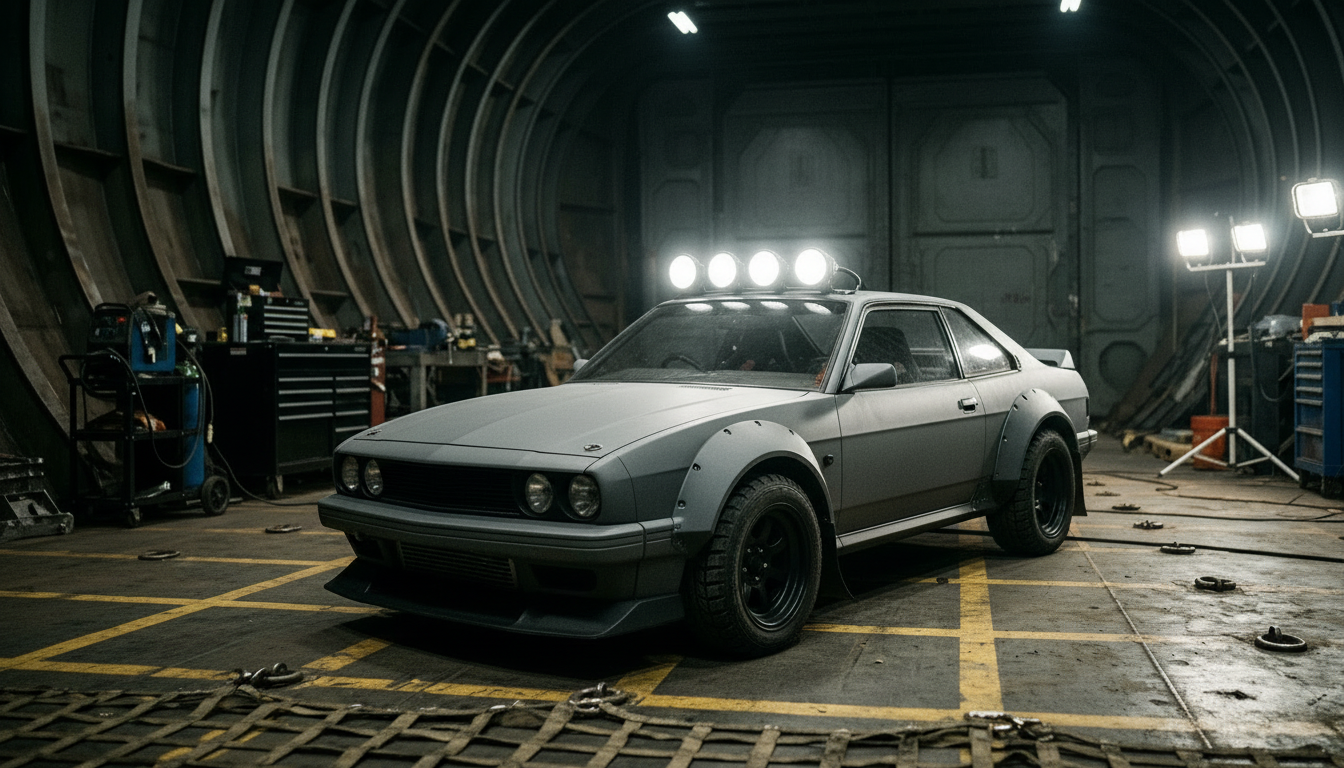
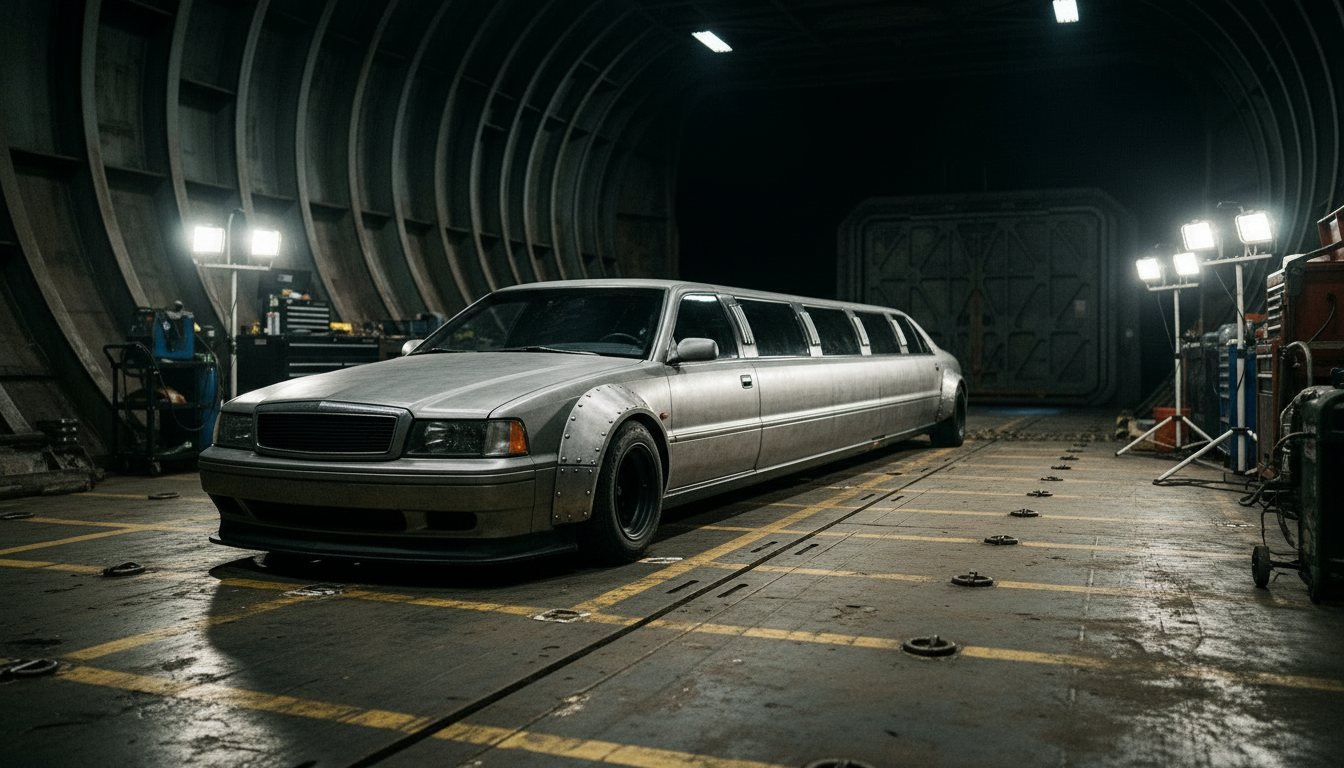
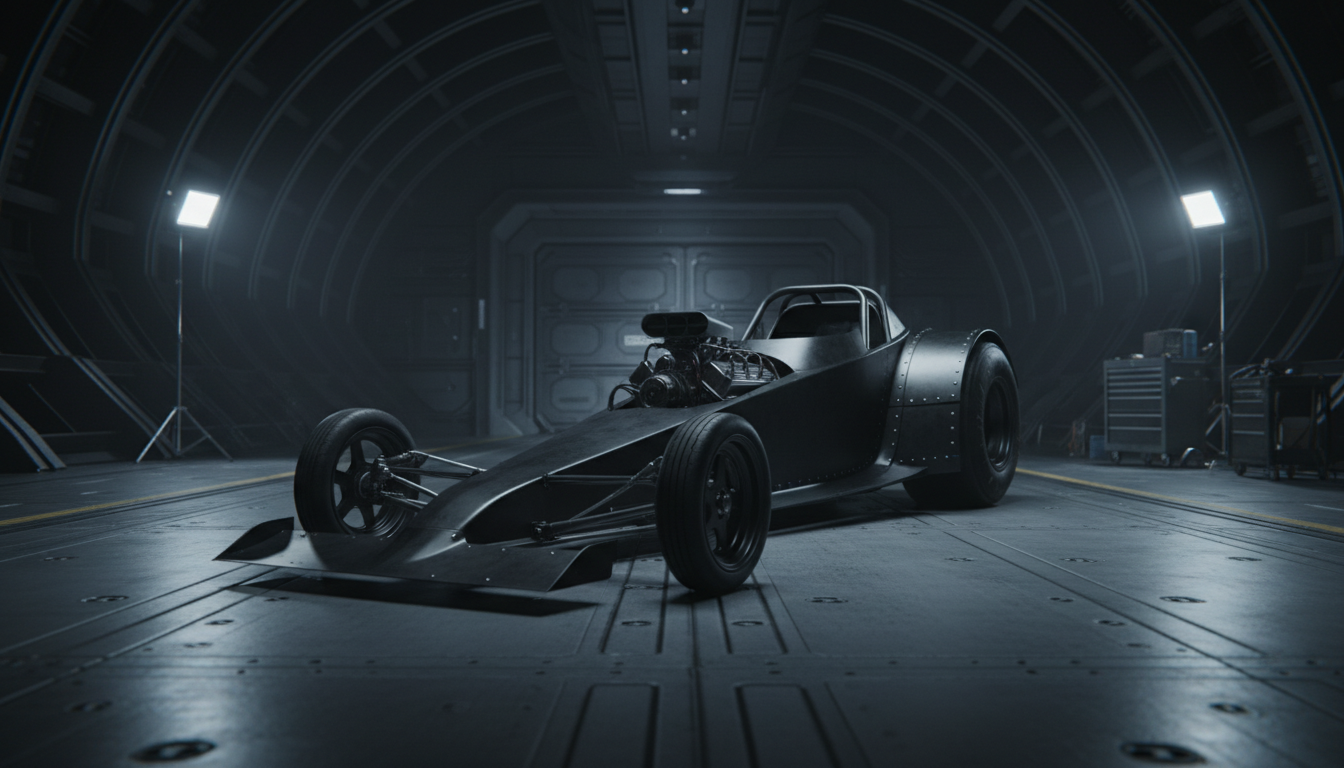
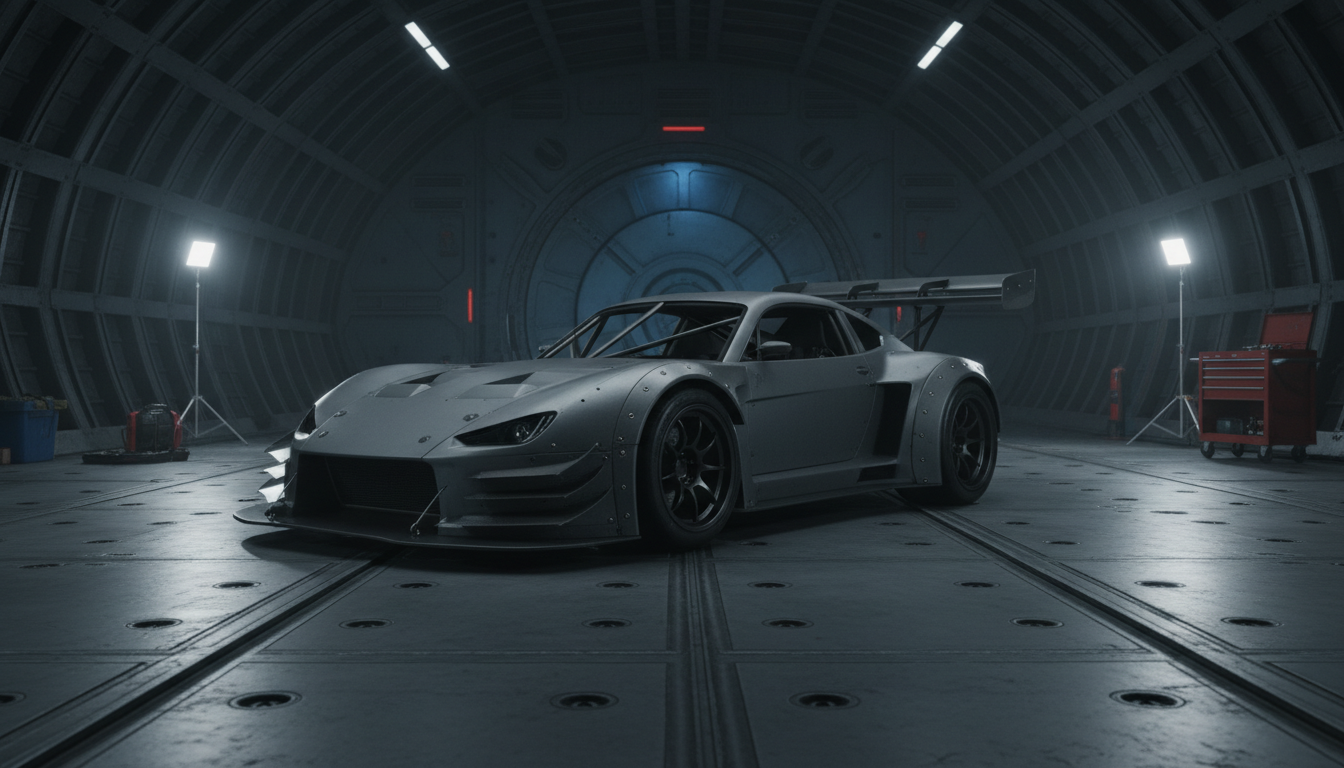
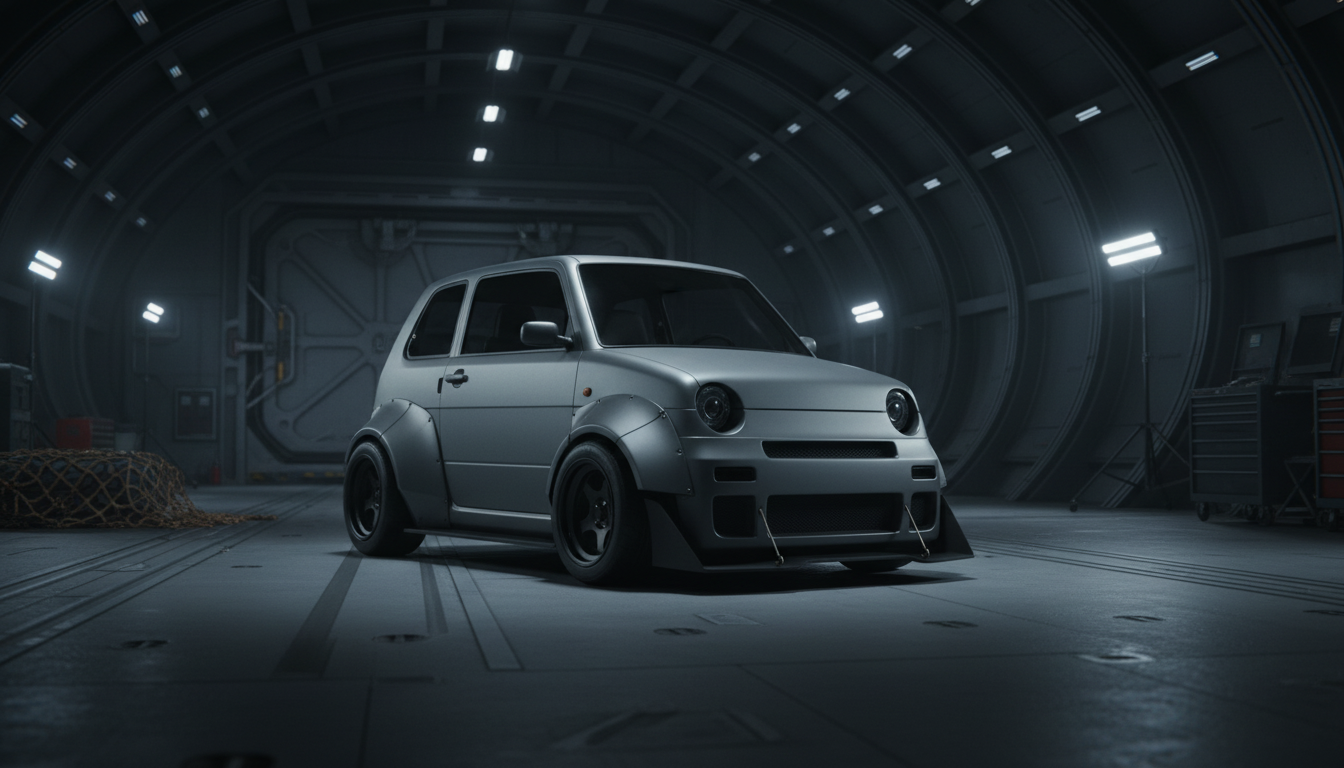
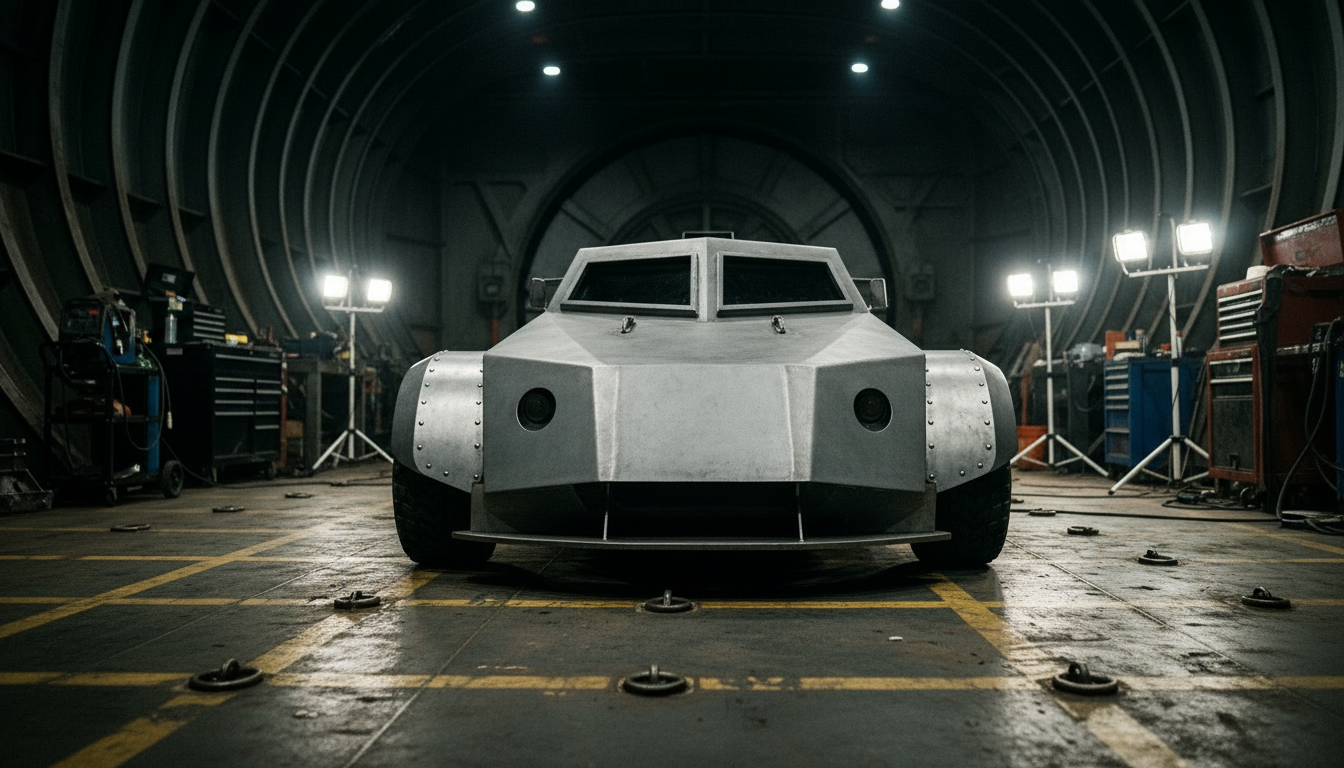
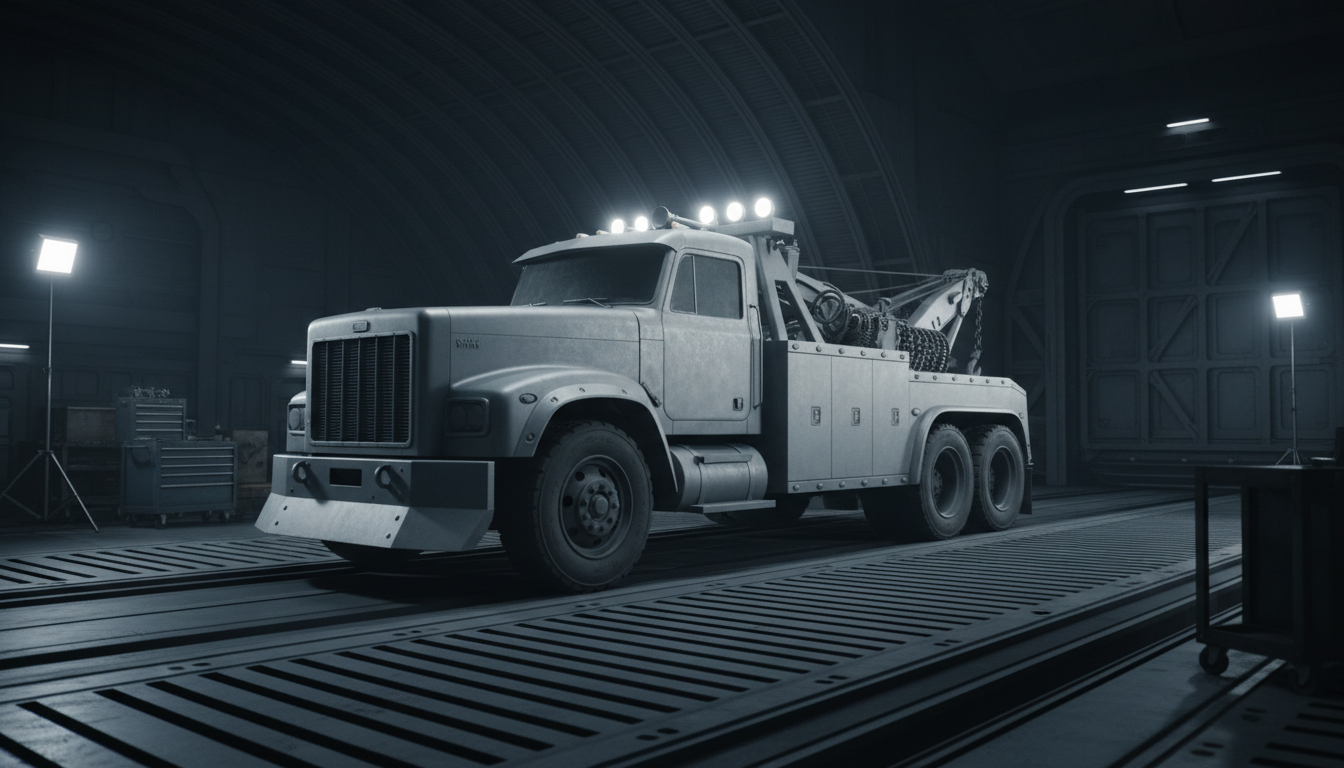
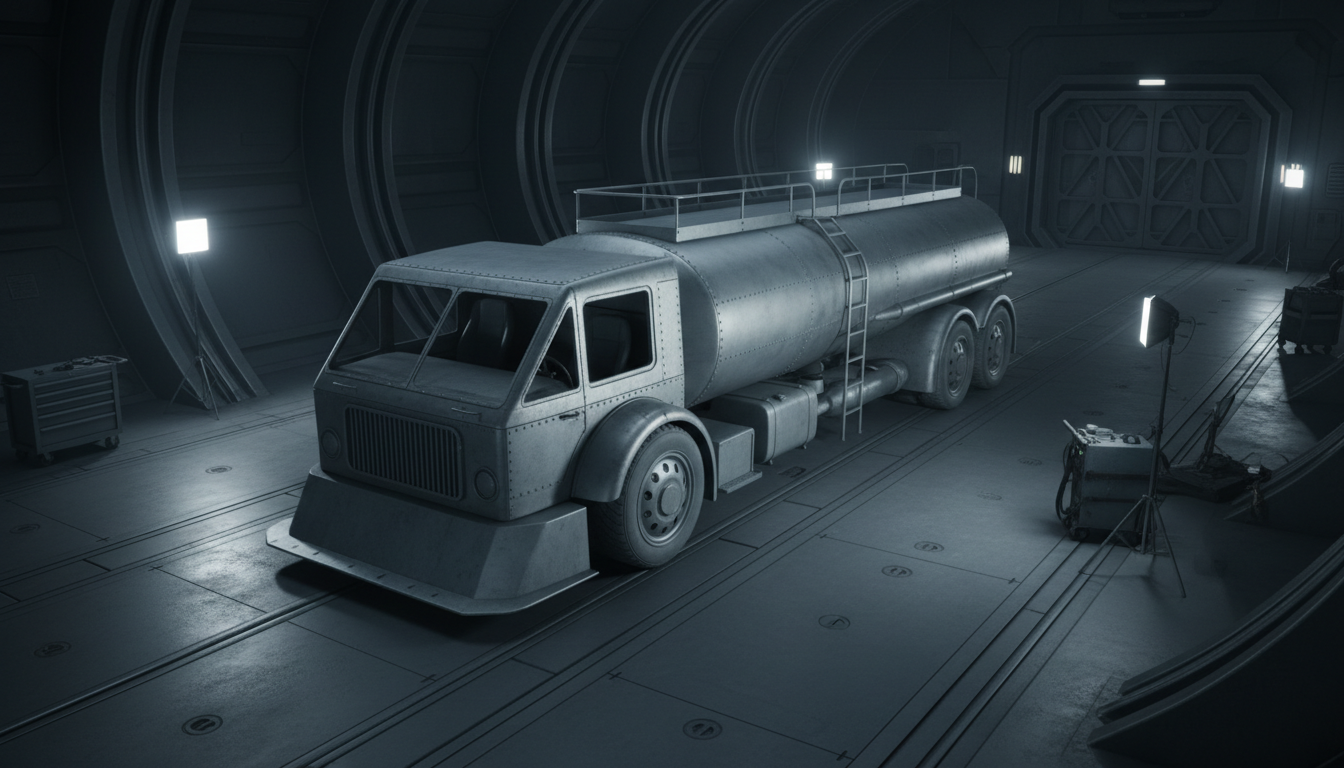
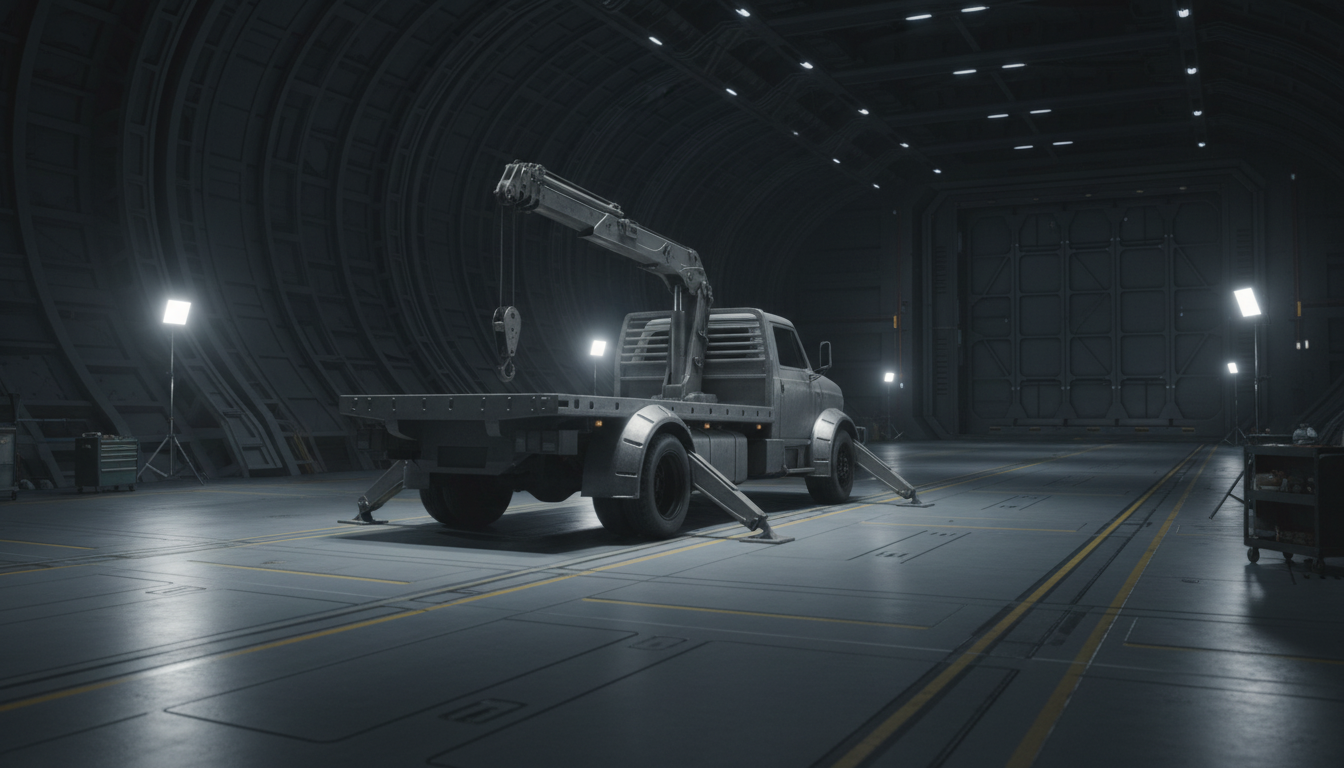
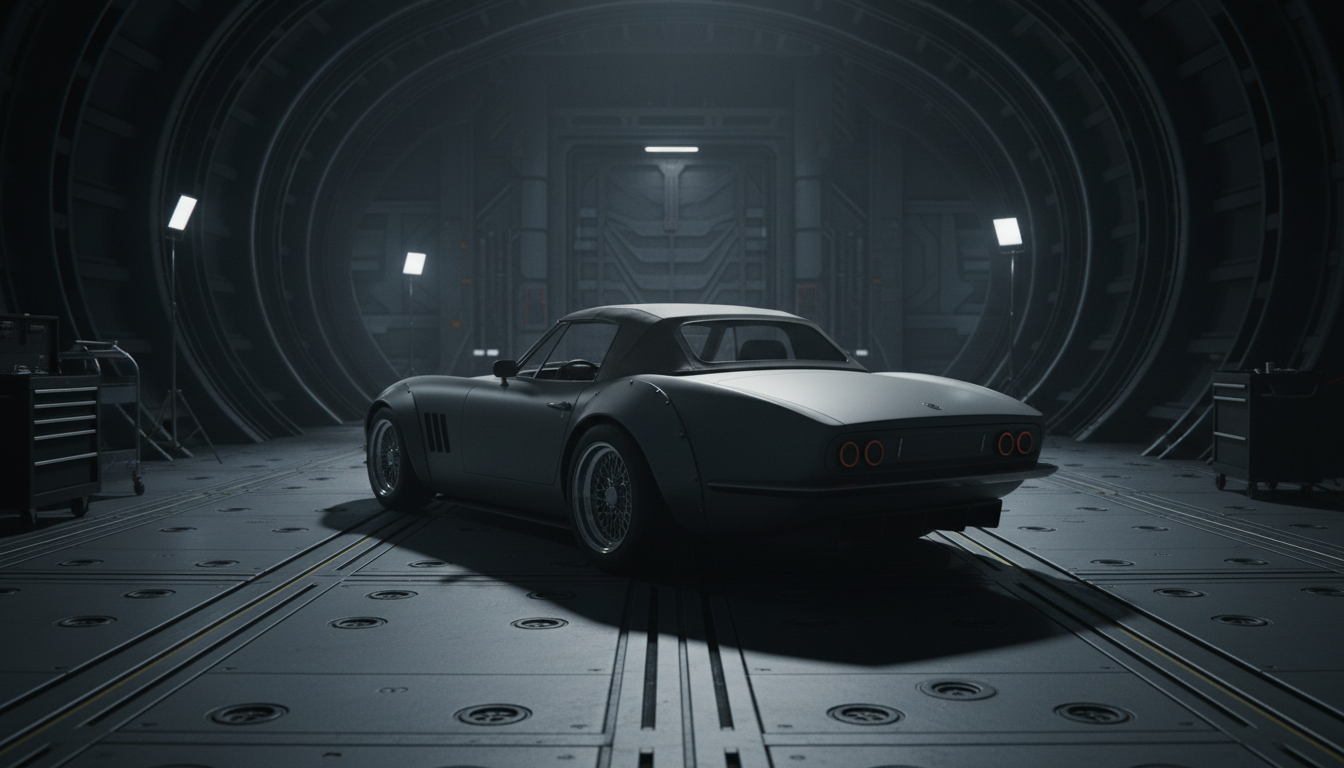
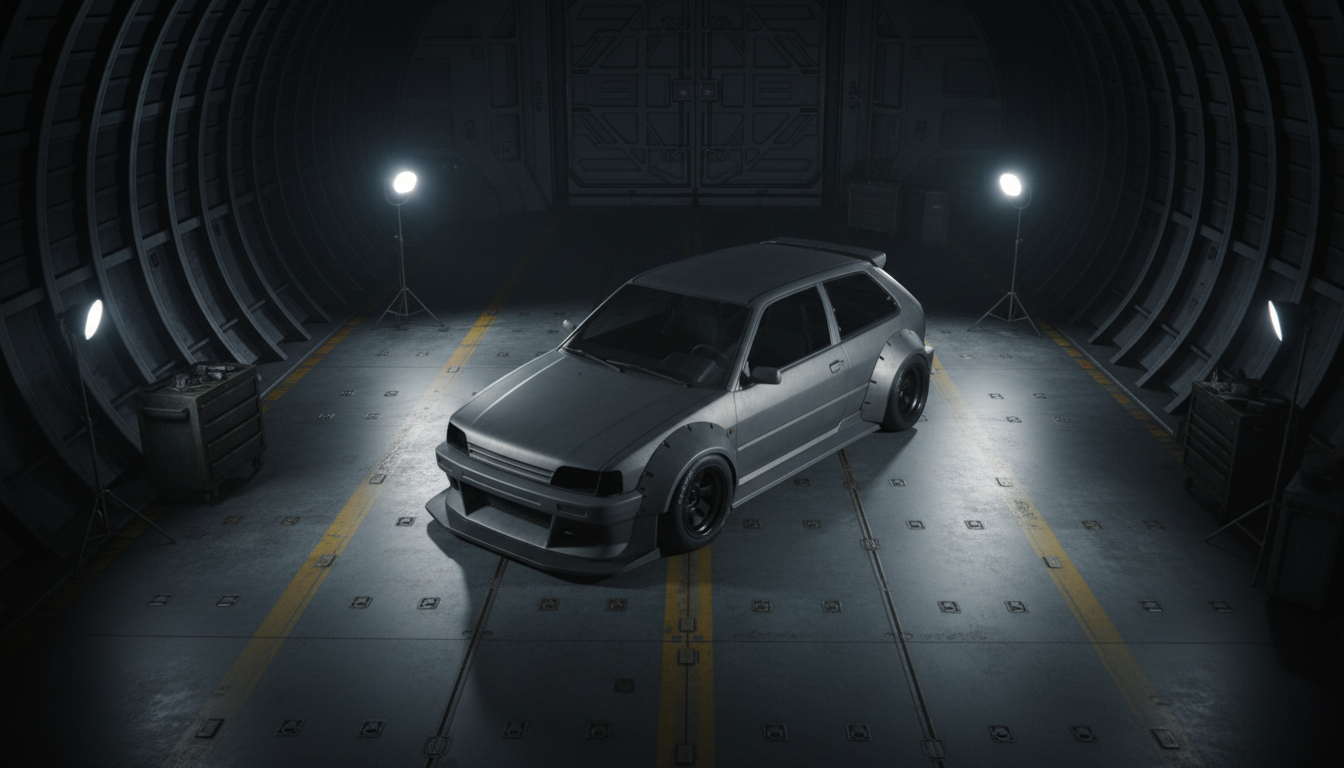
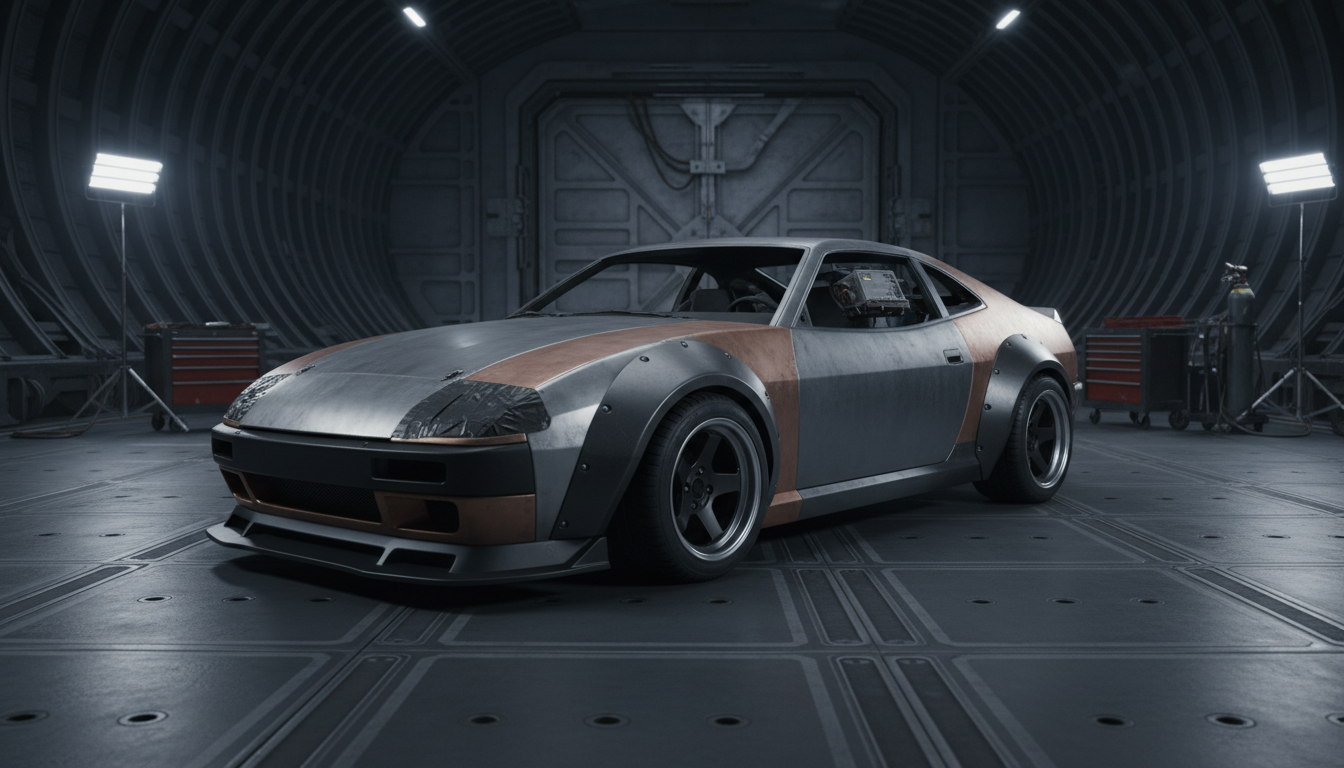
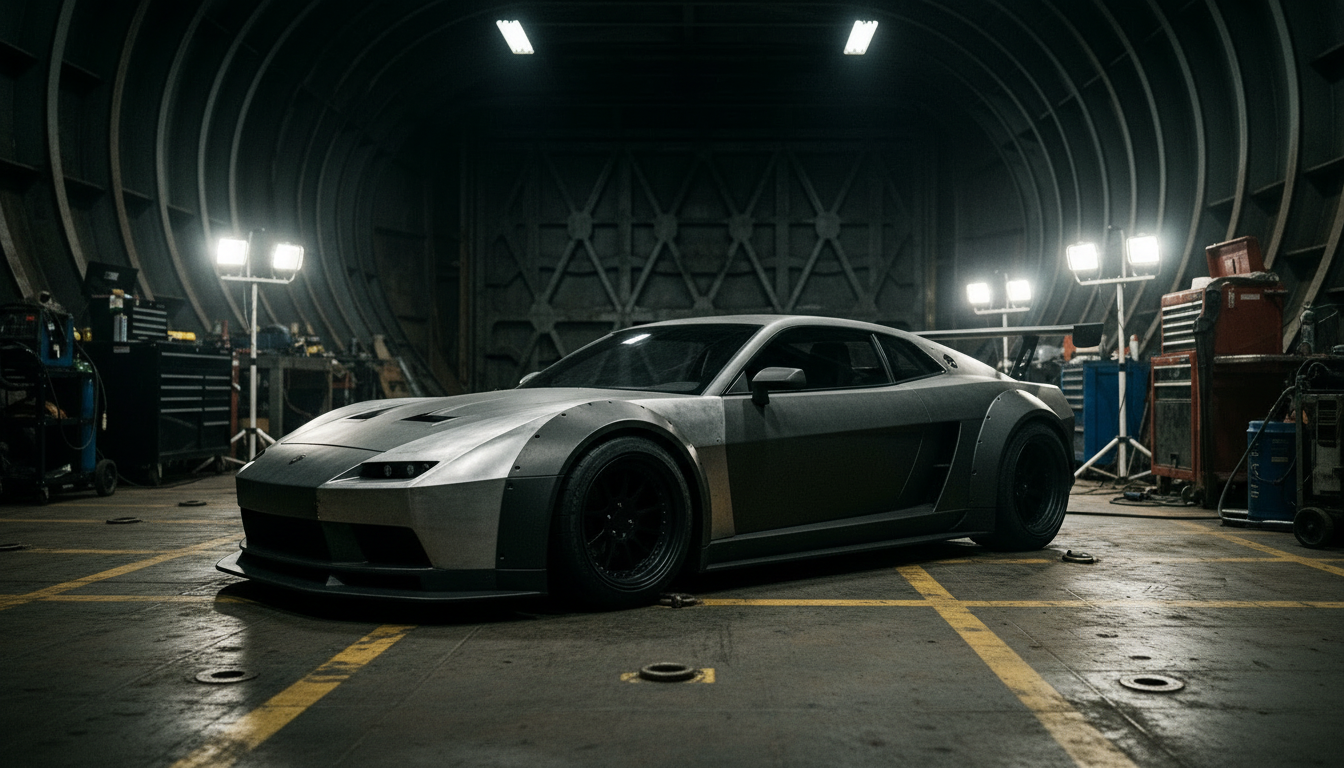
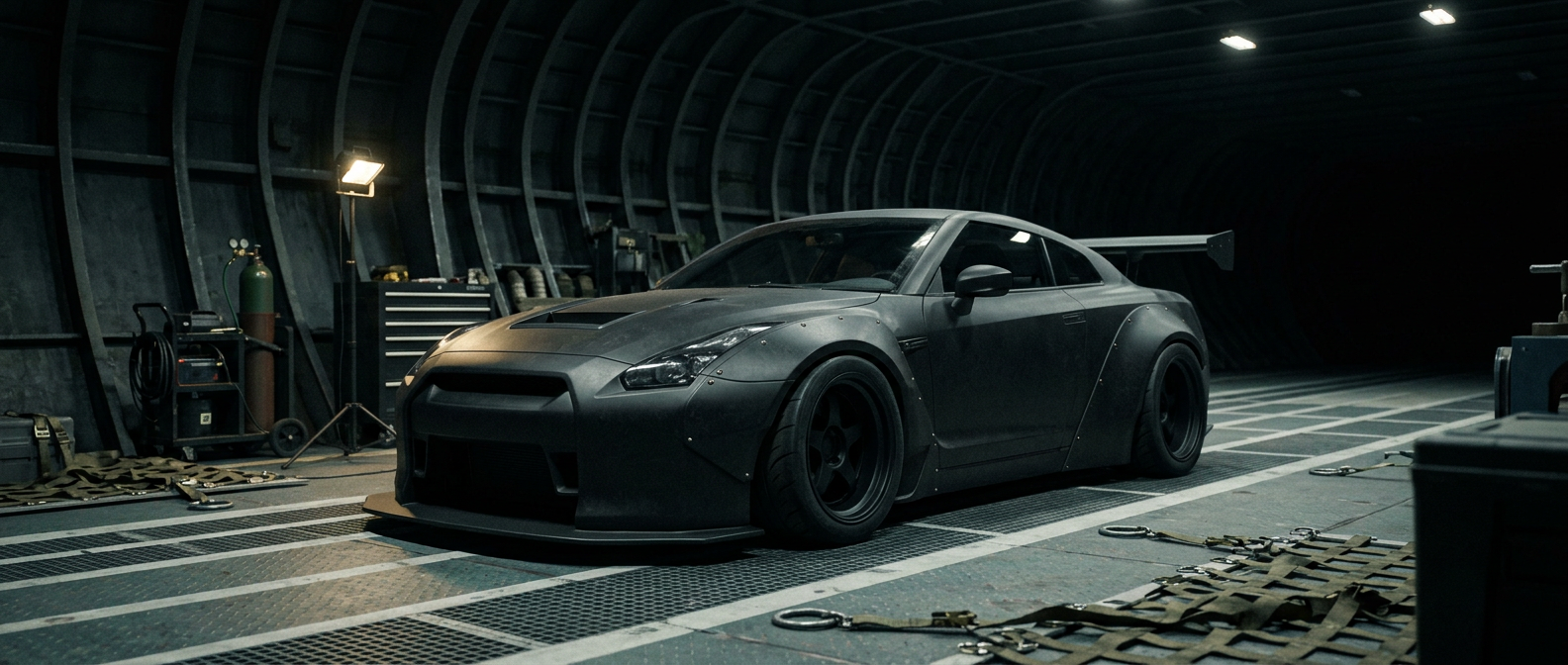
Chapter Index
Every chapter, all parts. Each becomes a real, readable chapter the moment it is written — the vehicle-by-vehicle plan above stays as the reference.
Chapter 1 — Nothing to Build With
↑ Back to ContentsFocus: Calder ("Ghost").
There was nothing to build with, which was the first thing he had to get past, and it took him four months.
The ship was full of material. That was the joke of it. A hundred thousand people asleep in the racks, thirty-six years of consumables, spares for systems that would not fail for a decade, and every gram of it accounted for on a manifest that Calder could read from the terminal in the hold whenever he wanted. Accounted for. That was the word that stopped him. Not locked, not guarded — nobody guarded anything, there were ten of them awake and nowhere to run to — just written down, in a column, against a purpose.
He spent those four months walking. Not for exercise, though he told Sergei it was. He walked the outer corridors because they were long and empty and because after the first month he had noticed that one particular stretch of maintenance way ran nearly straight for a mile and a half before it began to bend around the curve of the hull, and then kept going, and kept bending, and came out somewhere he had not expected, into the overflow holds where the hydroponic scrubbers dumped their excess and nobody had ever been assigned to trim what grew there.
Grass. Not a crop, not a specimen, just ground cover that had escaped a tray sometime in the first year and found the ribbing along the deck edge agreeable. It came up to his knee in places. Nobody had told it to stop.
He stood there a while, on a ship four years out from a planet he had never walked on, looking at weeds.
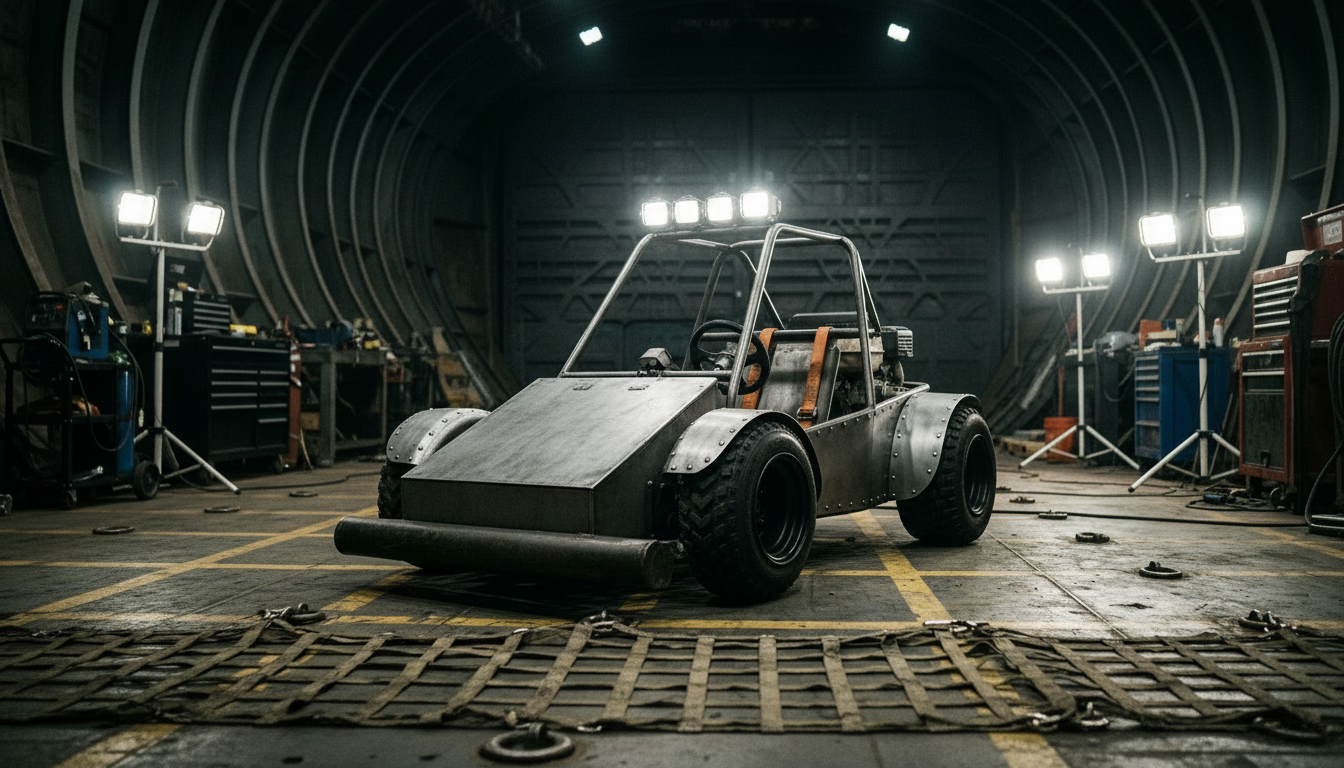
Then he went back to the hold and started pulling apart packing frame.
Packing frame was the answer because packing frame was already garbage. It came in around the cryo racks, it did its job once, and after that it was mass that the ship would carry for thirty-six years because ejecting anything was a fuel penalty and nobody had budgeted for tidiness. Tube, mostly. Light alloy, thin wall, cut to lengths that had nothing to do with what he wanted and everything to do with the crates they had cradled.
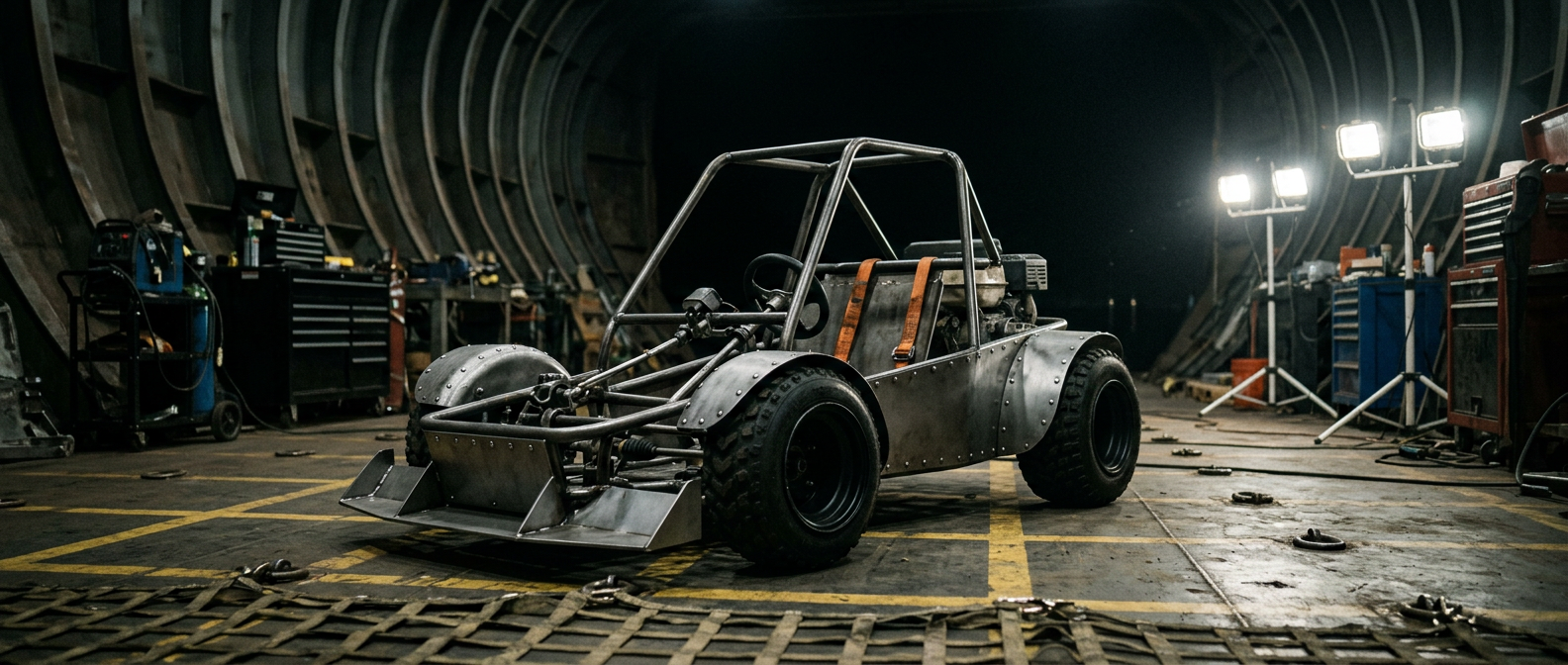
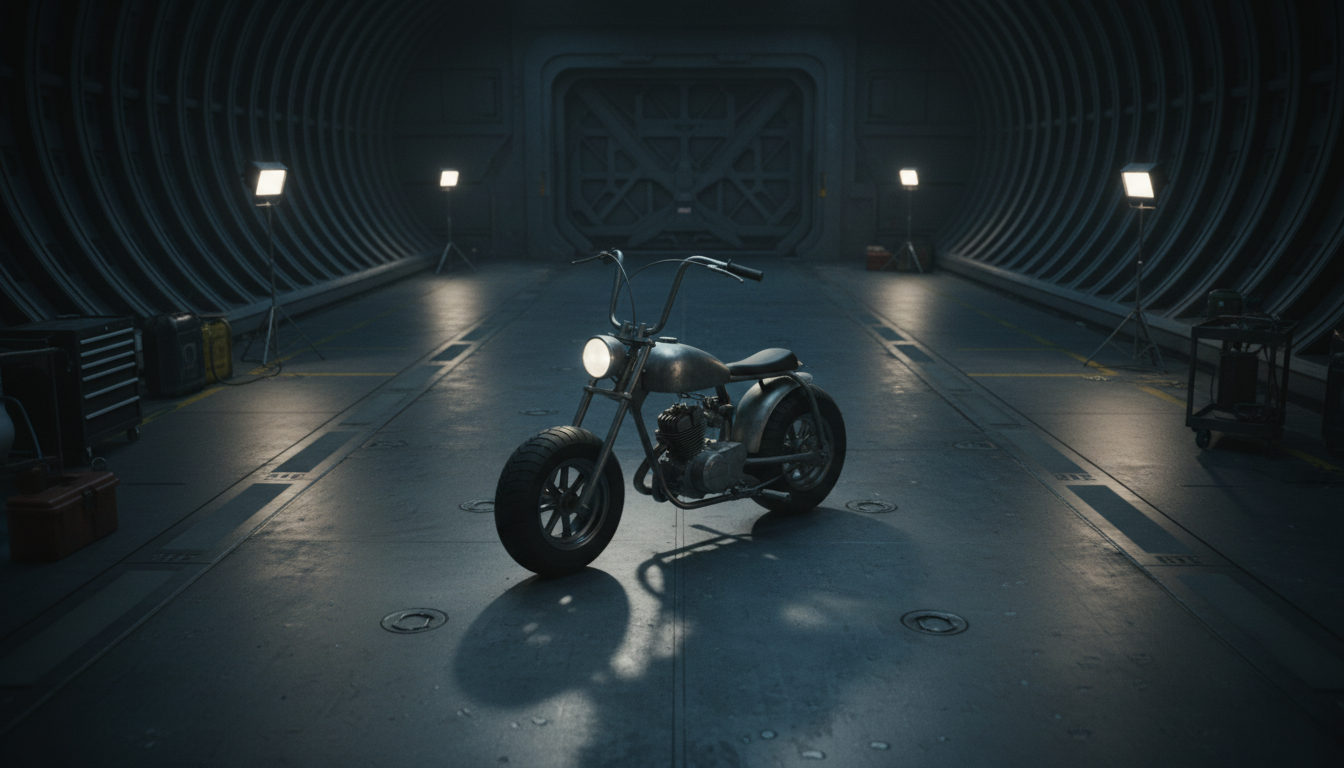
He built the smallest thing that could possibly move.
That was the whole design brief, and he knew it was a coward's brief while he was writing it out. A frame he could straddle. Four wheels off a materials dolly, hard compound, no give in them at all. A seat that was a piece of formed panel with the edges rolled over so it would not open him up. Steering that was two rods and a hope. He had built cars before — real ones, on the ground, with tools that cost more than the cars — and he was not building a car. He was asking a question.
The question was whether the hands still knew.
Because that was the thing about the crossing that nobody had said out loud in the first four months, and would not say out loud for another six years. Thirty-six years. Not a deployment, not a tour. A life, spent in a corridor, with nine other people, and at the far end of it a planet where the useful skill was going to be something else entirely. He was forty-one. He would be seventy-seven when the ship stopped. Everything he knew how to do was a thing he had learned somewhere with sky over it.
So: a frame, four hard wheels, and a seat. Find out.
The welds were poor. He was honest with himself about that at the time and he stayed honest about it afterwards, which is why the go-kart survived — he never cut it up for parts, the way he cut up almost everything after. The alloy was wrong for the process and he did not have the process he wanted, and the beads sat proud and ugly along every joint like something the frame had eaten. It held. Holding was all he had asked of it.
He took it out on a shift when the others were down in the forward sections, because he did not want company for this.
The stretch he had cleared of crates ran maybe six hundred metres before the first real bend. He rolled onto it and put his weight forward and got it moving, and the hard wheels sent every seam in the deck plate straight up through the panel seat into his spine, and the noise in the empty corridor was tremendous, and he went down the whole length of it at something between a walk and a jog.
He took the bend wide and slow, both hands hard on the rods, and came out of it still pointing the way he wanted.
He did not get sideways once. Not for a metre, not for an instant. The kart tracked like a shopping trolley, which is what it was, and the corridor stayed exactly as wide as it had been, and nothing about the five minutes he had just spent was anything like driving.
He sat at the far end with the frame ticking as it cooled and his hands shaking slightly, and he was so pleased with himself he had to sit there a while before he trusted his legs.
Then he pushed it back up the corridor by hand, all six hundred metres, and put it against the hold wall, and stood looking at the four hard grey dolly wheels.
Tyres, he thought. That is the whole of it. I need something that lets go.
Chapter 2 — Salvage Rights
↑ Back to ContentsFocus: Calder ("Ghost").
The scrap he wanted was not scrap. That was the difficulty with year two.
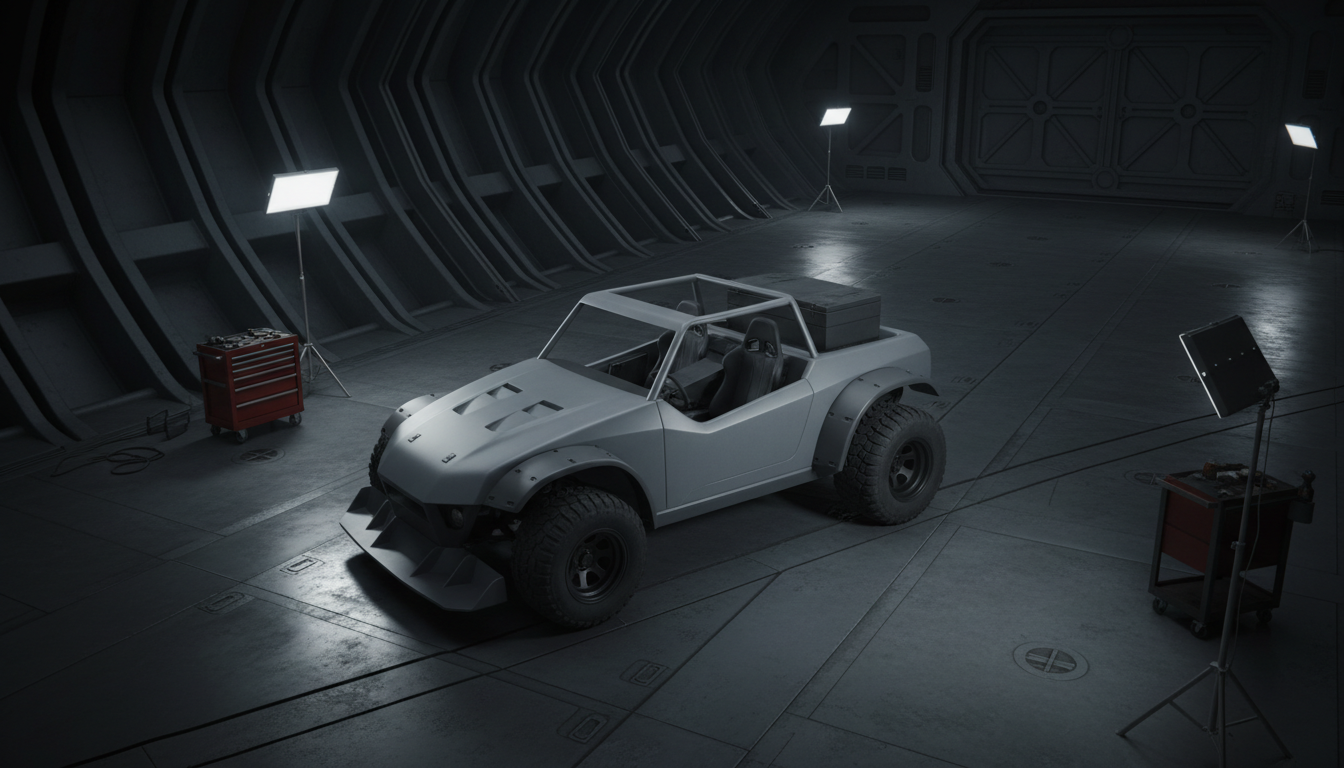
A stripped service buggy was in his head by then and had been since about the third week after the go-kart, and it was not a modest idea. He wanted a real chassis under him — something with a wheelbase, something with suspension travel, something where the wheels could move relative to the body instead of hammering the deck seams directly into his teeth. And the ship had exactly that, four of them, parked in the forward maintenance bay: low flat service trucks for moving equipment along the spine, with independent trailing arms and soft compliant wheels and a whole lot of unused capability.
They were not scrap. They were on the manifest. Two of them had not been switched on since launch.
He thought about it for a long time before he asked, and he thought about the asking more than about the buggy. He could have taken it. That was the uncomfortable part. Ten people awake, no watch on anything, and a maintenance bay nobody visited for weeks at a stretch — he could have walked one of the spares back to the hold in pieces over a fortnight and there was a reasonable chance nobody would have found out for six years, and by then it would have been a story rather than a theft.
He went and found Sergei instead, in the scrubber gallery, and asked him badly.
He was not good at this. He had spent his adult life in workshops where the transaction was money, and money is a wonderfully simple thing to hand somebody. Here there was no money, there was nothing he had that she wanted, and there was not going to be for thirty-two more years. So what he actually said, standing in a room that smelled of wet green, was something like: there are four and we need two, and I would like one of the other two, and I do not have a reason that would survive being written down.
Sergei looked at him for a while.
Then she said take the far one, it's got a bad arm anyway, and went back to what she was doing.
He has told that story maybe four times in his life and every time he has got the words slightly wrong, because the words were not the thing. The thing was that she did not ask what it was for. There was no reason on the ship for her to hand over a serviceable vehicle to a man who wanted to cut it up, and she did it anyway, and she did it in about nine seconds, and it was — he worked this out much later, on the ground, in a different decade — the first thing anybody aboard had done purely because they wanted to. Everything else in the first two years had been schedule.
Stripping it took him most of the year, because he did it properly.
Off came the cargo deck, the tie-down rails, the powered lift, the enclosed cab with its two seats and its climate loop, the safety interlocks that would not let it move above walking pace with a load aboard, the load sensors that told the interlocks what to think, the corner lamps, the bumpers, the toolbox, and about two hundred kilos of steel plate whose only function was to stop somebody dropping a crate through the floor. What was left when he had finished was a ladder frame, four trailing arms, the drive units, a control column and a mesh floor pan he had cut himself out of stair tread because the original deck was a slab and he wanted to see the corridor going past underneath him.
He fixed the bad arm in an afternoon. It was a seized bush. Sergei had been carrying that in his head as a defect for four years.
The buggy weighed a third of what the truck had weighed and it had the same suspension under it, which meant every calculation the original engineers had made about spring rate was now comprehensively wrong in his favour. It rode high. It rolled in the corners like something on a boat. It was, for the first time, a machine that responded to what he did rather than simply enduring it.
He took it up the corridor on the second-shift quiet and found out what a hairpin was.
Because the Long Five had a shape by then, and he had started to admit that he was making one. He had cleared crates from another mile and a half. The corridor did not run straight — no corridor on a rotating hull runs straight — and where it kicked around the structural ribs it kicked hard, twice within four hundred metres, tight enough that you had to slow for them and then tight enough that slowing was not the interesting option.
He came into the second one too fast, backed off the power, and felt the whole rear of the buggy go light and step out about a hand's width.
Just a hand's width. Then it caught, and he was through, mesh floor humming under his boots and the grass along the ribbing laid flat by the pass and standing back up behind him.
When he got back to the hold Sergei was sitting on a crate at the mouth of it with his arms folded, having walked down from the gallery to watch, and he had seen the whole thing.
She still did not ask.
Chapter 3 — Nothing Matches
↑ Back to ContentsFocus: Calder ("Ghost").
Year three was the year he stopped pretending a matched set was coming.
He had been holding out for one. That was the honest shape of the first two winters — winters being a word that meant nothing aboard and which the ten of them used anyway, for the stretch of the year when the ship ran its long maintenance cycle and everyone was tired. He had been saving. Every time a wheel came out of a failed unit he had put it on the rack in the hold and turned it so the good face showed and thought: three more of those and I have a car.
Three more of those were never going to happen. A ship carries spares against failure, and the failures a ship actually has are scattered across forty different systems, so what accumulates is one of everything and four of nothing.
What he had, by the start of year three, was this. A soft compliant roller off a cargo mover, four hundred millimetres, wide as his hand and a half, made to cross a floor without marking it. A hard grey dolly wheel of the kind he had used on the go-kart, two-fifty, no compliance at all. A narrow pneumatic-analogue off a gantry, three hundred, tall and thin, made to run in a rail and inclined to think it still was. And a solid moulded item, three-twenty, off something he never identified, which had a slight lobe in it that he could feel through the frame at any speed above walking and could never machine out.
No two the same size. No two the same compound. No two the same idea of what a wheel was for.
He built the runabout around them, and he did it deliberately, and this is the point at which somebody who has only heard about Calder from the cars gets him wrong. The story on the ground, sixty years later, has him as a man who could make anything out of nothing. That is not what happened in year three. What happened in year three is that he sat in the hold for a fortnight with four wrong wheels and let them tell him what the car was.
The big soft roller went right rear, because it would put down the most and forgive the most. The hard dolly wheel went left rear, because he wanted one corner that would give up early and tell him about it. The tall narrow gantry wheel went left front and gave the whole car a lean he had to build the frame around, three degrees of it, permanent. The lobed one went right front, where he would feel it through the column every revolution and be reminded, constantly, that the car was not symmetrical and never would be.
The frame followed. Longer on the left. Steering geometry that was a compromise nobody had ever needed to make on the ground, because on the ground you can simply buy a matching wheel. He had to build the pedals offset because the frame was offset. He built a spacer stack for the right rear and got it wrong twice.
It looked ridiculous. It looked like something that had been assembled during an emergency. Dov saw it in the hold and said it looked like four different cars had had an argument and the frame was the settlement, which was the first joke anyone made about the vehicles and by no means the last.
It drove better than anything he had built.
Not well. Better. It had suspension, it had a low centre of mass, and it had four corners that each announced themselves in a completely different voice, which meant that for the first time he was driving something instead of aiming it. Every corner on the Five asked the car a different question depending on which way it went, and the car gave four different answers, and he had to know all four.
He learned which corner would let go first the hard way, once.
It was the long right-hand sweeper at the second mile, the one that tightens where the hull rib comes through, and he went into it committed and on the power with the hard grey dolly wheel on the inside where it had no weight on it at all. There is no interesting way to describe what happened next. The left rear gave up entirely and instantly and without a word of warning, the car came around faster than he could catch, and he went into the ribbing sideways at something under thirty and put the whole left side of the runabout into a structural member that had been designed to survive a hull breach.
The frame folded. The gantry wheel came off and went a hundred metres down the corridor on its own. He was thrown against the column hard enough to break two of the ribs on his left side — the organic ones; the countermeasure housing on that side took the same impact and did not register it, which he found unpleasant to think about afterwards for reasons he never fully unpacked.
He lay in the grass at the edge of the deck for about ten minutes, breathing carefully.
Nobody came. Nobody knew he was out there. He walked back with one arm held against his side and told Halima he had fallen in the hold, and she believed him because it was year three and none of them had learned yet what he was actually doing down there.
He rebuilt the runabout in five weeks with the same four wheels in the same four corners.
He never moved the hard one to the inside of a right-hander again.
Chapter 4 — The Sled
↑ Back to ContentsFocus: Calder ("Ghost").
The sled was low because the ship said so, and everything else about the rest of his life followed from that.
He would not have put it that way in year four. In year four it was a clearance problem and nothing more. The Long Five had grown past three miles by then, and the far end of it — the section that ran through the overflow holds where the grass was — had a run of cable trays and conduit slung under the deckhead at a height somebody had chosen in a design office thirty years and eleven light-years ago, on the assumption that the tallest thing that would ever pass beneath it was a person carrying a box.
One metre ninety, in places. Less where a junction hung down.
The runabout, rebuilt, sat him at about one seventy with his head up. He had been ducking. For a year he had been going through that section with his chin near the column and his eyes doing something he did not like, which was looking at the deckhead instead of at the corner, and twice he had come out of the second overflow bend with no clear memory of having steered through it.
So: build low. That was the entire specification for year four, and it was the first time the ship had designed a car for him instead of merely supplying one.
He went about as low as the wheels allowed. The seat pan sat between the frame rails rather than on them, which meant cutting the rails and boxing them back together around a tub, which meant three months and a jig. He reclined it until his back was at maybe twenty degrees off the deck and his knees were higher than his hips. He put the steering rack behind the front axle line because there was nowhere else for it. He fed the control runs down the outside of the tub because there was no room inside it, and covered them with a strip of the same stair tread mesh, and that strip is on every photograph anybody has ever seen of a Calder car, thirty-two years of them, because he never found a better answer and eventually stopped looking.
Single seat. There was no argument to be had about that; there was no room for a second seat and no candidate for it either.
When he sat in it finished, in the hold, with the frame on stands, his eye line was level with the tops of the wheels.
That is a specific and slightly deranged place to put a human being. On the ground nobody does it outside of a racing class with a rulebook forcing the issue, and there is a reason: you cannot see. What you can see, from down there, is the deck rushing at you from about four metres ahead, and the wheel tops moving up and down at the edge of your vision, and nothing at all of what the corridor is doing beyond the next bend.
The first run was awful. He came into the first hairpin with no idea where it was — he had driven it two hundred times and could not find it from that height — and stopped, and sat there, and thought seriously about spending eight weeks putting the seat back up.
The second run was less awful. By the fifth he had stopped using the corridor to know where he was and started using the ribbing, which passed at the exact level of his shoulder, one rib every eleven metres, and which he could count without looking at.
What he had not expected was the speed.
He was not going faster. He checked, afterwards, by timing himself, and he was going marginally slower than he had in the runabout because the sled's wheels were narrower and it would not put the power down out of a slow corner. But at that height, at that recline, with the deck plate four metres in front of his face and the grass along the edge of the overflow section going past at eye level and dragging in his slipstream — at that height, thirty was enormous. Thirty was a thing happening to him rather than a number.
The hairpins arrived sideways before he was ready for them. That is the literal truth of it and not a figure of speech: from down there the corridor did not appear to turn, it appeared to swing across him, the way a door does when somebody else opens it.
He liked low. He worked that out in about the second week.
He liked it very much more three weeks after that, on the long left before the overflow holds, when he came in with a bit too much and the sled's tail went out and stayed out — not the runabout's abrupt bad-tempered snap, but a slow committed slide, the whole car turned maybe fifteen degrees off its direction of travel and holding there, and him lying nearly flat in it with the wheel tops describing a shallow arc against the ribbing and the deck coming at his face at an angle it had no business coming at.
He held it for perhaps sixty metres. It felt like a great deal longer than that.
He built thirty-two more vehicles after the sled and every single one of them put the driver low, and when he was asked about it on the ground, decades later, by a young woman who had never been off the planet and never seen a corridor, all he said was that it was a clearance thing on the ship.
Which was true in year four and had not been true since.
Chapter 5 — Two Wheels, Once
↑ Back to ContentsFocus: Calder ("Ghost").
There is exactly one two-wheeler in the thirty-six, and it exists because Aiyana bet him he could not make one.
That is not quite how she remembers it. Her version, which she told for years afterwards and which is more entertaining, is that she bet him he would not dare. His version was always that she bet he could not, which is a different wager and a much easier one to win, and the fact that he insisted on the distinction for the rest of his life tells you most of what you need to know about how the two of them got on.
Aiyana was the only one who ever went faster than him on the Five.
Not often. Four times across thirty-six years, by his count, and she disputed the count. But she had done something before the crossing that none of the other nine had done — she had raced, briefly and badly and a long time ago, on a surface with weather over it — and she was the only person aboard who understood what he was doing down there without having it explained, and the only one who ever asked for a go and then took the corner properly on the first attempt.
She also thought the cars were too heavy.
That was the argument, in year five. She would say that the whole enterprise was compensating for something with mass, and he would say that mass was the only thing on the ship there was any quantity of, and she would say that a bike would be a tenth of it and go twice as well, and he would say that a bike would be no fun to build.
He built the bike.
It took him four months, which is by a wide margin the fastest he ever finished anything, and that turned out to be the problem rather than the achievement. A frame, a wheel at each end, a seat, a column, a drive on the rear. There was no packaging problem to solve because there was almost nothing to package. There was no weight distribution question worth an evening's thought. There was no geometry to compromise, no place where two systems wanted the same three hundred millimetres, none of the long, slow, absorbing negotiation with a shape that had made the sled take eleven months and had been, he understood by then, most of the point.
He finished it in the spring of year five and sat looking at it and felt nothing much at all.
It went beautifully. He is on record about this, in the only real record there is, which is what Aiyana told people. It was light and it turned instantly and it did not care about the cable trays at the far end of the Five because nothing about it came anywhere near them, and on the first mile — the fast open first mile, before the corridor starts kicking around the ribs — it was quicker than anything he had built to that date.
She rode pillion on the bet. Once.
The bet had been that she would not, and she did, with her boots up on the frame rails and both hands flat on his back rather than around him because she said afterwards that holding on would have been conceding the point. They did the first mile at a speed neither of them ever put a number to. When they stopped she got off and walked in a small circle and laughed for about a minute and a half, which was longer than she had laughed at anything since launch, and then she said do the next mile.
He said no.
The next mile was the hairpins, and he had already found out what he needed to know about the bike and the hairpins, alone, three weeks earlier. You cannot hold a slide on two wheels the way you can on four. You can slide a bike — of course you can, and he could — but what you are doing when you do it is recovering, continuously, from something that is trying to end. A car in a long slide is in a state. It is doing a thing it can keep doing, and you sit in the middle of it and make small adjustments and it goes on being true for as long as you have corridor left. A bike sliding is a bike falling slowly, and the whole of your attention goes into the falling, and there is none left over to enjoy it with.
He tried to say that to Aiyana, at the end of the first mile, with the frame ticking between them.
What actually came out was: I didn't like how little of it there was to work on.
She took that to be about the building, and she was right, and he never corrected her because he could not have explained the other half without sounding like a man describing a religion. Two wheels cannot hold a slide the way four can. That was the whole of his theory of vehicles and he never put it better than he put it badly, that day, in a corridor, out of breath.
He gave her the bike.
Not that year — he kept it through year six, mostly out of stubbornness — but at the end of it he pushed it up to the forward section and left it against the wall outside her quarters with the charge lead coiled on the seat, and did not say anything about it, and she did not say anything about it either.
She still had it at planetfall. Thirty-one years. It is the only vehicle he ever built for a person rather than for a year, and it is the only one that outlived the crossing, and there is no photograph of that one either.$
Chapter 6 — The Hold Tug
↑ Back to ContentsFocus: Calder ("Ghost") — closes Phase 1.
The tug was the first one that was any use to anybody, and that is the only reason people remember year six.
What happened was that a scrubber stack in the mid-hold section failed in a way that required six people to move eleven hundred kilos of filter media forty metres, and the powered lift that was supposed to do it was on the wrong side of a bulkhead that had been sealed since launch for reasons nobody could locate in the documentation. It was going to take three days by hand. Nnamdi came down to the cargo hold to ask whether Calder had anything, and asked it in the tone people use when they already know the answer is no and are only asking so that they can say they did.
Calder said he could have something in eight weeks.
That was, as it turned out, exactly the wrong length of time to be useful for the filter media, which got moved by hand over three days by six tired people while he was still cutting frame. But it was not the wrong length of time to change what the other nine thought was happening in the cargo hold, because at the end of the eight weeks there was an industrial hold tug in the mid-section that could shift two tonnes at a walking pace and be driven by anyone, and after that nobody used the word hobby again.
He minded that more than he expected to.
He built it well. That should be said plainly, because everything else about this chapter is him being ungracious about a machine that did not deserve it. It had a proper low-geared drive with real torque at zero, a tow hitch he made from a cargo tie-down point, a flat deck at the back with recessed rings, a seat that could be got into by somebody in a hurry, and controls a person could understand in ninety seconds without being told. It had the mesh strip down the outside of the tub, because by then that was simply how he made things. It weighed nine hundred kilos empty, most of it ballast he had put there on purpose so it would not lift a wheel under load.
He knew before he started that it would not drift. You do not need to build a nine-hundred-kilo tug with a walking-pace final drive to find out whether it will hold a slide. He knew in the first week, at the frame stage, and he built it anyway and put the ballast in anyway, because it was the right machine for what Nnamdi had asked for and he was not going to make it worse in order to make it more interesting to himself.
He took it out on the Five regardless.
Nobody has ever quite understood this part, and he never explained it. The tug was the one vehicle in thirty-six years that had no reason to go up the corridor. It was going to be slow, it was going to be dull, and there was nothing to learn — the whole of its behaviour was legible from the specification.
He took it up the whole five miles at eleven kilometres an hour, which took him a little over twenty-six minutes, and he did it because he had never once done the Five slowly.
That is what he found out. Five miles is very long.
He had been driving that corridor for six years and he had never seen it. At speed the Five was a sequence — the fast first mile, the two hard kicks around the ribs, the sweeper, the section where the deck plate changed and the note under the wheels changed with it, the overflow holds with the grass, the low run under the cable trays, the far end. Nine or ten events, strung together, each one arriving as a problem and departing as a result. That was the whole shape of it in his head.
At eleven kilometres an hour it was not a sequence. It was a place.
He went past the cryo racks slowly enough to read the plates. He had never done that. There were four hundred and eleven of them visible from the corridor on that stretch, and each one had a number and a surname on it, and he read maybe sixty before the corridor turned away from them, and the sixty went into him and stayed. He got to the overflow holds and the grass had gone over waist high in the middle section where the scrubber outflow was heaviest, and there were seed heads on it, and it had made a path where he came through every week — a flattened line, two wheel tracks and a bare strip between them, worn into a crop nobody had planted, on a ship five years from anywhere.
He stopped the tug in the middle of it and sat there with the drive humming and did not move for some while.
Then he did the last mile and a half at eleven kilometres an hour, and turned the tug around, and took it up to the mid-section, and gave it to Nnamdi's crew, and they had it for the next thirty years and never once called it anything but the tug.
He walked back down to the hold the long way, on foot, and by the time he got there the question had arrived and it was not going to leave.
Six years of finding out whether he still could. Fine. He still could.
Now what was he going to build?
Chapter 7 — A Real Car
↑ Back to ContentsFocus: Calder ("Ghost").
In year seven he built a car, and it is the least interesting thing he ever made, and he knew that while he was making it.
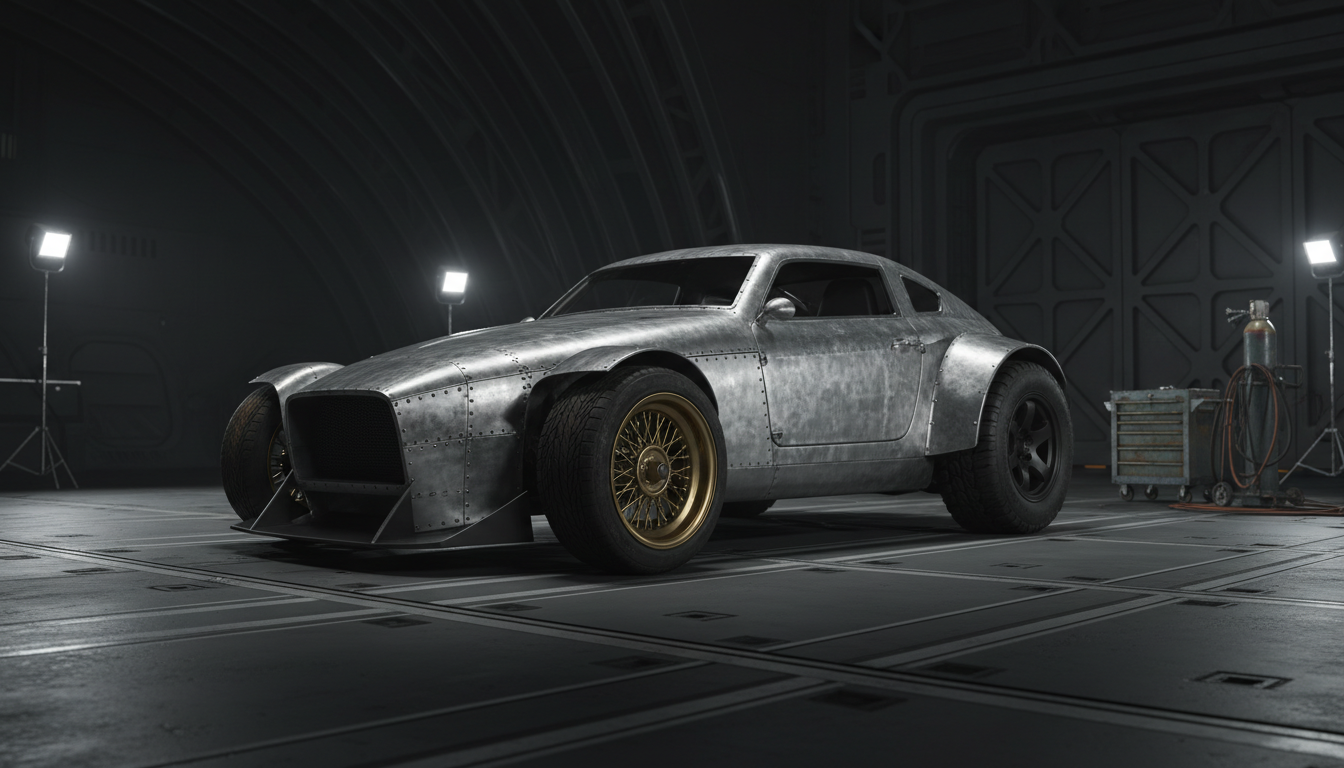
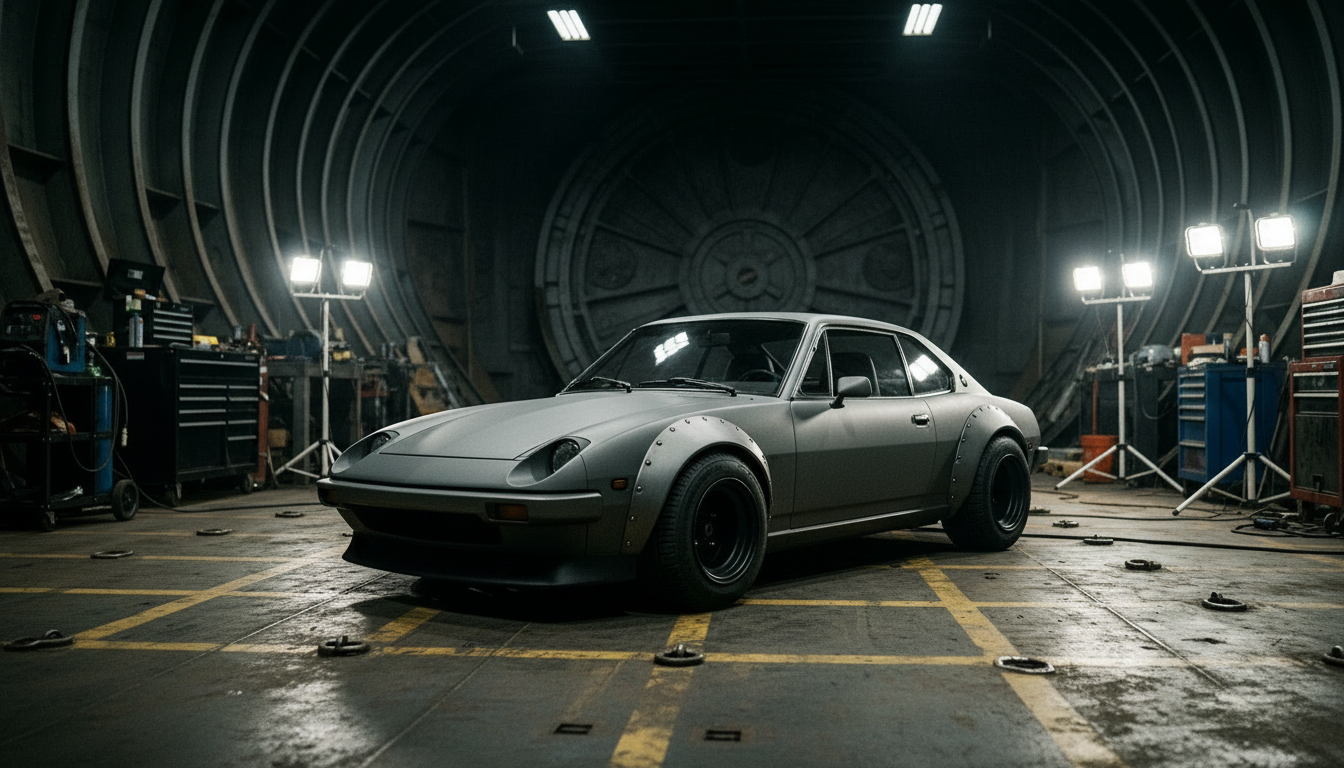
It had doors. That was the headline, in the hold, for about a month — actual doors, on hinges, with a latch he machined himself and a seal round the aperture cut from a spare airlock gasket. It had a roof. It had a boot with a lid, a proper one, with a strut to hold it up. It had two seats, which was a first and a last for a very long time, and a bulkhead behind them, and a dash with the controls set into it instead of hanging off a column.
Dov called it the executive saloon. Miriam asked, seriously, whether it would be all right to use, and he said yes, and she borrowed it for a fortnight to get between the forward section and the scrubber gallery when her knee was bad, and gave it back with the seat moved forward and the mirror adjusted, and that was the most anybody had ever used one of his cars for its stated purpose.
It was a narrow-body. Standard track, arches over the wheels with a couple of centimetres of air on either side, everything sitting exactly where the frame said it should sit. He drew it that way on purpose, because after six years of packing frame and mismatched wheels and a sled you had to be poured into, he wanted to make one thing that was simply correct.
He got it correct. That was the problem.
He knew somewhere around the eleventh week. He was making the door cards — the door cards, on a vehicle for a corridor on a ship, and he had cut and rolled two panels of trim and was fitting the second one when he stopped and looked at what his hands were doing and understood that he had spent four days on a surface nobody would ever look at, on a car whose behaviour he could already predict, because predicting the behaviour was no longer taking up any of him.
He finished it anyway. He always finished them.
The run confirmed everything. It went round the hairpins.
That sentence needs the emphasis it does not obviously carry. It went round them: it approached the corner, it turned in, the tyres gripped from entry to exit exactly as the geometry said they would, and it came out the other side pointing down the corridor with all four wheels tracking true and the driver having done nothing more strenuous than steering. It was tidy. It was quick, in the way that tidy things are quick — his time on the Five that year was the best it had been, by three seconds, and he did not care about the three seconds at all.
The sled had made him work. The runabout had lied to him in four different voices. This thing was a colleague.
Halfway up the second mile he found himself doing something he had never done in a car before, which was thinking about something else. He was on the approach to the tight left, at speed, and part of his head was on the filter schedule.
He came back down the Five slowly and sat in the hold with the door open and one leg out on the deck, and started cutting the car up in his mind.
Not scrapping it. Cutting. He was looking at the arch on the near side, the correct arch, two centimetres of air over a wheel that was exactly as wide as the frame had asked for, and what he was thinking was: what if the wheel were wider than the car wanted.
Everything on that car was a consequence of the track width. Spring rate, roll couple, how much of the tyre was on the deck when the body leaned, how fast the weight moved across when he lifted off — all of it downstream of a number he had chosen in the first week because it was the number the frame was happiest with. He had never once asked what happened if he chose a different one and made the frame put up with it.
Wider track. Wider wheels. Which meant the arches would not cover them, which meant the arches would have to go, which meant cutting metal off a car he had spent eleven months getting right.
He sat with that for the rest of the year, and drove the coupe most days, and got steadily better times out of it and enjoyed it less each month.
Miriam gave the seat back where she found it and said it was a lovely little car, and meant it kindly, and he thanked her and went on sitting there looking at the arches.
He kept the coupe intact until the spring of year eight.
Then he took an angle grinder to the front near-side arch, and stood back, and looked at the hole he had made in eleven months of correct work, and felt better than he had felt in eighteen months.
Chapter 8 — The First Flare
↑ Back to ContentsFocus: Calder ("Ghost").
Nobody understood the flares. Not one of the nine, not for years, and two of them never did.
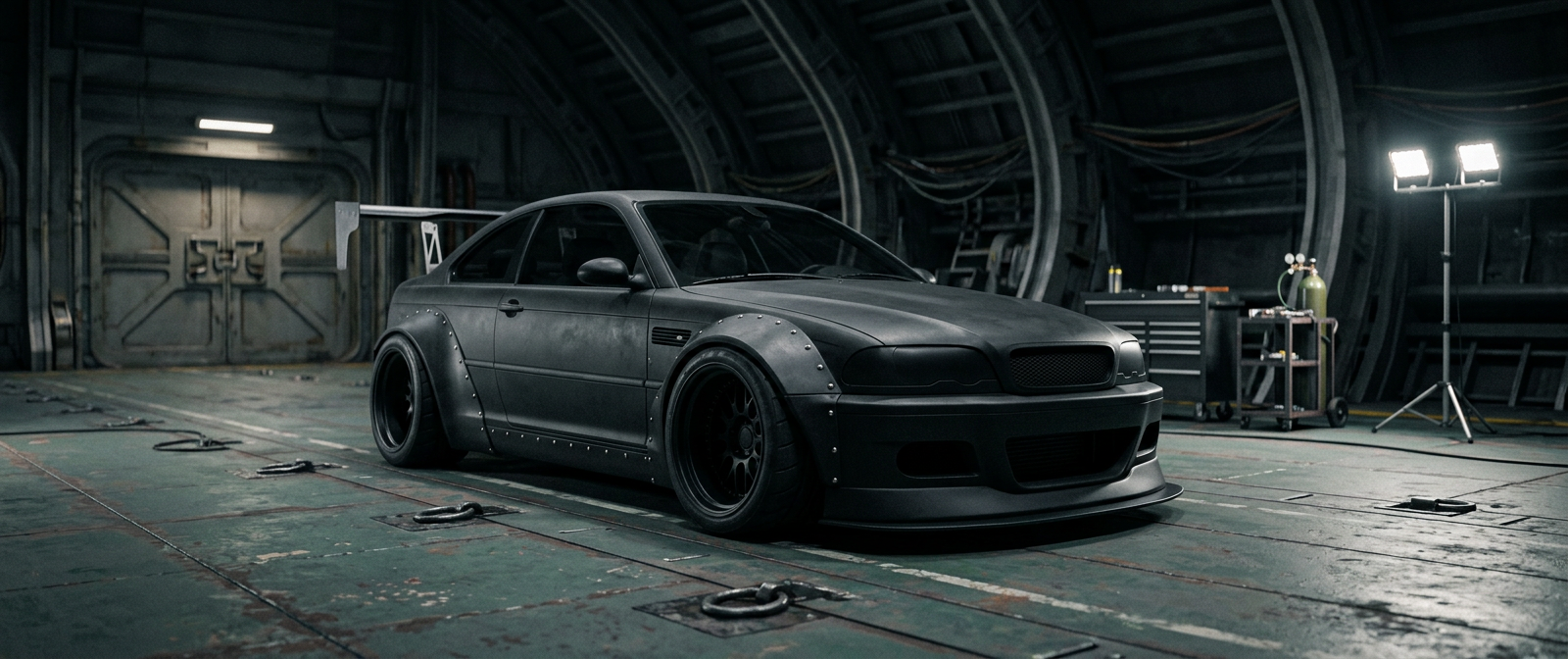
What they saw was this: a man who had spent eleven months building the only handsome, sensible, finished vehicle on the ship had cut all four wheel arches off it with a grinder, thrown the pieces in the offcut bin, pushed the wheels out from the body by nine centimetres a side on spacers he machined himself over six weeks, and then bolted on four new arches — deeper, rounder, standing proud of the bodywork by a hand's width, riveted at the lip because he liked the look of the rivets and made no claim that they were structural.
Renata came down and looked at it for a while and asked what it was for.
That was Renata's question, always, and it was never hostile; she asked it of everything, and she asked it in the tone of a woman who genuinely wanted the answer and would sit still for a long one. Calder said he did not know yet. That was true. It was the first honest answer he had given anybody about the vehicles in seven years and it did not satisfy either of them.
Dov said it looked like the car had put on trousers.
Here is what the flares actually were, technically, and he could have said this to Renata and did not, because saying it would have meant admitting how much of the last two years he had spent thinking about it. Pushing the wheels out widens the track. Widening the track lowers how much the body rolls for a given amount of cornering load, and — more to the point, the point he was actually chasing — it changes how quickly the weight moves from one side to the other when he does something abrupt. A narrow car transfers its weight fast and arrives at the limit all at once. A wide one takes longer to make up its mind, and the longer it takes, the more of the process the driver gets to be present for.
He did not want a faster car. He wanted a slower argument.
The arches themselves were not aerodynamic and were not pretending to be. They were there because the wheels were now outside the bodywork and something had to cover them, and because a wheel standing naked outside a body looks like damage, and because — this is the part he would have died before saying aloud in year eight — he thought they looked extraordinary.
The first run on the widebody was the most important five minutes of his working life and he did not know it until the second mile.
The first mile told him nothing much: fast, stable, slightly heavier in the steering off centre. Then the first hairpin, the tight left around the rib, the one he had taken four hundred times in six different vehicles.
He came in hard, turned, and lifted.
The tail came around. Not the runabout's snap. Not the sled's long slow committed drift, which had been a thing he sat inside and hoped about. It came around at a rate he could hear himself choosing, arrived at an angle he had picked on the way in, and stopped there — sat there, held, with the front wheels pointing into the corridor and the whole car crabbing through the corner at a diagonal, waiting on him.
He fed the power in and it went where he sent it. He straightened and it straightened.
He did the entire second mile like that. Both hairpins, the sweeper, the kink where the deck plate changed. He came out of the last of them at the top of the overflow section with grass whipping the flare edges and had to stop the car and get out and walk around it twice.
The thing he had been doing for seven years had, until that afternoon, been about survival: the corner arrived, the car did something, he coped. What had just happened was the opposite. He had told the car where to be, and it had gone there, and stayed, and asked him what next.
Every car he built after that had flares on it. Every single one, including the mule, including the tender, including the one he never signed. When the flares did not make engineering sense he put them on anyway and found a reason afterwards. Thirty-two vehicles wearing the same idea in thirty-two variations, and none of the nine ever quite worked out why, and by year fifteen they had stopped asking and started simply expecting it, which is how a habit becomes a signature without anybody agreeing to it.
Sixty years later there would be a word for the shape and a whole culture built on it and a road up a mountain where people would go to do the thing he had just done in a corridor, and the word would not be his and the culture would not know his name, and the wide-arched silhouette they all copied would be traceable, if anybody had ever tried to trace it, to a man in year eight of a crossing cutting up the only good car he ever made.
He did not know any of that. He got back in and did the second mile again.
Chapter 9 — Open Top
↑ Back to ContentsFocus: Calder ("Ghost").
In year nine he built a car for weather, on a ship where nobody had stood in any for eight years.
He did not put it that way and would have denied it if asked. What he said, when Coda asked why the roof came off, was that the widebody's roofline had been fighting the new arches and the proportions were wrong, which was true and was about eleven per cent of the reason.
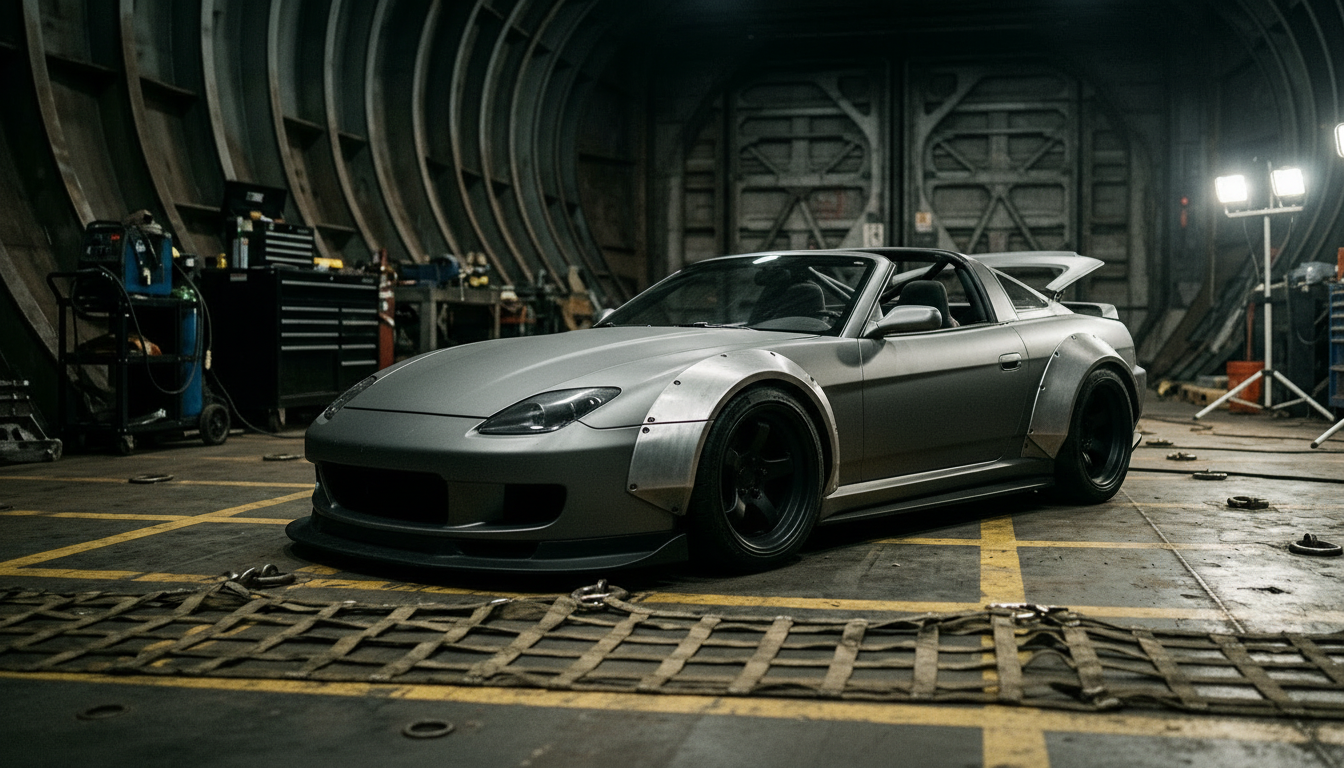
The targa was the first vehicle he designed from a blank sheet with the flares as a given rather than as an operation performed afterwards. Wide from the start. Arches built into the body rather than bolted over it, though he kept the rivets along the lip because by then the rivets were not negotiable. Low, of course. Single seat again — the two-seat experiment had ended with Miriam's knee. And then the middle of the roof came out.
Not a full convertible. He wanted the hoop behind his head, partly for the obvious reason and partly because the hoop was where he hung the rear of the body. A targa: a panel over the driver, unlatched at the front, lifted out, and stowed flat in the boot, and above him nothing but eleven metres of empty air and the deckhead ribbing going past.
It is a completely useless thing to build inside a hull.
There is no sky. There is no sun to want on your arms, no rain to be caught out by, no evening to drive into with the panel out. There is corridor lighting on a twenty-two-hour cycle that dims on a schedule and comes back up on a schedule, and above that a deckhead, and above that another deck, and eventually vacuum. He built an open-topped car anyway, in the ninth year of a thirty-six-year crossing, in a corridor.
The first run he did with the panel in, because he had not fitted the latches properly and did not trust them. The second run he did with it out.
The noise was extraordinary.
He had forgotten — properly forgotten, the way you forget a smell — what moving air does to a person. With the panel out at speed on the first mile, eight years of the ship's own recycled air came over the header rail and hit him in the face and the chest and went roaring past his ears, and he came off the power after four hundred metres because his eyes were streaming and he could not immediately account for it.
It was not weather. It was the same air he had been breathing since launch, at the same temperature it had been at every hour of every day for eight years, scrubbed and warmed and dead. It had never once moved across him. The ship's circulation ran at a rate calculated for gas exchange and nothing else, and the result, which none of the ten had noticed and all ten had been living inside, was that the air aboard was perfectly still and had been for eight years.
You cannot notice still air. You can only notice it stopping.
He did the whole five miles that day with the panel out and did not go particularly fast at any point, and when he came back down to the hold he sat in the car in the hold with the drive off for a long time, and eventually got out and put the panel back in and went to bed.
He took it out again the next day.
The grass was the other thing. He came through the overflow section with the top out for the first time in the late part of year nine, when the scrubber outflow was heavy and the crop along the ribbing had gone up past his shoulder and gone to seed, and the pass laid it flat on both sides as it always did, and this time the whole disturbed cloud of it came over the header rail with the air and went into the cockpit with him.
Seed heads. Dozens of them. In his collar, in the seat pan, down the back of the tub, in his hair, one in his mouth. He was picking them off himself in the hold that evening and laughing, alone, which was not a thing he did.
He found seed heads in that footwell for the next fourteen months. He would take a corner hard and one would come up out of the mesh and skitter across the floor. He never cleaned it out properly. Halima rode in the targa exactly once, sitting on the frame rail with her feet in the tub because there was nowhere else, and asked what all the bits were, and he said grass, and she said on a ship, and he said yes, and drove her up to the overflow holds and showed her.
She had been aboard nine years and had not known it was there.
That is the whole of year nine, really. A man built an open car for a planet he would reach at seventy-seven, drove it in a corridor, and found out what still air was and what a seed head was and that one of the nine people he would spend his life with had never seen the only field on the ship.
Chapter 10 — Everything Fits
↑ Back to ContentsFocus: Calder ("Ghost").
Halima asked for something that carried things, and she was very clear about it, and he did not listen to a word.
Her actual specification, delivered in the hold in about ninety seconds while she was on her way somewhere else, was: a flat floor, a long one, that she could get a stretcher onto without lifting it above her waist, and a tailgate she could open with an elbow, and enough room behind for the two hard cases the medical bay kept packed. She said she did not care what it looked like. She said that twice, because she had seen the targa and had formed a view about the direction of travel.
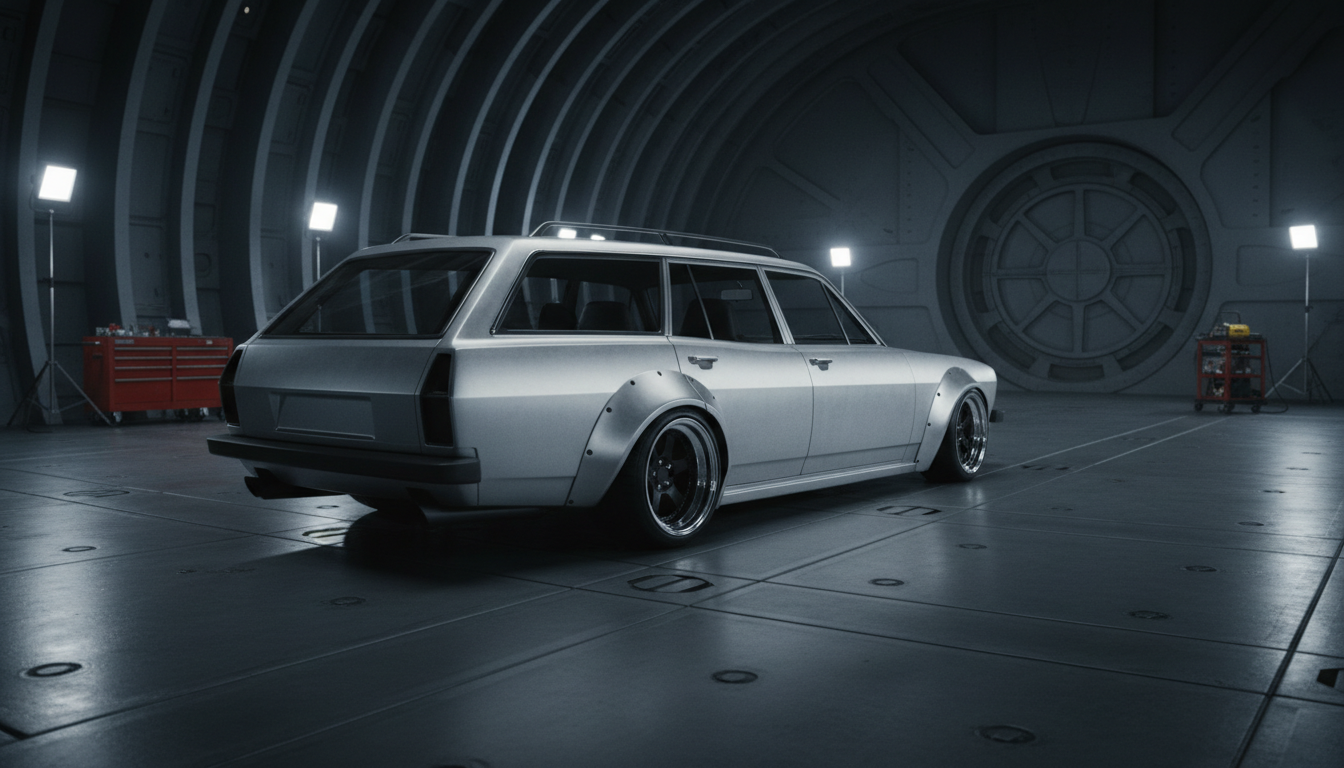
He built her a shooting brake.
A long low estate car with the roofline carried all the way back in one unbroken line to a tailgate cut on a rake, wide-arched at all four corners, riding on the same spacers as everything else, and finished — this is the part that embarrassed him — with the load floor laid in the same rolled stair-tread mesh he used on the outside of every tub, because he had four sheets of it left and because it looked, when the corridor lighting came down the length of it, like something worth looking at.
Everything she asked for was there. Flat floor, six hundred millimetres off the deck, which was as low as the drive units would allow. Two metres of length behind the seat. A tailgate on gas struts salvaged from a locker door that opened with an elbow, tested with an elbow, adjusted twice.
He also spent five weeks on the rear three-quarter.
There was no reason for it. The rear three-quarter of a vehicle is the part you see when you are walking away from it, and the only person who was ever going to walk away from this one was Halima, who did not care and had said so. He made a jig. He formed the panel in four passes and scrapped the first two, and got a curve running from the top of the rear arch up into the roofline that had no function and cost him five weeks of a life he had a fixed and known quantity of.
Coda came in while he was doing it and did not say anything, which from Coda was a whole essay.
Before he handed it over he took it up the Five loaded.
He did that on purpose and told nobody why. Four hundred and sixty kilos of ballast strapped down on the mesh floor over the rear axle, distributed the way two hard cases and a stretcher and a person would be distributed, because he wanted to know what the car would do for her when it was full and she was late and the corridor was the corridor.
It did exactly what he had calculated it would do, which was the pleasure of it. The extra mass over the back made it lazy on turn-in and enormously stable once it had taken a set, and when he provoked it at the second hairpin the tail went out slower and further and came back slower, and it took a firm hand to stop it, and it never once did anything he had not seen coming three metres earlier. That was the whole design. Not the tailgate, not the load floor, not the five weeks on the three-quarter panel. The spring rates at the rear and the way he had raked the arms, chosen so that a car full of medical kit driven quickly by a tired woman would be boring in a crisis.
He unstrapped the ballast at the far end and did the return leg empty, which was awful — nervous, light, sliding at every provocation — and he laughed the whole way down.
He gave it to Halima the next morning. She put both hands on the tailgate and worked it up and down twice with her elbow, and checked the height of the floor against her hip, and said that it would do very well.
Then she stood back and looked along the flank of it, at the curve, for slightly too long.
She said: I told you I didn't care what it looked like.
He said: I know.
She said: it's beautiful, Calder.
He said something that was not a sentence and went to find a tool he did not need.
He never told her about the ballast. Not that year, not in the twenty-six after it, not on the ground. She used that car for the rest of the crossing and it is the only one of the thirty-six that another person put miles on in any quantity, and she thought — she said so, more than once, fondly, in company — that he had made her a beautiful thing and thrown the practical bits in afterwards.
He had made her a practical thing and been unable to stop himself making it beautiful. Those are not the same, and it mattered to him, and he let her have her version anyway for twenty-six years, which is its own kind of gift and one nobody ever thanked him for because nobody ever knew.
Chapter 11 — The Van
↑ Back to ContentsFocus: Calder ("Ghost").
The van was a joke. He would like that on the record, because for about four years afterwards it was the only thing anybody quoted at him, and then it stopped being a joke and nobody noticed the moment it turned.
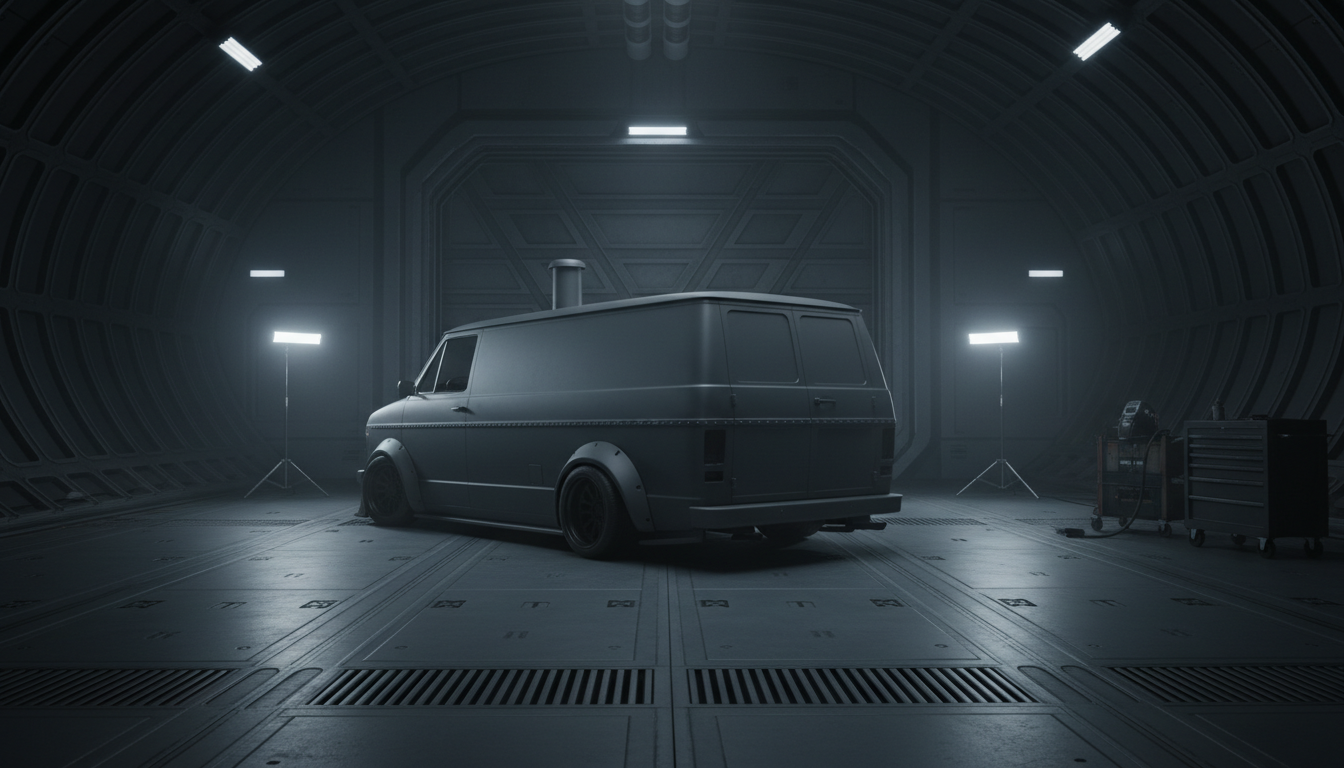
Year eleven. He had a panel van to build because Miriam had asked for one — an actual enclosed box on wheels, weathertight in the sense that mattered aboard, which was dust-tight, for moving calibration gear between the forward section and the sensor bays without it picking up hold grit. Perfectly sensible request. Perfectly dull vehicle. He could have built it in nine weeks and it would have been a box.
What he built was a box with the wheels pushed nine centimetres out at each corner, wearing four riveted flares deep enough to shade a man's boots, sitting about a hundred and ten millimetres lower than any cargo vehicle has any business sitting, with the stair-tread mesh strip running the whole length of the flank from the front arch to the tail door because on a van there was a great deal of flank to run it along.
Dov's line was that it looked like a filing cabinet that had been going to the gymnasium.
That was the joke, and the joke was not that it looked absurd. The joke, the one Calder was actually making and which took the other nine some years to catch, was structural. A van is a tall box with its mass high and its load in the middle and a long unsupported span behind the rear axle. Everything about the shape wants to roll, and everything about rolling makes a corner a negotiation you lose. You do not put a wide track and a low ride height on a cargo van because a cargo van is not for that.
Unless you do, and then it is.
He had spent three years by then learning what track width did to how fast weight moved across a car. On the van, with all that height above the roll centre and all that empty volume behind the axle, the effect was not subtle — it was the whole personality of the vehicle. Get it wide enough and low enough and the roll it wanted to do slowed right down, and the long tail that should have been a liability became an enormous lever with almost nothing on the end of it, which meant it would come around beautifully and stay there and be steered on the power, all day, at a speed that would embarrass a proper car.
He worked all this out on paper over about a fortnight and did not tell anybody, because it is not funny if you explain it first.
The first lap he did alone, at ship-morning, and confirmed everything. The second lap he did with the tail door up.
That was not planned. He had left it up after loading ballast and forgotten it, and he was already into the first mile when he registered the noise behind him, and by then he was not going to stop. So the second lap of the first proper run of the panel van was done with the back of it standing open like a shed with its door off, and the corridor lighting going in and out of the empty box, and every seam in the deck ringing through five cubic metres of unlined steel like the inside of a drum.
He took the second switchback flat.
He had not intended that either. He came in a little hot, felt the whole tall body take its time about leaning, understood in the middle of it that the van was going to hold, and stayed in it — and the thing rotated, all four tonnes of nothing, and hung there through the whole of the corner at an angle that a filing cabinet has no right to, with the open tail door swinging and the noise of it audible, as it turned out, from three sections away.
Coda was on the gantry above the second switchback doing a survey she had been putting off for a month.
Word reached the other nine before Calder had finished the lap. He came down the last mile and there were four of them standing at the mouth of the hold — Dov already laughing, Aiyana with her arms folded and an expression he did not care for at all, Renata asking her question before the drive was even off, and Miriam, whose van it technically was, looking at the ride height with the particular stillness of a woman doing arithmetic about ground clearance.
He gave her the van. It carried her calibration gear for twenty-five years and never once let dust into the box.
But that was the day the corridor stopped being private, and he knew it while he was standing there with the drive ticking and Dov quoting the filing-cabinet line for the first of what would be several hundred times. Eleven years he had run the Five alone. Nobody had ever come to watch. Nobody had ever had a reason.
Four years later they would have a schedule for it.
He did not mind as much as he had expected to, and minding less than he expected was, on a thirty-six-year crossing, the closest thing to news.
Chapter 12 — Load Bed
↑ Back to ContentsFocus: Calder ("Ghost").
The pickup is the one he never drove first, and he has never decided whether that bothered him.
Year twelve, and by then the hold was not private. That was the change the van had made, and it had made it permanently. People came down. Not often and not many — Dov because Dov went everywhere, Renata to ask what it was for at whatever stage it had reached, Nnamdi with a tape measure and a request he would not quite make out loud. The door was open because he had stopped closing it.
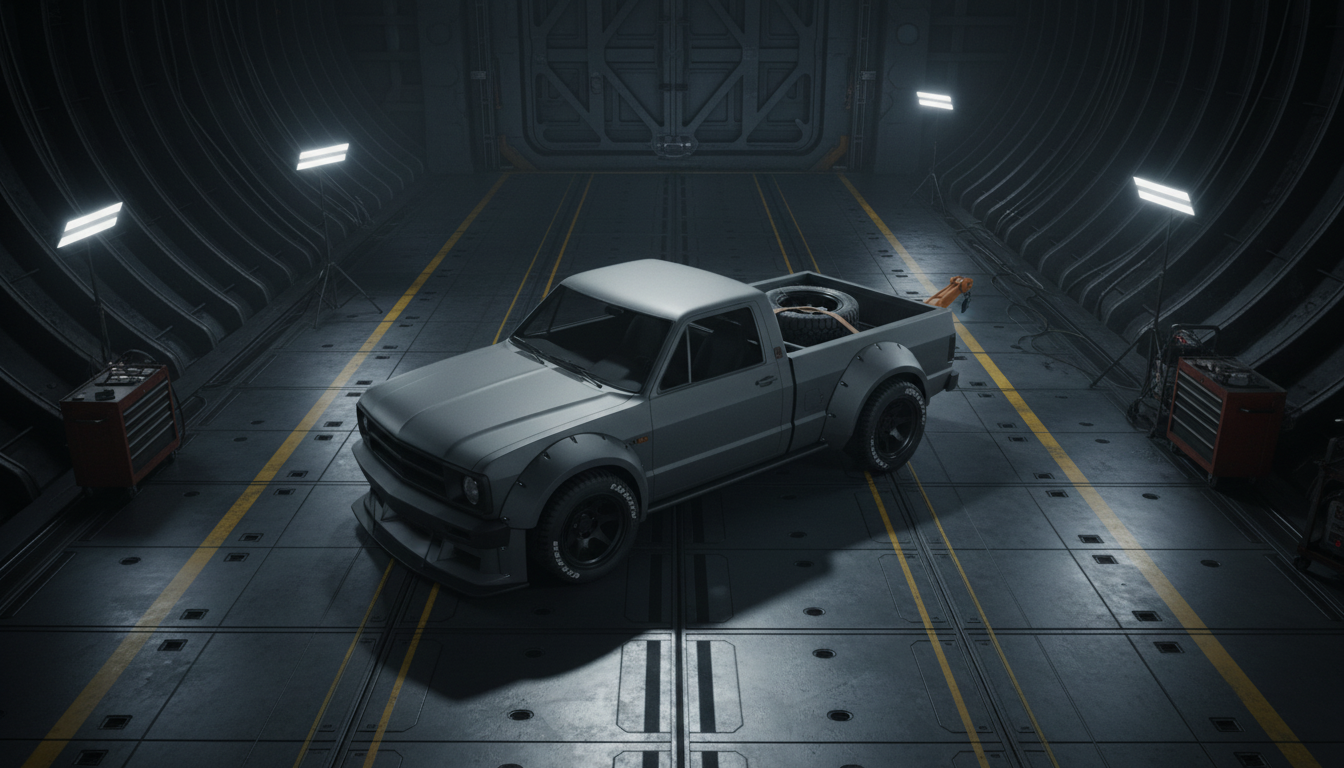
The pickup was Nnamdi's request, made the way Nnamdi made everything, which was by describing a problem in detail and then not asking for anything. His crew was running conduit through the mid-hold sections and the conduit came in four-metre lengths and there was nothing aboard to move four-metre lengths on except two people and a shoulder each. He said this twice over about a month. Then he came down and measured the width of the hold door, which was not subtle, and Calder let him do it.
So: a pickup. Long bed, drop sides, a tailgate that came all the way down flat so a four-metre length could overhang without fouling, and tie points every four hundred millimetres along the rail because Calder had watched enough people lash loads badly to know that the number of tie points determines how carefully a tired person secures a load.
Wide, low, flared, mesh strip. He was not going to stop doing that for anybody.
He finished it on a Thursday. He knew that because the drive units were bedded in and the fluid was up and he had planned the first run for Friday's second shift, when the Five would be empty, and he had been looking forward to it for a fortnight because a pickup with nothing in the bed was going to be a lively thing and he wanted the first lap to himself.
He came down Friday morning and it was gone.
There is a particular sensation, standing in a space where a vehicle you built with your own hands over eleven months is not. He went through the whole sequence in about four seconds — theft, which was absurd; some safety intervention, which was more absurd; and then he saw the drag marks in the hold dust where somebody had walked a bundle of conduit across to load it, and he understood.
It came back at the end of the shift with two hundred metres of conduit still in the bed and a note under the wiper that said needed it, will explain, N.
He stood there a long while.
He could feel, quite precisely, the shape of the annoyance he was entitled to. Eleven months. His scrap, his hold, his hands, and the first mile of a vehicle is a thing you only get once — you cannot un-drive a car, you cannot go back and find out what it felt like before it had been anywhere. Nnamdi had taken that, without asking, because he had needed a truck and there was a truck.
Then he walked round to the near-side rear and saw the sidewalls.
Fresh scrub marks. A band of them, high up the shoulder of the tyre, the outer edge scuffed and hazed and slightly rolled over — the mark a tyre makes when it has been loaded hard laterally and asked to hold on past the point where it wants to. He knew that mark. He had made that mark himself perhaps four thousand times in twelve years. It was not a mark you get moving conduit.
It was on both rear tyres. It was on the front near-side. It was not on the front off-side, which told him exactly which direction the corner had gone.
Somebody — Nnamdi, or one of Nnamdi's crew, and he never asked which and was never told — had taken a loaded pickup up the Long Five and put it through the sweeper hard enough to scrub the shoulders off three tyres, and had brought it back, and had said nothing about it at all.
He sat on the tailgate and laughed for a while, alone, in the hold, at nothing.
Then he drove it, that night, empty, and it was every bit as lively as he had hoped, and it was not the first mile and never would be.
The pickup belonged to Nnamdi's crew from that day, without anything being said, and it stayed with them for the rest of the crossing and went down to the surface in the second wave and worked for another eleven years on the ground. It is the only one of the thirty-six that anybody outside the ten ever used, and the people who used it on the ground did not know who had made it, and by then that was already true of almost everything.
He built a truck and somebody stole it to do a job with, and drove it too fast on the way back, and did not apologise for either.
He has said, in the only version of this anybody recorded, that it was the best thing that happened to him in the second decade.
Chapter 13 — Six Wheels
↑ Back to ContentsFocus: Calder ("Ghost").
Eleven people and their tools. That was the brief, and it was the first brief in thirteen years that could not be met by making something clever smaller.
Nnamdi's crew had grown. That is a strange sentence to write about a ship with ten people awake on it, and it needs the explanation: the crew was not ten people, it was Nnamdi plus whichever of the others was free plus, increasingly, a rotating set of the maintenance frames — the ship's own semi-autonomous units, waist-high, four of them, which had been carried as spares for hull work and which Nnamdi had spent six years teaching to be useful indoors. Eleven bodies, then, of two kinds, and about nine hundred kilos of tooling that had to arrive at the same place as they did.
Calder did the arithmetic and found that there was no honest way to do it on four wheels.
He could have done it dishonestly. He could have built a long four-wheeler with a heavy rear axle and told Nnamdi to load it carefully and watch the tyre pressures, and it would have worked most days and been horrible on the days it did not. What the load actually wanted was another axle, and once you have three axles you have a six-wheeler, and once you have a six-wheeler you have — he understood this on about day two and it made the whole year — a completely different animal underneath you.
He built it enormous.
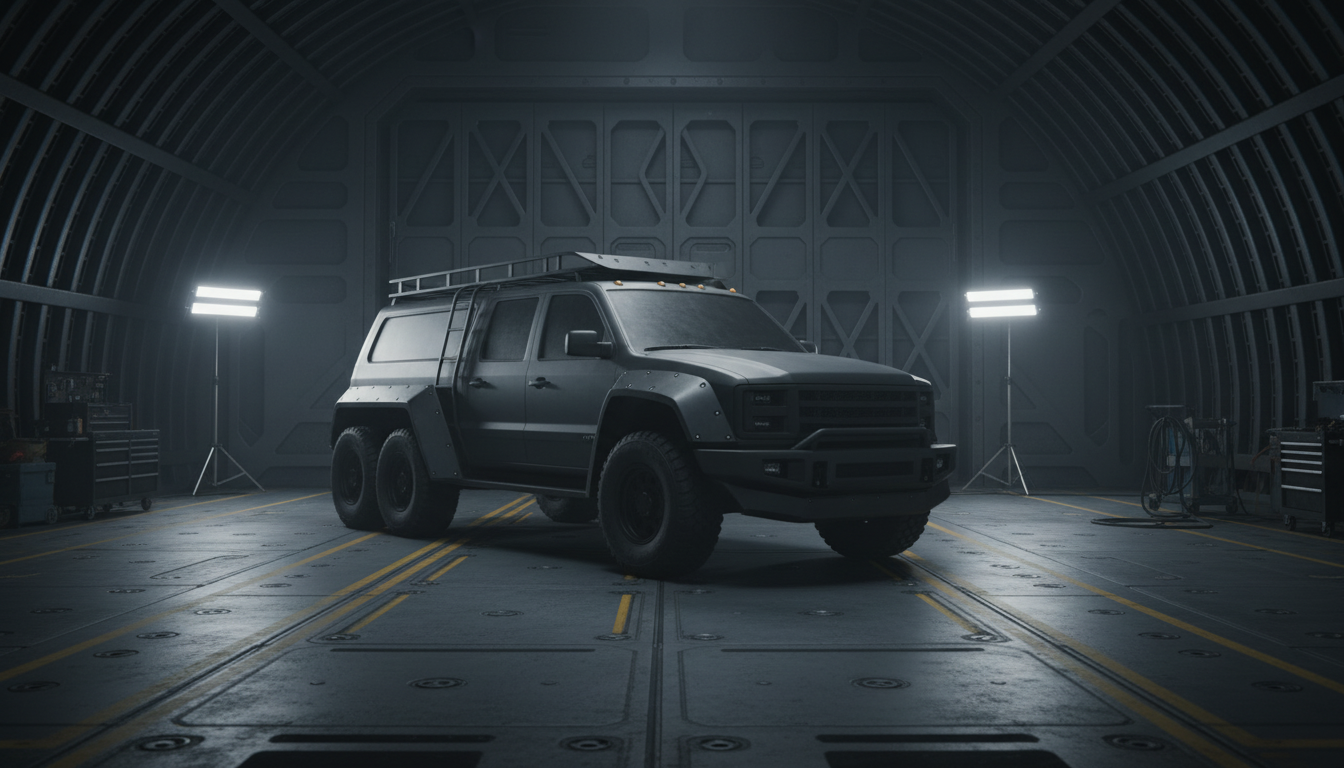
Not by ship standards. By ship standards it was a bus. Three axles, the rear two close-coupled, a crew cab across the front with a bench for five and standing room behind it for the frames to clamp into, a flat deck at the back long enough for the tooling, and a front end he made deliberately blunt and high because he wanted it to look like it could tow the hull. Wide-arched at all six corners, which took him nine weeks on its own, and the mesh strip running the entire flank in three sections because he could not source a single length long enough.
Dov said it looked like the ship had had a child and the child had gone into haulage.
It weighed two and a half tonnes and it was the least likely thing in the world to be interesting, and the run up the Five was one of the two or three best afternoons of his life.
Here is what a six-wheeler does, and he had never felt it before because he had never built one. Four wheels turn about a point. When the back steps out on a four-wheeler, the whole car rotates about somewhere near the front axle and the driver rides the arc. Put a third axle in and there is no single obvious point any more. The two rear axles fight each other in the corner — the front of the pair wants a bigger circle than the back of the pair, and neither of them gets what it wants, and the result is that the whole rear of the vehicle scrubs and yaws and settles in a way that is nothing like a car and much more like watching a heavy door swing.
It rotated through the long left after the third pod-row marker. It should not have. He came into it at a speed that was frankly rude for the mass involved, and the six-wheeler went round it in one enormous unhurried pivot, all three axles doing different things, the rear deck sweeping wide enough that he heard it take the tops off the grass along the ribbing.
He spent the rest of the run barely steering, just listening.
That is the thing he took from year thirteen and used for the next twenty-three. Six wheels means six voices and they do not all speak at once. He learned to hear which one let go first — it was the middle near-side, every time, on a left, about a tenth of a second before anything else moved — and once he could hear it he could act on it before the vehicle had committed to anything, which is the entire craft, and he had been doing it by feel for thirteen years without ever having enough separate channels to notice he was doing it.
He came back down the Five at a walk with the drive humming and his hands loose on the column.
Nnamdi took delivery the next morning, walked round it twice, counted the tie points, put one of the frames in and out of its clamp three times, and said it was more truck than they needed.
Calder said yes.
Nnamdi said they would take it.
They ran it for twenty-two years and wore out two sets of the middle-axle bearings, which Calder replaced both times himself, and on the second occasion he took it up the Five again for a shakedown and found that he could still hear the middle near-side and that it still let go first and that he was, by then, fifty-eight years old and still going up the same corridor listening for the same wheel.
Chapter 14 — The Big One
↑ Back to ContentsFocus: Calder ("Ghost") — closes Phase 2.
He measured the hold door in year thirteen, before he had decided to build anything, which is how he knew the number was nineteen millimetres.
The hold door was 3,412 millimetres wide at its narrowest, which was not the frame but a conduit run somebody had put across it during fit-out and never moved. The tunnel mouth at the head of the Long Five — where the maintenance way went through the pressure boundary into the outer corridor — was 3,412 at its narrowest too, which was not a coincidence; both had been set by the same standard for the same class of handling equipment, thirty years and eleven light-years ago, in the same design office that had hung the cable trays at one metre ninety.
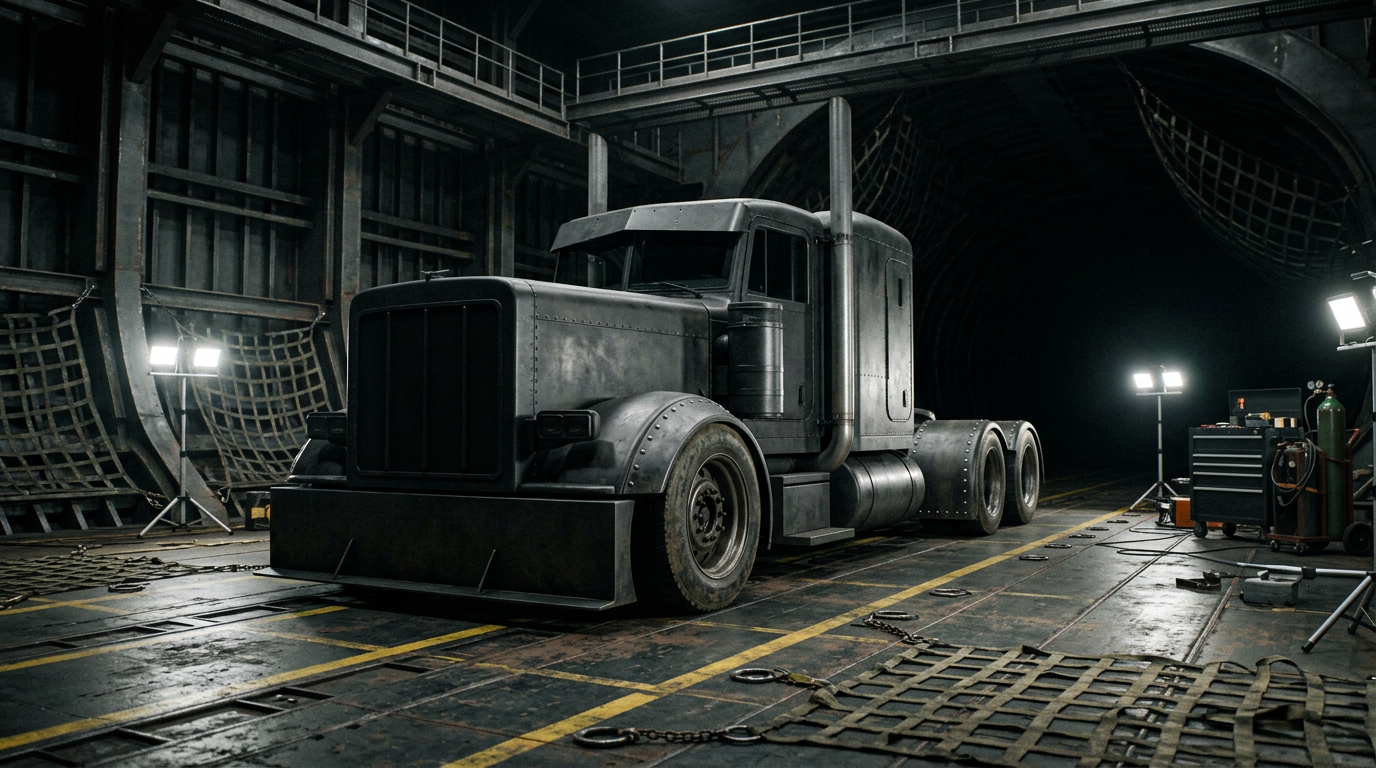
He built an articulated semi tractor 3,393 millimetres wide across the flare lips.
Nineteen millimetres a side is not clearance. It is an assertion. He could have taken forty millimetres out of the arches and nobody would ever have known, and he did not, because the entire point of year fourteen was to build the largest thing that would fit through the doors of his own life and then find out whether it could still do the only thing he cared about.
It took him the whole year and most of the next. A tractor unit — cab over the front axle, twin drive axles behind, a fifth wheel plate on the deck, and a trailer he built from the frame of a cargo pod that had been empty since launch and was never going to be needed because it had been packed with a redundancy nobody had used. Fourteen metres of vehicle, articulated in the middle, four tonnes unladen.
The flares on it were the biggest single pieces of metal he ever formed. He made the front pair three times.
Nobody laughed at this one. That surprised him. The van had got four years of filing-cabinet jokes and the six-wheeler had got the haulage line, and the semi — which was by any measure the most ridiculous object ever assembled aboard, a fourteen-metre articulated lorry on a starship, built by a man for no purpose — got a kind of respectful silence. Dov came down, looked up at the cab, and did not say anything at all, which Calder counted for the rest of his life as the best review he ever received.
Renata asked what it was for.
He said: to see if it fits.
It fit. Through the hold door at a crawl with Aiyana walking beside the near-side flare with a torch and her hand held up, calling the gap — a hand's width, half that, hold, hold, clear — and out into the corridor, and up to the tunnel mouth, and through that the same way, nineteen millimetres on each side, twice.
Then he did the whole Five at a crawl.
Eight kilometres an hour for five miles with fourteen metres of articulated vehicle behind him, and it took him the better part of an hour, and there was nothing about it that could be described as driving. What there was, was geometry. An articulated vehicle does not go where you point it. The trailer cuts the corner — always, by an amount set by the wheelbase and the corner radius and nothing else — so every bend on the Five had to be taken by putting the tractor somewhere it did not want to be, swinging wide, holding the wrong line, and letting the back end come through and find the apex on its own.
The first hairpin took him four minutes and two attempts.
The second one he got in one, and coming out of it he felt the trailer track through the exit exactly where he had meant to put it, four metres behind him, out of sight, doing what he had asked, and he made a noise in the cab that he was very glad nobody heard.
That was the thing. He had spent fourteen years finding apexes with his own front wheels. This was finding an apex with something enormous that he could not see, by knowing where it would be, and it worked, and the fact that it worked at eight kilometres an hour did not diminish it at all — it was the same act, at a scale where he could watch it happen in slow motion.
He got to the far end and sat with the drive off and the corridor ticking.
Fourteen years. He had proved he still could, and then proved he could do it well, and then proved he could do it to anything — a van, a truck, six wheels, fourteen metres, it did not matter, they all had a corner in them and he could find it.
Size had stopped being a question about a hundred metres back and he had only just noticed.
He reversed the whole articulated thing the length of the last straight because there was nowhere to turn it, using nothing but the mirrors, and got it back into the hold, and stood in the doorway looking at it.
And thought: so what is left.
Chapter 15 — Nothing But The Corner
↑ Back to ContentsFocus: Calder ("Ghost").
In year fifteen he built the first vehicle of his life that could not carry anything, and it was the first one that was entirely honest.
The question had been sitting in him since he reversed the semi into the hold. Size was finished. Utility was finished — he had made a tug, a van, a pickup, a crew truck and a lorry, and every one of them worked, and Nnamdi's crew and Miriam and Halima had all of them, and there was not a job left aboard that wanted a vehicle he had not already made.
So he sat down and asked what a car was for, when it was not for anything.
The answer took a fortnight and was: the corner. Not the journey — there was no journey, there was a five-mile corridor that began and ended in the same ship. Not the load. Not the shape, though he loved the shape. The corner: the forty or fifty metres in which a machine and a person negotiate with a surface, and one of them gives.
Everything else on a vehicle was in the way of that.
He took it all off.
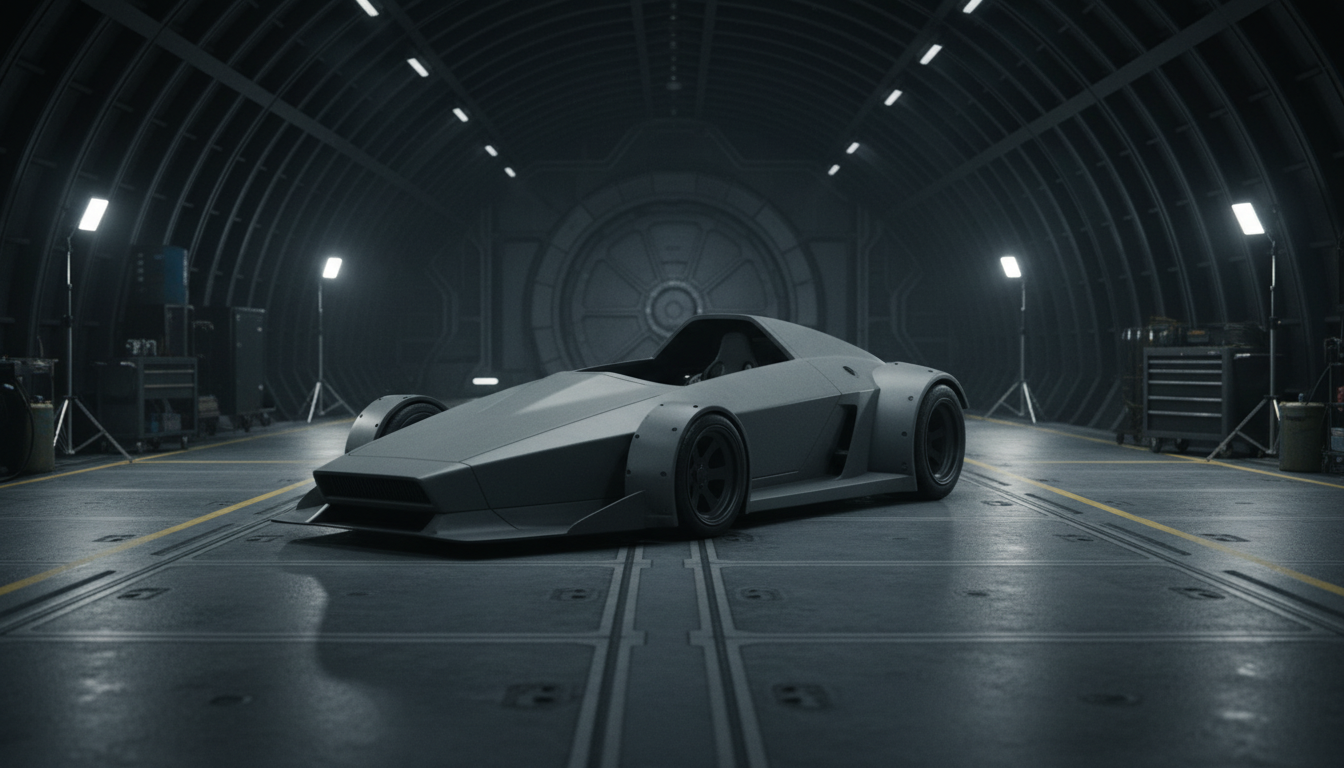
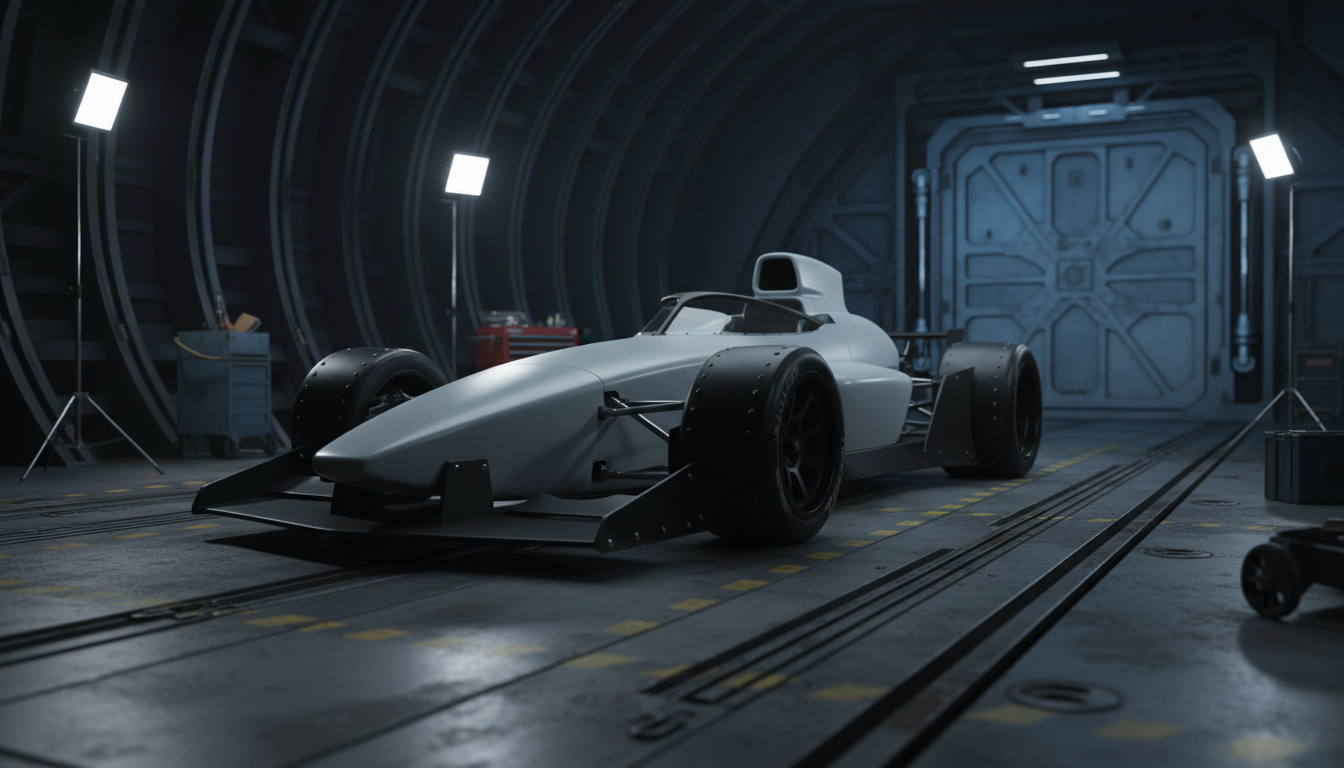
What was left was a frame, a seat in the middle of it, four wheels on long exposed arms, a column, and nothing else at all. No body. No panels, no doors, no floor beyond a pan under his heels, no arches — and this was the part that cost him three weeks of arguing with himself, because for seven years the flares had been the one thing he did not compromise on. He drew it with flares. He drew it four times with flares. Then he understood that an arch over a wheel exists to hide the wheel from the world and the world from the wheel, and that he had just spent a fortnight establishing that the wheel was the entire point.
He left them off. It is the only vehicle in the thirty-six with no flares on it, and if anybody had asked he would have said it was the most consistent thing he ever built.
Dov, who could be relied upon, said it looked like a chair that had escaped.
It weighed three hundred and ninety kilos.
He had never driven anything under a tonne except the minibike, and the minibike had been eleven years ago and had two wheels and did not count. The racer came off the stands and moved when he leaned on it. It changed direction the way a thought does. He got it into the corridor and up to speed on the first mile and it was, immediately and permanently, the fastest thing he had ever built or would ever build, and that was not the part that mattered.
The part that mattered was that he could see all four wheels.
Sit in a car with bodywork and you drive by inference. You feel a corner arrive through your seat and your hands and you construct, somewhere behind your eyes, a model of what the four contact patches are doing, and you drive the model. He had been driving models for fifteen years and had got extremely good at building them.
Now he did not need one. He came into the first hairpin and turned in and watched the front near-side tyre take the load and roll onto its shoulder and squirm and grip; watched the outside rear come up on its arm as the weight went forward; watched, actually watched, the moment where the inside rear went light and the whole car pivoted around a point he could see rather than one he had deduced. All four, at once, in his peripheral vision, lighting up in sequence like a thing being played.
He did the whole Five and then did it again and then did it a third time, which he had never done in one shift in his life.
The corridor had never fit anything the way it fit that car. Fifteen years of a maintenance way that had been a compromise for every vehicle he had put on it — too narrow for the semi, too rough for the sled, too low for anything tall — and here at last was a machine built to exactly the shape of the thing he had cleared out of the crates in year one without knowing what he was clearing it for.
The Five stopped being a corridor he used and became, for one year, a circuit.
He set his fastest time in the racer. He set it in the eleventh month of year fifteen and he never beat it in the twenty-one years that followed, not in the wedge, not in the fastback, not in anything, and he knew within a month of setting it that he was not going to.
Aiyana beat it in year sixteen, by four tenths, on her third attempt, in the same car.
He was standing at the far end with the timer in his hand when she came through, and he has said that it was the single most enjoyable thing that happened to him in the whole crossing, and that he told her so, and that she did not believe him.
Chapter 16 — Two Seats
↑ Back to ContentsFocus: Calder ("Ghost").
He told people for thirty years that the bike was the only thing he ever built for a person rather than for a year, and it was not quite true, and he knew it every time he said it.
Year sixteen. The roadster.
Two seats. That was the first line on the paper and everything else came after it, and there had not been two seats in one of his vehicles since the narrow-body coupe in year seven, which had been an accident of having room. This was not room. This was a decision, made in the first hour, and he spent the next eleven months building a car around it and never once wrote down why.
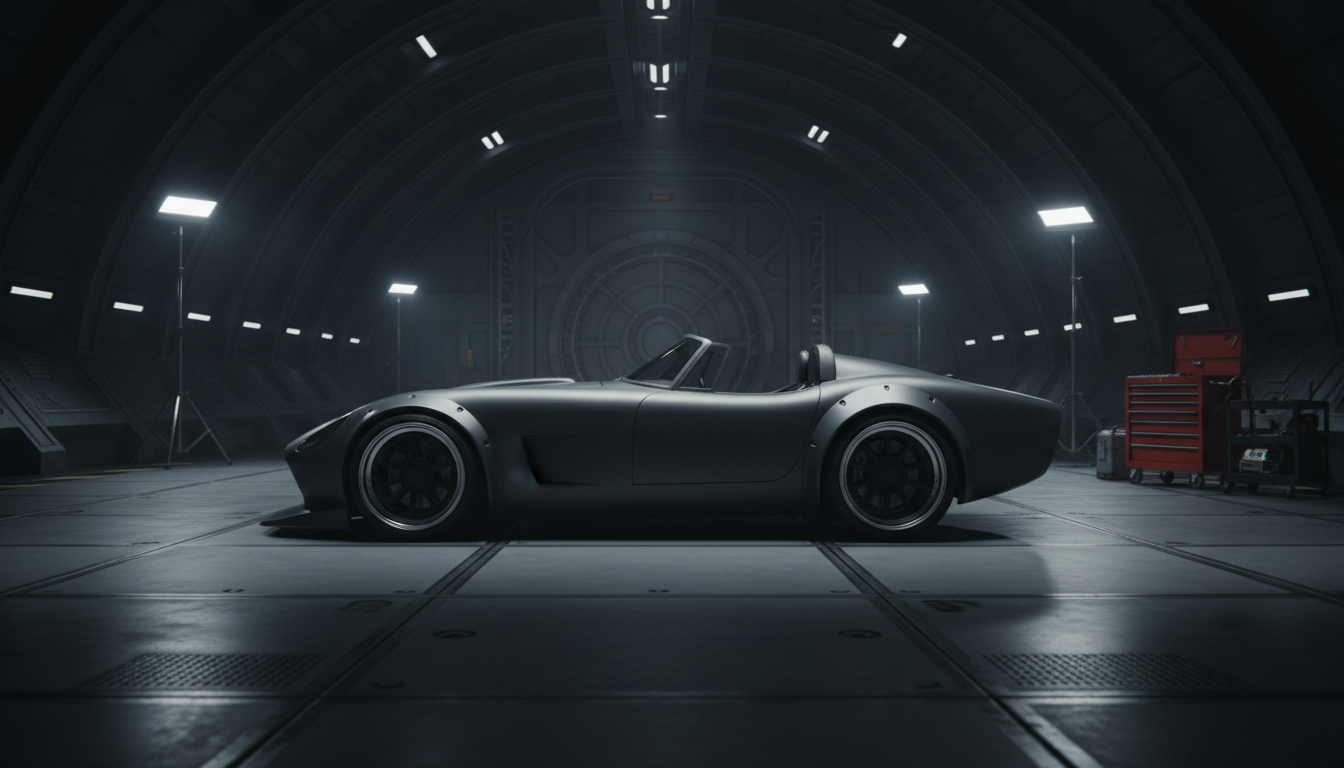
Low, of course. Wide, flared, rivets, mesh. No roof at all — not a targa, no hoop, nothing above the beltline but two cut-down screens, one in front of each seat, curved by hand over a former he made from a section of duct. He got the passenger screen wrong twice and remade it both times, which is a thing worth noticing about a screen in front of a seat with nobody in it.
It is the prettiest thing he ever made. He knew that too.
He finished it in the tenth month and did not take it out.
That is not like him and there is no innocent explanation for it. Every other vehicle in thirty-six years went up the Five within a day or two of the fluid going in, some of them within the hour. The roadster sat on its stands, finished, for six weeks, with a cover over it that he had cut and hemmed himself, in a hold where nothing else had ever been covered because nothing else had ever needed protecting from anything.
He took it out at ship-night, in the eleventh month, alone.
Ship-night was the dim cycle — the corridor lighting down to about a tenth, the level the sleep schedule ran at, everything the colour of nothing. He had run the Five at night before, occasionally, and had never liked it much. This time he ran the whole five miles with only the roadster's own lamps.
What that does, on that corridor, is turn the pod-rows into the only thing there is.
The Long Five runs past the cryo racks for about a mile and a half of its middle length, four hundred and eleven of them visible from the deck, in tiers, each one with a plate and a number and a surname. In the day cycle they are furniture. At a tenth of the lighting, with two hand-built lamps sweeping across them at speed, they came up out of the dark in sequence as he passed — a row lit, a row going dark behind, a row lit — and the whole mile and a half was a hundred thousand people arriving and leaving in the beam, one row at a time, and none of them knowing he was there and none of them ever going to.
He calls them family. He always has. He never met one of them and he never will, and he has been driving past them for sixteen years.
He went faster on that run than he has ever gone before or since. Faster than the racer's time — he was not timing it and there is no record, but he knew, and he said so once, decades later, to one person. The roadster was lighter than anything but the racer and it had bodywork to hold the air off him and two screens and an empty seat, and he had the whole corridor and the dim cycle and nothing to be careful of, and he went up the Five like something being fired.
He did not put a wheel wrong. Not once, over five miles, at that speed, in the dark.
He came back down to the hold and put the cover on it.
He never gave it to her. There was no moment when he decided not to — that is the honest shape of it, and it is why the chapter has nothing in it. There was no argument, no falling out, no other person, nothing happening at all. Aiyana was two sections forward and had been for sixteen years and would be for twenty more. There was a car in the hold with two seats and a screen he had made twice, and every week that it sat there made it a slightly larger thing to hand over, until at some point in the low twenties it had become unhandoverable, and after that it was simply a car under a cover that everybody had stopped asking about.
She never saw it. He is nearly certain of that.
It was still there at planetfall. It was still there thirty years after planetfall, in a cargo hold on a ship in orbit that had become, by then, a place people went to look at things, and the person who found it lifted the cover and saw a two-seat roadster with no roof and no dust on the seats and assumed, reasonably, that it had been abandoned by whoever built it.
Chapter 17 — The Long Back
↑ Back to ContentsFocus: Calder ("Ghost").
The fastback is the one everybody has seen and nobody knows they have seen, and it exists because of a corner that had been beating him for eleven years.
The fast right-hander sits at the top of the third mile, where the Long Five comes out of the pod-row section and the corridor opens up before it drops into the overflow holds. It is not a difficult corner in the way the hairpins are difficult. It is long, it is open, and it is quick — you go into it at very nearly the speed you came down the straight at, and it holds you there for something like eleven seconds, which is an extremely long time to be doing one thing in a vehicle.
And every car he had ever built went light at the back through the middle of it.
He had put a great deal of thought into why. The corridor rises slightly through the bend, the deck plate changes at the exit, and the whole section is the only part of the Five where the airflow does anything — the scrubber outflow from the overflow holds comes up the corridor against you, gently, all the time, and at speed it is not gentle. Sixteen vehicles, and every one of them arrived at the exit of that corner feeling as though somebody had put a hand under the tail and lifted.
He had learned to drive it. That is not the same as solving it, and he had known the difference for a decade.
Year seventeen, he built a car with a roofline that ran unbroken from the top of the screen all the way to the tail, falling the whole way, and finished it with a lip — thirty-five millimetres, turned up across the full width of the tail, riveted at the ends and blended in the middle.
A ducktail. He did not have that word. He called it the step and drew it eleven times before he cut anything.
The rest of the car was the best-resolved shape of his life to that point. Long back, wide arches sitting under the falling roofline instead of standing out from a slab side, a cabin pushed forward, the mesh strip carried along the flank and then — this was new, and every fastback anybody has built on Aura-36 since has copied it without knowing — carried up over the rear arch and stopped dead, so that the flank of the car had a line that went somewhere instead of simply running out.
Nobody said anything about it in the hold. Renata came down and looked at the tail lip for a while and asked what it was for and Calder said air, and Renata said there isn't any, and Calder said there's some.
He took it up the Five and did the first two miles carefully because he wanted the corner cold.
Then he went into the fast right at a speed he had spent eleven years not being able to hold, and it stayed flat.
Not gripped harder. Flat. The tail did not lift. The hand did not come under it. For eleven seconds the whole car sat level and did exactly one thing, which is what the corner had always been asking for and what nothing had ever been able to give it, and he came out at the deck-plate change with the fastback tracking dead straight and about a second and a half in hand.
He stopped at the top of the overflow holds and sat with his hands on the column.
Thirty-five millimetres of turned-up alloy. That was all it was. The oncoming air off the scrubbers had been getting under the tail of every car he had ever built and taking a few kilos off the rear axle at exactly the wrong moment, for eleven years, and it had never once occurred to him that the answer was not in the suspension.
He drove that car for the rest of the year and did not build the next one until he had done the fast right about four hundred more times.
The shape got out. That is the part he never knew about and never could have. Aiyana drove the fastback. Dov drove it. Coda drove it twice and drew it once, badly, on the back of a shift log, because she liked the roofline — and Coda's grandchildren were among the first cohort on the ground with the time and the metal to make anything, and the drawing was in a box of her effects, and it is not possible to trace what happened next and nobody has ever tried.
What is true is that sixty years later there were fastbacks on that planet with the roofline falling all the way to a turned-up lip at the tail, and a body line that ran along the flank and up over the rear arch and stopped, and that not one of the people who built them could have told you where the shape came from or that it had been worked out in a corridor to solve a problem with scrubber outflow that does not exist anywhere on the surface of a world.
Chapter 18 — Behind Your Head
↑ Back to ContentsFocus: Calder ("Ghost").
The wedge is the important one, and he had no way of knowing that, and he built it exactly right anyway.
Year eighteen. Halfway. He was fifty-nine, eighteen years out and eighteen years from arrival, and he had built seventeen vehicles and had the shape of the eighteenth in his head before he finished the fastback.
The idea was simple and he had been circling it since the racer. Everything he built had the mass in front of him — drive units under the nose or over the front axle, because that is where every donor vehicle aboard had put them and because he had never had a reason to move them. The racer had shown him what a light front end did in a corner. The fastback had shown him what happened when he stopped treating the rear as a problem to be managed. The obvious next thing was to take the heaviest object on the vehicle and put it behind the driver, between his back and the rear axle, as low as it would sit.
That is a mid-engine layout. He did not have the term. What he had was eleven months, a hold, and a piece of paper on which he had written mass in the middle, driver forward, cut everything off the nose.
Cutting everything off the nose is what makes it a wedge. With nothing in front of the driver but the front axle and a crash structure, the bonnet line has nowhere to be but low — it started at the base of the screen and fell in one plane all the way to a nose about six hundred millimetres off the deck. Behind him the body rose over the drive bay and finished square, and over the bay he cut a slatted deck — nineteen slats, angled back — because a bay with the drive units in the middle of it runs hot and a solid panel cooked them, and because a louvre cut by hand in thin alloy either looks right or looks like damage and there is no third result. He made that piece twice. It is the only part of the car he made twice. Wide-arched, low, riveted, mesh strip along the flank and up over the rear arch the way the fastback had it.
It looked like nothing else on the ship. It looked, Dov said, like a doorstop with ambitions, and that was the last joke anybody made about a Calder vehicle, and Dov only made it once and did not repeat it, which for Dov was almost an apology.
Here is what the layout does, and it is the whole reason the shape survived him.
A car with its mass in the middle has a small polar moment. It does not want to keep pointing where it was pointing; it wants to rotate, and it will start rotating the instant you ask, and it will stop the instant you stop asking. Put the mass at the ends and a car is a long thing being persuaded. Put it in the middle and the car is already halfway into the corner while you are still deciding.
He felt that on the first run, at the first hairpin, and it frightened him.
It went in half a second before he was sure. That is the literal description and he used it for the rest of his life: the wedge committed to a corner half a second before he had committed to it, and it was right, every single time. He would be arriving at a turn-in point still weighing it up and the car would already be rotating, and his hands would catch up and find that the car had chosen the line he had been about to choose and had simply got there first.
It took him two months to stop fighting that and about a year to trust it completely.
Once he trusted it, it was the best car he ever built. Not the fastest — the racer was faster and the roadster had gone faster once. The best. The one that did the most with the least asked of it, the one that was still teaching him things in year twenty-nine when he took it out for the last time, the one he would have chosen if he had been told he could keep exactly one.
He did not keep it. It went into the hold with the others and stayed there.
He built it in a corridor for an audience of nine, four of whom did not really look at it, on a ship where nobody could photograph him and nobody had thought to write down what he was doing. There was no drawing of the wedge. There was no plate on it, no name, no mark of any kind — he never signed anything he built, not once in thirty-six years, and the single occasion on which he came close belongs to a different chapter and did not end with a plate on a car either. When he died there was nobody alive who had watched him build it and nobody who could have said what the proportions were or why the nose fell the way it did.
And sixty years later, on a planet he had spent the second half of his life driving towards, a young woman he never met would sit in something with its mass in the middle and its nose on the deck and its arches standing proud on rivets, and it would rotate half a second before she was sure, and she would think that whoever had first worked this out must have known exactly what they were doing.
He did. That is the only part of this he would have wanted anybody to know.$
Chapter 19 — Up High For Once
↑ Back to ContentsFocus: Calder ("Ghost").
He raised one, and all nine of them told him it looked wrong, and it is the only vehicle he ever built that every single one of them borrowed.
The reason was the fourth mile.
Past the overflow holds the Long Five gets worse. The grass gives out where the scrubber outflow stops reaching, and after that there is about eight hundred metres where the corridor was never finished to the same standard as the rest — the hull ribbing shows through the deck plate in a series of raised bands, forty millimetres proud, every couple of metres, because somebody in fit-out had run out of plate and covered the section with a walkway grating instead and the grating had been lifted for an inspection in year three and never put back.
Nobody had ever complained, because nobody except Calder went out there.
Every car he had built took that section badly. The sled took it worst — he had nearly knocked himself out in it once. The low ones bottomed, the wide ones caught a flare lip, the fast ones simply could not be driven there at all. For eighteen years the fourth mile had been the part of the Five he crawled across, sitting up, wincing, on his way to the good bit at the far end.
So in year nineteen he built a car with a hundred and sixty millimetres of ride height and long soft arms and a bit of a lean forward, and it looked, on the stands in the hold, like somebody had built a proper coupe and then jacked it up to change a wheel and lost interest.
The reaction was unanimous and it lasted about eleven days.
Aiyana said he had spent eighteen years going lower and had now got confused. Dov said it looked like it was standing on tiptoe to see over something. Coda, who by then had stopped pretending not to have opinions, said the proportions were wrong in a specific way she could not name and it took her about a week to work out that it was the gap between the top of the tyre and the arch — a hand's width of daylight where every other Calder car had a couple of centimetres, and the eye, having learned the rule from eighteen previous vehicles, read the daylight as a mistake.
It was not a mistake. It was a hundred and sixty millimetres of clearance over forty-millimetre ribbing at speed.
He took it across the fourth mile flat out.
Nineteen years he had been crawling that section. The rally coupe went over the raised bands at a speed he had never approached in anything, and the long arms ate them — the body stayed level and the wheels went up and down underneath it in a fast continuous hammering he could hear but barely feel, and the whole eight hundred metres went past in something like twenty seconds, and at the end of it he was still pointing forward and nothing was broken and he was laughing so hard he had to stop the car.
Then he turned round and did it again.
Then he found out the other thing, which he had not designed for and which is why the car became what it became. High and soft with a lot of weight transfer, on a surface with no grip, does not understeer. It leans onto the outside front, takes a set, and then the whole car pivots on that one loaded corner and comes around in a slow, enormous, thoroughly telegraphed slide that anybody — anybody at all, including a person who has never driven anything — can catch.
He worked that out in the first fortnight. The other nine worked it out over the following eleven days, one at a time, because he left it parked at the mouth of the hold with the charge lead coiled on the seat and said nothing.
Renata took it out first and came back and asked what it was for and then answered her own question, which she had never done before.
Dov put it into the grass at the overflow section, sideways, at about thirty, and walked back and told everybody, in detail, at length, for years.
Miriam, who had called the fire tender superstition and who did not approve of any of this, borrowed it four times in the ninth month for reasons she declined to give.
Halima took it over the fourth mile with a stretcher in the back on the day Ines's hand went into a press, and got there in four minutes instead of eleven, and afterwards said nothing to Calder about the ride height at all, which he understood perfectly.
It is the only one all nine of them drove. Not the tug, which was Nnamdi's; not the shooting brake, which was Halima's; not the racer, which two of them were frightened of. The one they all called wrong, and all borrowed, and all quietly got better at driving, on the worst surface aboard.
He never told any of them that he had watched every single one of those runs from the gantry above the fourth mile.
Chapter 20 — The Long Car
↑ Back to ContentsFocus: Calder ("Ghost").
Twenty years in, he built a limousine for a ceremony that had not happened, on a ship where the longest journey anybody made was four hundred metres to the galley.
The joke started at a meal. They ate together perhaps once a month by then — ten people who had run out of new things to say to each other around year nine and had come out the other side of that into something better and quieter — and somebody, it was Dov, obviously it was Dov, said that when they got there somebody was going to have to be driven somewhere.
That was the whole of it. It got a laugh at the table and it should have died there.
But Calder went back down to the hold and sat with it, and it would not leave, because Dov was right and everybody at that table had known he was right and had laughed at it for exactly that reason. There was going to be a day. Sixteen years out, a ship was going to stop, and a hundred thousand people were going to be woken up over a period of months, and at some point in all of that there was going to be a morning where something formal happened, and formal things need somebody to be carried slowly and visibly from one place to another. It is one of the very few facts about human beings that survives a crossing.
None of them would be young. He would be seventy-seven.
He built six doors.
That is the joke, and the joke is in the arithmetic. A limousine is not a long car; a limousine is a car with a passenger compartment that has been made long enough to be pointless, which means a wheelbase you cannot justify, which means a vehicle that is physically incapable of the only thing its maker cares about. Six doors. Three rows. Seven metres between the axles, which was longer than the six-wheeler and only half as sensible, on a corridor whose tightest hairpin has a fourteen-metre radius.
He gave it everything. Wide arches on rivets, obviously. The mesh strip down all seven metres of flank in two sections. A roofline he kept dead flat the whole length so it would look like a plank, which took more work than a curve would have. Deep tinted glazing cut from a spare observation panel, because you cannot see into a ceremonial car and that is most of what makes it ceremonial. Inside, facing bench seats and a rail to hold, and a floor he laid in the good mesh.
Eleven months. On a joke.
The nine came down to look at it when it was finished, all of them, which had never happened before and did not happen again until year thirty-six. Aiyana walked the length of it twice. Renata asked what it was for and got, for once, a complete answer: for the day somebody has to be driven somewhere.
Nnamdi said it will never get round the second hairpin.
That was on a Tuesday and Calder did not sleep especially well and on the Thursday he took it up the Long Five.
The second hairpin is the tightest thing on the corridor, a fourteen-metre radius left around a structural rib with a wall on the outside and no run-off at all. He had spent twenty years learning it in nineteen vehicles. The semi had needed two attempts at walking pace. The limousine had a seven-metre wheelbase and about as much steering lock as a barge.
He came into it at a speed that was, by any reasonable standard, an act of vandalism.
It went sideways early — the whole seven metres of it, all at once, the way something long goes when its weight finally decides to move — and then it simply stayed there. That was the thing nobody had predicted, and the thing that made the joke land, and the reason all nine of them ended up on the gantry watching. A long car has an enormous polar moment. It does not want to rotate; but once it is rotating it does not want to stop, either, and if you can get it into a slide early enough and hold the power exactly steady, it will hang at an angle and sweep through a corner like a door closing, for as long as you have the nerve.
Seven metres of six-door ceremonial vehicle came through the tightest hairpin on the ship at about forty degrees with the tinted glass full of corridor light and the rear flare a hand's width off the rib.
Dov, on the gantry, made a sound that Aiyana described afterwards as a man being sat on.
He did it four more times that afternoon and then put it in the hold and left it there, finished, uncovered, for sixteen years.
Somebody did have to be driven somewhere, in the end. He had been right about that at the table and right about it in the hold and right about it for sixteen years, and what actually happened on that morning is not this book's business and belongs to people whose names are in other records.
But the car was ready. It had been ready since year twenty. That is the part he would have wanted written down, if he had ever wanted anything written down.
Chapter 21 — For When It Goes Wrong
↑ Back to ContentsFocus: Calder ("Ghost").
The limousine was finished in the eighth month of year twenty. The thing happened in the eleventh, and there are nine days after it that he never described to anybody.
What is on the record, because Halima put it on the record, is this. Ines was in the aft transfer gallery working a jammed pressure door alone, which was against every procedure the ten of them had written for themselves and which all ten of them did routinely by year twenty because there were ten of them and a great deal of ship. The door came off its arrest and took him against the frame. He was conscious throughout. He was found by Renata eleven minutes later because Renata had gone looking for a spanner.
Halima got to him in nineteen minutes with the shooting brake and what she could carry in the two hard cases.
He lived. That should be said now rather than at the end, because the chapter is not about whether he lived. He lived, and he worked for another twenty-nine years, and he was on the surface for eleven of them. What is true is that Halima worked on him on the deck of the aft transfer gallery for two hours and forty minutes with equipment designed to be carried by a person, and that everything she needed and did not have was four hundred metres away in the medical bay, and that four hundred metres and a stretcher and two tired people is a very long way when somebody is on the floor.
Ines asked for the vehicle herself, eight days later, sitting up.
He did not ask the way Nnamdi asked, by describing a problem and waiting. He did not ask the way Halima asked, in ninety seconds on her way somewhere. He said: build me the one that comes to get people.
Calder built it in nine days.
Everything else in thirty-six years took him between four months and two years. This took nine days, and he did not sleep properly through any of them, and none of the other nine came down to the hold during that week, which was not an accident — Aiyana had said something to the others and Calder found out about it eleven years later and never said anything about that either.
What he built was ugly. It is the only one he ever built that he would have called ugly himself. High-sided, square, tall enough to stand up in at the back, with doors at the rear that opened to a hundred and eighty degrees and locked there, and a floor at six hundred millimetres with a ramp that a person could deploy one-handed. Fixed brackets for both hard cases. Racks for what Halima said she needed and could not carry. A rail down each side of the compartment at the height of a hand.
Flares on rivets, because he could not stop himself, and the mesh strip, and beyond that not one decision made for any reason except the eleven minutes and the nineteen minutes.
He took it up the Long Five on the tenth day.
He ran it dead straight. Lights off — the drive lamps and the corridor at the dim cycle and nothing else, which is not something he had done since the roadster, and he had done it in the roadster to look at the pod-rows and he did not look at anything now. He went up the whole five miles as fast as the thing would go in the straights and he braked properly for every corner and took every one of them at a speed the vehicle was entirely comfortable with, and he did not put a wheel out of line the whole way.
Twenty years he had been going up that corridor to find out what a machine would do at the edge of what it could do. There is exactly one run in the record where he drove as though the corners were not there, and this is it, and it is the run he was doing the actual thing for.
He timed it. Four minutes and fifty seconds, hold door to tunnel mouth to far end.
He drove it back down and parked it at the mouth of the hold with the charge lead coiled on the seat, and went to find Halima, and told her the number, and she wrote it on the back of her hand.
They never had to use it. That is the true ending of year twenty and he was glad of it every year for sixteen years and it did nothing whatsoever to the nine days.
The rig sat where he had left it for the rest of the crossing, charged, brackets loaded, kept up. He checked it every month. He never mentioned checking it. Halima knew, because the fluid was always up and the lamps always worked and nothing on that ship stayed that way by itself for sixteen years, and she never mentioned it either.
Dov, who had a joke about every vehicle Calder ever made, never made one about that one.
Chapter 22 — Water
↑ Back to ContentsFocus: Calder ("Ghost").
A ship cannot burn. That is not an opinion, it is an engineering fact of the class, and Miriam was the person aboard who knew the arithmetic best, and she said it to him twice.
She was right both times.
The Ark-Genesis hulls were built by people who had thought about fire more carefully than any other hazard, because fire is the one that takes a crossing away from you in eleven minutes and leaves nothing to argue about afterwards. There is no free oxygen in any volume that is not occupied. Every compartment vents to vacuum on a two-second command and the command is not a person's to give. The materials do not sustain combustion at partial pressures the ship can produce. Miriam could recite the whole chain and had, at meals, more than once, because she found it comforting.
He built a fire tender in year twenty-two.
Six thousand litres in a tank behind the cab. A pump. Two reels of hose. A monitor on the roof that could be swung by hand. Ladders down the flanks that no compartment aboard had any use for, because every deck was reachable at deck level, and he made the ladders anyway and made them properly, in a jig, over three weeks.
He flared it. Of course he flared it — six thousand litres of water on a chassis, wide-arched and low and riveted, with the mesh strip running the length of the tank body, which took him an afternoon to accept and then looked, once it was on, like the only thing that could have been there.
Miriam came down to the hold when it was about two-thirds finished and stood looking at it for some while.
She said: it's superstition, Calder.
He said: I know.
That is the entire conversation and both of them were satisfied by it, and it is one of the reasons he liked her.
She came out to watch the run, which she had never done for any other vehicle. She stood at the pod-row rail on the third mile, where the corridor runs alongside the cryo racks and there is a handrail because the deck drops away to the service level below, and she watched him come up out of the second mile with six tonnes of water behind him.
Water is the worst load there is. He had known that going in and it was most of why he built it. Six thousand litres in a tank is not cargo — it is a mass that moves, continuously, always a beat behind you, and it goes on moving after you have stopped asking it to. Every input he made arrived at the rear axle late and then arrived again, reflected, a second and a half later. He put four baffles in the tank and it was still like driving with somebody heavy standing up in the back.
He got it through the sweeper on the second attempt and he was very pleased with himself about that and Miriam could see it.
He stopped at the rail. She came over and put a hand on the tank and said what is it for, if the ship can't burn.
That was Renata's question, in Renata's words, and Miriam had borrowed it deliberately, and she wanted an answer.
He did not give her one. He said something about the baffles.
Then he put the drive on and went up into the second hairpin considerably faster than he had any business going with six tonnes of moving water behind him, and got it out at an angle, and held it, and was gone.
She stood at the rail and watched him do it and understood exactly what had just happened, because she had been on that ship with him for twenty-two years and she knew what he did with his hands when he did not want to talk about something.
Here is the answer he did not give her, and there is no version of this on any record, because he only ever said it once, on the ground, decades later, to somebody who was not really listening.
He was not building a fire tender for the ship. There was nothing to build one for. He was building a fire tender for a planet — for a place with air in it that would burn, and dry ground cover, and structures nobody had thought about hazard chains for yet, and a hundred thousand people about to be woken up and put down on it. Somebody, at some point in the first decade down there, was going to need one, and would not have one, and would not have anybody who had ever built one.
He had eleven years of it left in him.
He could not say any of that to Miriam at the pod-row rail, because saying it out loud would have meant saying the other half — that he had started building things for after, and that after was a place he was going to arrive at as an old man, and that this was now the shape of the time he had left.
So he took the hairpin too fast instead, which is the same statement, made in the only language he was fluent in.
Chapter 23 — Everybody At Once
↑ Back to ContentsFocus: Calder ("Ghost").
He built one vehicle in thirty-six years that could hold every waking person on the ship at once, and it had twelve seats in it, and there were ten of them.
Nobody mentioned the two spare seats for eleven years.
The bus came out of nothing in particular. There was no request behind it — Nnamdi had his truck, Halima had her brake, Miriam had the van, Ines had the rig, and there was not a job aboard that wanted a bus. What there was, in year twenty-three, was a man who had started to think about after, and who had noticed at the meal that month that the ten of them had eaten together nine times that year and had gone to it separately every time, on foot, in ones and twos, along four hundred metres of corridor.
So he built the thing that would take all of them.
It is a proper bus: nine metres, two axles, a door that folds, a step, an aisle. Windows he cut and set himself, twenty-two of them, because there was no salvageable glazing long enough and he was not going to build a bus with slots in the side. Flat floor, high ceiling, a rail overhead the whole length of the aisle so somebody standing had something to hold.
Wide-arched. Riveted. Mesh along both flanks. It looked, on the stands, like something that had come off a boulevard on a planet none of them had ever stood on, and Dov, who had been quiet since the medical rig, got his voice back for it and called it the school run, and it was the school run from then on.
Twelve seats.
He drew twelve in the first week. He has never given an account of that. He was not building for a complement that had been cut, and there was no rotation aboard that had ever been meant to be twelve — the crossing was crewed at ten awake from the day it left and stayed at ten for thirty-six years, and every one of the ten walked off it. There was nobody missing. He simply drew twelve seats, in a hold, in year twenty-three, and built them, and upholstered all twelve in the same salvaged panel liner, and never once said why.
Everyone had a theory eventually. None of them said theirs out loud. It is a very small ship for that kind of question.
He got all nine of them into it on the last day of the year.
That took some doing and it was mostly Dov's doing — Calder had said, at the meal, that the thing was finished and would carry the lot of them, and Dov had taken that as a schedule rather than a remark, and by the following Tuesday there were nine people standing at the mouth of the hold in various states of willingness. Renata asked what it was for on the way in, from the step, and was told to sit down.
He drove them up the Long Five.
Twenty-three years he had run that corridor and every one of those runs he had run alone, except one, and the one was a mile of a minibike with Aiyana's hands flat on his back in year five. He had built for these people, been borrowed from by these people, been watched by these people from gantries and rails. He had never had them behind him.
He drove the first two miles like a bus driver, and they talked, and Halima pointed out the grass to Renata, who had also never seen it.
Then he came into the long left after the third pod-row marker with rather more speed than the situation called for, and let it go.
Nine metres of bus went round that corner sideways. Not far — a hand's width of angle and no more, which is all you want with nine passengers and no belts, and which he held for the whole length of the bend with the overhead rail creaking and twenty-two windows full of moving corridor.
The noise from behind him was not one thing. Somebody swore. Somebody laughed. Dov, at the back, made the sound he had made on the gantry in year twenty, and Aiyana, three rows down on the left, said Calder's name once, in the voice of a woman who had beaten his lap record and knew exactly what he had just done and how well he had done it.
He straightened it out and drove the rest at a bus driver's pace.
Nobody said a word about it afterwards. Not that evening, not that year, not ever — not one of the nine ever raised it, and he never raised it either, and it stayed for thirteen more years as the thing that had happened on the school run and did not need to be discussed.
The bus took them to every meal for the rest of the crossing. It made that run, four hundred metres, nine times a year, at eleven kilometres an hour, for thirteen years.
Twelve seats. Ten of them warm.
Chapter 24 — Tracks
↑ Back to ContentsFocus: Calder ("Ghost") — closes Phase 3.
The crawler was built from photographs, and he had eleven of them, and he had looked at all eleven so many times by year twenty-four that he could have drawn any of them from memory badly.
That was the whole survey package for the landing site, as carried. Eleven images and a soil column and a slope map at a resolution that meant nothing below forty metres. The photographs had been taken by an unmanned pass sixty years before the ship left, and they showed: a shallow basin, a watercourse that was probably seasonal, a great deal of loose grey scree on a long incline, and ground cover of some kind in the low parts that nobody had been able to classify from orbit and that everybody had privately decided was grass.
Nobody aboard had walked on it. Nobody would for twelve more years. There was no way to know what it was under a boot.
He built tracks.
The reasoning was sound and he could defend every line of it. Loose scree on a long incline is the specific case where a wheel is worst — a wheel puts its load through a patch the size of a hand and digs, and once it digs it is a hole with a vehicle in it, and there will be nobody down there for the first year with anything to pull it out. A track puts the same load through two metres of ground contact and floats. If the first survey rig on that scree slope had wheels, it would be a monument.
He also, privately, wanted to build tracks. Both things were true and he never pretended otherwise.
They took him fourteen months. He made two hundred and eleven track links, individually, in a jig he had to build first, and every link had a pin and every pin had to be a press fit into an alloy he had exactly enough of. The suspension was six road wheels a side on torsion bars he wound himself and got wrong twice. It is by a long way the most work he ever put into one vehicle and there is nothing beautiful about it.
Flares. On a tracked crawler, over the return rollers, riveted, doing nothing at all. He put them on and there is no engineering account of them and he never gave one.
He took it up the Long Five in the last month of year twenty-four, and the Five did not know what to do with it.
A hairpin holds a wheel. That is what a corner is: the wheel is turned, the tyre resists sideways, the vehicle is pulled round. A track does not turn. A track is dragged sideways across the ground while the two sides run at different speeds, and the vehicle pivots because it is being scrubbed round, and the ground pays for it. There is no apex. There is no line. There is no such thing as too fast in a corner, because the corner is not a negotiation any more — it is an operation performed on the surface.
It did not drift the Five. It flattened it.
He came up the fourth mile over the raised ribbing that had cost him nineteen years of wincing and did not feel it. He went through the overflow holds and took the grass off at deck level for the full width of the crawler and threw it up behind him in a cloud with the grit and the standing runoff, and left two clean scoured lines and a wake of wet green all the way to the tunnel mouth. He put it through the second hairpin at a speed that would have been suicidal in anything else and the crawler simply turned, unhurried, scraping, and went where it was pointed.
He stopped at the far end and looked back down the corridor at what he had done to it.
The grass grew back. It took most of a year and it came back thinner along the tracked lines and he could still see the marks in year thirty-one.
He put the crawler away and sat in the hold for a long time that evening, and this is the end of the third phase of his life and he knew it was an end while he was sitting there, which almost never happens to anybody.
For nine years he had been building for a planet. The fire tender, the rig, the bus, the crawler — every one of them had a piece of after in it, and he had told himself each time that it was a design exercise and had known each time that it was not.
Twelve years left. He was sixty-five.
The photographs had been photographs for twenty-four years, which is a thing you can build towards indefinitely, the way you can build towards a place in a story. They were about to stop being photographs. There would be a slope with a real angle on it and a real substance underfoot, and somebody would drive something onto it, and either it would float or it would dig.
He had been making things for a picture. Now there was a number, and the number was going down.
Chapter 25 — Straight Line
↑ Back to ContentsFocus: Calder ("Ghost").
He built a vehicle that could not turn, in the twenty-fifth year, and ran it once.
The tally is worth putting here because it is the only place in the book where it changes. He had kept one since year two — a mark on the frame of the hold door for every full run of the Long Five, four hundred metres of doorframe and thirty-six years of marks, which is the only record of any kind that he ever kept of anything. Year fifteen, the racer year, has two hundred and eleven marks on it. Year nineteen has a hundred and sixty. Year twenty-four, the crawler, has forty-one, and he had not noticed that at the time.
Year twenty-five has nineteen, and one of them is the dragster, and he did notice that.
The dragster came from the straight. There is exactly one stretch of the Five long enough to matter — the first mile, before the corridor starts kicking around the ribs, which is not a mile but is one thousand four hundred and ten metres of maintenance way with nothing in it, dead level, dead straight, the piece he had cleared of crates in year one because it was the easiest bit to clear.
He had driven it twenty-five thousand times. He had always driven it as an approach — the bit before the corners, useful for building speed and settling the car and thinking about the first hairpin. He had never once driven it as the point.
So he built the thing that had no opinion about corners at all.
Long. Absurdly long, six metres of it, almost all of it between the driver and the front axle, with the mass over the rear and the driver sitting practically on top of the rear axle line. Two enormous soft drive wheels at the back off a cargo mover, deflated to a pressure that made them look ill. Two bicycle-thin wheels at the front doing nothing but holding it off the deck and pointing it. No suspension worth the name. A steering rack with about eleven degrees of movement in total, which is not enough to get round anything on the Five and was not meant to be.
No flares. That is the second and last vehicle with no flares on it, after the racer, and for the opposite reason — the racer had no bodywork to put them on and the dragster had no corner to justify them.
He ran it on a day nobody else was awake.
That took some arranging. There is no night on a ship, only the dim cycle, and the ten of them had drifted over twenty-five years into overlapping rhythms that meant somebody was always up. He waited for the maintenance stand-down in the eighth month, when the ship ran its long cycle and everybody who could sleep did, and he went down to the hold at what would have been about four in the morning if the words had meant anything.
He towed it out to the tunnel mouth, turned it, and lined it up on the straight.
One thousand four hundred and ten metres.
He had no way to measure what happened next and did not try. There was no timing gear on the dragster and no marks on the deck and nobody at the far end. What there was, for something like nineteen seconds, was a man in a corridor going faster in a straight line than any human being had gone inside that hull, past the same deck seams and the same ribbing and the same pod-row markers he had learned by heart in a go-kart at walking pace twenty-four years earlier, with the whole thing hammering and the front end light and going where he pointed it only in the loosest sense.
He got off the power at the pod-row marker and let it run out and stopped it with a hundred and eighty metres in hand.
Then he sat there.
It was the most frightening thing he ever did and it was, he said later, entirely stupid, and he was sixty-six years old. If anything had let go at that speed there was no run-off, no barrier, no medical rig on standby, and nobody awake to find him for six hours. He knew all of that going in. He had put the fire tender's checks and the medical rig's checks on his monthly list and had gone out at four in the morning to do this without telling a single person.
He towed it back before the cycle came up.
He never ran it again. It sat in the hold for eleven years with the tyres going flat and he never put air in them, and it is the only vehicle of the thirty-six with exactly one run on it.
He put a mark on the door frame for it, the same as any other run.
Nineteen marks that year. In the twenty-sixth year there were fourteen, and he started counting them at the end of each year, deliberately, the way a man checks something he has begun to be afraid of.
Chapter 26 — Uphill
↑ Back to ContentsFocus: Calder ("Ghost").
There is one gradient on the Long Five worth the name, and it is four hundred and forty metres long, and Aiyana owns it.
The ramp runs from the last pod-row up to the tunnel mouth, where the maintenance way climbs out of the racks section and back through the pressure boundary. It is not steep — one in nine, near enough, which on a planet would be a slip road. But it is four hundred and forty metres of one in nine with a kink two-thirds of the way up where the corridor jogs around the boundary frame, and it is the only place aboard where a vehicle has to fight anything except its own inertia.
He had been going up it for twenty-five years and had never once gone up it on purpose.
The hillclimb special was the last pure thing he built, and he did not know that at the time, and it is very close to the best. Light — not racer-light, but under six hundred kilos. Short wheelbase. All the mass low and as far back as it would go, because everything about a climb is about keeping the drive wheels loaded. Enormous soft rubber at the rear. Gearing so short it was useless anywhere else on the ship. Wide arches, riveted, on a body that was barely a body: a nose, a tub, a cowl behind his head.
He built a timing gate. That was new. Two brackets and a beam, one at the bottom of the ramp and one at the tunnel mouth, and a display on a bracket he could read from the seat.
Twenty-five years he had driven that corridor with no clock on anything except the four minutes fifty of the medical rig, which he had timed with his own watch because it mattered. Now there was a number on a wall, and the number could be beaten, and everybody aboard knew within a week that it existed.
He got it to twenty-six point four.
He was very pleased with that. He had worked up to it over eleven days — twenty-nine, then twenty-eight and a bit, then a long plateau at twenty-seven, then two runs where he got the kink exactly right and found the last half second. Twenty-six point four, at sixty-seven years old, up the only hill on the ship.
Aiyana did twenty-six point one on the Thursday.
She had asked to borrow it, which she always did and never needed to. She did four runs. The first two were tidy and slow and she was learning the gearing. On the third she went up the kink flat, which he had never quite managed, because she carried a little less speed into it and could therefore stay in it, and that is the whole difference and he saw it from the bottom of the ramp and knew what she had done before the number came up.
The fourth run was twenty-six point one.
She came back down, got out, handed him the key strap, and said thank you, and did not say anything else about it, which was the most graceful thing anybody did to him in thirty-six years.
He said he did not mind.
He said it to her at the bottom of the ramp and then he said it to Dov in the hold that evening, unprompted, which was the mistake, and then he said it once more at the meal that month when nobody had raised the subject.
Three times. Nobody who says a thing three times does not mind.
Dov, to his eternal credit, let all three go past without comment and made his joke eleven years later instead, on the ground, at a point where it could only be kind.
He ran the ramp forty more times that year. Fourteen full runs of the Five in year twenty-six, and forty-one runs at a four-hundred-and-forty-metre hill, which tells you precisely what year twenty-six was.
He never got below twenty-six point one. He got to twenty-six point two twice.
The special sat at the bottom of the ramp for the rest of the crossing rather than in the hold, because he had stopped bringing it back, and the timing gate stayed up, and for the last ten years of the crossing anybody who wanted to could go and have a go at a number set by a woman in year twenty-six.
Three of them did, repeatedly. Nobody got near it.
He told her, twelve years later, on the surface, on the day of the thing that is in other records, that the four tenths in the racer and the three tenths on the ramp were the two best pieces of driving he ever watched.
She said she knew. She said he had told her the first one at the time.
He said he had not told her this one.
She said no, and let him.
Chapter 27 — Small
↑ Back to ContentsFocus: Calder ("Ghost").
The little one is the one people smiled at, and it is the only vehicle of the thirty-six that was ever described, by anybody, as lovable.
Year twenty-seven, and he needed to build something after the ramp. That is the honest reason and he gave it once, to Coda, in about six words. He had spent a year going up a four-hundred-metre hill chasing three tenths that were not coming back, and he had turned sixty-eight, and there was a version of the last nine years that he could see the shape of from where he was standing and did not want.
So he built the smallest possible car with the biggest possible arches on it.
Two point eight metres long. That is shorter than the go-kart was wide across its axles, and it is a real car — two seats side by side, a roof, doors, a boot lid you could get a bag under, a screen you looked through rather than over. Everything scaled down and nothing simplified, which is much harder than it sounds and is why it took him fourteen months to build the smallest thing he ever made.
And then the arches.
He pushed the wheels out ninety millimetres a side, which is what he had done to every car since year eight, except that on a body two point eight metres long ninety millimetres a side is not a modification, it is a personality. The flares stood proud of the flanks like a thing wearing somebody else's coat. From the front the car was almost as wide as it was long. He riveted them, of course, and the rivet spacing was the same as the semi's, because he had one spacing and used it on everything from a fourteen-metre lorry to this, and on this the rivets read as decoration and there was nothing he could do about that.
It was, and remains, the funniest-looking object anybody has ever built aboard a starship.
Halima laughed out loud when she saw it, which she had not done since the shooting brake. Renata asked what it was for and then said actually don't, which was the only time she ever withdrew the question. Dov, presented with the easiest target of his life, looked at it for a long moment and said only that he liked it, and that is the second time in this book that Dov did not make the joke and it is worth noticing both times.
Miriam drove it more than she drove her own van.
Here is the part that surprised everybody including him. It was, through the second hairpin — the fourteen-metre radius, the tightest thing on the ship, the one that had cost the semi two attempts and made the limousine famous — quicker and more satisfying than anything he had ever taken through it.
The arithmetic is not subtle once you see it. A corner has a radius and a vehicle has a width, and if the vehicle is small the corner is effectively larger. Two point eight metres of car in a fourteen-metre-radius hairpin has room to use the whole corridor, to run wide on entry and wide on exit and cut across the middle in a way that a five-metre car simply cannot geometrically do. And a very short wheelbase with a very wide track rotates instantly, which on anything faster would be lethal and at the speeds a tiny car can carry is simply enjoyable.
Tail out, nose tucked in, the whole thing pivoting about a point somewhere under the gear lever, taking the tightest corner on the Long Five at an angle that in a proper car would have had him in the rib.
It went round that hairpin like a coin going into a slot.
He did fifty-one runs in year twenty-seven, which is more than the previous two years put together and the last time the count went up rather than down. Then twenty-two in year twenty-eight, and eleven in twenty-nine, and the line does not recover after that.
He gave it to nobody. It was not for anybody. It was too small to carry a load and too slow to be interesting and no job aboard wanted it, and for nine years it lived at the mouth of the hold with the charge lead coiled on the seat, which was his signal that a thing could be taken, and every one of the nine took it, constantly, for nothing.
That is the whole use it ever had. People went four hundred metres in it who could have walked, because it was funny to arrive in.
He would have told you that was a failure of design. He kept the fluid up in it for nine years, every month, on the same list as the medical rig.
Chapter 28 — Doors That Weigh Something
↑ Back to ContentsFocus: Calder ("Ghost").
Renata asked what it was for, and Calder said he did not know yet, and that is the only true sentence in this chapter.
He had said it once before. Year eight, in the hold, standing next to a perfectly good coupe he had just cut the arches off, with Renata asking her question in the tone of a woman who would sit still for a long answer. I don't know yet. He had meant it then and it had been the beginning of everything — the flares, the shape, the twenty-eight years that followed.
He meant it in year twenty-eight too, and nothing followed it at all.
The vehicle is not complicated to describe. Four wheels, a box, and the box has walls. Twenty-two millimetres of laminate on the flanks and the doors, which is what you get if you take the shielding panel out of a cargo pod bulkhead and press it flat, and he had eleven of those and used nine. Slab sides with no line in them anywhere. Glazing in three small apertures, deep-set, cut from the same observation panel stock as the limousine's and four times the thickness. Doors on external hinges, because nothing internal would carry the weight, and each door was ninety-one kilos and needed a counterspring he wound himself.
Flares. Riveted. He did those without thinking about it, on a vehicle he thought about constantly.
He did not know what it was for.
That has to be taken at face value, because everything about the way he behaved that year says he was telling the truth. He did not build it fast, the way he had built the medical rig. He did not build it as a joke, the way he had built the limousine, and he did not build it for after, the way he had built the fire tender and the crawler and the bus — with the fire tender he had known exactly what he was doing and had merely refused to say it out loud at the pod-row rail. This was not that. He got up every day for eleven months and worked on a machine whose purpose he could not state, and when Renata asked, in the ninth month, standing in the hold with a cup of something, Calder put down what he was holding and thought about it properly for the better part of a minute and then said he did not know yet.
Renata waited. He was very good at waiting.
Calder picked the tool back up.
What was actually underneath it can be assembled from what he had in front of him that year and never from anything he said. Twenty-eight years out, eight to go. A hundred thousand people in racks a mile and a half up the corridor, who were going to be woken over a period of months onto a basin with a seasonal watercourse and a scree slope, and who would arrive with a charter and a schedule and every good intention that had been packed at departure. Ten awake people who had eaten nine meals a year together for twenty-eight years and had never once needed a door that weighed ninety-one kilos.
He had built a fire tender for a fire that could not happen aboard, and had known precisely who it was for.
He built this and could not finish the sentence, and did not want to, and that is not the same as not knowing.
He took it up the Five once.
Slab-sided and slow, on a corridor that had spent twenty-eight years teaching him what things did when he provoked them. He did not provoke it. He drove five miles at a steady speed with the drive labouring under four tonnes of pressed shielding, took every corner at a speed the vehicle was content with, and came back.
The Five had nothing to tell him. That is the only time in thirty-six years that is true. Every other vehicle went up that corridor and came back with something — a number, a fault, a discovery, a fright, a decision about the next one. The armoured transport went up and came back and was exactly the object he had put on the deck, and the corners had not tested it because there was nothing in it that a corner could reach.
He put it at the back of the hold behind the crawler, where the light did not go, and did not put the charge lead on the seat.
Twenty-two runs of the Five that year, and that was one of them, and it is the only mark on the door frame he put there without wanting to.
Nobody borrowed it. Nobody asked about it again. It went down to the surface in the fourth wave, eleven years later, with the rest of the hold, and what happened to it after that is in other records and is not for this book.
Chapter 29 — Recovery
↑ Back to ContentsFocus: Calder ("Ghost").
In the twenty-ninth year he built the vehicle whose entire purpose was the other twenty-eight, and it went to work inside a month.
The wrecker was overdue by about two decades. He had been recovering broken vehicles since year three, when he walked back from the runabout crash holding his side, and the method had never improved: a hand winch, a length of strap, the hold tug on its lowest gear, and either Nnamdi or Aiyana at the other end of a shouted conversation about which way it was pointing. He had dragged the sled out of the ribbing. He had winched the shooting brake off a lifted deck plate. He had spent an entire shift getting the six-wheeler off a jammed middle axle with a bar and a lot of language.
Twenty-nine years of vehicles, and every one of them was still aboard, and every one of them could break.
So: a proper recovery unit. A boom that swung and telescoped, on a turntable he built from a gantry bearing. A powered winch with two hundred metres of line and a fairlead he made three times. Underlift arms that would go under an axle and take the weight, sized off the six-wheeler because the six-wheeler was the worst case. Outriggers. Light towers on the corners. Storage down both flanks for strap and chain and the two enormous shackles he had been carrying loose in a bucket since year eleven.
Wide arches, riveted, mesh strip. Sixty-nine years old and still doing it.
It is a completely unromantic machine and he enjoyed building it more than anything since the wedge, because every single decision in it came out of a specific bad afternoon he could remember. The underlift geometry is Halima's brake on the lifted plate. The two hundred metres of line is the length of the fourth mile. The light towers are the crawler, at the far end, in the dim cycle, in the wet.
He finished it in the tenth month.
Its first real work came twenty-three days later, and it was the hillclimb special, and it was in the ditch beside the last hairpin.
The ditch is not a ditch. It is the cable channel that runs along the inboard edge of the corridor for the last two hundred metres before the tunnel mouth, four hundred millimetres deep with a grating over most of it and no grating at all for a stretch of eleven metres where somebody in fit-out had run out of grating. Every one of the ten knew about it. It had been discussed at meals. Three of them had put a wheel in it over the years and all three had driven out again.
The special was in it up to the axle with the near-side front arm bent and the nose against the wall.
Nobody said who. That is the whole texture of it, and it is why the chapter is a comedy rather than an incident: Calder came down to the hold in the morning and there was a note on the wrecker's seat, in handwriting he knew perfectly well, saying special's in the channel at the top. Not hurt. Sorry about the arm. No name. Nnamdi had done the same thing with the pickup in year twelve and had signed his initial, and this note had no initial on it at all, which was somehow more honest.
He took the wrecker up. He was, and he admitted this, delighted.
It took him forty minutes and he could have done it in fifteen. He set the outriggers, swung the boom, put a strap round the front subframe where he knew it would take it because he had welded it, and lifted the nose out of the channel about a hundred and ten millimetres before winching it back onto the deck at an angle that kept the bent arm off the ground the entire way. Textbook. He had never done it before in his life and there was nobody to watch.
He straightened the arm in the hold that afternoon and had the special back at the bottom of the ramp by the evening with the key strap on the seat.
Aiyana came down two days later and did not mention it and neither did he.
She said the wrecker looked useful. He said it was. She said it was a shame it would spend most of its life parked.
He said that was rather the idea, and she looked at him for a moment and then laughed, and they left it there.
Eleven runs of the Five in year twenty-nine, and one of them was a recovery at forty minutes with the boom out, and he counted it on the door frame anyway.$
Chapter 30 — Cargo
↑ Back to ContentsFocus: Calder ("Ghost").
Thirty years in, he built a thing to carry water on a ship that recycles every drop of it, and Dov waited until the tank was on the frame before saying so.
That was the correct moment and Dov knew it. Six weeks earlier it would have been advice. Six weeks later it would have been unkind. As it was, he came down to the hold on a Tuesday, stood looking up at eleven thousand litres of pressed cylinder sitting on a chassis, and observed that Calder had now built two separate vehicles for moving water around a closed loop that had been moving its own water perfectly well since before either of them was born, and that at this rate the thirty-third would be a machine for making it rain.
Calder said the fire tender had been superstition and this one was worse.
Dov said he had been going to say that and was glad not to have to.
Here is the thing about the tanker, and it is why it is the last chapter of the four that are properly funny. It was a genuine commission. Nnamdi's crew had spent two years on the long recommissioning list — every system aboard that had been carrying a redundancy for thirty years had to be proved out before the wake-up sequence began, and a great many of them had to be flushed, and flushing a loop means having somewhere to put eleven thousand litres of it while you work. They had been doing it with bladders and a hand pump. Nnamdi described the problem three times over five months and measured the hold door on the way out of the third one, which by year thirty was practically a contract.
So Calder built a tanker, and the joke was still exactly as good, and both of them knew it.
Eleven thousand litres in an elliptical section he rolled in eleven segments and welded on a former. Six baffles, which he was proud of, having learned everything he knew about baffles from six thousand litres of fire tender eight years earlier and having got it wrong then. Pump, hose reels, a discharge manifold with four ports because Nnamdi's crew worked in fours. A cab that sat him low and well forward with the whole cylinder behind him.
Flares on a tanker. Riveted. Mesh along the tank barrel. It looked magnificent, and there is no argument to be made for any of it.
He ran it full, obviously. Empty is not a test.
Eleven tonnes of water on the move behind a man of seventy is not a vehicle, it is a weather system. He got it up through the first mile at a pace, felt the load reflect off the front baffle and come back at him through the second hairpin, and had to be honest with himself in the middle of the corner that he was no longer entirely the person deciding what happened next.
Then he came to the long left at the halfway marker.
He had painted that marker himself in year four, a white band on the ribbing at two and a half miles, back when the Five was still something he was mapping rather than something he knew. It is the same corner where a six-wheel crew truck had pivoted through in year thirteen and taught him to listen for one wheel out of six. Seventeen years later he came into it with eleven tonnes of water and about as much confidence as anybody has ever had in a corridor.
He set it up early, on the brakes, and let the whole load walk forward and then let it walk sideways, and the tanker went round the halfway marker with its tail hung out further than any eleven-tonne object has ever hung it, and it stayed there, because eleven thousand litres in six baffled compartments takes a very long time to change its mind about anything and while it is making up its mind you can do almost whatever you like.
It was, he said afterwards, like being at the front of something enormous and slightly slower than the conversation.
Nnamdi's crew had the tanker for the whole recommissioning and used it every week for six years and it did exactly what they needed. It is the third-most useful thing he ever built after the tug and the six-wheeler, and Dov's joke about it is the one everybody remembered, and both of those facts sat together perfectly comfortably.
Nine runs of the Five in year thirty.
He wrote the number at the bottom of the door frame that year rather than putting up nine marks, which he had never done before, and did every year after.
Chapter 31 — The Crane
↑ Back to ContentsFocus: Calder ("Ghost").
In year thirty-one he built the vehicle that would take the other thirty down to the surface, and it is the only one whose job was the rest of them.
The wake-up sequence had a date on it by then. That was the change in the ship that year and it changed everything about how the ten of them thought — for thirty years the arrival had been a direction, and now it was a schedule with a first entry on it, and every list aboard had begun to be a list of things that had to happen before something else.
Calder made his own list and it was thirty items long and every item was a vehicle.
Because they were all still there. That is a fact about him that nobody outside the ten ever really absorbed: he did not scrap. He had cut up one car in thirty-one years, the narrow-body coupe, and he had cut it up into itself. Everything else he had ever built was in the cargo hold or at the mouth of it or at the bottom of the ramp — the go-kart with its ugly proud welds, the buggy, the runabout with four wrong wheels, the sled, the tug, the semi and its trailer, the racer, the roadster under its cover, the crawler, the armoured transport in the dark at the back. Thirty vehicles, four of them over four tonnes, one of them fourteen metres long.
They were going to have to come off the ship. Nobody had ever asked him how.
So: a flatbed with a crane. Twelve metres of deck with a bed that tilted and a winch at the head of it, and behind the cab a knuckle-boom on a slew ring he built from the same gantry bearing stock as the wrecker's, with four outriggers and a reach of nine metres and a rated lift he calculated three separate ways and then reduced by a fifth because he was seventy-one and had no intention of dropping a limousine on anybody.
It is the least interesting object in this book. He knew that. There is not one decision in it that was made for pleasure — even the flares, and he did put flares on it, went on with the resignation of a man doing a thing he had done thirty times.
What is interesting is the run.
He took it up the Long Five in the ninth month with the first real load on it: the six-wheeler, chained down, which was the heaviest single thing he would have to move and therefore the one worth finding out about first. Boom stowed. Outriggers up. Deck locked.
He drove it at nine kilometres an hour.
Not because he had to. The flatbed would have done thirty on the straight with that load and taken the first hairpin at twenty without complaint. He drove it at nine because he stopped every four hundred metres or so and got out and walked the length of the deck and put his hand on every chain and every binder, one at a time, the whole way, for five miles.
It took him two and a half hours.
He had done that corridor at eleven kilometres an hour once before, in the tug, in year six, and it had turned the Five from a sequence into a place. This was the second time, and it did something else. At nine kilometres an hour with a load he was responsible for, he was not looking at the corridor at all. He was looking at the chains and, between chains, at the pod-rows.
A mile and a half of them. Four hundred and eleven visible from the deck, and he had read sixty of the plates in year six and had never gone back and read the rest, in twenty-five years, because he had always been going too fast.
He read them that afternoon. All of them, in eleven stops, between checking binders.
He never said what that was like. There is no account of it in anything he ever told anybody, and Aiyana, who is the source for almost everything about him that survives, said only that he came back from the flatbed's first run and did not go up the Five again for two months, and that when he did he went up in the little one.
The flatbed did the work eventually, five years later, over the course of eleven weeks, thirty vehicles at a time down to a pad on a basin floor. It made that trip more times than he ever drove the Five in his last five years.
Six runs of the Five in year thirty-one. He wrote the six at the bottom of the door frame and did not add anything to it.
Chapter 32 — For A Road That Exists
↑ Back to ContentsFocus: Calder ("Ghost").
There is one photograph in the ship's general archive of a road beside a sea, and he had been looking at it, on and off, for thirty-two years.
It is not a good photograph. It was not taken for any purpose except that somebody with a camera had been on that road on a bright day, and it went into the general archive the way about eleven million other images did — bulk, uncurated, carried because the mass cost of carrying it was nothing and the cost of choosing what to leave out was a person's whole career.
A two-lane road cut into a hillside. On the left a rock face with scrub growing out of it. On the right a drop, a guard rail, and then the sea, going out flat and bright to a horizon that is very slightly curved. Sun high. No cars in shot. There is a corner in the middle distance, a long open right-hander falling away downhill, and you can see about four hundred metres of road beyond it before it goes behind the hill.
He had found it in about year four and had gone back to it, he estimated once, several thousand times.
In year thirty-two he built a car for it.
Not a replica of anything — he had no idea what had been driven on that road and it did not matter. He built a grand tourer: long bonnet, two seats, a boot big enough for two people's things for a week, a roof that folded down behind the seats and stowed under a tonneau, and gearing that was completely wrong for a corridor and exactly right for a road you would be on for six hours.
It is the most comfortable thing he ever made. The seat took him four months. He made the switchgear out of turned stock and the knurling on it is finer than anything else aboard, and he did the whole interior in the panel liner from the bus, of which he had exactly enough left, and there is a pocket in each door sized for a bottle.
Wide arches, riveted, mesh strip. On this one they look, for once, like they were always going to be there.
He took it up the Five with the roof down and did not go quickly.
That was the strange part and he noticed it in the first mile. He had a car with two hundred and forty kilos less on the front axle than the fastback and a chassis he had spent thirty-two years learning how to set up, and he was doing fifty on the straight with his elbow on the door top.
He went the long way round, which is a phrase that needs explaining on a five-mile corridor. There is a maintenance loop at the far end that comes back through the overflow holds on the inboard side and rejoins the Five at the halfway marker — eleven hundred metres of nothing, no corners worth the name, and he had used it perhaps twice in thirty years because it was slower and duller than turning round.
He did the loop twice.
The second time round he came through the overflow holds at about forty with the roof down and the grass at shoulder height either side going past, and the seed heads coming over the screen the way they had come into the targa in year nine, and the whole thing smelling green and wet the way it always did in the eighth month when the scrubber outflow was heavy.
And he stopped the car in the middle of it and sat there for a while with the drive off.
Here is what he let himself admit, and he was seventy-two years old, and it had taken him thirty-two years and two laps of a maintenance loop to get there.
The sea in that photograph is doing exactly one job. It is the thing on the other side of the guard rail that is not the road: open, bright, enormous, going on past where you can see, and utterly indifferent to the car. You do not drive on it. You drive past it. Its entire function, for a person on that road, is to be there — so that the road is a line through something rather than a line through nothing.
The grass along the hull ribbing is the same. It is on the other side of the deck edge. It is not the drift line and never was. It grew where nobody planted it and nobody has ever trimmed it and it will be there whether he comes past or not, and for thirty-two years it has been the thing that made the Long Five a place instead of a corridor.
He had been driving past a sea the whole time.
He never told anybody that. He told the grand tourer, apparently, and then drove it back down to the hold at fifty with his elbow on the door top.
Eleven runs in year thirty-two. The count went up, once, at the end, and that is the only time in the last decade it did.
Chapter 33 — Practical, Finally
↑ Back to ContentsFocus: Calder ("Ghost") — closes Phase 4.
Coda said it was the first one she would actually own, and Calder did not speak to her for a day and a half.
Coda was the quiet one. That is not a compliment in a crew of ten and he did not intend it as one — he was the ship's structures man, he had been on the gantry above the second switchback the day the van went sideways, he had drawn the fastback's roofline on the back of a shift log because he liked it, and in thirty-three years he had volunteered an opinion about a Calder vehicle perhaps six times. When he did, it was always a single sentence, and it was always right, and Calder had learned to brace when he saw him standing in the hold doorway with his arms folded.
The hatchback was the thirty-third vehicle and it is the one nobody has ever put in a photograph.
Four metres. Five doors, counting the tailgate. Four seats, and the back two fold. A boot with a parcel shelf. Ride height a hundred and ten, which is neither low nor lifted. Modest arches — he still flared it, he was never going to not flare something, but he pushed the wheels out fifty millimetres a side instead of ninety and the arches sit close over the tyres and read, for the first time since year seven, as bodywork rather than as a statement.
It is an entirely ordinary small car and it took him eleven months and he was pleased with it in a way he could not immediately account for.
Coda came down in the tenth month, stood in the doorway with her arms folded, looked at it for a long time, and said: that's the first one I'd actually own.
Then she went away, because that was the whole of what Coda ever said.
The day and a half is not exaggerated. Calder went through the entire sequence — that it was faint praise, that it meant the car was dull, that thirty-two years of work had led to a shopping trolley with arches, that Coda had never said she would own the wedge or the fastback or the racer and by that logic those were failures, which was obviously nonsense and did not stop him thinking it at length while doing something else.
By the second evening he had got to the bottom of it, which is that Coda was right, and that being right was the point, and that he had been sitting in the hold for a day and a half being annoyed about the best sentence anybody had said about his work in thirty-three years.
He took the hatchback up the Long Five the next morning and did something he had never once done deliberately in three and a half decades.
He drove it well and did not drive it sideways.
Every hairpin on the corridor. The tight left at the first rib, the fourteen-metre second hairpin that had made the limousine famous and that the little one went through like a coin into a slot, the sweeper, the long left at the halfway marker, the fast right at the top of the third mile, the last hairpin before the ramp with the cable channel on the inboard edge. Six corners that he had spent thirty-three years learning how to make a machine misbehave in.
He took every one of them properly. Turned in at the right point, got the car settled, held one steady arc through the middle, unwound it on the way out, and let the whole thing track true from exit to the next braking point with all four tyres doing the ordinary job that tyres are for.
It was not slow. That is the thing he had honestly not expected, and he checked it against himself twice. Driven properly and without a single degree of angle anywhere, the hatchback went up the Five inside four minutes, which is quicker than the crawler and the tanker and the semi and the tug and the flatbed and the bus and the armoured transport, and about eleven seconds off what he could do in the same car sideways, which is exactly the eleven seconds sideways costs.
He got to the tunnel mouth and sat there with the parcel shelf rattling faintly behind him.
Thirty-three years of a five-mile corridor and a set of corners he knew better than his own hands, and he had just discovered that he could drive the whole thing without doing the thing he did, and that it was fine — better than fine, that it was a nice drive on a nice morning in a car a sensible person would own.
The drift had never been the point. It had been the method. He had needed something to be trying to do, for thirty-three years, in order to keep doing it.
He drove back down and told Coda she was right, and Coda said she knew, and that was the end of that conversation and of Phase Four and of the part of his life where he had anything left to prove.
Two years. He was seventy-three, and for the first time since year one he did not know what the next one was.
Chapter 34 — The Pattern
↑ Back to ContentsFocus: Calder ("Ghost").
The thirty-fourth is not a car. It is a question with wheels on it, and he had two years left to answer it.
He started it eleven days after he told Coda she was right, and the first thing he did was go to the back of the hold and pull the wedge out into the light.
Sixteen years old by then. Year eighteen, mass in the middle, nose on the deck, the slatted deck over the drive bay that he had cut by hand because the bay ran hot and a solid panel cooked it — nineteen slats, angled back, the only piece of that car he had made twice. He had driven it last in year twenty-nine. He got in it, took it up the Five once, and came back and sat in the hold looking at it for most of a day.
Then he built the mule.
A mule is a vehicle you build in order to be allowed to change your mind about it. It has no bodywork at all, or only enough to sit in — a bare tub, the drive bay open, a seat, a column, and every single mounting point slotted, shimmed, bolted rather than welded, so that any of it can be somewhere else by the end of an afternoon. It is ugly the way a jig is ugly. It has no identity and is not supposed to.
It has a slatted deck over the drive bay because he could not help himself and because the bay still ran hot.
The question is easy to state and he never once stated it out loud.
The wedge commits half a second before he is sure. That is the sentence from year eighteen, and for sixteen years it had been the best thing about that car and the reason it was the best car he ever built — it went before he did, and it was always right, and learning to trust that had taken him a year and had made him a better driver than he had any business being.
He was seventy-three now.
Half a second early was no longer half a second early. He had noticed it first in the little one in year twenty-eight and had put it down to the car being small and quick. He had noticed it again in the hillclimb special, chasing three tenths he never got back, and had put it down to Aiyana being better. He had noticed it in the tourer with the roof down and had not put it down to anything at all, because he had been thinking about a photograph.
The car had not changed. The gap had.
What he wanted, and what he would not say, was a car that arrived at the corner exactly when he did. Not sooner. Not a machine that was right before he was — he had had that, he had loved it, and it was now a machine that got there and waited for him, and being waited for is a different feeling entirely and there is no version of it that does not tell you something.
So: the mule, and the second hairpin, on an afternoon in the sixth month of year thirty-four.
He ran that one corner nine times.
Between each pass he changed exactly one thing, alone, in the corridor, with a box of shims and two spanners on the deck beside him. Rear roll bar softer. Rear roll bar back and the front stiffer. Twelve millimetres more rake. Twelve back off and the mass moved forty millimetres rearward on its slotted rails. Steering rack shimmed to slow the ratio. Rack back and the front tyres down four kilopascals. And so on, nine times, three quarters of an hour between runs, one variable each, written on the back of his hand because he had no paper with him and had not planned to be out there that long.
Every single change worked exactly the way the arithmetic said it would.
Every single one made the car slower to rotate, and every single one moved the moment of commitment later, by measurable amounts he could feel in his hands. By the ninth run the mule turned in about a quarter of a second after the wedge would have.
And he was still behind it.
He sat in it at the bottom of the ramp with the numbers going up his forearm and worked out, somewhere in the ninth pass, that he could keep doing this. He could soften and slow and delay this car all the way to the end of the crossing and it would keep meeting him and he would keep being late, because what he was chasing was not in the vehicle.
He drove the mule back down to the hold and did not run it again that year.
He had two years, and one of them was going to be the prototype, and he already knew what the prototype was going to be right about and what it was going to be wrong about, and there was nobody on the ship he could have said that to in a way that would not have sounded like a complaint about being old.
Four runs of the Five in year thirty-four, and nine passes at one corner in one afternoon that he did not count at all.
Chapter 35 — Nearly
↑ Back to ContentsFocus: Calder ("Ghost").
The prototype was right about everything except one thing, and he would not say which, and everybody aboard worked out that there was a thing and nobody worked out what.
Year thirty-five. He built it in eleven months, which for a car of that resolution was very fast, and it was fast because he was not designing any more — he had done the designing in the mule, one variable at a time, on a corridor, with numbers on his forearm.
It is the wedge grown up. Mass in the middle and low, driver forward, nose falling in one plane to a point six hundred millimetres off the deck. Behind the seat the body rises over the drive bay and finishes square, and over the bay a slatted deck — nineteen slats, angled back, exactly as the wedge had them, because he had made that piece twice in year eighteen and got it right the second time and had never found a reason to change it.
Wide arches on rivets. Mesh strip along the flank and up over the rear arch and stopped dead, the way the fastback had first done it in year seventeen.
It is the best-looking thing he ever built and it is not close. Aiyana walked round it twice without saying anything, which from Aiyana was what Dov's silence had been for the semi.
It took the whole Five clean.
That is the honest report and he gave it, more or less, when asked. The first mile, the two hard kicks around the ribs, the sweeper, the long left at the halfway marker, the fast right at the top of the third mile where the scrubber outflow lifts a tail that has not got a ducktail on it — and this one did, thirty-five millimetres, turned up across the full width, because he had solved that in year seventeen and was not going to unsolve it — the fourth mile over the ribbing at a speed the rally coupe had first shown him, the last hairpin, the ramp. All of it, clean, at seventy-four years old.
Except the second hairpin.
Every time. Not a mistake and not a fault — nothing broke, nothing slid, nothing was untidy, and if anybody else had driven it they would not have known there was anything to notice. The car came into the fourteen-metre left, waited, and turned in a half-beat later than he wanted it to.
A half-beat. That is the unit he used and it is not a unit at all, and when Renata asked — Renata asked, of course Renata asked, in the eighth month, standing in the hold with a cup of something — Calder said that it was a half-beat late into the second hairpin and that he had not sorted it yet.
Renata said late compared to what.
Calder said he would sort it.
He did not sort it, because there was nothing to sort. He had established that in the ninth pass of the mule the year before, sitting at the bottom of the ramp with figures going up his forearm, and he had built the prototype anyway with the geometry that put the commitment as late as he could get it and still call it a car — and it arrived exactly when he had specified, and he was still behind it, by a half-beat, into the tightest corner on the ship.
The car was not late. He was.
He knew that with complete precision for the whole of year thirty-five and he did not say it to Aiyana, who would have understood it immediately and told him something true about it; or to Coda, who would have said one sentence and been right; or to Halima, who had watched him get older from closer than anybody and was the one person aboard professionally qualified to have that conversation.
He said it was a half-beat and he had not sorted it, four or five times, to four or five people, in the tone of a man discussing a suspension issue.
Here is what it cost him, and it is the reason the chapter exists.
He ran the Five eleven times in year thirty-five, which is the most he had done since the tourer, and every single one of those runs he spent waiting for the second hairpin — going into it braced, coming out of it doing the arithmetic, and driving the remaining three miles cataloguing what he might change. A corridor he had loved for thirty-five years, reduced for one whole year to one corner and one fault, and the fault was not in the corner.
He put the prototype away in the eleventh month, finished, sorted, quick and beautiful and absolutely correct.
Then he sat in the hold with a year left and understood that he had one more to build and that there was no engineering in it at all.
Eleven runs in year thirty-five. He wrote the eleven at the bottom of the door frame under the six and the four.
Chapter 36 — Ghost-Built
↑ Back to ContentsFocus: Calder ("Ghost") — closes the ship half of the book.
The last one has no name and no plate and no mark of any kind on it anywhere, and it is the only picture of him that has ever existed.
He built it in the thirty-sixth year, which was not a full year — the wake-up sequence began in the eighth month and after that nobody aboard had a spare hour for anything. He had about seven months and he did not hurry, and it is the only vehicle he ever finished with time in hand.
There is almost nothing new in it.
That is the first thing anybody who knows the other thirty-five notices, and it is deliberate to the point of being a statement. Mass in the middle and low, from the wedge. Nose falling in one plane, from the wedge. The slatted deck over the drive bay, nineteen slats angled back, cut by hand, from the wedge, which had it from a bay that ran hot in year eighteen. The thirty-five-millimetre ducktail from the fastback. The flank line that runs along the mesh strip and up over the rear arch and stops, from the fastback. Wide arches pushed out ninety millimetres a side and riveted at the lip at the same spacing he had used on everything since a filing cabinet and a fourteen-metre lorry. Low enough to clear cable trays at one metre ninety, which is a number from year four that no longer applied to anything.
Thirty-six years of a man's working life, and the last car is a summary.
The one new thing is the geometry, and it is not new so much as it is honest. He set the rear roll bar soft and the rake back twelve millimetres and the rack shimmed slow and the mass forty millimetres rearward on its rails — the ninth configuration of the mule, the last one, the slowest to commit. He had established two years earlier that this did not solve anything. He built it that way anyway, because it meant the car turned in at the moment he turned in, and there was no half-beat in it at all, and the reason there was no half-beat in it is that he had finally stopped asking the car to be somewhere he was not.
It is a car built to the exact speed of a seventy-five-year-old man's hands, by that man, on purpose, and he never said a word about it to anybody.
He cut a plate for it in the fifth month. Eighty millimetres by twenty, alloy, and he stamped it — his own name, the ordinary one, the one on the crew manifest and the medical record and the ration log, LR-0100, Aurelio Calder — and he made the letters properly with a jig because he was not going to do it badly.
Then he put it in the drawer under the bench and left it there.
It is the only thing he ever stamped in thirty-six years. It is still in the drawer. The bench went down to the surface in the fourth wave with everything else and the drawer went with it and the plate was in it, and it was found eventually by somebody who did not know what it was.
He took the car up the Long Five once.
The whole thing, in the ninth month, three weeks after the first sleepers had begun coming up in the forward racks and eleven weeks before the ship stopped. Hold door to tunnel mouth and back. Ten miles.
He did not go especially fast and he did not go slowly. He took the first mile at the speed the first mile deserved and the two kicks around the ribs cleanly and the sweeper properly and the long left at the halfway marker with a hand's width of angle, and the fast right at the top of the third mile flat, level, no lift, the way nothing else he had built could do it. He went through the overflow holds with the grass at shoulder height on both sides, laid flat by the pass and standing back up behind him, exactly as it had done for a mismatched-wheel runabout in year three.
He went past four hundred and eleven pod-rows at a speed at which you cannot read a plate.
He did not need to. He had read every one of them from the deck of a flatbed at nine kilometres an hour in year thirty-one and he was not going to forget them, and what he was doing on this run was not reading anything.
He took the second hairpin — fourteen metres, the tightest thing on the ship, the one that had cost the semi two attempts and made the limousine famous and cost him a whole year of being a half-beat behind — and the car went in exactly when he did.
He came back down and put it in the hold and never drove it on the Long Five again.
Not because anything happened. There were eleven weeks left and he was busy, and then the ship stopped, and then there was a planet and a schedule and a hundred thousand people and a flatbed making thirty trips, and the Long Five was a corridor in a hull in orbit that nobody had any reason to go down.
He drove that car for the rest of his life. Sixty-five more years of it, on roads that did not exist yet when he built it, in front of people who photographed it constantly and could never photograph him, until the shape of it was the most recognisable object on the planet and the man in it was an unledgered entry that citizens had filed themselves because they had seen the car and never the driver.
They called it Ghost. They meant the car. He let them.
No plate. No mark. The last mark he ever put on that door frame was a single stroke for one run of five miles out and five miles back, at the bottom of a column of numbers, in the thirty-sixth year.$
Chapter 37 — The Culture
↑ Back to ContentsFocus: Ren.
Nobody sells a car that will slide. That is the first thing you learn and everybody learns it the same way, which is by buying one that will not.
Ren was nineteen and had spent eleven months of wages on a two-year-old runabout with a factory chassis controller in it, and had taken it up to the third switchback on the mountain road above the Earth Sector on a dry evening with about forty other people parked along the verge watching, and had gone round the corner beautifully, correctly, and entirely straight, because the car had decided that it would.
You cannot turn it off. That is not a firmware problem, it is a design intention that goes back to the founding charters — every ground vehicle on this planet is built by people who have thought very carefully about a hundred thousand sleepers waking up onto a basin with a scree slope on it and deciding that nobody was ever going to be killed by a machine that could have decided otherwise. It is a good decision. Ren has never argued with it and does not now.
It does mean that if you want a car that will hang its tail out on a mountain road at 0.38g, you have to build it.
So there is a culture, and the culture is not glamorous. It is a rented bay in a yard on the low side of the Earth Sector, four bays in a row under a roof that leaks at one end, at a rate per month that is exactly affordable if you do not eat properly. It is a car with no chassis controller in it because there was never one fitted, because the shell came off a Z7 chassis that was written off in a flood eleven years ago and sold by mass.
It is dozens of people doing this badly at the same time.
Ren is very clear on that point and always has been. There were probably forty of them within an hour of that yard in that year, all of them nineteen or twenty-two or thirty-four, all of them with a shell and a ballast set and a theory. Everybody starts badly. The ones who tell you otherwise are lying, and the ones who are still doing it in ten years are the ones who found the thing they were bad at interesting rather than humiliating.
What Ren was bad at, that first year, was weight.
An Earth-pattern shell is enormously heavy — they were built for a planet with nearly three times the gravity, and the whole trick of driving one here is the ballast: dense alloy plates, bolted low, enough of them to make a six-thousand-pound car handle like something a third of that. Everybody knows this. Everybody has the plates. Where they go is an entire life's argument, and Ren spent that first year moving forty kilos of alloy around the floor of a rented bay one bolt hole at a time, taking the car up to the third switchback, coming back, and moving it again.
He was working from nothing. There is no manual for this. There is no manual for this because nobody who does it has ever written anything down, and nobody who does it has ever written anything down because everybody who does it learned it from somebody in a bay two doors along who also had not written anything down, and the whole body of knowledge on this planet about how to make a car go sideways lives in the hands of people who cannot articulate it and would be embarrassed to try.
The yard had four bays. Ren had the second. A woman he had not spoken to had the fourth and was building something on a chassis he did not recognise.
The third bay was rented by an older man who was there most evenings and who did not seem to be building anything in particular. He had a Z7 of his own, an old one, wide-arched, with a slatted deck over the drive bay, which he drove out on the mountain occasionally and did not talk about. He kept his bay tidier than anybody. He lent tools without being asked and did not stand over you while you used them.
Ren was nineteen and did not think about him at all, in the way that nineteen does not think about a man of that age in a garage.
Sixty years and one whole planet earlier, in a cargo hold, a man had cleared a stretch of maintenance corridor of crates in order to find out whether his hands still knew anything.
Nobody in that yard had ever heard of the Long Five. There is no reason they should have. The word for what they were doing had arrived on this planet from somewhere else entirely, along with the music, and nobody had ever asked where the shape of the cars came from because the shape of the cars was simply what a drift car looked like.
Ren moved the ballast again and went back up to the third switchback.
Chapter 38 — Mei
↑ Back to ContentsFocus: Ren.
Mei was in the fourth bay for four months before either of them said anything that was not about a compressor.
That is not a story about shyness. There was nothing to say. She was building a rear subframe on a chassis he did not recognise and he was moving ballast plates around a Z7 floor, and the yard's etiquette — which nobody has ever stated and everybody follows — is that you do not go and look at what somebody is doing until they have got to a stage where they would like you to.
What happened is this, and it took about four seconds, and neither of them ever mentioned it.
He had the car up on stands with the near-side rear arm off, which is a job that goes wrong at exactly one point: the top bush comes out on a taper and it will come out clean with a puller and it will not come out at all with anything else, and Ren did not own a puller and had been getting away with a slide hammer and stubbornness for eleven months. He had the hammer in his hand. He was three-quarters of the way through deciding, in the way you decide things at nineteen with somebody in the next bay, that he was going to do it the stupid way again rather than walk over and ask.
He had not put the hammer down yet.
Mei came round the end of the bay with a puller in her hand, held it out, and went back to what she was doing.
She did not say anything. She did not say you'll want this or that won't work or, worst of all, I've got one of those. She had heard eleven months of a slide hammer through a partition wall, and she had heard it stop, and she had known what the stopping meant and how long it would last, and she had crossed thirty feet of concrete and put the right tool in his hand before he had finished deciding he needed it.
Ren used the puller. The bush came out clean in about forty seconds.
He put it back on her bench that evening and she said thanks, and that was the whole of the conversation, and by the following month they were building the same car.
There was no discussion about it. That is the part that people who came later never quite believed, because it makes a bad story — there is no evening where they decided, no falling-out and reconciliation, no moment where one of them proposed it. There was a puller, and then there was a week where she came over to look at the ballast problem because she had been thinking about it through a wall for four months, and then there was a fortnight where his welder was better than hers and her lathe work was better than anything either of them had seen, and at some point the tools stopped belonging to a bay and started belonging to a car.
They took the partition down in the spring. It was not load-bearing and the yard did not care.
What they turned out to have in common was not taste. Their taste was different for the whole sixty years and they argued about it constantly — she liked things resolved and he liked things obvious, and the number of times she made him remake a bracket that worked perfectly well is not countable. What they had in common was the four seconds: that both of them, presented with somebody about to do a job badly, would rather hand over a tool than explain the problem.
You cannot teach that and you cannot arrange it. You find out in about four seconds whether somebody works that way, and then you either spend your life building things with them or you do not.
The old man in the third bay watched the partition come down and said nothing at all about it, which was also correct, and lent them the angle grinder.
Neither of them ever remarked on the puller. Not that week, not that year, not in the sixty that followed — not at the point where the car they built together went down the mountain in front of six thousand people, not at either of the two weddings, not at any of the evenings in that garage where the whole of the rest of this happened.
Mei told the story exactly once, decades later, to a young woman with a wood resonator who had asked how the two of them had started working together, and she told it in about four sentences and did not embellish it, and then said that the actual answer was that some people hand you the thing and some people tell you what you are doing wrong, and that you should sort the second kind out of your life early.
Chapter 39 — From the Pattern
↑ Back to ContentsFocus: Ren.
The shape came from nowhere and they both had it, and that is the only genuinely strange thing that ever happened to either of them.
It started as an argument about the drive bay. They had the Z7 shell, they had a rear subframe Mei had built twice, and they had reached the point where you have to decide what the car actually is — and Ren wanted the mass moved forward of the rear axle, into the middle, behind the seats, which is not how a Z7 is built and meant cutting the floor.
Mei said no for about a week and then came in one morning and said yes, and drew it on the back of a parts sheet, and what she drew was a wedge.
Nose falling in one plane to a point near the ground. Cabin pushed forward. Body rising over the mid-mounted bay and finishing square. Wide arches standing proud of the flanks. And over the bay, a slatted deck — she drew the slats angled back, and she drew them without counting, and when Ren counted them later on the sheet there were nineteen.
He said that is the one I keep seeing.
She said which one.
He said that one. That exact one.
They spent an entire evening on it and got nowhere and came back to it perhaps a dozen times over the following two years, and here is the whole of what they were ever able to establish. Both of them had a picture in their heads of a mid-engine wedge with a slatted rear deck. Neither of them could say where it was from. It was not a Z7 and it was not any of the four common shells. It was not in the catalogues, which they went through. It was not in the archive image sets, which Mei went through properly over three nights because she is that sort of person. Nobody in the yard recognised the description. Nobody at the third switchback recognised it either, and about nine of them said they thought they had seen something like it, which is what people say.
Ren thought he had seen it as a child. Mei was certain she had not, and equally certain she knew what it looked like from behind.
They built it.
That is the resolution and it is not a resolution. Two people in a rented bay built a car from a shape neither of them could source, and the reason they were confident enough to cut a Z7 floor for it is that both of them had the same picture, and when two people have the same picture you stop asking where it came from and start asking what size to make it.
It worked, which is the part that ought to be suspicious and never was. The mass in the middle did what Ren had wanted and rather more — the car rotated the instant it was asked and stopped the instant it was not, and on the mountain at 0.38g with the ballast set low it would hold an angle through the long third switchback that nothing else in the yard could hold at all. The slats over the bay turned out to be necessary within a fortnight, because a mid-mounted drive bay under a solid panel cooks itself. Neither of them had known that when they drew it.
Mei made the slats out of thin alloy, by hand, in a jig, and got them wrong the first time and made them again, and said afterwards that a louvre cut by hand either looks right or looks like damage and there is no third result.
She had never heard anybody say that. She worked it out at a bench, at twenty-three, on a planet, sixty years and an unimaginable distance from a cargo hold where a man of fifty-nine had worked out the same sentence at the same bench height with a piece of the same thin alloy in his hands, and had also made the piece twice, and had also never written it down.
Neither of them ever found out. There was nothing to find out with. There is no drawing of the wedge. There was never a plate on it, no name, no mark of any kind, and the man who built it never signed anything he built, not once in thirty-six years.
He had a car of his own in the third bay of that yard with a slatted deck over the drive bay, and he had had it a long time, and it was the last thing he ever built and it was parked thirty feet away on most of the evenings they were arguing about the shape.
He never said a word about it. He lent them the grinder, and once, when Mei was fitting the second set of slats, he stood and watched for a while, and then went back to his own bay.
They never found out, and nobody ever told them, and it did not make the car any better or any worse.
Chapter 40 — Nobody Asks Ghost for ID
↑ Back to ContentsFocus: Ren — ends the book.
The fortieth time that month. Mei counted, because Mei counts things.
The yard ran one speaker, a flat panel bolted to the roof truss over the second bay, and whoever was in first put something on and whoever came in after lived with it. That season it was The Touge, all season, because it was always The Touge — fast, synth-driven, absurdly upbeat, built for switchbacks by people who had never driven one, and there was not a bay in that yard or a car at the third switchback that played anything else.
And on that station there was one track that Ren played until Mei threatened him with the compressor.
Nobody Asks Ghost for ID.
It is not the best song on the station and Ren would have told you that. It is mid-tempo where the rest is frantic. It is about somebody who is famous and does not attend to it — a legend moving through a perfectly ordinary evening, buying something, waiting for something, being nobody in a queue, and the whole joke of it is that being calm about fame makes you more invisible rather than less. It has a synth arpeggio that comes in late and thins out at the end with an engine note held under it to the very last second.
Ren was twenty-two and had it on for the fortieth time that month, at about ten in the evening, with the wedge up on stands and the near-side rear back off again.
The car was two years old by then and nearly finished, which is a word that means something specific in a rented bay: it ran, it went up the mountain, it did the third switchback the way they had both known it would from a drawing on the back of a parts sheet, and there were still eleven things wrong with it that only the two of them could see. The arm was off for the fourth time because Mei was not satisfied with a bush she had made herself and Ren had learned, over two years, that there was no argument available to him on that subject and that the correct response was to jack the car up and go and make tea.
It was an entirely ordinary evening. That should be said plainly, because of what it turned into. Nothing was happening. The roof leaked at the far end the way it always did, and the yard smelled of hot alloy and the stuff Mei used on her hands, and somewhere down the row somebody was running an air tool in short bursts and stopping to swear at it.
There were three of them in the yard. Mei was at the lathe with her back to the room. Ren was under the car. And the man from the third bay was elbow-deep in the same engine block, because by then he was, most evenings — he had drifted over sometime in the second year and had never entirely drifted back, and he did not talk much and he was very good and neither Ren nor Mei had ever thought to ask him anything about himself, because he was a man of that age in a garage and that is not a thing you ask.
The chorus went past. Ren was not listening to it; you do not listen to a thing on its fortieth pass, you simply live in a room that has it in the air. Mei's lathe was running. The man in the third bay had both arms into the block up to the elbow and was doing something to a mount that Ren would ask him about the next day and would still be doing that way sixty years later.
The second verse came round.
And the man sang it.
Not under his breath. He sang it out, in a voice that was not a singer's voice and was not trying to be, and he was a half-beat ahead of the recording the whole way through — not late, not chasing it, ahead of it, the way you are only ever ahead of a line you have known longer than the recording has existed. He was louder than the speaker. He did not appear to notice he was doing it. His hands did not stop.
Mei's lathe stopped.
Ren came out from under the car.
He did it slowly. That is the thing he remembered afterwards, for sixty-seven years, and told exactly one person about: not that he scrambled, but that he came out slowly, because something had already gone very quiet in him and he did not want to disturb it.
The man got to the end of the verse and stopped, because the verse had stopped, and reached for a socket.
Mei had turned round and was standing very still with a part in her hand.
Ren stood up with a wrench in his hand and did not put it down. The arpeggio came in, late, the way it does.
He said: you know this song.$