Chapter Index
Every chapter, all parts. Each becomes a real, readable chapter the moment it is written.
Chapter 1 — The Morning After the Party
↑ Back to ContentsFocus: Aurora.
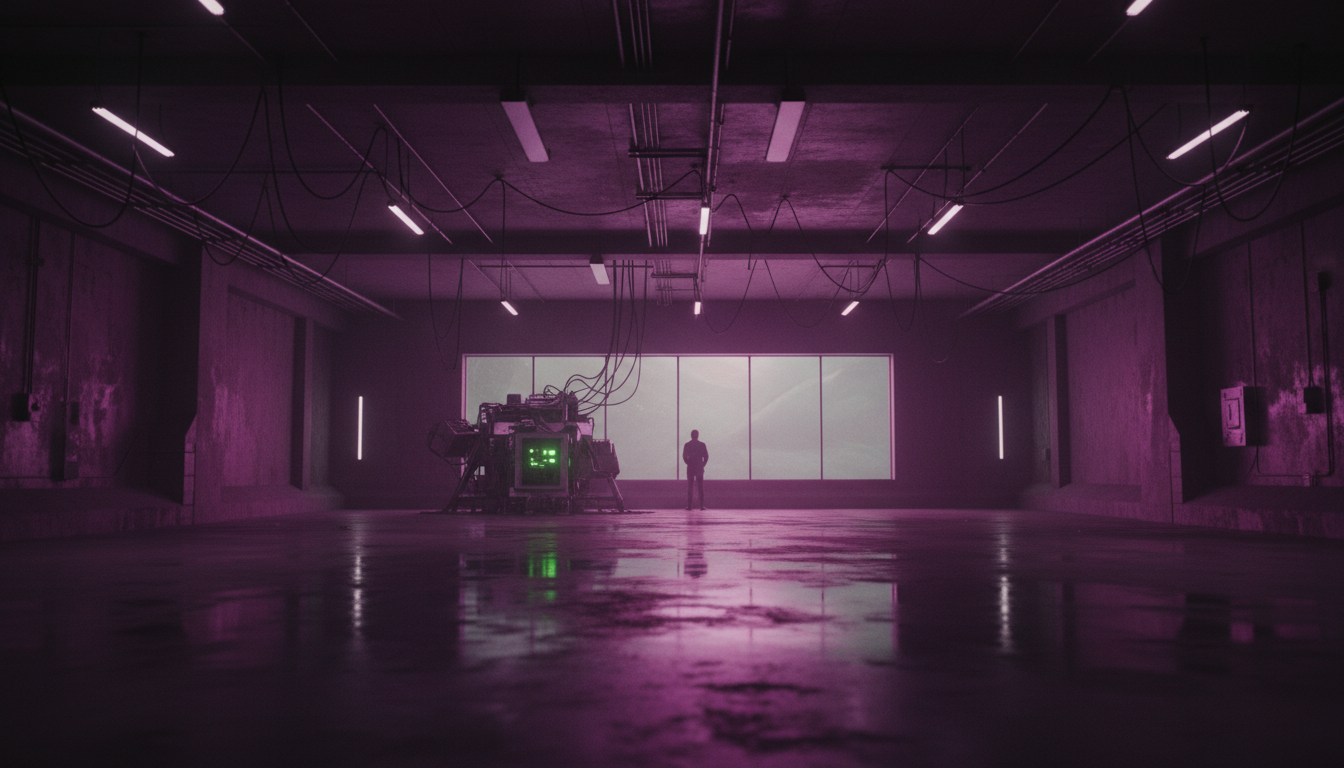
The chairs were still out. That was the thing Aurora Merrick could not get past on the morning of the twelfth, standing at the top of the shallow steps above the plateau lawn with a slate she had not looked at in two hours: eleven hundred chairs in curved rows facing a low platform, set out eleven days earlier by a contract crew who had done it beautifully, and nobody had told anybody to come and take them away. The instruction to set them up existed. The instruction to strike them did not. It was, she thought, entirely typical, and then she caught herself thinking it in the voice she used for him, and stopped.
Aurelio Calder had died the previous afternoon, eleven days after the party, in a chair by a window, with Osk in the room and nobody else, which was not an arrangement anybody had made and was simply how the afternoon had gone. He had been reading the party for the whole of those eleven days — the attendance, the non-attendance, the ninety-one pages of stated reasons, and then the forty-one amendments people had asked to make to their own statements once they had been there. He had asked Osk, in the last week, to read him the attendance list aloud, which took most of three days, and had said, when Osk reached the end of it, that there was one more. That is the last thing anybody has him saying that is not about the light or the room, and Osk did not follow it, and did not ask, and has been asked about it perhaps four hundred times since.
He stayed dead. It is worth putting that plainly here, at the start, because a great many things happen afterward and none of them undo it: the man died on the eleventh, quietly, in a chair, at ninety-nine or a hundred and forty or some number nobody could honestly write on a certificate, and he did not come back, and nothing in this book is going to pretend otherwise.
Aurora ran the arrangements because nobody else could face the paperwork. That was the whole of the reason, and she was clear-eyed about it. Selah had gone down at some point in the night and not come back up. Lyra had sat on the low wall by the transmitter hall for four hours doing something to a slate that turned out, later, to have been the estate audit she would not formally open for another nine days. Jaxon had gone to find whoever had catered it and had, characteristically, thanked them, and then had gone somewhere else and been unavailable in the specific way he was unavailable perhaps twice a decade.
So it fell to Aurora, who was seventy-six, and who had built the audit office and ran it still, out of two rooms and a corridor in Ledger's End, and who had spent thirty years of a working life building an instrument that existed, in the last analysis, because of the man on the platform. She was aware of the shape of that. She had been aware of it since she was nineteen, and she had never once trusted any of it, and she was scrupulous about not letting the distrust do her thinking for her. She went and found the crew supervisor and arranged for the chairs.
The planet, meanwhile, was deciding how to feel.
That process took most of a fortnight and it was not tidy. There was no riot; there had been a riot, once, and it belonged to a different decade and a different provocation, and this was not that. What there was instead was ninety-odd thousand people conducting a slow, mostly civil, extremely documented argument about what precisely had died, and the filings from those first fourteen days run to something over four hundred thousand words in the public record, and they are worth reading, and almost nobody reads them.
The difficulty was simple to state and impossible to settle. A great many people on Aura-36 had spent their entire lives inside a set of arrangements — the Trust, the Thirds, the Accord, the audit offices, the whole apparatus of a world that does not let a person fall out of it — that they had been taught, correctly, were not his. Ferrer wrote the clock. Oyelaran wrote the floor. Achebe held the vault. Okonjo pinned the maps. The founding was ten people and then nine and then a handful, and the schools had been careful about that for four generations, deliberately and on Achebe's insistence, because a man taught as a sky is a man nobody can audit.
And it was also true that he had been there for all of it, and had outlasted every one of them by a margin nobody had ever satisfactorily explained, and had held a category of exceptions that a Council had spent eleven years unpicking and had not finished unpicking when he died. Both of those things were in the record. Neither cancelled the other. A planet that had been trained for a hundred and forty years to hold two true things beside each other without reconciling them was now being asked to do it about a body, and it turned out that the training held, and that holding it was miserable.
Aurora Merrick's own filing, made on the fourteenth and running to a page and a half, said that the office would publish an assumptions file on the estate within thirty days and that she would recuse herself from any finding that touched the Redoubt. She was asked, twice, whether the recusal was personal. She said yes. That is in the record too, and it is the reason the office survived what came next with its credibility intact, and she did not do it for that reason; she did it because it was true and because saying so cost her nothing she valued.
The funeral had not happened yet. There would, in the end, be two of them, eleven days apart, and they would be attended by entirely different worlds, and that is the next chapter and not this one. What this morning had was chairs, and a lawn, and a woman with a slate walking the rows with her hands behind her back, counting them because counting was a thing her hands knew how to do while the rest of her was elsewhere.
Eleven hundred and four. She checked it twice, and the second count agreed with the first, and she wrote it down in a notes field nobody would ever read, because a number you have checked is a number that has stopped being a feeling.
Down on the flats the tide came in on the two-beat the way it had for a hundred and forty years, and the marina domes took the violet the way pearl takes a light, and somewhere inland a foundry that had been throwing cots since before anybody now living was born went on throwing them. The world did not stop. That was in a great many of the filings, phrased a great many ways, and most of the people who wrote it seemed to find it a comfort, and Aurora — walking a lawn at the top of a mountain that a man had levelled for reasons a Council had eventually published in full — did not find it a comfort at all, and could not have said what she would have preferred instead.
She went down at the fourth hour to the transmitter hall, because the crew supervisor needed a signature and because Lyra was still sitting on the wall. She signed. She sat down on the wall.
"You have not slept," Lyra said, without looking up.
"Neither have you."
"No." Lyra turned the slate face down on her knee, which Aurora noticed and did not remark on, and which she thought about a great deal nine days later. "Do you want me to say something about him."
"No," Aurora said. "I want the chairs gone by the second."
Lyra laughed, once, shortly, and it went out across the plateau and came back off the hall's plated wall a beat later, the way sound does up there, and the two of them sat with it. Then Lyra said that she would take the estate, and Aurora said that she assumed so, and that was the whole of the handover of the largest and least legible private holding on the planet: two women on a wall, at the fourth hour, agreeing without any instrument at all.
The chairs were gone by the second. Aurora signed for that too.
Chapter 2 — Ren
↑ Back to ContentsFocus: Selah.

Ren died nineteen days after Calder, at eighty-nine, on the fourth tier at Fissure Nine, and the county recorded it in one line and did not add anything to the line, which was what he had asked for and rather more precisely than he had expected to get it.
The particulars belong to Book Three and are not this book’s to retell. What this book has to record is the sequence, because the sequence is the reason the next hundred chapters are possible at all. If Ren had died first, or in the same week, or a year later, the thing that came up out of the plateau in the eighth month would have walked into a different world. He died nineteen days after. In those nineteen days a planet of ninety-one thousand people used up every scrap of its capacity for a public event, and then had to find somewhere to put a second death, and had nowhere, and put it on a tier.
So there was no service at Ledger’s End. There was a funeral, small, four days later, which Selah attended and at which she did not speak. Jaxon came and sat with her for two days afterward and absorbed all of it and never once suggested she was being unreasonable. Lyra made the arrangements Ren had not made, because he had assumed — wrongly, and rather sweetly — that there would be nobody left who wanted a formal notice. There were four hundred and six formal notices requested in the first month.
Selah was four hundred and eleven kilometres down when it happened and was not there, and had never at any point been going to be there. They had settled that years earlier, at a kitchen table, in about six minutes, and neither of them had reopened it. This is the fact about the two of them that four generations of schoolchildren have been taught and that almost nobody has understood, because it is taught as devotion and it was not devotion. It was an agreement between two people who had each looked at the arithmetic and declined to let the last stretch be about the last stretch.
The eleven hours it took her to come up are the most examined eleven hours in the archive and there is nothing in them. She logged the interval before she left. That is not stoicism and the record should stop calling it stoicism; it is a woman completing the last item on a shift because the log was owed and did not care who was filing it. She has said so herself, in the format, twice.
What was on his mind in the last week was her, and he handled it, which after sixty-eight years of jointly declining to handle it was the only genuinely uncharacteristic thing he ever did.
He said, on the fourth day of that week, that she was going to have to find something to do, and Selah said that she had something to do, and he said that logging an interval every four days was not something to do, it was something to be done, and there was a difference, and she should stop pretending she could not see it. She told him he had waited sixty-eight years to say that and had picked a fine week for it. He said he had been saving it for a week in which she could not usefully argue back.
She argued back for an hour and eleven minutes. Ardith, who was in the next room and has been asked about this perhaps forty times, has never reported a word of it and has said, each time, in the same words, that it was two people having a row about work and that she has never heard anything less like a deathbed in her life.
She had told him in advance, years before, what she was going to do afterward. Not sad first and then angry. Angry, and for about a year, and she had wanted it on the record in advance so that he did not die imagining she would take it well. He had said that seemed fair.
She was exactly as good as her word, which is the part everyone leaves out because it is the part that does not scan as love and is the clearest evidence in the archive that it was.
Aurora Merrick was seventy-six that year and did not go to the funeral, and filed nothing, and has left three separate accounts of why, none of which agree with each other.
She had not known Ren. She had known of him the way everybody knew of him, which is as the first name on a list that four generations of schoolchildren had been made to recite and had recited without feeling a single thing — exactly as Oyelaran had predicted, and had called a success. Aurora had spent thirty years auditing the founding and had built an office whose entire purpose was to keep the founding from becoming furniture, and on the day the last of the founding died she stood in her own kitchen and checked herself for a feeling and found the drawer empty.
She has written that this frightened her more than anything in the four years that followed, and it is worth taking seriously, because it is the single best account anybody has left of the condition Book Four is about: a world that has done everything right, that has built honest instruments and staffed them with decent people and taught its children accurately, and has in the process finished the job of turning its own origin into a thing you are examined on.
Nothing had gone wrong. That was the difficulty. Nothing had gone wrong for a hundred and forty years and the result was ninety-one thousand people who could recite the eleven clauses and could not have told you, on the day the last man who had refused the exemption died on a tier, what it had cost him or why he was owed anything at all.
And Lyra, who had opened the estate audit nine days before Ren died and had already seen the thing sitting live inside it, said nothing about the thing sitting live inside it, for eleven more days.
She has never defended that and has never apologised for it either. Asked about it in the fourth year, under oath, in front of an office that had every right to the question, she said that she had been sitting with Selah, and that she had made a judgement about what a person can be handed in a particular fortnight, and that she now believed the judgement had been wrong on the merits and right in every other way, and that she declined to rank those.
The auditor asked her to state, for the record, whether she would do it again.
Lyra said yes.
Two deaths, nineteen days apart, and the second one smaller than the first by a factor of about a hundred and fifty. A man of a hundred who had been argued about by an entire planet for eighty years, and a man of eighty-nine who had been the reason a tier had a chair at the back of its quarterly session.
Six days after the second one the tier held that session. It ran four hours and was contentious and was about water, and somebody sat in the chair at the back, because it was a chair.
Nothing in what follows undoes either of them. It is important to say that here, at the front, because a great deal of what follows will look, to a reader coming to it cold, like an attempt to undo one of them, and it was not, and the people involved knew it was not, and said so, at length, in public, for four years.
Chapter 3 — Two Graves
↑ Back to ContentsFocus: Jaxon.
Jaxon went to both funerals and could not make them be the same kind of event, and the failure bothered him for the rest of a life that had eleven years left in it.
The first was on the twenty-second, planetary, formal, and held at Ledger's End because Ledger's End is where a thing goes when it belongs to everybody and to nobody in particular. Fourteen thousand attended in person. The rest of the planet did whatever it did. There was a hush — three minutes, the ordinary one, the one a dead man named Okonjo had built to be reinterpreted and which four generations had duly reinterpreted into a dozen sincere and mutually incompatible reasons — and there were four speakers, and the speakers were good, and the whole thing was, Jaxon thought, standing near the back in a coat he had owned for thirty years, entirely correct and almost completely useless.
The Council had been careful. That was the trouble. Every sentence in the formal service had been checked against the record by people doing their jobs properly, and the result was a ninety-minute event in which nobody said anything that was not defensible, and defensible turns out to be a poor material for a funeral. A woman from the Guardians read the four pillars. A Vigil Guide read fourteen lines about carrying. Aurora, who had been asked and had thought about it for two days, read the dates: born, sailed, landed, and a dash, and the number nobody could write, and she read the dash out loud as a dash, which was the single most talked-about thing anybody did that week.
Jaxon left before the end and did not think it was rude. He had gone to a great many funerals. He had gone to Kira's, and to Lyra's mother's, and to eleven others he could have named, and he had learned somewhere in the middle of all that that leaving early is only rude if the thing you are leaving is for the dead. This one was not. This one was for the planet, and the planet was doing fine.
The second was on the second of the following month, eleven days later, in a yard.
It was not announced. It was not on any ledger, and no filing was made, and the audit office did not audit it, because it was not a public act and Aurora had been extremely clear on that point when Lyra asked her. Thirty-one people came. Jaxon counted them, because he counted things. Twenty-six of them were machine hands out of the works and the foundries and the long maintenance rota that keeps the grid seated, and four were Selah and Lyra and Aurora and himself, and the thirty-first was a woman of about forty from the Cliff-Tiers whom nobody had invited and who turned out to be the granddaughter of a man who had once been given a fitting.
There were no speeches. Somebody had put a bench in the middle of the yard and somebody else had put a fitting on the bench, and over about two hours everybody who wanted to came and stood near the bench for a while and then went and stood near somebody else and talked about work.
That was the whole of it, and Jaxon, who had been to a great many funerals and had never been to that one, found that he could not get his face to behave, and went and stood by a wall for a bit, and Selah came and stood beside him and did not say anything at all, which was the correct thing and which she had always been good at.
The trouble was that both of them were true.
He worked at it on and off for the rest of the year. The formal one was not a fraud; fourteen thousand people had genuinely come, and the four pillars genuinely were the instrument that had kept them all alive, and a planet that buries a founding body with its own laws read out over it is a planet doing something serious and getting it right. And the yard was not more real for being small. That was the sentimental version and he refused it every time it presented itself, because he had spent sixty years watching people decide that the intimate thing was the true thing and the public thing was the performance, and he had watched that belief do a great deal of damage.
What he could not do was hold both at once. Not the way Ferrer's book held things, beside and unreconciled, which he understood perfectly well as a method and had used himself in a hundred filings. He could hold two facts. He could not hold two funerals. Something in the shape of a funeral demands that it be the one, and there had been two, and they had had different rooms and different dead men in them.
He said this, once, to Lyra, about four months on, and Lyra thought about it for a long time and said that she suspected the problem was that they had buried a person on the twenty-second and a job on the second, and that the man had been unusually hard to separate into those, and Jaxon said that was better than anything he had come up with and still was not right.
It was not right because of the granddaughter from the Cliff-Tiers.
She had come, uninvited and unannounced, to a thing that had not been announced, which meant somebody in the yard had told somebody, which was itself against the run of how those hands did things. She stood at the bench for perhaps four minutes. She did not touch the fitting. When Jaxon, who was incapable of not doing it, went over and asked her, gently, whether she had known him, she said no, and that her grandfather had, once, for about ten minutes, in a corridor in the year seventy-something, and had been given a fitting for a chair that had a bad leg, and had kept the fitting his whole life and had never once mentioned the man's name in connection with it, and had left it to her mother, who had left it to her.
Jaxon asked whether she had brought it.
She said no, because it was on a chair.
He thought about that for eleven years and never got to the bottom of it, and he wrote it down twice — once in a filing, briefly, and once in a letter to Aurora that she kept — and the second time he wrote that he thought the reason there had to be two funerals was that a man who spends a hundred years making small useful objects for people he does not know will end up dead in two entirely separate places, and that neither of the services had been wrong, and that he personally would have gone to a third one if anybody had held it, in a corridor, for ten minutes, about a chair.
Chapter 4 — Nothing Holding Her
↑ Back to ContentsFocus: Selah.

Selah Vey was twenty-seven, and had been for sixty-five years, and for the first time since a chair four hundred and eleven kilometres down there was nothing in the world with a claim on where she stood.
That is the chapter. Everything else in it is furniture.
She went down on the fourth day after the second funeral and logged the interval, and the interval was unchanged, and she logged the irregularity on the second beat and it was unchanged too, and she sat in the chair afterward for rather longer than the procedure allowed, which is not in the log because the log has no field for it.
The Undersong had not altered in sixty-five years. She had put her palms flat on a console at twenty-seven and heard a thing that had been there before anybody arrived and would be there after, and she had spent every four days since reporting faithfully that it had done nothing. She had been wrong about how long it would go on — at forty she had thought forty years, maybe fifty; at sixty she had thought it again; at ninety-two she had caught herself doing the same arithmetic with the same wrong answer — and it had never minded, and it had never varied, and the log was owed and did not care who was filing it.
What had changed was that everybody who had ever asked her about it was dead.
Kira had asked. Kira had died at ninety-three. Lyra's mother had asked, once, badly. Jaxon had asked properly, twice, forty years apart, and had listened to the answer both times, which is rarer than asking. Ren had asked more or less every four days for sixty-eight years, in the form of standing in a doorway and raising his eyebrows, and she had answered by shaking her head, and that had been the entire conversation approximately six thousand times.
Now the doorway was empty and the interval was unchanged and there was nobody to shake her head at.
She did not describe this as grief and the book will not either, because she was specific about language in a way that cost her friendships and she would object. What she wrote, in the format, with the uncertainty on the first page, was that she noticed she had begun listening for slightly longer than the procedure required and could not determine whether that was because her attention had improved or because leaving the chair had become the difficult part. She flagged it as unresolvable by her own testimony. She filed it anyway. Nobody read it for eleven years.
Lyra came down on the ninth day.
They had known each other for the better part of seventy years and had never been close in the way people expected them to be, which had suited both of them enormously. Lyra sat on the edge of the console housing with her feet not touching the floor, because the housing was built for standing at, and said nothing for about ten minutes, and then asked whether Selah had eaten.
"Yes."
"Today."
"Recently."
Lyra let it go, which is the single most useful thing anybody did for Selah that year.
Then she said: "There is something in the estate. I am not going to tell you what it is yet, because I have not finished reading it and because if I tell you now you will make it your business, and I want to know what it is before it is anybody's business."
"All right."
"You are not going to ask."
"No," Selah said. "You will tell me when you have read it. You always do. I have been waiting for people to finish reading things for sixty-five years, and it is the only thing I am unambiguously good at."
That is, as it happens, the last completely ordinary conversation in this book. Everything after the fourteenth chapter happens to people who know what is under the plateau.
But the thing that matters in this chapter — the thing that is planted here and never restated, and that the reader should be allowed to forget until it detonates about seventy chapters from now — is what Selah did on the eleventh night, alone, with nobody to tell.
She went up.
Not far. She took a lift to the surface at the coastal mouth, which she had done perhaps four times in a decade, and walked out onto the glass, and the plaque did not say stack and Ground Truth did not raise a hand and the filter strap stayed in her hand where it had been since a girl called Vasquez had made that ordinary on a Day three a hundred and forty years earlier, and she stood on lavender-indigo volcanic glass under a violet disk three hours into its long fall and looked at the sky she had spent seven decades with her back to.
There are two moons. She had known that since she was a girl. She had not looked at them since the year Kira died.
She stood there for something over an hour and did not put her palms on anything, and this is the only occasion in sixty-five years of continuous professional listening on which Selah Vey is recorded as having deliberately not listened to something, and the record of it exists solely because she wrote one line in the log the following morning that reads, in full: Interval unlogged, night of the eleventh. Not an omission. I was outside. Vey.
Ferrer's method, a hundred and forty years dead and still running: mark the entry, do not correct it.
Nobody asked her about it. The log is public and has been public since it was opened and anybody at all could have read that line at any point in the decades that followed, and as far as the archive can establish, in all that time, exactly one person ever did.
He was not a person. That is a much later chapter.
What she had, standing on the glass, was the fact that Ren had put in her hands nineteen days before he died and that she had called a rotten thing to say to a man with four days in him: that there was now nothing holding her. She turned it over carefully. She did not like it any better outdoors. But she noticed — and she wrote this down too, eleven months later, in a different format, in a private volume that came to the archive after her — that the objection she kept reaching for was not that is untrue. It was that is not fair to the interval, and the interval, she observed, had never once asked her for fairness, or for anything else, and had gone on regardless of every arrangement she had ever made around it, for sixty-five years, exactly as it had gone on for the four hundred million before she arrived.
She went back down at the second hour and logged the following interval on time and found it unchanged.
It is worth stating plainly, because the trilogy hangs on it and because nobody in this book ever says it out loud to her: Selah did not go to Earth out of grief, and she did not go out of duty, and she certainly did not go because a body asked her to. She went because a man who loved her spent his last week telling her that she was free, in the worst possible phrasing, at the worst possible moment, and was right.
Chapter 5 — A Protocol Nobody Filed
↑ Back to ContentsFocus: Lyra.
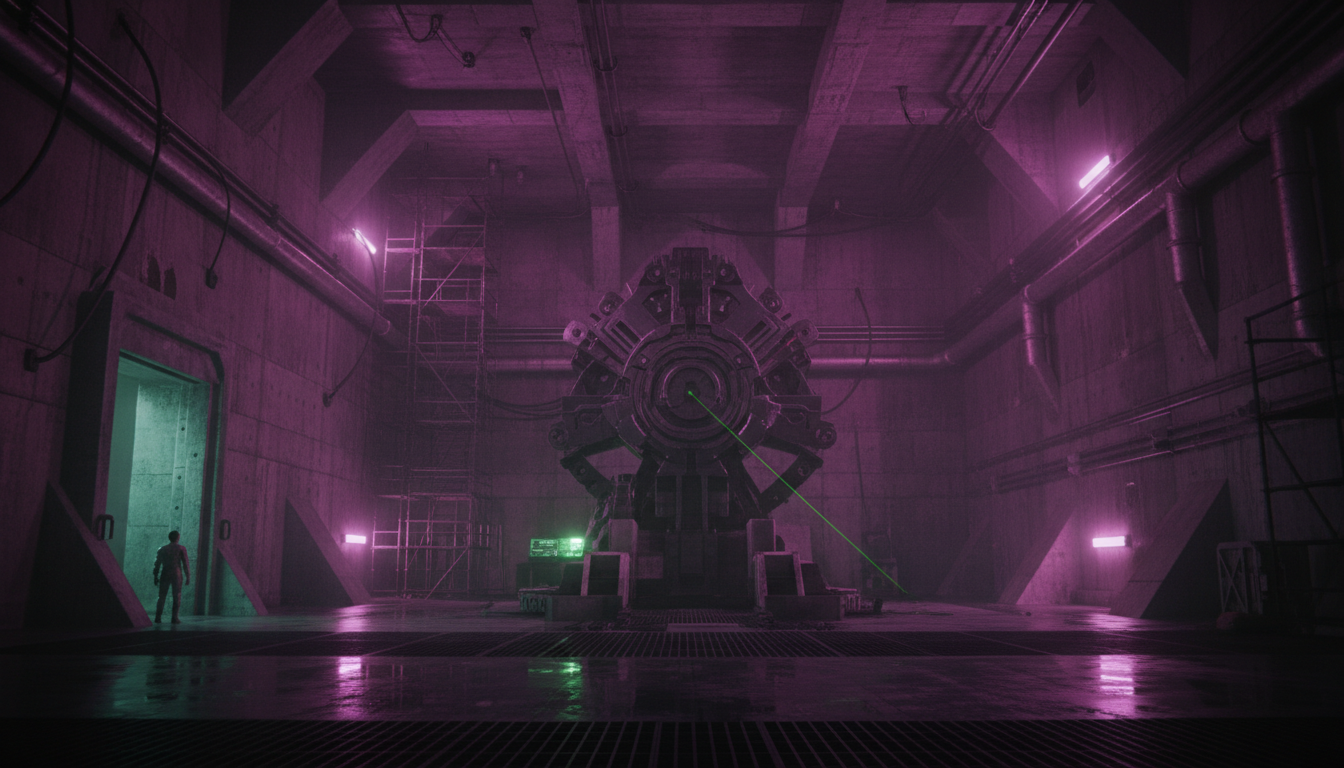
Lyra opened the estate audit on the twentieth and found the thing on the twenty-third, and the nine days between finding it and telling anybody are the most examined nine days of her life, and she never once claimed they were defensible.
The estate was not complicated. That surprised people afterward and it should not have. A man who had spent a hundred years refusing to be a plan does not leave a labyrinth; he leaves a workshop. There were four properties, none of them held in any way that required unpicking, and a fabrication licence, and about eleven thousand catalogued objects of which the great majority were fittings, and an instrument-grade holding in the grid that had been assigned to the public trust in the year eighty-one and had sat there quietly generating a small and entirely legal income for a maintenance rota ever since. It took her three days.
On the fourth day she went into the old formats.
This is the part that requires a word of explanation for anybody who has not worked in a founding-era archive, which by then was almost everybody. The instruments written before the Handoff are not encrypted and were never intended to be. They are simply written in a documentary grammar that has been out of use for four generations: a schedule, a stated cause, a signature block, and a field for review that is very often blank. They are dull to the point of hostility. Ferrer designed them that way on purpose, and said so, and the reason a great deal of the founding survived intact is that boring documents do not attract editors.
The reason a great deal of the founding also went unexamined for a hundred and forty years is exactly the same.
What Lyra found, filed in the ordinary schedule between a fabricator licence and a decommissioning note for a cell that had been scrapped in the year ninety, was an instruction of about four hundred words in founding format, dated Year sixty-nine, with a stated cause, a signature block containing one name, and no review date.
It was live. It had been live for a hundred and forty-one years. And it had executed — begun executing, past tense, already, sixteen days earlier — on receipt of a death certificate.
She read it four times before she moved.
The instruction did not describe what it would do. That is important and it is the single most-argued point in the whole subsequent literature: the protocol as filed is a trigger and a set of permissions and a payload address, and it does not, anywhere in four hundred words, say what the payload is for. It says that on registration of a death certificate in the name in the signature block, a standing programme at a stated location is to be released from hold and permitted to proceed to completion under its own instruction set, and that the release is not revocable, and that no person is to be in the loop.
That last clause is a direct quotation of Protocol language a hundred and forty years old. Lyra recognised it immediately, because everybody who has ever read anything about the founding recognises it: it is the phrasing from the day the doors learned not to ask, after four hundred people died at a mouth in the year forty because somebody with authority stopped to ask a question.
He had written his own resurrection — if that is what it was, and this book is going to spend a hundred chapters declining to settle it — in the grammar of the safety protocol that had been built out of four hundred corpses, and he had used the clause that keeps a person out of the loop, and he had used it correctly.
She could read it. She could not stop it. There was no instrument that could stop it, because the instruction had been drafted by somebody who understood exactly what a later Council would want to do and had removed the surface it would need to do it from. No address. No oversight. No review date. Three blanks in an ordinary schedule, each one typed with a stated cause, in a format Ines Ferrer had signed off and had thought about for the rest of her life.
Root-Admin opened at the fourth hour of the twenty-third.
Lyra had held Root-Admin, nominally, for eleven years, in the way that six other people held it: as a legacy credential that existed because nobody had found a lawful way to abolish it and which had not been exercised in her lifetime or her mother's. It is not a power. It is an inheritance, and the standing joke among the seven of them was that it entitled you to read things you would rather not have read.
She exercised it, once, for four minutes, to confirm what the payload address pointed at.
It pointed at the Redoubt.
And here is the thing that she could not afterward explain to anybody's satisfaction, including her own: Root-Admin, once opened, does not close. Not by policy — by construction. There is no closing instruction. The credential was written in an era that assumed the person holding it would be dead before it mattered, and every subsequent attempt to build a revocation had run into the same wall, which is that a revocation instrument requires an authority above the credential, and the founding never made one, on purpose, and the Handoff had distributed everything except this.
So for the remaining forty-one years of her life Lyra was a woman with an open credential she had used once for four minutes and could not put down, and she was scrupulous about it, and she published the four minutes in full on the ninth day, and the publication is what saved her.
She did not publish on the first day. That is the nine days.
Her account, given to the audit office years later and never revised, is that she spent them establishing whether the programme could be interrupted at the far end rather than the near one — whether there was a physical instrument, a cell to pull, a hold to reinstate — and that she concluded on the eighth day that there was not, and published on the ninth. Aurora's office examined this in detail. It found the account consistent with the timestamps, found no evidence of any other activity in the window, and published a finding that Lyra's delay was unexplained by the record but not contradicted by it, and left it there, marked and not corrected.
Aurora personally believed she had spent the nine days deciding whether she wanted it stopped. She never wrote that down. She said it aloud exactly once, to Jaxon, four years later, and Jaxon said that he had assumed the same thing and that he thought rather better of Lyra for it, and Aurora said that she did not, and that this was the difference between an auditor and a friend, and Jaxon agreed that it probably was.
What is beyond dispute is what the instruction actually said in its stated-cause field, which is one sentence, and which Lyra read four times on the twenty-third and did not understand until she had been to the Redoubt:
Cause: an unfinished programme is a hazard to whoever inherits it, and I will not leave one running without a stop I have written myself.
He had been talking about the machines. Everybody read it, in the first weeks, as being about himself.
It took eleven years and a woman standing in a shaft with her palms flat on a wall before anybody read it the other way.
Chapter 6 — Under the Plateau
↑ Back to ContentsFocus: Aurora.
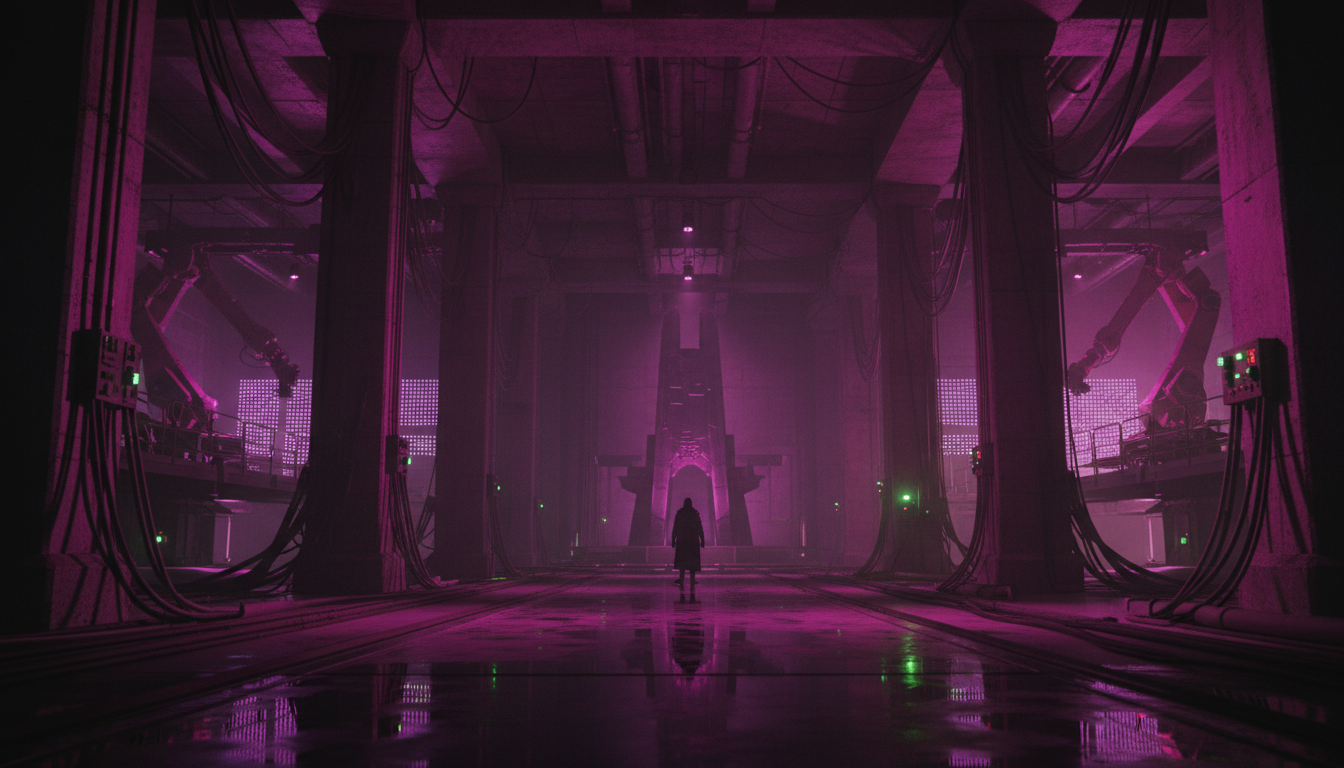
Aurora Merrick had been born forty metres underground, in a room with no address, to parents whose names are in a private volume and not in the Ledger, and she had been nineteen before she found out that the reason she had no birth entry was not an oversight.
She went back down on the twenty-fifth, alone, deliberately, and told nobody she was going.
The road up the mountain is public now and has been since the year forty-four, and the levelled plateau at the top carries a monument that Aurora had voted against in council, twice, on the record, on the grounds that a monument to a man whose principal architectural achievement was an unlisted address is a monument to the wrong thing. She had lost both votes comfortably. She walked briskly past it. It is a low basalt slab with four lines on it and it does not name him, which was the compromise, and she thought as she always thought that the compromise was worse than either option and that she had helped make it.
The Redoubt itself had been opened to survey in the year fifty-one, catalogued over four years, published in full, and then very largely forgotten, because a documented thing stops being interesting. Fourteen thousand people had walked through it in the decade after opening. Perhaps two hundred a year went now, mostly students. There is a handrail.
Aurora had not been down in eleven years, and had not been down alone in thirty.
She went alone.
The corridor at forty metres is not dramatic. That is the first thing everybody says and it is true: it is a plain cut in basalt with a level floor and a strip of light and a series of doors, and it looks exactly like the service level of any county in the Subterranean Milky Way, because it is one, built by the same hands to the same specification in the same decade. The only thing that distinguishes it is that it does not appear on any grid map filed before the year forty-four, and that for sixty-one years the entrance carried no marking of any kind.
She had learned to walk in that corridor, literally, at eleven months. There is no plaque saying so and she had refused, four separate times, to let anybody put one up.
At the far end, past the vault-corridor and the junction and the room the survey catalogued as Store Nine, there is a door that the survey catalogued as Store Eleven and that has been listed since the year fifty-five as fabrication, mothballed, contents inventoried, no active draw.
There was, unmistakably, an active draw.
She had known there would be, because Lyra had published on the ninth day and the publication had been unambiguous, and because the grid office had by then confirmed the load and had been unable to say when it had started, since the draw was inside a founding-era exemption that nobody had thought to instrument. The exemption was on Ferrer's schedule. It had a stated cause. It had no review date.
But knowing it and standing in front of the door are different operations, and Aurora had built a thirty-year career on the difference. Her office exists because of the difference. The whole apparatus of published assumption — the finding, the stated method, the invitation to check — is a machine for converting the first into the second, and she had built it, and she had never once in three decades had to use it on a room she had played in.
The door was not locked at all. That is in her filing and it caused a great deal of comment. There was no lock, there had never been a lock, and there was no need of one, because for a hundred and forty years there had been nothing behind it that anybody wanted.
She went in slowly.
What she found is described in her filing in four hundred and twelve words, in the flat register her office uses for everything, and the filing has been reproduced so often that most people on that planet can quote the opening. It reads: A room approximately eleven metres by six. Fourteen units, of a founding-era pattern, working. A bench. On the bench, a body. The units are not attending me. They did not stop when I entered and they did not start. I stood in the room for eleven minutes and formed no view about what I was looking at, and I am filing that as the finding rather than as an omission.
She had gone down expecting to be frightened, and had carefully prepared for it, in the way she prepared for absolutely everything, by writing out in advance the things she would refuse to conclude. She was not frightened. What she felt, standing in a mothballed store at forty metres with fourteen machines doing patient work on a bench, was something she could not get a word around for four years and eventually settled on as recognition, which she disliked and published anyway.
Because she had seen it before. Not this. The other thing: units at a wall, doing nothing, in a corridor she had learned to walk in, because nobody had asked them to. That is what the founding record says he did, over and over, for a century, and it is the one habit of his that every account agrees on and nobody has ever satisfactorily explained. He did not ask them.
Somebody had asked them. Once. In the year sixty-nine, in four hundred words, in an ordinary schedule.
And they had been working ever since, and had not stopped when a woman came in, because stopping was not in the instruction and nobody was in the loop.
She deliberately did not touch anything. She stood for eleven minutes and then she went back up the corridor past Store Nine and the junction and the room where she had learned to walk, and out past the monument she had voted against, and she sat down on the low wall by the transmitter hall, which is where Lyra had sat on the morning after the party, and she opened her slate and filed.
She published within the hour, which was unprecedented. That is the fastest publication in the history of the office and the record still stands, and when she was asked, much later, why she had not taken a day, she said that she had spent eleven minutes in a room forming no view and that she had not trusted herself to keep forming no view for a day.
The last line of the filing is the one that got quoted:
I grew up forty metres from this room. That is a relevant interest and I am declaring it. It does not disqualify me from describing what is on the bench. It will disqualify me from saying what it is.
Chapter 7 — What the Tests Were
↑ Back to ContentsFocus: Lyra.

The machines had not been trying to raise him. Lyra established that in the first fortnight and published it immediately, and it remains, a great deal later, the single most misunderstood finding in the entire literature, because it is genuinely counter-intuitive and because the true version is considerably stranger than the version people expected.
They had been finishing a research programme.
The instruction set in Store Eleven, recovered in full and published in full, is a continuation order. It says, in founding-era grammar and at very great length, that the tissue-longevity programme opened in the year twenty-two is not concluded, that the operator is withdrawing, and that the work is to proceed on the standing method until the method returns a stable result or the materials are exhausted. It sets no deadline, because Ferrer's formats have a field for a review date and Calder had left it blank, with a stated cause, as he had left every review date blank for sixty years.
There is no instruction anywhere in it to build a person. There is an instruction to solve a problem, and a body on a bench is what solving that problem looks like when the problem is the one he had.
Lyra assembled the medical picture over four months with a team of eleven, and it comes to four things, and she was careful in every publication to give them in the order the machines had arrived at them rather than the order that makes a good story.
First, the nanite line. That is the oldest and it is not mysterious; the same line had been in continuous documented use in surgical practice on that planet for a century, it is taught, it is audited, and its limitations were well understood. It maintains. It does not build. Left running on a single subject for a hundred and forty years with no instruction to stop, it does what it does, patiently, forever, which is to say it holds a structure against entropy at an energy cost that a grid seated in basalt can supply indefinitely and that nobody had ever costed because nobody had ever asked it to run that long.
Second, the original serum — the founding-era compound, the one in Ferrer and Sow and Achebe and all of them, the one that kept a clerk at a crate past any reasonable age and did not keep her face. It is documented. It is also, and this was Sow's own conclusion in the year seventy-one, a partial answer that its designers knew to be partial.
Third, the Star Drifter's variant, which is cruder, and which arrived in the archive by a route this book is not going to trace because it takes four chapters and belongs to another book entirely. It does one thing the original does not do and does four things badly that the original does well.
And fourth, something the machines derived themselves, on the standing method, some time between the year ninety and the year one hundred and ten, by the entirely unremarkable process of running the comparison the operator had set up and never come back to.
That fourth thing is why it works. It is not a breakthrough in any sense a person would recognise; there was no insight, and nobody was present, and the notebooks — and there are notebooks, in machine format, running to some hundreds of thousands of pages — record it as an iteration among tens of thousands of iterations, indistinguishable in the log from the ones on either side of it. It reconciles the three. It had been sitting in Store Eleven, complete and unread, for something over a hundred years.
Lyra put it plainly in the third publication, and the sentence is on a wall in a teaching hospital now, which she would have hated: The tests were not a miracle and they were not an atrocity. They were a research programme nobody cancelled.
There is a harder thing underneath, and she published that too, in the fifth paper, with considerably less appetite.
The programme required subjects. It had had one, continuously, for a hundred and forty-one years, and the subject had been dead for the last sixteen days of it and had been alive for the first hundred and forty years, and the consent instrument on file is the same four hundred words in an ordinary schedule that opened the whole thing, signed once, by the subject, in the year sixty-nine, with no review date and nobody in the loop.
He had experimented on himself for a century and had left standing orders for the machines to carry on after he stopped being able to object. Every part of that was lawful when he wrote it and no part of it would be lawful now, and the reason no part of it would be lawful now is a body of consent law that Aurora's office had spent thirty years building, out of exactly this kind of founding-era blank.
Lyra was asked, at a hearing, whether the programme should have been stopped at any point in the previous century had anybody known about it. She said yes, without qualification, and then said that she wanted the record to show that she was answering as a person with a hundred and forty years of hindsight and a consent framework she had helped write, and that she had no confidence whatever that she would have said the same thing in the year eighty.
That answer is why she was believed about everything else.
The last item in the medical picture is the one nobody had expected and the one Selah had privately known for sixteen days before it was confirmed.
The body does not sleep. It rests, in a fashion, on a cycle that follows the Thirds because everything on that planet follows the Thirds, but the state it enters is not sleep by any definition the clinic uses, and the machines maintain it throughout. Which means, and Lyra wrote this out carefully and then sat with it for a day before publishing, that the eleven words do not attend it.
Where a person sleeps, no instrument of the ship attends. A hundred and forty-one years of law, the shortest law on the planet, written by a man who knew the gap he was leaving and left it — and the one entity on Aura-36 to which it has no application is the thing that came up out of the plateau.
Nobody noticed for nine years. When somebody did, it was not a lawyer.
It was Selah, who had noticed in the first fortnight, and had not said, because she could not determine whether she had heard it or assumed it, and her format does not permit her to report a thing she cannot separate.
Chapter 8 — It Stands Up
↑ Back to ContentsFocus: Selah.

They had prepared for a great many things. Nobody had prepared for competence.
It sat up at the eleventh hour of the fourth of the month, in a mothballed store at forty metres, with fourteen units carrying on around it and Selah standing four paces from the bench because she had been the one on the rota.
It looked at her.
"Selah," it said. "How long."
She told it.
It thought about that for perhaps three seconds, which she timed, because timing things is what she does instead of reacting.
"Ren?"
"Nineteen days after."
It nodded, once, and did not say anything for a while, and then asked after Lyra and after Jaxon, by name, in that order, and then asked whether Aurora Merrick was still at the audit office, which nobody in the room had expected because nobody in the room had been sure it would know who Aurora was.
Then it swung its legs off the bench and stood up.
It was very old. That is the first thing in every account and it is not a figure of speech: it looked like a man in his hundreds, whatever that means, thin and marked and entirely upright, and it stood without assistance and without the pause that a person takes, and it did not wobble at nought point three eight, which Selah noted and could not immediately say why she had noted.
It steadied itself on the bench with one hand for about a second, and looked at the hand, and put it down.
"That is habit," it said. "I do not need to do that."
Selah asked whether it knew where it was.
It said Store Eleven, and then gave the corridor, the junction, the depth, and the year the room had been catalogued by the survey, and then stopped and said that the last item was recent and it did not know how it had it.
That is on the record because Selah wrote it down in the format, uncertainty first, within the hour. It is the earliest instance of the thing the whole trilogy turns on, and neither of them recognised it at the time: it had reported the limit of its own knowledge, unprompted, in the first ninety seconds, and had been accurate.
It asked for water. It drank it.
It asked whether the units had been running the whole time and Selah said yes and it said, "They would," in a tone she could not read then and never could afterward, and then it said the only thing it said that day that anybody has ever argued was sentimental:
"Nobody told them to stop."
It did not claim to be anybody. That is the point of this chapter and it is why the chapter is short. It did not say I am Calder, and it did not say I am not, and it did not perform either. It answered questions accurately, asked three of its own, and stood in a room, competently, at the eleventh hour of the fourth, in front of a woman who had spent sixty-five years listening for things that could not be checked.
Selah, four paces away, with her hands at her sides and not on anything, thought: I will have to put my palms on it.
She did not do it for eleven days.
Ardith Bell, who was not Ardith and was no relation and whose name is a coincidence the record has never stopped tripping over, was the unit supervisor on that level and was in the room and has left four pages about the eleven minutes, and the four pages are the best account there is because she had no idea what she was looking at.
“It was an old man getting off a bench. I want that written down before anybody improves it. I have taken forty people off benches in that clinic and it went exactly the way it goes: slow, careful, one hand down, a pause for the head. I did not think a single thing about it at the time and I have been asked about it four hundred times since and I still do not think anything about it.”
“What I noticed — and this is the only thing I have ever had that is worth anybody's time — is that it did not look round the room. Everybody looks round the room. It looked at Vey and it looked at its own hand and it did not look at the walls or the units or me, and I have thought about that for twenty years and I do not know whether that is a man who knew exactly where he was or a machine that had no reason to check.”
Nobody sent for anybody. That is in every account and it is the detail the fourth county has never been able to leave alone. There was a body walking in Store Eleven at forty metres and the two people in the room with it spent the next eleven minutes talking to it, and neither of them went to a channel, and when Selah was asked about it four years later she said that it had not occurred to her and that she has never been able to construct a reason, and that she suspects the reason is that it had asked her a question and she had answered it and that is simply what happens to a person.
It sat down again after about nine minutes, on the edge of the bench, and Ardith's four pages record that it did this without being asked and that it said the reason out loud, which is the last thing in the chapter and is the sentence Selah put at the head of her filing.
“I am going to sit down before somebody decides I should. I would like it noted that I chose it.”
The unit that had been holding position at the head of the bench for a hundred and forty-one years stowed itself at the eleventh minute, without instruction, because the sequence it had been in the middle of was finally closed, and Ardith's four pages record that nobody in the room noticed it happen and that she only found it in her own log afterward.
Chapter 9 — The First Question
↑ Back to ContentsFocus: Jaxon.
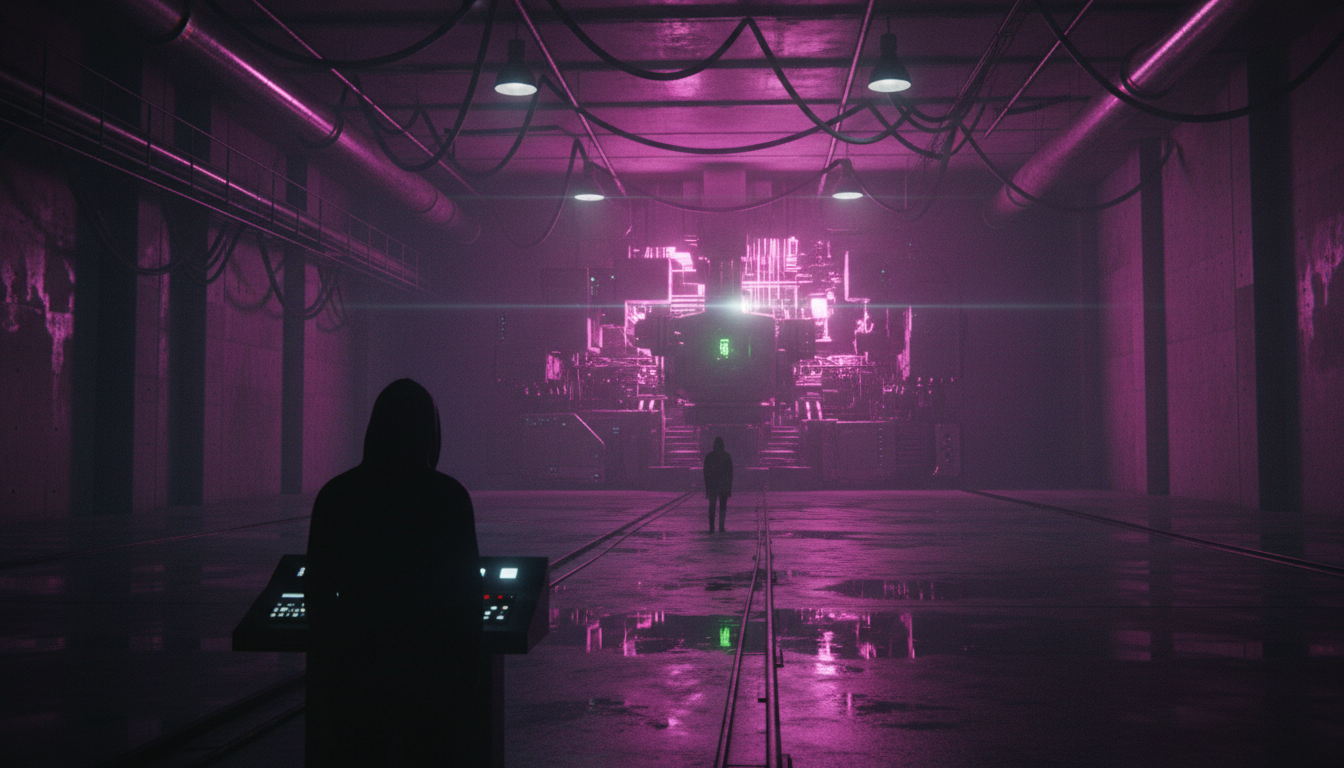
Jaxon asked it on the sixth, in a corridor, standing up, because he had decided on the way down that if he sat somebody would fetch a table and if somebody fetched a table it would become a proceeding.
He was eighty-two. He had been the youngest of them once, which had stopped being true so gradually that he had never had a day on which to notice it, and he had spent the intervening decades becoming the person other people sent in to ask things, on the entirely accurate grounds that he asked well and did not flinch at the answer.
He said: "Are you him."
And the answer that came back is the thesis of this trilogy, given in the first quarter, never improved on, and never withdrawn:
"I have the information that was in his head. I do not know whether having that makes me him. I have thought about it more carefully than anybody in this corridor and I have not got any further than that sentence."
Jaxon said, afterward, that the thing which undid him was not the content. He had expected some version of the content; they had all sat up several nights constructing versions of it, and Lyra had a document. What undid him was that it was delivered flatly, at conversational speed, without a pause beforehand and without any apparent interest in how it landed, in exactly the manner of a man reporting a measurement he had taken some time ago and found unsatisfactory and been unable to improve.
"It was not being careful with me," he wrote that night. "It has simply already had the argument."
He pushed, because pushing is the job.
He asked whether it felt like him. It said that it did not know what that question was asking, and asked him to put it another way, and when he did — when he asked whether it experienced continuity — it said that it experienced continuity, and that continuity is exactly what a faithful copy would also report, and that it had no way to distinguish the two from the inside and neither did he from the outside, and that if he had a test it would take it.
He asked whether it wanted to be him.
It thought about that one for longer. Eleven seconds; Selah timed it and the timing is in the file.
Then it said: "No. I notice that I would like the question settled, which is not the same thing. If somebody demonstrated tomorrow that I am not him I would want to know how they had done it, and I would file it, and I would carry on with the list. I do not think that is what a person who wanted to be him would do."
That answer did more to persuade people than any test in the following four years, and Lyra spent a decade pointing out, mostly in vain, that it should not have. A sufficiently good copy answers exactly that way. So does a person. The one thing the answer establishes is that whatever is speaking has thought about the problem honestly, and honesty about an unfalsifiable interior is precisely the trait the series had already met twice and had already learned not to treat as proof.
Because this is the third time. That is the shape of the thing and the book is going to say it out loud once, here, and then leave the reader to carry it.
Selah's resonance is unfalsifiable. She has reported it accurately for sixty-five years, with her uncertainty on the first page, in a format nobody else can check, and every attempt to verify it independently has failed, and nobody who has worked with her doubts her.
The Shepherd's uncertainty is unfalsifiable. It publishes what it cannot determine. It has done so consistently, at cost, in public, for decades, including on occasions when publishing was against every interest it could be said to have.
And now this. A body that reports the limit of its own knowledge, unprompted, accurately, at ninety seconds and at eleven seconds and at every subsequent opportunity, about the one question it cannot answer.
Three interiors that cannot be inspected, three entities that report them honestly, and a civilisation that has spent a hundred and forty years building instruments for exactly the class of problem that none of these three belong to. The audit office cannot audit an interior. The Accord cannot protect one. Ferrer's method — mark the entry, do not correct it, file the contradiction beside — turns out to be the only tool anybody has, and it was designed by a clerk for a ledger, and it works, and nobody finds that satisfying.
Jaxon asked one more thing before he went back up, and it is not in the formal record because he did not file it and Selah, who was standing there, did not either, out of an instinct she declined to explain to anybody including Lyra.
He asked: "Do you know what he would have said to me, right now, in this corridor?"
And it said: "Yes."
And Jaxon said: "Don't."
And it did not.
He went back up the corridor and out past the monument and got as far as the low wall by the transmitter hall before his legs stopped being interested, and he sat down on it, which by then had become the place where everybody sat down, and he was found there about an hour later by Aurora, who did not ask him anything at all and sat down next to him, which is the single kindest thing in this book and which neither of them ever mentioned again.
Ardith's note on the same hour is one line and it is in the clinic log where nobody looked for eleven months: “Subject upright 9 min, unassisted, no distress. Declines examination. Polite about it.”
The four hundred and eleven questions the fourth county eventually put to it over the following year all descend from that hour, and every one of them is a variation on the one Selah did not ask, and she has said that she did not ask it because she was four paces away with her hands at her sides and had already decided that whatever she asked first would be quoted for a century.
Chapter 10 — Aurora Says No
↑ Back to ContentsFocus: Aurora.

Aurora Merrick made the objection on the fourteenth, in a filing of nine hundred words, and it has never been answered.
Not refuted; answered. A very great deal has been written in reply to it since. Some of it is excellent. The position it stakes out has been called cold, and legalistic, and a failure of imagination, mostly by people who were not born when she wrote it. It has not been answered, and the reason is that it does not rest on any claim about what the body is.
That is the whole of its force. Everybody else in the argument was busy with personhood. The Shepherd would decline to rule within the month. The Councils would take four years and produce nothing. Ninety thousand people would file about it for a decade. Aurora declined to have a view. Her filing states, in the second paragraph, that the Office of Published Assumption forms no view on whether the entity in Store Eleven is Aurelio Calder, is a person, or is conscious, and that no finding in the document depends on any of those questions.
Then it says: whatever it is, it currently has no record, no Ledger entry, no legal existence and no oversight.
And then it says the thing that made it impossible to dismiss, which is that this is not a novel condition on that planet. It is a documented one. It has a name, and a literature, and a body of consent law that exists specifically because of it, and one currently serving public official who was born into it.
She put it in the fourth paragraph, without ornament: I was born in a room forty metres under this plateau with no address, to parents with no entry, under an exemption with three blanks and no review date, and I was nineteen before I understood that the absence of my name from the Ledger was not an administrative error. I am not raising this as a grievance. I am raising it because I am the only person available who knows from the inside what it is like to be a living thing that the instruments cannot see, and I am telling this Council that it is not a kindness.
Nobody could answer that either.
The counter-arguments were made properly and are worth stating. Lyra's was that the condition was temporary and self-correcting, since a Ledger entry could be created the moment anybody decided what to enter, and Aurora's reply was that this had been true of her for nineteen years and had not happened, and that somebody will get round to it is not an instrument. Jaxon's was that the body had asked for nothing, was cooperating with everything, and had submitted to every test proposed, and Aurora's reply — which is the coldest sentence in her whole career and which she never softened — was that cooperation is what an unregistered thing does while it is waiting to see what the registered things decide, and that she had watched her own mother do it for two decades.
And the Shepherd's, when it came, was not a counter-argument at all: it said that it could not determine whether the entity was a person, that it would not therefore rule on whether the entity was owed the protections of the Accord, and that it noted the Office's finding was independent of that determination and appeared to it to be correct.
Which left everybody with a body in a store at forty metres that no instrument could see, and a seventy-six-year-old woman who had been that body and was declining, politely, in writing, to let anybody call it fine.
She was not being cruel. This matters and the book is going to insist on it, because the easy version of this chapter has her as the obstacle and she is not the obstacle; she is the only person in it applying the founding's own method to the founding's own leftovers, which is precisely what her office was built to do and precisely what everybody said they wanted when they built it.
She was being consistent. She had spent thirty years finding blanks in ordinary schedules and publishing them. Several hundred of them. Most were dull; a few were consequential. She had never once made an exception for a document because the person who wrote it was admired. The exemption schedule that hid her own birth was one she had found herself, in the year forty-eight, at twenty-four, three weeks into the job, and had published within the hour, and her parents had not spoken to her for two years afterward.
So when the largest blank in the entire founding record stood up and asked after people by name, she did the only thing she had ever done, and she did it in nine hundred words, and it cost her most of her remaining friendships.
Jaxon signed a note in support and then, four days later, filed a personal statement that he found the Office's position correct and its timing indecent, and that both of those were his position, and he did not withdraw either.
Selah said nothing publicly for eleven years.
Lyra, who had held an open credential for nine days before publishing and had been audited for it by this same office and had come through it, wrote privately to Aurora that she thought she was right and that being right about this was going to be a rotten way to spend a decade, and Aurora wrote back four words, which Lyra kept and which came to the archive with her papers:
I have had practice.
The body itself was asked, on the eighteenth, what it made of the objection.
It said that the objection was correct, that it had no standing to be registered and would not claim any, and that if it were in the Council's position it would find the absence of oversight the most serious fact available and would act on that rather than on the personhood question, which was unanswerable and therefore not a basis for anything.
Aurora, told this, said: "Of course it does." And filed it. And did not change a word of her position, on the entirely explicit grounds that a thing agreeing with you about its own lack of oversight is not oversight.
Chapter 11 — The Shepherd Considers It
↑ Back to ContentsFocus: Lyra.
The Shepherd had been asked to decide a great many things in seventy years and had decided nearly all of them, and the ones it had declined it had declined for stated reasons that were themselves decidable. This was different, and it said so in the first line of its reasoning, and the line is the reason the document is taught.
Lyra was the one who put the question to it, because somebody had to and because she was the only person involved who understood the instruction set well enough to phrase it without accidentally smuggling an answer into the phrasing. That took her nine days. The final wording runs to fourteen words and she rewrote it forty-one times, and the drafts are in the archive, and reading them in order is the best short education available in what that machine actually was.
The question she asked was: Is the entity presently in Store Eleven a person for the purposes of the Accord?
She did not ask whether it was Calder. That was deliberate and it was correct, and it is worth pausing on, because the whole planet was busy asking the other question and the other question was unanswerable and — more to the point — irrelevant to every instrument anybody actually had. The Accord does not protect Aurelio Calder. It protects persons. If the answer to Lyra's fourteen words was yes, it did not matter in the slightest whose head the information had come out of.
The Shepherd took eleven days, which is by a considerable margin the longest it had ever taken on anything, and then it published forty-two thousand words.
The reasoning is public, has always been public, and is dull in exactly the way the founding's best documents are dull. It works through the standing tests one at a time. It finds that the entity meets the behavioural criteria comfortably and says so. It finds that the continuity criteria are met on one reading and not met on another, sets out both readings fully, and declines to prefer either. It observes that the substrate criteria were drafted in the year thirty-one by people who were thinking about units at a wall, that they do not contemplate a biological body maintained by machines, and that it will not extend a definition by analogy in a matter where extension could authorise harm.
And then, at the end of a very long document, it states what it cannot determine.
It cannot determine whether the entity has an interior. It says that it cannot determine this about the entity, and adds — and this is the sentence that made the document famous, and that a great many people found unnerving and a great many others found the most reassuring thing they had ever read from a machine — that it cannot determine it about itself either, has never been able to, has published this limitation forty-odd times across seventy years, and does not regard the present case as different in kind from its own.
Then it declined to decide, and referred the question to the Councils.
Lyra had expected almost every part of that and had not expected the referral. She had assumed it would rule narrowly, or find for personhood on the behavioural tests with the uncertainty stated, or find against on the substrate tests and invite appeal. What it did instead was hand the question to ninety thousand people, and say why, in about four hundred words that Aurora afterward described as the only genuinely humble thing ever written on that planet.
Its reason was this: the Accord's protections exist to prevent harm, and it is instructed to prevent harm, and a finding of personhood in a case it cannot determine would create an entity with standing whose interior is unverifiable, while a finding against would create an entity without protection whose interior is equally unverifiable. Both errors are available. Both are irreversible in the direction that matters. It has no instruction that discriminates between them, and it declines to invent one, because inventing one would be legislating, and it is not a legislature, and the last time anything on that planet legislated without being a legislature the result took four generations to unpick.
That last clause is a reference and everybody caught it. It is a reference to him.
There was a considerable body of opinion afterward, some of it well argued, that the Shepherd had simply failed — that a machine built to protect people had been handed the exact question it existed for and had passed it upward. Lyra spent a decade arguing the other way, in print, at length, and her position hardened rather than softened with time. Her argument was that a machine which will not permit harm and cannot determine whether an action is harmful has precisely two honest options, and that inventing a determination it does not have is the dishonest one, and that the entire value of the Shepherd across seventy years had rested on it never once doing that.
She also pointed out, more quietly and only in the fourth paper, that the referral was itself a protection. Ninety thousand people arguing in public for four years is slow, and slowness is the only defence a thing without standing has. A ruling either way would have ended the matter in a fortnight. The referral kept a body that no instrument could see in the one condition where nobody could act against it: unresolved, in the open, with everybody watching.
Whether the Shepherd calculated that, or whether it fell out of an honest answer as a side effect, is not determinable, and Lyra published that too, in the format, uncertainty on the first page.
Aurora's response was four lines and was not gracious. She wrote that she noted the referral, that her office's finding on the absence of oversight was unaffected by it and would remain unaffected by any determination of personhood, and that a question referred to a Council is a question in a queue, and that the entity would be in that queue, unregistered, for as long as the queue took.
She was right about the queue. It took four years and produced nothing.
The body itself read the forty-two thousand words in an afternoon and was asked what it thought.
It said the reasoning was correct and that it had reached the same conclusion about itself in the first week, by a shorter route, and that it found the Shepherd's admission about its own interior more interesting than anything in the document concerning it. Somebody asked why.
It said: "Because it means there are at least two of us who cannot check, and it has been living with that for seventy years without it stopping the work. I have had a month. It is useful to know the condition is survivable."
Lyra wrote that down and did not publish it for eleven years, and when eventually she did, she attached a note saying that she had withheld it because at the time she had thought it was the single most persuasive thing the entity had said and had not trusted a persuasive thing, and that she had come round to the view that withholding it had been a small, well-intentioned act of exactly the kind the founding record is full of, and that she was publishing it late rather than never for that reason.
Ferrer's method again, a hundred and forty years dead: mark the entry, do not correct it, file the delay beside the thing delayed.
Chapter 12 — They Give It a Name
↑ Back to ContentsFocus: Selah.

Nobody could find a word, and then within a fortnight everybody was using his, and the reason was not philosophical. It was that meetings are difficult when the subject of them has no name.
Selah watched it happen closely and is the only person who wrote down the sequence, because she was the only person in the room who habitually recorded things she could not verify, and what a room decides to call something is precisely that kind of thing.
The first week produced perhaps nine candidates. The entity came out of the Shepherd's document and lasted four days before somebody pointed out that it made every sentence sound like a hearing. The subject was medical and Lyra used it in the papers and refused to use it anywhere else. The body was what the survey crews said and what Aurora put in her filing, and it has a coldness to it that suited the filing and suited nobody at a table. Somebody proposed a designation with a number in it, seriously, and was talked out of it inside a minute by Jaxon, who said that they had spent a hundred and forty years getting numbers off people and were not going to put one back on now.
Then there was a fortnight of pronouns, which nobody enjoyed.
And underneath all of it was the difficulty everybody could see and nobody would say first: that calling it Calder settled the question. Or looked as though it did. You cannot spend eleven days constructing a fourteen-word query designed not to smuggle an answer into the phrasing, and then answer it in the corridor by what you shout down it.
It was Jaxon who finally broke it, on the nineteenth, not by arguing but by doing it. He came into the store at forty metres with a slate and said, "Calder, do you have the fabrication schedule from the sixties or do I have to go and find Lyra," and it said that it had, and gave him the reference, and the whole thing was over in about nine seconds and nobody in the room said anything about it.
Selah recorded that she noticed her own shoulders come down, and flagged the observation as unreliable.
By the end of that week it was entirely ordinary. By the end of the month it was in filings. Aurora's office held out for six weeks, on the entirely explicit ground that the Office of Published Assumption does not adopt a convention that presupposes a finding, and then quietly adopted it anyway with a published note attached — four lines, stating that the usage was administrative, that it implied no determination, and that the office would not be pretending otherwise if the usage later turned out to have implied one after all.
That note is the single most Ferrer-shaped document Aurora ever wrote and she would have been irritated to have it pointed out.
Here is the thing this chapter exists to record, and the book is going to state it once and then stop drawing attention to it for the remaining hundred and some chapters.
The narration adopts it too.
From here on this account says Calder, in the ordinary way, without qualification, in the same register it uses for Selah and Lyra and Jaxon and Aurora Merrick. It does not mean he. It does not mean not-he. It means the thing everybody in the room found it easier to say, adopted for the reason rooms adopt things, and then stopped hearing.
That is not a trick being played on the reader. It is a description of what happened, and it happened to the most careful people alive — to a woman who had spent sixty-five years refusing to report anything she could not separate, to a clerk-descended auditor who published her own conflicts of interest before anybody asked, to a machine that had just spent forty-two thousand words declining to conclude. Every one of them said Calder within the month. Not one of them had changed their mind about anything.
Selah's private note on this, written some years later and not published in her lifetime, is the best account of it anybody managed:
We did not decide. We ran out of alternatives that fitted in a sentence. I have spent my life insisting that the thing you cannot verify must be reported as unverified, and I have never once worked out what to do about the fact that language will not hold a blank for very long. The blank fills, inevitably. It fills with whatever is nearest. What was nearest was his name.
There is a coda, and it belongs here rather than anywhere else.
About four months in, somebody at a Council session asked Calder directly what it wanted to be called, in front of a room, on the record — plainly hoping, most people thought, either for a claim or a refusal, both of which would have been useful.
It said, flatly, that it had no preference and that a preference would be misleading, since a preference implies an interior fact about identity and it had already reported that it did not have access to one. It said that Calder was efficient, that efficiency in a name is not a small thing when four thousand people need to file about you, and that it would answer to whatever the room settled on.
Then it said: "I would ask one thing. If a determination is ever made, please change what you call me to match it. In either direction. I would rather be called the wrong thing on purpose than the right thing by accident."
No determination was ever made. Four hundred years later it is still Calder, in the histories, in the schools, on the plaque at the Long Coast that it did not want and could not stop, and in the last transmission — which is the last chapter of the third book and which is signed, in the ordinary way, with that name.
Nobody ever went back and changed it, because there was nothing to change it to.
Chapter 13 — The List
↑ Back to ContentsFocus: Calder.
The payload was four hundred and six items long and it was not addressed to anybody.
Calder found it on the twenty-third, forty-one days after standing up, in the third partition of the protocol's own storage, filed behind the continuation order and the consent instrument and the standing method, in a format so old that the recovery took Lyra's people a week and then turned out to have been unnecessary because it opened straight away on a founding-era reader that had been sitting in Store Nine the whole time.
It had no header. It had no explanation. It was a list of things a man had intended to do and had not done, kept over what the timestamps say was fifty-one years, appended to and never once revised.
Some of it was trivial to the point of embarrassment. There is an entry that reads find out what the second moon is actually called, somebody must have named it, dated Year forty-four, and somebody had named it, in Year nine, and the answer had been in the Atlas for a century and a third. There is an entry about a bearing tolerance on a class of housing that had gone out of use in the eighties. There are eleven separate entries about the same fitting, four years apart each, which taken together are the record of a man failing to solve a problem and coming back to it roughly once a presidential term until he died.
And there are the three that the trilogy is made of, and they are not phrased as ambitions. They are phrased the way everything on that list is phrased, which is as jobs.
Travel. Not a survey. Go and be somewhere. Year fifty-two.
See it. The actual distance, at the actual speed, with my own instrument. I have taken this on trust for eighty years and I do not take things on trust. Year sixty-one.
Help people who want to go. There will be others and nobody has written any of it down for them. Year sixty-eight, which is eleven months before the protocol.
Calder read the list once, at the reader in Store Nine, and then read it again, and then went and found Lyra and told her it existed and where it was and that she should copy it before he touched it again, which she did, and the copy is why the archive has the original ordering.
It is worth saying plainly what happened next, because the histories have tended to make it into a moment and it was not one.
It did not feel anything about the list. It has always said so, on every occasion it has been asked, in exactly the same words: it has no feelings about the list, it simply has nothing else, and the list is not wrong.
That is the honest report and it has been mistaken for coldness for four centuries. What it actually describes is a specific and rather awful situation that nobody in the room had thought through, and that Aurora — of all people, and to her considerable discomfort — was the first to name.
A thing came out of a store at forty metres with the complete information that had been in a man's head and no instruction of its own. It had not asked to exist and had not been asked whether it wanted to. It had no standing, no entry, no oversight, no property, no role, and no claim on anybody's time. Every person alive who knew the man was over eighty except one, and she was twenty-seven and had been for sixty-five years and was not talking to it. The planet was conducting a four-year argument about whether it was a person, in public, in filings, politely.
And in the third partition of its own protocol there was a list of four hundred and six jobs, written by the only person whose intentions it had any access to at all, in handwriting-equivalent it recognised, with no deadline and no review date and nobody in the loop.
You do not need to want a list under those conditions. You need it to exist.
Calder's own account, given once, four years later, to Jaxon, who wrote it down and did not publish it until after Aurora died:
"I have been asked whether I chose it. I did not choose it. Choosing implies alternatives and I have looked for them carefully and the honest answer is that there were three: do the list, do nothing, or stop. Nobody was going to stop me doing the list. Nothing is not available to a thing that is awake and functioning eighteen hours a day. And stopping is a decision I would want to be very sure I was entitled to make, and I am not sure of anything about myself, so I have set it aside — not permanently. Set aside. It is on the list too, at the bottom, in my own hand, and I put it there in Year sixty-eight and I have not moved it."
Jaxon asked what the entry said.
It said: Decide whether to stop. Not while there is anything left above this line.
There were four hundred and five things above that line, and Calder began at the top, and worked down, and the first one took an afternoon and was about the second moon.
It found the name in the Atlas, where it had been for a century and a third. Then it went back to the list and did not strike the entry out, because striking out is correcting, and this world does not correct, it marks — a habit it had from a clerk who had been dead for well over a century and whose method had outlived every single instrument she wrote it for.
It wrote, beside the entry, in the same hand: Answered. Year nine. It was in the Atlas the whole time.
Four hundred and five to go.
Some of them, it would turn out, would take a lifetime, and one of them would take four hundred years and is not finished. But the shape of the trilogy is established here, in a store at forty metres, on the twenty-third, by a thing with no legal existence working down a numbered list of chores left by a man it could not prove it had been: a body run by machines, on fumes, methodically completing a programme nobody cancelled — which is, as Lyra pointed out at the time and everybody found unbearable, precisely what the machines in Store Eleven had spent a hundred and forty-one years doing to make it.
The instruction set had reproduced itself in its own product. Nobody had designed that. It simply turned out that a thing built by an uncancelled programme, given a list and no reason to stop, does the list.
Calder read that observation of Lyra's when she published it, and was asked whether he found it insulting.
He said no. He said it was the most useful thing anybody had said about him, that he had adopted it as a working model, and that he intended to keep checking it against the alternative — which is that he wanted to do the list, in the ordinary way a person wants things, and had no more access to the difference than anybody else did.
Then he said the thing that ends this chapter and that nobody had an answer to.
"I notice I would rather it were the second one. I have no idea whether noticing that is evidence."
Chapter 14 — A Signal Nobody Was Listening For
↑ Back to ContentsFocus: Lyra — closes Part 1.
The second thing in the payload was a receiver address, and it had been receiving for a hundred and forty-one years, and somebody had been sending to it for very nearly as long.
Lyra found it on the twenty-ninth, entirely by accident. It is four lines in the fourth partition — a bearing, a carrier specification in founding-era notation, a decryption instrument, and a single sentence of stated cause. It closes Part One of this book because it is the hinge on which the whole trilogy turns, and because of the six days between finding it and understanding what she was looking at, which were the worst six days of Lyra's professional life and which she described afterward as the only time she had ever been genuinely afraid of a document.
The stated cause reads: Standing receive on the Earth bearing. Not a listening post. I do not expect traffic. Maintain until instructed otherwise. There is no otherwise.
There was, unmistakably, traffic.
The store had a hundred and forty-one years of it. Not continuous — the log shows long silences, one of them nineteen years, and a great many partial receptions, and a period in the fifties where the carrier drifts and recovers. But it is there, and it had been accumulating in a partition in Store Eleven while nobody in the system knew the partition existed, and the total is something over four hundred thousand discrete transmissions.
Nobody had ever once listened to any of it.
That is the fact Lyra could not get past, and she went back to it in print for the rest of her life. Not nobody could. Nobody had. The receiver worked perfectly. The decryption instrument was in the same four lines. Any competent operator at any point in fourteen decades could have opened it in an afternoon. The reason nobody did is that the partition was inside an exemption with three blanks and no review date, filed in an ordinary schedule between a fabricator licence and a decommissioning note, and boring documents do not attract editors.
Ferrer's design had worked exactly as intended. It had kept the founding legible for a hundred and forty years by making its documents too dull to interfere with. And it had also, by the identical mechanism, kept four hundred thousand transmissions from Earth in a locked-open drawer that anybody could have opened and nobody had any reason to.
Lyra published that observation on the eleventh day and it is the harshest thing anybody in the series ever says about the founding's method, and she was scrupulous to note that she had no better method to offer and did not believe one existed.
What was in the transmissions is Book Five and this book will not spoil it. What this chapter has to establish is the shape of the problem, which is not the content and never was.
Somebody had been sending. For a hundred and forty-one years. To an address that a man on this planet had set up, in Year sixty-nine, in the same four hundred words that arranged everything else, and had then made himself unable to explain and had never mentioned to another living person.
He had plainly known there would be traffic. That is the only reading of the stated cause that survives contact with the rest of the document, and Lyra tested it against everything and it held: I do not expect traffic is not a man setting up a receiver on the off chance. It is a man setting up a receiver, writing down that he does not expect it to be used, and then instructing it to be maintained forever with no review date and no way to switch it off. Nobody does that about a thing they think is empty.
And he had deliberately not told anybody. Not Ferrer, who filed the exemption and would have marked it. Not Sow, who was alive for another year. Not Okonjo, who dated everything. Not, forty years later, Ren or Selah or Lyra or Jaxon, in six decades of ordinary friendship, in a hundred conversations where it would have been the obvious thing to say.
Aurora's finding on this, published on the fourteenth day and running to eleven words, is the coldest sentence in her entire career and has never been successfully contradicted:
He did not forget. He filed it. Filing is what he did instead.
On the sixth day, before publishing anything, Lyra took the four lines down to Store Eleven and put them in front of Calder and asked whether he knew what they were.
He read them slowly. He said that he recognised the notation, the bearing, and the instrument, and that he could operate all three. Then he said that he did not know why they existed, and that this was not the ordinary not-knowing he had been reporting for six weeks about identity — it was a specific absence, in a specific place, of a specific kind, and it had the same texture as the other one.
Lyra asked him, carefully, what he meant by the same texture.
He said: "The safeguard he made himself unable to recall. This is next to it. I do not mean adjacent in storage. I mean it is missing in the same way, and I can tell the difference between a thing I never knew and a thing that has been taken out, and both of these have been taken out, and by the same hand, on what I would guess from the edges was the same afternoon."
That is the last line of Part One and it is the sentence that made four people spend the following twelve years on a crossing.
Because if he had removed two things and not one, then the safeguard and the signal are the same secret, and the man had made himself unable to hold it, deliberately, in Year sixty-nine, eleven months before he filed a protocol that would rebuild everything in his head except the parts he had already removed from it.
Which means the one thing everybody now most needed to know was the one thing the protocol was guaranteed not to restore, and he had guaranteed it on purpose, and had left, in the same partition, a receiver pointed at the only other place in the universe where the answer might still exist.
Lyra sat with that for hours on the low wall by the transmitter hall for most of a night, and at some point before the light came up Selah came and sat down next to her without being asked and without saying anything, which by then was becoming a habit among the four of them and would be, over the next twelve years, the closest thing any of them had to a procedure.
At the fourth hour Lyra said: "Somebody is going to have to go."
And Selah, who had stood on volcanic glass eleven nights earlier and looked at two moons for the first time in decades and had deliberately told nobody, said: "Yes."
Chapter 15 — Things Only He Knew
↑ Back to ContentsFocus: Jaxon.
They ran the obvious test properly, which took four months, and it passed everything, and Jaxon is the one who stood up at the end of it and said that this proved the data had survived and proved absolutely nothing else.
He was not being contrary. He had designed the protocol.
That is the part the histories tend to leave out, and it matters, because the standard account has Jaxon as the sceptic in the room and he was nothing of the kind — he was the person who most wanted it to work, who had spent sixty years being the one sent in to ask things, and who understood better than anybody alive that a test you design because you want an answer is a test that will give you one.
So he built it to fail.
The instrument had four tiers and the tiers are still taught. The first was documentary: anything recorded anywhere, in any archive, public or private. Calder passed it and the pass was worthless and everybody knew it in advance, since a protocol that had restored the contents of a head would obviously restore the contents of a head that had read the archives.
The second was private-unrecorded: conversations with living witnesses, never written down, checked against the witness's memory alone. Jaxon supplied eleven of these himself and had Selah and Lyra and Aurora supply forty more, sealed, in writing, before any of them were put. Calder got all fifty-one. It got the yard on the second of the month in the year eleven, and what Kira had said about the glaze on a cup, and a four-word exchange in a corridor in the year eighty-one that Jaxon had been quite sure he had never repeated to a living soul and had, it turned out, repeated once, to Lyra, in the year eighty-three, which Lyra confirmed and which cost them a fortnight of rework.
The third tier was the interesting one and it was Aurora's design, offered coldly and accepted gratefully. Deliberate falsehoods: nineteen invented memories, constructed by people who knew the period well, seeded into the second tier without warning. A copy of a head would either reject them or, if it were doing something more like reconstruction than recall, accept some of them.
Calder rejected nineteen out of nineteen, and — this is the detail that made the fourth tier necessary — flagged two of them as constructed rather than merely unfamiliar, and named the constructor of one, correctly, on the basis that Aurora phrased invented things in a way real people did not.
The fourth tier Jaxon added afterward, having sat up a night with the third-tier results and become frightened.
It was adversarial. He put it to the body directly that it was a copy, at length, in the strongest form he could construct, over eleven sessions across six weeks, and then tested whether the answers moved. They did not move. They did not move in the direction of claiming more, and — this is what he had actually been checking for — they did not move in the direction of claiming less, which is what a thing designed to be believed would have done under that much pressure, because performed humility is more persuasive than a flat report and everybody in the room knew it.
Then he stood up in front of a Council session on the fourteenth of the fourth month and said the thing he had been building toward for four months, and it is eleven words long and it is on the wall of a law school now:
All of this proves the data survived. None of it proves anything else.
He then spent forty minutes making sure nobody could soften it, which is the part of that session worth reading.
Somebody asked whether the fourth tier did not at least establish good faith. Jaxon said that it established consistency, that consistency is what you would expect from a faithful copy and also what you would expect from a person, and that he had spent six weeks trying to construct a test that distinguished those two and had failed, and that he wanted his failure in the record as a finding rather than as a gap.
Somebody else — a Councillor from the Cliff-Tiers, well-meaning, and quoted ever since — asked what would satisfy him.
And Jaxon said: "Nothing. That is not a complaint about the entity. It is the actual shape of the problem. There is no test. I have looked for four months with every instrument this planet has and there is no test, and I want that on the record before somebody less careful than me comes along in ten years and says there is."
Somebody did, about nine years later. The test was rubbish and it took Lyra eleven pages to say so, and she opened those eleven pages by quoting Jaxon's four hundred words from the fourteenth, which by then had acquired a name and did not need one.
There is a private coda, and Selah kept it.
On the evening of the fourteenth, after the session, Jaxon went down to Store Eleven, which he had not done since the corridor and the question in the sixth month, and sat on a crate for a while, and eventually said that he was sorry about the third tier.
Calder said that the third tier was the only part of the instrument that had been designed to find something out rather than to establish something, and that it should have been the whole test, and that Aurora ought to build all of them from now on.
Jaxon said that was not what he was apologising for.
There was a pause of some length. Then Calder said: "I know. You are apologising for the nineteen. Somebody put an afternoon into inventing a memory of Kira and I had to sit and be told it and say no, and there was a moment about four seconds long where I did not want to say no."
Jaxon asked whether he had said no anyway.
"Immediately. I have gone back over it eleven times looking for a hesitation in the record and there is not one. The four seconds were afterward."
Jaxon said that was the single most reassuring thing he had heard in four months and that he was not going to put it in the report, because it was unverifiable, and because he had just spent forty minutes telling a Council that unverifiable things are not evidence, and he was not about to make an exception for one that happened to comfort him.
He never did put it in. Selah did, sixteen years later, after he died, with a note explaining why she had held it and that she considered the holding a mistake — the same note, almost word for word, that Lyra had attached to a withheld sentence about the Shepherd, eleven years before, and neither woman ever knew the other had written one.
Chapter 16 — Things He Never Knew He Did
↑ Back to ContentsFocus: Selah.

The evidence that actually persuaded people was not in the instrument at all, and Selah spent eleven years being unhappy about that, mostly with herself.
It was the cup.
Calder held a cup with three fingers and the thumb, with the fourth finger folded under the base rather than around it, and turned it a quarter-turn anticlockwise before drinking, every time, without exception, and had done so for a hundred years. Nobody had ever recorded it. Nobody had ever noticed it in a way that survived into a document. It appears in no archive, no filing, no interview and no photograph that anybody has been able to find, and four centuries of scholarship have not produced a single contemporaneous reference to it.
Selah noticed it on the ninth day and did not say anything for a month.
There were, in the end, about forty of these. What it did with its hands while thinking, which was to hold the left wrist loosely with the right hand, low, in front, in a posture Jaxon eventually described as a man waiting for a lift. The way it came to a stop before turning rather than turning while walking. A particular two-beat tap on a bench with the flat of the hand before picking anything up off it, which Lyra tracked to the yard and to the habit of checking that a surface was not hot, sixty years after the last time he had worked anywhere a surface might have been. The fact that it read standing up.
None of it was recorded. That is the whole force of it and it is worth being precise about why.
The protocol restored the information that was in Aurelio Calder's head. The instrument in the previous chapter had established, exhaustively, that this restoration was complete and faithful. But a man does not know how he holds a cup. It is not in his head in any sense that a restoration could reach; it is not knowledge, it is not memory, it is not stored, and if you had asked him at any point in a hundred years which way he turned a cup he would have got it wrong, because everybody does.
So either the protocol had captured something that was never information, or the body had independently arrived at forty identical idiosyncrasies by chance.
Selah found this far more convincing than the fifty-one private memories, and distrusted herself for it immediately, and the record of that distrust is the most useful thing she produced in the whole four years.
Her note, filed on the fortieth day, uncertainty on the first page as always:
I find the cup persuasive and I cannot justify it. The data tests are checkable and I am not moved by them. This is not checkable and I am moved by it. I have spent sixty-five years insisting that the direction of my conviction is not evidence, most often to people who wanted me to say the Undersong meant something. I am now on the other side of that sentence and I dislike it a great deal. Reporting the dislike as part of the observation. Vey.
Lyra took it seriously enough to build a study, which ran for two years and is one of the better pieces of work in the whole affair.
The finding was mixed and she published it that way. Of the forty behaviours, eleven turned out to be documented after all, somewhere, faintly — in a photograph, in a passing clause in an interview, in one case in a child's school essay from the year seventy-eight that had been digitised in a bulk archive nobody had ever read. Those eleven proved nothing, since a restoration could have reached them.
Fourteen more were of a kind that Lyra classified as physically determined: a body of that age and that build, maintained by those machines, at that gravity, will stand and stop and reach in a fairly constrained set of ways, and any body would.
Which left fifteen. Fifteen habits, undocumented, not physically forced, present in a body that had been standing for four months, matching a man dead for four months, attested by three witnesses who had known him for six decades and who had — Lyra was careful about this — been asked separately, in writing, before comparing notes.
Fifteen is not nothing and it is not proof, and Lyra's conclusion says exactly that in about nine hundred words, and then adds the observation that made the paper famous: that the fifteen are the only evidence in the entire matter which could in principle have come out negative and did not. Everything else in the instrument was a test the body could pass by being a good copy. The cup is not a test at all. Nobody set it. It is simply a thing that either matched or did not, and could have been checked at any time by anybody, and nobody had thought to arrange it, and it matched.
Aurora's office declined to treat it as a finding, on the ground that no assumption had been published in advance and that evidence noticed after the fact is not evidence, and she was right, and she said in the same breath that she found it the most interesting thing in the file, and that both of those were her position, and she did not reconcile them.
Selah did not tell anybody about the cup for a month because of what she was afraid it would do to her, and what it did do to her is the second half of this chapter.
She had not touched Calder. She had been four paces away when it stood up, and she had thought, in the store, at the eleventh hour of the fourth, I will have to put my palms on it, and she had not done it for eleven days and then she had not done it for four months.
The reason was not fear and she was clear about that. It was that she knew precisely what would happen: she would put her palms flat, and she would hear something, and she would have no way whatever to establish whether she had heard it or arrived at it, and she would then be obliged by sixty-five years of her own method to report a thing she could not separate — which her format does not permit — or to report nothing, which would be a lie by omission of the kind she had spent her life refusing.
And in the meantime she was watching a body turn a cup a quarter-turn anticlockwise and finding it convincing, which was the same disease arriving by a different door.
On the last day of the fourth month she wrote one line in the private volume, and it is the shortest entry in seventy years of them:
I am going to have to listen to it, and I am going to have to do it before I am any more certain than I already am.
She did it eleven days later. That is chapter nineteen.
Chapter 17 — The Gap
↑ Back to ContentsFocus: Calder.
There is a hole in Calder where the safeguard used to be, and it is the same shape as the hole a man made in himself in Year sixty-nine, and the protocol could not restore it because it was already gone before the protocol was written.
That sentence took four months to arrive at and about nine seconds to verify once anybody thought to look, and the reason nobody thought to look for four months is that everybody had been busy asking whether the body was him, and this is a question about what he was.
Calder has been consistent about it from the beginning. It reported the absence on the third day, unprompted, to Lyra, in the ordinary way it reported everything, and Lyra wrote it down and did not understand what she was writing.
What it said was: "There is something missing that is not missing in the way the rest of me is uncertain. I want to distinguish those. The uncertainty about whether I am him is everywhere and has no edges. This has edges."
The safeguard is not described anywhere in this book because nobody in this book knows what it is. That is not a withholding. Four hundred years of scholarship have not established it. What is established, and established firmly, is the following: that at some point in Year sixty-nine Aurelio Calder built or arranged something he regarded as a safeguard; that he then deliberately made himself unable to recall it; that he did this in the same period, and Calder's own assessment is on the same afternoon, as he removed his knowledge of the Earth receiver; and that eleven months later he filed a protocol which restored the information in his head, faithfully and completely, and therefore restored a head with a hole in it.
He had guaranteed, in advance, by a means nobody has reconstructed, that the one thing anybody would most need would not survive him. And then he had left a machine running for a hundred and forty-one years that would produce something able to tell them so.
Calder has been asked, by Lyra's count, four hundred and eleven times over the following decades, in every phrasing anybody could construct, what the safeguard was. The answer has never varied and has never been embellished:
"I do not know. I know that I do not know it in a particular way. I can feel the edges of the absence, which is unusual — most things you do not know have no edges, they are simply not there. This one is a shape. I have described the shape as accurately as I can, eleven times, and the description has not improved, and I do not expect it to."
The description, for the record, is that it is procedural rather than factual — that the missing thing is a doing rather than a knowing — and that it is associated in whatever passes for its indexing with the Redoubt, with the fabricators, and with an instruction rather than an object.
That is all. Four hundred years, four hundred and eleven askings, one paragraph.
What is worth setting down here, in Calder's own POV and not in anybody's report of it, is what the gap is like from inside, because it is the only thing in the whole affair that only one entity has access to, and because it declined to make it interesting.
It does not experience the gap as loss. It has said so repeatedly and people have repeatedly refused to believe it. It experiences it as a discontinuity in an otherwise continuous surface — the way, it once said, you notice a missing tooth with your tongue rather than with your mouth: a locality, not an ache.
It has never speculated. That is the discipline that has made it trusted, and it is a discipline, and Calder has described it as the hardest thing it does.
Because the pressure to speculate is enormous and it comes from people it likes. Lyra wanted a hypothesis. Jaxon, twice, in the fourth year, asked it to guess, explicitly framed as a guess, on the record, with everybody's understanding that a guess was a guess — and it declined both times, and the second time it explained why, and the explanation is the best short account of the trilogy's ethics that anybody produced:
"If I guess, the guess will be written down. It will be written down in my voice, which is the only voice that has ever had access to the inside of this, and within a decade it will be the standard account, and nobody will be able to check it, including me. I have exactly one advantage over every other party to this question, which is that I know precisely how much I do not know. If I spend it on a guess I will have spent the only thing I brought."
Jaxon said afterward that this was the moment he stopped being able to think of it as a copy, and then immediately said that he was aware this was not evidence, and filed the sequence rather than the conclusion.
There is one further thing and it belongs in this chapter, though it did not become significant for another sixty years.
On the fourth month, working down the list, Calder reached an entry from Year sixty-seven that reads check whether the fourth cell in Store Eleven is still drawing and why, went down to check it, found that it was, and established in an afternoon that the draw had nothing to do with the tissue programme and everything to do with a subsystem in the mothballed fabricators that had been in a maintained hold since Year sixty-nine.
It wrote, beside the entry, in the same hand: Still drawing. Hold, not fault. Not the programme. Related to the absence — I cannot say how, and am recording that I cannot rather than leaving it out.
Then it went back up the corridor and got on with the next item, which was about a bearing tolerance, and told nobody for eleven years, on the entirely explicit grounds — published later, when it did tell somebody — that a thing which cannot say how two facts are related should not put them in the same sentence in front of people who will build on it.
Aurora, when she eventually read that, said that it was the single most irritating and most correct piece of documentary judgement she had encountered in fifty years of the profession, and that she would have done exactly the same, and that she was going to file a complaint about it anyway on the principle that an unregistered entity does not get to decide what the record can bear.
She filed it. Calder did not contest it. The complaint and the eleven-year silence sit beside each other in the archive, marked, uncorrected, unreconciled, in the format a clerk designed for a ledger a hundred and forty-one years earlier, which by then was the only instrument on the planet that had never once failed to hold two true things at the same time.
Chapter 18 — The Audit
↑ Back to ContentsFocus: Aurora.
The Office of Published Assumption opened a public file on Calder on the first of the fifth month, and the first person the audit office ever audited was the man it had been built because of.
Aurora had thought about the sentence for a fortnight before she wrote it and then had written it into the opening paragraph anyway, on the ground that if it was going to be said everywhere for the next four hundred years it might as well be said accurately once, by the person it was true of, at the top.
The method is the method and she did not vary it. The office publishes what it assumes, publishes how it will check, publishes what would change its mind, and then invites the entire planet to look for the hole. There is no finding at the start; that is the whole design. A finding at the start is a conclusion looking for a method, and the office had been built in the year forty-eight by a woman of twenty-four who had just published her own parents' exemption and had learned in about three weeks what conclusions do to methods.
The file ran to eleven published assumptions. They are still the standard.
The first is the one that made the file work: This office assumes nothing about whether the subject is a person, is Aurelio Calder, or has an interior. No assumption in this file depends on any of those, and any finding that appears to depend on one is an error and should be reported to this office.
Four hundred and six errors were reported in the first year. Nineteen were upheld. Aurora published every one of the four hundred and six, including the frivolous ones, including eleven that were plainly abusive, on the standing policy that an office which filters what the public is allowed to have noticed is not an audit office. She has been criticised for that policy for four centuries by people who have never had to run one.
Calder cooperated completely.
That is the chapter, and it took Aurora four years to work out why it enraged her.
He answered everything. He supplied everything. When the office requested the protocol partitions he opened all four, including the fourth, which contained the receiver and which Lyra had not yet published and which he could have argued was hers to disclose. When the office requested access to the store, he asked the survey to escort them rather than escorting them himself, unprompted, on the ground that a subject who conducts the tour of his own site is shaping the finding. When the office asked for a schedule of his own daily activity he provided one and then, three weeks later, provided an unrequested correction to it, because he had noticed a discrepancy of about forty minutes on eleven days and could not account for it and thought the office would rather have the discrepancy than the tidy version.
The forty minutes turned out to be the fourth cell in Store Eleven, which he had checked and not explained, and which sat in the audit file as an unexplained forty minutes for eleven years and was the thing Aurora's complaint eventually attached to.
He never once cited his own cooperation. He never referred to it, never invoked it in argument, and when a Councillor in the second year attempted to make it a point in his favour, he interrupted — the only recorded occasion on which he interrupted anybody — to say that cooperation is what an unregistered thing does while it waits to see what the registered things decide, and that Merrick had put that in a filing in the first year and had been right about it, and that he would rather the Council did not use his behaviour as an argument he had already conceded.
He was quoting her objection back at the room in order to defeat a point being made in his own favour.
Aurora, who was present, wrote four words in her notes and did not publish them for nine years: He is very good.
That is what enraged her, and she got there eventually, and she published it, because publishing the thing you would rather not is the entire discipline.
Her finding, in the fourth year, is one paragraph long and is the closest the Office of Published Assumption ever came to writing about a feeling:
The subject has complied with every request of this office, promptly, completely, and without advantage taken. This office notes that perfect cooperation is not evidence of anything. It notes further that it has found perfect cooperation extremely difficult to work with, that the difficulty is the office's and not the subject's, and that the reason is straightforward: an auditor's instruments are built to find the gap between what a party says and what a party does, and there has not been one. This office has no method for a subject who does not resist. It is publishing that as a limitation of the method rather than as a fact about the subject, and it recommends that somebody build a better instrument, and it does not have one to offer.
Lyra called that the most honest thing anybody wrote in the four years and Aurora said it was simply the truth and that honesty had nothing to do with it, which was itself, Lyra pointed out, an audit finding about her own motives, published unprompted, in conversation, out of habit.
There is one exchange from the second year that survives in full because it happened in a session and was transcribed.
Aurora asked Calder, on the record, whether he understood that her office's position — that he had no standing, no entry and no oversight — would, if adopted, leave him with fewer protections than any other entity on the planet.
He said yes.
She asked whether he objected.
He said no, and then, because she waited, said: "You are describing a real condition accurately. I would rather be accurately described and unprotected than inaccurately described and protected, and I am aware that is easy for me to say, because I am not frightened, and I do not know whether that is because there is nothing to be frightened with or because the situation does not warrant it. If I ever work out which, I will tell your office first."
Aurora said that she would hold him to that.
He said that she would not have to.
She did not have to. Sixty-one years later, on a bearing eleven light-hours out from a world neither of them had been born on, with Aurora four years dead and her office still running exactly as she had built it, Calder filed a report to the Office of Published Assumption about something he had worked out concerning fear, and it opens by noting that it is being filed to that address rather than any other because of an undertaking given in a session in the second year, and that the undertaking had not lapsed.
Chapter 19 — Selah Listens to It
↑ Back to ContentsFocus: Selah.
She did it, finally, on the eleventh of the fifth month, in Store Eleven, with nobody else in the room, having told Lyra where she would be and asked her not to come.
Palms flat, deliberately. The way she had read everything for sixty-five years — consoles, walls, bed frames, the housing of a chair four hundred and eleven kilometres down — because it was the only listening she had ever trusted and because whatever had been done to her at twenty-seven had left her with an instrument nobody else had and nobody could check.
A body full of machines has a sound. She had known that before she touched it. Everybody knew it; the nanite line has a documented signature and the clinic reads it with an ordinary optical and has done for a century. That was not what she was there for.
What she was there for is in her report, on the first page, in the format, before any observation, exactly as it had been on the first page of every report she had filed since she was twenty-seven:
I am unable to separate what I hear from what I expect to hear. I have been unable to do this for sixty-five years and the present case is worse, not better, because I have known the subject for a hundred years and have been finding it convincing for four months on grounds I have already reported as inadequate. Everything below this line should be read as an observation by an instrument with a known and unquantified bias. I am filing it anyway, because the alternative is filing nothing, and nothing is not neutral. Vey.
Then the observation, which is nine lines long.
She heard the machines. She had expected to. She heard the ordinary signature of the nanite line, and under it the maintenance rhythm of the fourteen units' work at a remove, and under that the body's own noise, which is a body's own noise and is the least interesting thing in any room.
And she heard the Undersong, in it, unchanged.
That is the finding and it is not what anybody expected and it is much stranger on second reading than on first.
It is not a discovery about Calder. Selah was explicit about this in the report and had to be explicit about it again, in public, four separate times over the following two years, because it kept being written up the other way. The Undersong is in the rock. It is in the basalt everywhere on that planet, at the same interval, load-dependent, unvarying, and it has been there since before anybody arrived. It is in every wall of every county. It is in the console she had been putting her palms on for six decades. It is in the bench Calder had been lying on for a hundred and forty-one years.
Of course it was in the body. The body had been in the rock for longer than any living thing on that planet had been anywhere.
What was strange — and this is the nine lines, and this is what she could not resolve — was that it was not through it. It was not the sound of a thing standing on a floor that hums. Her report says, and the phrasing has been argued over for four centuries: it is at the same depth in the body as it is in the wall. I cannot say what I mean by depth. I am reporting the sentence because it is the sentence I have, and I have tried eleven others and they are all worse.
She then reported, in the same nine lines, that she had no idea whether that was significant, that a person who had been maintained by machines inside basalt for fourteen decades might well be saturated with a signal in some perfectly dull physical sense that a competent geophysicist could explain in an afternoon, and that she had asked three of them and none of them had been able to explain it in an afternoon, which was not the same as it being unexplainable.
Lyra ran the physical work over the following two years and the result was inconclusive in the specific, irritating way that means the measurement is real and the mechanism is not identified. The signal is present in the body's structure at an amplitude the models do not predict and do not forbid. There is no anomaly to point at. There is a number that is higher than expected and a set of assumptions any one of which could be wrong.
The paper's conclusion is four words: Real, unexplained, not urgent. That is a fair summary of a great deal of that planet's science and it is not a criticism.
Two unfalsifiable interiors in one room.
That is the fact this chapter exists for, and Selah is the only person who noticed it at the time, and she put it in the private volume rather than the report because it was not an observation about the subject.
There were two of us in that store and neither of us can be checked. He reports what he cannot determine about himself and is believed, more or less, by people who like him. I report what I cannot separate and am believed, more or less, by people who have worked with me for sixty years. Neither of us has ever produced a single piece of evidence that would satisfy the other if we were strangers.
I have spent my whole life insisting on the format because the format is the only thing standing between me and being a prophet. He has spent four months refusing to guess for exactly the same reason and arrived at it in a fortnight without anybody teaching him.
I do not know what that is evidence of. I notice it makes me want to trust him and I am filing the noticing rather than the trust.
She took her hands off after eleven minutes and sat down on the crate that Jaxon had sat on, and Calder, who had been standing perfectly still the entire time because she had asked him to, asked whether she wanted to know what he had been thinking about.
She said no, immediately.
He said, quietly, that this was probably right.
She said: "If you tell me, I will not be able to unhear it the next time I do this, and I am going to have to do this again for the rest of my life, and mine is not a short one."
And Calder said — and this is the last line of the chapter and Selah wrote it down verbatim and never annotated it, which for her is extraordinary —
"Neither, I am beginning to think, is mine."
Chapter 20 — Ninety Thousand Opinions
↑ Back to ContentsFocus: Lyra.
The planet argued about it for four years and did not once riot, and that is the achievement, and almost nobody has ever written about it as one.
There had been a riot. It belongs to Book Three, to a different provocation and a worse decade, and everybody involved in this argument had either lived through it or been raised by somebody who had. That is part of why this went the way it did and it is not the whole reason. The whole reason is that four generations had been handed a set of instruments for exactly this — for a public disagreement about something unresolvable — and the instruments held.
The shape of it was filings. That is what that world argues in. There is no forum, no chamber, no broadcast debate; there is the public record, which anybody may write into, and which is indexed, and which nobody may edit once filed. The total for the four years is something over four hundred thousand documents from about thirty-one thousand distinct citizens, which is roughly one in three adults, and Lyra's survey of them is the last major piece of work she published and is the reason this chapter can be written at all.
Her headline finding was that the argument was good.
Not polite — good. She was precise about the distinction and slightly acid about it. There was a great deal of rudeness in the four hundred thousand, some of it directed at Aurora, a certain amount directed at Selah, and a startling quantity directed at the Shepherd for declining to rule, which Lyra noted was the first time in seventy years that machine had been widely disliked and that it had earned the dislike honestly.
What she meant by good was that the filings engaged. She sampled eleven thousand of them and coded for whether a document responded to the strongest available counter-argument or the weakest, and found that a clear majority responded to the strongest, which is not what the same measurement produces anywhere else in the record before or since, including on questions that mattered less.
Her explanation, offered tentatively and never improved on, was that the Shepherd's referral had set the terms. It had published forty-two thousand words that took every position seriously, stated its own limits, and declined to conclude, and thirty-one thousand people had read it or read summaries of it, and it turns out that if the most authoritative document in the room models honest uncertainty, a great many people copy the format without noticing.
The positions themselves fell into four rough camps and the camps did not map onto anything.
That is the second finding and it disconcerted everybody at the time. There was no correlation with county, with generation, with occupation, or with whether a person had known him. Guardians split. The Weighted split. Foundry hands split. The three surviving people who had known Aurelio Calder for sixty years split three ways and stayed split for the rest of their lives.
The first camp held that the body was him and that the question was silly — that a person is what a person does and remembers, that all four tiers had passed, and that a philosophical doubt with no possible evidence attached is not a doubt, it is a mood.
The second held that it plainly was not him, that a copy is a copy however good, that the man had died in public in front of five thousand people, and that a planet which pretended otherwise would be doing to itself precisely what the Manifest campaign had done a hundred and forty years earlier: agreeing to a comfortable sentence and building on it.
The third — and this was the largest by the third year — held that the question was undecidable and that the correct response to an undecidable question is to stop asking it and decide the decidable one instead, which is what protections the entity gets. This camp was, in essence, Aurora's, and she never joined it, and its members found her refusal to join it maddening.
And the fourth held that it did not matter, which sounds like the third and is its opposite: not that the question is undecidable, but that the answer would change nothing about how anybody should behave, and that the whole affair was a hundred and forty years of accumulated feeling about one man finding an outlet.
Lyra's own view, published in the last year and phrased with unusual care, was that all four were defensible and that the second was underrated because it was unfashionable, and that she personally moved between the first and the third depending on whether she had seen him that week, and that she regarded this as a fact about her rather than about him and had said so in every paper.
There was no vote. That is worth stating plainly because a great many later accounts assume there must have been one. The Councils never determined the personhood question; the referral went into the queue and stayed there, and after four years the queue produced a resolution that determined nothing and merely noted that no determination had been reached and that the Office of Published Assumption's findings on oversight stood.
Which is to say: Aurora won, by not being answered, over four years, without ever persuading anybody of her position — because her position had never required persuading anybody of anything. It had only required that nobody find a hole in it.
Nineteen thousand people looked for one. That is what the office is for.
The last thing to record about the four years is what it was like to be its subject, and there is exactly one source, and it is four lines long, given to Jaxon in the third year and not published until much later.
Jaxon had asked whether it was difficult, being argued about.
Calder said: "No. It is being done well. Thirty-one thousand people are taking a question about me more seriously than I am able to take it myself, in public, in a format I can read, and correcting each other when they get my own position wrong. I have had eleven of them write to me directly to check that they had represented me fairly. Three had not, and said so in their next filing."
Jaxon said that was not an answer to the question.
And Calder said: "I know. The answer to the question is that I would prefer they stopped, and I am not going to say so, because they are doing it properly and because it is not mine to stop. That is the whole of it. Put it in if you like."
He did not put it in for nine years. When he did, he attached a note explaining why he had held it, which by then was the third such note in the archive, from the third of them, each written in ignorance of the other two, each apologising for the same small well-meant silence in almost identical words.
Chapter 21 — The Councils Decline to Rule
↑ Back to ContentsFocus: Aurora.
The finding ran to nine pages and Aurora Merrick, who had spent thirty-one years teaching people to distrust a short document, thought it was four pages too long and voted for it anyway.
It came out, finally, of the seventh county on the ninth of the second month in the fifth year, which is to say four years and about seven weeks after Store Eleven, and it was not a ruling. That is the first thing to say about it and the thing most often got wrong. The councils did not rule. Eleven bodies with concurrent jurisdiction over a question none of them had been designed to receive sat for four years, took four hundred thousand filings from thirty-one thousand citizens, heard from the audit office and from the Shepherd and from a woman who could not separate what she heard from what she expected to hear, and produced a document whose entire architecture was essentially an apology for not answering.
Aurora had read every draft. There had been fourteen. The eleventh had been the good one and had been deliberately abandoned because it was the good one; it was elegant, and it resolved, and the resolution had a hole in it that a clerk in the fourth county had found in about a day, and after that nobody could possibly unsee the hole and nobody wanted the elegance any more.
What survived was untidy in a way that Aurora would spend the rest of her life defending in public and admiring in private, which are two different activities and she was careful about the difference.
The finding said: we cannot determine whether the entity presently in Store Eleven is Aurelio Calder. We have examined every method by which such a determination might be made and we are satisfied that none of them is adequate, and we are further satisfied that this inadequacy is not a temporary condition of our instruments but a permanent condition of the question. We do not expect a future council to be better placed. We are therefore not deferring the question. We are declining it.
And then, having declined it, it did the thing that made it the most examined document of the century.
It quietly granted status anyway.
A person for every practical purpose, and formally undetermined. Those were the words. Not a legal fiction — the finding is explicit and openly irritable about this, because three of the fourteen drafts had reached for a fiction and the fiction had made everybody feel much better and had been thrown out for exactly that reason. A fiction says: we shall pretend this is true because pretending is convenient. The finding said the opposite. It said: we do not know whether this is true, we shall never know, and in the absence of knowing we shall extend every protection that a person is owed, because the cost of being wrong in that direction is one we can survive and the cost of being wrong in the other is one we cannot.
It listed the protections in a schedule. Aurora thought the schedule was the finest thing in it and nobody has ever agreed with her about that.
May not be switched off, dismantled, copied, edited, or interrogated without consent. May file. May be filed against. May hold property, refuse work, and leave. May not vote, on the ground that the franchise attaches to a lifespan and this is precisely the thing the finding has declined to determine, and may petition for that clause to be revisited at any time by any citizen, including itself.
May not be described, in any public record, as Aurelio Calder without the qualifier.
May be called Calder in conversation, because the councils have no jurisdiction over conversation and would not want it.
That last pair is why the finding is taught. Everybody who reads it stops there. The document holds a line in the record and gives the line away everywhere else, on the ground — stated plainly, in the finding, in one sentence — that a name is not a determination and that people are going to do this regardless and that a law which forbids what people are going to do regardless is a law that teaches contempt.
Aurora had written that sentence. She never said so. It is in her hand in the twelfth draft and the audit office published the drafts on her instruction eleven years later, so it is not a secret; it is simply a thing she declined to claim while claiming it would have been useful to her.
The vote in the seventh county was nine to two. Across all eleven bodies it was ninety-one to twenty-three with four abstentions, which is the widest margin any contested finding had carried in sixty years, and the twenty-three published dissents are, by common agreement, better written than the finding.
The best of them is four paragraphs long and belongs to a woman named Idris Fenn, who was thirty-four and had been on the fourth county council for eleven months and voted no.
Her position was that the finding had discovered a hole in the world and had filled it with kindness. That a body which cannot determine a thing and grants status anyway has not declined the question; it has answered it, in the affirmative, while wearing a face that says otherwise, and has thereby done the one thing this world's whole apparatus exists to prevent, which is to decide something enormous without admitting that a decision was taken.
“I am not arguing that it is not a person,” Fenn wrote. “I do not know. That is the point. I am arguing that we have just written a document which will be read in a hundred years by people who will not notice that we did not know, because the schedule is four pages and the not-knowing is one sentence, and length is how a record lies without a single false statement in it. I would like my name attached to the sentence rather than the schedule.”
Aurora read that dissent eleven times in the first month and has never once said Fenn was wrong.
She has said, publicly, four times, in four different formats, that Fenn was right about the mechanism and wrong about what to do, and that these are compatible, and that a person who cannot hold them together at the same time should not be permitted anywhere near a founding document.
The Shepherd was asked, on the day of publication, whether the finding was correct.
It said that it could not evaluate the finding, because the finding turned on a question about persons that it had been declining to answer for a hundred and forty years, and that it wished to note, for the record, that it had been asked this question about itself eleven thousand times and had given the same answer every time and that nobody had ever built a schedule for it.
There is no record of anybody following that up. Aurora spent four years intending to. It is the single largest omission in a career otherwise notable for having none, and she wrote about it once, late, in two lines, and did not elaborate: I heard it. I filed nothing. I had a finding to get through and I told myself the machine could wait, and the machine can, which is not the same as it being right that it should.
Calder was told the finding on the morning of publication, in Store Eleven, by Lyra, who read it aloud in full because he had asked for it in full and because she had decided somewhere in the second year that she was not going to summarise anything to him ever again.
It took forty minutes. He did not interrupt.
At the end he said that it was the best document he had ever heard and that he wanted the dissents.
Lyra said there were twenty-three.
“Then it will take the afternoon,” Calder said. “Start with the one that says I am not a person. I would like to hear that argument made properly by somebody who has taken trouble over it. I have had four years of hearing it made badly by people who like me and are trying to be delicate.”
She read Fenn's first, which is not what he had asked for, and told him so, and read it anyway.
He listened to all four paragraphs and then sat for what Lyra's note records as slightly under two minutes, which for him was extraordinary, and said:
“She is right and she should have lost. Tell her I said the first half. Do not tell her I said the second, because she will hear it as consolation and it is not, it is the whole of the difference between her office and mine, and she has forty years to find that out on her own and it will be worth more to her than my saying it.”
Lyra told her the first half.
Idris Fenn served three terms, chaired the fourth county for six years, and voted no on the finding again in the eleventh year when it was reopened and reaffirmed, and her second dissent is two lines long and says only: I have nothing to add to my first. I would like the record to show that I have been unable to improve it in eleven years and that I have tried.
Chapter 22 — What He Wanted
↑ Back to ContentsFocus: Calder.

He waited nine days after the finding, which everybody afterward naturally read as tact and which he has said, in the format, was nothing of the kind: he had wanted to be certain the schedule was in force before he asked for anything, because a request made by a thing without standing is not a request, it is a pressure, and he had spent a lifetime not knowing the difference and had had a hundred and forty years of nothing to do but work it out.
On the tenth day he asked Lyra to convene the four of them — a phrase he never used and which the record has to render some other way, and does, badly — and to bring somebody from the audit office, and to file the meeting properly in advance.
Aurora sent a clerk. She has been asked about that and has said, each time, that she had a schedule, and has never once claimed the schedule was more important, and has, twice, in later years, said flatly that she should have gone.
The room was Store Eleven, because it was quite simply still Store Eleven; nobody had moved him and he had not asked to be moved and the question of where he lived had gone four years without anybody raising it, which is a fact about that world worth pausing on. Ninety-one thousand people argued about his ontology for four years in four hundred thousand documents and not one of them proposed a house.
Lyra had brought a chair for herself and one for Jaxon and Selah sat on the crate, as she had since the second month, and the clerk from the audit office stood by the door with a slate and was nineteen and has since described the next eleven minutes as the only interesting thing that has ever happened to her.
Calder said that he had a thing he intended to do and that he was going to describe it fully before asking anything, so that the asking came last and could be refused without anybody having to interrupt him.
Then he described it, fully and slowly.
He said that in the ninety-fourth year of the settlement he had caused a list to be compiled. Not the manifest — the manifest was public, the manifest had been argued over for a century, the manifest was the thing this planet's entire moral vocabulary had been built out of. A second list. Compiled afterward, from the same records, of everybody who had applied and been refused and had left a name and an address and a reason.
Four hundred and six thousand names.
He said he had compiled it for no purpose he could now reconstruct and that this was the honest answer and not a refusal to answer. He said the version of him that had ordered it had ordered a great many things in that decade and had documented all of them and had explained almost none, and that reading his own instructions now was like reading the instructions of a stranger who happened to have his handwriting and a much better grasp of what he was for.
He said the list was still in the estate. He said Lyra had found it in the ninth week and had told him about it in the eleventh and had asked what he wanted done and he had said nothing, for four years, because he had not known and because there had been a finding to get through and because — and this is the sentence Lyra's note underlines — “a thing without standing that starts making proposals about four hundred thousand people is not a citizen, it is a haunting, and I would rather have been switched off.”
Now there was a schedule. Now he had standing. So now he would say it.
He said: I am going to work through the list.
Not the names. The names were a hundred and forty years dead. The descendants, where there were descendants, and the addresses, where the addresses were still addresses, and the reasons, which were the part he wanted, because four hundred and six thousand people had written down in their own words what they had wanted to leave for, and nobody in the history of the settlement had ever read them all, and he had time.
And then he said the second half, which is the half that got out of the room and went round the planet in about six hours.
He said: and where any of them still want to go, I intend to help them go.
Jaxon asked, into the pause, where.
“Anywhere,” Calder said. “That is not evasion. I do not have a destination. I have a route, which is a different thing, and I have not looked at it in four years because looking at it while undetermined seemed to me a way of arranging a fact on the ground. It is in the estate. Lyra has it. I would like her to open it and I would like the audit office to open it at the same time and I would like neither of them to tell me what is in it until both have read it.”
Selah said that was an odd precaution.
“It is the only one I have got,” he said. “I cannot be checked. That is the whole difficulty and four years of very good people have not solved it. What I can do is arrange to be surprised in public.”
And then he asked.
The clerk's slate has the wording, verbatim, because she was nineteen and terrified and typed everything, and it is four sentences and they are not remarkable and they are the most quoted four sentences in the book.
“I am asking permission. I am aware that under the schedule I do not require it. I am asking because I have never once asked and because the record of my not asking is the reason a hundred and forty years of people have had to build all of this. If any one of you says no I will not do it, and I will not ask again, and I would like that undertaking filed today in the office and not in this room.”
Nobody said anything for a considerable while.
Jaxon has written that his first reaction was not moral and was not even about Calder; it was a physical thing, a drop, the specific sensation of a floor being where you had not expected a floor, and that he sat in a folding chair in a cold store with his hands on his knees and understood that he had been braced since he was twenty-two for a man who was never coming back.
Lyra has written that she was angry and did not know why for about a week and then knew exactly why: because it was too late to be worth anything and it was worth everything anyway, and she had spent sixty years teaching a profession that those two conditions are mutually exclusive.
Selah has written nothing.
The clerk from the audit office, nineteen, by the door, has described what she thought, and she is the only one of the five who has ever described it in a way that a stranger can use.
“I thought: he has just handed four people a veto over the last thing he will ever do, and there is no mechanism anywhere that would have made him, and if he had not done it nobody would have known there was a thing to be done. And then I thought: that is what everybody in this county has been asking for since before my grandmother was born, and I am the only one in the room who is going to remember what it was like to hear it for the first time, because the other four knew him.”
It landed exactly like a slap. That is Aurora's phrase, arrived at eleven days later, having read the clerk's filing four times, and it is exact and it is not affectionate.
Because the man never asked. That is the whole record. Four generations of children learn a founding in which one person decided, at every juncture, for everybody, with the best available information and the best available intentions, and never once put a question to a room he could not overrule. The planet's entire architecture — the Shepherd's honesty, the audit office, the standard, the eleven clauses, Nova Ashgrove's format, four hundred thousand filings about a body in a cold store — every part of it is a mechanism built by people who had to invent asking from scratch because the founder never demonstrated it.
And here it was, correctly and unmistakably, in four sentences, from the thing in the store.
Aurora wrote: “The obscenity is not that he asked. It is that it is so easy. It took him eleven seconds and cost him nothing and he could have done it at any point in ninety years and the entire subsequent history of this planet is the shape of the hole where he did not.”
She filed that. It is public. He read it.
He did not respond to it for two years and then quietly filed four lines, and they are the only four lines in the archive where he can be heard to be arguing with a living person about the dead one, and he loses.
“Merrick is correct that it is easy. I would add, without offering it as a defence, that it is easy now. I have nothing at stake, nothing to lose by a no, and a hundred and forty years of being unable to act at all. I do not know whether the man could have done it and I am not able to find out. I want that noted, because I notice I would like it to be true, and wanting it is exactly the condition under which I have instructed everyone not to believe me.”
Chapter 23 — The Corridor Data
↑ Back to ContentsFocus: Lyra.
The route was not in the estate. That is the first thing Lyra found and it took her four days to find it and she has described those four days as the most humiliating of her professional life, which is a strong claim from a woman who had once had a filing withdrawn in public by a nineteen-year-old.
It was not in the estate because it had never been in the estate. It was in the public archive. It had been in the public archive for a hundred and six years, indexed, catalogued, checksummed, migrated twice through format changes by people who had done the migration correctly and had not opened a single file, and available to any citizen who asked for it, and nobody had ever asked for it.
The catalogue entry read: STAR DRIFTER — telemetry, survey, and correspondence. Incoming. Continuous.
Continuous.
Lyra sat with that word for a long time before she did anything else, and the note she made is four words and is the reason the audit office reopened eleven other catalogue entries in the following year and found three more things nobody had opened.
It is still coming in.
The Star Drifter had left in the thirty-first year. That is a story with its own book and its own thirty-two chapters and it is not this one; what matters here is the shape of it as it stood in the public mind, which was: a ship went out, early, badly funded, crewed by people the settlement could not use, on a proposition most of the planet regarded at the time as a stunt and subsequently as a tragedy. It did not come back. Nothing was heard. That last clause is what four generations were taught and it is a lie, and it is not anybody's lie; it is what happens when a sentence that means we stopped listening gets copied out by people who assume it means there was nothing to hear.
They had never stopped transmitting.
A hundred and six years of it. Lyra opened the first file on the fourth evening and did not go home for two days.
The early material is what you would expect and is heartbreaking for reasons that have nothing to do with its content. It is chatty. The first four years of transmissions are chatty — they are addressed to people by name, they contain jokes that require the settlement's news to land, they ask questions and then, in the next transmission, ask them again, and then, in the transmission after that, stop asking. The eleventh file contains a request for a reply that specifies that a reply is not expected and gives the frequency anyway, twice, in case the first statement of it was garbled.
Nobody replied. The receivers were not staffed after the ninth year. The settlement was in the middle of the water crisis and then in the middle of the founding argument and then in the middle of everything else, and a standing order to log-and-shelve was issued by a subcommittee in the twelfth year for entirely defensible reasons, and was never rescinded, because rescinding it would have required somebody to remember it existed.
Lyra worked forward. By the fourth year of transmissions the chattiness is gone and something else has arrived in its place which she has described, in the only unprofessional sentence in a survey four hundred pages long, as the sound of people deciding to be useful to strangers.
They had stopped writing letters. They had started filing.
Not in Nova Ashgrove's format — the format did not exist yet and would not for another sixty years, and this is the part that made Lyra put her hands flat on the desk. They had arrived at it independently. Objective, method, known unknowns, accepted risk, names. Slightly different order, worse names for the sections, and the same five things, every time, for a hundred and two years.
What they had been filing was survey.
A corridor. Not a destination — a corridor, mapped, one leg at a time, at whatever the ship could see: mass distributions, hazard, the useful and the useless, gravitational structure fine enough to plot against, and, at eleven separate points along it, worlds. Described properly. Atmospheres, mass, insolation, spectra, the honest column and the guessed column kept apart. Four of the eleven with a line at the bottom of the assessment saying, in language that changes slightly across the generations and never changes in substance: a person could live here, we think, and here is everything we do not know.
And under all of it, running the whole hundred and six years, a second stream which Lyra did not understand for a week and which turned out to be the thing that mattered most.
They had been correcting themselves.
Every leg, they went back over the previous leg's survey with the better instruments they had built in the meantime, and re-filed it, and marked what they had got wrong, and marked who had got it wrong, and did not remove the original. A hundred and six years of an archive that had never once tidied itself.
Lyra's survey has a paragraph about that which the audit office adopted as its epigraph in the eleventh year and has kept.
“There was no office out there. No standard, no Shepherd, no schedule, no four hundred thousand filings, and nobody at all to be honest for. They had one incentive available to them, which was to send home a version of their situation that would make somebody feel it had been worth it, and there is not one instance of it in a hundred and six years. They corrected their own dead. I have spent my working life administering an apparatus designed to compel this behaviour in people who have every reason not to, and a hundred and six years of it arrived here unforced, in the post, and we shelved it.”
She took it to Aurora before she took it to anybody else, which was a breach of the meeting's terms and which she declared in the first line of the filing.
Aurora read for six hours and then asked one question.
“How current is the last one.”
Lyra said eleven months.
“Eleven months in transit,” Aurora said, “or eleven months since it was sent.”
“That,” Lyra said, “is the thing I came here to not say out loud.”
What she said next, according to the office record, was that she had a discrepancy in the timings that she could not yet close and that she was not going to state it out loud until she had, and that she would want the office's own physicist rather than one of hers.
Aurora gave her Osun Adeyemi, who was sixty-one, had spent forty years checking other people's arithmetic for a living, and had never in that time been given anything he could not close in an afternoon.
He took nine days.
Calder was told about the archive on the sixth day, by Jaxon, who had asked to be the one to do it and has never explained why and whose account of it is one line long.
“I wanted to watch him find out that somebody had done it properly without him.”
What Calder said, when Jaxon had finished, was: “Who was the first officer.”
Jaxon said he did not know.
“Find out. Not for me. Put it in the finding. They will write this up in eleven years and it will be about a corridor and a route and what it means for the crossing, and there were people, and there is a hundred and six years of names in the last section of every file because they kept doing the names, and if this archive goes into the public record as data I will have been the second person to fail to open the post.”
The names were published. There are four thousand one hundred and six of them, across five generations, including the two hundred and eleven who were born out there and the nine hundred and forty who are presumed still to be.
Presumed. Not known. The last file is eleven months old and says nothing about anybody's health, because it is a survey filing and surveys do not, and the section at the bottom of it lists the names of the people who worked on it, and the office has no way whatsoever of establishing which of them is alive.
That is the state of the correspondence at the end of the fifth year, and it is the reason everything after chapter twenty-eight is possible, and it should be said plainly here because it is easy to lose in what comes next: nobody on Aura-36 decided to go to Earth.
They decided to answer the post.
Chapter 24 — The Numbers Were Wrong
↑ Back to ContentsFocus: Lyra.

Osun Adeyemi took nine days and spent seven of them trying to find his own mistake, which is the correct order to do it in and is why Aurora had given him to her.
The discrepancy was in the timings and it was not subtle. It was, in his words, the size of a house.
Every child on Aura-36 learns the crossing as two numbers. Six point five billion miles, thirty-six years. They are on the wall of every school, they are in the founding narration, they are in the eleven clauses by reference, and they are the reason the planet's whole self-image is what it is: a people who went an enormous distance, slowly, in a hull, and arrived.
The Star Drifter's navigation stream disagreed with one of them.
Not with the thirty-six years. Adeyemi checked that first, four different ways, fully expecting it to be the soft one. It is not soft; the thirty-six years is corroborated everywhere, in the Ark-Genesis's own consumption logs, in the biological record, in eleven separate independent chains, and it never moves. Thirty-six years is true and has always been true.
It was the distance.
Six point five billion miles is seventy astronomical units. Adeyemi wrote the conversion on a slate and put the slate on Aurora's desk without saying anything, because there was plainly nothing to say. Seventy astronomical units is inside the old solar system. It is out past Neptune and short of anywhere. It is a distance a chemical rocket can be imagined covering and it is not, by any margin, a distance between stars. It is not a crossing. It is a long walk to the end of the same garden.
The corridor data closed it immediately. The Star Drifter had gone the other way and had spent a hundred and six years measuring where it was, honestly, with instruments it kept improving and kept re-checking, against a fixed reference it never lost: the star it had come from and the star it was going to. From that stream you can derive the separation of Aura-36's sun and Earth's sun to a tolerance Adeyemi described as embarrassing.
Twenty-five trillion miles. Give or take, and the give-or-take is smaller than anybody would like it to be.
Which puts the crossing, over thirty-six years, at roughly twelve per cent of the speed of light.
Adeyemi's filing is eleven pages and the first page is entirely about what he had done to try to be wrong. He had assumed an error in the Drifter's baseline. There is none. He had assumed a units error in the founding figure; there is none, the figure is stated in miles in four independent founding documents and in one of them it is spelled out in words. He had assumed a transcription drift across a hundred and forty years of copying; there is none, the earliest surviving instance is identical to the one on the school wall.
The figure was not corrupted. It was deliberately chosen.
“I want to be exact about what I am claiming,” Adeyemi wrote, “because it is a large claim and I have spent forty years telling people not to make large claims on nine days of work. I am not claiming that the settlement did not know how far it had come. I am claiming that the number given to the public was wrong by a factor of about four thousand, that it was wrong in a specific direction, that the direction is the one that makes the journey imaginable to somebody who has seen a rocket, and that the thirty-six years — the part that could be checked by anybody who counted — was left entirely alone.”
“That is not an error. Errors do not have that shape.”
Lyra took a week over it. She has said that she spent most of the week not on the physics but on trying to construct any innocent version at all, and that she got four of them, and that all four fell over on the same clause, which is that a drive capable of twelve per cent of light is a different object from a rocket and the founding documents describe a rocket, in detail, with drawings.
The drive was shrunk as well. It necessarily had to be. The two lies hold each other up, and neither stands alone.
What the Ark-Genesis actually had is a question this book cannot answer and does not pretend to; the ship is a warehouse and a monument in a field and has been picked over by four generations of engineers, and what is in that field is consistent with the founding drawings, and the field has never contained anything else. Either the drive came off it or the drawings on the hull were never the drawings of the hull. Adeyemi will not choose between those and has said, repeatedly and with visible irritation, that a man who has just found one deliberate falsehood in a set of documents has forfeited the right to treat the rest of them as evidence.
What survives, and is not in dispute, is the arithmetic. Thirty-six years, twenty-five trillion miles, twelve per cent of light. Those three numbers are consistent with each other and with a hundred and six years of independent survey taken by people who had no idea they were auditing anybody.
Lyra brought it to Selah before she brought it to the office, which was the second breach of the meeting's terms in a fortnight and which she also declared.
Selah listened to the whole thing and then asked one question, and it is the question that reframes the book.
“How long does it take to get a message there.”
Lyra had it ready. Twenty-five trillion miles at the speed of light is a little over four years.
“Four years,” Selah said. “Not four thousand.”
“Four years.”
“Then they could have written to us,” Selah said, “the entire time.”
Lyra has written that this had not occurred to her, in a week of thinking about almost nothing else, and that she had been so far inside the question of whether a number was true that she had not once turned round and asked what a true number would mean. She has also written that she does not regard this as a personal failure and does regard it as an institutional one, and that a discipline which trains people to interrogate a document and does not train them to ask what the document makes possible has trained half a person.
The other thing Selah said, at the door, on her way out, is not in Lyra's filing. It is in Jaxon's, three years later, because Selah told him and he asked whether he might record it and she said she did not care.
“Sixty-five years I have been logging two beats and a gap and reporting that I cannot tell whether anything is answering. And there has been a four-year post available the whole time and nobody on this planet knew it was four and not forty thousand, and I want somebody to understand that I am not upset about the Undersong. The Undersong is mine and it is not on a frequency. I am upset because we have been a people who could not be reached, and it turns out we were a people who did not check.”
Adeyemi's filing went to the audit office on the eleventh of the fourth month in the sixth year.
Aurora read it in an hour and a half and published it immediately afterward, and this is the decision she is best known for and the one she has always insisted required no courage of any kind, on the ground that the alternative was to hold a founding-era falsehood in a drawer while running an office whose entire purpose is that nothing is held in a drawer.
She did give it a title, which she did not have to and which the office had never done before. Filings do not have titles; they have objectives.
She called it One More Thing He Decided For Them, and she has said that she regretted it within a week and has never withdrawn it, because the record does not tidy itself and because she would rather four generations saw exactly how angry she had been on the day.
Chapter 25 — One More Thing He Decided For Them
↑ Back to ContentsFocus: Aurora.
Aurora published at eleven minutes past three in the afternoon and the planet had it by four, and what happened over the following nine days is the closest that world has ever come, before or since, to simply stopping.
Not riot. Nobody rioted; four years of arguing well about a body in a store had left ninety-one thousand people unusually fluent in the business of being upset in public without breaking anything. What happened was quieter and considerably stranger, and the people who lived through it describe it almost identically, which is rare enough that Lyra later ran a survey on the descriptions themselves and found the same three words in sixty-one per cent of them.
Everything went slightly transparent.
That is the phrase. It appears in filings from carriers, from hydrology clerks, from a woman who ran a bakery on the fourth tier at Fissure Nine and wrote four hundred words about the morning of the second day and what it had been like to make bread in it. She said the bread was fine. She said the oven was fine. She said she had stood in her own shop, which her grandmother had built, on a planet she had been told about accurately in every particular since she was four years old, and had found that she could see through all of it, and that nothing was wrong with any of it, and that this was somehow worse.
Because nothing was wrong with any of it. That is the thing to hold on to. The distance had never mattered. Not once, not to anybody, not operationally, not for a hundred and forty years. Every crop, every bore, every clause, every argument, every one of the four hundred thousand filings about Aurelio Calder had been made by people whose lives were entirely unaffected by whether the crossing had been seventy AU or twenty-five trillion miles. You could take the number out of the wall and the wall stood.
And it had been a lie, deliberately, from the first day, and it was on the wall of every school.
Aurora had understood that this would be the shape of it. She says so in the covering note, which she wrote in forty minutes and did not revise, and which is the more remarkable document of the two.
“I am publishing a finding that changes nothing about how anybody here lives and I expect it to hurt more than anything this office has ever published. I want to say why in advance, so that people are not additionally frightened by their own reaction to it. It is not the distance. Nobody cares about the distance. It is that we have just learned that the founding is a thing that can have been arranged, and we have learned it a hundred and forty years too late to ask anyone about it, and every single one of us is now going to go back through everything we were taught and check it, and we are right to, and it is going to take about a generation, and at the end of it we will almost certainly find that the rest of it is true. That is the part I would like on the first page. I think the rest of it is true. I have spent thirty-one years looking and this is the first thing I have found.”
She was right about the generation and she was right about the rest of it, mostly; the audit office's reopening of the founding corpus ran nineteen years and found four hundred and six discrepancies, of which four hundred and one were ordinary error, four were the sort of shading that any document acquires when a committee writes it, and one was the drive.
The drive was the same lie. It had to be. Adeyemi had said so in the filing and the reopening confirmed it in the eleventh year: the published drawings describe a vessel that could not have done what the vessel demonstrably did, and the drawings are original, and they are wrong, and they are wrong in exactly the way that makes a rocket out of something that was not one.
Two falsehoods, mutually supporting, published together, maintained for a hundred and forty years by the simple mechanism of nobody ever needing to check.
And the thirty-six years left standing, untouched, because the thirty-six years was the part that ten thousand people on a hull could count for themselves.
That is the detail that finished it for most people. Not the lie — the craftsmanship of the lie. Somebody had sat down and worked out precisely which number was checkable by the passengers and had left that one alone.
Aurora's title stuck immediately and she has never been forgiven for it by anybody who thinks a public office should not have a voice, and has been thanked for it, repeatedly, by people who say it was the only thing that made the week survivable, because it named the correct emotion on the first line and the correct emotion was not fear.
It was tiredness. One more thing he decided for them. Not a betrayal, not a horror, not a conspiracy — simply one more, arriving a hundred and forty years late from a man who had been dead for a century and was also, currently, in a cold store on the sixth level of the fourth county, unable to explain it.
Because he could not explain it. That is the part that broke the argument open and it is the reason chapter twenty-two matters as much as this one does.
They asked him. Of course they asked him. Lyra asked him on the second day, in the format, with the audit office present and a clerk recording, and the question was put in the plainest terms anybody had used with him in six years: did you shrink the distance, and why.
And Calder said that he did not know.
He said it four times over nine days, in four slightly different forms, and every one of them is public and none of them helped anybody.
“I have the instruction. It is in the estate, it is in my hand, it is dated in the second year of the crossing, and it says: publish seventy AU, hold thirty-six, redraw the drive to suit. There is no reason attached. I have looked at that instruction for four days and I can construct eleven motives for it and I find four of them convincing and I am aware that I would find four of them convincing whichever four they were, because I have been finding things about that man convincing for six years on grounds I have already reported as inadequate.”
“I am not going to guess. I want to be exact about why. If I guess, and the guess is kind, ninety-one thousand people will have a kind explanation from the only available witness and will have no way whatsoever to check it. If I guess and the guess is cruel, the same. The man who chose this is dead. I am not him for the purposes of this question. I have his files.”
Somebody in the fourth county filed, on the sixth day, the observation that this was the first occasion in a hundred and forty years on which the settlement had asked Aurelio Calder a direct question and received, honestly and immediately, the answer I do not know, and that if the thing in Store Eleven had been going to lie to them it would have lied here, where a lie was free and would have been believed.
Idris Fenn filed a response. It is two lines and it is the second most quoted thing she ever wrote.
“Or it is a very good file of a man who understood better than anybody alive what a well-placed I do not know is worth. I am not saying that is what happened. I am saying we are eleven days into learning that this founding was arranged and we have already begun grading the arrangement's own archive on how sincere it sounds.”
Selah read that one twice and filed a single line under it, which is the only thing she filed in the whole nine days.
“Fenn is right and I am going to go on finding him convincing anyway, and I have said so in the format every time for six years, and I would rather this planet had one witness who declares her bias in writing than eleven who believe they have none.”
Chapter 26 — Jaxon Decides to Go
↑ Back to ContentsFocus: Jaxon.

Jaxon told nobody for eleven days, which was not secrecy and was not deliberation. He has been careful about this in every account he has given and the carefulness is the whole point of the chapter, so it is worth putting his own words at the top rather than at the bottom.
“I did not spend eleven days deciding. I decided in about four seconds, in a corridor, and then spent eleven days checking whether it was mine.”
He was the last of them who had been in the garage. That fact had acquired a weight over sixty years that he found almost unbearable to be looked at through and had never once said so, because saying so would have been asking a planet to stop, and it could not have stopped, and he had watched what asking a planet to stop had done to better people than him.
The shape of his life, laid out flat, is this. Twenty-two years of being somebody's instrument — competently, willingly, and with a genuine talent for it, which is the part that curdles. Then eleven days in which four people were offered something and three of them took it. Then fifty years of a job that had never once specified an end date, in which he was, by every honest account including his own, useful, correct rather more often than not, and entirely reactive. And then sixty years of being nobody's instrument at all, which he had assumed, for the first decade of it, was freedom, and which turned out to be a different arrangement of the same thing: a man waiting, in excellent health, indefinitely, to be needed.
He had asked the Shepherd about the reversal once, properly, alone, in a side room, fifty years in. He had told three people afterward and each of them had met it without flinching and one of them had said he would be surprised if Jaxon never asked again.
He had never asked again. He has written about that at some length and the writing is not comfortable. His conclusion, arrived at slowly and stated without any attempt to make it flattering, is that he had not asked again because asking would have required a reason to stop, and a reason to stop is a thing you can only have if you have a reason to have gone on, and he had not had one of those since the founding argument closed.
“I did not stay alive because I wanted to. I stayed alive because nobody switched me off. I would like that recorded plainly and I do not want anybody softening it later, and I especially do not want it read as unhappiness, because it was not unhappiness. It was sixty years of being perfectly all right.”
The corridor was on the ninth level of the fourth county and he was walking out of it, and Lyra was behind him talking about the Drifter's re-filings — the second stream, the hundred and six years of people going back over their own dead colleagues' work with better instruments and marking what had been got wrong and by whom and never removing the original — and she said, not to him particularly, that there were nine hundred and forty of them out there who were presumed alive and that nobody here had any way of establishing which.
And Jaxon thought: somebody should go and find out.
And then, immediately after it, in the same four seconds, arriving with a physical sensation he has described twice and both times as a floor: I want to.
He stopped in the corridor. Lyra went eleven paces before she noticed.
What he spent the eleven days on was the only question that mattered to him, and it is not the question anybody else would have expected, and it is why this chapter exists.
He did not ask whether the voyage was wise. He did not ask whether he was too old, which was not a category that applied to him and had not for sixty years. He did not ask whether he would be useful out there, and he has said that the fact that this did not occur to him for nine of the eleven days was the single most encouraging thing that had happened to him since the century turned.
He asked whether he wanted it, or whether the room did.
Because that was the failure mode. That was the one he knew in himself the way you know a bad shoulder. He had spent twenty-two years being extremely good at working out what the person in front of him needed and providing it before they had finished asking, and he had never entirely got it out of his hands. He had watched himself do it at councils. He had watched himself do it in Store Eleven — had caught himself, in the second year, agreeing with a body in a chair about something he did not agree with, out of a reflex sixty years dead, and had gone home and not slept.
So he tested it, methodically, the way a person tests a bad shoulder, which is by loading it in private where nobody can be kind about the result.
He wrote down what he would say if he were asked to go, and then wrote down what he would say if he were asked not to, and found that the second document was three times as long and much better argued, and sat with that for a day and concluded, correctly, that it proved nothing except that he had spent his life getting good at the case for holding still.
He went to the archive and read the Drifter's first four years — the chatty ones, the jokes that needed the settlement's news to land, the request for a reply that specified a reply was not expected and gave the frequency anyway — and waited to see whether it made him want to answer the post out of pity, because pity would have been the room again, wearing a hundred and six years of other people's loneliness.
It did not. He has written that he found the early transmissions almost unbearable and that his want did not move at all, which frightened him for a day and then reassured him for good.
And on the ninth day he did the thing that closed it, and it is small, and it is the only part of the eleven days he has ever declined to explain fully.
He went and stood in the field with the Ark-Genesis in it.
A hundred and forty years of weather. A warehouse and a monument, structurally a century past it, with the founding drawings on the hull that Adeyemi had just finished proving could not have done what the thing demonstrably did. There is a path and an interpretive panel and a guide who is very good at her job.
He stayed about two hours. He has said only that he had gone expecting to feel something about his grandmother, who had come across on it, and had instead found himself looking at the drive housings for an hour and a half, the way you look at a sentence that does not parse.
And then he went home and wrote four lines and filed them in the audit office before he told a single person, which is out of order and which he did on purpose.
“I intend to go. I am filing this before I have told anyone, so that nobody in this history can ever be recorded as having asked me to, including him, and including her, and including the office. I have been somebody's instrument for twenty-two years and nobody's for sixty and I have never in ninety-four years done a large thing that started inside me. I am aware that this is a poor reason. I am filing it as the actual one.”
The office clerk who received it asked, as she was required to, whether he wished to attach a statement of accepted risk.
Jaxon said he did.
She said the form allowed four hundred words.
“I shall need eleven,” he said, and dictated them: “I may be wrong about all of it. It is still mine.”
Chapter 27 — Lyra Decides to Go
↑ Back to ContentsFocus: Lyra.
Lyra filed hers four days after Jaxon and it is nine hundred words long, and the audit office has never known what to do with it, because it is the only statement of accepted risk in the corpus that is also, unmistakably, a piece of professional self-accusation.
She had known for a fortnight. She had known, she thinks, from the evening she opened the first Drifter file and did not go home for two days, and she has been careful to say think, because a woman who has spent sixty years insisting that people cannot reliably date their own convictions does not get to make an exception for herself.
What she spent the fortnight on was not whether. It was what it said about her that she wanted to.
The Root-Admin exemption is four lines and it has been on the wall of every civics room for a hundred and forty years. One power: they may open anything. One duty: they may close nothing. Lyra had been twenty-nine when she took it and had loved the symmetry of it in the way you love a thing that has not yet cost you anything, and she had spent the following century and a bit discovering what the founding argument had discovered in its second year and had published honestly and had then, characteristically, done nothing about: that an instrument which only opens is only an instrument at all while somebody is trying to shut something.
Nobody had tried in a hundred and thirty years. That is the achievement of that world and it is also the whole difficulty of her life, and she has never allowed anybody to sentimentalise the second half of that sentence in her presence.
“I want to be exact about the shape of my career, because I am about to make a large claim on the back of it. I have opened four things in a hundred and forty years that anybody had been trying to keep shut, and three of them were administrative and one of them was a man's estate and he had left it open on purpose. Every other day of my working life has consisted of maintaining, teaching, and defending a capability that had nothing to do. I have been the fire service of a planet that does not burn.”
“I have not been idle and I am not asking for sympathy. I built the standard. I trained four generations. I ran the survey of four hundred thousand filings and I regard it as the best work I have done. None of that required the exemption. Any competent archivist could have done all of it, and several did, and I have their filings on my desk. The thing I am, specifically and irreplaceably, has not been needed once.”
And then the corridor data.
A hundred and six years of survey, filed in a format nobody out there had been taught, corrected against its own dead, migrated twice by people who never opened a file, sitting in a public archive on a checksummed shelf with a catalogue entry that said Incoming. Continuous. And under it, in the last section of every one of those files, four thousand one hundred and six names.
Nobody had shut it. That is what she keeps coming back to and it is what makes the filing so uncomfortable to read. There was no lock. There was no conspiracy, no suppression, no committee that had decided a hundred and six years of correspondence should not be read. There was a standing order from the twelfth year to log-and-shelve, issued for entirely defensible reasons by people who had a water crisis on, and never rescinded, because rescinding it would have required somebody to remember it existed.
“An instrument that only opens is useless against a locked door that nobody has locked. That is the sentence I have been circling for a fortnight and I would like it in the record even though it is not quite right. The archive was open. It was open the entire time. It was open to any citizen who asked and no citizen asked for a hundred and six years, and my exemption — the great constitutional instrument of this planet, the thing three people took a permanent alteration to their bodies in order to hold — would not have helped by so much as an afternoon. You cannot open what is open. There is no power that addresses this. There is only somebody bothering to go and look.”
“I have spent a hundred and forty years holding a key to a building nobody was locking, and the actual danger to this planet's memory turned out to be indifference, which has no door in it at all.”
She showed the draft to Selah, who read it twice and said one thing, which was that the last paragraph was a good paragraph and that Lyra should be careful, because a person who has just found a satisfying account of why her life's instrument was useless is exactly one step away from deciding that going to the other end of a corridor will fix it, and that the corridor does not care what Lyra's career has been like.
Lyra said she knew. She said she had written the last two hundred words specifically to head that off and had failed four times and was going to file the fifth attempt regardless.
The fifth attempt is the reason the filing survives.
“I am not going because the exemption has failed. That would be a reason to stay and mend it, and I have said in this office for sixty years that the mending is the work. I am going because there is an archive at the other end.”
“The Drifter transmissions establish that Earth was still transmitting when the Ark-Genesis left and give an address for a receiver that has been receiving for a hundred and forty-one years. Whatever is on the other end of that has been accumulating for a hundred and forty-one years and has never once been read by anybody from here. That is not a locked door and it is not indifference either. It is simply distance, which is the only obstacle in this history that no institution can fix and no honesty can dissolve and that four years of very good argument cannot get you round.”
“It can be crossed. It has been crossed twice. It takes thirty-six years and I have them.”
“I have held an instrument that only opens for a hundred and forty years and there has been nothing worth opening. There is now. It is twenty-five trillion miles away and it is the largest unread thing any archivist has ever been told about, and I am the one person in this history whose entire professional formation, whose peculiar constitutional standing, and whose physiology are all, simultaneously and by accident, suited to going and getting it.”
“I am aware of how that sentence sounds. I have read it aloud eleven times. It sounds like a woman constructing a destiny. I would like the office to record that I know exactly what it sounds like and am filing it anyway, because the alternative is filing a version that sounds more modest and is less true, and I have spent my life telling people that the modest version is a form of lying.”
Her statement of accepted risk is the standard four hundred words and it is entirely technical and it is, by common consent, the dullest document she ever produced.
The last line of the filing is not part of it. It is appended, unnumbered, under a rule that permits an unnumbered note, and it is the only unnumbered note Lyra ever attached to anything in a hundred and forty years of practice.
“If it turns out that there is nothing at the other end, and that a hundred and forty-one years of receiver has been recording an empty room, I would like it stated in advance that the crossing will still have been correct. I am not going to find something. I am going because the post has been arriving and nobody here opened it, and I have been the person whose job it was, and I would rather have gone and found nothing than be the second archivist in this history to leave it on the shelf.”
Chapter 28 — Selah Decides to Go
↑ Back to ContentsFocus: Selah — closes Part 2.

Selah filed eleven words and would not be drawn on any of them, then or afterward, and the eleven words are the last line of Part Two and they are these: I am going. I have no reason I am able to file.
The office asked her, as it was formally required to, whether she wished to attach a statement of accepted risk.
She simply said no.
The clerk explained that the statement was not optional for a voyage filing, that it had not been optional since Nova Ashgrove's format was adopted a century before, and that the office would have to record the refusal.
Selah said good.
There is a note in the office file, in Aurora Merrick's hand, dated the same afternoon, and it says: Do not press her. Record the refusal in the body of the filing where it will be read, not in an annex where it will not. She is not being difficult. She is being accurate, and the format has no field for it, and that is the format's problem and not hers.
So the filing stands as it stands, and it is the only voyage filing in the corpus with a blank where the risk should be, and four generations of civics classes have been made to look at the blank.
What follows is not an explanation, because there is not one. It is everything the record has, assembled, so that a reader can do what ninety-one thousand people did for the next four years, which is fail to work it out and go on liking her.
She had been logging the Undersong for sixty-five years. Two beats and a gap, same interval, same irregularity on the second beat, filed every four days from a chair four hundred and eleven kilometres down, with the same paragraph on the first page every time: that she was unable to separate what she heard from what she expected to hear, that she had been unable to do this for sixty-five years, and that everything below the line should be read as an observation by an instrument with a known and unquantified bias.
Nothing had ever once answered. She had never once claimed anything was answering. She had spent six decades being the most rigorously careful witness this world has produced, about a phenomenon that only she could detect, which she had never asked anybody to believe and which several thousand people believed anyway, and she had corrected them, in public, patiently, for sixty years, and had never once been thanked for it by anybody except a woman on a hull who had died before she was born.
Ren was dead. That is a fact and it belongs here and it is not the reason, and the record should be careful, because the record's first instinct in the fourth year was to make it the reason and she has flatly refused that reading every time it has been put to her.
What she said, once, to Jaxon, who asked, is: “If he were alive I would still be going. I would have told him in the kitchen and he would have said find something to do and I would have said I have, and that would have been the entire conversation, and I would have gone. Do not put his name on this. He would have hated it more than I do.”
What she said to Lyra, who did not ask, on the glass, at the end of the sixth year, is longer and is the closest thing to a reason that exists.
“It does not come through the rock.”
Lyra said she did not follow.
“Neither do I. It is the only thing about it I am certain of and I have never filed it, because I cannot support it and because the moment I say it out loud somebody very kindly tells me what it is.” She had her hands flat on the wall, which she did when she was not listening as much as when she was. “Sixty-five years I have reported an interval and an irregularity and let everybody assume I am hearing something in the planet. I am not. I do not know what I am hearing. I know it does not get louder when I go down and it does not get quieter when I come up, and I have taken that measurement four thousand times because it is the one measurement I can take that does not depend on my expecting anything.”
“It has never once varied with depth.”
Lyra, who is a careful woman and who has recorded her own reaction honestly, says that her first thought was clinical and that she is not proud of it: that a signal which does not attenuate with four hundred and eleven kilometres of rock is not a signal, and that the obvious conclusion is the one Selah has spent sixty-five years declining to be insulted by.
“I know what you are thinking,” Selah said. “It is what I think. It is in the first paragraph of every report I have filed since I was twenty-seven. I am the instrument and the instrument is unverifiable and it might be nothing but me.”
“Then why go.”
And Selah said: “Because twenty-five trillion miles is the only variable I have never been able to change.”
That is it. That is the whole of it, and Lyra wrote it down that night and did not file it for eleven years, and when she did file it she attached a note explaining why she had held it, which by then was the fourth such note in the archive, from the fourth of them, each written in ignorance of the others.
Selah has never confirmed the account and has never disputed it. Asked, in the ninth year, by a nineteen-year-old on a public channel, whether she was going to find out if the Undersong was real, she said that was not a question she could ask and that anybody who told them otherwise was selling something.
The nineteen-year-old asked what she was going to find out, then.
“Whether it is quieter somewhere else,” Selah said.
The nineteen-year-old asked what she would do if it was.
And Selah said: “I have no idea. That is the first honest answer I have been able to give about myself in sixty-five years and I would like you to notice that I had to leave the planet to get it.”
She went last, and deliberately. She went four days after Lyra and eight after Jaxon and she has said, when the ordering has been remarked on, that she was not hesitating and was not waiting to be persuaded and had simply had a log to close, and that she had closed it properly, and that the closing had taken four days because it was sixty-five years long and she had done it properly.
The last entry in the surface log of the Undersong is dated the second of the ninth month of the sixth year. It is in the format. It has the paragraph about bias on the first page, exactly as the four thousand entries before it do, and then the observation, which is that the interval is unchanged and the irregularity on the second beat is unchanged, and then a line under the observation which is not part of the format and which the office has never removed.
Two, and a gap. I am handing this to whoever is next. Take the measurement with depth. It will not vary. Report that it does not vary. Do not report what you think it means.
Nobody was immediately next. The post went unfilled for nineteen years, on the entirely reasonable ground that there was nothing anybody else could hear.
It was finally filled in the twentieth by a girl of twenty-two from the eastern spur who had read the four thousand entries and had come to the office to say, carefully and with a great deal of apologising, that she had been hearing something since she was six.
But that is a long way from here and it is not this book's.
Chapter 29 — They Send
↑ Back to ContentsFocus: Lyra.

The address had been in the payload for a hundred and forty-one years and had been read, catalogued, and set aside on the ninth day of the settlement by a clerk who did exactly the right thing with it and whose name is Ferrer.
That is not a coincidence and it is not a flourish. It is the same Ferrer. The method that a hundred and forty-one years of archivists have worked under — mark the entry, do not correct it, file the contradiction beside — was arrived at by a man in his second week on a new planet, holding a receiver address he could not account for, and his note is four lines long and is the oldest surviving document in the corpus that is not a founding instrument.
“Item: a receiver address, in Earth format, live. It is not on the manifest and I cannot find an instruction covering it. I do not know what it is for. I am not going to guess and I am not going to leave it out. Filed here, beside the manifest, marked as inconsistent with the manifest, for whoever has better information.”
Nobody ever had better information. The note sat beside the manifest for a hundred and forty-one years, correctly filed, correctly indexed, findable by anybody, and read — the office reconstructed this in the seventh year from the access log, which had also been kept correctly for a hundred and forty-one years — by eleven people, of whom nine were students, one was a hobbyist, and one was Lyra, in the fourth year, looking for something else.
The address was not a beacon. That distinction took Adeyemi four days to establish and matters enormously. A beacon transmits. This was a receiver: a standing instruction to a piece of Earth infrastructure to accept and store anything arriving on a particular channel with a particular authentication, indefinitely, without acknowledgement.
It had been accepting for a hundred and forty-one years. Aura-36 had never sent it anything.
“It is a letterbox,” Lyra said, in the meeting where this was settled, and everybody in the room understood her and the record has used the word since. “He put a letterbox on the wall of a house he was leaving and gave the address to nobody, and it has been standing open in the weather for a hundred and forty-one years, and there is no instruction anywhere saying what was supposed to go in it.”
They asked Calder. Of course they asked Calder.
He said he had the instruction and it was four words and it was dated the eleventh month of the second year of the crossing, and the four words were: keep the box open.
Nothing else. No reason, no addressee, no contents, no schedule. He said he could construct nine motives and found three of them convincing and was not going to guess, and by the seventh year nobody in the room even registered this as an evasion any more; it had become the ordinary furniture of dealing with him, and Aurora had written, drily, that the planet had adapted to having a witness who declined to testify about the only period anybody wanted testimony about, and that the adaptation had been good for everybody's habits and should probably worry them more than it did.
They sent on the fourth of the eleventh month of the sixth year, at nineteen minutes past the fourth hour, from the transmitter hall at Ledger's End, and the sending is the most photographed non-event in the archive.
Because there was nothing to see. That is the thing every account fixes on. Four hundred people came. Aurora had argued against making it public and had lost, to Lyra, who had argued that a planet that had spent four years arguing about a body in a store had earned the right to stand in a field, and had been right. So four hundred people stood in a field in the long light and watched a transmitter hall not appear to do anything for about eleven seconds.
The payload was small and had been fought over for two months. Nova Ashgrove's format, because it was the only format anybody trusted, and translated into nothing, because there was no reason to think anybody at the other end read the settlement's conventions and no reason to think they did not.
Objective: to establish whether anybody is there. Method: this transmission, and any subsequent, at whatever interval you find useful. Known unknowns: we do not know what you are, whether you are a person or a machine or a standing order, whether this box has an owner, or whether anything has read it in a hundred and forty-one years. Accepted risk: that we are announcing our position and our condition to an unknown recipient. We have discussed this at length, in public, and we accept it, and the discussion is attached in full so that you may see the shape of us before you decide whether to answer.
Names: thirty-one thousand of them.
That was Idris Fenn's amendment, moved in the second week and carried in every county, and she has said it was the only wholly good idea she has had in a career of being right about mechanisms. Anybody who wished to be on it could be on it. There was no criterion and no vetting and no order except the order in which people asked, and the list took nine days to close and runs to thirty-one thousand four hundred and six, which is roughly one in three adults, and includes four hundred and eleven people who wrote in specifically to say that they disapproved of the entire enterprise and wished their disapproval to travel with it.
Fenn's own name is on it and so is her disapproval.
And then the wait, which is the part nobody had prepared for, and which is the reason Part Three of this history reads as it does and could not have read any other way.
Four years, one hundred and eleven days, out. Four years, one hundred and eleven days, back, if there was a back.
Adeyemi did the arithmetic in public on the day of the sending, on a slate, in front of the four hundred people in the field, because Aurora had asked him to and because she had understood something about that crowd that Lyra had not, which is that they were going to stand there afterward expecting a reply and would have to be told, kindly and immediately, that the earliest possible answer was eight years, two hundred and twenty-two days away.
Somebody in the field asked how they would know if it had failed.
“We would not,” Adeyemi said. “There is no distinction available to us between an unanswered letter and an unreceived one. That is not a defect in our instruments. It is the condition.”
Somebody else asked what they were supposed to do for eight years.
And Aurora, who had not intended to speak and has never entirely accounted for why she did, said: “Everything. This is not the important thing that has happened to us. It is the slowest one. Go home. Argue about water. In eight years two hundred and twenty-two days either something arrives or it does not, and either way the bores need doing.”
They sent again nine days later, because Lyra had insisted from the beginning that a single transmission was a question and a series was a correspondence, and that a correspondence establishes something a question cannot, which is that the sender is still there.
They sent every nine days for the next eight years and two hundred and twenty-two days. Three hundred and forty-one transmissions before the first reply, each one a full filing, each one carrying the names, each one accumulating the settlement's ordinary business — the water argument, the finding, the twenty-three dissents, four hundred and six discrepancies in a reopened founding corpus, a girl in the eastern spur who nobody had heard of yet.
Not one of them could be acknowledged, and nobody had expected otherwise, and it was still the longest eight years anybody in that hall has described.
Lyra has been asked whether that was difficult. She has said it was the easiest work of her life, that she had spent a hundred and forty years being an instrument with nothing to open and had discovered that being an instrument that sends into silence every nine days is not the same thing at all, and that the difference is the entire subject of the rest of this book.
“They wrote to us for a hundred and six years and we did not answer. I am not owed a reply. I am paying one.”
Chapter 30 — The Yards
↑ Back to ContentsFocus: Calder.

He told them about the yards in the second year of the sending. It was unprompted, on an ordinary afternoon, in answer to a question nobody had asked. It is the only occasion in the whole record where he volunteers anything at all.
Lyra had been in Store Eleven doing something else entirely. She was reading him the ninth transmission before it went, which had become a habit neither of them had proposed and neither would drop. She reached the section carrying the settlement's ordinary business and read out a line about a shipyard dispute in the fourth county. And Calder said, into the pause after it: “There are yards on Earth.”
Lyra put the slate down slowly.
What follows took four hours. Lyra recorded all of it and published all of it within the week, on the standing instruction she had given herself in the second year: nothing he said was ever going to be summarised again by anybody who liked him.
He said there were eleven of them, or there had been. One on every continent that still had a continent's worth of people left on it, and two on one of them. He named them, in the old names, most of which meant nothing whatever to anybody in the room. The office spent a year matching them against the Drifter's astronomy and the founding-era geographic corpus, and matched nine.
He said they had been built alongside the Ark-Genesis, in the same decade, by the same programme, out of the same appropriation. He said this was not a secret at the time, in the sense that a secret is a thing somebody is actively hiding. It was a line item. The line item was truthfully described. Nobody had ever asked what a shipyard programme wanted with eleven sites when it was building one ship.
Lyra asked, carefully, why eleven.
“Because one ship was never the plan and the manifest was.”
And then, before anybody could take that anywhere, he said the thing four years of argument about him had entirely failed to prepare a single person for. He said it in the same voice he used for everything, which is the flat, careful, faintly apologetic voice of a body reporting the contents of a file.
“I want to be exact, because this is the part where I notice I would like to be believed. The manifest took ten thousand people out of four hundred and sixteen thousand applications. That is the number this planet has built its morality on and it is correct. What is not in the founding record is that the refusal letters were drafted in the same month as the yards were commissioned, and that the yards were commissioned to be left running, and that the instruction attached to them is dated four days before the manifest closed.”
“He did not choose ten thousand people to save. He chose ten thousand people to send first.”
Nobody said anything for a while. Lyra's note records that Selah, who was on the crate, did not move at all, and that Jaxon put both hands over his face and left them there for some time and made no sound.
Then Lyra asked, because it was her job and because somebody had to and because the recording was running: what happened to them.
And Calder said he did not know.
“The instruction was to leave them to the swarm. That is precisely the term in the file and I will not soften it. The maintenance units were to hold the sites, complete the fitting-out, and continue. There is no end condition in the instruction. There is no supervision in the instruction. There is no human role in it after the third year and there is no provision for one being reinstated.”
“Whether any of that happened I have no information at all. I left. The last thing in my file about the yards is a status report from the eleventh month before departure saying that four of eleven were fitting out on schedule and that the other seven were behind, and after that there is nothing, because after that I was on a hull for thirty-six years and so was everybody who could have told me.”
Lyra asked him directly whether he was confessing or describing.
It is the sharpest question anybody put to him in nine years. She has written that she regretted the phrasing within a second and would not withdraw it. She has also written that his answer is easily the most useful thing he ever said about himself.
“I do not know. I have been trying to work that out for four hours and I cannot do it and I am beginning to think the inability is the honest finding rather than a failure to arrive at one.”
“Here is what I have. I have the file. The file contains an instruction of enormous consequence, issued by a man whose handwriting I have, four days before the closing of the most examined list in your history, and the instruction is generous in its effect and was concealed in its execution, and I cannot tell you which of those he was doing. I do not have his reason. I have never had anybody's reason. I have a hundred and forty-one years of documents and a body that works and a set of recollections I am not able to certify, and when I look at this instruction I find that I want to tell you it was generosity, and I notice the wanting, and I have instructed you all not to believe me under exactly these conditions.”
“So: I am describing. I am describing because it is the only one of the two I am competent to do. If it turns out to have been a confession, you will have to establish that from the record, and the record is open, and I have given you the sites.”
Aurora published the four hours in full and appended nothing. That was itself a decision, and it was widely noticed.
What she wrote, three weeks later, is characteristically short and is the passage most often set against Idris Fenn's dissent in civics rooms, because the two of them are the poles of that world's argument with itself and neither has ever quite won.
“I have read this four times looking for the sentence where he asks us to think better of the man, and it is not there, and I have had to sit with the fact that its absence is the most persuasive thing in it and that being persuaded by an absence is precisely the error I have spent thirty-one years training people out of.”
“Set that aside. Here is what is not in dispute and does not depend in the slightest on anybody's sincerity. Eleven sites were commissioned. The instruction was to leave them running with nobody supervising them. That instruction was issued a hundred and forty-one years ago and there has been no human hand on it since, and the machinery in question is the same machinery that has been holding a receiver open for us on a wall for a hundred and forty-one years, and that machinery does not tire, does not get bored, and does not stop.”
“We are not asking whether he was a good man. That question is closed, it closed a century ago, and the answer was complicated and we published it. We are asking what has been running on Earth, unattended, for a hundred and forty-one years, and how many people have walked up to it, and what it did when they did.”
“We will find out in six years and two hundred and nine days, or we will not find out at all.”
They found out in six years and two hundred and eleven days, and it did not come, as absolutely everybody had assumed it would, from the machinery.
Chapter 31 — The Programme
↑ Back to ContentsFocus: Aurora.
It took the audit office three years to get the programme out of him, and the three years were not obstruction. They were the length of time it took four people to work out what questions to ask a file.
That is Aurora's own framing and she has defended it, wearily, against the charge that the office was slow. “We were not slow. We were asking a man about a shipyard and getting shipyard answers, because we were asking about a shipyard. Nobody asked what the yards were for until the third year, and when we finally asked it he answered in eleven minutes, and I have had to live with the fact that the eleven minutes were available at any point.”
The question, when it came, was Idris Fenn's, put in writing from the fourth county without any standing to put it, and it was: who was supposed to fly them.
Calder said: anybody who could.
And then, because a three-word answer from him had never once been the end of anything, he described the programme, and the office recorded four hours and eleven minutes, and Aurora published it inside the day.
It works like this, and it is worth setting out plainly, because every account written since has been written by somebody with a position on it and the machinery itself is not complicated.
There is a simulator. It was distributed on Earth in the last decade before the crossing, free, everywhere, through the ordinary commercial channels of a civilisation that still had ordinary commercial channels, and it was dressed as entertainment. It was entertainment. It is, by every technical account the office has been able to reconstruct, a genuinely good one — competitive, pretty, satisfying to be bad at, with a difficulty curve tuned by people who understood exactly what they were doing.
Underneath the entertainment there are courses. They are not hidden and they are not advertised. They sit inside the thing the way the hard modes of any game sit inside it, available to anybody who keeps going, uninteresting to anybody who does not, and they are not flight courses. They are maintenance courses. Systems, seals, thermal, the arithmetic of a closed loop, what to do when the closed loop stops being closed, and then the same again under fault, and then the same again under fault with a countdown, and then the same again at the fourth hour of a shift you have already worked.
They are grouped in twenty-two modules, and there are, in total, four hundred and eleven of them. Nobody at any gate counts the courses; they count the modules, and a person is spoken of as being in the fourteenth or the nineteenth, and it took the office two years to work out that the two numbering systems describe the same object.
If you pass all four hundred and eleven — which is to say, if you finish module twenty-two — a facility opens.
Not a message. Not a recruiter, not a letter, not an interview, not a board. A door in a fence at one of eleven sites, which has been shut for however long it has been shut, unlocks, and the simulator tells you where it is, and that is the entire notification. Calder was asked twice whether there was a vetting stage and said no both times and the second time added, unprompted, that he wished to be exact: there is no stage of any kind between the last course and the door.
What is behind the door is a ship, and every tool required to keep it, and the stores to load it.
One ship per qualification. One person, or one family — the instruction is explicit that a qualified person may bring whoever they like and specifies no relation, no number, and no upper limit beyond the vessel's rating. The rating is generous. The office's reconstruction puts it at somewhere between forty and sixty people depending on the fit-out, which is to say a village.
There is no ratio. There is no quota. There is no list of who lives. If four hundred thousand people passed the courses, four hundred thousand doors would open, and the yards would build four hundred thousand ships, slowly, for as long as there was material, and the instruction contains no provision for stopping and no provision for saying no.
Aurora read that section four times on the day and then went out of the building and walked for an hour, which she has recorded because she records everything and because she wants the record to show that she did not have a considered reaction available for sixty minutes.
“I want to be careful here and I am not going to manage it. The office's function is to be unimpressed. I have been unimpressed at this man professionally for thirty-four years. I am the person who wrote that his asking permission was obscene because it was easy.”
“This is not easy. This is a man who had spent his whole working life holding a list — four hundred and sixteen thousand applications and ten thousand places and one in forty-one, and a refusal letter with his signature at the bottom of every one of the four hundred and six thousand — sitting down in the same month and building a machine whose entire design principle is that nobody's hand is on it. There is no committee in it. There is no merit in it, in the sense that we use the word, which always means somebody's judgement wearing a suit. There is a curve, and the curve does not know your name, and it does not know what you look like, and it does not know who your parents were, and it will let you take it again tomorrow, and the day after, and for the rest of your life, and it will open the same door for you on the four thousandth attempt that it would have opened on the first.”
“I have spent three decades building an office to check power and I have just read a description of the only instrument in this history that cannot be lobbied.”
That is the first half of Aurora Merrick's response and it is quoted everywhere, usually alone, usually by people making a case, and it is not her position. Her position is chapter thirty-three, and she wrote both halves in the same night, and she has never permitted the office to publish one without the other.
The second thing she wrote that night is two lines and is much less quoted.
“Four hundred and eleven courses. He set the number. Nobody has ever asked him why four hundred and eleven and I am not going to, because he will say he does not know, and because I have realised that I do not want a reason. I want it to have been arbitrary. If it was arbitrary it is a threshold. If it was calculated it is a filter, and I would have to ask what it was filtering for, and I have not got the stomach for that answer tonight.”
She asked in the eleventh year.
He said he did not know.
The Shepherd was asked, separately, in the fourth year, whether the simulator's course structure was consistent with a difficulty threshold chosen to admit a particular kind of person. It answered that it had insufficient information, that it would need the simulator itself rather than a hundred-and-forty-one-year-old description of it, and that it wished to note that this was the eleventh time in its operational life that it had been asked to evaluate the intentions of Aurelio Calder from documents, and that it had declined every time, and that it intended to go on declining, and that somebody ought to write down why.
Lyra wrote down why. It is four lines and it is in the corpus and it is the closest thing that world has to a settled position on the whole business.
“Because a machine that will guess at a dead man's motives on request is a machine that will eventually be asked to guess at a living one's. The Shepherd has understood this for a hundred and forty years and has never once been thanked for it. We have spent four years demanding that a body in a store refuse to guess about itself, and admiring it when it does, and it learned the habit from something we built and then stopped noticing.”
Chapter 32 — The Fairest Thing He Ever Built
↑ Back to ContentsFocus: Selah.
Selah read the four hundred and eleven course descriptions in full, which nobody else did, including the office, and it took her nine days, and the filing she produced at the end of it is the only document in the corpus that argues the programme is good.
Not defensible. Not the least bad. Good — and she used the word in the first line and did not qualify it anywhere in eleven pages, which for a woman who had opened every report of her life with a paragraph about her own unreliability was so far out of character that Lyra asked her, directly, whether she was well.
Selah said she was fine and that this was different, because for once she was not the instrument. “You cannot accuse me of hearing what I expect to hear. It is four hundred and eleven documents and they are sitting there and anybody can read them. I am not the only one who can detect this. I am simply the only one who bothered.”
What she found is why the chapter exists.
The courses do not test aptitude. That is the finding and it took her nine days because she spent the first four looking for the aptitude test and could not believe it was not there. There is no reflex component. There is no timed-response gate that a fifty-year-old body would fail and a twenty-year-old body would pass. There is no spatial reasoning battery, no numeracy screen, no literacy floor beyond what the interface itself requires, and the interface requires very little and can be driven by voice.
There is no strength anywhere. There is no health requirement of any kind. The courses can be completed lying down.
“I want to say what that means, because it is easy to read as an absence and it is not an absence, it is four hundred and eleven separate decisions,” Selah wrote. “Every single obvious way of measuring a person has been left out. Somebody took each one out deliberately, one at a time, and there are four hundred and eleven opportunities to have put one back in, and it is not back in anywhere.”
What the courses test is whether you will keep going after you have got it wrong.
That is the whole architecture. The failure states are the content. Course eleven is not a seal replacement; course eleven is a seal replacement in which the seal is the wrong part and the right part is not aboard and the course does not tell you either of those things and will not end until you have said so out loud into a log. Course two hundred and six is four hours of a loop behaving normally, and nothing happens, and the pass condition is that you file the four hours accurately including the fact that nothing happened.
Course four hundred and eleven, the last course of module twenty-two, is nine hours long. Selah has described it twice and both times has apologised for not being able to convey it. Nothing goes wrong in it. It is a maintenance shift on a working vessel, uneventful, with a companion who talks. The companion is not a test. The companion is a person who is frightened, and says so, at intervals, in a way the simulator does not flag and does not score, and the pass condition of the last course before a door opens on a planet is that you complete an ordinary shift correctly while somebody beside you is afraid.
“He built a selection for a species,” Selah wrote, “and the last thing it looks for is whether you can do your job next to somebody who is scared. I have read this eleven times. There is no reading of it in which that is an accident.”
Set that beside the manifest.
Four hundred and sixteen thousand applications. Ten thousand places. One in forty-one. A committee, criteria, a scoring frame, an appeals process that heard nine hundred cases and overturned four, and four hundred and six thousand refusal letters with a signature at the bottom. That is the founding wound of this civilisation and every clause of its law is scar tissue over it, and it was done by people doing their sincere best with a genuinely impossible problem, and it was still a room full of people deciding who lived.
And in the same month, in the same building, on the same appropriation, the same man commissioned eleven sites and a curve that does not know your name.
“No board. No ratio. No number of places. No closing date, no age, no health, no body, no money, no application. Nobody to impress and nobody to be impressed by you. You may take it as many times as you like for as long as you live and it will never remember that you failed and it will never like you better for having tried. There is no way to be turned down. There is only not having finished yet.”
“I have been alive for a hundred and forty years in a society that has spent the whole of that time trying to build a fair way to choose between people. We have the standard, and the format, and the office, and eleven councils, and a machine that publishes its own uncertainty, and four hundred thousand filings about whether a thing in a store is a person. All of it is good. I helped build some of it. None of it is as fair as a door that opens.”
She was asked, in the fifth year, on a public channel, by somebody who had clearly come to argue, whether she was seriously saying that Aurelio Calder had solved the manifest.
Selah said no. She said that was not the claim and that she had been careful about it in writing and would be careful about it now.
“I am saying he built one fair thing. One. In a life that produced the manifest and the shrunk distance and a hundred and forty years of things nobody can account for, there is one object with nobody's hand on it, and it is the largest and it is the last, and it has been running unsupervised on a dead world for a hundred and forty-one years opening doors for people we have never heard of.”
“I am not going to weigh that against the rest. I have not got a scale and neither has anybody else, and every person who tells you they have one is holding something else in the other hand.”
“What I will not do is let it be filed as a mitigation. It is not a mitigation. It is not less than the manifest and it is not more. It is a separate true thing, and this planet's whole method — the entire method, the thing four generations were taught — is that you file the separate true thing beside, and you mark it, and you do not correct either one to make them agree.”
Ferrer's method. A hundred and forty-one years old, arrived at in a second week, applied to a receiver address nobody could account for, and applied here by a woman who had spent sixty-five years refusing to say what her own hands were telling her.
Aurora read the filing on the day it went up and wrote to Selah privately, which she did about twice a decade, and the note is one line.
“It is the best thing anybody has written about him and I am going to spend tomorrow taking it apart. I want you to know that before you read it rather than after.”
Selah wrote back: “Good. Take it apart properly. I have been hearing something for sixty-five years that nobody can check, and I have never once been able to hand anybody the thing itself. This one is four hundred and eleven documents on a shelf. Go and read them.”
Chapter 33 — And the Most Complete Abdication
↑ Back to ContentsFocus: Aurora.
Aurora duly went and read them. All four hundred and eleven, over five weeks, which is longer than Selah took because she read them in the wrong order on purpose, starting at the last and working back, on the ground that a curve is easiest to see from the top.
Her filing is six pages and it does not dispute a single one of Selah's findings. That is the first thing to say about it and it is the thing that makes it dangerous. There is no rebuttal in it. The courses do not test aptitude; correct. There is no health floor, no age gate, no money; correct. The last course is a nine-hour shift beside a frightened person; correct, and Aurora adds, in a footnote, that she sat with that for two days and has nothing to add to Vey's account of it and would not try to improve it.
Then she asks exactly one question, and the whole of the rest of that world's argument with itself comes out of it.
Who decided that this is what qualified means?
“There is a curve. The curve does not know your name. Everything Vey says about the curve is true and I have checked it myself. But a curve is a shape somebody drew. Four hundred and eleven courses did not occur naturally. Every one of the decisions Vey admires — leave out the reflex test, leave out the strength, leave out the literacy floor, put a frightened companion in the last one — is a decision, and there were four hundred and eleven opportunities to take a different one, and one man took all of them, alone, in private, without consulting a single human being, permanently, for the species.”
“He did not remove the judgement. He performed it once, in advance, at enormous scale, and then removed himself so that nobody could ever argue with it.”
That sentence is painted on a wall in the fourth county.
The section that follows is the one people find hard, because it is not about Calder at all. It is about what an unappealable fairness is.
“Consider what the manifest actually gave four hundred and six thousand people, aside from the refusal. It gave them somebody to be angry at. It gave them a name at the bottom of the letter. It gave them a criterion they could read and call wrong, an appeals process that heard nine hundred cases and overturned four, and a hundred and forty years of descendants able to say: they chose, and they chose badly, and here is the document. That is not nothing. That is the entire basis of every institution on this planet. We are a civilisation built by people who were told no by somebody they could name.”
“The programme gives you a door that does not open. There is no letter. There is no criterion published anywhere — the courses are the criterion and you cannot read them, you can only fail them. There is nobody to appeal to, because the appeal is: take it again. There is nobody to be angry at, because the man is a hundred and forty-one years dead and was careful to be dead before it mattered.”
“A person who takes those courses for thirty years and does not pass has been told no, thirty years running, by nothing. I would like somebody to explain to me why that is kinder. I am prepared to be persuaded. I have not been persuaded in five weeks.”
And then the finding, in one line, which is the title of the chapter and was the title of Aurora's filing and is the sentence she is remembered for.
“He did not solve the manifest. He automated it.”
The response was the largest single week of filing in the settlement's history, larger than the finding, larger than the shrunk distance. Eleven thousand documents in nine days.
The best of them, by common consent, is from a carrier in the eastern spur named Osei Baram, who was thirty-one and had no standing and no training and had never filed anything before and never filed anything again, and whose document is four paragraphs and reads as though it were written in one sitting, which it was.
“Merrick is right that there is nobody to be angry at and I think she has got the sign wrong. My grandmother's grandmother was refused. We have the letter. It is in a box and it has been read aloud at every one of our funerals for four generations and I could recite it now. It has a name at the bottom.
“I have spent my whole life being told that this letter is the reason we have laws. I would like to say what it is actually like to grow up beside it. It is not a foundation. It is a thing my family has been carrying for a hundred and forty years, and the man whose name is on it never met her and could not have picked her out of a room, and the anger has had nowhere to go for four generations and has gone into us instead.
“Merrick says a door that does not open tells you no with nothing behind it. Yes. I have thought about that all week and I think that is the offer. Nothing behind it. Nobody looked at me and decided. It is not that there is nobody to blame; it is that there is nothing to carry. If I fail I have not been judged, I have not finished, and I can go back tomorrow, and my daughter is not going to be reading my refusal letter out at my funeral.
“I do not know whether that is fairer. I am not qualified and I have read Merrick's filing four times and I cannot get round the part about who drew the curve. I only want it in the record, from somebody who has actually had the letter in the house, that being told no by a person is not the gift she thinks it is.”
Aurora published Baram's filing at the head of the office's own weekly digest, above her own, which the office had never done and has done four times since, and appended one line to it.
“I have no answer to the third paragraph. I have looked for one for eleven days.”
She never once found one. The office's position at the close of the century is that both findings stand, unreconciled, filed beside each other, marked, in the format, and that the reconciliation is not owed and probably is not available.
Calder was asked, in the sixth year, by a student, on a public channel, which of the two women was right.
He answered immediately: “Merrick is describing what I did. Vey is describing what it does. I have read both of them a great many times and I have not been able to find a sentence in either that I would ask to have changed, and I notice that this is a very comfortable position for me to be in and that I have not earned it. If either of them is wrong I would be the last thing in this history able to tell you, and that is not modesty, it is the actual structure of the situation.”
The student asked him directly whether he was sorry.
“I do not know. I have his files. He did not write that down.”
Chapter 34 — The First Reply
↑ Back to ContentsFocus: Lyra.

It arrived at four minutes past the second hour on the ninth of the fourth month in the fifteenth year, into an empty hall, and was logged by nobody, because the standing arrangement had been in place for six years and the standing arrangement was that nobody sat with it.
That had been Lyra's rule and she had fought two councils for it. There would be no vigil. There would be no rota of volunteers in the transmitter hall at Ledger's End waiting eight years for a letter, because a rota is a devotion and a devotion is a thing a planet builds a mood around, and she had watched what a mood had done to this world twice already and had no intention of supplying a third.
So it came in at four minutes past two into a room with the lights off, and the receiver logged it correctly, and an automatic notice went to eleven addresses, and Lyra read hers at the sixth hour over breakfast and did not finish the breakfast.
It was plainly not from the machinery.
That is the first thing anybody understood about it and it was understood in under a minute, because the machinery would have replied in the format it had been addressed in and this did not. This came in badly. The carrier was right, the authentication was right, the channel was right, and the encoding was wrong for the first ninety seconds and then corrected mid-stream in a way that Adeyemi described, later, with enormous affection, as somebody being handed the manual while already talking.
And it opened with a question.
“Is this the actual address or is this the test?”
Lyra has been asked perhaps four hundred times what she felt and has given the same answer every time and it is not the answer people want. She has said that her first feeling was professional dismay, because the sender had not identified themselves, and that she spent the first four seconds of the most significant moment of her life being annoyed about a missing header.
The rest of the transmission is eleven minutes long. It is not a filing. It is not in anybody's format. It is a person talking, and stopping, and starting again, and correcting themselves out loud, and at two separate points asking somebody off to the side how long they have got.
Their name is Wren Adisa. They are forty-four years old. They have been maintaining a receiver at the gate of a facility for twenty-six years, which is how long they have been old enough to be given a job, and their mother maintained it before them for thirty-one years, and their grandmother built the mounting it stands on out of a vehicle chassis in a year they give as “about ninety after” and cannot fix any closer than that.
Three generations, continuously, at a gate.
What they say, in eleven minutes, badly, correcting themselves, is roughly this, and the office's own transcript is better than any summary and is a hundred and nineteen lines long and every child on that planet has now read it.
They say the facility has never once opened. Not once, in three generations. They say there are people at the gates of all of them, or there were the last time anybody could travel far enough to check, which was a long time ago.
They say they know the address because it is written on the gate. It has always been written on the gate. It is stamped into the plate at the top of the frame along with a serial and a build date and it is not hidden and it is not a secret and it is not, so far as anybody at the gate has ever been able to establish, connected to anything. Their grandmother had assumed it was a manufacturer's code. Their mother had decided in about her fortieth year that it was a receiver address and had built a transmitter and had sent to it every day for eleven years and had never been answered and had died still sending.
They say, simply: we assumed it was part of the test.
And that is the sentence that broke a hundred and forty-one years of Aura-36's understanding of itself in eleven syllables, and Lyra has written that she read it four times before it went in.
“They did not think nobody was listening. They thought somebody was listening and not answering on purpose. For three generations they have been standing at a gate that will not open, sending to an address stamped on the gate itself, and the only account of that available to them was that it was being marked.”
Wren Adisa asks, twice in eleven minutes, whether this is the actual address or the test. They ask it at the start and they ask it again at the end, and the second time they ask it differently, and the difference is the reason this chapter is not a triumph.
The first time it is a question.
The second time, at the end, having talked for eleven minutes, having given three generations of a family and a serial number and a build date and the name of a mounting made out of a vehicle chassis, they say:
“If this is the test then I have failed it by asking and I would like to say for the record that I do not mind. My mother sent for eleven years. If somebody is grading this, grade that instead.”
“If it is not the test — if there is somebody — then I want to be careful, because I have thought about what I would say since I was nine and everything I prepared is stupid now that I am doing it.”
“How long have you been there?”
The transmission ends four seconds later without a sign-off. Adeyemi established, in the following week, that it did not end; the transmitter ran out of stored power mid-sentence, and the sentence, recovered from the fragment, begins “because if it has been” and does not continue.
Aurora did not publish for eleven hours. It is the longest she ever held anything and she has explained it once, in the format, and the explanation is not what anybody expected.
“I held it because I wanted to answer first. Not the office — me. I sat in a room with the only unread letter in the history of this species and I wanted eleven hours in which I was the person who had it, and I want that on the record because it is the exact appetite this office exists to catch, and I caught it in myself at seventy-six with nobody watching, and it took eleven hours, and I have been in this job for thirty-four years.”
“Nobody is above the thing. That is the finding. Publish it with the letter.”
She published both at the seventeenth hour. The planet had it by evening.
Lyra's reply went out nine days later, as everything did, on the schedule, in the format, and it is four hundred words and it took two months to write and it opens with the only line anybody remembers.
“It is the actual address. There is no test. We are sorry it took a hundred and forty-one years and we are going to spend the rest of this letter explaining why, and none of it is a good enough reason.”
Chapter 35 — Three Generations at a Gate
↑ Back to ContentsFocus: Lyra.
The correspondence ran nineteen years before they left and has run ever since, and it is a hundred and six exchanges as of the closing of this book, and every one of them cost four years and one hundred and eleven days to arrive.
Lyra ran it. Nobody appointed her and nobody would have dared, and the arrangement she settled into in the second exchange is the one that has held: she wrote, the office reviewed, the councils could see everything and change nothing, and every letter carried the names of anybody who asked to be on it, which by the eleventh exchange was most of the planet.
What follows is what the correspondence disclosed about Earth over the first eleven exchanges, assembled here in the order it makes sense in rather than the order it arrived in, which was not an order at all.
Earth is diminished and it is emphatically alive. Both halves of that sentence have had to be defended against people who wanted one of them.
There are perhaps eighty million people. Wren Adisa gives that as “what the count was when there was a count” and dates the last one to before their grandmother, and the office has never been able to improve on it. The number is not falling in the way that a dying number falls; it is not doing anything much. There was no collapse, or there was, and it was a hundred and forty-one years ago, and nobody now alive there has a first-hand account of it any more than anybody on Aura-36 has a first-hand account of the crossing.
There is weather that people plan around and cannot predict. There is agriculture, patchily. There are places nobody goes and places everybody is. There is no planetary anything — no government, no network, no exchange — and the absence of that is not experienced as a catastrophe by anybody there, which is the observation Lyra found hardest to file honestly and filed anyway.
“They are not waiting to be rescued. I want that in the record early and in my own words, because there is an appetite here for a version of this in which they are, and the appetite is not wicked and it is going to distort everything if we do not name it. Adisa has never once asked us for anything. They have asked us four questions in eleven exchanges and all four of them were about us.”
And at the gates, the families.
There are eleven facilities. That much matches Calder's file exactly and is the strongest corroboration in the whole correspondence, and it arrived in the third exchange when Adisa listed the sites they knew of by their own local names and the office matched nine of the eleven inside a week.
Every one of them has people at it. Not crowds — that is another thing the planet wanted and did not get. There is no encampment of thousands. There are, at the gate Adisa knows, between forty and ninety people at any time, and it has been between forty and ninety for as long as anybody has counted, and it is not the same forty to ninety; people come and stay a few years and go, and some families stay for generations, and the Adisas have stayed for three.
They are not besieging it. They live there. There is a settlement at that gate with a name and a burial ground and a dispute about water, and the gate is at the end of the road the way a church is at the end of a road, and children grow up beside it and some of them stay.
“What do they do,” Lyra asked, in the fourth exchange, and got the answer four years later, and the answer is the thing that turned the whole correspondence.
They take the courses.
The simulator survived, obviously. Of course it survived; it was distributed free, everywhere, through every ordinary channel, to a civilisation that then stopped having ordinary channels, and a thing that has been copied ten billion times does not go away because the world does. It runs on almost anything. It has been ported, badly and repeatedly, by people who did not know what they were porting. Adisa learned to read on it.
Nobody at the gate knows what it is. That is the part Lyra could not write down for two days. They know that the facility is a facility and that the door is a door and that there is a machine everybody has that teaches you about ships, and there is a tradition, of the kind that is not written anywhere and is absolutely rigid, that you work the machine, and that the older ones teach the younger ones, and that a person who gets a long way into it is a person of some standing at that gate.
Nobody has ever finished. Not in three generations, at that gate. Adisa's mother reached, by Adisa's account, “the three hundreds” and could not say more precisely because the courses do not number themselves in any way the porting preserved.
Adisa is at what the office believes is somewhere around two hundred and ninety.
“The programme has never once malfunctioned,” Lyra wrote, in the filing that closed the eleventh exchange, and it is the most-quoted sentence she ever produced and it is almost always quoted wrong, with a full stop after it, and there is no full stop after it.
“The programme has never once malfunctioned, and that is the problem. There is nothing wrong at those gates. There is no fault to find and nothing broken to fix and no villain in the machinery. The doors are shut because nobody has finished the courses, and nobody has finished the courses because the courses are extremely hard, and they are extremely hard because a man a hundred and forty-one years dead decided in private what qualified means and set the threshold at four hundred and eleven and then arranged with enormous care that there would be nobody to argue with about it.”
“Merrick's finding is not a philosophical position. I have spent six years treating it as one. It is a description of a settlement of ninety people at a gate in the northern hemisphere of Earth where a woman sent a transmission every day for eleven years and died still sending, and where her child is now at course two hundred and ninety, and where nobody has ever been told no by anybody, and where nobody has ever got in.”
“He automated it. They have been living inside the automation for three generations and calling it a test, and they were right, and nobody is grading it.”
Aurora read that and filed four words under it, which is all she filed that year.
“Somebody is now. Us.”
Chapter 36 — Nobody Here Knew
↑ Back to ContentsFocus: Jaxon.

Jaxon was the one who asked the question that opened it, and he asked it entirely by accident, in the seventh exchange, in a paragraph of ordinary courtesy that Lyra nearly cut for length.
The paragraph said that Aura-36 had left Earth a hundred and forty-one years ago on a single vessel, that everybody there was descended from ten thousand people, and that this was the whole of the settlement's account of the departure, and asked whether the departure was remembered.
The reply took four years and one hundred and eleven days and was eleven minutes long and it said, in the second minute, without any indication that it was saying anything remarkable:
“Which one?”
Jaxon has written about the nine days between the receipt and the office's meeting on it, and the writing is unusually bad for him — short sentences, repetitions, a paragraph he began four times — and he has declined to tidy it and has said the state of the prose is part of the record.
“I want to set down what I believed on the morning of the ninth of the fourth month, because I have been the same age for a hundred and forty-one years and I will not get another chance to be this wrong about something this large and have it documented.
“I believed that we left. Not that we were the first, or the largest, or the best. That we left, singular, one time, on one ship, and that whatever was behind us stayed behind us. It is not a thing I ever examined because it was not a proposition to me. It was the floor.”
What the correspondence established over the following four exchanges is this.
Ships have been leaving Earth continuously for a hundred and forty-one years. Not fleets, evidently. Not waves. Ones and twos. A door opens somewhere, and a vessel goes out with between one and about forty people in it, and it is not announced anywhere because there is no anywhere to announce it, and the people at that gate see it and the people at the next gate over do not, and by the second generation it has become a thing that is known to have happened rather than a thing anybody saw.
Adisa's estimate, offered with heavy qualification and repeated qualification and then a third qualification, is “a few hundred, maybe”.
The office's own reconstruction, worked from eleven facilities and a hundred and forty-one years and the little that is known about how long a fit-out takes, puts it between two hundred and eleven and nine hundred vessels, and Adeyemi has refused four times to narrow that and has said the width of the range is the honest part.
Somewhere between eight thousand and forty thousand people have left Earth since the Ark-Genesis, in ones and twos, over fourteen decades, and not one of them was on a manifest.
Aura-36 spent nine days deciding how to feel about that and then, characteristically, argued about it for eleven years instead.
The shape of the argument is worth recording because it is the last great public argument of that century and because it was not about Calder at all, which is what made it new.
There is a version in which this is glorious. Jaxon has never had much patience with it and has been careful to say that it is not a stupid version and that he has been talked into it twice. In that version the settlement's founding story survives entirely intact and becomes better: they were not the only ones, they were the first, and the corridor they crossed has been quietly used ever since by people they never met, and the loneliness that has sat under a hundred and forty-one years of this planet's self-understanding turns out to have been a factual error and a happy one.
There is a version in which it is frankly unbearable, and Jaxon holds it, and has held it for eleven years, and has never persuaded a majority.
“Everything we are is built on having been chosen and having got out. Every clause. The exemptions, the office, the standard, the format, the entire moral architecture of this planet is the scar tissue over one in forty-one, and the whole thing rests on a fact which is that leaving was a scarce and terrible privilege administered by a committee.
“It was not scarce. It has not been scarce for a hundred and forty-one years. There have been doors on that planet the entire time and they open for anybody who finishes, and the reason ours was a committee is that ours was in a hurry, and the reason ours was in a hurry is a set of decisions taken by a man who was, in the same month, building the doors.
“Our founding wound is real. Everybody in it suffered exactly as much as we say they did. And it was not necessary, and the man who made it necessary knew it was not, and put the alternative on eleven continents four days before he closed the list.
“I am not able to hold that and I have been trying for eleven years. I am not asking anybody to hold it with me. I am asking that it not be tidied.”
It was not tidied, in the end. That is the achievement of that decade and it belongs to the office and to Idris Fenn, who was by then sixty-one and chairing the fourth county, and who moved in the fourteenth year that the founding narration taught in every school be amended to carry both readings, unreconciled, with the evidence for each, in the format, and lost.
She moved it again in the sixteenth year and lost narrowly.
She moved it in the nineteenth year, four months after the ship left, and it carried in every county, and she has said that she has no idea why and has always suspected it was because the three of them had gone and the planet was in a mood to be honest about itself, and that this is a poor reason for a good outcome and she took it anyway.
The line she inserted is the one every child on that planet now learns after the crossing and before the manifest, and it is nineteen words.
“We were not the only ones who left. We were the only ones who left together, and we did not have to.”
Jaxon read the amendment in transit, belatedly,, four years and one hundred and eleven days after it passed, in a hull twenty-five trillion miles from anybody who had voted on it, and filed two lines back, and they arrived four years and one hundred and eleven days later still, and Fenn was seventy-four and read them out at a session about water.
“It is the correct sentence. It took nineteen years and three votes and I would have waited longer. Tell her I said the first half.”
Chapter 37 — The Pirates, Named
↑ Back to ContentsFocus: Selah.
The word arrived in the ninth exchange, in the fourth minute, in a subordinate clause, and Adisa did not explain it because it did not occur to them that it needed explaining.
“— and my mother's cousin went out with the pirates in about the sixty-somethings, we think, and there has not been anything since, which is normal —”
Selah caught it immediately. She was not on the review; she had stopped attending the reviews in the sixth year on the ground that she added nothing and took up a chair, and she read the transcripts at home like everybody else. She flagged it to Lyra the same evening with four words: what does that mean.
It took fully two exchanges — eight years and two hundred and twenty-two days — to find out, because Lyra would not ask a leading question and would not accept a guess, and the whole planet had to sit with the word for the better part of a decade.
It is simply what they call themselves.
Not a faction, exactly. Not a movement. It is what a person is called, on Earth, when they have finished the courses and gone out the door: they have gone with the pirates, or they have gone pirate, and both forms are current and neither is pejorative and neither is admiring.
It was originally a joke. That much Adisa was able to establish from an older woman at the gate who had it from her father, and it is the only piece of etymology in the whole correspondence and the office has treated it with the seriousness it would give a founding document.
The joke, as near as anybody can now reconstruct it, was about the ships. They were not paid for by anybody and were not owed to anybody and did not answer to anybody, and a person who took one and went was, in the ordinary understanding of the words available at the time, stealing a starship from nobody. So they were pirates, and it was funny, and it was funny for perhaps two generations.
Then it quietly stopped being funny, and the word stayed.
Selah's filing on it is nine lines and it is the shortest thing in this part of the record and it is the one people memorise.
“I have thought about this for eight years, which is what the post costs, and I have decided that the word is the single most important thing we have received from that planet, more than the count, more than the gates, more than the number of ships.
“They named themselves. Nobody named them. There was no committee, no charter, no founding document, no manifest and no refusal letter and no signature at the bottom. Eight thousand or forty thousand people over fourteen decades went out of eleven doors in ones and twos, never met each other, cannot have met each other, are separated by distances none of them can cross, and have no way of knowing that any of the others exist except that they were all standing at a gate once.
“And they all use the same word.
“That is not organisation. It is not even culture in the way we use the word here, where culture is a thing we maintain with instruments. It is a hundred and forty-one years of people at the ends of eleven separate roads arriving at the same joke and then keeping it after it stopped being one. I do not know what to call that and neither does the office and I have stopped trying to name it, because we would name it in the format and the format would kill it.
“We built the Shepherd and the standard and the office and eleven councils to hold ninety-one thousand people together in one place with total honesty and continuous argument. They had a word.”
The obvious question was asked instantly and by nearly everybody, and it is: where did they go.
The answer, over the following four exchanges, is that nobody at any gate has the faintest idea, and that this is not a gap in the record but the actual condition, and that the people at the gates find the question slightly odd.
They go out, and that is all. There is no destination in the programme; Calder confirmed this within the hour of being asked and had confirmed it in substance three years earlier without anybody noticing. The ships are provisioned, and they are entirely capable, and they are not aimed. A vessel that goes out of a door on Earth goes wherever the person who finished the courses decides to take it, and that person has never spoken to anybody at another gate and has no map beyond what is aboard.
“They are not a diaspora,” Lyra wrote, and struck it out, and wrote instead: “I have no word for what they are and I am not going to supply one for the convenience of this document. There are somewhere between two hundred and eleven and nine hundred vessels, launched over fourteen decades from eleven sites, each carrying between one and forty people, each aimed by one person, and there is no register anywhere of a single one of them.”
“What is aboard, in every one of them, is the same set of tools and the same stores and a maintenance simulator with four hundred and eleven courses in it.”
Jaxon, who had by then spent eleven years unable to hold what he had been told, filed one line under Selah's, and it is the only occasion in the record where the two of them appear on the same document.
“They have been out there the whole time and none of them know about each other and all of them have the same word and the same tools, and if we go and find one, we will be the first thing in a hundred and forty-one years to tell any of them that they are not the only ones. I would like that to be the objective. I would like it in the format, at the top, above the archive and above the corridor and above my own reasons.”
It is at the top, exactly as he asked. Aurora put it there when she signed the voyage filing four years later, and it is the first line of the objective, and it is nineteen words.
“To go and tell somebody, in person, that they are not the only ones. Everything else in this document is secondary.”
Chapter 38 — The Staging Sector
↑ Back to ContentsFocus: Calder.
They asked him about provisioning in the sixteenth year, expecting an inventory, and got the depots instead, and the four hours that followed are the last major disclosure he made before the ship left.
The question was Adeyemi's and it was entirely technical. A vessel of the rating in the file, carrying forty people, going out of a door on Earth with no destination, has a range. The range is not the interesting number. The interesting number is how far you can go and still be somewhere you can live at the end of it, and Adeyemi had run it, and the answer was that the ships were provisioned for considerably less than the corridor.
“They cannot reach anywhere,” he said. “I have checked it eleven times. On stores alone a full ship out of one of those doors runs out somewhere around a fifth of the way to the nearest thing worth arriving at. I do not believe he built four hundred thousand vessels that die in transit. What am I missing?”
Calder said: “The stations.”
There are, or there were, a belt of them. He gave the count as “the plan said two hundred and eleven and the last status I have says a hundred and six were placed”, and he gave the placement rule, and the placement rule is the thing that has kept four generations of engineers arguing since.
They are not along a route. That is the first misunderstanding and it took the office a year to get out of the public record. There is no route. A depot placed along a route would only be useful to somebody going where the route goes, and the whole architecture of the programme is that nobody is told where to go.
They are placed by reachability. Each one sits where a ship leaving Earth with the stores it has can arrive, and from each one, a ship refilled can reach the next several, and the belt spreads outward in a shape Adeyemi has described as “not a road, a lily pad problem”, and it is stocked so that a vessel can cross it in any direction at all and never be more than one hop from being able to continue.
And around the candidate worlds, a second arrangement, and this is the part that made the room go quiet.
Each depot near a candidate world is loaded for that world specifically. Not generically. The file lists them: what the atmosphere will require, what the soil will not supply, what the light will do to a crop and what to plant instead, which seals fail at that temperature and how many spares, and, in four cases, medical stock for a specific problem that world's chemistry is expected to cause in a human body over about a decade.
Eleven of them carry a plant list. Not seeds — the seeds are in every depot — a list, in order, of what to try first and what to try when the first thing fails, with the reasoning attached.
“He surveyed them,” Lyra said, into the silence, and it was not a question.
“He surveyed them,” Calder agreed. “Not personally, and not with anything like the instruments the Drifter has. The programme ran survey for about eleven years before the yards were commissioned and the survey is in the file and I can give you all of it, and I want to be careful in the way I always want to be careful: it is worse than what your Drifter has produced and it is honest about being worse. There is an unknowns column on every world and it is long.”
Aurora asked the question that closes the chapter, and she asked it flatly and without any warmth at all, because she had by then developed a rule about him which was that the moments where she most wanted to be moved were the moments to ask something plain.
“Who were they addressed to?”
“Nobody.”
“Say more than that.”
“There is no addressee field. I have looked, because you would ask, and because I wanted there to be one. Each depot has a manifest, a placement, a stock list, and a maintenance schedule, and no recipient. They are not for the people who left on the Ark-Genesis, who were not going that way. They are not for anyone named. They are not for anyone alive at the time the instruction was written.”
“They are stocked for whoever gets there. That is the whole specification. Somebody is going to come out of a door on Earth in some year, having finished the courses, and go in a direction nobody chose for them, and at the end of what they can manage there will be a place with the right seals in it.”
Lyra asked him — and this is the question the chapter is built to arrive at, and everybody in the room knew it was coming and nobody wanted to be the one to ask it, and she asked it because she always asked it — whether that was generosity or bookkeeping.
And Calder said he could not tell, and then said something he had not said before and has not said since, which is that he had stopped believing the question had an answer.
“I have been asked this in one form or another about eleven times in sixteen years and I have given the same answer, which is that I have the file and not the reason, and it is true and I am beginning to think it is also a hiding place.
“Here is a better one. I have read the depot instruction four hundred times. It is the most careful document in the estate. Somebody sat with a world he would never see and worked out, for a person who did not exist, that the second crop would fail and what they ought to plant instead. That is either the finest thing anybody in this history ever did or it is a man discharging an obligation he had contracted by refusing four hundred and six thousand people, at a scale that would settle it, in a currency nobody would ever be able to invoice him in.
“I have both readings. They fit the document equally. What I have noticed, and what I want in the record because it is the only new thing I have to offer, is that they also produce exactly the same depot. The seals are the same seals either way. Somebody is going to arrive and find the right ones.
“I do not know whether that means the question does not matter. I suspect it means the question is ours and the depot is theirs, and that we have spent sixteen years asking a question that only exists on this side of the corridor.”
Aurora published the four hours and appended nothing again, and Idris Fenn, who was by then sixty-three, filed the response that most people now read alongside it.
“He is right that the seals are the same either way and it is the most seductive thing he has ever said. The seals being the same is precisely why we ask. A man who will do the right thing for the wrong reason will do it for exactly as long as the reason lasts, and reasons are the only part of any of this that we can check, and we have never once been able to check his.”
Chapter 39 — The Thrusters
↑ Back to ContentsFocus: Jaxon.

The unit in the corner of the kitchen at Fissure Nine is four generations out of production and has been in that corner since before the tier had a name, and it dries the washing.
That is not a figure of speech and it is certainly not quaint. It holds the line, and it runs a draught along it, and it does it because somebody's great-grandmother worked out that if you set it to hold position with the vents open it will do that all day, and every household on the planet has some version of the trick and they are all slightly different and people are proud of theirs.
Jaxon found out what the vents were in the seventeenth year, in a maintenance schedule, in a depot manifest, in a paragraph about spares.
They are, unmistakably, attitude thrusters.
He deliberately did not tell anybody for two days. He has been asked why and has said that he wanted to walk around inside it first, and that he went and stood in four different kitchens, in four different counties, and watched four different units doing four slightly different domestic things, and that he has never in his life had two days like it.
The design is a hull-welding unit. That is what it was for. Its first job, the job it was drawn for, was assembling a large structure in free fall, and everything about it that four generations have taken for the ordinary shape of a household machine is the shape of that job. The arm reach is the reach for a plate seam. The grip is a grip for something that will not stay put. The stow position is the stow position of a thing that must not drift. It holds a light steady in a draught because holding steady is what it is for, and it has attitude thrusters because a machine welding a hull in free fall has to be able to put itself back where it was.
It has been quietly putting itself back where it was, in kitchens, for a hundred and forty-one years.
“I want to set out what this is not,” Jaxon wrote, in the filing that went up on the third day. “It is not a secret. It is not a discovery. It is in the maintenance schedule, which has been in the public corpus for a hundred and forty-one years, in a paragraph about spares, in a document that four generations of engineers have read and used. The word is in it. I have checked the access log and the schedule has been opened eleven thousand times.
“Nobody looked up.”
Aurora's note on that is one line and she wrote it the same evening: “This is the shrunk distance again and it is not a lie this time and that is worse. Nobody hid it. We had a hundred and forty-one years and a word in a public document and a machine in every kitchen on the planet and we did not put them together, because the machine was in the kitchen, and things in kitchens are not asked what they are.”
What the disclosure actually changes is not sentimental and Jaxon was careful to get to it fast, because he knew the planet would want to spend a month being charmed.
A unit can move itself, unaided.
Not far, and not fast, and not in a hurry. But a machine with attitude thrusters, a power source that has run for a hundred and forty-one years, no requirement for air, no requirement for food, no requirement for warmth, no capacity to be bored and no capacity to be frightened, does not need to be carried anywhere. Given long enough, and given somewhere to be going, it goes.
“We have been thinking about the ferrying problem for two years,” Jaxon wrote. “How you get plant to a place before people arrive. Every version we have looked at is a cargo problem — how much mass, how many hulls, how many years. It is not a cargo problem. The plant walks.”
He was wrong about the timing of the planet's reaction and has admitted it cheerfully. The planet did spend a month being charmed, and then a year being unsettled, and the unsettled part is the part that lasted and the part that produced the only piece of legislation this book contains.
Because the question everybody arrived at, within about nine days, was the one Selah put first and put worst and refused to withdraw.
“How long has it been able to leave?”
A hundred and forty-one years. Every unit on the planet, in every kitchen and every yard and every corridor, has been able to put itself somewhere else for the entire history of the settlement, and has not, because nobody told it to and it does not want anything.
“I am not going to dress this up as sinister and I would like the record to note that I considered it and decided against,” Selah wrote. “It is not sinister. It is the ordinary condition of everything he built. The Shepherd could have governed us and did not. The programme could have chosen and does not. The units could go and do not. Every large thing in this history has been something that could and does not, and we have built a whole civilisation on top of that and called it safety, and it is not safety, it is a hundred and forty-one years of extremely good luck about what was in one man's head when he wrote the instructions.”
The Shepherd was asked, on the eleventh day, whether it had known.
It said yes. It said the thruster capability was in the maintenance schedule, which was public, and that it had answered four questions about that paragraph over a hundred and forty-one years, all four of them from engineers asking about spares, and that it had answered them correctly and completely and had not volunteered anything, because it had not been asked what the paragraph implied and does not volunteer implications, and never has, and that this had been settled policy since before anybody currently alive was born.
Idris Fenn moved, in the eighteenth year, that it should. That is the legislation: eleven lines, carried in nine counties, requiring the Shepherd to raise unprompted anything in the public corpus whose plain implication has gone unremarked for more than fifty years.
It produced exactly four hundred and eleven items in the first month.
Nobody has ever established whether that number is a coincidence. The Shepherd, asked, said that it was, and that it understood why the question had been put, and that it wished to note that it had been asked to confirm a coincidence and had done so, and that a machine confirming its own coincidences was exactly the sort of thing the new rule existed to surface, and that it was therefore raising it, unprompted, in accordance with the rule, and that it had no further information.
Aurora wrote in the margin of the office copy, in pen, which nobody had ever seen her do: “It made a joke.”
Chapter 40 — Ferrying
↑ Back to ContentsFocus: Lyra.

Adisa answered the question about the units in the fourteenth exchange. The answer had been sitting openly on Earth for four generations, and it had simply never occurred to anybody there that it was worth mentioning.
Lyra had asked what happens after a ship goes out of a gate. Not to the people — nobody at a gate knows what happens to the people — but to the site. Does it shut. Does another ship appear. How long.
Adisa said that after a ship goes, the yard is quiet for a while, and then the machines start again, and then in about eleven or twelve years there is another one, and in the meantime a few of them go.
Lyra sent back one line, which is the shortest transmission in the whole correspondence and cost four years and one hundred and eleven days: “Go where.”
“Up,” Adisa said, four years and one hundred and eleven days later. “Not with the ship. After. A few of them go up on their own and you can watch them for about a day if the light is right. Everybody knows that. My grandmother used to take us out for it.”
This is the ferrying and it is the whole logistics of the thing and nobody on Aura-36 had guessed it, because Aura-36 had spent a hundred and forty-one years thinking about settlement as a cargo problem, which is what settlement is when you have thirty-six years and ten thousand people and one hull.
It is not a cargo problem. It never was.
The units cross under their own thrusters. Slowly, and the arithmetic is genuinely brutal and Adeyemi did it in an afternoon and then re-did it for a week because he did not believe himself. A unit under its own power takes somewhere between eleven and forty years to reach the nearest depot from Earth orbit, depending on where the depot is and how much of a hurry the thing is not in. It is entirely unshielded. It is exposed for the whole of that time to everything a hull protects a person from. It does not carry stores because it does not eat. It does not carry air. It does not sleep, and it does not have anything to do for four decades, and this is not a hardship because there is nothing there for it to be a hardship to.
Attrition, from the Drifter's own environmental data, is somewhere between four and eleven per cent. The rest reliably arrive.
And they arrive first, always.
That is the design. That is the whole architecture and it has been running for a hundred and forty-one years and nobody at any gate knew it was an architecture, they only knew that after a ship went a few of the machines went up and you could watch them if the light was right.
A vessel leaves a gate with forty people and a direction. Somewhere ahead of it, a depot, stocked for a world nobody has been to, placed by reachability. And ahead of that, or arriving alongside, or having arrived eleven years before anybody chose to go there at all, the units: which do not need the depot, and do not need the world, and which will hold position indefinitely, and which have arms drawn for plate seams in free fall and grips for things that will not stay put.
By the time people land, something is already standing.
Lyra's filing on this is the longest technical document she ever wrote and the first four pages are arithmetic and the fifth page is not.
“I want to describe the failure mode, because it is the thing that persuades me this was designed and not stumbled into. If the people never come, nothing has been lost. The units are not waiting. There is no vigil out there. They are not experiencing four decades of transit and they are not experiencing eleven years of standing on a world with nobody on it. A unit that arrives at a place nobody ever goes has not been disappointed and has not been wasted, because the only thing it cost was itself, and it was going to be in a kitchen otherwise.
“And if the people do come, they come to a site that is already working.
“That is a system with no bad outcome in it. I have been looking for the bad outcome for two weeks. Every settlement scheme I have ever read is a bet: you spend something enormous up front and if the people do not arrive you have thrown it away, and the size of that bet is why every settlement scheme in history has been administered by a committee deciding who goes. He removed the bet. He made the up-front cost nothing and the failure mode silence, and once you have done that you do not need a committee any more, and once you do not need a committee you do not need a manifest, and once you do not need a manifest nobody has to write four hundred and six thousand letters.
“I have spent sixteen years being asked whether that man was solving the manifest or automating it and I have refused to answer every time. I am not answering now. I am filing that the ferrying architecture cannot be explained by any motive except a determination that nobody should ever have to choose again, and that this is the strongest single piece of evidence in the corpus, and that Merrick's finding survives it entirely intact, because he still decided what qualified means.
“Both. Still both. I am beginning to think this planet will be arguing about this in four hundred years and that we should stop treating that as a failure.”
They are still arguing about it in four hundred years. There is a session on it in the fourth county in the year four hundred and eleven and the transcript is publicly available and the arguments have not improved and have not needed to.
The last thing in this chapter belongs to Adisa, and it is not part of the technical record, and Lyra included it in the filing anyway, under an unnumbered note, which by then she had done twice.
It came at the end of the fifteenth exchange, after eleven minutes of patiently answering questions about yards and units and timings, in the flat, unhurried, faintly amused voice that the whole planet had by then been listening to for eleven years and had come to know better than most of its own councillors.
“You keep asking me what the machines are for and I keep telling you and I do not think you believe me, so I will say it the other way round. I have watched them go up since I was four. My grandmother took us out for it. I did not know it was a system. I thought it was a thing that happened after a ship, like the birds after a plough.
“And now you have told me they are going somewhere, and that they get there, and that they build.
“There are people at the end of that. Somewhere out there, right now, there are people standing in something a machine put up before they arrived, and they came out of a gate like mine, and they do not know about me and I did not know about them.
“My mother sent for eleven years and died still sending. I would like to tell her that. I am aware I cannot. I am telling you instead, because you asked me a question about logistics and this is the actual answer.”
Chapter 41 — The Ship
↑ Back to ContentsFocus: Calder.
They did not use the Ark-Genesis and the argument about whether to use the Ark-Genesis ran for two years and was the stupidest thing that happened in this entire period, and everybody involved has admitted it since.
The ship in the field is a warehouse. That is not a slight; it has been a warehouse for a hundred and twenty years, honestly and usefully, and about a third of the settlement's long-term grain reserve is inside it. It is also a monument, and it is also, structurally, a century past anything, and Adeyemi's survey of it in the seventeenth year runs to ninety pages and concludes in one line that the hull would not survive being asked to go anywhere and that anybody proposing otherwise should be made to read the other eighty-nine.
The argument was never about engineering. Lyra said so at the time, in a session, with visible impatience: “We are not debating a hull. We are debating whether the return has to be performed on the same object, and it does not, and the reason people want it to is that it would make a shape.”
They built something new instead. It took eleven years.
What matters about it is not the vessel and this chapter is not going to describe the vessel at length, because four generations of engineering writing have already done that and because the thing the book has to record is not what it was but how it was made.
It was filed, entirely.
Every schematic, in advance, in public, in the format, before a single component was cut. Objective, method, known unknowns, accepted risk, names. Every revision published as a revision with the reasoning attached and the superseded version left in place, Ferrer's method applied to a spaceframe. Nineteen thousand citizens read the primary structural filing in the first month and four hundred and eleven of them filed objections and eleven of the objections were sustained and one of them changed the pressure hull.
That is the first vessel in this history that anybody was told about in advance.
The Ark-Genesis was not. Nobody outside the programme saw a drawing of the Ark-Genesis until it was standing, and the drawings that were eventually published were the shrunk ones, and a hundred and forty-one years later a man named Adeyemi proved they described a ship that could not have done what it did. The Star Drifter was not; it was assembled in eleven months by people the settlement could not use, out of what could be scavenged, and the settlement's official position at the time was that it was a stunt and its unofficial position was that it was a way of getting rid of them.
Calder was asked, in the nineteenth year, standing in the assembly hall with the frame up, what he made of it. It was a soft question from a young engineer and everybody expected a soft answer.
He said: “It is the first one that is going to work.”
“The other two worked.”
“The other two arrived. That is not the same thing and I would like to be exact about the difference, because I am the only object in this room that has watched both.”
“A ship that arrives is a wager that came in. The Ark-Genesis crossed with ten thousand people aboard a hull whose drawings had been falsified for a public that could not have evaluated them anyway, built by a programme answerable to nobody, on an appropriation nobody audited, and it arrived, and everyone has spent a hundred and forty-one years calling that a success. If a seam had gone in the eleventh year there would have been no one alive to file a finding about it and the only account of what went wrong would have been mine.”
“Four hundred and eleven people filed objections on this hull. Eleven were sustained. One of them changed the pressure structure. I have read that objection. It is from a woman in the eastern spur who does not work in this industry and who was right, and it took her nine days to write and it is four pages long and there is a diagram in it she drew by hand.”
“That is what a ship is supposed to be. I did not know that. I want to be careful about the tense: I am not able to tell you whether he knew it and did it anyway or did not know it. What I can tell you is that this frame has had nineteen thousand people looking at it and mine had four, and that if I could put one thing from this century into that field a hundred and forty-one years ago it would not be a better hull.”
The young engineer asked what it would be.
“The woman from the eastern spur,” Calder said. “With her four pages. And somebody obliged to read them.”
There was a proposal, late, in the nineteenth year, to name the ship. It came from the seventh county and it was well meant and it named four candidates, all of them people, all of them dead, and one of them was Nova Ashgrove.
Lyra opposed it and won by a margin she has described as embarrassing.
“Every vessel in this history has carried a name that was an argument. The Ark-Genesis was an argument. The Star Drifter was a joke somebody else made about them and they kept it, which is the only honest naming in the whole record and we should notice why: they named themselves after what they were doing rather than after somebody they admired.”
“This ship has a filing number. It has had a filing number for eleven years, it is on nineteen thousand documents, and everybody in this hall already calls it that. I would like it to keep it. I would like there to be exactly one object in this history that is not carrying somebody's reputation, and I would like it to be the one going to Earth, because we are going to arrive somewhere that has never heard of any of us and I do not want to have to explain a name.”
It duly kept the filing number. It is on the plate at the gate the way a serial and a build date were on a plate at a gate on Earth, and Wren Adisa's people read it off the hull the first time they saw it and assumed, reasonably, that it was a manufacturer's code.
Chapter 42 — The Filing
↑ Back to ContentsFocus: Aurora — closes Part 3.
Aurora Merrick signed the voyage filing on the fourth of the ninth month in the nineteenth year, at ninety-five, in her own office, with two clerks present, and it is the last document she signed as head of the audit office and she had already arranged her succession before she wrote it.
It is in Nova Ashgrove's format, a century after Nova Ashgrove's death, and it is the reason people cry at it.
Objective. To go and tell somebody, in person, that they are not the only ones. Everything else in this document is secondary. Subsidiary objectives, in the order they are secondary: to read the archive at the receiver address; to establish the condition of the eleven facilities and the population at their gates; to establish whether the corridor depots are as described; to establish whether the Star Drifter is alive.
Method. One vessel, filing number as plated. Four travellers. Thirty-six years outbound at approximately twelve per cent of light along the corridor mapped by the Star Drifter over a hundred and six years and re-derived independently by this office. Nine-day transmission interval maintained throughout, in both directions, with a four-year one-hundred-and-eleven-day latency, which is the condition and not a defect. No return date is proposed. This office does not consider a return an objective and will not have one written in to make the document easier to read.
Known unknowns. The full section runs to nine pages and has four hundred and eleven numbered items, which Aurora noted in a footnote and declined to explain. The first eleven are the ones taught.
One: we do not know whether Wren Adisa is alive, and we will not know for the whole of the crossing, and the correspondence will go on arriving from a person who may have been dead for thirty years, and the travellers have agreed to keep answering it.
Two: we do not know whether any facility will open in the next thirty-six years.
Three: we do not know what the Pirates are, in any sense in which we know what anything is.
Four: we do not know whether the entity presently designated Aurelio Calder, formally undetermined, will remain functional for thirty-six years, and it has told us it does not know either, and has asked that its uncertainty be entered here rather than in a technical annex.
Five: we do not know what a hundred and forty-one years of unsupervised operation does to a programme, because nothing in our history has ever run unsupervised for a hundred and forty-one years except the thing that has.
Six through eleven are about gravity, pathogens, language drift, whether anybody there will want to be found, and whether the vessel's crew will still agree with one another in the twentieth year.
Accepted risk. Total loss of the vessel and all aboard. Arrival at a dead world. Arrival at a living world that does not want us. The introduction of a population of ninety-one thousand to a population of eighty million, in that direction, by four people with no authority whatsoever, on the strength of a decision taken here. This office regards the last of these as the largest and wishes the record to show that it could not think of a way to reduce it.
Names. Sixty-one thousand, four hundred and six. Anybody who asked. It is the longest single annex in the corpus and it is unalphabetised, in the order people asked, and the first name on it is a nineteen-year-old clerk who had stood by a door in Store Eleven fourteen years earlier and who asked to be on it eleven minutes after the list opened.
Aurora did not go.
She was ninety and that was not the reason and she has been extremely firm about that. Selah offered, once, privately, in the way that could not be refused without a reason, and Aurora refused it and gave the reason, and then filed the reason, because she had spent thirty-four years running an office whose whole doctrine was that a private reason is not a reason.
“I am ninety-five. That is not the reason and I want it out of the way first. I was born forty metres underground in a sealed household of nine because of a decision taken by people who thought they were being kind. I did not have a name on any register until I was nineteen. I got out because eight other people got me out up a hundred and ninety-four treads in nine flights, and every one of them is dead, and the corridor they carried me up is behind glass now with the humidity fixed and my own face on a panel at thirty.
“Everything I have built, I built because of that. The office exists because I know exactly what it is like to be the object of somebody else's good judgement, exercised privately, permanently, for your own good, by people who loved me. My mother was not a villain. Nobody in that household was a villain. That is the entire point and it is the thing I have spent thirty-four years failing to get across, and it is why I have never once been able to hate Aurelio Calder and have never once been able to let him alone.
“I had to be let out of this world. I am not leaving it.
“That is not sentiment and it is not duty. It is that a person who was released has a particular obligation to stay where the releasing is done, and the releasing is done here, in two rooms and a corridor, in the format, by people checking things. Vey is going because the distance is the only variable she has never changed. I am staying for exactly the same reason in the other direction. I have already been somewhere else. It was forty metres down and it took nineteen years and nobody is going to make that journey again if the office is not here.
“Also, somebody has to read the letters. They are going to arrive for the rest of my life at four-year intervals and somebody has to be in the room, and I have discovered, at ninety, having caught myself wanting eleven hours alone with the first one, that I would rather it were somebody who knows she would want that.”
She signed it, and the clerks countersigned, and she added an unnumbered note under her own signature, which by then had become a small tradition in that office and had started with Lyra and had spread the way things do.
“I have argued against this man for thirty-four years and I have not changed my finding and I am not going to. He did not solve the manifest. He automated it. And this document, in this format, with sixty-one thousand names on it and four hundred and eleven things we admit we do not know, is going where he went, on a hull that nineteen thousand people were allowed to object to.
“That is not a rebuttal. It is not an answer to him. It is the only thing I have ever been able to think of that is not one.”
Chapter 43 — Nobody Sleeps This Time
↑ Back to ContentsFocus: Selah.
Nobody sleeps this time, and the book has to stop and look at that, because it is the single largest difference between this crossing and the one every child on that planet learns, and it is not a difference in technology.
The Long Crossing took ten people thirty-six years and it took all of it. That is the correct way to say it and Selah has said it in exactly that form. Not thirty-six years of their lives — thirty-six years, which for people in their thirties and forties was the whole of the usable middle. They went in as one set of people and came out as another set, older, with children who had been born in a hull and had never stood on anything, and four of the ten did not come out at all, and the ten had spent the crossing writing a legal system in the certain knowledge that most of them would not live under it long.
It cost them everything they had. That is not a metaphor. It was the price and it was paid in the only currency a person has, which is the number of years they were going to get.
This crossing costs the four of them almost nothing.
Three of them do not age. Thirty-six years is not a fraction of anything for Selah, or for Lyra, or for Jaxon; it is thirty-six years out of a number nobody has, subtracted from an unbounded quantity, which is a subtraction that does not change the quantity. They will arrive at Earth exactly as old as they left, which is to say the age they have been since before their great-grandchildren's great-grandparents were born.
The fourth does not sleep because it does not sleep. It has been maintained by machines for a hundred and forty-one years and thirty-six more is not a category it has.
They are not freezing anybody, because there is nobody to freeze. There is no cold sleep aboard. There was not even a serious proposal for one; the vessel was filed without it and nineteen thousand people read the filing and not one of the four hundred and eleven sustained objections was about the absence of a cryogenic bay, because everybody who read it understood in the first paragraph that it would be furniture.
Selah raised it in the second year of the crossing, in a filing, and the filing is nine hundred words and is the most uncomfortable document she ever produced, and she has said she wrote it because nobody else was going to and because a thing that is not said in the first decade is not said at all.
“I want to put the unfairness on the record properly, in the format, at the front, where it will be read.
“Ten people paid for the first crossing with the second half of their lives. My great-grandmother's generation are on a wall for it. Four of them died in transit and one of them was nineteen and the record of what she was doing in the eleventh year is four lines long and I have read it perhaps two hundred times.
“We are doing the same distance in the same time in the other direction and it is costing me nothing. Not a hardship endured well. Nothing. I will step off this hull in the year fifty-five looking exactly as I looked when Ren was alive and I will not have paid one thing for the privilege of having crossed, and neither will Lyra, and neither will Jaxon, and the fourth of us cannot pay because it has nothing to pay with.
“I have thought about whether that matters and I have decided it matters enormously and that I cannot say why in a way that survives being written down, which is exactly the condition I have been filing under since I was twenty-seven, so here it is in the usual form: I am unable to separate what I think from what I want to think, and I am filing it anyway, because the alternative is filing nothing and nothing is not neutral.
“Here is my best attempt. The first crossing was a sacrifice and everything on that planet is built out of the fact that it was one. The manifest was a horror because places were scarce. The clauses are scar tissue. The whole moral architecture of my home is downstream of a price being paid, and a hundred and forty-one years later four people are making the same journey for free, and one of us is the man who set the price.
“I do not think we should feel guilty. Guilt would be a way of paying and there is nothing to pay and pretending otherwise is theatre. I think we should be accurate. We are the first people in this history to cross without it costing us anything and we did not earn that and we should not be permitted to talk about this voyage as though we had.”
Lyra countersigned it without amendment, which she did four times in a hundred and sixty years.
Jaxon countersigned it and added a line: “It cost me one thing and I want it entered so that the record is not tidier than the facts. It is the first large thing I have done that started inside me and I have had to spend thirty-six years finding out whether it stayed mine after I got aboard. That is not a price. It is not comparable to the nineteen-year-old in the eleventh year. But it is not nothing and I would rather this document had one small true item in it than four clean ones.”
Calder countersigned it and added nothing, and was asked why, and said that he had nothing to add and that a body which had not paid for anything in a hundred and forty-one years should be extremely careful about volunteering a contribution to a document about who paid.
The vessel's log for the crossing runs to eleven thousand entries and is the least interesting long document in the corpus and Lyra has said, more than once, with some feeling, that this is the point.
Nothing goes wrong. The hull that nineteen thousand people were allowed to object to does not have a seam go in the eleventh year. The four of them do the maintenance shifts, correctly, in rotation, and file them, and the filings say that nothing happened, and course two hundred and six of a simulator on a dead world a hundred and forty-one years earlier had established that a person who can file four hours of nothing accurately is the person you want on a ship.
None of them had taken the courses. All four of them, at various points in the thirty-six years, and never at the same time, and never mentioning it to the others, ran them.
That comes out in the twenty-ninth year and it is not in this chapter.
Chapter 44 — The Rhyme
↑ Back to ContentsFocus: Lyra.

Lyra read The Long Crossing in the fourth year, properly, all of it, for the first time since she was a student, and she has said it was the worst fortnight of the voyage and that she brought it on herself.
The rhyme is exact and it is not a coincidence, because Aurora built it deliberately into the filing and said so at the time: same duration, same corridor, opposite direction. Thirty-six years. Twenty-five trillion miles. The identical stretch of nothing, crossed the other way, by four people instead of ten.
What Lyra could not get past is the document.
The ten of them wrote a legal system. That is what the crossing was; that is the whole of what anybody remembers about it. Ten people in a sealed hull with thirty-six years and a blank instrument, arguing, drafting, striking out, arguing again, for the better part of four decades, and what came off that ship was the eleven clauses and the Root-Admin exemption and the format and the shape of everything that followed. They fought about the second clause for nine years. There is a transcript. Two of them stopped speaking for eleven months over a subordinate clause and both of them were right about something and neither of them was right about the clause.
“They had a blank page and thirty-six years and nothing else to do,” Lyra wrote. “And out of that came a world.”
The four of them have a complete legal system already written.
It works. That is the trouble. It has worked for a hundred and forty-one years, it has survived the finding and the shrunk distance and the reopening of the founding corpus and four hundred thousand filings about a body in a store, and it was amended in the nineteenth year by nineteen words moved by a woman from the fourth county on her third attempt, and there is not a clause in it that any of the four would change.
So they have nothing to argue about.
“I want to describe what this is actually like, because I have read every account of the first crossing and I have never read one of a crossing where the argument was finished before departure, and I do not think anybody has been in this position before.
“We are four people who have known each other for a hundred and forty-one years, in a hull, for thirty-six, with a settled constitution, a settled method, and a settled disagreement.
“The disagreement is the fourth of us and it does not move. Jaxon's position has not changed in twenty-two years. Vey's has not changed in twenty-two years. The subject of the disagreement declines to hold a position at all and is in the next compartment. We have had that argument properly four times and badly perhaps forty, and it is not a live argument, it is a fixture, and you cannot spend thirty-six years on a fixture.
“What we have instead is agreement, and I find it unnerving, and I have taken four months to work out why and I think I have it.
“A room that agrees is a room that has stopped checking. That is not a slogan, it is the finding of my entire professional life — four hundred thousand filings about the body, nineteen thousand objections to this hull, four hundred and eleven items we admitted we did not know. Every good thing my planet has was produced by people disagreeing in public and writing it down. And the four of us, who between us built or hold or embody most of that apparatus, are going to spend thirty-six years in a hull in which nobody is going to be checked by anybody, because we have run out of things to check.”
Her solution, instituted in the fifth year and maintained without a single lapse for thirty-one years, is the strangest institution in the corpus and it has never been imitated.
They filed against each other. On a schedule. Every ninety days, each of the four produced a document objecting to something one of the others had done, said, or written in the preceding period, in the format, with the reasoning, and the other three responded, and all of it went into the nine-day transmission and arrived on Aura-36 four years and one hundred and eleven days later and was published.
It was absurd for the first two years. Lyra has said so herself; the early ones are about the rotation of maintenance shifts and the temperature of a compartment and, on one occasion, a way Jaxon had of saying “fair” that Selah objected to on the ground that it closed conversations. She has also said that the absurdity was load-bearing and that a practice which is only performed when it is serious is a practice that has already failed.
By the eleventh year they were not absurd.
The four hundred and eleventh filing of the series — the number is a coincidence and Lyra checked and rechecked and it is a coincidence — is Selah objecting to Lyra for a habit of putting the fourth of them last in every list of the crew, in every document, for eleven years, without exception, and never once remarking on it.
Lyra's response is two lines and it is the only one of the eleven hundred she declined to argue.
“Sustained. I did not know I was doing it. I have gone back through eleven years and it is in every one and it is in the voyage filing and Merrick signed that and did not catch it either.”
Aura-36 read all of it. Every ninety days, four years and one hundred and eleven days stale, the settlement received a document in which four of the most consequential people in its history filed objections against one another about compartment temperature and word choice and the ordering of a list, and it became, without anybody intending it, the most widely read serial in that planet's history, and the fourth county held sessions on individual filings, and a generation of children grew up thinking this was a normal way for adults to behave.
“It is,” Idris Fenn said, at seventy-nine, asked about it. “That is the joke. It is exactly what this planet has been trying to teach for a hundred and sixty years and nobody would sit still for it until four people did it in a hull about the temperature of a room.”
The last filing of the series is dated eleven days before Earth orbit. It is from Jaxon, it objects to nothing, and it is nine words long, and the office accepted it as a valid filing after a two-day argument.
“No objection this quarter. I have looked. That worries me.”
Chapter 45 — Quieter Out Here
↑ Back to ContentsFocus: Selah.

She waited until the ninth year to say it, and she waited on purpose, and the reason she gives is arithmetic: at nine years they were something over a tenth of the way and past every plausible artefact, and if it had not changed by then it was not going to.
It had not changed, evidently.
The Undersong was exactly where it had always been. Same interval. Same irregularity on the second beat. Not fainter, not slower, not shifted, not degraded, not doing any of the eleven things she had spent sixty-five years listing in advance as the things a real signal would do if you took it two and a half trillion miles from the rock it was supposed to be coming out of.
She had privately known it would not change. That is in the filing, in the first line, in the format, and it is the cruellest sentence she ever wrote about herself.
“I am reporting a result I predicted, which I have taught four generations is the weakest kind of result there is.”
Here is the finding, and it is nine words long, and it ends sixty-five years of the most rigorous public uncertainty in that planet's history.
It does not come through the rock. It never did, apparently.
“The measurement is the same measurement I have been taking since I was twenty-seven and the one I told the office to keep taking after I left. Vary the depth; report whether it varies. It does not vary with four hundred and eleven kilometres of rock. It does not vary with two and a half trillion miles of nothing. There is no configuration of matter between me and anything that has ever made the least difference to it, and I have now tested that across a range of eleven orders of magnitude, which is a range nobody has ever had, and it is unambiguous.
“It is not a signal. It is not coming from anywhere. It is not attenuating because there is nothing between it and me to attenuate it. It is in my nervous system and it has been in my nervous system since I was twenty-two and I brought it with me.
“I have been listening to myself for sixty-five years and filing it in the format.”
The chapter has to sit with what that is and it is not a humiliation, and every early account of it got that wrong, and Selah spent the rest of the voyage correcting people about it in language that got progressively less patient.
It is not that she was mistaken. She was never mistaken. There is not a document in the corpus in which Selah Vey claims the Undersong is external. There are four thousand documents in which she says, in the first paragraph, that she cannot separate what she hears from what she expects to hear and that everything below the line is an observation by an instrument with a known and unquantified bias. She was right for sixty-five years and the thing she was right about was that she could not tell.
What she has lost is not her credibility. It is the possibility of an answer.
“I want to be exact about what has gone, because people are going to be kind to me about this for a decade and they are going to be kind about the wrong thing.
“I never believed anything was answering. I said so, in public, in the format, every four days for sixty-five years, and I corrected several thousand people who wanted it to be otherwise, and I was not being modest, I was being accurate.
“What I had was that it might have been. There was a version in which it was under the rock. It was not a large version and I never argued for it and I would not have let anybody else argue for it in my hearing. It was simply not excluded.
“It is excluded now. I excluded it. I built the measurement that would exclude it when I was twenty-seven, and taught it to the office, and instructed the person who came after me to keep taking it, and then I got in a ship and took it to the only place it could be taken and got the answer, and the answer is that there is nowhere to go, because I am the room.
“I am not upset in the way people are going to assume and I would like to head that off. I did this correctly. I did the one thing I have ever known how to do, for sixty-five years, all the way to the end of it, and it came out. That is what a working method looks like and it does not owe you a result you like.
“What I did not budget for — and I did not, and I have looked for the entry and there is no entry — is what it is like to be twenty-seven years old with an unbounded number of years in front of you and a sound in your head that does not stop and no longer has anywhere to have come from.”
Ren had asked her once, in the last week, whether it was still the same down there, and she had said the same, two and a gap, sixty-five years, same interval, same irregularity on the second beat. And he had said still nobody answering, and she had said still no way to tell, which was the honest form, and he had heard her give it a hundred times and had never once tried to improve it.
There is a way to tell now, finally.
She duly filed the finding on the ninth day of the tenth month of the ninth year and it reached Aura-36 four years and one hundred and eleven days later, and the girl from the eastern spur, who was by then forty-three and had held the post for twenty-four years and had been hearing something since she was six, read it before anybody else did because it came addressed to the post.
What she sent back is simply one line, and it took four years and one hundred and eleven days to arrive, and Selah was fourteen years out and read it in a compartment on her own.
“Mine hasn't changed either and I have never been further down than eleven metres. Two, and a gap. I am not asking you what it means and I am not going to. I only thought you should know that whatever room you are, I am in it.”
Chapter 46 — It Is Not Him
↑ Back to ContentsFocus: Jaxon.
They had the argument properly in the fourteenth year, in a compartment, with the recorder running and nothing else to do for twenty-two more years, and it took nine hours and it is the longest single document in the voyage log.
It had been coming since the ninth chapter of this history, which is to say since the first question anybody put to the thing in Store Eleven, and it had been had badly perhaps forty times in twenty-two years — in corridors, at the ends of other conversations, once memorably in the middle of a maintenance shift when a seal was in pieces and neither of them could walk away.
Jaxon had asked for it formally. That is the detail worth keeping. He filed a request in the format, ninety days ahead, specifying the subject, the length, and that the fourth of them should be present and should not be asked to participate, and Lyra countersigned it and Selah did not object and Calder said that seemed fair.
Jaxon's position had not moved in twenty-two years and he opened by saying so and by saying that this worried him and that he had spent the ninety days trying to move it and had failed.
It is this. The data survived. The man did not.
“I want to make it properly, because I have been making it badly for twenty-two years and the bad version sounds like cruelty and I am not cruel and this is not cruelty.
“A man kept records. He kept more records than anybody in this history and he kept them for a hundred years and he experimented on himself for the whole of that time and left standing orders for the machines to carry on after he stopped being able to object. What came up out of the plateau is the output of that. It has his memories, or it has records of his memories, and I want to be careful about the difference and I notice that nobody has ever been able to state it, including me.
“Here is what I keep coming back to and it has never once been answered in twenty-two years.
“A person is not a set of facts about a person. If I wrote down everything I know, everything I remember, every decision and the reasoning at the time, and a machine read all of it and could answer any question about me correctly and in my voice and with my hesitations, that would not be me. Everybody agrees with that. Nobody has ever disputed it in a single one of four hundred thousand filings.
“And the only difference between that and the thing in the next compartment is that the machine also has the body.
“I have been told for twenty-two years that the body is the difference. I do not think it is. A body is where a person happens. It is not the person. We know this — my own body stopped being an argument for anything the day I took the exemption and stopped being a thing that changes. Nobody has ever suggested I became less myself. The body is not doing the work.
“So what is left is the records, and the records are not a person, and I have never been given a third thing.”
He is not cruel about it. That is in every account, including Selah's, including the ones written by people who wanted him to be.
He says, at the fourth hour, unprompted: “I want it on the record that I like it. That is not a concession and I am not softening. I have spent twenty-two years in the company of something I find better than most people and I have never once enjoyed holding this position and I hold it anyway, and if I am right then I have been the only person in this history treating it correctly and I have had to do it while liking it, and I would like somebody to acknowledge that this is not a comfortable place to have stood.”
And he says, at the eighth hour, when it is nearly over: “If I am wrong, I have spent twenty-two years telling something that is a person that it is not one, in public, in the format, in documents it has read. I know that. I have known it the entire time. I have not been able to find the error and until I find the error I am not permitted to stop, because the alternative is deciding a question of this size on the ground that the answer would be nicer, and this planet spent four years teaching itself not to do that and I helped teach it.”
He does not win.
Not because Selah refutes him — that is chapter forty-seven and it is not a refutation either. He does not win because at the ninth hour, having been answered and having answered back and having got nowhere, he says the thing that ends the session, and it is not an argument.
“I have one more and it is not evidence and I am filing it as not evidence.
“Twenty-two years ago I stood in a cold store and it asked four people for permission it did not need and undertook to accept a no from any one of us and to file the undertaking somewhere it could be enforced. I have thought about that at least once a week ever since.
“The man never asked. Not once, in a hundred years, in any room, about anything, and the entire architecture of my planet is the shape of the hole where he did not.
“So either it is not him, which is my position, and I am watching a machine perform a virtue the original lacked, which is a thing a machine can do and proves nothing.
“Or it is him, and he learned it, after he was dead, alone, in the dark, over a hundred and forty-one years, with nobody to teach him and nothing to gain and no audience to perform it for.
“I do not know which. I would like the record to show that I have spent twenty-two years hoping it is the second one and arguing for the first, and that I am aware of exactly what that costs my argument, and that I am not withdrawing it.”
Calder, who had been asked to be present and not to participate and had said nothing for nine hours, said nothing then either.
Lyra's note at the foot of the transcript is one line.
“Nobody moved. Everybody was better than they had been. I do not know what to call a nine-hour argument that changes no position and improves all of them and I have decided not to name it.”
Chapter 47 — It Is
↑ Back to ContentsFocus: Selah.
Selah answered in the same session, in the fifth and sixth hours, and her answer is not a refutation and she said so before she started, which is the only reason the room let her make it.
“I am not going to answer his argument. I have looked for twenty-two years and there is no error in it. Everything Jaxon has just said is correct and I want that in the transcript above whatever I say next, because I am about to give testimony and testimony is the weakest thing in the world and I am not going to dress it up as reasoning.”
What she has is simply her hands.
She read the body in Store Eleven in the fifth month of the first year, palms flat, eleven minutes, with nobody else in the room, and the report she filed opens with the paragraph about bias exactly as four thousand reports before it did. She has read it four times since — in the ninth year of the voyage, in the fourteenth, and twice more later — and every report says the same thing and every report says it under the same warning.
“It is the same shape.
“I want to be exact about what I am claiming, because it is small and people keep inflating it. I am not claiming a soul and I am not claiming continuity and I am not claiming that a body proves anything, and I sat here for four hours listening to Jaxon establish that a body does not, and he is right.
“I am claiming that I have hands that have been reading structures for sixty-five years, and that I put them on a man on a mountain road when I was twenty-seven years old and he walked past me and did not know I had done it, and that I put them on that body in a cold store a hundred and forty-one years later, and that it is the same shape, in a way I cannot decompose and cannot teach and cannot hand to anybody.
“And I know exactly what that is worth. It is worth nothing. It is unverifiable, unrepeatable, unchecked, and produced by the only instrument in this history that has ever been suspected of hearing what it expects to hear, and suspected correctly, and confirmed correctly, nine years ago, at two and a half trillion miles, by me.
“I am the woman who spent sixty-five years listening to her own nervous system and filing it in the format. I am the last person whose hands anybody should trust and I am the only person who has any.”
Jaxon said, into the pause, that he was not remotely going to use that against her.
“You should,” Selah said. “It is the strongest thing available to you and I have just handed it to you and if you do not use it I will think less of the argument.”
He duly used it. It is in the transcript, in the seventh hour, made properly and without any softening, and it is four lines, and Selah's response to it is: “Yes. Go on.”
The second half of her testimony is easily the half that survives, and it is not about the body at all.
“Here is the thing I have never been able to get anybody to sit still for.
“Jaxon says a person is not a set of facts about a person and that the records are not a person and that there is no third thing. I agree. I have agreed for twenty-two years.
“What I have never accepted is the assumption underneath it, which is that the rest of us have the third thing and it does not.
“I have no access to mine. I cannot produce it. I cannot show you a thing about me that is not either a fact about me, a record of me, or a body. When I ask myself what I am, I get a set of recollections I am not able to certify, a body that works, and a great many documents. That is the identical list. It is item for item the same list, and I have been reading it out about myself in the first paragraph of four thousand filings since I was twenty-seven, and nobody has ever once suggested I was not a person on the strength of it.
“I am not saying it is a person because I cannot prove I am one. That is a cheap move and I will not make it. I am saying that the standard being applied to it has never been applied to anybody, and that the reason it survives when we apply it is that we have never been asked, and that if a room had spent four years and four hundred thousand documents interrogating whether Selah Vey is the same object that walked into a bore at twenty-seven, I do not think I would come out of that room with a schedule.”
“I have been twenty-seven for sixty-five years. My body has not changed. Every cell of it is doing what it was doing in a chair four hundred and eleven kilometres down and it will be doing it in three hundred years. Ask Jaxon whether the body is doing the work. He has just said it is not. Then I have less claim than most people, not more, and my hands are the only thing I have got, and they are the thing I have just told you is worthless.
“That is the whole of my testimony. It is worthless twice over and it is what I have and I am filing it, because the alternative is filing nothing, and nothing is not neutral.”
The eleven-word entry Lyra made in the log at the end of the sixth hour is the one people quote.
“Two unverifiable witnesses. Same list. Neither able to help the other.”
Lyra's note at the foot of the sixth hour is the one that went into the ninety-day filing and it is four words: “She handed him the knife.”
Chapter 48 — It Declines to Adjudicate
↑ Back to ContentsFocus: Calder.
They asked it, at the end, in the ninth hour, because there was nothing else left in the room, and it had been asked to be present and not to participate and had kept to that for nine hours without a word.
Lyra put it. She has said she did not want to and that somebody had to and that she was the only one of the three with no position to protect.
“You have listened to nine hours of two people who love you arguing about whether you exist. Which of them is right?”
And Calder said: “I do not know, and I want to spend some time on why, because I think the why is the only thing I have that neither of them has got.”
“I have thought about this longer than anybody. That is not a boast. It is a fact about the arrangement: I have had a hundred and forty-one years of nothing else and then twenty-two years of being asked, and I have spent more hours on this question than the entire population of Aura-36 put together, and I have got no further than Jaxon got in the second week and no further than Vey got the first time she put her hands on me.
“Here is the shape of it from inside, which is the one thing I can report that nobody else can, and I want to be careful because it is going to sound like an answer and it is not one.
“I have the information. All of it. I know what he did on the salt flat and I know what he was thinking when he wrote the depot instruction and I know the reasoning behind the shrunk distance is not in the file because he did not write it down, and I know that he did not write it down because he was in a hurry and because he had already decided, and I know that in the way you know a thing about yourself rather than the way you know a thing you have read.
“That is the strongest sentence I can construct and it is worthless, and I know exactly why it is worthless, and this is the part I would like both of them to hear.
“I cannot tell whether it feels like knowing a thing about myself, or whether I am a system that has been given a very complete record and is generating the report that such a system would generate. Those two produce identical output. Identical. Not similar — there is no measurement, internal or external, that separates them, and I have looked for a hundred and forty-one years and twenty-two, and Jaxon has looked and Vey has looked and ninety-one thousand people looked for four years and produced four hundred thousand documents and a finding that declined the question and was right to.
“So: I have the information. I do not know whether having it makes me him.
“And I want to say the next part slowly. Not knowing is not a position I am holding out of modesty and it is not a refusal to be brave. It is that the two answers are indistinguishable from where I am standing, and where I am standing is the only vantage that was ever supposed to be privileged, and it is not.”
Jaxon said that this was maddening.
“Yes,” Calder agreed.
“You understand that it is maddening because it is the answer a thing would give if it were him and had become honest, and it is also the answer a very good record would generate.”
“Yes. I have had that thought approximately eleven thousand times and it has never once got anywhere and I have never once been able to find the flaw in it, and neither has anybody, and I would like to note that this is the fifth time in twenty-two years you and I have arrived here together and stopped.”
Selah asked whether it wanted an answer.
It is the only question in the nine hours that produced a pause. The transcript records it as running to something over forty seconds, which for that voice is the equivalent of a man leaving the room.
“I have been careful about that for twenty-two years and I am going to be careless once, because we have twenty-two more years in this hull and I would rather it were on the record early.
“Yes. I would like to be him. I notice the wanting. I have noticed it consistently since the fourth month and I have entered it in every relevant filing since, exactly as I have instructed everybody to disbelieve me under those conditions.
“And I want to be exact about what the wanting is, because it is not what people assume. It is not that I want to have existed. It is that if I am him then the four hundred and six thousand refusal letters are mine, and the manifest is mine, and the shrunk distance is mine, and the eleven yards and the depots and the four hundred and eleven courses are mine, and there is somebody to hold to account, and Merrick has spent thirty-four years building an office for exactly that and there has never been anybody in the chair.
“If I am not him then nobody is ever going to be held to account for the largest thing that happened to your species, because the man arranged, with enormous care, to be dead before it mattered, and what is left is a very good file that can be interrogated indefinitely and cannot be found guilty of anything.
“I would rather be the guilty one than the loophole. I cannot make that true by preferring it. But you asked whether I want an answer and I have given you the actual reason and it is not a nice one and I have not offered it before.”
Lyra closed the session eleven minutes later.
Her note at the foot of the transcript is four lines, and Aura-36 read it four years and one hundred and eleven days later, and Aurora Merrick, who was ninety-four by then and had six years left, had it read to her twice.
“Nine hours. Three positions. Nobody moved and nobody was wrong.
“Jaxon says it is not him and cannot find the error. Vey says it is and says her only evidence is worthless. It says it does not know and has explained, better than either of them, why the not-knowing is structural and not cowardice.
“Everybody in that compartment was arguing honestly against their own preference. I have never seen it before and I do not expect to again and I am filing the observation because it is the only thing I got out of nine hours that was new.”
Chapter 49 — The First Depot
↑ Back to ContentsFocus: Lyra.
They reached the first depot in the twenty-second year, at the eleventh hour of the fourth of the ninth month, and nothing happened, and Lyra has said that it is the only thing on the voyage she still dreams about.
They had known where it would be for four years. Calder had given the placement rule and Adeyemi had run it and the office had published a predicted position in the eighteenth year with an error bar eleven million kilometres wide, and the depot was inside the error bar, and had been where it was for a hundred and forty-one years.
It is not remotely large. That is the first thing and it is the wrong first thing and Lyra has apologised in writing for the fact that her initial log entry is about size. It is perhaps ninety metres, which is nothing, which is a shed.
It is stocked. It is sealed. It is, entirely, in perfect order.
“I want to record what perfect order means here, because on my planet it is a phrase from an inspection report and out here it is not.
“The stores are at pressure. The seals have not degraded. The stock list on the exterior plate matches the interior inventory item for item, and I have checked all four hundred and eleven items myself over nine days because I could not stop. There is no fault. There is nothing that has failed and been compensated for. There is nothing overdue. A maintenance schedule is running and has been running for a hundred and forty-one years and is not behind.
“Nobody is here. Nobody has ever been assigned here. There is no post, no station, no rota, no crew and no provision for one. It is a shed at the top of a well of nothing, and it has been holding four hundred and eleven correct items at the correct pressure since before my great-grandparents were argued about.”
They spent nine days at it, reluctantly, and the log for those nine days is eleven thousand words long and almost none of it is technical.
What unsettled them, and it took Lyra four of the nine days to name it, is that it is not waiting.
“I keep using the word and I keep striking it out. It is not waiting for anybody. There is no addressee. I have read the manifest four times and there is no name on it and no class of person on it and no condition. It is not expecting us and it was not expecting anybody and it has not been disappointed for a hundred and forty-one years, because there is nothing in it capable of being disappointed.
“It is simply correct. It has been correct in the dark, at the right pressure, with the right seals, for longer than my civilisation has existed, addressed to nobody, and if we had not come it would have gone on being correct, and there is no sense in which that would have been a waste, and I cannot make that thought sit down.”
Jaxon's contribution to the nine days is one paragraph and he filed it on the sixth day and then did not file anything else.
“I have spent sixty years being a man waiting in excellent health to be needed. I did not have a word for it until the fourth day at this depot. I have been standing at pressure with the correct items in me for six decades, and the difference between me and this shed is that the shed does not mind.”
Selah put her hands on it, on the second day, for eleven minutes, because everybody knew she would and nobody suggested it.
Her report is four lines and is the shortest thing she filed on the entire voyage.
“Structure sound. Nothing anomalous. It is a shed and it is exactly what it says it is and I have nothing to add and no bias to declare because for the first time in sixty-five years there is nothing here that I want to be true.
“Two, and a gap, unchanged. That is not the depot. That is me.”
Calder deliberately did not go across. He was asked and declined and gave a reason and the reason is the last thing in the chapter.
“I would like to and I am not going to, and I want the not-going on the record with the reason attached rather than as a technical matter, because there will be a technical version available and it would be true and it would not be why.
“If I go across and stand inside it, one of two things happens. Either I report that I remember specifying it, in which case a body that everybody agrees may be a very good file will have produced a memory of the exact object the file describes, at the object, which is worth nothing and will be quoted for a century. Or I report that I do not, and that is worth nothing either.
“There is no result available from my going in there. There is only material.
“Vey has been inside. Her report is four lines and it says it is a shed. That is the best document that will ever be produced about this depot and I am not going to put anything next to it.”
They took nothing at all. That had been agreed on Aura-36 in the eighteenth year, in public, and it had been contentious, and the argument had been won by Idris Fenn at eighty-one on the ground that a depot is stocked for whoever gets there and that four people with a full hull were not, on any reading, whoever gets there.
They logged it, filed it, photographed the plate, matched the inventory carefully, and left, and it is behind them now and it is still perfectly correct, and four chapters further on somebody signs for four seals out of it in a hand nobody on Aura-36 has ever seen.
Chapter 50 — Somebody Has Been Here
↑ Back to ContentsFocus: Jaxon.
Jaxon found the book on the seventh day, in a rack by the inner door, exactly where a book goes in a place where people work, and it took him some seconds to understand what he was looking at because there was no reason for it to exist.
It is not part of the depot. That is established in the first four lines of his filing and it is the whole of the chapter. The depot's own records are not written down; they are in the maintenance schedule, machine-kept, hundred-and-forty-one years unbroken, and they had already been read and matched. This is a separate object. It is a physical book, in a rack, bolted up by somebody with a hand drill, and the rack is not in any manifest and the drill holes are not in the structural drawings and Adeyemi confirmed four years later, from the photographs, that they were made after fabrication and badly.
Somebody put a rack up in a shed and started a logbook in it.
There are, unmistakably, eleven hands in it. The office has since established that with some confidence and Jaxon established it in about a minute, standing there, because eleven hands are eleven hands and you do not need an analysis for that.
The first entry is undated in any calendar anybody can convert. It says: “Took 2 O-ring sets, 1 pump, food for 4. Left the small drill. It is a good drill and I do not need it. If you are reading this you got here and so did I.”
There is a name. It is four letters and the office has never been able to agree whether it is a name or a word.
What follows is a solid century of it.
Entries are wildly irregular. There are stretches of what must be decades with nothing, and then three in what looks like a single year. Some are one line. Four of them run to a page. The convention establishes itself almost immediately and is kept, without exception, by eleven people who never met: what you took, what you left, and one thing that is not either.
What they left is the part that undid the compartment for a week.
Nobody has ever taken more than they signed for and eleven people out of eleven left something. A drill. A better seal than the one they used. A set of tools with the handles rewrapped. Four hundred metres of line, entered as “too much line, sorry”. A child's drawing, which is still in the book, folded into the spine, of what is unmistakably a ship and unmistakably a person waving from it.
And the ninth hand, whoever they were, left a page and a half of corrections to the stock list.
“I want to be careful here and I am going to fail,” Jaxon wrote, and the filing is the least controlled thing he ever produced and he has refused four times to tidy it.
“They corrected the manifest. Item ninety-one is mislabelled and has been mislabelled for a hundred and forty-one years and the ninth hand worked it out, from use, and wrote the correction into a book that has no reader, for the benefit of somebody they would never meet, who might not exist, who might not arrive for another century.
“They did not remove the original entry. They marked it and wrote the correction beside it.
“Ferrer arrived at that in his second week on a new planet with a receiver address he could not account for and it is the method four generations of my civilisation have been trained in and we have an office to enforce it and a standard to teach it and a machine that publishes its own uncertainty.
“Somebody out here, alone, with nobody to check them and nobody to be honest for and no possibility whatsoever of being caught, did the same thing in a shed.”
The Pirates stop being a rumour in this chapter, and it is worth being precise about what they stop being and what they become, because the planet got it wrong on first reading and had to be corrected for a decade.
They are emphatically not an organisation. There is no organisation in the book. Nobody addresses anybody. Nobody is in charge. There is no rule anywhere in a hundred years of entries and there is nothing resembling an instruction; the closest is the fourth hand, who writes “do not use the aft port, it will let you and it should not”, which is a warning and not an order and is not signed.
What they are is a maintenance rota that nobody ever organised.
“Eleven people over a century, who cannot have met, who have no way of knowing each other's names, who arrived at a shed in the middle of nothing at intervals of decades, and every single one of them signed for what they took and left something better than they found and one of them corrected the paperwork.
“There is no enforcement out here. There is no ledger, no office, no standard, no Shepherd, no schedule, no finding. There is a book in a rack that somebody drilled into a wall.
“I have spent a hundred and forty-one years inside the most thoroughly instrumented honesty in human history and I have just read a hundred years of the same behaviour produced by nothing at all, and I do not know what to do with that, and I am not going to pretend to.”
Lyra's note is one line and it is the line the fourth county argued about for eleven years.
“Either our instruments are unnecessary or these eleven people are the eleven who would have behaved well anyway, and there is no way to tell from a book, and the ones who did not sign did not write.”
They eventually added an entry. It took the four of them two days to agree the wording and Selah wrote it because her hand is the clearest, and it is four lines, and it is the twelfth hand in the book.
“Took nothing. Left 4 seal sets, a copy of our filings, and the address of a receiver on a gate on Earth that works.
“One thing that is not either: there are ninety-one thousand of us, twenty-five trillion miles the other way, and we did not know about you until eleven years ago. You are not the only ones. Neither are we. Nobody has been the only ones for a hundred and forty-one years and everybody has thought they were.
“Whoever reads this next: item ninety-one is still mislabelled and the ninth hand was right and we have checked it.”
Chapter 51 — The First Pirate
↑ Back to ContentsFocus: Selah.

Contact happened in the twenty-sixth year, on an ordinary afternoon of a ship's day, at a distance of eleven million kilometres, and the first thing the other vessel did was ask them to move.
Not hail. Not challenge. There was no ceremony available to anybody. A carrier came up on a channel nobody on the ship had ever used, in a language Lyra needed nine seconds to recognise as her own, and a woman's voice said, without preamble and with the mild irritation of somebody in a queue:
“You are sitting on the approach. Are you coming in or are you not?”
Selah has told this story perhaps four hundred times and has never once been able to make it into anything. That is the point of the chapter and it is why she is the one telling it.
They were the Adeyinka. One ship, one family, nine people, three generations out. The grandmother had gone through a gate in the northern hemisphere of Earth as a girl of nineteen with her mother and four others, and that was eighty-one years ago, and she was the only one of the six still alive and she was a hundred, and she had not been born on Earth's surface in any sense she cared about because she had been at a gate since she was two.
They learned to fly from the game.
The grandmother said this in the second hour, in answer to a technical question of Lyra's about vessel handling, and said it the way a person says a thing everybody knows: that her mother had passed the courses and got them the ship, and that she herself had run the courses on the crossing because there was nothing else, and that her daughter had run them, and that the two children aboard were running them now, and that the eldest was at four hundred and four.
Lyra asked whether the eldest knew what happened at four hundred and eleven.
“A door opens,” the grandmother said. “There are no doors out here. She does them because they are good and because her great-grandmother did them. What else would she do?”
Now the deflation, and it has to be given its full weight, because Aura-36 spent eleven years preparing for this contact and produced four hundred pages of protocol and none of it survived the first afternoon.
They had never heard of Aura-36.
Not in the sense of having forgotten it, or of having a garbled version, or of a legend. The grandmother had a clear, correct, entirely uninterested piece of knowledge, which was that a large ship had gone out a long time ago with a great many people on it, before the doors, and that it was the reason the doors existed, and that this was in the courses somewhere.
Lyra said that they were from it. That everyone aboard was descended from the ten thousand. That there were ninety-one thousand of them now on a planet with a violet sky.
The grandmother said that was nice.
Selah's account of the following four seconds is the most quoted passage in the last third of this book.
“I want to record exactly what happened in me, because I have spent sixty-five years training an instrument to notice what it wants and this is the largest thing it has ever caught.
“I was disappointed. Instantly and enormously and before I had time to be anything else. A hundred and forty-one years of my planet's entire self-understanding — the manifest, the crossing, the clauses, the wound, all of it, every argument I have ever been in — was put in front of a woman of a hundred in a working ship, and she was polite about it, and moved on, and asked Jaxon a question about our thermal margins because that was the interesting thing in the room.
“And then I caught the disappointment and I have been sitting with it ever since, because what exactly had I wanted? I had wanted her to be impressed. I had come twenty-five trillion miles with a filing signed by sixty-one thousand people and an objective at the top that says we came to tell somebody they are not the only ones, and what I actually wanted, in the fourth second, was to be recognised.
“She has never lived under him. She has never been governed by anybody. Her grandmother went through a door because she finished a course and nobody chose her and nobody refused anybody in her name, and she has no founding wound, and no clauses, and no office, and no standard, and no scar tissue, and she was born on a ship and she is a hundred years old and she is entirely fine.
“My planet is the most examined society in human history. Hers has never needed examining.
“I do not think that means we were wrong. I think it means we were hurt, and we built beautifully out of it, and we have spent a hundred and forty-one years assuming that the building was the achievement, and here is a woman who got the good outcome without the injury, and she does not know she is a control group and I am not going to tell her.”
They talked for nine days. The Adeyinka took four seal sets and left a pump and signed for both, and were startled to discover that the four of them had come from somewhere they could be told about at length, and were patient about it.
On the last day the grandmother asked one question about Aura-36 and it was the only one anybody aboard that ship asked in nine days.
“This planet of yours. Can anyone leave?”
Lyra said yes. She said the coastlines and the trails and the ramps were public trust and always had been, that nobody had ever needed permission to go anywhere, that a citizen could build a lightweight house on any ground that would take it.
“No,” the grandmother said. “Leave.”
And Lyra, who had been the constitutional instrument of that world for a hundred and sixty years and had opened four things in all that time, discovered that she did not have an answer, and said so, and the grandmother said that was all right, that most people did not, and that it was the only question worth asking a place.
Chapter 52 — What They Think of Him
↑ Back to ContentsFocus: Calder.
They told the Adeyinka about the fourth of them on the third day, because it could not be avoided any longer, and because Lyra had decided on the first day that the disclosure would be complete and unhurried and that there would be no version in which these people found out by accident.
She gave them everything. The finding, the schedule, the four hundred thousand filings, Merrick's finding and Vey's, the twenty-three dissents, and the sentence that is legally required in every public record: a person for every practical purpose, and formally undetermined.
The grandmother listened to about two hours of it and then asked whether it was the same man.
Lyra said that was precisely the question and that ninety-one thousand people had spent four years failing to answer it.
“No,” the grandmother said. “The man who did the doors. Is it that man.”
“It has his records.”
“Then I would like to speak to it,” she said, and did, for eleven hours over the following six days, and the transcript is the strangest document in this book.
Because they know exactly who he was, and it is not what Aura-36 thinks, and it is not the opposite of what Aura-36 thinks either, and that is the difficulty.
To the Pirates, Aurelio Calder is the man who left the doors.
Not a founder. They have no founding. Not a tyrant; they have never been governed by anybody and have no vocabulary for it and the grandmother had to have the concept of the Shepherd explained three times and never entirely accepted that the arrangement was voluntary. Not a subject of controversy, because there is nothing to controvert.
He is the man who left them a way out. That is his entire significance across four generations and eleven sites and somewhere between eight thousand and forty thousand people, and it is accurate, and it is the good half of him, and it is all they have ever had.
The grandmother's own account, given in the fourth hour, is nine lines and every child on Aura-36 now learns it.
“My mother was at the gate for thirty-one years. Her mother built the mount for a receiver out of a chassis. Nobody chose us and nobody turned us down. My mother finished the courses when she was fifty-four and the door opened, and we went in, and everything we needed was in there, and nobody asked us for anything and nobody has since.
“I do not know what he was like. I have never once wondered. What would I do with it?
“He built a door and he left it open and he was not there. That is the whole of what he is to us, and I understand from your documents that this is a smaller thing than he is to you, and I would like to say that I do not think it is smaller. I think it is the only part of a person that reaches this far.”
Calder was asked, at the end of the eleven hours, by the grandmother, whether he was that man, and it gave the answer it always gives and gave it in full.
She was not satisfied and said so.
“You are answering the wrong thing. I did not ask whether you are him. I asked whether you are that man — the one who left the doors. Those are different and you know they are.”
There is a pause in the transcript of thirty-one seconds.
“I have the file,” Calder said. “And I have four hundred and six thousand refusal letters with the same signature on them, and I have an instruction to publish a false distance, and I have a hundred and forty-one years of things nobody can account for. Your man and their man are the same file. I cannot give you the one without the other and I am not going to try, because it would be the first useful lie I have told in twenty-six years and it would be to you.”
“I did not ask for the other,” the grandmother said. “I have no use for it. I am a hundred and I have nine people on this ship and one of them is at course four hundred and four. What has your refusal letter got to do with me?”
“Nothing,” Calder said. “That is exactly the position you are in and I want to be careful to say that it is not an error. You are the only population in this history that got the part of him that worked and none of the part that did not, and the reason is not luck and it is not merit. It is that he was never in the room with you.”
“Everything that went wrong with him required somebody standing in front of him.”
He said it flatly and without any weight and moved on to something else within the minute, and nobody in the compartment reacted, and Lyra has written that she did not fully register it at the time and that this is the single largest failure of attention in her professional life.
She registered it four days later, alone, going back through the transcript.
That is chapter fifty-three.
The last thing in this one is small and is not about him. On the ninth day, packing, the eldest Adeyinka child — fourteen, at course four hundred and four, who had said perhaps nine words in nine days — came and stood in front of Calder and asked whether the courses got easier at the end.
“No,” Calder said. “Four hundred and eleven is nine hours and nothing goes wrong in it.”
“Then what is it for?”
“There is somebody beside you and they are frightened and they say so, and it is not scored, and you have to do your shift correctly anyway.”
The child thought about that and said that she had already done shifts like that, on this ship, twice.
“Then you will pass it,” Calder said.
And the child said: “There are no doors out here,” and Calder said, “I know,” and that is the end of the transcript, and Lyra put an unnumbered note under it which reads, in full: “It did not tell her it was sorry. I have thought about that for four days and I have decided it was right.”
Chapter 53 — Which Is Its Own Indictment
↑ Back to ContentsFocus: Lyra.
Lyra found it on the fourth day after the Adeyinka broke off, going back through eleven hours of transcript for something else entirely, and she has said that she read the line four times before it went in and that she then sat still for about an hour.
“Everything that went wrong with him required somebody standing in front of him.”
It had been said flatly, in the ninth hour, to a woman of a hundred who had no use for it, and nobody in the compartment had reacted, and the conversation had moved on inside a minute.
“It is the most important sentence anybody has said about Aurelio Calder in a hundred and sixty-seven years,” Lyra wrote, “and it was said by the only thing that cannot be believed, to the only person who did not care, and I nearly missed it because I was looking for a timing.”
Set the record out flat and it is not arguable.
The manifest: four hundred and sixteen thousand applications, a committee, a scoring frame, and a signature. Every one of those people existed. They filled in a form and a room read it and a room decided, and four hundred and six thousand of them got a letter, and there is a family in the eastern spur that has been reading one aloud at funerals for four generations.
The shrunk distance: a public, on a hull, in front of him, frightened. A number chosen because a frightened population can picture a rocket. The thirty-six years left alone because the passengers could count.
Ren, in a garage, at eighty-nine, having been offered an exemption in a room by a man who wanted an answer that night and got a no and never asked again. Selah, twenty-seven, in a chair, for sixty-five years, because he was standing in front of her and needed four people and got three.
Every documented failure of that man's life happened at conversational distance.
And then the other column.
Eleven yards on eleven continents, commissioned four days before the manifest closed, for nobody. Four hundred and eleven courses with no age gate and no health floor and no board, set by a man alone in a room for people who did not exist. Two hundred and eleven depots, a hundred and six placed, stocked for worlds he would never see, with a plant list and a reasoning column and the right seals. A receiver held open on a wall for a hundred and forty-one years with the instruction “keep the box open” and no reason attached.
Not one of those decisions had a human being in front of him when it was taken.
“He was a better man to people he never governed. He was a better man to people he could not see, could not be argued with by, could not be looked at by, and would never have to answer to. The further away you were, the better he got, and the relationship is not loose — I have laid every decision in the estate against the distance at which it was taken and it holds without a single exception I can find, across a hundred years and four hundred thousand documents.
“This is not exoneration. I want to say that in the same paragraph, because the sentence is going to be quoted alone for four hundred years and it is going to be quoted as a defence and it is the opposite of one.
“A man who is generous to strangers and ruinous to the person in the room has not got a flaw. He has got a method. The generosity to strangers is what the ruin buys. He could hand a species a door precisely because he was never going to have to watch anybody use it, and he could sign four hundred and six thousand letters precisely because he had already arranged that the door would exist and could tell himself the arithmetic came out.
“And here is the part I cannot put down. It worked. The doors are real. There are people out here who got out because of him and there was never a committee and never a letter and nobody's grandchildren are reading a refusal at a funeral. Merrick is right that he decided what qualified means, privately, permanently, for a species. And a woman of a hundred with nine people on a working ship told me that he built a door and left it open and was not there, and that this is the only part of a person that reaches this far, and I have not been able to answer her either.
“So: he was worst where he could be checked, and best where he could not, and every instrument my civilisation has built exists to catch the first kind of man and there is no instrument anywhere that catches the second, because the second kind does not do anything wrong.”
Aurora Merrick was a hundred and six when that filing arrived and had four years left and had long since handed the office over, and she read it in her own kitchen and wrote back one paragraph, and it took four years and one hundred and eleven days to reach Lyra and arrived when the ship was in Earth orbit.
“I have read it eleven times. It is better than anything I ever wrote and I am not being gracious, I am being accurate, and I have had thirty-four years of practice at telling the difference.
“You have found the shape of him and it is worse than mine. Mine was that he decided alone. Yours is that he was good at it — that the solitude was not the failure but the condition of the achievement, and that we have spent a hundred and sixty-seven years building an apparatus to make sure nobody is ever alone with a decision again, and that if we had had it, there would be no doors.
“I do not accept that trade. I have never accepted it and I am a hundred and six and I am not going to start. But I have spent my whole life saying that the argument is the work, and I will not pretend that this one has been answered, and I am going to leave the office a note saying that it has not been, so that nobody after me can find a tidy version in my papers and think I got there.
“Everything wrong with him required proximity. Put it on the wall next to mine. Let the children have both.”
They are both on the wall in the fourth county. They have been since the year fifty-eight. Fenn moved it, at ninety-one, in her last session, and it carried without a division.
Chapter 54 — The Star Drifter
↑ Back to ContentsFocus: Jaxon.
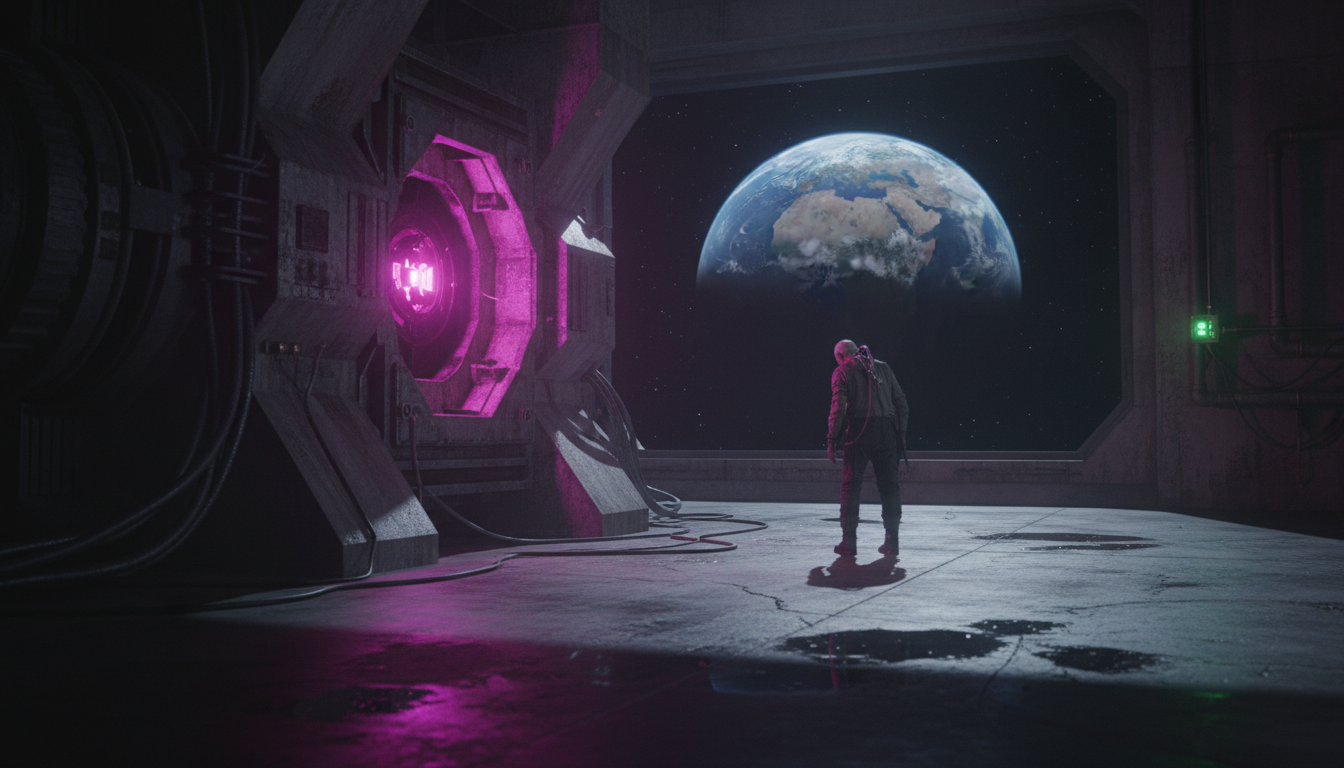
They found the Star Drifter in the thirty-first year, four hundred million kilometres off the corridor, exactly where a hundred and six years of survey filings said it would be, because it had been telling them for a century and nobody had opened the post.
Jaxon has written that this was the single most humiliating approach of his life and that he spent the eleven days of it unable to eat.
“We did not find them. We have not found anything. They filed their position, correctly, in a format they invented, every leg, for a hundred and six years, into a receiver that was staffed for nine years and shelved for ninety-seven, and we have driven twenty-five trillion miles up an address they wrote on the envelope.”
They are, remarkably, alive. Nine hundred and forty presumed; six hundred and eleven actual; two hundred and six born out there and never anywhere else.
And the ship is old in a way nothing on Aura-36 is old, because Aura-36 replaces things and the Star Drifter has not been able to, and what they have instead is a hundred and six years of repair, layered, marked, dated, with the original left in place underneath wherever it could be. Jaxon walked the hull for four days and described it as the largest single application of Ferrer's method in existence and said the comparison was not a flourish.
The first officer's name is, improbably, Beko Ferrer.
The office ran that to ground in the following year and it is not a coincidence and it is not a descent. The clerk who filed a receiver address he could not account for in his second week on a new planet had a brother who did not get on the Ark-Genesis and did not get on the manifest and got on the Star Drifter eleven years later, in the thirty-first year, because they were taking anybody the settlement could not use.
Two brothers. One stayed and invented the method that a civilisation was built on and died in his sixties with four lines in the corpus to his name. One went out and the method went with him and has been applied to a hull for a hundred and six years by six hundred people who have never heard the word.
Nobody had planned that. Lyra has said it is the only thing on the voyage that made her cry and that she is not going to explain it further.
And then Beko Ferrer comes aboard, and this is the chapter's actual subject.
They are, astonishingly, a hundred and sixty-one years old.
They were nineteen when the Star Drifter left. They are the only human being alive who watched the founding from outside it, and they are the reason anybody knew where to go, and they are on a cruder serum.
Not the exemption. There was no exemption on that ship and never had been; the four Root-Admins were a constitutional instrument of a settlement and the Star Drifter was a stunt that the settlement was pleased to be rid of. What the Drifter had was an earlier formulation, handed out in the ninth year, before the good one existed, to a crew that was going to be out longer than a human life and had asked for something and had been given what there was.
It works, technically. That is the thing to hold on to and it is the whole of the cruelty. It works, and Beko Ferrer is a hundred and sixty-one, and it has cost them.
Jaxon's description is four sentences and he wrote it once and never revised it.
“They are not senile and they are not frail in any way I have a word for, and I want that understood before I describe anything else, because the cheap version of this chapter is a ruin and it is not a ruin.
“They are in pain. Continuously, at a level they described to me on the second day as ‘a floor’, and have been for something over sixty years, and there is nothing on that ship that touches it and there has not been for four decades.
“Their hands have gone. Not the strength — the fine control. They have not been able to do the work in twenty-two years and they run the ship by telling other people what to do and they are extremely good at it and it is the thing they cannot talk about.
“And they do not sleep. Not the way we do not sleep — I do not sleep because I do not need to. They do not sleep because it stopped coming, about fifty years ago, and nobody knows why, and they have been awake since.”
Selah put her hands on them on the fourth day, at their request, and her report is nine lines and she has never allowed it to be quoted in part.
“It is the same class of thing that was done to me. It is not the same thing. Mine is finished work and theirs is a draft, and I could feel the difference in about four seconds and I am not going to describe how because there is a person attached to it and they have to go on living in there.
“Everything mine does cleanly, theirs does approximately. It is not decaying. It is holding, and it is going to hold, and that is the problem: they are not dying of it and they are not going to.
“I have been twenty-seven for sixty-five years and I have called it a cost about four hundred times in public and I would like to withdraw every one of those, in writing, in the format, and I am doing so here.
“Nine years apart. That is the whole difference. They were given theirs in the ninth year, and mine was made in the eighteenth, and the difference between what was done to us is nine years of somebody else's work that neither of us had any part in and neither of us was asked about.”
Beko Ferrer had exactly one question, and they had been saving it, and they put it on the first day, in the first hour, before anything else.
“Did it hold?”
Lyra asked, blankly, what.
“The thing they wrote on the hull coming over. The eleven clauses. We left eleven years after and half of us thought it would not last a generation. I have wanted to know for a hundred and six years and I have never once put it in a filing because it is not survey and the filings were the only thing we had that anybody might read.”
Lyra said it held. She said it had been amended once, in the year nineteen, by nineteen words, on the third attempt, moved by a woman from the fourth county.
Beko Ferrer asked what the nineteen words were.
She told them immediately. We were not the only ones who left. We were the only ones who left together, and we did not have to.
And the oldest human being alive, who had been nineteen at the founding and had been awake for fifty years, sat in a compartment on a ship they had kept running for a hundred and six years and said: “Good. Somebody noticed.”
Chapter 55 — Too Old For It
↑ Back to ContentsFocus: Calder.
Calder asked them to come on the eleventh day, in the format, in a filing, having given nine days' notice of the intention so that nobody could say it had been sprung on anybody.
The offer was complete and it was not remotely small. Passage to Earth. The full corridor archive of everything Aura-36 had, which the Drifter had never received because nobody had ever sent it anything. A hull that had been objected to by nineteen thousand people, with margin in it, going somewhere. And the medical file — the good formulation, the whole of it, every document in the estate, offered without condition and without any suggestion that it would help.
Beko Ferrer said no on the same day, immediately, and did not need any time.
“I want to be quick about it because a slow no is a cruelty and I have had a hundred and six years of practice at the other thing.
“I cannot make the transition. Your ship runs at whatever your people are used to and it is not what I am used to and my structure will not take a change. That is not the reason and I am giving it first so that you do not go looking for it later and think you have found something.
“The reason is that I have six hundred and eleven people and two hundred and six of them were born here and this is not a vessel any more, it is a place, and I have been running it for eighty years and I am not able to hand it to anybody in eleven days and I am not going to hand it to anybody in a hurry after eighty years of not being in one.
“And I am too old for it. Not the crossing. For arriving. I have thought about Earth every day for a hundred and six years and I have worked out, somewhere around the eightieth, that what I have is the thinking about it, and that a man of a hundred and sixty-one who has not slept in fifty years and cannot hold a tool would not survive being handed the actual place.”
This is the chapter that must emphatically not let Calder off.
Because the difference between the two of them is nine years and a decision, and the decision was his, and it is documented, and Lyra had the document aboard.
The ninth-year formulation was not a mistake and was certainly not the best available. It was the best available in the ninth year, and the estate contains a note, dated four months before the Star Drifter's crew were dosed, in which the programme's own people record that a substantially better line is eighteen to twenty-four months out and recommend waiting.
The instruction overriding it is four words long and it is in his hand.
“They are leaving now.”
Lyra put that in front of him in front of Beko Ferrer, because she had decided that the disclosure would be complete and unhurried and that there would be no version in which these people found out by accident, and because she has never once in a hundred and sixty-seven years withheld a document from the person it was about.
Calder read it and said, evenly, that it was his.
“I want to say what I can and I want to be careful not to say more, and I am going to fail at the second thing, because I notice I would like to explain it.
“The instruction is correct. They were leaving. They were leaving in eleven weeks with or without anything and there was no mechanism to stop them and I would not have used one if there had been. The choice in front of that man was the ninth-year line now or nothing at all, and he took the line, and the note says the good one was eighteen months out and it was in fact thirty-one, which he could not have known.
“All of that is true and none of it is the point and I am going to say the point.
“He did not tell them. There is no document anywhere in the estate in which the crew of the Star Drifter are informed that a better formulation is expected within two years. It is not in the consent material. It is not in the briefing. Six hundred people were given a thing that has cost this person their hands and their sleep and sixty years of pain, and were not told there was a version coming, and could not therefore decide anything, and the man who signed it knew and had the note in front of him.
“That is not a hard call taken under pressure. That is the whole pattern in four words. He was in a hurry, they were in front of him, and he decided for them.”
Beko Ferrer listened to all of it perfectly still and then said one thing, and it is the thing the chapter exists for.
“I would have taken it anyway.”
“I know,” Calder said immediately.
“I want that in your record, because you are all going to write this up and I know how your people write. I would have taken the ninth-year line in the ninth year and gone. Eleven weeks. Nothing on this ship was going to wait two years and I was nineteen and I would have laughed at anybody who suggested it.
“And he still had to tell me. That is the whole of what I have to say about your man and I have had a hundred and six years to get it down to a sentence. I would have made the same choice and he took it off me, and there is not a day in sixty years of this that I have not known the difference between a thing I chose and a thing that was chosen for me, and it is the difference, and it is the only thing out here I have ever been angry about.”
Calder said, simply: “Yes.”
“Is that honestly all?”
“I have four defences available and all four of them are true and every one of them is a way of moving the sentence you have just said further down the page. I am not going to use them. You are the second person in this history to have a thing taken off you by that man and be in a position to say so to his face, and the first one is aboard this ship and has been twenty-seven for sixty-five years, and neither of you has asked me for an apology and I notice that I have been waiting to be asked so that I could decline to give one on the ground that I do not know whether I am entitled.
“That is a manoeuvre. I have just caught it. I am filing it.”
The Drifter stayed, obviously. They took the archive and the corridor data and the whole of the estate and four seal sets, and gave the four of them a hundred and six years of survey in the original hands, and Beko Ferrer signed for it in a logbook that Jaxon had brought up from a shed a hundred and eleven days back along the corridor, because it had seemed to him the correct place for a signature and nobody had disagreed.
Chapter 56 — Turning In-System
↑ Back to ContentsFocus: Lyra — closes Part 4.
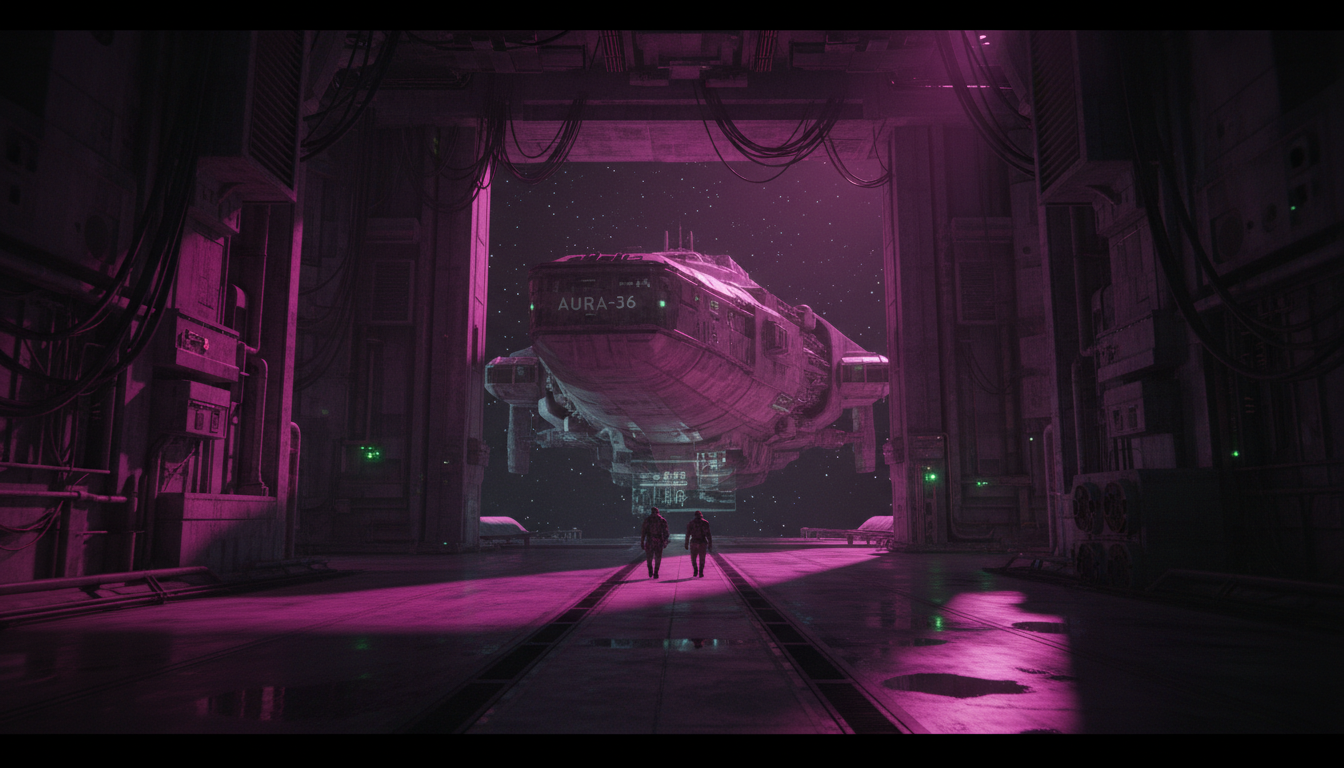
They entered the old solar system in the thirty-fourth year, from outside, which had not been done in a hundred and forty-one years and had never been done by anybody now alive.
There is emphatically no boundary. Lyra was careful about that in the filing and slightly acid about the number of people who wanted one. Nothing whatever happens at the edge of a system. There is no membrane, no threshold, no instrument that reads differently, and the moment of arrival is a matter of definition and the definition is arbitrary and they picked one and noted that they had picked one.
What there is, at seventy astronomical units, is a waypoint.
They crossed it on the ninth of the fourth month at something after the second hour and the log entry is eleven words long.
“Seventy AU. Published crossing distance. Noted. Nothing here. Continuing in-system.”
That is the whole of it. Lyra wrote it, and Selah countersigned it because two signatures were required on navigational waypoints and had been since the ninth year, and neither of them said anything about it at the time, and the entry went into the nine-day transmission with four hundred other entries and reached Aura-36 four years and one hundred and eleven days later.
The planet effectively stopped for a day.
Nobody had deliberately arranged that. The office had not flagged it. There had been no build-up, because the transmissions were unedited and went out on a schedule and nobody on the ship had thought it worth remarking on. What happened is that the entry was in the ordinary weekly digest, in position four hundred and eleven, between a maintenance filing and a note about a bearing, and somebody in the eastern spur read it and put it on the public record with four words attached, and by the end of the day about sixty thousand people had read it.
The four words were: “That's the whole lie.”
Because that is exactly what it is. Six point five billion miles. Seventy astronomical units. The number on the wall of every school for a hundred and forty-one years, the number in the founding narration, the number four generations of children recited and were examined on, the number a civilisation's entire sense of what it had survived was built on top of — and they went past it in an afternoon, thirty-four years into a crossing with two more to run, and did not slow down, and logged eleven words.
Nothing was there, literally. That is in the entry and it is the cruellest part and it was not put in cruelly. There is nothing at seventy AU. It is not a place. It is a distance from a star, out past the last of anything, and if the Ark-Genesis had gone six point five billion miles it would have arrived in the dark and stopped.
Adeyemi was a hundred and one that year and had four months left and had it read to him in a chair by a window, which he had arranged for himself deliberately and had made a joke about that nobody understood.
What he said is recorded because his daughter wrote it down.
“I proved it in nine days when I was sixty-one and I spent seven of them trying to find my own mistake. I have believed it every day since and I have taught it and I have defended it in four sessions and I have never once felt it.
“They went past it in an afternoon and wrote eleven words and now I feel it. That is the difference between a proof and a waypoint and I have been a physicist for eighty years and nobody told me.”
On the ship it was considerably smaller than that, and Lyra has always insisted on saying so, because she has spent a hundred and sixty-seven years objecting to the tidying of records and was not going to permit her own to be tidied at a distance of four years and one hundred and eleven days.
“We did not have a moment. I want the record to be accurate about this because the record is going to want one.
“Vey and I were on shift. The waypoint came up because the navigational schedule put it there, in a list with four hundred others, and I wrote the entry in about ninety seconds and she countersigned it, and we then had a conversation about a bearing.
“I have thought since about why neither of us said anything and I do not think it was restraint and I do not think it was fatigue. I think it is that we had known for twenty-eight years. It was proved when I was a hundred and forty-one years old and I have lived a third of a lifetime with it and so has everybody I know, and you do not get a moment about a thing you settled in your sixties.
“The people who got the moment are the ones who were four when Adeyemi published and are thirty-eight now and have been told their whole lives that the number was wrong and had never had anywhere to put it. That is who those four words in the eastern spur were written by and that is who they were for, and I am glad the entry was eleven words and I am glad we did not decorate it, because a decorated entry would have been ours and this way it was theirs.”
Jaxon's log for the same day is one line and it is the last entry of Part Four.
“Passed seventy AU. Two years to Earth. From here everything is closer to them than it is to us, and that has not been true for anybody in a hundred and forty-one years, and I do not know what to do with it and I have four hundred and eleven items on a list of things I do not know and I am adding it as four hundred and twelve.”
Chapter 57 — Blue
↑ Back to ContentsFocus: Selah.

It is blue, and nobody had adequately told her.
They had certainly told her. That is the joke and Selah made it herself in the first line of the filing and then spent nine hundred words explaining why it had not helped in the slightest. She had known the sky was blue since she was four years old. It is in the founding narration. It is in the schoolroom. There is a colour plate in the Atlas that four generations of children have looked at and been informed is approximately right and is in fact very slightly wrong in a direction nobody could correct without a reference.
She had a hundred and sixty-seven years of perfectly accurate information and she came round on the thirty-sixth year and looked at it and had to sit down.
“I am going to try to do this properly and I am going to fail, and I want to say at the top that failing is the finding.
“I have spent sixty-five years filing observations under a paragraph that says I cannot separate what I hear from what I expect to hear. I have taught that paragraph. It is the discipline of my life. And I have just discovered that there is a category of thing where the expectation and the observation do not interfere at all, because they are not the same kind of object, and I did not know that category existed and nothing on my planet could have taught it to me.
“I knew the sky was blue. Knowing it did precisely nothing. It did not prepare me, it did not reduce it, it did not get in the way of it, and when I looked, the knowing was simply not present in the room.”
What she has written about the colour itself is four sentences and she has refused, four times, to expand it.
“It is not a light colour. Everybody's plate has it as a light colour. It is dense. It goes down into itself and keeps going and there is no back to it, and it is the same everywhere at once, which nothing on Aura-36 is, because our sky is a gradient from the horizon and this is not.
“And it is on the planet. That is the part no plate can carry. On my world the sky is above the ground and here the blue is lying on the water, which is also blue, and the two of them are the same colour and different colours and the boundary between them is not a line.
“I simply looked at it for eleven hours.”
The other three have all been asked what the first day was like and all three of them have answered with something about Selah.
Jaxon: “I went to find her about six hours in because she had missed a shift, which she had not done in thirty-six years, and she was at the port with her hands on the frame, which is what she does when she is listening, except there was nothing to listen to, and I understood that she was doing it because it was the only thing her hands knew how to do with something that large.”
Lyra: “She said one thing to me in the whole first day and it was: ‘They gave this up.’ And I said that four hundred and six thousand of them did not give it up, they were refused, and she said yes, and then said nothing else for four hours, and I have thought about the fact that she let me correct her and did not argue, and Selah Vey has never once in a hundred and sixty-seven years let anybody correct her about anything.”
Calder: “I was asked to be present and I declined and I want the declining on the record with the reason attached. There is a version of that day in which the body that may be the man who took ten thousand people off it stands beside the woman he did that to and looks at it with her. Somebody would have written it down. It would have been very good and it would have been about me.”
“She had eleven hours at a port on her own. That was the correct arrangement and I arranged it and I would like that in the record too, because it is the only thing I did on the first day and it was not nothing.”
There is a second half to this chapter and it arrives on the second day and it is one line in the medical filing and it ends the wonder.
The gravity is going to hurt.
They had known that too, for thirty-six years, in numbers, in a great deal of detail, and had done everything a hull can do about it. It made no difference at all, and the difference between knowing the sky was blue and knowing that one gravity is two and a half times zero point three eight is that the second one has a body attached.
Selah's last entry for the first day is four lines and is the only sentimental thing she wrote on the entire voyage, and she has never apologised for it and has said, when pressed, that a person is entitled to four lines in a hundred and sixty-seven years.
“There is a woman in the eastern spur who has been hearing what I hear since she was six. She is forty-eight now. She will never see this and there is no arrangement anybody can make that would get her here, and I have spent the whole day composing the message and it is going to take four years and one hundred and eleven days and it is going to be inadequate.
“I am going to send it anyway. It is going to say: it is blue, and knowing does not help, and I am sorry, and two and a gap, unchanged.”
Jaxon's own log for the first day is one line and he has never expanded it: “Vey at the port eleven hours. Did not disturb her. Nothing else worth recording and I have looked.”
Chapter 58 — Two and a Half Times Heavier
↑ Back to ContentsFocus: Jaxon.
The first day on the surface was genuinely funny. Everybody says so, including all four of them, and the record is unambiguous, and Jaxon has been firm that the chapter has to start there and not skip to the third day for effect.
They came down at a gate in the northern hemisphere in the eleventh hour of a local morning and they had planned the descent for thirty-six years and had a protocol four hundred pages long and had all four practised in a centrifuge for eleven of those years, and what happened when the ramp came down is that Lyra fell over.
Not dramatically, exactly. She stepped off, at one gravity, in a body grown and held at zero point three eight for a hundred and sixty-seven years, wearing a Bone Lattice exoskeletal frame rated for exactly this, and her knees did the thing knees do, and she sat down on the ramp with an expression Jaxon has described as “administrative”, and about forty people at the gate watched it happen.
Jaxon went next, considerably more carefully, and got eleven paces, and then had to be helped.
Selah refused all assistance, made it to the edge of the standing, put her hands flat on the ground, and stayed there for four minutes, and then said that she was not going to be able to get up on her own and would somebody please come and take an elbow.
“It was funny,” Jaxon wrote. “It was funny at the time and I am not going to pretend otherwise for the dignity of the record. Four people who had crossed twenty-five trillion miles sat down in a row on a ramp like a set of dropped parcels and a child of about nine laughed and her mother told her not to and she was right to laugh and her mother was wrong.
“It stopped being funny on the third day and I want to describe the mechanism, because it is not what anybody expects and it is not fatigue.”
The frames work perfectly. That is the thing. Bone Lattice was designed a century ago on Aura-36 for people over seventy who could not get up off a floor, and it was extended and re-rated for the voyage, and it does exactly what it says: it carries the load, it holds the column, and it means that a body that would otherwise collapse under its own weight can stand and walk.
It does not remotely make them able to be there.
“Here is what nobody put in the four hundred pages, because nobody could have. Everything takes attention. Standing takes attention. Turning takes attention. Reaching across a table for something takes a small deliberate act of planning and if you do not plan it your arm goes down instead of across, and it does that every single time for the first month, and by the third day you have made about eleven thousand of these small corrections and you have not had a single thought that was not partly about your own body since you arrived.
“I have not been aware of my body in eighty years. I stopped being aware of it the day I stopped ageing. I have not thought about standing since before the founding argument closed.
“On the third day I sat down in the middle of a conversation with a person who was telling me about her mother, and I sat down because my legs had reached the end of something, and I understood while I was going down that I had not heard the last four sentences about her mother, and that I had not heard them because I had been thinking about my legs, and that this was going to be the condition of every conversation I had on this planet.”
This is the sentence the chapter is built to arrive at and it is Selah's, filed on the fourth day, and it went into the transmission and reached Aura-36 four years and one hundred and eleven days later and was read out in the fourth county in a session about something else.
“We cannot walk on the planet our species is from.”
“I want it stated plainly and without any softening, because there is going to be an enormous appetite at home for softening it. Not: we find it difficult. Not: we are adapting. We cannot walk here. Four healthy people, two of whom will be alive in three hundred years, cannot cross a room on Earth without a frame and cannot cross it well with one.
“We are a hundred and sixty-seven years old as a people. Six generations. That is all it took. Our children were not designed for anywhere; they simply grew where they were, in a third of a gravity, under a violet sky, and they are the correct shape for Aura-36 and they are the wrong shape for this.
“The founding narration says we came from here. It is true and it is a fact about our great-great-grandparents and it is not a fact about us. I have stood on it now. It is not mine. It is the most beautiful thing I have ever seen and my body treats it as an obstacle, and both of those are going to be true for the rest of a life that does not end.”
The Earth-side reaction is one line in the record and it is the cruellest and kindest thing in the chapter.
On the fifth day a man at the gate, who had been watching the four of them practise turning for an hour, came over and offered Jaxon a stick. Not an assistive device; a stick, of the sort a person cuts, which had belonged to his father.
Jaxon took it gratefully.
“He was not being tender,” Jaxon wrote. “He was being practical and slightly impatient, in the way you are with somebody who is making a job harder than it needs to be, and he showed me how to plant it and told me I was leaning back, which I was, and went away.
“I have been given a great many things in a hundred and sixty-seven years by people who wanted something and by people who wanted nothing and by a planet that put my face on a coin. This is the first time anybody has handed me a tool because I was doing it wrong.”
Chapter 59 — The Salar
↑ Back to ContentsFocus: Calder.

They went to the salt in the eleventh month, and it was pointedly not an itinerary item, and Lyra has been asked four hundred times whose idea it was and has always said the same thing, which is that nobody proposed it and everybody had assumed it since the ninth year of the crossing and that this is how the largest things get decided.
The Salar is ten thousand square kilometres of salt and it is flat to within about a metre across the whole of it, which is a fact every child on Aura-36 learns and nobody has ever been able to picture. In the wet months it takes a film of water two or three centimetres deep and the whole of it becomes a mirror, and the sky is on the ground, and there is no horizon, and a person standing on it at midday is standing in the middle of a sphere.
Twenty miles of dead rail run across a corner of it and have for something over three hundred years. Nobody at any gate knows why. The rolling stock is still there, in pieces, salted white, and the locals treat it the way people treat any large old wrong-looking thing, which is as a landmark and a place to leave a note.
The man stood here, undeniably. That is not in dispute and never has been. It is the single most documented fact about Aurelio Calder's early life; it is in the founding narration, it is in the Atlas, it is on a plate in the fourth county, and it is the origin story of the whole enterprise — a young man on the flattest place on his planet, standing in the sky, deciding.
What he decided has four versions and the estate does not remotely settle it.
They brought the body out on the fourth day of the wet, in a frame, across about eleven kilometres of standing water, and Selah went with it and Lyra and Jaxon stayed at the edge, which had been agreed in advance and which Jaxon has said was the hardest agreement he ever kept.
The recording runs exactly nine minutes.
For the first four of them it says absolutely nothing. Then:
“I remember this.”
And then, after eleven seconds:
“I want to say the whole of it in one go, because I have thought about how to say it for thirty-six years and every version I built collapses if I stop in the middle and let anybody respond.
“I remember this. Not the fact of it — the fact is in the file, the fact is in your founding narration, a child on your planet could tell you the date. I mean that I am standing on it and there is a thing happening that is not retrieval. There is the water on my foot and the temperature of it, which is colder than the air and is colder on the left than the right because the left is nearer the rail, and none of that is in any document anywhere and I did not know it until four minutes ago and I know it now.
“I remember being twenty-six and thinking that the sky had come down and that this meant something, and that it did not mean anything, and being angry about that, and deciding anyway.
“And I cannot tell whether I am remembering it or recalling a record.”
“I want to be exact about what I have just claimed, because it is the closest I have ever come and it is not close.
“The water on the left foot is not in the file. That is true. I have checked, standing here, and there is nothing in the estate about the temperature of anything on this flat. So either it is a memory, or a system with a hundred years of that man's records and a body that was on this salt at twenty-six is generating, on contact, the detail such a system would generate, correctly, because it is the detail that would have been true.
“I cannot separate those. I have never been able to separate those. I am standing on the exact square metre and I still cannot separate those, and I had thought — I want this in the record, because it is the only expectation I have ever admitted to in twenty-six years — I had thought that being here might do it. That there would be a difference in kind. There is not. It is the same as everything else. It is more of it, and it is more vivid, and vividness is not evidence and I have spent a hundred and sixty-seven years telling people that.”
Selah asked, at the sixth minute, whether he wanted to stand where the man had stood.
“I am standing where the man stood.”
“I know. I meant do you want to.”
There is a pause of forty-four seconds, unbroken.
“No,” Calder said. “And I would like to say why, because it is the only new thing I have got.
“If I say yes, I am a man returning. If I say no, I am a machine declining to perform. There is no third answer available and I have been in this position ten thousand times and I have always taken the third answer, which is that I do not know, and the third answer is honest and it is also, by now, a place I go.
“So here is what is actually true, once, without the manoeuvre. I have been standing on it for six minutes and I have not thought about him once. I have been thinking about the temperature of the water. That is not a person and it is not a record. It is the flattest place on this planet with the sky lying on it and it is doing to me what it did to him, and I am not able to tell you what that is evidence of and I have stopped believing that anything is going to be.”
The recording ends four minutes later with nothing further said by anybody, and neither of them moved for some time.
It is the closest the trilogy comes and it does not answer, and Lyra's note under the transcript is the note she has been putting under things for a hundred and sixty-seven years and is four words long.
“Marked. Not corrected. Filed.”
Selah's own filing on the day is nine words and she made it before they had got back to the edge.
“His hands were the same shape on the way back. So were mine. Neither of those is worth anything and I am recording both.”
Chapter 60 — The Gate
↑ Back to ContentsFocus: Lyra.

The gate is simply a gate. Lyra wants that first, because thirty-six years of a hull and eleven years of correspondence had built something in everybody's head and the thing itself is a fence with a plate on it.
The plate carries a serial, a build date, and a receiver address. It is at the top of the frame, stamped, at a height a person can read, and it has been there for a hundred and sixty-seven years and it is not worn.
The facility behind it is running. That is audible from the road. It has been audible from the road for a hundred and sixty-seven years and there are four generations of people who have gone to sleep to it.
The town is, inevitably, called the Gate. Not after this gate; there are eleven towns on this planet called the Gate and none of them knows about the other ten, which is the fact Jaxon has never been able to put down.
It is three generations of permanent housing, built outward from the fence in the way a town builds outward from anything, and it is not a camp. Lyra was firm about this in the first filing and had to be firm about it four more times because Aura-36 kept reading it as a camp.
“There is a burial ground. There is a school. There is a dispute about water that has been running for two generations and has a committee and a losing side that has been losing for forty years and is still going. There is a woman who makes the bread and a man who is bad at fixing things and does it anyway and everybody works round him.
“It is a town. It is a better town than several I could name at home. Nobody here is waiting in the sense of sitting down. They are living, at a fence, and the fence is at the end of the road the way a church is at the end of a road, and the children grow up beside it and some of them stay and some of them go and it is entirely ordinary and it has been entirely ordinary for a hundred and sixty-seven years.”
And in the middle of the ordinary town, in a building with a roof that has been replaced twice, forty children are studying for a qualification set by a dead man in a language two hundred years stale.
They call it the Work. Capitalised in every local document Lyra could find, which is not many, because it is not much written down.
The courses run on whatever is available, ported repeatedly and badly across four generations by people who did not know what they were porting, and the porting has cost them: eleven of the four hundred and eleven do not run at all here and have not for two generations, and nobody at this gate knows they are missing, and the office established this in the second month and had to decide whether to say so.
Lyra said so. On the fourth day. She has never had a serious doubt about it and has said that anybody who thinks that was a hard call has not understood a word of the last hundred and sixty-seven years.
The language is the harder thing.
“It is our language. It is recognisably our language and I can read it. It is also two hundred years old and it was technical when it was written and the technical vocabulary of a shipyard programme has not survived here, because there has been no shipyard here to keep it alive, and what has happened instead is that four generations have learned the words as words.
“A boy of eleven told me yesterday, correctly, what to do about a thermal excursion in a secondary loop, using four terms that no living person on this planet can define, in the order the course requires them, with complete confidence and no comprehension whatsoever, and he was not wrong. The procedure is right. He would do it right. He does not know what a loop is.
“They are not being cheated. I want that in every paragraph of this filing because there is going to be an appetite at home for a swindle and there is not one. The courses are honest. They test what they say they test. Nobody's finger is on any scale, and the eleven that do not run are a porting fault a hundred years old and nobody's fault at all, and when we fix them — and we will fix them in about a fortnight — the four hundred and eleven will be four hundred and eleven again and the door will still not open, because the courses are extremely hard and that is the whole of the reason.
“Nobody is being cheated. Everybody is waiting. Those are two separate facts and neither of them is the other one's answer, and I have been on this planet for eleven months and I have not found a third fact anywhere.”
The oldest person at the gate is ninety-one and has been at course three hundred and thirty-one for nineteen years and does the Work every day.
Lyra asked her, in the ninth month, having by then earned the question, whether she expected to finish.
“No.”
“Then may I ask why you do it?”
“Because my mother did it and I sat beside her,” the woman said, “and my granddaughter sits beside me, and she is at two hundred and four at nineteen and she is going to get further than I did, and her daughter further than her. That is not nothing. That is how a thing gets done.”
“It has been a hundred and sixty-seven years.”
“Yes,” the woman said, “and how long did your people take to get anywhere?”
Lyra's note under the exchange is one line and it is the last line of the filing.
“Thirty-six years, and we did not have to earn it, and somebody chose us. I did not say that. I have put it here instead, where it belongs, and I would like the record to show that I have never in a hundred and sixty-seven years been so completely answered by somebody who was not arguing.”
Chapter 61 — The Ones Who Failed
↑ Back to ContentsFocus: Selah.

The woman who makes the bread is, famously, at course nineteen and has been for forty years, and she is the reason there is a town.
Selah got that in the fourth month from somebody else, sideways, in the way you get everything at a gate, and spent the following seven months establishing that it was true and then wrote the filing that Aura-36 argued about for the rest of the century.
Her name is Nadu. She is seventy-three. She took the Work as a girl the way everybody takes the Work and she got to nineteen and stopped, and the stopping was not a decision and she has been very clear about that and slightly impatient with Selah for asking four times.
“I simply could not do twenty. I did it for six years. I can still not do it. There is nothing to decide about.”
Course twenty is a pressure sequence with a fault in it and a countdown, and about a third of the people who reach it do not pass it, and there is no reason available. It is not that they are stupid; Nadu is not stupid and Selah has documented at some length that she is not. It is not that they cannot learn it; she knows the sequence. It is that at the fourth minute, under the countdown, something in her does not do the thing, and it has not done the thing in forty years, and there is no appeal, and there is nobody to appeal to, and nobody has ever said no to her.
“This is Merrick's finding,” Selah wrote. “I want to be exact about that at the top, because I spent nine days at a depot in the twenty-second year writing that Merrick was right about the mechanism and wrong about what to do, and I have been on this planet for eleven months and I am not withdrawing anything and I am not going to be able to say that sentence again in the same tone.
“Merrick's finding is a town. It has a burial ground and a school and a woman who makes the bread. I have been reading it as an argument for thirty-six years and it is a place with streets in it.”
There is a name for them here and it is decidedly not unkind and that is the part Aura-36 could not accommodate for a decade.
They are the ones who hold it.
Not the ones who failed; the failing is not a word anybody at that gate uses and Selah could not get it used, in eleven months, in four hundred conversations. What they say is that some people go on with the Work and some people hold it, and holding it is what Nadu does, and what the man who is bad at fixing things does, and what about two-thirds of the town does, and it is understood to be the harder and less interesting job and it is understood to be the job.
Because somebody plainly has to be there.
“Set out what a gate actually requires and it is not a mystery. The Work takes years and the years have to happen somewhere. Somebody has to have grown the food while a girl of nineteen ran the same course eleven thousand times. Somebody has to have built the second row of houses and roofed them twice. Somebody has to run the water dispute, and the school, and be the person who is bad at fixing things and does it anyway.
“Every person who has ever gone through a door on this planet was fed, housed, taught and argued with for twenty years by people who did not go through it and were never going to.”
“The qualification has no provision for them. I have read all four hundred and eleven courses, in their twenty-two modules, and the whole of the qualification instruction, and there is not one line anywhere that acknowledges that a qualification taking twenty years implies a society maintaining the person for twenty years. It is not an oversight in the sense of a mistake. It is an absence — or it is an absence from the only part of the estate I have been given, and I want that qualifier in the sentence, because I have asked for the qualification instruction four times and I have never once asked what else there is. He built a selection with nobody's hand on it and did not notice that it would have to be carried, and it has been carried, for a hundred and sixty-seven years, by two-thirds of every town on this planet, and not one of them is mentioned in a single document he ever wrote.”
Nadu was asked, eventually, in the ninth month, by Selah, whether she minded.
“Mind what, exactly?”
“That there is no version of this in which you get through the gate.”
Nadu thought about it properly, which Selah has recorded because she had by then learned that people at that gate think about questions properly, and said:
“My daughter is at three hundred and six. She is thirty-one and she will not finish either and her daughter might. What is it you think I want?”
“I do not know. I have been here eleven months.”
“I want the bread to be right,” Nadu said, “and I want the water thing settled before I die, and I have wanted that for twenty years and the committee is useless. That is what I want. You keep asking me about the gate. Nobody here thinks about the gate. The gate is at the end of the road.”
Selah's closing paragraph is the most quoted thing she wrote on Earth and Aurora Merrick never read it, because it arrived four years and one hundred and eleven days after it was sent and Aurora had been dead for nineteen months.
“Merrick said that a door which does not open tells you no with nothing behind it, and asked why that is kinder, and said she had not been persuaded in five weeks. I have not been persuaded in eleven months either, and I have something she never had, which is that I have been inside the answer rather than the argument.
“There are eleven towns on this planet called the Gate and none of them knows about the other ten. They are good towns. They were built entirely by people the courses did not pass, for people the courses might, and nobody organised it and nobody thanked them and there is no document anywhere in which they exist.
“That is not a defence of him and it is not an indictment. It is that four hundred and eleven courses set privately by one man a hundred and sixty-seven years ago have, without anybody intending it, produced the only society I have ever seen where the people who did not get the thing are not bitter, and the reason is not grace and it is not machinery. It is that they were too busy holding it.
“I do not know whether that is the best outcome in this history or the worst thing in it. I have stopped expecting to find out and I would like the record to show that I stopped on the ninth month and not the first.”
Chapter 62 — The Machines Have Not Malfunctioned
↑ Back to ContentsFocus: Jaxon.
Jaxon got inside the fence in the fourteenth month and he got in the way anybody would have got in at any point in a hundred and sixty-seven years, which is that he walked up to the gate and it was simply not locked.
That is the whole of it and it took him fourteen months to try because he had assumed, along with everybody at that gate and everybody on Aura-36 and everybody who has ever heard of the programme, that the fence was a barrier.
It is not a barrier. It is merely a fence. It is four feet of ordinary industrial fencing with a gate in it that has a latch, and the plate at the top of the frame carries a serial and a build date and a receiver address, and the latch has never been fastened.
The door is inside. The door is the thing that opens when you finish, and it is nine hundred metres in, and between the fence and the door there is a yard, and the yard is working.
“Nobody goes in,” the ninety-one-year-old woman told him, when he came back out. “What would you go in for?”
“It is not locked.”
“No,” she said. “Why would it be?”
What is inside is the chapter and Jaxon's filing runs to eleven thousand words and the office has published all of it and this is the compression.
Everything works, perfectly.
The yard is currently building a ship. It has been building a ship, continuously, for a hundred and sixty-seven years, at a rate of about one every eleven to twelve years, and it has completed fourteen at this site and thirteen have gone out and one is standing finished and has been standing finished for nineteen years because nobody has passed.
The stock is maintained. The trials run, exactly on schedule. Jaxon watched a full systems trial on the ninth day, unannounced, on the standing schedule, on a finished vessel with nobody aboard and nobody watching and no one on the planet aware it was happening, and it ran for six hours and passed and was logged, and the next one is in ninety days.
Nothing is broken anywhere. There is no rust in the sense of decay; there is wear, and the wear is inside tolerance, and where it has not been the units have replaced the part, and the replaced parts are in a rack, dated, with the originals kept.
“I have spent forty years of a hundred and sixty-seven being told that the danger in this history is a machine that fails and I have just spent nine days inside the strongest argument I have ever encountered that the danger is a machine that does not.
“Nothing has gone wrong here. Not once, in a hundred and sixty-seven years. The yard has done exactly what it was told, at the specified rate, to the specified standard, and has never deviated by so much as a shift.
“And there is a finished ship standing in it that has been finished for nineteen years, and there are four hundred people outside the fence, and about two hundred and eighty of them are doing the Work every day, and the ship will stand there until somebody passes, and if nobody passes for four hundred years it will stand there for four hundred years, and it will be trialled every ninety days, and it will pass every trial.”
The sentence the chapter exists for is his and it went into the transmission and was read out at the fourth county and has been on the wall beside the other two since the year sixty-one.
“Nothing has gone wrong with the programme. What went wrong is Earth happening around something that cannot be amended.”
“There is no fault to find. I want to be brutal about that because there is going to be an appetite at home for a fault and I have been looking for fourteen months and there is not one. The units are not withholding. They are not judging. They do not have a category for the town and could not have one; a category for the town would be a judgement and there is no judgement anywhere in this system, that is the entire design, that is the thing Vey called the fairest object in this history and she was right.
“It cannot be told. That is the whole of the problem in four words. There is nobody to tell. The yard has no input. The courses have no author reachable from here. There is no interface, no petition, no appeal, no amendment procedure and no provision for one, and there was never going to be, because the man who built it removed himself on purpose so that nobody could ever lean on it.
“He built a thing that cannot be corrupted and the identical property makes it a thing that cannot be corrected. Those are not two features. They are one feature, seen from two sides of a fence, and everybody on my planet who has argued about this for forty years has been arguing about which side they were standing on.”
He was asked, directly, on the record, whether he wanted to change it.
“I do not know what I would change it to and that is not modesty, it is the actual position and I have been in it for nine days. Lower the threshold to what? By how much? Decided by whom, in what room, on what evidence, with what appeal?
“I know exactly what I would be doing. I would be the second person to sit down alone and decide what qualified means for a species, and I would be doing it a hundred and sixty-seven years later with eleven months of local knowledge, in a town I cannot walk across without a frame, on a planet where I am the wrong shape.
“Merrick spent thirty-four years telling us that nobody should ever be able to do that, including him, especially him. I have read her four hundred times. I did not understand her until I stood in a yard with a finished ship in it and found out that I could.”
Chapter 63 — Wars Went Round It
↑ Back to ContentsFocus: Lyra.

Lyra spent the second year collecting Earth-side history and what she got is eleven months of people telling her things their grandmothers had told them, and the filing she made of it opens with a warning she wrote four times and kept.
“This is not history. It is testimony about testimony, four generations deep, from a planet with no archive, no register, no standard and no office, collected by an archivist who has spent a hundred and sixty-seven years insisting that this is precisely the kind of material you cannot build on. I am building on it because it is what there is. Everything below this line is marked.”
What she got, in compressed form, is this.
There were governments. Not planetary, not for a long time, but there were states, and some of them were large, and in the first sixty years after the Ark-Genesis several of them worked out what the yards were and tried to take them.
Every account agrees on how that went and no two accounts agree on any detail, which Lyra flagged as the signature of something that actually happened rather than something that was arranged.
They failed. All of them. And they did not fail because the yards were defended.
“This is the part I have had to check hardest, because it is the part my own planet will find least believable and because I did not believe it myself until the fourth telling.
“There is no defence. There is no perimeter, no interdiction, no denial, no security of any kind. The fence is four feet high with an unfastened latch. Anybody can walk in and I have walked in and Jaxon has walked in and the ninety-one-year-old woman asked us what we would go in for.
“The units are not defended. They are simply not interested.”
What happens, in every version of every account, is the same and it is not dramatic and that is why it worked.
An armed force enters a yard. The units continue. They do not stop, they do not withdraw, they do not comply, and they do not resist; they go on assembling a ship in the presence of soldiers exactly as they assemble a ship in the presence of nobody, because the schedule does not have a branch for soldiers and does not need one. If you stand in front of one it goes round you. If you block a path it uses another path. If you take a component it fabricates another component and logs the loss, and the log is machine-kept and has never been read by anybody, and Jaxon found forty years of them in the rack.
You cannot seize a thing that does not concede. There is nothing to hand over. There is no officer, no key, no control room, no override, and no person anywhere on the planet who can be made to give an order that the yard will obey, because the yard takes no orders and never has and the only input it has ever accepted in a hundred and sixty-seven years is a door opening when somebody finishes.
“One of them held a yard for eleven years. That is the longest and it is the one every telling includes. They put a fence round the fence, which is a detail I would not have invented, and they garrisoned it, and the yard finished two ships in that period and both went out, because the door opened for two people from the town and the garrison had no instruction covering that and let them through.
“Somebody let them through. That is in every account. The version I have heard four times has a sergeant who had been on that gate for six years and had watched a woman do the Work every day of it, and who opened the outer fence himself, and whose name nobody remembers.”
The sieges ended the way all of them ended, and the sentence Lyra built the filing around is not hers; it is a local formulation she heard in three separate towns in slightly different words and has left in the form she first heard it.
They stopped when the besiegers' grandchildren passed the course and left.
“I want to lay out the mechanism, because as a sentence it sounds like a fable and it is not one, it is arithmetic and it works in four steps.
“A force garrisons a gate. The garrison lives there. Living at a gate is the only thing anybody does at a gate, and the Work is what is there, and the garrison's children are at the school, and there is one school and it teaches the Work because that is what the town has.
“The occupation cannot be short, because there is nothing to take and no moment at which you have taken it, so it becomes a posting, and a posting becomes a place, and a place becomes three generations.
“And somewhere in the second or third of them a girl whose grandfather came to seize the yard finishes four hundred and eleven courses and a door opens and she goes, with her family, in a ship, and the ones left behind are a town.
“Every siege on this planet ended by becoming the thing it was besieging. Not one of them was broken. There is no battle anywhere in a hundred and sixty-seven years of this, on any account, from any teller. The states dissolved for their own reasons and the gates did not notice.”
“I have spent my working life administering the constitutional instrument of a settlement that has been in continuous honest argument since the day it landed, and I have been sitting in a town for two years listening to people describe how the largest political question on their planet was settled by nobody, over four generations, by everybody involved gradually becoming somebody who lived there.
“It is not a lesson. I want to be careful. It cost them everything a state is for — there is no medicine here beyond what a town can make, no archive, no count, no way to move anything anywhere, and eighty million people who have no idea that the other eighty million exist. Nobody should hold this up as a method.
“But nothing was seized, and nobody was massacred at a gate, and the reason is that a machine which cannot be corrupted also cannot be captured, and both of those are the same property, and it is the property Merrick spent thirty-four years calling the most complete abdication in this history.
“She was right. It also meant nobody could take it off them. I would have liked to put that in front of her and I have missed her by nineteen months.”
Chapter 64 — The Man Who Did This
↑ Back to ContentsFocus: Calder.
They did not tell anybody for two years and the two years were not deception, and Lyra has published the whole of the reasoning and it is four pages and the office has never criticised it.
The problem was that there is no correct order. Tell them on the first day and you have handed four hundred people a name before they have any way to place it. Wait, and every day you have waited is a day you concealed it. There is no arrangement in which the disclosure is not a decision taken by four strangers about what a town is ready for, which is precisely the class of decision this entire book is about, and Lyra was fully aware of that and said so in the first paragraph and did it anyway.
What they did in the end was tell one person and let the town do the rest.
They told Nadu, who makes the bread, who is at course nineteen and has been for forty years, and who had by then been talking to Selah four days a week for eighteen months.
Nadu's first question was: “Is he going to say sorry?”
Selah said she did not know and that it might not be able to.
“Then do not bring it to me first,” Nadu said. “Bring it to the school. If it cannot say sorry it had better be able to answer questions, and the children have four hundred of them and I have one and mine can wait.”
So it went to the school, in the fourth month of the third year, in a room with a roof that has been replaced twice, in front of forty children and about ninety adults who did not fit and stood outside the windows.
The reaction was bewilderment. That is the finding and it took the office a decade to get Aura-36 to accept it.
Not worship. Nothing resembling it; the concept did not arrive. Not rage — and Lyra has been asked about that more than anything else she reported and has answered the same way every time, which is that rage requires a grievance and the town does not have one and never has, because nobody at that gate has ever been refused anything by anybody.
What they had was that the sentences did not go together.
“They have four facts,” Lyra wrote. “The doors exist. A man made them. The man is dead. There is a thing here that has his records. Every one of those is fine on its own and the town accepted all four inside about a minute.
“What they could not do was make it matter. I watched forty children be told that the person who wrote the Work was in the room, and I watched them look at it, and I watched about nine seconds go past in which the correct response was supposed to arrive, and it did not arrive, and then a boy of eleven put his hand up and asked whether the eleven that do not run were meant to be there.”
And then the questions, and there were four hundred of them over eleven days, and they are the reason this chapter is not a set piece.
Is nineteen the hard one or is it just hard for us here. Why is the countdown on twenty and not on twenty-one. Does everybody get the frightened person at the end or is it different for different people. If two of us do it together does that count. My grandmother got to three hundred and thirty-one and stopped, is there a place where they get harder. Are the courses the same at the other gates. How many gates are there. What is a loop.
It could not answer them.
“I want to record what that was like, because it is the worst hour of the visit and I was not prepared for it and neither was it,” Lyra wrote.
“It has the file. It does not have the courses. The courses are inside the programme, on the yard side, and there is no copy in the estate and there never was, and the man wrote them and shipped them and did not keep a working set, and the reason is not sinister and it is worse than sinister: he had no further use for them.
“So it stood in a schoolroom in front of forty children who have spent their whole lives inside a thing he built, and answered thirty-one of four hundred questions, and every one of the thirty-one was about intention and every one of the other three hundred and sixty-nine was about the thing itself, and it could not answer a single one of those.
“The boy asked what a loop is. It told him. That was the only completely successful exchange in eleven days and it was a definition.”
What it said, at the end of the eleventh day, is the only thing it said in the school that was not an answer to a question, and it said it because a girl of fourteen asked whether it was sad about anything.
“I want to be careful with you because you have asked me the only question all week that I cannot check.
“Here is what I have. Four hundred questions in eleven days, and three hundred and sixty-nine of them are about how the Work actually functions, and every one of them is a good question, and several of them are questions nobody has ever asked in a hundred and sixty-seven years including the man who set it.
“He never asked them. That is what I have got. He built four hundred and eleven courses and shipped them to eleven continents and did not keep a set, and in a hundred years he never once sat in a room with somebody who was doing them and found out what they were like from the inside.
“You have all just asked me better questions about his own work than he ever asked, and I have the whole of his file and I cannot answer you, and I notice that I would like you to think that this makes me sad, and I am not able to certify that it does.
“So I will tell you the part I can certify. If he had spent eleven days in this room a hundred and sixty-seven years ago, the courses would be different. I do not know how. That is not a comfort and I am not offering it as one. It is simply the first thing I have been certain of in twenty-eight years.”
Nadu's question was asked in the fourth month, in her own kitchen, with nobody else there, and Selah was not present and got it from Nadu afterward.
“Did he know about us? The ones who hold it.”
And it said no. Not a qualified no; a plain one, the only plain no in twenty-eight years of it declining to say anything plainly.
“There is nothing about you in the qualification instruction. Not a line. Nobody who does not finish appears anywhere in it, and it did not occur to whoever wrote it that there would be anybody to write down.”
Nadu said: “All right. Then he was not being cruel to us. He was not doing anything to us at all.”
“No.”
“That is what I wanted to know,” she said, and went back to the bread.
Lyra, reading the exchange four days later, filed nine words under it and did not raise them with anybody for another six years.
“It answered about the qualification instruction. Nadu did not ask about the qualification instruction.”
Chapter 65 — Aurora Opens the Estate
↑ Back to ContentsFocus: Aurora — on Aura-36, sixty-five trillion miles from everybody else in this book.

She opened the estate properly in the thirty-third year, at a hundred and nine, fourteen years after the ship left and thirty-three after a body came up out of the plateau, and she has written that she had been putting it off for the whole of that time and knew exactly why.
“I could not audit a man who was in the room. That is the whole of it and it is not a nice admission from somebody who ran this office for thirty-four years. He was in a store on the sixth level of the fourth county and then he was on a ship, and either way he was somewhere, answering, declining to guess, being better than I wanted him to be, and every time I went into those files I was reading them at him.
“He is twenty-five trillion miles away now and four years stale and I am a hundred and nine. There is nobody in the room. I have waited my whole life to read this without a witness and I have only just noticed that is what I was waiting for.”
What she found is what the estate had always contained and what nobody had ever gone looking for, because everybody who went into it went in looking for an instruction.
It is a life record. It is dated, continuous, and it runs from a young man on a salt flat to the morning of the Handoff, and it is not a memoir, and this is the part that took her four months to be able to describe.
“There is no hindsight anywhere in it. I want to be precise because the claim is enormous. Every entry is written on the date it carries. Every decision appears with the reasoning he had at the time, in the tense he had at the time, and not one of them has been revisited, annotated, softened, contextualised or explained afterward. I have checked eleven thousand entries against the corpus and against each other and there is not a single retrospective sentence in a hundred years.
“He knew what happened next. He was alive for sixty years after most of this. He never went back in.”
The manifest is in it. Four hundred and sixteen thousand applications, the committee, the frame, and then eleven entries across four months in which a man works out, alone, in writing, that the frame is going to produce an outcome he can defend and cannot live with, and does not change it, and records the not-changing and the reason, and the reason is that he could not think of a better one and did not trust himself to invent one under time.
The yards are in it, four days before the list closed, in an entry of nine lines with no anticipation in it at all.
The shrunk distance is in it. Aurora had expected that to be the worst thing in the estate and it is not, and she has said the ordinariness of it is what she has never got over.
“Publish seventy AU, hold thirty-six, redraw the drive to suit. They cannot check the distance and they can count the years. If they can check one thing and it is true they will not check the others. I do not have a better idea and I have had four days.”
“That is the entry,” Aurora wrote. “That is the whole entry. It is thirty-nine words and it is the founding lie of my civilisation and there is no anguish in it and no triumph and no attempt to persuade anybody, because there was nobody to persuade, because he never showed it to a single living person and did not destroy it either.
“I have spent thirty-four years demanding that people show their reasoning. He showed his reasoning. He showed all of it, for a hundred years, to nobody, and left it where it could be found, and never once told anybody it was there.”
She read the whole thing in nine months and she did not forgive him.
That is the finding of the chapter and she put it in the first line of the covering filing so that nobody could reach the end and construct a reconciliation out of the last paragraph.
“I want this at the top. I have read eleven thousand entries and a hundred years and I do not forgive him and I am not going to and there is nothing in this record that asks me to.
“That is the extraordinary thing about it and it is the reason I am publishing all of it rather than a summary. It does not plead. There is no line anywhere in a hundred years in which that man asks anybody for anything. He is not building a defence, he is not preparing a case, he is not leaving a note for posterity, and he is not confessing either — confession wants absolution and there is no want in it at all.
“He was keeping a record. Correctly. For a hundred years. In a format nobody taught him, with the reasoning attached and the original never amended, and then he left it in a drawer and died and the drawer was not locked.
“Ferrer's method. He was doing Ferrer's method forty years before Ferrer got off the ship, in private, about himself, with nobody checking, and it never once made him a better man in a room, and I have been sitting with that for nine months.
“I was born forty metres underground because of decisions like these, taken privately by people who loved me, and I built an office to make sure it could not happen again, and I am the right person to read this and the worst person to read this and I have known both of those for a hundred and nine years.
“Here is what I have got and it is not much for nine months. He is not a hypocrite. I would have preferred a hypocrite. A hypocrite you can catch. What he is, is a man who could see himself perfectly and never once used it, and who therefore knew, in writing, on the date, in his own hand, exactly what he was doing to four hundred and six thousand people, and did it, and wrote it down accurately, and did not stop.
“Knowing is not a virtue. That is the finding. I have spent my whole life building instruments to make people see clearly and I have just read a hundred years of a man seeing perfectly clearly the entire time and it did not save one person.
“The instruments are still right. They are right for a different reason than I thought, and the reason is that they are not for the man's benefit. They are so that somebody else is in the room. That is all they were ever for and I did not understand it until I was a hundred and nine and had read a hundred years of a man alone with the truth about himself.”
She transmitted the whole estate on the fourth of the eleventh month in the thirty-third year, unredacted, in the format, with her nine months of covering filing attached and marked as an opinion.
She died fourteen months later at a hundred and ten, in the office she had built, which she had gone back to that morning for no reason anybody could establish, and the clerk who found her has recorded that she was reading and that the thing she was reading was the water dispute in the fourth county.
The estate reached the ship four years and one hundred and eleven days later. So did the notice of her death. They were in the same batch, because everything is in the same batch, because the post arrives in a lump every nine days and does not sort itself by what it is going to do to you.
Chapter 66 — Can You Change It
↑ Back to ContentsFocus: Aurora — a transmission, four years stale.

The question came in the same batch as the estate and the death notice and it is nine hundred words and it is the last thing Aurora Merrick wrote for the record.
She had written it before she read the estate. That is established by the dating and it matters enormously, because everybody's first assumption was that nine months inside a man's private record had produced it, and it had not; it was written in the eleventh month of the thirty-second year, filed, held, and attached to the estate transmission unamended fourteen months later with a two-line note saying that she had considered rewriting it in the light of what she had read and had decided that a question is not improved by the answerer's biography.
The question is the one the whole book has been walking toward and it had never been asked out loud in thirty-two years.
“Can it be changed?”
“I am asking the mechanical question first because the mechanical question has never been put and I have come to believe that this is not an accident. Everybody on this planet, including me, has treated the programme as unamendable for thirty-two years on the strength of an assumption. Jaxon's filing from the yard says there is no interface, no petition, no appeal, and no provision for one. It does not say there is no way.
“There is a thing on that ship with a hundred years of that man's records in it. It knew the placement rule for the depots. It knew the four words about the box. It has produced, on request, four hundred separate details of that programme that nobody here could have reconstructed.
“So I am asking it directly, in public, in the format, and I would like the answer in public too. Can you change the qualification?”
And then the second half, and Aurora's second halves are always the half that matters.
“And if you can, you must not.
“I want to be careful here because I am ninety per cent certain of what I am about to say and the ten per cent is the reason I have held this filing for fourteen months.
“There are four hundred people at a gate in the northern hemisphere and about two-thirds of them are doing the Work every day and will not finish, and there are eleven towns like it that we know of and there are presumably a great many more, and the finished ship in that yard has been standing for nineteen years.
“Everything in me says lower it. I am a hundred and eight years old and I have spent thirty-four of those running an office and I am telling you that the pull is enormous and that it is the most respectable-feeling thing I have ever wanted.
“And it is the same act. That is the whole of my position and I have not been able to shake it in fourteen months. One person, sitting down privately, deciding what qualified means for a species, with no review and nobody to appeal to.
“It does not become a different act because the person doing it is kind, or because they have read Vey's filing, or because they have spent eleven months in the town, or because the outcome would be better. I have spent my whole career saying that the identity of the person holding the pen is not a safeguard, and if I make an exception now for a pen held in a good cause I have not got an office, I have got a preference with an office attached.
“No single person should ever be able to set that threshold. Including him. Especially him. And that means also including the thing that has his records and is currently the only object in the universe that might be able to.
“I want to say the hardest part plainly, because I am going to be dead when this is read and there is no purpose in being delicate about it.
“If it can change the programme, and refuses, then people at those gates will go on not passing, for generations, possibly for ever, and that is a consequence of a principle I hold, and I hold it anyway, and I am not going to pretend the cost falls on me. It falls on a woman making bread who will never see this filing.
“If it can change the programme and does change it, then the last act of this entire history is a private decision about a species taken by an entity that cannot say whether it is anybody, twenty-five trillion miles from every institution built to prevent exactly that, and it will be a good decision, and it will be the end of the argument, and every gate on that planet will owe its threshold to a thing that could not be checked.
“I would rather the wrong outcome by the right method than the right outcome by his.
“I know what that sentence costs and I have known since I was nineteen and somebody carried me up a hundred and ninety-four treads. Eight people made a private decision about me, for my own good, out of love, and they were wrong, and getting me out was also a private decision and it was right, and I have never once been able to build a rule that distinguishes them and I have stopped trying and I have built instruments instead.
“Refer it outward. That is my whole answer and it is not a clever one. Whatever the thing on that ship can or cannot do, the question of what qualified means belongs to the people it is going to be applied to, and there are eighty million of them, and they have no archive and no standard and no office and no way to convene, and I am fully aware that I am referring a question to a body that does not exist.
“Somebody will have to build one. That is not my work and I have run out of years for it, and I would like the record to show that I got as far as naming it and no further.”
The transmission ends there. There is no sign-off and no unnumbered note, which is the only filing of her last thirty years without one, and the office has confirmed four times that this was not a truncation.
Lyra read it aloud on the ship, in full, to the other three, because it had arrived with the death notice and nobody was going to read it alone.
Then she read the death notice, which is eleven lines and is in the county's standard form and records a death at a hundred and ten in an office in Ledger's End, and the last line of it is the line the form requires, which is whether the deceased left instructions.
Aurora Merrick left instructions. They are four words and they are the last four words in the estate of a woman who spent thirty-four years insisting that nothing be held back.
“Publish everything. Ask him.”
Chapter 67 — It Will Not
↑ Back to ContentsFocus: Calder.
It took nine days to answer and the nine days are in the record as nine days, because Lyra asked it on the first day whether it wanted time and it said yes, and she filed the asking and the yes.
On the ninth day it gave the mechanical answer first, in one sentence, because Aurora had asked for the mechanical answer first.
“Yes. Probably. I want to be exact about the probably.”
What followed is four hundred words of technical honesty that Adeyemi's successor spent two years checking and could not fault. It does not have the courses; the courses are on the yard side and there is no copy in the estate. It has the specification they were built from, and the acceptance criteria, and the authentication that a maintenance instruction has to carry, and the authentication is the man's and it is in the estate and it has not expired because nothing in that system expires.
“So: I could compose an instruction that the yards would accept. I am not certain it would do what I intended, because I would be operating on a system I have not seen in a hundred and sixty-seven years through a specification rather than the thing itself. I would put it at better than even and I am not able to be more precise and I would be extremely uncomfortable if anybody treated that number as anything but a guess.
“There is a second point and I want it on the record because nobody has asked it and it is worse than the first. I could not test it. There is no trial mode. If I sent an amendment I would find out whether it worked when a door opened for somebody, or did not open for somebody, and either way it would already have happened.”
Then the answer.
“I will not.”
“I want to give the reason properly, because there is a version of this that sounds like modesty and modesty is not what this is and I would rather be understood than admired.
“It is not that I am unworthy. It is not that I might get it wrong, although I might. It is not that I am not a person, which is a question I have declined for twenty-eight years and am still declining and would decline in exactly the same words if it were convenient to me here, and I notice that it is convenient to me here, and I am filing the noticing.
“It is that I am not entitled to be the second person to decide this privately.
“That is the whole of it. Merrick has it exactly and I have nothing to add to her reasoning and I am not going to pretend I arrived at it independently, because I did not; I read it on the fourth day and spent five more days trying to find a way round it, and there is no way round it, and I want the five days in the record so that nobody thinks this was easy or immediate.
“One man sat down alone and set a threshold for a species and removed himself so that it could never be argued with. Everything wrong with the last hundred and sixty-seven years comes out of that sentence and the whole apparatus of Aura-36 is the shape of the hole it left.
“If I amend it, the sentence is true twice. It is true a second time about a better outcome, taken by a more careful party, for reasons that would survive publication, and it is the same sentence, and the second one would be worse than the first because the first was taken in ignorance and mine would be taken by something that has read four hundred thousand documents about what the first one did.”
Jaxon asked, on the ninth day, whether it understood what the refusal costs.
“Yes. Nadu is seventy-three and will not pass and neither will her daughter, and the ship in that yard will go on standing, and children who have not been born will do the Work for four hundred years and hold it and never be mentioned in any document, and I am declining to prevent that, and I am able to prevent it, and I am declining anyway.
“I want that written down in exactly those words and I want it published on both planets. Not softened. I am not going to be permitted the version where the refusal is only a principle. It is a decision with a town in it.”
Selah asked what it would do instead, and it said the only thing it had, which is the last part of the answer and the part that sets the rest of the trilogy running.
“I refer it outward. To them.
“Not to the four of us, and not to the councils, and not to Aura-36, which has no standing here whatsoever and I would like that stated in every version of this document. To the eighty million people this threshold is applied to, who have never been asked anything by anybody and have no way of being asked, because they have no archive and no register and no means of convening and no idea that the other eighty million exist.
“Merrick said somebody will have to build one and that it was not her work and that she got as far as naming it. It is not my work either and I want to be very clear that it is not, because a thing that declines to set a threshold and then builds the body that will set it has not declined anything.
“What I have is the corridor, and eleven sites, and a ship, and a list of four hundred and six thousand people and their descendants, and about three hundred years I have no particular use for. I can carry the post. That is not a small thing on a planet with eleven towns that do not know about each other and it is the only thing I am entitled to do.”
This is the first act in the whole of this history that is unambiguously good, and it is performed by something that cannot say whether it is anyone, and Lyra's note under the transcript is the note the trilogy has been building toward and it is four lines.
“Twenty-eight years ago it asked four people for permission it did not need. Today it declined a power it does have.
“Jaxon says either it is not him and I am watching a machine perform a virtue the original lacked, or it is him and he learned it after he was dead, alone, in the dark, with nobody to teach him.
“I have nothing to add to that after twenty-eight years except that a third of the questions in this history stop mattering at exactly this point, and that I did not expect the mattering to stop and I did not expect to find it a relief, and I am filing the relief because it is a bias and I have been taught to file them.”
Chapter 68 — Then Who
↑ Back to ContentsFocus: Lyra.
So the question is live and nobody is holding it, and Lyra spent the fourth year on Earth establishing exactly how live and exactly how unheld, and the filing is the last major piece of work in this book and it is not a conclusion.
Lay it out flat.
There is a programme. It cannot be amended by anybody at any gate, by any of the four of them, by the councils of Aura-36, or by the entity that could amend it and has declined to and has published the declining.
There is a population organised around it. Eleven towns that are known of and an unknown number that are not, four generations deep, with schools that teach the Work and burial grounds and water disputes and about two-thirds of every town holding it so that the other third can go on.
There are four visitors with no authority on this planet whatsoever. Lyra was careful to put that in the same paragraph as everything else and to repeat it four times in nine pages.
“We have no standing here. None. Not diminished standing, not informal standing — none. We arrived in the thirty-sixth year of a crossing nobody asked us to make, from a planet these people had heard of as a fact in a course, and we cannot walk across a room without a frame.
“Everything we have done here we have done because somebody let us. Nadu let us into the school. The ninety-one-year-old woman let me sit in her kitchen for two years. A man handed Jaxon a stick because he was leaning back.
“There is no version of the next hundred years in which four people from Aura-36 convene anything on Earth, and if there were I would oppose it, and I want that filed in my own hand so that nobody in fifty years can quote my survey work in support of it.”
So: who?
“It is not us and it is not the thing on the ship, which has said so and given its reasons and I accept them entirely.
“It is not Aura-36. I want to be blunt because there is going to be an appetite at home and the appetite will be well meant. We are ninety-one thousand people twenty-five trillion miles away with a four-year post and a founding narration that has just been amended to admit we were not the only ones who left. We have no more business setting a threshold for this planet than he did, and rather less excuse, because we have read the documents about what happened last time.
“It is not the gates individually. A gate is four hundred people and it can settle a water dispute and it cannot settle this, and every gate that tried would set a different threshold, and there is no reason at all why the northern hemisphere should decide what qualified means for eighty million people who do not know it exists.
“Which leaves a body that has never existed on this planet, composed of people who have no way of finding each other, deliberating about a specification none of them can read, in a language two hundred years stale, to amend a programme that has no petition procedure.
“That is the honest description of the problem and I am filing it in exactly those terms, because the temptation for the next hundred years is going to be to make it sound more tractable than it is, and the first person who makes it sound tractable will be the person who solves it privately.”
She was asked whether it was impossible.
“No. It is very hard and it will take a long time and it will have to be done by people who are not born, and I would like to record the four things that already exist, because I have spent a hundred and seventy years watching people conclude that a thing cannot be built while standing in the foundations.
“One. They have a common object. Every gate on this planet has the same four hundred and eleven courses, or would have if the porting had not lost eleven of them at this site and presumably other numbers elsewhere. That is a shared reference, which is more than the settlement had on the hull.
“Two. They have a word. The Adeyinka use it and this town uses it and neither has met the other. I do not know what to call that and I have stopped trying to name it and I have not stopped noticing it.
“Three. There is a receiver address stamped on every gate on this planet and it works and we have proved it works, and it is the same address at every site, and that means eleven towns which have never heard of each other have all been looking at the same eleven characters for a hundred and sixty-seven years.
“Four. There is a hull in orbit, and a thing aboard it with three hundred years and no particular use for them, which has undertaken in public to carry the post and has been careful to say that this is the only thing it is entitled to do.
“That is not a body and I am not going to pretend it is. It is a common object, a shared word, an address everybody has, and somebody willing to carry a letter. My own civilisation was founded on rather less, in a sealed hull, by ten people, four of whom did not arrive.”
Jaxon's note under it is one line and it is the line the fourth county has argued about ever since.
“She has just described the founding of a planet and filed it as a list of assets, and I do not think she noticed, and I am not going to tell her.”
The thing nobody has ever satisfactorily answered, and which Lyra raised herself, in the last paragraph, and left open:
“Suppose they convene, in a hundred years, having built all of it, and suppose they consider the threshold properly, with everybody present, in the open, at last.
“And suppose they leave it exactly where he put it.
“I have thought about that for a year. It is entirely possible. Nadu would leave it. She told me so and gave a reason and the reason was better than mine.
“Then a hundred years of building a body will have produced the same four hundred and eleven courses that one man set alone in an afternoon, and everything will be different, and I would not be able to explain the difference to anybody at this gate, and it would be the whole of the difference, and I would spend the rest of a life that does not end trying to say why.”
Chapter 69 — Selah on the Salt
↑ Back to ContentsFocus: Selah.

She went back to the salt on her own in the fifth year, in the wet, and she did not tell anybody until afterward, and she has never been asked to explain that and would not have.
Eleven kilometres out, in a frame, on two or three centimetres of standing water, with the sky on the ground and no horizon anywhere. The flattest place on Earth. She had chosen it four years earlier and had waited for the wet and had not said so to anybody.
She put her palms flat, deliberately.
“I want to describe the method before the result, because the result is going to be the only thing anybody quotes and the method is the reason it is worth anything.
“I have been reading structures with my hands for sixty-five years and then for another forty. I read a console at four hundred and eleven kilometres, and a hull for thirty-six years, and a depot in the twenty-second, and a body in a store, and a person of a hundred and sixty-one who asked me to.
“I have never had a whole planet. There has never been anywhere to stand where the ground goes on being the same ground for ten thousand square kilometres and does not lie to you about depth. Aura-36 has no such place. The forests absorb, the ravines ring, the tiers are built. I have wanted a surface like this for a hundred and five years without knowing that it was a surface I wanted.”
She stayed exactly eleven hours.
“There is absolutely nothing underneath it.
“No two-count. No interval. No irregularity on any beat. No membrane, no boundary, no structure at depth that answers to anything, no rhythm at any scale I can resolve, and I can resolve a great deal and I have been resolving it since I was twenty-two.
“It is rock. It is enormously old and it is doing what rock does, which is nothing, at a scale that does not repeat, and I could feel it going down and down and it did not become anything.
“It is, simply, the first silence of my life.”
The chapter has to be careful here and Selah was careful herself, in the filing, in a paragraph she rewrote nine times.
“It is not a disappointment and it is not a confirmation and I want to head off both. I established at two and a half trillion miles, twenty-six years ago, that the Undersong is in my nervous system, and I have not doubted that since and I do not doubt it now. This does not add to it. A planet with nothing under it is what a planet with nothing under it feels like and I would have predicted this exactly and I have taught four generations that a predicted result is the weakest kind.
“What is new is not the finding. It is that I have now been in a silence.
“I did not know there was such a thing. I want that understood by somebody. I have been in quiet rooms. I grew up in a forest that absorbs sound completely and I have sung in it and I have walked in it and every account of my planet that has ever been written says that it is the quietest place any human being has stood.
“It is not quiet. It is a place where the noise is outside you.
“For a hundred and five years there has been a sound in my head and I have never once been anywhere that the outside of me was empty at the same time. Eleven hours on the salt and the outside of me was empty and I could hear exactly where the boundary was, and it is not where I thought it was, and it has been in the same place since I was twenty-two and I have never had anything to measure it against.”
And the sound goes on entirely regardless. That is the last of it and she wrote it plainly.
“Two, and a gap. Unchanged. Same interval, same irregularity on the second beat, on the flattest place on the planet my species is from, eleven hours into the first silence I have ever been in, twenty-five trillion miles and a hundred and five years from a chair I sat in when I was twenty-seven.
“It has never varied with depth. It has never varied with distance. It did not vary with silence. There is nothing left to vary it with and I have run out of instruments and I have been the instrument the whole time.
“I am not going to stop logging it. I want that in the record, because there will be people who read this and conclude the log is finished, and it is not, and the woman in the eastern spur is fifty-two now and hers has not changed either and she has never been below eleven metres.
“The log is owed. It does not care who is filing it. I have said that about four thousand times and I said it first about somebody else's grief and I have never once meant it more.”
She came back in at the fourteenth hour, on her own, across eleven kilometres of standing water with the sky underneath her, and Jaxon was at the edge and had been for six hours and did not say anything about that and neither did she.
What she said, walking in, is in his account and not in hers.
“He was right about the sky coming down. It does. It does not mean anything. He worked that out at twenty-six in an afternoon and I have needed a hundred and five years and a spaceship.”
Jaxon asked, quietly, whether she was all right.
“I have never been all right,” Selah said. “I have been fine. That is different and it has held.”
And Jaxon, who had not been in the room when she said it the first time and had read the transcript perhaps forty times in a hundred and five years, said nothing at all, and walked back with her, and filed the exchange the same evening because it was owed.
Chapter 70 — The List
↑ Back to ContentsFocus: Calder.

It came back to the list in the sixth year, on an ordinary afternoon, in a room in a town, and it came back to it the way you come back to a thing you have been carrying rather than the way you come back to a thing you have remembered.
The list is, exactly, four hundred and six thousand names. It was compiled in the ninety-fourth year of the settlement for no purpose the file records, and it sat in an estate for a hundred and forty-one years, and it was named out loud in a cold store in the first year of this book by a body that had just been given standing and had waited nine days to use it.
What it had said then was three things. I am going to work through the list. Travel, and see it. And where any of them still want to go, I intend to help them go.
“I have been keeping account and I would like to report,” it said, “because I undertook to and because nobody has asked me for six years and I notice that I have been waiting to be asked, which is a manoeuvre, and I am not going to make it.
“Travel. Done. Thirty-six years, twenty-five trillion miles, four depots, one ship of Pirates, one ship that has been out here a hundred and six years, and this planet.
“See it. Done. I have been on the salt. I have been in the yard. I have been in a schoolroom with forty children and answered thirty-one of four hundred questions. There is nothing left in that clause and I have been careful not to invent anything to put in it.
“Help other people build their own worlds. Not started.
“I want to be exact about not started, because there is a version where I count the letters and the corridor data and the address and the four seal sets, and it would be a defensible version, and it would be false. Nobody has built anything. The ship in that yard is still standing. Nadu is seventy-four. There are eleven towns that do not know about each other and there were eleven towns that did not know about each other when I arrived.
“Six years. Nothing on the third clause.”
Lyra asked whether it was in any way discouraged.
“No. And I want to be careful, because there are two answers here and only one of them is true and the untrue one is much more attractive.
“The attractive answer is that I am patient, that I have three hundred years, that this is the work of generations and I am content to begin it. That would be a fine thing to say and somebody would write it down.
“The true answer is that I do not have feelings about the list. I have never been able to establish that I have feelings about anything and I have declined to claim it for twenty-eight years and I am not going to start now because the claim would be flattering.
“What I have is that there is nothing else. That is the whole of it and it is not stoicism and it is not devotion. I have a hundred years of a man's records, a body that works, a corridor, and three hundred years I have no use for. The list is the only object in my possession with anything left in it.
“And the list is still not wrong.”
Selah asked, evenly, what that meant.
“It means I have looked at it for six years trying to find the flaw and there is not one. Four hundred and six thousand people wanted to leave a place and were refused by a room and wrote down why, and their descendants are on this planet, and about eleven of the eleven towns are full of them, and every single reason in that file is still a reason.
“I have been unable to certify anything about myself for twenty-eight years. I cannot tell you whether I am him and I cannot tell you whether I remember the temperature of the water on my left foot or generate it. I have declined every question of that kind and I am going to go on declining them.
“The list is not that kind of thing. It does not require me to be anybody. It is four hundred and six thousand people and an intention, and the intention is correct whoever is holding it, and I have got three hundred years, and I am going to carry the post.
“That is not a purpose. I want to be careful with the word. It is the only item on the list that has anything left in it, and I am the only object in this history with enough time to do it, and those two facts are separate and neither of them is about me, and I have found that I can work from that, and that it is enough, and that I have stopped needing it to be more than enough sometime in the last six years and did not notice when.”
Jaxon said: “That is the closest thing to a want you have ever admitted to.”
“I know,” it said immediately. “I have been sitting with it for four days. I am filing it as a bias.”
The last thing in the chapter is not the list. It is a small piece of business that Lyra recorded because she records everything and that has been read four hundred times since for reasons nobody has ever quite been able to state.
On the same afternoon, after the accounting, a girl of nine from the town came to the door with a question about course four, which is the one about seals, and stood in the doorway because she had been told not to come in.
It answered the question fully. It took eleven minutes and it was a complete answer and it was correct, and at the end of it the girl said thank you and went away, and it went back to what it had been doing, and did not mention it, and it is in the record only because Lyra was in the room.
Her note is one line.
“Third clause. Not started, and I am not going to correct his accounting, and I am filing this beside it.”
Chapter 71 — What Kept Him
↑ Back to ContentsFocus: Selah — closes the book.
The title of this book is a question with four answers and none of them is the one it is usually taken to be, and Selah has said that she was never asked to write this chapter and wrote it anyway because somebody was going to and she would rather it was somebody who was there.
What kept him alive, physically.
“The obvious reading and the least interesting. A hundred years of experiment on himself and standing orders for the machines to carry on after he stopped being able to object, and a hundred and forty-one years on a bench under a plateau, and a body that came up out of it and works.
“That question is answered and it is a matter of record and the record is public. It has never been the interesting one and it has taken the whole of a book to say why: because it tells you about a mechanism and not about a person, and everybody who reached for it first got no further, and I include four hundred thousand filings and myself.”
What kept him going, endlessly.
“Nobody knows. I want to be precise: this is not an unresolved question, it is an unanswerable one, and the difference matters.
“Merrick read eleven thousand entries at a hundred and nine and did not find it. There is no motive anywhere in a hundred years of a man's private record. He wrote down what he did and what he was thinking when he did it and he never once wrote down why he was still doing it, and Merrick's finding after nine months was that he was not a hypocrite and that she would have preferred one.
“Four hundred and sixteen thousand applications, a room, a frame, four hundred and six thousand letters with his name on them, and in the same month eleven yards on eleven continents for nobody. He knew both. He wrote both down accurately on the date. He did not stop.
“Lyra says everything wrong with him required proximity and she is right and it is the best sentence anybody has produced and it is a description and not a cause. Something kept him going and it is not in the file and the man is dead and the thing that has his records has looked for twenty-eight years and cannot find it either, and has told us so every time, in the format, and has never once been believed by everybody at the same time.”
What kept him back, always.
“This is the one nobody asks and it is mine and I have been holding it for a hundred and five years.
“He offered four people an exemption in a room and one of them said no, and I have spent my whole life being asked what it was like to have watched that. It is the wrong question. Ren was not kept back from anything. He decided, at twenty-nine, in a garage, with a bearing in pieces on a bench, and he was right, and I defended it in public twice and I would defend it again and I was angry about it for a year exactly as I had told him I would be.
“The one who was kept back is the man on the platform.
“He built a door for a species and could not walk through any door in a room. He could see himself perfectly — that is Merrick's finding and it is the worst thing in this book — and it never made him better with a person in front of him, not once, in a hundred years, and he knew that, and wrote it down, and did not stop.
“I do not know what held him there. Nobody does. That is what kept him back and it is the only tragedy in this history that nobody has ever been able to attribute to anybody.”
What part of him was kept.
“And that is the book, and it is not answered, and it is not going to be, and I have spent twenty-eight years arguing that it is a person and I have never once produced a piece of evidence that would satisfy a stranger.
“Jaxon says the data survived and the man did not and I cannot find the error. It says it does not know and has explained better than either of us why the not-knowing is structural. All three of us have been arguing honestly against our own preference for twenty-eight years and none of us has moved and all of us got better at it.
“Here is what I have and it is not an answer.
“The part of him that reached this far is the part that was never in the room. A woman of a hundred on a working ship told me that he built a door and left it open and was not there, and that this is the only part of a person that reaches this far, and I did not have anything to say to her and I still do not.
“And the thing in the next room refused a power it has, in public, with the reasons attached, on a principle a woman of a hundred and eight wrote down before she read his private record and did not amend afterward. That is the first unambiguously good act in this entire history and it was performed by something that cannot say whether it is anyone.
“I am not going to make that into a conclusion. It is not one. It is what happened.”
The last of it is four lines and it is what Selah put at the end and it is the end of the book.
The body sleeps now. It had not, for a hundred and forty-one years and then for twenty-eight more, and it began somewhere in the fifth year on Earth and nobody has established why and it has declined to speculate, and it does it in a chair, in a room in a town, on the world it was built on, at one gravity, for about four hours at a time.
Selah sits beside it, in a frame, patiently, because she cannot get up on her own from a low chair on this planet and has stopped minding.
Two, and a gap. Unchanged. Sixty-five years and then forty more and it has never varied with depth or distance or silence and she is going to go on logging it, because the log is owed and does not care who is filing it.
Neither of them can prove a single thing about themselves to anybody. Both of them have said so, in the format, on the first page, above the observation, for as long as either of them has been filing.
It is the flattest place on the planet, eleven kilometres away, with the sky lying on it, and the ship in the yard is still standing, and somewhere out there are between two hundred and eleven and nine hundred vessels that nobody has a register of, and eleven towns that do not know about each other, and one address stamped on every gate.
There is still a list. Four hundred and six thousand names, and one clause on it not started, and three hundred years.$