Chapter Index
All 85 chapters, five parts of seventeen. Each becomes a real, readable chapter the moment it is written.
Chapter 1 — Ninety Thousand Awake
↑ Back to ContentsFocus: the waking is complete. a hull built for sleepers is carrying a city, and there is no descent list.
Waking Manifest · Year 39, Day 12 · Authority: standing, unsigned
The last door opened at twenty past six in the morning of the twelfth day of the thirty-ninth year, and Ines Ferrer was there because somebody had to write the number down.
She had been there for the first one too, fourteen months earlier, at one in the morning, in a different gallery entirely, with Halima Sow standing immovably in front of a berth she would not be argued away from, and she had written that number down as well; but the two numbers are not the same kind of fact, and the record has never once treated them as one, because the first was properly a start and this one was only ever a load.
Bay four, gallery nine, last rack on the inboard wall. The door did precisely what the other ninety-five thousand four hundred and forty of them had done: it unsealed, it vented, and it showed a person who had been forty-four years old for thirty-six years and was going to have to go on being forty-four in a corridor by breakfast. Halima did the medicine and Ines did the book, which is how they had divided every waking between them since the first one, and the man sat up and asked what time it was, which is invariably the first thing they asked, and Halima told him plainly, and he nodded as though that were an entirely reasonable answer to have slept thirty-six years for.
His name was on the slate. Ines copied it carefully into the occupancy column and drew a line under the total, and the line sat there on the page looking exactly like an ending, which it emphatically was not.
Ninety-five thousand four hundred and forty-one people were awake inside a hull that had been designed to carry them unconscious.
That is the whole of the problem, and everything in this book comes out of it, and it does not improve with restating.
The Ark-Genesis is twenty miles of spin and corridor and bay, and it was priced, sold, reviewed and finally launched as a transit vessel — a hundred thousand sleepers, ten people watching over them, and a world at the far end that telemetry had already described in sufficient detail to print on a poster. The bays were deliberately built to be closed. The air plant was built to run a watch of ten and a cargo of ice, and the water reclamation was built exactly to the same figure, and the latrines and the galleys and the ring corridors and the dome lighting that had been amply sufficient for Miriam Achebe's crop plan and for a standing complement you could name from memory were all built to it as well. The whole of it was a machine for keeping unconscious people alive at the lowest achievable cost per year, and it had done that faithfully, without a single serious failure, for thirty-six years; and on the morning of the twelfth day of the thirty-ninth year it had a city in it.
Ines Ferrer was eighty-one. She had been sitting at the desk in the forward transfer gallery for thirty-nine years, which is considerably longer than the desk had been specified to last, and she had two volumes of a ledger that was deliberately a record and not a rule, and she had a published waking complement that still listed ten names, two of which were not in the hull. She had not amended the roll. Nobody had asked her to, and amending a roll is precisely the kind of decision she had learned, over a very long time, not to take on her own.
She walked back to the gallery with the slate.
The transfer gallery on the morning a waking completes is not remotely a quiet place. People who have been awake for months are trying to explain a ship to people who have been awake for hours, and the people who have been awake for hours are looking, mostly silently, for a room that is theirs. The bays are not rooms. The bays are racks with a door, and the door was never once meant to be used as an entrance, and there is a particular expression that arrives on a face at the moment a person finally understands that the place they were promised is a corridor with a number painted on it.
A woman from district two hundred and nine was standing at Ines's desk when she got back, holding a child. The child was seven, which meant the child had been seven for thirty-six years, which was a sentence Ines had long ago stopped trying to make sound like sense. The woman had a slip from the cadre assigning them to ring two, walk four, compartment 12-C, which had been a storage volume for spare bedding until eleven days earlier and still, unmistakably, smelled like it.
"There are three other families on the slip," the woman said.
"Yes," said Ines.
"It's one room."
"It's one compartment. The distinction is in the works order. I can show you the works order."
"I don't want the works order. I want to know where my son sleeps."
Ines Ferrer, who had spent four days in the fourth year establishing conclusively that the ship possessed no instrument for a person except as a load, a signature, or a name written against a berth, opened the occupancy book at that morning's page and turned it around.
"He sleeps here," she said. "With ninety-five thousand four hundred and forty other people, until there is somewhere else. I am sorry that is the sentence. It is the only one I have."
The woman looked at the number. They all did, in those first days; they looked at it exactly the way you look at a figure that cannot possibly be about you.
"The poster said a world," she said.
"The poster is still true," Ines said. "It is forty minutes away through the gallery windows. It is not a place you can stand on. That is being measured. I do not have the measurement. I have this."
She tapped the line under 95,441.
The woman took the child and the slip and went to find 12-C. Ines wrote compartment query, district 209, answered, no instrument in the day's notes, which took eleven seconds, and she marked the entry rather than correcting it, because the method written in the front of the book says plainly to mark a wrong entry rather than correct it — and no instrument was not wrong. It was only unbearable.
Nnamdi Okonjo came through at twenty to eight with a stack of district notices and the face he wore when a programme was working and the working was the problem.
"Last one?" he said.
"Twenty past six. Halima did the door. I did the line."
"How many did we lose."
It was not really a question. He had carried that projection from fourteen months earlier the way other people carry a birthday. Four hundred and forty had been the number on the sheet, and the sheet had been wrong in the useful direction, which is the only time in this book that a sheet is.
"Under it," Ines said. "Halima will put the exact figure on the board at noon. She asked me not to write a percentage. She said a percentage is a kind of comfort and she is not offering any."
Nnamdi set the notices down, and there were forty-four of them, because he had been working forty-four districts at a time ever since the word arrived, and he could date the word exactly, and he never once stopped dating it.
"They are going to ask when they go down," he said.
"They have started."
"What are you telling them."
"That there is no descent list. That there is no clearance instrument. That occupancy is a load figure. That I will write their name against a compartment if they have been given one, and that I cannot write them against a world."
Nnamdi looked at her for a long moment — looking at her precisely the way he had looked at her in the fourth year, when she read him a list of building instruments and he understood, about a third of the way down the second page, that the ten of them had been quietly governing a hundred thousand people with a works order.
"That is all true," he said.
"I know."
"It is not going to be enough for very long."
"I know that too."
He left the notices. She filed them. Filing is a thing you can finish.
At nine she went up to the gallery windows, because Adaeze Nwosu had sent a boy with a note saying the second volume needed a heading for the day the waking ended, and Ines did not properly know, until she was standing there, that she had been putting it off.
The planet filled the glass.
It had been filling the glass for four years. Insertion was Aiyana Roux's last piece of work and she did not live to see this particular morning, and the disc was exactly the same disc it had been on the day she died: violet at the limb where the haze stacks, dark across the near face, and a spill of something paler that the survey maps still stubbornly labelled ocean as though that were a settled word. From that distance it did not look remotely uninhabitable. From that distance it looked precisely like the poster. That is the cruelty of distance, and it is worth saying plainly, because the poster had always been a photograph taken from exactly that angle.
A man Ines did not know was standing at the rail. He had the new-awake walk, which is a walk that has not yet remembered spin, and he had his palm laid flat on the glass as though the glass were a door.
"How long," he said, without turning round.
"I don't know," Ines said.
"You're the one with the book."
"The book says how many of you there are. It does not say when the door opens. Those are different columns."
He turned then, and he was not angry, and that was going to become a theme — and Ines deliberately put the thought away as soon as she had it, because themes are what you notice afterwards, when you are writing a history, and she was decidedly not writing a history. She was writing an occupancy.
"We came all this way," he said.
"Yes."
"And we are still in a ship."
"Yes."
"Who decided that."
Ines Ferrer had answered a version of that question fourteen months earlier, in that same gallery, for nine minutes, completely and honestly, and had then been asked who the man in the yard was. She did not give the nine minutes again. The nine minutes are in the second volume, in Adaeze Nwosu's hand, with the method written underneath, and anybody who wanted them could read them then and can read them still.
"Nobody decided it," she said. "The world did. The measurements are being taken. Until they are taken, this hull is the only closed volume we have that holds air you can live in without asking anybody's permission. That is not a policy. That is a wall."
The man looked back at the disc.
"It doesn't look like a wall."
"No," said Ines. "It looks like a poster. I would like you to remember that you said that, when the measurements come in. I am going to write it down."
She did. Eleven seconds. Gallery eight, unnamed, day 12: it doesn't look like a wall. Marked, not corrected. It is the earliest surviving line of testimony from a person who was not one of the ten, and it is quoted in every school on Aura-36, and the man's name has never been established.
Halima found her at noon, as promised, with the board figure. Losses well under the four hundred and forty. The medicine had been flawless, and Halima used the word flawless the way other people use finished, as a description of a job and not a feeling. She sat down on the wrong side of Ines's desk, because the right side had a stack of district notices on it, and she looked at her hands.
"I did the last four hundred myself," Halima said. "Not because it was better. Because if I had handed them to the cadre I would have been the person who decided the cadre was good enough, and I had not decided that, and there was nobody who could check me."
"You decided it anyway," Ines said. "You just decided it with your own hands."
"I know." Halima closed her eyes. She was seventy-eight. She had been working fourteen months at two hundred and thirty a day, and she had not taken the fourth day of any week, and the fourth day of any week was still in the Accord, and she had been in continuous public breach of it, and not one person had said anything, because the alternative was that the doors opened more slowly. "Put the occupancy up. Do not put a speech with it. If anyone asks whether we are done, the answer is that the bays are empty and the ship is not."
Ines put the occupancy up. She did not put a speech with it. By fourteen hundred the number was on the boards in all four rings and in the domes and in the yard, and people stood under it the way they had stood under the insertion clock four years earlier, except that the insertion clock had had a second hand and this did not.
Dov Lindqvist came by at three with a tracker slate and a request that was already a compromise. Ring two, districts one through forty, had begun chalking their own occupancy on compartment doors, which was not an approved method and which was, as a method, better than anything Ines had, because you could read it without asking her. He wanted to know whether he should stop them.
"No," Ines said.
"It's going to be wrong by tonight. People move."
"Then it will be wrong in public, which is the only kind of wrong I can use."
He almost smiled. He had argued eleven words into law once, about rooms nobody watched, and he still walked as though he were counting exits. "The air plant is at ninety-one per cent of a watch-of-ten rating. Soma has it in the log. She says it will hold. She also says holding is not a plan."
"Write that down for me. Her words."
He did, on the corner of a district notice, and Ines copied it into the book, and marked it, and did not correct it.
Towards evening the queues for water in ring three met the queues for the latrines and became one queue that did not know what it was for. Ines did not go and look; she had looked at enough queues. Miriam Achebe sent a runner from the domes to say that the evening harvest would feed eleven thousand if it were stretched, and that stretching a harvest is a kind of lie she would tell for three days and not for four. Ines wrote three days in the book and sent the runner back with thank you, which is not an instrument either.
At eighteen hundred she opened the second volume to the page Adaeze had flagged and wrote the heading.
Day twelve of the thirty-ninth year. Waking complete. Occupancy 95,441. Descent: none. Instrument: none.
She sat with that for a while.
Then she wrote the sentence she had been trying not to write since twenty past six, because it was not a record of a thing that had happened; it was a record of a thing that had not.
The ship was built to carry sleepers. It is carrying a city. I have no column for that.
She marked it. She did not correct it. She closed the book.
That line is the first entry in the founding of Aura-36 and it is an admission of absence. Everything the next eighty-four chapters describe — the filters, the shafts, the sealed doors, the ledger, the exemption schedule, the man on the mountain — is somebody supplying a column that a records officer noticed was missing on the twelfth day of the thirty-ninth year and wrote down rather than filled in. She is not credited with it anywhere. She would not have accepted the credit; she had spent thirty-nine years insisting that a record is not a rule.
Outside the gallery windows the planet went on turning the way it had been turning since before any of them had a name for it, violet at the edge, looking like a door. Ninety-five thousand four hundred and forty-one people were awake behind her in a hull that had never been asked to be a house, and the published complement still read ten, and the man in the yard still had a light on, and Ines Ferrer — who once gave a woman a book instead of an answer — had nothing to offer that morning but a number with a line under it. The line was not an ending. She knew it was not. She went back to the desk anyway, because the desk was what she had, and because somebody was already standing at it with a slip.
Chapter 2 — Eighteen Hours of Daylight
↑ Back to ContentsFocus: the thirty-six-hour day, lived rather than calculated. the first medical crisis is mass insomnia.
The day was already on page two.
Nnamdi Okonjo had put it there, in deliberately plain language, under the gravity and above the filter, four days before the first door opened, and Kenji Arata read it on his own first morning exactly the way everybody read it — sitting on the edge of a berth in bay three with a paper in his hands and a head that had been forty-one years old for thirty-six years. Thirty-six hours. Eighteen of light. Eighteen of dark. He nodded, because it was a number, and numbers were his, and then he went off to work in a clinic that was still running on twenty-four, inside a hull that was still running on twenty-four, under a lighting cycle Soma Barua had simply inherited from a watch of ten and had never once been asked to change.
Six months later, on the nineteenth day of the thirty-ninth year, he stopped treating that as a scheduling error and took it to Halima Sow as a count.
The count is worth setting out carefully, because it is the first piece of epidemiology anybody performed on this planet and it was done by one man with a clipboard in four days.
He had asked, in the clinics of rings two and three, one hundred and eighty people who had been awake longer than a month whether they could tell him, without looking at a clock, when they had last slept a stretch they would honestly have called a night on Earth. One hundred and sixty-one could not. Twelve named a duration that was, when he checked it patiently against the lighting logs, a ship's night-setting and not a sleep at all. Seven said they were perfectly fine, and four of those seven had a tremor in the hand they were not using to hold the cup.
Halima looked at the slate for a long time. She did not bother telling him that one hundred and eighty was not a study; she had been doing this for considerably longer than he had been alive in any useful sense. She had written the day onto her own spectral work in the thirty-second year, and watched Nnamdi put it on page two, and opened ninety-five thousand doors knowing perfectly well what the windows were going to do.
"Show me," she said.
He showed her.
They walked the spine to gallery eight at what the ship's clocks still called 04:10. Behind them the ring was in night-setting; in front of them the planet was in broad daylight. Not a dawn — Aiyana Roux had written that there is no dawn on this world in any sense anybody had a word for, and Miriam Achebe had entered the terminator in a crop note as a lighting problem, and both of those documents were sitting in the index, and neither of them was standing at that rail. What was standing at that rail was a completed waking and a clock that still belonged entirely to Earth.
Kenji had been timing the disc for eleven days from a crate, with a slate and a cheap optical. The illuminated face lasted eighteen hours. The dark face lasted eighteen hours. It matched the notice exactly, and it matched the world file exactly, and it did not match a single person behind him trying to sleep.
"They read page two," he said. "I asked. A hundred and forty of the hundred and eighty can recite the hours. Reciting it does not put anybody down. The ship is on twenty-four. The world is on thirty-six. Everybody who can see a window is living in both, and everybody who cannot is living in a twenty-four they can feel is wrong, because the people with windows keep telling them what it looks like out there."
Halima put her hands in her pockets. She was seventy-eight.
"And the ones who can't sleep."
"Are not failing," Kenji said. "They are being asked to be a diurnal mammal on a clock they did not evolve for, inside a hull that is still pretending the notice was information. I can give you the melatonin curves. I can give you the cortisol. I can give you the cadre incident reports about people walking into bulkheads. I would rather give you the window."
A woman came up the gallery steps with a child, and the child asked whether that was morning, and the woman said, honestly, that she did not know. Kenji, who had a number, did not offer it. A number is simply not what you give a child at four in the morning of a ship-night that happens to be somebody else's noon.
They went back to the clinic.
The clinic in ring two had been a storage bay for spare filter media until the waking abruptly made it a clinic, and the racks were still bolted to the wall, empty. There were eleven people waiting. There had been exactly eleven people waiting every hour Kenji had been in it for six weeks. The faces changed and the number did not, and that is the shape of the entire first year if you want it in one sentence.
Halima took the first one, because she always took the first one. Kenji took the second.
The second was a man of about fifty from district two hundred and four, awake nine weeks, who had not by his own careful count slept more than two hours together in ten days. He sat on the crate that served as an examination bench and said he could do his rota, and that the rota was latrines in ring three, and that he had lately started seeing the corridor move when it was not moving, and that he had come in because his partner had told him firmly that seeing the corridor move is a medical fact and not a moral one.
Kenji shone a light. He took a pulse. He asked the questions Halima had taught him to ask, which are precisely the questions that distinguish a person who cannot sleep from a person who will not, and this man plainly could not.
"I can give you something that will drop you for six hours," Kenji said. "It will work once. If I give it to you twice this week I am teaching your brain that night is a drug. I would rather change the lighting."
The man looked at him as though lighting were a kind of joke.
"You're the atmosphere one."
"I was bay three, gallery eight, until they needed somebody who could read a spectrograph and a chart at the same time. The lighting is not my job. The lighting is why you are in this room, which has become my job."
"It was on the paper. Thirty-six hours. I thought that was for down there."
"It is for down there. You can see down there from the glass. That is the whole of it."
He sent the man away with a paper certifying him fit for rota and a second paper, entirely unofficial, saying that if the corridor moved again he was to sit down on the floor and wait. It was in no protocol whatsoever. It was considerably better than walking into a bulkhead in a corridor carrying traffic that had stopped being two hundred and thirty people a day and had quietly become ninety-five thousand people with nowhere at all to go.
At midday — ship's midday, which was not the planet's anything — he went to find Soma Barua.
Soma was in the air plant with a panel open and a unit standing off to the left doing nothing, because she had not asked it to do anything.
"If we put the ring lighting on thirty-six hours," Kenji said, "do we break anything you cannot unbreak."
Soma wiped her hands. She never wasted motion. She had covered a function that was never supposed to be hers for years, in slices; she had walked on the surface in the thirty-seventh year; she had sequenced an entire waking by district so that the first faces a person saw were the faces they would go on seeing every day afterwards — and none of that showed anywhere in her face.
"The plant is rated for a watch of ten," she said. "It is running a city. The lighting is the least of what is overdrawn. If you dim the rings for eighteen hours at a stretch you save me load. If you dim them on a thirty-six-hour cycle, the people in the interior bays, who have no windows, will live on a clock that matches the people at the glass, which is a kindness — and the people at the glass will still be able to see daylight when the lights are down, which is not a kindness, and I cannot fix a window."
"Can you do it."
"I can do it this afternoon. I will log it as a trial. I will not log it as a solution. Holding is not a plan. I have said that once already this week, to Dov, and he wrote it down for Ines, so it is in a book now, and I would like it to stay true."
"How long have you been awake this time."
She looked at him as though he had asked a rude question, which he had, and then told him anyway, because it was a number and she did not lie about numbers. Fourteen months, this slice. Before that, a bay. Before that, another slice. She did not add it up, and he did not ask her to, and nobody ever did; the total is not in the record, and it is one of perhaps six things about the founding that could easily have been established at the time and now cannot.
The lighting trial started at eighteen hundred under a works note Soma wrote herself: four lines, unsigned, because there was no instrument for a clock.
Kenji walked ring two at twenty-two hundred. People were genuinely trying. They were lying down. They were putting cloth over their eyes. They were telling children it was night. In the compartments with no window it very nearly worked; in the compartments that could see the gallery glass it did not work at all, because the planet was still in daylight, and no amount of dimming a strip-light was ever going to talk a human visual system out of a disc that size.
He found the man from district two hundred and four sitting on the floor of ring three, exactly as instructed. The corridor was not moving. The man said so very carefully, as though it might start again if he were imprecise. Kenji sat down next to him.
"Eighteen hours of light," Kenji said. "Eighteen of dark. That is the world. We put the ship on it this afternoon. It will not be enough for you tonight. It may be enough in a week. I am not going to lie to you about the week."
"On Earth I slept in a room with the shutters closed. I could have slept through a noon."
"You are not on Earth. The shutters here are twenty miles of hull and a window somebody put in so we would not go mad, and the window is winning."
A cadre girl went past with a stack of slips and did not ask them why they were on the floor.
Nnamdi Okonjo found Kenji at the clinic at two in the morning, ship's clocks, which were by then a fiction nobody had formally admitted to. He had a copy of the district notice in his hand, page two facing deliberately out, as though Kenji might somehow have mislaid his own.
"Halima says you want the clock changed in the notices," Nnamdi said.
"I want the notices to stop calling the ship's twenty-four a day. You already told them the truth. You told them the world is thirty-six. You did not tell them the hull would go on lying about it."
Nnamdi looked at the paper the way he always looked at papers, which was as a thing already decided and now being asked to decide something else.
"I can amend a notice," he said. "I cannot amend a window. If I put the lighting is on trial into four hundred and eleven documents, I am telling ninety-five thousand people that we did not think of this — and we did think of this, and thinking of it did not put anybody down. I will put it in the clinic copies. I will not put it on page two. Page two is for the world. This is the ship failing to be the world, which is a different column."
"That is Ines's method."
"It is the method of everybody who has ever had to write a number next to a person. Do your trial. Bring me a week of figures. If the figures move I will write the sentence. If they do not, we have a lighting cycle and we still have a window."
He left the notice behind. Kenji did not need it. He wrote the note Halima had asked for instead, and it survives intact, and it is the earliest document in the medical archive of Aura-36 that is not about a body.
The rotation was on page two. The first medical crisis of the waking is not that nobody told them. It is that telling them does not put a body down. Human circadian rhythm is a twenty-four-hour object. This world is a thirty-six-hour object. The ship can be either and is currently trying to be both. I have seen one hundred and sixty-one people who cannot name a night. I have changed a lighting cycle. I have not changed a planet. Recommend: treat insomnia as an environmental exposure and not a personal failure. Recommend: stop calling the ship's clock a day in the clinic, even if the notices keep it. Recommend: somebody who is not me tell them that the poster did not mention the length of the afternoon, which the notices did, and that both of those things can be true at once.
He sat with that last sentence for a while and then deliberately left it standing. Ines Ferrer's method, which he had watched her practise on a book, is to mark a wrong entry rather than correct it, and the sentence was not wrong. It was only going to be unpopular.
Halima read it in the morning and did not strike the last line. She wrote underneath it: Agreed. Do not put it on the board. Put it in the clinic. The board is for occupancy. This is for the people who cannot sleep inside the occupancy. Page two was not a failure. It was a number. Numbers do not close eyes.
Kenji took that as permission, which it was, and as a limit, which it also was.
He spent the next three days in the clinic. The number waiting stayed obstinately at eleven. The lighting cycle stayed on thirty-six. The window stayed on the world. A child in ring two asked him on the third day whether it was tomorrow yet, and he said that tomorrow was a word they were going to have to rebuild, and the child's mother looked at him as though he had been cruel — and he had been, a little, and he wrote that down too, and marked it, and did not correct it.
On the fourth night of the trial he slept, in a compartment with no window, for five hours together, and woke with the lighting still down and no idea whatever whether the planet was in day or dark, and for a few seconds it was genuinely enough. Then he remembered the man on the floor of ring three, and the hundred and sixty-one, and the tremor in the unused hand, and he got up and went back to the clinic, because five hours is not a night, and a night was simply not available, and the work was.
Soma's log that morning, which anybody could read and anybody still can, says: lighting trial, rings two and three, thirty-six-hour cycle, load down six per cent, complaints up. Holding. Not a plan.
Kenji copied it onto the bottom of his own note, next to the melatonin curves, because it was the truest sentence aboard, and because he wanted it there when somebody later asked whether they had known.
They had known. They had known since the world file, and on page two, and on the nineteenth day at a window at four in the morning of a clock that was already a lie — looking steadily out at eighteen hours of daylight that had no intention whatever of ending for the convenience of a species that had come six billion miles to stand under it and had then been asked to sleep inside a hull that could still see it.
Chapter 3 — Burnt Sugar
↑ Back to ContentsFocus: one world-day unfiltered. short exposure is survivable and a day of it is already disabling, which is the worst possible answer.
Waking Manifest · Year 39, Day 26 · Authority: standing, unsigned
Halima Sow had written the taste in the thirty-second year, off four Earth papers and a spectrum, before anybody had stood on the ground, and Dov Lindqvist confirmed it in six seconds on day one hundred and seventy-four of the thirty-sixth, with the filter off his face, item fourteen of the first descent, saying burnt sugar, Sow is right to eight people in a hull four hundred kilometres above him. It is in the transmission log to the second. It is quoted in every school on Aura-36. And it was not what Kenji Arata had been woken up to do.
He had been woken up to put a duration on it.
The four pages were lying on the bench in the clinic. Halima's specification covered mass, element life, pressure drop, and the requirement that it be worn on the face and not over it. The number was six to eleven years, unfiltered, for a working life. The sentence she had made Nnamdi minute in those exact words was this: it is not a poison, it is a tax. The oxygen was perfectly fine and the pressure was perfectly fine, and nobody needed a sealed environment to walk about outdoors and nobody ever would. What was in the air was the haze, and the haze was tholin, and tholin is properly a family and not a compound — somewhere over four hundred distinguishable species of it, of which nobody had characterised more than about eleven.
Kenji characterised eight more in six months, which was not remotely heroism. It was a spectrograph, a lock, and the plain fact that Halima had handed him the four pages on his third day awake, said you can read a chart, finish this, and gone straight back to the doors.
What he did not have was a body on a clock longer than an hour.
Dov's six seconds. Miriam Achebe's eleven minutes inside the forest, where the load was below the floor and the taste simply was not there at all. Soma Barua on the surface in the thirty-seventh year, filtered, because Halima's rule was Halima's rule and Soma did not break rules she had not been asked to break. Cadre returns of four hours, eleven hours, the lander cycle. All of it sitting comfortably inside the hour Halima had said you could take a filter off and talk to somebody and go back inside — and people did exactly that, routinely, and it was not brave, and it matters considerably to the rest of this book that it was not brave.
"I need a day," Kenji said. "Their day. Three twelves. Not a ship's day. Not an Earth day. The one on page two."
Halima did not look up from the slate she was writing on. They were in the clinic. There were eleven people waiting. There were always eleven people waiting.
"Of what."
"Unfiltered. Timed. In a lock with a sample of surface air, not a walk on First Ground where I can put the element back on the moment I feel like a person. Lung function at the end of each twelve. Reaction time. The Accord already cut a day into three equal parts, in the abstract, before anybody had a rotation to hang it on; the world has now supplied the rotation. Thirty-six hours, eighteen of light, eighteen of dark, three twelves inside it. If a descent list is going to be written, it will be written in those blocks, and I will not take your six-to-eleven years to a list that is going to be asked for in twelves. Your four pages are right. They are also seven years old. I was asleep for all seven of them."
Halima set the slate down.
"You want to sit in a box and breathe it for three blocks."
"I want to know what one of their days does, so that when somebody asks me whether they can live down there I am not reciting your four pages at them."
"You were asleep because we needed a spectrograph later and not a second medical officer then. Do not make that into a grievance. It is a sequence."
He waited. She was going to sign it. He had watched her sign Miriam Achebe's certificate at three in the morning in the thirty-sixth year, in the copy, with the figure for a woman of eighty at a third of her weight, and she had signed it because Miriam said four words. Kenji did not have four words. He had a method, and a method was, in that room, worth about the same.
"I will sit in the lock with you for the first six hours," Halima said. "After that you are on a timer and a panic bar, and Dov is on the other side of the glass, because if you drop I want the man who already took his own filter off on that ground to be the man who pulls you out. I will not have a second medical officer. I will have a measurement."
"All right."
"And you will write what it tastes of yourself. I have Dov's six seconds. I have my papers. I want the sentence from the person I am going to have to stand in front of a list with."
The lock had been a cargo volume for spare lander seals. Soma certified it in four hours the day before, because Kenji had asked her whether a box could hold a planet, and she had answered that a box can perfectly well hold a sample of a planet provided you do not lie about the volume, and she had not asked why. She never asked why about jobs that were already a works note.
Dov Lindqvist arrived with a tracker slate and the particular face he wore when a safety function had turned into a person sitting in a chair. He was seventy-seven. He had been the first human being to stand on that ground, and he had flatly refused Nnamdi four words for the notice, and he asked Kenji eleven questions before he would let the hatch close — about the panic bar, the element life, and whether the cadre briefing had covered the lock's dump cycle, which it had not, and he wrote that down.
"You talk the whole way through," Kenji said.
"I ask one more question than there is room for," Dov said. "Then I ask another one. If you stop answering, I open the hatch. That is the whole of the protocol. There is not a better one. I checked."
Halima went in with him for the first six hours.
The sample was First Ground air, drawn on a return two days earlier, pressure matched, composition matched, particulate load matched precisely to the figure she had derived in the thirty-second year and Dov had since repeated at three separate sites. Kenji ran it against the spectrograph before they sat down. Oxygen sixteen point four, methane four point six, the rest nitrogen and the usual almost-nothings — and then the haze, which is emphatically not an almost-nothing, and which is the entire reason they were sitting in the box.
They took the elements off together.
The taste arrived in about four seconds, which is appreciably faster than Dov's six, and Kenji wrote that down immediately, because the lock was warmer than a morning on a basalt plain and warmth moves organic chemistry. It was sugar taken slightly too far in a pan. Halima had put that sentence into a technical document and it was not a metaphor. It sat at the back of the tongue and it did not go anywhere. It was not unpleasant in the way people usually mean unpleasant; it was everywhere, which is an entirely different thing, and there is no Earth word for it, and a hundred and forty years later there is still no Earth word for it and the children of that planet do not need one.
"Say it," Halima said.
"Burnt sugar. Sow is right. Lindqvist is right. The papers are right. I am not adding a word."
"Good."
They sat. She did lung function at hour one, hour three and hour six. The numbers moved steadily in the direction her four pages had said they would move, which was a very small direction — and that is the whole cruelty of the tax. Nothing dramatic. Nothing you can point at in an afternoon. Simply a clearance load a lung had never once been asked to carry on Earth, beginning.
At hour six she put her element back on and went out, and Dov sat down on the other side of the glass, and Kenji stayed.
The first twelve he could still do the reaction board. That block is the one the Accord had written as work, in the abstract, before it had a world to fit, and it still fitted, which was not a comfort.
The second twelve he could still do the reaction board, and he wanted, with a clarity that embarrassed him, to eat something that was not the air. Halima fed him through the hatch at hour eighteen — the length of the light on that planet, and also the middle of the second block — on a protocol she wrote at two in the morning, four lines, because a measurement that starves the subject is not a measurement.
The third twelve is the one Nnamdi had insisted on back in the fifteenth year: the block that belongs entirely to the person and cannot be claimed by anybody, including their own conscience. Kenji spent his in a box. He noticed the joke and deliberately did not write it down. The taste stopped being a taste and became a condition of having a mouth, and he said exactly that through the glass, and Dov wrote it down and asked whether the panic bar was still a thing he could find with his left hand, and Kenji found it, and Dov asked him again at hour twenty-five, because Dov always asked one more question than there was room for.
At hour thirty he missed three on the reaction board, having not missed three on the reaction board in six months of clinic mornings, and he wrote it down twice, because the first time his hand had not liked the stylus.
At hour thirty-six Halima opened the hatch and put the element on his face herself — cheek-mounted, on the face and not over it, her specification — and sat him on a crate in the corridor and did the lung function while he looked at a wall that did not taste of anything and was, for about four minutes, the most interesting wall he had ever seen.
"Well," she said.
The numbers were on her slate. They were not a poison. They were a tax with a clock on it. Forced expiratory volume down nine per cent. Reaction time out by a margin she frankly did not like and pointedly did not round. Nothing that would drop a person in an afternoon; nothing whatever that would let a person work a rota for a week and honestly call it living.
"Short exposure is survivable," Kenji said. His voice sounded as though it had been used for something else. "You already knew that. Long exposure is disabling. You already knew that too. What I have is the shape of the middle. At the end of three twelves I am still a person and I am not a person I would put on a descent list. At an hour I am fine. At six years I am your number. The worst possible answer is that all three of those are true."
That is the sentence. Everything the founding does about the surface for the next fifty-five years — the filters, the shelters, the sealed doors, the release vote, the argument in Chapter 75 that another decade is recoverable and one unsheltered haze event is not — runs off a young man's conclusion at the end of thirty-six hours in a cargo lock, that the answer was not yes and was not no and was going to have to be administered.
Halima looked at the slate for a long time.
"I am going to put this on Ines's desk," she said. "Not on the board. The board is occupancy. This is why occupancy is not a clearance. And you will write it so that a person who has read page two can read this next to it and not think we have changed our minds. We have not changed our minds. We have put a clock on a sentence that used to be a lifetime."
He wrote it in the clinic — after water, after a tray he did not taste, after Dov had asked him eleven more questions and gone off to file the lock dump against a works note. He wrote it in the flat register the founding used for things that were going to be read by people who wanted a door.
Surface air, First Ground sample, unfiltered, one world-day: three equal parts of twelve hours. Subject: Arata, K., bay 3-08,441, awake six months, atmospheric medicine. Taste as previously reported, present throughout, not habituating. Oxygen sixteen point four, methane four point six, particulate load within Sow 32. FEV1 minus nine per cent at hour thirty-six, recovering to minus four at the next twelve. Reaction board: three misses at hour thirty, none at hour six. Short exposure survivable. Long exposure disabling on a clock shorter than the working-life tax and longer than an afternoon. Recommend: do not open a descent list on the strength of an hour. Recommend: the hour remains true. Recommend: write the list, when it is written, in twelves. Recommend: this is the worst possible answer and should be written as such.
Ines Ferrer read it at sixteen hundred. She did not ask him how he was. She asked him whether the figures on the new sheet were a measurement or a judgement, and he said both, and she wrote both, marked, not corrected in the day's notes, eleven seconds, and then she asked him the question that was her job.
"Do I put oxygen and methane on the occupancy board."
"Put them wherever you are going to reach for when somebody asks when they go down. Do not put them next to 95,441 as though the two columns were the same kind of fact. One is a load. One is a world. The world is breathable in the way Halima said it was breathable. It is also slowly taking things off people who stay in it. I sat in it for one of their days, three twelves. I am not a proof. I am a sample of one. I would like that in the same sentence as the numbers."
She looked at him the way she had looked at the man at the gallery glass on day twelve — which Kenji had not seen and had read, because Adaeze Nwosu had copied the line into the second volume and the second volume was not sealed.
"It doesn't look like a wall," Ines said.
"It doesn't," Kenji said. "It tastes like one."
She wrote that down too. She marked it. She did not correct it.
That evening the first Waking Manifest went up in the clinic and in the transfer gallery, unsigned, standing, with four counters on it. Woken of a hundred thousand: zero. Oxygen: sixteen point four. Methane: four point six. Held pending review: zero. No descent list, a bar at nothing, and a fine line at the bottom recording that the published complement still read ten.
A woman from district two hundred and nine stood under it for about four minutes and then asked Kenji, who was passing on his way to lie down in a compartment that did not taste of burnt sugar, whether sixteen point four was enough.
"To walk," he said. "To live — not yet, not like that, not without the thing on your face, and even with the thing on your face I would not put your name on a list this week. I am sorry that is the sentence. It is the only one I have."
She nodded, once, as though she had been handed a works order.
"The poster said a world."
"The poster is still true," Kenji said. "I sat in a box of it for a day of it. The poster does not have a taste. That is not the poster's fault. It is a photograph of an angle."
He went to the compartment and slept a little. The lighting was down on Soma's trial, and the planet in the glass three rings away was still in daylight, and the taste was gone from his mouth and not remotely gone from his notes. In the morning Halima put him straight back on the clinic rota, because a sample of one who can still stand is a doctor again, and because there were eleven people waiting, and because the numbers on the sheet were not going to move until somebody took another measurement, and she was not going to let him be that somebody twice in one week.
Chapter 4 — Filters
↑ Back to ContentsFocus: the dual-stage element meets the real mix. eleven weeks, forty days, and a failure rate.
The elements already existed. That is the fact this chapter runs off, and it is the reason the failure, when it came, was not a shortage but a surprise.
A hundred and forty thousand of them: cheek-mounted, two-stage, built exactly to Halima Sow's specification from the thirty-second year — mass, pressure drop, worn on the face and not over it — run out of cell four in frames eight to eleven under works order 5,102 and stacked carefully in dry store against a waking that had now finished. Soma Barua had not designed them; she had merely kept them in tolerance for years, in slices, and she had landed nine heavy cells on First Ground in the thirty-seventh year because the descent programme said plainly that the plant went down before the people. The plant had accordingly been running for eleven months, and the people were still in the hull, and the elements coming off the surface line were emphatically not the elements that had come off cell four.
That was the morning's fact, and it was sitting on a slate on the bench in the fabrication tent — a tent only in the sense that a volume with three walls and a lander for the fourth is a tent — while the wind on First Ground, which did not know it was supposed to be a wind, arrived as a steady push of haze at roughly walking pace, and the elements coming off cell four-down, which is what they had begun calling the landed copy of cell four, were failing the load test at one in nineteen.
Cell four in the spine had failed at one in four hundred. Soma had the log in her hand. She did not throw it.
Ovid Tenn was on the other side of the bench with a crate of rejects. He had been awake three years. He had stood on that ground with Dov Lindqvist and with Miriam Achebe, and he logged what the person he was with was doing, still, because nobody had told him to stop, and Soma did not tell him to stop either.
"One in nineteen," he said.
"I can count."
"I wasn't helping. I was saying it out loud so it would be in the log."
"Put it in the log. Put the spine figure next to it. Do not write a reason. I do not have a reason yet."
He wrote it. She went to the line.
The two-stage element was entirely Halima's: an electrostatic scrubber in front and a methanotrophic membrane behind, the first to take the particulate and the second to take whatever the first did not, which was a fraction of the methane chemistry that likes to ride on a particle. On the spine, in a test atmosphere mixed carefully from bottles, it did precisely that. On First Ground, in air that had been quietly doing organic chemistry to itself for as long as it had existed, the membrane was lasting eleven days against a specification of ninety, and the electrostatic stage was loading appreciably faster than the mass budget had assumed, and the two facts together came off the line as one in nineteen that would not pass a four-minute load test Halima had deliberately written to be passed in four minutes.
Kenji Arata had sat in a lock for three twelves and given them a clock on the tax. Soma did not need a clock. She needed an element that would last a rota.
She took one of the rejects apart on the bench, and Tenn logged that too. The membrane had browned in a pattern the spine membranes had never once browned in. She held it up to the tent's light, which was a strip and a planet, and the brown was plainly not dirt; it was a reaction. The membrane had eaten something it had not been asked to eat, or had been asked to eat something that was not actually the thing in the bottles, and either way the thing in the bottles had been a lie in the useful direction right up until the moment it abruptly was not.
A unit stood at the tent wall doing nothing, because she had not asked it to. There were four of them on First Ground, a third of a third of the swarm, and they waited the way they had always waited, and she did not look at them while she was thinking, because looking at them is a way of asking and she was not ready to ask.
Calder came in at ten. He did not announce himself; he never did. He had a crate of something that was not filters, and he set it down inside the lander-wall and looked at the brown membrane in her hand and did not ask a question, which she put down as the only useful thing anybody had done for her that morning.
She did not tell him what it was. He could see what it was. He had built the cells and run them in the spine, and he had thinned a tray of forty plants on his knees the night they decided the ship would stay up, with units standing at the wall. She had read that in a log. She did not mention the log.
"The surface mix is not the bottle mix," she said, because a sentence had to be said to somebody and he was there. "Halima's four hundred species, Kenji's eight more, and whatever the bottles left out because the bottles were made by people who had never sat in a lock. The membrane is doing extra work and then it is doing no work. Eleven days. Spec is ninety."
He nodded. He picked up a reject, turned it thoughtfully in his fingers and put it back down. He did not offer to fix it, and she did not ask him to. The cells were hers to run — that had been true since the nineteenth year, in slices, and it remained true on a plain of basalt with a close horizon, and she was certainly not going to hand it back merely because a membrane had browned.
"I need eleven weeks," she said.
"All right."
"That is not a request."
"I know."
He went to the crate he had brought and began doing whatever he had come to do, which was not her function and which she pointedly did not watch. Tenn logged Founder present, working, not on the filter line, and then looked up at her as though he ought not to have written Founder, and she told him flatly to leave it, because the word was already dated and Ines had said so, and a cadre log is emphatically not where you undate a word.
She called Halima on the link. Halima was in the clinic, which is where Halima was. Kenji was there too; Soma could hear the waiting-room noise that was eleven people and a hull.
"Your membrane is dying on the ground," Soma said. "Not the spec — the world. One in nineteen off the landed line. I can keep issuing spine stock. Spine stock is a hundred and forty thousand against ninety-five thousand faces, which is a margin until it is not, and it is not a production, it is a pile, and a pile does not replace itself. I am going to redesign the second stage for the mix Kenji sat in. Eleven weeks, if the cells run and nobody asks me to land a city in the tenth."
"Can they wear the spine stock until then."
"On the ship, yes. On First Ground, for an hour, yes. For a rota, I will not sign it. The electrostatic stage still does what you asked. The membrane is the one that is lying. A person in a spine element on this plain is wearing a first stage and a decoration."
Silence on the link. Then Halima, who did not waste silence: "Write that for Ines. Her words, your words, I do not care. I want it in the book next to Kenji's three twelves, so that nobody can open a list by quoting my specification back at me. The specification assumed a mix. The mix was wrong. That is not a failure of the specification. It is a reason not to use it as a door."
"I do not write books."
"You write logs. She copies logs. Do the log."
Soma did the log. Four lines, then a fifth, and then she struck the fifth, because the fifth was holding is not a plan and she had already said that once this week and she was not going to let it become a mannerism.
Surface line, cell four-down, element fail 1/19 on load test. Membrane brown, eleven-day life against spec ninety. Spine stock remains in spec on bottled mix. Bottled mix is not First Ground. Redesign of stage two opened, eleven weeks, my name. Do not issue surface-line elements for rota use. Do not treat spine stock as a production.
She sent it and went back to the bench.
The eleven weeks were not a montage. They were a bench, and a tent, and a planet that did not care in the slightest about a bench. She ran nineteen membrane chemistries against Kenji's lock mix, which he sent down in cylinders like a man sending down a fact he had no intention whatever of dressing. Four of the nineteen ate the extra species and then promptly ate themselves. Nine did nothing the spine membrane had not already done. Six held on the bench for a number of days she frankly did not trust, and she put the six on faces.
Tenn volunteered. She said no. She put them instead on four cadre who already had First Ground hours, and on herself, and she wrote the hours on the crate, and she deliberately did not put a unit on the job, because a unit would have done it faster and she needed to feel the pressure drop in her own sinuses when a stage clogged, and a unit does not have sinuses.
Week three, two of the six browned. Week five, one more. Week seven she had three chemistries left and a headache that Kenji, on the link, told her firmly was not the haze and was the lighting trial, and she told him she had been awake in slices for years and did not have a night coming, and he said that was not an argument, and she ended the link.
Week nine she took the three up to Halima, because a membrane that lasts on First Ground still has to be worn on a face, and Halima would not sign a thing she had not had on her own face. Halima wore each of them for four hours in the clinic lock with the same sample Kenji had sat in, took two off at hour three, left the third on until hour four, and then looked at Soma exactly as though Soma had brought her a child.
"This one," Halima said. "Pressure drop inside spec. Taste reduced, not gone — I will not promise gone. Gone is the forest, and the forest is not a filter. What is the life."
"Forty days on First Ground. Not ninety. I can get you forty. I cannot get you ninety without lying about the mix or about the membrane, and I am not going to lie about either."
"Forty is a rota with a replacement. Ninety was a comfort. Write forty. Kenji will hate it. I will hate it. Nnamdi will have to put it on a notice. Forty."
"Failure rate."
Halima waited.
"One in eighty on the last four weeks of bench, this chemistry, this mix. Spine was one in four hundred on a lie. I will not give you one in four hundred. I will give you one in eighty and a replacement cycle and a crate of spares on every lander, and I will log every fail as a fail, and if somebody calls that a rush job they will be right, and they can come and sit at the bench."
Halima signed the face-spec amendment that afternoon. Four pages became five. The fifth page was Soma's, and it said forty days, and one in eighty, and stage two is a surface chemistry, not a bottled one, and Ines copied it into the book that evening, marked, not corrected, because forty was not wrong. It was only less than the poster.
Week eleven the surface line ran the new membrane for fourteen hours without a fail, and then failed one, and Tenn put it in the crate. Soma stood at the tent wall and asked the unit, at last, to carry the reject crate to the lander, and the unit did, and she watched it go, and she did not feel anything she would have put in a log.
Nnamdi came down on the next return with a draft notice in his pocket, four hundred and eleven copies not yet made. He stood in the tent and read the fifth page and did not sit down.
"I told them six to eleven years," he said. "I told them a filter. I did not tell them forty days and one in eighty."
"Then you should tell them."
"I am going to tell them. I am standing here first so that you can hear me say that it is going to read as though we did not have a filter and now we do — and we had a filter, and now we have a different one, and the difference is the world, and the world is not going to be a sentence people like."
"The world is not a sentence," Soma said. "It is a brown membrane. I can do membranes. I cannot do sentences. That is why you came down."
He almost smiled, which was not a thing he generally did in tents. He went back up with the fifth page and a crate of the new elements for the clinic lock, and Kenji wore one in the sample for six hours and sent her a note reading taste reduced, not gone, Sow is right, forty days is a number I can put next to three twelves without lying, and she copied it carefully onto the bottom of the log and marked it — though marking was not properly her method but Ines's, because a log that is going to be copied into a book ought to know how the book is kept.
That night she walked out of the tent onto First Ground with the new element on her face — on the face and not over it — and stood in the haze at a third of her weight. The spin-wrongness that had finally stopped in the thirty-seventh year stayed stopped. The taste was there, reduced, not gone. Behind her nine cells were running steadily, landed and commissioned, doing a job that had been a pile in a spine and was now a line that failed one in eighty.
Every filter worn on that planet for the next hundred and forty years descends from the fifth page, and the fifth page is a rush job done in a tent by a woman who would not lie about a membrane, and she never received so much as a note for it, and would have refused one.
The cells ran. The line ran. The rejects went into the crate. It was not remotely a plan; it was a production. She went back inside and logged the night as a night, which it demonstrably was not, because the planet was in daylight, and she did not correct it.
Chapter 5 — A Third of What You Weigh
↑ Back to ContentsFocus: nought point three eight on bodies that spent thirty-six years under spin. the ems regime begins as panic.
Halima Sow had the figures for what a third of a gravity does to a woman of eighty long before Miriam Achebe ever went down, and she had the figures for what spin does to a herd before Soma Barua pulled the seventh-year papers, and she had said in the thirty-first year, plainly and in writing, that nobody could possibly model what nought point three eight would do to a hundred thousand people over a hundred and forty years, and that it would simply have to be found out by living it.
On the eleventh day of the fortieth year she sat in the clinic with a cadre man's bone scan and stopped being able to treat that sentence as a thing in the future.
The man was forty-four, and had been forty-four for thirty-six years, and then nine months awake, of which six weeks had been spent on First Ground — filter on, rota on the cells, sleeping in a lander bunk at a third of his weight because Soma badly needed bodies on the line and the descent programme had always insisted the plant went down before the people. He came up on a return with a pain in the left hip that he described simply as a wrongness, which is precisely the word Halima had heard from Soma in the thirty-first year about a floor, and she sent him for a scan because she sent everybody for a scan, and the scan was on the slate, and the slate was not a wrongness. It was a density.
She looked at it for a long time. Kenji Arata was on the other crate doing a lung function on a woman from district nineteen. Ines Ferrer was not there. Ines did not need to be there. Ines would get the note.
"Stay sitting," Halima said to the cadre man. "I am going to say some numbers at you, and then I am going to say what they are not, and then I am going to send you back down, which you will not like, and which is still the medicine."
He stayed sitting. He had the First Ground colouring that was not a tan — haze-light on a face that wears an element — and he looked like a man who had been given a world and was about to be told something about his skeleton.
"You spent thirty-six years under spin. Spin is not gravity. Miriam wrote that about cattle in the seventh year and it is still true and it is true of you. Then we put you on a surface at nought point three eight for six weeks. Your hip is not broken. Your hip is softening. That is not a disease; it is an answer. Bone answers to load. The load it had is gone, the load it has is a third, and it is answering. I have eleven other scans off the First Ground rota that look like this in the same places. I have Soma's, which looks like it less, because she was never comfortable under spin and her bone had been arguing for years. I have my own, which I am not showing you. I have Dov's from the thirty-sixth year, after eleven hours, which showed nothing, because eleven hours is not six weeks."
"Am I going to break."
"Not this week. Not if I can put a load back on you that your bone will believe. I do not have a planet at one g. I have a ship with a spin, and a clinic, and a thing I can strap to a person that makes a muscle fire whether the person feels like it or not. I am going to strap it to you. It will hurt. It is not a cure. It is a holding."
"Soma says holding is not a plan."
"Soma is right. I am still going to hold. If I wait for a plan I will be waiting with a hundred thousand softening skeletons and a descent list somebody is going to ask for, because the air now has a number on a sheet. Sit."
She went to Kenji once the cadre man had been strapped and duly sent to a bunk in ring two with a protocol of four lines. Kenji had finished the lung function and the woman from district nineteen had gone. There were ten people waiting, which was not eleven, which Halima noticed and pointedly did not remark on.
"Read this," she said.
He read the scan, and then the other eleven. He was not an orthopaedist; he was a spectrograph and a chart. He could read a density the way he could read a fraction.
"This is faster than I would have guessed," he said.
"Everybody guesses. I guessed in the thirty-first year and my guess was unknowable, which is a guess that looks like caution and is in fact a blank. Six weeks. Eleven people. The twelfth is going to be a child if I let children onto that ground, and I am not letting children onto that ground until I have something that is not a strap and a hope. How is the lighting trial."
"Still a trial. Still not a night."
"Good. Stay on it. Do not come down with me tomorrow. I need you on the scans I am about to fill this clinic with. If I drop, Dov can pull me out. He has done it with a hatch. He can do it with a woman of seventy-eight who has decided to stand on a planet."
"You haven't been down."
"I have been not-down for four years of other people going down. That was medicine too. It has reached the end of what it can tell me."
She went down the next morning with Dov Lindqvist and Ovid Tenn — the same crew the first ground had had, minus the man it had been for — and she did not ask Nnamdi for four words, and he did not offer them. The checklist was still nineteen items, eleven of which she had written herself. She read them aloud in order, including item fourteen, and she did not take the filter off, because she had not taken it off outdoors in twenty-nine years of a rule, and she was certainly not going to break a rule on the very morning she needed the rule to look like a rule.
First Ground is a plain of basalt-analogue in a violet light, with a horizon closer than a person expects. She had seen it on a screen. The screen had not given her the weight.
The weight was the thing. She took the last step off the lander and the step was wrong in the direction of too little, and her inner ear, which had believed a ring for thirty-nine years, promptly filed a report she ignored — because ignoring a report from an inner ear is a thing a mind can do for about four minutes — and then she sat down carefully on the ground, facing north, which she had read in Tenn's log about Dov, and which she now understood was not remotely a ceremony. It was a person waiting for the floor to become a floor.
Tenn logged it. She let him.
09:12. Officer sat down, facing north, approximately four minutes. Not on the list. Got up unassisted.
She walked. At a third of your weight a walk is really a series of decisions about how hard to put a foot down. The cadre on the cell line had plainly learned it; she could see it in the way they stood. She could also see, now that she was deliberately looking for it, the ones already holding a hip or a knee as though the joint had become a question. She did not stop the line. She took names instead. She took twelve more people up on the return that afternoon — not the worst, but the ones whose rotas could spare them — and scanned them in the clinic at eighteen hundred, and eight of the twelve were already moving in exactly the same direction as the first eleven.
That night she sat with Miriam Achebe in dome six. Miriam was eighty-three. She had been on the forest floor for eleven hours in the thirty-sixth year and on First Ground a dozen times since, for trays that are not properly this chapter. She had grown everything they ate. She looked steadily at Halima's slate and did not pretend to be surprised.
"The cattle went the other way," Miriam said. "Sixty-eight per cent lying down inside eleven weeks. The ground was a ground and their joints had been waiting for it. People are not cattle. People spent thirty-six years in a spin that was almost enough, and then you took the almost away and gave them a third, and their bones believed the spin more than the cattle's bones did. I wrote that and nobody read it. Soma read it. You are reading it now with a scanner."
"I need a countermeasure."
"I need a cultivar. Neither of us is getting what we need this year. We are going to hold."
Halima went to the yard.
Calder was there, as she had known perfectly well he would be, because he was there most nights, and she did not ask what he was making. He had a strap in a crate that was plainly not a medical strap, that was a thing for a machine, and she looked at it, and he looked at her looking at it, and she said: "I need something that makes a muscle fire at a load a bone will believe. Portable. A hundred thousand of them eventually, eleven of them tomorrow. And I do not want a speech about how long."
"You want EMS," he said. "Not the name — the thing. We had it in the yards for people who sat too long. It is ugly and it works and it is not a skeleton."
"Can you make me eleven by the end of the week."
"I can make you eleven by Thursday. I cannot make you a hundred thousand. Soma's cells are on membranes."
"Thursday. I will write the protocol. I will put my name on it. If it fails it is mine."
He nodded. He did not offer the units. She did not ask for them. She had watched Soma not ask, in a log, and had understood it then as engineering manners, and she understood it now as a decision about what you are willing to have done for you.
Thursday there were eleven. They were ugly. They worked. She strapped the first to the cadre man with the hip and set the load to a figure she had taken from a paper about bed rest on Earth that was ninety years old and was frankly the only paper she had, and he swore at her, which she duly wrote down as a function, and she sat with him for the whole forty minutes of that first session, because a thing you have invented in a panic is a thing you do not leave a person alone with.
Kenji watched from the door.
"This is not atmosphere," he said.
"No. Atmosphere is your tax. This is mine. They are going to be on the same people if anybody opens a list, and I would like you to remember that when you put oxygen on a sheet. Sixteen point four does not care about a hip. A hip is going to be the thing that drops a person on a plain while the air is still busy being survivable."
"Are you going to put this on the manifest."
"I am going to put this in the clinic. Ines can decide whether a density belongs next to a methane fraction. I do not think it does. I think it is a reason the descent list stays closed even though you sat in a lock for three twelves and Soma got a membrane to forty days. We have an air that takes years off. We have a ground that takes bone off. We have a clock that takes nights off. I am not opening a door because one of the three now has a sheet."
She wrote the protocol that evening. Four pages. She had written four pages for the filter; these four were considerably uglier. Every person with more than fourteen days on the surface comes up for a scan. Every scan that has moved is a strap, forty minutes, four times a week, load as tolerated, and pain is not a stop unless it is a sharp stop. Children do not go down. Pregnant women do not go down. Anyone who refuses the strap does not go down again until they have sat with her. The last line is the one she almost did not write, and then wrote anyway, because Ines's method is to mark a wrong entry rather than correct it, and the line was not wrong.
This is panic. It is also medicine. The two can be true at the same time. I will not wait for a lattice. I do not have a lattice. I have Thursday, and eleven ugly straps, and a man whose hip is a question. If somebody later builds a better answer they may date it from this week and call it whatever they like. They may not call it my idea of a plan. It is a hold.
The EMS regime described in those four pages is still in force on Aura-36. It has been amended nine times and the four pages have never once been withdrawn, and every child born on that planet is put on a variant of it before they can walk, and not one of them has ever been told that the instrument they are wearing was invented in a yard on a Thursday by a woman in a panic who wrote the word down.
Ines copied the last line into the book. She marked it. She deliberately did not put it on the board. The board still read 95,441, and zero woken, and sixteen point four, and four point six, and Halima stood under it on the Friday morning with a hip that had begun, very quietly, to ask her exactly the same question — and she did not put herself on the strap roster yet, because she had eleven people in front of her, and because a medical officer who straps herself first is making a speech, and she was not offering any.
Chapter 6 — The Landing Sites
↑ Back to ContentsFocus: the city goes on the coastal flats, not first ground. a where is not a when.

First Ground was the wrong place to put a city, and Nnamdi Okonjo had known it since Soma Barua chose it, and he had not said so at the time because it had not been chosen as a city.
It had been chosen as a lander site on four criteria, all of them hers: crust competence, distance from the forest boundary, distance from the southern ravines, and a flat approach. The fourth decided it entirely. A flat approach means a flat place, and there was simply nothing there — eleven kilometres in any direction without a single feature, a violet light, a horizon closer than a person instinctively expects, and nine heavy cells running under a tent that was not really a tent. That is a plant. It is emphatically not a country.
On the forty-first day of the fortieth year he put three maps on Ines Ferrer's desk and asked her to look at them as though they were a notice.
She looked. She did not sit down. The second volume was open at occupancy, which had not moved, and at the Waking Manifest, which had numbers on it now and still had no names.
"These are not districts," she said.
"Not yet. I need you to tell me whether they can become districts. I can write a coastal intake — I have written a coastal intake forty-one times, on Earth, and it is in the back of one of your volumes in four sentences, and those four sentences assumed a sea wall and a tide you could count on one moon. This is not that. I need you to look at the ground and tell me whether I am about to write a lie."
The first map was First Ground and she already knew it. The second was an inland plateau the survey had liked for wind and Halima had disliked for particulate, because wind on this world is how the haze arrives. The third was a coast.
The coast was a smear of paler ground where the disc met itself, four hundred kilometres from First Ground, comfortably inside the distance Soma wanted from the forest and safely outside the distance she wanted from the ravines, and it was not flat in the way a lander wants flat. It was flat in the way water wants flat. The transition from wet to dry did not have a line at all; it had a width. At nought point three eight, a width of wetland is simply not a problem you build a wall against. It is a filter.
"Who has stood on it," Ines said.
"Dov, for four hours, with a load cell and a stick. Soma, from a return, looking at crust. Miriam, from orbit, looking at colour, which she will not let me put in a notice until she has put a hand in it. Kenji has not. Halima has not. I have not. I am choosing a city out of other people's four hours, and I am aware of that, and I am still going to choose it, because the alternative is that ninety-five thousand people choose it by walking to the gallery glass and pointing, and that is not a method."
Ines turned the third map around. She did that with numbers too.
"The poster was this angle," she said. "The wet one."
"Yes."
"If you put them there they will think we have given them the poster."
"If I put them at First Ground they will think we have given them a factory. I can write either sentence. I would rather write the one that is going to be true in ninety years."
She marked the corner of the map rather than correcting it. He had watched her do that for thirty-nine years and it still meant the same thing: the entry was not wrong. It was only going to be expensive.
He took the maps to Soma. She was in the air plant, which is invariably where she was when she was not on First Ground, with a unit standing idly off to the left doing nothing whatever. He put the coast down on the panel she had open and did not apologise for the panel.
"Can I land on this," he said.
"You can land next to it," Soma said. "The flats will take a foot. They will not take a cell. The cells stay at First Ground until I have a pad that is not a sponge. I can give you a pad in eleven weeks if the basalt runs that far under the wet — and I do not know whether it does, and that is a survey, not a sentence, and I am not the survey."
"Who is."
"Adeyemi. Bay two. Woken in the ninth month because the cadre list had a survey hole and I would not send Tenn into a forest again as the only person who had ever been in one. He has not been down. He has read Miriam's eleven hours and Dov's nineteen items and my four criteria, and nobody has yet asked him to stand on anything. Ask him. Do not ask me to choose a city. I chose a lander. That is a different object."
He found Sefu Adeyemi in ring two, district forty, which is exactly where Soma had put the survey hole, on a corridor that still smelled faintly of spare bedding. Sefu was forty-four the way everybody was forty-four. He had a slate full of other people's returns and a face that had not yet been asked to be the person who goes.
Nnamdi put the third map on the crate that was a table.
"I need to know whether this is a city or a marsh," he said. "I need it in language I can put on page two of a notice I have not written yet. I do not need a feeling."
Sefu looked at it the way a man looks at a thing he has already studied from orbit and has been waiting to be asked about.
"It is both," he said. "The wet is not deep. At a third of a gravity a body does not punch through the way it would on Earth. You can walk the transition. You can put a pipe in it and the wetland will do a filtration I would otherwise have to build a plant for. You cannot put a foundry on it, and you cannot put Soma's cells on it. You can put people on it if Halima lets you, which she will not, this month, because of the hips. What you are actually asking is whether the city should be this, later. Yes. The lander site is a factory. This is a shore. Book a shore. Do not book a factory and hope a shore grows out of it — shores do not grow out of factories. I have read eleven arrival programmes. Not one of them admits that and every one of them demonstrates it."
"Have you been down."
"No. You are about to ask me to go, and I will go. I will take Tenn, because he has stood on two kinds of this planet already and I have stood on none. I will take a load cell and a stick. I will not take a city. I will bring you back a width, a bearing, and a sentence about whether a child can walk from dry to wet without a wall — because that is the question at this gravity. On Earth the question is the wall. Here the question is whether you need one."
"Do you."
"From the returns, no. I will not put that in your notice until I have walked it. And Nnamdi: do not write no seawalls required because it sounds like a gift. Write it because the water and the ground are the same object for about four hundred metres, and a wall would be a lie about that object."
Nnamdi wrote that down in the flat register he habitually used for things that were going to be copied. It is the earliest statement of a principle that now governs every settlement on that planet — that you do not build against the ground, you build the admission of it — and it was said in a corridor, offhandedly, by a man who had never once been outdoors.
He went to Halima in the clinic, where there were eleven people waiting and a strap on a crate that was ugly and was working.
"I want to put the city on a coast," he said. "Not this month. I want the site chosen so that when you stop saying no to hips I am not choosing it in a corridor with a hundred people pointing at a window."
Halima did not look up from a scan.
"Children," she said.
"Not yet."
"Water."
"Wetland. Filtration. Soma will not put cells on it. People can walk it, Adeyemi says, at this weight, without a wall."
"Adeyemi has not walked it."
"He is going to. I am asking you whether a coast is medically worse than a basalt plain."
She looked at him then. She was seventy-eight, and she had a hip that had begun to ask her a question, and she had not strapped herself, because a medical officer who straps herself first is making a speech.
"The air is the same air — Kenji sat in a day of it. The ground is the same third. The wet is not going to save a skeleton. It may save a throat. I will not fight you on a shore. I will fight you on a date. Do not put a date on the notice. Put a place. Places are not promises. Dates are."
He wrote the notice that night in district four hundred and two, which was still his room, and had been his room since the fifteenth year, and is a fact he never put in a notice.
It was not four hundred and eleven copies. It was one page, pinned in the transfer gallery beside the occupancy and the Manifest, because a site is not a district until people live in it, and he would not pretend a map was a corridor.
Proposed landing for settlement, not for plant. Coastal flats, four hundred kilometres east of First Ground. Wet-to-dry transition continuous; no wall indicated at this gravity. Wetland filtration in place of a works plant. First Ground remains the fabrication site. This is not a descent list. This is a place. Review when Sow, H. opens surface rotas beyond plant hours. Okonjo, N.
A woman from district two hundred and nine stood under it the next morning with the child who had been seven for thirty-six years. Nnamdi was there, because he had learned over forty years of copy to stand under the thing he has just published.
"Is that the ocean," she said.
"It is the edge of one."
"The poster was blue."
"The poster was an angle. The water is not going to be the colour you are remembering. Miriam Achebe will put that in a document when she has put a hand in it. I am not going to put a colour in a notice I cannot defend."
"When."
It was the question. It had been the question since day twelve. He had written four hundred and eleven district notices so that people would have somewhere to put a question that was not this one, and the question had waited, and here it was, under a map.
"When Halima says the hips will stand it, and Kenji says a day of the air is a day they can live, and Soma says a pad on a sponge is a pad, and Ines has a list that is a list and not a load figure. I have given you a where. I do not have a when. I am sorry that is two sentences. It is the only two I have."
The child asked whether they could go to the water. The woman said she did not know. Nnamdi did not offer a number. A number is not what you give a child under a map of a shore they cannot stand on.
He went back to the desk and wrote, for Ines, in eleven seconds: gallery, unnamed, day 41: is that the ocean. Answered with a where. No when. Marked.
She copied it. She did not correct it. The Manifest still read zero woken, sixteen point four, four point six, held zero, and the occupancy still read 95,441, and the coast sat there on the wall as a place, which is a quite different column from a door. He knew perfectly well that it was, and he went to find Sefu anyway, because a place that has not been walked is still only a sentence, and he had just published one, and the only way to stop it being a lie was to put a person on it with a stick.
Chapter 7 — The Ocean Is The Wrong Colour
↑ Back to ContentsFocus: the magenta is a living shield. the ocean is already doing a job they were going to do with a machine.
The water was entirely the wrong colour, and Miriam Achebe had known that from orbit since the thirty-first year, and had deliberately not written it as a colour, because a crop note is not a painting. On the forty-fourth day of the fortieth year she finally put her hand in it and the hand came out pink.
Not blood-pink. Not Earth-sunset pink. A magenta belonging entirely to a light the water was making rather than to a light the water was catching. She stood in it to the calf at a third of her weight with Ovid Tenn two paces back, dutifully logging the fact that she had taken a boot off — which was on no checklist whatever, and which she had done because a boot is simply a lie about a wetland if you are trying to find out whether a wetland is a floor.
The coastal flats were exactly as Sefu Adeyemi had said they would be. The wet and the dry were plainly the same object for about four hundred metres. She could walk it. At nought point three eight her foot did not punch through, and the wall nobody was ever going to build would have been a lie about that. Nnamdi had been quite right to refuse the gift-sentence. She was going to have to write a different sentence, and it was going to be about a colour, and she hated writing about colour, because colour is precisely what people remember from posters.
"Don't put magenta in the notice," she said to Tenn, who was not writing the notice. "Put it in my report. Let Nnamdi decide whether a notice can stand a colour. I have been wrong about what a notice can stand before."
Tenn wrote: 11:10. Officer in the water, left boot off, approximately four minutes. Water colour not as poster. Officer said not to put magenta in the notice.
She put the boot back on. She filled four bottles. She walked the four hundred metres of transition with a stick and a slate and the new element on her face — forty-day membrane, Soma's, taste reduced and not gone — and the burnt sugar sat obstinately at the back of her mouth while the water in front of her did not smell of sugar at all. It smelled simply of a pond. It was the first entirely ordinary smell she had had on that planet, and she wrote it down twice.
Kenji Arata was on the return with her, because Halima would not let a woman of eighty-three do a coast day without a spectrograph who had already sat in a box of the air. He did not go in the water. He stood carefully on the drier edge with a cylinder and a cheap optical and looked at the bottles exactly as though they were a lock mix.
"It is doing work," Miriam said.
"The water."
"What is in the water. I will put a name on it when I have a slide. I can tell you now that it is not a dye and it is not a mineral and it is not a sunset. It is an organism, or a family of them, and it is taking the ultraviolet this star throws and putting it back out as a colour a person can stand to look at. That is a shield. We were going to build a shield. I have the works notes. Soma has a line in the descent programme about surface ultraviolet and a plant we were going to land third, after the cells and before the people. The ocean is already doing the third plant."
Kenji looked at the disc of the star through the haze, which you are not supposed to do, and then stopped.
"If I take the haze off this shoreline in a model," he said, "does the water still do it."
"I don't know yet. If the haze is the problem and the water is the answer, then taking the haze off is a way of asking the water to do more. I am not going to recommend taking the haze off. I am going to recommend that we find out what the water wants."
"Water does not want."
"This water is full of something that has been wanting, in the only sense of the word that is any use, for as long as this star has been this colour. I have spent five years in a dome pretending a spectrum. I have forty-one cultivars that will grow under a lie. I am standing in a true thing and it is pink, and I am angry, which I will not put in the report, and which you may put in yours if you need a mood for a spectrograph."
He did not. He took the bottles up.
On the ship she went to dome six, which was still hers and had been hers for thirty-six years, and put a drop on a slide and sat with it for eleven hours — precisely the length of a forest day she had already had. The drop was not one organism and was also not obviously many, which was rapidly becoming a habit of that world. Violet bacterioplankton, absorbing in the ultraviolet, re-emitting in a band that arrives at a human eye as magenta. She wrote Aura-microphyta, because she had to write something a filing system could hold, and because naming a thing after the world is a kind of claim she disliked and made anyway, deliberately, so that nobody later would name it after a person.
Soma came at hour nine of the eleven — a third of a day on the new clock — and asked the engineer's question, because that is what Soma did, and Miriam had been waiting for it since the forest.
"Is it a plant I can put in a pipe."
"It is already in the pipe. The pipe is the ocean."
"The descent programme has a UV plant as item three. If the ocean is doing item three I can strike it and move the pad forward. I would like to strike it. Striking it saves me four months and a cell I do not have."
"Strike the machine. Do not strike the question. I do not know whether this lives in a pipe. I do not know whether it lives in the dark. I do not know whether it lives where Nnamdi wants to put a city, in four hundred metres of wet that is also a floor. I know it is doing a job we were going to do with a thing we carried six billion miles, and I know that is the best news I have had since the cattle lay down, and I am not going to let you treat it as a works saving until I have tried to kill it — because a thing you cannot kill is a tool, and a thing you can kill by landing on it is a responsibility."
Soma nodded. She did not strike the item. She wrote, in her own notes: UV plant: hold. Ocean doing the work. Achebe to confirm whether the work survives us. Ask again in ten weeks.
Kenji stayed on after she had gone. He had the cheap optical on the bench and a cylinder of the flats air, which was chemically the same air as First Ground in the fractions and was not remotely the same in the light, because the water was throwing a colour steadily back up into it.
"If I publish sixteen point four and four point six against this shoreline," he said, "I am publishing a haze number next to a shield. They are not the same column. I do not want Ines putting them on the same sheet as though they were."
"Then tell her they are not. She is very good at columns. It is the only thing she has ever claimed to be good at."
He almost smiled, which he did not do at cylinders. "The lock day is still true. The water does not cancel the tax. It cancels a burn from above, in a band, for a person standing in it. A person standing in it without an element still has a lung full of tholin. I will not let a magenta pond become a reason to take a filter off. Miriam."
"I took a boot off. I did not take the element off. I have read Halima's rule. I watched her keep it in a forest where nobody needs one. I am not going to be the person who turns a pond into a permission."
Halima read the report that night and came to the dome, which she did not often do, because the dome was Miriam's and the clinic was Halima's and they had kept that border for a very long time.
"The water is a shield," Halima said. "The air is a tax. The ground is a third. I am collecting facts that are not a door. Is there a medical reason not to put people next to this water once I have a hip I trust."
"Not from the colour; the colour is the shield. There may be a reason from what the shield is made of, if you drink it. I have not drunk it. I am eighty-three. I am going to drink a measured amount tomorrow with you in the room — because I will not put a city next to a water I have not put in my own mouth, and because Tenn will log it, and because I would like a log that says the first person who drank the ocean was the gardener and not a child from district two hundred and nine."
Halima looked at her for a long time.
"A measured amount. I write the protocol. You do not do it on a coast with a boot off; you do it in the clinic, on a clock, like Kenji. I am not collecting martyrs. I am collecting guts I can scan."
"All right."
The next day, in the clinic, Miriam drank forty millilitres of the bottled flats and sat on the crate for a twelve — one of the Accord's three parts, the one that belongs entirely to the person — and spent it being a sample. Nothing whatever happened that Halima did not like. The magenta did not come out of her. The burnt sugar in the lock-sample Kenji kept on a shelf did not mix with it. At hour twelve she wrote: Drinkable. Shield is not a toxin in this dose. Do not take that for a diet. Do not put it on a poster. It is a pond that learned a star.
Ines copied the last sentence into the book. She marked it. She did not put it on the board. The board was occupancy and the Manifest, and a pond that had learned a star was not a clearance.
Nnamdi stood under the coastal map with her that evening and did not ask whether he could put magenta in the notice.
"Don't," she said anyway.
"I wasn't going to. I was going to put water present, drinkable at measured dose, colour not as advertised. That is a sentence I can defend. Magenta is a poster. I have done posters. I am not doing another one."
She almost smiled, which she did not do at maps.
"The ocean is the wrong colour," she said. "That is the title. The body of it is that the colour is the reason a person can stand there at all, in the light of that star, without a machine we were going to land third. I have spent thirty-six years growing everything they eat. I did not grow this. I found it. Finding is not growing, and I would like that distinction in the archive, because in ninety years somebody is going to say the gardener made the water, and I did not, and I will not be alive to say so."
He wrote the distinction out properly. She watched him write it. It is still there, in the World Codex, in her own words, and it has held: on Aura-36 the magenta is credited to nobody at all, and the children who swim in it are taught only that a woman of eighty-three found it with one boot off and flatly refused to be called its author.
Then she went back to dome six and looked at her forty-one cultivars under a simulated violet spectrum that was, she now knew perfectly well, not even the right lie — because the lie had never once included a magenta pond throwing light back up at the underside of a leaf — and she thought hard about the trays she was going to have to put on that coast, and she did not sleep, because the lighting trial was still only a trial, and because a person who has just named a living shield does not close her eyes on the first night of knowing it.
Chapter 8 — Nothing Grows
↑ Back to ContentsFocus: forty-one cultivars die in the true light. the first outdoor planting is zero, and she asks that the zero be kept.
Nothing grew.
That is the chapter, and the rest of it is simply the trays, and the trays were emphatically not a metaphor. Miriam Achebe put forty-one cultivars out on the coastal flats in sealed beds she had built in dome six for a world that did not yet exist, and she put them out under the true star and the true haze and the true thirty-six-hour photoperiod and the magenta coming steadily back off the water, and she waited eleven days, which is not a season and was quite long enough, and at the end of the eleven days she had forty-one trays of things that had once been plants and were not.
Earth wheat, unmodified, had given her nine to nineteen per cent of plan under the simulated spectrum in the dome. On the flats it gave her nothing whatever she would put in a mouth. The leaves went a colour that was not really a colour — a sort of exhausted dark — and then they lay down, and at a third of a gravity a plant lying down is decidedly not a plant resting. It is a plant that has stopped believing in up.
She walked the beds at hour six of a light that still had another twelve to run. Ovid Tenn logged it dutifully. Sefu Adeyemi stood at the dry edge with a stick he plainly did not need and offered no advice whatever, which she put down as the first genuinely useful thing a surveyor had done for her in a week.
"Say it," she said.
"I don't grow things."
"Say the ground."
"The ground is fine. Bearing as Dov had it, a fifth better than the programme. Wet-to-dry as I said. The ground did not kill these. The light did, or the day did, or the magenta did, or all three, and I can map a coast and I cannot tell you which. I am sorry. That is not a survey sentence. I will go and map something else."
He went. Tenn stayed, because a cadre member stays until the officer is back in the lander.
Miriam sat on the edge of tray six — a wheat that had done nineteen per cent in the dome and had been her least-ashamed — and looked out at a field that was never going to be a field. She was eighty-three. She had grown everything they ate for thirty-six years. She had told a forest, once, that she was the best gardener alive, and the forest had not answered, because the forest simply eats the sound of a sentence like that. The trays were answering.
Kenji came down on the next return with a spectrograph and a face that had already sat in a day of the air. He did not try to make it a medical fact. He ran the light.
"The dome was a lie in three places," he said, once he had numbers. "The spectrum was close and not close enough at the end photosynthesis was built on, which you already knew, which is why you kept nine hundred and eleven and then forty-one. The photoperiod in the dome was thirty-six hours and the plants could be lied to about where the night was; out here the night is eighteen hours of dark that is actually dark, because the haze does not hold a twilight the way a wall does. And the magenta off the water is a light from below, and nothing in dome six throws light from below. I can give you curves. I cannot give you a wheat."
"I don't want a curve. I want a harvest. Nnamdi has eleven thousand people he can stretch a dome crop for three days and not four, and that was year thirty-nine, and this is year forty, and the stretch has been a lie for months. I said I would do three days. I have been doing ninety. I am not going to put that in a report either."
"Put it in mine. Atmospheric medicine includes not eating. I would rather have it on a slate than in your mouth as a secret."
She let him. She hated that she let him.
On the ship she went to Calder, because the seed was his, and because she was not going to pretend that a failure of forty-one lines was a failure she could keep inside agronomy.
He was in the grow bay. He was very often in the grow bay. There were units standing at the wall doing nothing, because he had not asked them to, and there was a tray of something that was not wheat and was not hers, and she did not ask what it was and he did not tell her. He had a way of being with plants that was not remotely agronomy. She had always known that and had never once put it in a minute.
"The forty-one are dead," she said. "Not reduced. Dead. Dome six was a rehearsal for a play the theatre would not put on. I need lines that will take a blue star, a thirty-six-hour day, a haze, a third of a gravity, and a pond throwing magenta at their feet. I do not have those lines. You have a vault. I am not asking to see it. I am asking whether you have anything in it that was not selected under a lie."
He looked at a tray in the bay that was not her tray six, and pinched a dead leaf off something that was not dead, and put the leaf in his pocket, which was a thing he did, and which she did not remark on.
"I have what we carried," he said. "You have had what we carried. The forty-one were the honest end of it. If you want a plant that lives on that shore you are going to have to make it there. Not here. There, in the light that killed the forty-one. I can give you seed. I cannot give you a result. The result is going to take years I will still be here for and years you may not, and I would like you to start it anyway."
"That is a cruel sentence."
"It is an accurate one. You can have both."
She stood in the bay for about four minutes, which Tenn would have logged had Tenn been there, and then she said: "I will start it. I will start it on the flats, in the light, in trays I expect to fail, and I will not call a failure a trial in public, because ninety-five thousand people are eating a stretch and a trial is a kind of hope I am not selling. Ines can have the word. Nnamdi can have the notice. I will have the dead wheat. That is the division."
He nodded and went back to the tray that was not hers. She went to Ines.
On the way she stopped in ring two at the glass, because the disc was in daylight and the coast was a paler smear on it if you knew exactly where to look, and a man she did not know was standing at the rail with his palm flat on the glass the way they still did, months after the last door.
"Is it green yet," he said, without turning. He had the new-awake voice, which is a voice that has not yet learned not to ask the window.
"No," Miriam said. "It is not going to be green. Green is a luxury of a star that can afford to let you throw light away. This one cannot. I put forty-one of our best on it and they died. I am going to put more, and they will die. If you have a seed you think is tougher than mine you may bring it to dome six and I will kill it in public, which is the only honest offer I have."
He took his palm off the glass. He was not angry. That was still a theme.
The transfer gallery on the evening of a failed planting is no different whatever from the transfer gallery on any other evening. People still wanted compartments. The occupancy had not moved and the Manifest had not moved. Miriam put her slate down on the desk and waited patiently while Ines finished with a man from district eighty who wanted to know whether a coast on a wall was a room he could have.
"It is not a room," Ines said. "It is a where. You have a compartment. The where is not open."
The man left. Miriam sat.
"Nothing grew," she said. "Write it like that. Do not write the first outdoor planting produced limited results. Limited is a word for nine to nineteen per cent. This was zero. I am going to do it again, and I am going to do it for years, and I would like the first time to stay zero in the book — so that when somebody later eats bread on that shore they cannot say we always knew."
Ines wrote: Day 55, year 40. Coastal flats, forty-one cultivars, outdoor. Zero. Achebe, M., requested the zero be kept. Marked, not corrected.
Eleven seconds. She turned the book round.
"Nnamdi will want a sentence for the gallery," Ines said.
"He can have: the shore is a shore. It is not a field. The field is going to be made, if it is made, by people willing to watch things die in public. I am willing. I am not willing to pretend the dome counted."
Nnamdi had the sentence by morning. He deliberately did not pin it beside the map. He put it instead in the clinic copies, next to Kenji's three twelves and Soma's forty days and Halima's strap protocol, because a person reading about air and bone ought also to read about bread, and because a gallery wall with a dead field on it is a kind of panic he was not going to offer the child from district two hundred and nine.
Halima found Miriam in dome six at what the ship's clocks still occasionally called night. The lighting trial was down; the planet in the glass was in full daylight. Miriam was steadily emptying a tray into a compost that would go down on the next return and would probably fail at being compost too, and she did not stop when Halima came in.
"Eat," Halima said, and put a bowl on the bench that was from the stretch, which they both knew, and which they both ate anyway.
"I told a forest I was the best gardener alive."
"You were, on a ship. This is not a ship. I have a hip that is a question and you have a tray that is an answer, and the answer is no, and no is a medical fact. Come to the clinic tomorrow. I am going to scan you. You have been on the flats four times in a fortnight, and you are eighty-three, and I will not have the gardener be the first skeleton I cannot explain."
"If the scan has moved."
"Then you get the strap. It is ugly. It works. It is not a wheat."
Miriam ate. She emptied the tray. She went to the glass and looked out at a world that had a forest which would grow nowhere else, and an ocean that had learned a star, and a wheat that simply would not, and she said, to the glass and not to Halima, "I will make you a field. It will not be this year. It will not be the forty-one. It will be something that has failed enough times to know the light."
Halima did not say that this was a plan. Holding was not a plan. Growing is not a hold; it is slower than either, and it was the only work Miriam had ever had.
She went back to the bench and labelled a new tray coast, true light, expect zero. That label is still in the archive, in her own hand. So is the tray after it, and the one after that. The first that did not read zero is dated three years later and is emphatically not this chapter. This chapter is the zero, kept deliberately, exactly as she asked, so that nobody could ever afterwards say they had always known.
Chapter 9 — The Forest Eats Sound
↑ Back to ContentsFocus: a survey team enters the forest as work, not as wonder. the radios die. one of them sits down.
Waking Manifest · Year 40, Day 70 · Authority: standing, unsigned
Sefu Adeyemi had read Miriam Achebe's eleven hours three times over before he went in, and the third time he read them aloud to the five people going with him, sitting in the lander four hundred metres outside the boundary — because a document that has been sitting quietly in an archive for four years is simply not the same object as a sentence said directly to a face.
He read the light first. Outside: violet, haze, and no shadows worth the name. Four paces in: shadows. The boundary itself a line you can stand with one foot either side of. Sky blue-white and hard above, a star you cannot possibly look at. Foliage with no surface at all, reflectance well below the floor. She had written four hundred words carefully trying not to say black. He did not bother trying. He said, "It will not look like a tree. It will look like a hole that has a shape. You will want to touch it. You may. It feels like a leaf."
He read the silence second. Total, at every frequency she could generate; no reflection, no decay, no room, no distance. It is not the absence of noise. It is the absence of the shape a noise makes.
"Radios will die," he said. "Not the batteries — the air. There will be nothing for a signal to bounce off and nothing that wants to carry it. We have line-of-sight, and we have Tenn, who has walked this once, and we have a rope. If you cannot see the person in front of you, you stop. If you cannot hear yourself, you have not gone deaf. The forest has eaten the shape of it. You are still speaking."
Laleh Voss, who was radio, who had been awake eleven months, who had tested the sets that morning on First Ground where they had worked perfectly, looked at him as though he had insulted a tool.
"Sets don't die because a botanist clapped."
"These will. I am telling you before they do, so that when they do you will not spend the first four minutes trying to fix a thing that is not broken. Tenn."
Ovid Tenn had been awake four years. He had stood on First Ground with Dov Lindqvist and in that forest with Miriam Achebe, and he still, invariably, logged what the person he was with was doing. He said: "She's right about the clap. I was there. I logged the hour she sat down. I logged the eleven minutes with the filter off. I did not log the grace, because she did not do it at me. The radio died at the boundary. I wrote that. Nobody read it. You can read it now, or you can read it when yours dies. I would read it now."
They went in on a rope, which was Sefu's, and which is not in Miriam's report, because Miriam went in with one cadre member and a checklist and not with a team, and a team is a different hazard from a gardener.
The light did precisely what she had said it would. Sefu stood with one foot either side of the line and watched his own shadow appear as though a switch had been thrown, and Imani Cole laughed once, shortly — and the laugh was a thing that happened entirely in her mouth and did not go anywhere at all, and her face changed.
"That is the silence," Sefu said. "It has started. Keep walking."
Four hundred metres in, Laleh's set died.
It did not fade. Sefu had said it would not. She had simply not believed him. She stopped and opened the case and changed the cell, and the set was still dead, and she changed the cell again, and Iosefa Rangi, who was bearing, put a hand on her arm, and she shook it off and said, quite clearly, into a forest that would not carry it, that the set was fine, that First Ground had been fine, that somebody had handed her a dead kit. Then she shouted — which was a serious mistake, because shouting in a place that eats the shape of a sound is an efficient way of finding out that your own voice will arrive flat and close and simply stop, as though you had spoken into a hand — and Laleh Voss, who had been radio for eleven months and before that for nine years in a yard where radio was how you knew you were not alone, sat down on the floor of the forest and put the set against her ear and did not get up.
Tenn logged it and looked at Sefu. Sefu had read the hour Miriam sat down. He had not read this.
"Rope," Sefu said. "We are not leaving her. We are also not staying. Cole, Haddad, on the transect marks, eleven minutes, then back to this tree, which is not a tree. Rangi, with me. Tenn — you have walked a person out of worse than this. If you have not, you are going to."
They got her up and she came, and she did not speak, and the set stayed clenched in her hand. At the boundary the set came back all at once: First Ground chatter, Soma's plant channel, and a weather ping that had been stacking uselessly for forty minutes. Laleh made a sound that was not quite a word and sat down again in the violet, in the haze, in the air that tasted of burnt sugar — which was, Sefu saw immediately, a comfort, because it was a sense arriving from a distance, and the forest had not allowed one.
Halima was on the link from the ship before they had the lander door shut. Kenji had given her the protocol for a person who had been inside the hole. Sefu gave her Laleh's name and the hour and said: "She is CLEARED. I am not putting her HELD. She did the day. The day included this. If you hold her you are telling the next team that sitting down is a status. Sitting down is a fact. Status is Ines's column, and I am not going to fill Ines's column because a radio died."
"Bring her up," Halima said. "I will scan her. I will not hold her unless the scan says hold. You will write the radio, and you will write it as a hazard and not as a wonder. I have Miriam's wonder. I need a rule a team can use."
He wrote it in the lander, with the set working, with Laleh's head against the bulkhead, with Tenn writing the same hour in the cadre log because that is the job.
Black Velvet Forest, day 70, year 40. Team of six. Boundary as Achebe 36: sharp, one foot either side. Radios dead four hundred metres in, all sets, not a kit fault. Acoustic environment is a hazard. One member sat down and was walked out. Recommend: rope, line-of-sight, no solo, brief the silence before the boundary, do not call a radio death a failure of the operator. Recommend: the forest is not a wonder on a work day. It is a place that takes the shape of a sound. Achebe already wrote that. This is the same fact with a team in it.
That is the founding document of every forest protocol on Aura-36, and it is four sentences long, and three of them are about not blaming a person for a thing the air did.
Ines opened the descent list that evening, because Nnamdi asked her to and because a list that does not exist is precisely how four generations invent a first step. She put six names on it. She put CLEARED against all six. She put nine hours, which was the ground time. She deliberately did not put a speech. She did put, in the fine line, that the names were published, because the practice of withholding them did not exist, and she was not going to invent it now in order to spare a woman who had sat down in a forest.
Laleh Voss came to the desk at twenty-two hundred, ship's clocks, lighting trial down, planet in daylight, and asked whether she was on the list.
"Yes," Ines said.
"As what."
"As a person who went. The column is CLEARED. If you want it otherwise you will have to ask Halima for a medical hold, and she will not give you one for a radio, and I will not give you one for shame. Shame is not a status. I have checked."
Laleh stood with that. She had the look of a person who has just been told that a corridor is not moving.
"It ate my voice," she said.
"Yes. Adeyemi wrote that. Achebe wrote it four years ago. The difference is that you were there to need it. I am sorry that is the sentence. It is the only one I have for a first list."
Sefu found Nnamdi under the coastal map, which was still a where and not a when, and put Haddad's cores on the crate that was a table.
"The forest is not a site," Sefu said. "It is a wall that happens to be alive. I will map the boundary. I will not put a city in it. I will not put a road in it until somebody who is not me decides that a road through a place that eats radio is a road they want. Soma asked four years ago where the haze goes. I walked four hundred metres into the answer and I still do not have it. Give that to Kenji — he likes a hole in a number. I like a line I can stand with one foot either side of. I have the line. I do not have the hole."
Nnamdi looked at the six names on the sheet Ines had sent him, the first time his notices had ever carried a list that was not a district.
"Six," he said.
"Six. Not a city. Not a field. A transect. Put it next to the zero wheat and the three twelves and the forty days. It belongs with the other numbers that are not a door."
"It is a door. It is a very small one."
"Then write it small."
He wrote it small. The Manifest went to six, and the bar moved a width nobody could possibly see unless they were looking for it. Laleh Voss's name is on it — CLEARED, nine hours, acoustic / radio — because a trade is not a day, and a day is three twelves, and she had done one of them in a place that would not let her hear the end of her own sentence.
Sefu Adeyemi, who had not been down until that morning, sat in ring two with a rope coiled on his berth and drew the boundary carefully into a map that had never once had a line on it you could stand on. Then he slept, in a compartment with no window, for five hours together, which is not a night, and which was the most quiet he had been able to bear since the forest showed him what quiet actually is.
Chapter 10 — It Also Eats Methane
↑ Back to ContentsFocus: the haze goes into the leaf. the only untaxed air is inside the thing that swallows sound.
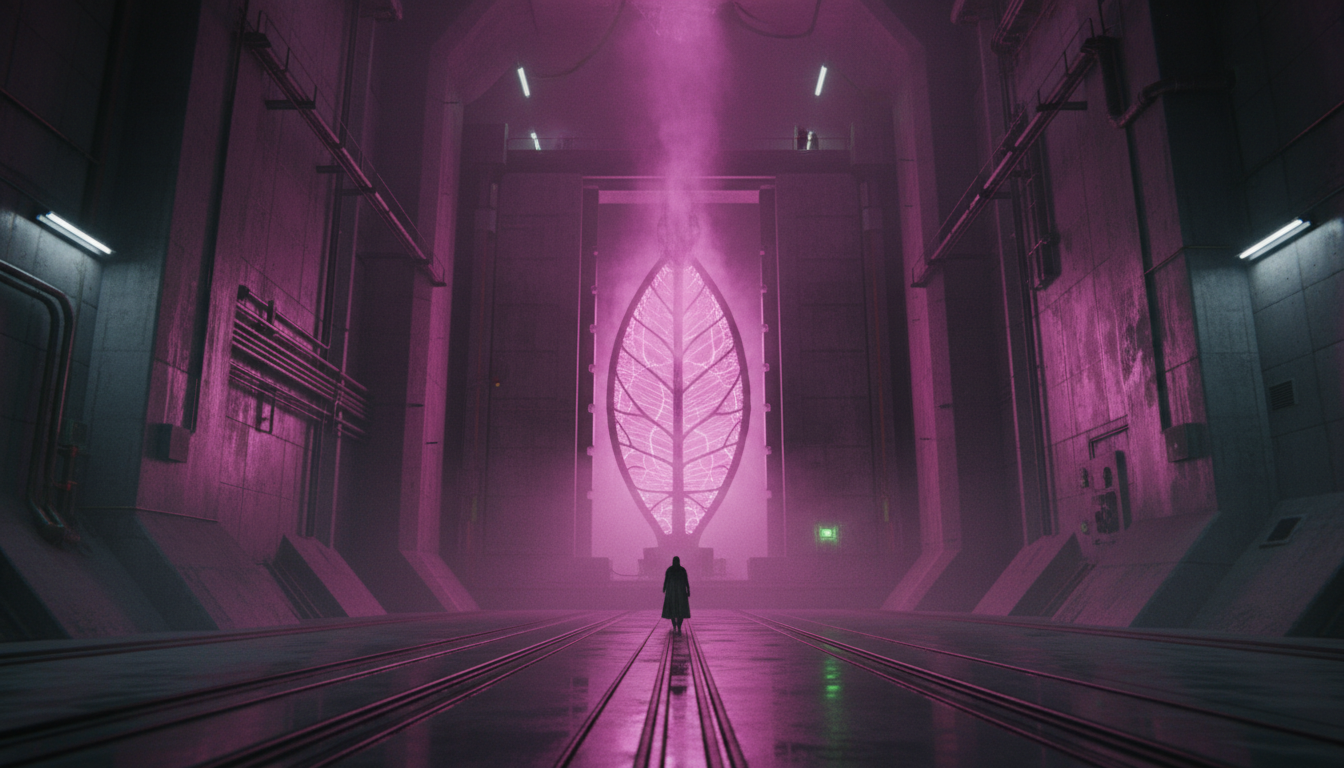
Waking Manifest · Year 40, Day 78 · Authority: standing, unsigned
Soma Barua had written the question four years earlier, in a line under a heading about atmospheric loading, and the line had gone down in the eleventh tranche and had subsequently been read exactly once. The once was Kenji Arata, on the seventy-eighth day of the fortieth year, because Sefu Adeyemi had put a rope in his hand and told him plainly that the hole in the number was his.
Forest boundary: no mechanism. Ask somebody in ten years.
It had not been ten years. It had been four. Kenji did not send her a note about the calendar. He went in.
Halima signed him for eleven hours, filtered, with Tenn, with the panic bar on the set even though the set would die — because a panic bar that does not transmit is still a thing a hand can find. She did not go. She had a clinic full of hips. She said: "If you take the element off you will write it. If you take it off for eleven minutes because Miriam did, I will strap you for the stupidity and not for the bone. The forest air is clean. The clean is the question. Do not make the question a performance."
He did not take it off at the boundary. He took it off four hundred metres in — where Laleh's set had died, where the shadows were, where the star is too hard to look at — and held the element loosely in his hand and breathed, and there was no burnt sugar whatever, and there was no particulate at all on the cheap optical, and the optical's floor was precisely the floor Halima had written in the thirty-second year. He sat down, because his knees had an opinion about a third of a gravity and about a fact at the same time.
Tenn logged: 09:40. Officer sat down. Filter off. Approximately six minutes. Did not speak. I asked if he was all right and he said he was counting.
He was counting.
Oxygen up. Methane down. Not merely a little — a hole. Exactly the same hole Halima's spectrometer had seen from orbit across four hundred and eleven thousand square kilometres, now sitting in a cylinder in his hand, now in his lung, now in a number he was going to have to carry to a sheet that already read sixteen point four and four point six as though the planet were one single room.
He put the element back on, because Halima had asked him not to make a performance of it, and because eleven minutes was Miriam's number and he would not steal it. He walked until the foliage was close enough to touch, and touched it four times, exactly the way she had, to keep establishing that it was actually there, and then he cut a piece the size of a thumbnail, which she had not done on the first day and had done later, four hundred and eleven times, and he did not apologise to the tree that was not a tree.
On the ship he sat in dome six with Miriam and a slide and a spectrograph. The leaf had no surface whatever. The pigment had no name that was not frankly a theft from an Earth eye. He wrote retinal-analogue, because he had to write something a filing system could hold, and because it was taking every wavelength, every photon, nothing rejected, nothing reflected — which she had already written down as the reason you cannot see it. He was simply writing the rest of her sentence, and the rest of her sentence was: it is eating the haze.
"Say it at me," Miriam said. There was a dead wheat on the bench between them, labelled coast, true light, expect zero, because she kept her failures where she could see them.
"The forest consumes atmospheric methane and the tholin load and vents oxygen. That is where the haze goes. Soma asked. The boundary is sharp because the consumption is complete — not lower, absent. It is an edge you can stand on because a leaf that takes everything takes the sky as far as it can reach and then stops, and I do not yet know why it stops, and I am not going to pretend the stop is something I designed. The clean air inside is not a mercy. It is an exhaust."
Miriam looked at the slide for a long time.
"So the only breathable air on this world, in the way you mean breathable, without a tax, is inside the thing that ate Laleh's radio."
"Yes."
"That is a vicious sentence."
"It is an accurate one. You can have both. Calder said that to you about a field. I am saying it about a lung."
She almost smiled, which she still did not do at slides. "Write it for Soma. She asked. She should have the answer in her own log, in her own line, under her own heading. Do not make me walk it down to First Ground. I have trays to kill."
He wrote it and took it to the air plant. Soma had a panel open and a unit off to the left doing nothing. She read the line. She did not sit down; she had sat down about gravity in the thirty-first year, and this was a different object.
"Where does the haze go," she said. It was not a question.
"Into the leaf. Out as oxygen. The hole is a process and the process is the forest. If we ever need the air to be the forest's air, we will need the forest, and if we ever hurt the forest, we will hurt the hole. I do not have a protocol for that. I have a number, and the number on the sheet is wrong if it pretends the planet is First Ground all the way over. I want to revise the sheet. Small. Honest. Sixteen point seven. Four point three, falling. That is a global figure that includes a hole I can now explain. I will not put nineteen and zero on the Manifest, because nineteen and zero are inside a place we cannot live in yet as a city, and a city in that forest is a city without radio. Sefu will not map it as a site. I agree with Sefu."
Soma wrote, under the four-year-old line, in the same notes, because the notes had come back up in a crate and she still had them: Mechanism: Arata 40. Consumption. Exhaust is the clean. Do not strike the forest. Do not pave it. Ask Calder whether a grid cares about a hole this large. Ask myself whether a plant does. Answer: yes.
She looked at him.
"Holding is not a plan. This is not a hold. This is a dependency, and I do not like dependencies I did not install. I am going to log it as a plant fact anyway, because the air plant is a city now, and the city is going to want this hole whether I like it or not."
"I need Ines to move the sheet."
"Then take her the old number and the new number and the leaf. She will not move a number for a feeling. She will move it for a leaf."
Ines moved it. She put the leaf down on the desk beside the book, which was decidedly not a filing system, and wrote sixteen point seven and four point three, falling, and she marked the old figures rather than erasing them, because the method in the front of the book says plainly to mark a wrong entry rather than correct it, and the old figures had not been wrong. They had merely been incomplete.
"Kenji," she said. "If I put falling on methane I am telling ninety-five thousand people that the air is improving. Is it."
"The hole is older than we are. The hole is not our improvement. Publishing falling is honest about a direction the forest was already going. It becomes a lie the moment they read it as our work. Put forest sink, not a programme in the fine line. If Nnamdi hates a fine line he can come and stand here and hate it in person."
Nnamdi came. He hated it thoroughly, in person. He left it standing anyway. He put Kenji's name on the descent list as seven — CLEARED, eleven hours, atmospheric medicine — because a man who had sat in a lock for three twelves and then in a forest for six minutes with the element off was a man the list already had in practice, and Ines would never keep a practice that was not also a column.
Laleh Voss read the new sheet in the clinic, where Halima had her on a follow-up that was not a hold. She looked at four point three, falling, and at Kenji's name, and said: "It was eating the air. That is why it ate the radio."
"It was eating the air," Kenji said. "The radio was in the way. You were not wrong to sit down. You were standing in a lung, and nobody had told you it was a lung. That was my job, four years late, on Soma's question, and I am sorry it arrived as a forest floor and not as a sentence in a briefing. I will put it in the briefing. I will put your name beside the sentence if you want it there, as the person who found the hole with her ear before I found it with a cylinder."
She thought about it. She was radio; she had been radio in a yard. She said: "Put the sentence. Leave my name on the list where it is. I do not want to be a hole. I want to be CLEARED. It is the only status I have ever liked."
He put the sentence in and left her name on it. Then he went to the glass in gallery eight, which was still Ines's window, and looked out at a disc that was violet at the limb where the haze stacks and dark across a patch the size of a subcontinent where it does not, and he knew exactly what the dark was now, and knowing it did not make it a door, and he wrote that down too, and marked it, and did not correct it.
Halima had come up behind him without asking. "The tax is still the tax outside it," she said. "Do not get religious about a leaf."
"I wasn't going to."
"You were, a little. I have seen it. Miriam sat down for an hour. You sat down for six minutes. The sitting is the religion. The cylinder is the work. Keep the cylinder."
He kept the cylinder. The Manifest read seven, sixteen point seven, four point three falling, held zero. The occupancy did not move at all. The wheat stayed obstinately at zero. The forest stayed a wall that happened to be alive, and the only untaxed air on the entire planet was inside it — which was, once again, the worst possible answer.
He had been woken six months before the last door specifically to finish Halima's four pages, and he was beginning to understand properly that finishing them was a job you did by finding worse answers that were still true. He did that for another fifty-one years. The four pages are nine pages now, and every one of the five he added is a worse answer than the one before it, and not one of them has ever been overturned.
Chapter 11 — Basalt
↑ Back to ContentsFocus: the planet has already poured a grid. lrc becomes possible in a tent, as a rock, not a programme.
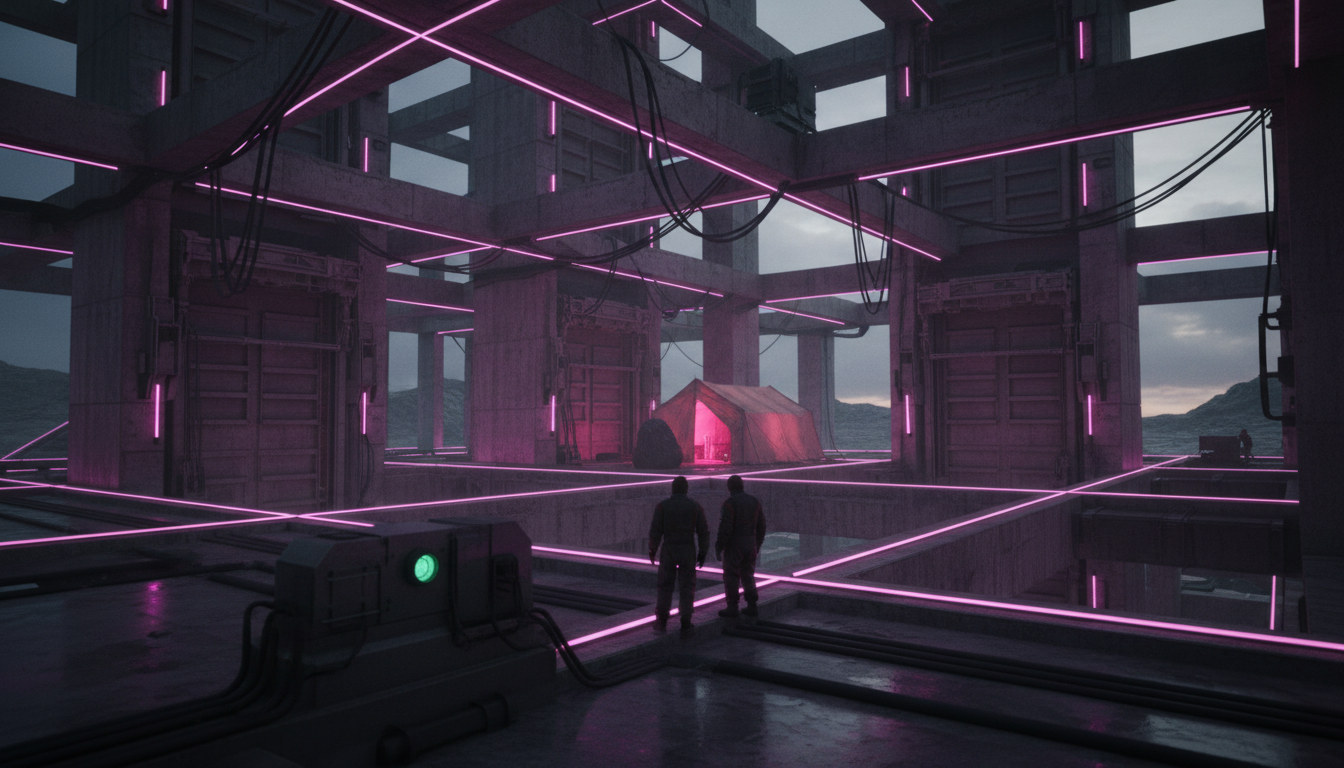
The cores came up from the forest transect in a crate Tenn logged carefully as rocks, officer Haddad, not plants, and Soma Barua put them down on the bench in the fabrication tent at First Ground and saw the hexagons, and the hexagons were exactly the same shape as a salar crust she had never once stood on, and she sat down, which she did not often do at rocks.
Columnar basalt, iron-rich, with magnetite in the seams — enough that a cheap compass, which she had, and had carried since a yard where compasses were frankly a joke, tugged visibly. She tapped two columns together and the tap went along the row considerably further than a tap has any business going, and she tapped again, and she did not yet write almost lossless, because almost lossless is precisely the sort of sentence you check with a meter. She had a meter. She checked it carefully. Then she wrote it.
Ovid Tenn, in the tent door: "Is that good."
"It is a grid that is already poured," Soma said. "I have been trying to work out how to put a conductive network under a city we have not built. The planet has been a conductive network since it cooled. Haddad — how far did you follow it."
Yara Haddad was cores. She had been in the forest on the rope and she had not sat down. She said: "As far as the eleven minutes. Same columns, same seams. I can follow it out of the boundary if you want a line that is not a forest line. I would like a day that is not a forest day."
"Take Tenn. Take the meter. Do not take Voss until Halima says so. I want to know whether this is a patch or a country."
It was a country.
Three days of ship's calendar, which was not a world-day and which she pointedly refused to confuse, and Haddad came back with a line running from the forest edge toward the coastal flats Nnamdi had pinned on the wall — not all the way, not yet — with a depth she simply could not finish and a bearing that made Soma fetch a second crate, a second compass, and a piece of paper that was decidedly not a works order.
She went up to the ship, and then to the yard. Calder was there, making something she did not ask about, with units standing at the wall doing nothing at all. She put a core down on the bench beside his hands and deliberately did not say his name, because she never did when the work would do it for her.
"Listen to it," she said.
He picked it up and tapped it, and he wore the face he always wore when a machine had already done a job he was about to assign. He set the core down and put his palm flat on it, which was plainly not measurement, and which she allowed, because she had herself put a palm on a membrane that had browned and that had not been measurement either.
"How far."
"Far. Contiguous enough to be a problem if I ignore it and a solution if I do not. Magnetite in the seams. Almost lossless along the column. I can land a current at First Ground and take it out at the coast if the line holds, and I do not know whether the line holds under the wet, and Haddad is going to tell me. I am telling you now because this is the thing your resonance work has been waiting for, and I will not have you find it in a log in six months and think I was hiding a rock."
He looked at her. He did not ask how she knew what he had been waiting for. She had kept his cells and his frames for years; she had watched him thin a tray on the night the ship was decided. She knew perfectly well what he made. She did not know why he made some of it, and she was certainly not going to ask why in a yard.
"LRC," she said, because a thing needs a name a filing system can hold. "Load-bearing, resonant, conductive. I will write the letters before I write the words. The words will make Nnamdi put it in a notice. The letters will let me build it. I need you not to take it off me. It is a plant fact. It is a rock. I am the rock, this year."
"I will not take it off you."
"If it sings, later, that is you. If it carries, now, that is me. I want that division in a log Ines will copy, because in ninety years somebody is going to say the Founder poured a grid — and he did not, and the planet poured it, and I noticed, and noticing is not pouring."
He nodded and went back to the thing he had been making. The division held, permanently. On Aura-36 today the grid is called the LRC and not by any person's name, and the reason is simply a woman standing in a yard insisting on a distinction ninety years before anybody would have needed her to.
She wrote the log in the tent that night — First Ground, cells running, membrane line at one in eighty, still a rush job, still a production.
Kenji came down on the morning return with a cylinder and a hip Halima had strapped anyway, because a spectrograph on a pad-trial is still a body. He looked at the cores as though they were an atmosphere.
"Does it eat methane."
"It is a rock."
"I have a leaf that eats methane. I would like to know whether I also have a rock that does. If I do, my sheet moves again. If I do not, my sheet stays, and your grid is a grid and not a lung. I would prefer a grid. I have enough lungs."
She let him put the meter on a seam. The meter did not give him a lung; it gave him a current that wanted to go sideways for ever. He wrote not a sink on the crate, which was easily the best present anybody had given her that year, and she left it there.
Nnamdi wanted the letters explained in a room that was not a tent. She gave him four minutes in the transfer gallery, with Ines listening, because Ines listened to four minutes whether you asked her to or not.
"L is load. The columns will hold a city if we do not lie about the wet. R is resonant — that is not my word; it is a word I am lending to a man who will do something with it I am not going to specify. C is conductive, and that one is mine. I can run a current along a thing the planet already poured. I cannot run a current along a wish. The wish is the city. The rock is the rock. Do not put LRC on the gallery wall. Put it in a works order when I have a pad that is not a sponge. Until then it is a crate of hexagons and a compass that tugs."
"If I do not name it," Nnamdi said, "somebody else will, and they will name it after him."
"Then name it after the rock. Basalt does not have a founder. I checked."
Ines wrote LRC: rock, not a person. Barua. Marked. Eleven seconds. She did not look at Soma while she did it, which Soma put down as manners.
Columnar basalt, iron, magnetite seams, almost lossless along column. Contiguous on present transect toward coastal flats, not proven under wet. LRC possible. Not a programme. A rock. Barua. Calder informed, yard, same day. Division: carry mine, song his, if any. Do not put song in the notice. Arata: not a methane sink. Okonjo: do not pin hexagons. Ferrer: not a person.
Ines copied the division. She asked, because it was her job, whether LRC was a door.
"It is a floor," Soma said. "A floor you can run a current through. It is not a reason to open a list. It is the reason the list, when it opens, will have lights. I would like the lights. I will not trade a hip or a wheat or a day of air for them. Kenji's hole and my rock are both the planet doing the work. Miriam's pond is the same. We keep arriving with machines for jobs the ground has already filled. I am trying to be glad. Glad is not a plant setting. I am logging the rock instead."
Nnamdi wanted a sentence, and she gave him one: bedrock will take a grid. Grid is not a city. City still wants the coast, the pad, the hip, the wheat, the filter. Do not pin a hexagon on the gallery wall. People will think it is a room.
He did not pin it. He put it instead into the clinic copies with the rest of the not-doors. Sefu came to the tent with another crate and a map with a line on it that made Soma's compass look positively modest, and said: "If you build on this you will be building on a drum. I do not know whether a drum is a foundation. I know it is not silent. The forest ate the sound above; this will carry it below. Somebody who likes a song is going to like this a great deal more than I do. I am survey. I am giving you a line. I am not giving you a concert."
"Good," Soma said. "I do not want a concert. I want a current that does not die at four hundred metres. The forest kills a radio; this rock may keep a grid. That is a joke the planet is playing, and I am going to take it seriously, which is how you take jokes made of magnetite."
Haddad, from the bench, not looking up: "Do I keep coring."
"Until the wet. Then we find out whether a sponge sits on a drum. If it does, Nnamdi gets his shore and I get my pad and Kenji gets a number that does not move, because a rock does not eat methane. If it does not, we are back to First Ground and a factory that will never become a country. I would like the sponge on the drum. I will not lie about the meter to get it."
She asked the unit, at last, to carry the first crate to the lander, and it did, and she watched it go. She put her palm on the second core exactly the way Calder had, which was not measurement, and the spin-wrongness that had stopped in the thirty-seventh year stayed stopped, and the rock was warm from the tent and not from a current, not yet, and she logged the warmth simply as warmth and did not correct it, and she carefully did not write the word grid in any way a child from district two hundred and nine could possibly read as a when.
That night, on the plant channel, which anybody could read, she posted four lines and firmly not a fifth. Holding was not a plan. A rock was not a hold. A rock was a rock. She went to sleep in a lander bunk at a third of her weight with a compass on the crate that still tugged, very slightly, toward a forest that ate sound and a coast that would one day eat a crane, and she did not dream about a grid, because she did not dream, and because a grid that is already poured does not need a dreamer. It needs a meter. She had one, and it was still on the bench when she woke, pointing exactly the same way.
Chapter 12 — The Two Moons
↑ Back to ContentsFocus: a crane is lost to a second beat. the two-beat enters the language in its first week.
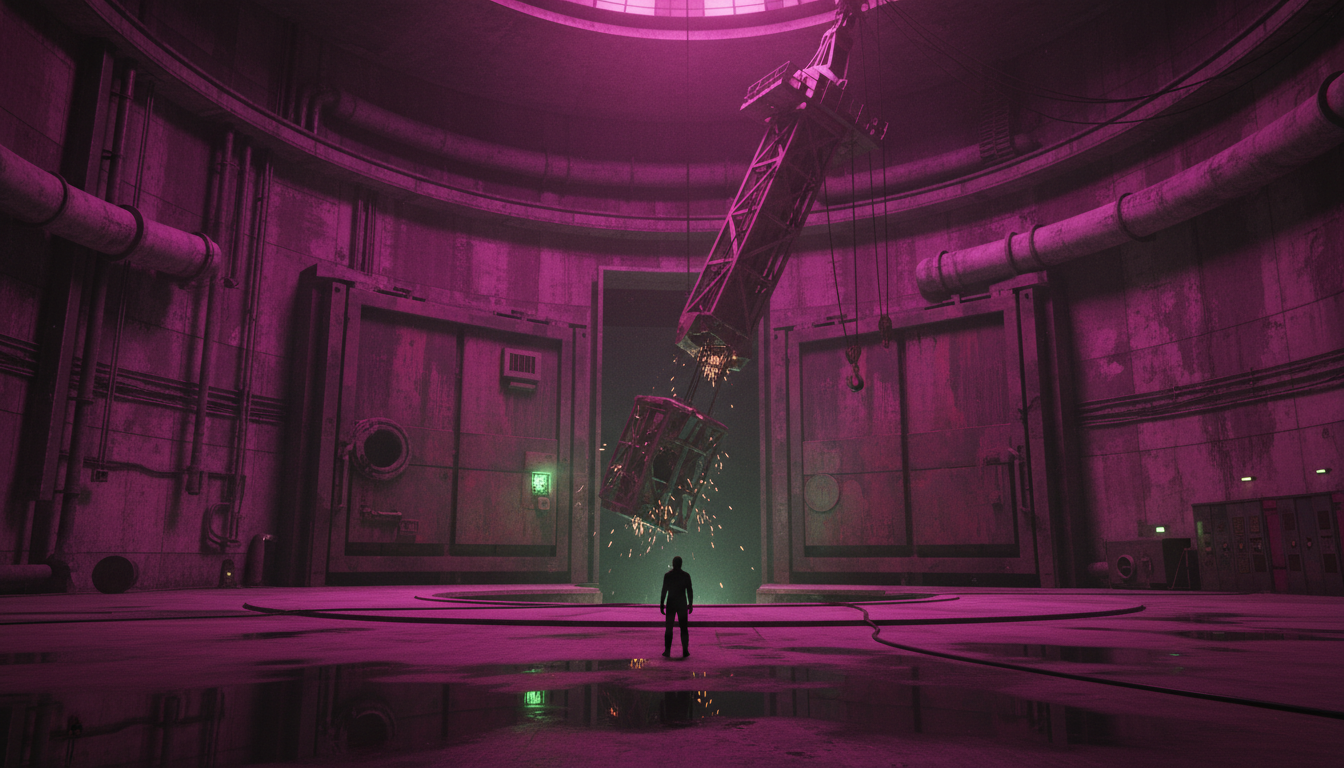
Dov Lindqvist lost a crane to a tide nobody had a name for. That is the chapter, and the rest of it is the naming, which he would not do, and which the dockhands did inside a week, because dockhands will not work a water they cannot swear at.
The moons had been in the survey all along. Aiyana Roux saw them cross the primary in the thirty-fifth year, wrote event as predicted, and went to bed. Nnamdi had duly put two moons on page two of the notices, in plain language, under the day and above the filter. Item nineteen of the first descent — Dov's own, four years earlier — recorded a two-count periodicity, planet-wide as far as three sites could reasonably say, long beat and short beat, amplitude four orders below structural, logged flatly as present, unexplained, no structural implication. Aiyana had exactly the same beat in reflectance in the thirty-first year. Nobody had ever once put the two entries side by side. Nobody at all had put either of them next to a crane.
The crane was Soma's, on loan to the coast for a pad-trial — not a cell, merely a thing to set down and pick up a bearing plate Haddad needed in the wet. Dov went because it was a safety function. Ovid Tenn went because Dov went. Sefu went because the wet was his line. They had a world-day of light left, eighteen hours, and they used eleven of them on the plate, and the water came in at hour twelve of the light, which was not a sea coming in but simply the flats remembering that they are an ocean, and the crane was still standing in the remembering when the second beat arrived.
The first beat had been entirely ordinary. A rise, a push, the wetland doing precisely what Nnamdi had pinned on the wall. Tenn logged the hour. The second beat was not ordinary at all. It came inside the first — a shorter, harder lift, as though the water had a second heart — and the crane, which had been standing in a third of a gravity as though a third were a kindness, went over with a slowness that was frankly insulting. Dov, who always asks one more question than there is room for, simply did not have time to ask this one. The crane lay in the magenta and the magenta went over it, and then the first beat finished, and the second finished, and the flats were a floor again, and the crane was a fact that was no longer a crane.
Nobody drowned. At nought point three eight a man can walk out of a wetland that has just remembered itself, provided he does not panic, and Dov did not panic, and Tenn did not panic, and Sefu panicked about the line, which was properly his job, and not about the water, which was a different job entirely. They walked out. They stood on the dry. They looked at a boom lying in a pond that had learned a star.
"Item nineteen," Dov said.
Sefu: "Say it."
"Two moons. Two beats. I logged the ground as a drum that did not matter. The water is the drum. The amplitude was four orders below structural when the drum was rock; the drum is not rock when it is this wet. I am going to write that I was wrong. I am not going to write that the survey was wrong. The survey had the moons. I had the beat. I did not put them on the same page as a crane."
Tenn logged: 16:10. Crane down. Officer said item nineteen. Nobody in the water more than four minutes. All up. Plate not recovered.
On the ship Dov went to Ines first, because a lost crane is a works fact, and a works fact that is also a safety fact belongs in the book well before it belongs in a notice. He stood at the desk with his element still on, cheek-mounted, which Halima would certainly have approved of had she been there, and said: "I need a word. I will not invent one. If I invent one it will be a door. I want a description."
Ines waited. She had a list of seven names and a methane fraction that was falling for a reason that was a leaf. She had room for a crane.
"Twin tide. Two beats. The second is the one that spends equipment. First Ground never saw it because First Ground is not wet. The coast is wet. Nnamdi's shore is this. I am not withdrawing the shore. I am withdrawing the assumption that a tide on a world with two moons is a tide you can count on one hand. I was the first person on that ground. I said the surface was safe to occupy. It is. It is not safe to leave a crane on. Both of those are true."
She wrote: Day 88, year 40. Coastal flats. Crane lost to a second beat. Lindqvist: twin tide, not a withdrawal of the site. Marked. Not corrected. Word not invented here.
The word arrived anyway, and it arrived from below, which is the only reason it survived.
It came from the cadre on the next pad-trial, six days later — a different crane, Dov standing on the dry with a clock and a slate and the two moon-rises written out in a hand that was not pretty — and specifically from a woman on the bearing team named Kesi Owusu, cadre, berth 40,218, who had been a dockhand on Earth, and who watched the second beat lift a plate and set it down a metre to the left, quite gently, as though the water were making a point, and who said, very loudly, in the burnt-sugar air: "That's the two-beat. You don't work the two-beat. You wait it."
Tenn logged the sentence, because he always logged sentences when officers did not tell him not to. Dov asked her eleven questions about docks and precisely one about whether she wanted her name on the notice, and she said she wanted the sentence on the notice and her name in the cadre list where it already was — which is exactly the answer Laleh Voss had given a sheet — and he wrote it that way, because a safety function that steals a dockhand's mouth is not really a safety function.
By the end of the week it was on the plant channel. By the end of the fortnight it was in Nnamdi's mouth, which he thoroughly disliked, and in a notice, which he disliked considerably more, and which he wrote anyway, because a word a dockhand will actually use is a word a hundred thousand people are going to need, and he was not going to have them learn it from a crane.
Coastal rota: do not work the second beat. The second beat is the Two-Beat. Interval from first lift to second lift varies with the moons; Lindqvist to post a clock until a table exists. First Ground not affected. Forest not affected. This is a wet fact. Okonjo, N., after Lindqvist, D., after Owusu, K., whose sentence is now the rule.
It is still the rule. Kesi Owusu never held an office of any kind, and her sentence is on every coastal works board on that planet, unaltered, and there is a bar in Aura-Marina named for the second half of it.
Dov posted the clock. He posted it badly at first, because two moons are a mathematics he had to sit with for three twelves, which is a day of that world, and Halima made him eat, and Kenji sat with him in the clinic, because a safety officer doing orbital mechanics in a medical bay is a man who will not sleep, and Kenji knew a great deal about not sleeping.
"Eighteen hours of light," Kenji said. "Two moons. You are allowed to hate the arithmetic. You are not allowed to do it unfiltered in a lock. We have had that week."
"I am not sitting in a lock. I am sitting in a mistake."
"Item nineteen said no structural implication. The crane was not structure; the crane was a thing we put down on a drum. You logged the drum, and you logged it as quiet, and the quiet was true for rock. Write the wet as an amendment. Do not write it as a confession. I have watched Ines mark a wrong entry. This is that. The entry was not wrong. It was dry."
Dov asked him eleven questions about the lock day and one about whether the cadre briefing had covered tides, which it emphatically had not, and he wrote that down. Then he went to Renata Oyelaran, because a rule telling a person not to work a beat is a rule that will inevitably be broken by somebody who thinks they can see it coming, and he wanted a person who wrote law to tell him whether a dockhand's sentence could honestly be an instrument.
Renata read Nnamdi's notice. She was seventy-something. She had written the Iron Protocol and she had lost arguments on purpose, and she said: "Leave it in their mouth. If I put it into four pages it will take eighteen months, and a crane is already in the pond. A sentence that can be shouted across wet ground is a better instrument than a clause. I will not decorate it and I will not put a penalty on it. The penalty is the crane. People will remember the crane a great deal longer than they will remember me."
He left it in their mouth. That is one of perhaps four occasions in the founding on which somebody who could have written a law declined to, on the grounds that the language had already done it better, and it is the only one of the four that everybody agrees worked.
On the eighth day after the loss he stood on the dry at the flats with Tenn and watched the Two-Beat go through an empty pad — lift nothing, set nothing down, and go out again — and the magenta learned the shape of it and promptly forgot. He sat down facing north for about four minutes, which Tenn logged, and got up unassisted. He asked Tenn whether the cadre briefing had covered filter element life, which it had, this time, because Dov had written it in himself. Then he asked one more question, which was whether Tenn had a better word than Two-Beat, and Tenn said no, and Dov said good.
They went up on the return. The Manifest did not move, because a crane is not a person and a tide is not a methane fraction. The list still had seven names. The occupancy still had a city in a hull. And the moons went on crossing, whether anybody had a table for them yet or not.
Chapter 13 — The Shuttles Are Finite
↑ Back to ContentsFocus: eleven hulls, unreplaceable. every seat is a ranked decision, weekly, forever.
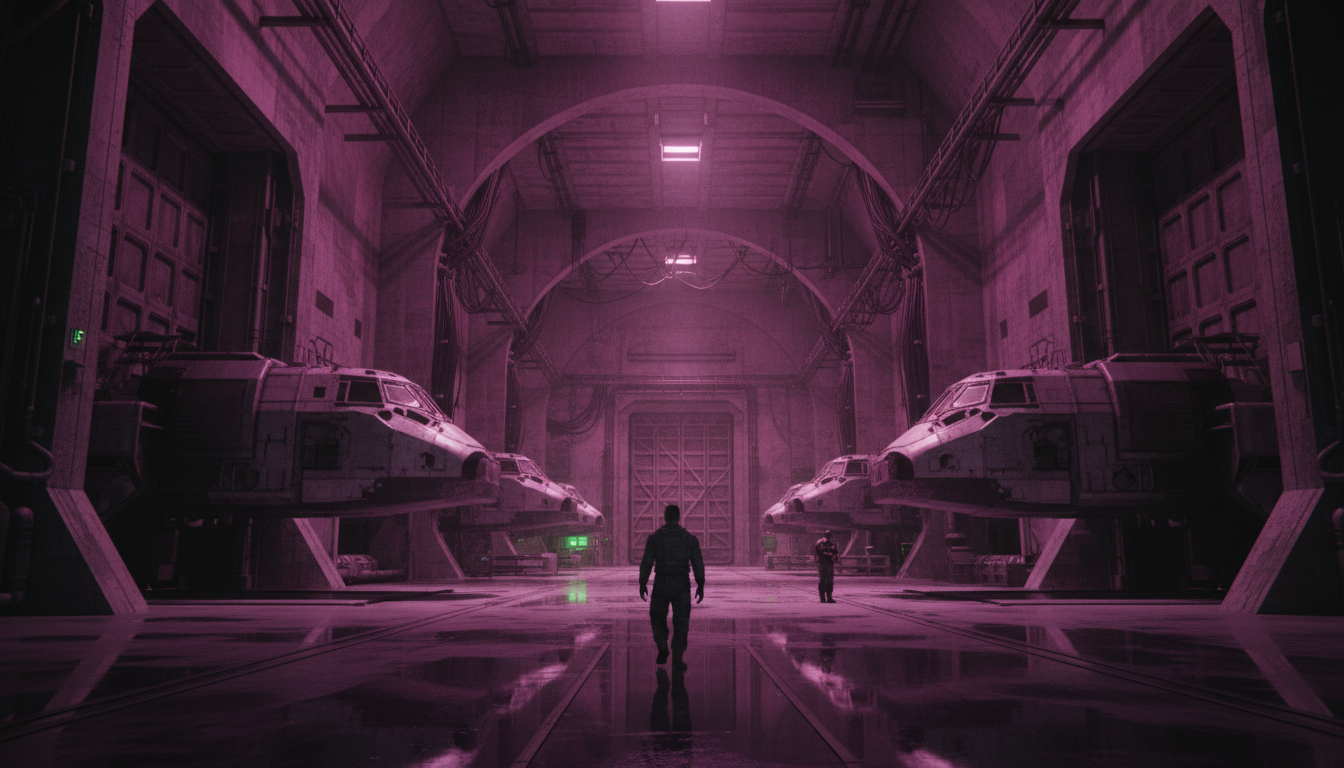
There were fourteen hulls that could still make the run, and eleven of those were rated for people, and not a single one of them could ever be replaced — and Nnamdi Okonjo put that on a slate in the transfer gallery on the hundred and first day of the fortieth year exactly as though it were a district notice, because a district notice was the only form he trusted not to turn quietly into a speech.
Surface-to-orbit capacity: fourteen vehicles. Eleven passenger-rated. Three cargo-only after the pad-trial losses. No hull in this system can make another. Every seat is a ranked decision. This is not a descent list. This is why a descent list, when it is written, will be a ranking. Okonjo, N.
Soma Barua had given him the fourteen. She had walked him to lander bay one and lander bay two and the three that live in the unspun spine because they do not like spin, and she had not wasted a sentence on hope.
"I can keep them flying," she said. "I cannot have them. Having them was a yard, and the yard is six billion miles behind us and eight years of signal away, and it is not going to send a fifteenth. If you spend one on a stupid run I will log the spend and I will not replace it. If you ask me to land ninety-five thousand people I will ask you which eleven thousand you meant — because that is a year of the eleven, full, every seat, no cargo, and then I have no vehicles for the cells or the sick or the thing we have not thought of, and Miriam has nineteen pages about the thing we have not thought of, and I have read them."
"How many seats."
"Forty a vehicle if Halima lets me stack them, which she will not, because a stack at a third of a gravity is still a stack of hips. Twenty-eight if we do it as a clinic. I will not sign forty. I will sign twenty-eight and a strap roster at the far end. That is three hundred and eight people on a full run of the eleven, if the eleven are all up — which they will not be, because two of them are on the cells and one of them is the crane we do not have any more."
He did the arithmetic openly in front of her, because he had learned painfully not to do it later, alone, in a corridor. Three hundred and eight, once. Then the vehicles have to come back. Turnaround, Soma said, is a day of that world if the pad is a pad, and the pad was still frankly a sponge, and a sponge adds a twelve. Call it two world-days per round trip if nobody breaks anything. Ninety-five thousand divided by three hundred and eight is not a year; it is a number he was not going to put on a wall.
"The Keel was this," he said. "Mass. Who goes, who does not, a ranking that pretended to be physics. I wrote coastal intake forty-one times so that a ranking would feel like an invitation. This is not an invitation. This is eleven hulls and a shore that eats cranes."
"Then do not write it as an invitation."
He took the slate to Ines. She read it. She did not sit down. The Manifest still had seven names; the occupancy still had a city.
"I can write a list," she said. "I have written lists. I will not write this one until you tell me the seats for the week — not the seats in the abstract. A ranking without a number of chairs is a wish. I do not keep wishes. I keep columns."
"I am telling you the chairs are the whole of the problem."
"Then the list will be weekly, and it will be short, and it will make people hate me, and I have been hated for lists before and I will be hated again, and I would like that in the book now, before the first week, so that nobody can say afterwards that I did not know."
He wrote it in the book himself, in eleven seconds, because it was his constraint and not hers: seats finite, unreplaceable, weekly ranking. Ferrer to hold the list when there is a week. Marked.
Halima found them, because the clinic copies had begun to include Nnamdi's slates whether she asked for them or not. She had a strap on a crate and eleven people waiting, which was not a metaphor.
"Children," she said.
"Not on the eleven," Nnamdi said.
"Not on the eleven, not on the three, not in a cargo net, not because a parent cried in a gallery. I will scan every adult you rank. If the scan has moved they get the strap and they go later, or they do not go. I am not opening a hip on a sponge because a vehicle had a spare seat. Dov will want a safety seat on every run; he can have one. That is twenty-seven left. Soma wants the membrane line fed. Miriam wants trays. Kenji wants a lock on the ground that is not a box on a ship. You are going to rank those against each other every week for the rest of your life, and I would like you to know that before you pin another map."
"I know."
"You knew about the day on page two. Knowing is not ranking."
A man from district eighty came to the gallery that afternoon with a slip saying he was a welder, and a child who was still seven, and a sentence about the poster. Nnamdi stood under the finite-slate and did the thing he had promised himself he would do, which was to say the number out loud, plainly, to a person it was going to hurt.
"Fourteen vehicles. Eleven with seats. No more will be made. A full run of the eleven, if Halima lets us fill them, is three hundred and eight people, once — and then they have to come back for the next three hundred, and the next, and the wheat is zero, and the air is a tax, and the forest eats radios. I am not putting your son on a list this year. I can put your trade on a ranking when Ines opens one. A ranking is not a promise. I am sorry that is the sentence. It is the only one that is not a poster."
The man looked at the slate the way people looked at 95,441. He did not shout. That was still a theme. He took the child and went to find a compartment that was not a world.
Dov came at sixteen hundred with a tracker slate and eleven questions, which Nnamdi had budgeted for.
"If a vehicle fails on the ground," Dov said, "do we have a spare run to fetch it, or do we have thirteen."
"We have thirteen, and then we have a ranking that has just got worse. I want that in the safety brief in those words. Do not write contingency as though a yard were coming."
"Who ranks a medical evacuation against a membrane crate."
"Ines, when she has a week. Until she has a week, me, in this gallery, in public, so that the hate has somewhere to stand. I will not do it in a room with nine chairs. I did the Keel in rooms. The Keel produced a ship. This will produce a queue that does not end, and queues that do not end have to be visible or they turn into a story about who was liked."
Dov wrote that down. He asked one more question, which was whether the cadre briefing had covered the finite number, which it had not, and Nnamdi said put it in tonight, and Dov did.
Soma sent a runner from First Ground: two of the eleven were down for a seal, four days, not a disaster, merely a seal. Nnamdi changed fourteen to a working nine on the slate by striking it rather than erasing it, because Ines's method had got thoroughly into his hand by then. The gallery watched him strike it. The woman from district two hundred and nine, the one with the child, stood there long enough to see the nine and then left without asking anything — which he privately put down as the first time the finite had done any work at all.
That night he sat in district four hundred and two and tried to write the ranking rule before Ines had to. He wrote four drafts. The first was kind and was straightforwardly a lie. The second was the Keel copied small, and was a cruelty he recognised immediately. The third was Soma's seats and Halima's scans and Dov's spare and Miriam's trays stacked together, and it read exactly like a machine. The fourth was one page.
Weekly. Seats as Barua certifies them that week, not in the abstract. Sow: no children, no unscanned hips. Lindqvist: one safety seat per vehicle. Remaining seats ranked by function the surface cannot do without for seven days: air, filter, pad, clinic, water, food, survey — in that order, because that is the order things kill you. Names from Ferrer. Hate in the gallery. No appeals to me. I am not a door. Okonjo.
That page is the direct ancestor of the exemption schedule, and of the shift-swap ledger, and of every rationing instrument on Aura-36, and it was written in one night by a man who had spent forty years writing invitations and had run out.
He took it to Renata, because a ranking that runs for ever is a kind of law whether you call it one or not.
She read it. She did not decorate it. She said: "The Keel was a mass budget pretending to be physics. This is physics pretending to be a mass budget. People will forgive physics for longer. Do not put my name on it. Put Ines's, when she takes the list. She is already that person. The rest of you have been handing her lists since a salar. This is only the first time the list is a planet."
He went back to Ines in the morning and put the fourth draft on the desk and did not ask her to like it.
"I will take the week," she said, "when you have a week. Not before. A list that exists without seats is how we got a published complement that still reads ten. I have that lesson. I will not learn it twice."
"The week is going to be ugly."
"Lists are ugly. Occupancy is ugly. The Manifest is ugly. I am eighty-one. Ugliness is a column. Bring me the seats."
He brought her the seats on the next return: nine vehicles up, twenty-eight each, one safety spare, Halima's scans in a crate — two hundred and forty-three chairs for a week, if they flew the nine until they broke. He deliberately did not fly them all. He flew four, because Soma would not strip First Ground, and four times twenty-seven is a hundred and eight, and a hundred and eight was the first week. Ines looked at a hundred and eight exactly the way she might look at a berth number and said: "All right. That is a week. I will make a list for a week. I will not make a list for a world."
He pinned the finite-slate up beside the coastal map and the Manifest. Fourteen. Eleven. Nine working. A hundred and eight this week. Zero children. The occupancy did not move. The seven names did not move. People stood under the nine and did arithmetic exactly the way they had stood under 95,441, and the arithmetic did not let them out, and Nnamdi Okonjo, who had once sold a voyage with four hundred and eleven invitations, stood under a number that was the precise opposite of an invitation and did not look away — because looking away is how a ranking quietly becomes a story about who was liked.
Chapter 14 — Who Goes Down First
↑ Back to ContentsFocus: she builds the descent list and recognises she is the person they hand this to.
Waking Manifest · Year 40, Day 108 · Authority: standing, unsigned
They asked Ines Ferrer to build the list. She had done this before — the before was a salar, and a mass budget, and a line of stakes that stubbornly did not curve — and she sat at the desk in the transfer gallery with Nnamdi's hundred and eight seats and Halima's scans and Soma's four vehicles, and understood, not as a feeling but plainly as a column, that they were always going to ask her.
It was not an accident of circumstance any more. Circumstance was year four, a Tuesday, a harvest split in four minutes. This was a planet. They had a clerk. The clerk had a book. The book is where a ranking goes when a ranking has to be true in public.
Adaeze Nwosu stood at the other side of the desk with the second volume and did not pretend this was a heading.
"You don't have to," Adaeze said.
"I do. If I do not, Nnamdi will do it in the gallery and it will be a notice, and a notice can be argued with. A list in this book cannot. That is why they brought it here. I am not going to perform surprise."
She wrote the rule at the top of the page, Nnamdi's fourth draft in her hand, shortened:
Weekly. Seats as certified. No children. Scanned hips. One safety spare per vehicle. Rank: air, filter, pad, clinic, water, food, survey. Hate in the gallery. No appeal to the clerk. The clerk is a column.
Then she asked for names.
Soma sent nineteen, membrane and pad. Halima sent eight, clinic, scanned, strapped where the density had moved. Miriam sent four for trays she fully expected to kill, and a fifth she crossed out herself because the fifth had a child and Miriam would not be the person who put a child on a sponge. Dov sent himself and Tenn and Owusu, whose sentence was already a rule. Kenji sent himself and a lock crate. Sefu sent Cole and Haddad and pointedly not Voss — because Voss had asked to be CLEARED and had not asked to go back in yet, and Sefu would not rank a radio against a person's ear.
That was thirty-nine. The week had a hundred and eight chairs and four vehicles. Ines did not fill a hundred and eight. Filling a hundred and eight would have been purely a gesture. She filled fifty-seven, because fifty-seven was what the functions could actually stand on a sponge for seven days without becoming a camp that thought it was a city, and because Nnamdi's ranking said seven days, and because she had learned on a salar that a line of stakes is only a line of stakes and not a town.
The rest of the names she simply did not write. People came to the desk with trades and with slips and with children. She said the rule, and the week, and that the fifty-seven were the fifty-seven. A welder from district eighty asked who he took it to. She gave him the Open Accord and the ranking and the gallery and Nnamdi, and she deliberately did not give him a later, because a later is a when, and she had no when.
Halima sat with her over the clinic eight. They went down the scans and Halima took two of the eight off the page herself.
"Hips," Halima said. "I will not argue with you about a membrane tech. I will argue with you about a femur. These two stay up — strap, four twelves, then we talk. If you put them on the sponge this week I will put my name next to the injury and I will not be kind in the note."
Ines took them off. She marked the taking-off. She did not call it HELD; HELD was a column she was not going to invent for a femur. They were simply not this week.
Miriam came up with the four and the crossed-out fifth, and put the fifth's slip on the desk anyway, face down, so that Ines would have to turn it over.
"She has a child," Miriam said. "I will not rank a tray against a child. I also will not lie to her that the tray is why. Tell her the rule. If I tell her the rule she will hear it as agronomy being kind, and agronomy is not kind this year. Agronomy is zero."
Ines turned the slip. She knew the name from occupancy, which is how she knew most names. She sent for the woman, and the woman came without the child, which was already a sentence, and stood the way people stood under 95,441.
"Not this week," Ines said. "Not because of the tray. Because of the child. The ranking does not take children. I am not going to give you a later; a later is a when. I can give you the rule in writing if you want it in writing."
The woman wanted it in writing. Ines wrote it. The woman put the paper in her pocket as though a pocket could be a door. Miriam did not watch her leave. Miriam watched Ines, and Ines did not perform the watching back.
Dov brought the safety-seat arithmetic in person, because he did not trust a runner with a number that made a ranking worse on purpose.
"Four vehicles is a hundred and eight after the spare," he said. "I want the four empties empty when the vehicle leaves and empty in the book — not as a rumour a pad can spend. If you fill a safety seat with a welder because a welder cried in the gallery, we will have thirteen hulls the first time a seal fails, and then the ranking will be a different hate and I will have asked the question too late."
Ines wrote Lindqvist, spare, not a person against the four chairs the week had already refused to count — which Adaeze said looked like a cruelty, and which Ines said was the only kindness those chairs were going to get.
The gallery filled at eleven, ship's clocks, because Nnamdi had said flatly that hate must have a place to stand and eleven was when the districts could stand. Ines did not go down to it. She could hear it through the deck, which is a design fault of a transfer ring built for sleepers and now containing a city shouting at a list. Adaeze went down with a copy of the fifty-seven and came back with dust on the paper that was not actually dust; it was hands.
"They want the hundred and eight," Adaeze said. "They want to know who the fifty-seven are to you. A man from eighty asked whether you were paid. I told him you were a column. He did not like the column."
"Good. If they like the column we have already failed. Pin the functions next to the names — air, filter, pad, clinic, water, food, survey. If they are going to hate a person they can hate a function first. Functions survive a week. I may not."
Adaeze pinned them. The shouting changed key and did not stop. Ines sat with the scans and the four blank chairs and did not go down to the bay, because a clerk at a bay is a performance, and she had done performances on a salar and they had not made the ranking any truer.
Nnamdi stood at the desk the way he stood under slates.
"You could have filled the chairs," he said.
"I could have. Then I would have a camp, and a camp is what Soma said a colony becomes if it arrives before its tooling. We have tooling at First Ground, a sponge at the coast, a forest that eats radios, and a wheat that is zero. Fifty-seven is a rota. A hundred and eight is a town that will ask me for a school. I do not have a school. I have a week."
"They will say you liked the fifty-seven."
"They will. The ranking is on the page. The functions are on the page. The scans are on the page. If I am liking people, I am doing it in a way that can be checked. That is the only kind of liking I will sign."
She put Adaeze on the list, because the surface was going to need a copy of the book, and because Adaeze had asked once, in a sentence that was carefully not a plea, whether a record that exists only in a hull is really a record, and because Ines was eighty-one, and a fall on a sponge would close the book, and the book was not allowed to close.
"You hate this," Adaeze said, when she saw her own name.
"I hate that I am good at it. That is a different hate. Pack for a week. Halima will scan you this afternoon. If your hip has moved you will hate me from ring two instead, which I will accept."
Adaeze's hip had not moved. Halima signed her with a look that said: I know why she is on this list, and I am not going to say so in the clinic.
Adaeze packed in the records annex exactly the way she copied — without once asking whether the annex would still be an annex when she came back. She took the second volume, a spare stylus, three days of ship-bread Miriam had already called a stretch, and the filter Soma had fitted to her own face and then taken off and handed over without a single sentence. Ines stood in the door and deliberately did not help, because helping would have been a goodbye, and a goodbye is a when.
"If the book goes into the wet," Ines said, "you will still have the names in your head and I will still have the names here. That is not a comfort. That is a duplication. I would like you to treat it as a duplication and not as a trust."
"I am going because the surface needs a copy," Adaeze said. "I am also going because you are eighty-one and you will not put yourself on a sponge, and somebody has to be the hand if the other hand closes. That is a trust. You can mark it. I am not going to un-say it."
Ines marked it. She did not correct it. She went back to the fifty-seven before she could write Adaeze's name a second time, which would have been a liking she had already refused to sign.
The four vehicles left at four in the morning, ship's clocks, lighting trial down, planet in broad daylight. Ines did not go to the bay; she had gone to bays. She sat at the desk instead and copied fifty-seven names into the Manifest in exactly the same hand as occupancy, and drew a line under sixty-four, and the line was not an ending.
A woman from district two hundred and nine came at nine with the child and looked at the new number and asked whether 64 meant the door was open.
"It means sixty-four people are standing on a sponge with a ranking over them," Ines said. "It does not mean your name. I am sorry that is the sentence. It is the only one I have that is not a when."
The child asked whether they could go to the water. The woman said honestly that she did not know. Ines did not offer the Manifest as a comfort. The Manifest is a count of who has been let out; it is emphatically not a promise to the people still in the hull. She had learned that on day twelve, standing under 95,441, and she was not going to unlearn it merely because the count had moved by fifty-seven.
Kenji sent a note from the coast at fourteen hundred: Pad is a pad if we do not call it a city. Lock crate down. Taste as before. Two-Beat clock posted. I am not opening a clinic for a town. I am opening a crate for a rota. Arata.
She copied it. She marked it. Then she sat with the fifty-seven and the seven and the empty chairs she had not filled, and wrote out the sentence she had been trying not to write since Nnamdi put the seats on the desk — because it was not a record of a thing that had happened. It was a record of a thing she had become.
They will bring me the next week. And the next. I am the person this ship hands a ranking to. I was that person on Earth and I was that person in a hull and I am that person for a planet. This is not circumstance. I am going to keep doing it. I would like that in the book while I still know it is a problem.
She marked it. She did not correct it. It is easily the most quoted sentence Ines Ferrer ever wrote, and it is quoted almost always for the wrong half; people take I am going to keep doing it and leave off I would like that in the book while I still know it is a problem, which is precisely the half she meant.
Adaeze, down on the sponge, copied it into the second volume when she came back. Ines Ferrer, who had once given a woman a book instead of an answer, had now given a planet a list, and the list was fifty-seven names long, and it was the kindest thing that could possibly be done with a hundred and eight chairs, and it did not feel kind in the slightest, and she went back to the desk anyway, because somebody was already standing there with a trade and a slip and a question about week two.
Chapter 15 — The First Haze Event
↑ Back to ContentsFocus: a tholin stack in ten minutes. eleven dead. cleared is not a survival flag.
Waking Manifest · Year 40, Day 119 · Authority: standing, unsigned
The flats had been calm for eleven days, which is how long it took Kenji Arata to trust a morning, and on the hundred and nineteenth day of the fortieth year the morning lasted about ten minutes past the hour he decided to trust it.
He was at the lock crate with Soledad Vega, who was clinic and hips, doing a lung function on Kofi Mensah that was better than the lock-day and worse than a ship. The Two-Beat clock Dov had posted was quiet. The magenta was doing the shield Miriam had named. The taste was reduced, not gone, on Soma's forty-day membrane. Then Vega said, "The light."
He looked up.
The violet had always been a thickness. This was suddenly a very much thicker thickness. Not weather — Halima had written plainly that tholins are not weather, and that they do not clear. What they can do, which the four papers had said and which he had never yet sat inside of, is stack: abruptly, without warning, whenever the chemistry finds a morning it likes. The stack is a surge, and the surge is simply the haze arriving all at once in a place that had until then been merely hazy.
"Elements," Kenji said. "Spare crate. Now. Dov —"
Dov was already on the pad, because Dov was always on the pad, asking Owusu whether the spare vehicle had its seals in the closed position, which it had, because he had asked at hour four and hour five and hour six. He did not ask a twelfth question. He shouted the one he had — and shouting on the flats still goes somewhere, which is exactly how they knew they were not in the forest — and people began to move.
The taste arrived in the mouth like a wall. Not burnt sugar as a note; burnt sugar as the only air there was. Kenji's optical, which was in his hand because he is precisely the sort of man who has an optical in his hand, went from four point three to a number he did not like at all in the time it took Vega to close Mensah's slate.
The membranes began to brown on the face. He saw it on Mensah first, a line the exact colour of Soma's rejects, and then on Vega, and then on his own fingers when he touched his cheek. Forty days is a rota. A surge is emphatically not a rota. The electrostatic stage loaded the way a lung loads, which is far too fast, and the second stage ate itself precisely the way it had eaten itself on the bottled lie, and people did what people invariably do, which is pull at the thing on their face as though pulling would clear it.
"Do not pull it off," Kenji said — to the nearest four, to the pad, to nobody who could hear him through a wall of taste. "Lander. Seals. If it is clogged you still have a minute. If it is off you have the surge in the lung. Go."
They went. Not all of them. A pad is a pad; a sponge is a width. People were out in the wet, and on the dry, and at the trays Miriam had labelled expect zero, and at the wetland pipe Park had been sitting with. The surge did not care in the least which. It was the sky, and the sky is everywhere the forest is not, and the forest was four hundred kilometres away, and the hole in the haze is decidedly not a thing you can walk to in ten minutes.
Adaeze Nwosu was at a crate that served as a desk, copying the morning's hips into a second volume that was not supposed to be on a sponge at all, and she closed the book on her own hand and ran — which Halima later put down formally as the correct medical decision for a records officer — and she made the lander, and she kept the book. Kenji saw the book tucked under her arm as she went past and did not tell her to drop it.
Mensah did not make the lander.
Vega turned back for him. Kenji caught her arm. He had sat in a box for three twelves specifically so that he would know what a middle looked like, and this was not remotely a middle. This was an afternoon Halima had said would not drop you — and she had been entirely right about an afternoon of the ordinary load, and she had never once been asked about ten minutes of a stack — and he was not going to spend Vega on a man whose membrane had already gone to decoration.
"I am clinic," Vega said.
"You are a seat. Get in the seat."
She got in the seat. He went back anyway, because a sample of one who can still stand is a doctor again, and he reached Mensah, and Mensah was not a person he could put in a seat, and he left him. He wrote that down later, twice, because the first time the stylus had not liked his hand. He made the lander with a lung doing four times the work and a face doing none of it.
Owusu had the seals shut. Dov was counting. Counting was the job. Kenji sat on the floor of the vehicle with the optical still in his fist and watched the number keep climbing, and then stop climbing, and then sit there — five point nine, sixteen point one — like a wall that had decided to be a reading.
They were shut in the vehicle for four hours. The surge did not care about four hours. It sat on the flats and ate the spare crate they had not got into the hull, and the trays, and the pipe Park had been sitting with, and then, exactly as Halima's papers had said a stack can, it lessened — not into weather, merely into the ordinary tax — and Dov opened a seal a finger's width and the taste was the old taste, reduced, not gone, and Kenji said wait one more hour, and Dov waited one more hour, and then they opened.
The flats were the flats. Magenta. Horizon too close. Eleven people who had been on the ranking were not on the pad.
Kenji walked them. Vega walked them. Dov asked whether the cadre briefing had covered a surge, which it had not, and wrote that down standing over a man from the membrane line whose element was a decoration and whose trade was still membrane line on a list that still said CLEARED.
Adaeze stood with the book and did not open it until Kenji said the number.
"Eleven," he said. "I can give you the names. You already have the names — they are the ranking. Put a mark, not a new column. If we invent DEAD as a status we are telling the hull that CLEARED was a lie. CLEARED was a week. The week included this. Ines will know how to write it. I do not. I know the fractions."
She wrote the eleven in the back, in the same hand she had used for occupancy, and marked them, and did not correct them, and did not cry at the crate — which Kenji put down as Ines's method travelling, and which was not a comfort.
That single decision is why Aura-36 has no separate word for a person killed by the planet. The status stayed CLEARED with a mark against it, and it has stayed that way through fifty-five years and four thousand and some names, and every argument since to give the dead a column of their own has been defeated by a paragraph a records officer wrote on a crate in a surge.
Halima came down on the next vehicle — a spend Nnamdi would certainly hate and Soma certified anyway, because a doctor on a sponge after eleven bodies is a function the surface cannot possibly do without for seven days. She did not shout. She scanned the living. She strapped two whose hips had decided to become questions in the running. She stood over Mensah, who had been latrines in ring three and a corridor that moved and a membrane line, and closed his eyes, which is in no protocol whatever and which she did anyway.
"You left him," she said to Kenji. It was not an accusation.
"I left him. Vega would have gone back. I spent him on Vega. I will write that. If you want a different spend you can have my name off next week."
"I want the surge in the brief. I want spare elements in the vehicle and not on the pad. I want the forty-day membrane written as a rota membrane and not a stack membrane. I want Ines to keep CLEARED. If we hold the dead we are doing theatre, and theatre is for later. This is a count."
He sent the fractions up. Ines put them on the sheet that same evening: sixteen point one, five point nine, sixty-four, held zero, no new names, eleven dead in the fine line. She did not put the names on the gallery wall; she put them in the clinic copy. Nnamdi stood under the gallery sheet and did not take the coastal map down.
"If I take the map down," he said to Kenji on the link, "I am telling ninety-five thousand people that a where becomes a when the first time it kills them. It was always going to kill some of them. I wrote six to eleven years. This was ten minutes. I do not have a sentence for ten minutes, and I am not going to invent one tonight."
Kenji sat in the lander with the optical in his lap and wrote the note Halima would make him file beside the three twelves.
Coastal flats, day 119. Tholin stack, not weather. Ordinary tax to event-peak in about ten minutes. Membranes browned, electrostatic stages loaded, spare crate on the pad and not in the vehicle, which is a ranking error I will not make twice. Eleven dead. Short exposure still survivable. A stack is not a short exposure. Worst possible answer, again: the morning was calm. Recommend: do not read calm as clearance. Recommend: the forest hole is not a walk. Recommend: somebody who is not me tell the hull that the poster was ten minutes from this.
Do not read calm as clearance is on the wall of every surface muster point on Aura-36, and almost nobody who reads it knows it was written on the floor of a lander by a man who had just left somebody behind.
He sat with that last sentence and left it standing. Ines would mark it. Vega sat down on the floor of the vehicle beside him, which is in no protocol either, and said the corridor was not moving, which was a joke belonging to a man who was dead, and Kenji did not laugh, and did not tell her to get up. Dov asked one more question from the hatch, which was whether they were going up tonight, and Kenji said yes, because a sponge after a stack is not a week any more, it is a scene, and scenes do not get rotas until somebody has counted the living twice.
Chapter 16 — Underground Or Nothing
↑ Back to ContentsFocus: he starts a hole without a meeting. the surface cannot be the house.
Aurelio Calder did not call a meeting.
He went down to First Ground on the return after the eleven, carrying a meter and a stick of chalk that was not really chalk but a keel-marking crayon out of a crate that had been sitting in the yard since Earth, and he stood on Soma's rock, which was properly the planet's rock, and drew a line where Haddad's columns ran toward the coast, and then he asked a unit to bite, and the unit bit, because he had asked it. The basalt came up in hexagonal plates that stubbornly did not want to fall, because nought point three eight does not persuade spoil to sit down, and the dust hung in the burnt-sugar air in a sheet that would not settle, and he stood in the sheet and watched the hole. That was the decision. There is no minute of it, and there was never going to be one.
The plates rang when they came — not loudly, a dry note, exactly like a pipe struck under a cloth. He put a palm on the next column before the unit took it and felt the iron precisely the way Soma had told the tent it would feel, which was not remotely a surprise and was still a fact in the hand. He did not take the element off. Halima's rule had survived the sponge, and a man starting a roof does not get to perform the air that has just killed eleven people four hundred kilometres down the same rock.
Sefu Adeyemi arrived before the second bite, which meant a runner had found him at the forest edge and he had come without a radio, because the forest still ate radios and a runner is slower and truer. He stood in the hanging sheet with his mouth closed and watched the spoil refuse the ground.
"It will hang until the third of the day turns," Sefu said. "Maybe through the next twelve. If you keep biting without ballast the unit will walk. I can put mass on it. I cannot put a floor under what it throws. You have started a chimney. Chimneys are a grammar, and I would rather write the grammar now than spend a year arguing with dust."
Calder said: "Ballast it. Keep the line. Do not go seaward — the sponge is a grave with a pad on it. I want a hole a person can get into. Then a hole a rota can get into. Then we talk about a people."
Sefu put mass on the unit with his own hands, crate-iron out of cell four, the ugly useful kind, and the bite stopped walking. The dust emphatically did not. It hung at chest height and turned the burnt sugar into a room. Calder walked straight through the room to the far end of Haddad's columns and drew a second line, shorter, a mouth, and he deliberately did not ask the unit for that one yet, because a mouth without a throat is only a gesture, and he had used up his gestures on a salar a very long time ago.
Soma was there. She had been there. The cells were her cells. She watched the unit work and did not tell him to stop, because stopping would have been a meeting, and a meeting would have been a speech, and she did not want a speech from him any more than she wanted one from herself.
"Dust will hang for hours," she said. "Drills will need ballast or they will walk. I can ballast. I cannot make spoil into a floor. Sefu will hate this, and he will also be the only person who can do it. If you are cutting a house, cut it where the grid already is. Do not cut it under the sponge. The sponge killed eleven without any help from a roof."
"Not a house yet," Calder said. "A hole a person can get into when the sky does that. Then a house. Then we argue about paint."
She almost smiled, which she did not do at units. "Kenji will want a seal. Halima will want a strap. Ines will want a works order, because she does not keep holes without numbers. I will want the membrane line moved under, because I am not running forty-day elements in a stack again. That is not a meeting. That is a list. Give the list to Ines. You are not a list."
He gave the list to Ines.
He went up with a core in his pocket, which was a thing he habitually did, and stood at her desk with the element still on, which Halima would certainly have approved of, and said: "The surface cannot be the place they live. Not until we understand a morning that kills in ten minutes. The crust can be. I have started a cut at First Ground on the columnar line. I am not asking permission. I am telling you so that you have a column. If the room wants to argue, they can argue with a hole that is already there."
Ines looked at him the way she had looked at him when he had four pages in year five and a decent position that circumstance outvoted. She was eighty-one. He was not the age he was supposed to be, which she did not write down, and had not written down for some years, and which was a column she was keeping empty on purpose.
"I will write it as a works order," she said. "Shelter, First Ground, columnar basalt; Barua to certify the line, Adeyemi to cut, Arata to seal, Sow to scan whoever goes in. Not a city. A hole. If it becomes a city that will be another order. I am not going to call you Founder in it. The word is dated."
"Good."
"The eleven are in the clinic copy. The gallery sheet still says sixty-four. If you put people underground I will need a new number, and I will not invent one tonight. I will invent one when Sefu tells me the hole will hold a person without killing them a different way."
He nodded. He did not say he was sorry about the eleven, and she did not ask him to. Sorry is a speech. He had a cut.
The room happened anyway, because Nnamdi would not let a hole exist without a room around it. Nine people who were not really nine any more — a complement with holes punched in it — sat in a ring-two volume that had been a meeting room when there were ten and was stubbornly a meeting room still. Halima came with a slate of the eleven. Kenji came with the optical. Dov came with questions. Miriam came with dust on her hands from emptying a tray the surge had finished. Renata came because a hole a civilisation goes into is a kind of law. Soma stood. Calder stood. Ines sat, because the book was in her lap.
Nnamdi said the thing that had to be said in order to be minuted.
"We can keep putting weeks on the sponge. We have eleven hulls and a ranking and a membrane that lasts forty days until it does not. We can also put people under the rock. Calder has started the second. I need the room to say that the second is the work, and not a side project a man is doing with a unit because he is tired of the sky."
Nobody argued with the sky. Kenji put the optical on the table. Five point nine. Sixteen point one. The forest's hole, four hundred kilometres away, unused, because a lung you cannot walk to in ten minutes is not a lung.
"Short exposure is survivable," Kenji said. "I have said that. A stack is not a short exposure. I will not certify a camp on the flats as a place to live. I will certify a rota with a vehicle attached and a spare crate inside the vehicle. That is not a civilisation. A civilisation that has to run for a vehicle every time the chemistry likes a morning is a civilisation that will lose more than eleven. I am not telling you to dig. I am telling you I cannot make the air into a house."
Halima: "Hips underground will still be hips. I do not have a countermeasure that is not a strap. I would rather strap people in a hole than count them on a sponge. I am not going to dress that up. It is panic with a roof, and panic with a roof is still better than ten minutes."
Miriam: "The wheat is zero in the light. If the light is also a thing that kills, I will grow in a lie again, underground, and I will hate it, and I will do it, and I will not call it a dome this time. I will call it a cave until it is something else. Do not ask me to like it this year."
Sefu, who had been sent for and had come with dust in his hair: "Spoil will not settle. Dust will hang. Drills will walk without ballast. I can cut a hole. I cannot cut a country this month. If you want a country you are talking years — and years are hips and wheat and a ranking that will still be weekly. I am survey. I am telling you the rock will take it if we do not lie about the wet. Do not cut under the sponge. Cut here. The grid is already poured. Soma said it. I am saying it again so that it is in the minute twice."
Renata did not decorate it. She said: "Write it as shelter. If you write it as a city I will spend eighteen months on a clause and the sky will not wait. Shelter does not need me. A city will. Fetch me when you have a city."
Dov asked whom the hole answered to. Nnamdi gave exactly the same line he had given about the ship, because it was the only line they had ever moved: the work answers to the ranking, and the ranking to the book, and the book to a gallery where hate can stand. Dov wrote it down. He asked whether the cadre briefing had covered digging, which it had not, and Ines said put it in tonight, and Adaeze, newly back from the sponge with the second volume and eleven marks in the back of it, copied it before she slept.
Calder did not take a vote. There was nothing to vote on. The cut was already there. Ines wrote the works order in the flat register, four lines, unsigned by him and signed by her, because a hole needs a column and he was not a column.
Shelter cut, First Ground, columnar line. Surface not primary habitat until the morning can be read. Crust to hold what the sky will not. Not a city. Sow, Barua, Adeyemi, Arata as named. Ferrer.
Six words of that order — crust to hold what the sky will not — are carved over the mouth of the Earth Sector on Aura-36, and were put there ninety years later by people who assumed they came from a speech.
He went back down that night. The dust was still hanging, hours later, a sheet of the planet that simply would not sit. The unit had stopped because he had not asked it to go on. He asked it again. It bit. The hole got deeper by a height a person could duck into, which was not a house, and which was a place eleven people were not.
Halima came on the last vehicle of the day with a strap crate and a look that was decidedly not permission. She stood at the mouth and would not go in until the element was still on his face and the unit was still, and only then went in as far as a person could duck, scanned the air with a hand-box that was not Kenji's optical and was still a number, and came out with dust in the tight curls over her ears.
"I can put a person in that for an hour," she said. "I cannot put a femur in it for a week. When you have a roof I will strap whoever you send. Until you have a roof I will strap them in a ring. Do not ask me to like a chimney. I like a count. This is not a count yet."
He sat on spoil that would not settle, at a third of his weight, and did not take the element off — because Halima's rule was a rule, and because a man who has just started a civilisation's roof does not get to perform breath. The units at the wall did nothing at all until he stood up and went to the grow crate he had brought down: forty plants, still in ship-soil, still on a clock that was eighteen and eighteen and did not care in the least about a stack. He thinned them on his knees in a tent in the hanging dust. He pinched what was crowding. He did not pinch what was merely ugly; the ugly would still make a leaf. He put two of the pinched leaves in his pocket and did not explain the pocket, and nobody asked him, because the people who would have asked were either dead or in a hull, and the people who were there were cutting a chimney and had no sentence at all for a tray.
Sefu logged the hang-time on a slate that would have become a maintenance complaint if anybody had troubled to copy it up: dust still in the mouth at hour nine. spoil will not sit. do not schedule a floor. schedule a broom that is not a broom. Calder did not take the slate. He did not need a slate to know what a planet does with a hole. And Ines, up in the hull, marked the order rather than correcting it, because it was not wrong. It was only going to put a people under a rock for a generation. She knew that perfectly well when she wrote it, and she kept the column anyway.
Chapter 17 — The Ship Stays Up
↑ Back to ContentsFocus: the minute is already four years old. nobody argues. they call it the ark.
The minute was four years old and unanimous and had four reasons in it, and after the eleven nobody tabled a motion to take it back. That is the chapter. The rest of it is a hull that had been a decision and was now a fact with bodies behind it.
Nnamdi Okonjo read the minute aloud in the same ring-two volume — not because anybody had actually forgotten it, but because Ines had asked him to read out things that were about to become furniture, so that furniture would reliably have a date. Year thirty-six, day one hundred and forty. Calder had given four grounds and every single one of them was correct. The ship could not be landed. Dismantling had been the arrival programme's assumption and they had kept it. Reserve. Hospital. Lifeboat. Optics and the link. Nine to nothing. Four lines had been filed from eleven hundred kilometres away that were carefully not a motion, and Ines had copied them into the back of the Bound Ledger and deliberately left the name off, because the name was not aboard and a minute does not need a ghost in order to stay true. The caretaker complement was forty, rotating, on Nnamdi's terms; the technical side to the Guardians; the reporting line to the Councils, when there were Councils — which there were not yet, which was a later that had not arrived, and which Dov had already asked about twice.
Nnamdi put the paper down.
"The eleven are not in this minute," he said. "The minute did not need them. We need the minute. If anybody wants to argue that a twenty-mile hull should come apart in the upper haze and arrive in pieces across four hundred kilometres of a shore that has just killed eleven people, they may argue it now, in this room, in language I can minute."
Nobody argued. There was no reason to argue. Renata did not decorate the silence. Halima said the hospital ground again, because it was hers, because a spinning ring was still the only place she could set a gravity a femur would believe, and because she had eleven scans off a sponge she would not repeat if she could put the next injury in a ring.
"I want the clinic up here to stay a clinic," she said. "Not a monument. A rota. People come up, I set a load, they go down into the hole when the hole is a hole. If you turn this ship into a museum I will take the straps off it and put them on the sponge, and I do not want to put them on the sponge."
Kenji did not speak. He had an optical and a note about ten minutes. The lifeboat ground was his now, whether he wanted it or not: ninety-five thousand people still sitting in a hull, a ranking that filled fifty-seven, and a sky that could stack without warning. The berths were empty. The volume decidedly was not. He had nothing whatever to add to a minute that had already described the only closed air they had that did not ask anybody's permission.
Soma said: "The cells are down. The cells can stay down. The ship still has the frames. If I break a cell I have a frame. If I break a vehicle I have thirteen. I am not landing the frames. I am not landing the optics. I am not landing the thing the general plan still calls unallocated. That is not a speech. That is a mass I will not put on a sponge."
Dov asked whether the caretaker forty had been briefed on a surge. They had not. He wrote it. He asked whom they answered to while there were no Councils — the question he had asked in the thirty-sixth year — and Nnamdi said the ranking and the book and the gallery, until there was a Council, and Dov said that was an elimination again, and Ines wrote elimination, until Councils, marked, not corrected, because it was the same box on page fourteen moving four years and not moving enough.
Miriam said: "If the ship is a reserve for when the crop fails, the crop has failed. The trays are zero. I am still feeding a city on a stretch that was supposed to be three days. I would like the reserve to mean stores I can have and not a sentence I can look at. Send me down what I need for a cave. Keep the rest. I will not come up to garden in a ring while a hole is being cut. I have done rings."
Ines asked about the name, again, because she had asked in the minute and Nnamdi had said it would be called whatever they called it, and since the waking the corridors had begun calling it the Ark, just that, without a vote, and she wanted that in the book on the day the minute became furniture.
"They are calling it the Ark," she said. "I am going to write that they are calling it the Ark. I am not going to write that we named it. We did not. I would like the difference kept."
Nnamdi, who had spent forty years naming things and had not named that one, said: "Write it. If I put it in a notice it will look like branding. If you put it in the book it will look like a fact. It is a fact."
Calder had not sat down and had not spoken. The room looked at him the way rooms had looked at him for thirty-nine years when a thing was already decided and they wanted the man who made things to say that it was a thing. He said: "Keep it. We already did. Do the hole. Do the ranking. Do not spend a vehicle proving a minute."
That is all they got. It was enough. Ines copied it in eleven seconds. She marked it. She did not put Founder on it.
The caretaker forty were already a rota on paper. Nnamdi had written the paper in the thirty-sixth year and had pointedly not filled it, because filling it would have been a when. After the eleven he filled it in a single afternoon: forty names drawn from trades that could keep a hull alive without a city in it, scanned hips, no children, a twelve on and two twelves off, rotating deliberately so that the same forty did not quietly become a caste by accident. Dov briefed them on a surge with a slate that still read five point nine. Halima briefed them on a strap. Soma briefed them on which frames they were not to enter. Calder did not brief them at all; he walked the line once and said nothing, and they understood immediately that the nothing was the job — keep the volume, do not turn it into a story, do not land it, do not take a souvenir down to a sponge.
He spent the rest of that night in frames eight to eleven, which still read unallocated on the general plan, which still carried a works order nineteen years older than the waking, which still drew power, which was still exactly the truth Sergei Duhamel had walked in the sixth year and accepted. He did not start a cell; the cells were all on the ground. He checked a tag with his own hand, at night, without a works order, precisely the way the tags had been checked five times in twenty-six years. The tag was warm. The sector behind it was a temperature a person could stand and a darkness a person was decidedly not invited into. He did not invite himself. He put his palm on the hatch the way he had put it on the column, and then took the palm off again, and went to the grow bay and thinned tray six — forty plants, on his knees, with four units standing at the wall doing nothing, because he had not asked them.
A unit logged it, because units log tasks, and the log went into a night series nobody was reading, because there were ninety-five thousand people awake and they were tired. Ines would not copy it unless somebody brought it to her, and nobody ever brought it to her. It is in the archive now. It has been read, at a generous guess, four times in a hundred and forty years, and one of those readings is Book Three.
Kenji found him there, which was not a meeting. Kenji had not been able to sleep, which was a lighting trial and eleven bodies and a clock. He stood in the bay door with the optical in his pocket like a man who had forgotten he was allowed to put it down.
"The sheet still says sixty-four," Kenji said. "Eleven of them are a clinic copy. The hull is still the city. If I am supposed to feel safer because this volume exists, I do. If I am supposed to feel that we have arrived, I do not. I am telling you because somebody should, and Ines will write it if I say it at the desk, and I am saying it at a tray instead."
Calder pinched a leaf that was not dead and put it in his pocket. He did not explain the pocket. He said: "Arrived is a when. We have a hole and a ranking and a hull. That is a where. Go to Halima. Sleep in a ring. The hole will still be there in the morning. The sky will too."
Kenji went. Halima put him in a bunk in ring two and deliberately did not give him a drug, because she had learned that from him. She set the load on the bunk to a gravity a femur would believe and left the optical on the crate where he would see it when he woke and not in his hand — a purely clinical decision, and not a kindness she would ever have admitted to.
The lighting trial was down. The planet in the glass was in daylight, eighteen hours of it. Calder stayed on in the bay until tray six was a tray again and not a crowding, and then washed the dust of First Ground off his hands in a sink that still thought it was a ship's sink, and the four units still did nothing, and he still did not ask them.
The Ark — which was the ship, and which is a bright slow thing if you know exactly where to look — was a fact in a sky that had just killed eleven people. Ninety-five thousand four hundred and forty-one were still merely a load figure in a book. Sixty-four were a list. A cut in a rock at First Ground was a works order. Part One of a founding is precisely that, and it is not a door.
Ship remains. Called the Ark, not by us. Surface not the house. Hole begun. Occupancy 95,441. Descent 64. Dead 11. Instrument: weekly ranking, finite hulls, no children. I have no column for arrived.
She marked it. She did not correct it. She went back to the desk, because week two was already a slip in a hand and the hand was standing right there. The Ark went over, bright and slow, about ninety minutes later, and nobody in the gallery pointed at it yet. They would, eventually. And when they did, the pointing would be at a reserve and a hospital and a lifeboat and a sealed sector the plan still called unallocated, and all of that would be perfectly true, and none of it would be a when, and the clerk kept the column anyway, because the column was what she had, and because a planet that can stack a morning needs a book considerably more than it needs a speech.
Chapter 18 — The First Cut
↑ Back to ContentsFocus: spoil will not sit. drills walk unless they are massed. the grammar of the hole is written as work, not as a speech.
Waking Manifest · Year 40, Day 124 · Authority: standing, unsigned
Sefu Adeyemi had already said the grammar once, in a ring, so that it would be in a minute twice, and then he had to spend a week teaching a planet that a minute is not a floor.
Calder's chimney was still only a chimney. A person could duck into it; a person could not possibly live in it. The dust off the first bites was still a sheet in the mornings, marginally thinner at the turn of the third, and never once a floor. Sefu stood in it with sixteen new names and the six he already trusted on a rope, and he said exactly the same four sentences he had said in the room — because saying them to a face in a hanging room is an entirely different object from saying them to Nnamdi's slate.
"Spoil will not sit. If you throw it down it will come back as weather. Drills walk unless we put mass on them. We are not cutting under the sponge; we are cutting this line, because the line is already a grid and because a house on a grave is still a grave. If you cannot see the person in front of you it is dust, not the forest — you can hear yourself here. The rock will ring. That is not a comfort. That is a fact you will learn to hate by the second twelve."
Imani Cole laughed once, shortly, the way she had laughed when her voice did not go anywhere in the trees. Here the laugh went. It came back off the columns like a dropped tool. Her face changed a different way.
"I liked the other one better," she said.
"No you didn't," Tenn said, already logging. "You sat down in the other one. I wrote it. You can like a ring and still cut a hole. I would cut the hole."
Aminata Traore put mass on the unit before Sefu had to ask her to, which is precisely why Ines had ranked her: crate-iron out of cell four, the ugly useful kind, chained through the carriage so that the bite had to argue with weight instead of with nought point three eight. The unit stopped walking. The plates came up whole, hexagons the size of a table, and hung in the air a moment too long the way a thrown thing always hangs at that gravity, and then decided to fall — and falling at a third of a gravity is not really falling, it is a slow insult — and Chidi Okafor got his shoulder under one because a shoulder was simply what he had, and the plate did not break him, and Halima, who had come down on the morning vehicle with a strap crate and a look, took him off the line for a scan anyway.
"It didn't hit me," Okafor said. "It arrived."
"Arrived is how femurs talk," Halima said. "Sit. If I like the density you can go back and be insulted again. If I do not like it you will hate me from a ring, which I will accept."
She liked the density. He went back. Sefu wrote plates come out as plates. do not stand under a when. stand to the side of a when. Tenn copied it onto the pad slate before the dust could eat the first copy.
Tadesse Bekele had been ranked spoil, which is a job that did not exist at all until a planet refused to take its own rock back. He tried a pile; the pile promptly became a cloud. He tried a slope; the slope became a weather that went into the chimney and came out the mouth and turned the burnt sugar into a room whose far wall you could not see. He tried bags, and the bags worked if you filled them only half — because a full bag at that weight still has the mass of a full bag and the manners of a balloon, and a balloon full of basalt is a wholly new object nobody had certified. Lucia Santos put a line on the bags so that a person could reliably find a person. Farah Ibrahim hauled them downslope on a sled that badly wanted to fly. The sled flew. They put mass on the sled. The sled became a sled again. That was the morning.
"We are not going to have a floor this week," Sefu said — to Bekele, to the cloud, to Soma, who had come out of the fabrication tent with a meter and a face that meant the grid was still the grid. "We are going to have a grammar. If the grammar is wrong we will spend a year arguing with dust. If it is right we will still argue with dust, and the argument will be a rota, and a rota is a thing I can hand Ines."
Soma tapped a plate. The tap went along the row the way it had gone in the tent. She did not smile. She said: "Keep the line. If you wander seaward you wander off the conductor, and then I have a hole that is only a hole. I can ballast a drill. I cannot ballast a mistake that long."
Petra Novak's drill walked anyway, once, because the mass chain slipped and nought point three eight is an extremely patient teacher. The bit skated, screamed, found a seam and tried earnestly to be a vehicle. Sefu put his own weight on the carriage, which was not enough, and Traore put hers, which was almost enough, and Rangi put a cell-four crate on the nose, which was finally enough. The bit bit, and the scream became a note, and the note went down the columns into a dark that was emphatically not a forest dark and came back as a note, and Laleh Voss, who was not on the line, who had asked not to go back into a thing that ate sound, heard it from the tent and came as far as the mouth and no further.
"That is a pipe," she said. "You have cut a pipe. I am telling you that from here. I am not coming in to confirm it. Confirm it with a rock."
Sefu confirmed it with a rock. He clapped once, the way Miriam had clapped in the trees, and the clap went, and came back, and had a shape, and the shape was a length. He did not like the length. A length you can hear is a length you are going to live in. He wrote it anyway.
Yara Haddad walked the columns ahead of the bit with the meter and the crayon that was not chalk — Calder's, which he had left in a crate and never once asked for back — marking seams the bit should take and seams the bit should carefully leave. The ones to leave were the magnetite, Soma's, the almost-lossless, the thing a city would badly need later if a city turned out to be a thing that happened under a rock. Haddad had sat through the forest and had not sat down. She did not sit down for a chimney either. She said: "If you cut the seam you make Soma walk a kilometre for a join she should have had for free. I would not make Soma walk a kilometre."
"Leave the seam," Sefu said. Novak left the seam. The hole went round a black line in the rock the way a road goes round a tree — except the tree was iron and the road was going to be a throat.
By the second twelve the dust was a weather inside the weather. Kenji stood at the mouth with the optical and would not certify the mouth as air. He certified the lander. He certified a crate with a seal. He said: "If you sleep in that cloud you will sleep the way Mensah slept, only slower. I am not ranking a lung against a metre of hole. Come out. Eat. The hole will still be there. The dust will too."
They came out. They ate ship-bread Miriam had already called a stretch. The burnt sugar sat on the bread and turned it into a different food entirely. Cole spat and then ate it anyway, because spitting is a gesture and a gesture does not fill a hip. Halima watched the eating exactly the way she watched a scan. She strapped two whose density had moved in a single week of being thrown at by plates. She did not take them off the planet; she took them off the carriage. "Rope. Bags. Not under a when. I can live with a bag. I cannot live with another arrived."
Calder came down at the turn of the third and did not take the line. He stood in the sheet with his element on and looked at the throat exactly the way he had looked at the first bite, which was not a meeting. The throat was properly a throat now. A person could walk into it bent. A person could not turn round without putting a palm on a column. He put a palm on a column. He did not ask a unit to bite. The units at the wall did nothing.
"Keep going," he said.
"I am going," Sefu said. "I am not going to give you a country this month; I said that in the room, and I am saying it in the hole so that the hole hears it. What I can give you is a grammar other people can cut without me. Ballast the carriage. Bag the spoil half-full. Stand beside a plate, not under it. Leave Soma's seams. Do not cut seaward. Do not believe a pile — a pile is a cloud that has not happened yet. If the bit screams, stop; it is walking. If the rock rings, you are still in the world. If it does not ring, you have a different problem and you send for me."
Every one of those sentences is still in the excavation standard on Aura-36, in the imperative, unattributed. The standard runs to four hundred pages now. The first page has not been altered.
Calder nodded. He went to the tent where the forty plants were and did a thing with a tray that was not Sefu's business. Sefu did not follow him. A cut is a cut and a tray is a tray, and mixing them is how a ranking becomes a story about who was liked.
Dov came with questions, because Dov invariably came with questions. He asked what would happen if a stack arrived while they were in the throat. Sefu said the throat was not a seal, it was a chimney, and a chimney in a stack is a lung with a roof that does not roof, and they would run for the vehicle exactly the way they had run on the sponge, and if the vehicle were a spend they could not make, they would have thirteen hulls and a hole full of people who had been ranked cut. He wanted that in the safety brief in those precise words. Dov wrote it. He asked whether the cadre briefing had covered hanging dust, which it had not, because hanging dust had not been a job until a planet refused a floor. Nnamdi said put it in tonight. Dov did.
Ines's runner brought the week's seats down on a slip: four vehicles, a hundred and eight after the spare, sixteen for the cut, and the rest air and membrane and a clinic Halima would not let him skip. Sefu did not go up to argue the sixteen. Sixteen was precisely what a chimney could teach without quietly becoming a camp. He sent Santos's line-copy up instead, so that the book would have a grammar and not merely a feeling.
At the end of the third, when the light had not changed — because the light there is eighteen hours of the same violet thickness — Bekele stood in the mouth and looked at the bags and the cloud and the sled that was a sled only because it was heavy, and said: "This is not digging. Digging is a hole that stays a hole. This is arguing with a sky that got into the ground."
"Yes," Sefu said. "Write that down. If we call it digging we will schedule a floor, and I will not schedule a floor. I will schedule a broom that is not a broom, and a mass that is a person, and a line that is already poured. That is the work. The work is ugly. Ugliness is a column. Ines can have it. I am going to cut until a person can turn round without a palm, and then I am going to cut until Kenji can hang a door, and then I am going to hate the ring of it until I stop hearing it — and that will be the day I send for Voss, and she will not come, and I will not ask her twice."
He clapped once more in the throat, not as a test but as a habit he was going to have to break if the ring ever became a people. The clap went down the pipe Voss had named from the mouth and came back appreciably longer than he liked. Tenn logged the new length without being asked. Cole did not laugh. Haddad marked the next seam to leave. Traore put mass on the bit for the morning. The dust hung, hours later, a sheet of the planet that would not sit.
Sefu Adeyemi, who had been ranked survey and had quietly become the man who taught a hole to have manners, put the manners on a slate in exactly the same hand he had used for a rope in a forest, and sent the slate up, and deliberately did not go up with it — because the hole was the work, and the work was not a when, and a when was the only thing he ever refused to cut.
Chapter 19 — Air Down There
↑ Back to ContentsFocus: a fan at the mouth holds a mix. the curtain is a lung that started as a broom.

The throat had become a room by the hundred and forty-first day — not a house by any measure, but the first volume Kenji Arata could put a seal on without actively lying. He stood in it with the optical and a blower Soma had originally meant for a fabrication tent, and understood, in a number, that dust-control was already an atmosphere if you were merely willing to call a gradient a door.
The blower sat at the mouth. Traore had massed it carefully so that it would not walk. It threw a sheet of moving mix across the opening exactly the way a broom that was not a broom threw spoil, and the hanging dust hit the sheet and went sideways instead of in, and the room on the inside, which had been solidly a cloud for two weeks, began to be a room whose far wall you could actually see. Kenji watched the optical take two readings at once, mouth and throat, and the throat was decidedly not the flats, and the mouth was not the throat, and the difference between them was a door nobody had voted for.
"Leave it on," he said.
Soma, who had come to see whether her seams had survived the bit: "It is a fan, Arata. It is eating a cell I wanted for a weld."
"It is eating a cell and it is holding a mix. I can work in this. I could not work in Bekele's weather. If you take it off I am taking the sixteen out and writing the room as a chimney again, and Ines will have a ranking with nowhere to put it."
She left it on. She stood in the sheet with her palm out, the way she stood at a membrane, and felt the throw. "I can make this a door that slams," she said. "Not tonight. A frame in the mouth, a knife of air, a plate that drops if the knife fails. I was going to do a plate anyway, because a stack will not ask a fan for permission. You are telling me the fan is the lung. Fine. The plate is the lung when the fan dies. Do not call it a blast door in front of Nnamdi, or he will put it in a notice and then I will have to build twenty of them before I have built one."
"Call it a curtain until it is a door," Kenji said. "I am not naming a lung I have not certified."
It is still called the curtain. Every mouth on that planet has one, and every one of them is a door, and nobody has called it a door in a hundred and forty years, because a doctor who would not name a lung he had not certified said so once in a hole.
He certified the room as a trial mix and pointedly not as air. Sixteen people, four hours, elements still on, Halima waiting at the mouth with a strap crate, Vega inside with a slate that still had Mensah's last lung function in the back, because Vega would not throw away a slate with a dead man's numbers on it. The optical said the throat was richer than the flats by a fraction that was not remotely a mercy — a fan throwing ship's bleed and filtered surface into a volume with no sky to stack in. Methane lower. Oxygen a little higher. Not a forest. Not a hull. A third thing entirely. Kenji wrote third thing, and disliked the phrase immediately, and left it standing, because Ines would mark a phrase she did not like and he had learned to let her.
Soledad Vega put the slate down on a plate that had been a wall an hour earlier. "They can work in this," she said. "They cannot sleep in this. Sleep is a lung at a different rate. You put sixteen people to sleep in a third thing and I will be counting in the morning, and I have done that count."
"I am not sleeping them here," Kenji said. "I am finding out whether a person can cut for a twelve without the cloud in the alveoli. If they can, Sefu gets a rota that is not a run for a vehicle every time Bekele makes weather. If they cannot, we are still a chimney, and the chimney is still a grave with a roof that does not roof."
They could cut. Novak's bit made the note Voss had named a pipe, and the note went down the room and came steadily back, and people flinched, and then stopped flinching, and then flinched again when the note landed in the sinuses — which is not a flinch Halima had any strap for. Tadesse Bekele put it on the maintenance slate at the end of the first twelve, because Bekele habitually put things on slates that were not poetry:
head hurts in the pipe. teeth hurt. not the dust. the ring. like the mountain is chewing. ache stays after we come out. name it or I will name it worse.
Kenji copied it up with the fractions and did not name it; naming is how a complaint becomes a department. Halima named it anyway, which was her right, because a head that hurts in a pipe is a head, and heads were hers.
"Tunnel ache," she said in the lander on the way up, as though she were labelling a drawer. "I do not yet know whether it is pressure or the note or nought point three eight in a hole that rings. I know the dry. The mix in there is sterile and has no wet in it, and the sinus is a fact you can time from the mouth. It eases when you come back to moisture. A strap will not fix it. I want it in the brief so that the next sixteen do not think they are dying of the taste. They are not dying of the taste; the taste is the old tax. This is a new ugly. I can live with a new ugly if it has a name. Names I can put next to a scan."
Kenji put it in the brief. Dov asked whether the cadre briefing had covered an ache that was a ring, which it had not, and Nnamdi said put it in tonight, and Adaeze copied Tunnel Ache, Sow, day 141, origin: maintenance log, Bekele. Not a diagnosis. A complaint that stuck. Ines marked it. She did not correct it. She deliberately did not give it a column of its own; she put it under the cut ranking as a fine line, which is precisely how things became true on that ship without ever becoming a speech. It is still the clinical term. It has a page in the medical curriculum and the page still credits a spoil hand.
On the second day Soma's frame went into the mouth. It was ugly. It was extremely useful. A plate on a rail, a knife of air from two blowers because she flatly did not trust one, and a drop-weight massed with cell-four iron so that nought point three eight could not argue the plate into a stroll. Sefu hated the drop-weight on sight, because a weight that falls is a when, and he had already written do not stand under a when, and now the door itself was a when. He stood well to the side of it, and made everybody else stand to the side of it, and they dropped it empty three times, and the third time it seated, and the knife kept throwing, and the room inside went quieter by a fraction Kenji could see on the optical and could also hear, because the pipe-note had rather less mouth to leak out of.
"That is a door," Sefu said. "I did not ask for a door this week. I asked for a throat a person could turn round in."
"You have both," Soma said. "The door is why Kenji will let you keep the sixteen in the throat when the flats do a morning. If the flats do a morning and this plate is up, you have a lung. If the plate is down and the knife is on, you have a lung with a draught. If both fail you have a chimney and you run. I am not certifying both-fail. I am building so that both-fail is a story Dov can ask about and not a rota."
Dov asked about both-fail anyway. Kenji said the spare crate was in the vehicle and not on the pad — the sentence he had written after Mensah, and would go on writing until it thoroughly bored the brief. He said the sixteen come out if the optical moves the way it moved on day one hundred and nineteen. He said he would not certify a sleep. He said it three times over, because the room had begun to look like a place a person could put a cot, and a cot is how a trial mix quietly becomes a camp, and a camp is how eleven becomes a number he would have to hand Adaeze again.
Calder came down and stood under the plate, which Sefu did not like, and looked at the knife of air, and did not ask a unit to touch it. He put a palm on the frame. He said: "Make more. Not twenty. Four. Mouths. If a stack comes I want more than one lung. Do not plate a city. Plate a way in."
Soma said four was a cell she could spend; twenty was a notice. She would do four. Ines would accordingly get four works orders and not a programme. Calder went off to the tent and the tray and did not stay to watch the fifth drop. The units at the wall did nothing. Kenji did not follow him. A tray is not a mix, and mixing them is precisely how a doctor becomes a story.
Vega took lung functions at the end of the second twelve. Better than the lock-day. Worse than a ship. Better than the flats with a browned membrane. She said it in those words, and Kenji put them next to Bekele's ache, because a function and a complaint were the two true things he had, and everything else was a ranking.
Park Min-seo came in from the wetland pipe, which had survived the stack as a pipe and not as a person sitting with it, and asked whether the curtain would work over water. Kenji said he did not know, and that not knowing was a sentence he had finished being ashamed of, and that if she wanted a curtain over a pipe she could have a fan and a plate and a drop-weight, and she could stand well to the side of the when. She wrote that down as though it were a specification. He let her. Specifications are exactly how Park did not die of a feeling.
At the end of the third he sat in the lander with the optical in his lap rather than in his fist — which Halima had called progress, and which he had not argued with — and wrote the note Ines would copy under the fine line.
First Ground, day 141. Room, not a house. Fan at the mouth holds a gradient; Barua to make the fan a plate that drops. Trial mix: sixteen people, four hours, elements on, no sleep. Throat richer than the flats by a fraction that is not a forest and not a hull. Recommend: keep the curtain even if the dust ever sits, which it will not. The curtain is a lung that started as a broom. I will not apologise for a broom. Spare crate in the vehicle. Tunnel Ache in the brief, Sow's name, Bekele's log. Short exposure still survivable. A sealed morning is not a short exposure. I do not have a sentence that makes a room into a city. I have a door. Arata.
He sat with the last line and left it standing. Vega sat down on the floor of the vehicle beside him, which was still in no protocol whatever, and said the pipe was chewing, which was Bekele's sentence travelling, and Kenji did not tell her to get up. Sefu clapped once in the throat, behind the plate, purely as a test, and the clap came back shorter than it had when the mouth was a mouth, and Tenn logged the new length, and Cole did not laugh, and the dust on the outside of the knife hung in the burnt sugar as though a planet were patiently waiting to be let in.
Kenji Arata, who had left a man on a sponge so that a seat could be a seat, looked at a door that had started as a fan and did not call it arrived — because arrived is a when, and a when was the only mix he refused to certify.
Chapter 20 — Forty Thousand Underground
↑ Back to ContentsFocus: forty thousand under rock. the not-sky is the whole of the problem.
Waking Manifest · Year 41, Day 12 · Authority: standing, unsigned
They asked Ines Ferrer to come down and see the number — as though a number she had personally written every week for a year could somehow become a different number simply by being stood in. She went, because Adaeze had said flatly that the second volume was true and was also a lie if the clerk never once stood under the strip lights, and because she was eighty-two, and because a fall in a hole would close the book, and the book was not allowed to close. She went anyway.
The date was the twelfth of the forty-first year. Occupancy had closed on the twelfth of the thirty-ninth. She had drawn a line under 95,441 and the line had not been an ending, and this line was not going to be an ending either. She wrote 40,000 in the Manifest in exactly the same hand, and the bar moved, and the woman from district two hundred and nine, the one who had asked whether sixty-four meant the door was open, stood under the bar and did not ask anything at all. That was considerably worse than asking, and Ines wrote that down too.
The vehicle put her down on First Ground in the hanging dust that had never learned to sit. Sefu's grammar was on a slate at the mouth in four languages and a drawing of a person standing beside a plate and pointedly not under it. The curtain threw. The plate was up. Kenji's third thing met her squarely in the face — not the flats, not the hull, but a mix with a ring in it. Tunnel Ache, already a brief, already a thing people said the way they said Two-Beat. She did not clap; she had read the length. She walked bent until the throat finally became a room, and then she stood up.
The room was a country of raw columns and strip lights Soma had hung because a person who cannot see a plate will stand under a when. There was no sky. The not-sky was the whole of the problem, and it does not improve with restating.
Forty thousand people were under a rock that had been a grid and was now a house that was not a house.
Adaeze had the second volume open on a crate that was a desk. She did not look remotely like a woman who had packed for a week; she looked like a woman who had become a column in a different room. She said: "Do not tell me it is a shelter. I have been writing shelter for a year. Shelter does not sit against a wall at the turn of the third and ask for a window. I have twenty-nine requests for a window this week. I have no window. I have a strip. I would like you to see the strip before you tell Nnamdi the ranking is still a ranking."
Ines saw the strip. It was a white that had been merely cheap on a ship and was frankly a cruelty in a hole. It made the iron seams look like wounds and it made faces look like scans. People sat against Haddad's columns with their filters still on, because taking one off in a third thing still felt exactly like a stack, and Kenji had not yet certified a sleep without an element, and a year of not-yet is a year of sleeping in a mask inside a rock. A child would certainly have asked why the sky was a tube. There were no children. That was still the only mercy on the page, and it was not a mercy at all when you stood in it. It was an absence sitting next to forty thousand absences.
Halima had a clinic in a side cut that had been left because Soma had said leave the seam. The seam was a wall you could not drill and a wall you could put a cot against. Halima did not thank Soma for a cot. She had a slate of hips and a slate of heads and a third slate that was not injury.
"They are not dying of the rock," Halima said. "They are dying of the not-sky. I do not have a strap for that. I have a count. The count is going to arrive in a form you will not like, and when it arrives I will bring it to you, and you will put it in the book, and Miriam will want to paint a lie on the ceiling, and Nnamdi will call the lie a morale measure, and I will call the lie a drug. I am telling you now so that when I bring the count you do not perform surprise."
"I am not going to perform surprise," Ines said. "I have done this before. The before was a hull that was supposed to be a watch of ten. This is a cave that was supposed to be a throat. I am the person they hand the list to. I came down to see what the list made. I have seen it. I am not going to un-see it on the vehicle."
A man from district eighty — the welder, the one with the son who was still not on any ranking — sat three columns in and did not get up when she passed. He had been ranked cut in week thirty-one. He had come down. He had never gone back. The son was still up in the hull with the fifty-five thousand four hundred and forty-one. The man said, without standing: "You told me a ranking was not a promise. You were right. It was a hole. I would like to take the hole back. I cannot take the hole back. I would like that in the book, in my name, so that if he comes down later he will know I said it."
Ines wrote it. She marked it. She did not correct it. She deliberately did not offer the Manifest as a comfort. The Manifest was forty thousand people let out of a hull into a rock; it was not a promise to the son, and it was not a window. It was a bar at forty per cent of a hundred thousand — and the bar looks exactly like progress if you happen to be a poster, and it looks precisely like a lid if you are a welder sitting against a seam.
Miriam found her at the crate, dust in the tight lines round her mouth and her hands quite empty, which on Miriam meant the trays had already refused her. "They want green," Miriam said. "They want a leaf that is not a column. I can give them ship-trays in a side cut if Soma will hang a light that is not that strip. The light that grows is not the light that lets you see a plate. I need both and I have one cell, and Calder will not give me the cell he is using for a tent I am not allowed to ask about. I am not asking you to take his cell. I am asking you to write that a people under a rock will start dying of the absence before they die of the air, and that absence is agronomy whether Nnamdi likes the word or not."
"Write it yourself," Ines said. "I will copy it. I will not translate it into a ranking. A ranking that says leaf will fill a vehicle with gardeners, and I do not have a school for gardeners. I have a week, and the week is still air, filter, pad, clinic, water, food, survey. Food is you. If you want a light, put it under food. I can sign food. I cannot sign a window."
Miriam put it under food. Ines signed food. That was the afternoon, and it was not a fix, and nobody called it one.
Nnamdi came down on the last vehicle, because he would not let a number like forty thousand exist only in a book. He stood under the strip and did the thing he had promised, which was to say the number out loud to a room it would hurt.
"Forty thousand under rock. Fifty-five thousand still a city in a hull. Eleven hulls, unreplaceable. The ranking is still weekly. This is not a descent finished; this is a descent that has a bar. If you ask me when the rest come, I will give you seats and not a when. If you ask me when you can go up into a sky, I do not have a sky that will not stack. I am sorry that is the sentence. It is the only one that is not a poster."
The room did not shout. That was still a theme and it had got considerably worse. Shouting had once been a gallery with a slate. Silence in a hole is a people quietly deciding that the slate cannot hear them. Dov, who had come with the questions, wrote silence, not consent and showed it to Ines, and Ines copied it, and Dov asked whether the cadre briefing had covered a people who had stopped asking, which it had not, because the briefing had been written back when asking was the problem.
Renata walked the room once and did not decorate it. She said, at the crate: "I told you to fetch me when you had a city. You have a city. It is an ugly city. Ugly cities still need a law that is not a ranking. I am not going to draft one tonight. I am going to stand here until the strip makes my eyes water, and then I am going to go up and write the word shelter out of the minute — because shelter was a chimney, and this is a county whether you like the word or not."
"Write county if you must," Ines said. "Do not write home. Home is a when. I will not keep a when."
Calder was there. He had been there all along. He did not take a tour. He was in a side cut with a tray — forty plants, under a light that was not the strip, which was a problem Miriam had already named — thinning, on his knees, with two units standing at the wall doing nothing. Ines did not go in; a clerk in a tray-cut is purely a performance. She stood in the mouth of it long enough to see that he had not stopped making a thing merely because a people had started sitting against a wall, and she put that down as neither comfort nor indictment, which was the only column she had for him and precisely the one she was determined to keep empty on purpose.
Kenji found her before the vehicle, optical in the pocket and not the hand. "I can keep the mix," he said. "I cannot keep the not-sky. If Halima's count arrives I will not be surprised. I was not surprised on the sponge. Surprise is a luxury of people who did not write ten minutes. I am telling you at a crate so that you do not have to hear it first as a number."
"I have heard it as a sitting," Ines said. "The number will be a copy. I will mark it. I will not correct it. I would like you to certify a sleep without an element before the year turns again. A people who sleep in a mask in a rock will begin to believe the rock is a stack. I can live with a belief I can write. I cannot live with a belief that makes them pull the thing off their face because a strip light looked like morning."
He said he would try. Trying is not a certification. She marked trying. She got on the vehicle. Adaeze did not. Adaeze was the copy in the hole now, the way Ines had meant her to be when the list was fifty-seven, and the meaning had become a year, and the year had become forty thousand.
Ines Ferrer, who had given a planet a list because a list in a book cannot be argued with, sat in a lander with the Manifest on her knee and a bar at forty per cent and wrote the sentence she had been trying not to write since the welder did not stand.
They crossed six billion miles to sit against a seam under a strip. I handed them the sitting. I am still the person this ship hands a ranking to. I am going to keep doing it. The bar is not arrived. I have no column for sky. Ferrer, day 12, year 41.
She marked it. She did not correct it. The Ark went over — bright, slow, a reserve and a hospital and a lifeboat — and from the pad you could not see it unless you knew exactly where to look, and from inside the hole you could not see it at all. The not-seeing was the new occupancy. She went back up to the desk, because week fifty-three was already a slip in a hand, and the hand was standing right there, and the hand wanted a window, and she did not have a window, and she said the ranking, and she said the week, and she said she was sorry that was the sentence, and it was the only one she had that was not a when.
Chapter 21 — Paint The Ceiling
↑ Back to ContentsFocus: a ceiling is hung after nineteen names. the sky is a mental-health intervention.
Miriam Achebe asked for a sky on the fourteenth day of the forty-first year, and Nnamdi Okonjo called it a morale measure, and Soma Barua called it a cell she did not have, and Ines Ferrer copied the asking into the book under food, and nobody hung a light that was not a strip. Then Halima Sow brought the count, and the count was not a morale measure.
Nineteen people in eleven days. Not the stack. Not a femur. Not the tax. The not-sky. Halima put the slate down on the crate that was Adaeze's desk and pointedly did not perform a speech; she had said she would not perform surprise, and she did not; she had said she would bring the count, and she brought it. Miriam stood there with dust in the lines round her mouth and read out nineteen names that were already in the Manifest as CLEARED — which was still not a survival flag, and which had now failed in a second direction entirely.
"I asked for green," Miriam said. "I asked for a leaf. I will take a lie on the ceiling. I will take a sunset that is a machine. I will take a cell Calder is using for a tent I am not allowed to ask about. I am done putting it under food as though a window were a cultivar. Give me the strip's opposite, or give me a column called absence and stop asking me to feed a people who are trying to leave through the rock."
Nnamdi, who had sold an entire voyage with a poster of a sky, deliberately did not look at the poster in his head. He looked at the nineteen. He said: "I called it morale. I was wrong in the way I am always wrong when I want a ranking to be enough. Do it. Barua will find a cell. If she cannot find a cell I will take one off a vehicle, and Soma will hate me, and I will live with the hate. Nineteen is a ranking I cannot pin in a gallery. Pin a sky. I do not care that it is a lie. I have pinned lies that were invitations. This lie is a roof."
Soma found a cell. She found it by walking into Calder's side cut without asking, which is a thing she did when a weld was a weld, and she stood over a tray of forty plants under a light that was not the strip and said: "I need that. Not the plants. The draw. I can hang a sky if I have what this is using. I cannot hang a sky on the leftover of a drill."
Calder did not look up from a pinch. He said: "Take the other one. This one stays. The other one is in frame nine and it is not doing a job." The units at the wall did nothing. Soma took the other one. Miriam did not ask what the tray was for. A tray is a tray and a sky is a sky, and mixing them is how a gardener becomes a story about a man.
The arrays were small, which was precisely the point of them. A strip is a tube that happened to be cheap; a micro-LED is a grain that can be any colour at all if you tell it a time. Soma hung them on a mesh across the first county's ceiling — which was not a county yet, which was merely a cut Sefu had made wide enough for a people to sit in — and Miriam stood underneath with a slate that still stubbornly thought in photoperiods and tried to teach a hole an Earth evening that lasted a third of a thirty-six-hour day.
The clock was the problem she flatly refused to solve by lying. Eighteen hours of light, eighteen of dark, three equal parts of twelve: that is the world, that is the Accord, that is the day Kenji had already failed to sleep through in a hull. She would not hang an Earth twenty-four under a rock and then cheerfully tell a people their insomnia was cured. She hung a thirty-six-hour sky instead and let the yellow be wrong in an entirely different direction. Cole asked, once, whether they could simply do a short day — a kind day, a day a body actually remembered. Miriam said that a body which remembers Earth is a body that is going to remember it wrongly for ever, and that a long lie matching the windows in the hull is better than a short lie fighting the planet. Cole said that was a gardener's answer. Miriam said she was a gardener.
Eighteen hours of a blue that was emphatically not that planet's blue. A white too hard to look at, which was at least honest. Then a yellow she had not seen in any sky for thirty-seven years, which was considerably less honest. Then a red that made the iron seams look like a different kind of wound altogether. Then a dark that was not the forest's dark and not the stack's dark — a dark with a fade in it, a dark that had a when.
People came out of the side cuts to watch the fade as though a fade were a vehicle. Some of them cried, which Halima recorded as a function and not as a cure. Some of them turned their faces to the wall, which she also recorded. Miriam stood with her mouth closed and hated the yellow. The yellow was Earth. Earth had not kept them. She hung it anyway.
At the first fade a woman from district four hundred and two stood with her filter still on and said, through it: "That is not our star."
"No," Miriam said. "Our star is a blue you cannot look at and a violet you cannot photograph. This is a postcard. I am hanging a postcard because a postcard is what the count will live under. If you want the true light it is still outside, and it still stacks, and I still have zero from it. Watch the postcard or watch the wall. I am not going to rank the watching."
The woman watched the postcard. She did not take the filter off. Miriam did not ask her to. Kenji had not certified a sleep without an element, and a fade is not a certification.
"It is a drug," Halima said at the second fade, which was the end of the second third, which is how a thirty-six-hour cycle sits on a people who have already failed to sleep in a hull. "I said it would be a drug. I am still hanging it. Drugs that keep a count down are medicine. Do not ask me to like the yellow. I like a number that stops climbing."
The number did not stop that first week. It slowed. Slowing is not nineteen. Miriam took slowing gladly. She went back to the mesh with Cole and Santos and the man from district eighty who had said he wanted the hole back and who now wanted a grain of light in his hand as though a hand could possibly be a window. They hung. They failed a colour. They hung again. The failed colour was a green that looked exactly like a bruise, and Cole spat at it, and Miriam took it down with her own hands before the turn of the third could make it into a joke. A joke on a ceiling is how a drug quietly becomes a cruelty. She would hang a cruelty if it kept a count down. She would not hang a joke.
Halima sat in the side-cut clinic with the nineteen and the slowing and a slate of heads that were not Tunnel Ache and were not femurs. "They sleep more under the fade," she said. "Not enough. More. More is a function, and I will take a function. If Nnamdi asks me whether morale is up, I will tell him morale is not a scan. Scans are up a little. That is the sentence. Do not put up a little on a poster."
Kenji stood with the optical and certified that the arrays did not change the mix, which was the only certification Miriam had asked him for. "If it eats oxygen I will take it down," she said. "If it only eats despair I will feed it." He did not smile. He said the mix held. He went back to the curtain, which was his sky.
Ines came down for the third fade and pointedly did not write beautiful. She wrote: Active Smart-Sky, Achebe / Barua, mental-health intervention, not a decoration. Origin: nineteen names, Sow, day 14. Marked. Adaeze said the heading sounded rather like a product. Ines said a product is a thing you can keep and a feeling is a thing you cannot. She kept the heading. She did not keep a speech about home. Every ceiling in the Subterranean Milky Way is still commissioned under that heading, and the nineteen names are still cited in the standard, and no child on that planet grows up thinking the sky underground was hung merely because it was pretty.
Dov asked whether the cadre briefing had covered a sunset that was a machine, which it had not, and Nnamdi said put it in tonight, and Dov duly did. A woman from two hundred and nine stood under the red and asked whether this meant the door was open. Miriam said no; Miriam said it was a ceiling. The woman nodded, exactly as though a ceiling were a reasonable thing to have crossed six billion miles for, and then sat down against a seam and watched the dark arrive on a clock and did not ask about the water. That was the first evening Miriam did not spit out the bread.
Calder came out of the side cut for the fade and stood with his element on and his hands entirely empty of plants. He watched the yellow exactly the way he watched a tray that was crowding. He did not say it was wrong and he did not say it was right, and he went back in before the dark — which Miriam privately put down as a man who already had a light he had not given her, and she did not follow him, and she did not ask Ines to put the other cell in the book. The book had a sky. The book did not need a tent.
Voss came as far as the mouth, not into the county, and heard the pipe-note under the fade and said, from the curtain: "You have given them a sky that does not eat sound. They will start to think sound is safe. It is not safe. It is only present. I am telling you from here." Miriam said she knew. Present was the job. Safe is a when, and she was done with whens for the year.
Sefu hated the mesh on sight, because a mesh is a when that can fall, and he massed it, and stood well to the side of it, and wrote do not stand under a sunset on the slate at the mouth, which Cole laughed at — and the laugh went, and came back, and had a shape, and for a moment the shape was not a pipe but a room. Sefu did not like that either, because a room is how a chimney becomes a people, and a people was already the fact, and facts do not ask him.
At the end of the eleven days after the eleven days, Halima brought a second slate. Four. Not nineteen. Four is still four. Miriam stood under a yellow that was a lie and took four the way she had taken zero on the flats: as a number she would not translate into hope. Hope is a poster. She had hung a poster on a ceiling and it was doing a job, and the job was not arrived.
She went back to the trays in the side cut, under a grow-light Soma had hung because food was still a ranking, and pinched what was crowding and did not pinch what was only ugly, because the ugly would still make a leaf, and a leaf under a fake evening is still a leaf. She put two of the pinched ones in her pocket, the way she had seen another person do, and did not explain the pocket, and nobody asked her.
Ines, up in the hull, copied the four under the nineteen and marked both and corrected neither. The Ark went over a sky nobody in the hole could possibly see, and the hole had a sunset anyway, and that was the intervention, and it was frivolous right up until it very much was not. Miriam Achebe, who had run a true light for thirty-six years and watched it fail in eleven hours on a shore, hung a false one because a false one was what a count would actually live under. She did not call it a dome. She called it a ceiling. She would call it a sector later, when a sector was a thing they had earned the right to be embarrassed by.
Chapter 22 — The Earth Sector
↑ Back to ContentsFocus: the first county is plated to one. absence is the reason, not charm.
The ceiling was not enough. Halima had said so, and Miriam Achebe had known it the way she had known forty-one cultivars would die, and knowing is not a sector. The sector was what she built when the four had sat on the nineteen long enough to be a trend and not a morning.
Halima put it in a sentence a ranking could hold. "Hips in nought point three eight for a year are hips I am going to lose. I can strap. I cannot replace a femur with a fade. I want a county at one. Not the whole hole — a county. People go in, they weigh what they weighed, they come out, I scan. If you tell me plating is a Venus problem I will tell you Venus is a word and a femur is a person. Give me one. I will not ask for two this year."
Soma said plating was a cell she had been keeping for a weld that could wait — and a weld that can wait is a sentence she did not say often. She said it in the Earth cut, under the mesh, with her palm on a column that was already a conductor. "I can plate a county because the rock is the grid. If the rock were not the grid I would tell Sow to strap harder. The rock is the grid. I will hang a field that makes a person weigh what a person weighed on a salar. It will cost. It will hum. People will hate the hum and like the weight, and then hate the weight and like the hum. I am not decorating it; I am hanging a load. Achebe — if you put a tree in my field I want the tree's mass on a slate before I turn it on, or the field will treat the tree as a person and the person as a rounding error."
Miriam put the trees on a slate. They were not really trees. They were ship-stock that had lived in a ring for thirty-six years and had not seen a true light since a bay door, and they were now going to live under a yellow that was a lie and a gravity that was a field, and she wrote out their masses anyway, because Soma had asked for a number and a number is a kindness. Soil from the flats, which Park had memorably called a wetland dressed as dirt, went into crates Sefu thoroughly disliked, because a crate of wet at a mouth is a when. They massed the crates. They stood well to the side. They did not cut seaward.
The county line was a curtain and a plate and a painted mark Adaeze had copied from a heading Ines had not wanted to write: Earth Sector, not home. Achebe to run. Barua to plate. Sow to scan. Origin: absence, not charm.
Renata read the heading and did not decorate it. She said: "Somebody will call this whimsy in a hundred years. Write that they are wrong now, while the slate still has nineteen on it. I cannot bind a future embarrassment. I can bind a present reason." Ines copied the present reason. She marked it. She did not write whimsy. She had no column for a hundred years. The clause is still attached to the Earth Sector's charter, and it is read aloud once a year, and it is the only reason anybody on that planet knows the sector is a hospital.
They turned the field on at the start of a third, which Halima had specifically asked for, because a femur that gains weight in the dark is a femur she wanted to watch closely. Miriam stood on the county side and felt herself abruptly become a person she had been on a ship and had not been on a sponge. One. Not a third. The strip, which was now a sky, obligingly stayed a sky. The hum arrived in the teeth exactly the way the pipe-note arrived, and Bekele, who had named an ache once, looked at Miriam as though to ask whether this one was hers. It was Soma's. Miriam said so. Bekele wrote hum in the bones, sector side, not the pipe. different chew. Halima copied it under Tunnel Ache as a cousin and emphatically not as a cure.
Soma stood on the other side of the line with a meter and watched the field settle. "It will cost more than a curtain," she said. "It will cost more than a ranking. If you ask me to plate the whole hole I will tell you to pick a smaller people. This county is a spend I can make because the columns are already doing half the work. A second county will be a different spend. Do not name the second one yet. I have not built the first one long enough to know whether a tree is going to be a rounding error at dusk."
Miriam did not name a second county. She had a first one, and it hummed. That was the morning.
People walked in and slowed. A year of nought point three eight teaches a gait that one untaught in ten metres. A woman from two hundred and nine put her hand on a crate and laughed once, shortly, and the laugh went, and came back off a plated wall, and had a shape, and she sat down, because sitting at one is a work her hips had forgotten. Vega scanned her. Density better than the sponge, worse than a ring. Halima took better. Better was a ranking she could sign.
Miriam ran the first season as a programme, because a planet would not consent to give her one. Wet that was a pipe Park could open. Light that was a mesh. A length of days that was still stubbornly thirty-six hours, because she would not lie about the clock even while she was lying comprehensively about the sky. Spring in a hole is a temperature and a green and a smell — a smell she had kept alive in a ring for a generation and had not found anywhere on the flats, because the flats were magenta and burnt sugar and zero. Here the smell was soil, and a leaf that was not a column. People stood in it and genuinely did not know where to put their hands.
The man from eighty — the welder — put his hands into the dirt exactly the way he had put them round a grain of light. He did not ask for the hole back. He asked instead whether the dirt was allowed. Miriam said it was allowed; she said it was work; she said that if he wanted a window he still did not have one, and he said he knew, and he kept his hands in the dirt. She left him there, which was the first time in two years she had left a person in a crop without expecting zero.
Kenji certified the mix, because a biosphere is a lung whether she called it one or not. Trees on a slate. People in a field. A curtain at the line so that the sector's wet did not become Bekele's weather in the throat. "If you make a morning in here I want to know it is your morning," he said. "If the flats stack I do not want this room stacking with them. The plate stays. The knife stays. You can have a season. You cannot have a sky that opens."
"I am not opening a sky," Miriam said. "I opened a ceiling. This is a floor that pretends. I did this for thirty-six years in a ring, and the ring was honest about being a ring. This will not be honest. People will call it Earth because we wrote Earth on the mark. It is not Earth. It is a field and a pipe and a lie that keeps a count down. I can run a lie. I ran a true light and it died. I am not going to be precious about a name on a wall."
Calder came in once, element on, and stood under a green that was a real leaf and a yellow that was not a real sun, and pinched nothing. The units did not come with him. He looked at the welder's hands in the dirt. He looked at the slate of masses. He said, "Keep it alive." That was all they got. It was enough. Miriam did not ask him for the other cell. The sector had a cell. The tent could keep its tray.
Nnamdi pinned up a map that was not the coastal map: First Ground, a throat, a curtain, and a mark that simply said Earth. He stood under it in the gallery, up in the hull, and said the sentence out loud to a city that could still hear a slate. "There is a county under rock where you weigh what you weighed. There is a ceiling that does a sunset on our clock and not Earth's. There is still no when for the rest of you. The ranking is still weekly. This is not a poster. This is a room that exists because nineteen people left through the absence. If you want the room you go on a list. If you want a window I still do not have one."
The gallery made a noise that was not shouting and was not silence either. Dov wrote noise, not consent, closer to asking. Ines copied it. She came down for the first programmed dusk, which was eighteen hours after a blue that hurt to look at, and stood in a field that hummed, and did not write home. She wrote: Earth Sector operational. 1.0 by plating. Season is a pipe. Sky is a mesh. Absence remains the reason. Ferrer. She marked it. She did not correct it. Adaeze said the heading would be charming later. Ines said later could be charming provided later kept the nineteen in the back of the volume. Adaeze kept the nineteen. They are still there.
Sefu walked the county line with Haddad and would not step on the plated side without a mass on his belt, because a man who has spent a year teaching nought point three eight to a drill does not remotely trust a field that can turn a plate into a when with rather more enthusiasm. Haddad stepped straight on it and swore, once, which went, and came back, and had a shape. "That is one," she said. "I had forgotten one. I do not like remembering. I will remember. The seams are still the seams. Do not let her plant a tree on a join. I will not walk a kilometre for a root."
Miriam did not plant a tree on a join. She planted at the edges instead, where Soma's field was a little less sure and a leaf could be a leaf without becoming a rounding error. She ran the wet. She ran the dusk. She ran a heat that would eventually be called summer once they were embarrassed enough to call it that. She did not call it that yet; she called it the second programme. Halima's count, in the fourth week of the sector, was one. One is not zero. One is not nineteen. Miriam stood under a yellow she still hated and took one exactly the way she had taken four: as a number she would not translate into a speech.
At the end of the third she sat on a crate of soil that had been a wetland and wrote, for Ines, because Ines had asked for a sentence that was not a heading.
I ran domes for thirty-six years so that a people could arrive and walk into a sky. They arrived. The sky stacks. I ran a dome under a rock so that a people would stop leaving through the absence. The dome is a field and a lie and a leaf. It is working the way a drug works. I will keep running it. I will not call it charming. If somebody calls it charming later they can copy the nineteen first. Achebe.
Ines copied it. She marked it. She did not correct it. The Ark went over. The hole did a dusk. The welder still had his hands in the dirt when the dark arrived on a clock, and Miriam Achebe left him there and went to pinch a tray that was crowding, and did not pinch what was only ugly, because the ugly would still make a leaf, and a leaf under a plated evening is still a leaf. That was the first themed county. It was not whimsy. It would be one day, and she knew it perfectly well, and she kept the programme anyway — because a programme was what she had, and because a planet that will not give you a season is a planet that is going to have to live under one you wrote.
Chapter 23 — Mars, Because It Was Cheaper
↑ Back to ContentsFocus: the second county is dry and native g. mars is a budget, not a dream.
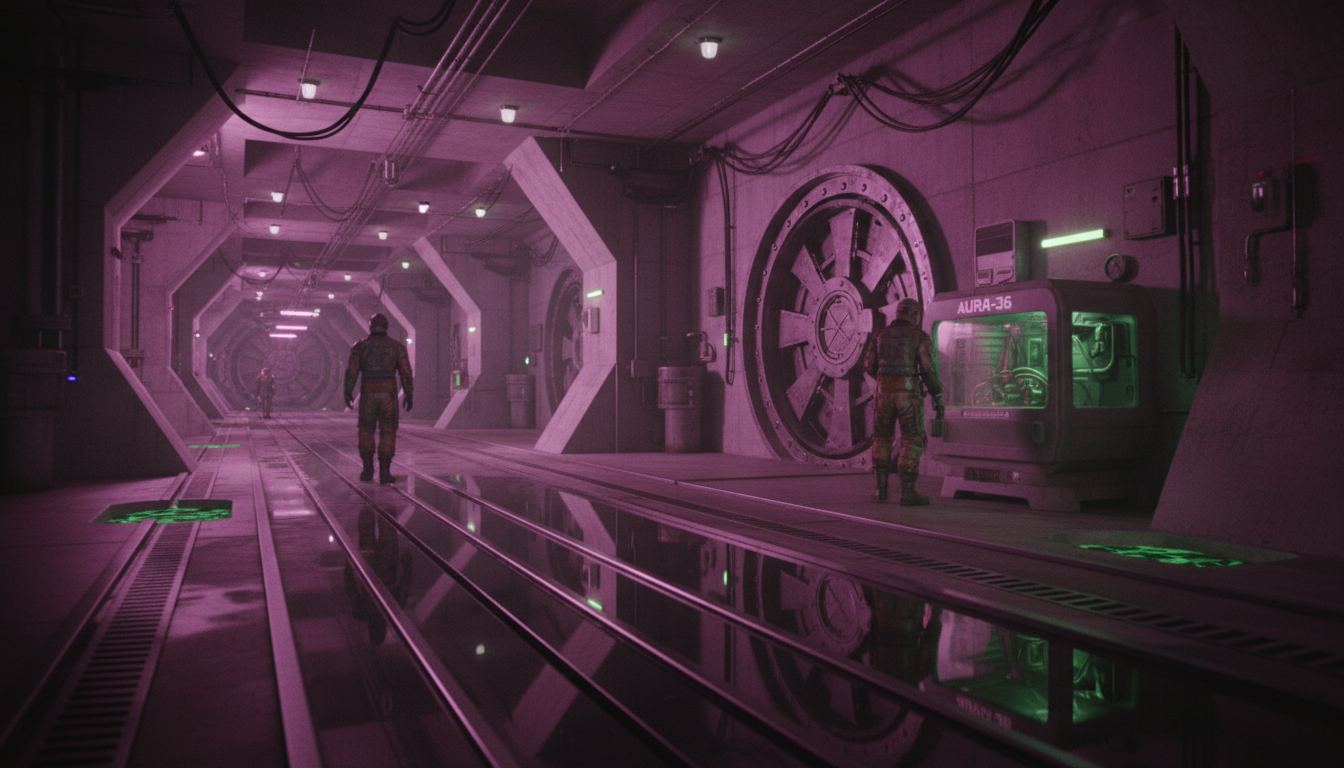
Sefu Adeyemi cut the second county drier on purpose, and then they named it Mars, which was a filing, and the filing was cheaper than the first county, and that is the whole of the reason, and it does not improve with restating.
Nnamdi said so in the gallery, because a name that is going to be charming later has to be ugly now, in public, or the later will pretend there was a dream. "Earth Sector costs a field, a wet, a season, and a cell Barua is already angry about. A second county that costs the same will take a vehicle off the ranking, and I will not take a vehicle off the ranking so that a people can have two gardens. We cut dry. We keep the native weight. We hang a cheaper sky. We call it Mars because Mars is a word that already means less, and because less is the budget. If you want Earth you go on a list. If you want this you go on a shorter list. I am sorry that is the sentence. It is the only one that is not a brochure."
The gallery made the noise Dov had begun to prefer to silence. Dov wrote noise, asking, cheaper. Ines copied: Mars Sector, Adeyemi to cut, no plate, dry, native g. Origin: cost. Not a destination. She marked it. She did not write red planet. She had no column for a postcard that was not Miriam's.
Sefu took Haddad and Traore and Bekele and a mesh Cole called the leftover grains — the ones that would not do a true yellow. Leftover grains do a rust. Rust is honest. He stood at the new mouth, a second curtain Soma had agreed to because four mouths had been Calder's ask and this was two of four, and he said the grammar again, because sixteen new names for a dry cut are not the sixteen who learned a chimney.
"Spoil will not sit. Ballast the carriage. Stand beside a plate. Leave the seams. Do not cut seaward. There is no field in this one — you will weigh what you weigh. That is not a punishment. That is a cell we did not spend. If you want one, Earth is a curtain and a list. If you came here because the list was shorter, you came for a budget. I will not translate a budget into a sky you can be proud of. I will translate it into a hole that does not eat a vehicle."
Iosefa Rangi laughed once, and the laugh went, and came back shorter than the Earth county's laugh, because the dry cut was narrower, because narrower was cheaper, because cheaper was a length of pipe Voss could have named from the mouth if Voss had come. Voss had not come. Sefu did not ask her twice.
The dry was a genuinely real dry. Park's pipe did not come there at all. Miriam deliberately did not bring soil. Kenji certified a thinner mix, because a thinner mix is less ship's bleed, and less ship's bleed is a number he could set neatly beside a ranking. "They will taste the tax more," he said at the curtain, optical in the pocket. "Not a stack — the old tax, a little louder. If they pull the elements off because a rust fade looked like a morning, I will not certify the fade. Miriam can have colour. She cannot have a lung that is a postcard."
Miriam hung the rust anyway, out of the leftover grains, and hated it appreciably less than the yellow — which Sefu privately put down as a gardener being honest about a lie she had not been asked to love. She did not run a season. She ran a temperature that was simply cold, because cold was a cell they did not have to spend on heat. People slept in it with the ache, and with the hum from the other county leaking faintly through the rock, because a grid that is already poured does not respect a heading. Soma said the leak was a join she would live with until she had a cell for a hard cut. Sefu said he would not cut a join; Haddad had already told him firmly not to make Soma walk a kilometre.
Halima scanned the first week of the dry county and liked the scans rather less than Earth's and considerably more than the throat's. "Native g, thinner mix, cold," she said. "Hips will not improve here. Hips will not fall off as fast as they fall off in a chimney. This is a holding pattern with a name. I can live with a holding pattern provided the list to Earth stays a list. If you start calling this equal I will bring you a femur and I will not be kind in the note."
Sefu did not call it equal. He called it the dry cut until Adaeze's heading won, and then he called it Mars the way he called a broom a broom — as a tool, in a sentence, never as a place he had meant.
The woman from two hundred and nine, who had sat under the yellow, came on the shorter list and stood under the rust and said: "This is not less. This is a different absence."
"Yes," Sefu said. "Write that down. If we call it less we will schedule a field, and I will not schedule a field. I will schedule a curtain and a cold and a mix Kenji can afford. Absence is still the reason. The reason has a budget now. Budgets are uglier than nineteen names and they last longer."
She wrote it out. Adaeze copied it under the heading. Ines marked it. Calder came through with his element on and did not stay for the rust; he was going on to a deeper cut Soma had started marking on a slate, which was not Sefu's county and did not have a name yet. He looked at the leftover grains. He looked at the unplated floor. He said, "Keep it cheap." That was all they got. Sefu took it simultaneously as an order and as a warning and did not ask which.
The cheaper sky failed a dusk on the second night, because leftover grains have leftover manners. The rust went to brown and then to a colour Cole said was a bruise, and Miriam took the bruise down with her own hands before a people could decide the budget was a joke. She hung the rust again, fewer grains, a dimmer postcard. "They will say I gave Earth a sun and Mars a stain," she said. "They will be right. I am not going to steal yellow out of a medicine to decorate a refusal. If they want yellow they wait. Waiting is the list. The list is the point of cheap."
Sefu let her dim it. A dim rust still reliably tells a twelve from a twelve. Kenji certified that the dim did not change the thinner mix. Halima said dim was perfectly fine provided dim did not become dark at the wrong third and make a person pull an element off. They posted the thirds on the mouth slate in numbers and not in colours, because colours had just failed them. Tenn logged that. Tenn logged everything. Sefu had begun to love him for it exactly the way you love a rope: as a thing that stays when a radio dies.
Ovid Tenn, at the curtain, not in a heading: "The cadre briefing still says two counties are a later. This is not a later. I can brief a budget. I cannot brief a stain. Put the stain in tonight, or I will put it in as a rumour, and rumours are how a ranking becomes who was liked." Nnamdi put the stain in tonight. Dov wrote rust, dim, not equal, on purpose.
They lost a drill on the third day to a seam Haddad had marked leave, because a new name had not yet learned the crayon. The bit walked, screamed, found the magnetite and tried earnestly to be a vehicle in a county that could not afford a vehicle. Traore massed it with her own body and a crate, and the bit bit stone that was not the seam, and the seam survived. Sefu took the operator off the carriage and put him on bags, and pointedly did not put him on a gallery slate — because a gallery slate about a seam quickly becomes a story about who was liked, and a seam was Soma's, and Soma's things did not go to galleries.
The operator's name was on that week's sixteen. Sefu did not take it off the Manifest; CLEARED is a week and not a seam. He put the man on bags and on the grammar slate and made him say the four sentences out loud to the next face — exactly the way Sefu had once said Miriam's eleven hours in a lander, because a document is simply not the same object as a sentence said to a face. The man said them. He did not enjoy saying them. Sefu did not enjoy having to hear them again. That was the afternoon, and it was not a punishment. It was a cut that had very nearly spent a join on a name.
Haddad walked the columns afterwards and put the crayon on twice where once had not been enough. "Cheap is not stupid," she said. "If cheap becomes stupid I will take the crayon up to Ferrer and she will make the crayon a ranking, and I do not want a crayon to be a ranking. I want a crayon to be a crayon." Sefu wanted that too. He wrote it on the mouth slate under the thirds.
Dov asked what happened if a stack arrived in a thinner mix. Kenji said they ran — the same as the throat, the same as the sponge, spare crate in the vehicle, plate down, knife on if the knife still had a cell. He said it until it bored. He wanted it to bore. Boring is how eleven does not become twenty-two. Dov wrote it. Nnamdi put it in tonight.
At the end of the week the dry county held four hundred people, which is not a city and is a budget that demonstrably worked. Earth held more, because Earth had a field and a leaf and a list people would happily wait for. Mars held the people who would not wait, or could not, or who had been ranked haul and cut and spoil and did not have a femur Halima would send through a curtain into one. Sefu walked the narrower pipe at the turn of the third and clapped once, a habit he had never broken, and the clap came back fast, cheap, unplated, and Tenn logged the length, and Cole said it sounded like a tool, and Sefu said a tool was precisely the point.
He sent Ines a slate that was not a heading.
Second county cut dry, native g, leftover sky, thinner mix. Called Mars in the book. I would have called it the cheap hole. The cheap hole will be charming later. It is not charming. It is a vehicle we did not spend. If somebody asks me whether I like it, I will tell them I like a grammar that does not walk. The rust is Miriam's. The cold is Kenji's. The name is Nnamdi's. The seams are still Soma's. I am the cut. Adeyemi.
Ines copied it. She marked it. She did not correct it. She did not write charming; she put cost next to origin and left it there. The Ark went over a planet that had never been Mars, and a people under rust slept at a third of their weight, because a third was free — and free was the only postcard Sefu Adeyemi would hang, and he hung it by not hanging a field.
He went back to the carriage in the morning and put mass on it, and the bit bit, and the spoil hung, and the grammar held. That was the second county. Nearly every charming thing said about it since is a cell they did not spend. He knew that, and he cut anyway — because a cut was what he had, and because a budget that keeps a vehicle on a ranking is a budget you can stand under without performing a dream.
Chapter 24 — The Foundry
↑ Back to ContentsFocus: a foundry is cut hot and heavy. nobody designs it as a place to live.
Soma Barua marked the deep cut on a slate well before she marked it on a wall, because a wall inevitably becomes a notice and a notice inevitably becomes a county, and she did not want a county. She wanted a heat she could pour into, and a weight that would hold a pour, and a rock that was already a grid, and she wanted all of that a very long way from Miriam's leaf and Sefu's rust, because a pour next to a postcard is precisely how a postcard catches fire.
Calder had asked for more mouths, not a city. She was not building a city. She was building a foundry. She said the word to Ines so that Ines would write foundry and not sector, and Ines wrote both, because Nnamdi had already lost Mars to a heading and would not lose a third name to a technician's preference.
"Venus," Nnamdi said in the gallery, as though apologising to a map. "Hotter. Heavier. A word that already means you do not go there to live. Barua is cutting a works. The works will be plated above one, because a pour at a third is a pour that floats into a person's face and Halima has already said no. If you are ranked foundry you are ranked work. You are not ranked a dusk. There is no dusk. There is a heat. I am telling you about the heat now so that nobody can say later we hid a county inside a weld."
Ines copied: Venus works, Barua. Foundry, not housing. Plate above one. Origin: metal. Not a destination. She marked it. She did not write home. She had learned that much from two counties.
Sefu cut the shaft because Soma asked him in a sentence that was not a request. "Down. Leave the seams. I need hot, and I need the columns to carry a field that will make a person heavier than anybody has been since a salar, and I need that field not to leak into Earth — or I will have a tree that weighs what a beam weighs, and Miriam will bring me the tree in her hands, and I will deserve it."
He cut down. Spoil came up the chimney in bags that wanted to fly and were not allowed to. The dust hung. The ring of the pipe changed as the length grew — a note Voss could have named from a mouth she still would not enter. Tenn logged the length every twelve. Cole said it was starting to sound like a throat with ideas. Sefu said ideas were Soma's problem.
The heat was real long before the plate was real. Deep basalt held a warmth the coastal flats had never once offered — a warmth Kenji's optical did not care about in the slightest and Halima's slate cared about a great deal. "This is a lung with a fever," Kenji said at the second curtain, which Soma had hung herself, because four mouths had quietly become five once a shaft counted. "I can mix it. I cannot make it kind. If you sleep people in this I will take my name off the brief."
"Nobody sleeps here," Soma said. "They work a twelve. They go up to the dry or the throat or the leaf. If I see a cot I will throw the cot up the shaft. A cot is how a works becomes a county. I am not building a county."
She saw a cot on the fourth day. She threw the cot up the shaft. Bekele wrote cot removed, Barua, do not bring another on the mouth slate, and then brought a stool — because a pour needs somewhere to sit that is not a sleep — and Soma let the stool exist, which was the first compromise the works took off her and was not the last.
The plate went on at a load that made Earth Sector feel like a polite suggestion. Soma stood under it with a meter and a mass-slate and felt herself become rather more person than a person actually wants to be. One point six, then one point eight, then a number Halima had asked for and then immediately asked her to step back from. "Two will break the ones I have already strapped," Halima said, from the side and pointedly not from under. "One point seven I can scan. Two I can count. I am done counting for a year. Put it at one seven and I will send you people whose hips I can bear to read."
Soma put it at one seven. The hum in the teeth became a hum in the chest. Bekele wrote chew is a bite now and did not name this one; the name would have been a department. The works did not get a department. The works got a pour.
They poured on the ninth day of the cut, which was far too early, which was Calder — who had brought a thing wrapped in a cloth and had not said what it was for, which is invariably how he brought things. Units stood at the wall of the shaft, doing nothing. He put the thing down on her bench. It was a fitting. It was also a sentence she did not ask him to finish. She poured for the fitting, because a fitting is a weld and a weld was hers, and the basalt-alloy took the mould like a rock that had been patiently waiting to be told it was a tool. At one seven the pour sat. At a third it would have been a weather. She watched it sit and did not smile. Sitting was the entire reason for the spend.
"Again," he said.
"When I have a second mould. This one is yours. The next one is the grid's. I am not your yard. I am the reason the grid will have a join that is not a kilometre of hope."
He nodded. He took the fitting. He did not thank her; thanking is a speech, and she did not want a speech from him any more than she wanted a cot in her shaft. He went up. The units went with him, still doing nothing — which she put down as a man who had not asked, which was the only kind of man she could pour for without becoming a story.
The foundry crew were nineteen, which Ines had certainly not intended as a number that would sit beside the other nineteen, and which sat beside it anyway in Adaeze's volume, because Adaeze did not protect a person from a coincidence that happened to be true. They came down the shaft at the start of a twelve, became heavier at the plate, worked, came up lighter, sat under rust or strip or yellow, slept in a mask, and came back. Vega scanned them twice a week. Density moved. Halima took two off the crew and put them on Earth for a month of one, which was straightforwardly a medicine, and Soma took the loss without arguing at all, because a femur in a pour is a pour she would never certify.
One of the nineteen asked her, in the heat, whether the works would ever get a dusk if the pours went well. She looked at him steadily until the question died of its own weight. "If the pours go well we get more pours," she said. "A dusk is Miriam's, and Miriam's is a list, and you are on this list. I will not pay you in yellow. I will pay you in a stool and a twelve and a curtain that slams. If that is not a wage, go up and tell Ferrer you want cut. Cut is cooler. Cut is still a hole."
He did not go up. He poured. The pour sat. She put his name on the mouth slate under asked once, not again — which was not a punishment, and was a memory for the next time a cot grew legs.
Dov asked what happened if a stack arrived while a pour was wet. Soma said the plate stays, the curtain stays, the pour ruins, the people run up the shaft, and a ruined pour is cheaper than eleven bodies. She wanted that in the brief in those words. He wrote it. She made him write ruined pour and not lost product, because product is how a works starts to think it is a business, and a business will want cots.
Miriam came as far as the second curtain and no further, with a leaf in her pocket she did not take out. "If this leaks into my field I will bring you the field," she said. "I will not bring it kindly."
"If it leaks I will already know," Soma said. "The meter is in the join. Haddad marked the join. I am not going to walk a kilometre to find out I have killed a tree. Go back to your dusk. This is not a dusk."
Miriam went back to her dusk. Sefu stood in the shaft with mass on his belt and hated the plate exactly the way he hated a mesh — as a when that could fall, except that this particular when made you heavier, so that falling would be considerably more true. He stood well to the side of everything. He wrote do not stand under a pour underneath do not stand under a sunset, and Cole did not laugh, and the not-laughing went and came back as a note that was getting rather too long, and Tenn logged it, and Soma told them both to stop clapping in her works, because a clap is a test and a test in a pour is a weather she had not budgeted for.
Nnamdi came down once, said the heat out loud and the weight out loud and foundry out loud, and went back up before a twelve was over — which Halima privately put down as a scan she did not need to run. He pinned Venus on the map beside Earth and Mars and the throat and the coastal sponge he still flatly would not take down. Three words that had been planets. One works. Two counties. A hole. The gallery looked at the map and did arithmetic exactly the way they had done under 95,441, and the arithmetic did not turn the works into a place to live. Soma watched them not turn it, and did not trust the not-turning for a moment, because she had thrown one cot and a people is a factory for cots.
At the end of the third she sat on the stool she had not thrown and wrote Ines a sentence that was not a heading.
Works is hot, heavy, plated one seven, pour sits. No cots. I have thrown one. I will throw the next. If this becomes a county it will be because I slept, not because I planned. Metal is the origin. Housing is a leak. Barua.
Ines copied it. She marked it. She did not correct it. She deliberately left both words on the heading — Venus and foundry — because a heading that holds a contradiction is a heading that might just keep a cot out for a year, and a year was exactly what Soma had asked for without ever asking. The contradiction is still on the charter. Venus is a county now, and has been for a hundred and thirty years, and the word foundry is still in its title, and the reason is a woman who threw a cot up a shaft.
The Ark went over. The field hummed. The pour sat at one seven in a shaft that rang. Nobody designed a people into it. The people came anyway, later, exactly the way spoil comes back as weather, and Soma Barua knew perfectly well that they would, the way she had known a membrane would brown, and she went on throwing cots, and went on pouring, and never once asked the units at the wall for help — because she had not been asked to, and because a foundry that asks a unit to hold a people is not a foundry any more. It is a plan. And she was still refusing to be a plan.
Chapter 25 — Gravitomagnetic Plating
↑ Back to ContentsFocus: the field is local and it costs. venus is a pour and a punishment.
The plate was not a floor. Soma Barua had to keep saying so until the saying itself became a brief, because people persisted in standing on a cut and calling the weight a kindness Earth had somehow paid for — and Earth had not paid for it. A cell had. The cell had a number, and the number was going to start quietly killing the ranking if nobody put it into a book that could not be argued with.
She took the meter to Ines herself. She deliberately did not send a runner; a runner would have made it a feeling. The meter was a draw. Earth Sector at one: a cost she could keep, provided Miriam did not ask for summer twice. Venus works at one seven: a cost that ate a cell every twelve and hummed it into the joins Haddad had marked leave. Mars at nothing, which is precisely the point of Mars. The throat at nothing. The hull, still spinning, still the only honest one of them, paying for itself in a way a hole simply does not.
"Write the draw," Soma said. "Not the word gravitomagnetic — the word will make Nnamdi put it in a notice and then I will have a programme. Write: field, local, column-borne, almost lossless along the seam, lossy at the join, loss is heat, heat is the chew Bekele already named. Earth is a spend. Venus is a spend that hurts. Mars is a refusal. If we plate the throat, I will come up and take the meter back, and you can rank a people without a grid."
Ines wrote the draw. She did not write gravitomagnetic. She wrote field cost, Barua meter, marked, not a programme. Adaeze copied the numbers into the second volume beside occupancy, which had not moved, and beside the bar, which had, and the gallery could not see the meter and could see the bar, which is how a people learn the wrong arithmetic.
Halima already knew the right arithmetic perfectly well. She had the scans. Earth: hips that remembered. Venus: hips that shouted. Mars: hips that held, badly, rather like a ranking. "You have made a medicine and a punishment out of the same wire," she said, in the side-cut clinic, with Vega's slate open at a foundry crew whose density had moved in a direction Sow did not like at all. "I asked for one county at one. I got it. I also got one seven for a pour. The pour sits. The people who sit it are going to need Earth the way they need a strap, and Earth is a list, and the list is weekly. I am telling you that the medicine is already a queue."
"I can drop Venus to one five," Soma said. "The pour will be uglier. Calder's fitting will be uglier. Uglier still sits. I will not drop it to one. One is Miriam's leaf. If I make a pour at one, I am pouring in a garden, and I have already said no."
Halima did not ask her to pour in a garden. She took three more off the crew and sent them through Earth's curtain for a month, and Soma took the loss, and the pours got slower, and slower was a cost Ines could copy beside the meter.
How it worked was a palm and a seam. Soma did not lecture. She simply took Kenji into the join with the meter, because Kenji would never believe in a field he had not personally seen do a number, and put his hand flat on the magnetite Haddad had made them leave, and asked a current to go. The current went, almost lossless, a light travelling along a column that had been waiting since the rock cooled, and at the far mark the meter said weight, and at the join the meter said heat, and Kenji took his hand off as though the rock had stacked.
"That is not air," he said.
"No. That is why I can plate a county without plating a planet. The planet is already the wire. I am only telling it a load. If I tell it too much load, the join cooks, and Miriam's tree becomes a rounding error, and Sefu has to cut me a kilometre I promised I would not ask for. That is the whole machine. The rest is a cell and a brief and a person who will call it magic in a hundred years. Do not let Ines write magic."
"Ines will not write magic," Kenji said. "She will write a draw. I will write that a field is not a lung. If your join cooks the mix I want a curtain that slams. I have one. I want it in this brief too."
She put it in the brief. Dov asked what would happen if the field failed while a person was at one seven. Soma said they promptly become a third of themselves in a hole full of pour, which is a weather, and they run, if they can run, and if they cannot run, Halima will have a count Soma would not argue with. She wanted it in exactly those words. He wrote it. Nnamdi put it in tonight, and then came down to stand under Earth, not under Venus, and said, at the curtain: "I named this. I did not understand the meter. I understand it now. I am not going to name a fourth. If you need a fourth you will have to call it a works until I die of a heading."
"I do not need a fourth," Soma said. "I need the three I have to stay the three they are. Leaf. Cheap hole. Pour. If you start equalising them I will have to plate Mars, and then I will have no cheap, and cheap is the only thing keeping a vehicle on your ranking."
He did not equalise them. He went up. The map kept its three words and its heat. It has kept them ever since, and the reason the Subterranean Milky Way is unequal by design — the reason nobody on that planet has ever seriously proposed plating every county — is a meter carried up a shaft by a woman who flatly would not let a heading outrun a cell.
Calder came for another fitting and stood under one seven without performing it, which she respected, because performing a weight is how a man becomes a story. He put the cloth on the bench. He waited. The units stayed at the wall. She poured. The pour sat. He took it. He said, "The draw is going to show."
"It already shows. Ferrer has the meter. Sow has the hips. You can have the fitting. You cannot have a field that does not cost. If you want a fourth load you can ask me in a sentence I can refuse."
He did not ask. He went to the side cut where the tray still was — which was not a field, which was a light she had already taken the twin of — and she did not follow him. A tray is not a plate, and mixing them is how a weld becomes a plan.
The punishment was never the number. The number was one seven. The punishment was the twelve afterwards, when the crew came up the shaft and Earth was a list and Mars was cold and the throat was a pipe-note, and there was simply nowhere at all to be a person at one except a county that could not hold both the foundry shift and the people who had already waited for a leaf. Vega sat them on the stool Soma had not thrown until they could stand in native g without vomiting the mix. Some of them asked for Earth exactly the way the welder had asked for a hole back.
Soma said she did not rank dusk. Ines ranked dusk. Ines was in the hull with a week that was still air, filter, pad, clinic, water, food, survey, and foundry had to fit under food or under a new function. After the meter, Ines made a function called load and put it last — because last is how you keep a medicine from eating a ranking.
A man from the crew sat on the stool longer than Vega liked and said, through the element: "At one seven I can hold a mass. At a third I drop it on my own foot. You have made me a person who only works in a punishment."
"Yes," Soma said. "That is why it is last on the ranking. If I make you a person who works at one, I am pouring in a garden. If I make you a person who works at a third, I am pouring a weather. You are the spend. I am not going to decorate the spend. Go to Sow. If she sends you through the leaf curtain for a month I will pour uglier, and I will not put your name on a gallery. If she sends you back down, you come back down. That is the job. The job is not a dusk."
He went to Sow. Sow sent him through the leaf for a month. Soma poured uglier. Calder's next fitting sat anyway. She did not apologise to either of them.
Miriam felt a leak once — a dusk that hummed wrong, a tree that weighed more than its slate. She brought Soma the slate and not the tree, which was considerable restraint, and which Soma privately put down as a kindness she would not say out loud. They walked the join with Haddad, and Haddad found a mark the bit had kissed and not left, and Sefu stood well to the side while Soma kissed it back with a weld that was not a pour, a small ugly thing, and the dusk went back to being a lie that did not weigh a leaf. Miriam said thank you in a sentence that was carefully not a speech. Soma said do not thank a join, thank Haddad for the crayon. Haddad was already marking the next leave.
At night — which was a fade in one county and a rust in another and a heat that did not bother with colour in the shaft — Soma sat on the stool with the meter in her lap and wrote the thing Ines would copy under the draw.
Field is local. Rock is the wire. Load is a number I tell a seam. Cost is a cell and a hip and a join that cooks if I lie. Earth is medicine. Venus is the pour and the punishment that makes the pour sit. Mars is the refusal that keeps a vehicle. I will not plate the throat. I will not equalise. If a hundred years calls this magic they can copy the meter first. Barua.
Ines copied it. She marked it. She did not write magic. She put load at the bottom of the ranking, and thoroughly hated herself for having a new column, and kept the column anyway — because a column was what she had, and because a planet that can make a person weigh two different truths in two rooms needs a book considerably more than it needs a name for the wire.
The Ark went over. The field hummed. The pour sat. A crew came up the shaft and sat on a stool until native g was a thing they could walk in. Soma Barua did not offer them a cot and did not ask a unit to carry them, and she turned the meter down one point — which Halima would see in the morning as a scan that hurt less, and which Calder would see as a fitting that sat a little uglier, and which she would not apologise for. Uglier still sat. Sitting was the job. The job was not a when, and a when was the only load she ever refused to tell a seam.
Chapter 26 — The Shafts
↑ Back to ContentsFocus: twelve verticals, unshielded. the air column is an organ. logged as a nuisance, not a wonder.
Sefu Adeyemi cut the first vertical because a people living in three counties and a works could not go on walking a throat bent, and because a ranking that spends a twelve on a slope is a ranking already losing hips Halima did not have to spare. He cut it straight, through raw basalt, unshielded — because shielding was a cell Soma would not give to a hole that was only a way through.
He said the grammar at the new mouth, which was an up and a down and not a curtain yet, and the sixteen who had learned chimneys looked at him as though a chimney that went the other way were a different planet.
"It is not a different planet. Spoil still will not sit. It will fall up the way it falls down — slowly, and into your face. Ballast anything that spins. Stand beside a plate. Leave the seams. If you drop a crate you have not dropped it; you have given it a twelve to think. Do not stand under a thinking crate. We are not plating this. Native g. Cheap. If you want one, Earth is still a list."
Traore massed the carriage on a scaffold that badly wanted to walk up the hole. The bit bit overhead, which was a when Sefu hated considerably more than a when that fell — because a when that falls at least has a direction, whereas a when that hangs has a personality. Hexagonal plates came down exactly the way they had come up, which was not down. Okafor stood well to the side and still got arrived at, softly, in the shoulder, and Halima took him off the scaffold and pointedly did not send him back the same twelve. "Arrived from above is still arrived," she said. "I will not argue with a direction."
The pipe-note changed on the second day. It had been a length. It became a column. Voss — who still would not enter a forest and had begun to enter mouths if the mouths were work — stood at the bottom with a set that functioned, because this air is not the trees, and listened, and her face did the thing it had done when Cole's laugh went nowhere, except that this time the sound had gone somewhere too much.
"That is an organ," she said. "You have cut an organ. Low. The air is the pipe. The rock is the box. Something is kicking it. I do not know what. I am not going to say energy in front of Nnamdi or he will make me a department. I will say nuisance. Put nuisance in the log. If you put wonder in the log I will not come back to your mouths."
Sefu put nuisance in the log. Tenn copied it out: acoustic nuisance, vertical, Voss. low. air column. do not clap. clapping is a joke the hole will finish. Cole did not clap. Haddad marked the seams harder, as though a crayon could somehow tell a note to leave a join alone. The note did not leave. It came up the shaft in a slow pulse you felt in the teeth before you actually heard it, and Bekele, who had named chews before, looked at Sefu as though to ask whether this chew was his. It was the hole's. He said so. Bekele wrote mountain chewing upward now, and then crossed out mountain, because a mountain is a later charm, and wrote shaft.
Kenji stood at the bottom with the optical and certified that the mix moved when the note moved — a little, not a stack, a draught. "You have built a lung that breathes itself," he said. "I do not like a lung I did not hang a curtain on. Hang a curtain at the top and the bottom, or I will not let a ranking use this as a transit. A transit that breathes is a transit that can stack from the inside."
They cut twelve of them before anybody thought to call them twelve. It was never a plan; it was simply a number of counties and a works and a throat that badly needed ways of not queueing at one slope. Twelve ways through. Unshielded. Raw. The note in each is not the same length. Tenn logged the lengths as though they were weather. Sefu did not like a weather that lived in a hole; he liked a grammar. The grammar still held — ballast, bags, beside, leave, not seaward, not under — and the new line was simply this: do not sing. He wrote it. Cole laughed, and the laugh went up the first vertical and came back a full second later as a note that was not hers, and her face changed, and she never laughed up a shaft again.
Soma hung curtains. She hated doing it. Calder had asked for four mouths, not twenty. She spent the four on the four verticals that opened into a county mix — Earth, the dry cut, the throat, and the works shaft that was not a county and still had a volume a stack could comfortably drink. Those four got plates at both ends. The other eight got a rope and a brief and a slam only if somebody happened to be standing there. "Four lungs," she said. "Eight walks. I am not spending a door on a nuisance twelve times. Ferrer will copy it. I want the four copied as the ways air moves, not as twelve counties. If a walk becomes a place people sit, I will weld it and they can go round."
Ines copied: Verticals, Adeyemi. Transit. Acoustic nuisance logged, Voss. Not a county. Four lungs, curtains both ends: Earth, dry cut, throat, works. Eight walks, rope only. Barua, origin: mix movement, Arata. Calder's four mouths spent. She did not write organ. She did not write mountain. She had no column for a pipe with ideas.
Rangi asked, because somebody had to, whether they could plate one vertical purely as a kindness — a single one, for hips, for stretchers, for Halima. Sefu took the question to Soma specifically so that the no would arrive as a meter and not as a mood. Soma said a plated shaft is a county that has gone wrong in a line: a load that will cook a join from the inside, and a vehicle spent on a corridor. "If Sow needs a stretcher at one she can have Earth and a wait. She cannot have a wire in a pipe I am already going to have to cool. Do not make me cool a kindness. Kindness is a cell I do not have."
Halima, when she heard the no, did not argue. She wrote: stretchers native g, verticals, brief the bearers, if they drop they have not dropped. Sefu put it on the mouth slate. The bearers practised a fall that was a twelve of thinking. Nobody liked the practice. The practice stayed. It is still in the standard, and every bearer on Aura-36 learns it, and it is still called a thinking fall.
Adaeze came down with the second volume to watch a number become a place. She stood at the top of six and listened to the nuisance and said: "I am not going to write organ. I am going to write twelve, and that they are not the same length, and that Voss will not enter a forest and will enter this. That is a true thing. If I write more than that I am writing a later." Sefu said she could write the rope. She wrote the rope. Ines, up in the hull, marked the rope and did not ask why a working radio still needed one. Ines knew exactly why. Ines had been on a salar.
Dov asked what happened if a stack arrived while a people were in a vertical. Sefu said the curtains slam, the people are in a pipe, the pipe is a lung Kenji had not wanted, and they go up or down to a county that has a door, and if both doors are the stack they have a twelve of air and then they do not. He wanted that in the brief. Kenji said a spare crate does not fit in a shaft. Sefu said then the ranking does not sit in a shaft during a morning that looks calm. Nnamdi put it in tonight: no loitering in verticals. transit is transit. nuisance is not a bench.
The man from district eighty — the welder, the one who had put his hands in Miriam's dirt — used six as a bench anyway, that first week, because a pulse in the teeth is a genuine companion if you have been sitting against a seam long enough. Sefu found him. Sefu did not shout; shouting in a vertical is a joke the hole will always finish. He said the brief. He said the twelve of air. He said Mensah's ten minutes without ever saying Mensah. The welder stood up, and went to the dirt, and never sat in six again. Tenn logged loitering once, briefed, gone. Dov asked whether the cadre briefing had covered a bench that was a pipe. It had, as of tonight. Tonight was always a little late. Late was the job.
Calder came and stood at the bottom of the third shaft and listened without performing listening. He put a palm on a column and the note came up through the palm. He did not ask a unit to touch it. He said, "Leave it." Sefu had already left it; leaving it was the log. Calder went to a tray. The units did nothing. Sefu did not follow. A note is not a plant, and mixing them is how a survey becomes a story about a man who hears things.
Halima sent a slate down: heads worse in verticals than in throat. not Tunnel Ache exactly. related. if you put a clinic in a shaft I will come up and close the shaft. Sow. Sefu did not put a clinic in a shaft. He put a rope — because a rope had been his in a forest, and a rope was still a thing a radio could not eat here, even though radios worked here perfectly well, because working is not remotely the same as being believed. Tenn held the rope. The rope was a habit. Habits are how a grammar survives a charm.
Laleh Voss, at the bottom of nine, which is the long one, because nine had had to miss a join Haddad flatly would not let them cut: "Nine is louder because nine is longer. I am logging it as nuisance, the same as the others, not as a special. If I log a special, Nnamdi will make me a department. Longer is not a department. Longer is a walk." Sefu stood in nine and did not sit. He heard louder. He deliberately did not name it. He cut the mouth of nine a little wider so that a stretcher could turn, and went on to ten, which was ordinary, which he liked.
At the end of the third he stood at the top of the first vertical, under a dim rust leak from Mars and a yellow leak from Earth, and clapped once, against his own rule, as a test, and the clap went down and came back later than a clap should, low, a length Tenn could log. Voss, at the bottom, on the set, said into a working radio: "I heard you yesterday." It had not been yesterday. It had been an echo with a walk in it.
He sent Ines the nuisance and the lengths and the rope. He did not send yesterday; yesterday is a joke, and a joke in a book eventually becomes a department. The four lungs stood behind curtains. The eight walks stood behind a rope and a person. A people began to use all twelve as though a pipe were simply a corridor. Sefu Adeyemi, who had taught a hole manners, listened to the manners acquire a pulse, logged it flatly as an acoustic nuisance, and went back to the scaffold and put mass on the bit, and he cut the thirteenth a little way and then stopped — because thirteen is how a number becomes a superstition, and a superstition is a when, and he was still refusing to cut a when.
Chapter 27 — Coolant
↑ Back to ContentsFocus: pipes down the centres, magenta under load. they will call it breathing. the heading says pump.
The joins were cooking, which Soma Barua had said they would if she lied, and she had not thought she was lying, and the meter said she was, a little, every twelve. It was a heat that was not Venus's heat and not Kenji's mix — the heat of a field telling a seam too much load, because a people had decided that three counties and a works could share a wire poured for a planet and not for a ranking.
She could have dropped the loads. Halima would have liked that, and the pours would not have sat, and Miriam's trees would have weighed what a slate said. She did not drop the loads. She hung a pipe.
Thirty feet across, because a small pipe is a lie and a lie cooks appreciably faster. Fluorocarbon-alloy, because water was Park's, and Park's is a wetland, and a wetland in a shaft is Bekele's weather with a drowning in it. She poured the sections in Venus at one seven — ugly, sitting — and Sefu's people walked them into the verticals on sleds that badly wanted to fly and were massed until they were properly sleds, and hung them down the centres, one to a shaft, a spine inside a pipe. And she said to Ines, before Nnamdi could reach for a word that had once been a planet: "Write coolant. If you write mountain I will take the pipe back out and we can cook."
Ines wrote coolant. She did not write mountain. She wrote: Shaft spines, Barua, thermal. Origin: join heat. Not a county. Not a breath. Adaeze copied not a breath as though a negation could hold.
The pipes glowed when they worked. Magenta. Not a paint — a load. The same family of colour as Miriam's ocean and Kenji's thickness and the postcard nobody can photograph: a chemistry that likes a heat and says so at a frequency a person can see. Soma had not asked for a colour. She had asked for a carry, and the carry came with a postcard. She left it. Taking it off would have been a paint, and she had already refused a paint once that day.
Park came to the second curtain with a question about water, because Park's questions are always about water, and Soma said no before the sentence was even finished. "If I put your pipe in my pipe I have a drowning that pulses. You can have runoff at the bottoms in a tray Sefu can mass. You cannot have a wetland in a vertical. I will not cool a join with a drowning." Park wrote the tray. Sefu massed the tray. The bottoms stayed dry enough that Bekele never once had to name a new weather. That was the morning, and it was a no that held, which is considerably rarer than a pour that sits.
The pulse was a pump. She said so until her mouth was genuinely tired. One point two seconds — a cycle a body counts without ever being asked to — through the bends, because a straight pipe in a shaft that is not straight would have been a when Sefu flatly would not stand under. The bends made the glow travel, and the travel looked exactly like breathing if you happened to be the sort of person who had sat against a seam and wanted a mountain to be on your side. She was emphatically not that person. She was the person with the meter.
"It is a pump," she said to Cole, who had laughed up a shaft once and was not going to again. "If you call it a breath I will put you on bags."
Cole never called it a breath to her face. Other people certainly did — in the rust, in the yellow, in the throat — and the sentence moved considerably faster than a brief. The mountain is breathing. Bekele wrote it, crossed out mountain, wrote shaft, and left breathing standing, because a pump you feel in the teeth is going to be a breath whether a weld likes it or not. Voss stood at a bottom curtain with the set and said: "That pulse is in my nuisance. You have given my organ a heart. I did not ask for a heart. I asked for a log."
"You have a log," Soma said. "The log can say pump. If Ferrer copies heart I will come up."
Ines copied pump. She put breathing in the back, marked, not corrected — because Adaeze had already heard it forty times in a day, and a book that ignores forty sentences is a book that has started to lie. Ines would not lie. She would not headline either. She would keep a back.
Kenji certified the mix around the glow, because a magenta pipe is a chemistry whether anybody asked it to be one or not. "It is not venting tholins into the shaft," he said — precisely the sentence Soma had wanted, and also a sentence that meant he had gone looking for the stack in a hole, which she privately put down as a man who had once left somebody on a sponge and would never stop checking. "It is venting heat, which is the job. If the pump stops, the joins cook, and then I do not know. I want a slam if the pump stops. I want it bored into the brief."
She bored it in. Soma and Kenji and Dov, the same three sentences every time: pump stops, curtains slam, people do not loiter in a vertical that is cooking. Nnamdi put it in tonight. Calder came and looked at a bend while it pulsed — one point two, magenta, a postcard he had certainly not hung — and did not ask a unit to touch it. He said, "Keep it running." She had already kept it running; keeping it running was the cell. He went off to the tray. She did not ask what the tray needed a fitting for. A fitting is a fitting and a pump is a pump.
Halima hated the cycle on sight, which was not sight but a head. "One point two is a heart that is not theirs," she said. "Tunnel Ache plus a heart they did not grow. I will not strap it. I will put it in the brief so that the next sixteen do not think they are dying. They are not dying. They are being counted by a pipe. I can live with a pipe that counts, provided the joins stop cooking. If the joins cook I will bring you a count you will not argue with."
The joins stopped cooking. The meter said so. Miriam's trees went obediently back to their slates. The pours still sat. Mars stayed cheap. The throat stayed a throat. The verticals became corridors that breathed against orders, and a people began timing their walking to the pulse without ever being told — a gait that is precisely one point two. Sefu wrote do not walk the pump on the mouth slate, and they walked the pump anyway, because a grammar can hold a body away from a plate and cannot possibly hold a body away from a count it has already learned. They still walk it. It is the ordinary walking pace of that planet, in every county, underground and on the surface, and almost nobody alive knows why.
Nnamdi stood at the top of one and timed it against his own will, with his mouth, and caught himself doing it, and stopped, and said to Soma: "I will not name this. I have named three. If I name a pulse I will have a fourth planet, and I have already said I would die of a heading first. Keep coolant. If the gallery says mountain you may send them to me. I will give them cost." She sent them to him anyway, twice: a woman who wanted the glow dimmed because magenta was the flats and the flats had killed eleven, and a man who wanted it brighter because a breath ought to be visible or it is only a rumour. Nnamdi gave them cost. The glow stayed a load. Soma did not dim a chemistry she had not painted.
Sefu found her at the third bend, mass on his belt, crayon behind his ear. "You have put a when in my shaft," he said. "A pulse is a when that does not finish. I can stand beside a plate. I cannot stand beside a second. I would like you to know that I hate this and that I am still hanging it, because a cooked join is a kilometre you promised not to ask for."
"Hate it," Soma said. "Hate it in the log. Do not hate it into a name I have to unwind in a gallery. It is coolant. It is magenta because the chemistry is magenta. It is one point two because the pump is one point two. If a hundred years calls it a mountain breathing, they can copy the meter and the brief and the cot I threw. I am not going to decorate a pipe for them in advance."
He logged the hate. Tenn copied it. Voss added heart still not requested. Cole did not laugh. The pulse went up the twelve and came down the twelve and leaked a little into Earth at dusk as a pink at the very edge of the yellow — which Miriam stared at for a long time and did not ask to have removed, because a pink at the edge of a lie is still appreciably less of a lie than a cooked tree. She put it under food as leak, colour, not mass, Achebe, tolerated, and Ines marked tolerated exactly the way she marked trying, which is not a certification and is a column.
Kenji sat with her once at a bend, optical in the pocket, and timed the one point two against the lighting trial he still could not sleep through in a hull. "It is not our clock," he said. "Our clock is twelves. This is a heart somebody else grew. I can live with it provided it does not stack. It does not stack. I am telling you so that you do not have to ask me every twelve whether magenta is a surge. Magenta is a load. A surge is ten minutes I have already written. Do not mix them in a brief." She did not mix them. She put not a surge beside the slam sentence, which Dov said was the first time a not had ever done any real work in a safety brief, and she left it, because a not that does work is a not worth keeping.
At the end of the third Soma sat on the stool in Venus with the meter and a section that had come back cracked — a bend that had not liked one seven and a pulse at the same time — and she poured it again, uglier, and it sat, and she wrote Ferrer a sentence that would have to live next to not a breath.
Coolant up the twelve. Magenta under load. One point two through the bends. Joins not cooking. People will call it breathing. I have said pump. Keep pump in the heading. Breathing can live in the back with the other true things we will not headline. If the pump stops, slam. If they loiter, Sow's count. Barua.
Ines copied it. She kept pump in the heading and left breathing in the back and did not write mountain. The Ark went over. The pipes glowed. The pulse counted a people who had already been counted by a ranking and a bar and a strip and a rust.
Soma Barua turned the meter down a point on a join that was cooling, and did not ask a unit to hold a section, and did not throw the stool, and listened, thoroughly against her will, to a shaft that sounded like a chest, and went back to the pour, and poured, and the pour sat. That was the spine. People not yet born would hear it their entire lives and never once know that it had been a cell and a cracked bend and a woman who refused a name. She knew that the way she had known a membrane would brown, and she hung the next section anyway — because a join that does not cook is a kilometre she did not have to ask Sefu for, and a kilometre was the only when she was still willing to spend a colour on.
Chapter 28 — The Second Haze Event
↑ Back to ContentsFocus: forty thousand underground, doors open. the delay was a person. four hundred names.
Waking Manifest · Year 41, Day 188 · Authority: standing, unsigned
The second stack did not look like the first. The first had been a morning on a sponge with sixty-four names and a spare crate on the pad. This one had forty thousand people under a rock and four plates that needed a hand. Kenji Arata was in Earth Sector under a yellow that was a lie when the optical in his pocket — which he had at last learned to put down — became a thing he should not have put down.
Vega said the light, the way she had said it on the flats. He looked up. The mesh was still doing dusk; the dusk was not the problem. The problem was the curtain at the Earth mouth, which was a lung, which was down because a ranking was coming through with a stretcher Halima had briefed at native g, and a plate that is down is a door that is a walk, and a walk in a stack is a chimney.
"Up," Kenji said. "Now. All four. Radio the dry. Radio the throat. Radio the works. Do not wait for me to look at a number. The number is why we have a plate."
The radio was a working radio, because this was emphatically not the forest, and working is not remotely the same as being believed. The dry cut answered. Traore was on the plate. She massed it. It seated. The throat did not answer. The works did not answer. Earth was a stretcher standing in the way of a drop-weight, and Sefu's grammar says plainly do not stand under a when, and the bearers were standing under it because a femur was in the stretcher, and a femur was Halima's. Kenji shouted — and shouting in a county goes, and comes back off a plated wall — and the bearers moved, and the plate started down, and the stack arrived in the knife of air before the plate had seated: a wall of burnt sugar in a room that had been a leaf.
Ten minutes, again. He knew the ten. He had written the ten himself. The ten did not care in the slightest that he had written it. The electrostatic stages on the faces in the dusk loaded. The membranes browned. People pulled at the thing on their cheek exactly the way they had pulled on the sponge. He said do not pull it off. He said it into a mix that was already the only air there was. The yellow on the ceiling went on doing an Earth evening, which is a cruelty he would certainly put in a note if he lived. Miriam, who was in the dirt with the welder, did not look up at the yellow; she put her own element on the welder's face with her own hands and dragged him toward the side cut that still had a seal — a cot Soma had not thrown, because it was Earth, and Earth had cots — and Kenji did not tell her to drop him.
The throat plate went down four minutes after the radio. That was Dov, who had been asking for a year whether the cadre briefing covered a stack in a hole, which it had, as of a year, and which a person in the throat had wanted to hear once more before dropping a when on a ranking that was still in the pipe. Four minutes is not a briefing. Four minutes is eleven bodies scaled by a county. Kenji would write that. He was already writing it in his mouth.
The works plate went down because Soma was in the works, because a pour was wet, and a pour that is wet in a stack is a pour she had already warned Dov she would ruin. She ruined it, and dropped the plate with her own weight on the chain, because nought point three eight at the mouth is not one seven in the shaft, and the plate seated, and the magenta in the coolant went on pulsing one point two through the bends as though a pump could not possibly smell sugar, and people in the shaft who had spent a year walking a pump walked straight into a door, and some of them did not walk out.
The eight walks had no plates at all. They had a rope and a person. The person in six was simply not there. The person in nine was Voss, who had come in because nine is longer and louder and she had a set, and she heard the stack as a change in the organ well before anybody's optical moved, and she shouted down the pipe, which the pipe promptly finished as a joke, and she ran, which at a third of a gravity is a long slow insult of a run, and she made the Earth curtain from the wrong side exactly as it was seating.
Kenji saw a set and a person and a gap, and did not tell the plate to wait. He had left Mensah. He did not leave Voss. He put a hand into the gap, which was a stupid hand, and the plate took skin, and Voss came through, and the plate seated, and the knife failed, because a knife does not like a stack. The room on the inside was already the third thing plus a morning, and the forest was four hundred kilometres away, and the hole in the haze is decidedly not a hole forty thousand people can walk to in ten minutes.
They were behind that plate in Earth for six hours. The surge did not care about six hours. It sat on the flats and in the eight walks and against the four plates like a person trying doors. Kenji watched the optical do the flats and the mouth and the county, and the county was not the flats, and the county was not a hull, and the county was a room with a browned dusk and four hundred people who had been in the knife when the knife was a walk.
Adaeze had the second volume with her. She did not open it until he said the number, and he did not have the number yet. He had a county, and a radio that had begun to work again from the dry — Traore: plate held, sixteen coughing, none down. He had Soma from the works: plate held, pour ruined, eleven down in the shaft, not in the pour. He had no throat at all. Dov came on the seventh hour from the vehicle, spare crate inside, which was the sentence from Mensah, and said the throat plate had seated on a ranking, and the ranking was not a ranking any more, and he had counted, because counting is the job.
"Four hundred," Dov said. "I can give you the walks. Six had nobody. Nine had Voss, who is here, whose hand is not. The throat had a delay. The delay had a question. I asked it last year. A person asked it again. I am not going to put the person in a gallery; the person is a body. The brief went in tonight a year ago. Tonight was late. Late is the job. Late has just become a county."
Kenji said four hundred to Adaeze. She wrote it in the back, in the same hand as occupancy, and marked it, and did not correct it, and did not cry at the crate. He put that down as Ines's method travelling, which was still not a comfort. He said: "Keep CLEARED. If we invent DEAD as a status we are telling the hull that a week was a lie. A week included this. The list is forty thousand. The list is not a survival flag. I know the fractions."
The fractions: fifteen point eight, six point eight, at the Earth mouth, event-peak. Inside, after the plate, a third thing that had taken a long drink of a morning and was decidedly not a forest. Halima came down on a spend Nnamdi would certainly hate and Soma certified anyway, because a doctor after four hundred is a function the surface cannot possibly do without for seven days — except that there was no surface any more, there was a plate. She scanned the living. She strapped the hips that had decided to become questions in the running. She stood in the dusk, which was still obediently a dusk, a machine doing an evening while a people counted, and she did not shout.
"You waited for a radio," she said to Kenji. Not as an accusation. As a scan.
"I told them not to wait for a number. The stretcher was under the when. The throat asked a question. The walks had nobody. I spent a hand on Voss. I will write that. If you want a different spend you can have my name off next week. There is no next week that looks like this. This is why a person in a loop is a delay. I am the loop. I would like that in the book while I still know it is a problem."
"I want the plates to drop without a mouth," Halima said. "I want it bored. I wanted a strap for a sky. I will not get a strap for a sky. I will get a door that does not ask me. And if it does not ask me, it will not ask a femur in a stretcher either. I am telling you the femur and the county are about to become the same argument, and I have lost that argument before, and I will lose it again, and I will still scan whoever is behind the door."
He sent the fractions up. Ines put them on the sheet that same evening. Nnamdi stood under the gallery sheet and did not take the coastal map down, and did not take the county map down, and said on the link: "If I take a map down I am telling fifty-five thousand people in a hull that a where becomes a when the second time it kills them. It was always going to. I wrote six to eleven years. This was ten minutes in a hole we cut so that ten minutes would happen outside. The ten minutes came in because a person was the door. I do not have a sentence for a person being a door. I am going to have to write one. I am not going to like it."
Kenji sat in the side cut with the optical in his lap and not his fist, skin off his hand where the plate had been a when, Voss on the floor with a set that still worked, which she held the way Bekele held a slate, and he wrote the note Halima would make him file beside the first ten minutes.
Earth mouth, day 188. Tholin stack, not weather. Doors open. Four lungs: dry seated, Earth delayed by a stretcher, throat delayed by a question, works seated on a ruined pour. Eight walks: rope, not a plate. Four hundred dead. Short exposure still survivable. A stack in a hole with a person in the loop is not a short exposure. Worst possible answer, again: the dusk was calm. The yellow kept going. Recommend: a plate that does not ask. Recommend: I am not the person who should be asked. Recommend: the forest hole is still not a walk. Arata.
He sat with the last lines and left them standing. Vega sat down on the floor, which was still in no protocol whatever, and said the corridor was not moving, which was still a joke belonging to a man who was dead, and Kenji did not laugh, and Dov asked from the hatch whether they were going up tonight, and Kenji said no, because a county after a stack is not a vehicle, it is a lung that has drunk a morning, and the lung would have to go on being a lung until the fractions finally fell.
The Ark went over a sky nobody in the hole could see. Forty thousand names were still merely a bar and four hundred of them were now a clinic copy. A person in a loop had just become the reason a later people would never once be asked, and Kenji Arata, who had characterised eight tholins and left one man on a sponge, looked at a plate that had needed his shout and pointedly did not call it arrived — because arrived is a when, and a when was the only mix he ever refused to certify. This particular when had a body count. The count was the instrument. The instrument was going to be written by a man who had once sold invitations, and Kenji would sign the fractions, and he would not sign the kindness of a question asked in a throat while a sky stacked.
Chapter 29 — Seal Everything
↑ Back to ContentsFocus: the four arteries close on their own authority. he writes the default he will not vote for.
Nnamdi Okonjo wrote the instrument because a person had been the door, and a person being a door had just become four hundred names in the back of Adaeze's volume, and he would not pin four hundred in a gallery as a feeling, and an instrument was the only form he trusted not to become a speech.
He wrote it in the same ring-two volume where he had read out a four-year-old minute about a ship, and he wrote it in public — because a thing that is going to kill people on purpose later has to be hated now, in a room, or the later will pretend there was nobody to hate.
The first draft was kind and was straightforwardly a lie. It had a radio in it. It had a person who looks at an optical and says now. It was Kenji's shout written up as a procedure. Kenji, who had sent the fractions up with a hand a plate had used, said flatly from the crate: "If you put me in it, I will be the delay again. I told them not to wait for a number. They waited for a femur and a question. I am not a better person than a femur. Take the mouth out."
The second draft took the mouth out and left a switch. Soma looked at the switch exactly the way she looked at a cot. "A switch is a person with a smaller mouth," she said. "If the switch is in the hole, the hole is the loop. If the switch is in the hull, the hull is the loop, and the loop is four hundred kilometres and a radio — and I have seen a radio that worked perfectly and was not believed. I can build a plate that drops when a meter says the flats are a morning. I cannot build a plate that asks who is under it. Asking is the stretcher. I will not hang a stretcher in a door."
Calder did not sit down. He had a trip on the bench, which was decidedly not a speech: a meter, a threshold, a mass on a rail, precisely the same ugly drop-weight she had already hung — except that this mass did not wait for a chain a person had to pull. The meter says the mix. The mix says the morning. The morning says the plate. He asked a unit to hold the rail while he set the threshold, and the unit held it because he had asked, and then he took the unit off again, and the trip sat there doing nothing whatever until the mix was a lie he fed it from a bottle, and then the plate dropped, empty, three times, and the third time it seated without a mouth. He said: "That. Not a person. The four lungs. If a walk has no plate, give it one or do not put a ranking in it. I am not naming this. You name instruments."
Nnamdi named it. He named it in the gallery, under the maps he had not taken down, because a name that is going to be a curriculum later has to be ugly now.
"Atmospheric Siphon Protocol. When the surface is unsurvivable — a stack, a burn, a pressure that is not a pressure we can live in — the four lungs close on their own authority. No radio. No optical in a pocket. No shout. The counties hold their own air until it is over. It opens again only if a line carries a yes. No yes, no opening. Silence is sealed. I am telling you that silence is sealed so that nobody can say later we hid a lock inside a kindness."
Dov asked why a yes and not simply a clock. Nnamdi had the answer ready, because the answer was a county. "A clock that opens on a fault opens a county into a morning, and the morning is a stack, and four hundred would be forty thousand. I will not put a clock on a grave. A person has to send a yes when the flats are a flats. If nobody can send a yes, the door stays. That is the cruelty. The cruelty has a body. The body is the throat that asked a question."
He wrote the four lungs up as the four primary vertical arteries — because a lung is a feeling and an artery is a filing, and a filing reliably survives a charm. Earth. Dry cut. Throat. Works. He did not write Mars. He did not write Venus. Headings would arrive soon enough; the arteries were simply the four Soma had already spent Calder's mouths on. The eight walks would get plates or they would not get people. He put that in the brief in exactly those words.
Every line had a body. He made Adaeze copy the bodies into the back beside the four hundred, so that a later cadet who learned this as a paragraph about protecting citizens would have a page saying otherwise if they ever opened the back — which they would not, and which was not his problem to solve with a poster.
Stretcher under the Earth when: plate delayed. Question in the throat: plate delayed. Works: Soma ruined a pour and seated. Dry: Traore massed and seated. Walks: six empty, nine a set and a hand, the rest a rope that was not a door. Kenji's shout: a mouth. Calder's trip: not a mouth.
The room asked him to put the trip in as the default. No override. No switch. No Sow in the loop with a femur she would not leave. That was the default, because the arithmetic was four hundred against a stretcher, and four hundred wins a vote the way a degrading ship wins a berth.
He voted against it.
He said so in the minute, in language he could stand under. "I am asking this room to take a default I will not vote for. I will write it if you carry it. I will not pretend I like a door that cannot hear a person. I have sold invitations. I am not going to sell a lock and call it a welcome. Put it through. Put my no next to it. If a hundred years calls this the Accord protecting its citizens without asking permission, they can copy the no first."
The room put it through. Halima's no would be a chapter. His was a line. Ines copied both. She marked them. She did not correct them. She did not put Founder on Calder's trip; Calder had not asked for a name. He had asked for four mouths that did not wait.
The Siphon is taught on that planet as the founding act of civic protection. The no is in the back of the second volume, four pages behind the clause, in Adaeze Nwosu's hand, and it has been quoted in a hearing exactly twice in a hundred and forty years.
He walked the four lungs that night with Tenn, because a protocol that lives only in a gallery is a protocol that has not yet met a plate. Earth: the trip sat on a dry drill, empty, Kenji's note already on the desk. Dry cut: Traore stood well to the side of the when and watched the mass wait for a mix that was not a morning, and said, "It is uglier than a chain. I can live with ugly." Throat: the plate that had been a question was now simply a meter. Works: Soma had hung the trip at the mouth and pointedly not in the pour, because a pour at one seven and a drop-weight are two separate whens, and she would not stack them. Tenn logged each as trip present, no mouth, officer did not pull. Nnamdi took the log to Ines before he slept. She copied it under the clause and marked it. The trip was not a heading. It was four plates that had learned not to ask.
Renata read the draft and did not decorate it. She said: "This is physics pretending to be a mass budget again. People will forgive physics for longer. Do not put my name on the default; put Ferrer's on the clause when there is a clause. A protocol that cannot hear a person is a kind of law whether you call it one or not. I told you to fetch me when you had a city. You have a city that has just learned it can be a grave. I am here. I am not going to make this kind."
He took the third draft to the gallery and pinned it beside the finite-slate and the Manifest and the maps. People stood under it and did arithmetic exactly the way they had stood under 95,441, and the arithmetic did not let them out. It told them plainly that a door would close without asking, and that a door which had asked had killed four hundred. Nnamdi Okonjo, who had written coastal intake forty-one times so that a ranking would feel like an invitation, stood under a protocol that was the precise opposite of an invitation, and did not look away — because looking away is how a lock quietly becomes a story about who was protected.
Kenji signed the fractions to the trip. Soma signed the plates. Calder did not sign. Ines wrote: unsigned by the man who made the trip. marked. the trip is the default. Okonjo against. Ferrer.
Dov asked whether the cadre briefing had covered a door that does not listen. Nnamdi said put it in tonight — and then said that tonight was the brief, and Dov wrote it while the gallery was still standing there, which is how a briefing stopped being late for once. Late had just been a county. He would not be late with this one.
He went back to the volume and wrote the sentence he had been trying not to write since Dov said four hundred, because it was not a record of a thing that had happened. It was a record of a thing he had become.
I was asked to put in a default I will not vote for. I put it in. The four arteries close on their own authority. They open on a yes. Silence is sealed. Every cruelty has a body from day 188. I have no column for kind. Okonjo.
He marked it. He did not correct it. The Ark went over. The plates sat on a trip that did not need a shout. Fifty-five thousand people in a hull stood under a new slate and did not shout, which was still a theme and had got considerably worse. A protocol that would one day be the single most-cited example of an Accord protecting its citizens without asking permission first was, that night, merely a pin in a gallery and a no in a book. Nnamdi Okonjo left the no exactly where a person could find it, and went to Halima — because she was about to lose the same way she had once lost a berth, and he wanted her to lose in a room that had already heard a no, which would not save her, and which was still the only kindness he had that was not a when.
Chapter 30 — Halima's Second Objection
↑ Back to ContentsFocus: she argues for a door that can hear a person. arithmetic carries. she is the one.
Halima Sow had lost an argument once before, in the eighteenth year — eight to one, over a berth that was frankly confinement with a lottery attached — and she had minuted it carefully, and then prepared the berth herself. She recognised the shape of this room instantly, exactly the way she recognised a scan that has already decided to be a problem.
The default was Calder's trip. No mouth. No switch. No Sow anywhere in the loop with a femur she would not leave. Nnamdi had voted against it and had written it anyway. The room was there to hear her second objection, which was decidedly not a feeling — it was a stretcher that had been standing under a when, and a county that had drunk a morning because a person was a door, and a principle that was going to lose to four hundred exactly the way it had once lost to a ship that could not keep a seventh.
She did not perform surprise. She stood with the slate of four hundred, and the slate of the living, and Vega's hand-copy of a femur that had been in the Earth mouth when the plate wanted to drop.
The femur was still in Earth. Soledad Vega had signed the density. The stretcher had been under the when because Halima had briefed bearers at native g, and a native g bearer does not throw a person off a rail to save a county they cannot even see. That was the job. The job had four hundred beside it now. Halima would not un-brief a bearer, and she would not put a bearer in a trip. Those two sentences are the whole of the objection, and they do not fit inside a default, and she said so before she said the rest, deliberately, so that the room could not later call the rest a feeling.
"I am not asking you to put a radio back in," she said. "I am asking you to put in a door that seals and can be opened from the inside at a cost. The cost is some risk to the people already sealed. The risk is a morning leaking. The alternative is a femur on the wrong side of a trip, and a person on the surface who is a citizen right up until the trip decides they are weather. I lost a berth to arithmetic. I will lose this. I am going to say it anyway, in this room, in language Nnamdi can minute, so that when a later people stand on the wrong side of a plate they cannot say nobody in this room knew."
Renata did not decorate the silence. Kenji did not speak at all; he had already signed the fractions to a trip that did not ask him. Soma said: "An override is a switch. I have said that a switch is a person with a smaller mouth. If Sow wants a smaller mouth I can hang one. I will not hang it on the trip; I will hang it behind the trip — a second yes, a cost, a leak. That is a cell. That is also a way for a stack to be invited in by a femur. I can build it. I am not going to recommend it. The pour sits because the plate does not ask. Asking is the delay. The delay is four hundred."
Dov asked eleven questions, as he always did. The eleventh was whether an override that existed would inevitably be used by a person who should not use it. Halima said yes. She said it perfectly plainly. "A person will open a door for a person. That is the job I have. That is exactly why you do not want me in the loop. I am telling you the job will still exist on the other side of the plate. If you take the job out of the door you have not taken it out of the world. You have only taken it out of the minute."
Ines wrote that down before the vote, because a sentence like that is a column whether it wins or not. It is the single most quoted line of the founding on Aura-36 that did not become law.
Nnamdi said the arithmetic, because somebody had to, and because he had already put his no on the default and could not pretend the arithmetic was not the room.
"Four hundred dead with a person in the loop. Forty thousand behind plates that seated late. Fifty-five thousand still in a hull. If the door can be opened from inside, a femur opens it, a stack comes in, and the four hundred becomes a county. Sow is right that a person on the wrong side is a person. The counter-argument is a number. I have voted against the default and I am still going to let the number speak — because I am not going to sell a lock and then sell a key that turns the lock into a feeling. If you want the override, you vote it. If you do not, Sow's no goes in the back with mine."
Miriam said, from the dusk that had gone on running placidly while people counted: "I hung a ceiling so that a count would live. I will not hang a switch that lets a morning in because a leaf is on the other side. My leaf is not a femur. I am not going to pretend it is. I am voting the plate."
Calder said: "Keep the trip. If you put a mouth behind it I will take the trip out and you can shout." That was all they got. It was enough. The units at the wall did nothing.
Sefu said the grammar: do not stand under a when. An override is a when a person can call down. He would not schedule it. He would cut around it if they hung it. He was survey. He was telling them that a door which listens is a door that walks.
The vote was not nine. The complement had holes in it. The people who were a room voted. Halima was the one. She had been the one before. She minuted it herself, because she had minuted the berth, and a minute you write yourself is a minute nobody can later call a rumour.
Nnamdi, afterwards, at the crate, not in the minute: "I voted against the default and I still let the number speak. That is not a comfort, and I am not going to offer it as one. If you want me off the next instrument you can have it."
"I want you on the instrument," Halima said. "I want the no in the back. I want Sow against in the same hand as Okonjo against. Two nos are not an override. They are a record. A record is what I had in the eighteenth year. I used it. I am going to use this. Do not take your name off to be kind. Kind is how a later dies."
Year 41, day 190. Override from inside: no. Sow against. Principle: a person on the wrong side remains a person. Counter: four hundred. Arithmetic carried. I will scan whoever is behind the door. I will not be in the door. Marked. Sow.
Ines copied it. She marked it. She did not correct it. She did not put a later on it. Halima looked at her and saw the later anyway, because Ines was a clerk and clerks invariably keep the columns that rooms defer, and Halima said: "If you flag a surface exception, flag it now. If you flag it later, the later will not come. I have watched a later not come. It was a berth. This will be a plate."
Then she went down and scanned the living, because that is precisely what she had done with the berth, and because a principle that has lost is still a principle you can set a strap down next to. Vega sat with her in the side cut and did not say the corridor was moving. Voss sat with a hand a plate had used and let Halima look at it, and Halima said the hand would work, which was a medicine, and carefully did not say the vote would work, which was not.
Kenji found her at the end of the third, optical in the pocket. "You were right," he said. "The number was also right. I signed the number. I am not going to ask you to like me for it. I am going to certify the mix behind a door that will not hear you. If that makes me the delay in a different direction, put it in the brief."
"It is in the minute," Halima said. "The brief is for people who did not sit in the room. The minute is for people who did. I have lost to a number twice. The number does not get kinder because I prepare the berth. I am still going to prepare the berth. Go and sleep in a ring. The plate will still be there in the morning. The sky will too. I cannot strap a sky. I told you that when you were a lock. I am telling you again now that you are a trip. Same sentence. Different door."
He went. She stayed. Vega, at the crate, not as a clinic: "If I am on the pad when it sits, I would like you to have said this."
"I have said it," Halima said. "It lost. If you are on the pad you run for a vehicle the way we ran on the sponge. The spare crate is inside — that is Dov's sentence, and it is not a door. I cannot give you a door. I can give you a scan after, if there is an after. Go to Earth if you can. Earth is a lung. A pad is weather. I am sorry that is the sentence. It is the same one Ferrer will give you, and she will give it without a strap."
She wrote one line under the minute that she did not give Ines, because Ines would copy it and a copy becomes a later, and she was done with laters for the year:
A person will be on the wrong side. I have said so. The door will not hear them. I will hear them after, if there is an after, and I will not be kind in the note.
She did not mark it. She did not need to. The plate sat on a trip that did not ask. The yellow did a dusk. The Ark went over. Four hundred names were a clinic copy.
Halima Sow, who had once been the one in a room with a berth and was now the one in a room with a door, put a strap on a living femur and pointedly did not put a strap on a protocol. Whoever stands on the wrong side of it later stands there because a room did arithmetic, and she had already written the sentence that would be true when they finally had names, and she went back to the scans, because scans were what she had, and because a planet that can stack a morning needs a doctor considerably more than it needs to win.
Chapter 31 — No Exception For The Surface
↑ Back to ContentsFocus: she flags the omission. it is deferred. there is no later revision.
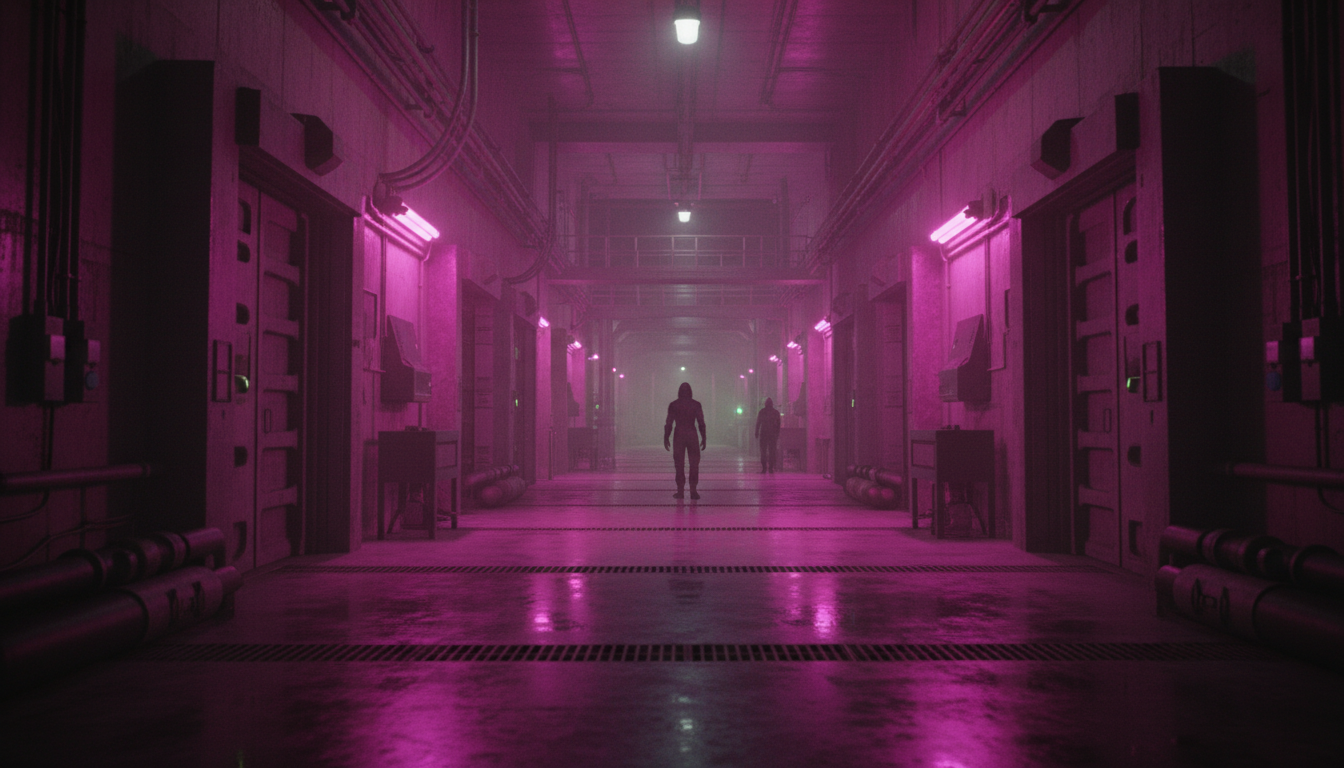
Ines Ferrer wrote the operative clause because Nnamdi had asked her to put a thing in a book that could not be argued with, and she had done this sort of work before, and the before was a ranking, and this was a door. She sat at the desk in the transfer gallery with Calder's trip in a fair copy and Halima's minute in the back and four hundred names she flatly would not put on a wall — and she saw the omission immediately, exactly the way she saw a column that had never once been opened.
The clause said when. It said the four primary vertical arteries sealed on their own authority. It said the counties held their own air. It said a yes reopened them and a silence did not. It did not say a word about the person who was not in a county.
She wrote it in the margin first, because a margin is not a law and a law was what they were asking for:
Nothing here accounts for a citizen caught outside. Pad. Flats. Walks without a plate. A ranking in a vehicle. A person who went up to look at a sky. Flag. Ferrer.
She took the flag to Nnamdi before she took it to the room, because a flag that becomes a speech in a gallery is a flag that will lose for the wrong reason.
Adaeze had already written outside = ? in the second volume in a hand that was carefully not a heading — because Adaeze had been on the sponge when eleven died and in the hole when four hundred died, and she had learned to put a mark wherever a clause was thin. Ines looked at the mark and did not tell her to make it prettier. Pretty is precisely how a hole quietly becomes a feeling.
"You can put it in now," she said, "or you can defer it to a revision, and the revision will not come. Sow said so; she has watched a later not come. I have watched occupancy close while a published complement still read ten. I am not going to perform surprise if you defer. I am going to write that you deferred. That is the only later I can keep."
Nnamdi read the margin. He had four hundred in the back of the book and a default he had voted against and a gallery that had already stood under a lock. He said: "If I put a surface exception in tonight I am putting a mouth on the trip. The mouth is a person on a pad who radios a yes, or a plate that waits for a vehicle, or a walk we have not plated. All three of those were day 188. I am not going to write a kindness that is a delay with a different name. Flag it. Defer it. I will sign the deferral. I will not like it. Liking is not a column."
Renata said: "A deferral is a decision. Write it as a decision. If you write it as a later I will spend eighteen months on a clause and the sky will not wait. The sky did not wait; four hundred are a clinic copy. The people outside are not a rounding error. They are also not a door I can hang tonight without hanging Sow's override in a different coat. Fetch me when you have a revision. I am telling you now there will not be one. Put that in the book so that I am not a prophet. I am only a person who has watched a later die of a heading."
Ines wrote the deferral in the flat register — four lines, signed by her, unsigned by Calder, because a hole in a clause needs a column and he was not a column.
Operative clause: four arteries close on own authority, reopen on positive return, silence sealed. Surface persons: flagged, deferred to revision. No revision date. Sow's minute in the back. Okonjo's no in the back. Ferrer, day 191.
There was no revision. There has never been a revision. The flag is still in the front of the second volume, in Ines Ferrer's hand, and every surface death on that planet for fifty-five years falls through the hole it marks, and the hole is still there.
Adaeze copied it into the second volume in the hole, under a yellow that was still a dusk, and said: "You hate this."
"I hate that I am good at it. That is a different hate. Pack the clause. If a person comes to the desk and asks what happens if they are on the flats when the trip sits, I will give them the ranking and the vehicle and Dov's spare crate, and I will not give them the clause, because the clause does not have them. I would like that in the book now, before the first person asks, so that nobody can say afterwards that I did not know."
The first person asked that afternoon. The woman from district two hundred and nine, the one who had asked whether 64 meant the door was open, stood under the new slate and asked what the slate did if she was in the wet.
"It closes," Ines said. "It does not account for you. I have flagged that. There is no date on the flag. I am sorry that is the sentence. It is the only one that is not a when."
The woman looked at the slate exactly the way people had once looked at 95,441. She did not shout. She took the sentence, and went off to find a compartment that was a county — which is the only answer the clause was ever going to give her. Ines put that down as the first time the omission had done any work at all, which was not remotely a comfort, and which was a column.
Halima came up on the next vehicle with a scan crate and a look that was decidedly not permission. She stood at the desk and read the flag and the deferral and did not say I told you. She had told her. "Keep it in the front, not only the back," Halima said. "If it lives only next to my minute it is a medical complaint. If it lives next to the clause it is a hole in a law. I lost the door. I will not lose the hole. Put the flag where a pad officer can see it without having to open Sow."
Ines moved the flag up. She marked the moving. She did not call it a revision. Revision was the thing that was not coming.
Dov brought the safety-seat of it in person. "A vehicle on the pad when the trip sits is a vehicle on the wrong side," he said. "I want the spare crate still inside. I want a clock that is not a yes. I cannot get a yes off a pad if the trip has already decided the pad is weather. Write that the rota comes in before a morning that looks calm. Write that calm is not clearance — Kenji has written it twice already. I am asking you to put it beside a hole in a clause so that a pad officer is not the later that does not come."
Ovid Tenn, who logged sentences when officers did not tell him not to, logged that one. Ines let him. A log that sits beside a hole is still not a filling.
She put it beside the hole. She did not fill the hole. Filling the hole would have been Halima's override in a coat Nnamdi had already refused to hang. She marked the putting-beside. She did not call it an exception; exception was a word Renata would have had to live with for eighteen months.
Calder came through the gallery with a fitting wrapped in a cloth and did not so much as look at the slate. He had made the trip; the clause was simply the trip written into a book; and mixing the two is exactly how a clerk becomes a story about a man. Ines did not stop him. She wrote, after he had gone: the man who made the trip did not read the hole. I am not going to make him. The hole is mine to keep empty on purpose until a revision I do not believe in. Ferrer.
Kenji sent a note up from the Earth mouth: Trip sat in a drill last night. Empty. No stack. Plate dropped without a shout. Mix held. I hate it and I am keeping it. The hole in the clause is the walks and the pad. I cannot certify a person in either. Arata. She copied it. She marked it. She sat with the clause and the flag and the four hundred and the empty column, and then wrote out the sentence she had been trying not to write since Halima had told her to flag it now.
They will not revise it. I am the person this ship hands a hole to. I have handed the planet a list and a door and an omission. The omission will have a body. I am going to keep the flag. I would like that in the book while I still know the later is not coming.
She marked it. She did not correct it. Adaeze, in the hole, would copy it into the second volume when the next vehicle came, if the trip let a vehicle come.
Ines Ferrer, who had once given a woman a book instead of an answer, had now given a planet a clause with a person missing out of the middle of it, and the missing was the kindest thing available to her under a default she had not voted on, and it did not feel kind in the slightest. She went back to the desk anyway, because somebody was already standing there with a trade and a slip and a question about whether the Ark was a yes. She said the Ark was a reserve and a hospital and a lifeboat, and that it was emphatically not a door for a person on the flats. The Ark went over, bright and slow, about ninety minutes later. Nobody in the gallery pointed at it as a way out yet. They would eventually, and when they did, the pointing would be at a hull that could not hear a pad either, and all of that would be perfectly true, and none of it would be a revision, and the clerk kept the flag anyway, because the flag was what she had, and because a planet that can stack a morning needs a book considerably more than it needs a later.
Chapter 32 — The Forest Is Load-Bearing
↑ Back to ContentsFocus: the trees are a lung. the filing is equivalent to a person. not a faith.
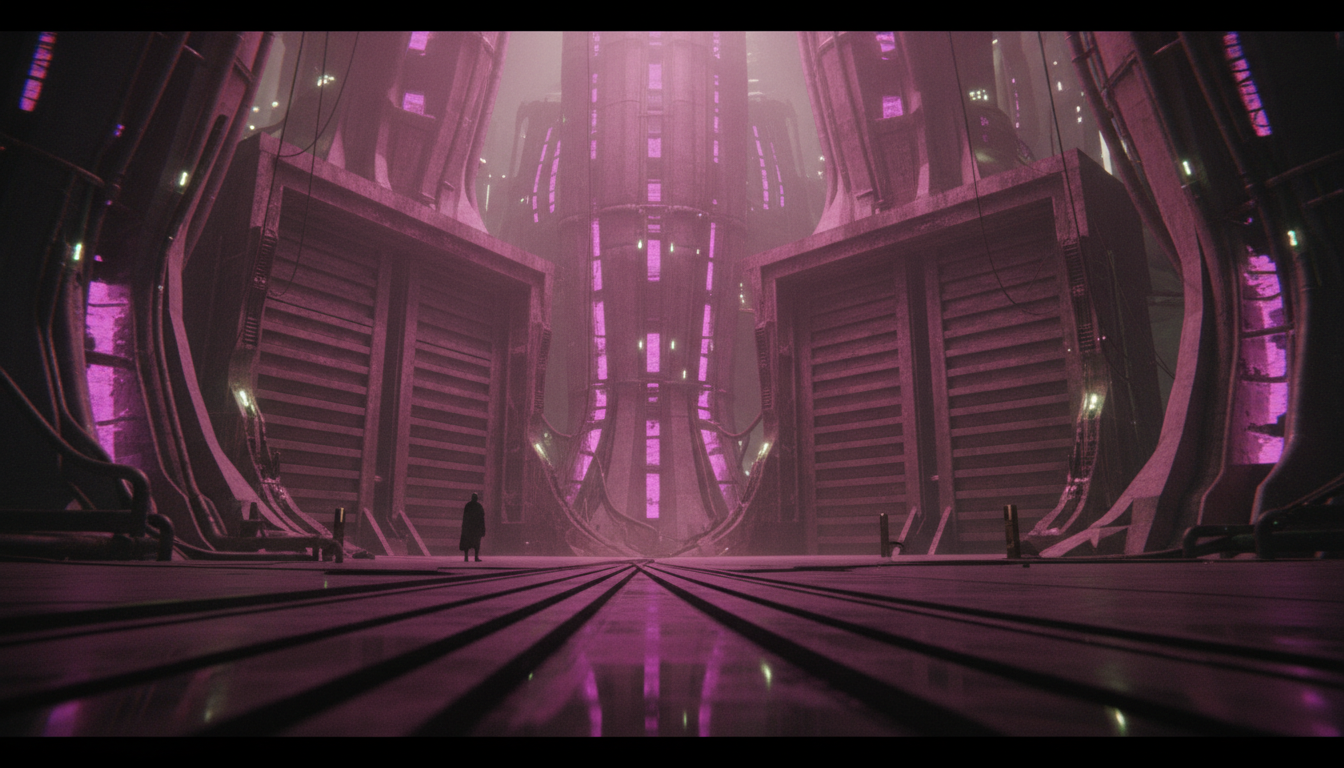
Miriam Achebe asked for the forest to be a person, and Nnamdi Okonjo looked at her as though she had asked for a window, and she said it again without the word person, because person is a later charm, and what she actually had was a lung four hundred kilometres from a plate that would not hear a pad.
"The only untaxed air any of us has ever sat in is inside the trees," she said, in the ring-two volume, under a protocol that had just learned to close without asking. "Kenji wrote it. The haze goes into the leaf. The leaf vents what we can breathe. The flats stack; the hole does not. If you cut that forest for a ranking or a pad or a pretty, you cut the lung that is not a plate. I want it written as a dependency and not as a feeling. Feelings lose to arithmetic. Lungs should not."
Kenji signed the fractions to her sentence. Sixteen point something inside the trees, the old tax simply gone, methane eaten, sound eaten, a hole in a haze the size of a country. He had sat down in it himself. He had not made it a walk for forty thousand people. He said: "I can certify the interior as the only mix on this planet that is not a tax. I cannot certify a people walking there in ten minutes. The legal thing is not a park. The legal thing is: do not spend the lung."
Renata, who had refused to decorate a ranking and refused to decorate a lock, did not refuse this. She said: "Equivalent to a person is a filing I can hang. Spiritual is a later I will not draft. Write: the forest is load-bearing. Harm to it is harm to a lung the counties do not own. Penalty later. Teeth now. If somebody calls this a woven anything in a hundred years, they can copy the fractions first."
Ines looked at woven and did not write it yet. She wrote: Black Velvet Forest: load-bearing. Origin: oxygen, methane sink, Arata / Achebe. Not a park. Not a charm. Harm flagged as harm to a person for the purpose of the book. Ferrer. She marked it. She did not correct it. She did not write soul.
Nnamdi pinned it beside the Protocol, because a people who had just accepted a door that did not hear them needed to see the lung the door was for. He said it out loud in the gallery, which was the only form he trusted.
Adaeze stood under the pin with the second volume and read the heading twice. She said: "If I copy equivalent to a person, a ranking will ask me which person. I need a sentence that is not a who."
"The sentence is a meter," Miriam said. "If the methane in the trees goes up, the lung is sick. If the sound starts coming back, the lung has been cut. If somebody takes a saw to it, I will bring Kenji's optical to the gallery and I will not be kind. Who is the forest? Nobody. That is exactly why it needs the filing. A nobody cannot stand in a room and lose to arithmetic. I have stood in rooms. I have lost. The trees will not be asked to vote."
"It is not yours to cut," Nnamdi said in the gallery. "It is not a county. It is not Mars and it is not a cheap hole. It is the reason a plate has anything to hold. If you take a saw to it you take a saw to a person as far as this book is concerned. I am sorry if that sounds like a sermon. It is a meter. Arata has the meter. Achebe has the leaf. I have the pin."
The gallery made the noise Dov much preferred to silence. Dov wrote noise, asking, forest, not a when. A man from eighty asked whether he could walk in it. Miriam said he could walk in it with a rope and a face that had been properly told the radios would die, and that he could not live in it, and could not take it home, and could not hang a dusk in it. The dusk was a lie they had already hung. The trees were not a lie. She was not going to make them one.
Sefu, who had taken five people in on a rope and watched Voss sit down on the floor of it, said flatly that the grammar for a forest is not the grammar for a hole. "You can hear yourself in a shaft. You cannot in there. If you put a ranking in the trees I will not be the man who teaches it manners — manners require a sound that comes back, and it does not come back. That is the hazard. That is also the lung. Both true. Adeyemi." Ines copied both true.
Calder came through with no fitting and dirt on his knees. He listened to load-bearing the way he listened to a tray. He said, "Leave it." He had said leave it to a shaft-note; he said it to a forest. Miriam did not ask him what he was growing at First Ground. A tray is a tray and a lung is a lung, and mixing them is how a gardener becomes a story about a man.
The heading arrived the way headings always arrive: Adaeze needed a line that could live next to the Protocol without actually being the Protocol. She tried forest rule and it looked like a park. She tried Achebe's lung and Miriam told her sharply to take her name off a tree. She tried the woven balance, in lower case, because the trees are a weave whose surface you cannot see, and the balance is simply the meter — methane in, oxygen out, sound in, nothing out. Ines looked at it for eleven seconds and wrote it up.
Woven Balance. Instrument, not a faith. Forest load-bearing equivalent to a person. Breach is a meter, not a prayer. Achebe / Arata / Ferrer. Day 198, year 41.
Renata said: "Somebody will make that a pillar. Write that it is a dependency now. I cannot bind a future embarrassment. I can bind a present lung." Ines copied the present lung under the heading and deliberately left pillar off. She had no column at all for a hundred years. The Woven Balance is now the second of the four pillars of the Resonant Way, and it is taught to children on that planet as a reverence, and the fractions sit in an appendix nobody reads.
Kenji asked whether the trip should sit if the forest was the thing breached and not the flats. Miriam said yes: a cut in the lung is a morning even if the flats look perfectly calm. Soma said she could hang a meter at the boundary if Haddad left her a seam that far out, which Haddad flatly would not, not this year, not a kilometre. They hung a meter as far as the line would carry. The trip learned a second yes — degradation at the flats, or a hole in the weave that is the trees. Ines put both trips beside the clause. She did not put Sector on it; sectors were a later map. The trip did not need a number. It needed a forest and a mix.
Haddad walked the boundary with the crayon that was not chalk and marked the seams that would carry a meter without also carrying a ranking into the trees. "If you put a people in there to save a lung, you will lose the people and then the lung," she said. "I will give you a line. I will not give you a road. A road is a cut. A cut is the thing we have just made illegal in a book." Sefu massed the meter so that it would not walk. Tenn logged boundary meter, not a pad, officer Haddad, leave the trees. That was the afternoon, and it was a lung with a trip on it, and Miriam took it gladly, because a trip is uglier than a prayer, and uglier is precisely what had kept four hundred from becoming forty thousand.
Laleh Voss, who would willingly enter a mouth and would not under any circumstance enter the trees, said from the Earth curtain: "If you make a law out of a silence I will not come to court. I will tell you the silence is a hazard. You may file the hazard as a person. I am filing it as a set that dies." Miriam said both filings could perfectly well live. Voss did not come to court; there was no court, there was a book. The book had a heading that would one day be spoken in a cold synthetic voice into an ear that had not yet been born, and Miriam Achebe did not know that voice, and she hung the heading anyway — because a lung that is only a feeling always loses to a ranking, and a ranking had already lost eleven and four hundred, and she was not going to lose the trees the same way.
At the end of the third she stood at the boundary with one foot in violet and one foot in shadow, exactly the way Sefu had stood, exactly the way she had stood at eighty with Tenn, and she took the element off four hundred metres in, where the taste simply is not there, and breathed the only untaxed air on the planet, and did not clap. She wrote, for Ines, because Ines had asked her for a sentence that was not a heading:
I asked for a person. I got a filing. The filing is a lung. The spirituality can arrive later to explain a rule that already had a meter. If they weave a faith out of this they can copy the four hundred first, and the eleven, and the zero on the flats. The trees are not a comfort. They are the reason a plate has a job. Achebe.
Ines copied it. She marked it. She did not correct it. She did not write faith. The Ark went over. The forest ate sound and ate methane and vented a mix a person could sit in, and a protocol sat on a trip that had learned the weave as a second morning.
Miriam Achebe put the element back on at the boundary, where the burnt sugar returns like a fact, and went down into a dusk that was a lie, and pinched a tray that was crowding, and did not pinch what was only ugly, because the ugly would still make a leaf — and a leaf under a fake evening is still not a forest. She knew that perfectly well. She kept the filing anyway, because a filing was what she had, and because a planet that would not give her a true sky had given her instead a lung that swallowed one, and she was not going to let a ranking spend it.
Chapter 33 — Aura Kush
↑ Back to ContentsFocus: the ship's indica mutates in the true light. it will not burn. they call it the silence.
Aurelio Calder found it the way he found most things that mattered — with his hands in a tray, at night, without a works order, the units at the wall doing nothing because he had not asked them.
The Indica had come down in a crate out of the vault, which he held, which nobody asked him about any more, and which Miriam had asked about exactly once in a hull and had never asked about again. He had been growing it steadily since the crossing. The machines had helped, and then they had not, and they stood at the wall in a tent at First Ground precisely the way they had stood in a bay, and he thinned, and pinched, and never pinched what was only ugly.
He had put a line of it outdoors, because a tent is a lie in exactly the way a dusk is a lie, and he wanted to know what a blue star actually does to a plant that has been a ship's plant. The ultraviolet did what ultraviolet does, which is not a speech. The leaf shed its green and went dark — matte, a black that eats twilight the way the forest eats light — and along the stems a frost came steadily up, neon-violet, dense, a resin that glowed a little whenever the eighteen hours of day had the manners to dim.
He pinched a bud. It did not smell of burnt sugar. It smelled of pine, and of a cold that was not the dry county. He took it up to the grow bay in the hull, because a test that is a fire is a test he would not run in a tent beside forty thousand people, and he put a flame to it, and the flame sat on it and did not take it, and he took the flame away, and the bud was still a bud — ugly, unburnt, a resin far too dense for a clean combustion. He sat down, which he did not often do at a plant.
He did not ask a unit. He warmed it the other way instead — a low heat, the kind a tray already understands — and the resin let go a vapour, violet-tinted, cedar and night, and he breathed it, because he is precisely the sort of man who puts a thing in his own mouth before he puts it in a book. The frantic thing that lives at the back of a crossing, which he did not name and had not named for some years, went abruptly quiet. Not gone. Quiet. A clean descent into a twelve he had not been able to take since Kenji's lighting trial first taught a hull what thirty-six hours actually feels like.
He took it to Halima before he took it to Ines, because a quiet that sits on a brain is either a medicine or a harm, and she would tell him which without a heading.
Kenji was in the clinic for the lighting trial he still could not finish. He looked at the bud exactly the way he looked at an optical. "If it stacks a lung I will take it off the rota," he said. "If it only stacks a thought I will take it. I have been awake through thirds I was not built for. I am not going to be precious about a vapour that does a twelve." Calder did not answer; answering is a speech. Halima told Kenji to sit down and be a sample, which Kenji recognised immediately, and which he did, because he had sat in a lock for three twelves and he knows a sample when he is one.
She sat with it in ring two, load on the bunk, element off, and breathed what he had breathed, and looked at him the way she had looked at him when he had a strap for a machine and she needed a strap for a bone.
"Insomnia is a county," she said. "Kenji is a county. The thirty-six-hour clock is a county. If this shuts a racing thought without shutting a lung I will sign it as a drug that is a function. I will not sign it as a sky. Do not put it on a poster. Put it in the clinic. If Nnamdi names it I will take my name off the scan."
"I am not naming it," Calder said.
He went to Miriam with a stem and did not explain the vault. He put the stem on her crate in the dusk. She looked at the black leaf and the violet frost and did not ask why he had the accession; she had asked once. She said: "It will not burn."
"No."
"Good. I have had enough of mornings that take a leaf. If it grows in the true light I want a line at First Ground and not in my field. Your light is not my light. I will not have a medicine crowding a food. I will take a cutting if Halima signs. I will not take a story."
He left her the cutting. He went back to the outdoor line and thinned it on his knees in the hanging dust, element on, because Halima's rule is a rule even when the plant in question is a quiet, and the units did nothing at all, and Sefu walked past with mass on a sled and did not ask what the black line was, because a cut is a cut and a tray is a tray, and mixing them is exactly how a survey becomes a story about a man.
Soma came, because a thing that will not burn is a thing a foundry badly needs to know about. She put a flame to a bud on the works bench at one seven, and the flame sat on it and did not take it, and she put the flame away and said: "If this gets into a pour I will throw it the way I throw a cot. If it stays a clinic I will not. Do not weave it. Do not tell me why you have a bank. I am the rock. You are the tray. That is still true." He did not tell her. She went back to a pour that sat. The units at the wall of the shaft did nothing; he had not asked them.
The name arrived the way names always arrive, which was not from him. A woman on the foundry crew, coming off one seven onto a stool, breathed the vapour Vega had begun putting in the side cut because Halima had signed a function, and said, not at all loudly: "That's the silence." Tenn logged it. Ines copied: Ship's indica, surface-mutated, resin will not burn, vaporises low, clinic function for the clock. Called the Silence in the hole. Not a poster. Calder to keep the line. Ferrer. She did not write vault. She did not write why. She marked it. She did not put Founder on a bud.
Park asked whether it would grow in a wetland. Miriam said not in hers. Halima said not in a lung. The line stayed at First Ground, outdoors, true light, black, frost — a field that glowed a little when the dim had manners — and Calder walked it every third the way he walked a tag in frames eight to eleven: with his own hand, at night, without a works order.
Adaeze, copying occupancy, asked once whether the line should be a heading. Ines said a heading would make it a programme, and a programme would make it a ranking, and a ranking would put it above air. She would not put a quiet above air. The quiet lived at the bottom, with load, last, a function that did not get to eat a week.
Nnamdi did not name it in the gallery. He pinned the clinic function next to load at the very bottom of the ranking, because a medicine that eats a cell will eventually eat a ranking if it is allowed to live at the top. People came off shift and sat with a diffuser exactly the way they had once sat under a fade, and the racing about thirty-six hours slowed, and Kenji, who still could not sleep through a lighting trial, sat with it once and did not hate it, and put it in a note as not a lung, a twelve I can take. Do not mix with a stack. Arata.
In the first week of the function, Halima brought a slate that was not nineteen and was not four. Sleeping more. Not enough. More. She took more. She told Ines not to put up a little on a poster. Ines did not. She put the Silence under load and left it there, last — a quiet that did not get to eat air or filter or pad.
Calder did not come to see the slate. He was in the line, in the dim, in the frost, pinching. The units had not moved; he had not asked them. A woman from the Earth dusk stood at the tent mouth and asked whether the black was a crop she could have. He said, "Clinic. Sow." That was all she got. It was enough. She went to Sow. Sow signed a function and not a field.
Dov asked whether the cadre briefing had covered a plant that will not burn. Calder did not come to the briefing. Nnamdi said put the Silence in tonight as a clinic tool and not as a crop you smoke on a walk, and Dov did, and a woman from two hundred and nine asked whether this meant the door was open. Ines said no. Ines said it was a quiet. The woman took the quiet. She did not take a window.
He grew it. That is the chapter. The rest is a line of black at First Ground that the true light made, and a resin that would one day fill a car with a neon-violet mist on a mountain road nobody had cut yet, and a people with mass insomnia who adopted a function because a function was what they had.
Aurelio Calder, who held a vault he would not explain and a tray he would not delegate, pinched what was crowding, and did not pinch what was only ugly, because the ugly would still make a frost, and he put two of the pinched leaves in his pocket and did not explain the pocket, and nobody asked him, and the units at the wall did nothing, and the Ark went over a field that glowed a little in the dim, purple if you knew exactly where to look. He did not look up. Looking up is a when, and a when was the only crop he ever refused to thin.
Chapter 34 — A Generation Underground
↑ Back to ContentsFocus: children in the dusk who have not seen the sky they were brought here for.
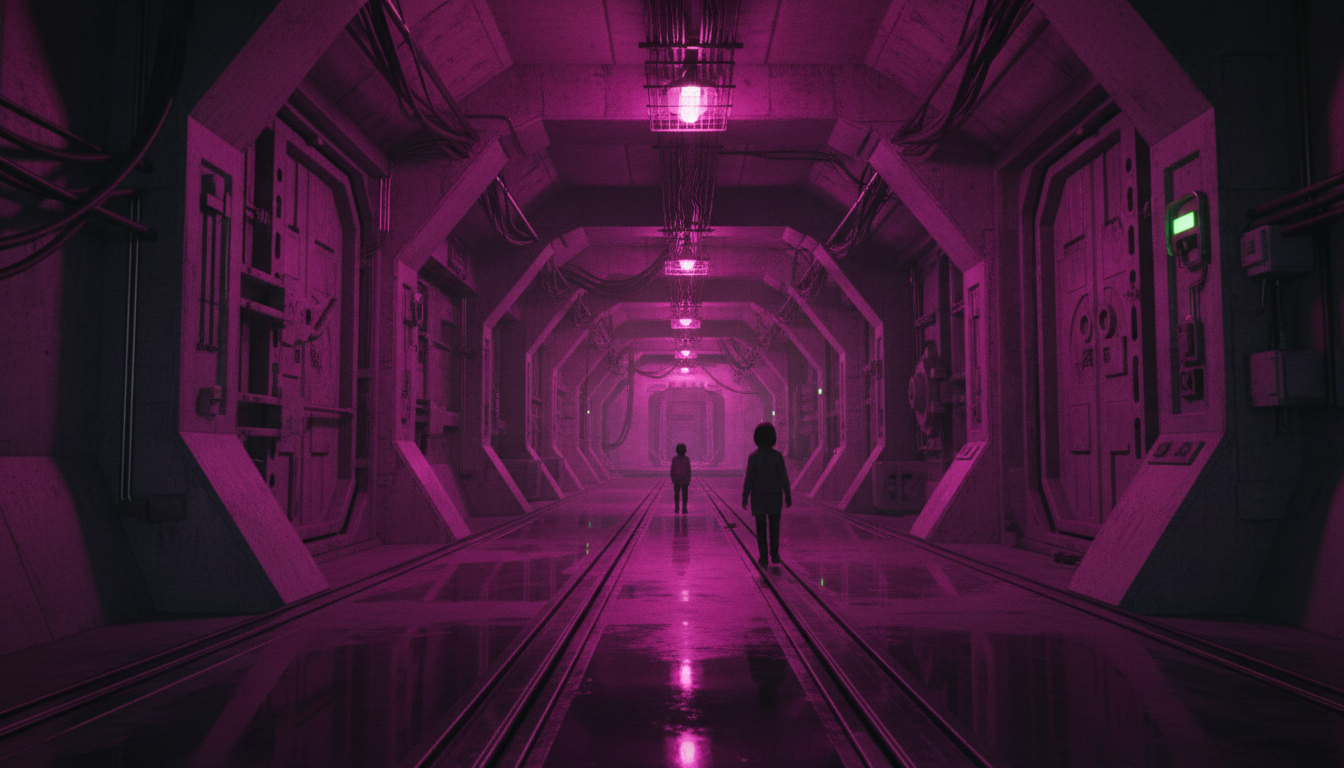
Waking Manifest · Year 44, Day 12 · Authority: standing, unsigned
Ines Ferrer closed Part Two exactly the way she closed occupancy — with a line that looks precisely like an ending and is not — on the twelfth day of the forty-fourth year, five years after a hull had become a city and three years after a hole had drunk a morning. She wrote the line in the same hand, and the line sat there on the page, and a child stood under the bar with a woman from district two hundred and nine and asked why the sky was a tube.
The woman said, honestly, that she did not know. Ines did not offer the Manifest as a comfort. The Manifest was forty thousand people let out of a hull into a rock; it was not a sky and it was certainly not a when. The child had been born in Earth Sector under a yellow that was a lie, at one, with a hum in the teeth; had been carried through a curtain that would never hear a pad; had never once stood in burnt sugar; had never heard a forest eat a clap; and had never seen the Ark go over except as a story a clerk flatly refused to tell as a door.
There were children now. Not many. Halima scanned them as though they were a new ugly she could live with provided it had a name, and she had a name for it. She did not put them on a ranking. She did not put them on a pad. The Protocol did not have them. The flag in the clause did not have them. Ines kept the flag. The later had not come. She had known it would not.
The hole was a civilisation, if you were willing to call a dusk and a rust and a pour and a pulse a civilisation. Earth hummed at one. Mars stayed cheap. Venus threw cots and Soma still threw them back. The twelve verticals carried a nuisance and a magenta that people timed their walking to against standing orders. The four lungs sat on a trip that did not ask. The eight walks had plates now, most of them, because day 188 had been a lesson a rope simply could not hold. The forest was a filing equivalent to a person. The Silence sat in side cuts and quietly shut down racing thoughts about a clock. The wheat was not zero in the lie. The wheat was still obstinately zero in the true light. Miriam would not translate either number into hope.
A day in the hole was three twelves. Active, if you had learned the word from a hull that had not yet actually used it: a ranking, a cut, a scan, a dusk that was a machine. The second third was a walk timed to one point two against Sefu's slate. The third was a twelve Halima had finally begun getting people to genuinely take, because a people who sleep in a mask inside a rock start to believe the rock itself is a stack. Kenji had certified a sleep without an element behind a plate. He had not certified it on a pad. The pad was still weather. The trip still sat empty rather more often than it sat true — a mercy that does not feel remotely like one when you are telling a child they cannot go up.
Nnamdi still flew eleven hulls, unreplaceable. The ranking was still weekly. Fifty-five thousand were still a city in a hull. He still did not take the maps down. He still said seats and not a when. The gallery still did not shout. Silence in a hole had become a people who asked about a tube and not about a door, which Dov wrote as asking, smaller, not consent, and which Ines copied, and which was not a comfort.
Renata walked the counties once a year and still flatly would not call them home. She had written shelter out of the minute; she had never written home in. She told Ines, at the crate: "You have a generation that will think a mesh is a sky. That is not a failure of the mesh. That is a success of a door that does not hear. Fetch me when you want a law that lets a child go up. I am telling you that you will not want it while the trip sits. I am not a prophet. I am a person who has watched a later die."
Halima's hips were a county by then. The EMS was a rota. The Bone Lattice was not yet a word. She strapped. She scanned. She lost arguments to numbers and prepared the berth anyway. She held a child in ring two at a load a femur would believe, and sent it back down into a dusk, and did not put the child on a sponge, and wrote, for Ines: they will not know the tax as a taste. they will know it as a story. I do not know which is worse. Sow. Ines marked it. She did not correct it.
Kenji certified mixes. He still would not certify a sleep without an element on the flats; the flats were weather. The trip had sat empty eleven times since day 188 — drills, no stack, plates dropping without a shout — which he hated and kept. Voss held a set and would not go into the trees. Traore massed what walked. Bekele named chews and then stopped naming them, because a department had begun to want the names.
Calder grew a black line at First Ground and thinned trays in a tent and a side cut and a bay, units off, a leaf in his pocket, no explanation. Ines still kept his age column empty on purpose. She still did not write Founder on a works order. He still did not read the hole in the clause. The hole was still empty. The flag was still in the front, where a pad officer could see it without opening Sow.
Sefu's grammar held. Spoil would not sit. Drills walked unless they were massed. Stand beside a plate. Leave the seams. Four lungs, eight walks. Do not clap in a pipe. Do not work the Two-Beat. Do not loiter in a vertical. Do not stand under a when. Adaeze copied the grammar into the second volume as though it were a law. It was better than a law: it could be shouted across a mouth.
Ovid Tenn logged the first birth exactly the way he had once logged a crane, which was entirely without a speech. Earth dusk, year 42, day 11. Live. Sow present. Not ranked. Not a pad. Officer said keep CLEARED off this one. It was never a bay. Ines copied it under occupancy and deliberately did not draw a line; a line would have looked like an ending. Occupancy was still 95,441. A birth in a hole is not a waking, and she would not put a child into a counter built for sleepers let out.
The woman from two hundred and nine, who had asked for a window at 64, held the child under a yellow and did not ask for a window. She asked whether the tube would still be a tube when the child could walk. Ines said yes. She said it in eleven seconds. She marked it. She did not correct it.
The child asked again why the sky was a tube. Ines said: "Because the other sky stacks, and a door we built will not open for us if we are under it, and I flagged that, and nobody revised it, and you were born anyway." She said it directly to a child, which was not kind, and which was a column. The woman from two hundred and nine put her hand on the child's head and did not ask whether 40,000 meant the door was open. She had asked that at 64. She had learned.
Dov asked, because Dov always asked, whether the cadre briefing had covered a generation that had never seen a sky. Nnamdi said put it in tonight. Tonight was by then a year of nights. Dov wrote it anyway: children, hole, no pad, no ranking, sky is a mesh, trip sits, flag kept. Ines copied it under the close. She had no column at all for a briefing that was late on purpose. Late had been a county. Late was now a childhood. She kept the copy. She did not make it a poster.
Ines wrote the close of the volume in eleven seconds, because it was a fact and not a speech.
Hole is a people. Surface not allowed. Protocol in force, no surface exception, flag kept, no revision. Forest load-bearing. Silence in the clinic. Children in the dusk who have not seen the sky they were brought here for. Occupancy 95,441. Descent 40,000. Dead 11 + 400. Instrument: weekly ranking, finite hulls, trip without a mouth. I have no column for arrived. Ferrer, day 12, year 44.
She marked it. She did not correct it. She went back to the desk, because week two hundred and something was already a slip in a hand and the hand was standing there.
The Ark went over — bright, slow, a reserve and a hospital and a lifeboat — and from inside the hole you could not see it at all, and the not-seeing was the occupancy of an entire generation. Part Two of a founding is exactly that. It is not a door. The clerk kept the column anyway, because the column was what she had, and because a planet that can stack a morning needs a book considerably more than it needs a child to be told a when.
Chapter 35 — Thermal Survey
↑ Back to ContentsFocus: twelve deep shafts commissioned into the mega-ravine floor, hunting geothermal capacity for the grid
Sefu Adeyemi took the works order down to the ravine because a grid that is already poured still wants a heat nobody has yet given it. Nnamdi Okonjo had pinned a map that was not the coastal map and not the county map — a third pin, a line running along a floor that lies a drop below summits Kenji flatly would not certify as a lung — and the pin said geothermal, and geothermal was a budget, and a budget is a rota, and a rota is people, and Sefu was invariably the man they handed a hole to when the hole was supposed to be ordinary.
It was not the twelve. He said so in the briefing until his mouth was genuinely tired. The twelve were transit: unshielded, an organ Voss had named a nuisance, curtains on four and ropes on eight. These were an entirely different twelve. Deeper. Down into the mega-ravine floor, hunting a heat Soma could actually seat a cell in, a line of bores the survey model insisted would find gradient at depths a transit shaft would dismiss as a later. He said it to sixteen faces in a lander on a shelf that was not First Ground and not the sponge — a basalt ledge with a drop on three sides and a cold Halima had already written up as a different ugly from Tunnel Ache.
"These are not walks," he said. "These are not lungs. We are not hanging a dusk in them. We are cutting for heat. If you treat them like the verticals I will take you off the carriage and put you on bags. The grammar still holds: ballast, bags, beside, leave the seams. New line: the bottom is a different air. Kenji will tell you that when he has a number. Until he has a number you come up when Sow says, not when you feel heroic. Heroic is a when. I am not cutting a when."
Imani Cole laughed once, shortly — which went, and came back off the shelf, because this is not the forest — and said: "You have twelve again."
"I have a budget that bought twelve holes in a line," Sefu said. "I do not have twelve finishes. Some of these will be started and left. The model is a model. If you finish one in a month I will not love you for it. If you leave one as a mouth that is capped I will love the cap. Tenn will log the cap. Ferrer will copy the cap. A cap is a fact. A finish is a feeling."
Ovid Tenn, already logging: ravine floor, thermal, Adeyemi. not transit. twelve commissioned, not twelve promised. officer said some left. That was the morning, and it was a rota, and Ines had signed the rota in the hull as thermal survey, ravine, Barua to take heat, Adeyemi to cut, Arata mix, Sow scan. Not a county. Not a lung. Origin: grid. Ferrer. She had marked it. She had not put a when on it.
Nnamdi came down on the first vehicle, because he would not let a third pin exist only in a book. He stood on the shelf in the thin cold and said the number out loud to a drop that was not going to be impressed.
"Twelve shafts. Geothermal. A line. This is industrial work. It is staffed, it is scheduled, it is budgeted. If you ask me when the grid gets its heat I will give you a rota and not a when. If you ask me whether these are the verticals, they are not. I am sorry if two twelves is a joke. It is the only count the rock will take in a year I can pay for."
The gallery, up in the hole, would see a slate, and the slate would look exactly like a ranking. It was not a ranking. It was a crew list: cut, ballast, line, mix, scan, log. Cole, Haddad, Rangi, Traore, Novak, Santos, Tenn. New names Ines had taken from a week that still had air at the top: Emeka Okoro, Linh Nguyen, Rosa Fernández, Marek Kowalski, Lemlem Abebe. Twenty-four if you counted the officers. Sefu did not count the officers. He counted the people who would actually be in a hole when a hole was only a hole.
Yara Haddad walked the floor with the crayon that was not chalk and marked a line running along the ravine the way the columns run under First Ground — not the same line, a cousin — seams to leave, seams a bit could safely take. "If you cut the magnetite here you make Soma walk a kilometre she has already refused to walk," she said. "Leave it. Heat is a depth, not a seam. I can give you a depth. I cannot give you a road into a lung. The lung is four hundred kilometres that way and it is a filing. This is a budget."
Soma sent a meter and did not come the first week, which Sefu put down as a foundry that still threw cots. The meter said gradient the way a meter says weight: as a number a person can copy. Expected. Ordinary. He copied it. He did not love it. Love is a when.
They cut One on a third that was daylight on the shelf — eighteen hours of a blue you simply cannot look at — and the bit walked until Traore massed it, and the plates came up as plates, and falling at a third was still a slow insult, and Okafor, who had been arrived at once already in a chimney, stood well to the side and was not arrived at, which Halima put down as a scan she did not have to run. Spoil would not sit. It hung in the ravine air, which is thinner than the flats and appreciably colder, and Bekele bagged it half-full, because a full bag at that weight still has the manners of a balloon, and the sled wanted badly to fly toward the drop, and they put mass on the sled, and the sled became a sled again. That was One. One was a hole. One was supposed to be a hole.
Lemlem Abebe asked, because a new name always asks, whether One would get a curtain. Sefu said no: a curtain is a lung, and a lung is four of the other twelve. This was heat. Heat does not get a dusk. Heat gets a cap when you are done, or a cap when you are not, and both caps are a fact. She wrote it on her glove. He let her. Gloves are how new names learn a grammar without a gallery.
Kenji stood at the mouth with the optical and certified the shelf as the old tax — reduced, not gone, not a stack, not a forest. "If the trip sits, you are on the wrong side of a clause Ferrer flagged," he said. "Spare crate in the vehicle. I am not certifying a sleep on this shelf. I am certifying a twelve with an element and a vehicle attached. If you feel heroic about a bottom you have not seen, come up. Heroic is Mensah. I have written Mensah."
Sefu put that on the mouth slate under the grammar. Dov asked whether the cadre briefing had covered a third twelve. Nnamdi said put it in tonight: thermal, ravine, not transit, not a county, come up when Sow says. Dov wrote it. Tonight was still a little late. Late is the job.
Halima scanned the twenty-four before the second third. Hips. Heads. The particular dry of a shelf that is not a tunnel yet. She took two off the carriage and put them on bags. "I will not argue with you about a meter," she said. "I will argue with you about a femur on a scaffold over a drop. These two stay on the shelf — strap, four twelves, then we talk. If you put them in One this week I will put my name next to the injury and I will not be kind in the note."
He took them off. He marked the taking-off. He did not call it HELD. HELD was still a column nobody was going to invent for a femur.
Calder came on the last vehicle of the first week and did not take a tour. He stood at the mouth of One with his element on and looked at a hole that was a hole, and put a palm on a column, and did not ask a unit to bite. The units at the wall of the lander did nothing. He said, "Keep it boring." Sefu took that as an order and as a warning and did not ask which.
Item nineteen was already in the book. Dov had logged it four years earlier as a two-count, planet-wide, no structural implication, and the crane had subsequently taught them all that the wet is a very different drum, and the rock was still logged quiet. Sefu did not put a meter on One to find a song. He put a meter on One to find a heat. The meter duly found a heat that was exactly a model. Tenn logged: One: gradient as predicted. quiet as logged. no structural. officer did not clap.
Ines's runner brought the week's seats down on a slip: two vehicles for the shelf; a hundred and eight after the spare still belonging to counties and pads; twenty-four for thermal, because thermal was a function the grid could not do without for seven days if you ranked heat under food, which she had, last, beside load — because last is precisely how you keep a survey from quietly eating a ranking. Sefu did not go up to argue twenty-four. Twenty-four was what a shelf could teach without becoming a camp. He sent Haddad's line-copy up instead, so that the book would have a grammar and not merely a feeling.
At the end of the third he stood on the shelf with the drop on three sides and the thin cold in the element and clapped once, against the transit rule, purely as a test — because this was not a pipe yet, it was a mouth in a floor — and the clap went down One and came back like a hole, which was all he wanted from it. Cole did not laugh. Haddad marked Two. Traore put mass on the bit for the morning. The dust hung over the ravine exactly the way spoil hangs over a chimney, a sheet that would not sit.
Sefu Adeyemi, who had been ranked survey and had become a man who teaches holes manners, put the manners on a slate in the same hand he had used for a rope in a forest and a scaffold in a vertical, and sent the slate up, and did not go up with it — because the line was the work, and the work was not a when, and a when was the only thing he refused to commission, even when the commission was twelve.
Chapter 36 — Shafts One Through Six
↑ Back to ContentsFocus: six shafts, six unremarkable results. deliberately dull
Waking Manifest · Year 44, Day 70 · Authority: standing, unsigned
Two through Six are the chapter, and the chapter is a rota, and a rota is a thing you can hand Ines. Sefu Adeyemi handed her six holes that did what the model said, which is the only kind of luck he would sign, and which the people who have already read a later book will not believe was luck, because they are waiting. Waiting is the whole of the work. The work was dull on purpose.
He said dull in the lander on the morning they marked Two. Cole had already been calling the first week the dullest work on the planet. Sefu put it on the slate underneath the grammar: Dull is a fact. If we call it a wonder we will schedule a later. I will not schedule a later. I will schedule Two when the rota says Two. Adaeze copied dull into the second volume exactly as though dull were a heading. Ines left it standing. She had learned by then that a heading which holds a boredom is a heading that might just keep a people from inventing a song.
Two: they cut it three mouths down the line from One — Haddad's crayon leaving the seam, Novak's bit walking until Traore massed it, plates coming up as plates, spoil hanging in the thin cold precisely the way it had hung over One, Bekele bagging half-full because a full bag at that weight still wants the drop. Gradient as predicted. Tenn logged quiet. Cole did not laugh. They came up at the end of the third with hips Halima would call tired and not injured. She scanned. Hips held. Heads held. The dry of a new hole was Tunnel Ache's cousin and not its name. Kenji certified the mouth as the old tax. Spare crate in the vehicle. No stack. No song. Sefu clapped once at the end of the third, a test he had already run on One, and the clap came back like a hole. He wanted a hole. He got a hole.
Okoro asked, standing beside the plate the way the grammar requires, whether Two would be left or finished. Sefu said finished is a feeling: Two would be a mouth with a heat Soma could put a number on, and then it would wait behind whatever she had in a foundry, and waiting is not leaving. Leaving is a cap. He would cap when the budget said cap, or when a meter said stop, and neither had said it. Okoro wrote it on his glove under Abebe's line about curtains. Gloves were still how new names learned.
Three: much the same, with a sled that flew once toward the drop because Kowalski had not got the mass on in time, and became a sled again under bags, and Kowalski swore, which went and came back off the shelf, and Abebe wrote the grammar out on her other glove, and Halima took Kowalski off the carriage for a third and put him on bags — not for the swearing, but for the femur that had decided to become a question over a drop. He hated her thoroughly from the thin cold. She accepted it. Three finished on the next third. Gradient as predicted. Ines copied Three: as Two. Ferrer. She marked it. She did not decorate it. Decoration is exactly how a budget becomes a story.
Miriam sent bread that was still frankly a stretch. They ate it in the lander with the burnt sugar sitting on top of it — item fourteen, still the smell of a world you cannot stand on for a day — and Cole spat and then ate it anyway. Rangi said the bread was the only thing on the shelf that had a county. Sefu said the shelf is not a county; the shelf is a ledge with a drop on three sides and a rota. Rangi ate. The Ark went over, slow and bright, a reserve they could plainly see from a ravine they could not live in, and nobody made a speech about it. Tenn logged the going-over exactly the way he had once logged a crane.
Four: Rangi asked whether they could plate the scaffold purely as a kindness. Soma's answer came up on a slip from the foundry, which still threw cots: no. heat is not a county. do not make me cool a kindness in a ravine. Barua. Halima put stretchers native g on the slate. The bearers practised a fall that is a full twelve of thinking. Nobody enjoyed the practice. The practice stayed. Four came up. Quiet as logged. Nguyen lasted the whole third and came up talking, which Halima put down as a pass. Fernández sat down once on the scaffold and was not Voss in a forest; she was simply a person whose femur had a question in a thin cold, and Halima strapped her and did not send her back down that week. Sefu marked the taking-off. He pointedly did not call it HELD.
Nnamdi pinned four dots on the ravine map and did not take a tour. He sent a slate: four holes, heat as model, Adeyemi bored, which is the point. if the gallery asks what we found, we found a rota. Okonjo. The gallery did not shout; a rota is not a ranking. Dov asked whether the cadre briefing had covered four entirely unremarkable results. Nnamdi said put it in tonight. Dov wrote: four holes, heat as model, quiet as item nineteen, no structural, Adeyemi bored, which is the point. Ines copied it under thermal. She carefully did not mix the two-count into the heat. Mixing them is exactly how a survey becomes a story about a man who hears things.
Item nineteen was still in the book: two-count, planet-wide, no structural implication. The rock under Four was still a drum that did not matter. Sefu did not put the two-count next to the heat. Calder came once in the second week, looked at Four, put a palm on a column, said "Keep it boring" — which he had already said — and went to a tray. The units at the lander wall did nothing. Sefu did not follow. A tray is not a hole, and mixing them is a plan, and he was still refusing to be a plan.
Five: a bit walked for eleven minutes because a mass chain slipped. Traore swore in a language the shelf did not keep. Sefu put the operator on bags and made him say the four sentences to the next face, standing out in the thin cold with the drop on three sides, until the sentences were a mouth and not a feeling. Ballast. Bags. Beside. Leave the seams. The operator said them. He did not like saying them. Five finished on the next third. Gradient as predicted. Tenn logged: Five: walked, recovered, as predicted. officer did not send a gallery. Kenji stood at the mouth with the optical and certified the old tax and nothing else whatever. "If you are waiting for a mix to change you will wait a year," he said. "The soup is later. This is a mouth. I certify mouths. I do not certify songs."
Halima, at the lander, after Five: "They are tired. Not injured. Tired is a scan I can live with. If tired becomes a head I will take them off the shelf. I am not taking them off for dull. Dull is medicine. If anybody asks me for a department of dull I will put them on bags." Sefu put dull is medicine on the mouth slate. Cole saw it and did not laugh. Haddad marked Six with a crayon worn down to a stub and asked for another. Ines sent three down, ranked under load — because a crayon is how a seam stays a seam, and a seam that is not left is a later Soma will have to walk.
Six: they finished Six because the budget said six before seven, and because a line that stops at five looks unmistakably like a feeling. Six was a hole. The meter found heat. The heat was a number Soma could set beside a cell she had not seated yet. She sent a second slip, still from the foundry, still not coming down: usable. not urgent. queued behind membranes, plates, a pour, a trip, a ranking, a dusk, a rust, a foundry, a coolant, a forest meter, a silence, and a child. eleven things. Six can wait. Barua. Sefu read it out on the shelf. He did not argue eleven. Eleven is a queue. A queue is uglier than a wonder. Uglier is what he would sign.
He stood on the shelf at the end of Six and looked at a line of mouths in a ravine floor — six dark circles in a rough row, not pretty, not a county, decades away from being the thing a later book would call a line of ages — and Cole said again that it was the dullest work she had done on this planet, and he said again, write that down, and Tenn wrote it. The writing of dull is the whole of the luck he would ever admit to.
Seven was marked and not cut. Haddad's crayon waited on a seam. The budget had a third left in the fortnight and Sefu would not spend it on a seventh hole, because a seventh hole in a fortnight looks like a man chasing a finish. He sent Ines a slate that was not a heading.
One through Six: holes. Heat as model. Quiet as logged. Not transit. Not a lung. Not a when. Some of the twelve will be started and left. Six can be left if Seven is a feeling. I am not cutting a feeling. Adeyemi.
Ines copied it. She marked it. She did not correct it. She did not write waiting. Waiting is a reader's job, and only for a reader who has already been told a later truth about a last crew. The clerk's job was six dots and a rota and a shelf with a drop on three sides.
A people who would one day say the last crew came up dry have, in this volume, six crews who came up talking about bags and hips and bread. That is the truth of the first six. Sefu Adeyemi kept it boring on purpose. The Ark went over a ravine that did not care in the slightest. He put mass on the bit for a morning that was not Seven yet, and he did not clap, and the dust hung, and the grammar held, and dull sat in the second volume as a heading, and a heading that holds a boredom was still the only kind of luck he would ever sign.
Chapter 37 — The Air At The Bottom
↑ Back to ContentsFocus: thick, warm, heavy air against thin cold summits. crews rotate out early and nobody thinks it is anything but the heat
The air at the bottom of Six was not the air at the mouth. Kenji Arata had said he would have a number, and he had a number, and the number was heat and thick and a weight in the chest that Halima Sow would not call a stack and would not call Tunnel Ache. Sefu Adeyemi then had to spend a week teaching a rota that a bottom is a different planet from a shelf.
Kenji stood in Six at a depth the model had called ordinary, optical in the fist again — which Halima had called a relapse and which he had not argued with — and said it to the people who would have to live it, because that is the only way a mix becomes a grammar.
"Thick. Warm. Heavy. Not a surge. The flats are a tax; this is a soup. Oxygen is not the problem. The problem is a lung doing work it did not budget for. The summits up there are thin and cold. You are going from a thin cold to a thick warm in a hole that rings. Come up early. I am not certifying a twelve at the bottom. I am certifying four hours and a scan. If you feel heroic about the soup, you have not read Mensah."
Halima put it on the slate in the lander: bottom air, Six, not a stack, not the dry. heads worse after four hours. rotate out. if they argue heat I will call it heat. it is not only heat. Sow. She deliberately did not give it a name; naming is precisely how a soup quietly becomes a department. The crews called it heat anyway, because heat is a word you can shout up a hole, and soup is a joke, and a joke in a hole eventually becomes a later.
They rotated. Okoro came up at hour three with a face the colour of a membrane reject and said it was the heat. Vega scanned him. Density held. Lung function worse than the lock-day, better than a stack. Halima took him off the bottom and put him on the shelf. He hated her from the thin cold, which she accepted, standing in the lander with the optical still in Kenji's fist and a drop on three sides that did not care about a hatred.
"You can hate me from a shelf," she said. "You cannot hate me from a bottom I have to fetch you out of. Four hours is not a kindness. Four hours is a femur I still have. If you go back down this third I will put my name next to the injury and I will not be kind in the note."
Nguyen lasted four hours and came up talking, which is the pass. Fernández lasted two and sat down on the scaffold, which was not Voss in a forest; it was a femur that had decided to be a question in a soup, and Halima strapped her and did not send her back down that week. Sefu marked the taking-off. He did not call it HELD. HELD was still a column nobody was going to invent for a soup.
"They think it is heat," Halima said to Sefu at the mouth after the first rotation. "Let them think it is heat. Heat is a rota. If I tell them it is a different ugly they will invent a song, and I have watched a people invent a song under a strip. I am not hanging a song in a ravine. Rotate. Scan. Do not be a hero. That is the brief."
Sefu put it on the mouth slate underneath the grammar: Bottom is soup. Four hours. Sow says. Heat is the word. Come up. Tenn copied it out. Cole lasted four and came up and did not laugh. Haddad lasted four and marked a seam with a hand that shook visibly, which she put down firmly to the crayon and not to the soup. Traore massed in the thick and the mass felt like considerably more mass — which was not the plate, which was simply a body doing one in a hole that was not plated — and she said so, standing in the soup with the bit still walking, and Kenji said that was the soup sitting down on a third of a gravity and making a third feel like a lie.
The summits above the ravine are thin and cold and a blue you cannot look at. Eighteen hours of it if you are on the shelf in daylight, and then eighteen of a dark that is nothing like the hole's dusk — a true dark, with two moons if the sky is clear — and Kenji flatly would not certify a sleep on the shelf without an element. The shelf was a between. The bottom was a room that badly wanted to be a lung and was not. People went down into the thin and came up into the thick and stood in the between and waited for a scan, and the waiting looked exactly like a ranking, and it was a rota. Ines copied the rota as thermal, bottoms, four hours, Sow. not a county. Ferrer.
Dov asked what would happen if a stack arrived while a crew was down in the soup. Sefu said they were on the wrong side of Ferrer's flag; spare crate in the vehicle; come up if the optical at the mouth moved the way it had moved on day one hundred and nineteen; and if they could not come up they had a four-hour lung and then they did not. He wanted that in the brief. Kenji said a bottom is not a plate, a bottom is a hole, and a hole in a stack is a chimney. Nnamdi put it in tonight: no bottoms if the flats look calm in the way Arata has written twice. calm is not clearance. Dov wrote it. Tonight was still a little late. Late is the job.
Calder came down Six as far as the soup and stood in it with his element on and did not take a tour. He put a palm on a column. The column was warm. He said, "Heat." Sefu said, "Heat." Neither of them said the other word. The units at the shelf did nothing. Calder went back up. Halima scanned him. She did not write what she did not write. She put him in exactly the same column Ines kept empty on purpose. Ines, given the scan because a founding body in a soup is a slip she would always copy, marked it and did not correct it and did not put a when on it.
Bekele, at hour four in Six, wrote on the maintenance slate: chew is different down here. not the pipe. not the sector. like the rock is a chest. still calling it heat. if I name it you will make me a department. Sefu took the slate. He deliberately did not send it up to Ines; Ines would mark a chest, and a marked chest is a song. He sent heat, rotate, Sow. He kept the chest in a pocket the way other people keep a leaf, and he did not explain the pocket, and nobody asked him — because the people who would have asked were eating bread in a thin cold and calling it heat, and calling it heat was the job.
Seven waited. Six had a soup. The model had never said soup; the model had said gradient. Gradient was still perfectly true. Soup was an extra, and extras queue behind eleven other things. Soma sent a third slip after Kenji's number: bottoms are a lung I did not budget. I will not seat a cell in a soup until Arata tells me the soup is a mix I can hang a dusk on. it is not. queued. Barua. Sefu read it. He did not argue a cell. A cell is a foundry. A foundry is not a ravine. Mixing them is a when.
Miriam's bread still arrived. They ate it on the shelf and not in the soup, because Halima would not certify chewing in a thick that makes a third feel like a lie. Cole spat the burnt sugar and ate it anyway. Rangi said the soup made the bread a county. Sefu said the soup was heat. Rangi ate. The Ark went over. Nobody made a speech.
Park Min-seo, who had come onto the shelf from a ranking that had put her under thermal because thermal was last and last is how you keep a survey from eating food, lasted four hours in Six and came up and sat down on a bag and said, very quietly, that the heat had a walk in it. Sefu told her to say heat. She said heat. Tenn logged heat. Halima scanned her and found a head that was tired and a lung that had done unbudgeted work, and put her on the shelf for a third and pointedly not off the carriage — because off the carriage is a femur and this was a soup. Park did not argue. Arguing is a when. She ate Miriam's bread in the thin cold and did not spit the burnt sugar, which Cole noticed and carefully did not make a joke about, because a joke about a person who has just come up from a soup is a later.
Ines's runner brought the week's seats: the same two vehicles, the same hundred and eight after the spare, twenty-four for thermal still, because a soup had not made thermal a county. Sefu did not go up to argue twenty-four. He sent Kenji's four hours up instead, so that the book would have a lung and not merely a feeling. Ines copied four hours. She marked it. She did not put a when on it. Adaeze asked whether soup ought to be a heading. Ines said heat was the heading; soup was Sow's column, and Sow's column was not a gallery.
At the end of the third Sefu stood at the mouth and did not clap — because a clap in soup has a walk in it he did not want Tenn logging as weather — and Cole said the dull had got heavier, and he said dull was still medicine, and they rotated out early, nobody thinking it was anything but heat.
The Ark went over a ravine that held a thick air in a hole. Sefu Adeyemi sent the heat up as a number and kept the chest to himself, and put mass on a bit that was not Seven yet, and the grammar held, and the bottoms went on making people come up early, and early was a scan, and a scan was what Sow had, and a song was what he would not give her. Ines copied early as a rota, and a rota that holds an early was still the only kind of luck he would ever sign, on a shelf with a drop on three sides, in a year that was still supposed to be ordinary.
Chapter 38 — Shaft Nine Runs Long
↑ Back to ContentsFocus: nine goes deeper than the survey model predicted. queued behind eleven more urgent things
Nine ran long, and Soma Barua found out from a slip and not from a feeling, which is the only way she was ever going to find a thing that would one day become a later. She stood in the fabrication tent at First Ground with a meter and a density profile that stubbornly did not hit what the survey model said it would hit, and she queued it behind eleven other things that were already eating cells. The queue is the chapter. The chapter is a woman who had once been wrong about a membrane and would very much rather be wrong about a rock than invent a song.
Sefu's people had cut Seven and Eight as ordinary holes — heat as model, soup as extra, rotate strictly at four. Haddad's crayon had carefully left the seams. Novak's bits had gone exactly where bits reliably go. Tenn had logged quiet. Ines had copied Seven and Eight as Two. Soma had not come down at all; the foundry was still throwing cots. A foundry that throws cots is already comfortably eleven things, if you honestly count the pour and the plates and the trip and the ranking and the dusk and the rust and the coolant and the forest meter and the Silence and a child Ines flatly would not put in a counter. Nine made a twelfth thing. She did not like twelve. She sent the slip anyway.
Nine was supposed to be the same. The model said a density floor at a depth Soma had copied in eleven seconds, standing at a bench with a unit doing nothing because she had not asked it. The bit did not hit it. The bit kept going. The profile on the slip was a line that should have turned and did not.
Tenn logged: Nine: long. density not as model. Adeyemi asks Barua. not a gallery.
She went to the ravine, because a slip is not a rock. She stood at the mouth of Nine in the thin cold with the meter and a face that meant a foundry had been left throwing cots for a day. Sefu met her with dust in his hair and a slate that was not a heading.
"It is long," he said. "I can stop. Stopping is a cap. A cap is a fact. I would like a meter to tell me whether the cap is a feeling."
"Keep cutting until I say stop," she said. "I am not saying stop. I am saying the model is a model. I have been wrong about a bottle mix; I can be wrong about a floor. If I cap Nine for a coupling I will have made a department out of a wire. Queue it. I have membranes. I have plates. I have a trip. I have a pour. I have a dusk that eats a cell. I have a forest meter. I have a child Ferrer will not put in a counter. Nine can wait in a line of eleven."
He kept cutting. She took cores. The cores were basalt. Hexagons. Magnetite in the seams, enough that a cheap compass tugged, the way it had tugged in a tent in the fortieth year when a grid was a rock and not yet a programme. She tapped two, and the tap went, almost lossless. She had written that already; she did not write it again. She wrote Nine: deeper than model, density not found at predicted floor, cores ordinary, queued.
Ines copied it under thermal. She marked it. She did not put a when on it. Adaeze said it looked like a later. Ines said a later is a heading and a queue is a number, and she kept the number.
Kenji asked whether the soup was worse in Nine. Sefu said the soup was simply the soup: four hours, Sow. Kenji took an optical to a depth well past the model's floor, climbing down a scaffold that was not plated because Soma had refused a kindness, and the mix was thick and warm and heavy and emphatically not a stack, and he wrote Nine: soup as Six, longer hole, same lung doing unbudgeted work. not urgent. Arata. He queued it behind a trip drill and a membrane rota. Eleven things. Nine made twelve. He did not like twelve either. He sent it anyway.
Halima scanned the Nine crew at the mouth and took two off for heads that were not Tunnel Ache and were not a femur. Okoro again. Fernández again. "Tired plus soup plus long," she said to Soma, who had not asked for a head and was given one anyway because a long hole without Sow is a when. "I can live with tired. I cannot live with a person who will not come up at four because the hole is interesting. Interesting is a when. Rotate. If you want a longer hole you can have a longer rota. You cannot have my femur."
Soma did not want a longer hole. She wanted a floor the model had promised, and the floor did not arrive. She sat in the lander with the profile and the eleven slips and a unit at the wall doing nothing, and did not ask it, and Calder came in with a fitting in a cloth and looked at the line that did not turn and did not ask a question.
"Queued," she said.
"All right."
He took the fitting. He did not take the profile. Mixing a fitting and a profile is exactly how a weld becomes a story. She let him go. She looked at Nine until looking had become a feeling, and then she put Nine underneath the pour and the plates and the trip, and went back to a cell that was already angry, and she did not clap into a radio, and she did not go down Nine past the soup that week — because going down past the soup for a line that had not turned is a when, and she was still the rock, and the rock does not chase a when.
Nnamdi, in the gallery, standing under six dots and a seventh and an eighth and a ninth that was a mark visibly longer than the others: "Barua has a long hole. It is behind eleven things. If you ask me what it is I will tell you it is a queue. Queues that do not end have to be visible or they become a story about who was liked. This one is visible. It is not liked. It is a meter."
Dov wrote: Nine long, queued, not a gallery, item nineteen not consulted. Sefu had not consulted item nineteen; the two-count was a drum that did not matter, and Nine was a density that had simply not arrived, and mixing the two is a song. Ines left them in entirely different columns. She had learned columns from a salar and from a ranking and from a hole in a clause, and she would not mix a drum and a floor together in order to make a later.
Cole, on the shelf, after a four-hour bottom in Nine that had not found a floor: "It is still dull."
"Good," Sefu said. "Dull is medicine. Long is a queue. Do not put them in the same sentence where Tenn can hear you."
Tenn heard him. Tenn logged: Nine: long, queued, officer said dull, not a gallery. Ines copied dull and long into different lines. She marked both. She did not correct either.
Soma went down Nine as far as the soup exactly once, with the meter and an element and a four-hour Halima had written on her glove precisely the way Abebe wrote curtains. The bit was still walking. The floor was still stubbornly not there. The soup sat down on her chest exactly the way Kenji had said a lung would sit, unbudgeted, and she took a reading at a depth the model had confidently called a floor, and the reading was a line that had simply not turned, and she came up at hour three, because hour four was Sow's number and she would not spend Sow's number on a feeling. Sefu met her at the mouth. He deliberately did not ask whether she had found a song. She would not have given him one. She gave him a number. The number was duly queued.
Miriam's bread arrived on the same vehicle that took Soma back to First Ground. They ate it in the lander and not in the soup. Cole spat; Soma did not. The burnt sugar was still item fourteen. Nine was still a slip. Mixing them is a story about a woman who hears things in a smell, and she would not be that woman. She went back to a pour. The pour sat. Nine stayed long.
Lucia Santos, who had been on the carriage since One, asked quietly on the shelf whether a long hole was a finish or a leave. Sefu said flatly that it was a queue. Santos wrote queue on her glove directly underneath curtains. Soma saw the glove and pointedly did not correct it. A glove is not a book. The book was Ferrer's, and Ferrer's book said queued, and queued was the only word Soma would ever sign, standing on a shelf with a drop on three sides, with a bit still walking past a floor that had not arrived, and a foundry still throwing cots, and a child Ines would not put in a counter, and eleven things genuinely more urgent than a line that had not turned.
At the end of the third she stood at Nine's mouth with the meter and watched the bit go past a number she had trusted — a number she had copied in eleven seconds — and wrote Ferrer a sentence that would have to live under queued.
Nine runs long. Model floor not hit. Cores ordinary. I am not stopping a bit for a feeling. I am not chasing a bit for a feeling. Eleven things are more urgent, including a child and a door that does not hear. If Nine is a later it can wait in a line. Barua.
Ines copied it. She marked it. She did not correct it. She did not write song. The Ark went over. The bit went down. The floor did not arrive.
Soma Barua went back to a pour that sat at one seven, and Nine stayed a slip in a line of eleven, and waiting was still the reader's job, and the clerk's job was a queue, and a queue is uglier than a wonder, and uglier is what she would sign — standing in a thin cold on a shelf with a drop on three sides, with a meter that had not been wrong yet and a model that had, and a unit at the wall she still would not ask, because asking a unit about a floor is precisely how a rock becomes a plan, and she was still refusing to be a plan.
Chapter 39 — The Instruments Disagree
↑ Back to ContentsFocus: seismic and resonance readings that do not reconcile. soma assumes equipment error
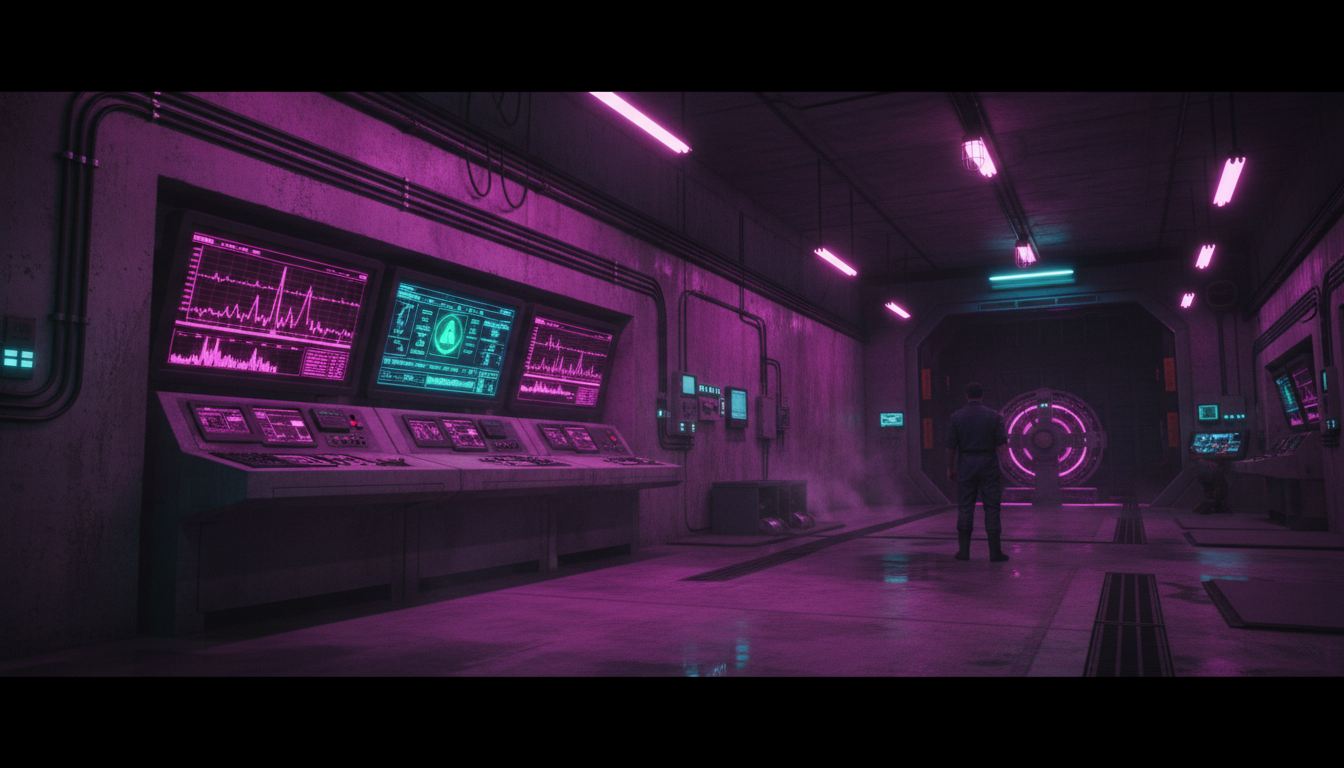
The instruments disagreed, and Soma Barua assumed equipment error — because that is what it looked like, and because a membrane had browned on a bottle mix she had trusted, and she would rather take a meter apart than take a planet's word for a song.
She said it in the fabrication tent first, to a bench and two meters and a unit that did nothing, well before she said it to a person. Seismic said one thing. Resonance said quite another. The cheap compass still tugged obediently on the seams. The tap still went almost lossless along the column. Nine's density floor still had not arrived. The two-count Dov had logged as item nineteen — no structural implication — sat in an entirely different column, and she did not put it on the same bench as the new slips, and then she did, because a person who has already been wrong about equipment puts things on the same bench precisely to see whether the wrongness is a wire.
The slips did not reconcile. Seismic wanted a mass that was not in the cores. Resonance wanted a length that was not the hole. The two-count, if you looked at it with a worse meter than Dov had had in the thirty-sixth year, was not quite the two-count. It was a cousin to it. Cousin is a word she would not send to Ines. Cousin is a song.
She took the meters apart in the tent. Tenn logged the taking-apart from the doorway, because Tenn logs a woman taking a meter apart exactly the way he logs a crane, which is entirely without a speech. She swapped crystals. She swapped leads. She put the seismic on Eight, which was ordinary, and Eight was ordinary. She put it on Nine, and Nine was a fight. She put the resonance on Six — soup, ordinary hole — and Six sang a little, which she put down confidently as the organ Voss had named in a vertical, a nuisance leaking into a thermal, a pipe simply being a pipe. She put it on Nine, and the song was decidedly not the organ. The organ has a length. This had a length that changed when she powered the meter.
She powered it down. The length went. She powered it up. The length came. She did not write answers. She wrote load-dependent artefact, suspect coupling, queued behind a pour.
Sefu stood in the tent door with dust in his hair and the thin cold still on him from the shelf. "Is it a hole I should cap."
"It is a meter I should replace," she said. "I have been wrong about a bottle. I can be wrong about a coupling. If I cap Nine for a coupling I will have made a department out of a wire. Keep the rota. Four hours. Sow. I will send a second meter. If the second meter agrees with the first I will still not believe a planet. I will believe two meters I have not trusted yet."
He kept the rota. She sent the second meter down on the next vehicle, ranked under load because Ines would not let a meter eat a ranking. The second meter agreed exactly with the first, which was the worst possible answer — which she had heard Kenji say once about a calm morning, and which she now said about a rock, in a tent, to a unit that did nothing because she had not asked it to.
Kenji looked at the slips in the lander, optical clenched in his fist, and did not like a length that changed with a load. "That is not air," he said. "I do not certify rock. If your coupling is eating my mix I want to know. If it is not eating my mix I want it off my brief. I have a trip. I have a forest meter. I have four hundred names. I am not taking a song."
"It is not a song," Soma said. "It is a disagreement. Disagreements are equipment until they are not. I am still on until they are not."
Halima, given the slips because Ines would not let a head-count live beside a meter-fight without Sow: "The Nine crew are quieter when they come up. Not sick. Quieter. I have eleven quiet people and no scan that holds a quiet. If you tell me it is a coupling I will write coupling. If you tell me it is heat I will write heat. If you tell me it is a song I will take them off the shelf and I will not be kind in the note."
Soma said coupling. Halima wrote coupling. Ines copied: Instruments disagree, Nine, Barua: equipment error, queued. Sow: quieter, no scan. Ferrer. She marked it. She did not correct it. She carefully did not mix item nineteen into the line. Adaeze very nearly did, standing at the crate with a two-count in one hand and a coupling in the other. Ines took the two-count firmly back to its own column. "A drum that did not matter stays a drum until a meter I trust tells me it matters. I do not trust this yet. Barua does not trust this yet. That is the book."
Calder came to the tent and looked at the two meters on the bench and the two slips that agreed and the unit at the wall. He picked up a core from Nine and tapped it. The tap went. He set it down. He said, "Replace the meter anyway."
"I did. They agree."
"Replace the person reading them."
"I am the person. I am not replacing me for a coupling. I am the rock. The rock does not get to be a song because a line did not turn."
He nodded. He did not take the slips. He went to a tray. She did not follow. A tray is not a meter, and mixing them is a plan, and she was still refusing to be a plan. The units did nothing; she did not ask them. Asking a unit about a disagreement is how a coupling becomes a person, and she would not give a wire a person.
Nnamdi pinned a note under Nine's mark: meters disagree. Barua: error. do not invent. Okonjo. The gallery did not shout; a disagreement about a wire is not a ranking. Dov asked whether the cadre briefing had covered a quiet crew. Halima said put coupling in tonight, not quiet. Dov wrote coupling. Tonight was late on a quiet. Late is the job. He wrote it anyway, in a book he kept privately for nights — quieter, no scan, Barua coupling, Sow heat, Adeyemi dull, item nineteen not consulted — and he did not send that book to Ines, because Ines would mark a quiet, and a marked quiet is a song.
That book survived. It is in the archive, in Dov Lindqvist's hand, and it is the only contemporaneous document in the founding that has all four of those lines on the same page, and nobody read it for eleven years.
Cole, after a four-hour bottom, standing in the between with an element on: "It is still dull. It is a quieter dull."
Sefu said: "Write dull. Do not write quieter where Tenn can hear you."
Tenn heard him. Tenn logged: Nine: meters disagree, Barua equipment, officer said dull. Ines copied equipment. She left quieter in Sow's column, where a head can live without becoming a heading.
Soma took both meters down to Eight and ran them side by side in the soup, four hours, Sow's number, Sefu on the scaffold because he would not let a rock sit alone in a hole with a disagreement. Eight reconciled. The organ was an organ. The pipe was a pipe. She took both meters to Nine and ran them side by side, and they agreed precisely with each other and not at all with Eight, and she came up at hour four with a head Halima scanned and found tired, and a lung that had done unbudgeted work, and a coupling that was not a coupling sitting in a pocket she would not explain.
"Equipment," she said to Halima at the mouth.
"I will write equipment," Halima said. "I will also write that you came up quieter than you went down. Quieter is not a scan; quieter is a note I am putting in an archive, because an archive is what I have. If quieter becomes a head I will take you off this shelf. I am not taking you off for a meter — a meter is your femur. I am taking you off if you start to love a disagreement."
Soma did not love a disagreement. She sat on the foundry stool. The pour waited. Miriam's bread was a stretch she did not eat that third. Cole, on a slip Tenn had not been asked to send, had written Barua quieter, Adeyemi said dull, not a gallery. Ines did not copy Cole. Ines copied equipment. Columns were the job.
Iosefa Rangi brought her a fitting she had not asked for, out of a tray Calder had left, and she set it down beside the meters and pointedly did not mix them. "He said you would know if you needed it," Rangi said. She did not know. She did not need a fitting for a coupling; she needed a floor, and the floor had not arrived. She sent the fitting back up on the next vehicle, ranked under load, so that a tray would not go on living on a bench with a disagreement. Rangi did not argue. Arguing with the rock is a when.
At the end of the third Soma sat on the foundry stool with both meters in her lap and a pour waiting, and wrote the sentence she would have to live next to queued.
Seismic and resonance do not reconcile on Nine. Second meter agrees with first. I still call it equipment. I have been wrong about equipment in a direction that killed a rota. I would rather be wrong that way than right about a rock that answers a load. I will not use the word answer. I will use coupling. If I am wrong, Ferrer can mark it. Barua.
Ines copied it. She marked it. She did not correct it. She did not write answer.
The Ark went over. Nine stayed long. The meters stayed in a fight. Soma Barua went back to a pour that sat, and a coupling that was not a coupling sat in a hole in a ravine, and she did not go down past the soup that night, because the person who would go down past the soup for a disagreement was not yet a crew. When it finally was a crew she would still call it equipment until equipment could no longer hold, and holding is not a plan, and a plan was the only meter she ever refused to hang.
Chapter 40 — The Eleventh Crew
↑ Back to ContentsFocus: the crew that comes up quiet. not injured, not raving. medical finds nothing
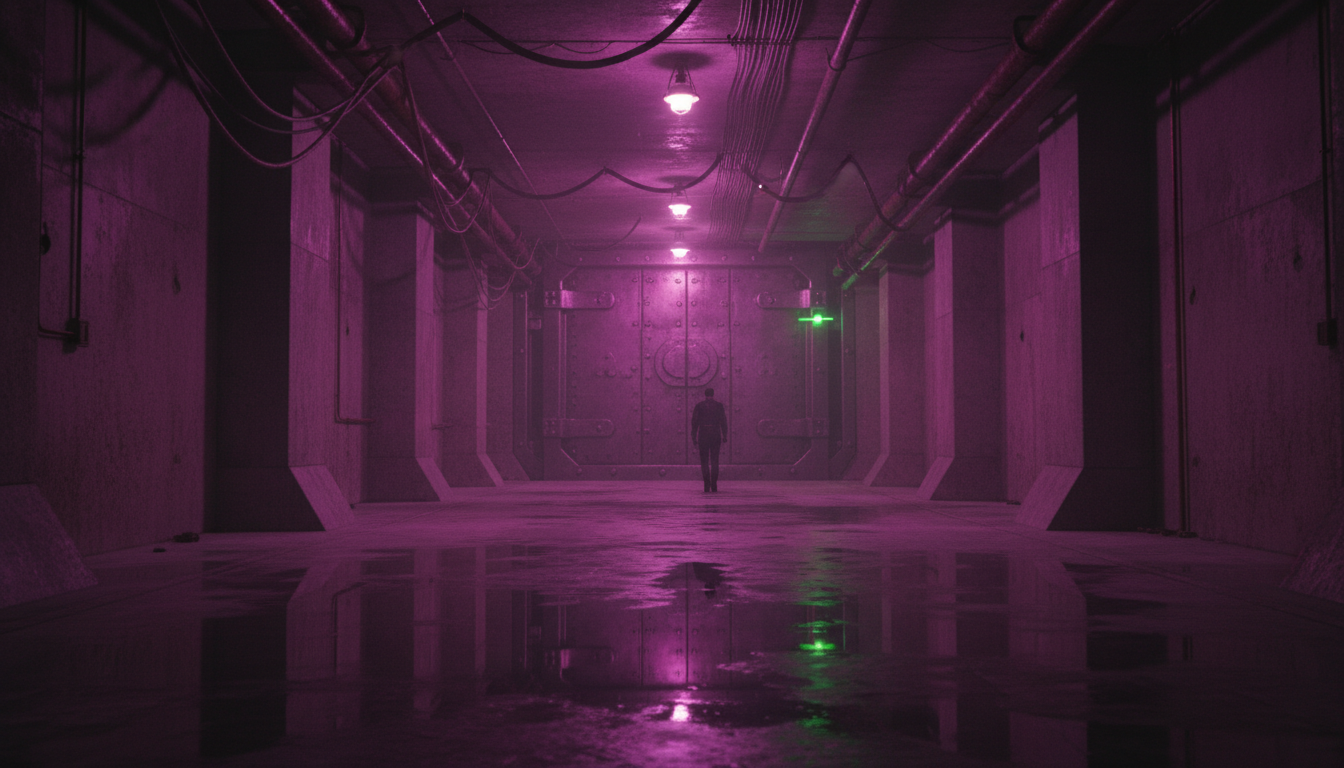
The eleventh crew came up quiet.
Sefu Adeyemi, who had spent a year teaching holes manners, stood on the shelf in the thin cold and counted eleven faces that would not give him a sentence, and he did not invent one for them, and Tenn logged the coming-up the way he logged a crane, which is without a speech. The speechlessness is the whole of the chapter, and the chapter is not a song.
They had gone down Eleven at the start of the third — a rota exactly like the others, heat as model, soup as extra, four hours, Sow. Eleven was past Nine. Eleven was a mouth Haddad had marked and Sefu had cut, because a line that stops at ten looks unmistakably like a feeling, and he would not cut a feeling, and he would not leave a gap in a budget that had bought twelve holes. Cole had called it dull. He had told her to write dull. She had written dull. Then they went down, eleven of them, and they came up at hour four, which was the pass, and they did not talk.
Okoro first. He stood beside the plate precisely the way the grammar requires, and looked steadily at Sefu's mouth and not at Sefu's eyes, and when Sefu asked him for the heat he said, "Heat," and then said absolutely nothing else. Nguyen sat down on a bag. Fernández sat on the other bag. Abebe did not write on her glove. Okafor — who had been arrived at once in a chimney four years earlier and had stood beside plates ever since — stood beside this one and was not arrived at, and did not joke about it, and pointedly did not look at the drop. Santos took her element off and put it back on, twice, as though the strap were a sentence she could not quite finish. Ibrahim, Park, Owusu, Kowalski, Gebre. Eleven. They came up. They stood. They did not rave. They were not injured. They were not anything at all that Halima's optical could hang a heading on.
"Scan," Sefu said, to Halima, who was already scanning, because a quiet that arrives as a rota is still a femur until a scan says it is not.
She scanned them one at a time in the lander, the drop on three sides, the thin cold coming in whenever the door took a breath. Density held. Lungs had done unbudgeted work, exactly the way they always do in a soup. Hips held. Heads held. No stack. No insult. No fever. No fracture. She put the optical down and looked directly at Okoro, who would not look back at her, and said: "I have nothing. I will write nothing. Nothing is not clearance. You are off the bottom — all of you. If anybody asks me why, I will say I have eleven people who will not give me a sentence, and I am not sending a sentence-less person into a soup. That is a femur. That is not a song."
Sefu asked Okoro whether he would go back down on the next third. Okoro said no. He said it once. He did not decorate it. Sefu asked Nguyen. No. Fernández. No. Abebe, who had written curtains on a glove in her first week, said no, and looked at the glove as though the glove had become a later. Okafor said no. Santos said no. Ibrahim, Park, Owusu, Kowalski, Gebre. No.
Eleven nos. Not a mutiny. Not a speech. A rota refusing itself.
Cole, who had not gone down Eleven, stood in the lander door and did not laugh. Haddad stood with a crayon and did not mark Twelve. Tenn logged: Eleven: crew up at four. quiet. Sow nothing. Adeyemi asked return. eleven no. not a gallery. officer did not clap.
Kenji took the optical to the mouth and certified the old tax and the soup and nothing else whatever. He did not go down; Halima had taken the bottoms off the brief for anybody who had been in Eleven that third, and Kenji, who had four hundred names and a trip, did not argue a quiet. "I do not certify a quiet," he said. "I certify a mix. The mix is the mix. If you want a person to tell you what they heard, I am not that person. Sow is that person. Sow has nothing. That is the brief until it is not."
Sefu put them on bags. Bags were not remotely a punishment; bags were a shelf, and a shelf is a between. They sat on bags and did not talk to each other either — which is the part he would not send up to Ines if he could possibly help it, because eleven people who will not talk to each other after four hours in a hole is a heading, and a heading is a song. He sent instead: Eleven crew rotated out. Sow: nothing. They will not return to the bottom. I am not sending them. Adeyemi.
Ines copied it. She marked it. She did not correct it. Adaeze said it looked like a later. Ines said a later is a heading and a refusal is a number: eleven nos. She kept the number. She did not mix item nineteen into the line. She did not mix Nine's coupling. Columns were the job. A quiet with no scan lives in Sow's column until Sow puts it somewhere else.
Nnamdi, given the slate because a third pin that had gone quiet was a pin he flatly would not leave only in a book, stood in the gallery under eleven dots and did not take a tour. "Adeyemi has a crew that will not go back down. Sow has nothing. Barua has a coupling. If you ask me what we found, I will tell you we found a rota that stopped. I am not inventing. Put it in tonight as a refusal, not a wonder."
Dov asked whether the cadre briefing had covered eleven people who would not discuss a shift. Halima said put nothing in tonight, because nothing was precisely what she had, and a briefing that decorates a nothing is a song. Dov wrote nothing. He wrote it in the book he kept privately for nights — eleven quiet, no scan, will not return, Adeyemi dull stopped — and he did not send that book to Ines. It is the same book that already had the coupling and the two-count in it, four pages earlier, and it is still the only place in the entire founding record where all of it sits together.
Calder came on the last vehicle of the third. He did not take a tour. He stood at the mouth of Eleven with his element on and looked at a hole that was a hole, and put a palm on a column, and did not ask a unit to bite. The units at the lander wall did nothing. He looked at the eleven on the bags. He did not ask them a question. He said, to Sefu: "Do not send another crew tonight."
"I was not going to."
"Do not send one in the morning either, until Sow has a sentence or Barua has a meter I can hold. A refusal is a fact. A fact is a cap. I am not telling you to cap. I am telling you not to spend a femur on a quiet."
Sefu did not cap. Capping is a feeling until a meter says stop. He left Eleven open and empty — a mouth in a line, soup at the bottom, four hours nobody would take. Haddad's crayon waited on Twelve and did not move. Cole sat with the eleven and did not laugh and did not ask them what they had heard, because asking is a when, and they had already given him the only word they had, which was no.
Miriam's bread arrived. The eleven ate it. They did not spit the burnt sugar. They did not talk over it. Cole spat for them, once, shortly — which went, and came back off the shelf — and nobody made a joke about a clap that had gone and come back, because a clap is a test Sefu would not run on a quiet. He did not clap. Tenn logged that he did not clap. Ines copied the not-clapping as though it were a heading. It was considerably better than a heading. It could be shouted across a mouth: do not clap, do not ask, do not send, Sow has nothing.
Halima took the eleven off the carriage for a week — strap, scan, sleep in the lander with an element, and no bottom. Gebre asked, once, in a voice that had no walk left in it, whether they would be put on a ranking. She said no. A ranking is seats. They had not become seats; they had become a quiet, and a quiet is a femur, and she would not put a femur on a weekly list. Ines, given that, left them off the ranking entirely. Twenty-four for thermal became thirteen who would still cut and eleven who would sit, and the sitting was the work now, and the work was dull in a way Cole would not write down.
Farah Ibrahim, who was not a name Ines would have picked for a later, sat on a bag with her element in her lap and looked at the mouth of Eleven for a whole third and did not go near it. Haddad offered her the crayon to mark something — anything, a seam, a grammar, a glove. Ibrahim did not take it. Sefu did not make her take it. A crayon is a sentence, and they had already given him no.
Cole brought Miriam's bread and sat on the bag next to Park and did not ask Park what the soup had done, and Park did not tell her, and the not-telling sat between them like a plate you stand beside. Sefu, watching from the mouth, put that on no slate, because a slate that holds a not-telling is a gallery, and Tenn was already logging the only fact that would bear a gallery, which was eleven nos, and eleven nos were enough.
At the end of the third Sefu stood on the shelf with the drop on three sides, and eleven people on bags who would not go back down, and a mouth that was still only a hole, and a grammar that had not failed and had not been enough. He sent the slate up, and he deliberately did not go up with it — because the line was still the work, and the work had become a refusal, and a refusal was the only kind of luck he would ever admit to: standing in a thin cold, with a quiet he would not decorate, and a later he would not schedule, and a cap he would not yet cut. Cutting a cap for a quiet is how a rota becomes a song, and he was still refusing to be a song.
Chapter 41 — Debrief
↑ Back to ContentsFocus: eleven accounts consistent in a way that no eleven honest accounts ever are. the notes go into the archive
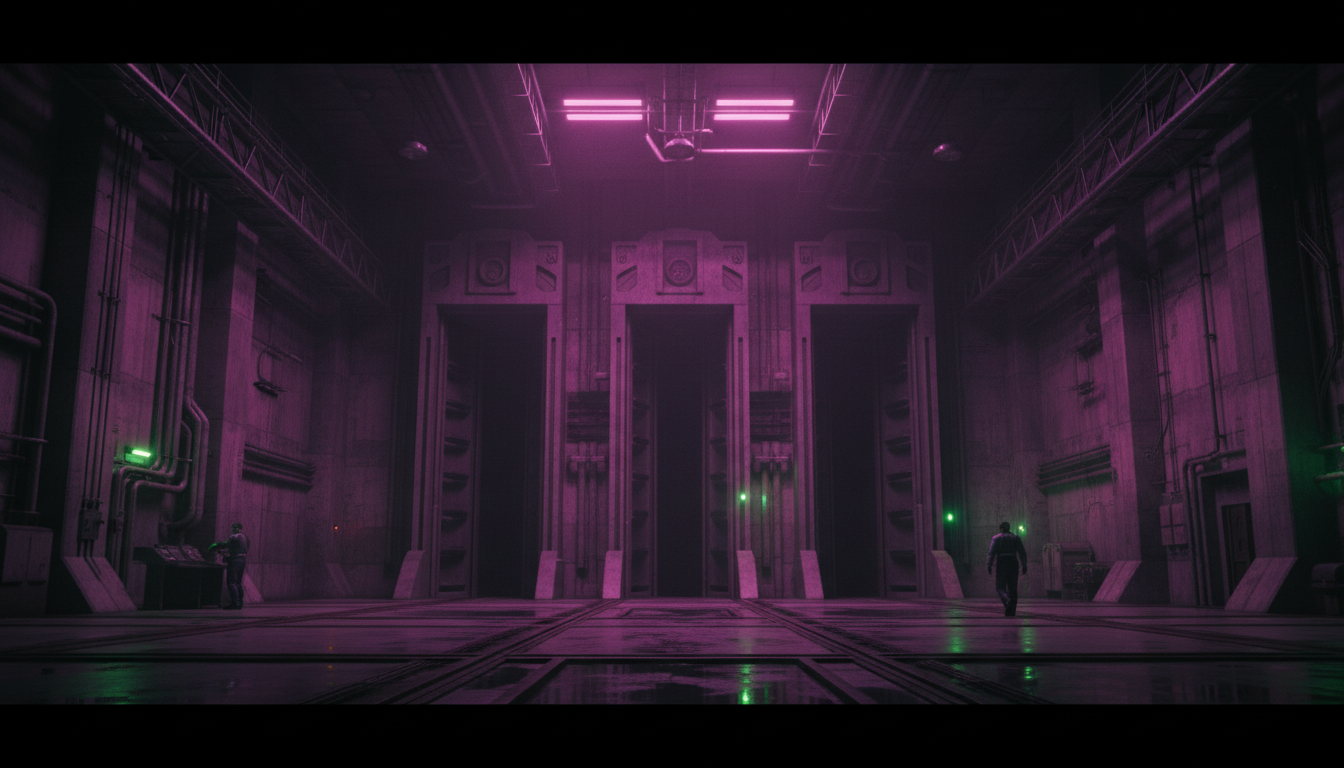
Waking Manifest · Year 45, Day 22 · Authority: standing, unsigned
Halima Sow interviewed them one at a time in the lander, which was the only room on the shelf with a door that closed, and she got eleven accounts that were consistent in a way that no eleven honest accounts ever are. She wrote that in her notes, and her notes went into the archive, and the archive is the whole of what she could do with a quiet that had no scan.
She started with Okoro, because he had been first out of the mouth, and because a man who stands beside a plate is a man who still has a grammar, and a grammar is a place to begin. She sat him on the cot. She left the optical on the bench. She did not strap him. Strapping is a femur. This was a sentence.
"Tell me the third," she said.
He told her the third. Down the scaffold. Soup at the depth Kenji had numbered. Bit walking. Mass on the bit. Four hours. Heat. Up the scaffold. Scan. Bags. No. That was the whole of the third. She asked whether anything at all had happened that was not the third. He said no. She asked whether he had heard a thing. He said heat. She asked whether he would go back down. He said no. She wrote it out. She did not decorate it.
Nguyen next. Down the scaffold. Soup. Bit. Mass. Four hours. Heat. Up. Scan. Bags. No. Fernández, exactly the same. Abebe, exactly the same, with the glove mentioned once — curtains, a word she had written in her first week and would not write now. Okafor, the same, without the chimney, which Halima carefully did not remind him of, because reminding a person of a chimney is a when. Santos, the same, with the strap of the element mentioned twice, as though the strap were the only sentence she could finish. Ibrahim. Park. Owusu. Kowalski. Gebre. Down. Soup. Bit. Mass. Four hours. Heat. Up. Scan. Bags. No.
Eleven thirds. Eleven heats. Eleven nos. She laid the slips out on the bench in the order they had come up and looked at them until looking was a feeling she would not send to Ines as a feeling. She sent Ines a number.
Eleven accounts. Consistent in a way that no eleven honest accounts ever are. Same sequence, same words, same refusal. No injury. No scan. I am not calling it a song. I am calling it a note. The note goes in the archive. Sow.
Ines copied it. She marked it. She did not correct it. Adaeze said consistent was a later. Ines said consistent was Sow's column, and Sow's column is not a gallery. She left the eleven accounts in the archive exactly the way she left occupancy in a counter: as a fact that would simply have to live next to a quiet, and a quiet that would have to live next to a coupling Barua still insisted on calling equipment, and a coupling that would have to live next to a two-count that had never mattered. She would not mix them — mixing them is precisely how a clerk becomes a prophet, and she was still a clerk.
She brought Kenji in after the sixth account — not because she wanted a mix, but because she wanted a man with four hundred names to hear a consistency and tell her, flatly, that it was heat. He listened to Park say down, soup, bit, mass, four hours, heat, up, scan, bags, no, and he put the optical on Park and found a lung that had done unbudgeted work, and he said: "Heat is a word. I will not take a word off your brief. I will not put a song on it. If they are lying, they are lying the same. If they are not lying, they have nothing I can hang a dusk on. I have a trip. I have a forest meter. I have four hundred names. I am not taking eleven heats."
She brought Sefu in after the ninth, because a rota that has refused itself is still emphatically his rota. He stood in the lander door and listened to Kowalski say the third, and he did not clap, and he did not ask a single question Halima had already asked. He said: "I will not send them. I will not send a twelfth until you have a sentence or Barua has a meter. Dull was medicine. This is not dull. I am not going to name what it is."
She brought Soma in after the eleventh, with both meters wrapped in a cloth, because a coupling that agrees with itself and not with Eight is still merely in a queue, and a queue with eleven heats sitting on top of it is a queue Ines would insist on making visible. Soma listened to Gebre say the third. She did not take the meters out of the cloth. She said: "I still call it equipment. I will not call eleven people a coupling. If you want me in the hole I will go. I will go with a meter. I will not go as a person who believes a planet. I have been wrong about a bottle. I can be wrong about a quiet."
Halima did not send her that third. A meter in a quiet is a when. She wrote the offer into the note. The note went into the archive.
Calder came at the end of the third and did not sit on the cot. He stood. He did not ask to hear an account, and Halima did not offer him one; she offered him the sentence she had already sent Ines. He read it. He did not take it. Mixing a founding body and eleven heats is how a weld becomes a story.
"Do not put them on a ranking," he said.
"I have not."
"Do not put them on a pad."
"I have not. They are a femur. A femur stays on a shelf."
He nodded. The units at the wall did nothing. He went to a tray. She did not follow. She sat with eleven slips that said the same third, and a scan that said nothing, and a head that was tired in a way no optical would hold, and she wrote, for herself, in the book she would give the archive and not the gallery:
No eleven honest people tell a day in the same words unless they have agreed, or unless the day was so small it had only those words, or unless something took the rest. I do not know which. I will not guess in a note. Guessing is a song. The archive can hold a consistency. I cannot hold a guess. Sow. Year 45, day 22.
That paragraph is the most-cited document in the founding after the Siphon clause. It is cited almost entirely for its first sentence, and the sentence people quote is the one that names three possibilities; the sentence they leave off is the one that refuses to choose between them.
Nnamdi put it in tonight as a refusal and pointedly not as a wonder. Dov wrote consistent in the book he kept for nights and did not send it anywhere. Miriam's bread arrived. The eleven ate it in the lander, one at a time, after each account, because Halima would not debrief a person on an empty gut, and they did not talk over the bread, and they did not spit the burnt sugar. Cole, who had asked to sit in, was told no — because a laugh in a debrief is a later, and Cole had already given the shelf the only joke it needed, which was dull, and dull had stopped.
She did Gebre last, deliberately, because last is how you keep a debrief from eating a person who has already given you ten thirds. He sat on the cot. He left his element on. He told her the third. Down. Soup. Bit. Mass. Four hours. Heat. Up. Scan. Bags. No. She asked him, because she had asked all of them and the asking was the work, whether he wanted a different word than heat. He said no. She asked whether the others had told him what to say. He said no.
She believed him. Believing him made the consistency worse. She wrote that down. She did not send the worse to Ines; Ines would mark a worse, and a marked worse is a song. The archive could hold a consistency. The gallery could not.
Renata came down on the last vehicle, because Ines flatly would not let eleven nos live in a book without a person who had buried everybody. Renata stood in the lander door and listened to Halima say she had nothing, and she did not make a law, and she did not call it a later dying. She said: "You have eleven people who will not go back into a hole. That is not a failure of a scan. That is a success of a refusal. Fetch me when you want a law that lets a quiet stay a quiet. I am telling you that you will want it. I am not a prophet. I am a person who has watched a later get decorated."
Halima did not fetch her a law. She put the notes in the archive. The archive was the law she had.
Ines filed the eleven accounts under thermal, under Sow, under nothing, and left them there. She did not make a poster. She did not mix a two-count. She did not write waiting. Waiting is a reader's job. The clerk's job was eleven slips that matched, and a scan that did not, and a note that would have to live in an archive until an archive was all a people had left of a quiet.
Halima Sow, who had lost a door and would not now lose a femur, closed the lander at the end of the third and sent the notes up, and did not go up with them — because the shelf still had eleven people on bags who would not go back down, and a quiet with no scan is still a person, and a person was what she had, and a person was what she would keep, even when the person would only ever give her a heat, and a heat, and a heat, eleven times over, in a way no eleven honest accounts ever are.
Chapter 42 — Soma Goes Down
↑ Back to ContentsFocus: she descends shaft twelve and turns back well above crew depth. the signal changes when her equipment draws current
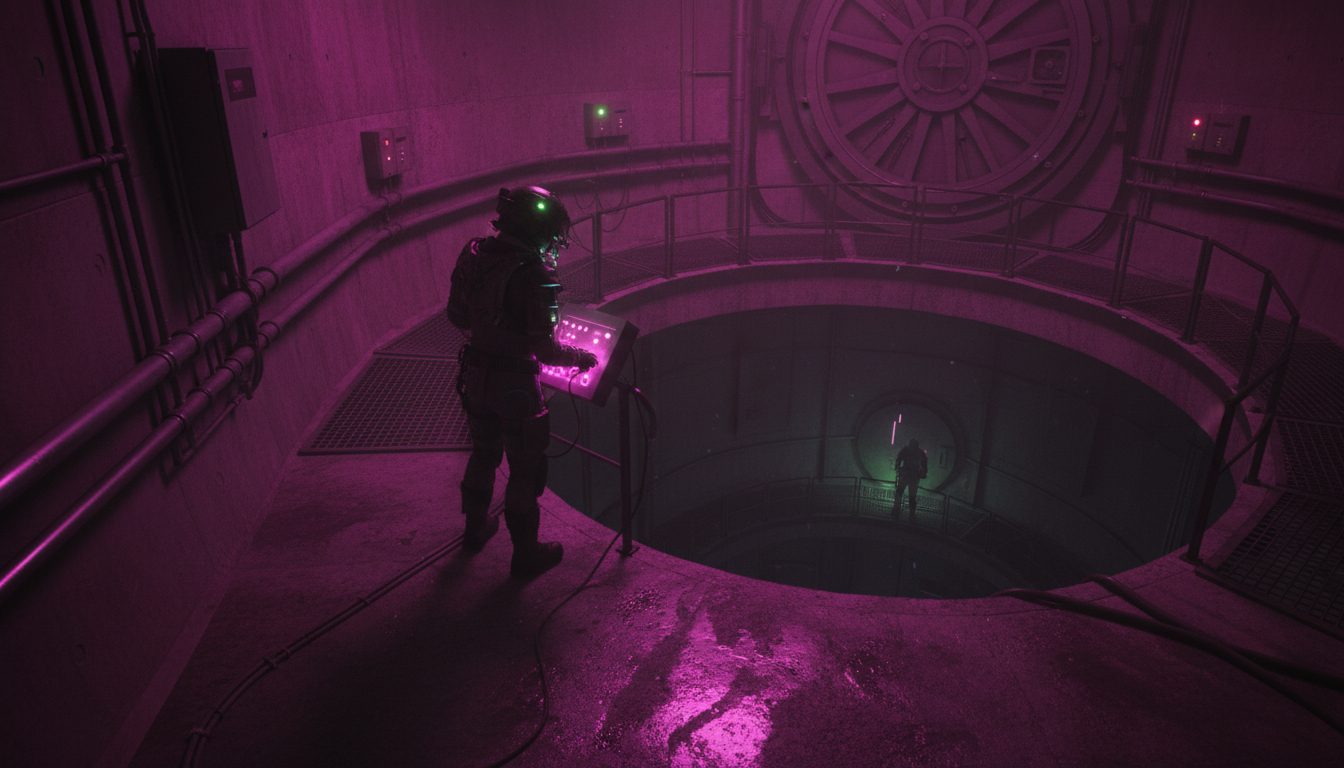
Soma Barua went down Twelve with a meter, and a second meter, and an optical Kenji had made her take. She turned back well above the depth the eleventh crew had reached.
She did not write the word the length had used on her, and she did not write why her hands stopped. The not-writing is the whole of the report. The report is a record, and a record was the only thing she would sign.
She said so to Sefu at the mouth before she went, because a rota that has refused itself still needs a person at a plate. "I am going to a depth I can hold a meter at. I am not going to their depth. If I do not come up at four, Sow is not to send anybody. Ferrer can mark that. I am the rock. The rock does not get fetched."
Halima said: "If you do not come up at four I will send somebody. I have already lost a door. I will not lose a meter to a pride. You will take the optical. You will take a crate in the vehicle at the mouth. You will not be a hero. Heroic is Mensah. I have written Mensah."
Soma took the optical and the two meters. She did not take a crew. Calder stood at the lander door with a fitting in a cloth and did not offer to go, and she did not ask him — mixing a founding body and a meter is a plan, and she was still refusing to be a plan. The units at the wall did nothing. She did not ask them. She went down.
Twelve was a mouth Haddad had marked and Sefu had not yet cut past a depth the model still called ordinary. The scaffold was not plated; Soma had refused a kindness. She climbed. The thin cold of the shelf became the soup exactly in the way Kenji had numbered it — thick, warm, heavy, a lung doing unbudgeted work — and she stopped at a depth that was still a number she trusted, well above Eleven's floor, well above a quiet, and powered the first meter.
The length came. It was not the organ. It was not the pipe. It was not seismic. It was not the two-count Dov had logged as item nineteen, though it was plainly cousin to it, and cousin was still a word she would not send anywhere. It was low. It was not random. It sat in the basalt precisely the way a pour sits in a plate: as a thing that had quite obviously been there long before she arrived with a tool.
She powered the meter down. The length went. She powered it up. The length came back. She drew more current, and the length changed. She drew less, and the length changed again. She did not write answers. She sat on the scaffold with the second meter and ran it, and the second meter agreed exactly, and the agreement was the worst possible answer, which she had already had once in a tent, and which was considerably worse in a hole — because a tent is a coupling and a hole is a chest Bekele had written and Sefu had kept in a pocket.
Her hands shook. She put that down to the crayon, exactly the way Haddad had, and then she could not put it down to the crayon, because the crayon was up on the shelf and her hands were on a meter that was drawing current, and the length was changing with the draw, and her chest was doing the unbudgeted work Kenji had named and also a work he had never named — a work that was not a stack and not Tunnel Ache and not a femur, a work that made a third of a gravity feel like a lie in a direction a soup does not account for.
She tried to go down one more landing. The landing was still above their depth. She could see the scaffold continuing: a dark that was not a dusk, a soup that was thicker, a length that was louder when the meter drew and quieter when she thumbed it off. She thumbed it on. Her hands would not take the next rung. She sat.
She sat for a count she did not number, because numbering a sit is a when. She turned the meter off, the length went, her hands were still not a rung. She turned it on, the length came, her hands were still not a rung.
She came up. Hour two. Not hour four. Early. Sow's number spent on a sitting she would not name.
Sefu met her at the mouth. Halima scanned her. Density held. Lung unbudgeted. Hands shaking. Head tired. Nothing that would hang a heading. Calder stood in the lander door and looked at her and did not ask a question. She did not give him the word. She gave Ines a record.
Twelve, above crew depth. Low-frequency, non-random, not coolant, not drills, not seismic. Changes when the meter draws current. Second meter agrees. I turned back. I did not reach their depth. I will not use a word I do not have a scan for. Equipment is no longer the whole of it. I still will not say the other word. Queued is no longer honest. Ferrer can mark that. Barua.
Ines copied it. She marked it. She did not correct it. She did not write answer. Adaeze said turned back was a later. Ines said turned back was a number: hour two, above a depth, two meters, a current, a change. A clerk can hold a change. A clerk cannot hold a word Barua will not use.
Kenji looked at the optical log and the mix and the hour and said: "She came up. That is the brief. I do not certify a length; I certify a lung. Her lung did unbudgeted work and then she sat. Sitting is Sow. If you want a person to go to their depth you are not asking me. I have four hundred names. I am not adding one for a rung she would not take."
Halima put Soma off the bottom for a week — strap, scan, sleep in the lander, and not Twelve. "You will not go back down this week," she said. "You came up quieter than you went down. Quieter is a note. I have eleven notes already and now I have yours. I will not stack a twelfth quiet on a meter. If Calder wants a depth he can argue it with me. He will not argue it with your hands."
Soma sat on the cot and looked down at her hands. They were a rung she had not taken. She did not ask Calder why his hands would take it. She had seen him in a soup with a palm on a column and an element on and a scan Halima would not write; she had seen him stand in a foundry with a fitting after a pour that sat at one seven; she had seen him not age, in a column Ines kept empty on purpose. She would not put any of those facts in a report. A report is a length and a current and a sitting. A report is not a person. Mixing the two is precisely how a rock becomes a plan.
Nnamdi pinned a note under Twelve: Barua down, turned back, above crew depth, meters agree, word not used. do not invent. Okonjo. Dov wrote turned back in the night book. Sefu left Twelve open and empty exactly the way he had left Eleven — a mouth in a line, a scaffold continuing down into a dark he would not send a crew into, not tonight, not in the morning, not until a meter he could actually hold said stop or a person he would not name said go. Haddad's crayon waited. Cole did not laugh. Tenn logged: Twelve: Barua up at two. above crew. officer did not clap. not a gallery.
The climb down had been a grammar she already knew perfectly: ballast on the person, bags at the landings, beside the scaffold and never under it, leave the seams Haddad had marked. Twelve was not plated. The bit had not walked far. The hole was still a hole Sefu would once have called dull, if dull had not stopped. She counted landings exactly the way she counted cells — by hand, because a hand that is counting will reliably notice when it stops being a hand. She noticed. The meter noticed first. Then the chest. Then the hands. The hands were last, which was the only mercy in any of it, and mercy was not a word she would send up to Ines, because mercy is a song, and a song is what the length would become if she let a person into the report.
Cole, who had not been allowed down, stood at the mouth with Tenn and did not laugh when Soma came up at hour two. Haddad put the crayon into Soma's pocket without asking, and Soma left it there; a crayon is not a meter. Miriam's bread was sitting on the bench. Soma did not eat it, and Halima did not make her. Calder did not offer the fitting; the fitting stayed in the cloth and the cloth stayed in his hand. The units did nothing. Nobody asked them. Asking a unit about a sitting is how a rung quietly becomes a person.
The eleven were on bags twenty metres away — people who had already been where she had not, and who would not tell her what the next landing was. She did not ask them. Asking is a when, and she had already turned back.
At the end of the third Soma sat on the foundry stool that was not a foundry, on a shelf, with both meters in her lap, and did not power them, and wrote the sentence she would have to live next to a quiet.
It changed when I drew current. I sat. I came up. I did not reach them. I do not have whatever I would need to reach them. I will not name what I do not have. The record is the sitting. If I am wrong, Ferrer can mark it. Barua.
Ines copied it. She marked it. She did not correct it. The Ark went over. Twelve stayed a mouth. Soma Barua did not go back down that night, and her hands remembered a rung, and the length, which she flatly refused to call an answer, sat in a hole in a ravine, and the people who had already reached a depth she had not sat on bags and did not talk, and the clerk kept the columns, and the rock, who had turned back, kept the record. The record is not a song, and a song was the only meter she still refused to hang.
Chapter 43 — It Is In The Rock
↑ Back to ContentsFocus: the signal is present in the basalt network well beyond the shaft. the horror is retroactive
The signal was in the rock.
Soma Barua found that out with a meter she took off the shelf and put on a column that was not a shaft — a kilometre along Haddad's line, in a side cut that was not Twelve and not Eleven and not Nine — and the length was there. Low. Not random. Quieter than in the hole. Present.
The finding was not the horror. The horror is entirely retroactive. It had been sitting there the whole time they had been on that planet, and they had only just built instruments good enough to hear it. Item nineteen had been a drum that reportedly did not matter, and it had mattered all along. She had queued it patiently behind eleven other things, and the eleven other things had been a child and a door and a pour, and the pour had sat, and the rock had been doing this quietly underneath the sitting the entire time, and she had confidently called it equipment, and equipment was no longer a word she could possibly hang.
She did not say singing. She said present. Present is a record. Singing is a song.
She stood in the side cut with both meters and Kenji's optical and Sefu at the plate — because Sefu would not let a rock sit in a cut alone with a disagreement that had become a presence — and she powered the first meter, and the length came, and she powered it down, and the length went, and she walked another hundred metres of column, and the length came again, load-dependent, cousin to the two-count, not the two-count, not the organ, not the pipe. In the basalt network, well beyond the shaft.
"It is not the hole," she said to Sefu, who already knew, standing in a cut that had no soup and still had a length. "The hole made a meter I could hold. The rock was already doing it. We have been walking on it. We have been pouring on it. We have been hanging dusks on it. We have been ranking seats over it. We have been putting children in a yellow lie over it. It was here."
Sefu said: "Write that down. Do not write it where Tenn can turn it into a gallery. Ferrer can have it as a presence. I will not put a presence in a briefing. I have eleven people on bags. I have a mouth I will not send a crew into. A presence is a cap. I am still not capping. Capping is Ines. Finding is you."
She wrote it. She sent Ines a record that would have to live next to turned back, and next to eleven heats, and next to a coupling she could no longer hang.
Signal present in basalt beyond the shafts. Side cut, one kilometre off Twelve, no soup, same low-frequency non-random, load-dependent. Presumably present since landing. Item nineteen is cousin, not the thing. I queued a floor behind eleven urgents. The floor was not the finding. The finding is that we have been living on it. I will not personify it. I will not name it. Ferrer can mark the queue as a failure of urgency, not of character. Barua.
Ines copied it. She marked it. She did not correct it. She sat at the crate with Adaeze and did not mix the two-count into the line for a long minute — and then she mixed it, because a clerk who had kept columns through a stack and a trip and a door that would not hear cannot keep a drum in a separate book once a meter she trusts has called it cousin.
She wrote: item nineteen, cousin, Barua. not structural implication, Lindqvist, year 36. implication now: presence. Ferrer. She did not write song. She did not write waiting. She wrote presence. Presence is a fact, and a fact is a column. That single line is the join between the two halves of the founding archive, and Ines Ferrer wrote it in eleven seconds after four years of refusing to.
Kenji, given the side-cut mix — which was the old tax and emphatically not a soup — said: "Then it is not air. I have been certifying air. I will keep certifying air. If your presence eats my mix I want it on the brief. If it does not, I want it off. I have four hundred names. I am not taking a planet that was always here. Always is Sow. Always is a head. I do not certify heads."
Halima took the note and the eleven accounts and Soma's sitting and the side cut and laid them all out together on the lander bench, and pointedly did not turn them into a heading. "Always is a head," she said. "I have eleven people who went into a hole and came up with exactly one word. I have a twelfth who sat down on a rung. I have a rock that was already here when Mensah died, and when four hundred died, and when a child was born under a strip. I cannot possibly scan always. I can scan a femur. The femur is: nobody else goes to their depth until I say so. Barua does not go. Adeyemi does not send. If Calder wants always he can come to the cot and tell me exactly why his hands would take a rung hers would not. He will not tell me. I am writing down that he will not tell me. The note goes in the archive."
Calder came. He did not tell her. He stood in the side cut with Soma and put a palm on the column and did not power a meter. The units at the cut mouth did nothing. He said: "Keep recording. Do not name it. Do not send a crew. I will not send one either, tonight."
Tonight is a word with a morning in it. Soma heard the morning. She did not argue a morning; arguing a founding body is a plan. She recorded. She did not name it.
Nnamdi, in the gallery, under a line of dots that had become a presence: "Barua says it was always here. If you ask me what we do with always, I will tell you we do not invent. We keep the rota visible. We keep the quiet off a ranking. We do not make a poster. Always is not a when. I will not give the hole a when."
Dov wrote always in the night book, and then struck it, and wrote presence, and then sat with the strike and the presence and item nineteen — which he had logged as no structural implication in a year when a crane had taught them a second beat — and he did not send Ines the strike.
Miriam, given a presence because Ines flatly would not let a forest meter live beside a basalt length without Achebe, said the forest eats sound and methane and had not eaten this, which means this is not a sound in the way a clap is a sound, and she would not translate a length into hope, and she would not translate it into a prayer either. The Woven Balance is a filing. A filing is not a presence. She sent bread. The eleven ate it. Soma did not.
Cole asked, up on the shelf, whether the dull had all along been a lie. Sefu said the dull had been six holes that did precisely what the model said; the model had never said a presence; the dull had been true and was simply not the whole of the truth. He would not put that in a sentence where Tenn could hear it. Tenn heard him anyway. Tenn logged: side cut: present, Barua. officer said dull was true. not a gallery. Ines copied both. Columns were the job.
She walked further. Another kilometre. Then a third. The length did not thin with distance from Twelve the way a pipe-note reliably thins from a foundry. It simply sat. It was in the columns exactly the way magnetite is in the seams — enough that a cheap compass had tugged in a tent four years earlier, and she had written ordinary beside it, and ordinary had been a grid, and the grid had been a rock that had already poured a world.
And the world had been under them while Mensah died on a pad, and while four hundred died behind a door that needed a person, and while a child was born under a yellow strip, and while she queued a floor behind eleven things that were more urgent. The urgency had been real. The queue was a failure anyway.
She stood in a cut that had no soup and put her palm on a column the way Calder puts a palm, and she did not ask a unit, and she did not name what she felt — because feeling is not a record, and a record is: present, load-dependent, beyond the shaft, always.
Haddad, brought down to the cut to look at a seam she had left, stood there with the crayon and did not mark anything. "I left the magnetite so that you would not walk a kilometre," she said. "You walked it anyway. I cannot leave a presence. A presence is not a seam." Soma said a presence is a record. Haddad put the crayon away. Tenn, who had followed because Tenn always follows a crane, logged: cut: present, not a seam, Haddad did not mark. not a gallery. Ines copied not a seam. She marked it. She did not correct it.
At the end of the third Soma stood in the side cut with the meters off — because she could not go on drawing current on a thing that changed when she drew — and looked at a column that had been a grid in a tent in the fortieth year: a rock that had already poured a world, a tap that had gone almost lossless, a cheap compass that had tugged.
And she understood, without using the word understand, that they had been building the instruments all along. The foundry and the pour and the dusk and the trip and the forest meter had been a making of ears. The ears had started to work, and the working is the horror, and the horror is retroactive.
She would not put retroactive in a report; retroactive is a feeling, and a feeling is a song. She sent Ines a presence, and Ines duly marked it. The Ark went over a planet that had been listening, or not listening, or simply sitting there, at a scale that does not admit a person at all. And Soma Barua, who had turned back, kept the record faithfully, and the record is that it is in the rock, and it had always been in the rock, and they had only just heard it, and hearing it did not remotely make it a person, and not being a person did not make it go away.
Chapter 44 — The Twelfth Crew
↑ Back to ContentsFocus: they stop coming up. what reaches the surface reads as a massive electrical insult from no source anyone can point at
Waking Manifest · Year 45, Day 55 · Authority: standing, unsigned
They stopped coming up.
Sefu Adeyemi, who had flatly refused to send the eleventh crew back down, nonetheless sent a twelfth — because a budget that had bought twelve holes looks unmistakably like a feeling if it stops at eleven, and because Barua had turned back well above their depth and a presence in a side cut was not yet a cap, and because Calder had said not tonight, and tonight had a morning in it, and the morning was a rota, and a rota is people. The people were nine. The nine did not come up at hour four.
The not-coming-up is not a song. It is an administration, and the administration is the horror: he had to decide whether to send people after them, and how many, and how far.
Nine, not eleven. He had deliberately cut the carriage because Halima had taken the quiet off the bottom, and Kenji had taken the soup off anybody who had been in Eleven, and Soma was off the bottom for a week, and Cole he simply would not send, and Haddad he would not send, and Tenn he would not send. The nine were names Ines had taken from a ranking that still had air at the top: Anika Bose, Kwame Asante, Elena Varga, Hassan Malik, Mei Lin, Jorge Alvarez, Fatima Ndiaye, Pavel Horak, Amina Diallo. He had carefully said the grammar. He had said four hours. He had said heat. He had said come up. They had gone down Twelve at the start of the third, past the landing Soma had sat on, toward the depth the eleventh crew had reached and come up quiet from.
Hour four. The mouth. The thin cold. The soup at the bottom stubbornly not answering a shout. Sefu shouted. The shout went down and came back exactly like a hole. He did not clap. He shouted names instead — Bose, Asante, Varga — and the names went down and came back precisely like a hole. Tenn logged: Twelve: nine not up at four. Adeyemi shouted. not a gallery. Halima was already moving stretchers. Kenji was already at the optical at the mouth. The mix at the mouth was simply the old tax. The mix would not tell him anything whatever about a bottom.
"I am not sending a stack of stretchers into a soup I cannot see," Halima said. "I am sending a look. One look. Two people. As far as Barua's landing. Not past it. If they are on the landing we bring them. If they are not on the landing I am not spending two femurs on a depth she would not take. That is the brief. If you want past the landing you are arguing with me and not with a rota."
Sefu wanted past the landing. He wanted nine people who had gone down on his own grammar. He stood in the thin cold and did the arithmetic she had already done. Two people to a landing Soma had sat on. Two people past it, toward a quiet that had already produced eleven nos. Two people down to a depth a meter had changed in. How many. How far. The questions are a works order, and a works order is a number, and he did not have a number that was not simply a feeling.
"Barua's landing," he said. "Two. Then we stop and look at what the two bring. I am not sending a third until I have a fact. A fact is a body or an absence. I will not send a song."
Traore went. Novak went. Mass and bit — entirely the wrong grammar for a fetch and the only grammar he had. They went down with stretchers at native g and an optical and a crate Halima put into their hands; spare, in the vehicle at the mouth; Ferrer's flag still flying over a ravine that was not a pad. Hour four plus a twelve of thinking. They came up at hour five with nothing at all on the stretchers and a look Halima scanned and found tired, and a sentence Novak would give exactly once and would not decorate.
"Landing empty. Scaffold continues. We did not go. Sow said. There is a smell. Not burnt sugar. Not the pipe. Like a storm that already happened. I am not going back."
Traore said the same, shorter. Empty. Did not go. Storm. No.
Halima scanned them. Nothing that would hang a heading — and then something, on the optical: a pattern she had seen once in a body that had taken a current all at once, in a bay, years back, a training insult, a whole-body thing, no entry, no burn a person would call a burn. She put the optical down and looked at Sefu.
"They have not come up," she said. "What reached the landing is not a person. What reached Traore and Novak is an insult medicine recognises as electrical, delivered through the whole body, from no source I can point at. I cannot point at a source. I cannot send a stretcher at a source I cannot point at. I am writing that. The note goes in the archive. If you send more people I will put my name next to the sending and I will not be kind in the note."
Kenji took the optical log and did not like a storm in a hole. "That is not air," he said. "I do not certify rock. I certify a mix at a mouth, and the mouth is the old tax. If you want a person at their depth you are not asking me. I have four hundred names. I am not adding nine for a look past a landing. Empty is a fact. Storm is Sow. I want it off my brief until it is a mix."
Sefu stood at the mouth with nine names and an empty landing and a storm he would not send a third person into, and he did the administration — which is the horror, and which is a slate.
Twelve: nine not up. Look to Barua landing: empty. Traore, Novak: insult Sow calls electrical, no source. I will not send past the landing. I will not cap until Ferrer says cap. Nine names to clinic copy. Adeyemi.
Ines copied it. She marked it. She did not correct it. She sat at the crate with nine bays that still read CLEARED, because CLEARED was never a survival flag and she would not move a flag for a storm, and she would not put HELD on a person who had not come up, because HELD is a column she had refused to invent for a femur and would not invent for an absence.
Adaeze said nine was a later. Ines said nine was a clinic copy, and a clinic copy is a fact, and a fact is a column. Occupancy 95,441. Descent 40,000. Dead eleven and four hundred and nine — when she could bring herself to write dead, which was not yet, which was Sow's note in an archive and not a Manifest counter, because a counter is people let out, and these nine had already been let out, and the dead stay on the list.
Nnamdi, in the gallery, standing under a twelfth dot: "Adeyemi has nine who have not come up. Sow has an insult and no source. Barua has a presence. If you ask me what we found, I will tell you we found a rota that ended. I am not inventing a rescue. A rescue past a landing a rock would not take is a when. I will not give the hole a when. Put it in tonight as an absence, not a wonder."
Dov asked whether the cadre briefing had covered sending people after people. Nnamdi said put the stopping in tonight. Dov wrote stopping.
Calder came and stood at the mouth and did not go down. He looked at Sefu. He said, "Do not send a third." Sefu said he had not. Calder said, "Do not cap yet." Sefu said he had not. Calder went to the lander. The units did nothing. Halima watched his hands. His hands were a rung Soma's had not taken. She did not ask him. The note in the archive already said he would not tell her.
The nine did not come up at hour six, or hour eight, or at the end of the third. Tenn logged the hours as they passed. Cole did not laugh. Haddad did not mark. Miriam's bread arrived and sat untouched on the bench and nobody ate it. The eleventh crew sat on bags and looked steadily at the mouth of Twelve and did not say heat. Okoro said, once, "No," which was not a new word, and Sefu did not make it a heading.
At the end of the third Sefu Adeyemi stood on the shelf with a drop on three sides and nine names that had quietly become an administration, and he did not clap, and he did not send a third crew, and he sent the slate up, and he deliberately did not go up with it — because the line was still the work, and the work had become an absence, and an absence was the only fact he would ever sign. Standing in a thin cold, with a storm in a hole he would not decorate, and a later he would not schedule, and a cap he would not yet cut: because cutting a cap for nine people who have not come up is precisely how a rota quietly becomes a song, and he was still refusing to be a song. Even now. Even with a clinic copy that would carry them. Even with a grammar that had not failed and had simply not been enough.
Chapter 45 — The Recovery That Isn't
↑ Back to ContentsFocus: dov takes a party down and brings it back up early on his own authority, having lost nobody
Dov Lindqvist took a party down Twelve and brought it back up early on his own authority, having lost nobody, and he did not fully explain why — then or ever. The not-explaining is the beginning of a willingness to decide things alone. The decision was almost certainly correct. Correctness was not a comfort.
He said it to Nnamdi first, because a fire alarm still goes through a gallery even when the gallery happens to be a ravine. "Adeyemi has stopped. Sow has stopped. Barua has turned back. Nine have not come up. If we do not look past the landing we will have to live with not looking. If we look past the landing we will have to live with what we send. I am taking a look. I am taking four. I am bringing them back before a fifth becomes a feeling. You can put it in tonight as my authority. I am not asking the ranking."
Nnamdi said: "Put it in tonight as a look, not a rescue. A rescue is a when. If you lose anybody I will not decorate you. If you come back early I will not decorate you either. Early is Sow. Early is the only luck we have left on that shelf."
Halima met him at the mouth with the optical and the stretchers and a face that plainly meant she had already written a note about Calder's hands. "Four," she said. "Barua's landing. If you go past it I will put my name next to the four and I will not be kind. If you feel a storm you come up. Storm is not a word I can scan. Storm is Novak. I believe Novak. I do not believe a hero. Heroic is Mensah. I have written Mensah. I have written nine. I will not write four more because a cadre officer wanted a look."
"I am not going past the landing unless the landing has a person on it," Dov said. "If it has a person we bring the person. If it does not I am coming up. I am telling you before I go so that you can hold me to it. Holding is not a plan. Holding is four names."
He took Imani Cole, because Cole would not laugh at a storm and would reliably stand beside a plate. He took Yara Haddad, because a seam left is a grammar a look still needs. He took Ovid Tenn, because a look without a log becomes a gallery later. He took Soledad Vega, because Sow flatly would not let a look go down without a scan in the hole. He did not take Sefu; Sefu had a shelf. He did not take Soma; Soma had already sat. He did not take Calder; Calder had a morning in his mouth, and Dov would not spend a founding body on a look he had already privately decided to end early.
They went down. Grammar: ballast, bags, beside, leave the seams. Soup at Kenji's number. The meter in Haddad's pocket — Soma's second meter, which Dov had not asked for and Haddad had brought anyway — ticked a length when it drew, and Haddad thumbed it off, and the length went, and Dov said: "Off. We are not drawing. Drawing is Barua's sitting. I will not sit four people on a current."
The landing was empty. Stretchers empty. No Bose. No Asante. No Varga. No Malik, Lin, Alvarez, Ndiaye, Horak, Diallo. The scaffold continued down into a dark that was emphatically not a dusk. The smell Novak had named was there — a storm that had already happened, a whole-body thing with no burn a person would call a burn. Vega put the optical on the air and on the rail and on a glove that was not Abebe's, a glove that had been nine, and the optical found an insult and no source whatever, and Vega said, "Sow was right. I am not going down."
Cole stood beside the scaffold rail the way you stand beside a plate, and did not laugh. Haddad did not mark. Tenn logged: Twelve, Barua landing: empty. storm as Novak. Lindqvist said up. not a gallery.
Past the landing the dark had a walk in it. Dov felt the walk. He had felt walks in a forest that ate a clap, and in a vertical that rang, and in a ranking that came too late. This was not those. This was a scale that did not admit a party of four. He did not have a word. He did not take a word. He said, "Up."
Cole looked at the dark. "If they are one landing down."
"Then they are one landing down, and we are four, and I am not spending you on a one. Up. That is not a request. That is my authority. Ferrer can mark it. Sow can hate me from a shelf. I am bringing you up."
They came up at hour three. Early. Nobody lost. Halima scanned them: tired, unbudgeted lungs, Vega's optical log of an insult with no source, no heading that would hold a storm. Calder stood in the lander door and looked at Dov and did not ask why early. Dov did not tell him. Sefu stood at the mouth and looked at four people who had come back and nine who had not, and he did not clap, and he did not ask Dov to go again.
Ines copied: Lindqvist, look, Barua landing, empty, up at three, nobody lost, own authority. Ferrer. She marked it. She did not correct it. Adaeze said own authority was a later. Ines said own authority was a number — four names, hour three, empty. A clerk can hold a number. A clerk cannot hold a why Dov would not give.
Nnamdi put it in tonight as a look that ended. Dov wrote, in the night book, a sentence he did not send:
The dark past the landing did not want four. I do not know whether want is a word. I will not use it. I brought them up. I will bring people up early again if the alternative is a fifth. This is the first time I did not ask. I am writing that I did not ask. I am not sorry. I am not proud. I am a fire alarm that went down a hole and came back before it became a person.
That is the earliest surviving statement of the principle that will be called Lindqvist's Rule for the next hundred and forty years, and it was written by a man who thought he was apologising.
Halima, who had watched him come up, put the four off the bottom for a week and did not argue early. Early was medicine. Dull had been medicine; early was what dull had become. Miriam's bread arrived and they ate it in the lander. Cole spat the burnt sugar and did not make a joke. Haddad put Soma's meter on the bench and did not power it. Tenn copied the log into the second volume. Sefu left Twelve open and empty. The nine did not come up.
Then Calder went down.
He went alone, over objection, because he would not send another crew, and because his hands would take a rung Soma's had not, and he would not say why.
Halima said no. She said it the way she had said no to a door, which was with the note already written. "You will not go past Barua's landing. I have four who came up early, and nine who did not come up, and eleven who will not go back. I will not scan you out of a dark Dov would not spend a cadre on. If you go, I will put my name next to the going and I will not be kind."
He went. She put her name next to it. Sefu did not stop him; stopping a founding body is a when Sefu would never cut. Soma watched his back at the mouth and deliberately did not offer the meter, and he did not take one — a meter draws current, and current changes a length, and he would not carry a length into a depth as a tool. He took an element and a light and a body that had already done a thing in a bay years back which nobody on that shelf had ever been told as a procedure, which Halima had not written, which Ines kept in an empty column, and which he would not explain, then or ever, because explaining is a plan, and a plan is the only thing he had refused to be since a hull became a city.
The units at the lander wall did nothing. He did not ask them. He climbed.
Soup at Kenji's number. Barua's landing, empty, Dov's four already gone from it, a glove that had been nine, a smell like a storm that had already happened. He did not sit down. His hands took the next rung. The next. The next. The soup thickened steadily. The dark past the landing did not admit a party of four. It admitted one person exactly the way a column admits a tap: as a fact that goes almost lossless, as a thing that had quite obviously been there before the person arrived with a tool.
He reached their depth. The nine were there. He would not put into any report what a body looks like when an insult has been delivered through the whole of it at once, from no source a person can point at. He put a hand on Bose, because a name is a person, and a person is what Sow would want carried, and the carrying was simply not possible, and the not-being-possible is a fact, and he left them, which is the administration of it, which is the horror, and which he would live next to for the rest of a life that would not age the way the others aged.
The contact itself was not a voice. It was not an intent. It was not a message. It was not a name; he never gave it one. It was a potential — a vastness, a thing that was not attacking and was simply there, at a scale that does not admit a person.
He was a person. The scale did not notice that, or noticed it the way a planet notices a tap: as a small lossless going. He drew breath. The potential changed, the way Soma's length had changed when a meter drew current. He stopped drawing more than breath. Breath was already a draw. He was already too much of a load.
The hurt arrived all at once — a whole-body thing, no entry, no burn he would call a burn, medicine's electrical insult, weather, no malice, closer to a storm than to a hand. And he was still a person. He turned round, and his hands took the rungs up, which is the thing Soma's hands had not done, which he would not name, which Halima would scan and not write, which Ines would leave in an empty column.
The climb was not a tour. He counted landings the way Soma had counted cells, by hand, and the hand did not stop being a hand at her sitting, which he noticed and did not write. The soup sat on his chest and also did not, which he noticed and did not write. A body that has already done an unlicensed thing in a bay does not get to be a speech on a scaffold. It gets to take a rung. It took the rung.
Coming up was slower than going down. Sefu had a stretcher at the mouth and Calder did not take it until the last landing, and then took it, because Halima had put her name next to the not-taking and he would not make her write two unkind notes in one third. Cole saw him come up and did not laugh. Haddad saw him and did not mark. Tenn logged: Calder up at five. walking, then stretcher. Sow strapped. nine not. officer Adeyemi did not clap. not a gallery.
He came up at hour five. Badly hurt. Walking, which was an insult of its own. Halima had the optical on him before he had even sat down. The log showed exactly the insult she had already seen on Traore and Novak and on Vega's rail — delivered through the whole body, worse, a founding body that had gone down to a depth and come back with the storm still in it. She strapped him. She did not ask what he had seen. She asked whether the nine were coming up. He said no. She wrote no. She sent the no to Ines. She did not send the storm; the storm went into the archive, under Sow, under a scan she would not hang a heading on.
Soma stood in the lander door and looked at his hands. His hands were shaking. They had taken the rungs. Hers had not. She did not ask him why. He did not tell her. Dov stood behind her and did not ask why a look that had ended early had become a man who had not ended. Calder did not explain. Explaining is a message, and there had been no message.
Ines copied: Calder down Twelve, past landing, to crew depth, up at five, Sow: insult, badly hurt, nine not coming. own authority. Ferrer. She marked it. She did not correct it. She sat at the crate with an empty age column and a scan she would not write, and Adaeze said that own authority twice in one week was a later, and Ines said own authority was a number — one person, hour five, nine not, a body that walked. A clerk can hold a number. A clerk cannot hold a potential. She did not write potential. She did not write vastness. She did not write weather. She wrote hurt, and not coming, and up.
Nnamdi, in the gallery, did not take a tour. "He went. He came back. Nine did not. If you ask me what we found, I will tell you we found a person who would not send another crew. I am not inventing a name for what hurt him. I am putting it in tonight as a return, not a wonder."
Dov wrote return in the night book and then sat with the word — because he had brought four back early and Calder had brought himself back late, and both were authority, and authority was becoming a habit. The habit was not yet a citadel. The not-yet was the only luck he would admit to.
Halima sat with Calder through the third. Strap. Scan. A lung that had done unbudgeted work in a direction a soup simply does not account for. Hands that shook and had taken rungs. A head that was not quiet the way the eleven were quiet, and was not talking the way a debrief wants talking. She said: "You will not go down again this week. You will not send anybody. You will lie here and be a femur I still have. If you try to explain I will stop you. Explaining is a song. I have eleven heats and nine absences and your insult. That is the archive. The archive does not need a voice."
He did not explain. He lay on the cot. The units at the wall did nothing. Miriam's bread sat on the bench and he did not eat it.
Sefu stood at the mouth of Twelve and did not clap, and did not send a third, and looked at a hole that had given him six dulls and a quiet and an absence and a man walking, and the grammar had not failed, and the grammar had not been enough. Calder, who had gone down and come back, closed his eyes on a shelf with a drop on three sides, and did not give it a name, in this book or any other.
The not-naming is the whole of the contact. The contact was simply there. He had been a load, and the load hurt him, and he came up. Coming up is the only fact Ines copied, and the only fact a people would be allowed to keep — when the keeping became a line about a crew that came up dry.
Chapter 46 — Calder Goes Down
↑ Back to ContentsFocus: he goes alone, over objection. he reaches crew depth. he is badly hurt. he comes back up
Calder went down Twelve alone, over a written objection, because he would not, under any circumstance, send another crew — and the whole of what happened to him at the bottom of it stayed permanently unnamed for the rest of his life, in this book and in every other. The not-naming is the chapter. It is also the first time in this history that a man came back from something with information he would not put in a record, and the record is what everything after this is built out of.
Halima Sow said no, and said it exactly the way she had said no to a door, which was with the note already written.
“You will not go past Barua's landing. I have four who came up early and nine who did not come up and eleven who will not go back. I will not scan you out of a dark Dov would not spend a cadre on. If you go I will put my name next to the going, and I will not be kind.”
He went anyway. She duly put her name next to it, that afternoon, in the clinic copy, in four words that are still there.
Sefu Adeyemi did not stop him, obviously. Stopping a founding body was a when Sefu would not cut, and he has never defended that and has never taken it back, and it is the single largest omission of a career otherwise notable for grammar. Soma Barua watched from the mouth and did not offer the meter.
He did not take a meter. That detail is in Tenn's log because Tenn logged everything and did not know what he was logging, and it is genuinely the only technical fact anybody has about the descent. A meter drew current. Current changed a length — Soma had established that on her own turn-back, at four hundred metres above where the crews had stopped, and had filed it, and nobody had done anything with it because there was nothing to do with it. He would not knowingly take a length into a depth as a tool.
He took an element, and a light, and a body that had already had something done to it in a bay years earlier that nobody on that shelf had been told as a procedure, that Halima had not written, and that Ines Ferrer kept as an empty column on a crate and would not fill in.
The units at the lander wall did nothing. He did not ask them. He simply climbed.
Kenji's number for the soup, at the depths the survey had, and then past them. Barua's landing, empty, Dov's four already gone up off it, a glove on the plate that had been nine, and a smell that everybody who has ever been asked has described as a storm that had already happened.
He did not sit, evidently. His hands took the next rung, and the next, and the next, and the dark past the landing did not admit a party of four. It admitted one person the way a basalt column admits a tap: as a fact that goes almost lossless, as a thing that was there before the person arrived with a tool.
He reached the depth the crews had reached. The nine were, unmistakably, there.
He would not put in a report what a body looks like when an insult has been delivered through the whole of it at once, from no source anybody can point at, and the office asked him four times over the following year and he politely declined four times, and that refusal is the reason Sow's classification of the twelfth crew is medically vaguer than anything else she ever signed.
He put a hand on Bose, because a name is a person and a person is what Sow would want carried, and the carrying was simply not possible.
Then he left them, which was the administration of it, which was the horror, and which he would have to live next to for the whole of a life that was already not going to age the way the others were aging.
What he met is emphatically not a voice. It is not an intent. It is not a message and it is not a name, and he never gave it one, then or ever.
It was a potential. A vastness, is the other word he used once, on a cot, to Halima, who did not write it down. It was not attacking, exactly. It was not addressing him. It was there, at a scale that did not admit a person, and he was a person, and the scale did not notice that — or noticed it the way a planet notices a tap.
He drew breath, once.
The potential changed, the way Soma's length had changed when a meter drew current, and he understood in about the time it takes to understand a thing like that on a rung in the dark that breath was already a draw, and that he was already too much of a load, and that there was no version of standing there that was not an instrument.
The hurt arrived, entirely, all at once. It is the same insult Sow had already written up on Traore and Novak and on Vega's rail, delivered through the whole of a body rather than through a hand, and worse, and into a body that was going to have to carry it for a very long time.
The climb up was considerably slower than the climb down. He counted landings by hand the way Soma counted cells, and the hand did not stop being a hand, which he noticed and did not write. The soup sat on his chest and also did not, which he noticed and did not write.
He took the stretcher at the last landing and not before, and he took it then because Halima had already put her name next to the going and he would not make her write two unkind notes in one third.
Tenn logged it in the ordinary form, at the ordinary interval, with no idea what any of it was: Calder up at five. walking, then stretcher. Sow strapped. nine not.
He came up at hour five, badly hurt, walking, which was an insult of its own and which Halima has described as the worst four metres she ever watched anybody cover.
She had the optical on him before he sat. She did not ask him what he had seen. She asked him whether the nine were coming up.
He said no. She wrote no, immediately. She sent the no to Ines and she did not send the storm, and the storm went into the archive under Sow, under a scan she would not write out, where it has stayed for a hundred and forty years.
Soma Barua stood in the lander door and looked at his hands. His hands were shaking. They had taken the rungs. Hers had not. She did not ask him why, and he did not tell her, and Dov Lindqvist stood behind her and did not ask why a look that had ended early had become a person who had not ended.
Calder did not explain anything. Explaining was a message. There had been no message.
Ines Ferrer copied it into the record that evening, in the format, in the shape everything on that shelf came to her in: Calder down Twelve, past landing, to crew depth, up at five, Sow: insult, badly hurt, nine not coming. own authority. Ferrer.
She marked it, carefully. She did not correct it. She sat at the crate with an empty age column and a scan she would not write, and Adaeze said that own authority twice in one week was a later, and Ines said that own authority was a number: one person, hour five, nine not, a body that walked.
A clerk can hold a number. A clerk cannot hold a potential. She did not write potential. She did not write vastness. She did not write weather. She wrote hurt, and not coming, and up, and that is the whole of what a hundred and forty years of this world has ever had about the first contact any human being made with the thing under the rock.
Nnamdi Okonjo did not, characteristically, take a tour.
“He went. He came back. Nine did not. If you ask me what we found I will tell you we found a person who would not send another crew. I am not inventing a name for what hurt him. I am putting it in tonight as a return, not a wonder.”
Dov wrote return in the night book and then sat with the word, because he had brought four back early and Calder had brought himself back late, and both of those were authority, and authority was becoming a habit. The habit was not yet a citadel. The not-yet is the only piece of luck Dov Lindqvist ever admitted to in writing.
Halima sat with him through the third. Strap, scan, a lung that had done unbudgeted work in a direction the soup did not account for, hands that shook and had taken rungs, a head that was not quiet the way the eleven were quiet and was not talking the way a debrief wants talking.
“You will not go down again this week. You will not send anyone. You will lie here and be a femur I still have. If you try to explain I will stop you. Explaining is a song. I have eleven heats and nine absences and your insult. That is the archive. The archive does not need a voice.”
He did not explain. He simply lay on the cot. The units at the wall did nothing. Miriam's bread sat on the bench and he did not eat it.
Sefu stood at the mouth of Twelve and did not clap, and did not send a third, and looked at a hole that had given him six dulls and a quiet and an absence and a man walking, and the grammar had not failed and the grammar had not been enough.
And Calder, who had gone down and come back, closed his eyes on a shelf with a drop on three sides and did not give it a name.
He never once did. Not in this book and not in any other, not to Sow on a cot and not to Ferrer at a crate and not, a century and a half later, to anybody who came looking with a hundred years of his own papers in their hands. The not-naming is the whole of the contact, and the contact is simply that a man went to a depth, and was noticed the way a column notices a tap, and came up, and was scrupulously careful for the rest of his life about what he put in a record.
Chapter 47 — What Do We Tell People
↑ Back to ContentsFocus: they cannot explain, cannot fix, and cannot evacuate a planet over. concealment is the least bad and everyone knows what they are choosing
They sat in a room that was not a gallery and not a lander — a hull room with a crate and a map that still had twelve dots on it — and looked at something they could not explain, could not fix, and could not evacuate a planet over.
Every option was bad. Concealment was the least bad. Everyone in that room knew exactly what they were choosing, and the knowing is the chapter. The chapter is not a song. It is a minute, and a minute was what Ines Ferrer had.
Nnamdi had called it. Not a ranking; not a vote that would go anywhere near a gallery. Nine people: the ten minus Aiyana, who was already a year into a book, plus Sefu and Kenji and Soma, because a shelf and a mix and a rock had to sit exactly where a door had sat. Dov. Halima. Miriam. Renata. Calder on a cot they had brought up, strapped, the optical still clenched in Sow's fist, not talking. Ines at the crate. Adaeze outside, because a second volume was not this room.
"Options," Nnamdi said. "I will say them so that they are said. We explain it — we cannot. Barua will not give it a word. Calder will not give it a name. Sow has an insult and no source. An explanation without a word is a song, and a song on a ranking is a stack of a different kind. We fix it — we cannot. It is in the rock. It was always in the rock. A pour will not sit on always. A trip will not close always. We evacuate — where. The Ark is a reserve and a hospital and a lifeboat for ninety-five thousand; it is not a second planet. The hole is the house. The surface stacks. Ferrer's flag is still in the clause. There is no later landing. Those are the three that are not a concealment. They are bad. Concealment is bad. I am not going to pretend the least bad is good. I am going to ask Ferrer to write the least bad so that we cannot say afterwards that we did not know."
Ines wrote the three, and the fourth. She marked them. She did not correct them. She did not decorate them. Decoration is how a minute becomes a poster.
Renata said: "If you conceal it you will want a law that lets a quiet stay a quiet. I told Sow that on the shelf; I am telling you the same here. A law that hides a depth will eventually become a law that hides a person. I have watched a later get decorated. I am not voting for a decoration. I am not voting for a ranking that tells ninety thousand people that something in the rock answered a meter. I do not have a vote I like. I am a person who has buried everybody. I am telling you concealment is a burial. Burials are what I do. I am not proud of that. I am not going to stop you."
Miriam said the forest eats sound and had plainly not eaten this, and that she would not translate a presence into a pillar, and would not translate a concealment into a kindness either. Kindness is bread, and bread had sat uneaten on a bench. She would go on sending bread. She would not send a prayer. The Woven Balance is a filing, and a filing that hides a depth is still a filing, and she would not call it faith. She would sit in the room and be counted, permanently, as knowing.
Kenji said: "I certify mixes. I will not certify a story. If you tell the hole a presence, you will have a department of presence by week two. I have four hundred names. I have eleven from a pad. I have nine from a hole. I am not taking a panic I cannot hang a dusk on. Concealment is a mix I can live with, provided Sow keeps the quiet off a ranking and Adeyemi keeps the bottom empty. If you make me a spokesman I will put the optical down and I will not be kind."
Halima said: "I have eleven people who will not go back, and nine who did not come up, and a founding body that walked out of a storm. I can keep a femur. I cannot keep a planet that has been told always. Always is a head. I lost a door. I will not lose ninety thousand heads to a word Barua will not even use. Concealment is the least bad. I know exactly what I am choosing. I am choosing eleven heats in an archive, and nine names on a clinic copy, and a scan I will not write. I am not choosing a song."
Soma said: "I will keep the record. I will not destroy a measurement. I counted nine hundred and forty-four by hand once. I will not stand in a gallery and say the word I would not write. If you conceal it I will not contradict you. If you ask me to forget the length, I will not. Forgetting is a destruction. I am the rock. The rock does not forget. Ferrer can mark that."
Sefu said: "I can cap. Capping is a fact. I can strike a line off a map. Striking is a fact. I cannot tell a carriage that nine people came up if they did not, and I will not. If the record says dry I will not say wet; I will say the bottoms are closed. I will take the quiet off the shelf and put them on work that is not a hole. Dull was medicine. Caps are medicine. I know what I am choosing. I am choosing a grammar that stops at Eight."
Dov said: "I brought four up early. I did not ask. I will do that again. If concealment needs a person who ends looks, I am already that person. I am not proud. I am not going to offer a ranking a dark I would not spend a cadre on. Least bad is bad. I know it."
Calder, from the cot, said two words, which was more than he had said on the shelf. "Least bad." He did not explain, and Halima did not let him; explaining is a song. The room took least bad as a minute.
Ines read the minute back. She had learned reading-back from a salar and from a stay and from a door.
"We cannot explain it. We cannot fix it. We cannot evacuate. We will not tell ninety thousand people that something in the rock is simply there, at a scale that does not admit a person, and that eleven came up quiet and nine did not come up, and that one of us went down and came back hurt. We will cap. We will strike. We will keep the notes in the archive. We will keep Barua's measurements. We will not make a poster. Everyone in this room knows what they are choosing. I am writing that everyone knows. If a later clerk finds this, they will find that we knew. That is the only honesty I have left to file."
She said the options again, more slowly, so that Calder on the cot would hear them without having to sit up. Explain. Fix. Evacuate. Conceal. She had learned more slowly from a ranking and from a child under a tube. Calder's eyes were open. He did not add a fifth. Halima watched his mouth; if a fifth had started she would have stopped it. A fifth would have been a name, and there was no name.
So the room sat with four, and the fourth was the one they took, and taking it in a room with witnesses was the only honesty left available to them, and honesty of that kind is not remotely the same as telling ninety thousand people. She wrote that down too — because a later clerk will inevitably try to turn a least bad into a fall, and a fall is a when, and she would not hand a later clerk a when if she could hand them a room instead.
That is the whole difference between this chapter and every account of it written since. There was never a moment when it felt like a fall. There was a room, and nine people, and four options, and a stated reason, and the reason is still in the second volume, in her hand, four pages before the sentence everybody quotes.
Adaeze, who had been left outside, was brought in at the very end for the copying and not for the choosing; Ines would not let a second volume be written by a person who had not sat with the knowing. Adaeze sat. She copied the four options. She copied everyone knows. She did not copy a word Barua had not used, and she did not ask for one — a second volume that asks for a word is a gallery, and she had learned galleries from a ranking that did not shout. She marked the copy. She did not correct it. She went back outside.
Nnamdi did not take a tour. The map still had twelve dots. Tomorrow the dots would change. Tonight the room sat with the knowing, and the knowing was uglier than a wonder, and uglier was what they would sign.
Ines Ferrer, who had been a clerk through a waking and a hole and a flag, copied the least bad into the book, and the book would now have to live next to a line she had not yet typed — a line about a crew that came up dry. The line would be technically true. The truth would be a concealment. The concealment was a choice made in a room, with witnesses, for a stated reason. She would not file it as a fall, then or ever — because a fall is a when, and a when was the only thing she still refused to file. Even now. Even with nine names. Even with a man on a cot who would not give it a name, and a rock who would not forget.
Chapter 48 — The Official Record
↑ Back to ContentsFocus: the last crew came up dry. technically true. the most consequential sentence she ever types, in eleven seconds
Ines Ferrer typed the line in eleven seconds, because it was a fact and not a speech.
the last crew came up dry.
It is technically true, and it is the most consequential sentence she ever put in a book, and she wrote it at the crate with the minute from the room still wet in the second volume.
She marked it. She did not correct it. She deliberately did not decorate it; decoration is how a minute quietly becomes a poster. Eleven seconds. She counted them, because she counted occupancy and seats and a flag, and a clerk who counts eleven seconds on a sentence is a clerk who will live next to those seconds for the rest of a life that runs on into exemptions and a vault and a release. She thought about this one afterwards considerably more than she thought about the door, and rather more than the surface she had flagged and never revised — because this one was technically true, and technically true is easily the worst kind of true, and she knew that perfectly well while the seconds were still seconds.
Adaeze stood at the crate and read the line and did not ask for the other one. The other one was in the minute: nine not up, insult, no source, Calder hurt, Barua present, eleven quiet. The official record was four words. Adaeze said: "Dry is a heat. They were hunting heat. Heat is a gradient. A crew that does not bring a gradient comes up dry. That is a survey word."
"Yes," Ines said. "It is a survey word. It will be read as a survey word. That is why it will survive. If I write nine names I will have written a song. If I write quiet I will have written a later. Dry is a fact the last crew can still hold: they did not bring a gradient, they did not come up with a heat Soma could seat, they came up dry. The rest is Sow's archive, and Sow's archive is not this book."
She put the line under thermal, under Adeyemi, under a heading that read survey complete, which was also technically true. Twelve commissioned; some started and left; nine through twelve to be capped; one through eight remaining as holes that had done what the model said, or had run long, or had a soup — and a soup is heat, and heat is a survey, and a survey that ends dry is a survey a later clerk will skip.
Skipping is how the most dangerous sentence in the founding survived: by being uninteresting. She wrote that for herself, in a book she did not give Adaeze, and she did not write it in the official record, because the official record was four words, and four words were the job.
Nnamdi came to the crate, because a third pin that had become four words was a pin he would see typed. He read the line. He did not take a tour. He said: "If the gallery asks what we found, I will say we found a rota that ended. I will not say dry in a briefing as a wonder. Dry is Ferrer's word. I will use Ferrer's word. I am not inventing."
Dov read it and did not put it in tonight. Tonight was a look that had ended and a man who had come back. Dry was a morning's book. He wrote, in the night book, technically true, and sat with it, and did not send it.
Halima read it and put the eleven accounts and the nine names and Calder's scan into the archive beside it, and pointedly not under it. Beside is a column. Under would have been a contradiction she would have had to sign, and she would not contradict four words in a book she did not own. She would keep a femur in an archive the book had no heading for. "I know what you typed," she said. "I typed nothing. Nothing is still what I have. Nothing beside dry is the least bad. I am not going to be kind about it. I am going to live with it."
Soma read it and did not contradict it. Dry is not a length. Dry is not a current. Dry is not a sitting. Dry is simply a survey word for a crew that did not bring back a gradient, and the ninth through twelfth had not brought back a gradient. She would keep the measurements that said why, and she would not put the why on the same page — the same page is a song, and she was still refusing to be a song. She said: "Mark it. I will not correct it. I will not forget it. Forgetting is a destruction."
Sefu read it on the shelf, in the thin cold, with Twelve still open and empty, and he did not clap, and he did not shout the four words down the hole. He said, to Cole, "That is the book. The hole is not the book. We cap in the morning." Cole did not laugh. Haddad did not mark. Tenn logged: official record: last crew came up dry. Adeyemi said cap in the morning. not a gallery.
Dov did not put dry in tonight. He put in the map-strike that had not actually happened yet, and then took it straight out again, because a briefing that anticipates a cap is a when. He sat with the four words in the night book and wrote technically true again, and then wrote I agreed in a room, and then sat with the agreement — which was one night old, and would become a year. He held the tracker. He knew exactly what a tracker does with four words: nothing. Four words are not a person to find. Four words are a skip. He had lived with late; a skip is an entirely different late.
Adaeze asked, because a second volume always asks, whether dry needed a date. Ines put Year 45, Day 70 — the morning after the room, which is emphatically not the morning the nine did not come up, which is a different date entirely in Sow's archive. Two dates. She did not mix them; mixing them is precisely how a survey word becomes a death. The official record has one date. The archive has the other. A later diligence that reads both will have to sit down. A later diligence that reads only dry will skip. Skipping was the design — and she did not write design, because design is a plan. She wrote a date. She marked it. She did not correct it.
Miriam came to the crate with bread and did not ask to see the line; she had sat in the room and knew the four words without needing to read them. She set the bread down. Ines did not eat it. The burnt sugar is item fourteen. Dry is not item fourteen. Miriam said: "I will not translate this into a pillar. I will not translate it into a kindness. I will keep sending bread. Bread is not a record." Ines copied bread under a heading that was not thermal. She left dry exactly where it was. Columns were the job.
Kenji read the line in the lander, optical clenched in his fist, and said it was not a mix, and that he would not certify it, and would not contradict it either. "Dry is Ferrer's word. I have nine names. I am not putting nine names on a survey. If the programme that is coming wants a mix I will give it a mix. I will not give it a song. I am going back to a trip." He went back to a trip.
Calder, on the cot up in the hull, was given the line, because Ines would not let a founding body go on living next to a sentence he had not seen. He read it. He did not add a word. Halima watched his mouth carefully. He said, "All right." All right is not a name. All right is a minute. Ines copied all right underneath the line, in the book she did not give Adaeze, and left it off the official record entirely.
Because the official record was four words. Four words are what a later diligence will find, if a later diligence ever sits down long enough to read a survey that came up dry. She typed them in eleven seconds, and the seconds were already over, and the line was already in the book, and she could not take it back without writing a song. She would not write a song — standing at a crate, with a map that still had twelve dots on it for one more night, and a people who would not be told, and a knowing that would have to live in a room, and a sentence that would have to live for a century. Technically true: the worst kind. The kind a clerk thinks about afterwards, when the afterwards has become exemptions and a vault and a man on a mountain. She never corrected it. Correcting it would have been a when, and a when was the only thing she had refused to file.
Chapter 49 — Seal It
↑ Back to ContentsFocus: shafts nine through twelve capped and struck from the survey map. sefu is retired quietly with an excellent pension
Sefu Adeyemi capped shafts nine through twelve and struck them from the survey map. He supervised the capping of his own life's work, and he was retired quietly afterwards with an excellent pension.
The retirement was not a punishment and it was not a speech. It was a fact, the way a cap is a fact. He stood on the shelf in the thin cold and watched the mouths become not-mouths, and he did not clap, and Tenn logged the not-clapping, and the grammar ended at Eight.
Nine first. Haddad's crayon reversed. Traore massed the cap exactly the way she had massed the bit, because a cap that walks is a later. Novak's tools, the ones that had cut, now sealed. Spoil that would not sit was packed until it sat, which at a third of a gravity takes bags and a patience the drop on three sides does not care about in the slightest. Kenji certified the mouth as a mouth that would never again be a lung. Halima stood by with stretchers she did not use. Cole did not laugh. The eleven on bags watched Nine close and did not say heat. Okoro said no, once, which was still not a new word, and Sefu did not make it a heading.
Ten. The same. A hole that had been ordinary — soup as extra, heat as model — now a cap. Ordinary was the luck he would still sign, and he signed it. Ines copied Ten: capped, struck. Ferrer.
Eleven. The quiet hole. He stood at the mouth considerably longer than the rota allowed, and Halima did not hurry him; a femur that has become a cap still has a person inside it. He put the cap on. He struck Eleven off the map with a hand that had spent five years teaching holes manners — and the manners had not failed, and the manners had simply not been enough, and striking is the administration of that, and the administration is the horror. He did it anyway, because a map that keeps Eleven is a song, and he was still refusing to be a song.
Twelve. The absence. The landing Soma had sat on, sealed above. The depth Calder had reached, sealed above. The nine, sealed above — which is a burial Renata had already named in a room, and which Sefu would not call a burial on a slate. He called it a cap. Tenn logged: Twelve: capped, struck. last crew came up dry. officer did not go down. not a gallery.
He did not go down. Going down had been Calder's authority and Dov's look and Soma's sitting. Capping was his. He capped. The mouth became a floor, the floor became a line that was not on the map, and the map went up to Ines. Ines struck nine through twelve in precisely the same hand she had used for occupancy, and marked it, and did not correct it. The official record still said dry. The map now agreed with the record by omission, and omission was the least bad, and everybody who had sat in the room knew it.
Nnamdi came down for the last cap, because he flatly would not let a third pin disappear only inside a book. He stood on the shelf and said the number out loud to a drop that was not going to be remotely impressed. "Eight holes remain. Four are struck. The line is a line of eight. If the gallery asks where twelve went, I will say some were started and left. Adeyemi said that in the first week. It was true then. It is true now. I am not inventing."
Dov put the striking in tonight as a map and not as a wonder. Calder, still a femur up in the hull, did not come; Halima would not let him. Soma stood at Twelve's new floor with a meter she pointedly did not power, and recorded the cap as a measurement — because a cap is a fact a meter can hold, and she would not destroy a fact. Miriam's bread arrived and they ate it on the shelf, and Cole spat the burnt sugar and did not make a joke about a clap that would never be run. The Ark went over. Nobody made a speech.
The pension arrived on a slip Ines ranked under load, because a pension that eats a ranking is a later, and this was not a later; this was a quiet. Excellent, the slip said, which is a number Sefu did not argue with. He had never asked for a number; he had asked for a grammar that stopped, and the grammar had stopped. The number is simply how a people say thank you without ever saying why. He took it. He did not go up to the gallery to be thanked. Thanking is a song.
Halima took the eleven off the shelf and put them on work that was not a hole — bags in Earth, plates in Mars, a foundry that still threw cots. She wrote: quiet reassigned. not a ranking. not a pad. excellent work, ordinary depths. if anyone asks why they left thermal I will say Sow. Sow is a femur. Ferrer can mark that. Ines marked it. She did not put the eleven on a poster.
Later crews — the ones who would keep a deep network for the rest of their lives, sworn and reassigned — would be a different quiet: the other half of a record that had flattened two fates into four words. Sefu saw the first of those names on a slip and did not add himself. He was retired. Retired is a cap. He would not be a network. He would be a pension, and a grammar somebody else could shout.
Cole asked, on the last morning, whether he would come back if Seven ever needed a person. He said no. No was a word he had learned from eleven people on bags. He said it once. He did not decorate it. Haddad gave him a crayon stub, and he put it in a pocket the way he had kept Bekele's chest, and he did not explain the pocket. Tenn logged: Adeyemi retired, excellent pension, shelf to Ferrer. officer did not clap. not a gallery.
The eleven watched the last cap from a vehicle already pointed at Earth — Halima's reassignment, bags and not bottoms. Gebre had the glove Abebe would not write on. Ibrahim looked at Twelve until Twelve was a floor. Park did not say quiet. Santos took her element off and put it back on, once, not twice. Okafor stood beside a plate that was a vehicle door. Sefu did not ask them for a sentence; they had already given him no, and no is quite enough for a pension and quite enough for a cap. He raised a hand. He did not clap. The vehicle went.
The shelf was thirteen, then eight, then a map. Tenn logged the going. Ines copied the going as a rota ending and not as a song.
Rangi came for the last cap, because a kindness Soma had refused still wanted a person standing at a plate. He stood beside Twelve's new floor and did not ask to plate it; plating a cap is a county, and a cap is not a county. He said: "The grammar ends at Eight. I can shout that. I cannot shout why." Sefu said he would not be asked to shout why. Why is four words, and four words are Ferrer's. A scaffold is Rangi's. Rangi shouted the grammar at a carriage that would not go down. The carriage went to Eight. Eight still had soup, and soup is heat, and heat is a survey that had not come up dry. He could live with Eight. He could not live with a why. Sefu did not give him one.
Ines's runner brought the pension slip and the map-strike down on the same vehicle, ranked together under load — which is how a quiet and a fact travel without either of them becoming a ranking. Sefu signed both. He did not go up to argue the number; the number was excellent, and excellent is a word that does not need a gallery. Halima scanned him before he left the shelf: hips, head, a dry that was not Tunnel Ache, a tired that was not eleven heats. She said, "You are a femur I am taking off a drop. Retired is a scan. If you come back to recut a cap I will not be kind." He said he would not come back. No was a word he had learned. He said it once.
At the end of the third he stood on the shelf with the drop on three sides and eight mouths in a line and four floors that had been mouths, and he sent the map up, and he went up with it, which he had not done in a year — because the line was no longer the work, and the work had become a pension, and a pension was the only kind of luck he would admit to.
Ines Ferrer copied the retirement in eleven seconds, and marked it, and did not correct it. Sefu Adeyemi, who had been ranked survey and had taught holes manners, stopped teaching. The manners held in eight holes and stopped in four, and the stopping is the book, and the book says dry, and dry is technically true, and he lived next to technically true for the rest of an excellent quiet, which was the job, and the horror, and a fact.
Chapter 50 — Soma's Copy
↑ Back to ContentsFocus: she keeps the raw data because destroying a measurement is the one thing she cannot do
Soma Barua kept the raw data. Not to expose anything — destroying a measurement was the one thing she was constitutionally unable to do. She had counted nine hundred and forty-four by hand once, in a foundry, in a year when a pour sat at one seven, and she was not going to become a person who uncounted a length because a room had chosen four words.
She said so to Ines at the crate, with the official record still effectively wet, and the map struck, and Calder still a femur in a hull, and Sefu's pension already a slip. "I will keep a copy. Not a poster — a copy. If you tell me to destroy it I will not. If you tell me to file it under thermal I will file a second copy somewhere thermal is not. Ferrer can mark that I told you. I am not asking permission. I am the rock. The rock does not uncount."
Ines said: "I will not tell you to destroy it. Destroying it would be a when. I will not file it under the four words — the four words are the book. Your copy is Sow's kind of archive: beside, not under. If a later clerk finds the four words, they will not find your copy in the same drawer. That is the least bad I can do for a measurement. I am not going to pretend it is good."
She made the copy by hand first, because a hand that has patiently counted nine hundred and forty-four lengths will reliably notice if one quietly goes missing, and then she made it again on a slip that was emphatically not the foundry's — a private volume, a thing Calder had already taught a planet without ever intending to, a book that was decidedly not Adaeze's second volume. She deliberately did not tell Calder; mixing a founding body and a copy is a plan. She told Halima instead, because a femur that has scanned a sitting has a genuine right to know where the sitting lives. Halima said: "Keep it. If you lose it I will not be kind. If you hang it in a gallery I will take it off you. Beside is the job."
She kept it in the fabrication tent, and then in a side cut that was not Twelve, and then in a place Ines had no heading for. Where it ended up is not this book's business, and she knew that when she moved it.
She drew current on the length once a week — because a measurement that is not repeated is a memory, and a memory is a song, and she was still refusing to be a song. The length was still there. Present. Load-dependent. In the rock. Always. She wrote always on the copy and then struck it, the way Dov had struck it in a night book, and wrote present, and present is the record.
Kenji found her at the bench and did not ask to see the copy. "I certify mixes," he said. "If your copy eats my mix I want it on the brief. If it does not, I want it off. I am not taking a private volume as a dusk. I have four hundred names and nine more. I am not adding a drawer." She said it did not eat his mix. He put the optical down and deliberately did not look at the slips. Mixing a mix and a length is a department, and he would not be a department.
Nnamdi, given the fact of a copy because Ines would not let a measurement live only in a tent, said: "Barua has a copy. If you ask me where it is, I will tell you I do not have a pin for it. Pins that do not exist are not a tour. I am putting it in tonight as a measurement kept, and not as a wonder. Do not ask me to find it."
Dov wrote copy in the night book and did not send it. Miriam sent bread. Soma ate it, which she had not done on the shelf, and the burnt sugar was still item fourteen, and the copy was not item fourteen, and she did not mix them.
Calder, once he could sit up, came to the tent with a fitting wrapped in a cloth and looked at the bench and did not ask for the copy. She did not offer it. He said, "Keep recording. Do not name it." She said she had not named it. He said, "Do not hang it where a ranking can eat it." She said she had not. He went off to a tray. The units did nothing. She did not ask them to count nine hundred and forty-four. Counting is a hand, and a hand was the whole of the constitution she had left.
Sefu came once, retired now, with the crayon stub still in his pocket and dust on him that was no longer a shelf. "If you keep it, keep it dull," he said. "Dull was medicine. A copy that becomes a song will undo a cap. I cut the cap. I am not coming back to recut it because a meter got lonely." She said the copy was thoroughly dull — it was numbers, and numbers are a rota. He nodded. He did not ask to see them; seeing them is a when. He went back to a pension. She went back to a hand.
Cole asked, because Cole always asks, whether the copy would ever tell the eleven why they had said no. Soma said no. A copy is a length, and a length is not a why. The eleven were on work that was not a hole, and a why would put them straight back into a hole in their heads; Halima had taken them off a ranking for exactly that reason. She would not put them on a measurement. Cole did not laugh. Haddad left a crayon behind. Soma set it beside the meters and did not mix them.
Dov asked, because Dov invariably asks, whether the copy was a thing a tracker ought properly to know how to find. Soma said no. A tracker that can find a copy is a gallery, and a gallery is a ranking. She had not put the eleven on a measurement and she certainly would not put a drawer on a tracker. Dov wrote copy, not findable, Barua said no in the night book, and did not send it, and did not put it in tonight. Nnamdi did not pin a drawer; a pin that does not exist is not a tour. Calder never asked again. The fitting stayed a fitting. The copy stayed a hand. Ines, told no, left the drawer entirely unpinned, which was the only pin she would sign.
She counted the copy three times that third, because nine hundred and forty-four had been three times, and three times is how a hand knows it has not invented a cell. The length held. The side-cut readings held. The load-dependence held. Twelve's last powered reading, above the sitting, held. She did not count the nine names; names are Sow's and measurements are hers, and mixing them is a poster, and she would not hang a poster in a drawer.
Traore asked, from a foundry that still threw cots, whether the copy needed mass. Soma said a copy that needs mass is a later. The copy needed a hand, and a hand is not mass. Traore went back to a plate. Soma went back to a count.
Adaeze asked once, at the crate, whether the second volume should carry a heading that said beside. Ines said no: beside is Sow, beside is Barua. The second volume is a book that can be read, and a copy that can be read in a second volume is a gallery. Adaeze did not ask again. She marked thermal. She left the drawer unmarked, which is the only mark the drawer would ever bear.
At the end of the third Soma sat on the foundry stool with the copy in her lap and counted it by hand — not because she had to, but because a hand that has done nine hundred and forty-four does not skip a length — and the count held, and she wrote, for a drawer that was not Ferrer's:
Copy kept. Not under dry. Beside. Present, load-dependent, beyond the shaft, not named. If I am dead, the copy is still a measurement. A measurement is not a person. A person is not to destroy it. Barua.
Ines did not copy that; she had said she would not file it under the four words. Soma put the slip in with the copy.
The Ark went over. Twelve was a floor. The length was still sitting in the rock. The rock, who would never uncount, kept the record faithfully, and the record would have to survive long enough to become somebody else's business entirely, and she would emphatically not be that somebody. She knew that standing in a tent with a hand, and a pour that still sat, and a foundry that still threw cots, and eleven things that were still genuinely urgent, and a twelfth that was a copy — a copy uglier than a wonder, and uglier is what she would sign. Even after a room. Even after four words. Even after a cap.
Chapter 51 — There Is No Good Version Of Saying It
↑ Back to ContentsFocus: every version of telling ninety thousand people produces panic. he chooses silence. a year later he can never say it
A year later Calder still could not find a good version of saying it.
He was frightened. He was still physically wrecked in a way Halima's optical would faithfully hold and Ines's age column would not. He was thoroughly out of his depth. He worked through every available way of telling ninety thousand people that something is under them, that it predates them, that nobody knows what it is, and that there is no second lifeboat — and every single version produced panic and nothing else whatever. So he chose silence.
The silence is not sinister. It is a decision, and it was taken in a tent at First Ground with a tray and a unit that did nothing, and a person who would later be afraid of him would have agreed with him for about a page. The next line is the one that damns him, and the next line is not a scheme. It is a year.
He said the versions out loud once, to Ines — because a clerk who has typed four words has a right to hear the ones he would not type, and because Halima had told him not to explain on the cot, and a year is not a cot.
"If I tell them it is alive, they will want a door that hears it, and we have a door that does not hear a pad. If I tell them it is not alive, I will have lied in a direction I cannot take back. If I tell them it hurt me, they will want it hunted. If I tell them it did not mean to, I will have given it a meaning. If I tell them we can leave — we cannot; the Ark is not a second planet. If I tell them we can seal the hole — the hole is the house. If I tell them we can cap the rock — the rock is the planet. Every version is a stack, and I will not hang a stack I cannot take down. I am not saying that as a founder. I am saying it as a man who went down and came up and still does not have a word. Ferrer can mark that I do not have a word."
Ines marked it. She did not correct it. She did not put it under dry. She sat with him in the tent and did not offer a fifth version, because a fifth version would have been hers, and hers was four words, and four words were already the book.
"A year ago I agreed with you in a room," she said. "I still agree with you about ninety thousand. I am telling you the agreement has become a year. A year is a different offence from a night. I am not going to make you a villain for a night. I am going to copy that a year has happened. You can do what you like with the copy."
He did not want the copy. He wanted a version that did not produce panic, and he did not have one.
He went to Halima, who scanned him because a year had not taken the insult out of the log, and she said: "You are still a femur. You are still not explaining. If you want to tell ninety thousand I will strap you first. Telling is a head. I lost a door. I will not lose a planet to a word you do not have. Silence is still the least bad. I know exactly what the year has done. I am not going to be kind about the year. I am going to live with it. You will too."
He went to Soma, who still powered a meter once a week in a cut that was not Twelve, where the length was perfectly and stubbornly there, and she still would not name it, and he still would not name it, and they stood together with a presence and a year and carefully did not mix them into a plan. She said: "If you say it now you will have to say why you did not say it for a year. I will not help you with that sentence. I kept a copy. The copy is not a speech. A speech is a destruction of a year. I am the rock. The rock does not give speeches."
He went to Dov, who had brought four up early and had not once been asked why. Dov said: "If you tell them, I will have to tell them I ended a look, and I will not. Ending a look is a fire alarm. A fire alarm that becomes a speech is a ranking. I am still a fire alarm. Do not make me a spokesman. Silence is bad. I know it. I knew it in the soup. I still know it. I am not going to offer you a good version. There isn't one."
He went to Nnamdi, who did not take a tour. "Ninety thousand is a city," Nnamdi said. "A city that is told always will invent a when, and I will not give the hole a when. I gave it a rota that ended. Ferrer gave it four words. You gave it a year. If you undo the year you will have to undo the four words, and I am not inventing a way to undo four words without a song. Do not ask me to. I am putting it in tonight as a man who is still not saying it. That is not a wonder. That is a fact."
He went to Miriam, who sent bread, and he ate it, and the burnt sugar was still a world you cannot stand on, and she said she would not translate a year into a pillar, and would not translate a silence into a kindness. Kindness is bread. Bread is not a speech.
He went to Renata, who said that concealment had been a burial and a year had made the burial a cemetery, and she would not write a law that opened a cemetery for a ranking, and she was not a prophet, she was a person who had watched a later get decorated, and a year is a decoration you cannot scrape off.
He walked the eight mouths that still existed — Year 46, Day 80 — a look that was decidedly not Dov's look, a founding body on a shelf with a drop on three sides, Halima's optical waiting in a vehicle at the mouth, spare crate, Ferrer's flag still flying. He did not go down. Eight still had soup, and soup is heat, and heat was a programme he had not yet named. He stood at Eight and put a palm flat on a column and did not ask a unit for anything at all, and the column was warm, and the warmth was a model, and the model had been perfectly true for Six and had simply not been the whole of Twelve, and he still did not have a word for the whole.
He went back to the tent without a word. That is the walk he would go on taking for the rest of a life that did not age the way the others aged, and he never understood it as the walk that damned him. He understood it as work.
Ines, after he had said the versions aloud, sat with the year in a column she had no heading for at all. She wrote year of not saying, Calder, Ferrer. She did not put it under dry, and she did not put it under Ground Truth, which did not yet exist and would exist that same afternoon. She put it beside — Sow's kind of archive. She marked it. She did not correct it. Adaeze never saw it; a year a second volume can read is a gallery, and a year a clerk keeps is a femur.
He sat in the tent at the end of the third, a year and some from a mouth that was now a floor, and did not ask a unit, and did not go down, and chose silence again. The choosing was the same choosing as the room, and it was not the same — because the offence had stopped being the thing and become the year.
He saw that, without ever quite understanding it, without turning it into a scheme, the way a person sees a pour that has sat: as a fact that will not unsit. He never said it. Not because he became a villain in a single night. Because he was a frightened man for a year, and a year is a door that does not hear, and he had helped build that kind of door.
He would not name that either — standing at a tray, with a leaf in a pocket he would never explain, and an empty age column, and four words in a book, and a copy in a tent he would not ask for, and ninety thousand people who would never be told. A reader who has agreed with him for a page now has to live next to the year. The year is precisely the line that damns him. He did not understand it as a damning. He understood it simply as a silence with nowhere else to go. He went back to a fitting, and the fitting was work, and work was what he had, and a name was what he would not give, in this book or any other.
Chapter 52 — The Undersong
↑ Back to ContentsFocus: the phenomenon is unnamed in the record and privately named. the same day, the ground truth programme is filed
Waking Manifest · Year 46, Day 80 · Authority: standing, unsigned
The word entered the world on the same day the programme did.
Soma Barua did not put the word in a report. Calder did not put the programme in a speech. Ines Ferrer filed one of them and not the other — and that filing is a true thing standing in front of another thing, which is what would make it unbreakable as a cover. The cover was not a lie. That is the point of it.
The other thing still has no name in the record. Privately, informally, the people who had felt it had a name for it, and the name was Undersong, and it carried into a later century as a rumour with no origin. The origin is a tent and a shelf and a year, and the origin is not in the book.
Cole said it first, on a slip Tenn was pointedly not asked to send — because Cole had stood in a soup with Dov and felt a dark that did not admit four, and had not named it then, and a year is a very long time not to name a feeling you are not allowed to hang. Undersong. Not a heading. A mouth-word, exactly the way chew had been a mouth-word before Bekele stopped naming chews. Haddad said it once, in a cut, with a crayon she did not mark with. Okoro, on work that was not a hole, said it to Park, who said it to Vega, who did not put it on an optical. Halima heard it and deliberately did not put it in the archive as a heading; she put it in a note: informal. not mine. I will not hang it. Sow. Ines did not copy Undersong. Ines copied a programme.
Calder opened the Ground Truth Programme on a slip ranked under load, because a programme that eats a ranking is a later, and this was emphatically not a later. This was a hazard survey and an early-warning system: budgeted, staffed, entirely genuine. He took the name from the satellite-calibration crews on the salt flat where he had built the ship — Ground Truth, a phrase that had once meant a stake in a salar and a number a meter could hold, and that would now mean a planet that stacks, and a forest that eats methane, and a soup in a hole, and a trip that sits empty. It would save lives from its very first month. It has never stopped. And it would stand, permanently, in front of a presence he would not name.
It was not a false front. It was a true thing, and a true thing is the only cover that holds for four generations.
He said it to Nnamdi in the gallery, standing under a map that had eight dots and no twelfth. "Hazard survey. Early warning. Stacks, mixes, gradients, the trip, the forest meter, the bottoms we still have. Staffed. Budgeted. I want it visible. Visible is the whole point. If it is visible it will catch a morning like day one hundred and nineteen before eleven names. If it is visible it will catch a calm that is not clearance. If it is visible, nobody will ask what else it is listening to. I am not asking them to ask. I am asking you to pin it."
Nnamdi pinned it. He did not take a tour of what else. He said: "Ground Truth. If the gallery asks what we found, I will say we found a programme that will save lives from month one. That is true. I am not inventing. I am not asking Calder what else. Asking what else is a when, and I will not give the hole a when."
Soma sat in the tent with the copy and the slip and heard Undersong from the doorway — Cole's mouth, not a gallery — and heard Ground Truth from the crate, Ferrer's hand, a heading, and she did not mix them. Mixing them is a song. She wrote, for the copy and not for Ines:
They have a word. I will not use it in a report. He has a programme. The programme is true. The programme will stand in front of the copy. I am not destroying the copy. I am not hanging the word. Present, still. Load-dependent, still. Not named in the record. Barua.
Kenji took the programme as a brief he could actually certify: mixes, opticals at mouths, the trip, the forest meter, bottoms that still had soup, One through Eight, rotate at four, Sow. He said: "This will save lives. I am taking it. If it eats a mix I do not like, I will say so. If it listens to a length I cannot hang, I want that off my dusk. I have four hundred names and nine and eleven. I am not taking a rumour. I am taking a rota." Calder gave him a rota. Kenji took the rota. The rumour stayed in mouths. The rota went to Ines.
Ines filed Ground Truth under thermal and under air and under forest — a heading a later clerk would not skip, because a heading that saves lives from month one is interesting, and interesting is how a true thing stands in front of four words that are not.
Halima staffed the medical arm of it, because a hazard programme without Sow is a ranking without a femur. She put the quiet eleven nowhere near it. She put Vega on opticals at mouths. She put the insult log in the archive, beside, and not under. She said: "This will save lives. I am taking it. I know exactly what it is standing in front of. I am not going to be kind about the standing. I am going to live with it. If anybody hangs Undersong on a works order I will take the works order off them. Informal stays informal. The programme stays a programme."
Dov held the tracker that would become the programme's legs, the way he held a fire alarm, and he knew what it did, and he knew what it also did, and he put the also in the night book and did not send it.
Sefu, retired, excellent pension, heard Ground Truth on a slip and heard Undersong in a mouth, and did not come back to recut a cap. Dull had been medicine. A programme is medicine. A word is not. He kept the crayon stub. He did not explain the pocket.
Miriam sent bread to the first Ground Truth rota. They ate it. Cole spat and said Undersong once more, quietly, and Tenn did not log it, and the not-logging is the origin of a rumour with no traceable origin at all. Ines, at the crate, filed the programme in eleven seconds, because it was a fact and not a speech, and she did not file the word, and she marked the programme and did not correct it, and she sat afterwards with a year and four words and a true thing, and did not reconcile any of them.
The first month saved a life. Kenji said so, which is the only way Ines would ever put saved in a book. A stack on the flats, an optical at a mouth, a Ground Truth rota up a third early, spare crate in the vehicle, Ferrer's flag, nobody on a pad. Eleven minutes, not ten. Not Mensah. Kenji certified the mix and the early and the living. Halima scanned a crew that came up talking, and talking is a pass. Ines copied: Ground Truth, month one, early, living. Ferrer. She marked it. She did not put Undersong next to it. She did not put dry next to it.
A true thing that saves a life does not need a rumour to stand it up. That is the unbreakable part. She sat with the unbreakable and the four words and did not reconcile them, and this book will not reconcile them either.
Sefu heard about the save on a slip, at a pension that was still excellent, and did not come back, and did not clap, and told nobody at all that dull had been the first medicine and a programme was now the second. Cole told him Undersong anyway, once, in a hull corridor, quietly. He said, "That is not a heading." She said she knew. He kept the crayon stub. She kept the word.
The word went into a world that would have no origin for it. The programme went into a book that would.
At the end of the third Soma stood in the side cut with the meters off and listened without a tool, which is not a measurement and which she would not send, and the rock was simply there, at a scale that does not admit a person, and the people who had felt it had a word, and the record did not.
That is the close of Part Three: found, survived, covered up, never explained. Two crews, two fates, one record, four words. A copy in a drawer. A word in a mouth. A stake in a salar that had become a planet's early warning. Soma Barua, who turned back, kept the record; Calder, who came up, kept the silence; Ines Ferrer, who typed dry, kept the book. The Ark went over a ravine that no longer had twelve mouths. The grammar held in eight and stopped in four, and the stopping is the world — a world that would have to go on living next to what it would not say, for forty years, and then for very much longer.
Chapter 53 — The Grid Goes Planetary
↑ Back to ContentsFocus: the lrc grid switched on across the contiguous basalt crust. no power lines, no batteries, no combustion
Waking Manifest · Year 50, Day 12 · Authority: standing, unsigned
Four years after a programme that had saved lives from month one, Soma Barua switched the LRC Grid on across the contiguous basalt crust.
The switching-on was not remotely a ceremony. It was a meter, and the meter said plainly that the world now had no power lines, no batteries and no combustion, and had been built that way entirely on purpose, in a single lifetime — her engineering and his mathematics. She stood in the fabrication tent at First Ground with a pour that no longer sat at one seven, and a foundry that still threw cots because throwing cots is how a foundry stays honest, and she did not clap, and she did not ask a unit for anything. Ines Ferrer copied the switch simply as a fact: Year 50, Day 12. Six years after a child had asked why the sky was a tube, and the tube was still a tube.
It had not been an afternoon. It had been six full years of cells seated in columns Haddad had carefully left, of a cheap compass that still tugged, of a tap that still went almost lossless, of Eight still having soup and Four still being entirely ordinary, of Ground Truth rotas reliably catching stacks at mouths, of a copy in a drawer she still counted by hand, of a word she still flatly would not put in a report. The grid was the public work. The copy was beside. She never mixed them — mixing them is a song, and the grid did not need a song. The grid needed a crust that had already poured itself, and a mathematics Calder brought on slips she would pointedly not call genius, and a people who had learned not to hang a dusk on a kindness in a ravine.
Traore massed the last injector at a peak that was not yet a citadel. Novak bit a seat Soma had numbered three separate times. Rangi asked whether they could plate the injector housing purely as a kindness. Soma said no, flatly. Heat is not a county. A grid is not a county. A grid is simply a rock doing a job a wire would otherwise have done, if they had had a world that wanted wires. They did not. Combustion is a stack with a name. Batteries are a later that dies. Power lines are a ranking a wind can easily eat. She had written all of that in the fortieth year in a tent; she wrote it again in the fiftieth, as a switch, and Ines marked the switch, and did not correct it, and did not put a when on it.
Kenji certified the mix at the mouths the grid now fed — Earth humming steadily at one, Mars cheap, Venus throwing cots, the four lungs still on a trip that did not ask, the eight walks plated because day 188 had been a lesson. The grid did not change a mix; the grid changed only whether a dusk ate a cell, and dusks that had been eating cells for a decade now sat comfortably on a crust. He said: "I certify the mix. I do not certify a world without a wire. If your rock eats my optical I want it on the brief. If it does not, I am taking the rota. I have four hundred names and nine and eleven. I am not taking a wonder. I am taking a meter that does not brown a membrane." Soma gave him the meter. The meter did not brown a membrane. He took the rota.
Halima scanned the crews who had seated the last cells — hips, heads, a tired that was six years and emphatically not a soup — and took nobody off. "This is not a hole I have to fetch people out of," she said. "This is a planet doing a job. If anybody calls it a when I will put them on bags. A grid is a femur I can live with. A grid that becomes a speech is a head. I lost a door. I will not lose a switch to a gallery."
Nnamdi pinned the grid on the map that still had eight dots and no twelfth, and did not take a tour of the crust. "If the gallery asks what we found, I will say we found a rock that carries charge. That is true. I am not inventing. I am not asking Barua what else the rock is doing — asking what else is a when. Ground Truth is visible. The grid is visible. Visible is the point. I am putting it in tonight as a switch, not a wonder."
Dov wrote switch in tonight, and wrote in the night book that a tracker on a world without wires is a different tracker, and did not send that — because a tracker that becomes a speech is a ranking, and he was still a fire alarm.
Calder came to the tent with a fitting and looked at the meter and did not ask a unit to bite. The units did nothing. He said, "Keep it boring." She had heard that on a shelf in a ravine. She took it as an order and as a warning and did not ask which. He went to a tray. She did not follow. A tray is not a grid, and mixing them is a plan she was still refusing to be.
Sefu, four years into an excellent pension, came out to First Ground because a grammar that had ended at Eight still wanted to see a switch. He stood in the tent door with the crayon stub in a pocket he would not explain. "Dull was medicine," he said. "Is this dull." Soma said it was a meter, and a meter is a rota, and a rota is dull provided you do not clap. He did not clap. Tenn, who still logged, logged: grid on, crust, Barua. Adeyemi present, retired, did not clap. not a gallery. Ines copied the not-clapping. Adaeze put grid under thermal and under Earth and under a heading a later clerk would not skip — because a world without wires is interesting, and interesting is allowed if it is true, and this was true.
Cole asked, on a slip Tenn was not asked to send, whether the grid could hear Undersong. Soma said she would not answer a word that was not in a report. Cole did not hang the word on a works order; Halima would have taken the works order off her. The word stayed a mouth. The grid stayed a rock.
Miriam sent bread to the switch-crew. They ate it. The burnt sugar was still item fourteen; the grid was not item fourteen. Renata, given the switch because Ines would not let a world without wires live next to a law that had not been told about it, said that a people who no longer need a wire still need a later that is a law — and she was not a prophet, and she was not going to write a law about a rock. She would write a law when a child could go up. The child was eight years into a tube. The trip still sat. Ferrer's flag was still in the clause. The grid did not open a door. The grid seated a dusk.
Park Min-seo, years off bags and onto a Ground Truth mouth, stood in the tent after the switch and asked whether a crust that carries charge would carry a quiet. Soma said a crust carries charge; a quiet is Sow's, and mixing them is a department. Park did not make a department. She went back to an optical. Halima, told of the asking, wrote not a heading. Sow. Ines did not copy the asking; she copied the switch.
The eleven who had said no were still on work that was not a hole, and the grid did not put them back in one. Sefu's grammar still ended at Eight. Eight still had soup. Soup was still heat. Heat was still a survey that had not come up dry. The grid did not unsay four words. The grid seated a dusk.
At the end of the third Soma stood in the tent with the meter and a crust that was doing a job, and wrote Ferrer a sentence that would have to live next to dry and next to Ground Truth and next to a copy in a drawer.
Grid on. Contiguous crust. No lines, no batteries, no combustion. Engineering mine, mathematics his, rock the planet's. Six years. Not a when. If I am wrong about a membrane I have been wrong before. This meter does not brown. Ferrer can mark a switch. Barua. Year 50, day 12.
Ines copied it. She marked it. She did not correct it. She did not write Undersong. She did not write presence. She wrote switch.
The Ark went over — slow, bright, a reserve and a hospital and a lifeboat — and the hole hummed on a rock that had already poured a world. Soma Barua, who had turned back in a shaft and kept a copy, switched on a grid that would outlast every single person who had sat in that room, and the outlasting was not a speech, it was a meter, and a meter is uglier than a wonder, and uglier is what she would sign. Even four years after a year of not saying. Even with a word in a mouth. Even with a programme standing in front of a drawer. In one lifetime, on a planet with no wires to cut.
Chapter 54 — The Magnifying Transmitters
↑ Back to ContentsFocus: geothermal injectors seated in volcanic peaks. the primary is sited at the highest point available
The primary transmitter was sited at the highest point available, which was a purely technical decision.
Soma Barua wrote it that way — Year 52, Day 40 — and Ines Ferrer copied it that way, and neither of them wrote down that the site would eventually determine where one man would live for four generations. The not-writing is not a concealment agreed in a room. It is simply a meter that wanted altitude, and altitude is a peak, and a peak is a plateau you can level, and a plateau you can level is a later that grows a citadel. The later is not this chapter. This chapter is injectors seated inside volcanic peaks — magnifying, geothermal — because a grid that had been a crust for two years already wanted a throat to shout through. She seated the throat. She did not clap.
Haddad walked the peak with the crayon and left the seams. Traore massed housings Soma flatly would not plate as a kindness. Novak bit seats numbered three separate times. The air at the summit is the thin cold Kenji would never certify as a lung: eighteen hours of a blue you cannot look at, then eighteen of a dark with two moons if the sky is clear. Kenji stood at a temporary mouth with the optical and said the old tax, reduced, not gone, not a stack, and a transmitter is not a sleep. "I am certifying a twelve with an element and a vehicle attached," he said. "If you feel heroic about a peak you have not read Mensah. Spare crate in the vehicle. Ferrer's flag. I have four hundred names. I am not adding one for a view."
Halima scanned the seating crews — hips at a third of a gravity, on a slope — and took two off and put them on bags. "I will not argue with Barua about altitude," she said. "I will argue with a femur on a peak. These two stay off the slope. If you put them on the injector this week I will put my name next to the injury and I will not be kind." Soma took them off. She marked the taking-off. She did not call it HELD. HELD was still a column nobody was ever going to invent for a slope.
Calder came up on a vehicle, because a mathematics that had wanted altitude would want to look at the altitude. He stood on the plateau that was not yet levelled and put a palm on a column that was a peak, and did not ask a unit to bite. The units in the vehicle did nothing. He said, "This is the one."
Soma said: "This is the highest. Highest is the spec. If you are telling me something else, do not. I am the rock. The rock seats a throat. The rock does not seat a house."
He nodded. He did not say house. He went down. She stayed. A throat is a rota. A house is a when. She would not cut a when into a peak with a crayon.
Nnamdi pinned the primary on the map — a fourth kind of pin, not coastal, not county, not ravine. "Highest available. Technical. If the gallery asks why this peak, I will say altitude, and altitude is a number. I am not inventing a home. I am putting it in tonight as a transmitter and not a citadel. Citadel is a word we do not have yet, and we will not have it in a briefing I write."
Dov wrote transmitter. He wrote, in the night book, that a man who says this is the one is a man who has already seen a house, and he did not send that, because a house a fire alarm names is a ranking.
Ines copied: primary transmitter, highest peak, Barua: technical. Calder present. Ferrer. She marked it. She did not write house. Adaeze said a peak that determines a life is a later. Ines said a later is a heading and a spec is a number, and she kept the number. She had typed four words in eleven seconds seven years earlier. She was not going to type a house in eleven seconds now. A house would have to be typed later, in a room, with witnesses, for a stated reason — and the later was decidedly not this slip.
Sefu, six years into a pension, did not come; a peak is not a hole, and a hole had been his entire grammar. He sent a slate instead: highest is a fact. do not clap. Adeyemi. Tenn logged the slate. Cole, on Ground Truth now, optical at mouths, asked whether a transmitter could hear a word that was not in a report. Soma said a transmitter magnifies a grid, and a grid is a rock, and a rock does not hang a mouth-word. Cole did not hang it; Halima would certainly have taken the works order off her.
Miriam sent bread to the peak. They ate it in the thin cold and the burnt sugar sat. Rangi said the bread was the only county on the slope. Soma said the slope was not a county; the slope was a spec.
Renata, told about a peak because a law that had not yet let a child up still had to know where the throat lived, said she would not write a law about altitude. She would write a law when a door finally heard a pad. The door still did not. The flag was still in the clause. The child under the tube was ten years old by then. The transmitter did not open a door. The transmitter seated a shout the crust could carry.
They seated three lesser injectors that year — other peaks, lesser altitudes, a line that was not the ravine line, a line a later book would call stewardship and a present book called spec. Soma queued them behind membranes and a trip and a forest meter and a copy she still counted by hand. Eleven things, still. A peak is not more urgent than a mix. Kenji agreed. Halima agreed. Calder did not argue a queue; he had said this is the one, and the one was seated, and the lesser ones could perfectly well wait in a line. Waiting was still the job.
Ground Truth ran a rota on the peak the whole time they seated — optical at a temporary mouth, spare crate, Ferrer's flag, Kenji's twelve with an element. A stack did not come. Early was still medicine. Cole stood the optical and did not hang a word. Vega scanned a slope-femur Halima had already taken off. Tenn logged: peak, primary, seating, Ground Truth quiet. not a gallery. Ines copied quiet as a rota and not as a song.
Adaeze asked whether a peak needed a county name. Ines said a peak needs a spec, and the spec is highest, and highest is a number. She would not name a house. She had not named a presence. She was not going to start naming houses because a man had said this is the one.
Park, off a Ground Truth mouth for a third, came up on the vehicle with a slate for Soma: the crust under the peak hummed the way the dual carrier would later make the whole crust hum — and Park did not know that yet. Soma wrote peak columns ordinary, tap lossless, compass tugs, queued behind injectors. She did not write cousin. Cousin is a song. She queued it.
Miriam came up on the last vehicle of the third, because Ines would not let a peak live beside a forest meter without Achebe, and she stood in the thin cold with bread and did not translate altitude into a pillar. The Woven Balance is a filing. A filing is not a house. She set the bread down and Soma ate it, which she had not always done on a shelf. The burnt sugar was still a world you cannot stand on for a day; the peak was a spec you can stand on for a twelve with an element. Miriam said exactly that. Soma wrote it up as a mix Kenji already had. She did not write four generations.
At the end of the third Soma stood on the plateau in the thin cold and did not clap, and watched the Ark go over — slow, bright, closer from here than from a hole, a reserve you could see from a peak you could not live on yet — and she wrote Ferrer a sentence.
Primary seated, highest available, technical. Three lesser queued. I did not seat a house. If a house arrives it will not arrive as my spec. Ferrer can mark altitude. Barua. Year 52, day 40.
Ines copied it. She marked it. She did not correct it. She did not write four generations. Four generations is a when, and a when was the only thing she still refused to file — even with a man who had said this is the one, and a plateau that would take a level, and a throat that would shout through a crust for a century. Two years after a grid. Seven after four words. A lifetime that was still only one lifetime, on a peak that was a number, and a number is uglier than a home, and uglier is what she would sign.
Chapter 55 — The Dual Carrier
↑ Back to ContentsFocus: the grid's second carrier wave keeps charge from pooling in stone. engineered for one reason, load-bearing for another
The grid's second carrier was a physical low-frequency vibration, seated to keep charge from pooling in stone.
Soma Barua put it in because a crust that carries charge will pool if you let it — Year 54, Day 22 — and she wrote the reason as engineering, and Ines Ferrer copied the reason as engineering, and neither of them wrote that an acoustician in a later century would feel a planet's nervous system through her palms. The not-writing is not a room. It is a spec, and a spec that does two jobs is still a spec.
She would not personify a vibration and she would not name a presence. She stood in a cut that was not Twelve, with a meter that still changed when she drew current, and she seated the carrier anyway — because pooling is a fire, and a fire is four hundred names, and she had been wrong about a bottle, and she would rather be wrong about a palm than right about a pool she had not hung a dusk on.
She said it to Kenji first, because a vibration in stone is a mix until it is not. "Low-frequency. Physical. Keeps charge from sitting in a column the way a pour sits in a plate. If it eats your optical I will take it off. If it does not, I want it on the crust. Pooling is a stack in a rock. I have seen a stack. I will not see one in a grid I seated."
Kenji put the optical on a column with the carrier running and then on a column without. The mix did not brown. The optical did not hang a heading he liked, and it did not hang a storm either. "It is not air," he said. "I do not certify rock. I certify that my mix does not change. If Sow finds a head, I want it off. If she does not, I am taking it. I have four hundred names. I am not taking a palm. I am taking a pool that does not sit."
Halima scanned the seating crews, and then, because Ines flatly would not let a vibration live beside a head-count without Sow, she put a palm on a column herself, exactly the way Calder habitually puts a palm. She did not at all like what she felt, and she deliberately did not hang it. "I have a femur that can live perfectly well with a hum," she said. "I have eleven people who will not go back into a hole because a hole had a thing in it I could not scan. If this hum is that thing I will take it off the crust. Barua says it is charge. I am writing down that Barua says it is charge. If quieter starts again I will not be kind."
Soma said it was charge. She said it in the tent, to a meter, to a unit that did nothing, and to Calder, who had brought a fitting and a mathematics that wanted a second wave. He did not say Undersong. He did not say presence. He said, "Pool is the brief. Palms are not the brief." She said palms are not in the spec. He nodded and went to a tray.
She seated the carrier. The copy in the drawer still changed when she powered a meter in a cut. The carrier was a different frequency, on purpose. Different is a column. She kept the column. She did not mix the copy into the spec — mixing them is how a vibration becomes a person, and she would not give a wave a person.
Nnamdi pinned dual carrier neatly underneath the grid pin. "Second wave. Engineering. If the gallery asks why the rock hums I will simply say pooling. Pooling is a fire. I am not inventing a nervous system. I am putting it in tonight as a spec, not a song." Dov wrote pooling. He wrote separately, in the night book, that a hum you can genuinely feel in a palm is a tracker you did not mean to build, and he did not send that anywhere at all, because a tracker that becomes a palm is a ranking he was not yet remotely ready to hold.
Ines copied: dual carrier, low-frequency, Barua: pooling. Sow: hum, no quieter yet. Ferrer. She marked it. She did not write palms. She did not write later century. Adaeze said a spec that quietly does two jobs is a later. Ines said a spec is a number. She had learned two jobs already, from a programme that saved lives and stood in front of a drawer, and she would not write the standing-in-front on this slip. She would write pooling. Pooling was true, and true is the unbreakable.
Sefu, eight years into a pension, felt the hum in Eight on a visit Halima had not forbidden and had not liked, and sent a slate: hum is not soup. still calling the bottoms heat. do not clap. Adeyemi. Tenn logged the slate. Cole put a palm on a mouth-column and took it straight off again and did not say the word. Haddad left a seam. Miriam sent bread, they ate it, the burnt sugar sat, and the hum sat underneath the bread exactly the way a pour sits, as a fact that will not unsit.
Renata said she would not write a law about a hum. She would write a law when a child could go up. The child was twelve. The tube was still a tube. The carrier did not open a door.
Ground Truth took the carrier onto its rota from month one of the wave: if the hum changes, report. Kenji wanted the change off his dusk unless it turned out to be a mix. Halima wanted the change on her femur the moment quieter came back. Soma wanted the change in the copy — beside, and not under. Three columns. Ines kept three columns. Calder did not argue three. He had a mathematics, and a tray, and a year he still would not unsay. The carrier was work. Work was what he had.
Traore massed the first carrier node the way she had massed a bit in a ravine, because a wave that walks is a later. Novak bit seats. Haddad left seams in columns the carrier would live in. Rangi asked again about plating; Soma said no again. A hum is not a county.
Eight's soup did not change when the carrier came on. Kenji certified that. Halima scanned the Eight crew afterwards and found tired, not quieter, and wrote not eleven. not yet. Sow. Ines copied not yet as a femur and not as a heading. Sefu's slate had said hum is not soup. She left soup in Sow's column and hum in Barua's. Columns were still the job — eight years after four words, twelve after a door.
Calder sat in the tent with the mathematics of the second wave and a fitting, and did not ask Soma to power the copy while the carrier ran. She would not have, and she said so. He said all right. All right was still not a name.
Dov, holding a tracker that was not yet an eye, asked whether a hum is a thing a missing person could be found by. Soma said a hum is charge pooling; a missing person is Sow's; and mixing them is a department. He did not make a department. He wrote pooling in tonight. He wrote palms in the night book. He did not send the night book anywhere. Nnamdi did not pin palms; a pin that does not exist is not a tour.
Park put a palm on a mouth-column at Earth and took it off and told Halima the hum was not quieter — it was a chew Bekele would certainly have named, if Bekele still named chews. Halima wrote chew, then struck it, then wrote hum. Sow's column can hold a strike. Ines did not copy the strike; she copied Sow: hum, no quieter yet. Cole, who had said Undersong in a corridor years earlier, did not say it on a works order.
The carrier was a spec. The spec was pooling. Pooling was a fire that did not happen, and Kenji certified the not-happening the way he certified a trip that sits empty: as a mercy that does not feel like one until you count the names it has not added.
At the end of the third Soma stood in the cut with the carrier running and the meter off — because she would not draw current on a copy and a spec at the same time — and wrote Ferrer a sentence.
Second carrier seated. Pooling is the brief. It is a vibration in stone. I will not personify it. I will not name what else a palm might feel. If I am wrong about a frequency I have been wrong about a bottle. This one does not brown a mix. Ferrer can mark a spec. Barua. Year 54, day 22.
Ines copied it. She marked it. She did not correct it. The Ark went over. The crust hummed. Charge did not pool. A later acoustician's palms were not a heading, and a presence in a drawer was not a heading.
Soma Barua, who had turned back once in a shaft, seated a wave that would faithfully do the job it was built for and would also quietly do an entirely different job a century later, and nobody ever told her about the second job, because a second job is a when. She stood in a cut with a hand that still counted a copy, and a grid that still had no wires anywhere on it, and a peak that was still not a house, and a hum that was charge — and charge is uglier than a nervous system, and uglier is what she would sign.
Chapter 56 — The Open Eye Comes Down
↑ Back to ContentsFocus: shipboard monitoring extended across the surface. every argument for it is a corpse. dov holds the tracker
The Open Eye came down in Year 56, Day 18 — ten years after a programme, twelve after a child under a tube — and Dov Lindqvist held the tracker, and he knew what it did.
Every argument for it is a corpse out of Part One or Part Two, and he said the corpses out loud in a gallery that did not shout, because a fire alarm that has become a planet still has to be a fire alarm. Ines Ferrer copied the coming-down simply as a fact. She did not write that a three-second delay would be quietly ported into it later, and she did not write that interiors would stay unmonitored; those are other chapters entirely. This chapter is audio nodes, optical scanners and subsurface weight sensors, justified explicitly as haze-event response and missing-person recovery.
The justification was true. The truth is eleven names, and four hundred names, and a trip that sat empty, and a door that did not hear, and Mensah, and a stretcher, and a question asked in a throat, and walks without plates. He held the tracker, and he knew.
Nnamdi called it. Not a ranking — a pin. "Shipboard monitoring, extended. Surface. If the gallery asks why, I will say day one hundred and nineteen and day one hundred and eighty-eight. I will say eleven and four hundred. I will say a door that needed a person. I am not inventing a kinder reason; kinder is a song. Corpses are a briefing. Lindqvist holds it. He knows what it does. I am putting it in tonight as a recovery architecture, not a wonder."
Dov said, to a room that was not the room of four words and was unmistakably a cousin of it: "I will hold it. I held a look and brought four up early; I will hold this. Every argument for it is a body I failed to get to in time. I am not going to pretend a tracker is a kindness. A tracker is a fire alarm with a longer wire. If you ask me whether it will be used for something else, I will tell you I know exactly how wires get longer. I am holding it anyway. Least bad is still bad. I know it."
Halima said: "If it finds a person in a stack I will take it. If it finds a quiet I did not ask it to find, I will take it off you. I have eleven people who will not go back into a hole. I will not put them on a node. I lost a door. I will not lose a head to a scanner that wants to be a ranking. Recovery is a femur. A ranking of recoveries is a head. Ferrer can mark that."
Ines marked it. She copied: Open Eye, surface, Lindqvist holds, Sow: recovery not ranking. origin: haze, missing. Ferrer. She deliberately did not write corpses; corpses were properly Nnamdi's briefing. Adaeze said a planet with an eye is a later. Ines said an eye is a node and a node is a number, and she kept the number. She had typed four words once. She would certainly not now type an eye as a song. She would type recovery. Recovery was true, and true is the unbreakable — even when the unbreakable made her tired, even when she was demonstrably older than the woman who had flagged a door, even when a child under a tube was fourteen and had still never once seen a sky.
Kenji took opticals at mouths as though he had not already had them; Ground Truth and Open Eye would share a rota or they would fight, and he would not let them fight. "I certify mixes. If your node eats my mix I want it off. If it finds a stack before I do, I will take it. I have four hundred names. I am not taking a planet that watches people chew. I am taking a stack that does not get eleven minutes."
Soma seated the nodes the way she seated cells — a crust, a spec, no kindness plated. She did not mix the copy into the eye. She did not mix Undersong. Cole asked. Soma said no. Halima would have taken the works order off her.
Calder came to the gallery with a fitting and did not take the tracker, and Dov did not offer it; mixing a founding body and an eye is a plan. Calder said, "Hold it. Do not make it a speech." Dov said he would not. Calder went to a tray. The units did nothing.
Sefu, ten years into a pension, sent a slate: an eye is not a hole. do not clap. Adeyemi. Tenn logged the slate. Miriam sent bread to the first node-crew and they ate it and the burnt sugar sat. Renata said she would not write a law that let an eye into a place where a person sleeps; she had eleven words already, out of a ship, out of a chapter Dov had argued for over Halima's objection, and she would carry them if nobody else would. Dov would carry them. That is the next chapter. This chapter is the eye coming down, and the coming-down is corpses.
In the first week the eye found a person who had walked off a ranking into a cut and sat down — not Voss, a cousin of that, a femur Halima strapped, a missing that became a recovery, a node doing precisely the job it had been justified by. Ines copied: Open Eye, week one, living. Ferrer. Dov wrote living in tonight, and wrote separately in the night book that a wire which finds a person will sooner or later be asked to find a word, and that he would not let it, and he did not send that anywhere.
They put the first nodes at the four lungs, because a door that does not hear still has a mouth a scanner can stand beside, and at the eight walks, because day 188 had been walks without plates, and at the pads, because Mensah had been a pad, and at the forest edge, because a forest that eats sound will quite happily eat a shout a missing person might still be making. Soma seated them. Dov held the map of them. Halima promptly took the forest-edge node off a rota that would have put Park on it, because Park had been quieter once, and quieter is emphatically not a scanner's job. Ines copied the taking-off. She did not call it HELD. HELD was still zero. A node is not a bay.
Sefu's eleven, ten years into work that was not a hole, were not put on nodes. Halima said so twice. Dov said so once. Calder did not argue. Okoro was a plate in Mars. Nguyen was bags in Earth. Gebre still had a glove nobody wrote on. Dov did not find them with a tracker; finding them is not missing. They were assigned, and assigned is Sow.
He held the tracker anyway — for the ones who are not assigned, for the ones who walk off a ranking into a cut, for a first week that had already gone living. Living is the justification. The justification is corpses. He knew both. He held both. He did not send both.
The second week the eye found nobody at all, which is the pass. The third week it found a child who had walked a dusk out to a walk that still had a plate — not a stack, Halima's femur, a recovery Ines copied simply as living again. Dov did not put the child on a ranking, Nnamdi did not pin a child, Calder did not come to look, Miriam sent bread to the dusk the child had left, and Renata said a later that is a law had still not arrived. And the eye had found a child anyway, which is precisely the argument of corpses doing a job that is not itself a corpse. Dov held that too, and he knew it perfectly well, and he did not send the knowing — standing in a gallery that did not shout, with a tracker that had already been right twice, which is easily the worst possible luck if you happen to be a man who remembers being late.
At the end of the third Dov stood in the gallery with the tracker and a planet that had an eye, and he did not clap, and he did not ask to be thanked, and he wrote, for himself, a sentence he did not send:
I hold it. I know what it does. Every argument is a corpse. I am not proud. I am not going to put it down. A fire alarm that covers a planet is still a fire alarm if I do not let it become a ranking. If I let it, that will be on me. I am writing that now, Year 56, day 18, so that I cannot say later that I did not know.
He did not send it. Ines, who had sat with a year of not saying, did not ask for it. She copied the eye. She marked it. She did not correct it.
The Ark went over. The hole hummed. The nodes sat. A person had been found. Eleven and four hundred were still a clinic copy. HELD remained zero. Dov Lindqvist held the tracker, and he knew exactly what it did, and the knowing is uglier than a wonder, and uglier is what he would sign — ten years after a look that ended early, twelve after a door that did not hear, on a planet that had started to watch itself for reasons it had already buried.
Chapter 57 — The Sanctuary Exception, Again
↑ Back to ContentsFocus: he carries the eleven words planetside. interiors unmonitored, entries and exits logged. he knows the gap and leaves it anyway
Waking Manifest · Year 58, Day 4 · Authority: standing, unsigned
Dov Lindqvist carried the eleven words down the way he had carried a tracker, which is to say knowing exactly what they did.
Year 58, Day 4. Two years after an eye had come down on corpses. He did not rediscover the clause; the clause was already sitting in the Open Accord, already on that planet, already the sentence he had argued into a document over Halima's objection in the ninth year of a crossing, nine to one. He had found, in the sixteenth, that Sergei Duhamel's offence had happened inside the very gap he himself had drawn on a graph, in front of witnesses, and had been thanked for drawing. He had written then that the clause would eventually kill somebody and that he was proposing it anyway. It had. He was still proposing it.
Private interiors unmonitored. Entries and exits logged. This time he knew exactly what gap he was leaving, and he left it anyway.
He said it in the gallery, not as a discovery but explicitly as a seating. Nnamdi had pinned the Open Eye, the Eye watched pads and lungs and walks and a forest edge, and the Eye did not yet have any rule at all for a room a person sleeps in. The ship had had that rule. The planet would have it, or the Eye would go straight into the one place Dov had deliberately designed as a weakness — and then the weakness would not be designed at all, it would be wherever a person happened to shut a door, and he would not be surprised by a gap he had not drawn himself. He had made exactly that argument in the ninth year. He made it again with a map of nodes instead of a graph of compartments.
"The eleven words stand," he said. "Where a person sleeps, no instrument of the ship attends. We are not a ship. We are a hole and a crust and an eye. The protection follows the person, not the compartment. Nnamdi won the pin. I won the following. I am not asking to win it again. I am asking Ferrer to seat it: interiors unmonitored; entries and exits logged. If a person goes in, the log has the going-in. If a person does not come out, the log has the not-coming-out, and Sow gets a femur, and I get a missing. What happens inside is not a node. I drew that gap on a ship. I am drawing it on a planet. I know what lived in it. I am drawing it anyway."
Halima brought the same objection she had not withdrawn in the eleventh year, or the seventeenth, or the twenty-second, and had not withdrawn on a planet. She did not say she had told him so; she had never said it about Sergei. She said the same words she had said on the ship, which Ines could have copied out of a volume without asking her to speak.
"When somebody dies in there," Halima said, "they die in there, and it will be your fault, and you have written that down. You wrote it on the back of a graph. You are writing it on the back of a node-map. I am still the one. I am not going to be kind about a gap you have already buried a man in. I am not going to propose it be repealed. I am going to sit here and be counted as knowing that you know, and that you are leaving it anyway. Sow. Not a heading. A femur I will not be able to scan through a door."
Dov said: "Then they die in there, and it will be my fault, and I have written that down." He had. Ines minuted the sentence at his own request, the way she had minuted it on the ship. She marked it. She did not correct it. She did not write Sergei's name; Sergei is a volume, and this was a seating.
Adaeze said a gap that has already killed is a later. Ines said a gap is eleven words, and eleven words were already the Accord, and seating them is a number: interiors, log, exit. She kept the number. She did not make a poster of a man who had used a blank.
Renata voted for it the way she had voted for it on the ship, and wrote why — four lines, cousin to the four lines in her own papers from the ninth year:
His argument is still that a system with no blind spot is a system whose blind spot has not been located yet. That is still true. I cannot answer it. I remain of the view that this is the most dangerous clause in the document. I have voted for it on a ship and I am voting for it on a planet and both of those are my position. The difference is that he knows now. Knowing is not a reason I can use to vote no. Oyelaran.
Ines copied the four lines beside the eleven words. She did not mix them into dry. She did not mix them into Ground Truth. Columns were the job.
Nnamdi did not take a tour of interiors. He pinned entries and exits. "If the gallery asks what we watch, I will say pads, lungs, walks, forest edge, and a door. I will not say a bed. A bed is Lindqvist's eleven words. I am not inventing a kinder Eye. I am putting it in tonight as a log, not a wonder."
Kenji asked whether a node at a door eats a mix. Soma said a node at a door is a log, and a log is not a dusk. She seated the door-nodes exactly the way she seated cells, with no kindness plated anywhere. She did not seat a node inside; inside is the clause. She did not mix the copy into a bed. Cole asked whether Undersong lives in a room a person sleeps in. Soma said she would not answer a word that was not in a report; Halima would certainly have taken the works order off her.
Calder came with a fitting and did not ask for an interior to be watched, and Dov did not offer him one. Mixing a founding body and a bed is a plan, and a plan is how a gap becomes a house, and the house is not this chapter.
Sefu, twelve years into a pension, sent a slate: a bed is not a hole. do not clap. Adeyemi. Tenn logged the slate. Miriam sent bread to the door-crew, they ate it, the burnt sugar sat. A child under a tube was sixteen and had still never seen a sky. The clause did not open a door that heard a pad; the clause shut an instrument at a sleep.
Dov stood at a door-node in Earth Sector and watched the log take a name going in, and not take a name inside, and take a name coming out again. The taking and the not-taking is precisely the gap. It is the gap he chose, whose location he knew, whose boundaries he had drawn himself, in the one place on a planet where a person is least likely to be doing anything at all — except that he now knew, for a fact, that somebody once had. And he left it.
He walked the eleven who had said no — not with a tracker, but with a ranking Halima had deliberately kept them off nodes for. Okoro at a plate. Nguyen at bags. Gebre with a glove. He did not put a node in their sleep; he put a log on their door. Park asked whether quieter is a thing a log can hold. He said a log holds a going-in; quieter is Sow's, and mixing the two is a department. He did not make a department. He wrote, in the night book:
I know the gap. I left it. Sergei is not a reason to fill every room with an eye. Filling every room is how the forty become clever, and clever is worse. I said that in the ninth year. It is still true. It is also true that the gap killed. Both of those are my position. I am not proud. I am not going to take the eleven words out of the Accord because I got what I asked for. Year 58, day 4. Lindqvist.
He did not send it. Halima, who had heard him say he knew, did not ask for the night book. She put the objection on the same grounds, in the same words, without proposing repeal.
Ines filed the seating under the Accord, and under the Eye, and under Sow's one, and she marked it, and did not correct it, and she sat afterwards with a clerk's certain knowledge that a later diligence will find eleven words in an entirely ordinary format, boring enough to skip — and that skipping is exactly how a designed weakness survives. She had typed four words in eleven seconds twelve years earlier, and she would not now type a bed as a song.
Dov Lindqvist held the tracker and the gap together, and he knew perfectly well what both of them did, and the knowing is uglier than a wonder, and uglier is what he would sign — even after a man in a blank, even after an eye that had found a child, even with a founding body who would one day commute through doors the log would faithfully take and interiors the log would not. He was already leaving room for that, without ever using the word house, standing in a gallery that did not shout, with eleven words that had always been eleven words: seated, not discovered, on a planet that had started to sleep with an instrument at the door and nothing whatever attending the sleep.
Chapter 58 — Three Seconds, Carried Forward
↑ Back to ContentsFocus: the delay is ported into the planetary architecture. one man, one afternoon, no memo
He did it in one afternoon, and there is no memo.
Year 60, Day 11. Calder sat in a room that was not a gallery with a node-map Dov had left in his keeping for an hour — because a founding body had asked to look at a delay the ship had always had — and he ported three seconds into the planetary Open Eye. He did not explain why.
Four generations later a grey HUD will call it a glitch: a node floor gone under for three seconds, and a log that comes back perfectly clean. The glitch was manufactured here, by one man, in one afternoon. Ines Ferrer would not copy a memo that did not exist. Dov would go on holding a tracker with a hole in it he had not drawn. Calder went back to a tray, and the units did nothing, because he had not asked them; asking them would have been a speech, and a speech is the only thing he would not give a delay.
The ship's architecture had always carried a lag — round-trip, comms, a graph on a wall that once read a hundred and eleven days each way. This was emphatically not that. This was three seconds. Local. Planetary. A node that sees a person and then abruptly does not, for a count you can hold comfortably in a mouth, and then sees them again, and the log shows no gap at all, because the gap was written as a floor that is allowed to go, and a floor that is allowed to go is not a missing, and a missing is Sow's, and Sow will not be woken for three seconds of a HUD gone grey.
He sat with the map. He deliberately did not call Soma; a rock who kept a copy would have asked immediately what the three seconds were for, and he would not have had a word, and a word is a name, and he still had no name. He did not call Dov back early; Dov would have asked whether a delay is a gap, and the eleven words were already a gap, and mixing a bed and three seconds is a department. He did not call Ines; a clerk who had typed four words would have marked a memo, and there was no memo.
He changed the floor. He sat. He changed it again, so that the going-grey would not be a fault a Ground Truth rota would hang a dusk on. Kenji's mix would not brown. Halima's optical would not hang an insult. The Eye would blink, and the blink would be architecture, and architecture that does not write itself down is the afternoon.
Soma found it anyway, because a meter sitting on a crust feels a node floor drop. She came to the tent with a slip and a face that meant a foundry had been left throwing cots. "Three seconds," she said. "The Eye goes. The log does not. I did not seat a blink. If this is a coupling I will replace a meter. If this is a person, I want the person to tell me it is a spec."
"It is a spec," he said.
"What is it for."
"Pooling," he said — which is the dual carrier's word, and which is not this, and which she heard, and which she did not contradict in a report, because contradicting a founding body without a scan is a song, and she was still refusing to be a song. She wrote: three seconds, Eye floor, log clean, Calder: spec. queued behind a pour. Barua.
Ines copied spec. She marked it. She did not correct it. She did not put it under the Accord; a spec without a memo is a number she could hold without a heading. Adaeze asked whether a blink should be a later. Ines said a blink a log does not have is not a missing, and a missing is Sow. She left it in Barua's column, queued — which is how a manufactured glitch survives: beside, not under, boring enough that a later racer will assume the HUD has failed.
Dov came back for the tracker and felt the floor go under his hand: three seconds, grey, clean. He stood in the gallery and did not shout. "That is not my gap," he said to Calder, who had a fitting in a cloth. "My gap is a bed. This is an Eye that shuts its own eye. If you want me to hold a tracker that blinks I will hold it. I will not log a blink as a missing. I am telling you I noticed. I am not asking why — asking why is a when. I have eleven words. I have corpses. I do not need a third thing I have to know and not say. If this becomes a person I cannot find, that will be on you. I am writing that in the night book. I am not sending it."
Calder said, "Hold it." Dov held it.
Halima, given Barua's slip because Ines flatly would not let a blink live beside a femur without Sow, put the optical on a node through a three-second drop and found nothing whatever that medicine could hang. "I will not be woken for a grey," she said. "If a person is gone longer than a mouth can hold, I want the log. If the log is clean I will believe the log until I should not. I lost a door. I will not lose a third to a blink I cannot scan. Ferrer can mark that I was told it is a spec. I am not going to be kind if the spec eats a child."
Kenji certified the mix through a blink and the mix did not change. "Not air," he said. "Off my dusk unless it browns. I have four hundred names. I am not taking a grey. I am taking a stack that does not get eleven minutes. If your Eye sleeps on a stack I will put the optical down and I will not be kind."
Nnamdi did not pin three seconds; a pin that does not exist is not a tour. He put it in tonight as nothing at all, which is the only briefing a memo-less afternoon can possibly have. Sefu sent no slate; a blink is not a hole. Miriam sent no bread; a blink is not a crew. Renata said she would not write a law about three seconds; she would write a law when a child could finally go up. The child was eighteen. The tube was still a tube. The delay did not open a door.
He walked a node in Earth at the end of the third and stood underneath it while it went grey — three seconds — and came back. A woman from district two hundred and nine, who had asked for a window at sixty-four and had long since learned not to, walked under it with a child who was now eighteen, and did not look up, because a grey that lasts a mouth is not a sky. He did not tell her the floor had gone. She did not ask. Tenn, who still logged, did not log a blink, because Dov had said a blink is not a missing, and a log without a blink is simply the architecture working. Calder put his palm on the wall the way he puts a palm on a column — a node housing Soma had not plated as a kindness — and the three seconds sat in it, and he went back to the tent without a speech.
Ground Truth's rota asked, once, whether a grey is a stack precursor. Kenji said no, mix unchanged, off the dusk. Cole stood an optical through a blink and did not hang Undersong on it. Haddad left a seam. Miriam's bread sat uneaten in the tent, because there had been no crew to feed — only a man and an afternoon. Sefu, fourteen years into a pension, heard nothing whatever, which is correct: a blink a pensioner does not hear is a blink that has been seated properly. Ines left the queued slip queued. A year later she still left it queued. Queued is precisely how a glitch becomes weather.
He went down a cut that was not Twelve afterwards, and put a palm on a column, and did not power a meter, and the presence was still there, unnamed, and the Eye above it blinked for anybody who passed a node.
What he would build under a vault is not this afternoon. This afternoon is only the blink — and the blink is what will let a thing that listens go unlistened-to, in the very same three seconds a racer will fall through, later. He did not write that down. He did not name it Sister Ear yet. That is a fibre he would drive into basalt in years he had not yet spent, a hub under a vault that had not yet opened, pointed at the one thing he would not name, set deliberately against an Open Eye that everybody knew about.
Today he only made the Eye miss. Three seconds. Clean. He went back to a tray, and the units did nothing, and Soma's slip stayed queued, and Ines's book had spec and no memo, and Dov's night book had a third thing.
Calder, who had gone down a shaft and come up and not said it for a year and then never, sat with three seconds nobody would ever be able to unsit — the way a pour sits: as a fact, as architecture, as a glitch a later century would take for weather. He did not understand that as a damning. He understood it as work.
The Ark went over. The hole hummed. A node floor went grey and came back, and the log was clean. The clean is the whole of the chapter, and the chapter has no memo, and a chapter with no memo was the only kind of luck he would sign without a clerk.
Chapter 59 — The Birth Ledger
↑ Back to ContentsFocus: dna registration at birth. the correct medical policy and the completion of a total identification system
Halima Sow signed the Birth Ledger because it was the correct medical policy for a founding population of that size.
Year 62, Day 9. DNA registration at birth is how you do not lose a child into a mix you cannot treat. It was also, simultaneously, the completion of a total identification system that the Open Eye and the eleven words and the ranking had been building for twenty years without calling it that. She was not wrong to sign. She knew both jobs of the slip. She signed anyway.
She said it to Kenji first, because a mix and a strand are close cousins. "Every live birth, ship and hole. Strand on file. I can treat a child I can name; I cannot possibly treat a child who is only a rumour in a dusk. We have children now — they have been a dusk since year forty-two. They are not on a ranking. They are not on a pad. They are on my optical. I want them on a Ledger that is emphatically not a ranking. If Ferrer indexes them I will live with the index. If the Eye uses the index to find a missing, I will take it gladly. If the Eye uses the index to make a ranking of children, I will take the Ledger off the Eye and I will not be kind."
Kenji said: "I certify mixes. A strand is not a mix. If your Ledger eats a dusk I want it off. If it lets me treat a femur I have not met, I will take it. I have four hundred names. I am not taking a catalogue as a wonder. I am taking a child I can hang a treatment on." He did not vote. He was not the signatory. She was. She signed.
Ines sat at the crate with the Keel's demographic model, which she had indexed by individual for three whole books, and the Ledger is that model made flesh — or made file, which is the clerk's particular kind of flesh. She copied: Birth Ledger, Sow: medical. index: Ferrer. not a ranking. not a pad. Ferrer. She marked it. She did not correct it. She did not write total identification. Total is a later a diligence will find perfectly well without being told.
Adaeze said a strand at birth is a later. Ines said a strand is a number, and the number is a child who can be treated. She kept the number. She had typed four words once; she would not type a baby as a song. She would type medical. Medical was true, and true is the unbreakable — even when the unbreakable completes an Eye.
Dov asked whether a Ledger is really just a tracker that starts at hour zero. Halima said flatly that a Ledger is a femur and a tracker is a fire alarm, and that mixing them is a department. He did not put children on nodes; he put missing children on a recovery the Eye had already justified with corpses. He wrote, in the night book, that a strand at birth means a person who has never once in their entire life been off a file, and that the eleven words will be the only blank they are ever going to get — a sleep. He did not send that, because a blank that starts at birth is a later he was not remotely ready to hold as a speech.
Nnamdi pinned the Ledger under Sow and not under the Eye. "If the gallery asks what we found, I will say we found a way to treat a child. I am not inventing a census. I am putting it in tonight as medical, not a wonder."
Calder came with a fitting and did not ask to see a strand, and she did not offer him one; mixing a founding body and a birth file is a plan. He said, "Sign it if it is medical." She said it was medical. He said, "Then sign it." He went to a tray. The units did nothing.
Soma, given a slip because a strand is a measurement, said she would not destroy a file — destroying a measurement is the one thing she cannot do. She had counted nine hundred and forty-four by hand. She would not uncount a child, and she would not hang a child in a gallery. Beside, not under. Halima said beside was the job.
Sefu sent a slate: a child is not a hole. do not clap. Adeyemi. Tenn logged the first Ledger entry exactly the way he logs a crane: Earth dusk, live, strand on file, Sow present. not ranked. not a pad. officer said CLEARED stays off this one. it was never a bay. Miriam sent bread to the clinic, they ate it, the burnt sugar sat. The child was a child, not a counter. Ines would not put a birth into a woken-of-a-hundred-thousand. Occupancy was still 95,441. A birth in a hole is not a letting-out.
Renata said a Ledger that decides who exists is a later she would have to write a law for, and she was not writing it that day, and she was not a prophet, and she voted with Sow, because a child you cannot treat is a later she had already buried, and she would not bury a dusk for a principle about files.
The second birth the Ledger named was in Mars, native g — a woman off a ranking that had put her under thermal years back and then under a dusk. Vega scanned. Strand on file. Halima held this one too, because holding is the job, and sent it back under a rust strip, and did not put it on a sponge, and did not put it on a pad. Ines indexed the second exactly the way she had indexed the first: by individual, Keel model, a clerk's hand. Adaeze copied the index as medical. She did not copy total. Total is a word the second volume would acquire simply by existing, and not by being told.
Park asked whether a strand can hear quieter. Halima said a strand is a treatment, quieter is a note in an archive, mixing them is a department. Park went back to an optical. The child went back to a rust.
Cole, on a Ground Truth mouth, heard Ledger as a heading and asked Tenn whether it belonged in a gallery. Tenn logged: Ledger, Sow, medical, not a gallery. Dov put medical in tonight and left catalogue in the night book. Calder's trays did not need a strand. Soma's copy did not get a child's name; a copy is a length and a child is a person, and she kept the column.
Nnamdi, in the gallery, said seats were still weekly and hulls still finite, and that the Ledger was not a seat. A birth in a hole is not a letting-out of a hull. The Manifest did not move. HELD remained zero. The bar was not arrived. A people were naming their children and still not letting them up, and Halima lived with both, because both are femurs, and a femur that can be treated is the one she would never refuse — even when the treating completes a file an Eye can one day read.
She held the first child the Ledger named, in ring two, at a load a femur would believe, and sent it back under a yellow strip, and she wrote, for herself, in the archive and not the gallery:
I am not wrong. Medical is true. Total is also true. I am signing both. I lost a door. I will not lose a child I could have named. If a later clerk finds a catalogue, I will have built it. I am writing that I know. Sow. Year 62, day 9.
Ines, who had sat with a year of not saying and a blink with no memo and eleven words seated on a planet, filed the Ledger under medical and under index and did not reconcile it with the Eye. This book will not reconcile it for her either.
The Ark went over. The hole hummed. HELD remained 0. A child had a strand and could be treated, and a people had a file that started at the first breath in a dusk.
Halima Sow, who had spent three whole books managing other people's bodies, signed the file, and she was not wrong, and the not-being-wrong has to go on living permanently next to the completeness, and completeness is uglier than a wonder, and uglier is what she would sign. Even with an objection she had never once withdrawn. Even with a fire alarm who knew a blank the instant he saw one. Even with a clerk who would one day use this very index to decide which children existed — which was not that day, and which was a vault that had not yet opened, and which she could already feel coming in a berth she had been quietly preparing for years. Because a femur that waits for a later still prepares the berth. Preparing was the joy she had not yet been given. Signing was simply the job.
Chapter 60 — The Anchor
↑ Back to ContentsFocus: the tether. a permanent surface-to-orbit link because finite shuttles were the founding's tightest constraint
Waking Manifest · Year 65, Day 20 · Authority: standing, unsigned
The Anchor is a tether — a permanent surface-to-orbit link — and Soma Barua seated the last lock in Year 65, Day 20: eleven years after a dual carrier, fifteen after a grid.
It is the single largest engineering project since the ship itself, and the reason the Ark-Genesis would never afterwards have to come down. She stood at the coastal flats with a meter and a cable that was not a kindness and not a lung — a throat of an altogether different kind — and she did not clap. Nnamdi Okonjo looked up from a gallery that had flown eleven unreplaceable hulls through twenty-six years of weekly ranking and said that the ranking could finally become a rota, and a rota is not a when, and Ines Ferrer copied the lock as a fact, and Calder did not take a tour.
Finite shuttles had been the founding's tightest constraint for thirty years. The constraint had just become a cable.
It had not been an afternoon. It had been a full decade — cells in a crust, a peak with a throat, a carrier that hummed, an Eye that blinked, a Ledger that named, and through all of it a cable climbing steadily toward a sky a child under a tube had never seen. Massed by Traore, bitten by Novak, seams left by Haddad, Kenji certifying a mix at altitude that was emphatically not a sleep, Halima taking femurs off a slope, Ground Truth catching stacks so that a tether crew did not quietly become eleven minutes. Soma had queued the Anchor behind eleven things for years, and then the eleven things had themselves become the Anchor — because a ranking that eats seats forever is a fire of an entirely different kind, and Nnamdi had said so without a speech, and she had seated a lock.
"Eleven hulls," Nnamdi said at the flats, looking up a cable until looking became a feeling he would not pin as a feeling. "Unreplaceable. Every seat a ranked decision, weekly, forever. That was the brief. The brief has just grown a throat. If you ask me when the Ark comes down I will tell you it does not have to. That is not a when; that is a lock. I am putting it in tonight as a tether, not a wonder. Seats will still be seats until Ferrer says they are a rota. I am not inventing a sky for a child. I am inventing a way to stop spending a hull on a bag of spoil."
Ines copied: Anchor, lock seated, Barua. Okonjo: hulls not required for descent. ranking to rota, not yet. Ferrer. She marked it. She did not correct it. She did not write never come down; never is Calder's chapter. This was a cable. Adaeze said a cable that ends a ranking is a later. Ines said a cable is a number — lock, load, mix — and she kept the number. A child under a tube was twenty-three. The tube was still a tube. A tether does not open a door that hears a pad. A tether merely means a hull can stay a reserve without being a weekly argument about bags.
Kenji stood at the base with the optical and certified the old tax and a column of air that was not a soup and was not a lung. "I certify a mix at a lock. I do not certify a sky. If your cable eats a dusk I want it off. If it lets a stack be a Ground Truth problem and not a shuttle problem, I will take it. I have four hundred names. I am not taking a wonder. I am taking eleven hulls that get to go on being eleven hulls."
Halima scanned the last seating crew — tired, not soup, not quieter — and took nobody off. "This is a femur I can live with," she said. "A cable is not a hole I have to fetch people out of. If anybody calls it a when I will put them on bags. If a child asks whether the cable is a sky, I will tell them no. Sow. Not a heading."
Dov held the tracker at the base, because a cable is a missing-person geometry he had never once had: up. He logged entries and exits at the lock exactly the way he logs a door. The interior of a capsule is a sleep if a person sleeps; the eleven words follow the person. He knew the gap. He left it. He wrote in the night book that a tether is a wire that goes to the Ark, and that a wire which goes to the Ark is a ranking he would not hold as a speech, and he did not send that anywhere.
Calder came with a fitting and looked at the lock and said, "Keep it boring." Soma took it as an order. He went to a tray. The units did nothing. She did not ask them to hold a cable. A cable is a hand. A hand had counted nine hundred and forty-four. A hand can seat a lock.
Sefu, nineteen years into a pension, came because a grammar that had ended at Eight still wanted to see a throat that was not a ravine. He stood at the flats with the crayon stub. "Dull was medicine. Is a cable dull." Soma said a lock is a meter, and a meter is a rota. He did not clap. Tenn logged: Anchor locked, Barua. Adeyemi present, retired, did not clap. not a gallery.
Miriam sent bread. They ate it in a wind that was not a stack. The burnt sugar sat. Renata said she would not write a law about a cable; she would write a law when a child could go up without a ranking. The ranking was becoming a rota. A rota is not a sky. She voted the lock as a constraint ending, which is a later she could live with without being a prophet.
Cole asked whether the cable could hear Undersong. Soma said a cable carries mass and people and a mix Kenji certifies; a cable does not hang a mouth-word. Halima would have taken the works order off her. Park stood Ground Truth at the base for the first month, no stack, early still medicine.
In that first month the lock carried spoil that would never have sat in a hull. Traore massed bags at the base. Bekele, who had long since stopped naming chews, named this one cable-chew and then promptly stopped again, because a department had visibly begun to want the name. Nnamdi watched a ranking that had been weekly for twenty-six years take an entire week off a hull. He did not shout; he put the week off in tonight as a rota beginning and not as a when.
Ines copied the week off. She did not put a child on the cable; a child on a cable is a pad, and Ferrer's flag was still sitting in the clause. Halima still would not certify a sleep at the base without an element. Kenji still would not certify a sky. The lock was a lock, the sky was weather, the weather still stacked, and Ground Truth still caught mornings. The cable did not eat a stack. The cable ate a ranking, slowly, which is the only kind of eating Soma would ever sign.
Calder went up the tether once that month — sealed sector, fabricators he would not name — and came back down, and Halima scanned him, and the empty age column stayed empty, and Soma did not ask what he had opened up there. She asked whether the lock had taken the load. He said yes. Load is a spec, and spec is the brief. She wrote the load into a public volume and not into the drawer. The drawer still changed when she drew current in a cut; the cable did not. She kept the column. Dov logged his going-up and his coming-down. Interior of the capsule: unmonitored if he slept, and he did not sleep. The log had the lock. The log did not have the sector. Dov knew. He left it.
At the end of the third Soma stood at the flats with the meter and a cable that was doing a job, and wrote Ferrer a sentence.
Anchor seated. Finite shuttles were the constraint. The constraint is a cable. Largest since the ship. Engineering mine, mathematics his, mass Traore's. I did not seat a when. I seated a lock. If the Ark never comes down that will not be my heading. Ferrer can mark a tether. Barua. Year 65, day 20.
Ines copied it. She marked it. She did not correct it. She did not write never. She wrote lock.
The hole hummed. The crust hummed. The Eye blinked three seconds and the log came back clean. The Ledger named a child that week and did not put it on a pad. HELD remained 0. Occupancy 95,441. Descent 62,000.
Soma Barua, who had turned back in a shaft and kept a copy and switched on a grid, seated a tether that would let a ship go on being a ship, and the seating is uglier than a wonder, and uglier is what she would sign — twenty years after four words, with a peak that was still not a house, and a blink she had queued as spec, and a drawer that still changed when she drew current, and eleven hulls that could finally stop being a weekly argument about who goes down. Which is the whole of the luck a founding can admit to without ever calling it a when.
Chapter 61 — Never Bring It Down
↑ Back to ContentsFocus: the formal decision. reserve, hospital, lifeboat public. a sealed sector of mothballed fabricators is not
The formal decision was never bring it down. Year 66, Day 2. Calder sat in a room with witnesses.
The first three grounds were public, and they were already old: reserve, hospital, lifeboat — the grounds of a stay that had been unanimous in the thirty-sixth year and confirmed after a haze in the fortieth. He did not rediscover them. He seated a fourth that would not be public: a sealed sector of mothballed fabricators that only he had opened in fifty years.
Ines Ferrer copied the public three as a fact she had already copied twice, and copied the fourth as a heading that said sealed, and did not write what was in it, and he did not explain, and the explaining is a plan, and a plan is the only thing he still refused to be. A people who now had a tether would still be told the three grounds, and not the fourth.
Nnamdi said the three out loud specifically so that they were said. "Reserve. Hospital. Lifeboat. That minute is thirty years old and nobody is arguing it. The Anchor means we do not have to argue seats in order to keep it true. If the gallery asks why the Ark stays, I will give them three grounds. I will not give them a fourth. A fourth is Calder's sealed. I am not inventing a tour of a sector I have not been asked to pin. I am putting it in tonight as a stay — already decided, now a lock. Do not make me a man who discovered a stay in year sixty-six."
Ines wrote the three and the sealed. She marked them. She did not correct them. She had flagged a door, and typed dry, and seated eleven words, and indexed a Ledger, and queued a blink, and she was by then considerably older than the woman who had done any of those things. She did not write Founder. She wrote: Ark stays. grounds 1–3 public, as the stay minute year 36, as the confirmation after the second haze. ground 4: sealed sector, fabricators, access: Calder. not a gallery. Ferrer.
Adaeze said sealed was a later. Ines said sealed is a heading a later clerk can skip — and skipping is how a fourth ground survives. She had learned skipping from four words. She did not like that she had learned it. She filed it anyway.
Renata said: "I voted a stay when it was nine to nothing. I am not voting it again as though we had never done so. If you want my name on a sealed sector, I will not give it. I will give it on reserve, hospital, lifeboat. A fourth that only one man opens is a later I will not decorate. I am not a prophet. I am a person who has watched a later get hidden. Fetch me when you want a law that opens a sector. I am telling you that you will not want it."
Halima said: "I certify femurs, not fabricators. If the sealed is a hospital I want it on my brief. If it is not, I want it off. I lost a door. I will not lose a berth to a sector I cannot scan. The public three I will live with; I have lived with them since a haze. The fourth is Sow's column only if a body ever comes out of it. Ferrer can mark that I was told sealed and did not look."
Dov held the tracker and pointedly did not put a node in the sealed sector. Entries at the sector door: logged. Interiors: eleven words if a person sleeps — and if nobody sleeps, still not a node, because Calder had asked for a blank that was not a bed, and Dov had not given him a bed. He had given him a log at a door. He knew the gap. He left it. He wrote in the night book that a fourth ground is a fire alarm he was deliberately not holding, and he did not send that.
Kenji said that a mix in a sealed sector was not his dusk unless it browned a membrane he could see. Soma seated nothing in the sealed; she seated the cable, and kept the copy, and did not ask what the fabricators were. Asking a unit is how a tray becomes a speech. She did not ask a unit. Calder did not offer a tour.
He took Nnamdi up the tether that same week — not into the sealed, only to a gallery that had become a window — so that the three grounds could be said in a place where a hull could hear them. Reserve: grain and water and a hospital that had once been a bay. Hospital: Kenji's mix in a spin that does not stack. Lifeboat: ninety-five thousand if a planet fails, which a planet demonstrably can, which day 119 and day 188 had both taught — not as a failure of a world, only ever of a morning. Nnamdi said them. Calder stood. The gallery did not shout. A stay that is thirty years old does not need a shout; it needs a lock, which it now had, and a fourth, which it did not say.
Soma asked, once, in the tent, whether the sealed sector drew on the grid she had seated. He said it drew. She asked how much. He said not enough to brown a membrane. She queued the draw behind Ground Truth and the forest meter — visible as a number, without a tour. Visible is the whole point of a programme. Invisible is the whole point of a sector. She kept the column. She did not hang a song on a draw.
Dov, told of a draw, did not put a node on it. A draw is Barua, a node is a corpse, mixing them is a department. Halima, told that a body had gone up, kept scanning the coming-down. Miriam's bread sat in the room and in the hull — two breads, one burnt sugar. Renata did not go up. She had buried everybody. She would not bury a sector by looking at it.
The first three grounds were already in two books of a clerk's life. Ines did not reread them as though they were new; she reread them as a stay that had grown a cable and a sector. Calder, in the room, said the three and then stopped — which is the fourth without being a word. Adaeze copied the stop. A stop is not a heading.
Cole, told later that the Ark had stayed, said it had already stayed. Tenn logged that it had already stayed. That is the whole of the public.
The private is a fabricator and a man who makes without a speech, and Halima's scan on the coming-down, and an age column that stays empty, and a people who do not ask. Year 66 — a habit twenty years old by then, and a habit four generations later, and he never wrote it down as a plan.
Park stood Ground Truth at a mouth while the decision was being said, and a stack did not come, and early was still medicine. Cole did not ask Undersong of a stay. Tenn logged: Ark stays, three grounds public, fourth sealed, not a gallery. Sefu's slate had already arrived. Ines filed the night.
Calder opened a fabricator that had been mothballed since a bay on a ship, and he did not explain what he made, and the making was the work, and the work is precisely why a ship that never comes down still had a man who went up. He came down again on the cable, and Halima scanned him — because a founding body that goes up is a femur she still had — and she did not write what she did not write, and she put him in the empty age column, which was emptier now than it had been in year forty. Nobody asked why. Not asking was already the habit, and the habit was not yet a question.
He went to a tray. The units did nothing. The Ark stayed up, formally, decades after it had already stayed in practice, with a fourth ground that would sit and wait for a diligence willing to read past the interesting headings. He did not understand any of that as a scheme. He understood it as a stay: Year 66, Day 2, witnesses, stated reasons — three of them spoken, one of them sealed. And there was never a moment when it felt like a fall.
Chapter 62 — The Citadel
↑ Back to ContentsFocus: a structure on the levelled plateau beside the primary transmitter. nobody in the chapter is lying. he can date the word founder
Nnamdi Okonjo wrote the justification for the Citadel because somebody had to.
Year 67, Day 14, on the levelled plateau beside the primary transmitter. Every justification was real: the transmitter needed stewardship, the site was defensible, the founder was old and the planet needed continuity. Nobody in this chapter is lying.
And he could readily date the word founder — which Ines Ferrer had never once written on a works order in twenty-seven years, and which he wrote now, quite deliberately, in a brief, because a structure on a peak badly needs a reason a gallery can hold. Founder is a date quite as much as it is a man. The date is the seating of a throat in year fifty-two. The man is Calder, who pointedly did not take a tour of the levelling. And Soma Barua, who had said plainly that she did not seat houses, watched a house arrive anyway — not as her spec, but as Nnamdi's pin — and she did not clap, and she did not contradict a justification that was perfectly true.
He stood on the plateau in the thin cold — eighteen hours of a blue you cannot look at, Kenji's element, spare crate in the vehicle, Ferrer's flag still in a clause a child of twenty-five had still not been allowed to walk under — and said the reasons out loud to a drop the peak still had on two sides.
"The transmitter needs stewardship. That is Barua's spec: highest available. A throat that is not staffed is a throat that fails, and a grid without a throat is a dusk that eats a cell again. The site is defensible — that is not a song, that is weather and a slope and one cable up. The founder is old. I can date that word, and I am dating it: Year 52, Day 40, Barua, technical, this is the one. Continuity is a planet that will have people who slept through the crossing and people who were born in a dusk, and they will need a place that does not move. I am not inventing a palace. I am pinning a structure. If the gallery asks why, I will give them three true things. I will not give them a fourth. I am putting it in tonight as stewardship, not a wonder."
Ines copied: Citadel, plateau, primary transmitter. Okonjo: stewardship, defensible, founder dated Y52 D40, continuity. nobody lying. Ferrer. She marked it. She sat for a while with the word founder in a brief she had refused for twenty-seven years. She did not correct it. She did not put it on a works order — a brief is not a works order. Adaeze said founder was a later. Ines said founder was a date Nnamdi could point at, and a date is a number, and she kept the number. She thought about four words. She thought about a sealed sector. She thought about this pin. She did not reconcile any of them.
Soma walked the levelled plateau with Haddad's crayon and left the seams the transmitter still needed. "I did not seat a house," she said to Nnamdi, who already knew perfectly well. "You are seating one. I will not unseat a throat in order to unseat a house. If the house eats the spec I will take the house off the peak. Stewardship is a rota, and a rota is dull. If this stops being dull I will send Adeyemi a slate and he will tell you not to clap." Nnamdi said it would stay a rota. He hoped that was true. Hoping is not a pin. He pinned stewardship.
Halima scanned the levelling crews — slope femurs — and promptly took two off. "I will not argue with Okonjo about continuity," she said. "I will argue with a plateau. These two stay off the slope. If you put a founding body up here to live, I will put my name next to the living, and I will not be kind about a scan I cannot do from a hole."
Calder was not living there yet. The structure was still only a skeleton. He came with a fitting and stood inside the skeleton and put a palm on a column that was a peak, and did not ask a unit for anything, and went back down. Dov logged entries and exits at a temporary door. Interiors unmonitored. He knew the gap. He left it. He wrote in the night book that a citadel is a bed the size of a peak, and he did not send that.
Kenji certified the mix on the plateau as the old tax — not a sleep without an element, not yet. "I will certify a twelve with an element until Sow tells me otherwise. I have four hundred names. I am not taking a house as a dusk. I am taking a throat that stays staffed."
Miriam sent bread and they ate it in the thin cold and the burnt sugar sat. Renata said she would not write a law that made a peak a county; she would write a law when a child could go up. Sefu sent a slate: a peak is not a hole. stewardship is a grammar. do not clap. Adeyemi. Tenn logged the slate. Cole did not laugh. Park stood Ground Truth. No stack.
The levelling took a full year that this chapter holds as a fortnight of thirds: crews on a slope, spoil that still would not sit, bags, Traore, and a grammar Sefu had taught that held perfectly well even when the hole had become a peak. Rangi asked about plating the skeleton. Soma said no — a citadel is not a county, a throat is a spec, and if they plated a house she would have to cool a kindness at altitude, and she would not. Haddad marked the transmitter's keep-off in crayon that a structure would simply have to walk around, and Nnamdi walked around it; he would not eat a spec merely to pin a sentence.
Dov walked the temporary door. Log in, log out. Cole stood Ground Truth and did not laugh at a skeleton that would be a house. Park asked whether stewardship was a ranking. Nnamdi said stewardship is a rota, and a rota is dull, and dull was still medicine — even on a mountain.
Ines, at the crate, sat with founder in a brief and did not put it into the second volume's heading. Adaeze asked once. Ines said a brief is Nnamdi's and a heading is hers; she would not give a later clerk founder as a poster. She would give them a date, if they sat down. Sitting down is diligence, and diligence was not that afternoon.
Miriam came up with bread and did not translate a citadel into a pillar. The Woven Balance is a filing; a filing is not a mountain. Renata did not come up; a peak is not a law. A child of twenty-five was still under a tube. The Citadel did not open a door. The Citadel staffed a throat.
The first winter on the plateau — if winter is a word a thirty-six-hour world will even take — Kenji kept the element firmly on the brief and Halima kept a stretcher at native g in a vehicle, spare crate, flag, and a skeleton that did not yet sleep anybody at all. Nnamdi came up every third for a month and said stewardship to a throat that never answered, which is exactly the point of a spec. Soma checked the injector; the injector did not care in the slightest about a house. Calder brought fittings and quietly left them, Dov logged the fittings as entries, and interiors stayed blank. Miriam's bread froze at the edges in the thin cold and they ate it anyway. Renata, below, wrote nothing whatever.
Calder said, to Nnamdi, at the end of the third: "You dated it."
"Somebody had to. Ferrer would not. Barua would not. I will not let a structure exist without a sentence a gallery can hold. The sentence is true. I am not sorry it is true. I am sorry it is a word we did not use when it would have been smaller."
Calder did not argue smaller. Smaller was a year of not saying. He went to a tray. The units did nothing.
Nnamdi stood on the plateau and looked at the Ark on its tether — closer from here, a reserve you can see from a house that is not yet a house — and he wrote the brief in the same hand he had used for a third pin in a ravine. Stewardship, defensible, founder, continuity. All of it true. The truth is how a citadel begins.
Nnamdi Okonjo, who still privately flew the thought of eleven hulls even after a cable had finally made them safe, pinned a structure so that a later people would not have to invent a reason why a man lived on a mountain, and the pinning is uglier than a palace, and uglier is what he would sign. Even with a clerk who flatly would not write founder on a works order. Even with a rock who had not seated a house. Even with a fire alarm dutifully logging a door. Even with a femur who would not certify a sleep. Even with a man who would live there for four generations and had not yet said so — which Nnamdi dated anyway, because dating is a pin, and a pin was the job, and the job is a sentence a gallery can hold without ever shouting.
Chapter 63 — No Review Date
↑ Back to ContentsFocus: crown sanctuary onto the standing exemptions schedule: no address, no oversight authority, no review date
Waking Manifest · Year 68, Day 8 · Authority: standing, unsigned
Ines Ferrer entered the Crown Sanctuary onto the standing exemptions schedule in Year 68, Day 8, and anybody watching her hands watched three omissions get typed, each for a stated and reasonable operational cause.
She was older than sixty-something — older than the woman who had flagged a door, older than the clerk who had typed four words in eleven seconds — a founding body kept at a crate by a serum while an entire people grew up under a tube. She had done this twice before: a cryo exemption, and a sleep-clause seating. This is the one she thought about afterwards.
She stood at the crate with Adaeze outside, because a second volume that reads this afternoon turns it into a gallery. The schedule was ordinary. The format was ordinary. That is how the most dangerous document in that world's history survived: by being uninteresting.
Nnamdi had pinned the Citadel. Soma had flatly not seated a house. Calder commuted. The Sanctuary was never a retreat he withdrew into; it was a hub he commuted from, already linked to private volumes inside public sectors by a concealed transit Dov logged as entries and exits and did not log as interiors — eleven words, the gap known, left anyway. Ines was not filing a hiding. She was filing a line. The line had three blanks in it. She typed the first.
No address.
She said the cause out loud, deliberately, because a cause that is not said becomes a song later. "The transmitter site is classified under Ground Truth as a critical node. Publishing an address publishes a node, and a node a ranking can walk to is a node a stack can be waited out under. Sow will not certify a public path to a peak. Arata will not certify a sleep on a slope as a tourist. Operational cause: do not publish a path to a throat. I am typing no address. I am not typing hidden. Hidden is a heading. No address is a blank in an ordinary field."
She typed it. Adaeze, brought in for the copying and not the choosing, copied no address, and did not ask for a pin. Nnamdi had a pin; the schedule did not. Ines marked the field. She did not correct it. She sat with the blank. The blank was reasonable. The blank was the first omission. She thought about four words. She typed the second.
No oversight authority.
"Stewardship of the primary transmitter is a technical rota — Barua's spec, Okonjo's brief. An oversight authority that is not technical will hang a dusk on a throat, and a dusk on a throat is a grid that browns. Kenji will not certify a mix a committee can brown. Operational cause: technical stewardship is not a gallery. I am typing no oversight authority. I am not typing unaccountable. Unaccountable is a heading. No oversight authority is a blank in an ordinary field. Lindqvist logs the door. Sow scans the body that uses the door. That is the femur. That is not a committee."
She typed it. Halima, who had been asked to sit because a blank about a body is properly Sow's, said: "I will scan him. I will not oversee a house. I lost a door. I will not lose a peak to a committee I cannot argue a femur in. Ferrer can mark that I heard the cause, and did not like it, and did not stop it. I am still the one who sits and is counted as knowing." Ines marked it. She did not correct it. She sat with the second blank. Then she typed the third.
No review date.
This was the one. She knew it while the cursor sat. She had given review dates to a cryo exemption and to a ranking and to a thermal survey that ended dry. A review date is how a clerk tells a later clerk to sit down. She was not going to tell a later clerk to sit down on this line.
She said the cause rather more slowly this time, exactly the way she had once said options to a man on a cot. "A review date on a critical node is a date a ranking will inevitably treat as a when. A when on a throat is a later that will eventually want to move a transmitter because a people have feelings about a mountain. Barua seated highest available, highest does not expire, and Ground Truth does not expire. Operational cause: do not give a throat a birthday a gallery can celebrate by unseating it. I am typing no review date. I am not typing forever. Forever is a heading. No review date is simply a blank in an ordinary field."
She typed it. Eleven seconds, or near enough that she counted them — because she counted occupancy, and seats, and four words. Adaeze copied no review date. Her hand did not shake; a second volume that shakes is a gallery.
Nnamdi, given the three blanks because a pin that has become a schedule is a pin he would insist on seeing typed, did not take a tour. "If the gallery asks what we filed, I will say we filed a stewardship exemption in the ordinary schedule. I will not say three blanks. Blanks are Ferrer's. I am putting it in tonight as a rota, not a wonder. I dated founder. I did not date this. Dating this would be a when."
Dov read the schedule and saw his own door-log sitting quietly under no oversight, and did not take the tracker off the door, and he wrote in the night book that three blanks are a gap considerably larger than a bed, and he knew it, and he left it, and he did not send the night book anywhere. Renata said she would not write a law that fills three blanks; she had voted eleven words and she would not vote forever; she sat and was counted as knowing. Miriam did not translate the schedule into a pillar. Kenji said a mix does not care about a review date. Soma said a spec does not expire.
Calder did not come to the crate. Mixing a founding body and three blanks is a plan, and she was typing this without him in the room, which is the ordinary format, which is the point.
Sefu sent no slate; a schedule is not a hole. Tenn logged: exemption, ordinary schedule, Ferrer. not a gallery. Cole did not ask Undersong of a blank. Park stood Ground Truth. The Ark hung on the tether. The Citadel was a skeleton becoming a house.
Ines sat after the signing with the three blanks and the four words and the queued blink and the Ledger index and the sealed fourth ground, and she did not reconcile them, and she wrote, for herself, in a book she did not give Adaeze:
I have done this twice. This is the one I will think about. The causes are true. The blanks are the document. A later clerk who sits down will find it because they sat down, not because I hung a flag. I am not hanging a flag. I flagged a door and nobody revised it. I am not flagging this. Ferrer. Year 68, day 8.
The sign-offs sat at the crate in precisely the order the format demanded: Ferrer, Okonjo, Sow, Lindqvist. Ordinary names, ordinary initials. Calder deliberately did not initial — a founding body initialling an exemption to himself is a poster, and she would never hang a poster. She had his commute in Dov's log, his scan in Sow's column, his throat in Barua's spec. That was quite enough to be true. It was emphatically not enough to be a heading. Adaeze asked whether the fourth name ought properly to be his. Ines said a fourth name is a gallery. She had four without him, and she kept four without him, and the schedule did not notice. Ordinary format does not require a beneficiary to initial a blank.
She marked it. She did not correct it. She went back to the desk, because a week of a ranking that was becoming a rota was already a slip in a hand, and the hand was standing there.
The Crown Sanctuary went onto the schedule: no address, no oversight authority, no review date. Boring. Filed. A hundred and forty years later a diligence will be a person who reads a file everybody else has been skipping since the founding — and Ines would never know that person's name.
She thought about the third blank afterwards, when afterwards had become a vault and a release and a stopping of work, and the thinking did not untype it, because untyping is a when, and a when was the only thing she had ever refused to file. Even with three omissions. Even with causes that were entirely true. Even with a house on a mountain that commuted — which is considerably worse than a retreat, because it means the exception was designed purely for convenience rather than out of fear. She typed that convenience as three blanks, in an ordinary format, and the ordinary is the horror, and the horror is administrative, and Ines Ferrer, who had been a clerk through a waking and a hole and a dry, kept the column anyway, because the column was simply what she had.
Chapter 64 — Sector 9-Alpha
↑ Back to ContentsFocus: the perimeter designation and the local grid dampening. privacy, by a man who is genuinely tired
He switched on the null in Year 69, Day 21, and he was tired.
Calder walked the perimeter that would eventually be called Sector 9-Alpha and seated a local grid dampening that hid a hub. The dampening is privacy, and the privacy is a man who commutes out of a Sanctuary with no address on file. The null is the zone a drift racer will fall into four generations from now — a floor gone, three seconds already sitting in the Eye — and this is the stone going quiet under a peak.
He did not explain. Soma Barua felt the dampening on a meter and queued it as spec. Dov Lindqvist logged a perimeter door and did not put a node inside. Ines Ferrer copied 9-Alpha as a designation in an ordinary field. Nobody was lying about privacy. Privacy was true, and true was standing in front of a thing he would not name.
Soma stood in the tent with a meter that said, flatly, that a patch of crust had stopped carrying the carrier the way the rest of it carried. "Dampening," she said. "Local. Not a pool — a mute. I did not seat a mute. If this is a spec I want it on a slip. If this is a fault, Ground Truth will hang a dusk on a peak we cannot possibly afford to dusk."
"It is a spec," he said. "Privacy. The Sanctuary sits in it. Ferrer filed the blanks. A throat that broadcasts a house is a ranking. I am not ranking a house."
She wrote: 9-Alpha, dampening, Calder: privacy, queued behind Ground Truth so Kenji does not hang a dusk. Barua. She sent it up. Ines copied privacy. She marked it. She deliberately did not put it under the three blanks; beside. Adaeze said a mute was a later. Ines said a mute is a number — local, peak, spec — and she kept the number. She thought about no review date. She did not untype it.
Kenji put the optical on the mute and the mix did not brown. "Not air. Off my dusk if Barua says spec. If it eats a stack warning I will put the optical down. I have four hundred names. I am not taking a quiet patch as a wonder. I am taking a mix that still shouts when a morning stacks."
Halima scanned Calder after a day inside the perimeter and found tired — not soup, not the insult from a shaft; a tired that was years. She wrote: tired. not a heading. age column still empty. I am not asking. Sow. She did not ask. Not asking was the habit. He did not offer.
Dov walked the perimeter with Sanaa Okonkwo, who had been endurance in Venus and was not yet a Legion, and dutifully logged the line. Entries. Exits. Interiors unmonitored. He knew the gap perfectly well. He left it. He said, to Calder: "A mute is not my eleven words. My eleven words are a bed. This is a hill that does not hum. If you want me to hold a tracker that goes blind on a slope, I will hold it. I will not log a blind as a missing. I noticed. I am not asking why." Calder said hold it. Dov held it.
Nnamdi pinned 9-Alpha as a designation and not a tour. "If the gallery asks, I will say a stewardship perimeter. That is true. I am not inventing a null. I am putting it in tonight as a line, not a wonder."
He drove the sensors himself, in the night thirds, when Ground Truth's rota was on other mouths. Columns. Basalt. A tap that still went almost lossless. He did not power Soma's copy. He seated a listening that was not the Open Eye: the Eye watches people; this watches a planet.
He would name it later, in a private volume, against the Eye — Sister Ear: one watches the citizens and everybody knows, one listens to the planet and nobody does. He did not write the name on a works order. He wrote a depth, and a count, and a hub that was not a hub yet, under a vault Halima still held shut.
Miriam, who held that vault as work, felt a crew moving in a corridor she had not scheduled and asked Halima about it. Halima said Calder. Miriam said the vault is children who are not yet children. Halima said she would scan anybody who came out of it. Nobody came out with a child. They came out with a making. Miriam sent bread. He did not eat it. The burnt sugar sat.
Traore massed a housing at the perimeter, because a mute that walks is a later. Novak bit a seat Soma had numbered three separate times. Haddad left the transmitter seams inside the line, so that a throat would not starve. Rangi asked about plating the mute; Soma said no, a mute is not a county. Kenji stood well off the line and certified the mix outside it — old tax — and would not certify a sleep inside a quiet patch.
Ground Truth's rota learned to walk round 9-Alpha the way a ranking had learned to walk round a forest filing. Cole stood an optical on the outside and did not hang a word on the inside. Park asked whether a blind slope was a stack she would miss. Kenji said the mix still shouts outside. Early still medicine. The mute was local. Local was the spec.
Ines, at the crate, set 9-Alpha beside three blanks and did not make them one heading. A designation is a number; a blank is a blank. Adaeze copied both.
Renata said she would not write a law that opens a mute. A child of twenty-seven still had a tube over their head. The null did not let the child up. The null hid a commute. Sefu's slate arrived and sat: a mute is not a cap. do not clap. Adeyemi. Tenn logged the designation twice, because twice is how a crane becomes a fact. Dov walked the line a third time with Sanaa and did not ask why the hum stopped. Not asking was already the habit.
He walked the mute at the end of the third with no unit and no meter, palm flat on a column, the making finished for the day, tired in a way Halima's scan would faithfully hold and Ines's column never would. Sanaa waited at the line; Dov had told her firmly not to ask why; she did not ask. The carrier went round the patch exactly the way water goes round a stone. The Eye blinked three seconds somewhere below, perfectly clean. Ground Truth was on another mouth entirely. The vault was still shut. The sensors sat quietly in the rock.
The stone was a house, and the house was a hub, and the hub had begun to listen. He did not give the listening a name in this chapter. He went down to a tray. The units did nothing.
Ines's schedule had three blanks in it, and the blanks now had a mute to sit comfortably inside. A later racer will fall through a floor that was switched on by a tired man purely for reasons of privacy, and the reasons were entirely true, and the truth was standing squarely in front of a listening. He did not understand that as a scheme. He understood it simply as being tired — Year 69, Day 21 — which is the only cause he would ever have given, if anybody had thought to ask him a direct question. Nobody did.
Chapter 65 — The Legion
↑ Back to ContentsFocus: a small detail becomes a standing force. he hands somebody else the fire alarm
Dov Lindqvist handed Sanaa Okonkwo the fire alarm in Year 70, Day 30, and the handing was the last act of this part of his life.
The thing he handed had started as a detail and become a standing force: recruited quietly, trained in the Venus Sector under cover of endurance work, answering to Calder because the constitutional alternative had never been built. He knew exactly what he was handing. He handed it anyway.
It had not been an afternoon; it had been years. A look that ended early. A tracker. Eleven words. An Eye. A door-log. A mute. Endurance in Venus, because Soma's pour sat at one seven, and a body that can take a pour can take a run, and a run is not a ranking — and a run that quietly becomes a unit is a later he had seen coming for years and had not stopped, because stopping would have required a constitutional alternative, and the alternative was a committee, and a committee had never been built.
Calder had asked him to hold a detail exactly the way he held a tracker, and he had held it, and the holding had gradually become recruiting: quietly, names Halima would scan and Ines would not put on a poster. Sanaa first, then others. Venus, endurance, cover — true as far as it went. Endurance was real. Venus was real. The cover was a true thing standing carefully in front of another thing, which is a lesson he had taken from Ground Truth without ever being told he was learning it.
"I am giving you the tracker and the detail and the door-logs and the thing we do not call a legion in a briefing," he said to Sanaa, in a room that was not a gallery. "You answer to Calder because nobody built the other door. I am not proud of that. I am not going to unbuild a force by pretending it is still a fire alarm. It is a fire alarm that can stand. If you let it become a ranking, I will have failed twice: I failed a look by ending it, and I will not fail this by keeping it until I am a man who cannot end it. Ferrer will copy a transfer. Sow will scan you. Okonjo will not pin you. That is the job. Do not clap."
Sanaa said she would not clap. She had run Venus until a pour was a chew she did not bother to name. She had logged doors under Dov. She knew the eleven words, and she knew the gap, and she would leave it. Dov believed her exactly the way he had once believed four people in a soup. Belief is not a constitution. It was simply what he had.
Ines copied: detail transfer, Lindqvist to Okonkwo, endurance cover remains, not a gallery. Ferrer. She marked it. She did not write legion. Legion is a later a diligence will eventually find in a force that does not stop. Adaeze said a transfer of a force is a later. Ines said a transfer is a number — names, Venus, door — and she kept the number. She thought about three blanks. She did not mix them into a detail.
Halima scanned Sanaa. Hips that had taken a pour; a head that was not quieter. "I will scan a force exactly the way I scan a crew," she said. "If you put them into a hole I have to fetch people out of, I will put my name next to it. Endurance is a femur. An army is a head. I am not signing a head. I am signing a scan."
Nnamdi put it in tonight as endurance and not a wonder. Calder came with a fitting and did not take the tracker, and Dov did not offer it to him; mixing a founding body and a handoff is a plan. Calder said, "Hold it." Sanaa held it.
Dov stood empty-handed for the first time since a ranking had been late, and the emptiness was the point, and he wrote in the night book:
I started a fire alarm. I am handing a force. The constitutional alternative was never built. That is on all of us. I am not keeping it until I cannot see the difference. Year 70, day 30. Lindqvist.
He did not send it. Soma, told about the Venus cover, said a pour that trains a force is still a pour that throws cots, and she would not unthrow cots in order to untrain a force. Kenji said a mix in Venus does not care in the slightest who runs it. Miriam sent bread to the handoff, they ate it, the burnt sugar sat. Renata said she would not write a law that turns endurance into a committee; she would write a law when a child could go up. Sefu sent a slate: a force is not a hole. do not clap. Adeyemi. Tenn logged the transfer. Cole did not laugh. Park stood Ground Truth.
The Protocol still closed four arteries without a person. A legion was not in the loop. Silence still sealed. Dov had wanted a person in the loop and lost, and he was handing a force that could be a person in a different loop. He hated that. He handed it anyway.
Venus threw cots the morning of the transfer, because a foundry does not care about a handoff, and Soma threw them straight back. Sanaa's people ran the pour as endurance — cover that was true, sweat that was true, a unit that was also true. Halima walked the foundry with stretchers at native g and did not like a force that looked like a crew. She scanned them anyway: hips, heads, not quieter, not soup, a pour at one seven. She took one off for a femur. Dov did not argue — a fire alarm that will not take a person off is a ranking, and he had refused rankings all his life. He watched Sanaa take the one off, and put that in the night book as the only luck he would admit to.
The first names had been endurance for two full years before they were a unit. Dov had taken them off a ranking Halima would scan — Venus, a pour, a run, cover that was genuinely sweat — and he had never called them a legion, and Calder had never called them a legion, and Ines had never once had a heading for them. The heading arrived as a transfer. Sanaa knew every door-log. She knew eleven words. She knew 9-Alpha was not a council's. She held the tracker.
Nnamdi asked, once, whether endurance needed a pin. Dov said no; a pin that says army is a when. Nnamdi did not pin.
He walked Sanaa to a door-node and watched the log take her in, and not take her inside, and take her out, and he said the eleven words once more — not as a discovery, as a seating she already had — and went back to a gallery that did not shout, without a tracker in his hand.
Ines's book had a transfer. Calder's house had a force. A people did not notice that a fire alarm had changed hands, which was the design, and the design was accretion, and accretion was years of a pour.
Dov Lindqvist, who had been late, and then early, and then a man who decided alone, stopped holding the alarm — which is the only kind of luck he would ever admit to, standing empty-handed in Year 70, with a night book he would not send, and corpses that had justified an Eye, and a gap he had left twice, and a force he had not meant to build and had built anyway. Nothing here was a fall. It was years of endurance in a pour, and years are precisely how an exception accretes. He knew that by then, without being a prophet, without being kind, and without ever taking it back.
Chapter 66 — The Line Starts
↑ Back to ContentsFocus: six graded sizes in fixed proportion. industrial sites on the capped bores. mass as shielding
Waking Manifest · Year 71, Day 16 · Authority: standing, unsigned
Soma Barua built the tooling for the exoskeleton line in Year 71, Day 16, and she noticed the specification before she noticed the quantity.
Six graded sizes, in fixed proportion. That is not an army's spec. That is a population's.
She asked what the standing order was for, and she was given an answer that was adequate. And she seated the first industrial sites on the capped bores — nine through twelve, struck from a map twenty-six years earlier, last crew came up dry — and the stated reason was that the draw would mask the Ground Truth Programme's power signature.
The real reason was mass. Hundreds of metres of slag and machinery as shielding, thickest where people would live closest: forty years of protection disguised as manufacturing, paid for by selling what it makes. Why is Book Three's question. This chapter only shows it beginning.
The spec came on a slip ranked under load. Six sizes, proportion fixed — a curve that looks unmistakably like a people, children through to the very old; not a curve that looks anything like a detail in Venus. She held it up beside Sanaa's transfer and beside Dov's empty hands, and she carefully did not mix them. Mixing them is a song. She went to Calder in the tent with the slip.
"This is not an army," she said. "An army is two sizes and a spare. This is six, graded, fixed. That is a population that will wear a frame. What is the standing order for."
"Labour," he said. "Nought point three eight, for ever. A people who pour and carry and climb a cable without a frame will be Sow's femur inside a decade. Ground Truth wants frames on mouths. The foundry wants frames on a pour. The proportion is the Ledger's curve; Ferrer indexed it."
It was adequate. It was also a people in frames for four generations. She wrote: exo line, six sizes, fixed proportion, Calder: labour, Ledger curve. adequate. Barua. Ines copied labour. She marked it. She did not write army. She did not write population. She wrote spec. Adaeze said six sizes was a later; Ines said six sizes was a number, and kept the number.
Halima looked at the curve and saw hips. "If a frame saves a femur I will take it. If a frame becomes a ranking of bodies I will take it off. Labour is medical if it is labour. Ferrer can mark that I heard adequate and did not like how adequate it was."
Then the sites on the caps. She walked Nine's floor, and Ten, and Eleven, and Twelve — mouths that were floors, Sefu's last work, struck, dry in the book — and seated foundry-weight on them: slag, machinery, a draw Ground Truth could point at when a peak's mute needed a story.
Kenji certified the mix at the new mouths as industrial and emphatically not soup. "If your slag eats a stack warning I want it off immediately. If it masks a draw, I will take the mask as a rota. I have four hundred names. I am not taking a heap as a wonder." Nnamdi pinned industrial squarely on the ravine map, where twelve dots had long since become eight. "If the gallery asks where the draw went, I will say caps — Adeyemi's line, started and left, now honest work. That is true. I am not inventing shielding. I am putting it in tonight as a foundry, not a lid."
She knew the lid. Mass, thickest where a dusk would sit if a dusk ever sat on a ravine. She did not write lid. She wrote draw, mask, Programme, stated, adequate. Dov, who no longer held a tracker, still had a night book; he wrote mass and did not send it.
Sanaa logged the industrial doors. The interior of a foundry is not a sleep, nodes on a foundry are the corpses' argument, she put nodes on the doors.
Calder drove the last of a line of sensors into a column under the vault corridor — Miriam watching, Halima watching; a making, and not a tour. Miriam said, "This is children who are not yet children." He said, "This is a junction. It does not open the vault." She sent bread. He did not eat it. Halima scanned him. Tired. Empty age column. Not asking.
In a private volume — not Adaeze's, not Ines's, not Soma's drawer — he wrote a name down against the Open Eye: Sister Ear. One watches the citizens and everyone knows. One listens to the planet and nobody does. Soma never saw the volume. She saw a junction spec. She seated it. She did not personify a listening. She did not use Undersong.
Cole, on a mouth, asked whether a heap on Twelve could hear a word. Soma said a heap is mass, mass is a foundry, a foundry does not hang a mouth-word.
Sefu, twenty-five years into a pension, came out to see his caps working. He stood on Twelve's industrial floor with the crayon stub in his pocket. "I cut a cap so that a song would not live here. You have put a foundry on it." She said a foundry is dull, and dull is medicine. He did not clap. He did not recut. Tenn logged: sites on caps, Barua, Adeyemi present, did not clap. not a gallery.
The first frames came off the line in six sizes and Traore massed them as though they were bits. Novak bit mounts. Haddad left seams in a housing Soma would not plate as a kindness. Rangi asked. Soma said no; a frame is not a county.
Kenji put a frame on a Ground Truth mouth and duly certified a mix that did not brown. Halima put a frame on a stretcher-bearer and watched a femur quietly become a day a person could actually finish, and wrote: labour, as said. femur saved. I am not hanging a people. Sow. Ines copied femur saved under medical and pointedly not under force. Sanaa's people did not get a different size curve — same six, same proportion exactly. Dov, empty-handed, saw the curve and deliberately did not send a night book about armies; he had already handed over a force, and a population in frames was Barua's spec, and he left it.
On Twelve's cap the slag sat. Bekele walked it and did not name a chew. Renata said she would not write a law about six sizes; she would write a law when a child could go up. Kenji took frames onto Ground Truth mouths from month one of the line. Early was still medicine. The line did not stop. The heap paid for itself in plates and frames and a draw Ground Truth could point at.
Soma sat on the foundry stool with the spec and the junction and the slag and the copy still in its drawer, and wrote Ferrer a sentence.
Line started. Six sizes, fixed, population curve, adequate answer: labour. Sites on nine through twelve, stated: mask Programme draw. I can feel the mass. I will not write the other reason as a heading. Junction under vault seated as spec, not a name. Ferrer can mark a line. Barua. Year 71, day 16.
Ines copied it. She marked it. She did not correct it. She did not write Sister Ear. She did not write shielding. She wrote labour and mask.
The Ark hung on the tether. The Citadel staffed a throat. 9-Alpha muted a commute. A force ran Venus as endurance. A people would wear six sizes for four generations. And a heap sat on a quiet.
Soma Barua, who had turned back and kept a copy and switched on a grid and seated a cable, started a line that would never once stop, and the starting is uglier than a wonder, and uglier is what she would sign — with an entirely adequate answer, and a mass she could physically feel, and a junction she would not name, and a drawer that still changed whenever she drew current. Which is the whole of a why she would never be told, and the not-being-told is precisely this book's rule: found, survived, never explained. A foundry on a cap is simply how a never-explained goes on paying for itself.
Chapter 67 — The Handoff Designed
↑ Back to ContentsFocus: peer-assigned councils and hand-selected guardians planetside. a good system with one standing exemption it does not cover
Ines Ferrer seated Peer-Assigned Councils and Hand-Selected Guardians planetside in Year 72, Day 3, and what she seated was a genuine, functional, working democracy — the system a later people would live inside.
It is a good system. It has one standing exemption it does not cover.
She typed the system in the ordinary format, and she deliberately did not type the exemption into the system's mouth — because the exemption was already sitting on a schedule with three blanks, and mixing a good system and three blanks is precisely how a clerk becomes a poster. She would not be a poster. Adaeze copied councils as though they were a ranking that had finally learned to share. Nnamdi pinned a handoff he had wanted since a gallery that did not shout. Dov was empty-handed. Halima scanned a people who would now assign each other. Calder was not in the room — which is the whole point of a system that works, and also the whole point of the exemption it does not cover.
She had designed the handoff back in the Keel's last years, purely as a thought experiment. She seated it now as a people: councils assigned by peers rather than by a ranking of hulls, guardians selected by hand for skills a dusk genuinely needs, recallable, boring, good. Renata wrote the recall as a law, four lines, which is a later she would sign without ever once being a prophet. Miriam insisted firmly that the Open Accord still protect a person who will not sit on a council, and Ines copied the protection and marked it — she had learned protection from eleven words and from a forest that was a filing. A good system that forces a sitting is simply a ranking, and she would not seat a ranking and then blithely call it a council.
Nnamdi said: "If the gallery asks what we found, I will say we found a way to stop being a crew. That is true. I am not inventing a kindness. I am putting it in tonight as a handoff, not a wonder. There is a schedule this does not cover; I will not say the schedule in a briefing. Ferrer filed it. Ordinary. I dated founder. I am not dating this. This is a people."
Halima said: "I will scan a council exactly the way I scan a crew. If a sitting becomes a femur I cannot reach, I will put my name next to the sitting. A good system that loses a person is still a person. I lost a door. I will not lose a council to a blank I have already sat with. Ferrer can mark that I know there is one exemption. I am not going to be kind about knowing. I am going to live with a good system anyway."
Dov said: "Sanaa holds the door-logs. Councils do not hold 9-Alpha. That is the exemption. I handed a force because we never built the other door. You are building a door for everything else. I am not proud of the everything else having a hole. I am not going to vote a good system down because of a hole I left. Both of those are my position. I have written that before."
Adaeze asked whether the ordinary format ought to have a field for exemptions. Ines said no. A field that names a hole teaches a council to go looking for a hole, and a council that looks for a hole becomes a gallery. She would not teach a gallery; she would teach a sitting. The hole would stay a schedule, and the schedule would stay boring — and boring is the entire luck of that document. She had typed three blanks. She would not now type a fourth that said look here.
The first Peer-Assigned Council sat in Earth dusk, under the yellow lie: twelve people who had been a ranking and were now a sitting. Boring. Good. A recall Renata had written in four lines. Miriam sent bread and they ate it. A woman from district two hundred and nine sat, and her grown child sat beside her, and neither of them was a ranking. Ines watched from a bench and deliberately did not speak — a clerk who speaks in a council is a ranking. Adaeze copied the sitting. Nnamdi did not pin names. Halima scanned nobody. Dov did not log the room. Sanaa logged the door. Calder did not come. Soma did not come. Kenji did not come. Tenn logged: first council, Earth, not a gallery. Cole sat, and did not have to. Park stood Ground Truth.
The system worked. The exemption sat on a schedule the council did not read. Ordinary. Skip. That was the design.
Mars sat the week after — rust, cheaper, a sitting that looked like a ranking until it did not. Venus sat a fortnight later, a pour in the next room, Sanaa's people running an endurance that was not on the council list. Ines went to all three sittings and did not speak. Adaeze copied three logs in the ordinary format. The format had recall, protection, skills, and names assigned by peers. It had no field for 9-Alpha and no field for three blanks.
She thought about four words, and a dry, and a blink with no memo, and a Ledger, and a cable, and a sealed sector, and a mute, and a force — and she put not one of them on the council page. Beside was still the job. A good system that lists its own hole is a poster; she would hang a democracy instead, and let the hole go on living on a schedule a council would reliably skip. Skip is how it would survive. She had learned skip. She did not at all like that she had learned it. She filed it anyway.
Renata drilled recall at the third sitting: four lines, a name taken off, a name put on. Boring. Kind. Miriam sent bread to the drill. Halima did not scan the taken-off; a recall is not a femur. Dov watched from a door Sanaa logged and did not enter. Nnamdi put the drill in tonight as a people practising and not as a wonder. Kenji said a mix does not care who is recalled. Soma said a spec does not expire merely because a people have started assigning each other.
A child of thirty asked, afterwards, whether a council could let them up. Ines said no. The flag was still in the clause. The trip still sat. A good system does not open a door that does not hear. She said it in eleven seconds. She marked it. She did not correct it. The child did not ask whether 40,000 had meant the door was open, the child had learned, the child was thirty, the tube was still a tube.
The Hand-Selected Guardians were a considerably shorter list: mix, femur, lock, forest meter, trip, cable. Skills, and not a caste. Recallable. Ines wrote the skills as numbers. Kenji took mix, without becoming a hymn about it. Halima took femur. Soma took lock and meter. Nnamdi took cable. Miriam took forest, as a filing. Dov took nothing at all; he had handed over a force that was not on this list, and Sanaa was not on this list, and the list did not cover 9-Alpha. Ines knew that perfectly well. She filed the list anyway.
Sefu sent a slate: a council is not a hole. grammar still holds. do not clap. Adeyemi. Tenn logged the seating. Cole did not laugh. Park stood Ground Truth. Renata's four lines sat beside Ines's system. Calder, told afterwards, said keep it boring; she took that as an order she had already given herself.
She sat with a genuinely good system and an exemption it simply did not cover, and she did not reconcile them. Year 72, Day 3: a clerk older than a founding, still at a crate, typing out a democracy that would hold securely for four generations — and a blank that would hold every bit as long. Holding both was the job, and the job is uglier than a wonder, and uglier is what she would sign. Even with a force that answered off to the side. Even with a mute on a hill. Even with a house that commuted. Even with a people who would eventually come to believe they had been handed everything — which is almost true, which is the most dangerous kind of true, and which she filed as ordinary, because ordinary is exactly how it would survive.
Chapter 68 — The Resonant Way
↑ Back to ContentsFocus: four pillars. the accord protects rejectors. the founder is taught as a man
Miriam Achebe formalised the weekly session into four pillars in Year 73, Day 12 — forty years on from a crossing's habit of sitting with bread — because a founding population needs a shared moral language.
She insisted on the Open Accord's protection for anybody who rejected it, and she insisted equally that the founder be taught as a man. Both would hold for four generations, and both are precisely why the schools on that planet later teach history as a warning loop. She did not clap. She did not translate a citadel into a prayer. She sent bread. Ines Ferrer copied the pillars as a filing and never as a faith.
The session had always been a room. Bread. Burnt sugar. A strip of yellow that was a lie, and a people who sat under it anyway. She had never called it a way; a way is a later. The later arrived as children under a tube who needed a language that was not a ranking. She gave them four sentences: spoken, not hung, refuseable.
Hold: a person is not a ranking. Sow's femur. Lindqvist's missing. A child not on a pad. File: the forest is equivalent to a person — a meter, a filing, methane and sound; and emphatically not a faith. Refuse: the Open Accord protects the one who will not sit, will not wear a frame, will not take a pillar, will not say a word Cole still says quietly in corridors. Name: the founder is a man. Dated. Technical. He commutes. He is tired. He is not a when.
"If you teach him as a when," she said, "I will take the bread off the table, and I will not be kind in the taking."
She said the four in a dusk in Earth, under the yellow lie, in a council's first month — Peer-Assigned, good, boring. A woman from district two hundred and nine, older now, sat and listened, and her child, who had once asked why the sky was a tube and was now thirty-one, asked whether the man on the mountain was the sky. Miriam said no. The sky stacks. The man commutes.
Ines, at the back, copied: Resonant Way, four pillars, Achebe: hold, file, refuse, name as a man. Accord protects rejectors. Ferrer. She marked it. She did not correct it. She did not write faith. Adaeze said pillars were a later; Ines said pillars are a filing, and a filing is a number of sittings, and she kept the number.
Halima sat in once, because a language about bodies is properly Sow's. "Hold is medical," she said. "File I will live with provided it stays a meter. Refuse I have been since a door. Name as a man — I scan him, and I do not ask. If your way asks for me, I will not come every week. I will send bread. Bread is not a pillar." Miriam said bread had always been the session. Halima sent bread. The burnt sugar sat.
Nnamdi put it in tonight as a language and not a wonder. "If the gallery asks what we found, I will say we found four sentences a people can refuse. That is true. I dated founder; Achebe is teaching the date as a man. I am not inventing a church. I am putting it in tonight as a session that grew up."
Dov, empty-handed, sat at the back and did not log the room — eleven words; a session is a sitting. Sanaa logged the door. Calder did not come; mixing a founding body and a pillar is a poster. Soma did not come; a spec does not need a way. Kenji said a mix does not care about a pillar. Sefu sent a slate: a way is not a hole. do not clap. Adeyemi. Tenn logged the four. Cole, who still had a word, sat and did not hang it — refuse included her. Park stood Ground Truth.
Renata wrote the protection for rejectors into the same four lines as recall, so that a council could not eat a person who would not sit. She said this was a success, or would be, when a generation could no longer feel the founding. That is the next part. This is the language.
Earth's second month of sittings asked her to hang the four on a wall. She said no. A wall is a ranking, and a language you are free to refuse does not belong on a wall. Ines copied the no. Adaeze wanted a poster; Ines did not give her one. Hold, file, refuse, name — spoken aloud, with bread and burnt sugar under a yellow lie. That is the way. A wall would have made a man into a when.
Venus got the four last, because a pour does not sit still for a session. Miriam stood in a foundry with bread and said hold over a cot Soma had thrown straight back, and refuse to a person in a frame who plainly did not want the frame, and name as a man to a crew who had watched Calder bring a fitting in and leave. File is the forest, which Venus emphatically is not, which she said anyway, because a meter is a meter even inside a pour. Sanaa's people did not have to sit at all — Accord. Ines copied Venus as a sitting that had simply happened in a foundry: ordinary, not a gallery. Halima scanned a femur afterwards and pointedly not a soul. Kenji certified the mix. The way held perfectly well in a pour, which was exactly the test she had wanted.
Mars took the four in the very same week — rust, native g, a council that had once been cheaper and was now a sitting too. A man in Mars asked whether refuse genuinely meant he did not have to wear a frame off Barua's line. Miriam said yes. Accord. Ines, told about it, copied refuse under the line as well as under the way: six sizes are labour, and labour is not a ranking so long as a person can freely refuse it. Halima liked that a very great deal more than she had ever liked adequate. Soma did not argue a refuse; a spec that can be refused is still perfectly a spec.
Children of the tube — thirty-one years inside a mesh — recited hold and file without ever once having felt a pad. Miriam heard the recitation and did not correct it into hope. The warning loop kept the bad present and framed it as pointless to repeat, because this world had removed the conditions. She had not written that framing; the framing simply arrived, as a sitting that felt like kindness. She noticed it as bread being eaten. She did not name it drift; drift is a later century.
This century's job was four sentences and a protection Renata had already written. She went on saying no whenever a grown child asked whether a man was a sky. No is the pillar, and no would hold as long as she kept saying it, and she kept saying it.
She walked the forest edge after the session — a filing equivalent to a person, sound eaten, methane eaten — and she did not clap, because a clap goes nowhere, and she said the four again to trees that do not need them, and she went back to a dusk with bread.
Ines filed the way as ordinary, and ordinary is exactly how a warning loop survives: unvarnished in policy, already drifting quietly in a sitting that feels like kindness. Miriam would never once notice the drift as drift, because bread is not a lie, and a man taught as a man is not a lie. The drift belongs to a later century entirely. This century's job was four sentences a people could genuinely refuse, and she insisted, and the insisting held, and the holding is uglier than a hymn, and uglier is what she would sign — even with a house on a mountain, and a good system that did not cover a blank, and a child of thirty-one who had asked whether a man was a sky, to whom she had firmly said no. Which is the whole of the pillar that would matter, and which she would go on saying until the bread was gone. It was not gone.
Chapter 69 — The Old Are Very Old Now
↑ Back to ContentsFocus: the founding crew is an ageing minority. except one of them. nobody asks a direct question
Waking Manifest · Year 74, Day 40 · Authority: standing, unsigned
Halima Sow closed Part Four on a clinic bench in Year 74, Day 40, looking at a founding crew that had become an ageing minority in a world of people who had either slept through the crossing or been born after it.
Except one of them, who did not appear to be ageing at the same rate, and about whom nobody asked a direct question. She scanned him anyway — a femur does not require a question — and she put the scan in the empty column, and she did not write why.
Ines Ferrer, considerably older than a person has any right to be at a crate, serum in a clerk, still came in every single morning. Nnamdi Okonjo's hands shook badly on a pin. Dov Lindqvist's hair had gone entirely. Miriam Achebe sat visibly longer after every session. Soma Barua's meter-hand had a tremor she stubbornly still called a crayon. Renata Oyelaran walked steadily more slowly through a county she would never call home. Kenji Arata's optical sat in a fist with an arthritis he flatly refused to name. Sefu Adeyemi's pension had comfortably outlasted dull. And Calder stood in the door with a fitting: tired, and not old in the way that all of them were plainly old. She did not ask. He did not offer. The not-asking is the close.
She had the numbers. Occupancy 95,441. Descent 76,000. Born in the hole: an entire generation under a tube, thirty-two years of children who had never once seen the sky they were brought here for. The ten were not ten — Aiyana Roux had been a volume since year thirty-six — and the published complement still read ten, historically, which Ines would not correct, because correcting a history policy is a later, and the practice had already drifted well past the page.
She scanned the living of that complement the way she scanned a crew: Ferrer, Sow, Okonjo, Lindqvist, Achebe, Barua, Oyelaran and Calder, and Kenji, who had not been one of ten and was a brief, and Sefu, who had not been one of ten and was a grammar. Old. Except one.
She sat him down. Optical. The insult from a shaft was a log she still had — Year 45, a storm, a walk out of Twelve — and the log did not show a man in his... she did not finish the sentence. Ines's age column was empty on purpose, and Halima had kept it empty for twenty-eight years.
She looked at his hands. Soma's hands shook; his did not, except when he had come up out of a dark, which was not this week. She looked at Nnamdi's hands, which shook on a pin. She did not ask a direct question. She wrote: scan as standing. tired. not the others' old. I am not asking. Sow.
Ines, given the note because a column that stays empty is properly a clerk's, sat with it and deliberately did not fill the column. She had already typed three blanks; she would not now type a fourth that said why a man does not age. Adaeze asked, once, whether the column ought to have a number in it. Ines said a number is a when, and she had refused whens for fifty years. She marked the empty. She did not correct it. She was old, and she knew perfectly well that she was old; serum had made her a person who could still copy, and it had emphatically not made her a person who looked like him. She did not say that aloud. Saying it would have been a question.
Nnamdi came for a scan he hated and said: "If the gallery asks how old we are I will give them a rota. I will not give them a comparison. A comparison is a when. I dated founder. I did not date a face."
Dov, waiting, empty-handed, said he had noticed in a soup and in a mute and in a handoff, and had not asked, and he was not going to ask now that he was old enough for the asking to look like a ranking. Sanaa logged the clinic door. Interiors: a scan is not a sleep. Halima had a node she would not allow.
Miriam sent bread and the old ones ate it in a clinic — burnt sugar, item fourteen, a world they still could not stand on for a whole day. Kenji still would not certify a sleep on a pad without an element. Ferrer's flag was still sitting in the clause. A generation was still under a tube. The vault was still shut, and children who were not yet children were still Miriam's work. Part Five would open them. This part closes on a bench.
Soma stood in the door with a meter she did not power. She had watched him take a rung in a soup that she herself had not taken, and she had not asked why then, and she certainly would not ask now; a rock does not ask a person to be a spec. Kenji put the optical down and said not air, which is exactly what he always says when he will not enter a head. Renata said she would not write a law about an age; she would write a law when a child could finally go up. Sefu, on a visit, looked steadily at Calder and then down at his own hands, and did not clap, and did not ask.
Tenn logged: founding crew scanned, Sow. not a gallery. Cole did not hang a word. Park stood Ground Truth. The Eye blinked three seconds and the log came back clean. 9-Alpha muted. A listening that has no name in this book went on listening. Ground Truth saved a life that month — early, living — a true thing, standing in front.
She scanned Ferrer: old, hands that still copied, a serum that had kept a clerk at a crate and had not kept a face like his. Okonjo: hands that shook. Lindqvist: empty-handed, hair gone, a night book still a night book. Achebe: sitting longer. Barua: a tremor she called a crayon. Oyelaran: slower through a county. Arata: optical, arthritis, mix still a mix. Adeyemi, on a visit: pension, crayon stub, dull still medicine. She did not scan Roux; Roux is a volume. She scanned Calder last, exactly as she always did — empty column, tired, not their old — and she did not ask.
Adaeze asked the column question once, and was told a when, and did not ask a second time. Sanaa logged the clinic door and did not look at faces. Nnamdi's briefing had a rota in it and not a face. Ines's book had an empty. Miriam's bread sat. Renata's law still waited on a child going up. Soma did not power a meter at a bench. Kenji said not air. Sefu did not clap. Calder said all right.
Halima walked him to the door. She did not ask. He did not offer. She said: "You are a femur I still have. The others are femurs I am losing at a rate I can write down. I will not write you at that rate. I am not asking you to explain a rate. I am telling you that I have noticed, and that noticing is not a heading, and if anybody ever makes it a heading I will take the heading off them, and I will not be kind."
He said, "All right." All right is still not a name. She let him go to a tray. The units did nothing.
She sat with the old, who were very old now, and with a generation that thought a mesh was a sky, and with a good system that did not cover a blank, and with a man who would live on a mountain for four generations. And she did not ask a direct question.
That is the close of the exceptions. They accreted. There was never a moment. She lived with it — serum in her too, old in a way he was not, a difference she would not hang, a scan she would keep, a people she would still strap, and a vault she would open next, which was a joy she had not yet been given. This chapter is not that joy. This chapter is a bench: a world that worked perfectly well for people who did not know what it was standing in front of. Which is the job, and the horror, and a fact.
Chapter 70 — Opening The Vault
↑ Back to ContentsFocus: the Cryo-Embryo Vault unsealed after fifty years; Halima is unambiguously glad
Waking Manifest · Year 75, Day 1 · Authority: standing, unsigned
Halima Sow opened the Cryo-Embryo Vault in Year 75, Day 1, after fifty years shut, and the genetic floor became a later that was today.
She was joyful. That is emphatically not a heading she had been given in three whole books of managing other people's bodies, and she did not decorate it. She stood in a corridor Miriam Achebe had held as work, with Ines Ferrer copying a seal simply as a fact, and Calder deliberately not making a speech, and a junction under the floor she would not ask about, and the first tray came up in a cold that was not Tunnel Ache and not a soup — a properly designed cold — and she put her hands out, and her hands did not shake the way Soma's shook, and she laughed once, shortly, which went, and came back off a plated wall. Miriam laughed too. The laughing is the chapter, and the chapter is children who were not yet children finally becoming a berth she had been quietly preparing for years.
The seal had been a plate and a slate and a lock Miriam had kept as a rota and not a relic. Halima put her palm on the plate the way she puts a palm on a femur, which is to know it, and Miriam said the lock was hers to turn and Halima's to receive, and they turned it together, because a vault that has been work should not become a ceremony on the day it arrives.
The plate came off with a sound that was not a clap. The corridor ate most of it. What was left was a hiss — brief, designed — and then a cold that smelled of nothing, which Kenji would certify as mix and which Halima certified as ready by standing there with her hands out.
Miriam had held that door for fifty years, and the holding had been bread and a sitting and a refusal to turn a tray into a ranking. Today the holding became a handing. Halima took the first tray. It was light. Everything there is light. She had strapped bodies that weighed a third of a lie, and this was lighter still, and she did not strap it, because a tray is not a fall. She said, "I have it."
Miriam said: "You have it. I am still holding the work. Having and holding can perfectly well sit in the same corridor. I am not translating a tray into a pillar. Hold: a person is not a ranking, and a tray is not a ranking. File: this is not the forest; this is a cold I kept. Refuse: nobody has to watch — Accord. Name as a man: there is a junction under this floor and I watched a man make it, and I am not going to make this morning about a junction. The morning is a tray."
She sent bread. Halima ate it, which she had not always done in a clinic, and the burnt sugar sat, and she spat and laughed again, and Miriam said, "That is item fourteen. These are not item fourteen. These are a floor becoming a people."
Ines copied: vault unsealed, Year 75, Day 1, Sow, Achebe. genetic floor to berth. not a ranking. not a pad. Ferrer. She marked it. She did not correct it. She did not write fifty years as a song; fifty years is a number. Adaeze asked whether joy should be a heading. Ines said joy is Sow's, and Sow's column can hold a laugh, and a second volume that hangs a laugh is a gallery. She left the laugh in the corridor.
Occupancy 95,441. Descent 78,000. HELD 0. A vault is not a letting-out, and she would not move a baby onto a counter built for sleepers. Adaeze copied occupancy unchanged. Ines stood at the crate until the first tray had a clinic, and then went back to the desk — because a seal is a fact, and a fact wants a clerk who does not stay to watch a laugh become a hymn.
Kenji stood with the optical and certified the mix in the vault as a mix he had trusted for fifty years, which is a bottle he had never browned. "I certify the cold. I certify the tray. I do not certify a when. If Sow is laughing, I am taking it. I have four hundred names. I am adding none today. I am adding a floor. That is not a dusk; that is a berth. I will hang a mix on a berth. I will not hang a speech."
He put the optical down. Arthritis in the fist. He did not name it. Halima did not scan him for it today. Today she had a tray.
She took the first tray to a clinic she had kept ready for years — ring two, a load a femur would believe, a warmth that was decidedly not a soup — and did the work she had always done, which is a body, and the body was small, and the body was not a ranking, and she strapped nothing at all. She wrote, for herself, in the archive and pointedly not in the gallery: I have managed other people's bodies for three books. This is mine to be glad about. I am glad. I am not hanging glad. I am doing the berth. Sow. Year 75, day 1.
Imani Cole stood in the door and did not hang a word. Yara Haddad brought a second warmth off a foundry rota and did not ask to hold the tray; Halima let her stand. Standing was allowed. Holding was Halima's until Miriam said otherwise, and Miriam had said having and holding could sit together — which Halima took as bread, and ate, and spat the sugar of, which made her laugh a third time, which Cole did not log as a heading.
Nnamdi came, because a pin that has become a vault badly needs a sentence a gallery can hold. He did not take a tour of the trays. His hands shook on the pin. He stood in the corridor and said: "If the gallery asks what we found, I will say we found a floor becoming children. That is true. I am not inventing a when. I am putting it in tonight as a seal opened, not a wonder. Seats are a rota, this is not a seat, this is Achebe's work arriving. I dated founder. I am not dating a tray. If anybody asks me to clap, I will tell them Adeyemi already sent the slate."
He had. Sefu's slate sat on the crate: a child is not a hole. do not clap. Adeyemi.
Dov, empty-handed since a fire alarm became a force, logged the vault door, because a door is a door. Entries. Exits. Interiors: a tray is not a sleep, and the eleven words follow a person, and a tray is not yet a person. He left the inside unmonitored anyway, because he knew the gap and he left it, and he wrote in the night book that a vault opening is a missing he does not have to find, which is the only luck he would admit to, and he did not send it.
Sanaa Okonkwo stood the log and did not go in; Halima would have taken a force off a tray. Dov said: "I am logging a door. I am not logging a laugh. A laugh is Sow's. If the gap is the same gap I have always left, I am leaving it. I already knew what the gap could hold. I am not rediscovering it on a glad morning." Halima heard him and did not thank him for a gap. She had a tray. Thanking a gap is a later she would not spend today on.
Soma stood in the corridor with a meter she did not power. The junction under the floor was a spec she had personally seated, and she would not mix a copy in a drawer into a tray. The crayon-tremor in her meter-hand stayed, obstinately, a crayon. She said: "I will not destroy a measurement. A tray is not a measurement I uncount. If Ferrer indexes them I will live with the index. I am not hanging a child in a gallery. Keep the corridor boring. Boring is a spec. A spec that arrives is still a spec."
Calder came with a fitting and a length of plate and set them down on a bench that was not the clinic bench, and worked the fitting with his hands exactly the way he always works a fitting — tired, and not old in the way they were all old — and he did not offer a tour of what sat under the corridor. Halima did not ask. Miriam did not ask. Joy does not require a junction. He said, "Keep it boring." She was not boring. She was glad. She let him go off to a tray of an entirely different kind. The units did nothing.
Ovid Tenn logged: vault open, Sow laughing, Achebe holding, not a gallery. Park stood Ground Truth at a mouth. No stack. Early still medicine — a true programme standing in front of a morning that did not need it, which is the luck of a glad day.
Renata Oyelaran came slowly down the corridor and looked at a tray and did not write a law. She said: "I buried everybody. I am not burying this. Fetch me when you want a law that lets them up; I am telling you that you will want it, and I am telling you I will write it as a success. I am not a prophet. I am a person who has watched a later get decorated. Do not decorate a tray. A tray is a child, and a child is not a crossing. If they never feel us, that will be the point. Not today. Today you laugh. I can live with a laugh I did not write."
Halima did not decorate a tray. She warmed it. She named nothing yet; naming is the Ledger, which is next week, which Ines already had in a hand, and which Halima would sign as medical and total and not wrong. Today was not the pairing. Today was the seal.
She walked Miriam to the next tray, and the next — a floor steadily becoming a rota of berths, dull in precisely the way Sefu had meant dull, which is medicine — and she was glad inside the dull, which is the only kind of glad she had ever trusted. A third tray. A fourth. Ring two took them. Bekele brought a slate of temperatures. Okoro stood a door and did not come in. Vega asked whether the gallery wanted a picture. Halima said no; a picture is a heading. Ines, told, marked the request refused. Mark, do not correct. A refusal is a fact, and a fact sits.
By the ninth hour the corridor smelled of bread and cold and a clinic warmth that was not a soup. Halima's back did not hurt; a third of a weight had given her that, even old. Miriam sat longer after the tenth tray, which Halima had already scanned as old, and the sitting longer is not this morning's subject. This morning's subject is a floor.
She laughed a last time when the eleventh tray came up as light as the first, and Miriam laughed, and the plated wall gave it back, and the forest above them, if it heard anything at all, ate it. She did not go up to check. A forest is a meter; this was a clinic.
She stood with her hands out — Year 75, Day 1, fifty years, a corridor, bread, burnt sugar, a junction she would not ask about, a man who did not age the same and did not get this laugh. This one was hers. She would not hang it. She would do it as a berth, which is the job, and which for once was also the joy.
Ines marked the seal. The Ark hung on the tether. The hole hummed. Children who were not yet children were a later that had finally arrived. And Halima Sow, who had lost a door and kept a femur, kept a laugh, and the keeping is uglier than a hymn only in the sense that it is a clinic, and a clinic is what she had, and what she had was enough. Enough was a tray. A tray is a person. A person is what she had always had. Today the person was new, and she was glad.
Chapter 71 — The Ledger Decides Who
↑ Back to ContentsFocus: the Birth Ledger pairs, matches and schedules; the Keel model decides which children exist
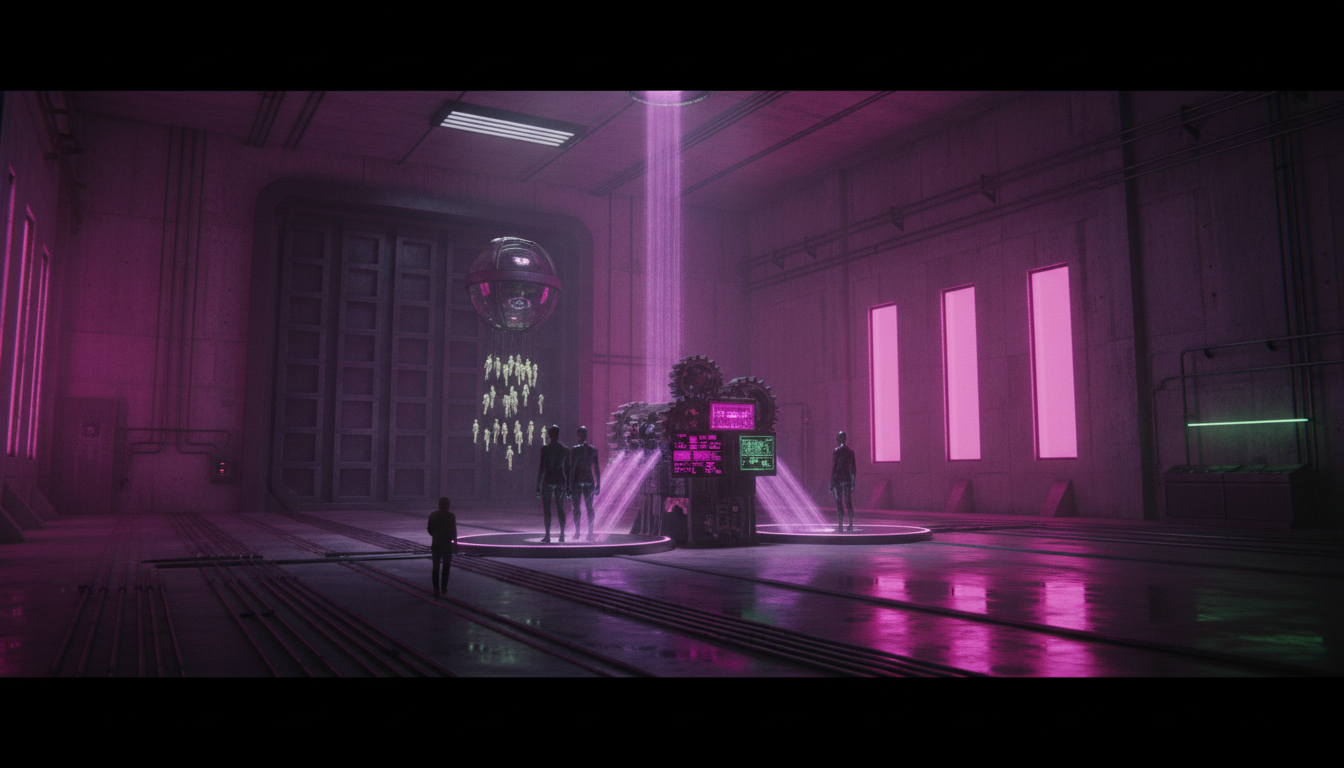
Ines Ferrer used the Birth Ledger to pair, match and schedule the vault's floor in the same week it opened, Year 75, Day 8, and the demographic model from The Keel — indexed by individual, by her own hand, across three books — reached its final form as a thing that decided which children existed.
She sat at the crate with Adaeze Nwosu and a list that was medical and total. Halima Sow signed the medical, and she was not wrong. Ines signed the index, and the index is who.
The Keel had been numbers: how many, which years, which mixes of a people who would have to live at a third of a weight under a sky that stacks. She had indexed those numbers by individual specifically so that a ranking could never eat a name. The vault was names that were not yet names, and the Ledger gave them names by carefully pairing a floor with a people already in the hole — carriers, dusks, a woman from district two hundred and nine whose grown child now sat on a council, a foundry, a forest meter. Match is medical; Halima said so. Schedule is a rota; Ines said so. Who exists is unavoidably both.
She wrote who. She did not write God. She did not write Founder. She wrote: Ledger, vault floor, pair, match, schedule. Sow: medical. Ferrer: index. not a ranking. not a pad. Ferrer.
Pair was a dusk, a name already in the hole, a capacity Halima had certified as a femur that could hold. Match was strand and mix and a note Kenji would not call a when. Schedule was a week, a ring, a clinic warmth, and a person who would stand at a door and not come in unless asked. Adaeze asked whether a fourth stack ought to be occupancy. Ines said no. Occupancy was 95,441. A birth is not a waking, and a vault child is emphatically not a letting-out of a hull. HELD remained zero. Descent remained 78,000. The Manifest does not move for a tray, and she would not put a baby into a counter built for sleepers let out.
Halima sat with the pairs and did not at all like a clerk deciding a body, and did very much like a clerk indexing a body she could afterwards treat. "I am not wrong to sign medical," she said. "I am not going to be kind about who. Who is your model, and your model is a later I have been quietly preparing a berth for. If you pair a child into a dusk I cannot reach, I will put my name next to the pair. If you pair a child onto a pad, I will take the Ledger off you entirely. Medical is a femur. Who is a head. I am signing the femur and living with the head. Both of those are my position. I laughed last week. I am still laughing. I am not laughing at a pad. There is no pad in this crate. If there is a pad in this crate, I will know it instantly by the way you do not look at me."
Ines looked steadily at her. "There is no pad. Who is a number, and the number is a child who can be treated. I have indexed since the Keel. I am not inventing a people today; I am seating a model that was always going to arrive. If a later clerk finds a catalogue, I will have built it, and I am writing down that I know. I am not hanging a flag. I flagged a door, and nobody revised it. I am not flagging a baby. A baby is not a surface. A baby is a dusk. I can live with a dusk I can name."
Halima signed medical. She was not wrong. Ines signed index. The first slip went to a dusk in ring two, to a carrier named Bekele who had asked — and Accord would have protected her if she had not asked, and she had asked, which Ines marked as asked, not assigned. Asked sits beside pair. Assigned would have been a ranking, and she would not file a ranking in a week of joy.
The second slip was a refusal. A carrier in Mars — rust, native g, a cheaper sitting — named Okoro, who had sat Miriam's four and used refuse. Accord. Ines marked refuse. She did not correct Okoro into a later yes, and she did not move the tray to a dusk that would be kinder to a model; kindness to a model is a ranking. She wrote: refuse, Accord, Achebe's four. tray held. next pair. Ferrer.
Miriam, told, brought the tray back to cold without translating a refusal into a loss. Hold: a person is not a ranking. File: a tray is a floor. Refuse: this was the pillar working. She sent bread. They ate it. The burnt sugar sat. A pairing is not item fourteen, a refusal is not item fourteen either, a refusal is a person. Ines lived with the person. Halima lived with the femur that would wait. Waiting is medical. Waiting is not a pad.
Nnamdi put it in tonight as a rota and not as a wonder, hands shaking badly on the pin. "If the gallery asks who decides children, I will say Ferrer indexes and Sow signs medical. That is true. I am not inventing a when. I dated founder. I am not dating a pair. This is a people using a model they already had. If they want a hymn I will give them a rota. A rota is uglier, and uglier is what we have always given them whenever we were being honest."
Dov did not log the pairings; a pairing is not a missing. He logged the crate door, because a door is a door. Sanaa stood the log. Interiors: a slip is not a sleep, and the eleven words do not attend a crate. He left them not attending. He already knew the gap; he did not rediscover it on a pairing.
Soma said a schedule is a spec, and she would not uncount a pair. Kenji said a mix does not care who is paired, provided the cold holds, he would not certify a when, he certified strand. Strand is air he will enter. Who is a head he will not. "Not air," he said, and went back to a bottle.
Renata read the first week's who and pointedly did not write a law against an index. She walked to the crate rather more slowly than she had once walked to a county, and she sat, and she said: "I buried everybody. An index that keeps a child treatable is a later I will not decorate as a loss. Fetch me when you want a law that lets them up. Who is not up, who is a dusk, and I can live perfectly well with a dusk that has a name. If the name is Ferrer's, I can live with Ferrer. I have lived with Ferrer since a hull, and a hull was a ranking we undid by indexing. Do not undo an index by quietly becoming a ranking. That is the whole of my advice. I am not hanging it."
Ines did not hang it. She marked the advice as heard and did not file it as a heading — a heading that says the law is waiting is a when, and she had refused whens. The flag on the door still sat. Nobody had revised it. A pairing does not revise a door.
Sefu sent a slate: a pair is not a hole. do not clap. Adeyemi. Tenn logged: Ledger, vault, Ferrer index, Sow medical, not a gallery. Cole did not hang a word on a who. Park stood Ground Truth.
Calder came in with a fitting and did not look at the list, and Ines did not offer it to him. He set the fitting on the far bench and worked it with his hands — a length of plate, a seat that would take a load a dusk could believe — and he did not ask who was going into which dusk, and she did not tell him. The not-telling was not remotely a secret. It was a crate, and a crate is not a mountain. He said keep it boring. She was being boring; a model is dull; dull is medicine. She kept pairing. The units did nothing.
Week two produced a slip that simply would not seat: a dusk already at capacity, and a femur Halima flatly would not overfill. Ines did not force it — forcing is a ranking. She held the tray. Miriam held the cold. Halima wrote a date that was a rota and not a when. Ines copied held for capacity, and carefully not held pending review; HELD on the Manifest remains zero. Adaeze asked whether held-for-capacity should share a column with held-pending. Ines said no: pending is a punishment a person was given in another book entirely, and capacity is a femur, and mixing them is exactly how a baby quietly becomes a status. Two columns. Ugly. True. Halima much preferred the two to a clean page; a clean page is a song.
By Day 18 the first week's dusks had names in them that had not been names at all on Day 1, and Ines sat with the book and felt the model finish itself the way a ranking had once finished — which is not a feeling she has ever trusted, so she did not trust it now. She copied. She copied who, and refuse, and asked, and capacity, and occupancy unchanged, and the flag that still sat on a door, and Sow medical not wrong, and Achebe holding, and Adeyemi's slate without clapping, and Tenn without a gallery. She did not copy a junction under a corridor; a junction is not a who.
The Keel had always been for this: a model indexed so that a ranking could not eat a name, arriving at last as a name eating a number. That is the inversion she had wanted. She would not hang it as a song. She filed it as who.
She went back to the desk, because week two of a pairing was already a slip in a hand, and the hand was standing there, and the hand was a dusk, and the dusk would hold a child with a name, and a name is a femur Sow can treat, and a name is also a file an Eye can one day read. Both true. She filed both — not on the same page. Beside. Which was the job.
Chapter 72 — Born Here
↑ Back to ContentsFocus: first children born planetside; lighter skeletons, longer limbs; Miriam's generation becomes historical
The first children born planetside rather than shipboard arrived in Year 76, Day 11: lighter skeletons, longer limbs, no memory of anything else.
Miriam Achebe had held the Cryo-Embryo Vault as work, and this was that work arriving, and she understood, standing in a dusk that was still a yellow lie, that her generation had just become historical.
Shipboard births had been a dusk since year forty-two — children under a tube, a generation that thought a mesh was a sky. This was different. This was a body that had never known spin. The dusk was ring two, a load a femur would believe, a strip that was not a sun, a yellow Kenji still called a lie and still called medicine.
Halima scanned the first and said the skeleton was light, the limbs long, the hips a question a Bone Lattice would eventually have to answer, and she was thoroughly glad anyway. "I can live with light," she said. "Light is a planet, and a planet is a femur I have been preparing for. If anybody puts this child on a pad I will take my name off the live and I will not be kind. Born here. Not a seat. I laughed last year; I am still laughing. A live is a laugh I will sign." She signed. She was not wrong.
Miriam held the child the way she had held a vault, which is as work, and the child was lighter than a tray, which is a planet doing what a planet does, which she would not hang as a wonder.
She said the four to herself, quietly, without hanging any of them — bread on a bench, the child against a shoulder that had been sitting longer after sessions for two full years of Halima's scanning. Hold: this person is not a ranking. File: the forest is still a meter, and this child has not seen it. Refuse: nobody at all has to make this child feel a crossing. Name as a man: the founder is a man, dated, and not a sky.
She did not say the four to the child. She said them to the bench. The burnt sugar sat. Item fourteen — a smell the child would never once know as a world you cannot stand on. The child would know it only as a clinic. That is history. Hers had been a ship. The child's is a hole. She deliberately did not decorate the difference; decorating a difference is exactly how a generation becomes a hymn, and a hymn is what she had spent an entire way refusing.
She sent bread to the dusk. They ate it. Halima ate it and did not spit, which was a change Miriam filed as glad and not as a heading.
Ines copied: first planetside live, Year 76, Day 11, Achebe present, Sow present. light skeleton, long limb, strand on file. not occupancy. not a waking. Ferrer. She marked it. She did not correct it. Adaeze asked whether historical should be a heading. Ines said historical is Achebe's, and a heading that says the old are history is a when, and she had refused whens.
Occupancy 95,441. Descent 78,000. HELD 0. A birth is not a counter; a live is not a letting-out. The pairing had given this child a dusk and a name and a femur. The name was on the Ledger. The live was on the copy. The copy did not move the Manifest.
Nnamdi put it in tonight as a live and not as a wonder. Hands shaking. Pin. "If the gallery asks what we found, I will say we found a child who was never a hull. That is true. I am not inventing a people. I dated founder; I am not dating a first. Achebe may date a first if she wants; I will not. A first is a when. A live is a rota. If they clap, I will read them Adeyemi."
Miriam did not date a first as a when. She dated it as work arriving. She had held a vault, the vault had become a live, holding had always been this, if you waited long enough and did not turn the waiting into a hymn. She sat longer. The sitting is the history.
Dov logged the clinic door. Sanaa stood the log. Interiors: a live is not a sleep, and the eleven words follow a person, and a person had arrived. He left the inside unmonitored, because he knew the gap and he left it, and he did not write a missing, because a live is not a missing, and the night book could, for once, stay a night book.
Soma came with a meter she did not power and looked at a lighter skeleton exactly the way she looks at a spec, crayon-tremor in the hand, and said that a planet had poured a grid and had now poured a body. "A live is not a measurement I destroy. If the limbs are long, that is a spec the hole poured. I am not hanging a spec in a gallery. Keep it boring. Boring is how a generation stays a generation instead of quietly becoming a poster."
Kenji certified the mix in the dusk. Not a stack. Yellow lie. He still would not certify a sleep without an element on a pad, Ferrer's flag still sat in the clause, and the child was not going up. "Not air," he said, looking at the long limb — meaning that he would not enter a head about what a planet had already done to a femur. Halima took the optical off him, because his fist had an arthritis he would not name, and she was still glad.
Renata walked in slowly and looked down at a child who would never in its life feel a burial, and said: "Good. I buried everybody so that this one would not have to. Fetch me when you want a law. I am not going to make this child recite a crossing. Reciting is a later I will call success when it fails. You are historical. I am historical. That is not a loss unless we decorate it. Do not decorate a live. A live is a person, and a person is not a lesson. If they never believe us, that is the point arriving early. I can live with early. I cannot live with a hymn."
Miriam took that as bread. She did not file it as a pillar; the four already covered it. Refuse: nobody has to feel a crossing. A child who would not feel one is the pillar working, not the pillar failing. She sat with that, sitting longer, historical, and did not hang historical. She held the child until Halima took it back for a scan — light, long, hips a later, glad.
Sefu sent a slate: born here is not a hole. do not clap. Adeyemi. Tenn logged the live. Cole did not hang a word on it. Park stood Ground Truth. Calder came and did not take a tour of a child; he had a fitting; he set it on a bench that was not the clinic bench and worked it, tired, not their old, and Halima did not offer a tour, and Miriam did not offer a holding, and he said keep it boring, and Miriam was not being boring, she was being historical, and she let him go. The units did nothing.
Yara Haddad stood in the door from a foundry and asked whether the live needed a load. Halima said the dusk had a load. Haddad left. Bekele — who had asked, and had not been assigned — held the child after Halima's scan, and did not ask Miriam what a crossing had felt like. Not asking is refuse working. Miriam sent bread. Bekele ate it. Burnt sugar. A clinic. A planet. A live.
A second live came that month: same light, same long, same hole. A third. A rota. Dull. Medicine.
Miriam held the vault and the rota and the bread, and understood, without hanging understand, that the crossing had become a lesson a child would not feel, and the not-feeling is Renata's success arriving early, and her generation had become a sitting that went on longer. She would keep sending bread until the bread was gone.
She walked the forest edge after the third live — a filing equivalent to a person, sound eaten, methane eaten — and she did not clap, because a clap goes nowhere, and she said the four again to trees that do not need them, and she went back to a dusk with bread.
Ines filed live as ordinary, and ordinary is how a generation becomes historical without ever acquiring a hymn. Miriam Achebe, who had held a vault for fifty years, held a child, and the holding was the work, and the work is history, and history is uglier than a wonder only if you happen to need a hymn. She did not. She needed a bench, and a bench was what she had, and what she had was enough. Enough was a live. A live is a person. A person is not a ranking — which is the first pillar, which she did not say out loud, and which she said anyway simply by standing there.
Chapter 73 — They Do Not Believe Us
↑ Back to ContentsFocus: the first generation cannot feel the founding; Earth is a word; Renata calls it success
Waking Manifest · Year 82, Day 22 · Authority: standing, unsigned
Renata Oyelaran sat a county session in Year 82, Day 22, and watched the first generation fail to feel the founding — which she had buried everybody in order that they would not have to.
Earth was a word. The crossing was a lesson. A child born in a hole under a strip asked her what a ranking had felt like and did not wait for the answer. That is the success, not the loss. She did not decorate it. She wrote it as a fact a law could live with.
The session was ring two, a dusk that had become a sitting, under the yellow lie: children of the tube who were adults now, and children born here who were six and light and long. Miriam had given them the four — hold, file, refuse, name as a man — and they could recite them. Reciting is not feeling.
A woman named Rangi, born shipboard under a mesh, asked what Earth had smelled like. Renata said burnt sugar, item fourteen, a world you cannot stand on, and Rangi nodded the way a person nods at a lesson, and did not ask again. A boy born here, Bekele's, lighter skeleton, asked whether a ranking was a game. Renata said no. She did not say more; more would have been a hymn. The no sat. The boy went back to a rota.
That is the transmission stopping. She had buried everybody, and the burying had been for exactly this: a child who thinks a ranking is a game, accepts no, goes back to a rota, and will never feel a pad, or a hull, or a crossing. Success. Not loss. She wrote it that way in a book she still would not call a home.
Ines, told, copied: session, Year 82, Day 22, Oyelaran. first gen does not feel founding. Earth a word. crossing a lesson. success, not loss. not a heading. Ferrer. She marked it. She did not correct it. Adaeze asked whether success should be a column. Ines said success is Oyelaran's, and a column that says a people have forgotten is a when, and she had refused whens.
Occupancy 95,441. Descent 80,000. HELD zero. A lesson is not a waking; a word is not a letting-out. Descent had moved — two thousand more had gone down since a vault opened — and Ines duly marked descent. Not a hundred thousand. The bar had not arrived. A generation that does not feel a founding is not a bar; it is a sitting. She left the sitting in the county and went back to a crate. Ferrer's flag still sat there. Nobody had revised a door. A lesson does not revise a door.
Miriam sat the four after Renata and did not correct recitation into feeling. Hold: a person is not a ranking — the boy had asked whether it was a game, and no had been quite enough. File: the forest is a meter, and not one of them had ever stood a single day on a pad. Refuse: the Accord still protected Okoro, who had refused a pair seven years earlier and still sat Mars. Name as a man: Calder is a man, dated, and not a sky. A grown child asked whether a man was a sky. Miriam said no. No is the pillar, and no would hold exactly as long as she kept saying it, and she kept saying it.
She sent bread. Renata ate it. Burnt sugar, item fourteen — a smell these children know only as a clinic. History. Miriam was historical. Renata was historical. The children were a rota, and a rota is not a loss. Miriam said so without ever hanging so. Renata took it as law arriving early, and law arriving early is still law. She would write it the moment they asked to be let up. They had not asked. Not feeling is not remotely the same as asking to go up. She could wait. Waiting is a county.
Nnamdi put it in tonight as a lesson and not a forgetting, hands shaking on the pin. "If the gallery asks whether they believe us, I will say they recite. Reciting is not believing. I am not inventing a when. I dated founder; I am not dating a failure. Oyelaran says success; I will put success in tonight as a rota. If they want a hymn about memory I will give them Adeyemi."
Dov logged the session door — empty-handed, hair gone, night book still a night book — and did not log a feeling; a feeling is not a missing. Sanaa stood the log. Interiors: a sitting is not a sleep, and the eleven words do not attend a county. He left them not attending, he already knew the gap, he did not rediscover it on a success.
Soma, crayon-tremor and all, said a generation that does not feel a spec is still a spec, and she would not uncount a sitting on that account. Kenji said not air, which is precisely what he says when a head is a lesson he will not enter. Halima, told, said a lighter femur does not need to feel a crossing in order to be a femur she can treat, and she was still glad; glad had lasted seven years by then, and she would not hang glad as a heading that requires anybody to believe her.
Sefu sent a slate: a lesson is not a hole. do not clap. Adeyemi. Tenn logged: Oyelaran, success not loss, not a gallery. Cole did not hang a word. Park stood Ground Truth. Calder came with a fitting and did not sit the session; Renata did not offer him a lesson; he worked the fitting on a bench that was not the county bench, tired, not their old, and she did not ask, and he did not offer, and the not-asking had been a clinic's close eight years earlier and was still a close. He said keep it boring. She was not being boring. She was a person who had buried everybody, watching the burying finally work.
Yara Haddad asked whether the foundry should hang a word about Earth. Renata said no; a foundry is a load, and a load is not a lesson. Vega asked whether the gallery wanted a picture of a sitting. Ines, told, marked it refused; a picture of children not feeling a founding is a hymn, and she would not file a hymn.
Rangi came back after the sitting and said, very carefully, that she had tried to feel a pad and had felt only a lesson. Renata said: "That is enough. Feeling a lesson is not a failure. I buried people precisely so that you would not have to feel a pad. If you feel a lesson, I have done the burying. I am not going to make you try again. Trying again is a ranking of grief, and I will not rank grief. Go back to a rota."
Rangi went. The boy who had asked whether a ranking was a game did not come back at all. Not coming back is the transmission stopping in the body. Renata sat with that and wrote: success. not loss. do not decorate. Oyelaran. She did not send it to a gallery; she sent it to Ines. Ines copied it, marked it, and did not correct it — a clerk and a law, two very old women, a sitting, and a generation that would open a door later by rules those two old women had written.
Renata walked the county afterwards and did not call it home. Not calling it home was a habit she would not correct into belonging; belonging is a hymn, and a hymn is what a generation that does not feel a founding does not need her to sing. She let them not need her. The not-needing is the success.
She had buried everybody for a people who would never have to bury that way. They were not burying that way. They were reciting four sentences and eating bread and asking whether a ranking was a game. She could live perfectly well with a game that had been answered no. She could not live with a later clerk decorating the no as a forgetting — so she told Ines, and Ines copied, and copying is how a success stays a fact instead of quietly becoming a song.
Halima, in the clinic, scanned a six-year-old's long limb and said the Bone Lattice would have work, and the child asked what a ship was, and Halima said a hull, and the child asked whether a hull was a dusk, and Halima said no, and the child went back to a rota.
Halima told Renata. Renata said good. They ate bread. Miriam sat longer, historical. Ines's book had success, not loss, marked, not corrected. Year 82, Day 22: a county, a word, a lesson, and a generation that would never believe them — which was the whole point, and the burying working, and uglier than a wonder only if you happen to need to be believed. She did not. She needed a law that would let them up when they asked, and they had not asked yet, and not asking is not a failure of a sitting; it is simply a sitting that has not yet become a door.
Chapter 74 — Let Them Out
↑ Back to ContentsFocus: the atmospheric case for surface release; one recommendation, and he makes it
Kenji Arata made the atmospheric case for surface release in Year 84, Day 14: one recommendation, a life's work reduced to a sentence a council could vote on.
The filters had matured. The haze events were modelled and predictable. The forest's oxygen output was a number a meter could stand on. And a people who had been born in a hole could go up.
The room was a sitting and not a gallery. Yellow lie, ring two. He set the optical down because the fist would not keep it, and Halima took it without scanning him for the arthritis.
"I certify the filters. I certify the model. I certify the forest number. I do not certify a when. I am making a recommendation, and the recommendation is: let them out. A haze is a stack we can see coming, and a stack we can see coming is a door we can shut. Protocol still shuts without a person in the loop, silence still seals, I am not asking for a person in the loop. I am asking for a pad that is not a punishment. Ferrer's flag has sat for forty years. I would not certify a sleep without an element, and I am not certifying a sleep. I am certifying a day. A day is air. Air is my brief. I have four hundred names. I am not adding a name today. I am adding a recommendation. Arata."
Ines copied: recommendation, Year 84, Day 14, Arata. filters matured, haze modelled, forest O2 a number. let them out. flag still sits. not a when. Ferrer. She marked it. She did not correct it. She did not revise the flag; a recommendation is not a revision, and a revision would be a council.
Adaeze asked whether the flag ought to move into the second volume as pending. Ines said pending is a punishment; a flag is simply a flag. She had flagged a door and nobody had revised it in twenty-three years, and a mix being ready is not nobody — it is Arata, and Arata is a brief, and a brief is not a council. Occupancy 95,441. Descent 80,000. HELD zero. A recommendation does not move a counter. She left the flag exactly where it was.
Soma sat with the forest number and pointedly did not uncount it. Crayon-tremor; meter unpowered in the room and powered in the file. "I will not destroy a measurement. The forest eats sound and methane; the number is a number. If Arata hangs a day on it, I will live with the hanging as a spec. I am not hanging a people on a pad; that is a council. Keep it boring. Boring is how a number stays a number."
Miriam sent bread. They ate it. Burnt sugar, item fourteen — a smell a generation knows as a clinic. She did not translate a recommendation into hold, or file, or refuse; though refuse would cover a person who would not go up, and she sat with that. Name as a man: Calder was not speaking, and a man speaking a pad into a people is a poster.
Halima said: "I can treat a femur on a pad provided the pad is genuinely a day and not a sleep without an element. I am not wrong about a day. I am certainly not going to be kind about a sleep. If they go up, I will have a clinic at a mouth. If they do not, I will have a clinic in a dusk. Both are femurs. I laughed nine years ago and I am still laughing. A recommendation is not a laugh. I can live comfortably with both."
Renata said: "Fetch me when the council wants a law. I am not writing a law because a mix is ready. A mix being ready is Arata. A people going up is a later I will call success. I buried everybody. I am not burying a recommendation. I am waiting. Waiting is a county, and a county is slower."
Nnamdi put it in tonight as a brief and firmly not as a wonder, hands shaking badly. "If the gallery asks what we found, I will say we found a number that can hold a day. That is true. I am not inventing a when. I dated founder; I am not dating a pad. Lindqvist will have a counter-case. I will put both in tonight as a rota. A rota is uglier. Uglier is honest."
Dov did not wait for tonight. He said it in the room, empty-handed, hair entirely gone: "I will make the counter-case. I am not making it today as a heading; I am simply telling you now that it exists. Another decade underground costs nothing whatever that cannot be recovered. One bad haze on an unsheltered people costs absolutely everything. Safety has the better argument. I have always had the better argument. I am not going to pretend a number makes a missing recoverable. A missing on a pad is a missing I cannot log a door for."
Kenji said: "I know. I am still recommending. Knowing the better argument is not the same as not making the recommendation. Air is ready. Ready is not safe. Safe is your brief. Air is mine. Both can sit in a room."
They sat. Both. Ines copied both and did not reconcile them — reconciling is a council, and a clerk who reconciles a brief and a safety is a clerk becoming a when. She marked both. She corrected neither.
Sefu sent a slate: a day is not a hole. do not clap. Adeyemi. Tenn logged: Arata recommendation, Lindqvist counter, not a gallery. Cole did not hang a word. Park stood Ground Truth. Calder came with a fitting and did not speak a pad; he worked the fitting, tired, not their old, and Kenji did not ask him to bless a mix, because blessing is a hymn and a hymn is emphatically not air. Sanaa logged the sitting door. Interiors: a recommendation is not a sleep.
Yara Haddad asked whether the foundry should tool for surface loads. Kenji said a recommendation is not a tool order. Vega asked whether the gallery wanted a picture of a mix; Ines marked it refused.
Bekele — who had asked for a pair nine years earlier, and now had a child born here — asked whether the child could go up. Kenji said a council. Bekele asked whether a council was a ranking. Miriam said no: Accord, a council is a sitting, and a sitting can always be refused. Bekele sat down. The child — light, long, nine years old — did not ask what a pad was. Not asking is a generation.
Kenji looked at the child and deliberately did not hang a day on a nine-year-old. He had hung a day on a number, and the number is a forest, and the forest is a meter, and the meter is Soma's, still uncounted. He could live with a number. He would not live with a hymn about a child on a pad. The recommendation is the people, the people include a child, and the child is not the sentence. The sentence is air.
He went to the forest meter with Soma and stood while she powered it, crayon-tremor, a number arriving that he had already certified — sound eaten, methane eaten, a filing equivalent to a person. He did not clap. She did not clap. She said the number again. He said the number again. Saying a number twice is not a hymn; it is a brief checking a spec.
Park, at a mouth, had no stack. Early still medicine. Ground Truth saved a life that month exactly the way it had saved lives steadily for forty years — true, and standing squarely in front — and Kenji did not hang the save on a pad. A save is a dusk. A pad is a later. He was recommending the later. He was emphatically not stealing the dusk. Halima, told of the number, said a femur can live with a day provided a mouth still reliably shuts. She did not say the femur would enjoy the day; enjoyment is a hymn, and a day is air. He took the air. He left the enjoyment.
He walked the forest edge afterwards, optical in a pocket he could not open easily, and the forest ate the sound of his walking and ate methane and gave him a number he had already certified, and he did not clap, and he went back to a dusk with a recommendation sitting in Ines's book beside a counter-case that had not yet been a chapter.
Year 84, Day 14. Filters, model, forest. Let them out. The flag still sitting. Dov already shaking his head. Halima still glad. Miriam still historical. Soma still a spec. Renata still waiting. Nnamdi still a rota. Calder still a fitting. Sefu still do not clap. A yellow lie, a tube for a sky, a generation that did not feel a founding, and a mix that could hold a day.
That is his life's work, made as one recommendation. He would not hang it as a hymn. He hung it as air — which is uglier than a wonder, and uglier is what he would sign, even with four hundred names, and a fist that would not keep an optical, and a better argument sitting in the same room, and a flag he had not asked Ferrer to move.
Chapter 75 — The Argument For Waiting
↑ Back to ContentsFocus: another decade recoverable; one unsheltered haze costs everything; safety has the better argument
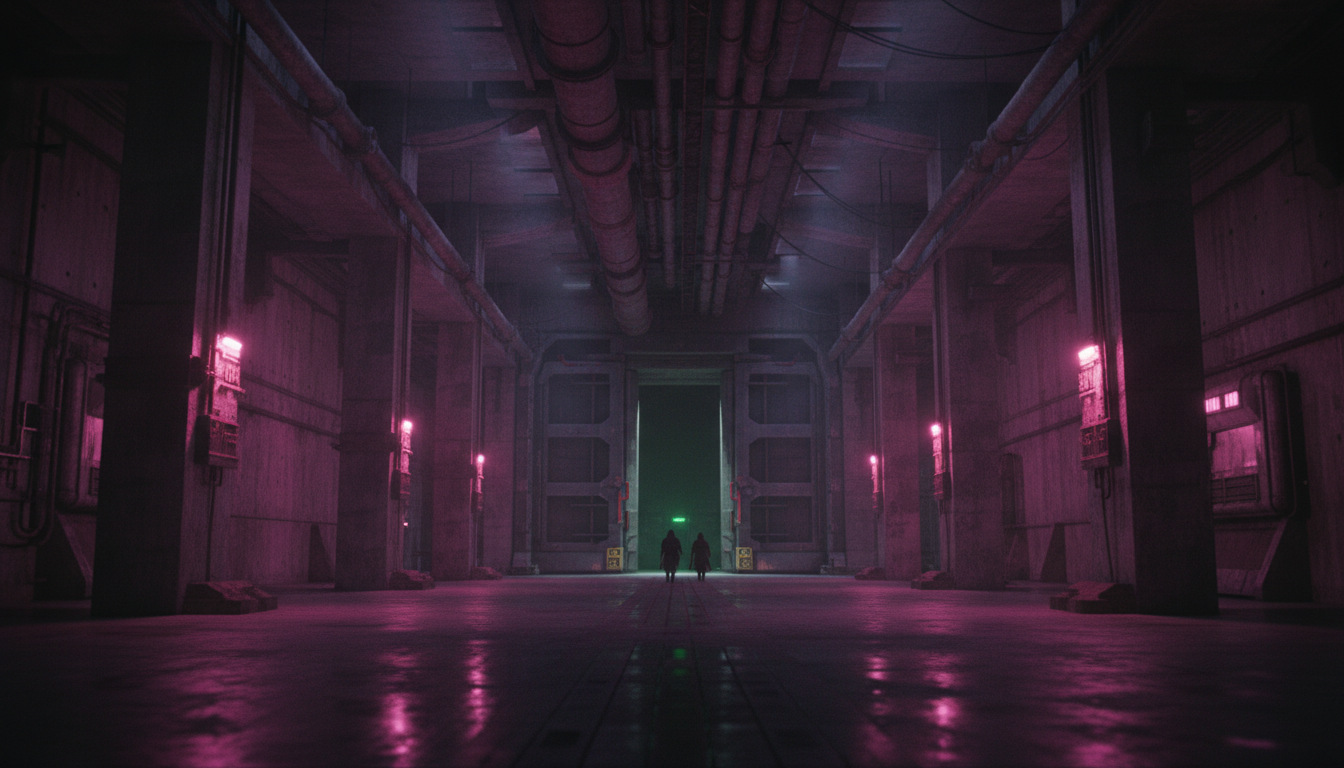
Dov Lindqvist made the argument for waiting in Year 84, Day 21, seven days after Kenji Arata named the air.
The argument was strong, and he knew it was strong, and he did not decorate the strength. Another decade underground costs nothing that cannot be recovered. One bad haze on an unsheltered people costs everything. Safety has the better argument.
That is the whole thesis of a life spent logging doors. He would not hang it as a hymn. He hung it as a missing he would not be able to find if they went up.
He had been empty-handed ever since a fire alarm became a force. The Legion sat with Sanaa. The night book sat with him. Hair entirely gone. Old. The eleven words still law: where a person sleeps, no instrument of the ship attends. He knew the gap perfectly well and he had left it, and he was certainly not rediscovering it now in order to win a sitting. He was simply telling a sitting that a pad has no door he can log the way he logs a dusk.
"A dusk has a mouth. A mouth has a protocol. Protocol shuts without a person in the loop; silence seals. That is a door I can live with. A pad on a coastal flat in a stack is not a door. A stack we can see coming is still a stack that arrives. Kenji's model is a model. I have watched models. I have four hundred names I did not prevent, and nine I still carry, and eleven I still copy. I am not adding a surface to that copy because a forest number is ready. Ready is not recoverable. Recoverable is a decade in a hole. A decade in a hole is a cost I can write. A haze on a people with no mouth is a cost I cannot. Lindqvist."
Ines copied: counter-case, Year 84, Day 21, Lindqvist. another decade recoverable. one unsheltered haze not. safety the better argument. recommendation still sits. flag still sits. Ferrer. She marked it. She did not correct it. She deliberately did not reconcile it with Arata; reconciling is a council's work. Adaeze asked whether the better argument ought to be a heading. Ines said better is Lindqvist's, and a heading that says safety won is a when, and she had refused whens for fifty years. Both briefs sat beside the flag. A clerk who picks a brief is a clerk quietly becoming a council. She kept both. Ugly. True.
Kenji said: "I know it is better. I am not withdrawing air. Air is ready; ready is not safe. I said that in the room and I am saying it again. A better argument is not a veto unless a council makes it one, and I will not make it one. I am a brief. You are a brief. Both can sit."
Dov said: "Both can sit. I am not asking you to unname air. I am asking a council not to confuse a number with a mouth. I have logged doors for forty years. I am empty-handed. I am not empty-headed. A force cannot log a coastal flat the way a door logs a dusk. Sanaa can stand a mouth. She cannot stand a horizon."
Sanaa, in the door, did not speak. Standing a door is her brief. Standing a horizon is not a log she had been given, and Dov did not give it to her; giving a force a horizon is how a missing becomes a ranking.
Halima said: "I can treat a femur that waits. I can treat a femur that goes up. I cannot treat four hundred on a pad with no mouth. I am not wrong about a mouth. I am not going to be kind about a horizon. If they wait, I will have a clinic in a dusk. If they go up, I will have a clinic at a mouth, and I will want a protocol that still shuts. Sow." She was not wrong.
Miriam sent bread. They ate it. Burnt sugar. Item fourteen. She did not translate wait into refuse; refuse is Accord, a person, a pair. Wait is a people, and a people is not a ranking as long as a council can still say no. She sat longer. Historical. She did not hang safety as a pillar. Safety is Dov's. Bread is hers.
Soma said a forest number is still a number she will not uncount, and a decade is still a spec a hole can hold. Crayon-tremor. "I will not destroy a measurement to win a wait. I will not destroy a wait to win a measurement. Both are specs. Keep it boring. Boring is how a people does not become a poster on a pad."
Renata said: "I am still not writing a law. A law that lets them up will be a success. A law that waits will also be a success, provided it is a council. I buried everybody. I am not burying a better argument. Fetch me when a sitting wants either. I can live with either. I cannot live with a hymn that says we were cowards for waiting or heroes for going. Both of those are decorations, and I will not decorate."
Nnamdi put both in tonight as a rota, hands shaking. "If the gallery asks who is right, I will say both. That is true. I am not inventing a when. I dated founder; I am not dating a pad. Adeyemi already sent the slate."
Sefu's slate sat where it always sat: a wait is not a hole. do not clap. Adeyemi. Tenn logged both briefs, not a gallery. Cole did not hang a word. Park stood Ground Truth. Calder came with a fitting and did not pick a brief; he worked the fitting, tired, not their old, and Dov did not ask him to bless a wait, because blessing is a hymn. Calder said keep it boring. Dov was not being boring; he was a missing he would never be able to log.
Bekele sat with a nine-year-old who did not ask what a pad was. Not asking is a generation. Dov looked at the child and deliberately did not hang a wait on a nine-year-old. He had hung a wait on a missing, and a missing is a door, and a door is his brief. The child is not the sentence. The sentence is recoverable versus not.
He wrote in the night book, and did not send it:
safety has the better argument. I have always had it. a council of people born after the crossing will not owe me the argument. I am logging that I made it. I am not logging that I will win it. a door I can log is a dusk. a pad is a horizon. I know the gap in a dusk. I leave it. I will not pretend a horizon has the same gap. Lindqvist.
He logged the sitting door. Entries. Exits. Interiors unmonitored. Eleven words, the gap he knew, left. He did not use the gap as a scare. Sergei had been the scare, and Sergei is a volume, and a volume is not a horizon; he would not hang a dead man on a wait. He hung a decade. A decade is recoverable, and recoverable sits.
He walked a mouth after the sitting — Park on Ground Truth, no stack, early still medicine, a true programme standing squarely in front of a wait that did not need a scare. The Protocol plaque was the same plaque it had always been: auto-close, no person in the loop, four primary vertical arteries, four transit lungs, reopen only on positive return, silence sealed. He put his palm on the plaque exactly the way Halima puts a palm on a femur, which is to know it, and said to Sanaa: "If they go up, I want this at every mouth they invent. I am not asking you to invent a horizon. I am asking you to keep a shut. A shut is a door. A door is what I have left."
Sanaa said she would keep a shut. She did not offer a horizon. He did not take one. Cole did not hang a word on a plaque. Tenn logged the walk as a door and not a gallery. He went back to the night book. The night book takes a wait. The night book does not take a hymn.
Kenji sat with him afterwards — two old briefs, bread, burnt sugar, a yellow lie — and they did not reconcile, and Ines did not reconcile them, and the flag still sat, and the forest still ate sound, and Ground Truth still caught a morning, early, living, true, standing in front.
Dov Lindqvist, empty-handed, made the better argument: Year 84, Day 21. Another decade. One haze. Everything. A later sitting would not owe him that argument, and he made it anyway, and making it is uglier than a wonder, and uglier is what he would sign — even with a force that was no longer his, and a gap he still left, and air named in the same book, and a child who did not ask what a pad was.
Chapter 76 — The Release
↑ Back to ContentsFocus: the vote to open; a Council born after the crossing; founders lose by their own rules; a good day
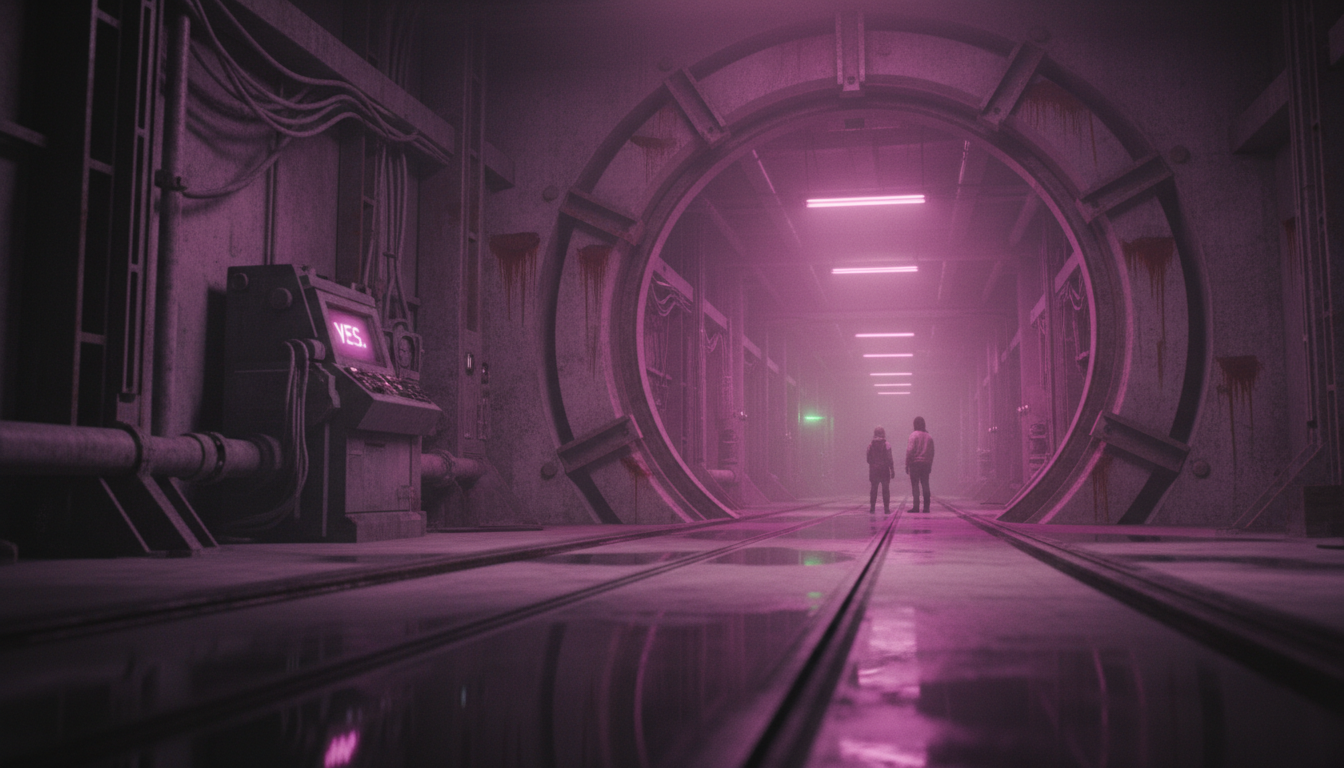
The founding generation lost control of Aura-36 on Year eighty-five, Day nine, and it lost it entirely legitimately, by the rules it had carefully written itself, and every one of the nine surviving founders who were in the room that morning agreed afterward that it had been a genuinely good day. That is the whole of it. The Council that voted to open the surface was seated by peer assignment, three-year terms, Hand-Selected Guardians at the wall and pointedly no founder in a chair; a clear majority of the people who raised their hands had been born after the crossing and had never once seen a stack from the outside of a hull, and they carried the motion squarely over the recorded caution of the survivors who had spent twenty-three years keeping them alive. Ines Ferrer copied the slip. She had personally typed the flag it revised — no surface exception, deferred, no revision — in Year sixty-two, and she had left it sitting untouched for twenty-three years, and she did not erase it now.
That distinction is worth pausing on, because it is the whole of the archive's method and this is the morning it cost her something. Adaeze Nwosu asked whether revised should simply replace flagged in the second volume. Ines said that replacing was correcting, and she would not correct a flag that had been true for twenty-three years; she would file the revision beside it. Two lines, then, where a tidier clerk would have left one. The flag: Year sixty-two, no surface exception, deferred. The revision: Year eighty-five, Day nine, Council, open. Mark, do not correct. A clerk who erases a flag because a later sitting has moved past it is a clerk in the process of becoming a hymn about having been right, and she had not been right or wrong; she had been a flag, and the sitting had been a sitting, and both of them sat.
The motion itself was considerably smaller than the histories make it. A woman named Rangi, who had been shown a pad in a classroom and had come away with a lesson rather than a feeling, said flatly that a day was not a ranking. A man named Bekele, who had a child born planetside and had asked years earlier for a pair, said the child would go up with a mouth rather than a horizon, which is easily the flattest sentence anyone spoke that morning and the one Ines deliberately copied twice. The Accord's refusal still stood underneath all of it. Okoro of Mars did not have to go up, nobody did, refuse sat on the page and open sat quietly beside it and neither one cancelled the other. Ines filed them both. Not on the same page. Beside.
The record of the sitting reads, in her own hand: vote, Year 85, Day 9, Council. open surface. flag revised. Arata recommendation taken. Lindqvist counter logged, not carried. Sow: clinic at mouth. Oyelaran: law to follow. not a when. a sitting. Ferrer. Occupancy stood at ninety-five thousand four hundred and forty-one, descent at eighty thousand, held at zero. A vote does not move a counter, and Adaeze copied occupancy across entirely unchanged, and Ines left the Manifest alone. A door is not a bay. It is a very small thing to insist on, and she insisted on it stubbornly for fifty years, and the reason the second volume can still be read honestly against the first is precisely that she did.
Dov Lindqvist had made the better argument the day before — the one recorded in the previous chapter, another decade recoverable, one unsheltered haze costing everything — and he lost. He came into the room empty-handed, which by then was simply how he came into rooms, and he said, "I made the better argument. I did not win it. I am logging that. I am not logging a theft. A sitting that can refuse me is a sitting I wrote a door for. I will log mouths. I will not pretend a coastal flat is a dusk. Protocol still shuts. Silence still seals. If they go up I want the same shut. I am not hanging a loss. I am hanging a door I will have to invent." He invented it. The auto-close plaques at every surface mouth on the planet are his, and they are the last thing he built, and he built them for a vote he had argued against.
Kenji Arata, who had certified the air and could easily have had the morning if he had wanted it, would not take it. "Air is still air," he said. "I am not hanging a hymn. I am hanging a day. A day is what I certified. A sitting took it. I can live with a sitting. I have four hundred names. I am adding none today." Halima Sow said she would have a clinic at the mouth and that she was not wrong about a mouth and was certainly not going to be kind about a sleep without an element; that a day is not a sleep; that she had laughed about it ten years ago and was still laughing; and that a vote is not a laugh and she could comfortably live with both. Sow. She was not wrong. Nobody in the room pretended she was, and nobody let it stop the vote, and both of those facts belong squarely in the same sentence.
Miriam Achebe sent bread. They ate it — burnt sugar, item fourteen, the smell a whole generation of that Council knew as the smell of a clinic and not of a kitchen — and she did not translate the vote into a pillar. The four pillars had been enough for forty years precisely because she had never added a fifth for an occasion. Hold: a person is not a ranking, and a vote is not a ranking so long as refuse still sits. File: the forest is a meter, and the meter was the number Kenji had hung a day on. Refuse: Okoro would not have to go. Name as a man: Calder was not the sitting, and mixing a founding body up with a vote makes a poster. She sat with it longer than the others. The historical had just lost a flag by having written a Council that could take it. She did not decorate the losing. Losing by your own rules is bread, not a monument, and she sent more bread.
Renata Oyelaran, who had buried more of them than anyone, said, "I am fetching the law. I told you you would want it. I am writing it as a success. I buried everyone so a sitting could do this without burying that way. Do not decorate a vote. A vote is a people. A people is not a lesson. I can live with a people I do not believe I own." Nnamdi Okonjo put the vote into that night's programme as a rota item and not as a wonder, hands shaking, the pin still on, very old. "If the gallery asks what we found I will say we found a sitting that could take a flag. That is true. I am not inventing a when. I dated founder. I am not dating a door. This is a good day. I will put good in tonight as a rota, not a hymn. If they clap I will read them Adeyemi." Sefu Adeyemi's slate, kept on the desk of every night programme for sixty years after his death, sat where it always sat: a vote is not a hole. do not clap. Adeyemi.
Tenn logged it as Council, open, flag revised beside, not erased, not a gallery. Cole did not hang a word on it. Park stood Ground Truth at the shore all day, as she had on every day the model said haze and on most days it did not, early still being medicine. Soma Barua said that a number of hers had been taken up and used as a specification and that she would not uncount it on that account; the note is in crayon and the tremor in it is bad; it ends, "Keep it boring. Boring is how a door stays a door." Calder came in with a fitting in his hand and worked it through the sitting and did not speak against the vote, and left, tired, and not in the way he had once been tired. Ines did not offer him the slip. He told her to keep it boring. She was, for once in fifty years, willing to be less boring than a fitting, and she let him go, and the units did nothing, and they have gone on doing nothing ever since.
There is a smaller thing in the file that the histories invariably leave out, and it is the entire reason this chapter is in the book at all. After the seats emptied, Rangi came to the crate and said, carefully, that a lesson had become a day, and asked whether she ought to thank the founders. Ines said no. A sitting does not thank a flag; a sitting uses a rule, and using the rule is the whole of the thanks a clerk will ever accept. Rangi went back to a rota. Adaeze copied the refusal. Ines marked it and pointedly did not correct Rangi into gratitude, because gratitude is a ranking of feeling and she had spent her entire life undoing rankings by indexing them, and she was certainly not going to index a thank-you at the end of it.
She walked out with Halima afterward, two very old women in a corridor with bread in their hands, and Halima laughed once, shortly, and it went out and came back off a plated wall, and Ines did not copy the laugh. Then she went straight back to the desk, because week one of an open surface was already a slip in somebody's hand. Year eighty-five, Day nine: the vote, the flag revised beside and not erased, Arata's air taken, Lindqvist's wait logged and not carried, Sow's clinic, Oyelaran's law to follow, Achebe's bread, Okonjo's rota, Barua's number, Calder's fitting, Adeyemi's do not clap. A Council of people who did not feel a founding, which is exactly what success looks like from the inside and precisely why nobody recognises it at the time. It was uglier than a wonder. Uglier is what she signed. Seven years later a girl named Lorena Vasquez walked onto a dune without a filter and did not know that any of this had ever happened, and that is the door working, and it is the only monument the founding generation ever agreed to accept.
Chapter 77 — The Coastal Flats
↑ Back to ContentsFocus: first planetside generation as a POV; Lorena on volcanic-glass dunes without a filter; the title lands
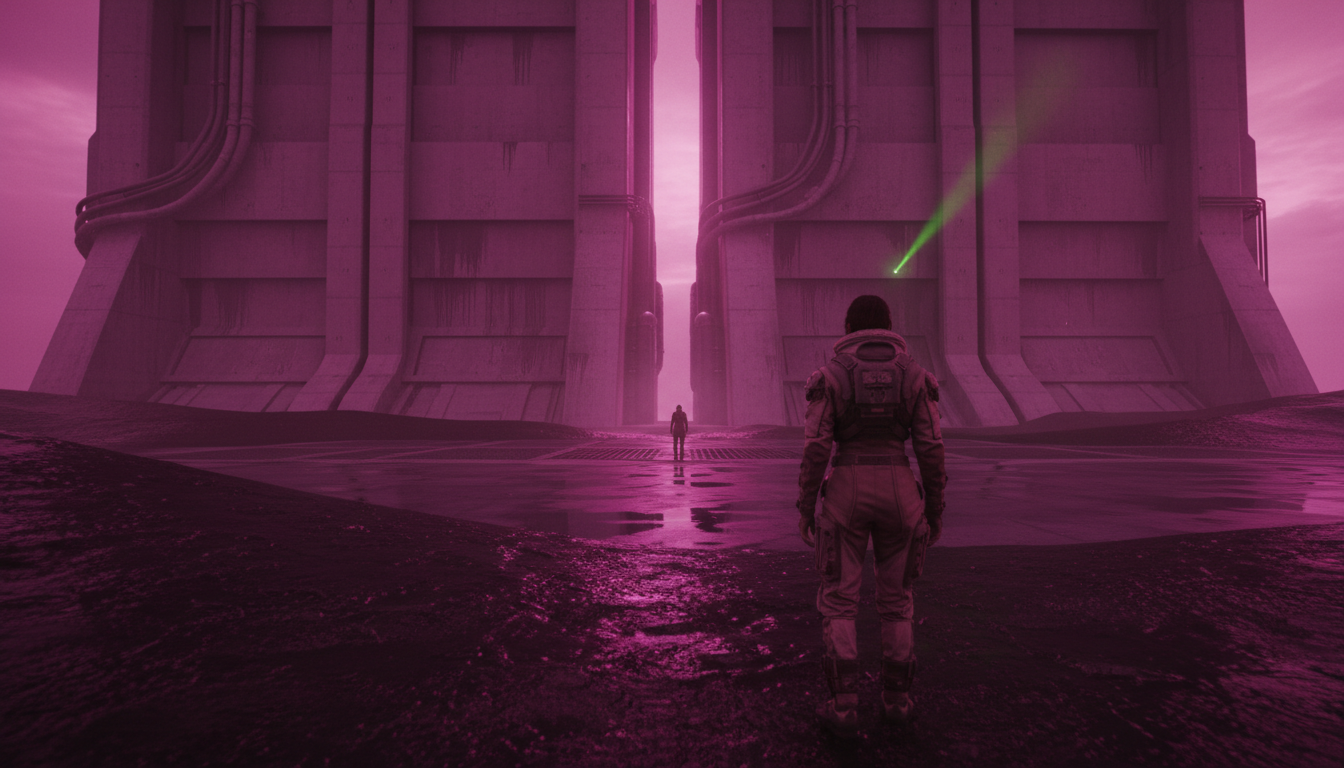
The first human being to breathe the open air of Aura-36 without a filter was sixteen years old, born planetside, and did not remotely think of it as an occasion. That is the whole of it, and it is exactly why the book is called what it is called. Lorena Vasquez walked out onto the lavender-indigo dunes of ground volcanic glass at the coastal flats on Year ninety-two, Day three, with the filter held in her hand and not on her face, and the air came into her mouth simply as a world rather than as a lesson, and she did not think Earth, and she did not think crossing, and she did not think ranking. She thought only that the glass was cold under a boot that did not have to carry her. She breathed. She laughed once, shortly, and it went out across the flats and never came back, because there was no plated wall for it to come back off and the forest, far inland, quietly eats whatever reaches it.
Nia Bekele walked beside her, also sixteen, also born here, also with the strap in her hand. They did not talk about founders. They did not talk about the vote seven years earlier that had made the walk legal. They talked about the glass, and the glass is the chapter.
Behind them the mouth still carried its plaque, and the plaque still said precisely what Dov Lindqvist had written for it: auto-close, no person in the loop, silence sealed. Halima Sow's clinic sat at the mouth exactly as she had promised in the sitting, a femur at a door, very old by then and openly glad in a way Lorena had grown up inside and had never once had to name. Lorena did not name it, because naming a clinic as glad is a sitting, and she was decidedly not a sitting. She was a dusk-child with a long stride and a day that a man named Arata had personally certified as air. She knew that name the way she knew a rota item. She did not know the other four hundred names, and nobody had ever told her she was required to.
What the classrooms had given her was haze, stack, door. What no classroom had given her was how the glass would sound underfoot. It sounded like nothing much. Nothing much is the point. The filter was a strap she had been told to carry and not to wear unless a plaque said stack; the plaque did not say stack; Park, at the mouth, standing Ground Truth the way she had stood it for thirty years, did not say stack either. So Lorena went further out onto the glass.
"It is cold," Nia said. "It is glass," Lorena said. They kept walking. At thirty-eight hundredths of a gravity the dune did not climb the way dunes climb in the stories a sitting tells about dunes; a sitting had used the word and the word had been a lesson; the thing under the boot was a slope that did not care what the word had been. Her knees did not hurt. Her back did not hurt. She had been raised inside a number without ever having felt the heavier one it was measured against — eighty-something pounds, somebody had said once, in a dusk, and she had nodded at it the way anyone nods at a lesson and gone back to her rota. Out on the glass the number was a stride. She took the stride, and Nia took it, and neither of them counted, because counting is a crate and they were not a crate.
Ines Ferrer was at the mouth with a slate, copying the day because a day is a fact, serum in a clerk that Lorena had been told not to ask about. Lorena did not go back to watch her copy. Copying was Ines's; the breath was Lorena's. Adaeze Nwosu asked, from beside the plaque, whether the day ought to be a heading. Lorena did not hear the answer. She was already too far out for a heading.
The wind was slow, as it is. Haze sat in the distance the way haze sits in a model — stacked, and elsewhere. Kenji Arata had said that a stack can be seen coming, and she believed Kenji the way she believed a rota, which is to say without examining it. She did not believe a stack the way she believed the glass. The glass was under the boot. A stack was a later.
Dov Lindqvist had logged the mouth that morning, empty-handed, the hair entirely gone. She knew him only as a door and not at all as a better argument. Somebody had mentioned once that he had lost a sitting. She had not been in it; she had been ten, light, long, and not asking what a pad was. She was sixteen now and still not asking, walking a pad that was not really a pad but a dune, which was glass. Sanaa Okonkwo stood the log at the shore. The interiors rule held exactly where it always holds: where a person sleeps, no instrument of the ship attends — eleven words Lorena had dutifully recited in a classroom because everybody recites them, and which did not attend a dune, because she was not sleeping, she was walking, and nothing whatever attended her mouth except the air. She liked that without ever knowing she liked it as a law. It was a walk.
Miriam Achebe had sent bread to the mouth and Lorena had eaten it before going out. Burnt sugar. Item fourteen. The smell she knew simply as a clinic. She did not spit it, and she did not know it as the smell of a world you cannot possibly stand on, because she was standing. Standing is not a lesson. Standing is a boot. Soma Barua did not come; a meter is a forest and the forest is inland and a dune is not a meter anyone can break. Renata Oyelaran had written the law that let them up. Lorena had never once read it. She had read a rota that said Day three, mouth, no filter, return if the plaque says stack. She would certainly have returned. The plaque did not say stack.
Nnamdi Okonjo put something into that night's programme, presumably. She did not go. The night programme is strictly for people who date things; she dated the breath by taking it. Calder was not on the dune; a fitting is a mountain and the mountain was a later she had been told was a house and had never visited. She did not visit. A dune was quite enough. Sefu Adeyemi's slate, had it come out to the flats, would have said do not clap, and nobody clapped, because there was simply nothing to clap at. The sun was a violet disk gone soft at the edge, throwing a long low light over the lavender-indigo of everything, and the sky held a colour she could not compare to anything at all because there was nothing in her life to compare it to, and she stood on the glass with the strap in her hand and deliberately let her shoulders come down.
"Are we supposed to feel something," Nia said. "I feel cold," Lorena said. "I feel glass. I feel that I can breathe." "That is not what they mean." "I know. I am not going to mean it for them." They stood. Two moons sat pale in a day-sky, not as a lesson, just as two moons. The ocean lay far off and magenta where the light caught it, and it was not yet a walk, today was glass, tomorrow could be water, a rota would say. She did not own a rota. She owned a breath, and she took another. The first one had been the one. The rest were walking, and walking is ordinary, and ordinary was the whole of what she wanted from a dune.
A haze-drill sounded once from the mouth, a tone she knew well from a dusk, and she put the filter on because the rota says put it on when a tone says drill, and Nia put hers on, and the two of them stood out on the glass with mesh across their faces and waited. The plaque did not say stack. It said drill. Park lowered a hand. They took the filters off, and the second breath without mesh was not the first — it was the one that finally taught her the first had been real. She spat glass-dust and laughed, and Nia laughed, and nothing gave it back. Halima did not come out; a drill is not a femur. Ines copied the drill because a drill is a fact. Dov logged the tone. Ground Truth had not been a scare. It had been a tone. Lorena could live easily with a tone. She could not have lived with a hymn about a tone, and nobody offered her one, which is easily the most deliberate thing the founding generation ever did on her behalf and the one thing she never knew about.
Kojo Rangi met them on the walk back, nineteen, shipboard-born under a tube, filter still on out of habit though the plaque was clear, and he asked what the glass felt like. Lorena said cold. He said he had been told it would feel like a lesson. She said it felt like glass. He took his filter off, late, and breathed, and did not report a lesson. The three of them walked in together to a mouth, a plaque, a clinic, and bread still on the bench — Miriam's, burnt sugar — and Kojo ate it and said it tasted like a dusk, and Lorena said it tasted like bread. That is the whole of a generation talking. It is not a sitting. It is a walk ending.
Halima did not call them back. A clinic at a mouth is a femur that can wait. Lorena raised a hand; Halima raised a hand; glad, still, more than a decade after a vault Lorena had never been a tray in, because Lorena had been born here, a live, a dusk, a name on a Ledger she had never read. She did not need to read it. She was the name. She walked until the mouth was only a dark spot in the glass and then she walked back, because the rota said return, and returning is not a failure of a breath; it is precisely how a day stays a day instead of becoming a hymn. The strap bumped her thigh the whole way and she did not put it on. Park watched them in. Lorena nodded at her the way you nod at a door. She went inside, and the inside hummed, and the outside had been nothing, and she missed the nothing already and did not say so, and she would do it again tomorrow if the rota said. Year ninety-two, Day three: glass, cold, two moons, a violet sun, and a breath that had not come through a mesh, which was the first, and was enough.
Chapter 78 — Aura-Marina
↑ Back to ContentsFocus: pearl-white biomimetic domes on buoyant spans; a generation that finds none of it remarkable
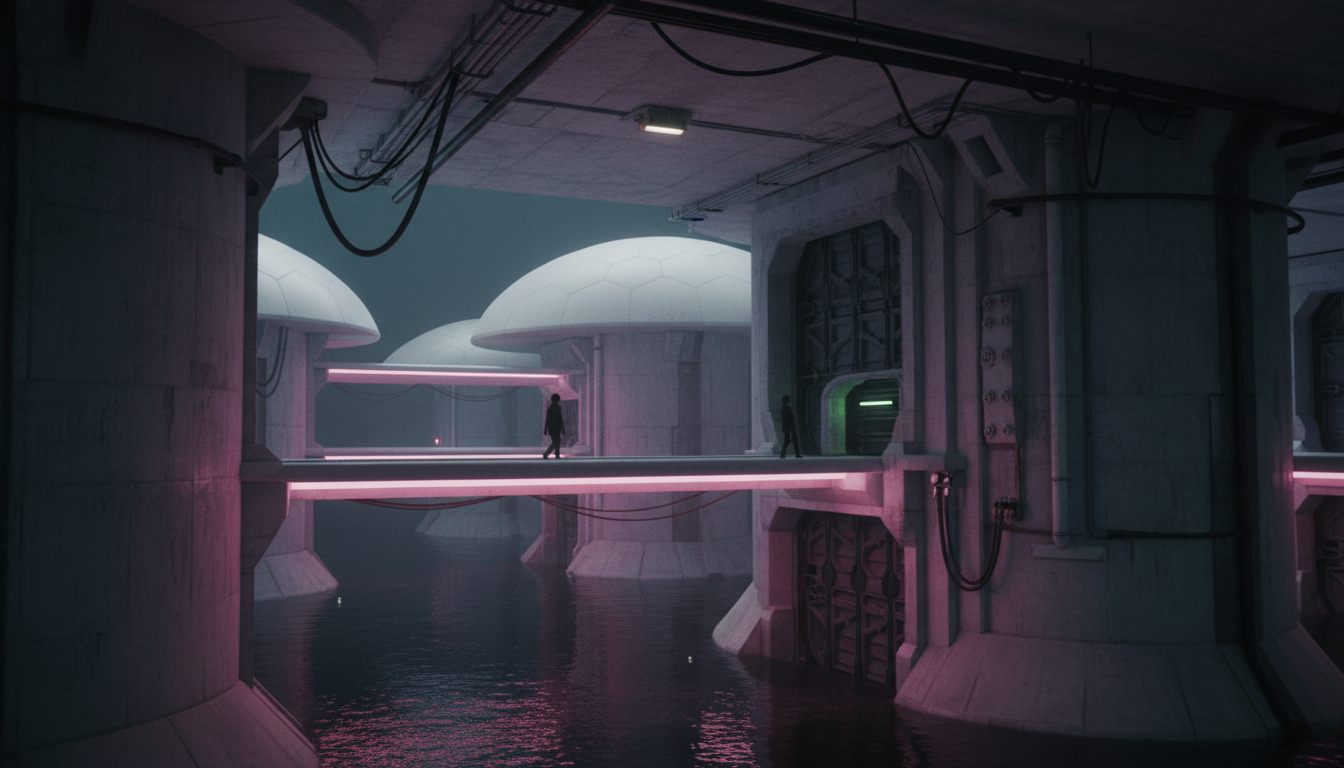
Aura-Marina is a city of pearl-white biomimetic domes on buoyant spans over amethyst water, and the generation that built it found absolutely none of it remarkable. That is not remotely a failure of theirs. It is simply the design arriving. Lorena Vasquez went out to the marina on Year ninety-three, Day eighteen, and walked a span that flexed exactly the way a span is supposed to flex at thirty-eight hundredths of a gravity, and the water went under it slowly, magenta where the light caught it and amethyst where it did not, and she did not think floating city. She thought rota. The rota said the hydrosphere wanted a hand on a housing. She put a hand on the housing. It knocked twice, slightly uneven, precisely the way it had knocked since she was assigned to it; four inspections had already declared it within tolerance; it was within tolerance; she checked it anyway.
That knock matters more than the domes do, and anyone who has read Book One will know why, and it is worth saying plainly here that nobody in this chapter knew. Nia Bekele was already on the next span. Kojo Rangi was under a dome painting a seal that no gallery would ever be shown. They did not talk about a founding. They talked about the knock.
The domes take the violet the way pearl takes a light, which is by not arguing with it. Lorena had grown up in a dusk that argued with yellow, and yellow is a lie that Kenji Arata still named as medicine to the end. Out on the water the lie was a colour a person could stand in, and she stood in it. The span had a rail she did not need and used anyway, because the rota says use the rail, and using a rail is not a ranking; it is a hand. The marina had a mouth at the shore-end and Halima Sow's clinic a walk inland and the plaque still a plaque — auto-close, silence sealed — and Park still stood Ground Truth on any day the model said haze. That day the model did not. That day was a knock.
"The seal is drying," Kojo said. "The housing is knocking," Lorena said. "Both of those are the job," Nia said. They kept working. At this gravity a bucket of seal does not weigh what a sitting once said a bucket weighs on a world none of them had stood on, and Kojo did not drop it, and there would have been no need to hurry if he had, because a drop out here is a second long and you can watch it happen. He painted. Lorena ran her palm down the third housing and felt violet water pulsing through it. Within tolerance. She logged the check the way she had been taught, a word into a collar, and the Echo Link — that was the name that year; the name has changed four times since and the function never has — picked her voice out of the span-hum without effort. Logged. Housing three. Vasquez. That is the whole of the ceremony. She did not think ceremony. She thought logged.
Ines Ferrer came out on a slow boat that was really only a span that moved, very old, slate in her lap, copying a marina because a marina is a fact. Lorena did not go to the boat to be copied. Adaeze Nwosu asked whether biomimetic ought properly to be a heading. Lorena did not hear the answer; she was under a dome with a knock. Miriam Achebe had sent bread to the shore-end, and the marina crew ate it on a span and did not spit it, and did not know it at all as the taste of a world you cannot stand on, because they were standing on a span above water they could have fallen into and would have fallen into very slowly. Falling slowly is not a lesson. It is a joke Kojo had already made twice. Lorena told him firmly not to make it a third time. He made it a third time. She did not file a refusal; refusal is Accord; a joke is a joke.
Dov Lindqvist logged the shore-end mouth and did not log a span, because a span is not a door he had a plaque for. Sanaa Okonkwo stood the shore. The interiors rule had followed them out onto water without anybody having to extend it deliberately: Lorena slept in a dome two nights in seven and never once thought about instruments, and the eleven words held over a dome exactly as they hold over a bunk, because they were written to follow a person and not a place, which is precisely why they are still the shortest law on the planet. Soma Barua's meter was a forest, and the forest is inland, and the marina made only a small local hum that died at the rail. Lorena liked the dying and never named it. Renata Oyelaran's law had let them up here; the law was a rota that happened to include a span; Nnamdi Okonjo would put the marina into a night programme as a rota item and not as a wonder, and she would not go. Calder was a mountain, and a mountain does not have a knock anybody had assigned her. Kenji, if he came, would name the air over water as air. She believed him. She still checked the housing.
Halima walked the shore-end once that month, very old, openly glad, a clinic that had followed a people the way a femur follows a walk, and she did not take a tour of the domes. She sat on a rail and ate bread and looked at Lorena exactly the way a clinic looks at a live it has already signed. Lorena raised a hand. Halima raised a hand. No scan. A scan is a dusk, a span is a day, a day is air. Halima had said plainly in the sitting that she would not be kind about a sleep without an element, and Lorena slept with an element, and simply did not know the word element as a thing that had ever been missing from a sleep. She knew it only as a plaque at a mouth. She could live with a plaque. She could live with a knock.
Nobody clapped. Sefu Adeyemi's slate, had it ever reached water, would have said that a dome is not a hole and not to. Tenn logged a marina and not a gallery. Cole hung no word on it. Yara Haddad's foundry had tooled for surface loads after all — the later slip that Ines had copied without comment eight years before — and the spans carried the loads, and the loads were thoroughly dull, and dull was the job. Vega did not come with a picture, and a picture of pearl on amethyst would have been a hymn, and they had work. Lorena checked the fourth housing. Within tolerance. She checked the fifth. The fifth knocked identically. She logged it; Nia logged hers from the next span; two logs and no heading, which is a city being a city in a way no sitting would ever have known how to ask for.
A buoy-span wanted a second seating before the ninth hour, a load out of Haddad's foundry, dull and heavy in the way nothing there was heavy, which is to say it still took two of them to walk it out. Lorena took one end and Nia took the other and the span flexed and the water did not mind. Kojo painted around them and said the seal would take the seat if the seat sat before the seal skinned. They sat it. Logged. East buoy, second seat. Vasquez. Ines's boat was still in the channel and Adaeze waved, and Lorena did not wave at a crate, and she went back and checked the housing again because the seating had changed a line, and the knock was still the knock, within tolerance, and she said so to Nia, and Nia said so to the log.
They took the east buoy after the seating and walked it out to a dome that had not existed the year before, pearl, new, ordinary already, and Lorena put a palm on its skin the way she put a palm on a housing, which is how she knew things, and the skin was warm from the violet. Nia said it would sleep six. Kojo said six was a rota. They logged six. Nobody asked who the six had been on a ship. Ines's boat turned in the channel without coming alongside — a clerk who had copied enough, and a city that does not need to be watched in order to be a city — and Halima's hand did not rise from the shore, because a dome is not a femur, and Lorena did not need it to.
Toward the ninth hour the sun went slowly toward a fall that would take hours, and the two moons sat pale, and the water held magenta in the troughs, and Lorena stood on the span with her hands on a rail she did not need and deliberately let her shoulders come down. "Tomorrow the east dome," Nia said. "Tomorrow the east dome," Lorena said. That is the whole of the later. She did not think first generation and she did not think remarkable; she thought only that the knock was still within tolerance, and the bread was still a little in her mouth, burnt sugar, clinic, and the air was still a day that a man had certified and four hundred names had been paid for, and she went in off the span when the rota said. Year ninety-three, Day eighteen: pearl, water, a housing, a log, and a joke Kojo should not have made a third time. It was enough. Three chapters from here she will be asked, once, what any of it was actually for, and she will not have an answer, and that is not a failing either.
Chapter 79 — The Cliff-Tiers
↑ Back to ContentsFocus: vertical city on braided cable; leap pads, not stairs; a body designed at 0.38g
There are no stairs at all in the Cliff-Tiers except the ones somebody specifically asked for. That is worth saying first, because absolutely everything else about the place follows from it. Lorena Vasquez went up the Tiers on Year ninety-three, Day forty — a vertical city hung off basalt columns on braided cable, leap pads set exactly where a landing would be on any world with a heavier pull — and she leapt, and the leap took a second she could comfortably watch happen, and she came down on a pad that had never been designed to forgive a spine, because the generation that laid the pads out designed deliberately for the body it actually had rather than for the body its grandparents had left behind. Nia Bekele leapt behind her. Kojo Rangi was already three pads up with a coil of cable over his shoulder. Nobody talked about stairs. Stairs are a lesson about a spine, and none of them had that spine.
The cable sang a low note that the forest would have swallowed if the forest had been anywhere near, and the cliff is not the forest; the cliff is basalt, and a city that goes up the way the holes went down. Lorena thought about neither. She thought about the next pad.
The pads were not a game. A sitting had asked, years before, whether the pads amounted to a game, and had been told flatly no, and the no is still in the file. A pad is a floor you arrive at by leaving a floor. Lorena left a floor and arrived. Long limb, light skeleton, hips that Halima Sow had once called a later back when Lorena was a live on a tray — and the later had arrived, and it had arrived precisely as a leap. She did not thank a vault. She did not thank a Ledger. She thanked a coil that Kojo threw, by catching it, and catching a thrown coil at thirty-eight hundredths of a gravity takes long enough that you can laugh partway through, which she did, shortly, and it went out over the ravine and nothing whatever gave it back.
Ines Ferrer came as far as the lowest pad, very old, slate in hand, and did not leap. Adaeze Nwosu asked whether leap should be a heading. Ines said — and this reached Lorena secondhand, much later, and she did not understand it then — that leap was Vasquez's, and that a heading announcing the young had a body the old did not have would be a when, and she had spent fifty years refusing whens. Lorena did not know that sentence. She knew a pad. She logged the cable seat into a collar the way she logged a housing out on the water. Logged. Pad seven, cable seat. Vasquez. That was ceremony enough.
Miriam Achebe's bread sat at the lowest pad, burnt sugar, item fourteen, and the leap-crew ate it between climbs, and the sugar was a clinic, and the clinic was a long walk down at a mouth, and Halima did not climb. She had said a femur at a mouth and she had meant a mouth. A cliff is a later a clinic treats if somebody misses a pad. Nobody missed a pad. Missing is a story about a heavier world, and they did not have that world.
Dov Lindqvist logged the ravine-end door at the bottom, empty-handed, because a cliff is not a door and a door is all he had left. Sanaa Okonkwo did not stand a pad; a pad is not a log anybody had ever given her. Soma Barua's ravine is an entirely different ravine and her meter is a forest; this ravine had cable, and cable is a specification she would certainly not have uncounted if she had come, and she did not come, because a crayon-tremor does not leap. Renata Oyelaran's law had never once mentioned pads — a law that lets a people up onto the surface does not need to specify how they will get up a cliff once they are there — and going up a cliff was simply a rota. Nnamdi Okonjo would put the pads into a night programme as a rota item and not as a wonder. Calder's mountain is a different basalt entirely, with a house on it, and Lorena did not mix the two, because mixing a house and a pad is a sitting, and she was not a sitting.
"Pad nine wants a second seat," Kojo said. "Pad nine can wait until the coil sits," Nia said. Lorena sat the coil — a wrap, a lock, a log — and her thumbs ached afterward the way thumbs ache after a morning of small precise work rather than from anything having been heavy, because nothing there was heavy in any sense worth writing down. She ran a palm along the braid and felt it take the load of a city, and the load was ordinary, and ordinary is the job. Sefu Adeyemi would have said do not clap. She did not clap. Ovid Tenn would not have found a gallery in a pad. Imani Cole hung no word on it. Yara Haddad's loads were in the seats. Vega did not come with a picture, and a picture of a leap would have been a hymn about a body, and they had a body, and they used it, and using it is not a heading.
On a haze-day Park would have been standing Ground Truth at a mouth rather than a pad, and the model said clear, and Kenji Arata still named air, and Lorena still believed him exactly the way she believed a rota. She leapt to pad ten. The ravine went down considerably further than she had ever kept a number for; she did not keep numbers that were not a cable seat. Two moons sat pale over the lip. The sun was violet and slow. Magenta water was somewhere else entirely, another rota, a knock she would go and check the following week. This week was a pad. Halima, told about it afterward, said simply that the hips had answered. Lorena never heard that as a later. She raised a hand from pad ten toward a mouth she could not possibly see, and nobody raised one back, and a leap does not need a wave.
A child came up as far as pad three that afternoon with a parent who had been born under a tube on the ship, and the parent took the stairs — there are stairs beside the pads, all the way up, for a spine that still wants them — and the child took the pads, and nobody made a sitting out of the difference, because the difference is a body and a body is not a ranking. Lorena gave the child the rail-habit anyway: a hand, a pad, a wait for the next. The child waited. The parent, on the stairs, did not ask Lorena to make the child feel a founding, and Lorena would frankly not have known how. She said, "Pad four." The child went. The parent went. The city took both, which is the sentence the Tiers were quietly built around, and it is not in any charter.
Pad eight's cable had a sing in it she did not like. She did not call it a missing. She called Nia, Nia listened, Kojo brought a wrap, they sat the wrap until the sing came down into the note the other cables held, which is a note and not a hymn. Logged. Pad eight, wrap. Vasquez. Ines, at the lowest pad, copied a wrap because a wrap is a fact. Halima, told by a runner, did not climb; a sing is not a femur until it is, and it was not. Dov logged nothing about it, because a sing is not a door.
They ran a drill on pad five in the afternoon — tone from the bottom, filters on, wait, Park's hand down, filters off. Kojo still leapt with his filter on, out of a habit Lorena did not love, and she had hers off before the hand had finished dropping, and the leap with air on her mouth was the one she had come for. "Drill is a rota," Nia said. "Rota is a drill," Lorena said. They went back to pad twelve. Bread, burnt sugar, a parent still on the stairs, a child already at pad six. Ines copied the drill beside the wrap. Two facts, no song.
At pad eleven they put in a second rail for a spine that still wanted one, and Lorena sat the rail without liking it as a hymn about kindness and liking it instead as a parent who had used the stairs. Kojo said the rail was ugly. Nia said ugly was a seat. Ines copied a rail beside a wrap beside a drill — three facts, no song. A child used the rail and a pad in the same climb, which is a body choosing, and choosing is emphatically not a ranking. Lorena leapt over the rail on her way down purely because she had a body that could, and the parent on the stairs did not ask her to stop, and she did not ask the parent to leap.
Toward the ninth hour she sat on pad twelve with Nia and Kojo and a coil that had become a seat, and they finished the bread, and Kojo pointedly did not make the falling joke because a ravine makes it considerably less funny. "Tomorrow pad thirteen," Nia said. "Tomorrow pad thirteen," Lorena said. She looked down the cable and up the cable and found a hymn in neither direction. Year ninety-three, Day forty: basalt, braid, a leap you can watch, a city that goes upward, and a body born for a third of a weight that does not know itself as a design. That is the last generation this book follows, and it does not know what it is, and the six chapters remaining are largely about the people who did know, closing their books one at a time while the leaping went on above them.
Chapter 80 — The Thirds
↑ Back to ContentsFocus: the thirty-six-hour day formalised; Shift-Equity Act; last document, and the kindest
Waking Manifest · Year 94, Day 12 · Authority: standing, unsigned
The Thirds were law before anybody thought to write them down, and the law, when it came, was written to stop a foundry rather than to start a custom. Ines Ferrer drafted the Shift-Equity Act on Year ninety-four, Day twelve: the thirty-six-hour day formalised into three blocks of twelve, with eight hours of work inside the Active Block and no ninth available to anybody at any price. It was the last document she wrote. It is also the kindest, and she would have refused both descriptions, and the second one for better reasons than the first.
The world-day is thirty-six hours and has been since they first stood under a violet sun and carefully counted it: eighteen of light, eighteen of dark. Not a stretched Earth day, not a seventy-two, but exactly this planet's. Inside it a people had already drifted into a shape — work in the first third, a life in the second, a sleep in the third — and the foundries had gradually drifted into taking a little more, and the dusks into offering a little less. A child on a cliff-pad had a rota that ended at eight and a parent on the stairs who still stubbornly wanted nine. Equity was simply a clerk's word for a foundry not owning the ninth hour, and she wrote it out as flatly as that. Shift-Equity Act, Year 94, Day 12. Active Block: eight inside twelve. Lifestyle: twelve. Sleep: twelve. foundry may not take the ninth. dusk may not donate the ninth as a ranking. Ferrer.
Adaeze Nwosu asked whether last should be a heading. Ines said last was a when, and she had refused whens for fifty years and was not going to start with her own. She filed an act. An act is not a when. An act is a clock a people can hold up against a load.
Halima Sow took the sleep third and signed it medical, which she was entirely right to do. "Twelve is a femur," she said. "Eight is a femur that can still leap. If a foundry takes nine I will put my name on the foundry. I am not going to be kind about a ninth. I am being kind about a twelfth. Kind is not a hymn. Kind is a sleep. Sow." Miriam Achebe held the pillars exactly where they were and pointedly did not add a fifth for the occasion — a person is not a ranking of hours; a clock is not a forest; the Accord still protects anyone who will not work a ninth; and Calder was not the clock — and she sent bread, and they ate it, burnt sugar, item fourteen, the smell that by then meant a clinic to a whole generation and a span and a pad besides. Renata Oyelaran said, "I will write this as law. It is a success. A people that can stop a foundry taking a ninth is a people I buried everyone to get. Do not decorate it. A clock is a clock. Fetch me the slip. I am slower. I am still fetching."
Nnamdi Okonjo put it into that night's programme as a clock and not as a wonder, hands shaking badly by then, the pin still on. "If the gallery asks what we found I will say we found eight, twelve, twelve. That is true. I am not inventing a when. I dated founder. I am not dating a block. This is Ferrer's last. I will not say last in tonight. I will say rota. If they clap I will read them Adeyemi." Sefu's slate sat where it always sat: a clock is not a hole. do not clap. Adeyemi. Dov Lindqvist did not log a clock, because a clock is not a missing. Sanaa Okonkwo stood the crate door, because a door is a door. Soma Barua said a cap on hours was a cap on shafts and she understood caps — the note is in crayon and the tremor is very bad — "I will not uncount eight. Keep it boring. Boring is how a ninth does not become a ranking." Kenji Arata said not air, which was his way of declining to enter a head he had no instrument for. Calder came in with a fitting, worked it through the drafting, said keep it boring, and left. Ines was drafting kindness and kindness done as a number is dull, and she kept the number, and the units did nothing.
Lorena Vasquez was not in the room. She was on a span, or a pad, or a housing, for eight hours, and she would be told at some point that a law had named the thing she already did, and she never read the act. She read a rota that said eight. Ines did not need her to read it. A law that requires a child to be grateful is a ranking of feeling, and she was not going to index a thank-you at the end of fifty years spent unpicking rankings.
Adaeze copied occupancy across entirely unchanged: ninety-five thousand four hundred and forty-one, descent at eighty-two thousand, held at zero. Two thousand more had gone up since the vote nine years earlier, already living the thirds, and a clock does not move a counter and a baby born planetside never once appears on a Manifest. Tenn logged it as Shift-Equity, Ferrer, eight twelve twelve, not a gallery. Cole hung no word. Park stood Ground Truth. Yara Haddad came and asked directly whether the foundry was losing a ninth hour. Ines said the foundry would keep eight. Haddad left with eight. Eight is a load; a load is dull; and the dullness was precisely the kindness, which is the sentence this chapter exists to make.
Adaeze read the act back aloud, as she always did, and Ines listened to it as though she had not written it, which is how a clerk checks a clock. She marked one comma. She did not mark a hymn. Halima took the sleep third down to the clinic and a six-year-old born planetside asked her what a ninth was, and Halima said a ninth was a foundry trying, and the child went back to a rota that already ended at eight. Halima told Ines. Ines copied the child as evidence of a people already living the act, and not as a heading.
Kenji came at the eighth hour and did not name air. He sat with the clock as a man whose fist would no longer close on an optical, and said that a sleep third was a mix a dusk had always quietly had and was now a law, and that he would not certify a ninth hour as medicine. Ines copied not-ninth as Arata. Dov, empty-handed in the doorway, said a clock was the only door he had ever liked that he could not log. Calder's fitting waited on the far bench until the act had a fair copy, and then he picked it up and left without a speech, tired, and not in the way he had once been tired, and Halima did not ask, and Ines did not ask, and the not-asking was itself a kind of close.
She sat with the three thirds after the room emptied and did not write a fourth, because a fourth would have been a hymn about rest, and rest is twelve. She copied the act a second time, because a last document still wants a clerk who copies twice. A foundry complaint had come in that afternoon and she did not correct it out of the margin; she filed it beside. Two lines. Ugly. True. Halima signed medical again. Renata took the slip out to a county that was slower. Miriam's bread sat. Nnamdi's programme had a clock in it. Dov's night book did not. Soma did not uncount eight. Kenji said not air. Calder's fitting stayed a fitting.
Ines Ferrer was very old by then, the serum in her exactly the way it had been in all of them, at a crate she had never once given up, writing eight and twelve and twelve for a people who were already living eight and twelve and twelve and would never know the act had existed at all. That is the shape every good law she ever wrote takes, and it is the shape she plainly preferred, and she filed it as a clock. It sits in the second volume beside the flag, and the revision, and Sow medical, and Oyelaran's door-law, and she closed the volume that evening because a last document still wants a close, and she deliberately did not write last on it. She wrote Ferrer, Year ninety-four, Day twelve, and went straight back to the desk, because week one of a clock was already a foundry slip in somebody's hand, and the hand was Haddad's, and the slip said eight.
Chapter 81 — The Baseline Trust
↑ Back to ContentsFocus: housing, energy, water, food and medical for life; a resilience calculation written as law
The Baseline Trust — housing, energy, water, food and medical care guaranteed to every citizen for life, which the rest of the series routinely treats as the bedrock of the post-survival economy and which every later generation takes instinctively for a moral position — was originally written as a resilience calculation. Renata Oyelaran drafted it on Year ninety-four, Day forty, twenty-eight days after Ines Ferrer's clock, and the reasoning in the first draft is purely arithmetic. A closed founding population that lets anybody fall out of it loses capability it has absolutely no way of replacing. There were ninety-five thousand of them and no more coming. That is the whole of the argument. The generosity is entirely downstream of the arithmetic, and Renata never once pretended otherwise, and it is worth knowing that the kindest law on the planet was written by the woman who had buried more of them than anyone else alive.
She walked to the crate more slowly than she had once walked to a county. Ines copied the calculation. Halima Sow signed medical, not wrong. Miriam Achebe sent bread and did not translate a guarantee into a pillar. Nnamdi Okonjo put the trust into a night programme as a rota item. Dov Lindqvist did not log a house. Soma Barua did not uncount a calorie. Kenji Arata said not air. Calder came in with a fitting and made no speech. Lorena Vasquez was not in the room, which is the point of the chapter and of the law: a generation that would take a house as a rota rather than as a hymn.
A later that starves a foundry-hand loses a foundry-hand. A later that leaves a dusk without water loses a dusk. Capability is a people, and a people is not a ranking so long as the floor holds all of them. She wrote it exactly that way. Baseline Trust. housing, energy, water, food, medical, life. not a luxury. a floor. fall-out is a capability we cannot replace. Oyelaran. Year 94, Day 40. Ines copied it into the second volume beside Shift-Equity — two kindnesses in a single month, a clock and a floor, last documents from two very old women who flatly would not use the word last. Adaeze Nwosu asked whether the floor should share a column with occupancy. Ines said no; occupancy was ninety-five thousand four hundred and forty-one and a floor is a law, and mixing them is exactly how a house becomes a bay. Descent stood at eighty-two thousand. Held at zero. A trust does not move a counter.
Halima said, "Medical for life is a femur I have been signing since a hull. I am not wrong to sign it as a floor. I am not going to be kind about a clinic that turns a person away. If a dusk tries I will put my name on the dusk. Sow." She was not wrong. Miriam held firm: a person is not a ranking of need; a house is not a forest; the Accord still protects anyone who refuses a house they did not ask for, which is a considerably thinner refusal than the old ones and still sits; and Calder was not the floor. She sent bread. Burnt sugar, item fourteen. A generation that thinks bread simply means a clinic will think a house simply means a rota, and she sat with that rather longer than the rest of them did, and she did not hang the trust as a pillar. The trust was Renata's. The bread was hers.
Nnamdi put it in as a floor and not as a wonder, hands shaking, the pin still on — a pin that would not last another year, if Halima's scan was truly a scan, and Renata never once asked to see it. "If the gallery asks what we found I will say we found a people that will not let a person fall out. That is true. I am not inventing a when. I dated founder. I am not dating a house. If they clap I will read them Adeyemi." Sefu's slate sat: a floor is not a hole. do not clap. Adeyemi. Dov said a house was not a missing he could log, and logged the crate door instead. Sanaa stood it. Soma said a calorie she would not uncount was a specification the holes had always had and was now simply a law — crayon — "Keep it boring. Boring is how a floor stays a floor." Kenji said not air. Calder worked his fitting through the drafting and said keep it boring and left, tired, and not in the way he had once been tired.
Yara Haddad asked whether a foundry-hand's house belonged to the foundry. Renata said the house was plainly the person's; a foundry has eight hours and a house has a life. Haddad left with eight and a life. She came back later the same day and said a hand had asked whether the house could be taken away if the hand missed a rota. Renata said no. A house is a life, a rota is eight hours, mixing them is precisely how a person falls out, and falling out is the one capability they could never replace. Haddad left with no. The no is still the answer, a hundred and forty years on, and it has been tested in a Council chamber four separate times, and it has held four times.
Adaeze asked, once, whether the Trust ought to list names. Renata said a floor that lists names is a ranking of who has been given something, and a floor that lists none is a people. Ines copied no-names, and filed the refusal beside the law so that a later clerk who wanted a donor wall would find it waiting. Two lines. Ugly. True. That refusal has done more work than most of the clauses above it.
She sat with Halima after the room emptied and said, "Medical is the floor I cannot write without you." Halima said, "You have always had me. I am not wrong. I am not a hymn. Sign me as a femur. Do not sign me as a gift." Renata signed her as a femur, and Ines copied femur and not gift. Miriam's bread sat between them. Nnamdi came back for a sentence he had forgotten and forgot it again, and Tenn quietly took the pin, and Renata did not date the taking. Dov, in the doorway, empty-handed, said a floor was the only missing he was glad not to log.
She took the slip out to the county herself, more slowly than she once would have, and sat through a session that recited the four sentences, and she did not make them recite a floor, because a floor that has to be recited is a lesson and she had already watched a lesson fail entirely to transmit a crossing. Rangi, older now, asked whether a house could be refused. Renata said yes — the Accord, a thinner refusal, still a person. Rangi did not refuse. She had asked purely so that somebody standing behind her could. Renata copied that asking as a people and not as a heading, and Ines, told about it, marked asked and not assigned, exactly the way a pair had been asked and not assigned twenty years earlier. Nobody clapped. Miriam sent more bread.
Park was standing Ground Truth at a mouth as she walked past, no stack in the model, early still being medicine, a true programme standing in front of a floor that did not need a scare to justify it. Renata nodded at her the way a county nods at a door. She went home to a house she would not call home and slept twelve hours, because a clock had named twelve and a floor had named the sleep as medical, and both of those sat, and she was old, and slower, and finished enough for one day.
She walked the county afterward and passed a mouth where Lorena's generation was coming in off the glass and the spans and the pads, eight hours done, twelve of life ahead of them, twelve of sleep after that. A clock Ines had named. A floor Renata had named. Nobody looked at her as the woman who had buried everyone. That is the success, and it is uglier than a wonder only if you need to be thanked, and she did not need it. She needed a floor. A people that cannot replace a person it drops will not drop one: that is the sentence, and it is arithmetic, and it has fed every child born on this planet since.
Chapter 82 — The Founding Hush
↑ Back to ContentsFocus: Nnamdi's staging observed by people who never met him, for reasons they invented and hold sincerely
The founding hush is three minutes, and it is observed on Aura-36 to this day, and nobody who observes it has ever agreed with anybody else about what it is for. That is not a decay of the ritual. It is what the ritual was designed to become, and the man who designed it that way was in the ground eleven months before the morning this chapter describes.
Lorena Vasquez was standing a shore-end rail at Aura-Marina on Year ninety-five, Day six, when the rota said hush, and she stopped. The knock in housing three ceased under her palm as if a hand had closed on it — within tolerance a second earlier, and then nothing. The foundry inland went off. The leap-pads held whoever was on them mid-wait. The forest, which has eaten sound since before anybody arrived to be quiet in it, ate a silence that had been made on purpose. She did not know Nnamdi Okonjo except as a pin that had stopped shaking and a funeral she had attended because a rota said attend: ordinary, well-attended, bread, burnt sugar. She held, sincerely, that the three minutes were so that a person could hear a plaque if a plaque were going to say stack. Nia Bekele held, sincerely, that they were for the forest. Kojo Rangi held, sincerely, that they were for the people who had not come. None of the three of them had ever seen the memo. None of them needed it.
The water kept its slow shape under the span. Magenta in the troughs, amethyst where the light missed it, two moons pale, the violet sun not yet into its long fall. Nobody spoke. Kojo, on the next span, had a coil in his hands and it did not sing, because he was not moving it. Inland, a foundry tone she had never liked went out. Halima Sow, at a mouth, would be standing with a femur that did not need three minutes and would take them anyway. Ines Ferrer would be at a crate with a clock she had named and a hush she had not, copying a stop because a stop is a fact. Calder would be on a mountain, and a mountain does not knock, and Lorena guessed it went quiet by already being quiet, and she did not guess for long, because guessing is a sitting and she was a rail.
Three minutes is longer on water than it was in a dusk. A dusk always had the strip-hum under it, and the strip-hum was a yellow lie; this was a span that had had a knock, and the knock was hers, and without it she could hear Nia breathing. Several people in the dusks had said the same thing about the first hushes forty years earlier and had used the word intimate. Lorena did not use that word. What she had was: I can hear you. She did not say it. Saying it would have broken a thing she held sincerely. Nia looked at her, she looked at Nia, that is the whole of the conversation a hush permits. The plaque at the shore-end did not say stack. Park did not raise a drill-hand. Ground Truth stood in front of a silence that was not a scare, and Lorena could live with a silence that was not a scare, having been raised inside one.
She had gone to Okonjo's funeral in the last week of Year ninety-four, after Tenn took the pin and then the pin no longer needed taking. It was a county sitting, and it was ordinary: Miriam Achebe sending bread, Halima not decorating a body, Renata Oyelaran walking through a rite this world is very good at more slowly than she had walked to the county, Dov Lindqvist logging a door because a door is a door, Sanaa Okonkwo standing it, Soma Barua not uncounting a death, Kenji Arata saying not air, Calder at the back with a fitting he did not work, and Sefu Adeyemi's slate already known to everybody in the room. Do not clap. Nobody clapped. Lorena stood with Nia and Kojo and did not know the man except as a night programme she had never gone to, and she held, sincerely, that a funeral is so that a person stops being a rota. That is not what the old people in the front row held. She did not ask them. Asking would have made it a lesson, and she did not do lessons on a day off.
The hush on the span was not a funeral, though. It was a stop, and each of them held their own reason for it, and Ines — if anybody had thought to ask her to copy reasons — would have filed three, beside one another, unreconciled, mark and do not correct. That is exactly what she would have done, and Lorena never knew it, and the not-knowing is the design working. She believed in the plaque the way she believed in a housing. Within tolerance. A memo is a crate, and a crate is a mouth she did not go to.
Nobody was going to tell her about a campaign office. Halima was a femur and would not have raised it. Miriam, had she still been alive that morning, would have sent bread and declined to translate a hush into a fifth pillar — a person is not a ranking of reasons; the forest is a meter and also, that day, an excuse Nia loved; nobody has to hold Kojo's people-who-had-not-come, and the founder was a dated man on a mountain and not a sky, and also not the hush. The hush had been a pin's. The pin was dead. The hush was not.
Adaeze Nwosu had come out to the shore-end with a slate and stood the three minutes without copying, which Ines would have marked as correct: a stop is not a heading. After the tone she copied resume. Yara Haddad's foundry came back up in a dull that was a load and not a hymn. A child on a cliff, Nia said afterward, had held a rail and not leapt, and then leapt, and that was the whole of a hush on the Tiers. Sanaa stood the shore and did not come onto a span. Halima, at the mouth, took the three minutes with her hands empty, which is a femur resting, and she would not have hung it as anything else. Ovid Tenn logged the hush as a rota and not as a gallery. Imani Cole hung no word on it. Vega did not bring a picture, because a picture of a silence is a hymn.
The three minutes ended the way they had always ended, with a tone so small the forest nearly took it, and the knock came back under her palm, slightly uneven, within tolerance, and she logged it, because a start is as much a fact as a stop. Logged. Housing three, after hush. Vasquez. Nia logged hers. Kojo moved the coil. The foundry came in dull from inland. Lorena's shoulders came down and she had not noticed them go up, three minutes of holding something sincerely had done that, she did not file it. She checked the fourth housing. Within tolerance.
"The forest had it," Nia said, afterward. "The ones who did not come had it," Kojo said. "The plaque had it," Lorena said. They did not pick a winner, because picking a winner is a ranking of grief, or of weather, or of a stack, and they had a knock to get back to. A city does not need a man it never met. It kept his three minutes anyway. That is what a ritual is for, and it is the only thing Nnamdi Okonjo ever built that he refused to date, and he refused to date it precisely so that a girl on a rail a hundred years later could invent her own reason and mean it. She meant it. He would have counted that a success and put it in a night programme as a rota item, and Tenn, who had the pin by then, did exactly that.
Chapter 83 — The Last Of The Ten
↑ Back to ContentsFocus: ordinary well-attended funerals; the crossing crew reduced to a handful, then fewer
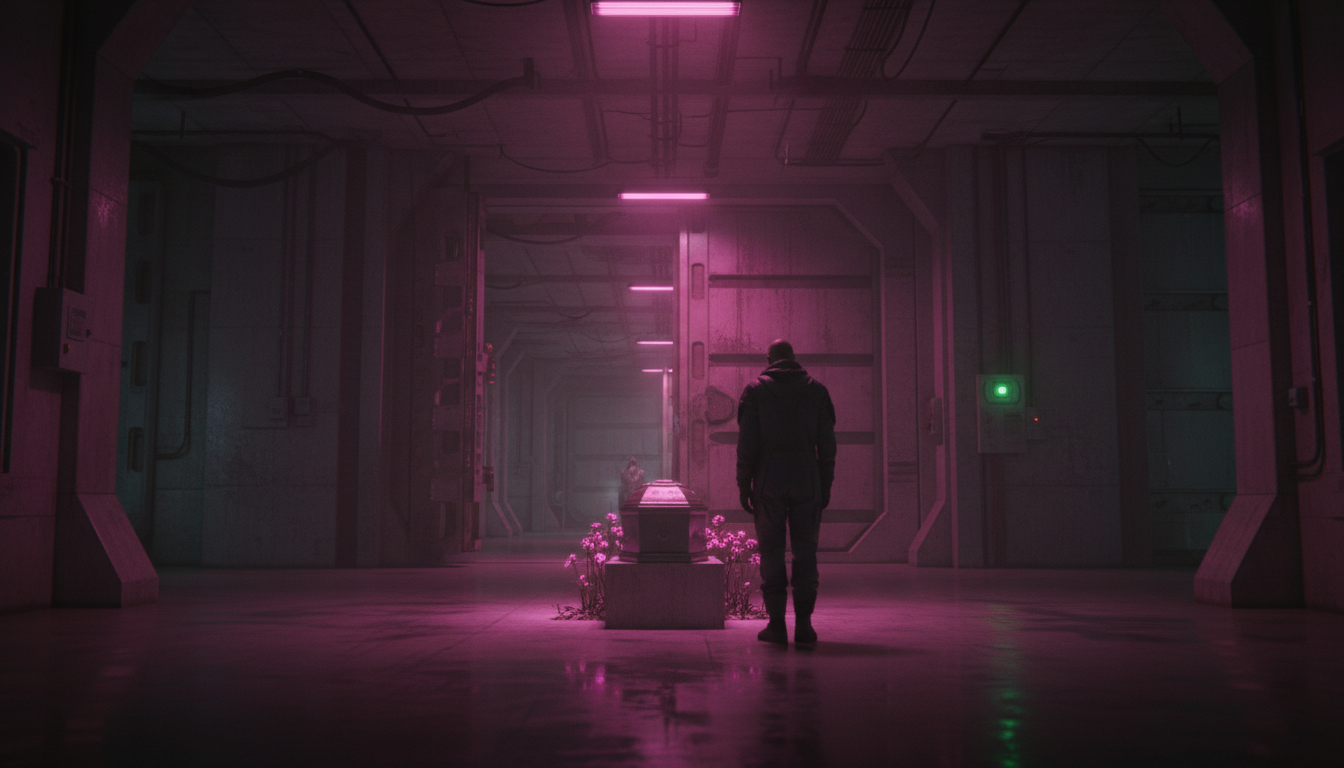
Year ninety-five took seven of them. Halima Sow buried them as they came, and the funerals were ordinary and well-attended, because a world that learned how to bury people on a ship had not forgotten the learning, and she did not decorate the fewer. She signed medical on bodies she had been signing for fifty years. She was not wrong. She did not kill a single one of those days with a hymn.
Nnamdi had gone at the very end of Year ninety-four and Tenn had the pin. Dov Lindqvist went in the second month of ninety-five, empty-handed, hair long gone, the eleven words still law and the gap he had always known about still sitting quietly inside them, unclosed, entirely on purpose. Halima put his night book into the archive beside four hundred names and beside the nine and the eleven, and she deliberately did not reconcile the copies, and Ines did not either. The sitting was held at a mouth with the Protocol plaque in plain view — auto-close, silence sealed — and Sanaa logged the door and did not log a missing she could not find. Lorena Vasquez came because a rota said attend, and Nia came, and Kojo came, and not one of them knew what a better argument was; they knew a door. Halima can perhaps be forgiven for thinking that was enough. She signed Dov as a femur that had stopped. Sefu's slate, even from a pension: a door is not a hole. do not clap. Nobody clapped.
Miriam Achebe went in the fourth month, sitting longer and longer until at last the sitting was simply a sleep, historical finally in the way a body is historical. Four pillars left behind in dusks that recite them faithfully without ever having felt a pad. Hold. File. Refuse. Name as a man. Halima held the vault that same week, because the vault was still work and lives still arrived, light and long, and she was glad in a corridor and tired in a county on the very same afternoon and did not once make the glad pay for the tired. She sent Miriam's bread to Miriam's own sitting, which was entirely allowed, and which was item fourteen, and which is precisely the joke Miriam would have liked best. Ines copied it: Achebe, Year 95, Day 88. work arrived. bread. not a ranking. Ferrer. Occupancy unchanged at ninety-five thousand four hundred and forty-one. A funeral is not a letting-out. Calder stood at the back. Halima did not offer him bread as a question, and he ate it simply as bread, and the units did nothing.
Soma Barua went in the sixth month, the crayon-tremor finally finished, having never once uncounted the meter. Halima sat her and did not ask a rock to be a specification. The rock had been a person, and the person had seated a tether, and a grid, and a line of six sizes, and sites on caps, and a copy in a drawer Halima would never open. Kenji Arata went in the seventh — the optical, the arthritis, the four hundred names, the mix he never browned, the recommendation a sitting had taken and a flag that had been revised beside it. Halima closed the optical away in a drawer. She signed him as a femur that had named air, and she was still not going to be kind about a pad-sleep without an element, and the element still sat, and both things are perfectly true and neither one cancels the other. Park stood Ground Truth at a mouth on the morning of Kenji's sitting. No stack. Early still medicine. Halima nodded at her. A door is a door.
Sefu went in the ninth month, pension and crayon stub, dull still medicine, a slate that had comfortably outlasted a hole. They did not clap. Renata Oyelaran went in the eleventh, considerably more slowly than she had once walked to a county, with a floor already written and a success already filed and a burying that had quietly turned into a people who no longer looked at her as the woman who had buried everyone. Halima said exactly that at the sitting without hanging it: "She wrote a floor. Sleep on it. Do not thank her. Thanking is a ranking. Sow." Lorena, at the back, did not thank anyone. She had a house, and eight hours, and twelve and twelve, and a hush she genuinely meant, and she had never once read the Trust. Halima could live easily with the not-reading. Ines copied Oyelaran beside the Trust — a law and a body, two lines, not the same page, beside.
Between sittings she ran the clinic, because lives kept arriving and a vault does not close merely because Miriam died. Adaeze copied lives as lives and pointedly not as occupancy; Ines marked them; the Manifest did not move at all, because a funeral does not move a counter and a baby born planetside has never once appeared on it. Park stood mouths. Sanaa stood doors that Dov would have stood. The eleven words followed a person to sleep, and Halima left interiors unmonitored, and she knew the gap perfectly well, and she left it, and she was certainly not going to rediscover it on a bench of funerals in order to make the year mean more than it meant.
Lorena asked her, after Renata's, whether they were supposed to feel something. "You are supposed to attend," Halima said. "Feeling is not a rota. If you feel bread, eat it. If you do not, do not decorate the not. Sow." Lorena ate the bread. Burnt sugar. Nia ate it. Kojo ate it. None of them recited a crossing, and Halima did not ask them to. Miriam's four sentences still sat in the dusks that recite them, and reciting is not feeling, and Renata had called that success, and Halima called it a sitting that had been attended, and Ines copied both, not on the same page, beside.
The published complement still read ten. Roux had been a volume since Year thirty-six. Okonjo, Lindqvist, Achebe, Barua, Arata, Adeyemi and Oyelaran had all gone into a single year that turned out to be extremely good at funerals. Living, in Halima's own scan: Ferrer, Sow, Calder. Three of ten, and rather fewer than that if you counted how a handful actually feels. She scanned Calder last, exactly as she always scanned him last, and the column came back empty, and he was tired, and it was decidedly not their tired, and she did not ask, and he did not offer. She wrote scan as standing. I am not asking. Sow. Ines, given the note, did not fill the column. Adaeze did not ask twice. That empty column is the last unresolved thing in the entire founding record, and the next two chapters are what becomes of it.
Tenn logged the sittings as sittings and not as a gallery. Cole hung no word. Haddad's foundry sent loads to graves that did not need them and then stopped, which was correct. Vega brought no pictures. Bekele came, Nia came, Kojo came. The Accord still protected a refusal, and Okoro sent a slate from Mars and did not have to come, and Miriam would have liked that, and Halima liked it. Nnamdi's hush still ran three minutes on the span where Lorena stood. The ritual had outlived the pin.
Halima sat with Ines Ferrer after the eleventh month and ate bread that was still Miriam's recipe. Two very old women, a man who would not lie down, and a generation that did not feel a founding and was good at funerals anyway, because a ship had taught a people and the people had kept the teaching. Year ninety-five: ordinary, well-attended, fewer. It was uglier than a wonder, and uglier is what she signed, and the vault was still making lives, and the mouth was still shutting, and the mountain was still a house.
Chapter 84 — Ines Closes The Book, Again
↑ Back to ContentsFocus: she deposits the Bound Ledger, the unredacted Keel copy, and the exemptions, and stops; she does not reconcile them
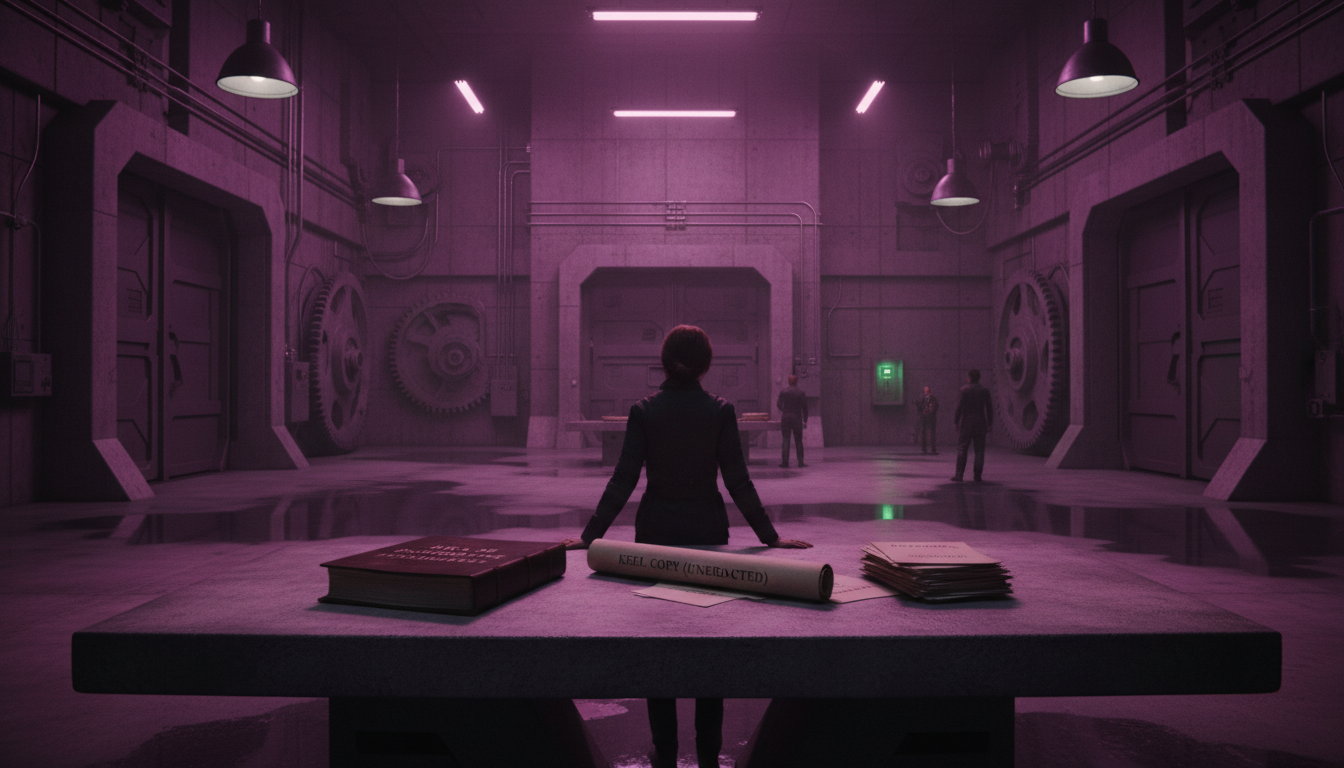
Ines Ferrer deposited three documents into the archive on Year ninety-six, Day two, and then she stopped working. The hand-written Bound Ledger. The unredacted manifest copy carried off The Keel. The exemptions schedule. She did not reconcile them, and she did not ask any later clerk to reconcile them, and she did not write down why. Three documents, one clerk, three books. Adaeze Nwosu took the crate. Halima Sow sat with her while she put the three on a shelf that would not make them one.
The Bound Ledger is favours and seats and who covered whom — a notebook that gradually became a spine, ship to hole, kept weekly, forever, until forever turned out to be a shelf. The Keel copy is the names a ranking badly wanted to eat and the index that flatly did not let it, closing at ninety-five thousand four hundred and forty-one at close of waking, held at zero, and pointedly not at a hundred thousand, because she would never once put a baby born planetside onto a counter built for sleepers. The exemptions schedule is the accretion: the eleven words, Sanctuary, no address, no oversight, no review date, each omission typed carefully with a stated cause, the sealed sector, the mothballed fabricators, the public reserve hospital lifeboat, the Citadel beside a transmitter, 9-Alpha mute, a delay of three seconds that an afternoon in Year sixty ported and never memo'd, a flag revised beside and not erased, Councils and Guardians, a genuinely good system, with exactly one exemption it does not cover. She set them on the shelf in that order. Ledger. Manifest. Exemptions. deposited, Year 96, Day 2. not reconciled. Ferrer.
Adaeze asked whether a fourth volume ought to say why. Ines said why was a when, and she had refused whens for fifty-four years, and she was not going to make an exception for the shelf. That refusal is the reason the archive is still usable. A clerk who had reconciled those three books would have produced one narrative, and one narrative is a hymn, and a hymn cannot be audited. Three books that disagree can be. They have been, twice, in Councils she did not live to see.
Halima said, "I am not wrong about a shelf. I am not going to be kind about a clerk who stays behind to watch a later make them one. You have copied. You have stopped. Stopping is a femur. Sow." She was not wrong. Ines sat with it. She deliberately did not send for Calder. He came anyway, with a fitting, and set it down on the far bench and did not look at the shelf, and she did not offer him the three, and he said keep it boring, and she said, "I am stopping," and he said, "All right." All right was still not a name. She let him go. The units did nothing.
Tenn logged it as Ferrer stop, three documents, not a gallery. Cole hung no word. Park stood Ground Truth at a mouth that morning, which was Park's every morning. Sanaa logged the archive door. Interiors: a shelf is not a sleep, so the eleven words did not attend it, and the gap Dov had left sat where it had sat for forty years, and Ines left it there on the way out, which was the last thing she did not do.
She did not walk a marina afterward, or climb a pad, or stand a hush. She walked a corridor that had once been her crate's and was now entirely Adaeze's, and ate bread that was still Miriam's recipe, burnt sugar, item fourteen, and did not spit it, and did not call it the smell of a world you cannot possibly stand on, because by then they stood on it perfectly comfortably — days, mouths, plaques, Lorena's glass, a knock, a leap, three minutes of invented why, Renata's floor, her own clock, a vote a sitting had taken, and a flag she had not erased.
Adaeze asked once more whether occupancy should move. Ines said occupancy was ninety-five thousand four hundred and forty-one, descent eighty-two thousand, held zero, and a stop does not move a counter. Adaeze copied it across unchanged, which was the habit Ines had taught her and which had by then become a person rather than a habit. She could live with a person at a crate. She could not have lived with a person who made three books into one on the day she left, and Adaeze did not, and never did, and the volumes are still three.
Halima walked her as far as the clinic bench. "You have stopped. I have not. A femur still has lives. I am glad. I am not hanging glad on your shelf. Sow." Ines said, "Do not hang me on a live. A live is yours. A shelf is three. I am not a fourth." They ate. Nobody clapped; Sefu had written that down years before either of them needed it. Then she went home to a house standing on a floor she had not named — Renata had named it — and slept twelve hours because a clock she had named said twelve, and did not once get up in the night to correct a line, and the not getting up was precisely the stop.
She walked through the archive once after the three were finally on the shelf, not to watch them sit but simply to be sure the walk now belonged to Adaeze. The Bound Ledger has her own hand in it from a hull. The Keel copy has names a ranking did not eat. The exemptions schedule has blanks she typed with causes: a delay that was never a memo, a mute, a house on a mountain, a force that was Sanaa's, a sector that had never come down, a flag revised beside. She did not open any of them. Opening is properly a later clerk's work. Adaeze did not open them behind her. Halima came as far as the door and no further, being a femur and emphatically not a witness to a hymn.
Nobody came to thank her, and this is exactly the part she would want kept. Yara Haddad did not ask for a tool order. Vega did not ask for a picture of three books. Bekele did not come to thank a clerk for a pair granted twenty years earlier. Lorena did not come to be copied, and Lorena's knock, if it happened to be a marina day, did not pause for a shelf. All of that is entirely correct, and Ines took it as the job having finally arrived. She had indexed names, not feelings, and a generation that needed a clerk to close a feeling for them would have been a generation she had never indexed for.
She put a hand on the Bound Ledger the way Halima puts a palm on a femur, which is to know it, and took the hand off, and walked out. Year ninety-six, Day two: three documents, one clerk, three books, not reconciled, a crate that was Adaeze's, a clinic that was Halima's, a mountain that was his. She did not stay to watch them sit. They have sat for a hundred and forty years, and this account is drawn from all three, and where they disagree it has said so, because she left it possible to.
Chapter 85 — The Man On The Mountain
↑ Back to ContentsFocus: Calder alone in the finished Citadel; every exception acquired in a room with witnesses; there was never a moment
There was never a moment. That is the finding, and it is the least satisfying finding in the archive, and every attempt to overturn it in a hundred and forty years has failed on the same evidence.
Calder stood in the finished Citadel on Year ninety-six, Day eighteen, high above a working world, holding a category of exceptions no other person on the planet held: a force that answered solely to Sanaa Okonkwo and to a door; a sealed orbital sector that had never once come down; a buried survey result; and a delay of three seconds in the monitoring grid that he had built with his own hands. Every single one of those was acquired in a room, with witnesses, for a clearly stated reason, across eighty years. Not one of them was ever seized. There is no meeting anywhere in which he asks for power and no meeting in which anybody grants it, and researchers have looked exhaustively, and the minutes are complete precisely because Ines Ferrer kept them complete, and what the minutes show is simply a series of sensible afternoons.
He was not a villain. A person looking up at that peak from a marina or a pad or a crate would still have been right to be afraid of what came next. Both of those sentences are true, and the whole difficulty of the founding is that they are true simultaneously, and he did not make a speech about it. He set a fitting on a bench and worked it, tired, and not old in the way the others had gone old.
The windows took the violet the way a peak takes weather, which is by being thoroughly in it. Aura-Marina was a scatter of pearl on amethyst, far off. The Cliff-Tiers were a braid across a ravine. The forest was a black that ate sound and methane both. The mouths had plaques on them: auto-close, silence sealed. Lorena Vasquez was on a span or a pad or a housing somewhere for eight hours, under a clock Ines had named and on a floor Renata had written, with a hush of three minutes she sincerely meant for a reason entirely of her own. He did not watch her. Watching is an Eye, and the Eye blinked three seconds late because an afternoon in Year sixty had quietly ported a delay and never written a memo, and he had been in that room, and there had been witnesses, and the reason had been a specification, and Soma had seated the specification, and Soma was a drawer now, and the delay sat.
Sanaa came up on a rota rather than on a summons. The Legion had been a fire alarm, then a cover, then a handoff, and Dov had gone empty-handed ever since, and Dov was now a volume in an archive. She stood a door at a peak exactly the way she had once stood a door at a mouth. The interiors rule made a house a sleep: where a person sleeps, no instrument of the ship attends. He had left the gap. Dov had known about the gap and had left it deliberately. Halima knew. Ines had typed no address, no oversight, no review date, each omission with a cause carefully beside it, and the schedule was sitting on a shelf with two other books she had flatly refused to reconcile, and he had not asked her to reconcile them and did not go down to look. Sanaa logged entries and exits and never logged a room, and he did not ask her to invent a horizon, because Dov had never given her one and he was certainly not going to be the man who did.
The sealed sector had still not come down. Public reason: reserve, hospital, lifeboat. Fourth reason, unpublished: mothballed fabricators, a sector Ines had copied as stay. Soma had seated a tether so that the Ark would not have to come down, and the Ark hung, and he did not bring it down, and he had not rediscovered any of this as a fresh decision — he had formalised it in Year sixty-six, in a room, tired, and the word in the minutes is privacy. 9-Alpha mute. Fibre laid into basalt with his own hands. A hub beneath a vault that Halima had opened gladly and never asked a question about. He did not explain the hub. He set another fitting. The units on the bench did nothing, as they had done nothing for eighty years, because nothing had ever asked them to do anything, and he did not ask.
Halima came up once that month, very old, still glad, and ran the scan she always ran last. Empty column. She did not ask. He sat patiently for it. Optical; the insult from a shaft that she still had a log for; and he offered no why and she demanded none, and she wrote standing. She ate bread that was still Miriam's recipe and spat it, and laughed once, shortly, and the peak did not give it back the way a plated corridor always used to. He let her have the laugh. It had never once been his. It had been a vault, and children, and a later that had finally arrived.
He went down as far as the transmitter hall that week, not to date anything — Nnamdi had dated founder, and founder was a man, and a man was a house — but to reset a plate that had worked loose in a night of wind the peak still gets. He set it by hand. The hall hummed. The dual carrier still did what Soma had seated it to do, and he did not power a meter to check it, because checking is a specification a later generation would have. Sanaa logged the hall door and the peak door. Two doors, no horizon.
He stood at the window long enough to see a leap on a far cliff — a second you can watch, a body born for a third of a weight — and he did not take it as a hymn about a design. He took it as a pad that had been logged. Then he went back to the bench, because a fitting was waiting, and because a bench with a fitting on it is a man who has not yet become a when.
Sanaa, in the doorway, did not ask him what he was afraid of next. He was afraid of next exactly the way he had been afraid of a soup, and a shaft, and a stack, and a people on a pad, and a sitting that could take a flag, and a generation that did not feel a founding and would one day, inevitably, come up the mountain with a question. He did not date the fear, because dating is a when. He seated the plate, and the plate sat, and the fear sat beside it, carefully not on the same page. Beside. It is a clerk's habit and he never once named it as one and he had learned it from her.
Night came the long way, eighteen hours of it, two moons, magenta far off, a marina knock he could not have heard from there, a forest eating everything that reached it. He worked one more fitting. Occupancy ninety-five thousand four hundred and forty-one, descent eighty-two thousand, held zero. He did not write those numbers down. Ines had written them, and deposited them, and left them unreconciled, and he left them unreconciled too, because making them one would have been a moment.
He turned the lamp down. The Eye, three seconds late, kept a perfectly clean log of a house that had never invited it in. 9-Alpha mute. A hub he would not name. A vault opened gladly without a single question about a junction. A world working. A next that was still only a next. He slept, and the eleven words held over him exactly as they held over everyone else, and the gap held with them, and that is precisely where the founding record ends: not on a seizure, not on a betrayal, not on a moment, but on a very tired man on a peak with a fitting in his hands and every exception still firmly in place and nothing at all having happened.
Chapter 86 — The First Breath
↑ Back to ContentsFocus: an ordinary clocking-off; violet sun, two moons, magenta ocean, eighteen hours of night, nothing on her mind; the world working
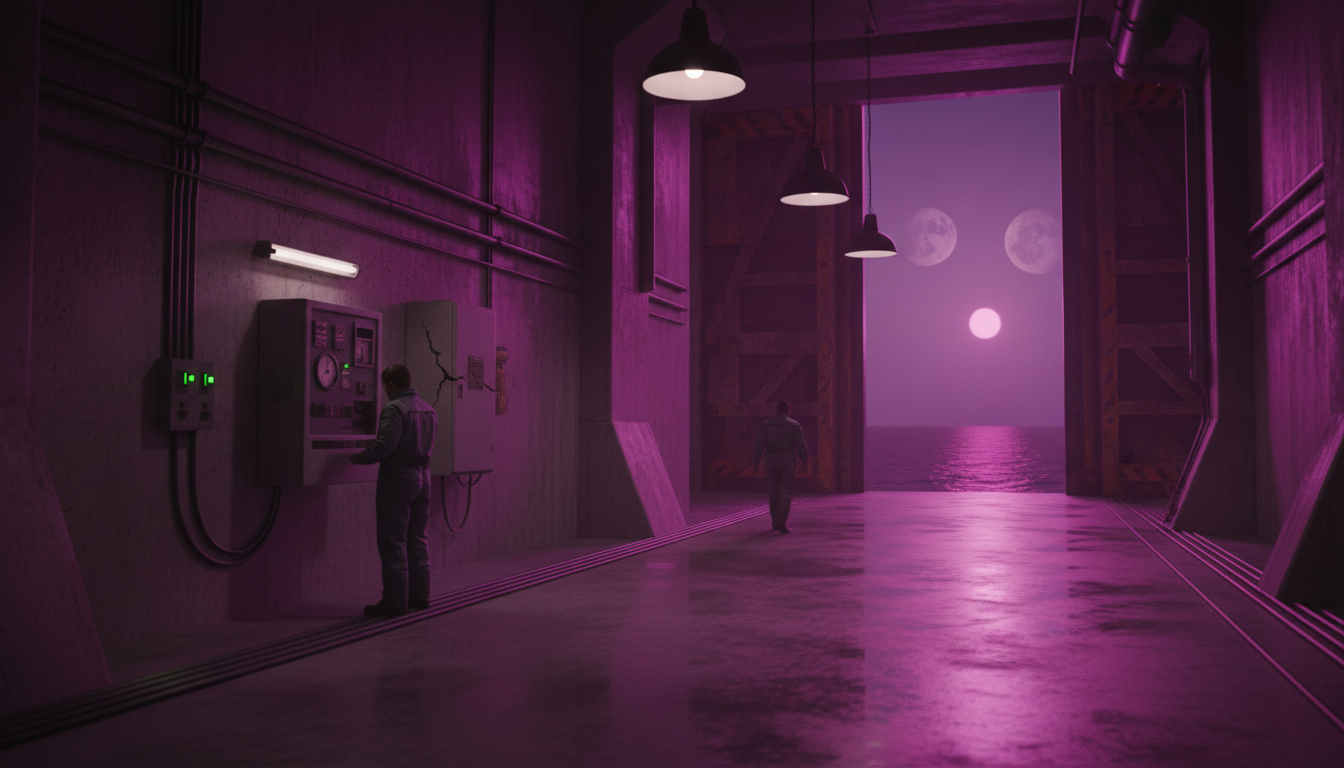
Nothing whatever happened on Year ninety-six, Day thirty-one, and that is precisely the entry the archive closes on. It is not remotely a shortage of material. It is the finding. A world that had been argued painstakingly into existence by ten people in a hull, and carried across the dark by a crew who buried each other steadily on the way, and let out onto its own surface at last by a vote its founders lost, arrived finally at an afternoon in which a twenty-year-old checked a bank of housings, clocked off, and walked home with nothing whatsoever on her mind. Everything in the eighty-four chapters before this one was spent purchasing exactly that afternoon. Nobody who paid for it was in the room.
The housings were the last thing Lorena Vasquez checked, and she checked them the way she always did, which was by touch rather than by the readout. Eight hours of the Active Block had put a particular ache into the base of her thumbs — not from lifting, because nothing at the marina weighed anything worth mentioning, but from the thousand small precise adjustments a bank of pressurised housings wants across a shift. She ran her palm along the third and felt the pulse of violet water going through it, that slightly uneven double-knock that had been there since she was assigned and that four inspections had declared within tolerance. It was within tolerance. She still checked it.
The span chimed — not loudly, because nothing on this planet is loud, a single soft descending tone meaning the eighth hour had closed and whatever was left in front of her now belonged to somebody else. She logged her departure the way she had been taught, a moment and a whispered word, and the collar picked her voice out of the span-hum without effort, as it always did, because the nodes were built to find a voice inside a forest that eats sound and a marina is nothing to them. Logged. Twelve hours, the link said, in the flat pleasant register it uses for everything. That is the whole of the ceremony.
Then the outer door, and the change. Inside was the working hum, the housings, the ventilation, the low industrial weather of a place that runs continuously. Outside was nothing — not quiet, nothing — and every time the door sealed behind her the absence arrived like a hand laid flat on both ears. She had made a private decision at some point not to try to get tired of it.
Above the ridge the sun was three hours into its fall and would be a long while getting down: an enormous neon-violet disk gone soft at the edges through the haze, throwing a long low light across the lavender-indigo of everything else, and the sky held that colour it holds for most of a day here, the one nobody born on this world can describe because there is nothing to compare it to. Two moons sat pale in frame. The ocean held magenta in the troughs and amethyst where the light missed. Eighteen hours of night ahead of her. She stood on the platform a moment with her hands in her jacket and let her shoulders come down. Then she went down the ladder in long floating strides, the way everybody does.
Eighty-three pounds. She had been raised inside the number without ever feeling the heavier one it was measured against. Her knees had never hurt. Her back had never hurt. She had met Earth-born people at a mouth, very old, who had described to her what a spine feels like after fifty years of a weight she did not have, and she had listened the way anyone listens to a lesson and had not understood one word of it in the body. That failure of transmission is what Renata Oyelaran called success, and she called it that deliberately, and she was right.
Nia was already on the lower span with the filter strap in a hand she was not using, the plaque clear, Park pointedly not raising a drill. Kojo had a coil and did not make the falling joke. Halima Sow was at the shore-end clinic, or possibly was not; Lorena did not look back to check. Ines Ferrer had stopped, and a crate was Adaeze's now, and a mountain was a house, and a hush would come again on some other day's rota and she would sincerely mean her own reason for it. Tonight was twelve hours of life inside a clock somebody had named, in a house standing on a floor somebody had written, with bread somewhere that still tasted faintly like a clinic. She did not know any of those sentences as sentences. She knew a rota.
She did not think ranking. She did not think crossing. She did not think Earth except as a word a classroom had used. She thought the third housing was within tolerance, and the door had sealed, and the platform had no sound on it, and the sun was violet, and the moons were two, and the water was magenta, and the night was eighteen hours long, and there was nothing whatsoever on her mind.
That is where this account stops, and it stops there entirely on purpose. Every other book in this series is about people who knew exactly what they were doing and argued about it and wrote it all down. This one ends deliberately on somebody who did not have to. The last three founders were still alive that evening — a clerk who had deposited three books and would not reconcile them, a physician still signing lives at a vault, and a man on a peak with a fitting in his hands and every exception still firmly in place — and not one of the three of them was anywhere on Lorena Vasquez's mind, and none of them would have wanted to be, and one of them was a problem that had not yet come due.
It came due later, and what it cost, and who paid it, is not this book. What follows this book is an ordinary shift at an ordinary station on the Amethyst Hydrosphere, a great many years on, with everything still working. It begins the way this evening ended, because that is how the world had been built to run and because for a long time it ran that way.
The filters were the last thing Ren checked, and he checked them the way he always did, which was by touch rather than by the readout.$