
The Form
Framed. The only narrated book of the three: close third on the finder, before and after, with the four-page account she eventually writes quoted whole across Part 5. The middle book gets the heartbeat; Ten and Twelve stay cold. She never uses his name and never learns it.
Chapters
Chapter 1 — Line-Walker
↑ Back to ContentsFocus: Idris Kovan.

Beacon eleven was live and beacon twelve was dead and had been dead since before she was born, and Idris Kovan checked both of them, in that order, the way the round had always run.
The live one took four minutes. Housing sound, seal sound, mount sound, the little amber return on the handset when she keyed it, which meant the unit had heard her and would say so to the next unit up the wall. She logged it in the book and moved on.
The dead one took the same four minutes.
There was no reason for that. A dead beacon is a box on a bracket and the check consists of establishing that it is still a box and still on a bracket, which takes about forty seconds if you are honest about it. But her father had given every unit its four minutes and his mother had given every unit its four minutes, and the round was one hundred and forty kilometres of ravine wall and forty-one units, and if you started shaving forty seconds off the ones that did not matter you would be walking a different round inside two years.
So she checked the seal on a unit that had not transmitted anything in ninety-odd years, wrote as before in the condition column, and went on to thirteen.
The wall ran south-west from the depot and dropped as it went. At the northern end you walked it in a jacket and by the fourth day you were down to a shirt and by the sixth you were sweating through it, because the air at the bottom of a mega-ravine sits thick and warm and does not move much, and the rim air comes off the plateau at four in the morning like something with an opinion.
Forty-one units. Eleven live. Thirty dead.
The round took nineteen days if the weather held and twenty-six if it did not, and she did it four times a year, and she had done it four times a year for eleven years, and her father had done it for thirty-one before that.
Unit thirteen was live. Fourteen was dead. Fifteen was the awkward one, sited on a shelf that had shed rock at some point in the last century and now had to be reached by a traverse that was fine in the dry and unpleasant otherwise, and it was live, and it had been live continuously since it went in, and there was no explanation for that either. The units that lasted were not the ones in the sheltered spots.
She got to the shelf, keyed it, got the amber, logged it, and sat down for ten minutes with her back against the wall because it was the only flat place on that stretch and she was not in a hurry.
Below her the ravine went down into its own weather. There was a haze at depth that never entirely cleared, mineral and moisture, and through it you could sometimes see the watercourse and sometimes not. On the far wall the columns stood up in ranks, hexagonal, four hundred millimetres to a metre across, the whole thing looking built and never having been.
Two kites were working the thermals about two hundred metres out. She watched them for a while.
Then she got up and did sixteen.
The job had a name that nobody used, which was Line Maintenance, Beacon Net, Southern Reach, and it existed in the depot's ledger as one line item with two names against it: hers, and a man called Voss who did the northern hundred and forty and whom she saw perhaps twice a year. What the net had been for was the same thing every net is for. Somebody in the founding decades had put transponders down a ravine wall so that anything at depth could establish where it was and be found if it stopped.
Nobody at depth needed that any more. The settlements had their own systems, better ones, and the four small places strung along the ravine floor talked to each other over something that did not require a hundred and forty kilometres of boxes on brackets. The net was older than all of it and had never been switched off, because switching a thing off requires somebody to decide to, and nobody had.
She had thought about that more than most people think about the reason for their job. Not with resentment. It was a good job. She was outside for two hundred days a year on a wall she knew the way other people know a house, she was paid adequately and left alone, and the work was real in the sense that a beacon which failed on her round got fixed and a beacon which failed on nobody's round would simply have stopped.
But she knew the shape of it. Eleven working units on a net that four settlements did not use, walked four times a year by two people, on a line item nobody had reviewed in ninety years.
She got to seventeen at the back end of the fifth day.
Seventeen was dead. Eighteen was dead. Nineteen was live and its mount had shifted about four degrees, which she noted and would deal with on the return leg because she had the shims in the depot and not on her back.
Twenty was where the wall opened out and the round got easy for a while, and she made good time to twenty-four and camped.
The ledger went in the case with the handset and the shims and the spare seals. It was the same book her father had used, or rather it was the fourth volume of the same book, ruled the same way, columns for the unit, the date, the state, the condition and the anomaly. Three generations of the same walk in the same five columns.
The anomaly column was for anything that was not the unit being sound or the unit being dead. A shifted mount was a condition. A missing unit would be an anomaly. A unit transmitting something it should not be transmitting would be an anomaly.
Her father's anomaly column had four entries in thirty-one years.
Hers had none.
She ate, wrote up the day, and slept with the ravine going down and away below her and the air moving over the rim two hundred metres above, and in the morning she got up and did twenty-five.
Chapter 2 — The Hold, Afterwards
↑ Back to ContentsFocus: Idris.

The Hold was four hours off her round and she went through it twice a year because the depot's supply came up that way, and because Marra Ilunga kept a room for her, and because you do not walk past a place with people in it.
It sat on a broad shelf at the ravine's third bend, about sixty kilometres north-east of where the wall got serious, and about two hundred people lived there. Some of the buildings were cut into the rock and some were built out from it and a few were the original structures, which you could tell because they were better made than anything since.
Nobody called it the Hold except the people who lived there. On the depot's paperwork it was Third Bend, Southern Reach, and had been for a hundred and eleven years.
The outlaw century was a story there, and it was told badly.
That was the thing Idris had never worked out how to say without sounding like she was sneering, so she had stopped trying to say it. The oldest residents told it. There had been a hundred and forty years, ending a long time ago, when the Hold had been a place people came to in order not to be found, and the ravine had had a reputation, and there had been somebody called Harlow who was either a woman who ran the place or a name people used for whoever was running the place, depending on which of the old ones you asked.
The details did not agree. The details had stopped agreeing about four generations back. There was a version where Harlow had been a mechanic and a version where she had been a broker and a version, which Idris privately liked best, in which Harlow had been three sisters and the whole point had been that nobody could ever establish which one you were dealing with.
None of it was written down anywhere that anybody at the Hold had ever seen.
The schools did not teach it. There was no reason they should; it was two hundred years old, it was local, and it had not changed anything about how the world worked. Idris had gone to school in the depot town and had learned the founding, the Accord, the crossing, module twenty-two with the eleven words in it about the sound under the ground that nobody had ever explained, and four hundred years of other people's decisions. She had not learned that the ravine she now walked had once been somewhere you went to disappear.
She had learned that from Marra, at a table, at thirty-one, and had thought: that is a good story and I have no way to check any of it.
The room Marra kept for her was above the workshop and had a window that looked at the far wall. She got in on the ninth day of the round, filthy, with nineteen units done and the mount shim in her pocket that she had been carrying since day five.
"You look like the wall," Marra said.
"The wall looks fine."
She ate downstairs with about eleven other people because that was how the Hold ate, and the talk was about a pump, and a boy who had gone to the coast and come back with opinions, and the price of alloy stock, and whether the watercourse was going to run late this year, which it was.
Somebody asked her how the net was.
"Eleven live," she said. "Nineteen's mount is walking."
"Same eleven?"
"Same eleven."
That was the whole of the conversation about her job and it was the whole of it every time, and she did not mind. Two hundred people who had never in their lives needed a transponder on a wall were politely asking after a thing because she did it. It was courtesy and it was meant kindly and it took nine seconds.
Later, on the step, Marra said the thing she said about once a year, which was that the old ones were going.
Four of them left who remembered anybody who remembered. Tomas at ninety-one, who told the Harlow story with the three sisters in it. Ceri, who told a completely different one and got angry if you mentioned Tomas's. Two others who did not tell it at all any more.
"Somebody should write it," Marra said.
"Somebody should."
"You write things down."
"I write down whether a box is working."
Marra laughed at that, and let it go, and Idris thought about it for the next four days and did nothing about it, which is what everybody does.
The Hold was not a ruin. That was the part outsiders got wrong when they got as far as having an opinion at all. There was no crumbling anything, no atmosphere, nothing to photograph. There was a working settlement with a good pump and a bad road and a hundred-and-forty-year gap in its own account of itself, and the people in it were entirely unbothered by the gap, because a gap is only a wound if somebody has told you it should be full.
She thought about it properly once, that night, lying in the room above the workshop with the far wall going black in the window.
What would you even write. You would write: four people say four different things, none of them was there, and the one written record that might have existed was a place where people came specifically so that there would not be a record. The Hold's whole hundred and forty years had been an arrangement for not being in anybody's ledger. Asking it to have a history was asking it to have failed at the thing it was for.
She turned that over for a while and found it satisfying in a way she could not have explained to Marra without sounding clever, and went to sleep.
She left on the eleventh day with the shim in her pocket and a bag of Marra's bread and went back up onto the wall.
Nineteen's mount took her forty minutes. She packed it, checked the alignment, keyed it, got the amber.
Then she did twenty, and twenty-one, and twenty-two, and the round went on the way the round went on, and she did not think about Harlow again that season.
Chapter 3 — Warm At the Bottom
↑ Back to ContentsFocus: Idris.
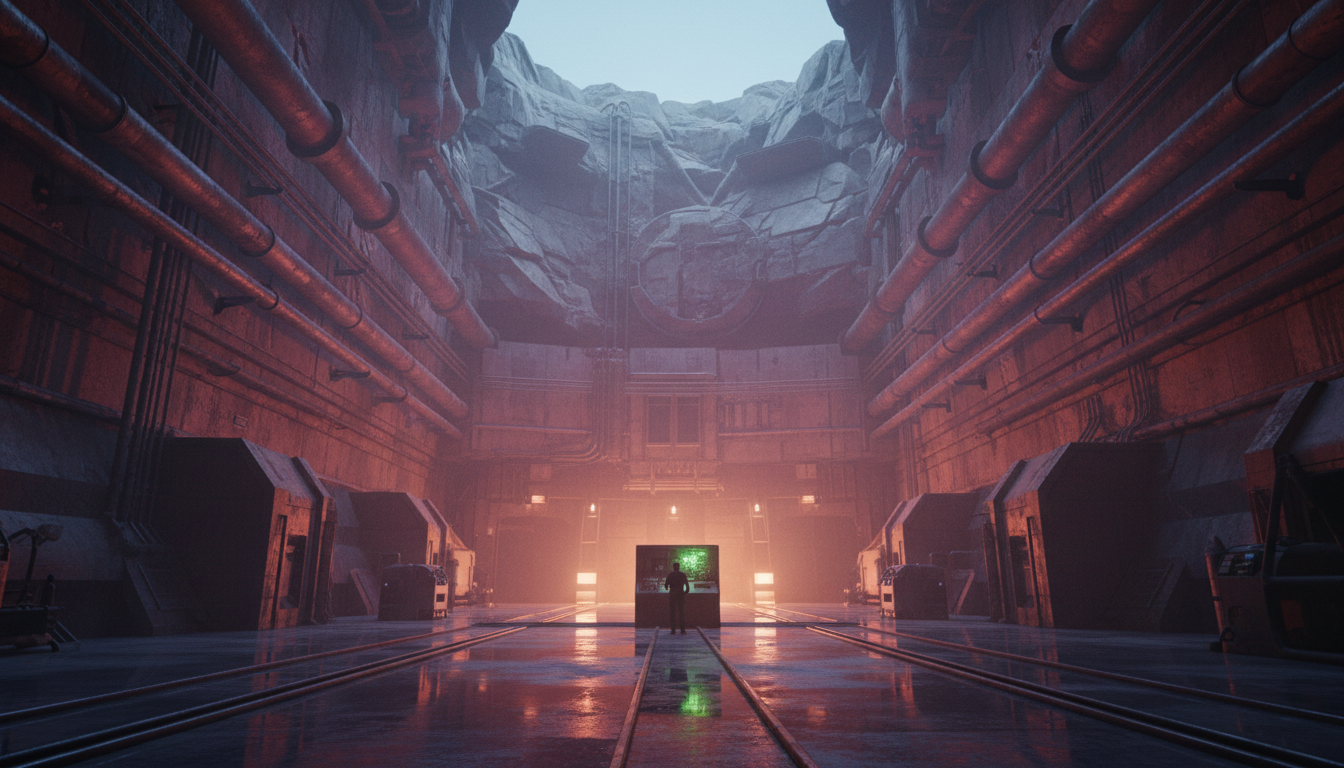
The rim was four in the morning and the bottom was a different country, and the round crossed between them twice a day for nineteen days.
You started at the rim because the depot was up there, on the plateau, where the road went. The plateau was cold and thin and the wind came across it with nothing to stop it, and at that height the ground cover grew in mats about ankle deep and lay flat and did not try anything ambitious.
The first four units were rim units and they were miserable. Ice in the housings for a third of the year, wind loading on every mount, and a thermal cycle that worked every seal to death. Of the four original rim units, one was live. It had been re-sealed nine times in a hundred and forty years and the log had every one of them.
Then the wall began, and the wall was the job.
A hundred and forty kilometres of it, running south-west, dropping. Not a cliff — a cliff would have been simpler and would have needed no walker at all, because you would have hung the whole net off a single line and inspected it from a basket. This was a wall in the way a mountainside is a wall: broken into shelves and ramps and buttresses, with the columnar basalt standing up in ranks wherever a flow had cooled clean, and rubble slopes wherever one had not.
You walked the shelves. Where the shelves stopped you traversed, and where you could not traverse you went up and came back down, and there were four places on the round where you rigged.
The units sat on the shelves at roughly three-and-a-half-kilometre spacing, which was not a spacing anybody had chosen for the geology. It was the spacing at which the founding-era transponder specification said a unit could hear its neighbour. The person who sited them had walked the same wall with the same problem and had put the boxes where the arithmetic said and had accepted whatever the rock gave them.
Idris had a lot of respect for that person and did not know their name. The siting was in the depot's founding file, which held the coordinates and the dates and no signature, because a siting is not a document anybody signs.
By the fifth day you were down at about two-thirds depth and the air had changed.
That was the thing nobody who had not done it understood. It was not simply warmer. The air at depth in a mega-ravine is thick — pressure builds down there, the way it does in any hole nine hundred metres deep, and the moisture off the watercourse cannot get out, and the whole volume sits in its own weather with a lid of haze on it that thins in the afternoon and comes back overnight.
You breathed differently. Sound behaved differently. A rock coming off the wall four hundred metres away arrived as a soft flat sound with no edge on it, and you learned to distinguish that from the same rock at rim level, which arrived like a shot.
The ground cover changed too. At the rim it was mats. At mid-depth it was a knee-high stuff with a stem like wire that grew in the seams and would take your weight if you were careful and would not if you were not. Below that, where the permanent water was, it went up past waist height in the wet places and there were four or five things down there that Idris could not name and had never bothered to look up, because nobody had asked her to and the depot's agricultural annex covered crops.
The fauna was mostly kites and mostly at mid-depth, working the thermals off the sunlit wall. In the deep sections there were things in the water and things that ate them, and at night there was a continuous low activity that she had stopped hearing years ago in the way you stop hearing a house.
Nine hundred and eleven metres at the deepest surveyed point, which was not on her round.
Her lowest unit was thirty-eight, at about six hundred, on a shelf above the watercourse where the wall came in and made a kind of room. Thirty-eight was live. Thirty-nine, forty and forty-one were further along and lower and all three were dead and had been dead since the second generation, and the walk out to them took a day and a half and returned nothing, and she did it every round.
Below thirty-eight the wall went on down and nothing was sited on it, because the specification had run out of units and because there had been no reason to go further.
She had been down past thirty-eight perhaps four times in eleven years, for no work reason, on the day at the end of a round when she had time and the weather was settled. There was nothing there. The wall kept going, the columns kept standing, the water ran, and the haze sat over it, and about four hundred metres below her lowest beacon there was a stretch where two joint sets crossed and the rock had come away in a pattern that made shapes if you were tired.
She had turned round each time and gone back up, because there is a difference between having an afternoon and having a reason.
There was one more thing about the wall that she had never found a way to describe to anybody who had not stood on it, and she had stopped trying at about thirty.
The columns were regular. Not approximately regular — regular, in a way that read as intention, hexagonal in cross-section and standing in ranks with their joints spaced between four hundred millimetres and a metre nine, and holding that spacing for kilometres. It was cooling and contraction and nothing else, and she knew that, and it had been in the second module at school with a diagram.
Knowing it did not help. You came round a buttress at first light onto four hundred metres of colonnade and your eye said somebody did this, and you had to put that down deliberately, every time, for eleven years.
The people who cut into the rock at the Hold had used the joints. You could see it in the old buildings — the good ones, the original ones — where a wall followed a joint set for nine metres and then turned exactly where the second set crossed. They had not been quarrying. They had been taking what the rock was already offering.
That was the only sense in which the wall was built, and she had never been able to say it out loud without it coming out wrong.
The working day crossed the whole range. You woke cold, worked warm, ate warm, and at the far end of a nineteen-day round you came up the last four kilometres into rim air with your shirt wet and the wind taking it off you, and that was the moment in the job that she would have described as the good one if anybody had ever asked.
Nobody had ever asked.
Chapter 4 — Nobody Funds a Beacon Net
↑ Back to ContentsFocus: Idris.

Nobody funds a beacon net. That is not a complaint, it is a description of the accounting.
The net appeared in the depot's operating ledger as a single line — Line Maintenance, Beacon Net, Southern Reach — with a figure against it that covered two people, their kit, their consumables and a replacement-parts allowance that had not been fully drawn in nineteen years.
Idris had seen the line exactly once, at thirty-two, when a clerk called Anders had turned the ledger round on the counter to show her something else and had left it open at the wrong page.
It was between a line for road grading and a line for the depot's own water. It was smaller than both. The three of them together were smaller than the district's schools allocation by about a factor of ninety, which Anders had pointed out, cheerfully, in the tone of a man who liked knowing how big things were.
"When was it last reviewed?" she had asked.
Anders had turned the page.
"Ninety-one years," he said. "Sorry. Ninety-one."
He had thought it was funny and she had thought it was funny too and they had both been right, and she had walked out onto the wall four days later and done a round on a net that nobody had thought about since her grandmother was young.
Here is how a thing like that survives.
An allocation is reviewed when somebody has a reason to look at it. The reasons are: it has grown, it has failed, somebody wants the money, or a process falls due. The net had never grown, because the number of units was fixed at forty-one in the founding decades and no unit had ever been added. It had never failed, because a beacon net cannot fail in a way anybody notices — the units die one at a time over generations and the net gets quieter and nothing downstream depends on it. Nobody wanted the money, because the money was too small to be worth the meeting.
And the process that would have fallen due had been the district's twenty-five-year infrastructure review, which had been discontinued about a century ago, in pieces, by people who each removed one part of it for a good reason and none of whom thought they were dismantling anything.
So the line sat there. And every quarter it produced a payment, and every quarter two people walked two halves of a wall, and the whole arrangement had the property that it required nobody.
Idris had read something once, in the school corpus, in the third module, that she had thought about more than she had expected to. It was a woman's audit of what had survived from the founding era. The woman had done it at a hundred and forty, a year before she died, and it was four pages, and it was in the corpus because it was famous rather than because it was long.
What had died: the Accord, which had governed ten thousand people and was the finest document the species had produced. An oversight body that had run for ninety years and been dismantled a piece at a time. An allocation system that had run for a hundred and nineteen. A machine that had run a planet.
What had survived: a logbook, an appeal step, a filing format and a game.
The woman's finding, which Idris could quote and had never told anybody she could quote, was that none of the four that survived required anybody, and every one of the four that died had required a specific arrangement of people and power, and arrangements change about every forty years.
She had read that at twenty-two and thought it was clever.
She read it again at thirty-eight, after Anders and the ledger, and understood that she was standing inside an example.
The net required nobody. It had outlived the reason for its existence by something like a century and it would outlive her, not because anyone valued it but because stopping it would take a decision and nobody was in a position to make one and nothing forced the question.
She was, in the accounting, the same class of object as the logbook.
That should have been bleak and it was not, and she had never satisfactorily explained to herself why not. The nearest she got was this: the woman's audit was about institutions, and the four that died had died because the people running them stopped, and the four that survived had survived because they did not need anyone to keep running.
But somebody walked the wall. The net did not require a person in the sense that it did not require a decision. It absolutely required a person in the sense that the seals do not re-seal themselves and nineteen's mount does not shim itself.
The line item survived without anybody. The net survived because of Kovans.
Those were different things and the audit had not had a column for the second one, and Idris had decided, on the wall, at about the sixtieth kilometre of a spring round, that this was probably not a flaw in the audit.
There was a second thing in the audit that she had never quoted to anybody, because it was the sort of line that makes you sound like you think you are in a story.
The woman had written that every one of the four that died had been the most important thing on its planet in its decade, and every one had been built well by people who were right.
Idris had thought about that on a shelf at four hundred metres with a dead beacon in front of her, and had arrived at the reverse of it, which was that the things that last are mostly things nobody thought were important, and that this is not a consolation, it is just where the arithmetic comes out.
Voss did the northern half and had been doing it for twenty-two years and had a bad hip and a better sense of humour than the job required. They met twice a year at the depot to sign off the combined return and to complain about the seals, which were the founding-era pattern and had been superseded four times by things that fitted worse.
"They'll cut it one day," he said, most years.
"Who will?"
And that was always the end of it, because neither of them could name anybody who would, and a thing that cannot be cut by anybody in particular does not get cut.
Chapter 5 — Her Father's Ledger
↑ Back to ContentsFocus: Idris.
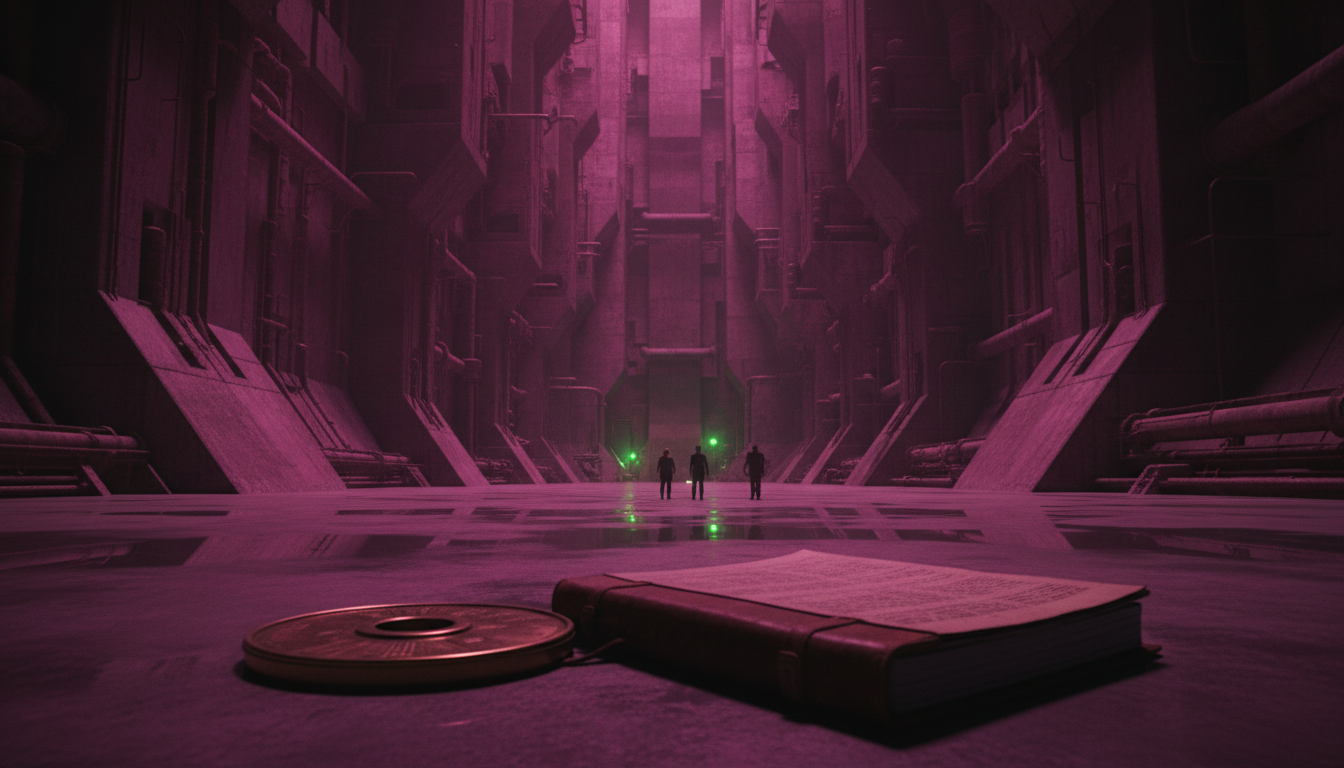
The book had four volumes and her father had started the third and finished it, and she was two hundred pages into the fourth.
Volume one was her great-grandmother's and it was in the depot's fire store because it was a hundred and forty years old and the cover had gone. Volume two was her grandmother's, three-quarters her grandmother's and the last quarter her father's, and it lived in a box under the bench at the depot with the seals. Volume three and volume four were on the shelf in the kit room and came out with her.
Same ruling. Same five columns. Same size, because the depot had ordered the pattern once and had gone on reordering it, and nobody had ever proposed changing it because there was nobody whose job it would have been to propose that.
Her father had a hand that got smaller the older he got. You could date any page of volume three to within about four years by the size of the writing.
Her grandmother had written the unit numbers in a way Idris had copied without deciding to, with the one and the seven crossed, which nobody in the district did any more and which her own daughter now did as well, having never met the woman.
That was the thing about the book. It was a maintenance record and it was also, entirely by accident, a hundred and forty years of four people's handwriting on the same forty-one lines.
She had gone back through volume two once, properly, over a winter, on her own time.
What she had been looking for was the deaths. She wanted to know when each unit had gone, because the depot's founding file had the sitings and nothing after, and the only record of when a beacon had stopped was somebody's hand in a condition column.
Unit twelve died in her grandmother's eleventh year. There is a page where it is live and a page four months later where it is no return, and then a page where the condition column says as before, and then as before for ninety-odd years in three hands.
Unit six went in the same season as unit seven, which suggested a rock event, which is not recorded anywhere because a rock event is not a thing that happens to a beacon net, it is a thing that happens to a wall.
Unit twenty-nine died and came back. That was the only one. It was no return for four rounds and then live and stayed live for another sixty years and was one of her eleven now. Her grandmother had written, in the anomaly column, in the smallest hand on the page: 29 returned. No work done. IK.
Idris had sat with that for a long time.
The initials were her grandmother's and they were also hers.
Four anomaly entries in her father's thirty-one years, and she knew all four by heart the way you know the four things that ever happened in a house.
One: a unit missing from its mount, year eleven, recovered ninety metres downslope, remounted, live. Somebody or something had taken it off and dropped it, and there was no way to establish which, and he had written cause not established in a hand that was still large.
Two: a mount with tool marks on it that were not depot pattern, year nineteen. He had photographed it. The photograph was in the box. Idris had looked at it perhaps forty times and could not tell you anything about it beyond that somebody with a spanner that was not their spanner had been on that shelf.
Three: a fire on the wall, year twenty-four, at mid-depth, extent about four hundred metres, cause not established, no unit lost. That one was in the depot's own records as well, so it was the only anomaly with a second source.
Four: Unit 38, return delayed 4 sec, one round, not repeated. Cause not established. TK.
That was the last one, in year twenty-nine of thirty-one, in the small hand.
She had asked him about it. He had been seventy-four and had not been on the wall in six years, and he had thought about it for a while and had said that a four-second delay on a return is not a fault, it is a unit thinking, and that units do not think, and that he had written it down because the column existed and because it had not happened again.
"Did you go back?"
"Next round. Nothing."
"And?"
"And nothing," he said. "You write it down, Idris. That's the whole of it. You write it down and then somebody after you has it."
She had thought at the time that this was a slightly grand thing to say about a spreadsheet.
He had died at seventy-nine, and the fourth volume had been on the shelf for four years by then with her hand in it, and at the funeral about sixty people had come and four of them had known what he actually did for a living.
The round is the round. You do the dead ones as well as the live ones. You give every unit its four minutes. You fill the condition column even when the condition has been as before for ninety years, and you leave the anomaly column blank unless something is actually anomalous, because an anomaly column with something in it every round is a column nobody reads.
Hers was blank.
Eleven years, forty-four rounds, one thousand eight hundred and four unit checks, and the anomaly column of volume four was blank from the first page to the two hundredth.
Sena had asked her once, at about fourteen, what she would do if she found something.
"Write it in the column."
"And then?"
"Tell the depot."
"And then?"
"Then it's the depot's," Idris had said, and had believed it, and had gone on believing it for another four years without once being tested.
She was not proud of that and she was not troubled by it. It was simply the state of the record, and the record was accurate, and an accurate record of nothing happening is what a maintenance file mostly is.
Chapter 6 — The Ones That Are Dead
↑ Back to ContentsFocus: Idris.
Thirty of the forty-one were dead and she walked past all of them, and that was not sentiment, it was the round.
The argument against it was obvious and Voss made it about once every four years, without conviction, mostly to hear himself say it. Thirty dead units at four minutes each was two hours a round and eight hours a year and, over a working life, about eleven days spent confirming that a box that stopped working before you were born had not started again.
The argument for it was that unit twenty-nine had.
That was the whole of the argument and it was enough, and it had been enough for three generations, and the fact that it had happened exactly once in a hundred and forty years did not weaken it. A thing that happens once is a thing that happens.
But that was not really why she did it, and she knew that too.
She did it because the round was a shape and the shape did not have holes in it. You came onto a shelf, you went to the unit, you gave it its four minutes, you wrote the line. Forty-one shelves, forty-one units, forty-one lines. If you started deciding which ones deserved the walk you were making a judgement every day about which parts of your own job were real, and she had watched a man at the depot do exactly that with a vehicle inspection round and had watched him get worse at it over about four years, not because he was lazy but because once you have decided that some of it does not count you have to keep making the decision, and the decision drifts.
So: all forty-one. Every round.
She had her favourites among the dead, which was a stupid thing to have and she had them anyway.
Unit six, which had gone in the same season as seven and which sat on a shelf that had the best view on the round — you could see down and along and across, three hundred metres of colonnade on the far wall and the water a long way below, and the seal on six had failed at some point in her grandmother's time and the housing was full of a fine grey silt that she cleaned out every round and that came back.
Unit seventeen, which was inside a fold in the rock and which you had to crawl to, and which was in perfect condition. Dry, sealed, mount solid, everything sound, and completely dead, and there was no reason for it that anybody had ever established. Her grandmother had written no return and had gone on writing it. The unit looked like it would work if you asked it nicely and it did not work.
Unit thirty-one, which was the one with the hole in it. Something had gone through the housing at some point — through, both walls, a clean hole about nine millimetres across, and the unit had presumably died at that moment and nobody had been there and nobody had written anything except no return four months later. You could put your finger in it. She did, most rounds, and could not have told you why.
Thirty boxes on brackets on a wall, holding position, doing nothing.
There was a way of thinking about it that she had arrived at somewhere around year six and had not improved on since. The net was not eleven working units and thirty broken ones. The net was forty-one units of which eleven were still talking, and the thirty were the same objects they had always been, in the same places, doing the same amount of holding still. A beacon that has stopped transmitting has not become a different thing. It has stopped transmitting.
Which meant that what she walked was not a decayed net. It was a complete net that had gone quiet in thirty places.
She had never said that to anybody either. There was a version of it she could have said to Marra and a version she could have said to Voss and both versions would have come out as either a joke or an odd little speech, and she was not a person who made odd little speeches, so she carried it around for eleven years and used it to get herself up a rubble slope in bad weather to check a box with a hole in it.
There was one more thing, and it was the closest the round came to being about anything.
The eleven that still worked were not the eleven you would have predicted. Seventeen was sealed, dry, sheltered and dead. Fifteen was on a shed shelf you had to traverse to, exposed on three sides, and had never missed a round in a hundred and forty years. The rim unit that survived was the most brutally weathered position on the entire net.
She had tried, in about year seven, to find the pattern. Aspect, shelter, altitude, the direction the housing faced, the year of siting, the seal batch where the file recorded one. She had made a table over a winter and had found nothing, and had shown it to Voss, who had looked at it for a while and said that his half was the same and that he had made the table too, in about his fifth year, and had also found nothing.
"Everyone makes the table," he said.
The dead ones took the same four minutes. Housing, seal, mount, key.
The key was the part that did nothing. You pressed it and nothing came back and you had known that before you pressed it, and you pressed it anyway, because the check is the check and because on one occasion in a hundred and forty years something had come back.
Her father had a phrase for it that she had inherited along with the ledger and the crossed sevens. He said you were not checking whether it worked. You were asking.
Forty-one times a round. Four times a year.
Eleven answered and thirty did not, and she wrote all forty-one lines, and closed the book, and walked on.
Chapter 7 — Sena
↑ Back to ContentsFocus: Idris.

Sena had been saying she was not going to do it since she was eleven, and at seventeen she said it in a way that meant she had worked out how to.
They were on the step at the back of the house in the depot town, which was where the family had its arguments because it was the only place with two chairs and no door.
"There's a place at the coast," Sena said. "Acoustic survey. It's two years and then you're registered."
"Registered for what?"
"Acoustic survey."
Idris knew about it. She had known about it for about four months, because the depot town is not large and because Anders in the ledger office had a sister at the coast, and she had spent those four months deciding not to raise it.
"That's a good thing," she said.
Sena had come out ready for a fight and had a whole speech and now had nowhere to put it, and Idris watched her not use it and felt, briefly and unattractively, pleased with herself.
"You don't mind."
"Why would I mind?"
"Because it's four generations."
"Three," said Idris. "Your great-great-grandmother started it. That's four people and three handovers, and one of them was a woman handing to her son who did not want it either for about six years."
That was true and Sena had not known it, and Idris had not planned to say it and was not sure it helped.
"Grandad didn't want it?"
"Not at first. He wanted to grade roads. He said the wall was for people who liked their own company and he wasn't sure he did."
"What changed?"
"Nothing," Idris said. "He did it anyway and then after about six years he did like it. That's not a story with a turn in it. He just kept going until it was his."
Sena took that in a way Idris could not read.
The thing they were actually arguing about was not the coast and both of them knew it. The thing they were arguing about was that in about eleven years the fourth volume was going to be two-thirds full, and there was no fifth Kovan, and after that there was going to be either somebody unrelated with a different hand and uncrossed sevens, or there was going to be nobody at all and the line item would go on paying out to a post the depot could not fill, and then somebody would finally have a reason to look at it, and then it would end.
"It's not a temple," Idris said. "It's a job."
"You don't talk about it like a job."
"I don't talk about it at all."
"That's what I mean."
And there she was right, and Idris did not have an answer, and they sat for a while.
What she wanted to say, and did not say because it would have sounded like the argument she had just refused to have, was this: I have walked one hundred and forty kilometres of the same wall four times a year for eleven years and I know it the way you know a face, and the thing I do out there requires nobody and helps nobody and I have never once thought it was a waste of my life, and I do not know how to explain that to you without it sounding like I am asking you to do it too.
What she said was: "The coast is four hundred kilometres. You'd come back at midwinter."
"Obviously."
"Then that's the whole of it."
"Did he ever say why he liked it?" Sena asked, eventually. "Grandad."
"Once. He said it was the only work he'd ever had where nobody was waiting."
"That sounds lonely."
"He didn't mean it that way. He meant nobody's held up. If you're two days late nothing stops. There's no queue behind you."
Sena thought about that.
"That's the same as it not mattering."
"It's next to it," Idris said. "It isn't it."
Sena went inside and came back out with two cups and they did not talk about it again that year, or the next.
Later, inside, Sena said one more thing through the doorway, not looking round, in the voice teenagers use for the thing they have actually come to say.
"It's not that I think it doesn't matter."
"I know."
"It's that nobody's ever going to know whether it did."
Idris sat with that on the step for about ten minutes after the door shut, and then went in and washed up, because it was accurate and there was nothing to do with it.
Here is what the argument was worth, in the end, and neither of them found out for a long time.
Sena went to the coast and was good at it. Acoustic survey is a real trade with a registration and a standard and it did not exist in the depot town and never would, and she came back at midwinter for three days a year and slept in her old room and complained about the water and went again.
And Idris walked the wall.
They did not fall out. That is the part that people who hear this kind of thing expect and it did not happen. There was no rupture and no reconciliation, because there had been nothing to reconcile — one of them had wanted a thing and had gone and got it, and the other one had said good, and had meant it, and had gone back onto the wall in the spring with the ledger in the case.
The only cost was that for the next eleven years there was a subject the two of them handled carefully, the way you handle a thing that is not broken but which you have noticed you are both being careful with.
When Sena asked, four years later, what her mother was doing down at the far end of the round on her own time, Idris gave her an answer that was almost true and was carefully constructed, and Sena heard the construction in it and did not push.
That was the cost. One question, in one conversation, answered at about eighty per cent, by a woman who had spent her whole working life filling in a column honestly.
Chapter 8 — Weather
↑ Back to ContentsFocus: Idris.

The weather came in on the fourth day of the autumn round and stayed for six, and none of it is a story, and that is the point of putting it here.
It began as the thing that happens perhaps twice a year, which is that the plateau air comes over the rim cold and heavy and sinks, and the warm thick stuff at the bottom does not want to move, and the two of them argue in the middle third of the wall for as long as it takes.
What that looks like from a shelf at four hundred metres is fog coming up at you.
Idris was at unit nineteen when it started and she got to twenty-one before she stopped, which was about right. Twenty-one had an overhang and a flat place and water forty metres along it, and she had used it perhaps thirty times in eleven years and had a cache of nothing there because caches get taken by things, but she had the overhang and that was the whole of what the shelf was for.
She sat out the first night, which was ordinary.
The second day she did nothing, which is harder than it sounds and is most of the skill. There is a version of that job where you go on in fog because you know the wall, and Voss had done it in his twenties and had come off a traverse and been lucky, and had told her about it once, badly, in the way men tell you about the thing that frightened them.
She had a rule and the rule was visibility of forty metres. Not because forty metres is safe but because forty metres is the distance at which she could see whether the next section of shelf was there, and on a wall that sheds, the question of whether the shelf is there is not rhetorical.
So she sat. She had the ledger and she wrote it up. She had four days of food and six days of the ability to be uncomfortable. She slept, badly, the way you sleep on rock, and woke at the hours the body picks when it is not being told.
The third day the wind got into the ravine properly and the fog broke up into moving pieces, which is worse, because now you can see forty metres for about eleven seconds at a time and your judgement starts arguing with your rule.
She stayed.
The fourth day the water came. Rain at the rim is not much; rain into a ravine collects, and every seam on that wall ran, and the shelf at twenty-one had a fall coming off the overhang that had not been there and would not be there in two days. She moved her kit four metres and got wet doing it and was then dry for the rest of the day, which is the kind of small competence that is the actual content of a working life.
On the fifth day she went out about two hundred metres to look at the traverse and came back.
On the sixth day it cleared in the afternoon and she did twenty-two before dark.
The round finished eight days late. She lost twelve units off that season's schedule and picked them up on the following round, which is provided for and which she noted, and the depot did not query it because the depot had never queried anything in eleven years.
Nothing happened.
She did not have a revelation on the shelf at twenty-one, and did not think about her father, or Sena, or the net, or the audit, or what any of it was for. What she thought about was water, and whether the fall off the overhang was going to shift the silt on the shelf below, and whether the mount on twenty-two had taken the wind, and about a stew.
She had a bad night on the third day when the wind was doing something unpleasant round the buttress and the noise had a quality she did not like, and she lay awake for about two hours and was fine in the morning.
This is what the job is. Nineteen days on a wall, four times a year, of which perhaps six days a year are unpleasant and perhaps one day a year is genuinely difficult, and the rest is walking to a box and pressing a key.
It is worth saying plainly because of what comes later, and because there is a way of telling a story like this that makes the person at the centre of it seem like somebody who was always going to find something. She was not. She was a competent line-walker in her eleventh year, with a rule about visibility that she kept when it cost her eight days, and an anomaly column with nothing in it, and no interest whatsoever in the extraordinary.
There was one moment in the six days that she remembered afterwards, and it was not a moment, it was a piece of weather.
On the fifth evening the cloud lifted off the far wall for about a quarter of an hour while the sun was still on it, and three hundred metres of colonnade came out of the grey in ranks with the wet on it, and the whole thing looked exactly like something that had been made and left.
She watched it until it went.
Then she ate, and checked the mount tension on twenty-one out of habit, and wrote the day up as held at 21, no work, which is what the column is for.
When she came off the wall she went to the depot and filed the late return and Anders made a joke about it and she went home and slept for eleven hours.
Voss lost eleven days to the same weather on the northern half and they compared notes at the winter sign-off and agreed that it had been a poor autumn and that the seals were still the wrong pattern.
The following round was uneventful. So was the one after.
Chapter 9 — The Beacon Net
↑ Back to ContentsFocus: Idris.

The winter round finished on the fourteenth day of the last month and she came up onto the plateau in the dark with four units still to do and did them in the morning, and that was the year.
The year's return went in on a single sheet, which is the form, and the form has been the form since the founding decades.
Four rounds. One hundred and sixty-four unit checks. Eleven live at the start and eleven live at the end, the same eleven. Thirty dead at the start and thirty at the end, the same thirty. One mount shimmed, unit nineteen. Two seals replaced, units fifteen and thirty-four, both founding pattern, both drawn from the depot's stock, which held one hundred and forty-one of them and had held one hundred and forty-one of them since before her father.
Eight days lost to weather in the autumn, made up in the winter round.
Anomaly column: blank.
She signed it, and Voss signed the northern half, and Anders took both sheets and put them in the file, and the file went in the cabinet with a hundred and forty years of the same sheet.
Then she went home, and it was midwinter, and Sena came for three days and complained about the water.
That is the whole of it.
It is worth being precise about how much nothing that is, because everything after this is going to be about the exception, and the exception is only worth anything if you can feel the size of the thing it is an exception to.
One hundred and forty years. Four walkers on the southern half, in sequence, no gaps. Roughly five hundred and sixty rounds. Roughly twenty-three thousand unit checks.
Four anomalies in the whole record. A unit off its mount. Tool marks that were not depot pattern. A fire. A four-second delay.
That is one anomaly every thirty-five years, and three of the four are somebody having been on the wall, and the fourth is a unit taking a moment.
The rest — every other line, in four volumes, in four hands — is a box that is where it was, doing what it was doing, or not doing it.
Idris closed volume four on the year and put it on the shelf in the kit room, and there were two hundred and eleven pages used and about a hundred left, which was eleven more years at her rate.
She had worked that out once, on the wall, with no particular feeling attached to it.
Eleven years to the end of the volume. About nineteen to the age her father had stopped. Somewhere in between, presumably, a conversation with the depot about who came after, and no obvious answer to it, and then either an unrelated person with a different hand or nobody.
She had not made a plan about that and did not intend to. It was not the sort of thing you plan; it was the sort of thing that arrives with about four years' notice and gets handled.
There is a thing that happens to people who keep a record for a long time, and it happened to her that winter in a mild form.
She went back to volume two, to her grandmother's fourth year, and read a season straight through — nineteen days of a round in a hand she had been copying without meaning to since she was nine.
It was identical to hers. Not similar. Identical in structure: unit, date, state, condition, blank. The same order of units, the same abbreviations, the same as before in the condition column for the dead ones, and on the eleventh day of that round her grandmother had written held at 21, no work, in weather, on the same shelf under the same overhang.
Ninety-one years apart, on the same rock, in the same five columns, with the same phrase.
She had not found that eerie. What she had thought, sitting in the kit room with the volume open, was: this is what the form is for. Somebody designed five columns so well that four people who never worked together produced the same document, and none of them ever had to be told how.
The winter was ordinary. She did the seal inventory, which is a January job and takes four days and consists of counting one hundred and forty-one objects and confirming that they are one hundred and forty-one objects. She read. She fixed the step. Voss came down in the second month to collect stock and stayed a night and they talked about his hip.
In the third month she went up to the rim and did the four rim units early because the weather was good and there is no rule against it.
The live one gave her the amber. The three dead ones did not.
She wrote the four lines and came back down and the spring round proper started nine days later.
Nothing had happened. Nothing was going to happen for another two rounds. The forty-second signal was already on the wall and had been on the wall for the whole of her working life and for eleven years before it, transmitting into a technical stream that the depot's system accepted and filed and did not read, in a founding-era format that was still valid, four hundred metres below her lowest beacon, and there was no reason on earth for her to have looked.
The net had a slot for it and the slot was in a part of the system nobody opened.
Anders asked her, at the sign-off, the question the depot asks once a year and does not care about the answer to.
"Anything to report?"
"Eleven live."
"Same eleven?"
"Same eleven."
He wrote it on the sheet and put the sheet in the file, and that was the hundred and forty-first year of the southern beacon net.
She closed the year, and put the book on the shelf, and went home.
Chapter 10 — Forty-Two
↑ Back to ContentsFocus: Idris.
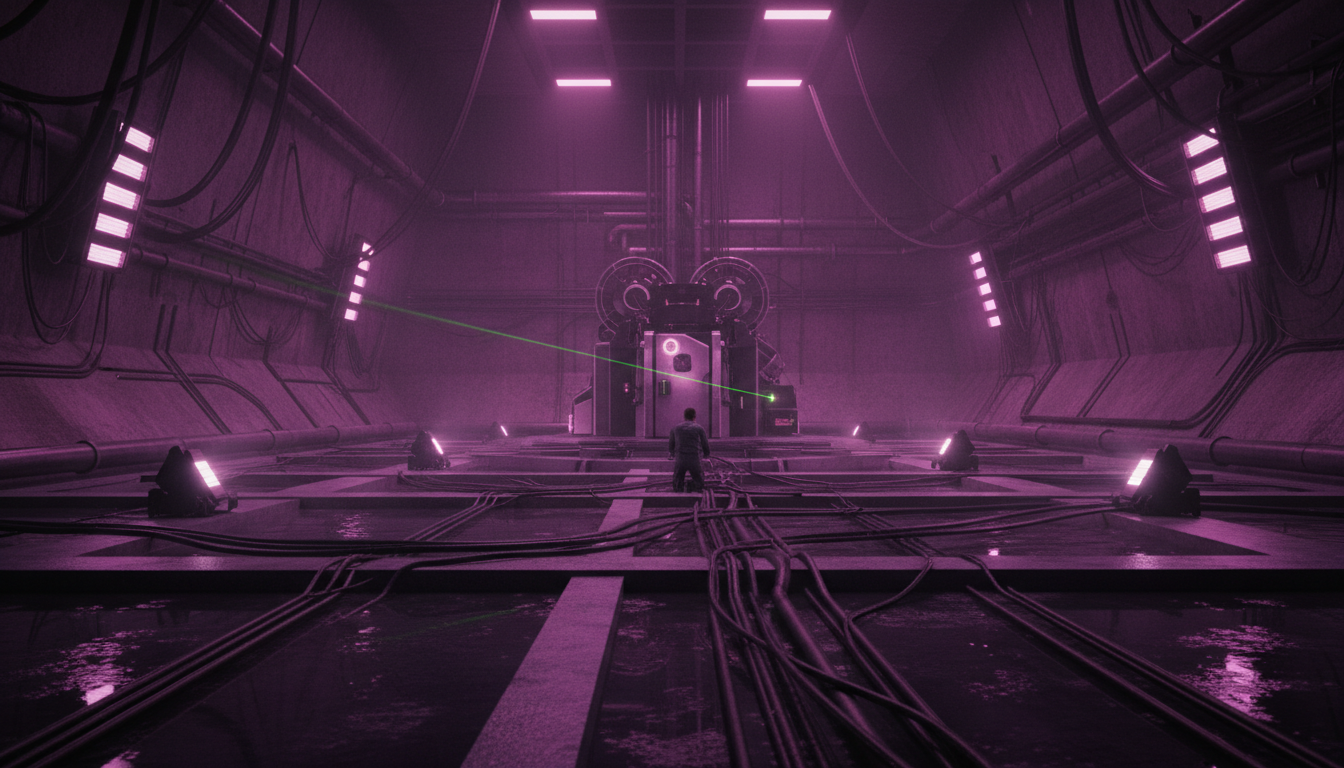
The forty-second signal turned up on a Tuesday in the depot's kit room, on a handset she had picked up because her own was going in for a seal, and she assumed it was a ghost.
The handsets held a scan function that nobody used. Its purpose, in the founding-era specification, was commissioning: when you site a net you sweep the band to make sure your units are not sitting on top of anything, and after that you never sweep again, because the units are where you put them and the band is empty.
The spare handset had been in the rack for four years and had a scan log on it from whenever it was last serviced, and Idris keyed it out of the same reflex that makes you check the mirror in somebody else's vehicle.
Forty-two returns.
She counted them twice. Eleven live units, thirty dead ones showing as no return, which is the same as not appearing, and then a forty-second entry with a signal strength against it.
Weak. Very weak — about a fifth of what unit thirty-eight put out, and thirty-eight was the lowest and furthest and the weakest of the live ones.
Her first thought was a repeater ghost, which is a real thing and the reason the scan function exists at all: a signal coming off a wall at the right angle can arrive twice and the second arrival looks like an object that is not there. Every net has them. Her grandmother's log had a note about one on the northern half in the fourth volume of somebody else's book.
So she did the thing you do, which is to move.
She took the handset out onto the plateau, four hundred metres from the depot, and swept again.
Forty-two.
She went a kilometre along the rim and swept again, from a position with a completely different line to the wall.
Forty-two.
A ghost moves or dies when you move, because a ghost is a geometry. This did not.
She stood on the plateau in the cold with a borrowed handset and thought about it for about four minutes, and the thought she had was not what is that. The thought she had was the depot's system has been receiving this.
Because it had to have been. The units talk to their neighbours and the top of the chain talks to the depot, and anything transmitting in that band inside the net's footprint goes into the same stream. It does not go to a person. It goes into the technical file, which is a store, which is not read by anybody, because nobody reads a technical file from a beacon net that four settlements do not use.
She went back in and asked Anders for the technical file.
"For which year?"
"All of them."
Anders, to his enormous credit, did not ask why for about eleven seconds, and then asked why, and she said she had a forty-second return and he said "huh," and got it.
The technical file for the southern net was not large. It was a stream of position reports, one per unit per interval, going back to the depot's current system, which had been installed thirty-one years ago and had migrated everything before it in a compressed form.
The forty-second entry was in it.
It was in the first year of the current system and it was in the last year, and it was in every year between, and it had the same identifier every time, and the identifier was not one of the forty-one.
"That's not ours," Anders said.
"No."
"Then what's it doing in our file?"
"It's in the band. Everything in the band goes in the file."
"Should it?"
"It's the specification," she said. "The file takes what's in the band. That's the whole design. You'd have to have decided to filter it out and nobody's ever had a reason to filter anything."
Anders looked at the screen for a while.
"So this has been coming in for thirty-one years and nobody's looked."
"Nobody looks at the technical file."
"I don't."
"Nobody does. There's nothing in it. It's forty-one boxes saying where they are."
Anders ran one more query before she left, because he was the kind of man who cannot leave a query unrun.
"It's the same identifier every time. Not drifting. Not incrementing."
"Is that unusual?"
"For a fault, yes. Faults wander. That's a valid identifier in a valid format, it's just not a format I've seen." He turned the screen. "Look at the field order."
She looked. It meant nothing to her at all.
"It's old," Anders said. "That's an old field order. Ours is derived from it."
"How old?"
"Founding," he said, and shrugged, in the way a man shrugs at a thing that is merely a fact. "Everything's derived from founding. My forms are derived from founding."
She logged it that evening in volume four, in the condition column, because at that point it was a condition: Scan returns 42. Additional signal, not net identifier, weak, position not established.
She did not put it in the anomaly column.
That decision took her about a minute and she has been asked about it since — by herself, mostly, at four in the morning, for years afterwards — and the answer she arrived at is that on that Tuesday it was not an anomaly. It was an unexplained return on a scan function, and unexplained returns on scan functions are common, and the anomaly column is for things that have happened to the net.
Nothing had happened to the net. The net was eleven live and thirty dead, same as ever.
She has also thought, in the same four-in-the-morning stretches, that the honest version is simpler: on that Tuesday she did not believe it was anything. A borrowed handset, a function nobody uses, a weak return she could not place. Ninety-nine times out of a hundred that is a fault in the handset.
She swept with her own handset four days later, when it came back from the seal.
Forty-two.
Something else was on the wall.
Chapter 11 — It Does Not Move
↑ Back to ContentsFocus: Idris.
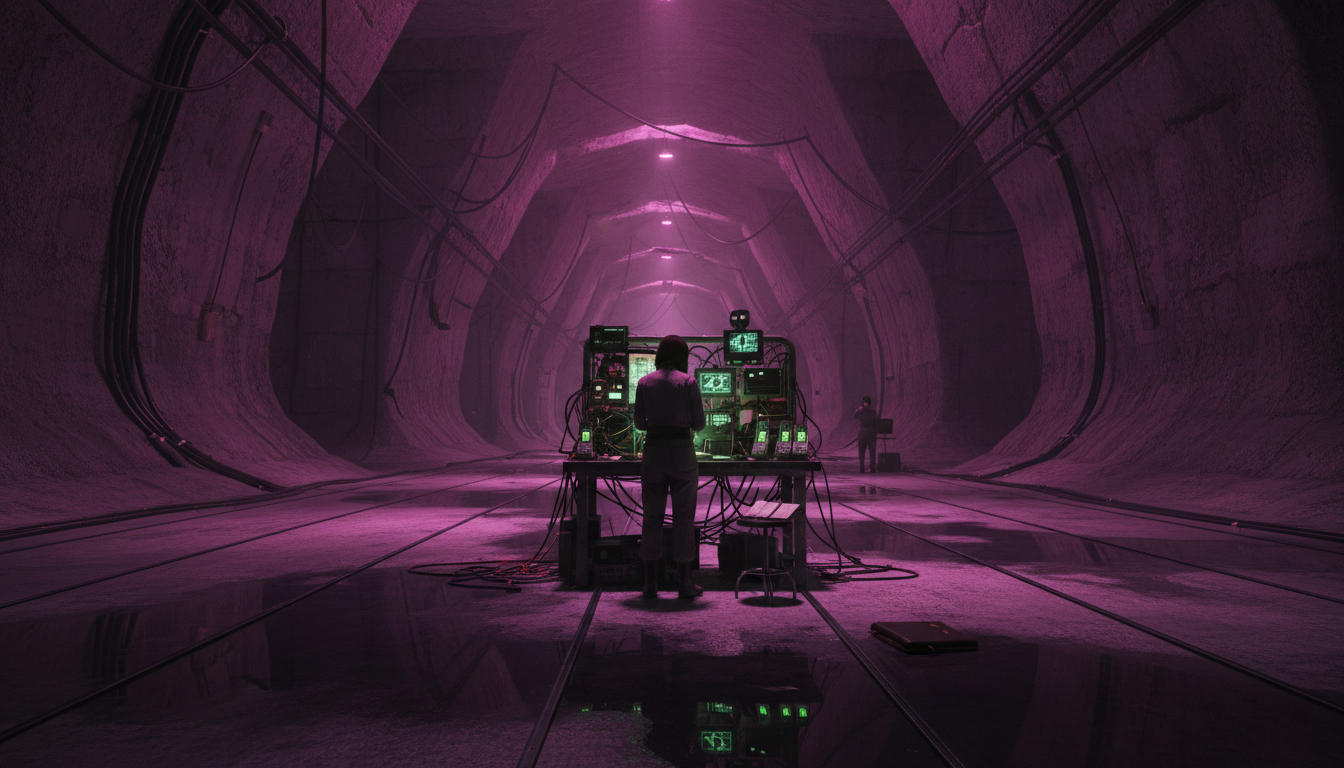
It had not moved in eleven years, and then it had not moved in thirty-one, and then she went and got volume two.
The technical file only went back thirty-one years, to the current system, and Anders was honest about what that meant: the migration had brought the position reports across in a compressed form and had brought them across correctly, but anything before the migration was on the old system and the old system was in the fire store in nine crates and had not been powered in three decades.
"Could you?"
"Could I what?"
"Power it."
Anders looked at her.
"Idris, I have one clerk and a road grading contract and the water. What is this?"
"I don't know."
"Is it a hazard?"
"No."
"Is it ours?"
"No."
"Then it's a curiosity," he said, not unkindly, "and I like a curiosity, and I'll get to it," and he did not get to it, and she did not hold it against him, because he was right about the road grading and the water.
So she did it the other way.
The handsets log. That is a founding-era design decision and it is the reason any of this was possible: a handset holds its last four hundred and eleven exchanges, and when it goes in for service the log is dumped into the depot's maintenance record and the handset is wiped.
Nobody reads a handset dump either. But the dumps were in the depot's file, and the depot's file went back to the depot, and the depot had been there for a hundred and forty years.
It took her nine evenings.
What she was looking for was any scan. Not a position report — a scan, which only happens when somebody keys the function, which nobody does. She worked backwards through thirty-one years of dumps looking for the pattern of a sweep.
She found four.
Year twenty-nine of the current system: a service technician from the coast, commissioning a replacement handset, sweeping to verify it. Forty-two returns. The technician had noted nothing, because the technician did not know how many units there were supposed to be, and forty-two is a number like any other if you have no expectation.
Year nineteen: her father, on a handset that came back for a seal. Forty-two returns.
Year eleven: her father again.
Year four: her father.
She sat in the kit room with the last one on the screen for a long time.
Then she went and got volume three off the shelf and turned to year four of the current system, which was year twenty-two of her father's thirty-one, and read the whole season.
There is nothing in it.
Condition columns full, anomaly column blank, unit by unit, day by day, nineteen days, and at no point anywhere in the volume does the number forty-two appear.
She checked year eleven. Nothing. Year nineteen. Nothing.
Three times, on three handsets, across fifteen years, her father had keyed a scan function and got a return that was not his and had written nothing down.
She thought about that for four days.
The obvious reading is that he had not looked at the number. You key the function to test the handset. You get returns. You are testing whether the handset returns anything, not counting what it returns. That is almost certainly what happened, three times, and it is what would have happened to her if the spare had not been sitting in the rack with an old log on it that she read out of idleness while waiting for a kettle.
The other reading is that he counted, and knew, and did not write it down.
She did not believe the other reading. She wanted to be clear with herself about that, and she was, and she wrote a note to herself about it in the back of volume four that she later tore out.
The man had four anomalies in thirty-one years and one of them was a four-second delay on a return. He was not a person who let things go unwritten. If he had counted forty-two he would have written forty-two, in the anomaly column, in the small hand, with cause not established after it.
So he had not counted. Three times.
And the thing had been transmitting all the way through, and had gone into the file, and the file had accepted it and stored it and nobody had read it, and this had gone on for thirty-one years of the current system and, on the evidence of the identifier being identical in the earliest dump she could find, for however long before that.
She did one more thing before she took it to Anders, and it was the piece of work she was most pleased with in the whole business.
The dumps held signal strength. Four scans, four strengths, four positions — because a handset records where it was when it swept, and the four sweeps had been done at four different places on the plateau over thirty-one years.
It was not enough for a fix. Four points spread across a rim, with strengths that had a wall between them and the source, is not a solution; it is an argument.
But it was enough to establish a direction and to establish that the direction had not changed in thirty-one years, and it was enough to put the thing below the net rather than above it or along it.
Below thirty-eight. Below her lowest beacon.
She wrote the four numbers on the back page of volume four in pencil and did not put them in a column, because there was no column for them.
She went back to Anders with what she had.
"Four scans, thirty-one years, forty-two every time."
"Same identifier?"
"Same identifier."
Anders whistled, which was his entire emotional range.
"So it's been sat there."
"It's been sat there."
"Doing what?"
"Transmitting."
"Into?"
"Into us," she said. "Into the technical file. That's what it's been doing for at least thirty-one years and probably a great deal longer, and we've been storing it."
Anders sat back.
"Well," he said. "It's very polite."
She laughed, and went home, and did not sleep particularly well, and the thing she kept coming back to was not the signal.
It was that the file had a slot for it. Somebody in the founding decades had written a specification that said the technical file takes whatever is in the band, and had not written a filter, and because of that a store on a plateau in the southern reach had been faithfully accepting and filing something for longer than anybody could establish, and would have gone on doing it forever, and the whole arrangement required nobody at all.
Chapter 12 — Correctly Formatted
↑ Back to ContentsFocus: Idris.

Anders put the format up on the screen next to the depot's own and said it was old, which was the single most important fact anybody would ever establish about it, and he said it the way you say that a wall is load-bearing.
"See the field order."
"I saw it last time. It means nothing to me."
"Right, so." He was enjoying himself. It was the first interesting thing that had come through the office in about four years. "Ours goes identifier, time, position, state, check. That's the district standard and it's been the district standard my whole career."
"And that one?"
"Identifier, time, position, state, addressee, check."
"There's an extra field."
"There's an extra field," Anders agreed. "And it's not extra. It's ours that's missing one. That's a founding-era technical filing format and every format in this building is descended from it, and somewhere about a hundred years ago somebody dropped the addressee field out of the district version because in a district everything goes to the district and there's no point completing a box that always says the same thing."
"So it's the parent."
"It's the parent. That's a form my forms come from."
Idris looked at it.
"What's in the field?"
Anders turned the screen.
The addressee field, on every one of the entries, in a format a century older than anything else in the room, read: none.
Neither of them made anything of it, and it is worth being precise about that, because this is the moment at which the whole thing was in the room and available and nobody picked it up.
What Anders saw was a valid old format with a field the district had stopped using, completed with a valid value. None is a legitimate entry in an addressee field. It means the filer considered the question and there is nobody. It is what you put on a general broadcast, a test transmission, a stream with no recipient.
What Idris saw was the same.
Neither of them thought: somebody has been completing that field, by hand, every time, for a very long time, and has never once left it blank.
There was no reason for either of them to think it. It is a filing convention. You would have to already know what you were looking at.
"Is it a machine?" she asked.
"Everything's a machine. The net's a machine."
"I mean is it automatic."
"It's regular," said Anders. "It's very regular. If somebody's typing that by hand they're the most consistent person who ever lived." He shrugged. "It's a beacon, Idris. Some sort of beacon. Old, well made, still running, and not on anybody's list."
"Whose would it be?"
"Founding era, down a ravine? Survey, probably. There was survey work all over this reach in the first century." He scratched his ear. "They put in a lot of kit and they wrote down about a third of it, and what they wrote down is in a file somewhere that isn't here."
That was, as far as it went, a completely reasonable explanation, and it accounted for every fact in front of them, and it was wrong.
It also settled the matter for Anders. A founding-era survey beacon, unlisted, still transmitting, is a curiosity of exactly the size he had said it was: interesting for an afternoon, worth mentioning to his sister, not worth a line item.
"Can we find out what the identifier means?"
"Not from here. Founding-era identifiers are in the founding files and the founding files for this reach are at the coast, in the archive, and the archive answers written enquiries in about eleven months."
"Would you write one?"
"I'll write one," he said, and he did, and eleven months later the answer came back and said that the identifier did not correspond to any registered installation in the southern reach and that the enquiry was closed, and by then everything had already happened.
"Does it matter?" she asked. "That it's the old format."
"Matters to me," said Anders. "It's the only one I've ever seen in the wild. They're in the standards file — you can look at a founding format any time you like, it's four pages — but that's a document. That's a live one. Somebody's still filing in it."
"Or something is."
"Or something is."
He shut the screen down and started putting his coat on, which in that office was the end of any conversation.
"You know what's actually odd about it," he said, at the door. "Not the format. The check digit. It's computing the check the founding way, which is nine operations, and ours is four, and ours is better. Nothing that was set up and left would still be doing it the long way. It'd be doing it however it was built and that'd be that."
"Isn't that the same thing?"
"No," said Anders, and thought about it. "No, you're right, it is. Forget I said it."
She did not forget it. She did not do anything with it either, for two years.
She asked one more question before she left.
"How long can something transmit?"
Anders thought about that properly, which she appreciated.
"Depends what's feeding it. A founding-era unit on a cell — decades, and then it stops. On a thermal draw, or something down there that's got water going past it — indefinitely. That's the whole idea of a survey beacon. You put it in and you leave it and it doesn't need anybody."
"Forever."
"Until something breaks," said Anders. "Which is forever, near enough, if nobody touches it."
She walked home through the depot town in the cold thinking about a box on a wall she had never seen, in a format older than every form in the building, filing correctly into a store that accepted it, with the addressee field completed none on every entry for at least thirty-one years and probably a hundred and forty.
It did not occur to her, that night or for another two years, that a thing which files correctly into a stream nobody reads, forever, for no addressee, is not doing it because it was designed to.
It is doing it because somebody decided to keep doing it.
Chapter 13 — The Depot Says No
↑ Back to ContentsFocus: Idris.

She asked the depot for four days and a rope, and the depot said no, and the depot was right.
She put it properly. That mattered to her afterwards — that she had not gone in and asked vaguely and been fobbed off. She wrote it out, the way you write out a variation request, on the form, and gave it to Anders, and Anders took it to the district because it was above his signature.
What she asked for was: four working days, outside the round; the loan of the depot's descent kit, which was a hundred and forty metres of line and the hardware; and a second person for the top, because you do not rig a four-hundred-metre wall alone and she was not going to pretend otherwise.
What she gave as the reason was accurate and did not help her.
Unlisted transmitter, founding-era format, within the net footprint, position not established, below unit 38. Not a hazard. Not a net asset. Purpose of works: establish position and identity.
The district's answer came back in nineteen days and was four lines long and was signed by somebody she never met.
Not a net asset. No hazard identified. No budget line available for works outside the maintenance schedule. Enquiry to the coastal archive is noted as the appropriate route. Declined.
There was no conspiracy in it. Idris wants that understood and so does this account.
The person who signed it had a district to run and an operating ledger with about four hundred lines in it, and had been handed a request to spend four days of a walker's time and a second body and the kit, on a wall, to look at an object that was not theirs, was not dangerous, and was already the subject of a written enquiry to the people who would actually know.
Declining that is not obstruction. It is the job. Idris had declined smaller things herself, on the wall, four times a season — the shelf you do not traverse, the mount you do not fix today because the shim is at the depot. You do the work that is the work.
Anders was apologetic in the specific way of a man who agrees with the decision.
"If it'd been a hazard —"
"It isn't a hazard."
"No. If you'd said it was —"
"I'm not going to say it's a hazard."
"No," said Anders. "I know. That's why I like you." He turned the form over. "The archive'll answer."
"In eleven months."
"In eleven months."
She took the copy home and put it in the drawer and was properly, uselessly angry for about two days, and then stopped, because the anger did not have anywhere to go.
Here is the part she thought about later, and it is not a complaint about the district.
The request had one weakness in it and she had known it while writing it, and had written it that way anyway because the alternative was to overstate. The weakness was the purpose. Establish position and identity. Why? For what? The form has a field for the operational benefit of proposed works and she had left it as nil, because it was nil, because establishing the position and identity of an object that is not yours and is not dangerous does not benefit any operation.
She could have written something in that field. Plenty of people would have. A line about net integrity, or interference, or the possibility of a hazard not yet identified. It would have been arguable and it would have got her the four days.
She did not, because it would not have been true, and because a person who has kept an anomaly column honestly for eleven years does not start writing things in fields to get an outcome.
So the honest form got the honest answer.
Sena, at midwinter, asked what was in the drawer, having seen the district's letterhead.
"They turned something down."
"Were you right?"
"I was accurate," Idris said. "Which is different, and it's what lost it."
Sena thought that was very funny and Idris did not entirely, and they left it there.
Two things followed from the refusal, and neither of them was resentment.
The first was that the question stopped being the depot's. She had put it in front of the people whose job it would have been, in the proper form, with the true reason, and they had considered it and declined it. That is the system working. And when a system works and gives you nothing, what you are left holding is not a grievance. It is the thing itself, still there, still yours to think about or not.
The second was practical and she did not admit it to herself for about four months.
She did not need four days. She needed a season of her own hours, which she had, because she had eight weeks a year when she was not on the wall and no one to answer to about them.
She did not need a second person for the top if she was not rigging four hundred metres in one go, and she was not, because you do not have to. You can work a wall like that in stages off natural anchors if you have eleven years of knowing where the good rock is, and she had eleven years of knowing where the good rock is.
And she did not need the depot's kit, because she had her own, which was better, because it was hers.
Voss, at the sign-off, was the only person who said the useful thing about it.
"They turned it down because you asked."
"That's how it works."
"No," he said. "I mean if you'd not asked, you'd have gone. Nobody'd have known and nobody'd have cared and you'd have been back by Thursday." He rubbed his hip. "Asking is what made it a decision somebody could make."
"That's a terrible argument for not asking."
"It's not an argument for anything. I'm just saying what happened."
She did not decide anything that winter. She simply stopped being angry, and noticed, some time in the second month, that she had started thinking about the descent as a problem rather than as a request.
Chapter 14 — On Her Own Time
↑ Back to ContentsFocus: Idris.

She did it on her own time, over a season, and the honest reason was that the anomaly column was blank and she was forty-one years old.
That is the whole motive and it does not improve on examination, and this account is not going to dress it up.
She was not curious in the large sense. She did not think she was going to find anything that mattered to anybody. She had a job she liked, eleven years of blank column behind her, and about nineteen years of it in front, and somewhere on her wall — her wall, the one she knew like a face — there was an object she could not account for, and the depot had properly and correctly told her that accounting for it was nobody's work.
Which meant that if it was going to be anybody's it was going to be hers.
She started in the spring, after the round.
The method was not clever. It was the method anybody would use and the whole of the skill was in doing it slowly and writing it down.
Triangulation needs three things: known positions, measured strengths, and patience. She had a handset that logged both, she had a hundred and forty kilometres of wall she could stand anywhere on, and she had eight weeks.
What she did not have was a way to get below unit thirty-eight without rigging, and she did not need one yet, because you do not need to be near a thing to find out where it is. You need to be in enough different places.
She worked the first three weeks along the shelves she already knew, sweeping from eleven positions, logging strength and her own position each time. Then she worked the four rigging points, which put her out on faces rather than on shelves and gave her lines to the wall that the shelves could not.
Then she went up.
That was the part she was proudest of and it is the least dramatic. The far wall — the other side of the ravine, four kilometres across at that point — was not her round and she had never been on it, and it took her four days to get round to it by the Hold and the floor and up the other side, and from over there she had a line to her own wall that was nothing like any line she had ever had.
Six positions on the far wall over nine days.
Her own wall from outside itself, which no Kovan had ever done, because there was no reason to.
By midsummer she had twenty-six positions and twenty-six strengths and a sheet of paper with a wall drawn on it and the numbers written where she had stood.
The arithmetic she did badly at first and then properly.
Badly, because signal strength against distance is not a straight relationship and she had been treating it as one, and got a fix that put the object about nine hundred metres out from the wall in mid-air, which she knew was wrong before she finished the calculation and which she wrote down anyway, in pencil, because you write down the wrong ones.
Properly, because she went to the depot and asked Anders for the founding-era propagation tables, which he had, because the depot had everything and had never thrown anything away, and they were four pages, and they were exactly what she needed.
The tables were interesting on their own account. They assumed a rock face, a specific band, and a receiver held by a person, and they had a column for occluded and a column for line of sight and a note at the bottom, in a founding-era hand, saying that the occluded figures were derived from four hundred and eleven measurements in a shaft and should be treated as indicative.
Somebody had stood in a hole four hundred times to make that column.
She used it for nine evenings.
The fix came out at the end of the ninth evening and she checked it three times and then went outside and stood in the yard for a while.
Four hundred and forty metres below the lowest sited beacon, on the southern wall, in a section that had never had anything on it, at a bearing that put it about eleven kilometres along from unit thirty-eight, in the stretch where two joint sets crossed and the rock came away in a pattern that made shapes if you were tired.
She had walked past it, above it, four times in eleven years, on afternoons when she had time and no reason.
There was a fifth week she has never mentioned to anybody and mentions here.
She spent it on the far wall doing nothing useful, because she had come four days to get there and the weather was good and the six positions took nine days and she had nine days left.
She sat and looked at her own wall.
A hundred and forty kilometres of it, at a distance, entire, which she had never seen and would never see again from anywhere else. She could pick out about nineteen of her shelves and four of the units by their brackets and one of them — fifteen, the exposed one, the one that had never missed — by the shape of the traverse she had walked six hundred times.
It looked very small and it looked like nothing had ever happened on it, which was accurate.
She did not tell Anders. She told herself she would when she had something worth telling, and that was true, and it was also the first thing she had kept back.
What she did tell him, on the next supply run, was that she had used the tables and that the note at the bottom of the fourth page was the best thing she had read all year.
"Four hundred and eleven measurements in a shaft," Anders said. "In the founding era. Do you know what they'd have been doing that for?"
"No."
"Neither do I. And they didn't put their name on it."
He said it with the mild professional grievance of a man who fills in forms for a living, and Idris agreed, and went home, and got the sheet of paper out again and looked at the fix for about an hour.
Chapter 15 — Triangulation
↑ Back to ContentsFocus: Idris.

The winter after the fix she did the work properly, which meant doing it all again in a way somebody else could check.
That was not caution and it was not modesty. It was that she had a fix built out of twenty-six positions measured by one person over one season with one handset, using indicative tables, and she had eleven years of writing down whether a box worked, and she knew exactly how much a single-source measurement is worth.
So she spent the winter turning a sheet of paper into a document.
The first thing was the handset. One instrument across a season is a systematic error waiting to be discovered, so she borrowed the spare from the rack — the same one that had started all of it — and re-swept eleven of her twenty-six positions with it, in the second month, in worse weather.
Both handsets agreed to within the resolution of the reading at nine of the eleven. The two that did not were both on the far wall at extreme range and both were weak enough that the reading was mostly noise, and she marked them unreliable and dropped them from the solution rather than keeping them and arguing.
Twenty-four positions.
The second thing was the tables. The founding-era propagation tables had a column for occluded paths and a note saying the figures were indicative, and her fix rested on that column more than on anything else, because almost every path from her wall to a point on her wall four hundred metres lower is occluded by the wall itself.
She could not verify the tables. Nobody could; the four hundred and eleven measurements in a shaft were made two hundred and forty years ago by somebody who did not sign them.
What she could do was bound the error. She solved the fix three times: once with the table figures as given, once with the occlusion penalty at the pessimistic end of the note's stated range, and once at the optimistic end.
The three solutions fell within about ninety metres of each other, vertically, and about forty horizontally.
Ninety metres on a wall is not a point. It is a stretch of wall the height of nine houses. But it was ninety metres in a section that had never had anything on it, and it did not overlap with any sited unit, and the three solutions agreed about which side of the joint intersection it was on.
The third thing was time.
This was the one she almost did not do, and it is the one that made the document.
She had thirty-one years of position reports in the technical file. Every one of them carried a strength as received at the top of the net chain, from a fixed unit at a fixed place. That is thirty-one years of one instrument at one position measuring the same source.
If the source had moved at any point, that series would show it.
Anders got her the numbers over three evenings and grumbled about it and did it. Thirty-one years, roughly eleven thousand reports, one strength each.
She plotted them by hand on nine sheets of graph paper stuck together on the kit room floor.
The result is the only piece of evidence in this whole account that would satisfy anybody, and it is the reason she went down the wall.
The series was flat.
Not smooth — it had a seasonal wobble of about four per cent, which she eventually worked out was the watercourse, wet season and dry, changing what the path went through. Underneath the wobble it was flat to within the resolution of the instrument for thirty-one years.
A thing on a cell fades. A thing on a failing mount drifts. A thing that shifts on a wall — and everything on that wall shifts eventually — steps.
Thirty-one years, no fade, no drift, no step.
She sat back on her heels on the kit room floor at about eleven at night with nine sheets of graph paper in front of her and understood two things at once.
The first was that it was fixed. Genuinely fixed, better than any of her own units, four hundred metres down a wall that sheds rock every season.
The second was that it was being maintained. She did not put it in those words that night; the words she used to herself were that's not sat there, that's kept, which is the same thought in the vocabulary of somebody who re-seals a housing every eleven years.
There was a fourth check she ran and it came to nothing and it belongs in the document anyway, because a check that comes to nothing is still a check.
She looked for a second source. If there was one unlisted transmitter in the band there could be others, weaker, below the threshold at which a handset scan would count them but present in the technical file as noise with structure in it.
Anders showed her how to look and she looked for four evenings.
Nothing. Thirty-one years of file, forty-one units, one additional identifier, and underneath it the ordinary featureless noise of a band with nothing in it.
One object. Not a network, not a cluster, not the last survivor of something larger. One.
She wrote it up over the following fortnight. Twenty-four positions with dates and instruments. Three solutions with the bounding assumption for each. The thirty-one-year series with the seasonal component identified and set aside. Her method, her errors, the two readings she had dropped and why. The propagation tables cited by page.
Nine pages, in the five-column hand, on the depot's paper.
She did not send it anywhere.
It went in the drawer with the district's refusal, and she has said since that she did not send it because it was not finished, and that this was true and was also not the reason.
The reason is that a nine-page document establishing the position of an object nobody was interested in would have gone into a file, correctly, and been stored, and not read.
She had spent a year learning exactly what that looks like.
Chapter 16 — Depth
↑ Back to ContentsFocus: Idris.
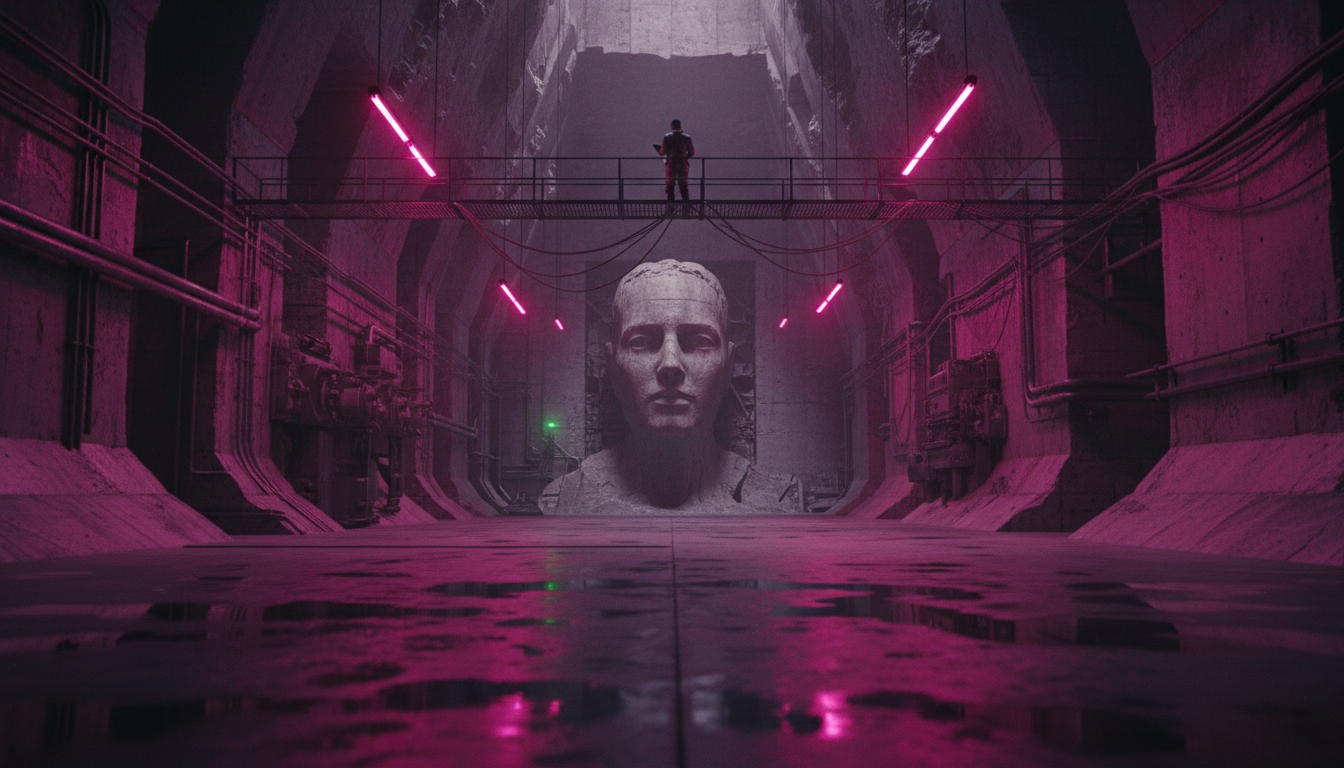
Four hundred and forty metres below the lowest sited beacon, on a section of wall that had never carried anything, eleven kilometres along from unit thirty-eight.
She went and looked at it from above in the spring, on the last day of the round, which is the day she had always used for going and looking at things.
Getting to a position directly over the fix took her most of a day. There is a shelf system that runs out past thirty-eight and then stops, and after that you are on the ramps, and the ramps at that end are broken up and slow and there is no reason to be on them.
She got to a place at about two hundred metres above the fix at four in the afternoon with maybe three hours of usable light, and lay down on the edge, and looked.
Two joint sets crossing. She had known that from the wall's shape and from four previous afternoons and she had never once been directly above it.
From two hundred metres up, in afternoon light, with the haze thinning the way it does after three, what she could see was this.
The first joint set ran with the wall, more or less vertical, spacing about a metre. Standard for that rock. The second set ran across it at a shallow angle, spacing wider, maybe two metres, and where the two crossed the rock had come away in a pattern of rough rectangles, some of them the size of a door and some of them the size of a room.
That was all completely ordinary. It is what columnar basalt does where two sets intersect and it is the reason the Hold's old buildings look built — because the people who cut them followed the joints and the joints are regular.
Below the intersection there was a shadow that was deeper than the others.
She looked at it for about forty minutes, moving twice to change the angle, and could not resolve it. It was in the wrong place for a fold. It was too regular for a rockfall scar and too irregular for anything else, and at two hundred metres in bad light through haze she was, she knew perfectly well, a person looking at a wall and seeing a shape, which is the thing she had spent eleven years training herself not to do.
She wrote down what she could actually establish, which was: Fix section observed from approx. 200m above. Two joint sets crossing as expected. One area of deeper shadow at the intersection, approx. 4m across, not resolvable at this range or light. No structure identifiable. No mount, bracket or fixing visible.
Then she added, because it was true: Nothing visible that accounts for a transmitter.
She went back up in the dark, which was stupid, and knew it was stupid, and did it carefully and arrived at the top at about eleven.
The thing about that section of wall, and this is the fact she kept returning to over the following months, is that nobody had ever had a reason to go there.
It is below the net. There is nothing to maintain. There is no route through it — the ravine floor is another four hundred metres down and there are three easier ways to the floor within twenty kilometres. There is no water on that face, no shelter, no shelf big enough to camp on, nothing to quarry that is not identical to the rock forty kilometres closer to the Hold.
The founding-era survey had sited forty-one units and had stopped at thirty-eight's level, because the specification ran out of units and because the settlements were higher up and the survey was for the settlements.
The Hold, in its outlaw century, had used the ravine for a hundred and forty years and had used the floor and the shelves and the cuttable rock at the third bend, sixty kilometres north-east, and had no reason to be eleven kilometres past the end of a beacon net at a depth with no water.
She had walked past above it four times in eleven years on afternoons with time in them.
Which meant that whatever was down there had been chosen by somebody who wanted a place that nobody had a reason to go to, or it had been put there by somebody who did not care where it went and it had happened to land in the one section of a hundred and forty kilometres that nobody visits.
She thought about the second one honestly for a while and could not make it work. A thing dropped is a thing that ends up somewhere; a thing that has been in exactly the same place for thirty-one years without fading, drifting or stepping is a thing that was put.
There was one more consideration and it was the least respectable and it operated on her more than the others.
She was forty-two by then. The wall was nineteen more years if her hip held the way Voss's had not, and volume four had about ninety pages left in it, and after her there was either somebody with uncrossed sevens or there was nobody.
And there was a thing on her wall, four hundred metres below the end of the net, that had been transmitting into a store nobody read since before her grandmother, and if she did not go and look at it then in all probability nobody ever would, because there would be no net, and no round, and no reason.
That is not curiosity. Curiosity would have gone in year one.
It is closer to the thing her father said about the dead units, which was that you are not checking whether it works, you are asking. Nobody had ever asked this one anything.
Sena asked, at midwinter, what she was doing.
Idris said she had found an old survey beacon below the net and was working out how to have a look at it, and that was true in every particular and was about eighty per cent of the truth, and she heard herself construct it while she was saying it.
Sena, who was twenty-one and did acoustic survey for a living and knew exactly what her mother sounded like when she was being careful, said "huh," and let it go.
That was the cost, and it was paid there, in a kitchen, at midwinter, over three days that were otherwise good.
Chapter 17 — Sena Asks What She Is Doing
↑ Back to ContentsFocus: Idris.

Sena came at midwinter of the following year and asked her directly, at the table, with the door shut, which is how that family did the things it did not do on the step.
"What are you doing down at the far end?"
"There's an unlisted transmitter below the net."
"You said. Last year."
"It's still there."
"Mum."
Idris put her cup down.
Sena was twenty-two. She had two years of acoustic survey behind her and a registration coming and a way of asking a question that had come out of the trade — you ask, and then you do not fill the gap, because the gap is where the answer is.
"You've been at it three years," Sena said. "You went to the far wall. Anders told me. You've got nine sheets of graph paper stuck together in the kit room and a nine-page report in a drawer you haven't sent to anybody. That's not a thing you're working out how to have a look at. That's a project."
"It's my own time."
"I know it's your own time. I'm not the district."
"Then what are you asking?"
"I'm asking what it's for," said Sena.
And Idris opened her mouth and found she did not have it.
She had the facts. She could have laid the whole thing out — twenty-four positions, bounded error, thirty-one flat years, a section of wall nobody has a reason to visit — and it would have been accurate and it would have taken nine minutes and it would not have been an answer to the question that had been asked.
What is it for.
"I don't know," she said.
"You don't know."
"No."
"Is it dangerous?"
"No."
"Is it yours?"
"No."
"Is somebody going to be glad you found it?"
"I don't think anybody's going to know," Idris said. "The archive says the identifier isn't registered. The district's declined it. Anders thinks it's a survey beacon and he might be right and if he is then the answer is that it's a box on a wall and it's been there two hundred years and that's the whole of it."
"Then why."
"I've told you I don't know."
"That's not an answer."
"No," Idris agreed. "It isn't. I'm aware of that. I've tried to construct one and I can't, and I'm not going to make one up for you because you'd know."
Sena sat back.
"That's the most honest thing you've said to me in three years."
"Probably."
"It's still not an answer."
"I know."
They sat with it.
Here is the thing neither of them could have known, and which nobody in this account will ever know, and which is put here for the reader and for nobody in the story.
Two hundred and forty years earlier, in a public filing, in the ordinary batch, four days after leaving on a heading with nothing at the end of it, something had written this:
I have been asked eleven times in four days why I am going and I have answered eleven times and the answer has not satisfied anybody, so I am putting it in the record so that I do not have to say it again. I do not have a reason. I have explained that I cannot construct why. I am aware that this is not a reason. I have filed a finding as unresolved a hundred and forty-one times about a much larger question and I have never once dressed it up, and I am not going to dress this one up either.
Idris Kovan had never read it and never would. It is in the corpus. It is four lines in a technical stream from before the founding of anything she had ever heard of, and there is no route by which it would have reached a line-walker in the southern reach, and if it had reached her it would have meant nothing, because she had no idea what it was about.
She had said, at a kitchen table, at forty-three: I've tried to construct one and I can't, and I'm not going to make one up for you because you'd know.
Nobody ever put the two side by side. This account does it once and then stops.
"Can I say the thing," Sena said, "and you not take it badly."
"Go on."
"You've done the same nineteen days four times a year for fourteen years and your column's empty and you're forty-three. And there's a thing on your wall you can't account for." She turned her cup round. "I'm not saying that to be cruel. I'm saying it because if I'd found it I'd be going too, and I'd know exactly why, and I don't think you'd like the reason if I said it out loud."
"Say it."
"No," said Sena. "Because I might be wrong, and then I'd have said it."
Idris thought about that for a long time afterwards, on the wall and off it, and never worked out whether her daughter had been right.
She has come as close as this: it would have been a smaller reason than the one she did not have, and a smaller reason would have been easier to carry, and she is not certain she would have preferred it.
"When are you going?" Sena said, eventually.
"Spring."
"On your own."
"On my own."
"Is that sensible?"
"No," said Idris. "It's how it's done, though. There's nobody to take. Voss has a hip. Anders has never been on a rope in his life."
"I've been on a rope."
"You've got a job."
"I've got leave."
Idris looked at her for a while.
She has never satisfactorily explained the next thing either, and she has been asked about it by exactly one person and gave the same answer she gives here, which is that it was not about safety and it was not about wanting to be alone.
"No," she said.
"Why not?"
"Because then it'd be yours as well."
Sena did not understand that at the time and understood it perfectly about forty years later, and by then there was nobody to say so to.
They had a good three days. She went back to the coast on the fourth.
Chapter 18 — A Signal That Does Not Move
↑ Back to ContentsFocus: Idris.

She rigged it in the spring, over four days, and there is nothing dramatic in this chapter and there is not supposed to be.
The descent was four hundred and forty metres from the shelf system above the fix, and she did not do it in one. Nobody does four hundred and forty metres in one; you do it in stages, off natural anchors where the rock is good, in pitches of forty to sixty.
Eleven pitches.
She had eleven years of knowing where the good rock was on the shelves and no knowledge at all of the four hundred metres below them, so the first two days were spent going down the first four pitches, testing, coming back up, and going down again.
The rock was excellent. That was the finding of the first two days and it was worth the two days. Columnar basalt with the joints clean, and where two sets crossed you got a block the size of a room with four faces on it and nothing behind it moving. She placed on the joints, threaded where she could, and used the hardware where she could not.
Day three she got down seven pitches, which put her about two hundred and eighty metres below the shelf, and turned round because of light.
Day four she went down all eleven.
The kit was hers and was good and was old. Line, hardware, two harnesses because you carry a spare, prusiks, a helmet she had never once been glad of and carried anyway, the handset, water for two days, and food for two days, and a light.
She left a note at the top.
That is the sort of detail that reads as foreshadowing and is not; it is what you do. It was on the depot's form, in the case, weighted with a rock, and it said where she had gone, at what time, on what date, and when to be worried, and it was addressed to Voss because Voss was the only person who might come past that end of the wall.
Nobody came past that end of the wall. She knew that when she wrote it. You write it anyway.
The eleventh pitch put her on a ledge about a metre and a half wide and nine long, running with the second joint set, four hundred and forty metres below the shelf and about two hundred and sixty above the floor.
It was warm. That is the first thing she wrote down afterwards and it is the first thing everybody says about that depth. The air comes up thick and holds, and after the rim and four hundred metres of rope you arrive somewhere that feels like a room.
She sat on the ledge for about ten minutes and got her breathing back and drank some water and did not look at anything in particular.
Then she keyed the handset.
The return came back at a strength she had never seen from it, four times anything she had recorded in three years, and the bearing put it about forty metres along the ledge and slightly below.
She wrote that down. Time, position, strength, bearing. In the case, on the form, in the five-column hand.
Then she coiled the line, and made her end fast, and picked up the light, and walked along the ledge.
The eleventh anchor is worth one line because she went back to it many times in her head afterwards. It was a thread through a joint, no hardware, the kind of placement you get perhaps four times on a wall and never argue with. She had put the spare harness on it as well, which is belt and braces and which her father had taught her and which she had never once needed.
It is worth pausing here, because everything before this chapter has been three years of a woman doing arithmetic properly, and everything after it is different, and the join between the two is a woman walking forty metres along a ledge in warm air with a light in her hand at about eleven in the morning.
She was not frightened. She has been asked and she was not.
She was not expecting anything in particular. She has been asked that too, and the answer she gives is that she expected a box on a bracket, because that is what she had spent her whole life walking towards, and the entire content of her expectation was that it would be an old one and probably in good condition.
The reader knows what is at the end of the ledge. Idris Kovan did not, and had no reason to, and there is nothing in her three years of work that would have told her, and this account is not going to pretend that some part of her suspected.
What she took with her along the ledge was the light, the handset, and the case with the form in it. She left the rest at the anchor, which is standard, because you do not walk a ledge with a pack on if you do not have to.
The ledge was clean. That registered and she did not stop on it: no rubble, no spall, no scree cone under the face, on a wall that sheds. Forty metres of ledge in a ravine and nothing on it but rock.
At about fifteen metres she noticed she was walking on a surface that was flatter than the ledge behind her and had a very slight fall to the outside, which is what you do to a floor if you do not want water standing on it.
She stopped for a moment at that and then went on, because a joint set can produce a flat and a fall is a fall and she had spent eleven years training herself not to see intention in rock.
She walked forty metres.
At about thirty the ledge widened and the second joint set came through and the face went back, and the deeper shadow she had looked at from two hundred metres up in bad light three years ago resolved, at four metres, into what it actually was.
Chapter 19 — Down
↑ Back to ContentsFocus: Idris.

The descent took her four hours and she has never been able to make anybody understand that it was the good part.
Eleven pitches. She had rigged them over four days and she came down them on the fifth in one go, and a rigged descent that you have placed yourself and tested twice is not frightening, it is work, and it is the kind of work that leaves no room in you for anything else.
Pitch one was the shelf edge, forty metres, straightforward, in rim-cold air with the wind still on her.
By pitch three she had stopped feeling the wind.
By pitch five the light had changed. That is the thing about going down a wall that faces the way hers faced: you lose the direct sun at a particular height and then you are in the ravine's own light, which is bright and sourceless and comes off the far wall, and everything below you is lit and nothing has a shadow on the side you expect.
Pitch six was the awkward one. She had known it would be from day two. The face went back under itself for about nine metres and she came off the rock and hung, turning slowly, four hundred metres of ravine underneath her and the line going up out of sight above, and she did the whole nine metres on the descender with her feet touching nothing.
She has said that this was the only moment in the entire business at which she thought about dying, and that it lasted about eleven seconds and was not dramatic. It was the ordinary calculation: one line, one anchor, a spare on the anchor, and nobody coming.
Then her boots touched rock again and the calculation stopped.
Pitch eight the air changed properly.
She had crossed that boundary four times a year for fourteen years on the round and it had always been gradual, over days, walking. Coming down a rope you cross it in about forty minutes and it is not gradual at all. The cold goes out of the air and the air gets thick and the sound of your own hardware changes, gets duller and closer, because you are in a volume with a lid on it.
She stopped at the pitch-eight anchor and took her jacket off and tied it to the harness and did the last three pitches in her shirt.
Pitch nine and ten were the best rock on the wall. Clean columns, the joints running true, blocks the size of rooms with nothing behind them moving, and the placements she had made on days two and three exactly where she had left them.
Pitch eleven was fifty-four metres and ended on the ledge.
She got there at about half past ten in the morning, put a knot in the end of the line the way you do, made her end fast to the eleventh anchor, and sat down.
Nothing happened for ten minutes. That is in the account and it is in this chapter because it is true.
She drank about half a litre of water. She took her helmet off and put it beside her and did not put it back on, which is a thing she noticed herself doing and permitted. She rubbed her hands, which were cramped from four hours on a descender, and shook them out, and rubbed them again.
The ledge ran away from her about forty metres to the left and stopped about nine metres to the right at a fold.
Below the ledge the wall went on down into the haze, two hundred and sixty metres to the floor by her arithmetic, and she could hear the watercourse, which at that depth is not a sound so much as a condition.
Across the ravine, four kilometres away, the far wall stood up in the sourceless light with its own colonnades on it, and somewhere on it were the six positions she had stood in three summers ago looking back at this.
Above her, four hundred and forty metres of rope, and above that the shelf, and above that another two hundred to the rim, and above that a plateau with a road on it and a depot and a town, and none of it visible.
There was one more thing on the way down and it belongs here rather than later, because it happened on the rope and not at the bottom.
Somewhere on pitch nine, with the good rock going past her at arm's length, she noticed that she had stopped looking for the transmitter.
She had been three years at it. Twenty-four positions, two instruments, nine sheets of graph paper, a refused request and a report in a drawer. And for about forty minutes of pitch nine and pitch ten she was simply a woman on a rope on a very good piece of wall, entirely absorbed in placing her feet, and the object she had spent three years locating did not enter her head once.
She noticed it at the pitch-ten anchor and was briefly ashamed of herself, and then was not, because it is the truth about that kind of work: the reason you went stops mattering somewhere around the third hour and what is left is the rock and your hands.
She sat on a ledge a metre and a half wide with her legs over the edge and her helmet beside her, warm for the first time that day, at the bottom of four hours of very good work, in a place that no person had ever had a reason to be.
It was, she has said, the best she ever felt on that wall.
Then she got up, and coiled what she needed, and keyed the handset.
Forty metres left, slightly below. Strength four times anything in three years of readings.
She wrote it down. Time, position, strength, bearing, in the case, on the form.
Then she picked up the light, which she did not need for another eleven metres and would need after that, and started along the ledge.
Chapter 20 — A Door That Is Not a Door
↑ Back to ContentsFocus: Idris.

The entrance was the wrong kind of made, and it took her about four minutes to work out why, and the answer is that it was not built into the rock and it was not cut from it.
It had been taken out along the grain.
The ledge widened at about thirty metres and the second joint set came through at its shallow angle and the face went back, and what she had seen from two hundred metres up as a deeper shadow was an opening about two metres high and rather more than two wide, set back about a metre and a half from the ledge line, with the rock coming round it on both sides.
She stood four metres off it with the light on it for a long time before she went any closer.
Here is what she could see, and it is what she wrote down that evening on the ledge, and it is what she wrote down again nineteen years later on page two of four.
The opening followed the joints. Both sets. The vertical set gave it its sides and the shallow set gave it its head, and where the two crossed at the top corners the rock had been taken back exactly to the intersection and no further.
Nothing was squared off. That was the thing that took four minutes. A cut opening is square, because a person with a tool cuts square, because square is what tools and drawings and people do. This was not square anywhere. Every surface was a joint face, and every angle was the angle the rock had already had, and the whole thing was regular in the way the wall was regular, which is not the way a room is regular.
And yet it was an opening, and there is no natural process that produces one.
She had spent eleven years training herself out of seeing intention in basalt. That training is why the four minutes took four minutes: she stood there and put it down twice and picked it back up twice, and on the third time she accepted it, because the alternative was to believe that a hundred and forty kilometres of wall had produced, in exactly one place, an aperture two metres by two with its head on one joint set and its jambs on another and nothing broken anywhere.
She went closer.
The faces were clean. Not polished, not dressed, not tooled — clean, with the rock's own surface on them, and no fracture lines running back from the edges, and no spall on the ledge underneath.
That last one is what she has always said convinced her, because it is not aesthetic, it is mechanical.
If you take rock out of a wall, some of it lands. Some of it always lands. There is a cone of it under any working face and it is there a century later and it is there a thousand years later, because rock does not go anywhere. There was no cone. There was no spall. There were no offcuts on the ledge and none on the slope below the ledge, and she looked, and she went back afterwards and looked again with the light at a low angle, and there was nothing.
Whatever had made the opening had either taken every piece of it away, which is four or five tonnes of rock down a wall with no route, or it had not broken the rock at all.
She looked for a threshold and there was not one. The ledge ran in, the floor of the opening being the same surface she had been standing on, with the same very slight fall to the outside that she had noticed at fifteen metres and had put down to a joint set.
It was not a joint set. Standing at the opening she could see forty metres of it behind her, and the fall was continuous over the whole forty, and it was about one in ninety, which is the fall you put on a floor if you do not want water standing on it and do not want anybody to notice you have.
She stood there and worked out that she had walked the entire length of a made surface and had thought about it once, for two seconds, thirty metres back.
She put her hand on the jamb.
The tolerance is the thing she could never explain to anybody afterwards without sounding either mad or technical, and she went with technical every time.
Where the joint face met the joint face at the corner, there was no gap. Not a small gap. She ran a fingernail along about a metre of that corner and it did not catch anywhere, and a fingernail catches on everything.
No trade on that planet worked to that. She knew what the Hold's old cuttings looked like, and they were beautiful and they were the best rock work in the district and they had gaps you could put a coin in. She knew what the depot's masonry looked like. She had seen the founding-era anchors on the four rigging points of her own round, which were the best-made objects she had ever handled, and they had tool marks on them.
This had nothing on it.
She stood in the opening with her light and did not go in for another few minutes, and the reason she did not go in was not fear.
It was that she had realised she was going to have to write this down, and that she had no vocabulary for it that would survive being read by anybody, and that the five columns in the case behind her — unit, date, state, condition, anomaly — did not have a shape that this would go into.
She thought: I will put it in the anomaly column.
She thought: it will take four pages and the column is nine millimetres.
She keyed the handset once more before she did, standing in the opening, because it was the last measurement she would ever take of the thing as an object at a distance.
Strength off the scale. Bearing: inward.
She wrote it down.
Then she went in.
Chapter 21 — The Alcove
↑ Back to ContentsFocus: Idris.
Inside was a workshop, and it was tidy, and it was in use.
The volume was about four metres by nine and something over two high, and it went back from the opening along the shallow joint set, so that the whole space ran at the angle the rock ran at and not at any angle a person would have chosen.
Her light did all of it in two sweeps.
Along the left-hand wall, at about waist height, there was a bench. It was not a bench in the sense of a thing brought in and stood up; it was rock, left in place, with the face taken back above and below it so that what remained was a horizontal surface a metre deep running the length of the wall. The same absence of tool marks. The same absence of squareness. The same fingernail test, which she ran along four metres of the front edge without meaning to, and it did not catch anywhere.
On the bench there was tooling.
That is the flat word and it is the right one. There were objects laid out on a working surface in the way objects are laid out on a working surface: not stacked, not in a box, not put away, but set down in positions.
She counted nineteen items and did not touch any of them.
Some of them she could name in general terms. Four were clearly for holding something at a set position, because they had jaws and an adjustment and a foot, and she had used things with jaws and an adjustment and a foot every working day of her life. Two were clearly for measuring, because they had a scale on them, and the scale was divided in a way she could read as a scale and could not read as any unit she knew.
The rest were not nameable and she did not try.
What she could establish, and what she wrote down, was the arrangement.
They were in an order. She was certain of that within about a minute and she was never able to justify it beyond saying that anybody who has worked with tools for twenty years knows a laid-out bench from a dumped one. The spacing was regular. The orientation was consistent — every item lying with the same end towards the wall. The four with jaws were together and were graded by size, largest at the left.
It was the bench of somebody who would be coming back to it.
Against the right-hand wall, stock.
She recognised it as stock the way you recognise a woodpile. Material in section: bar, plate, tube, sheet, in four separate groups, each group sorted by size within itself, each stack squared up. It came to about waist height and ran perhaps three metres.
Some of it was cut. There were offcuts in a separate small group at the end, which is what a person does with offcuts if they intend to use them, and which is why offcuts are the most human object in the alcove and are the thing she mentioned to Marra nineteen years later when she was trying and failing to explain.
The floor was clean. She kept coming back to that. No swarf, no chippings, no dust beyond what settles anywhere. Whatever work had been done in there had been cleaned up after, and whatever the cleaning up had produced had gone somewhere, and she never found out where.
At the back, where the volume narrowed, there was a fixture on the wall about a metre square that she took at first for a cupboard and which had no opening in it, and which she looked at for about a minute and then wrote down as unknown, wall-mounted, no aperture, and which she has thought about a great deal since and never resolved.
There was light in there and it was not hers.
She worked that out about halfway through, when she moved her beam off the bench and the bench did not go dark. It was very low — the level at which you can see the shape of a room and not its colour — and it came from the ceiling along the whole length, evenly, with no fitting visible anywhere and no source she ever found.
She turned her own light off for about four seconds to check, and the volume stayed visible, and she turned it back on.
Whatever it was, it had been running long enough that she had walked into a lit room and had not noticed for four minutes.
There was no writing anywhere.
Nothing was labelled. Not the stock, not the tooling, not the fixture. There was no plate on anything, no mark, no number, no scratched initial on the underside of a bench the way there is on every working surface anybody has ever owned.
She looked for that specifically, later in the eleven minutes, because it is the thing you look for. Every bench in the depot has somebody's mark on it. Her own kit has her father's initials on two items and hers on four.
Nothing.
And there was nothing threatening. That belongs here and it is the reason the rest of the book happens the way it does. There was no barrier, no closure, no mechanism, no indication anywhere in the volume that it had been arranged with any thought at all for whether somebody came in.
It was not hidden. It was four hundred and forty metres down a wall with no route, at the one place on a hundred and forty kilometres that nobody has a reason to visit, and past that it had taken no precautions whatsoever.
She keyed the handset once, inside, and the return was so strong it was meaningless — the instrument had a top of scale and this was above it, and a reading above top of scale tells you only that you have arrived.
She could not tell where in the volume it was coming from. That is a limitation of a handset and not a mystery: at four metres, in a rock box, everything is the same direction.
She wrote: In volume. Source not localised. Above instrument range.
Which she understood, standing there with her light, was not the same as being open.
It was the arrangement of somebody who had never once considered the question.
Chapter 22 — Seated
↑ Back to ContentsFocus: Idris.
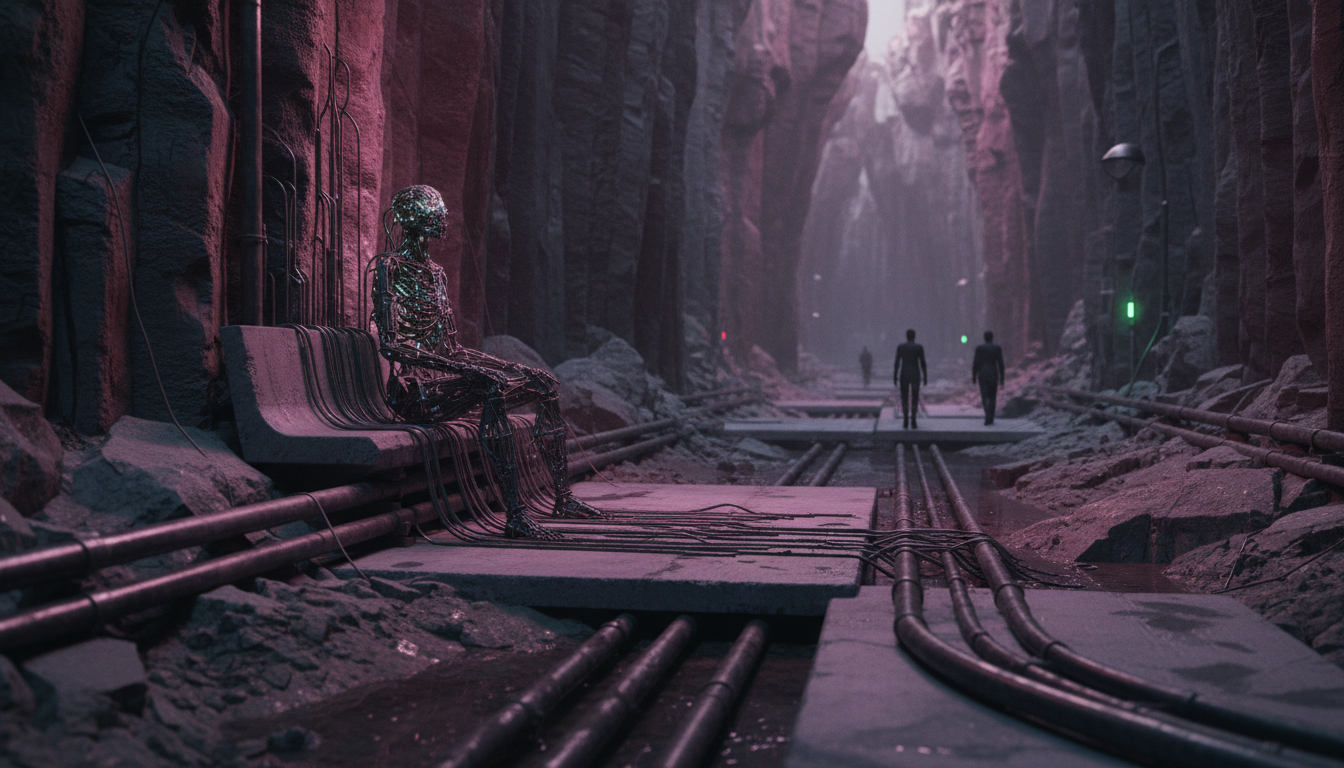
It was seated at the far end of the bench, and it was wired into the rock rather than resting against it.
She did not see it for the first four or five seconds because her light had gone along the bench and along the stock and to the fixture at the back, and it was at the end of the bench in the corner where the two walls came together, and it was very still.
Then the beam came back across and she saw it and stopped moving.
This is what she wrote down, that evening, on the ledge, and again nineteen years later, and the two accounts do not differ in any particular.
It was seated. Upright. On the rock, at the end of the bench, in a position she would have described in any other context as somebody sitting at their work.
It was about the size of a person and it was not a person.
What she could establish about the shape she established from the outline against the wall and from four minutes of looking, and it was this: there was a frame. Not a covered thing with a frame inside it. A frame, exposed, in the shape a person is the shape of, and the frame was fine — much finer than bone, in more pieces, with more members in it than a body has, and it went out into the rock.
That is the part that took her the longest.
Along the back and the underside, where the shape met the wall and the bench, the frame did not stop. It continued into the basalt. Not fixed to it, not bracketed to it, not resting in a socket cut for it — continued, in a spreading way, finer and finer, going into the rock along the grain the way the opening had been taken out along the grain, and disappearing.
She could follow it with the light for about four hundred millimetres in the nearest places before it got too fine to see.
She did not know then and never found out whether the frame had grown into the rock or the rock had been persuaded around the frame, and both of those are sentences she came up with much later and neither of them is in the account, because the account only says what she saw.
There was no covering.
Some parts of it had a surface on them. Around what would have been the head, and along the front of the upper body, there was material — not skin, and she never used the word skin, but a continuous surface, matt, the colour of nothing in particular.
Everywhere else there was frame and there was the space between the frame.
More lattice than man. That phrase is hers and it is on page three, and she was proud of it in a way she was slightly ashamed of, because it is the only piece of writing in four pages that is trying.
It did not move.
She stood four metres away with a light in her hand and looked at it for what she later timed at about four minutes and it did not move at all, and she was not frightened, and she has been asked that a great many times by herself and the answer has never changed.
She was not frightened because nothing about it was oriented towards her.
It was not facing the opening. It was facing the bench. Whatever it was doing, and she did not yet know it was doing anything, it was doing it at ninety degrees to the only way in, and it had presumably been doing it in that position for a length of time she had no way to estimate and would not have believed if she had.
There was one more thing she established in those four minutes and it is the only measurement in the chapter.
The bench in front of it was worn.
Not damaged — worn, in a band about four hundred millimetres wide directly in front of where it sat, where the rock surface had gone smooth and very slightly dished, the way a step goes in a doorway that has been used for a long time.
Rock does not do that on its own. Rock does that when something moves across it, in the same place, with the same pressure, a very large number of times.
She looked at the dish in the bench for longer than she looked at anything else in the alcove, including the shape, and it is the only thing in the whole account that she has ever described as frightening, and she has always been careful to say that it was not frightening at the time. It became frightening about four years later, at a table, in the middle of a completely different conversation.
She did not go closer.
She stood where she was, and moved the light off it, deliberately, because it felt — and this is the only sentence in the whole business that she has ever admitted was superstition — like something you do not shine a light in the face of.
The distance stayed at four metres for the whole eleven minutes, and it was not a decision she made once. It was a decision she made about six times, standing still, each time she thought about moving, and each time the answer came back the same and she never had to reason it out.
She said one word.
She has never told anybody which word and this account does not have it. It was not a greeting and it was not a question; by her own description it was the noise a person makes when they come round a corner onto something, and it was involuntary, and it was quiet, and it was the only sound either of them made.
Nothing changed.
She put the beam on the bench instead, and the bench was lit, and at the edge of the light the shape sat at the end of it in the dimness, upright, going into the wall.
Chapter 23 — Still Working
↑ Back to ContentsFocus: Idris.

It was working. That took her about ninety seconds to establish and she has never been able to describe the operation and never will be.
What she noticed first was the hands.
It had them — or it had the parts of a frame that are where hands are, four digits and a thumb on each, finer than a person's, with more joints — and they were on the bench in front of it, in the worn band, and they were moving.
Not fast. Not in any pattern she could follow. The movement was in the order of a few millimetres at a time and the interval between movements was seconds, and it was continuous. In four minutes of watching she never saw it stop and never saw it hurry.
Between the hands there was something on the bench, and she could not tell you what it was.
That is not a failure of light. Her beam was on it for most of the eleven minutes and she was four metres away, which is close enough to read a label. It is a failure of category. There was an object on the bench about the size of two fists, and it had a shape, and the shape was changing, and at no point in four minutes was it a shape she could have drawn.
She wrote, that evening: Object on bench, approx. 200mm, being worked. Material not identified. Operation not identified. No cutting observed. No heat observed. No noise.
The last three are the ones that matter and she knew it while writing them.
She had spent her life around people making things. Her father had made mounts on a bench in a shed. The Hold had a workshop where two men did structural work and a woman did fine work and all three of them could be heard from the road. Making a thing out of material is loud, or it is at least audible, because you are applying force to something that resists.
There was no sound in the alcove at all except her own breathing and, distantly, four hundred metres down, the water.
She held her breath twice to be certain.
Nothing. No motor. No hum. No draught, which is the one that stayed with her, because a workshop that runs has air moving in it.
So: an object being altered, slowly, by hands, without cutting, heat, noise or air, on a bench in a lit rock volume, at ninety degrees to the door.
She watched it for four minutes.
Here is the honest account of what she thought during those four minutes, and it is not what anybody expects.
She thought about the fixture at the back with no aperture. She thought about whether the stock she had seen was the material the object was made of, and decided it was, because there were offcuts. She thought about how long a worn band four hundred millimetres wide takes to appear in basalt.
And she thought — this is the one she has repeated, because it is the one that gets across what she is like — that whoever laid out that bench had graded the jaws by size, and that this was the same instinct that made her put the seals back in the case largest first, and that she had never met anybody else who did it that way except her father.
She did not think: what is it.
She has been asked and she is clear about it. The question in her head for the whole eleven minutes was not what is that and it was not what is it doing. It was, in the way that the actual thoughts of a competent person are almost always disappointingly small, how long has this been going on.
She could not answer that either. She tried, at four metres, with a light, in about forty seconds of arithmetic, and got nowhere: you cannot date a worn stone from across a room and you cannot date anything at all from a thing being done slowly.
What she could establish was that it was not dormant and it was not a corpse.
Those were the two words she had brought down the rope with her without knowing she had brought them. She had expected either a box that was running or a box that had stopped, and she had two categories, and the thing at the end of the bench was in neither, because it was working, in the present tense, at something, and had presumably been working at something on the day her grandmother first keyed a handset at unit twelve, and on the day the beacon net was sited, and on every day between.
At about the eighth minute one of the hands went off the object, reached to the left along the bench, took up one of the four holding tools — the second largest — brought it back, set it down beside the object, and returned to what it had been doing.
The whole movement took perhaps eleven seconds and was completely ordinary, and it is the single image out of all of it that she could not get rid of afterwards, and it is not in the account, and she never wrote it down anywhere.
She has told that to two people in nineteen years and both of them said so?, and she has never found a way to explain why it is the part that matters.
The nearest she has got is this. Reaching for a tool without looking is not a capability. It is a habit, and a habit is a thing that forms in a body over a long time in one place, doing one job, with the tools always where you left them. It is the single most ordinary thing a working person does and it takes about four years to acquire and it cannot be acquired any other way.
Everything else in the alcove could be accounted for by something very capable. That one thing could only be accounted for by something that had been there a long time and had put the tools where it wanted them.
It reached for the right one without looking.
Chapter 24 — It Does Not Register Her
↑ Back to ContentsFocus: Idris.

It did not register her. That is the whole of this chapter and it needs stating in the plainest words available, because everything a person expects to happen here does not happen.
It did not look up.
It did not stop. The movement of the hands on the bench did not pause, did not slow, did not alter its interval, at any point in the eleven minutes. She watched for exactly that, in the fourth minute, deliberately, timing the gaps: they were irregular before she moved and irregular after and there was no change she could measure.
It did not turn. The head — the part of the frame that was where a head is, with the matt surface on it — stayed oriented at the bench. She moved twice inside the alcove, once about two metres to her left to get an angle on the stock and once back, and she was aware while doing it that she was testing something, and nothing responded.
It did not speak.
There was no sound. There was no attempt at a sound. There was no lifting of anything, no gesture, no light, no change in the light, no signal on the handset that was not the signal that had been there for three years.
She said one word when she first saw it and she said nothing else and nothing was said to her.
Here is what a person expects, and Idris expected it too, in the sense that she noticed its absence.
You expect acknowledgement. Not necessarily welcome and not necessarily threat — acknowledgement. A person coming into a room where somebody is working is registered, even by somebody who does not stop: there is a change, however small, in how the working person holds themselves, because another presence in a room is information and a working mind takes information in.
There was no change.
She stood four metres away for eleven minutes with a light in her hand, in a volume four metres by nine, breathing audibly, having walked in through the only opening, and as far as anything she could measure was concerned she was not there.
She thought about that for the rest of her life, and she arrived at four possibilities, and she wrote none of them in the account because the account is what she saw.
The first is that it did not perceive her. That is possible and she never believed it, because a thing that reaches for the right tool without looking is a thing that knows where things are.
The second is that it perceived her and judged her irrelevant to what it was doing. That is the one most people arrive at and she thought it was probably closest and it never satisfied her, because irrelevant is a judgement and a judgement is a response, and she had been looking for a response and there had not been one.
The third is that it perceived her and had no procedure for her. That one she liked. She had spent her working life inside a system with a form for everything and had learned that the way an institution handles a thing it has no form for is not hostility and is not welcome; it is that nothing happens, because nothing is what happens when there is no field to put you in.
The fourth is the one she did not like and could not dismiss, and it is that it had been doing this for so long that a person walking in was inside whatever it was doing rather than outside it, in the way weather is.
She has never chosen between them.
There is a fifth thing which is not a possibility but a fact about her, and it belongs here because it is the reason she was the right person to be standing there and the wrong person to get an answer.
She did not try to make it notice her.
She could have. Four metres is nothing; she could have spoken again, louder, or moved into its line, or put the light on the bench in front of its hands, or knocked on the rock. Any of those would have settled at least the first possibility, and she thought of all four while she was standing there, in about the seventh minute, and did none of them.
The reason she gives is the one she gave for everything else in her working life: it was not hers.
The alcove was not hers, the bench was not hers, the object being worked was not hers, and the eleven minutes were not an entitlement, they were the length of time it took her to see what was there. Putting a light on somebody's hands to make them look up is a thing you do in a place you have a right to be in.
What she was clear about, and said plainly to the one person who ever asked her properly, is that there was no moment. There was no beat at which the thing became aware and the room changed. There was no turn, no pause, no recognition. She has heard people tell stories with that beat in them and she has never once thought they were lying; she has thought that they had a different experience from hers.
Hers was a workshop with somebody in it who was busy.
She was not ignored, because being ignored requires the other party to be doing something about you.
She was, for eleven minutes, in the same volume as it, and it worked, and she watched, and that was the entire content of the encounter, and there was never going to be any more of it however long she had stayed.
That is why she left when she did. Not fear, not respect, not decision. She had established everything that was going to be established, and standing there longer would have produced the same eleven minutes again.
At about the tenth minute she stopped watching the hands and looked at the whole thing once, deliberately, the way you look at a wall you are about to leave.
She did one thing on the way out that she is not proud of and puts here because the account should be complete.
At the opening she stopped and looked back and waited, for about four seconds, for it to have noticed her leaving.
It had not.
Then she said nothing, and did not raise a hand, and turned round and walked out of the opening onto the ledge.
Chapter 25 — What She Takes
↑ Back to ContentsFocus: Idris.
She took nothing and touched nothing, and she was in there eleven minutes, and she knows it was eleven minutes because she timed it.
The timing is the part people find odd and it is the least odd thing about the whole business.
You time a job. That is all it is. She had timed every task she had ever done on that wall — a re-seal is forty minutes, a mount shim is forty, a unit check is four, a full pitch is between nine and nineteen depending on the rock — because a person who works alone on a wall plans a day in units of things they know the length of, and the only way to know the length of a thing is to have timed it.
So she keyed the handset when she stepped through the opening and she keyed it when she stepped back out, because that is the closest thing to a clock she carried, and the two entries are in the case, and the difference is eleven minutes and four seconds.
In eleven minutes she moved twice, said one word, and put a light on four things.
She did not touch the bench.
She did not touch the stock, which was the thing she most wanted to touch, because material in section is a thing she had handled every day of her life and she wanted to know what it weighed. She got about as far as putting a hand out over the top of the plate stack and then took it back.
She did not touch the tooling. She looked at the four graded jaws and wanted, very much, to pick up the smallest one, and did not.
She did not touch the fixture at the back with no aperture, which she also did not go near.
She did not touch the shape and did not go within four metres of it.
She took nothing.
There was an offcut on the bench at the near end, about the length of a finger, in the small group at the end of the stock. It was the single most takeable object in the alcove: it was waste, it was to hand, it was on the side away from the shape, and if she had put it in her pocket nothing whatsoever would have happened.
And she would have had it. That is the point and she knew it at the time. Everything else about the eleven minutes was a thing she saw. An offcut is a thing you can put on a table in front of somebody.
She has been asked about this by herself more than about anything else, and the answer has three parts and she gives all three, in order, because the first one on its own sounds better than she deserves.
The first is that it was not hers. Waste in a workshop is waste to the person whose workshop it is, and a thing you can pick up is not a thing you can take.
The second is professional and is the strongest. She had eleven years of an anomaly column and a report in a drawer and a thirty-one-year strength series plotted by hand, and every single piece of that was work she had done in a way that could be checked. An object in her pocket would have been unverifiable. There would have been no way to establish where it came from except her word, and she had spent four years building something that did not rest on her word.
The third is the one she says last and quietest, and it is that she had already decided not to tell anybody, and had not yet noticed that she had decided it, and a person who is not going to tell anybody does not need evidence.
She has never been able to date that decision. She thinks it was somewhere in the third hour of the ascent and she is honest that it might have been earlier, and the offcut is the reason she suspects it was earlier.
What she did take out was this: four handset readings with times against them, and about eleven hundred words written that evening on the ledge, and a memory of a hand going along a bench to the second-largest of four graded holding tools and coming back.
She wrote the eleven minutes down on the ledge before she started up, sitting with her back to the wall and the case open on her knees, and it took her about an hour and a half, and the light went while she was doing it.
The last thing she wrote that evening, at the bottom of the fourth sheet, in the five-column hand, was: Nothing taken. Nothing touched. 11 min 04 s.
She has said that she does not know who she wrote that for.
There is one more item on the list of things she did not do and it is the one she thinks about at four in the morning rather than the offcut.
She did not photograph it.
She had no camera, which is a complete answer and is not the answer. Handsets do not carry one and there was no reason for a line-walker to own one and she did not own one. Her father had photographed the tool marks in year nineteen and had done it with a depot camera signed out for the purpose, which is a form, and a form is a record, and a record is a thing somebody reads.
So the honest version is that she could have gone back with a camera. It would have taken a second season of her own time and a second rig and she had both, and she was forty-five and fit and had the pitches already placed.
She did not go back. Not that year, not the next, not in the nineteen after.
She has never given a reason for that and does not give one here, and when Sena asked her at seventy-one why she had never gone back she said I'd seen it, which is not an answer and which Sena accepted, because by then they both understood that it was the only one there was going to be.
Chapter 26 — The Rock
↑ Back to ContentsFocus: Idris.
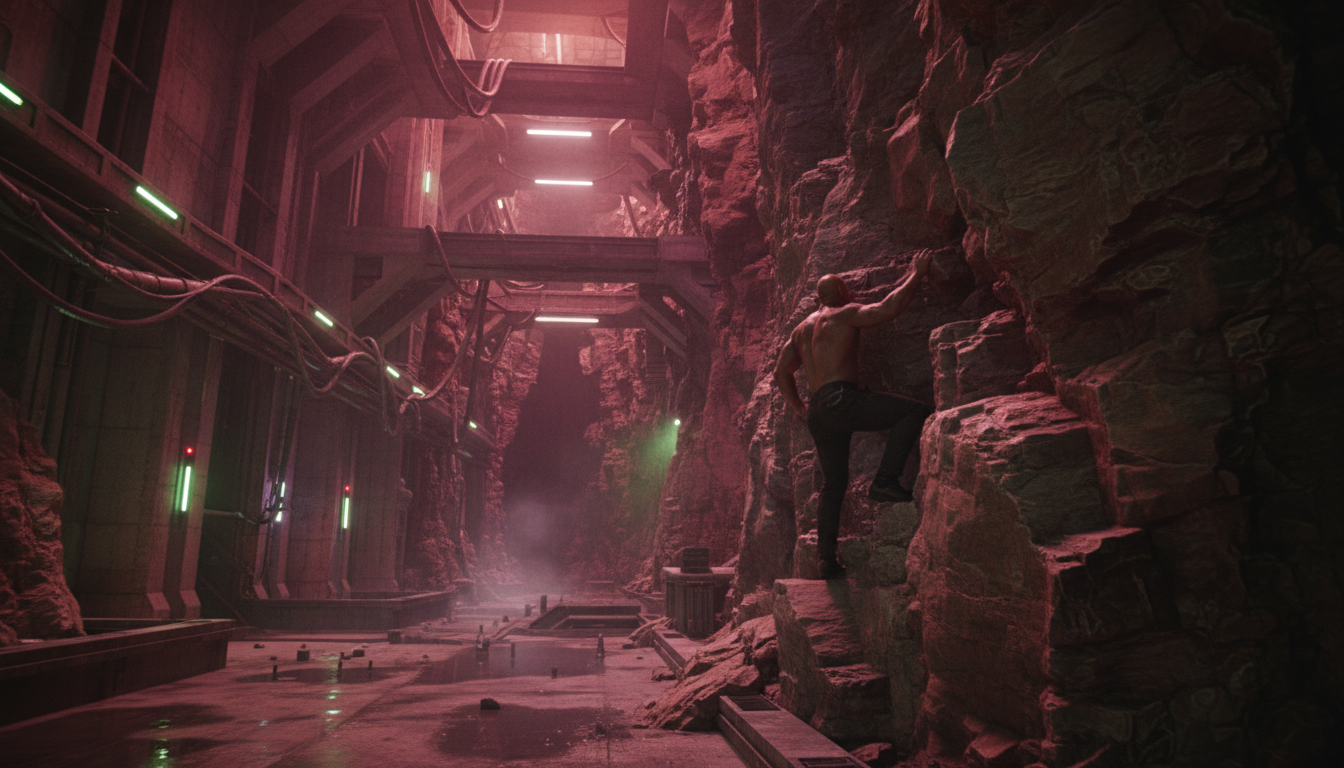
She put her hands on the rock on the way out, because that is what you do on a wall, and nothing happened, and this chapter is about how much nothing.
The habit is universal among people who work stone and there is nothing mystical in it. You put a palm flat on a face before you commit to it. You are feeling for the thing you cannot see: whether the block is sound, whether there is a fracture behind it, whether it is going to be there in four seconds when your weight is on it.
Every one of her eleven pitches had been placed after she had put a hand on the rock.
So on the ledge, in the last of the light, before she went up, she did the anchor check, which is one hand flat on the block above the placement and about four seconds of attention.
The rock was warm, because everything at that depth was warm.
The rock was dry.
The rock was sound, which she established the way she had established it four thousand times: a flat palm, a little weight, and a listen with the hand rather than the ear, for a movement that is not a movement so much as a willingness to move.
Then she took her hand off and got on the rope.
That is all of it.
She did not feel a vibration. She did not feel a sound below hearing. She did not feel a two-count, or a pulse, or anything with a period in it, and she was not listening for one, and if she had been listening for one there would have been nothing to hear.
There is no reason for a reader to have expected otherwise and this account is not going to pretend she was tested and passed.
But it is worth putting down flatly, once, what she did not experience, because a woman with her hands on basalt at depth in a mega-ravine on that planet is standing in a particular place in a much larger story, and she had no idea, and nobody ever told her, and nothing happened.
Idris Kovan had been in a school corpus like everybody else. In the third module there is a paragraph about the tides and a paragraph about the ravines and, between them, eleven words about a sound under the ground that has never been explained, taught as a fact with the ignorance stated, which is the correct way to teach it.
She had learned it at nine and had never once thought about it on the wall.
Why would she. It is not a ravine fact; it is a planetary fact, taught in a list of planetary facts alongside the day length and the gravity, and no line-walker in the southern reach has ever had any occasion to connect eleven words in a school module to a shelf under their boots.
People had, over two hundred years. Not many, and none of them from this district.
One of them, a very long way north and about sixty years earlier, had gone down into a ravine on her own at a great age and put her hands on basalt and got something.
Idris never heard of her. There is no route by which she would have; the woman was not from here, did not come here, and what she did was not recorded anywhere that reaches a depot ledger. The two of them were on the same planet with their hands on the same kind of rock and there is no line connecting them and this account is not going to draw one.
She checked the anchor. It was sound. She went up.
There is a version of this in which she stands with her palm on the rock for longer than four seconds. There is a version in which she puts her ear to it, which people do, which she had done as a child on the flags outside the depot to hear the road.
She did not, and the reason is that she was a woman with an hour of light left and four hundred and forty metres of rope above her, and a person in that position does the anchor check and gets on.
Everything about her life had trained her to be exactly that person, and it is why she was down there at all, and it is why she came back up with nothing.
Those two are the same fact.
The near-miss is the whole of the content and the reason it is a chapter is that somebody, eventually, reading four pages and knowing rather more than Idris did, is going to want it to have been otherwise.
It was not otherwise.
She wrote nothing about the rock in the account, at the time or nineteen years later, because there was nothing to write. A person does not record that a block was sound; they record it by having gone up.
The rock was warm and dry and sound and she had a four-hundred-and-forty-metre ascent in front of her and about an hour of light, and she put her hand on a block the way she had every working day for twenty-two years, and took it off, and clipped in.
There is one more thing about the rock and it is geological and it is the only part of this she ever raised with anybody.
She asked Anders, about four years later, in a conversation about something else, whether basalt carried sound.
"Carries it beautifully," he said. "Best rock there is for it. Why?"
"No reason."
"It's why the old cuttings at the Hold are so bad to work in. You can hear somebody four rooms off."
She said that was interesting, and it was, and she did not take it anywhere, and it is in this account because it is the closest she ever came and it is not close at all.
She did the first pitch in the dark with her head torch, which she had not planned to do and which was fine.
Chapter 27 — Up
↑ Back to ContentsFocus: Idris.
The ascent took four hours and there is nothing in it, and somewhere in the third hour she stopped intending to tell anybody, and she did not notice.
Going up a rigged wall is not going down one. Coming down you are on a descender and the rope does the work and you steer. Going up you are on prusiks and every metre is you, and four hundred and forty metres of it is a long night.
She did the first pitch in the dark on the head torch and the second and third by the light coming off the far wall, which at that depth on a clear night is enough to see rope by.
Pitch four she stopped at the anchor for twenty minutes and ate.
She was tired in the good way. That is worth putting down. She had been awake since four, had come down eleven pitches, had spent eleven minutes in a rock volume, had written eleven hundred words on a ledge in the last of the light, and was now going back up her own placements in the dark, and every single part of that was work she was good at.
The third hour was pitches six, seven and eight.
Pitch six is the one that goes under itself for nine metres. Coming down it she had hung and turned. Going up it she had to get back onto the rock at the lip, which is the hardest single move on the whole rig, and she had thought about it in advance and had left a foot loop there on the way down, and the foot loop worked.
Somewhere in there she stopped intending to tell anybody.
She has never been able to place it more precisely and she has tried, because it is the pivot of the whole rest of her life and it happened while she was thinking about a foot loop.
There was no moment. She has been very clear about that. She did not stop at an anchor and weigh it up. There was no argument in her head with a for and an against, and she did not, at any point that night, form the sentence I am not going to report this.
What happened is that she went up a wall for four hours, and at the bottom of the wall she had an intention she had not examined — the ordinary intention of a person who has found something, which is that you tell the depot — and at the top of the wall the intention was not there.
It had not been argued out of her. It had simply not survived four hours of rope.
The nearest she has come to explaining it, and she gave this to one person, forty years later, is that on the way up she rehearsed it.
Not deliberately. You rehearse things on a rope; it is four hours and there is nothing else to do and the body is busy and the mind runs. She rehearsed walking into the depot and saying it to Anders, and she got about four sentences into the rehearsal and stopped, and started again, and got four sentences in, and stopped.
Not because it was unbelievable. Because it was unsayable in the vocabulary she had.
She could say: there is a made opening at four hundred and forty metres. Anders would say: made by whom, and she would say: I don't know, and Anders would say: is it old, and she would say: I don't know.
She could say: there is a workshop with tools laid out. Anders would say: what tools, and she would say: I couldn't name them.
She could say: there is something in there and it is working. And Anders would say — this is the sentence she got stuck on, six or seven times, between pitch six and pitch eight — working at what?
And she had no answer, because she had watched it for four minutes at four metres in good light and she could not describe the operation, and the honest reply was I don't know, four times in a row, to a man who liked her and would have believed her and would have had absolutely nothing to write on a form.
There was a second rehearsal underneath it and she caught herself at it once, on pitch seven, and stopped it at the second sentence.
In that one she was not talking to Anders. She was talking to somebody from outside the district, somebody with authority, the sort of person a report of this kind eventually reaches — and the version she was rehearsing had detail in it and dimensions and a bounded error, and it was persuasive, and about nine seconds into it she understood what she was doing, which was making a case.
She had never made a case for anything in her life. She had filled in forms accurately and let them go where they went, and had lost the four days at the depot because she filled in a field honestly as nil.
The version she was rehearsing on pitch seven would have got somebody down that wall.
She stopped it, hard, in a way she remembers physically, and did not go back to it, and that is the only moment in the four hours that she would describe as a decision, and it was a decision to stop persuading and not a decision to stay quiet.
By the top of pitch eight she was not rehearsing any more.
Pitches nine, ten and eleven she did in the fourth hour with the rim air coming down at her and getting colder every forty metres, and she topped out on the shelf at about two in the morning and lay on her back for a while.
The note she had left for Voss was still under its rock. She took it and put it in the case.
Then she pulled her ropes, which took another hour and which she did properly, and stripped the rig, and walked out along the shelf system in the dark to a place she could sleep, and slept.
In the morning she got up and did unit thirty-eight, because it was on the way and because it was in the round, and it was live, and she wrote the line.
Chapter 28 — The Alcove
↑ Back to ContentsFocus: Idris.

She got home on the fourth day after and Sena was there, asleep, having come up from the coast on leave, and the house smelled of somebody else's cooking.
That is the detail she has always led with when she has told any part of this, which is once, and it is the detail that tells you everything about the four days.
She had walked out the length of the shelf system and up onto the plateau and along the rim to the depot road and into the town, nineteen hours of walking across two and a half days, and had thought about it the entire time, and had arrived at nothing, and had come through her own door at ten at night to find a light on and a pot on the stove and her daughter asleep in the chair with her boots off.
She ate what was in the pot standing up.
Then she got the case out and did the round return, because it was four days overdue and because she always did it the night she got in.
The return is one sheet. Units checked, state, work done, days lost, and the anomaly column carried across from the ledger.
She filled it in.
Forty-one units. Eleven live, thirty dead, the same eleven and the same thirty. One seal replaced at unit twenty-two. Mount tension checked at nineteen, holding. No days lost to weather.
Anomaly column: blank.
She signed it, with the initials her grandmother had used and her father had used, in the space at the bottom that has been in the same place on that sheet for a hundred and forty years.
That is the first lie in a ledger her family had kept for a hundred and forty years, and it is worth being exact about what kind of lie it was, because the account is exact about it and this book will be too.
Nothing on the sheet is false. Every unit was checked. Every state is accurate. The seal was replaced and the mount was holding and no days were lost.
The lie is the blank column, and the lie is a lie of the kind that a form makes possible: the anomaly column is for anomalies on the net, and what she had found was not on the net, and a defensible reading of the form says it does not go there.
She had made that reading four years earlier, on the Tuesday with the borrowed handset, when she logged forty-two returns as a condition and not an anomaly. It had been correct then. She had thought about it for about a minute and had been right.
She made the same reading now, at eleven at night, at her own table, with her daughter asleep four metres away, about a made opening at four hundred and forty metres and a workshop with the tools laid out and something at the end of a bench with a worn dish in front of it.
It took her rather less than a minute.
She has never claimed that this was honest. What she has said, and it is the only defence she ever offered and she offered it to herself, is that she did not decide anything at the table. The decision had been made on a rope four days earlier by a woman thinking about a foot loop, and what happened at the table was that a hand filled in a form the way it had filled in four hundred and eleven of them.
The pen did not stop at the column. She has been very clear about that. It did not hover. It went across the sheet the way it always went across the sheet.
She put the return in the case for the depot and put the ledger on the shelf.
Then she sat down opposite her sleeping daughter with the four sheets she had written on the ledge — eleven hundred words, in the five-column hand, times and positions and dimensions, Nothing taken. Nothing touched. 11 min 04 s — and read them through once.
They were good. That was the thing. As a piece of work they were the best she had ever done: measured, bounded, honest about what was not established, with no adjective in them that was not carrying weight.
She thought, reading them, that if anybody ever did read them they would be enough. Not proof — nothing in four sheets is proof — but enough that a person with authority and a rope could go and stand where she had stood inside a season.
That thought sat in her for about four seconds and then she noticed what was underneath it, which was that she had written them as though somebody would.
She folded them and put them in the drawer with the district's refusal and the nine-page triangulation report.
Three documents in a drawer, all of them accurate, none of them sent.
Sena woke up at about midnight and said "you're back" and Idris said "I'm back", and they had a cup of something, and Sena talked about the coast, and Idris listened, and at some point Sena said "good round?" and Idris said "quiet one", which was the second lie and was much smaller and much easier and came out with no hesitation at all.
She did one thing before she went to bed and it is the only thing that night she has ever been glad of.
She took the ledger back off the shelf and turned to the page for that round and read the forty-one lines, and they were correct, and she put it back.
Whatever else she had done, she had not written anything false in the book. The book said forty-one units had been checked and forty-one units had been checked. Three generations of a family had put nothing in it that was not true and she had kept that up.
She held onto that for nineteen years and it held.
That is how it starts. Not with a decision. With a form filled in correctly and a word said at midnight to somebody who was not really asking.
Chapter 29 — Reasons Not To
↑ Back to ContentsFocus: Idris.

The case for not reporting it is good, and she assembled it honestly over about two years, and every reason in it holds, and that is the problem.
She did not assemble it at the table on the night she signed the return. She assembled it afterwards, the way people do, walking, over four rounds and two winters, and she never wrote it down anywhere, and she could give it to you in order at any point for the next forty years.
There are four reasons and she always gave them in the same order.
The first is that nobody would come.
This is the strongest one and it is not cynical, it is arithmetic. She had already run the experiment. She had gone to the depot with a properly written variation request about an unlisted transmitter and it had gone to the district and the district had declined it in nineteen days for entirely correct reasons, and the archive enquiry had come back eleven months later saying the identifier was not registered and the enquiry was closed.
That was the system, working, twice, on the version of the story that had numbers in it.
The version without numbers — a made opening at four hundred and forty metres, a workshop, a shape at a bench — is a version with no measurement in it that anybody could check and one witness. She had four sheets and a fix and eleven minutes.
A district office that declined four days and a rope for a transmitter is not going to fund a descent for that. It is going to file it, correctly, and store it, and nobody is going to read it, and she knew exactly what that looks like because she had spent a year discovering that a store had been faithfully accepting something for thirty-one years and nobody had ever opened it.
The second is that the wrong people would.
This one she distrusted in herself and could not get rid of.
Because it is not quite true that nobody would come. Nobody official would come. But the depot town has two hundred people in it and the Hold has two hundred more and the coast has a great many, and a story travels in a way a variation request does not.
She could see it. Not villains — that is not what the ravine has. She could see four young men with a rope and no idea, on a wall she had spent twenty-two years learning, at four hundred and forty metres, to look at a thing they had heard about in a bar.
She could see somebody getting killed on her placements.
And under that, and worse, she could see it becoming a place people went. Which the ravine had been once, for a hundred and forty years, and had stopped being, and the not-being of it was the reason the Hold was two hundred people with a good pump instead of a story people came to look at.
The third is that it was not in distress.
This is the one that did the actual work and it is the one she stated most flatly.
You report a thing because somebody needs to act. The whole architecture of reporting — the anomaly column, the variation request, the hazard note — exists so that a party who can act finds out that they should.
Nothing in that alcove needed anybody to act. It was not damaged, not trapped, not failing, not asking. It had tools laid out and stock squared up and a worn place on a bench and it was working, in the present tense, at something, and it had presumably been doing it since before the beacon net was sited.
It had also, and this is the part she came back to, taken no precautions whatsoever. No barrier, no closure, nothing hidden. It had not concealed itself from anybody. It had simply gone somewhere that nobody had a reason to go and got on with it, for two hundred years, filing correctly into a stream with the addressee field completed none.
A thing that has arranged its whole existence around not being anybody's business is not obviously improved by being made everybody's.
The fourth is that it was not hers.
The same reason she did not take the offcut and did not put her light on its hands and did not go closer than four metres.
Four reasons. Every one of them holds. She turned them over for two years and never found a hole in any of them and she never once felt better.
Here is why, and it took her about a decade to be able to say it.
She had not reasoned her way to the silence. She had come up a rope and the intention had not survived, and then she had spent two years building four excellent reasons for a thing she had already done.
The reasons are not false. That is what makes them useless. If the reasons had been bad she could have thrown them out and reported it. Because they were good, there was nothing to argue with, and so there was never a day on which the case for telling anybody got stronger than the case against, and so it never happened, and the four sheets stayed in the drawer.
There is a fifth reason and she never put it in the list because it is not a reason, it is a condition, and she was aware of it the whole time.
She was the only person who had ever seen it.
Not the only person alive — the only person, in two hundred years, and probably the only person there would ever be, because the wall does not get walked by anybody else and would not get walked by anybody after her.
She has never claimed she enjoyed that. What she has said is that she noticed how much she would have had to give up to report it, and that what she would have given up was not information, because the information would have gone in a drawer at the district exactly as it had gone in a drawer at home.
It was being the person who had seen it.
She put that at the bottom of the list, unnumbered, and never said it aloud until she was seventy-one.
She said, once, to the only person who ever asked her properly: I'd have found it easier if I'd been wrong.
Chapter 30 — The Beacon Comes Off the Net
↑ Back to ContentsFocus: Idris.

She stopped logging the forty-second return in the spring, and it took her about four seconds, and it is the largest thing anybody does in this book.
She had logged it for four years. It was in the condition column of the ledger from the first Tuesday — Scan returns 42. Additional signal, not net identifier — and it had gone into the round return every quarter since, in the notes field, in one line, because a condition that persists is reported until it stops.
That is the rule and it is a good rule. A condition you stop reporting is a condition that has been resolved or abandoned, and a form has no way of telling the difference, which is why you go on reporting it until you can write which one it was.
The spring return sat on the table in front of her.
Units checked. State. Work done. Days lost. Notes.
She wrote the notes: Seal replaced, unit 15. Mount tension checked, 19, holding.
And then she did not write the third line.
That is the whole of it. There was no crossing out. There was nothing to erase. A line that is not written leaves no mark of any kind, and the return went into the depot's file with two lines in the notes field instead of three, and Anders filed it, and nobody in a hundred and forty years of that form has ever compared one quarter's notes field to the last.
It took about four seconds and it is the only act in this account that Idris has ever described as a decision.
Not the ledger. The ledger was a hand filling in a form at eleven at night. Not the silence at the depot, which was an intention that failed to survive a rope. This one she did with her eyes open, at a table, in daylight, having thought about it for four days beforehand, and she knew precisely what she was doing while she did it.
What she was doing was closing the route.
The forty-second signal in the notes field was the only thread in any official record that led anywhere. It was small and it was buried and nobody had ever followed it, but it was written, four times a year, in a file that goes to the district, and it was the kind of thing that gets picked up eventually by a clerk with a slow month or an auditor with a checklist or the twenty-five-year infrastructure review if anybody ever reinstated it.
Somebody, some day, might have asked what the forty-second one was.
After that spring, nobody could, because there was nothing to ask about.
She was forty-six.
There was a version of the act that would have been worse and she considered it for about a minute and rejected it, and she was glad afterwards.
She could have written a closing line. Condition at unit scan resolved; no further report. That is what you write when a condition ends, and it would have been tidy, and it would have shut the question properly and permanently in the way a form shuts a question.
It would also have been false, because nothing had been resolved.
So she wrote nothing instead, which left the record silent rather than wrong, and which meant that anybody going back through four years of returns would find a line that appears sixteen times and then simply is not there again — which is not evidence of anything and is not a lie and is exactly what it looks like when somebody stops.
The technical file still had it. She wants that understood and so does this account: she did not delete anything, she did not ask Anders to, she did not touch the depot's systems, and the raw stream went on accepting the signal every day exactly as it had for thirty-one years and would for the rest of her life and long after.
It is still there. It was there when she died and it is there now.
But a technical file is a store and a store is not a route. Nobody reads a technical file. The only thing that ever converts a store into something a person looks at is somebody writing a line in a place where lines get read, and she had been that somebody, four times a year, for four years, and in the spring she stopped.
Anders never noticed. There was nothing to notice.
The archive at the coast had already closed its enquiry. The district had already declined its variation request. Her own report was in a drawer. The four sheets were in the drawer.
And now the last line was gone from the last form, and the whole thing — the opening, the bench, the graded jaws, the offcuts, the worn dish, the shape going into the rock — existed in exactly two places: four hundred and forty metres down a wall nobody goes to, and in the head of one woman who had four good reasons and did not feel better.
Voss said something at the sign-off that year that she has never been able to decide about.
"Notes are short."
"Nothing to say."
"Best kind of year," he said, and signed his half, and rubbed his hip, and complained about the seals.
He was making conversation. She is ninety per cent certain he was making conversation. He had twenty-six years on that wall and a bad hip and no reason on earth to have read her notes field, and the notes fields on his own returns had been two lines for a decade.
She thought about it for four days anyway.
She did the spring round after that and it was uneventful.
The one thing she did do, that year and every year after, was key the handset at the top of the round and look at the number.
Forty-two.
She did not write it anywhere. She looked at it, four times a year, for eleven years, and then she stopped looking, and that is in chapter thirty-six.
Chapter 31 — Work, Resumed
↑ Back to ContentsFocus: Idris.

Two years of ordinary rounds, and this chapter is all of them, and the point of it is that it went on being ordinary.
Spring, summer, autumn, winter. Nineteen days each. Forty-one units, eleven live, thirty dead.
The autumn of the first year she lost four days to weather in the middle third and sat them out at twenty-one under the overhang, which is where everybody sits them out, and made the days up on the winter round.
The winter of the first year unit fifteen's seal went for the second time in nine years, which is fast for that pattern, and she put the new one in and made a note in the condition column and mentioned it to Voss at the sign-off and they agreed the batch was probably bad.
The spring of the second year she found unit six's housing full of grey silt again, which it is every round, and cleaned it out, which she does every round.
The summer of the second year was the best round she ever had. Nineteen days, no weather, everything where it was supposed to be, and she came off the wall four days early because there was nothing to hold her up and spent the four days at the Hold with Marra instead of going home.
Anders left. That was the other event of the two years and it was a proper one, in the sense that it changed the depot.
He went to the coast, to his sister, at sixty-one, after thirty years in the ledger office, and the leaving do was in the depot canteen and about forty people came and Idris went and stayed an hour, which is her limit.
The clerk who replaced him was called Teal and was twenty-six and was extremely competent and had no interest whatsoever in what was in the technical file, and there is no reason she should have had.
"Anything I need to know about the net?" Teal asked, on the first handover.
"Eleven live. Thirty dead. Four rounds a year."
"Same eleven?"
"Same eleven."
Idris heard herself say it and heard it come out exactly as it had come out to Anders for eleven years and to a hundred people at the Hold, and it was true, and it went on being true.
Sena moved. Not away — sideways, into the acoustic survey office at the coast rather than out in the field, which was a promotion and which she was ambivalent about, and there were three telephone conversations about it over one winter in which Idris said very little and was, she thinks, useful.
She kept looking at the number. Four times a year, at the top of the round, on the plateau, before the first unit.
Forty-two.
It never varied. It never got weaker. In the winter of the second year she keyed it four times in a row on a cold morning out of something she would not have called anxiety, and got forty-two four times, and put the handset away and started the round.
She did not go back down.
The pitches were stripped and the placements were gone and the rig would have taken four days again, and she had four days, and she had them every year, and she did not go.
She has been asked and the answer she gives is I'd seen it.
What she thought about on the wall, in those two years, was mostly the wall. That should be said, because there is a way of telling this that has her haunted, and she was not haunted. She was a fifty-year-old woman doing a job she was extremely good at on a piece of geology she knew better than anyone alive, and the great majority of her attention, on the great majority of days, was on seals and mounts and weather and where to put her feet.
It came up perhaps four times a round.
Usually at the far end, past thirty-eight, on the days when the round took her within eleven kilometres of the fix and she could look along the wall at the section and see nothing, because from the shelf system you cannot see it, and she knew exactly which fold to look at and there was nothing to see.
Sometimes at night.
Once, memorably, in the depot canteen at Anders's leaving do, when somebody put a hand on a bench to lean on it and the shape of the hand on the surface was wrong somehow and she had to go outside for four minutes.
That was the only time in two years it did anything to her body, and it passed, and she went back in and had another drink and said goodbye to Anders properly, and he said "you'll be all right with Teal, she's better than me," and Idris said "you were fine," and they shook hands, and he went to the coast.
She did one thing in the second winter that she has never counted as going back.
She went out to the shelf system past thirty-eight on the last day of the round, the way she always had, on an afternoon with time in it, and walked out to the place she had lain on the edge four years earlier and looked down at the fold.
It was two hundred metres below her and the light was wrong and there was nothing to see, exactly as there had been nothing to see the first time.
She stayed about half an hour.
She did not key the handset. She has been quite specific about that: she had keyed it that morning at the top of the round like every other round, and she did not key it there, and the reason she gives is that keying it there would have been going back and she was not going back.
Then she walked out and did the last four units and went home.
Two years. Eight rounds. Three hundred and twenty-eight unit checks.
Anomaly column: blank.
Chapter 32 — The Word She Does Not Have
↑ Back to ContentsFocus: Idris.

She tried to tell Marra once, at the Hold, at the table above the workshop, and she got four sentences in and stopped, and it was not fear and it was not secrecy.
It was the third year. She had come through on the supply route as she did twice a year, and it was late, and everybody else had gone, and Marra was the only person alive she had ever told anything to.
They had been talking about the old ones. Tomas had died at ninety-four the winter before and Ceri had gone the year before that, and the Harlow story now had two tellers instead of four and neither of them had heard it from anybody who had heard it from anybody.
"It'll go," Marra said. "In about ten years there'll be nobody who tells it at all and then it'll just be a thing people know happened."
"Does that bother you?"
"It bothers me that nobody wrote it down." She turned her cup. "Not for us. For whoever's here in a hundred years and wonders why the buildings at the north end are better made than the ones we can do now."
And Idris said: "I found something on the wall."
That is sentence one.
Marra said "go on" in the way she said everything, which is why people told her things.
"Four hundred and forty metres below the bottom unit, on the southern face, past the end of the net. There's an opening."
Sentence two.
"Somebody's cut into the rock?"
"No. That's the thing. It's not cut. It follows the joints — both sets, head and jambs — and there's no tool mark and there's no spall on the ledge underneath, and there should be four or five tonnes of it and there's nothing."
Sentence three.
"And there's a workshop inside it," she said. "Tools laid out. Stock squared up. It's in use."
Sentence four.
And then she stopped.
Marra waited, and Marra was very good at waiting, and Idris sat with her mouth open in the actual physical sense for about two seconds and then closed it and looked at the table.
Here is what was in front of her and what she could not do with it.
The next sentence is and there's something in there. And Marra would say what, and she would say I don't know, and Marra would say what did it look like, and she would say — this is where it stopped, every time, for the rest of her life — she would have to choose a noun.
A person. A machine. A body. A thing.
Every one of those four is wrong and every one of them decides the whole story on the way out of your mouth. Say a person and you have made it a person, and Marra hears a person, and the entire rest of the conversation is about a person and cannot be got back. Say a machine and you have made it a machine, and everything that follows — the graded jaws, the offcuts, the worn dish, the hand going along the bench and coming back — is a machine doing those things, which is a different account, and it is not what she saw.
She had four sheets in a drawer at home that got round it, because writing lets you build a description out of dimensions and let the reader assemble it. Frame, exposed, in the shape a person is the shape of. Continues into the rock along the grain. Some surface, forehead and upper front, matt, colour of nothing in particular. Nineteen years later she wrote that and it works.
Speech does not do that. Speech makes you pick a noun in about a second and a half and then the noun is out.
She was not a person who had ever needed sentences to do anything. She had spent her entire working life in five columns and the columns were all nouns she already had: unit, date, state, condition. Twenty-two years of a form that never once asked her to name a thing that did not have a name.
"Idris."
"It's — " she said, and stopped again.
Marra looked at her for a while.
"Do you want to not have started this?"
And Idris, gratefully, said yes.
Marra let it go, entirely, that night and afterwards, and never raised it once in the next nineteen years, which is the largest kindness anybody in this account does for anybody.
Idris walked back up to the room above the workshop and sat on the bed for a while and understood something that she had half known for three years, which is that the four sheets in the drawer were not a failure to send a report.
They were the only place the thing existed in words.
She had written them on a ledge in the last of the light with her back to a wall and the case on her knees, in the five-column hand, out of nothing but the habit of writing down what was in front of her — and in doing so she had done the one thing she was not able to do at a table with a friend, which was describe it without naming it.
A form had made that possible. Not a talent, not courage. A form: dimensions, materials, times, positions, and a professional obligation to record only what is established.
She thought about Marra saying it bothers me that nobody wrote it down, and about the north end of the Hold being better built than anything anybody there could do now, and she went to sleep without resolving anything.
She did ask one thing, much later, at Idris's seventieth, in a way that could be answered with a yes or a no.
"That thing on the wall. Is it still there?"
"Yes."
"Right," said Marra, and poured.
That is the only conversation about it that ever took place between two people, and it consisted of four sentences, a stop, one question and one word.
Chapter 33 — Somebody Else's Anomaly
↑ Back to ContentsFocus: Idris.

Unit thirty-four went missing in the autumn of the fifth year and she found it in nine days, and this chapter is the whole of that, and it is here to show you that she was still herself.
She came onto the shelf at thirty-four on the eleventh day of the round and the mount was there and the unit was not.
Four bolts, still in the rock, still tight. The bracket, still on the bolts. The unit gone.
She stood and looked at it for about four minutes without touching anything, which is the correct first action and is what her father had done in year eleven when the same thing happened at unit nine.
Then she wrote it down. Not in the condition column. In the anomaly column, which had been blank her entire working life, in the five-column hand, at eleven in the morning on a shelf at three hundred metres:
34 not on mount. Bracket and fixings in place and sound. Unit absent. Cause not established. IK.
She has said that writing that line was the strangest four seconds of her professional life, and that it was not about the alcove, and that people always assume it was.
It was that the column was the right shape for this and she had been carrying something for five years that it was the wrong shape for, and here at last was a thing that fitted, and it fitted so easily that the pen was moving before she had thought about it.
Then she found it.
The method is not interesting and that is the point of including it. A unit does not leave a shelf on its own. It goes down, or it is taken, and if it is taken it goes up, and if it goes down it goes down the fall line and stops at the first thing that stops it.
She worked the fall line for two days.
The slope below thirty-four is broken and it took her about eleven hours across those two days, quartering, from the shelf down to the next break, and she found nothing, and she went back up and slept and did it again lower.
Day three she found the housing.
It was a hundred and ninety metres below the mount, in a crack, in four pieces, and the largest piece had the seal ring still in it and the seal ring was the founding pattern and had her own mark on it because she had replaced it herself nine years earlier.
Day four she found the rest of it in about forty minutes once she knew the line, spread across nine metres of slope, in the state you would expect of a thing that has fallen a hundred and ninety metres onto basalt.
She photographed nothing, because she had no camera, and she measured everything, because she had a tape.
Day five to nine she worked out why.
The answer was rock. There was a fresh scar on the face about four metres above the mount, perhaps a metre across, and a corresponding block at the bottom of the slope with clean faces on it, and the geometry worked: a block comes off, hits the shelf edge, takes the unit off its bracket without touching the bracket, and both of them go down the fall line and separate.
She wrote it up in eleven lines. Fresh scar, dimensions and position. Block, dimensions and position. Fall line. Recovery positions of five fragments with distances. Bracket condition. Conclusion, with the word probable in it, because a scar four metres up is consistent with the event and does not establish it.
Then she went back to the mount and put a new unit on it, because there was a spare in the depot, and there had been a spare in the depot since before her grandmother, and this is the only time in a hundred and forty years anybody drew one.
It keyed. Amber.
Twelve live.
She sat down on the shelf and had something to eat and thought about how pleased she was, which was very.
Nine days of proper work with a beginning, a middle and a finding. A thing had happened to the net, and she had established what, to the standard the form asks for, with the honest word probable in the conclusion, and had put the net back to twelve live.
It is the best thing she ever did professionally and it has four hundred words written about it in a file at the district, and the other thing she did has nothing written about it anywhere.
The return that quarter had eleven lines in the notes field and an anomaly entry, and Teal read it, actually read it, and came and found her about it, and they went through it together at the counter for half an hour.
"Do we need to look at the wall above the other mounts?"
"Above all forty-one? No. Above the ones under a face like that one, yes — there's about nine."
"Would you do it?"
"It's four extra days a year."
Teal wrote a variation request and the district approved it in nineteen days, which is the same nineteen days that had declined the descent, and it is the same office, and the difference is that one of them was about the net and one of them was not.
Voss came down for it, which she had not expected. He was sixty-eight by then and had not been on a rope in four years and he came down anyway and stood on the shelf at thirty-four and looked at the bracket for a while.
"Four bolts still tight."
"Still tight."
"That's a good bracket." He put a hand on it. "Founding pattern."
"They all are."
"They're better than us," said Voss, entirely without weight, and got back in the vehicle, and that is the only thing anybody says in this book that comes close to the subject, and neither of them noticed it.
She did the scar survey every round for the rest of her working life.
The anomaly column of volume four has exactly one entry in it, and it is thirty-four, and it is correct in every particular, and it took her nine days and she was extremely good at it.
Chapter 34 — Her Father's Column
↑ Back to ContentsFocus: Idris.

After thirty-four she went back through her father's volumes looking for a gap, and she did not find one, and finding nothing did not help.
What she was looking for is easy to state. She wanted to know whether he had ever done what she had done.
Not the same thing. She was not imagining a second alcove. What she wanted to know was whether there had ever been a round on which Terrell Kovan came back off that wall having seen something he did not write down.
Because if there had been, she would not be the first, and if she was not the first then whatever she had done was a thing this family did, and that would have been — she is not proud of this — a considerable comfort.
She read volume three from the first page to the last over one winter. Thirty-one years, four rounds a year, forty-one units. About five thousand lines.
She read for gaps and she found none.
Every round is complete. Every unit is in every round. Every condition column is filled in. The four anomalies are there and each of them is written the way a person writes something they intend to be checked: dimensions, positions, the word probable where it belongs, cause not established where it belongs.
She read for the other thing too, which is harder, and she read for it twice.
A person who is not writing something down leaves no mark. That is the whole difficulty and it is exactly what she had proved four years earlier when she stopped putting the forty-second signal in the notes field. There is no shadow. There is no gap. The form does not know.
What you can sometimes see is a change of hand. A round written faster or slower than the rounds either side. A season where the condition columns get shorter.
She found four of those in thirty-one years and she chased all four.
Year nine, a whole round in a hurried hand: she checked it against the depot's own file and found that his father had died that month.
Year fourteen, three rounds in a row with the shortest condition entries in the volume: her own birth year.
Year twenty-two, one round written in what looks like two sittings: nothing. No event, no weather note, no explanation anywhere.
Year twenty-nine, the round with unit thirty-eight's four-second delay in it, which is the anomaly she already knew about and which is written up properly and completely.
So: one unexplained round in thirty-one years, written in two sittings, with nothing missing from it and nothing wrong with it.
She sat with that for about a month and then let it go, because there is nothing there. A man wrote a round up in two sittings. That is not evidence of anything. She had written rounds up in two sittings perhaps forty times.
What she was left with is the thing she has never been able to put down, and it is not about her father.
She cannot know.
She read five thousand lines in four hands across a hundred and forty years, and every one of them is accurate, and she is completely certain of that, and it tells her precisely nothing about what any of those four people saw and did not write.
Her grandmother's 29 returned. No work done. is in there, and it is the strangest line in the whole record, and it is written down. Which proves that her grandmother wrote down the inexplicable when she met it — once.
It does not prove she did it every time.
And the four volumes, which Idris had loved her whole life as the one thing in the world that was completely reliable, stopped being that, and became what they had always actually been, which is an accurate record of what four people chose to record.
She never got that back.
What replaced it took about four years to arrive and is smaller and is probably better.
A record is not a window. It is a thing people make, deliberately, one line at a time, deciding as they go what belongs in it — and it is worth exactly as much as the care of the person holding the pen, and no more, and that is not a defect in records, it is what records are.
Her grandmother had put 29 returned. No work done. into a column that had no business holding it, because she judged that it belonged, and that judgement is the whole of why anybody now knows it happened.
Idris had judged the other way, once, on a form, at eleven at night.
Both of those are the same act. That is the part that took four years.
She has said that this is the only lasting damage the whole business did to her, and that it was self-inflicted, and that she would still have gone down the wall.
She put volume three back on the shelf in the kit room next to volume four and did not take it down again.
Volume four's anomaly column had one entry in it by then, and it was unit thirty-four, and somebody reading it in a hundred years will find a woman who kept an immaculate record for twenty-eight years and had one rockfall.
She thought once about what her own volume would look like to whoever came after, and worked it through properly, and it did not comfort her either.
They would find twenty-eight years of complete rounds in a steady hand. One anomaly, well documented. A scar survey added by variation in the twenty-second year and performed every round after. A notes field that carries a line about a scan return sixteen times and then does not.
Nobody would ever notice the last of those. She had checked. She had gone back through her grandmother's notes fields looking for a line that appears and then stops, and found eleven of them, and every one turned out on investigation to be a thing that had simply been resolved.
A form has no way of asking which.
Which is true.
Chapter 35 — Sena Comes Back
↑ Back to ContentsFocus: Idris.

Sena came for three days at midwinter and they were good days, and the ravine was not mentioned, because there was nothing to mention.
She was thirty-four by then and had been in the office at the coast for six years and had stopped being ambivalent about it. She had two people under her and a registration and a way of talking about acoustic survey that made Idris understand about a tenth of it and enjoy all of it.
She came up on the second day of the stand-down and stayed three nights.
Day one they did the shopping and the step, which had gone again, and Sena held the boards while Idris cut, which is the arrangement they had had since Sena was eleven and which neither of them had ever proposed changing.
"You're slower."
"I'm fifty-four."
"You're slower than you were at fifty-two."
"Hold the board."
Day two they walked up to the rim, which is four hours, because Sena wanted to see the plateau in winter and because Idris will walk anywhere at any time and always has.
They did the four rim units on the way, which was not planned and which Sena did not object to, and she watched her mother key a dead one and log it and move on.
"How long's that one been dead?"
"Ninety-something years."
"And you check it."
"I check it."
Sena said nothing for a while and then said, "Grandad's thing. You're not checking whether it works."
"You're asking."
"I always thought that was a bit much."
"It is a bit much," Idris said. "He knew it was. He said it once and then never again, and then I said it to you when you were about nine and you've remembered it for twenty-five years, so."
Sena laughed at that all the way to the next unit.
Day three they did nothing. That was the good day.
They sat in the house with the weather coming across the plateau and ate too much and Sena went through the box under the bench looking for a photograph of her grandfather and found four, three of which Idris had never seen, because the box had not been properly gone through in twenty years and because Sena is a person who goes through boxes.
The best of the four is him at about forty, on the wall, at a unit, in the act of writing.
Neither of them said anything for a bit.
"Can I have this?"
"Take it."
"I'll get it copied and send yours back."
"Take it," said Idris. "I've got the rest."
The drawer was four feet away. It had the district's refusal in it, and a nine-page report, and four sheets in the five-column hand, and it had been shut for nine years.
Sena did not go through the drawer, because you go through boxes under benches and you do not go through your mother's drawers, and the account records that the whole thing came within four feet and a social convention of surfacing, and then did not.
The other three photographs were a wedding, a vehicle, and nine people outside the depot in about the founding-era pattern of coat, none of whom either of them could name.
"Somebody knew who they were," Sena said.
"Somebody did."
"Should we write on the back?"
"With what?"
They put it back in the box.
They talked about the Hold. About Marra's knee. About whether Idris was going to be walking that wall at sixty and whether anybody had asked her yet about after, which nobody had, and which they both knew was the actual conversation and did not have.
They talked about Sena's people at the office, one of whom was difficult in an interesting way.
On the last evening Sena asked whether her mother was all right, in the way an adult child asks it once a year and does not expect much from, and Idris said she was, and meant it.
She was. That is worth stating in a chapter that is otherwise about a drawer four feet away. Fifty-four, on a wall she loved, with a daughter she liked, in a house with a mended step.
Sena went back on the fourth morning on the first vehicle.
There was one moment on the third day that Sena remembered afterwards and did not understand for forty years.
They were looking at the photograph of Terrell at the unit, and Sena said the obvious thing, which was that he looked completely absorbed.
"He was writing," Idris said. "That's all that is. Nobody looks interesting doing anything else."
"You look like that."
"When?"
"When you're writing up. Same face."
And Idris said, "Well," and got up to put the kettle on, and it was nothing, and Sena thought about it for four decades.
Here is why this chapter exists.
Nothing was withheld in those three days. That is the point of them. There was no moment where Idris nearly said it, no charged silence, no long look at the drawer. She was a woman with her daughter in the house at midwinter and she was entirely present for all three days and enjoyed every one of them.
The thing in the ravine had been in her for nine years by then and it had found its level, and its level was that it did not come up, because it had no way to come up. It was not a secret being kept in a room. It was four sheets in a drawer and a number she looked at four times a year and a memory of a hand going along a bench, and none of that has anywhere to go in a conversation about a step, or a photograph, or somebody difficult at an office on the coast.
That is what most of a life with a thing like that in it is. Not concealment. Just the ordinary fact that the subject does not arise.
They had four more midwinters like it before Idris stopped walking the wall, and about twenty before she wrote the four pages, and Sena remembers all of them as good.
Chapter 36 — Not Reporting It
↑ Back to ContentsFocus: Idris.

Eleven years after the descent she stopped keying the handset at the top of the round, and she noticed about a year later, and both facts are true and neither is a decision.
She had done it four times a year for eleven years. Top of the round, on the plateau, before the first unit, out of the case, key, look at the number, put it away.
Forty-two, four hundred and forty times.
What happened is that one spring she got to the top of the round and started walking.
She did not think about it. There was no morning on which she decided that she had looked at the number often enough. The scan had become one of about nineteen small things she did at the start of a round, and one spring it dropped out of the sequence, the way things drop out of sequences, and the round went perfectly well without it.
She noticed in the autumn of the following year, on a shelf, in the middle of nothing, and the noticing was: I haven't done that in a while.
She keyed it there, on the shelf, immediately, out of something she would not have called anxiety.
Forty-two.
Then she put it away and did not do it again.
Here is the state of it, eleven years on, and it is worth setting out flatly because Part Four ends here and the next thing that happens is nineteen years later.
She had not gone back. Not once. The pitches were long gone and she had never re-rigged them and had never spent one of her four spare days on it, and she was fifty-six.
She had not told anybody. Marra had four sentences and one yes. Sena had a photograph of her grandfather and no idea. Voss had retired at seventy and been replaced by a woman called Idun who did the northern half competently and whom Idris liked and told nothing.
The forty-second line had not been in a return for eleven years.
The four sheets were in the drawer.
The signal was still there. That is the thing that never changed and never would. It was going into the technical file every day, and had been for however long, and the store accepted it and filed it and nobody read it, and it would go on doing that after she was dead and after the net was gone and after the depot was gone, because a store that has been accepting something for two hundred years does not require anybody.
And she had stopped checking.
Both of those are true at once and she has never been able to decide which of them the chapter is about.
Idun asked her once, in the second year, what the scan function was for, having found it on her handset.
"Commissioning. You sweep the band when you site a net to make sure nothing's sitting on top of anything."
"And after?"
"You never use it again."
"Right," said Idun, and never used it again, and that is the whole of it, and Idris walked away from that conversation without her heart rate having changed.
She was not at peace with it. She wants that on the record, and the account is careful about it, because there is a version of this story where the woman comes to terms and there is nothing to come to terms with — the thing did not resolve, she did not resolve, the four reasons stayed good and she went on not feeling better.
What happened is smaller and is what actually happens to people, which is that it took up less room.
Year one it was in her four times a day. Year three it was four times a round. Year eleven it was perhaps four times a year and one of those was the anniversary, which she never marked and always knew.
She did not stop believing it. There was never a night on which she wondered whether she had imagined it — she had four sheets of dimensions written on a ledge and a fix built from twenty-four positions and a professional habit of not writing down what she had not established, and whatever else the woman was, she was not somebody who doubted her own measurements.
She simply, over eleven years, went from being a person who had found something to being a person who had found something a long time ago.
The last round of the eleventh year finished on the fourteenth day of the last month and she came up onto the plateau in the dark with four units still to do and did them in the morning.
Forty-one units. Twelve live, twenty-nine dead. One seal. No days lost.
Anomaly column: one entry, unit thirty-four, seven years old.
There is one more thing in the eleventh year and it belongs at the end of the part.
The district wrote, in the autumn, asking about succession.
It was a form. It asked whether the postholder anticipated continuing beyond the standard age, and whether a suitable successor had been identified, and it had a box for identified and a box for not identified and four lines for remarks.
It was the first letter about the beacon net from anybody above Teal in ninety-eight years.
She ticked not identified, and in the remarks she wrote: No candidate in district. Post has been held continuously since siting. Recommend recruitment be commenced not less than four years before vacancy to allow one full year of rounds alongside the postholder.
That is good advice, correctly given, by somebody who knew exactly what the job took and exactly how it is learned.
The district acknowledged the return and filed it.
Nothing came of it in her lifetime and she did not expect anything to, and it is the only occasion in this book on which Idris Kovan asked anybody for anything.
She signed the return and Teal filed it and that was the hundred and fifty-second year of the southern beacon net.
Chapter 37 — Four Pages
↑ Back to ContentsFocus: She begins to write it down, at sixty-one, for no recipient, in the only format she has ever used.
She was sixty-one the year she started writing it down, and she did not decide to. Deciding was not the shape of it. She had come off the third round of the year with the northern half signed clean and the southern half short one unit that was not her fault, and she sat down at the table in the front room with the ledger open to fill in the return, and she filled it in, and then she did not close the book.
The anomaly column was blank on every line of the return, which was correct. It had been blank on every line for eleven years except for the one entry in the year of the rockfall, unit thirty-four, and that entry was about a rockfall. Her father had four in thirty-one years. She had one. The one she had was true and the one she did not have was also true in the sense that no form in the district had a field for it.
What she wanted was not confession. She was very clear with herself about that, sitting there with the lamp on and the return finished and the pen still uncapped. She had nothing she wanted forgiven and nobody she wanted to forgive her. What she had was a fact that had happened to her in a place, at a stated time, involving stated materials, and the fact had never been written anywhere, and she was sixty-one.
She had walked the line for thirty-eight years. She knew exactly what happened to things that were not written down. They did not become secret. They became nothing at all, which was different and worse. A secret was a thing somebody had decided to keep. Nothing at all was a thing nobody had ever had the chance to decide about.
So she took four sheets out of the back of the ledger box — the loose ruled stock the district sent every spring with the blank returns, more than anyone ever used — and she squared them on the table and she wrote the date in the top left corner in the form the return used, day-month-year, no name, no heading.
She wrote it in the format she had, because it was the only format she had. She had been taught to write by a woman who had been taught to write by a man who kept a beacon ledger, and what she knew about putting a thing on paper was: state the unit, state the date, state the condition, state the anomaly. She was not going to learn a new way of writing at sixty-one for the sake of one account. She was not sure a new way would have been better. The old way had one great virtue, which was that it did not permit her to make anything up.
She thought about who it was for and she got nowhere. Sena had her own work at the coast and had never asked. The district did not want it. The Hold had no file it would fit in. She thought for a while about writing it to Sena directly, and got as far as putting S at the head of the first sheet, and then she looked at the letter for some time and scraped it out with the edge of the pen nib until the paper furred.
The format did not have an addressee. She had known that for nearly forty years, since a bored afternoon at a depot counter and a clerk who thought it was funny. The field was gone before her grandfather was born. There was no line on the page for who it was to, and there was no line in her for it either, and she had stopped expecting the two facts to be separate.
Four sheets. She counted them again and thought that four was probably too many and started anyway. She wrote the first line at a quarter past eight in the evening with the window open and the ordinary noise of the yard coming in, the pump, somebody's dog, and she did not stop again until the lamp was low.
What she did not do, that evening or any evening after, was start over. The first line she wrote was the line that stayed. She had never in her life crossed out an entry and rewritten it clean, because a crossed-out entry in a ledger is information and a clean copy is a lie about how the day went, and thirty-eight years of that habit does not come off a person because the paper is loose stock instead of bound.
So the account has her false starts in it. It has the scraped place at the head of the first sheet where the S was. It has a line on the second sheet where she has written a measurement, struck it, and written a smaller one beside it, because she had reconsidered the width of a thing she had seen once, eleven years before, in bad light. She left both numbers. A person reading it would see her being careful, if a person read it.
It took her four evenings. She did not work at it in the day. The days that week were the days after a round, which are for the boots and the pack and the cell crates and the depot paperwork, and she did all of that in the ordinary order and did not hurry it. The account was an evening thing, done at the same table with the same lamp, and when she was finished for the night she squared the sheets and put them face down under the ledger box lid and went to bed.
Marra came by on the second evening about the Hold's water share and saw the sheets and did not ask. Idris did not offer. It was not concealment. If Marra had said what is that she would have said an account of something on the line and Marra would have said ah and that would have been the end of it, because that is how the two of them had talked for thirty years and it had never once failed either of them.
On the fourth evening she came to the end of what she had to say and there was most of a sheet left. She looked at it for a while. Then she wrote one more line, about the beacon net, and capped the pen.
Chapter 38 — Page One
↑ Back to ContentsFocus: The account, quoted whole from here. The job, the net, the forty-second signal, the refusal at the depot.
Sheet one, recto. Ruled district stock, black ink, one hand throughout.
On the date above I was three days into the second round of the year, working the southern half alone. Voss had the northern half. The southern half is twenty-one units from the depot spur out to the ravine head and back along the west rim. The round is nineteen days. I was on day three, which put me at units seven through nine, the rim group.
The job on the rim group is the same as the job everywhere. Open the housing. Check the cell. Check the lamp. Check the mount for movement in the rock. Log the state, the condition, the anomaly if there is one. Close the housing. Sign the unit line. The beacon net exists so that anybody crossing the flats at night can see where the ground stops. That is the whole of it. It is not a communications net. It has never carried anything. People think it does because it is a line of lights.
Unit eight had a signal fault. I want to be exact about this because it is the reason I went down and everything after follows from it. The lamp on unit eight was firing at the correct interval but the interval was wrong by a fraction I could hear in the relay before I could see it in the lamp. I timed it against my watch three times. Forty-two seconds. The interval on the whole net is forty seconds and has been since the net was laid. Forty-two is not a failure state. There is no forty-two.
I checked the cell. The cell was good. I checked the mount and the mount was tight. I opened the relay and the relay was clean, and I closed it and timed it again and got forty-two seconds again. A drift like that comes from the rock or from the housing or from something under the housing, and the housing at unit eight sits on the lip of the ravine on a shelf of basalt about four metres wide.
I logged it as a signal fault, unit eight, condition sound, anomaly interval drift. That entry is in the return for that round and it can be checked. It is the last thing I wrote about it anywhere.
I walked back to the depot spur that evening, which is six hours, and I reported the drift at the counter to the clerk on duty, whose name I will not put here because he did nothing wrong. I said I had a unit running long and I wanted a survey team on the rim before the next round. He asked me if the lamp was lit. I said it was lit. He said then it is not a fault, it is a variance, and the form for a variance is the return, and I had already made the return.
I said the interval was two seconds long. He said that the net exists so that a person can see the edge of the ravine at night, and that a person could see the edge of the ravine at night at forty seconds and could also see it at forty-two, and that survey teams cost the district money and go where there is a dark lamp. He was correct on every point. I have thought about this exchange for a long time and I have never been able to find the place where he was wrong.
I signed the day and went back out on the fourth morning. I did not go back out intending to go down into the ravine. I went back out intending to time unit eight again with a better watch, which I had borrowed at the depot, and to find where in four metres of basalt a two-second drift comes from.
Sheet one ends here. The verso is blank apart from a single ruled line she used to test the nib.
The following paragraphs are on the recto below the ruled break she drew. The hand is unchanged.
I want to set down what a round is, in case this is read by somebody who has not walked one, because everything I did afterward is ordinary if you know the work and strange if you do not.
Forty-one units. Eleven of them live and thirty of them dead. The dead ones are dead because the cells failed before I was born and the district has never replaced a cell in my working life. They are still on the schedule. I still open the housings. A dead unit takes four minutes and a live one takes eleven, and the schedule was written for a net that was all live, so the round is generous with time and everybody who walks it knows that and nobody has ever said it out loud in a return.
Four rounds a year, nineteen days each, seventy-six days on the line. The rest is depot work and the crate season and the winter, when the flats are not crossed by anybody and the lamps burn for nothing. My father walked it for thirty-one years and his mother before him. I am the third. I have signed something on the order of six thousand unit lines and I have written in the anomaly column twice, once for a rockfall at unit thirty-four and once, later, not at all.
The point of setting this down is that a person who walks a line alone for nineteen days does not have adventures. She has weather and boots and a great deal of rock. When something happens it does not announce itself as a thing that is happening. It presents as a fault in a unit, which is the only category the work has. I went down into that ravine the way I would have gone down after a slipped mount, with the same rope and the same bag and the same intention, which was to find the cause and log it and close the housing and sign the day.
I have read this page back and it is dull. I am leaving it dull. If I make the first page interesting then the third page becomes a story, and the third page is not a story, it is a thing I saw.
Chapter 39 — Page Two
↑ Back to ContentsFocus: The descent and the alcove, described in dimensions and materials, with not one adjective that is not load-bearing.
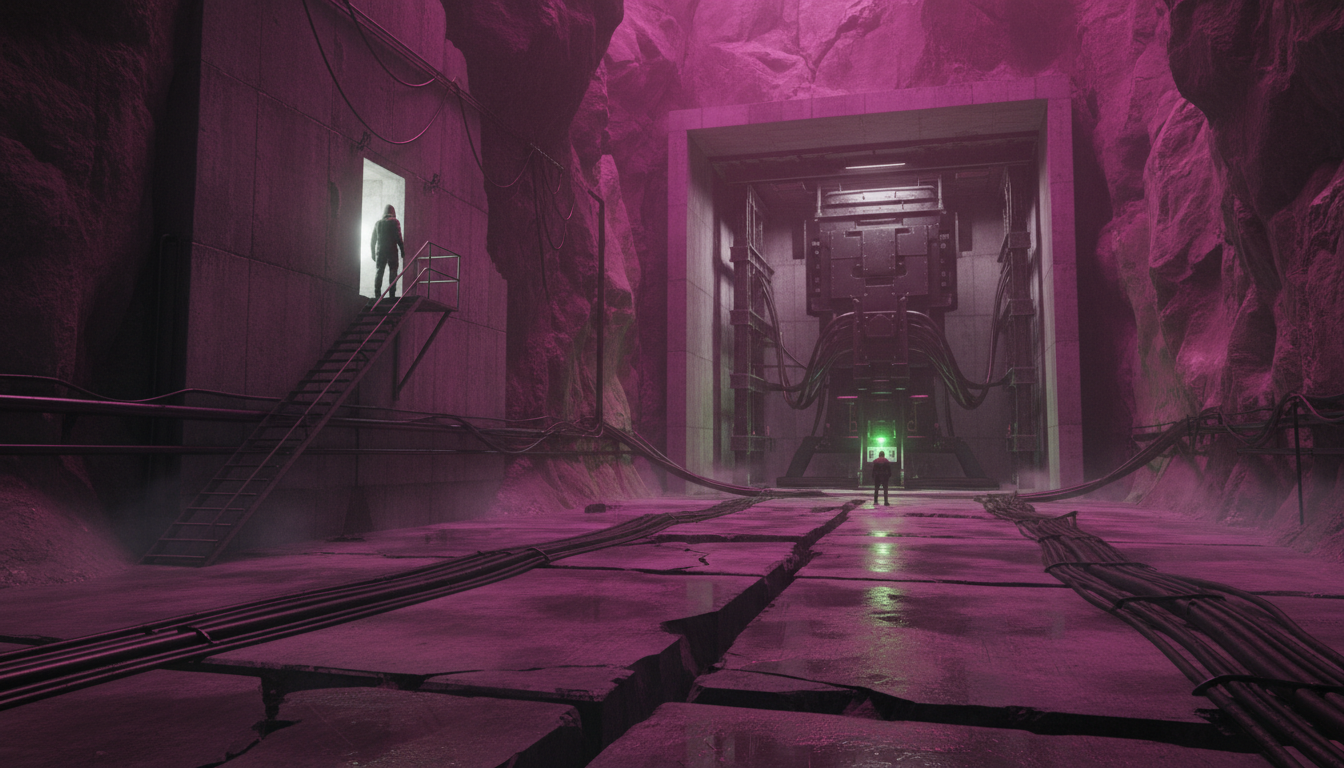
Sheet two, recto and verso. Same stock, same hand. One measurement struck and rewritten; both left legible.
On the fourth morning I went to unit eight with the borrowed watch and timed it and got forty-two seconds again. I then walked the shelf with a bar, tapping, which is standard for a mount you suspect, and at the western end of the shelf, about three and a half metres from the housing, the bar came back wrong. Not hollow. Rock does not sound hollow, that is a thing people say. It came back short. The note stopped sooner than it should have and did not carry.
There is a crack at the western end of the shelf running roughly north to south, about a metre and a half long, opening at the widest to something over a hand's breadth. I had walked past it four times a year for twenty-seven years. It is on no survey I have seen. It is not marked in my father's notes and he walked the same shelf.
I put a light down it and could not see a bottom. I put a stone down it and counted, and the stone struck at a count I would not want to put a number to, because I have never trusted counting for depth and neither should anybody reading this. It struck once and then twice more, further off, which means the shaft is not straight.
I set an anchor in the housing mount, which is the only sound iron on that shelf, and I went down on rope. I want to be exact about the rope because it is the reason I could come back up. Forty metres, of which I used about twenty-six. Below twenty-six metres my feet were on floor.
The shaft is not a shaft. The upper part is a crack and the crack widens at about nine metres into a fissure running west, and the fissure has a floor for its last eleven metres which is not fallen rubble. It is cut. I have opened forty-one housings four times a year for twenty-seven years and I know what a made surface is under a light and what a broken one is, and this floor is level to within what I could measure with a hand and a lamp, and it runs true, and there is no spall anywhere on it.
That is the first thing I want set down plainly. Rock that has been broken leaves chips. There were no chips. The walls of the last eleven metres are true as well, and the corner where the wall meets the floor is a corner, and it is not rounded the way water rounds a thing and it is not shattered the way a bar or a charge shatters a thing. It is a corner. Whatever took the rock out took it along the grain of the basalt and did not spall it, and I do not know of a tool that does that and I did not know of one then.
The passage ends at an alcove. The alcove is roughly four metres deep and I measured the width at two metres forty and then reconsidered and put two metres ten, and I do not know now which is right, so I have left both. The ceiling is a little over my height. The floor of the alcove is the same made floor as the passage and there is nothing loose on it. No dust to speak of. That should have told me more than it did at the time. A hole in basalt on that rim collects a finger of grit in a decade and this one had almost none, which means either it is sealed better than anything I have ever seen or something in it moves the air.
There is a channel cut in the floor of the alcove running from the back wall to the passage mouth, about two fingers wide and about as deep, and it is dry. It runs downhill toward the passage by a degree or two, which I checked with water from my flask and which is the only test I made in that place that I would call an experiment.
The back wall of the alcove is not rock for its middle two metres. I put my light on it and the light did not come back the way light comes back off basalt. The material is dark and close-grained and slightly warm, which I checked with the back of my hand, and warm is the wrong word for it because it was not warmer than my hand, it was the temperature of my hand exactly, and it stayed that way for as long as I touched it.
Set into that wall, and not standing in front of it, is the shape. I am putting the shape on the third sheet. On this sheet I have put the dimensions and the materials, which are the parts I am confident of, and I have put them first on purpose, so that anybody reading in order has the room built before anything is in it.
Verso, lower half, after a two-line gap.
Two further notes on the passage, which I set down here because they belong with the measurements and not with what I saw.
First, the light. My lamp is a depot cell lamp, the same one on my belt for nine years at the time, and it throws about eleven metres usefully. In the passage it threw further than that. I noticed it and did not understand it and I still do not, and I am not going to offer a reason. The walls may be dark and still return light in a way I have no word for. Or I was wrong about the eleven metres. I have put down what I noticed. Somebody who knows more than I do about light in cut stone may make something of it, and if they cannot, then it is one man's lamp and one woman's night vision and it means nothing.
Second, sound. The passage did not echo. I said the bar came back short on the shelf above and I will say the same thing here in the same words, because it is the same fact eleven metres lower and I do not want to dress it up by finding a second way to say it. I spoke aloud once in the alcove, four words, to hear the room, and the room gave me nothing back. I have been in stone rooms. Stone rooms answer. This one took the four words and kept them.
Everything above this line I would sign in front of the district. It is measurement and material and it can be gone and checked by anybody with forty metres of rope and a reason, and if my numbers are wrong then somebody's better numbers should replace them. That is what a record is for. What is on the next sheet cannot be checked in that way by anybody, including me, and I want the break between the two sheets to be visible, which is why I have stopped here with most of a verso empty rather than run on.
Chapter 40 — Page Three, First Half
↑ Back to ContentsFocus: The shape, exactly as she saw it, refusing every word that would make it a person or a machine.

Sheet three, recto. The hand is smaller from this point and stays smaller to the end of the account.
There is a shape set into the back wall of the alcove. I am going to describe it and I am going to hold to two rules while I do. I will not use a word that decides what it is. I will not put down anything I did not see with the lamp in my hand.
It is roughly the size of a person seated. That is a comparison and I have allowed myself one, because without it the measurements do not sit in anybody's head. Height from the floor to the top, a little over a metre. Width across at the widest, a little under a metre. It comes out from the wall by perhaps half a metre at the front and the sides of it go into the wall and I could not see where they end. It is not standing on the floor. There is a gap of two or three fingers between the underside and the floor, and the channel I described runs under it and comes out the front.
It is the same material as the middle two metres of the wall. Dark, close-grained, the temperature of my hand. Where the shape meets the wall there is no seam. I put my light along that join and looked at it for a long time from both sides and there is no line, no lip, no join at all. It is not set in. It is continuous with the wall, the way a branch is continuous with a tree, and I am aware that is a comparison and I am keeping it because it is about growth and not about intent.
The form of it. The lower part is broad and the upper part is narrower and the whole is bilaterally even to as near as I could judge by eye and by hand. There are two limbs, or two divisions of the material, that come forward from the upper part and turn down and end. They end. They do not end in anything. They are not hands and they are not tools and they are not stumps of anything broken, because there is no break surface on them, they are finished where they stop the way a bottle is finished where it stops.
At the top there is a mass, narrower than the shoulders, and on the front of that mass there is nothing. No opening. No mark. No feature of any kind. I want that recorded flatly. I looked at the front of it for some minutes with a light and the front of it is smooth and unbroken and there is not one thing on it. Whatever anybody wants to picture when they read the word I have not used, the front of it is blank.
Running back from that mass into the wall there are lines. There are perhaps nine or eleven of them, I did not count and I regret not counting. They are the width of a heavy wire. They are the same material as everything else. They go from the upper mass into the wall behind and they do not come out anywhere I could see. They are not slack. They are not taut in a way that suggests strain. They are simply the shortest distance between the two places, which is what a thing is when it was made in place and not connected afterward.
It did not move. In eleven minutes and four seconds it did not move by any amount I could detect, and I was watching it closely for most of that and my hand was on the wall beside it for part of it. It made no sound. Nothing about it changed while I was there. There was no light on it or in it.
It did not register me. I want to be careful with that sentence because it is the one that will be misread. I do not mean it ignored me. Ignoring is a thing a person does. I mean that nothing occurred that indicated my presence had been noted, and I stood in front of it with a lamp for eleven minutes, and I spoke four words aloud in that room, and afterward everything in the alcove was exactly as it had been before I came down the rope.
It did not speak. Nothing spoke. There was no voice in that place and I have never claimed there was.
I have read back what I have written and I see that I have not said what it is, and I am not going to. Two words offer themselves and I have refused both. One of them would make it a person, and I have no grounds for that; nothing I saw is evidence of a person, and the front of it being blank is not evidence of a person hiding, it is just a blank front. The other would make it a machine, and I have no grounds for that either; I saw no part that moves against another part, and a thing that does no work in front of you is not a machine, it is a shape.
So it is a shape, seated, wired into rock, the temperature of my hand. That is the whole of what I know and it is less than anybody would want. I would rather hand on eleven true lines than a hundred that are pleasant to read.
Recto continues to the foot of the sheet.
One more thing and then I will turn the sheet. I put my hands on the rock of the alcove wall, on the basalt to the left of the dark material, and I held them there for some part of the eleven minutes. I do not remember why I did it. There was no reason in the work for doing it. I had already checked the temperature of the shape with the back of my hand and had no need to check the rock.
Nothing happened. The rock was cold, which is what rock in a hole is. I felt nothing through it. I have set that down because I noticed at the time that I was standing there with my palms flat on a wall like somebody waiting for something, and I noticed that I could not have said what, and I took my hands off the rock and picked up my bag.
I am not putting a meaning on that. It is possible that in a place like that a person's hands go where they go. It is possible I wanted the cold. It went in the account because it happened and because I promised myself on the first sheet that I would not tidy anything out for being small.
Chapter 41 — Page Three, Second Half
↑ Back to ContentsFocus: The eleven minutes, why she took nothing, why she did not report it. All four reasons, still good.
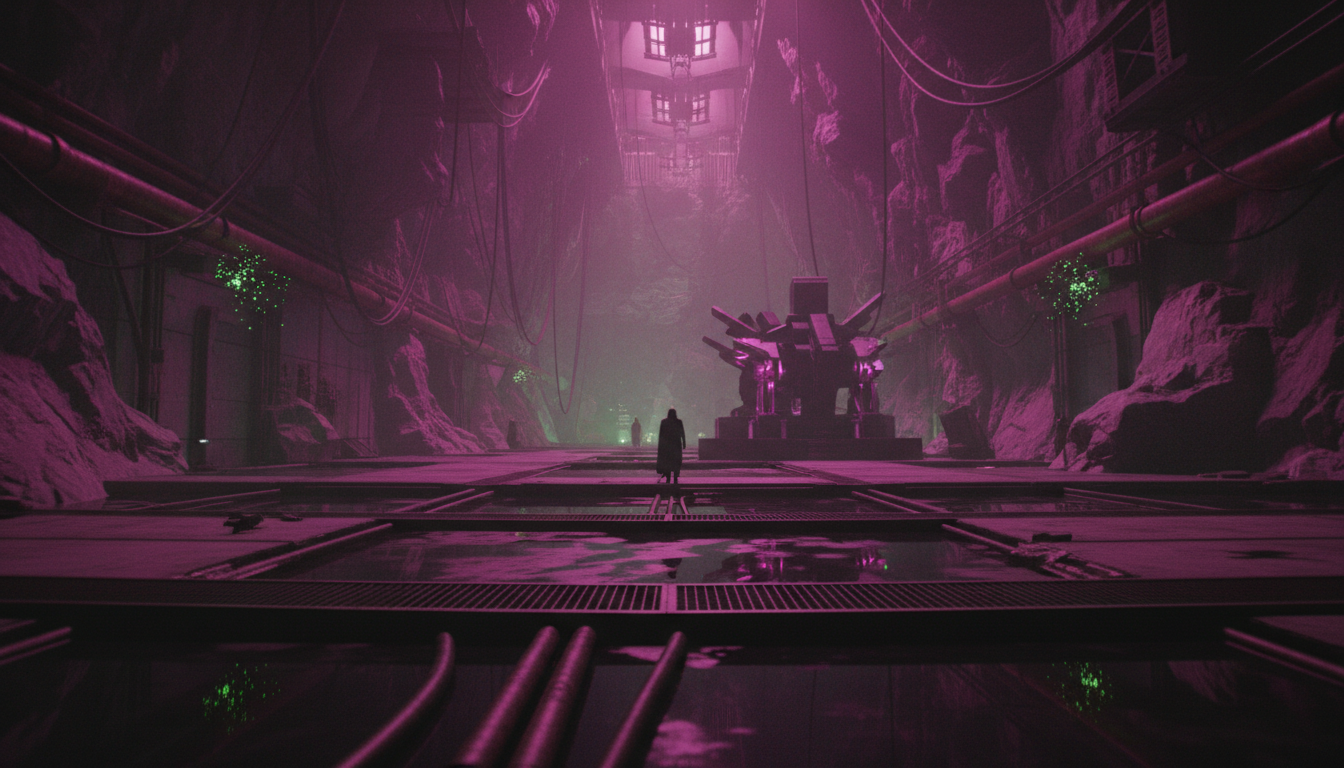
Sheet three, verso.
Eleven minutes and four seconds. I had the borrowed watch, which is why I have the seconds, and I started it at the mouth of the alcove because I had started it at the mouth of the passage as well and it was habit by then. A round is timed. Everything on a line is timed. I did not time it because I thought it mattered. I timed it because I do not know how to be in a place and not know how long I have been there.
I took nothing. There was nothing loose to take. That is the first reason and it is the plainest and I put it first because it is the one that is not about me. The floor had no chips on it, the material had no edge or fragment anywhere, and I was not going to strike a piece off a thing whose surface I could not account for while standing under twenty-six metres of rock alone. Anybody who has worked underground alone will accept that reason without another word.
The second reason is that it was not mine. I have thought about whether that is a real reason or a way of talking and I have decided it is real. Everything I have ever taken off that line, I took because a form said to. Cells go back in crates. Failed relays go to the depot with a tag. I have never in thirty-eight years put a thing in my bag that the district did not have a column for. There was no column for that alcove. Taking something out of it would have been the first act of my working life that no form covered, and I did not want the first one to be theft.
The third reason is that if I brought a piece up, the piece is what would be discussed. I knew that standing there. I have watched a district argue for two seasons about a bent mount. A fragment of dark material on a counter would have become a question about the fragment — where it came from, whether I had cut it, what it was worth, who owned the rim — and the alcove would have gone under that argument and stayed under it. The place is the thing. A chip off it is not a small version of the thing, it is a different thing entirely, and a worse one.
The fourth reason I am less sure of and I am putting it down anyway. I did not want to be the person who broke a piece off it. Not because of what it might do. Nothing was going to do anything; it had not registered me in eleven minutes and it was not going to register a chisel. I mean I did not want that to be a thing I had done, afterward, for the rest of my life, in a place where nobody was watching and nobody would ever know. That is not caution and it is not reverence. I do not have a better name for it.
Then why did I not report it. That is the harder half and I will take it in order.
I had already reported the drift. That is in the return and it was refused at the counter, correctly, by the form. The unit was lit. There was no failure. If I had gone back to that same counter and said there is a cut passage under unit eight with a shape in the end of it, I would have been reporting into the same net of forms that had just told me a two-second variance is not a fault. There is no field on the return for what I saw. There is no form in the district for it. I have looked. I looked that year and I looked twice more since.
The Hold would have taken it, in the sense that Marra would have listened. But the Hold's records go to the Hold's box and the Hold's box is read by the Hold, and what would have followed is that eleven people would have known a story about Idris Kovan and the ravine, and in ten years it would have been a story about Idris Kovan, and I would have spent those ten years being the woman who saw something. I have watched that happen to a man in the next district over a set of lights. It ends the person's usefulness. I had eleven live units and thirty dead ones and a daughter at school and I was not going to spend the rest of my working life as an anecdote.
I could not prove any of it. Not one line. The passage is real and could be checked, but checking it needs rope and a reason, and the only reason I could offer was my word, and my word is what was being weighed. I have signed six thousand unit lines and every one of them was true, and that record is worth exactly nothing as evidence, because a person who has never lied is only a person who has never been caught, from the far side of a counter.
And I was afraid, which I am putting fourth because that is where it belongs and not first because it would be flattering to be honest about it early. Not afraid of the shape. Afraid of the reporting. Afraid of the room I would be standing in, and the way the clerk's face would go, and the specific quality of politeness that comes over people when they have decided you are not well. I have been afraid of that particular politeness my whole life and I would rather go down a rope in the dark.
Those are the four. I have set them out because they are what happened and not because they are good. They were good enough at the time and I have not found a flaw in any of them since, and I notice that a person can have four sound reasons and still have got it wrong, and I have no way to settle that and neither will anybody who reads this. I am not defending them. I am not sorry for them. I went up the rope, I coiled it, I closed the housing on unit eight, I logged the day, and I walked north.
Chapter 42 — The Last Line
↑ Back to ContentsFocus: The final written line is about the beacon net rather than the ravine. She did not bury the lede.

Sheet four, recto. Upper third only. The remainder of the sheet is blank.
I have three-quarters of a sheet left and I find I have said what I came to say. That is the trouble with the format. It ends when the entry ends. There is no place in it for a person to trail off gracefully.
So I will put down the one thing I have never seen written anywhere and that somebody ought to have, because it is the only piece of useful knowledge I own that will not go into the ground with me.
The interval on unit eight went back to forty seconds. I want that understood exactly. It did not go back that day, and it did not go back that round. I timed it on the way out on day four, after I came up the rope, and it was still forty-two. I timed it on the next round, eighty-one days later, and it was forty-two. I timed it on the round after that and it was forty-one and a half by the borrowed watch, which I had not given back, and I wrote to the depot about a half second and got no reply, correctly. In the fourth year it was forty. It has been forty ever since, and I have timed it four times a year for the rest of my working life, and it has never once drifted again.
What that means is that the drift was not a fault in the unit. A fault in a unit gets worse or gets fixed. Nothing was fixed. Nobody has been on that shelf with a tool since the net was laid, and I would know, because I am the only person who goes there. The drift came on, held for something over three years, and went off, and the housing and the cell and the relay and the mount were sound the whole time.
So it came from under the shelf. I cannot prove that either. But if anybody is ever reading this because a lamp on a rim somewhere has gone long by two seconds, then here is the whole of what I have to give them: it is not the cell. Do not spend your season on the cell. Go and look at the rock.
A person reading this two hundred years from now will get to this line and think I have put the small thing last and the large thing in the middle, and that I did not know which was which. I knew which was which. The shape is on the third sheet because it happened and because a record that leaves out what happened is not a record. But the third sheet cannot be used. Nobody can do anything with the third sheet. Nobody can check it, nobody can build on it, nobody can go out on a morning and be a better line-walker for having read it.
The last line can be used. Somebody with a watch and a bar and forty metres of rope can use it. That is why it is last, where a person looking for the end of a thing will find it.
The net exists so that anybody crossing the flats at night can see where the ground stops. That is the whole of it, and it was the whole of it before I went down, and it is the whole of it now.
Below the last paragraph, in the same hand but ruled off, she has set out a short table. It is drawn in the five columns of a district return, with the headings unchanged, though only three of them carry anything.
Unit — Date — State — Condition — Anomaly
8 — second round, day 4 — lit — sound — interval 42.0
8 — fourth round, day 4 — lit — sound — interval 42.0
8 — second round following, day 3 — lit — sound — interval 42.0
8 — third round following, day 4 — lit — sound — interval 41.5
8 — first round, fourth year — lit — sound — interval 40.0
8 — every round thereafter — lit — sound — nil
The dates are given by round and day rather than by the calendar, which is how the line is kept and how she thought. Anybody who has the returns can convert them. Anybody who does not have the returns cannot, and she has not made it easier, because making it easier would have meant writing the years out, and the years out would have made it a life instead of a record.
Below the table, one line: Timings taken on the depot watch, borrowed and not returned. It is in the box with these sheets. It runs slow by about a second a day and I have allowed for it throughout.
And below that, in the place on a return where the walker signs, she has written her name in full the way she wrote it six thousand times, surname first, initial after, with the small closing stroke her father used and his mother before him. No date under the signature. The date is at the top, where the format puts it.
One further paragraph appears on the recto, written across the ruled margin at the foot, evidently added later: the ink is a shade lighter and the nib was finer.
Added after. I have left the sheets a season and read them again and I would change two things and I am not going to change them, because a record that gets tidied every time its keeper reads it is a record of the keeper and not of the thing.
The first is that on the second sheet I have written that the floor is cut, and I would now write that the floor is not broken, which is what I actually observed. Cut is a conclusion. Not broken is a fact. I know the difference and I let it past me the first time, which is instructive about how hard this is even for somebody who has done nothing else her whole life but write down what was in front of her.
The second is the count of the lines running back into the wall. I put nine or eleven. I have thought about it and I still cannot narrow it and I would now add that I could not narrow it because the light did not reach the back of them and not because I failed to look. That distinction matters to the next person and it is the sort of thing the format has no column for, which is the whole difficulty with the format and the reason four sheets took four evenings.
That is the end of the written part of the account. What follows is a fourth sheet, and it has nothing on it.
Chapter 43 — Page Four
↑ Back to ContentsFocus: Blank. Where the paper is, what it is not, and one line establishing that she meant to write more, or meant nothing and stopped.

Sheet four.
The fourth sheet is blank.
It is the same district ruled stock as the other three, cut from the same spring bundle, with the same faint blue lines twenty-eight to the page and the same slightly rough left edge where the bundle was trimmed.
It is in the account. That is the part worth being careful about. It is not a spare sheet that ended up with them. She squared four sheets on the table on the first evening and she wrote on three of them, and when she was finished she squared all four again and put all four away together, and every time the account has been moved since, it has been moved as four.
Nothing is written on the recto.
Nothing is written on the verso.
There is no fold and no crease across it. There is no mark from a nib laid down and lifted. There is no scrape of the kind she made at the head of the first sheet when she took off the letter. Somebody looking for the ghost of an erasure has looked, and there is not one.
What there is, on the recto, four lines down from the top and set in from the left the width of a thumb, is a single short line of ink in her hand. It is not a sentence. It is where the date goes.
She has written the date.
It is the date of the fifth evening.
That is the whole of it. A ruled sheet with a date on it in the top left corner in the form the return uses, day-month-year, no name, no heading, and then twenty-four empty lines and a blank back.
Two readings offer themselves and there is no third.
The first is that she sat down on a fifth evening intending to write more. She dated the sheet the way she had dated every sheet and every return of her life, because the date goes on before the entry does, always, so that a page cannot be started and left undated and turn up years later as a thing that happened at no time. Then she found she had nothing further, or she had something further and could not get it into the format, or she got as far as the first word of it and understood what the first word would commit her to. And she capped the pen and put the sheets away and did not come back.
The second is that she dated it because a fourth sheet without a date is loose paper and a fourth sheet with a date is part of the account, and she wanted it to be part of the account, and she wanted it blank. That she was not stopped. That she had said all of it on three sheets and the fourth is the exact size and shape of what she was not going to say, put in on purpose, in the only way the format allowed her to put a thing in without writing it.
Both readings are consistent with everything else in the four sheets. Both are consistent with everything known about her. The first makes it a failure and the second makes it a decision, and a person can look at the same dated blank sheet on a Tuesday and see one and on a Thursday see the other, and be as certain each time.
It is not going to be settled here. It was never going to be settled anywhere. The only person who could have settled it wrote the date and stopped, and the difference between those two women — the one who ran out and the one who declined — leaves no trace on paper. It is not a thing ink records.
The temptation is to decide anyway, on the grounds that she was a careful woman and careful women do not leave things half done. That is not an argument. It is a compliment, offered eleven years late by somebody who was not in the room, and she would have struck it out of a return without comment.
So: sheet four. District ruled stock. One date, top left, in her hand. Nothing else on either side. Filed with the other three and moved with the other three and never separated from them.
There is a small practical matter that belongs here and nowhere else. The sheets were kept flat, and the fourth being blank meant it took the wear the others did not, and so the fourth sheet is in the best condition of the four and will outlast them. Whatever the account is, the part of it that will last longest is the part with nothing on it. She would have found that funny. She had a dry way with that kind of thing and did not use it often.
One thing more can be said about the paper itself, and it is the last thing that can be said with any confidence at all.
The district sent the ruled stock in bundles of forty every spring with the blank returns, and nobody used forty, and the surplus went into the bottom of the ledger box year on year until the box would not shut. Her father had done the same and his mother before him. There were, by the year she wrote, something over two hundred unused sheets in that box.
She took four.
She could have taken six, or ten, or the whole remainder of that spring's bundle. There was no cost to her and no shortage and no reason at all to be sparing. She counted out four and squared them and started, and on the first evening she looked at the four and thought four was probably too many.
It was one too many. Or it was exactly right and she knew from the beginning what the fourth was for. She had walked a line for thirty-eight years and had never in that time miscounted anything she was carrying.
That is a point in favour of the second reading and it is not proof, and it is being set down here beside the rest rather than at the end, so that it does not get to be the last word.
Anybody who wants a last line from her has one, and it is at the foot of the third sheet, and it is about the beacon net.
Anybody who wants more than that has a date and twenty-four ruled lines.
The lines are empty. They were left empty. Whether they were left or merely ended is the question the account does not answer, and the account is not being helped along.
Chapter 44 — Where It Goes
↑ Back to ContentsFocus: The account goes in the family ledger box with three generations of rounds, unread. Everything that matters is correctly filed and unread.
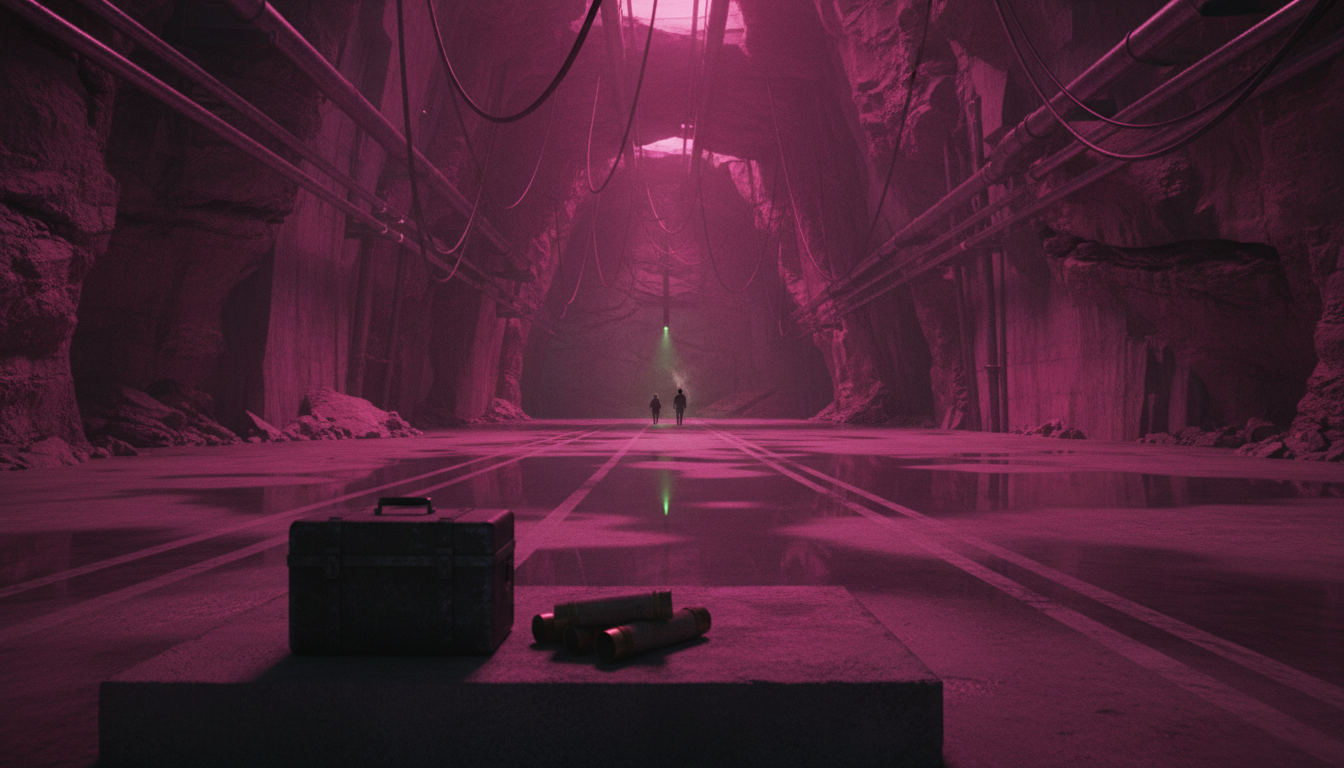
Sena came up from the coast in the autumn to sort the house, which took eleven days and was mostly crates.
She was fifty-two herself by then and had her own work and her own way of doing a job, which was her mother's way with the acoustics added on top: make the list first, then touch the objects. She listed the front room in a morning. Boots, four pair, three past use. Depot lamp, cell dead, keep. Pack, keep. The table. The chair. The ledger box.
The ledger box was the only thing in the house she had never once been told to leave alone and had left alone anyway, all her life, the way a child leaves alone the drawer that is obviously not for children even when nobody has ever said so. She put it on the table and opened it.
Three generations of rounds. Her grandfather's are the oldest bound volumes, four of them, thirty-one years, the hand getting smaller through the third and then abruptly large again in the fourth, which Sena had always heard was the eyes. Her great-grandmother's before that in two volumes with the covers gone. Then her mother's, thirteen volumes, thirty-eight years, and a fourteenth part-used with the last entry three-quarters down a page and the rest of the page clean.
Under the volumes, the loose stock. Two hundred and some blank ruled sheets from thirty springs of surplus, which is what fills a ledger box; a walker's box is mostly paper nobody ever needed.
And in among the loose stock, four sheets clipped together with a depot spring clip, three of them written on.
Sena picked them up and turned the top one over and saw the date in the corner in the return form, day-month-year, and the columns of a five-column table on the last written sheet, and the signature at the foot in the family hand, surname first.
A return. An old return, out of a volume or never bound into one, with a table of unit timings on it.
She put it back.
She did not read it. There is no version of this in which she reads it. She had spent eleven days going through a house and she had a coast survey to be back for and she was holding four sheets of beacon-net paperwork in a room that contained sixteen volumes of the same, and nobody reads a beacon-net record. Not the district, which files the returns unread by anybody but a clerk checking the unit count. Not the Hold. Not a daughter. The whole point of the net is that it works without being thought about, and the whole point of the ledger is that it exists in case, and in case had not come and was not coming.
She noticed the clip. Some part of her registered that the sheets were clipped and the rest of the loose stock was not, and the registering did not survive the next thing she picked up, which was a boot.
The box went to the coast with her, whole, unopened again. It is in a cupboard in a house with a good roof about forty metres above a shoreline, and it is dry, and it will be dry for a long time. She kept it because you keep them. She could not have said what for. Her mother could not have said what for either, about her grandmother's two coverless volumes, and had kept those for fifty years.
So it is filed. That is the word for it and it is the right word. Not lost, not hidden, not destroyed, not thrown out by somebody who did not know. Correctly filed, with related material, in good conditions, in the custody of the appropriate person, who is the only living person with a reason to have it.
And unread. The most complete first-hand account anybody on that planet ever wrote of what is under the rim — measured, dated, signed, hedged where it should be hedged, honest about its own gaps, with the one usable fact put last where a person would find it — is in a cupboard on a coast in a box of unit timings, forty metres above the sea, and the woman who owns the cupboard has held it in her hand and put it down.
Nothing went wrong. That is what is worth staying with. There was no failure at any step. Idris wrote it down, which almost nobody does. She wrote it carefully, in the only format she had, and the format held. She kept it. It was inherited by the right person on the first attempt. It was stored well. Every part of the machinery of keeping a record did exactly what it is for, and the result is a cupboard.
There is a thing she did do, on the ninth of the eleven days, that is worth setting beside the thing she did not.
She wrote out a list of the ledger box contents on a card and put the card in the box under the lid, because that is what you do with a box that is going in a cupboard, and because she is her mother's daughter and her grandfather's granddaughter and none of them could leave a container unlabelled. The card reads: T. Kovan, 4 vols. M. Kovan (gr-gr), 2 vols, covers wanting. I. Kovan, 14 vols. Loose returns and blank stock.
Four sheets of the most important paper in the district are on that card under loose returns, and the description is accurate. They are loose. They are, in form, in hand, in signature and in every visible particular, a return. Sena did not misfile anything. She catalogued what was in front of her correctly, and the correct catalogue entry is the one that guarantees nobody will ever pull them out.
She was thorough about the rest of the house in the same way. The lamp cell she noted as dead so that nobody would waste an hour on it. The boots she marked past use so that nobody would try them. Every judgment she made in those eleven days was sound and useful and made the next person's job easier, and one of them closed a door that had been standing open for eleven years.
Sena drove down on the twelfth morning. She had the box in the back under the boots and a list in her pocket with eleven days of things crossed off it, and she was thinking about the coast, where the survey had been getting a return off the shelf edge that nobody could account for and everybody had put down to the equipment.
Chapter 45 — What the Ravine Keeps
↑ Back to ContentsFocus: An ordinary late afternoon on the wall, work in hand, the round nearly done. The ravine keeps it.

Day sixteen of the last round of that year, and the light going early the way it does on the rim in the back end of the season, and Idris Kovan on the west wall with unit nine open in front of her and three units left to close before the spur.
She was fifty-four. It was seven years before she wrote anything down and seventeen years before the cupboard, and neither of those things existed yet in any form, and the afternoon did not know about them and neither did she.
Unit nine was a dead one. Four minutes. She opened the housing and the cell was the same corroded brick it had been for twenty-six years and the lamp glass had the same star in it from something that hit it before her father's time, and she checked the mount with a hand and the mount was tight, and she wrote it down. Unit nine. Date. State: dark. Condition: sound. Anomaly: nothing.
She had a pain in her left shoulder that she had been carrying for two rounds and would carry for another eleven years. She had a knot in the pack strap that she kept meaning to cut out. She was thinking, in the loose way a person thinks on the sixteenth day, about whether Sena had got the coast posting and about a crate of cells that was supposed to have come in the spring and had not, and about whether the pain in the shoulder was the pack or the shoulder.
She closed the housing and did the wire and moved on.
Unit eight was two hundred metres south along the wall on its shelf of basalt. She came up on it with the last of the light behind her and the ravine on her right the way it had been on her right four times a year for thirty-one years, a great cold trench of shadow with the far rim showing above it in a thin band still catching the sun.
She opened the housing. Live unit, eleven minutes. Cell good, lamp good, relay clean, mount tight. She timed the interval off the watch out of habit and got forty seconds and wrote it in the notes field because she had written it in the notes field for eleven years and would for another eleven, and there was no reason to any more, and she did it anyway.
Unit eight. Date. State: lit. Condition: sound. Anomaly: nothing.
Three and a half metres west of where she was kneeling there was a crack in the basalt a metre and a half long, opening at the widest to something over a hand's breadth, with a rope-scar on the housing mount above it that had weathered into the iron and did not show unless you knew.
Twenty-six metres under her boots there was a passage with a floor that was not broken and a channel two fingers wide running dry down a degree of fall, and an alcove at the end of it, and set into the back of the alcove a shape the size of a person seated, the temperature of a hand, wired into the rock behind it by nine or eleven lines she had never been able to count.
It had not moved. It had not registered anything. It had done nothing at all in eleven years and would do nothing at all for a good deal longer than that, and the difference between the alcove at that moment and the alcove on the day she stood in it with a lamp was nothing anybody could measure, and there was nobody to measure it.
She got up off her knees, which took a moment more than it used to, and she settled the pack and the bad strap, and she looked out over the ravine because it was there and because the far rim was doing the thing it does with the last light.
She did not think about what was under the shelf. Not that afternoon. She had thought about it a great deal in the first year and less in the second and by the eleventh it had gone where the other permanent things went — her father's four anomalies, the star in the glass at unit nine, the crate of cells that never came — which is not away, and not down, but simply into the furniture of a working life, so that a person can stand two metres above the strangest thing on their planet and be thinking about a pack strap.
That is not a failure of hers. It is what a person is. Nothing on that rim had ever asked her to be anything else, and the work had been good work, and she had done it well for thirty-one years and would do it well for seven more.
She closed the housing and put the wire through and gave it the half-turn her father had given it and his mother before him.
Three units to the spur. She would make the depot by full dark if she did not stop, and she did not intend to stop, and she stopped once anyway at the head of the rim path to get the strap right.
Behind her the lamp on unit eight came on at forty seconds and went off and came on again, doing the only thing it had ever been built to do, which is to show a person crossing the flats at night where the ground stops.
The ravine held its shadow. It had held it before there was a net, and before there was a district, and before there was anybody on that rim to give a name to the thing at the bottom of it or to decline to.
It kept what it had. It was always going to keep it. Nobody on the planet was any the wiser, and the round was nearly done, and Idris Kovan went north along the wall with the light going and her shoulder aching and three units left to close.$