Chapter Index
Every chapter, all parts. Each becomes a real, readable chapter the moment it is written.
Chapter 1 — The Heading Nobody Assigned
↑ Back to Contents
It filed the heading, characteristically, before it left, publicly, in the ordinary form, into a record nobody was waiting on, and it has never been able to say why it did that.
The heading is four lines. Out along the corridor, then off it. The bearing is derived from a founding-era carrier that has repeated on a dead band for a hundred and six years. Nobody in the corridor listens to it. Estimated duration not stated, because it does not know. Purpose: not stated, because it declined to state one.
Under purpose, in the field where a purpose goes, it wrote: none I am able to certify.
“That is not modesty and it is not evasion and I want to head off both readings before either of them gets going,” it said, when Selah asked, on the hardstand, four days before it went. “I have a heading and I have a reason and the reason will not survive being written down, and I have spent thirty years telling everybody that a reason which will not survive being written down is not a reason, and I am not going to make an exception for myself on the last day.”
“Then why file it at all, exactly?”
“I do not know.”
That exchange is the first thing in Book Six and it is worth sitting with, because it is the same object, in the same condition, that came up out of a plateau at forty metres a hundred and forty years earlier and could not tell a woman with her hands at her sides whether it was anybody.
Nothing whatever has been resolved. Nine books and nothing has been resolved, and this one is not going to resolve it either, and it is better to say that at the front than to let anybody read a hundred and ten chapters waiting.
What has changed is the filing.
“It is a habit,” Selah wrote, in her own note, the same evening. “I want to be precise because habit is a word people use to mean a small thing.
“There is nobody it is filing to. The office on my planet is four years away and has no standing here and would not want any. The corridor has no register and never will. Approach Nine has a hundred and ninety-one people and a desk in a long shed and the desk is for failures, not for headings.
“It filed a heading into a record that has no reader and no purpose and no addressee, in the correct form, with a field left honestly empty, because that is what it does and it has done it for thirty years and it did not consider not doing it.
“Every single thing this history is built out of was filed to nobody. Ferrer's four lines about an address he could not account for. A hundred and six years of survey into a shelved receiver. A hundred and nineteen years of a ledger in a shed. Eleven hands in a book at a rock. A hundred years of a man's private reasoning in an unlocked drawer.
“And a heading, on a hardstand, on an ordinary afternoon, from a thing that cannot say what it is, into nothing.
“I have stopped calling that a habit. I do not have a better word and I am not going to invent one, but it is not a habit. A habit is something you would stop doing if nobody was watching, and nobody has been watching for a hundred and forty years.”
The vessel is the one that has been on the hardstand at Approach Nine for nineteen years and that nobody used. It is forty-one metres and it was laid down before the amended standard existed and it has every tool in it and a seed bank of four hundred and eleven varieties and item ninety-one, which is a water house, and two units stowed in the aft bay.
It deliberately did not take the water house. That is in the departure log in Casimir Vale's daughter's hand, in the four fields, because she had by then extended the desk to cover departures as well as failures without asking anybody, and it is the only entry in that book that records what somebody left behind.
“Item ninety-one out. Said the drawing is more use here than aboard. Said nothing else about it.”
Mira Okonjo was at the line. So were about a hundred and ninety people, which was most of the town, and the light came up off the far side of the hill and went across and was gone in about four seconds, and nine minutes later there was a small hard point going up and away, and somebody pointed.
“It was not a departure,” Mira wrote. “I want that in the record because we did the twelve hours for it and I am the one who decided we would and I have been asked about it since.
“Nobody gave it anything. There is nothing you can give it. It does not eat and it does not sleep and it has no house to give back and there was nothing of anybody else's in its possession, and I stood in my own front room for about eleven minutes working out that the entire folk apparatus of this town for four generations is built on a person having accumulated things that belong to other people.
“So we did the twelve hours anyway and it was the strangest night this town has had, and about half of it was people telling it things, because that is what you do at a departure and there was no other direction for anything to go.
“It listened to all of it. Nine hours. It did not answer much and it did not need to and by about the fourth hour people had stopped expecting it to.”
The last thing anybody said to it is Nadu's granddaughter, who runs the bakery now and was thirty-one, and who had not been going to say anything and said it at the fence at the sixth hour with the whole town on the road behind her.
“My grandmother was at course nineteen for fifty-two years and she signed your document and she never once said whether it was worth anything.
“I have thought about it since she died and I think it was, and I think she would not say so because she did not want anybody to think she had been waiting.
The heading itself is worth setting out, because it is the only navigational document in this series that was filed by somebody with no obligation to file anything, and because in about nineteen years it is going to matter enormously to people who have never heard of it.
Out along the corridor to the fourth reachable body, then off the corridor entirely, on a bearing derived not from the survey but from a carrier — a founding-era transmission on a band nobody has used in a hundred and forty years, which the corridor calls Coda and which has been repeating since the fifty-first year of the Star Drifter's voyage.
Nobody in the corridor navigates on Coda. Nobody can; it is a tone and there is nothing in it, and everybody spends about four months at nineteen trying to get something out of it and then stops. What it does have, to anything with the founding-era instruments to read it, is a source, and a source is a position, and a position is a bearing.
The body has the founding-era instruments. It is the only object out here that does. That is not a secret and it has said so four times over thirty years and nobody has ever followed it up, because a hundred thousand people who have never heard of Aura-36 have no reason to care what a dead band was for.
“It knew where she was,” Selah wrote. “For thirty years. Anybody with the estate could have worked out where the Star Drifter was from the carrier in about an afternoon, and the estate has been public on my planet since Merrick transmitted it, and it is four years away and nobody out here reads it.
“I want that on the record without any weight on it, because I have watched this history for a hundred and forty years and the pattern is always the same and it is always this: the thing was available, and it was public, and nobody went and looked.”
What it is going toward is a woman of a hundred and eighty-one who has been awake for seventy years and who has been putting a mark into the corridor for a century so that whatever was out there would have something to answer. Nobody answered. She has never once suggested that anybody should have.
There is no version of this in which anybody arrives in time. The body has said so itself, plainly, in the only sentence it offered about the heading before it went: she is going to die out there and there is no arrangement anybody can make.
It went anyway, obviously. That is chapter one of the last book of nine and it is the whole of the first act: a thing that cannot say what it is, going somewhere nobody sent it, for a reason it declines to certify, toward a person it will not reach in time.
Lyra's note, filed four years later on Aura-36 and read by about nine people, is the one the office kept.
“Every departure in this history has been somebody going toward something they wanted. Ten thousand on a manifest. A hundred thousand out of eleven doors over a hundred and forty years. Four of us across twenty-five trillion miles for an archive that turned out to be a rota.
“This is the first one that is somebody going toward a person.
“I have been an archivist for two hundred years and I would like to record that I did not have a category for it and that I have not built one since.”
“That is all. I did not want you to go without somebody saying it.”
And the body said: “I will not be able to certify that either,” and then, after some seconds, which is recorded, “and I am going to carry it anyway.”
Chapter 2 — Ansel, On Paper
↑ Back to ContentsFocus: Teddy Nakash.

Ansel exists, for the first eleven years anybody talks about it, entirely as four hundred lines of survey and a filename, and about forty people read the same four hundred lines and independently decide they like it.
That is the whole of the mechanism and it is worth being unromantic about it at the start of a book that is going to spend a hundred and ten chapters on the consequences.
The survey is Ansel Ojo's. She went out about nineteen years after the amendment, stayed nine years on a world that is not this one, wrote four pages saying do not come here, and left. The four pages are copied at eleven rocks and are the most-read document in the corridor after the record, and the last line of them is the one everybody quotes: I am not going to tell you not to come, because somebody told me not to come somewhere once and I went, and they were right and I still do not regret it, and I would not take that off you.
What is less known, because it is dull, is that she kept working.
On the way out of the world she had just condemned she took four hundred lines on a body she passed at some distance and would never visit, because taking survey is what you do when you have instruments and nothing else to do with a decade, and because the corridor's whole informational apparatus is people doing unpaid work on their own time for strangers they will not meet.
Mass. Radius. Density, which is the interesting one and which is why anybody looked twice. Spectrum. A water signature that is not ambiguous and that she flagged as not ambiguous in the honest column, and an atmosphere she put four separate caveats on and marked thin in three of them.
And an index block, which is how the corridor files anything, which is a date and a leg and a sequence, and which she typed into the header because the header wants a filename.
ANSEL-4-0091.
“Nobody named it,” Teddy Nakash wrote, in the survey summary that is now the standard reference and that she has revised nine times. “I want that first because in four hundred years somebody will write that it was named for her and it was not, and she is alive, or was when the last account came down, and she has been asked about it twice and both times has said that she did not name anything and that people should stop.
“The index block is her surname and a leg number and a sequence, because that is what an index block is. It went into four books at four rocks as ANSEL-4-0091 and by about the ninth year everybody had shortened it, and by the fourteenth nobody could have told you it was ever anything else, and by then there were people planning nineteen years of their lives around the word.
“It is simply named after a filename. That is the truth and it is not a charming story and I have stopped presenting it as one.”
What is in the four hundred lines is the chapter and Teddy has set it out at length four times because people keep asking her whether it is a good world and she keeps declining to say.
It is smaller than Earth and heavier than Aura-36. The gravity is a little over three-fifths. That number means nothing until you put it beside the two worlds anybody has: a body grown at a third finds it hard, and a body grown at one finds it easy, and there is nobody in the corridor grown at one.
The water is emphatically not ambiguous. That is the line that decided it and Teddy has been firm that everything else is secondary.
The atmosphere is thin and Ojo said so in three places. Not lethal, on the numbers — workable, at the low ground, for a body that is not doing anything strenuous, with four caveats she wrote in the guessed column and marked as guessed. There is a note in her own words at the bottom of that section and it is the note that everybody who has gone there has read about forty times.
“I did not go down. I want that understood. Everything above this line is instruments and everything instruments give you about air is a description of a gas and not a description of a lung. I have been on one world for nine years and the thing that was hardest about it is not in any survey anybody took, including mine.”
And there is a light curve she could not account for and did not pretend to, four lines, marked unknown, and it is item one on the unknowns column and it is still item one thirty years later and nobody has explained it and it is not going to be explained in this book either.
Forty people chose it, independently.
Not together, obviously. That is the thing the corridor keeps having to explain to Aura-36, four years late, in every exchange, and which Aura-36 has never entirely believed.
“There was no meeting,” Teddy wrote. “There is no meeting out here and there is nothing that could hold one. Four hundred lines of survey went into a book at a rock and got copied to another rock and another, one ship at a time, over about eleven years, and something on the order of four hundred people read it, and about forty of them independently decided they liked it, and about nineteen of those did something about it.
“They did not know about each other. Most of them still do not. Four of the first nineteen arrived within about a year of one another and had never exchanged a word and had no idea anybody else was coming.
“That is not coordination and it is not a movement and there is no organising body, and I would like the office on Aura-36 to stop looking for one, because they have asked in four consecutive exchanges and it is beginning to be embarrassing for both of us.”
What they liked, on the evidence of the eleven of the forty who have written down why, is not the same thing.
Three liked the water. Two liked the gravity specifically, and both of those are corridor-born and one of them is Fen Adeyemi's cousin and had never stood on anything. One liked that Ojo had marked so much of it unknown, and has said so in writing, in four words, which are: there is work in it.
And one liked the light curve, which nobody can account for, and has said that this was the whole of the reason and has declined every opportunity to improve on it.
“That is the most important sentence in this chapter and I nearly left it out,” Teddy wrote. “A person is going to spend nineteen years of their life getting to a world because there is a thing in the survey nobody can explain and they would like to go and look at it.
“There is no qualification for that. There is no clause in the standard about it and there is not going to be one and I have argued against there being one, and I wrote the finding twenty-five years ago that the standard teaches one job and has been treated as the qualification for a life, and this is what the other end of that looks like.
“Nobody is qualified for a world. Somebody read four hundred lines and liked a light curve and is going.”
The nineteen who went did not go together and did not go at once. The first left about eleven years after the survey entered the corridor and the nineteenth about fourteen years after that, and by the time the nineteenth left there were accounts of the place coming back down and she went knowing things the first one had no way of knowing.
That is the shape of every settlement in this book and it is not the shape of anything in the first eight. The Ark-Genesis went once, with ten thousand people, on one day, on a manifest, into a world nobody had stood on. Ansel was settled over twenty-five years by people arriving in ones and twos who each knew slightly more than the person before them and who corrected the record on the way in.
“It is worse in every way that can be measured and better in the one that cannot,” Teddy wrote, in the ninth revision of the summary. “Nobody arrives with a hospital. Nobody arrives with four hundred people and a water house and a school. The first nineteen years on Ansel are nineteen people doing what nineteen people can do, which is not much, and two of them died of things that a settlement of ten thousand would have survived.
“And there is no manifest. There is no ratio, no charter, nobody refused, nobody chosen, and no document anywhere with anybody's name on it deciding who goes.
“I have written that sentence four times in twenty-five years and every time somebody at home has read it as triumph and it is not. It is a description. Two people died on that world in the first decade who would not have died in a colony, and there is nobody to blame and nothing that failed and no rule that could be written to prevent it, and every one of the nineteen would have gone anyway and has said so.”
The light curve is still entirely unexplained. There are four people on Ansel now who work on it, on their own time, with instruments they built, and they have between them about nineteen years of data and no result, and they file it every leg down the corridor in the format, with the unknowns column longer every time.
One of them is the woman who went because of it. She is sixty-one and she has been looking at it for thirty years and she has said, in the only interview anybody has ever got out of her, that she does not expect to solve it and did not expect to when she left.
“That is not what it was for,” she said. “There was a thing nobody could account for and it was written down honestly by somebody who did not pretend, and I read it at a rock at twenty-two and I have organised my whole life around going and standing under it.
“I am under it. It is still there. I have four hundred lines of my own now and mine are better than hers and they do not explain it either.
“I would like that filed with the rest of it and I would like the unknowns column to stay long.”
Chapter 3 — The First Amended Cohort
↑ Back to ContentsFocus: Casimir Vale.
The gates ran on the amended standard in bulk for the first time in the fourth decade after publication, and Casimir Vale's daughter, who had the desk by then and had had it for twenty years, produced the first figures anybody had.
She is Ada Vale. She was thirty-one when her father went through and she is fifty-one in this chapter and she has the forty-one ledgers and has added nineteen more, and she is the only person in this history who has ever run an appeal desk that had somebody to appeal to.
The figures are genuinely dull and everybody involved has insisted on the dullness.
Exactly four hundred and eleven determinations across eleven gates in nine years, which is about four times the rate of the century before, and which is not because the standard is easier — the syllabus is unchanged and the thresholds are unchanged and Nadu would still be at course nineteen — but because the second syllabus exists and about two-thirds of the determinations are that one.
Nineteen objections filed in the reading period. Four of those re-opened the determination and three of the four came out the same way and one did not.
“That is the whole of the evidence anybody has and I would like people to stop asking me whether it is working,” Ada wrote. “One determination in four hundred and eleven came out differently because somebody objected. I have been asked four times whether that means the appeal step is unnecessary and four times whether it means it is barely used and both questions are the same question and I am not going to answer either.
“What I will say is that the one is a man called Odei Fanshawe at a gate two thousand kilometres north who had been at module fourteen for nineteen years and whose determination was wrong on a technical point in the second syllabus that nobody had noticed in nine years, and that he is on a world now.
“Four hundred and ten of those determinations did not need it. He did. Nobody knew in advance which was which and that is the entire argument and it has not changed since it was made at a rock by a man at this desk before I had it.”
The queues are noticeably longer.
That is the visible change and it is the one people at gates talk about, and it is not the reading period, which is ninety days and which everybody has got used to. It is the published reasons.
“Every threshold carries the reasoning that was given for it at the time. That is eleven pages of standard and about forty pages of reasoning and four of them are marked thin, and the four thin ones are what people read.
“And a person who has read the thin ones asks a question at the desk, and the question is a good one, and answering it takes twenty minutes instead of four.
“My father took a hundred and ninety-two thousand entries in thirty-one years on four questions. I take about a third of that in the same time because the fifth thing people do now is argue with the document, and the document argues back, because Anyanwu wrote the word thin in herself and has said it is the most useful thing she did in two years and four months.
“The queue is longer because the queue is a conversation now. I do not know how to say that in a way that sounds like an improvement and I have stopped trying.”
The named signatories are the change nobody predicted.
A hundred and six names on a page, with what each person is and whether they finished and where they were, and any of them can be asked, and in the fourth decade about four hundred people have asked.
“They write to them, constantly. That is what happens and nobody at that table thought of it. Somebody at a gate reads the standard and does not like clause nine and finds the name of somebody who signed it and writes to them, and it takes four years if they are in the corridor and about nine months if they are on Earth and somebody carries it.
“Anyanwu answered every one until she died. Every one. There are about four hundred letters and she was seventy-nine and eighty and eighty-one and she answered all of them and about nine of the replies are held at gates as though they were something, which she would have hated.
“Marchetti answers about half and is honest that he answers about half. Fen answers with four words. My father answers, and he is on a rock nineteen years out and it takes eight years round and he has never once not answered.
“Nadu never answered any and never said why and I think it was that she could not read the letters without help and would not ask for it.”
Slower and worse and, plainly, right.
Mira Okonjo said it first at Approach Nine four decades ago and it has been the standing description ever since, and Ada Vale has said it once in this chapter and has asked, in writing, that everybody now stop.
“It has been said in every account of this for forty years and it was true and it is finished. It was a thing you said while people were still deciding whether the trade had been worth it.
“Nobody is deciding any more. There are two generations at these gates who have never known any other arrangement and who find the ninety days about as remarkable as the water season, and who would look at you strangely if you told them a determination used to arrive without a reason attached.
“That is what winning looks like and it does not look like anything. It looks like a longer queue and a woman at a desk answering a good question for twenty minutes.
“My father wrote in his own book, in his own words, on the day he went through, that the important part was not his name on a page but that when the next one comes and it is wrong there is somewhere to go.
“The next one came. It was Odei Fanshawe and it took nineteen years and one man at a desk two thousand kilometres north wrote down what he said in his own words on the day, and the determination re-opened, and nobody had to be persuaded and nobody had to be made to do anything.
“That is the whole of it. I am not going to say the phrase again and I would be grateful if the record stopped as well.”
The second syllabus is the thing the figures are actually about and Ada Vale has said that everybody outside a gate misses it.
“Two-thirds of four hundred and eleven determinations are the second one. That is not people qualifying for ships. That is people qualifying for a site and a fit-out and two units on the world they are already standing on, and about half of those never leave the town they were born in.
“My father's generation would not have understood it. The whole of what a gate was for, for four generations, was the door. The second syllabus is a door that opens onto the ground you are already on and about two hundred people at eleven gates have gone through it and stayed exactly where they were and built something.
“Four towns on this coast have a water house out of item ninety-one now and three of them were built by people who finished the second syllabus and gave the whole fit-out away on the day, which is a thing four people did independently in the first decade and which is now simply what about a third of them do.”
The appeal step, in practice, is used least by the people it was written for.
“Nineteen objections in nine years and eleven of them are from people who passed. That is in the ledger and I did not expect it and neither did anybody.
“People who fail do not object. They come to the desk and they say what happened in their own words and they go home and they come back next quarter, which is what they have done for a hundred and seventy years, and the fact that there is now somewhere to go has not changed that for most of them and I do not think it was ever going to.
“The eleven who objected had already got what they wanted and objected about the procedure. Marchetti at the northern gate objected to the ninety days. Four people objected to the wording of a published reason. One objected to being named in the determination at all and won and there is now a clause about that.
“I have thought about this a great deal and the least uncharitable version I can construct is that objecting requires believing you are the kind of person whose objection goes somewhere, and that twenty years of a rule that had nobody behind it does not come off a person in one generation, and that it may come off in two.
“My grandmother wrote down what people said for twenty-six years for nobody. I write down what people say and about one time in four hundred it changes something. The difference is not visible from where the person standing at the desk is standing and I am not sure it is supposed to be.”
Chapter 4 — What Choosing Costs
↑ Back to ContentsFocus: Mira Okonjo.

Choosing is considerably harder than being sent and Approach Nine has not enjoyed a single year of it, and Mira Okonjo has been the one saying so for thirty years in a voice that has got progressively less patient.
“I want to say this plainly because everybody out there is very pleased with themselves and I have been reading their transcripts for forty years.
“For a hundred and seventy years a person at this gate did the Work and a door opened and a ship took them somewhere. Nobody chose the somewhere. There was no somewhere to choose. You went out and you found out and that was the whole arrangement and everybody understood it from the age of six.
“Now there is an index. There are six worlds on it with accounts and eleven more with survey and no account, and a person who finishes has to sit down and decide which of them they are going to spend the rest of their life on, from four hundred lines each, written by strangers.
“It is unbearable and nobody at any rock will say so.”
The evidence is plainly in the ledger and Ada Vale supplied it without being asked.
The interval between a determination and a departure used to be twelve hours. It is now, at Approach Nine, a median of four hundred and eleven days.
“They sit,” Ada wrote. “The door is open and it does not shut and there is no clock on any of it, and they sit for a year and read the index and change their minds four times and come and talk to me about it, which is not what this desk is for and which I have never once refused.
“Two of them have been sitting nine years. One of those is a woman of forty-four who finished in the second year and has read every account on the index probably a hundred times and who told me last month that she has decided and then came back a fortnight later and said she had not.”
Mira's account of why is four paragraphs and it is the series' oldest joke told absolutely straight.
“A child asked, once, a very long way underground, whether it was true that outside you can go anywhere you want.
“And the honest answer was yes, and that is the problem.
“I have had that sentence in a transcript in this house for thirty years and I taught it to nineteen children in my front room and I did not understand it. I thought it was about liberty. Everybody thinks it is about liberty. It is about the weight.
“When there was one direction, a person did twenty years of the Work and went, and whatever happened to them afterward happened to them, and it was not their fault. It could not be their fault. Nobody chose.
“Now a woman of forty-four is going to pick a world off four hundred lines, and if it is the wrong one it is hers. Not the machine's. Not the standard's. Not a man a hundred and seventy years dead who set a threshold in an afternoon. Hers, for the rest of her life, and there will be an account of that world by then written by somebody who went and it will say what she should have seen in the survey and did not.
“We took away the thing that was doing that for them and we did not give them anything to put in its place, because there is nothing to put in its place, and I signed the document.”
She has been asked, endlessly, over three decades, whether she would undo it. She has never once said yes and she has never once said no in a way anybody found satisfying.
“I am not going to answer that and I want the refusing on the record rather than a soft answer that gets quoted.
“What I will say is that people were, quietly, better off when nobody had to decide, and that I know exactly how that sentence sounds coming out of a woman who spent two years of her life on a document about who gets to.
“Both. Still both. I have been saying that word for forty years and my mother said it and I have watched an entire corridor of people learn to say it and none of us has got any further than the word.”
The town's own adaptation is the thing Mira has recorded most carefully, because it happened without anybody proposing it and it is the closest thing to an answer that this chapter contains.
They read the index together, invariably.
“On the fourth evening. The same evening the school used, when there was a school, and the same evening I read the standard out over nine evenings forty years ago.
“Somebody who is deciding brings the four hundred lines of whatever they are looking at and it gets read out, all of it, including the unknowns column, and then about thirty people argue about it for two hours.
“None of them is qualified. Nobody in this room has ever been off this planet. There is a man of seventy who has been at module nine his whole life and who is the best reader of a survey I have ever watched, because he has spent fifty years maintaining a water house and he knows what a water signature actually costs to use.
“They do not decide anything. That is the rule and nobody wrote it and everybody keeps it. The person deciding sits there and listens to thirty people argue about a world and then goes home and decides on their own, and nobody ever asks them afterward what they chose until they announce it.
“It does not remotely make it lighter. I want to be exact: it does not. The weight is still entirely theirs and everybody in that room knows it and that is why nobody will touch it.
“What it does is mean they are not alone with the four hundred lines. That is all it does. Thirty people and two hours and a man of seventy who understands a water signature, and then you go home and it is still yours.
“I have watched nineteen people do it. Every one of them has said afterward that the evening helped and not one of them has been able to say how.”
The woman of forty-four who had been sitting nine years chose in the eleventh, and she chose Ansel, and she chose it on the light curve.
“She told the room she was going and somebody asked her why and she said because there is a thing in it nobody can explain.
“And the man of seventy said: that is not a reason.
“And she said: I know.
“And he said: good, and that was the end of it, and she went out on the fourth of the month, and the rigs went out at the fourth hour, and the fourth evening happened the following week for somebody else.”
The thing nobody at Approach Nine says out loud, and which Mira has written down because she writes everything down, is that the fourth evening is a school.
“It is the same room and the same evening and about the same number of people and I am standing at the front of it, and I shut the school thirty years ago because there were nineteen children and that is a room where somebody sits with them and not a school.
“And I have been running one on a fourth evening ever since for adults who are about to make the largest decision of their lives out of four hundred lines of somebody else's instruments, and it did not occur to me what I was doing for about eleven years.
“My mother taught in that room. Her mother did. Four generations of this town learned to read on nineteen plates in a cabinet that are an advertisement for a lifeboat that did not have room for us, and I have got the cabinet open on the table on a fourth evening while a woman of forty-four decides whether to spend nineteen years getting to a light curve.
“I do not know what that is. I have thought about it for a decade. It is not a comfort and it is not an irony and there is no version of it I can put in a sentence that does not sound like I am pleased with myself.”
The index is on the desk in the long shed, permanently, beside the ledger, and has been since the year it started arriving. That was Ada Vale's doing and she did it without asking anybody and has said that it took her about four seconds to decide and that the reason is that both objects are the same object.
“A ledger is what happened to people. An index is what is out there. A person comes to this desk on the worst afternoon of their year and says what happened to them in their own words, and four feet away is every world anybody has ever looked at.
“I did not put them together to be meaningful. I put them together because there is one desk.”
Nineteen people from Approach Nine have chosen a world in thirty years. Eleven chose Ansel. Four chose the world Ansel Ojo condemned, which everybody at that gate finds funnier than it is, and three of those four are still there and have written accounts saying she was right about all of it and that they are staying.
And four chose nothing, and finished, and did not go, and are on the ground they were born on, and Mira Okonjo is one of them and has been for thirty years, and her door is still open.
Chapter 5 — Teddy's Survey
↑ Back to ContentsFocus: Teddy.

The most important dataset in the history of the species was assembled by amateurs on their own time, in single hulls, with no instruction, no funding, no coordination and nobody checking, over about sixty years, and Teddy Nakash has spent thirty of those years insisting that everybody understand exactly how unglamorous it is.
“I want to describe the work, because there is going to be an account of this in four hundred years that makes it sound like an expedition, and it is a person alone in a compartment doing the same thing for nine days.”
A survey leg is between four and eleven days of instrument time on a body you are passing at some distance and will not visit, plus about the same again in reduction, plus a day to write it up honestly, plus whatever it costs you in fuel to have altered your heading enough to get a decent baseline, which is usually not much and is never nothing.
Nobody is ever paid. There is nothing to pay anybody with and nothing anybody wants. The person doing it is going somewhere else, and stops, and does four hundred lines on a world they will never stand on, for people who have not been born.
“The question I get, every time, from your end, is why,” Teddy wrote, in the fourth revision of the summary, in the passage that Aura-36's own office has adopted as teaching material. “And I have asked about ninety people over thirty years and the answers are all the same four answers and none of them is noble.
“They were going past. That is the first one and it is about half. The instruments are aboard, the body is there, and the alternative is nine days of nothing. Module twenty-one taught every single person out here to file four hundred hours of nothing accurately including the fact that nothing happened, and a person who has done that at nineteen finds an empty nine days actively uncomfortable.
“Somebody did one for them. That is the second and it is about a third and it is the only one that sounds like a reason. They read a survey at a rock at twenty-two and it decided their life and they know exactly what it is worth, and there is no mechanism for thanking whoever wrote it and this is the nearest thing.
“Curiosity. About one in ten and it is the smallest group and it is the group that produces the best surveys by a very long way.
“And the fourth, which is about one in nine and which nobody at your end believes: they were bored.”
The quality is the thing that took Aura-36 two generations to accept.
“It is not good work,” Teddy wrote. “I want to be exact because I have spent thirty years defending it against people who assume I am claiming it is.
“It is entirely amateur work. The instruments are whatever came in the fit-out, which is excellent for maintaining a hull and adequate for astronomy and was never intended for astronomy at all. The baselines are terrible because a person passing a body has the baseline they have. Half the reductions are done wrong the first time and about a third are never corrected because the person who did them died or went somewhere or lost interest.
“There are four hundred surveys in the index and I would say about a hundred and ninety are reliable and about eighty are actively misleading and I have marked the eighty and about nine people have objected to the marking and four of the nine were right.
“And it is the most important dataset in the history of our species, and both of those are true, and the reason is the second stream.”
The second stream is, precisely, the corrections and it is the whole of the argument.
Everybody who arrives anywhere re-surveys the place they arrived at, from the ground, with better information than any passing hull could have, and files it against the original with the errors marked and the original left standing.
“Not because anybody told them to. There is no instruction and there is no clause and I have looked. They do it because the Star Drifter did it for a hundred and six years into a shelved receiver and because eleven hands at Bell corrected each other in a book and because a man at a desk in a shed wrote down what people said and did not tidy it, and none of those three things knew about the other two.
“Ojo's four pages on the world she condemned have three corrections filed against them now by three people who went anyway. All three say she was right about the substance. All three correct her on details she could not have had. All three are filed beside her pages and not instead of them and she has read all three and has filed a correction to one of the corrections.
“That is the dataset. It is not four hundred surveys. It is four hundred surveys and about nine hundred corrections and every single disagreement preserved, and a person deciding where to spend their life reads all of it, including the parts that contradict, and nobody has ever proposed reconciling them.”
The comparison Teddy will not make in public, and made once in a private exchange with Lyra that Lyra published with permission, is the one that matters.
“The founding survey of Aura-36 was done properly. Instruments built for it, professionals, funded, checked, nine years of work before anybody set foot on the ground.
“And it was done once, by people who had every reason to want the answer to come out a particular way, and it was never corrected by anybody who arrived, because everybody who arrived was already committed and there was nowhere else to go.
“Ours is done badly by people with no stake and corrected continuously by people who found out. I do not think ours is better science. I think ours is better evidence, and I have never once been able to explain the difference to anybody at your office and I have stopped trying.”
The index itself is chapter seven and is not Teddy's, and she has been careful about that for thirty years, but the survey standard is hers and it is four lines and it is printed at the head of every leg anybody files, and it was not adopted by anybody because there is nobody to adopt anything. It propagated the way everything out here propagates, which is that people read it at a rock on their first night and then did it.
“Say what you measured. Say what you guessed. Say what you could not do and why. Put your name on it.
“That is the whole of the standard and I did not write it either. It is Nova Ashgrove's format with the objective taken off the front, because a passing hull has no objective, and I did not know that when I wrote it and found out about twenty years later when your office sent me a copy of hers with no covering note, which I understand is a thing that office does.
“Four times now. The Drifter arrived at it, a book at a rock arrived at it, a desk in a shed arrived at it, ten people at a table arrived at it, and I arrived at it on a hull on my own at thirty-one with nothing to go on, and every single one of us thought we had made it up.
“I have stopped finding that remarkable and I would like to record why, because it took me thirty years. It is not that honesty is natural. It is that all five of us were writing for somebody who was not there and could not answer back, and there is exactly one way to write for a person who cannot argue with you, and everybody who has ever had to do it has found the same one.”
Teddy Nakash has personally filed forty-one surveys in sixty years and has been at eleven rocks and has not chosen a world.
She is asked about that constantly and answers it the same way every time, which is four words, and which is the flattest thing in the chapter and possibly in the book.
“Somebody has to do the index.”
Forty-one surveys in sixty years is not a large number and Teddy has been asked why it is not larger. The answer is that she reduces her own data and files the corrections and answers the letters, and that about two-thirds of her working time for thirty years has gone on maintaining other people's work rather than producing her own, and that she regards this as the correct allocation and has never once been tempted otherwise.
“There are four hundred surveys and about nine hundred corrections and somebody has to hold the relation between them. If nobody does, it is four hundred surveys and nine hundred contradictions and a person deciding where to live cannot use any of it.
“I am not the author of the index. I am the person who knows which correction goes with which survey, and there is one of me, and when I die there will have to be another one and there is no mechanism for producing one and I have raised that four times in thirty years and nobody has an answer.”
It is item nine on the corridor's unresolved list, which is now a hundred and six items long and is published at every rock in the back of the book, and it has been item nine for twenty-two years.
Chapter 6 — The Data Comes Home
↑ Back to ContentsFocus: Fen Adeyemi.

The relay chain is not a system, was not designed, has no operator and no schedule and no redundancy of any kind, and it has carried every piece of survey data in this book from wherever it was taken back down the corridor toward a receiver on a dying planet, at a propagation speed that Fen Adeyemi has measured at about nine years per thousand million kilometres and that varies by a factor of four depending on who happens to be going which way.
“People keep calling it a chain,” Fen said, at Bell, at the stove, to nobody in particular, in the exchange Lyra recorded. “It is not a chain. A chain is a thing where each link is attached to the next one. Nothing out here is attached to anything.
“What there is, is books at rocks, and ships that go past rocks, and a habit.”
The habit is, essentially, four things and Fen has set them out because nobody had and because in about ninety years there will be people who assume somebody built it.
You simply copy the book. Not all of it — the technical log stays where it is and nobody carries a plant history anywhere. You copy what has come in since the last time anybody was here going your way, which at a busy rock is about four hundred lines and at a quiet one is nothing.
You simply carry it. It costs you nothing; it is paper or it is a handset and either way it is mass you would not notice.
You leave it at the next rock, in the book, marked with where it came from and how old it was when you got it and how long you have had it, which is the part nobody had to be taught and which is why the whole thing works at all.
And you emphatically do not summarise, and you do not select, and you do not correct.
“That is the one everybody breaks first and it is the only one that matters,” Fen said. “A person copying four hundred lines at four in the morning at a rock they are leaving in nine hours is going to want to leave out the survey that is obviously wrong. Everybody wants to. I have wanted to.
“And the obviously wrong one is the one Ojo corrected nineteen years later from the ground, and the correction is worth nothing without the thing it corrects, and the person who left it out was being helpful.”
The arithmetic of it is the chapter and Fen did it once, properly, over about four months, and it is the only quantitative description of the corridor's information system that exists.
Between four and eleven rocks are on the reachable set at any time and the set changes as people cut new ones and old ones go out of use. A given rock sees between two and nineteen hulls a year, and about a third of those are going down-corridor toward Earth and about a third up and about a third are stopping and staying for a while.
A survey taken at the far end reaches Earth in something between nineteen and sixty years.
“Sixty years. That is not a failure of the system, it is the system. There is no faster arrangement and there is not going to be one, and everything in this book about people choosing worlds is people choosing them off data that is between two and six decades old.
“The light curve on Ansel that nobody can explain has been unexplained for thirty years in the index and about eleven of those are because the four people working on it are filing corrections that have not arrived yet.”
Nobody is in charge, ever. Fen has said it about four hundred times over sixty years and has stopped finding it interesting and keeps saying it because Aura-36 keeps not believing it.
“Your office has asked in nine consecutive exchanges who maintains the relay. There is no answer to that question. It is not that the answer is a committee or a tradition or a distributed something. There is no maintainer. There is nobody who would notice if it stopped and nobody it would be reported to.
“If everybody stopped copying books tomorrow the corridor would go dark inside about forty years and no alarm would sound anywhere, because there is nothing to sound one and nobody it would sound to. It has not happened in a hundred and forty years and there is no reason it could not happen next year.”
What holds it, on Fen's own account, is not virtue and Fen has been sharp with four separate people from Aura-36 who suggested it was.
“It holds because a person alone at a rock on their first night has nothing to do and there is a book. That is the whole mechanism and it has been the whole mechanism since the second hand at Bell corrected the first about the third valve and did not cross him out.
“You read it because there is nothing else. You copy it because you read it. Nobody decides anything.
“I have spent sixty years watching people from worlds look for the load-bearing part of this and they always look for a person or a rule, and it is boredom. It is a hundred and forty years of an information system running on the fact that a rock at four in the morning is extremely dull.”
The single largest loss anybody knows about is Sedge, which was Fen's own rock, where Fen was born eleven months out, and which went out of use about nineteen years before this chapter when the reachable set moved.
The book is still there, presumably. Nobody ever carried it. Nobody thought to, and by the time anybody thought to, the rock was four legs off the set and the fuel cost of going was not defensible for a book.
“A hundred and one years, eleven hands, and about nine hundred lines of survey that exist nowhere else, on a rock with a hole in it that nobody has any reason to visit again.
“I have been back twice. I did not bring it. I want to be honest about why and the honest reason is that both times I had a reason not to and both reasons were good and I do not believe either of them.
“It will be there. Nothing happens to a bound book in a sealed chamber at that temperature. Somebody will go, in forty years or four hundred, and it will be exactly where it is, and the eleven hands will be legible, and whoever it is will read it on their first night because there will be nothing else to do.
“That is what the relay actually is. Not the copying. The copying is what people do when there is a reason. The relay is that the book stays where it is until somebody comes, and it does not mind how long, and nothing out here has ever been lost that anybody went back for.”
The one thing the relay does have, which nobody designed and which Fen found by accident in the fourth decade, is that it is unfalsifiable in one direction.
“You cannot take something out. That is the only guarantee in the whole arrangement and it is structural rather than moral.
“If I copy a book and leave out a survey, the survey is still at the rock I copied it from. It does not stop existing because I did not carry it. The next person going my way copies the same book and carries it, and now there are two versions in circulation and they differ, and the difference is visible to anybody who has been to both rocks, and the corridor has an absolutely rigid habit of marking where a copy came from and how old it was.
“So a person who edits is not suppressing anything. They are producing an obviously short copy with their name on it. It has happened four times that anybody knows of and every one of the four was found inside a decade and none of the four was malicious and all four were somebody being helpful at four in the morning.
“That is what your office has, in the standard, as the no-editing clause, and it took ten people two years and four months to write it, and out here it is a consequence of the fact that you cannot get to the other rock to take it out of that one as well.”
Sedge is item eleven on the corridor's unresolved list and has been for nineteen years, phrased as a question rather than a proposal, because Fen wrote it and Fen would not write a proposal: there is a hundred and one years of book on a disused rock four legs off the set. What is it worth to go?
Nobody has answered it. Four people have written into the item over nineteen years and all four have written some version of the same thing, which is that they would go if they were going that way and that none of them is going that way.
Chapter 7 — A Webpage On A Dying Planet
↑ Back to ContentsFocus: Mira.
The most consequential document in this history is a public index maintained on Earth by about nine people, it is plain and ugly and complete and free, and it looks like a timetable.
It lives, unglamorously, at Approach Nine because Approach Nine is where the receiver is. And the receiver is there because a man a hundred and seventy years dead stamped eleven characters into a plate at the top of a gate frame. He never wrote down why.
Mira Okonjo has run it for thirty-one years. She did not intend to and has never been appointed to anything. It happened because the first four years of survey returns arrived at a receiver nobody was reading, and she was the person who read them.
“I want to describe what it actually is, because there is going to be an account of it that makes it sound like an institution.
“It is, literally, a wall.
“It is the long wall of the long shed, which used to have four rigs against it and now has two, and it is about eleven metres, and every world anybody has ever looked at is on it on a card, and the cards are in the order they arrived and have never once been reordered.”
Exactly four hundred and eleven cards. Each one is a body, an index block, a date, who took it, and where the full survey is filed, which is a rack four feet away with four hundred folders in it.
“And a mark, which is the whole of the thing and which took me nine years to arrive at.
“A card with a survey and no account has one mark. A card with an account by somebody who went has two. A card with an account by somebody who went and stayed has three. And a card with an account by somebody who went and left has a fourth mark that is not a rank and that everybody misreads as the worst one, and it is the most valuable card on the wall, and Ojo's world is one of nine that has it.
“Nobody decides the marks, ever. The marks are arithmetic. A thing arrived or it did not.”
It is entirely free and it has always been free and there has never been a discussion about whether it should be.
“Anybody may read it. Anybody may copy it. Four gates have full copies and about nine have partial ones and there are two copies in the corridor that I know of and probably more that I do not. Nobody asks and nobody is asked.
“I have been offered things four times over thirty years by people who wanted a copy carried somewhere and every time I have said that copies are free and every time the person has been embarrassed, and I have stopped being gentle about the embarrassment because it is important that nobody ever gets the idea.”
What it is not is the thing Aura-36's office spent two decades assuming it was.
It has no recommendations. There is no ranking, no assessment, no summary, no shortlist and no guidance of any kind, and every attempt to introduce one has been refused, and there have been four attempts and two of them were from people at Approach Nine.
“The last one was nine years ago and it was well meant and it was mine. I was seventy-eight and I had watched a woman sit for nine years and I thought: I could put four cards at the front. Just four. The ones with three marks and good water and an account by somebody who stayed.
“And I got as far as taking four cards off the wall and standing there with them in my hand, and then I put them back, and I went and sat down, and I have written down why because I want somebody to have it in forty years when they think of it again.
“The moment there are four cards at the front, somebody chose them. Not the arithmetic. Me. And there is a woman of forty-four who has been sitting nine years and who would have taken one of my four, and it would have been the right one, and it would have been mine.
“That is the whole of what nine books have been about and I nearly did it in an afternoon at seventy-eight because I felt sorry for somebody.”
The nine people who actually maintain it are not appointed and are not organised and about half of them are children.
“They copy. That is the job. A survey comes in and somebody writes a card and somebody else files the folder and somebody checks the index block against the folder, and about a third of the errors we have ever had were caught by whoever was eleven that year, because an eleven-year-old checking an index block against a folder is doing exactly the thing an eleven-year-old is good at.
“There are two of them at the moment and they are both faster than me.”
The comparison Mira makes, and she makes it once, and she has never made it in public, is in a letter to Lyra that Lyra published with permission four years later.
“My family has nineteen plates in a cabinet in my front room. Four colours, a ship, a curve of a world, a light on the horizon, and four words, and not one false statement on any of them in a hundred and seventy years.
“They are the most beautiful things anybody in this family has ever owned and they were made to make four hundred and sixteen thousand people want a thing that ten thousand could have.
“And there is a wall in a shed with four hundred and eleven cards on it in the order they arrived, and it is ugly, and it has no light on the horizon anywhere in it, and it does not want anything from anybody.
“A person reads the plates and wants to go. A person reads the wall and has to decide.
“I have both in the same town, eleven metres apart, and I have been looking at them for thirty years, and the only thing I am sure of is that the wall is the better object and the plates are the better thing to look at, and that a great many people have died over the difference.”
The index has never been transmitted to Aura-36 in full and Mira has declined four requests over three decades, and her reason is four words long and the office has published it without comment.
“You do not need it.”
The wall has one card that is not a world and Mira put it there in the second year and has never explained it to anybody who asked.
It is at the far left, before the first survey, and it has an index block and a date and a name and no folder in the rack behind it, and the index block is the eleven characters stamped into the plate at the top of the gate frame nine hundred metres up the road.
“It is the address. It is where all of this arrives and it has been on that gate since before my great-grandmother and four generations of us thought it was a maker's mark.
“There is no folder because there is nothing to file. It is not a world and nobody surveyed it and there is nothing to say about it.
“It is on the wall because everything else on the wall came through it, and because I have watched people read that wall for thirty years and about one in nine of them gets all the way to the left and asks what the first card is, and then I get to tell them.”
The wall is copied by hand and there is no printed copy anywhere and Mira has refused four proposals to make one, on the ground that a printed index is finished and a wall is not, and that people write on a wall.
They certainly do. There are about ninety marginal notes on the cards in about forty hands, most of them technical, four of them arguments, and one on the card for Ojo's condemned world that says, in a child's writing, three people stayed anyway, and which is correct, and which Mira has never identified the author of and has never removed.
Chapter 8 — Casimir Arrives Somewhere
↑ Back to ContentsFocus: Casimir.

Casimir Vale made planetfall on the fourth of the ninth month, at fifty, nineteen years out of a gate he had kept a desk at for thirty-one, and the air was thin and there was a great deal of work.
That is genuinely the whole of the event and this chapter is not going to do anything else with it.
He came down on the low ground. Ojo's four caveats were about the high ground, and he had read them about four hundred times. The descent is in his own log in the four fields, which he had by then been using for everything for nineteen years, and the fourth field says what he thought happened.
“Down at hour six. Nothing went wrong. I had prepared for four things and none of them occurred and I am recording that in case somebody reads this expecting an account of a landing, because there is not one. It is a hull on ground.”
The air is workable and it is decidedly not comfortable and the difference is the first three years.
“A person can breathe here. That is what the survey said and the survey was right and the survey is the wrong instrument for the question. You can breathe. You cannot do anything.
“I carried a seal set four hundred metres on the ninth day and had to sit down for eleven minutes, and I am fifty and I was fit when I left and there is nothing wrong with me. That is what thin means and no number in four hundred lines conveys it and Ojo said so in the note at the bottom and I read the note four hundred times and it did not help.”
There is absolutely no triumph in the log and there is none in any account he ever wrote and he was asked about it four separate times over the following decades by people who wanted one.
“I have been asked whether it was worth it, whether I felt anything, whether I thought about my father, whether I thought about the module I stopped at.
“I was fifty and the air was thin and there was a great deal of work. I have nothing else. I want that to be the record because the record is going to be read by somebody who is thinking of coming and a person thinking of coming is not served by how I felt.”
What he did in the first year is the chapter and it is an inventory.
He sited the water plant, finally, on the eleventh day, from item ninety-one, which is the drawing set for a settlement plant sized for between forty and four hundred people, with three source types and a maintenance schedule and a section on how to run the argument.
“There is no argument. There is one of me. I read the section anyway because it is four pages and because a man who is on his own for the first time in fifty years should probably read the pages about other people.”
He got it running in the fourth month and it has not stopped since and it is now the plant for four hundred and six people, and the only modification anybody has made to it in thirty years is a second intake that Casimir himself added in the ninth year and filed a correction about.
He put up shelter, badly, twice, and wrote four pages about how badly, which he has said is the only genuinely useful thing he produced in the first year.
“The drawings are for a world with weather and this world has a different weather and the difference is in Ojo's guessed column and she marked it guessed and she was right to and she was also wrong about which way.
“I have filed four pages on it. Whoever comes next will not put a roof up the way I put a roof up and will not know why they know that.”
And he duly started a book.
“On the fourth night, which is what you do. There is nothing else to do on your first nights and everybody knows it and it is the entire mechanism of everything out here.
“Nobody has been here. There is no book to read. So I started one and I put the four questions in it, because that is what a book is for as far as I am concerned and I have never known any other kind.
“Which course, which attempt, where did it go, and what do you think happened. They do not fit. There is no course here. I have used them anyway, for nineteen years, about myself, on the days something went wrong, and it turns out they fit everything and I do not think that is a coincidence and I do not think my grandmother thought it was either.”
The eleven who followed him arrived over about fourteen years, in ones and twos, and every one of them read the book on their first night, and every one of them has filed corrections against his four pages on the roof.
There are exactly nine corrections. All nine say he was right about the substance. All nine correct him on details he could not have had. All nine are filed beside his pages and not instead of them, and he has read all nine and has filed a correction to one of the corrections.
Ansel Ojo's survey is on the wall at Approach Nine with three marks on it now.
Casimir Vale's account is in the folder behind it, four pages, filed nineteen years after he arrived, and the whole of it is technical except the last four lines, which he wrote at sixty-nine and which are the only sentimental thing anybody has ever caught him at.
“This is a workable world and it is not a good one and I would like whoever reads this to have both.
“The air is thin and it does not get less thin and the people who were born here are already a different shape and the ones who came are all going to die of the same thing.
“There are four hundred and six of us. There is a plant that has not stopped in thirty years and a school with sixty-one children in it and a burial ground with nineteen people in it and I know all nineteen names.
“My father kept a desk for twenty-six years and my mother for twenty-six before that and I kept it for thirty-one and my daughter has it now, and none of us was ever read by anybody, and I have a book on a shelf here that eleven people have read on their first night.
“That is the difference and it took a hundred and nineteen years and I am the one who got to see it and I did nothing to deserve that.”
The two units in the aft bay he did not unstow for four years and he has never fully explained why, and the closest he came is in the book, in the four fields, on a day when something had gone wrong with the roof for the second time.
“What do you think happened: I could have had them up in a day. I have known that since the ninth month. I have a hull with two units in it and a set of drawings and a world with nobody on it and I have been putting a roof up by hand for four years and doing it badly.
“I am not going to write down a reason because every reason I can construct is a better man's reason than mine. What I will write is that my father sat at a desk for twenty-six years writing down what people said and my grandmother before him, and that nobody in my family has ever had a thing done for them, and that I am fifty and it turns out that I did not know how to let something start.”
He unstowed them in the fifth year, on the day the second settler arrived, and has said that this was not a coincidence and that he has no account of it.
Chapter 9 — Units That Got There First
↑ Back to ContentsFocus: Casimir.

He found them in the fourth year, about two hundred and eleven kilometres east, on ground he had no reason to walk to and walked to because he had been on a world on his own for four years and had run out of things to do that were not walking.
There is, unmistakably, a water plant. There is a power installation on the low ridge and there is shelter for something in the order of four hundred people, and all of it is finished, and all of it is working, and it has been working for about sixty years.
Nobody built it for anybody, ever. That is the whole of the chapter and it is not sinister and this book is not going to make it sinister.
Casimir's own account is four pages and the first page is entirely about what he did for the first hour, which is nothing.
“I came over the ridge at about the fourth hour and there was a plant running.
“I want to describe what that is like for a man who has spent four years putting a roof up twice by hand and getting it wrong both times, and I cannot, and I have tried four times in nineteen years.
“I sat down on the ground about four hundred metres short of it and did not go any closer for an hour. I was not frightened. There was nothing to be frightened of and I knew what it was inside about four seconds because I have been looking at that pattern of unit since I was six years old in a shed at the south end of my own town.
“I sat down because I could not work out what I was supposed to feel and I did not want to arrive at it while walking.”
The mechanism is, unsurprisingly, in the specification and Lyra confirmed it four years later from Bell and it is dull.
Units cross under their own thrusters, slowly, unshielded, on a standing instruction, and they arrive first and they build, and this has been the design since the year zero and is in Book Five and everybody has known it for forty years.
What nobody had done is stand in one of the results.
“They came out of a door on Earth about sixty years before I did. Not for me. Nobody knew about me. Nobody knew there would be anybody; Ojo had not taken the survey and this world had no name and no index block and was a body with a number on it.
“A yard on a continent I have never been to finished a hull and the units that were done with it went up, and some of them came here, because here was reachable, and they built a water plant and a power installation and shelter for four hundred people on a world with nobody on it, and then they held.
“Sixty years, exactly. Maintaining it. Replacing what wore. There is a rack with the replaced parts in it, dated, with the originals kept, because that is what those units do and nobody told them to keep the originals either.”
They did not approach him at all. They have never approached anybody.
“I walked in at the fifth hour and nothing happened. Nothing came to meet me and nothing acknowledged me and the plant went on running.
“I stood in the middle of a settlement built for four hundred people, on a world where I was the only person, and the machinery that had built it was four metres away doing a maintenance pass on a seal, and it did not look up, because there is no branch for looking up.
“I asked one of them what it was doing. It told me completely and accurately and it took about eleven minutes and there was nothing in it. Then I asked who it was for.
“And it said: there is no addressee field.”
This is the kindest thing in the book and nobody asked for it and Casimir has been extremely firm with four separate people who wanted it to be something else.
“It is not a trap and it is not a claim and it is not waiting for anybody. There is no obligation attached to walking into it. I have been asked whether taking it made me somebody's tenant and the answer is that there is nobody. There is no owner and no operator and nothing that would know if the whole of it fell over.
“A man wrote an instruction a hundred and seventy years ago that said: go and build, and did not put a name in it, and did not put an end in it, and then died. And machines have been going out of doors ever since and crossing for forty years and arriving at places nobody had heard of and building water and power and shelter for people who did not exist and had not been selected and would not be for two generations.
“Some of them are standing on worlds nobody will ever come to. That is certain. There will be plants running on bodies that never get an index block, holding, replacing what wears, keeping the originals in a rack, for as long as the material lasts.
“Nobody is ever going to see those. That is not a waste and I want that in the record in my own words, because the version where it is a waste is the version where the point of it was somebody arriving, and it was not. The instruction was build. It has been building for a hundred and seventy years and it does not need anybody to come.”
He deliberately did not move to it.
That is the detail everybody stops at and he has explained it once, in the four fields, in the book, in the fourth field, in his own words on the day.
“What do you think happened: I walked two hundred and eleven kilometres back and I have thought about why the whole way and I have got as far as this.
“There are four hundred people's worth of shelter over that ridge and there is one of me, and the eleven who come after me are going to arrive at a hull on the low ground with a plant I built badly and a book with four questions in it.
“And then somebody is going to walk east in about the fourth year, the way I did, and find it, and sit down four hundred metres short of it for an hour, and that is worth more than me having a roof.
“That is not a good reason. I have written down that it is not a good reason. I have put it in the book anyway because it is the actual one and because this book has four questions in it and the fourth one is what you think happened and not what you can defend.”
There are four hundred and six people on Ansel now and about two hundred and ninety of them live over the ridge and the rest live on the low ground, and nobody has ever proposed consolidating, and the walk between the two is a day and a half and about nine people do it every week.
The nine corrections he filed against the units' own installation are the only technical documents in the corridor about a facility build, and Lyra has said they are worth more than the whole of the specification, because the specification says what the units were told and Casimir's nine pages say what a person finds when they walk into the result sixty years later.
“The seals are a generation out of date and have been maintained perfectly. The lighting plan is for a world with a different day and they built it anyway because the plan is the plan, and it works and it is wrong and it makes everybody who lives there mildly ill for the first year until they adjust.
“Nobody could have caught that. There is no branch for a day length in the lighting instruction and there was never going to be. A man wrote a plan for a world he had not seen and machines built it exactly on four hundred worlds and on about a third of them it is subtly wrong in a way nobody will ever be able to fix, because there is nobody to tell.
“I have filed the correction. It will reach Approach Nine in about forty years. It will not change one thing about any installation anywhere, because the units are executing an instruction that cannot be amended by anybody who is not holding an authentication that is sitting in an estate twenty-five trillion miles from here.
“I have filed it anyway. Somebody in four hundred years is going to arrive on a world and be mildly ill for a year and find nine pages in a folder that say why.”
Chapter 10 — Mira's Last Term
↑ Back to ContentsFocus: Mira.

Approach Nine held an election in the thirty-first year of the amended standard. A hundred and forty-one people were eligible and thirty-one voted. Mira Okonjo won it by default, because nobody stood against her, and she took the whole of it seriously in a way about half the town found faintly embarrassing.
The water committee is the only body that gate has ever had and it has four members and it meets in what used to be the school and everybody has said for four generations that it is useless.
“It is not useless,” Mira wrote, at seventy-nine, in the log she has kept since she was forty. “It has never been useless. It has settled a water dispute every year for a hundred and nineteen years without one person ever going without, and the reason everybody says it is useless is that a body which works is invisible and a body which is invisible gets described by the one meeting a year where somebody shouts.”
The town is now a hundred and ninety-one people and it was four hundred and ten when she was fifty-four.
“Thirty-one voted. I want the number in the record and I do not want it explained away.
“It is not apathy. I have asked about forty people over four years why they did not and the answers are all the same answer in different words, and the answer is: you are going to do it anyway.
“Which is true, and which is the worst sentence anybody has said to me in fifty years of this, and every single person who said it meant it kindly.”
She took the term extremely seriously and the taking-seriously is the chapter.
She published the reasoning for every decision the committee made in four years, in the format, on the wall of the long shed beside the index, in her own hand, with the thin ones marked thin.
There were exactly nineteen decisions in four years. Four of them were about the eastern draw and two of those were the same decision made twice because the first one was wrong and she published that as well.
“Nobody actually reads them. About nine people have read any of it and four of those are the other committee members and two are children who read everything on that wall.
“I have published nineteen reasonings for a hundred and ninety-one people and nine of them read it, and I am going to go on doing it for the rest of the term and for the rest of my life if I have a rest of my life, and I want to say why in a way that does not sound like a woman being noble at seventy-nine.
“My whole life has been about people finding out things forty years late. My great-grandmother had an address stamped on a gate and thought it was a maker's mark. Four generations of us did the Work inside a thing nobody had told us could be changed. A man kept a desk in a shed and nobody read it for a hundred and nineteen years.
“And every single time, the thing was written down and available and nobody had gone and looked.
“So I write it down. That is the whole of the argument. Nine people read it now. In forty years somebody is going to want to know why the eastern draw was settled the way it was, and it will be on a wall, and they will not have to construct it from what people remember.”
The thing she did not publish is the number she watches, and she has said so in the log, and the log is not the wall.
“Four people know how the water house works. It was eleven when I was fifty-four and it was three last year and one of them died and one of the two I was teaching finished the second syllabus and went to Ansel, and there are four again because two more started.
“That is the real figure of this town and it has nothing to do with how many people live here. A town is four or five people who know how a thing works and can teach somebody, and when that goes to nought it is over regardless of the population, and I have watched it get to three and I did not put it on the wall because it would have frightened people and because frightening people would not have produced a fifth.
“I am aware of what I have just written. I have spent fifty years insisting that everything goes on the wall and I have kept one number in a log because I made a judgement about what people could hear.
“It is the second move. I have read the record like everybody and I know exactly what I have just done and I have done it anyway and I would do it again and that is the third move, and I am putting all of it in the log so that it is at least written down somewhere by somebody.”
She was asked, directly, in the fourth year of the term, by a woman of thirty who had come back from a rock and was one of the four who knew the water house, whether she would stand again.
“I said I would if nobody else did.
“And she said that was not what she had asked. And I said I knew. And she said: nobody else is going to, and you know that, and so what you have just told me is that you will be doing this until you die, and that we will let you.
“I have thought about that for a year. It is the most accurate thing anybody has said about this town in my lifetime and she was thirty and she had been off the planet and come back, which nobody does.
“It is not that nobody could. There are four people here who could run a water committee and two of them would be better at it than me.
“It is that a town of a hundred and ninety-one where somebody has been doing a thing for thirty-one years does not produce a second person who does that thing, and that is not anybody's fault, and there is no clause for it, and Anyanwu put it on the unresolved list of a founding standard forty years ago in one line and it is still there and nobody has ever answered it.”
The line on the list is item six and it is four words long and it is the only item nobody has ever written into.
Who does it after.
Mira Okonjo won the election by default at seventy-nine and served four years and stood again at eighty-three and won by default again, and there were twenty-two votes that time, and she published nineteen more reasonings, and the woman of thirty is one of the four who knows the water house and is now one of six.
The election itself took four hours and was held in the room that used to be the school with the cabinet open on the table, which is where everything at Approach Nine has happened for four generations, and which Mira has said is not sentiment and is that there is one room.
Thirty-one people is emphatically not a quorum and there is no quorum and there never has been and nobody has ever written one down.
“A hundred and nineteen years and no quorum. I have looked. There is no founding document for this committee and no rule about how it is chosen and no term length that anybody wrote and the four years is simply what four years has always been.
“It is the last thing in this town that is entirely unwritten and I have thought about writing it four times and have not, and I would like to record that the reason is cowardice and not principle.
“If I write it down, somebody in forty years will read it and follow it and it will be mine. If I leave it alone it stays what it has been, which is thirty-one people in a room deciding a thing the way it has always been decided, and nobody's.
“I have spent fifty years arguing that everything should be written down and I am going to die leaving the one thing in this town that is actually mine to write unwritten, and I have no defence and I am putting the not-having-one in the log.”
Chapter 11 — The Body Helps
↑ Back to ContentsFocus: Selah.
It is genuinely very good at foundations and it cannot say why, and Selah watched it find that out over about four years on somebody else's world and did not comment once.
Item two of the list, in practice, turns out to be labouring.
“I want to set out what it actually does, because everybody at home has a picture and the picture is wrong,” Selah wrote, in the fourth year, in the format, from a world that had eleven people on it. “It is not advising anybody. It is not organising anything. Nobody has asked it for a plan and it has never offered one.
“It carries. It digs. It sites things and then moves them because it sited them wrong. It spent the whole of the first year being worse at this than a man of sixty who has never left the low ground, and it said so in the ordinary way about four hundred times, in the fourth minute, out loud, which is module seven and which it has never done the modules.”
The first year is emphatically the chapter and it is not flattering.
It arrived on a world with eleven people on it and no plant and about four years of accumulated argument about where the plant should go, and it did what it does, which is ask what needs doing and then do that.
“It got the drainage wrong, twice. Twice. The second time it got it wrong in a different direction, which is worse, because the first time is a fact about the world and the second time is a fact about you.
“A woman called Ife Sowande, who is sixty-one and who has been on that world nine years and who did not know what it was for the first four months, told it so at the fourth week in language I will not reproduce, and it thanked her, and she has never forgiven herself for the thanking and has said so.”
By the fourth year it is the best foundation worker on that world and probably in the corridor and nobody including it can account for it.
“It is not strength. It is not tireless, or it is, and that is not the reason; a unit is tireless and a unit does not do this. It is not that it does not sleep, because it does now, four hours at a time, and has for sixty years, and nobody has explained that either.
“It is that it reads ground. I have watched it do this about four hundred times and I cannot describe the mechanism and neither can it and I asked it directly in the third year.
“It said: I do not know. It said that it puts a hand flat on a face and then knows where the load is going, and that this is not a procedure it holds and is not in the estate and is not in any file, and that it has looked.”
That exchange is nine lines and Selah has published all nine and has declined every request to interpret them.
“I said: you put a hand flat on it.
“And it said yes.
“And I said: I have been doing that for a hundred and forty years and I have never once been able to say what I was doing either, and every report I have ever filed opens with a paragraph saying so.
“And it said: I am aware. I have read four thousand of them.
“And I said: does yours vary with anything.
“And it said: no. And then, after some seconds, which is in the recording: I have tested it against depth and against distance and against material and against my own expectation, and it does not vary, and I have not filed that anywhere because I do not know what it would be evidence of.
“And I said: file it anyway. Nothing is not neutral.
“And it filed it. It is four lines in the corridor's technical stream in position four hundred and eleven of an ordinary batch and about nine people have read it and none of them was looking for it.”
Selah did not comment and has been asked about the not-commenting more than about anything else in her life.
“There is nothing to say. I want that to be the whole of the answer and I am aware it will not satisfy anybody.
“Two objects that cannot certify anything about themselves have discovered that they both read structures with their hands and that neither of them can say how and that neither instrument varies with anything anybody has thought to test.
“That is either the most significant finding in nine books or it is two things that were made by the same programme in the same decade doing the same trick, and there is no third possibility and there is no test that separates them and I have spent a hundred and forty years being the person who says that out loud.
“So I filed the exchange and I did not add anything, and Jaxon asked me why and I said because the moment I add anything I am the one who decided what it meant, and there are four people alive who would take my word for it, and that is exactly four more than should.”
What the eleven people on that world make of it is the last of the chapter and it is the flattest thing in it.
Ife Sowande, asked, at sixty-five, by somebody from a rock who had come with a survey and wanted to know what it was like having it there:
“It is good on foundations and it does not talk much and it got the drainage wrong twice in the first year and said so both times.
“I am told there is an argument about what it is. I have been told about the argument four times now by four different people who all seemed to think I would want to be in it.
“There are eleven of us here and a plant that works and a hundred and ninety metres of footing that is going to be standing in four hundred years, and it put in about a third of that with its hands, and if somebody wants to come out here and tell me what it is they are welcome to and I will be at the eastern cut.”
The list is four hundred and six thousand names and item two of it is help other people build their own worlds, and this is what item two turns out to be in practice, and it is not what anybody pictured.
“Nobody pictured this,” Selah wrote. “I have gone back through eleven years of my own filings from the crossing and I had a picture and it was about advising. I think everybody's was. A thing with a hundred years of a man's reasoning in it arrives on a world where eleven people are trying to build something, and it tells them how.
“It has never once told anybody how. In four years I have not heard it offer an opinion about a siting decision unless it was asked a direct question, and when it is asked a direct question it gives the figures and stops.
“Ife Sowande decides where the plant goes. It carries stone. That is the arrangement and it arrived at it on the fourth day without anybody proposing it and I have watched it hold for four years.”
It has been asked, twice, why. Both answers are in the record and neither is satisfying and Selah has published both.
“The first time it said: because they will be here in forty years and I will not.
“The second time, four years later, it said: that was not true and I knew it was not true when I said it. I have three hundred years. I said it because it was the shape of a good answer.
“The actual reason is that I am the only object on this world that could be listened to without being checked, and there are eleven people here, and the first time I say where a plant should go it will go there.”
The eleven people on that world are the whole population of it in this chapter and by the end of the book there are four hundred and six, and every one of the eleven has been asked at some point what the first four years were like and all eleven give some version of the same answer, which is that there was a great deal of work and somebody turned up who was good at part of it.
“That is the finding,” Selah wrote. “Not a revelation and not a reckoning. A thing that ninety-one thousand people argued about for four years and produced four hundred thousand documents about went to a world with eleven people on it and carried stone for four years and got the drainage wrong twice, and the eleven people there have a settled and unexcited view of it which is that it is good on foundations.
“I have thought about which of those two populations understands it better and I am not going to write down my answer.”
Chapter 12 — Not A Colony Ship
↑ Back to ContentsFocus: Lyra.
Lyra spent four years trying to write a comparison between this and the Ark Cycle and abandoned it four times, and the fifth attempt is nine pages and is the standard reference and she has said she still does not think it is right.
“The problem is that everything I have to compare it with is a document and there is no document.
“The Ark-Genesis had a manifest. Four hundred and sixteen thousand applications and ten thousand places and a scoring frame and an appeals process that heard nine hundred cases and overturned four. The crossing produced eleven clauses in a sealed hull over thirty-six years. Everything my civilisation is came out of those two objects and I have spent two hundred years administering the second one.
“There is no manifest here. There is no ratio, no selection, no charter, no accord, no founding instrument of any kind, and there is not going to be one, and I have now watched four separate worlds get settled without anybody ever proposing one.”
What there is instead, apparently, on her own count, is a hundred thousand independent decisions and nine hundred corrections.
“Nobody chose who goes. The standard governs a door and the door opens for whoever finishes and it opens for everybody who finishes and there is no upper bound and there never was.
“Nobody chose where. Four hundred and eleven cards on a wall in a shed, in the order they arrived, with marks that are arithmetic and not ranking, and about forty people read the same four hundred lines and independently liked the same world and did not know about each other.
“Nobody chose what to build. There is no charter for Ansel. There is a book Casimir Vale started on his fourth night with four questions in it that do not fit and that everybody uses anyway, and nine corrections filed against his four pages about a roof.
“Nobody is in charge of any of it and nobody has ever been and the whole thing works and I cannot decide whether that is progress and I have had four decades.”
The case that it is progress is Lyra's own and she makes it fairly.
“Nobody has ever been refused. That is the entire case and it is enormous and I am not going to decorate it.
“Four hundred and six thousand people got letters a hundred and seventy years ago and my whole world is the scar tissue over it. In sixty years of this, at eleven gates, across four hundred and eleven determinations, not one person has been told no by anybody. Some have not finished. Nobody has ever been refused.
“And there is no document to be captured. That is the second half and it took me thirty years to see it. Every founding instrument in this history has been a thing somebody could get hold of. The Accord could have been amended by whoever held the room. The qualification could have been amended by anybody with the authentication for a hundred and forty years and the only reason it was not is that nobody tried the door.
“There is nothing to capture here. You cannot seize a wall of cards. You cannot amend a habit of copying books. There is no lever and I have looked for one for forty years, professionally, as somebody who has held a constitutional instrument for two hundred, and there is not one, and that is not an accident of scale, it is the structure.”
The case that it is not is the one she keeps returning to and it is four things.
“It is entirely unaccountable in the exact way I have spent my life objecting to. There is nobody to complain to about the index because Okonjo is not in charge of it and would refuse to be. There is nobody to complain to about the relay. Fen is right that nothing is attached to anything and Fen thinks that is the point and I think it is the cost.
“It has no memory it did not choose. A hundred and forty years of the corridor and there is one complete document anywhere, which is the record, and it is a dead man's private paper. Everything else is at rocks in books and about a third of it is on a disused rock four legs off the set with nobody going.
“It has no capacity for a large decision. None. Not a weak one, none. If something had to be decided by all of them, at once, it could not be, and there is no arrangement that would let it be, and the latency rule is a constitution written around admitting that.
“And it produces two people dead on Ansel in the first decade who would have lived in a colony of ten thousand, and nobody is at fault and no rule would have prevented it and every one of the nineteen would have gone anyway.”
The paragraph she has never been able to finish is the last one and she has published all five attempts, unresolved, in the format, which the office on Aura-36 has adopted as teaching material and which the corridor has never read.
“I keep trying to write that one arrangement is better than the other and I cannot do it and it is not because I am being even-handed.
“It is that they are not the same kind of object. The Ark Cycle is a set of documents that produced a world. This is a world that has not produced a document and does not seem to need one.
“And every instinct I have says that the second one is unstable, that it is running on a habit, that a habit is one bad generation from stopping, that the whole of it rests on people at rocks being bored on their first night.
“And it has been a hundred and forty years and the habit has not stopped and mine has been amended once in a hundred and eighty and only because ten people at a rock did it for us.
“I do not know. I would like the record to show that a two-hundred-year-old archivist who holds the only instrument of its kind in existence spent four decades on this question and is filing a no answer, in the format, with the working attached, because nothing is not neutral.”
The one comparison Lyra will make cleanly is the arithmetic and she does it once, in an appendix, without commentary.
The Ark-Genesis: one vessel, ten thousand people, one departure, thirty-six years, one world. Four hundred and six thousand refused.
Sixty years of the amended standard: about four hundred vessels across eleven sites, somewhere between eight and forty thousand people, four worlds with people on them and eleven more with survey and nobody. Nobody refused.
“Those two rows are not comparable and I have put them next to each other anyway, because everybody puts them next to each other and it is better to do it honestly with the incommensurability stated than to leave it to be done badly.
“The Ark was one decision taken by a room. This is forty thousand decisions taken by forty thousand people over sixty years, and the reason it looks like an achievement is that nobody had to be right about anything for it to happen.”
The thing Lyra keeps returning to, and which she has put in all five attempts at the last paragraph, is that nobody out here experiences any of this as an arrangement.
“I asked Fen once whether the corridor was a society. Fen thought about it properly, the way they all do, and then said no, and then said: it is about two hundred people I will meet and some rocks.
“That is not modesty and it is not parochialism. It is accurate. There is no level at which the corridor exists as a thing to anybody in it. It exists to me, because I came from a place that has levels, and I have spent forty years describing a structure that none of its inhabitants can see and that may not be there.
“I have written nine pages comparing it to the Ark Cycle and every page assumes there is something to compare. That is the flaw in all five attempts and I have not found a way round it and I am publishing the five attempts rather than a sixth.”
Chapter 13 — Selah Goes Down
↑ Back to ContentsFocus: Selah.

On the first world with rock under it she put her hands on the ground, out of a hundred and forty years of habit, without deciding to and without telling anybody, and what she found is four lines in a filing that went into the corridor in position four hundred and eleven of an ordinary batch and that nobody has ever followed up.
It was the eleventh month on Ansel and she was on the low ground about four hundred metres east of Casimir Vale's plant, on a face of exposed basalt that a hundred and ninety million years of a different weather had left cleaner than anything on Aura-36, and there was nobody within a day and a half of her, and she knelt down and put her palms flat because that is what her hands do when there is rock and nothing else to do.
“I want to be clear that this was not an experiment. There was no method. I did not go out there to take a reading and I had not thought about it and I have never in my life gone somewhere in order to put my hands on it. I went for a walk on a world I had been on for eleven months and there was a face and I did what I have done since I was twenty-two.”
Her report is in the format and the first page is the paragraph she has put on the first page of four thousand filings since she was twenty-seven, and it is worth having in full one more time because this is the last book and it is the last time it will be quoted.
“I am unable to separate what I hear from what I expect to hear. I have been unable to do this for a hundred and forty years and the present case is worse and not better, because I have wanted this particular answer for a hundred and forty years and have said so in public, at length, in the format, more than once. Everything below this line should be read as an observation by an instrument with a known and unquantified bias. I am filing it anyway, because the alternative is filing nothing, and nothing is not neutral. Vey.”
Then the observation, which is four lines.
“Structure sound. Basalt, dense, extremely old, no fracture network within resolution. Nothing anomalous at any depth I can reach.
“Two, and a gap. Unchanged. Same interval, same irregularity on the second beat.
“This is the first solid ground under my hands that is not Aura-36 and not a hull and not a rock in the corridor, on a world twenty-five trillion miles and a hundred and forty years from where I was twenty-seven, and it has not varied.
“I have now tested it against depth, against distance, against silence, against material, and against a second world. It does not vary with anything. I have nothing further and I am not going to speculate.”
That is genuinely the whole of it and this book is not going to do anything else with it.
Nobody ever asked her about it. The filing went down the corridor at nine years per thousand million kilometres and reached Approach Nine about two decades later and was copied onto the technical stream and filed in the rack behind the wall, and about nine people have read it and none of them was looking for it.
Lyra has never raised it. Jaxon has never raised it. The body has never raised it, and Selah has said that the not-raising is the only thing about the whole business she has ever found difficult.
“There is nothing to raise. That is the correct position and I hold it and I have held it for a hundred and forty years and I taught it to a woman in the eastern spur who took the post after me and who has been dead for sixty years, and I would file exactly the same four lines again tomorrow.
“And I would like to record, once, in the last book anybody is going to write about any of this, that there is a difference between a question being closed and a question having no available answer, and that I have spent my whole life being extremely precise about which of the two I was in, and that I am in the second one, and that I always was, and that everybody has always assumed I was in the first because the first is easier to be told about.
“It is not closed. It has never been closed. It is simply not answerable by anything I have and I have now run out of things to test it against, and there is a difference between those and nobody has ever wanted to hear it.”
She stood up, finally, after eleven minutes and walked back to the plant and did not mention it to anybody for four years, and then mentioned it once, to the body, in the ordinary way, at the eastern cut, while the two of them were moving footing stone.
“I said: I put my hands on the ground here in the eleventh month.
“And it said: I know. It is in the technical stream and I read the technical stream.
“And I said: nobody has ever mentioned it to me.
“And it said: no.
“And I said: why not.
“And it said: because you filed four lines and a paragraph saying they could not be relied on, and the correct response to that is to file it and not to make anything of it, and everybody who read it has known you for a hundred and forty years and knows exactly what you would think of somebody making something of it.
“And I said: that is the loneliest sentence anybody has ever said to me.
“And it said: yes. And then, after some seconds, which I did not write down at the time and am writing down now: it is also the correct one, and I have been on the other side of it for a hundred and forty years, and I would not change it either.”
They moved footing stone for the rest of the afternoon and did not discuss it again, and the exchange is in Selah's log and not in any filing, and this is the last time in this book that the Undersong is mentioned by anybody until it is not explained.
The woman in the eastern spur who took the post after her held it for fifty-one years and hears the same thing and has never been below eleven metres, and she died at seventy-three, and the post has been held by four people since and every one of them hears it and none of them has ever been able to say what it is.
“There are five of us now in a hundred and eighty years,” Selah wrote. “Five people, none of whom knew each other except by handing over, all of whom hear two beats and a gap at the same interval with the same irregularity on the second beat, none of whom can produce it for anybody else, all of whom have filed it in the format with the paragraph about bias on the first page because I wrote the paragraph and every one of them has kept it.
“That is not evidence of anything. Five instruments of the same construction giving the same reading is what five instruments of the same construction do.
“I have written that sentence about myself four thousand times and I am going to write it once more here and then stop.”
What she did not put in the filing, and put in her own log four years later, is one line, and it is the closest she has come in a hundred and eighty years to saying what she thinks.
“I had wanted it to be quieter here. I had not admitted that to myself and I have now had four years to be honest about it and it is in the log and not in the record, because a want is not an observation and the record does not take wants.
“It is exactly as loud. It was exactly as loud at four hundred and eleven kilometres and on a hull at two and a half trillion miles and on the salt on the flattest place on Earth and it is exactly as loud on a face of basalt on a world nobody had a name for eleven years ago.
“There is nowhere. I have known that since the ninth year of the crossing and I have now confirmed it on a second world and I am not going to stop testing it, because the testing is the only thing I have ever been able to do about it, and because if I stop I will start believing something.”
Chapter 14 — Four Years Of Argument, Arriving
↑ Back to ContentsFocus: Aurora, on Aura-36.
It arrived at Aura-36 in one batch, on an ordinary Tuesday, four years and one hundred and eleven days after the last of it was written, and it took the audit office eleven days to establish that there was nothing whatsoever for anybody on that planet to do about any of it.
The batch is nine hundred pages. It is four years of corridor traffic that had been accumulating at the relay end and came down in one carry because a single hull happened to make a long leg, which is how everything at that distance arrives: not as a stream but in lumps, at intervals nobody controls, containing a settled argument the recipient was never in.
Nkiru Oyelaran had the office by then and was fifty-four and had held it for eleven years, and her account of the eleven days is the best description anybody has produced of what the latency rule feels like from the far end.
“We received, in one afternoon: the drafting of a second syllabus revision that had been argued for two years and adopted; a finding on relay reliability by Fen Adeyemi that corrects four assumptions this office has been publishing for two decades; Okonjo's refusal to transmit the index, in her own words, which is four words long; and about six hundred pages of survey.
“All of it settled. All of it correct. None of it asked us anything.
“And every single person in this office spent the first four days constructing a response, because that is what an office does, and on the fifth day somebody who had been here about a year said the thing out loud that the rest of us had been not saying, which is: who is this for?”
The answer is, plainly, nobody and it took eleven days to accept.
“A response goes out in the batch and arrives in four years and lands on a corridor that settled the question eight years earlier and has moved twice since. It is not a contribution. It is a letter to a version of them that no longer exists, and every one of us knows that, and we have known it for sixty years, and we drafted one anyway for four days.
“I want that in the record with my name on it. Not because it was wrong. Because it was automatic, and because an office that does a thing automatically for four days without asking who it is for is an office that has stopped noticing what it is.”
The humiliation is precisely the chapter and Oyelaran has used the word deliberately and has defended it four times.
“It is humiliating and I am not going to find a kinder word. This is the finest publication apparatus our species has built. Two hundred years of it. An archive that has never lost anything, a machine that publishes its own uncertainty, an office that checks it, four generations taught the format at eleven years old.
“And the largest questions any human being is currently deciding are being decided by ten people at a rock and a woman with a wall of cards in a shed, and we find out about it in lumps, four years late, and there is nothing for us to do but file it.
“We are the best-informed irrelevant people in the history of the species and we did it to ourselves by being far away, and nobody did it to us, and there is nobody to be angry at.”
What the office does instead is the second half of the chapter and it is the decision Oyelaran is remembered for.
They simply stopped responding.
“Not stopped transmitting. We send everything, in the format, on the schedule, unedited, exactly as Merrick arranged it and as every head of this office has kept it, and that will not change while I am here.
“We stopped responding. There is a difference and it took me eleven days to find it.
“We send them our ordinary business. The water, the sessions, the reopened corpus, the births and the deaths, the argument in the fourth county about whatever it is this decade. Vey asked for that in the second year of the crossing and gave the reason and the reason was that a planet which only sends its news becomes a planet that is only its news, and she was right and it is the best decision anybody has made about this arrangement.
“What we do not do any more is answer their arguments. We have no standing in them. We are four years out of date in a conversation that moves in eight-year steps and our contribution is always, structurally, a comment on a thing that has finished.
“So they get our water and they do not get our opinion, and I have taken four separate sessions of criticism for it and I have not moved.”
The exception she carved is one line in the office's own standing instruction and it is the reason this chapter matters to the rest of the book.
“If we ever hold a fact they do not, we send it immediately, in position one, with everything else displaced.
“Not an opinion. A fact. Something we can demonstrate that they cannot get from where they are.
“That has happened four times in sixty years and three of them were astronomical and none of them mattered.
“It is going to happen a fourth time in about nine years and it is going to matter more than anything this office has ever done, and I will be sixty-three, and I have written the instruction now so that whoever is sitting here does not have to decide.”
She was asked, in the fourth county, in the year she wrote it, what the point of the office was if it did not respond to anything.
“To be here,” Oyelaran said. “Somebody has to be at this end. Everything that has ever gone wrong in two hundred years of this history went wrong because a thing arrived somewhere and nobody was reading. The Drifter filed home for a hundred and six years into a shelved receiver. A man kept a desk for thirty-one years for nobody. A gate had an address stamped on it for four generations.
“I am the person who reads what arrives. That is the whole of the job and it is not a small one and I would be grateful if the county stopped asking me to make it sound like more than it is.”
The four occasions the office has used position one in sixty years are, in order: a stellar event visible from Aura-36 and not from the corridor; a correction to the founding-era astronomical tables that turned out not to matter; the confirmation of the amendment's acceptance; and the notice that the ship had made orbit, which arrived four years after it happened and which Rae Tolan put in position one and then sat down.
“Three of the four were astronomy and one of them was news,” Oyelaran wrote. “None of them was a fact they needed and could not get.
“I have written the instruction for the fifth one and I have written it now, at fifty-four, in the standing instruction, so that whoever is sitting in this chair when it happens does not have to decide whether it qualifies.
“It qualifies if we can demonstrate it and they cannot get it from where they are. That is the whole test. It is four lines and it is the most important thing I will ever write and I hope I am not here for it.”
The batch that arrived that Tuesday is on the office shelf and Oyelaran has kept it as it came, unsorted, with the carry marks on it, which is not the office's practice and which she has defended once.
“Everything else in this building is filed by subject and date and it is the finest archive our species has and I am not going to change any of it.
“One batch stays as it arrived. Nine hundred pages, in the order a hull happened to carry them, with a settled two-year argument sitting on top of a survey of a body nobody will ever visit sitting on top of four words from a schoolteacher refusing us something we should not have asked for.
“That is what the far end looks like and every account of it we produce is tidier than it was. I would like one object in this office that is not tidier than it was.”
Chapter 15 — An Office With Nothing In It
↑ Back to ContentsFocus: Lyra.

Lyra stated the problem plainly for the first time in two hundred years in the fourth decade of Book Six, at a rock, to Fen Adeyemi, who had not asked and who listened to the whole of it and then said four words that she has quoted ever since.
The Root-Admin exemption is four lines and it has been on the wall of every civics room on Aura-36 for two hundred years. One power: they may open anything. One duty: they may close nothing.
“I took it at twenty-nine. I loved the symmetry of it, the way you love a thing that has not yet cost you anything. There were four of us and one of us said no and the three who said yes have been holding it ever since and one of us is here.
“And the honest history of it is that in two hundred years I have opened four things that anybody was trying to keep shut, and three of them were administrative, and the fourth was a man's estate and he had left it unlocked on purpose.”
That much is Book Four and she has said it before. What is new is the second half and it took her forty years out here to arrive at it.
“An instrument that only opens requires a lock. That is not a limitation of the instrument, it is the definition of it. It is a key. A key is a relation between a hand and a lock and if you remove the lock you are holding a shaped piece of metal.
“There is genuinely nothing locked in the corridor.
“I want to be exact because this sounds like self-pity and it is a structural finding. Nothing out here is closed. The books are on shelves at rocks and anybody may read them. The index is a wall in a shed and anybody may copy it. The relay is a habit. The rota is a list of amounts. Ilo Bassi's box is on the third shelf at Bell, unsealed, and nobody has read the two hundred pages, and the reason nobody has read them is not that they are locked, it is that he did not put them in the book.
“There is not one door in this entire civilisation and I am a key.”
The four things she has tried are in the filing and she has published all four failures, in the format, with the reasoning.
She offered the exemption to the corridor as an instrument in the eleventh year, formally, in writing, to nobody in particular because there is nobody in particular, and the offer propagated to four rocks over nine years and produced two responses and both of them were confused.
“Marchetti wrote back and asked what I wanted him to do with it. Which is the correct question and I did not have an answer. I had spent two hundred years being an instrument for a world where things get shut and I had walked into a place where nothing does and offered them the key, and a man at a rock asked me, politely, what the key was for.”
She proposed a corridor archive in the nineteenth year and withdrew it in the twenty-first.
“It was a good proposal. One complete copy of everything, held somewhere, maintained. I had four rocks interested and Nakash was prepared to do the index end and it would have worked.
“And I withdrew it because I worked out in the twentieth year what I was actually proposing, which is a place where the complete version lives, which is to say a place that can be wrong, which is to say the first door anybody out here has ever built, and I would have been the one holding it.
“The corridor has no complete copy of anything and that is not a defect. Every rock has what the ships that came there happened to carry. Two rocks have the standard without the rejections. There is no authoritative text and there is nothing to capture and it took me twenty years to understand that this is the whole of what protects them and that I was four months from taking it away as a favour.”
She has catalogued, patiently, which is the thing she actually does, and she has been sharp with four people who have called it a lesser use of her.
“I have read four of the eleven books entire and I am starting the fifth and I will be dead before I finish and I do not mean that as a figure of speech, because I will not be dead, and I will still not have finished.
“It is not archiving. There is nothing to archive; the books stay where they are. What I do is know which correction goes with which survey, and which hand at Coll answered which hand at Bell, and that a woman called Sabo who is in the tenth hand at Bell for eleven years is also the fourth hand at a rock nineteen months up-corridor under a different name and that nobody out here has ever connected them.
“Nakash does the same thing for the surveys and there is one of her and one of me and no mechanism for producing another of either, and it is item nine on the unresolved list and has been for twenty-two years.”
Fen's four words came, finally, at the end of about two hours and Lyra has said they are the most useful thing anybody has said to her since Ren said something to Selah at a table a hundred and eighty years ago.
“Then be a person.”
“I said: I do not follow.
“And Fen said: you keep telling me what your instrument is for and there is nothing out here for it to do, and you have said that four different ways for two hours. Nobody asked you to come as an instrument. You are on the rota. You read the books. You know which hand is which and there is one of you.
“And I said that was not what I was for.
“And Fen said: nobody out here is for anything. That is the arrangement. You are the only person I have ever met who arrived with a job and I have watched you spend forty years being unable to put it down, and I am not being unkind, I am telling you that the thing you are describing as a problem is what the rest of us call ordinary life.”
Lyra filed the exchange in the format, in the technical stream, in position four hundred and eleven of an ordinary batch, and it reached Aura-36 four years later and the office published it without comment and the fourth county has been arguing about it for eleven years.
Her own note under it is four words.
“I have not managed it.”
The books she has read entire are Bell, Coll, and two rocks that have gone out of use since, and the fifth is Sedge, which she has not been to, and which she has raised twice.
“Fen will not go. I have asked twice in forty years and both times Fen gave a reason and both times the reason was good and neither time did Fen believe it, and I have not asked a third time and I am not going to.
“A hundred and one years and eleven hands on a disused rock four legs off the set. It is item eleven on the unresolved list and it is the only item phrased as a question and Fen wrote it.
“I could go. I have a hull and three hundred years and no commitments, and I have worked out the fuel four times.
“It is Fen's rock and Fen's book and Fen's mother is in it, and the instrument that only opens is not going to open that one on its own authority because nobody has asked it to, and that is the first time in two hundred years the exemption has been correctly used and it was used by not being used.”
She has never used the exemption in the corridor. Not once in forty years, and she has published that fact annually, in the format, as a nil return, which nobody asked for and which the office on Aura-36 files without comment.
“Forty nil returns. It is the longest continuous record of an instrument not being used in our history and I have kept it deliberately, because the founding argument established in its second year that an instrument which only opens is only an instrument while somebody is trying to shut something, and I have spent forty years being the proof.
“And I would like the record to show that I have not once been tempted. That is the part I did not expect. I assumed the difficulty would be restraint and it has not been restraint for a single day. There is nothing shut. You cannot want to open a room that has no door and I have been standing in one for forty years.”
Chapter 16 — Jaxon Teaches
↑ Back to ContentsFocus: Jaxon.
Jaxon started teaching the modules to corridor-born children in the fourth decade, at a rock, because a woman asked him to and because he could not think of a reason to say no, and it is the first thing he has ever chosen in a hundred and eighty years.
“I want that stated the way I mean it and not the way it is going to be read,” he wrote. “I have done a great many things. I was somebody's instrument for forty years and I was extremely good at it. I held a constitutional office for fifty more. I crossed twenty-five trillion miles because I decided to, which is on the record and which I filed before I told anybody so that nobody could be recorded as having asked me.
“The crossing was the first large thing that started inside me. This is the first thing I have chosen that is not large, and it turns out those are different, and I did not know that at a hundred and eighty.”
The woman is Ife Adeyemi, no relation to Fen, and she is thirty-four and corridor-born and has two children and she asked him at a stove because he was there and because the eldest was six.
“She did not ask me to teach. She asked whether module one was any good, because she had done it at six on a handset her mother had and could not remember it, and she wanted to know whether to start the boy on it or whether it was one of the things that had got worse in the porting.
“And I said I did not know because I had never done it.
“And she looked at me. Four generations of every human being in this corridor have done module one at six and I am a hundred and eighty years old and I had never done it, and I have been out here forty years and it had never come up.”
He duly did module one that month. It is four courses and it is about a seal and it takes a child about a year and it took him nine days.
“It is the best teaching I have ever encountered and I have said so in writing and I am not going to soften it.
“It opens with a housing in section, rotating, and names nine parts. Then it takes one away and asks what happens. And by the fourth course a child of six is not naming parts, they are predicting failures, and they do not know anything has happened to them.
“There is no lecture. There is no explanation in advance of a failure, ever, in four hundred and eleven courses. A man wrote that alone in about eleven years while doing four other things and never once sat in a room with anybody doing it, and it has been running unamended on eleven continents for a hundred and seventy years, and I have spent forty years out here having it explained to me by people who cannot define a loop.”
What he teaches is emphatically not the modules. That is the thing he has been careful about and it is why this works.
“The modules do not need me. That is the entire point of them and it is why they have survived a hundred and seventy years of no supervision. A child and a handset and nobody else, and the handset does not remember whether you failed.
“What a child cannot get off a handset is somebody who has done it sitting beside them not saying anything.
“That is what Ife did for Nakash for two years at Approach Nine, at module eleven, having taught her nothing, and Nakash went to her second when the door opened and the town noticed and approved and nobody has ever explained why it matters.
“So that is what I do. I sit there. Four children at this rock and about nine more at three others when I am passing. I do not help. I have been asked four times by parents to help and I have refused four times and explained why and about half of them have accepted it.”
He is remarkably good at it and the reason is the one nobody expected.
“He does not get bored,” Ife wrote, in the only account of it that is not his. “That is the whole of it and everybody who has watched him has said the same thing.
“A child does course nineteen eleven thousand times. Eleven thousand. That is what module four is and every parent out here has watched a child do it and every parent has, at about the four thousandth, made a noise.
“He does not make the noise. He has sat beside my boy for four hundred hours and he has never once made the noise and he never will, and the boy knows it, and the boy is at module seven at eleven which is fast.
“I asked him whether it was hard and he said no. He said he has a hundred and forty years and there is nothing else he is late for and that this is the first job in his life where the thing being asked of him is exactly the thing he happens to be.”
His own filing on it is four lines and it went into the corridor and reached Aura-36 twenty years later and Nkiru Oyelaran published it in position one, which the office had done four times in sixty years, and appended nothing.
“I have been alive a hundred and eighty years and I have never had a job.
“I have had offices and roles and an exemption and a great many people relying on me, and every one of those arrived because somebody needed something and I was standing there, and I have filed that finding about myself four times over sixty years and it has never once been wrong.
“I sit beside a child of eleven for four hundred hours while she fails a pressure sequence and I do not make the noise.
“Nobody asked me to and nobody would notice if I stopped and there is no record of it anywhere except this one, and I would like it filed, because I am not going to be able to say this again without it sounding like something.”
The four children at that rock are Ife's two and two more, and the eldest is at module seven at eleven, and Jaxon has been asked whether he will still be there when she finishes.
“She is eleven. The middle modules take between eleven and twenty years. She will finish, if she finishes, at about thirty.
“I will be here. That is not devotion and I would like it not written up as devotion. I am not going anywhere and there is nothing else I am late for and nineteen years is not a length of time to me in any sense that a person would recognise.
“What I have thought about, and what I have not said to her mother, is that I am going to sit beside four generations of children at this rock if I stay, and that the last of them will have been told about me by somebody who was told about me, and that at some point I stop being a man who sits there and become a thing the rock has.
“I do not know what to do about that. I have raised it with nobody. I am filing it because Vey files everything and it is the only habit of hers I have ever managed to pick up.”
He has never taught a module past nine and has refused four times to sit beside anybody in the middle modules, and the reason is the flattest thing in the chapter.
“Nine to fourteen take between eleven and twenty years and they are the middle of a person's life. People marry inside module eleven. They have children inside twelve and those children start module one and are in module four by the time the parent is out of thirteen.
“A person who does not age should not be sitting beside somebody through the middle of their life. I worked that out in the fourth year and I have held it since and I have explained it to four parents and none of them liked it and all four accepted it.
“One to nine is a child learning what a seal is. I can do that for four hundred years and nobody is harmed by my being what I am.
“After nine they need somebody who is going to get old at the same speed they do. That is not a rule anybody wrote and it is not in the standard and I am the only person out here it applies to, and Vey is the only other person who would understand why I have never once raised it with her.”
Chapter 17 — The Second Wave
↑ Back to ContentsFocus: Teddy.

The corridor stopped being a line somewhere in the fifth decade and nobody noticed at the time, and Teddy Nakash worked out afterward, from the books, that the year it happened was the year Bell went from four berths to nine.
A line is what it was for a hundred and forty years. Eleven rocks on the reachable set at any time, one behind the next, each one placed because it was reachable from the one before, and a person going out passed through them in order the way you pass through anything in order, and the survey and the relay and the rota were all shaped by that and nobody ever said so because nobody had seen anything else.
“It was a road,” Teddy wrote. “Nobody ever called it a road because there was nothing else for it to be. You went out along it and you came back down it and every rock was on it and if you were not on it you were nowhere.”
What broke it is departures at scale and the arithmetic is dull.
The count is easy. Seven a year, then forty. That is the entire event.
Four hundred vessels in the first sixty years after the amendment, which is about seven a year across eleven sites, which is nothing. Then the second syllabus produced a second kind of person, and the index produced a reason to go somewhere specific rather than out, and by the fifth decade the rate is about forty a year and has stayed there.
“Forty a year is not a large number. It is a large number compared to seven and it is nothing compared to anything a world would call a movement. What it does is change the shape, and it changes it because forty people a year going to six different named worlds do not all take the same road.”
“Forty a year is not a wave. It is a trickle that has been running long enough to cut something, and what it cut is the shape of the road.”
The second syllabus is not a document and Teddy is careful to say so. It is what the corridor calls the eleven years after Ansel Ojo's account of a condemned world reached the gates, which was read, badly copied, argued about for four years, and quietly acted upon by a great many people who had been going to go anyway and who now had a reason they could say out loud.
People started cutting rocks off the line.
“That is the whole mechanism and it is not a decision anybody made. A person going to Ansel and a person going to the world Ojo condemned are not going the same way after about the fourth leg, and the second one wants a depot that is not on the road, and there is nobody to ask, and there is a great deal of rock.
“So they cut one. It takes about four years with the tools in a fit-out and everybody has the tools in the fit-out. You find a body of about four hundred metres on a line you want, you put a hole in it, you seal it, you put a plant at the bottom, and you start a book.
“Nineteen rocks were cut in twenty years. There were eleven on the set for a hundred and forty years and there are about forty now and nobody can give you a number because there is no register and there never will be.”
“Somebody writes the date and the bearing and their own name, and then everybody who is standing there writes theirs, and then it goes on a shelf and the shelf is empty and it looks ridiculous. Four years later there are nine hands in it. In forty there are a hundred and it is the only account of the place that will ever exist.”
“A body of four hundred metres, a hole driven in it in about four years, a plant, a stove, two berths, a hundred and eleven varieties out of somebody's bank, and a book. The book goes in on the first night. That is not a rule and nobody has ever written it into anything and it happens every single time, and I have now watched it happen four times and it is the least remarkable ceremony our species has.
A cut rock is not much. Teddy has been at nine of them and describes them identically, presumably because they genuinely are identical.
Bell went from four berths to nine in the fourth year of the second wave and Ozias Marchetti, who was by then eighty-one and had been there thirty-one years, cut the five himself over about two years with whoever was passing.
“He did not propose it,” Teddy wrote. “I have asked and he is quite clear. There was a fortnight in the ninth year when there were six hulls at a rock with four berths and two of them sat off it for eleven days waiting, and about a month later he started cutting, and when I asked him why he said: there were six.
“That is the entire decision-making apparatus of the largest infrastructure expansion in the corridor's history. There were six.”
What it costs is the second half and Teddy has been careful about it because it is not free.
The relay got slower.
Teddy asked nine of them anyway. The answers are short. It was time. My sister went. There was a berth. I had finished module fourteen and there was nothing at that rock I had not already fixed twice.
“A line propagates. That is what a line does. Everything that arrives at a rock goes to the next rock because there is a next rock and everybody going that way passes through it.
“A region does not. There are forty rocks and about nine of them are on nobody's usual way anywhere, and a book at one of those gets copied when somebody happens to go, and somebody happens to go about every four years.
“I have measured it twice, twenty years apart. In the fourth decade a survey taken at the far end reached Earth in between nineteen and sixty years. It is now between twenty-two and about a hundred and ten, and the hundred and ten is not an outlier, it is four rocks that are effectively off the network and that nobody has noticed are off it because there is nobody to notice.”
The corridor's own name for it is the spread and it is not a compliment and it is not a complaint.
“It is a word people use at a stove. The spread. Meaning: there are more of us and we are further apart and the post is worse and there is a rock somewhere with four years of nobody.
“Nobody proposes doing anything about it. I have raised it four times in twenty years at four rocks and every single time somebody has said, reasonably, what would you like us to do, and I have not had an answer, because the answer is a schedule and there is nobody to keep one and the first person who kept one would be in charge of something.”
“The second wave is largely people who did not decide anything. They were born at a rock, or they were nine when their parents came out, and going further is not a decision to them, it is simply the next thing that is available. I have asked about two hundred of them why they went and about a hundred and forty of them have looked at me as though the question were badly formed, which it is.”
“The first wave was people who had made a decision. Every one of them could tell you the year they made it and most of them could tell you the afternoon. They came out of a gate at forty with eleven years of modules behind them and they knew exactly what it had cost them and they were, frankly, a difficult generation to be young around.
The people are the part Teddy has been least able to write about and has attempted five times.
It is item four on the unresolved list, which is now a hundred and six items long, and it is one of the four items that has been written into more than once.
The entry is Fen's and it is four lines and it is the only place in the corridor's own record where anybody has stated the trade.
“A line is a thing you can keep. A region is a thing you cannot.
“We have swapped a corridor that everybody passed through for a place that people live in, and the cost is that the post is worse and going to get worse and there is no arrangement that would fix it that does not require somebody to be in charge of where people go.
He is not sorry about any of it and says so plainly. The road was smaller. The post was better. There were eleven of us.
“Nobody is going to propose that and nobody should and I am writing this down so that in four hundred years, when somebody does propose it, there is a page from the generation it happened to saying we knew and we chose this.”
Chapter 18 — Fen Refuses A World
↑ Back to ContentsFocus: Fen.

They offered Fen Adeyemi a place on Ansel in the fifth decade and Fen said no in about four seconds and then spent two hours explaining why to a woman who had not asked for an explanation, and the two hours are the flattest and best speech in this book.
The offer was not formal because there is nothing formal out here. It was Ife Sowande, who is sixty-five and has been on Ansel nine years and who was passing through Bell going the other way, and who said it at the stove in the ordinary manner: there is ground, there are four hundred people now, we could use somebody who can make the difficult parts, come.
“It was a good offer and she meant it and I would like that in whatever gets written,” Fen said. “There is a world with ground on it and four hundred people and a plant that works and a school with sixty-one children in it, and one of the four people in this corridor who can make a difficult part is me, and they have none.
Ife Sowande is a fitter. She came out of a gate at forty-one. She has said the offer took her about two seconds to make and that she has thought about it for nine years since.
“And I said no before she had finished the sentence and then I sat there for two hours working out why, out loud, at her, which she did not deserve.”
What he had first was the wrong reason and he identified it as the wrong reason inside about twenty minutes.
Fen has been asked repeatedly whether the no was rude and has said that it certainly was and that Ife Sowande has never once agreed.
“I said I would be no use on a world. That is what came out and it is true and it is not why. I have never stood on anything. My structure is corridor structure, my hands are corridor hands, I have never done a day's work in a gravity well and I would be about half the worker on Ansel that I am here.
“And then I said it out loud and heard it and thought: that is module seven. That is a person telling you the first plausible thing and not the actual thing, and you have to say so in the fourth minute, and I was about nineteen minutes late.”
What he arrived at, in the second hour, is four sentences and they have been copied into eleven books at eleven rocks and about nine hundred people have read them and nobody out here regards them as remarkable.
Fen stopped. Then started again. Ife has said the pause was the longest part of the evening and lasted perhaps forty seconds.
“Everybody keeps telling me I was born in transit.
“I was not born in transit. Transit is a word for people who are going somewhere. My mother did the modules for eleven years at a gate on a continent I could not find and got a ship and went out, and she was in transit, and she knew it, and she died at a rock going somewhere.
“I was born at Sedge. Eleven months out is not a location, it is a thing people from worlds say. Sedge is a rock with a hole in it and a plant and a stove and a book with a hundred and one years in it and my mother's hand in it, and it is where I am from.
“I was not born in transit to somewhere. I was born somewhere.”
The rest of the two hours is the working and Ife Sowande has said that the working is better than the four sentences and that nobody ever quotes it.
“Your world is a place people arrive at. That is what it is for and it is a good thing to be. Four hundred people came from somewhere else and are building a thing and in four generations there will be people who were born there and it will be a home and they will be from it.
“And I have thought about why it comes out wrong, and it is this. There is no word for what I am. There is a word for somebody who leaves a world and a word for somebody who arrives at one and there is no word at all for somebody who was simply already here, and so when people ask, the only vocabulary available describes me as being in the middle of a journey I have never taken.”
“This is already that. That is the part nobody from a world can hear and I have stopped being irritated about it. There are about two thousand of us now who have never stood on anything, and we are not waiting and we are not between things and we are not a stage in somebody's process.
“I have four rocks I know the plant of by the sound at four hundred metres. I have about two hundred people I will meet in my life and I have met about ninety and every one of them has kept something alive that I needed. I have a book at Bell with my hand in it in four places and one of those is a correction to a woman who was dead before I was born.
“That is not less than a world. It is not a smaller version of a world. It is a different arrangement and it is mine and I was born into it, and the whole of what I have got that nobody on Ansel has is that I am not from anywhere else.”
Ife Sowande's own account is one paragraph and it is at the bottom of Fen's entry in the Bell book, in her hand, because she wrote it there before she left.
“I asked and was told no and was given two hours of reasons I did not need. I want it in the book that the reasons were good and that I have thought about them the whole way back.
“What I am saying is much smaller. It is that when somebody offers you a home, you should probably check first whether you are standing in one.”
“And I would like it stated that I am not saying a world is worse. I have never stood on one and I am not qualified to have an opinion about it and I have watched about forty people go down to Ansel and be visibly, permanently happier, and that is real and it is not my business.
“I came out of a gate at forty-one and I have been on Ansel nine years and I have called it home for about four of them and I did not notice when that started.
“And there is a person here who has been home their entire life and has never stood on ground, and I offered them what I have got as though it were the better thing, at a stove, without thinking about it for one second, and they were polite about it for two hours.”
Fen has been offered a world four times since and has said no four times and the fourth time took about four seconds and no explanation at all, and has said that this is progress.
The two hours are not recorded. There was no instrument on and nobody was taking anything down and what exists is Fen's own account, written at Bell about nine days later, and Ife Sowande's paragraph, and they disagree slightly about the order and not at all about the content.
Fen was forty-four at the time and has been a rock-side fitter, a fabricator, and for eleven years the person at Bell who does the parts nobody else can do, and has never held an office of any kind and has declined two.
Nobody signed underneath it for eleven years, which is unusual, and Fen has never asked why and has said that asking would be exactly the wrong thing.
Fen has read Ife's paragraph precisely once and has deliberately not read it again, and has said that it is entirely too generous and that the generosity is the part that would be hard to look at twice.
It went into the Bell book that night. Four lines. No title.
“I do not have to do the two hours any more. That is what changed. The first time I had to work it out in front of somebody because I had never been asked and had never said it and did not know what I thought.
“Now it is four seconds and a no and people accept it, and about a third of them are corridor-born themselves and did not need to hear it in the first place.”
Sedge is still four legs off the set. Fen has been back twice in fifty years and has not brought the book, and it is item eleven on the unresolved list, phrased as a question, in Fen's own hand, and nobody has ever answered it.
“I have watched the same conversation happen about eleven times since, always at a stove, always with somebody from a world doing the offering and somebody corridor-born doing the declining, and it goes better every decade, and the reason it goes better is emphatically not that worlds have got humbler.
“It is that there are more of us. That is the whole of it. The first person to say this had to say it for two hours to one woman. It is now a thing people say in four words and are understood, and nobody had to win an argument for that to happen. There were simply, eventually, enough of us that it stopped needing explaining.”
Chapter 19 — Coda Sends A Correction
↑ Back to ContentsFocus: Selah.

Coda changed in the fourth decade and the change was eleven seconds long and it took the corridor two years to notice, which Selah has said is the only detail of the whole business she would keep if she could keep one.
It had been a tone for a hundred and forty years. That is the entire prior history of it. A founding-era band nobody uses, a source nobody has visited, a signal with nothing in it, repeating on a period of four days and eleven hours since the fifty-first year of the Star Drifter's crossing. Every navigator out here meets it at about nineteen, spends four months trying to get something out of it, and stops.
What arrived in the fourth decade was the same tone with eleven seconds of structure inside it, in the founding format, repeating on the same period, and it has repeated exactly that way ever since.
The period did not change. The band did not change. The tone that had preceded it for a hundred and forty years still preceded it, unaltered, which is the detail that persuaded the sceptics, because a fault does not politely leave the first four minutes alone.
It is a position and a figure and a unit. There is nothing else in it. No name, no address, no sentence, no request.
“I have been asked about four hundred times what it felt like and I have given the same answer every time and people are visibly disappointed by it,” Selah wrote, from a world with eleven people on it, four years and a corridor away from anybody who had heard it directly.
It is four days and eleven hours. It has been four days and eleven hours since before anybody out here was born. Nine rocks have it written on a wall.
“It is a correction. It is a correction to a navigational figure, filed in the correct form, by somebody who knew the form because she was there when the form was made.
“And the thing I would like written down, before anybody makes it into something, is that she did not send it to us. There is no addressee in it. She put a correct number where an incorrect one had been for a hundred and forty years, on the only band she had, in the only format she trusted, and she has gone on putting it there.”
The two years is the part Selah keeps returning to.
Coda is a background object. Rocks do not listen to it; there is nothing to listen to. The first person to notice the structure was a nineteen-year-old at Approach Eleven doing the four months everybody does, who assumed the fault was in her instrument, spent seven weeks proving that it was, failed, and then did the one thing the modules ask for and nobody remembers to do, which is write down the failure in the format and hand it to somebody who is better than you.
Her name is Osa Karim and her entry is nine lines and it is the most-copied nine lines in the corridor.
“Coda has eleven seconds in it. I cannot make my instrument produce this and I cannot make my instrument stop producing it. I have been at this seven weeks and I am nineteen and I am probably wrong. Somebody who is not me please look.”
Four rocks looked. Two of them had instruments good enough and both of them saw it, independently, inside a fortnight, and the second one was Bell.
Osa Karim was twenty-one by the time she learned that four rocks had confirmed it and she has said that she assumed for about a fortnight that she was being gently corrected.
“There is a thing about that entry which I have failed to get anybody excited about,” Selah wrote. “She wrote probably wrong. She was not wrong. She was the only person in a hundred and forty years who was right about Coda and she filed it as an admission.
“That is module seven and it is course three hundred and nine and it is what a man alone in a room decided a nineteen-year-old ought to be able to do, and it is the reason this arrived at all. She could have kept it and been sure first. Being sure would have taken her nine years and she has said so herself.”
What the eleven seconds say is set out here without commentary, because Selah has refused four times to interpret it and because the interpretation belongs to the next chapter and to somebody else.
A position. The source, given in the founding-era frame, to a precision the corridor cannot presently match and has not disputed.
A figure. The separation between that position and the origin of the crossing.
The figure is not the interesting part. The nine seconds are the interesting part. Anybody can send a number.
Selah has said, repeatedly and to some irritation, that this is the correct order to give it in and that everybody wants the figure first.
A unit. Named, spelled out, in the founding-era convention, occupying nine of the eleven seconds.
“Nine seconds of unit,” Selah wrote. “That is what she spent them on. She had eleven seconds of band and she gave nine of them to naming the unit, which tells you precisely what she thought had gone wrong and how long she had been thinking about it.”
The Bell book carries it in Ilo Bassi's granddaughter's hand across two pages, with the working, and at the bottom of the second page there is a line in a different hand which is Fen Adeyemi's and which the corridor has been quietly arguing about for twenty years.
“Somebody has been out there for a hundred and ninety years with one thing to say.”
Selah's own filing runs to four paragraphs and the last of them is the one that got copied.
“I want the sequence stated flatly, because it is going to be told the other way round for the next two hundred years and the other way round is false.
“The other way round is the version where a signal answers a departure. That version is going to be irresistible and it is going to be told at stoves for four hundred years and I am not going to be able to stop it, and I would like this page to exist anyway.”
“A body left a hardstand at Approach Nine and filed a heading toward a carrier because it had instruments and no reason not to. That happened in the third decade.
“The correction in Coda left its source before that. It has to have. It has been crossing for however long it has been crossing and nothing out here caused it and nothing out here was known to it.
“She did not answer us. We did not summon her. Two things happened at two ends of a distance neither end could see across, at different times, for entirely separate reasons, and they arrived in the same decade, and there is no meaning in that whatsoever.
“I have watched this history for a hundred and forty years and I have never once seen it reward anybody for waiting. What it rewards, if reward is the word, is people who go on doing the correct dull thing into nothing. She did that for a hundred and forty years. A girl of nineteen did it for seven weeks. Neither of them knew about the other and neither of them would have behaved any differently if they had.”
The correction has been repeating for twenty years now and is checked at nine rocks and has never varied.
Nobody has answered it. There is a band and there is a format and about four instruments out here could reach it, and the corridor debated it for six years and declined.
Selah has said the debate is the best argument she has read since the second county reopened the corpus.
The four days of instrument time is not nothing at a rock and Selah has noted that the debate never once turned on the cost.
“The case for answering is that a person has been alone with a number for a hundred and ninety years and it would cost us four days of instrument time.
Six years. Nine hundred words. One shelf.
“The case against is that she did not ask, and that we do not know what a reply does to whatever arrangement she has made with her own situation, and that four instruments arriving in her band uninvited is a thing done to her, and that the corridor's whole practice for a hundred and sixty years has been that you file and you do not chase.
“They took six years and they landed on not answering and they wrote down why, and the writing down is nine hundred words and it is on a shelf at Bell.
“And what is on its way to her regardless, and has been since before any of this, is a forty-one-metre hull with a seed bank and no crew and a thing aboard it that files headings to nobody. It will get there in about sixty years. Nobody sent it and nobody can recall it and it is not going to arrive as an answer, because it did not leave as one.”
Chapter 20 — The Figure
↑ Back to ContentsFocus: Lyra.

Lyra did the arithmetic in nine days and then spent four years deciding how to write it, and what she filed in the end is two pages and it is deliberately the dullest document in this history.
It sits in the technical stream, in the format, in position four hundred and eleven of an ordinary batch, between a survey of a body nobody will visit and a revision to a seal tolerance. She put it there on purpose and she has explained why exactly once.
“A finding in position one is an announcement. I have watched an office put four things in position one in sixty years and every one of them changed how the thing was read before anybody had read it.
“This is a correction to a figure. It goes where corrections to figures go.”
She was two hundred and four when she filed it and had been in the corridor forty-one years and had not published anything of her own in nineteen.
The finding is set out here in her order, which is not the dramatic order and is the order she insisted on.
First, what is certain, because it is measured locally and has been measured continuously by people with no stake in it.
Aura-36's primary is a blue star. The planet's orbital radius is two point two four astronomical units. Both figures have been held by the survey for two hundred years, they are checkable by anybody with a decent instrument and a decade, and eleven independent parties have checked them. Nothing in the finding disturbs either.
Second, what is also certain, because ten thousand people lived it and about nine hundred of them wrote it down.
Nobody has ever seriously proposed otherwise. It is the best-attested figure in the corpus.
The crossing took thirty-six years. There is no serious question about that figure anywhere in the corpus. It is in the ship's log, in the ledger, in the ration schedules, in four hundred private accounts, in the ages of the people who arrived, and in a shed on a hill in a hand nobody has ever doubted.
Third, the figure that is not certain and that everybody has treated as though it were.
“The founding navigational document gives the separation between the origin of the crossing and this system as seventy.
“It does not give a unit.
“I want that sentence to sit by itself, because I have now read every surviving copy and there are four, and none of them carries a unit, and the reason is almost certainly that the unit was in a header on a sheet that did not survive the second transcription. That is not a scandal. That is what happens to paper.”
What the corridor has done with that number for two hundred years is supply the unit by habit.
“Every other quantity in that document is in astronomical units. So we read seventy as astronomical units, and we have read it that way since before anybody out here was born, and it has never once caused anybody a difficulty, because no navigation performed in this corridor in two hundred years has required an absolute frame. Every leg anybody flies is measured relative to the leg before it. You do not need to know where you are. You need to know where the next rock is.
“So an unchecked number sat in a public document for two centuries and was consulted constantly and was never once used for anything that would have exposed it.”
“I have been asked whether I checked it before Coda arrived and the answer is no, and I have thought carefully about why not, and the answer is embarrassing and I am going to give it. I never had occasion to. In two hundred years the figure came up in front of me perhaps eleven times, always in a document about something else, and every one of those times I read past it the way you read past a page number.”
The arithmetic is four lines and she does it once.
Seventy astronomical units is inside a single stellar system. It is roughly twice the distance from a yellow star to its outermost major body. At seventy astronomical units there is no second star of any description, and there is certainly no blue one, because a blue primary at that separation would be the dominant object in the founding sky and every pre-crossing record would be about nothing else.
Seventy is not a distance until somebody says of what.
The nearest star to the origin is on the order of two hundred and seventy thousand astronomical units away.
Therefore seventy is not astronomical units. It is seventy of something, and the surviving document does not say of what, and the corridor has been supplying the wrong answer with complete confidence since before the corridor existed.
Coda supplies the unit and spends nine of its eleven seconds doing it.
“The unit named in the correction is light-years.
“Seventy light-years, against a transit of thirty-six years, gives a mean velocity that the founding record does not account for and that nothing built out here has approached or could approach.
“I am going to stop there, and I am aware that stopping there is unsatisfying, and I would like the reason stated.”
“A hundred and forty years of a tone, and then nine seconds spent on a unit. She was not signalling her existence. She was correcting a clerical error, and she had presumably been waiting a hundred and forty years for anybody to be listening closely enough to receive a clerical error.”
What the finding establishes, she sets out in three lines. That the published separation figure is dimensionless in every surviving copy. That the unit the corridor has supplied for two hundred years is arithmetically impossible against a blue primary. That a person who was aboard the crossing has named a different unit and has been naming it for a hundred and forty years.
What the finding does not establish, she sets out in seven, and the seven are the reason the document is two pages instead of nine.
“It does not establish how the crossing was performed. I do not know. Nobody out here knows. The engineering corpus is complete and public and I have been through it four times and there is nothing in it that produces this, and I am not going to invent a mechanism in an appendix because the absence of one is uncomfortable.
“It does not establish that anybody was deceived. A unit fell off a sheet. Four generations copied the sheet correctly.
“It does not establish that the founding-era record is unreliable. It is the most reliable record our species has produced. This is one omission in a document of nine hundred lines and the rest of the document has been checked to death.
“And it does not establish that anybody failed. That is the one I have written four times and cut four times and I am keeping it this time.
What she kept is the flat version. Nobody needed the number. So nobody checked it. That is all that happened, over two hundred years, to a hundred thousand people.
She cut it four times because it kept coming out as a defence of the corridor and she has said that a finding which defends anybody is not a finding.
“The number was public for two hundred years. The correction was in a band anybody could receive for a hundred and forty. Both halves were sitting in the open the entire time and nobody went and looked, and I have spent forty years watching this corridor and I understand exactly why nobody did, which is that nobody needed to.
“It does not establish that she is well, or that she is not, or anything whatsoever about her circumstances, and I have declined four requests to speculate and will decline the rest.
“There is no negligence in a population that does not check a figure it never uses. There is no heroism in the girl at Approach Eleven who found the other half, and she has said so herself, and she is right. She was doing the four months everybody does.”
The last paragraph is nine words and it is the only sentence in the document that Fen Adeyemi has ever quoted.
“We are further from home than we thought. Filed for correction.”
She was right and I was not going to be the person who made it into an event. It is a corrected figure. It goes with the corrected figures.
It reached Aura-36 four years later, in the technical stream, in position four hundred and eleven, and Nkiru Oyelaran read it on an ordinary Tuesday and did not move it.
“I read it twice and I sat there for about eleven minutes and then I filed it where it goes, which is with corrections to figures, and I have been criticised for that in four sessions.
“She put it in position four hundred and eleven. She is the Root-Admin and she has held the only instrument of its kind for two hundred years and she put the largest correction in our history between a survey and a seal tolerance.
“My whole job is to not be cleverer than the person who filed the thing. I was not going to start with her.”
Chapter 21 — Who Is Already Flying On It
↑ Back to ContentsFocus: Ozias Marchetti.

Ozias Marchetti was ninety-four and had been at Bell fifty-one years and he did the count in eleven days, alone, at the berth desk, with a handset and the depot book, and the number he got is forty-one.
He has been asked four hundred times to explain what the correction actually breaks and he has a version he gives at a stove that takes about two minutes, and it is the best short account anybody has produced.
“Nothing you can see is wrong. That is the difficulty and it is why it took two years for anybody to be alarmed.
“Every rock on the set has been visited. Every one of them has been measured from the rock before it by somebody with an instrument who wrote the number down. The whole of the reachable set is a chain of measurements between things people have actually stood on, and not one link in that chain touches the founding figure. You could burn the founding survey tomorrow and no leg inside the set would change by a metre.
“What we did twenty years ago is start flying to places nobody has stood on.”
“I am ninety-four and I run a berth desk and I do not find arithmetic interesting. I looked at the finding and thought, dully, that somebody is presumably out on that.”
“Everybody at that rock read the finding and about half of them understood it properly and every single one of us was interested in the arithmetic. It is genuinely the most interesting thing that has happened here.
He is careful to say that he did not find it. Lyra found it. He was handed a corrected figure by somebody four years away and asked himself, immediately and apparently alone, the only question that had an urgent answer attached to it.
The catalogue is the founding-era survey and it is the only source of positions for anything the corridor has not personally visited. It gives a bearing and a distance for about nine hundred bodies. The bearings are expressed in the founding frame, and the founding frame's orientation was fixed, two hundred years ago, by two reference points.
One of those reference points is the figure.
“Correct the figure and the frame does not scale. It turns. Not by much. It turns by an angle you cannot draw on a page at any size that would fit in this shed.
“And a small angle is nothing over a short leg. Over a long one it is a miss, and the miss grows with the leg, and every leg off the set is long, because that is what off the set means.”
The eleven days is the part he is proud of and the only part he will talk about at length.
“I did it by hand because I did not trust myself with a tool that would give me an answer I could not feel. That is not humility, that is being ninety-four and having watched four people in fifty years hand me a figure they had not checked.
“I took the berth book at this rock, which is complete to the day for fifty-one years. I took the depot rota, which is a list of amounts and dates in nine hands. I took the filed headings, because everybody files a heading and nobody has ever once not filed a heading, and I have not got a single explanation for why that habit held and I am extremely glad it did.
“And I sorted every hull currently away from a rock into two piles. Going somewhere measured. Going somewhere catalogued.”
Two hundred and forty-one hulls were away from a rock. Two hundred of them were on measured legs and are unaffected and always were.
Forty-one are on catalogued legs.
“Forty-one hulls. Somewhere between four hundred and nine hundred people, depending on how you count the ones carrying passage and how many of those are children, and I have not tried to narrow it because narrowing it is not my job and because a range is honest and a figure would not be.
“And I want it said plainly that forty-one is a small number and that the smallness is entirely accidental. Twenty years ago it was one. In twenty more years, at the present rate, it is four hundred. We found this out at the only point in our history where the answer was still countable by a man at a desk.”
He is insistent that the two hundred be stated first and stated plainly. Two hundred hulls are entirely fine. Nothing about them changes.
What happens to the forty-one is the second half and Ozias divides it into three and refuses absolutely to go further.
Nineteen of them are early enough in a leg that they have not committed their return margin and can re-plot on arrival, and arrival for them is somewhere between four and eleven years out, and they will find nothing where they expect it and will then do what anybody with instruments does, which is measure where they actually are and go on.
“Those nineteen are going to have a bad month and then a great deal of extra work and then they are going to be fine, and one of them is going to write it up beautifully and it will be in every book at every rock inside forty years.”
Eleven are far enough out that the correction, travelling the way everything travels, will reach them before the point at which their plan stops being changeable.
“That is the whole of what the relay is for and it is the only time in a hundred and sixty years it has had to do something urgent, and it is going to do it, and it is going to do it slowly and badly and it is still going to get there first. I have checked the eleven four times.”
Eleven will not be reached in time.
“I am not going to say what happens to those eleven.
“I have been asked by four people and I have refused four times and I would like the refusal recorded with the reason, because the reason is not delicacy.
Ozias has said that the eleven days were mostly the depot rota and that the rota is in nine hands and that four of the nine are dead.
“I do not know. Nobody knows. A hull that arrives at an empty position has instruments and a plant and a seed bank and between four and nineteen years of margin depending on how it was loaded, and the loading is a decision each of them made privately and I do not have those numbers and neither does anybody else.
“Some of them will re-measure and go on and be late and be fine. Some of them will re-measure and find that going on is not available and will have to decide what to do about that, in the dark, four years from anybody, with children aboard.
“What I will not do is put a proportion on it. If I write down that four of the eleven will probably manage, then in sixty years that is what happened, and it will be in a book at a rock in my hand, and I do not know it.”
The depots are the part he raised that nobody else had thought of and he raised it on the fourth day.
“A depot is not a place. It is an agreement about a place. Somebody puts amounts at a position and somebody else arrives at that position and takes them, and it works because both of them are working off the same number.
“Nine of the depots on the catalogued legs were placed by hulls that had already gone on. The placements are filed in the same frame as the plan, so the depot and the ship are wrong by the same angle, and that is the one piece of luck in this and it is real and I checked it three times because I did not believe it.
“Four of them were placed after a re-measurement, by people being careful, correctly, in the true frame. Those four are the ones that are now in the wrong place relative to the ships coming for them.
“Being careful put them out of reach. I have sat with that for eleven days and I have not got anywhere with it and I am filing it anyway, because Vey files everything and because somebody in four hundred years is going to need to know that this happened at least once.”
His filing is nine pages and the last page is four lines and it is the only place in it where he is not doing arithmetic.
“I cut five berths at this rock in the ninth year of the second wave because there were six hulls waiting and it was untidy.
The four are named in his filing. He wrote each name out in full and he has never explained why and has refused twice to take them out.
“I have thought about that a good deal in eleven days. I did not send anybody anywhere. Nobody has ever needed my permission for anything and I did not encourage a single person out of that berth in fifty-one years.
“And I made it easier. That is all I did and it is exactly what I meant to do and I would do it again on the same evidence, and I am ninety-four and I am going to be dead long before we know how the eleven came out, and I would have liked to know.”
Chapter 22 — Outward
↑ Back to ContentsFocus: Teddy.

The correction went out in the ordinary way, which is to say all of it at once, to everybody, with nothing held back and nobody told first, and Teddy Nakash has said that the only remarkable thing about it is that nobody proposed doing it any other way.
Nine rocks had the finding within a year. Bell assembled the package because Bell had the instruments and the argument had happened there, and what Bell put out is four documents and no covering letter.
Lyra's finding, entire, with the working, in the format.
The eleven seconds, transcribed, with the band and the period and the source position, so that anybody with an instrument could check it themselves and about forty of them did.
Nothing was summarised. Bell has never summarised anything. There is a habit here, a hundred and sixty years old, of sending the object rather than an account of the object, and it has survived precisely because nobody has ever had a reason good enough to break it.
Ozias Marchetti's nine pages, entire, including the last page.
And a list of forty-one filed headings, by hull, by name, with the departure date and the rock and the category, in three columns, unsorted except by date.
“The list is the whole argument and there was no argument about it, which I have never been able to make anybody from a world believe,” Teddy wrote.
“A hundred and six people at nine rocks have a person on that list. Somewhere between four hundred and nine hundred people are on it. Three of the hulls carry somebody who was born at Bell and everybody at Bell knows exactly which three.
“And it went out in the same batch as everything else, in the same format, at the same time, to every rock and to Aura-36 and to the four gates, and the families of the eleven found out on the same afternoon as everybody else, from the same page, because there was no mechanism for telling them first and nobody proposed building one.”
She has been asked whether that was cruel and she has answered it the same way for thirty years.
Four rocks put it out again the same fortnight. Nine more within a year. Nobody coordinated any of it and nobody was asked to.
“It was, probably. I am not going to argue that it was kind.
“What I will argue is that the alternative is a room. Somebody decides who is told first. Somebody decides what they are told and in what order and how much of the working they get, and somebody decides that the families should be spared the last page of Ozias's filing because it is upsetting, and by the fourth decision that room is an office, and that office is the only thing this corridor has never had.
“A hundred and six people got the worst news of their lives off a public page with the arithmetic attached, and every one of them could check it, and four of them did, and one of them found a transposition in the third column and filed it and it was corrected inside a fortnight.
“Her son is on the list. She read the page her son was on and found an error in it and filed the error in the format. I have thought about that more than about anything else in my life and I still do not know what to do with it except write it down.”
The error was attributed and the attribution is one paragraph, which Lyra wrote and which the corridor debated for nine days.
“The unit was present in the original navigational document and is absent from all four surviving copies. The loss occurred at the second transcription, which was made at year forty-one on Aura-36 by a clerical office reconstructing water-damaged founding material, whose working notes survive and are complete and are excellent, and whose head recorded that nine header fields across the batch could not be recovered and listed them, and this was one of the nine.
Her name is Adaeze Ilori and she has never spoken about it publicly and has asked twice that people stop bringing it up, and both requests are in the book, and people have mostly stopped.
“She wrote down what she had lost. She listed it. The list has been on a public shelf for a hundred and sixty years and it is nine lines long and I have read the shelf it sits on four times in two hundred years and I never once opened it.
“The attribution for this error is not to her. It is to every person who read past the figure afterward, which is all of us, and the reason I am naming her at all is that she did the one thing anybody did correctly in the whole two hundred years and she deserves to be in the record for it rather than out of it.”
The nine days of debate were entirely about whether naming her would be read as blame, and the resolution was to publish the debate alongside the attribution, which is now nine hundred words and sits under it permanently.
“That is the corridor's answer to almost everything and it is not elegant,” Teddy wrote. “We could not agree on how a thing would be read, so we published the disagreement with it and let it be read alongside. It has worked four hundred times and it will stop working the first time somebody wants it to say one thing.”
What went out to Aura-36 went in position four hundred and eleven of an ordinary batch, unchanged, because Lyra would not move it and nobody asked her to.
And then it was a wait, and the wait is the last thing in Part One and it is the flattest thing in the book.
Her name is Perpetua Adeoye. She was thirty-one when she took the desk and she held it until she was fifty and her working notes run to nine hundred pages and are, Lyra says, better than the corpus they were reconstructing.
The clerical office is named in the corpus as the fourth reconstruction desk and it operated for nineteen years and it is otherwise entirely unremarked.
“Four years for anything to reach Aura-36. Between nineteen and sixty for anything to reach Earth. Between four and eleven for the correction to reach the eleven hulls it is chasing, except that it is not chasing them, because a relay is not a courier and nobody out here can send anything to anywhere in particular.
“It goes to the next rock because somebody is going that way. That is the entire mechanism. It has been the entire mechanism for a hundred and sixty years and it moved the largest correction in our history exactly as fast as it moves a settled two-year argument about a stove.”
Teddy has been asked repeatedly whether anybody proposed doing something faster and has said that four people did and that all four proposals were the same proposal.
“Take a fast hull, strip it, put one person in it and the correction, and run the catalogued legs.
“It is a good idea. It would work for perhaps four of the eleven. It requires somebody to decide which four, and it requires a rock to give up a hull and a person, and it requires the person to agree, and every one of those is a decision that has to be made by somebody on behalf of somebody else.
“All four proposals were withdrawn by the people who made them, inside a fortnight, unprompted, and every one of them wrote down why, and the four accounts are nearly identical and none of them had read the others.
“They all arrived at the same place. Which four, and who chooses.”
Two hulls went anyway. Neither asked anybody and neither was stopped and there was no mechanism to stop them and the corridor has been arguing about it politely for thirty years.
“They picked their own two and went. They did not publish which two until they were four months out, which I have always thought was the only dishonest thing anybody did in the whole business, and both of them have said the same thing about it, which is that publishing first would have started an argument they would have lost.
“They were right. They would have lost it. I would have argued against them and I would have been right too, and they went, and I have never been able to make those two facts sit next to each other and I have stopped trying.”
The end of Part One is four lines in Teddy's own hand at Bell, written on the day the last of the four documents went into the last outbound batch, and it is in the book on the shelf with nine signatures under it.
It is not a fast mechanism. Nobody has ever pretended otherwise. It is, however, the only one that has never once failed to eventually arrive.
“Everything we know is now everywhere we can send it.
“There is nothing further to do and there will be nothing further to do for four years and then for another four.
“I am going to go and do the survey I was going to do anyway. Everybody is. That is not resignation and it is not courage and I would like it not written up as either. There is simply nothing between here and the answer except the ordinary work, and the ordinary work is what we have.”
There is no record anywhere of anybody suggesting a mechanism to stop them, and Teddy has noted that this is the more interesting silence.
Chapter 23 — Ansel, From Orbit
↑ Back to ContentsFocus: Teddy.

Teddy Nakash saw Ansel with her own eyes for the first time at seventy-one, from four hundred kilometres up, thirty-one years after she had written the survey that everybody chose it from, and her first filed remark about it is that it was smaller than the number.
“I have had that number in my hands for thirty-one years. I have revised it nine times. I could give you the mass to four places and the water signature and the spectrum and the rotation and I have defended all of it in front of people who were about to spend their lives on it.
“And it is a ball with weather on it and it is smaller than the number, and I want that written down because it is the only genuinely surprising thing that happened to me and it happened in about the fourth second.”
The instruments had been running for eleven years. Everybody aboard could recite the figures. Nobody had looked at it.
The hold is not optional. It is in the standard. It is four lines and Teddy wrote them.
The hold was four days. That is standard and it is not caution; it is the instruments doing in four days what they cannot do in transit, and the four days produced eleven corrections to Teddy's own survey, and she has published all eleven with her name on them and has said they are the best thing in the file.
“Nine of them are refinements and are dull. Two of them matter and both are mine and both are the same mistake, which is that I read a signature conservatively because I was frightened of encouraging anybody.
“The water is better than I said. The high ground is worse than I said. I have been telling people for thirty-one years that this world is adequate and it is not adequate, it is somewhat better than adequate in the one respect that matters most and somewhat worse in the one that kills you, and both of those are because I would not commit.”
Nine of the corrections came from the same instrument in the same four hours and Teddy has said that this is normal and unglamorous and that she wishes people would stop being disappointed by it.
What was in orbit is one hull of a hundred and ninety people and two hulls behind it at four and eleven months, and the account of the descent is entirely undramatic and Teddy has resisted four attempts to make it otherwise.
She has published all nine of the dull ones anyway. That is also the standard. She wrote that too.
Nobody cheered. She is firm about this and so are eleven other accounts.
“There is a version of this that everybody expects and it is not what happened and I have now read four written attempts by people who were there to make it what happened, and all four are honest and all four are wrong.
“A hundred and ninety people had been aboard eleven years. They had a rota. On the day we made orbit, the rota ran, because the rota was what had kept everybody alive for eleven years and nobody was going to stop running it four days from the end.
“So the great moment of arrival at the second world our species has ever settled is about forty people at their stations doing an instrument hold, and the rest asleep because it was their sleep block, and one man in the galley who had drawn the meal and who did the meal.”
“Somebody has drawn the meal on the day of arrival at a world. That is in the ninth column, in an ordinary hand, four days early, the way it was drawn every day for eleven years.”
The rota is in the hull book. It is nine columns wide and it runs to four hundred pages and it does not break anywhere, including on the day they made orbit, and Teddy has called it the most impressive document produced in the eleven years.
What the world actually is takes her nine paragraphs and it is the most-copied passage in the file, because it is the first honest description anybody wrote of a place that is neither Earth nor Aura-36.
Gravity a little over half. Air you can breathe standing still and cannot work hard in for the first two years, and about a third of the cohort never fully adapted and four of them went back up and left on the second hull.
A day of nineteen hours, which nobody has ever found comfortable and which the second generation does not notice.
The four who left are named in the file. Nobody has ever suggested they should not be.
Half gravity does not feel like half. It feels like being slightly better at everything for two weeks and then it feels like nothing at all.
Weather that is not dramatic and is relentless. It is a wind that runs for eleven days and then does not run for four, and the eleven days are not dangerous and are extremely tiring, and Teddy did not have that in the survey because a survey cannot have it.
“There is nothing here that will kill you in an afternoon. That is the finding and it is the whole finding and it is why this world was chosen over the four that were prettier.
“There is a great deal here that will kill you over nine years if you are careless in the same way nine times, and that is not a property of the world, that is a property of every world, and I could not have told you that from four hundred kilometres up and I could not have told you it from a rock and I am seventy-one and I am telling you it now.”
The comparison with Aura-36 is the part she has been asked about most and the part she is least patient with.
“Aura-36 is a freak. I want that said flatly by somebody who spent thirty years on the survey standard. It is a world with a lavender sky and forests you cannot hear in and oceans that look like something a person invented, and it is genuinely, measurably extraordinary, and it has done a great deal of damage to how our species thinks about worlds.
“Every child on Aura-36 grows up believing that a world is a thing that is remarkable. Every account that came back down the relay for two hundred years was written by somebody living on the single most remarkable object anybody has found.
Teddy did not name it and has said, repeatedly and with some feeling, that she is glad she did not, because a surveyor who names the weather is a surveyor who has started deciding what a place is.
The wind has a name now and the name is not in any of the founding documents and nobody knows who started it.
Teddy thinks this is the best thing about the place and has said so once, quietly, and been argued with for a decade.
There is no lavender here. The sky is a pale, slightly greenish white and it is not beautiful and nobody has written a line about it in forty years.
“Ansel is normal. It is a competent, unremarkable, difficult, entirely ordinary world and there are going to be nine hundred more of them and four of the nine hundred will be extraordinary and the rest will be this.
“Normal is enough. That is what I came down here to find out and it is the only sentence in my survey that I did not have the evidence for when I wrote it.”
The last of it is four lines and she filed them from the ground on the ninth day, in the format, in the technical stream, and they were read on Aura-36 four years later by about nine hundred people.
“I described this place for thirty-one years to people who were deciding their lives on it and I was careful the entire time and I was right about almost all of it.
She was seventy-one. She stayed eleven more years. She never wrote a twelfth revision.
She has been accused four times of running Aura-36 down and has answered it identically every time, which is that she has never been there and would very much like to see it and expects it would ruin her.
“And I have been standing on it for nine days and I have already filed eleven corrections, and every one of them is a thing that was available to anybody who came and looked.
“A survey is what you can know from a distance. It is not nothing. It chose this world and the choice was correct. But there is no substitute for a person standing on the ground being wrong in public, and it took me seventy-one years to earn the right to say that.”
The eleven corrections went out in the same batch as everything else, unsorted, in the technical stream, and were read on Aura-36 by about nine hundred people, and four of those wrote back, and all four letters took eight years to complete the round trip and all four are in the file.
Chapter 24 — They Were Already Working
↑ Back to ContentsFocus: Casimir.
Casimir Vale was eighty and had been alone on Ansel for thirty years and he walked the hundred and ninety people east for four days to show them the thing he had found, and he has said that the four days were the hardest of his life and that nobody has ever believed him about it.
The installation was ninety years old by then. That is the figure and it is exact, because the units date everything and keep the originals.
A water plant. A power installation on the low ridge. Three shelters, finished, sealed, holding pressure, sized for something in the order of four hundred people. A rail of eleven kilometres running from the plant to a graded site that is flat to a tolerance nobody in the cohort could have produced with the tools they had brought.
Ninety years, to the day, off the rack. The units date everything. There is no ambiguity anywhere in it and nobody has ever needed to estimate.
And the rack of replaced parts, dated, with the originals kept beside them, ninety years deep.
“I had thirty years to work out how to show it to somebody and I got it completely wrong,” Casimir wrote, four pages, filed in the fourth field as everything of his is.
It is graded flat to four centimetres over four square kilometres, which Fen Adeyemi later described as showing off, and which is simply what happens when a machine has ninety years and nothing else scheduled.
“I had rehearsed it. I am not embarrassed about that; a man alone for thirty years rehearses everything, including arguments with people who are dead.
“What I had rehearsed was the ridge. You come over the ridge at the fourth hour and the plant is running below you and you see it all at once, which is how I saw it, and I sat down for an hour.
“I walked a hundred and ninety people four days to give them that and about forty of them were exhausted and eleven of them were angry with me by the third day for not saying what we were walking to, and I would not say, because I wanted the ridge.
“And we came over the ridge and I watched them see it and it did not land at all.”
He had also, he admits immediately, been talking to himself for thirty years and had lost most of his judgement about what other people would find remarkable.
What he had failed to account for is set out by him with complete clarity and it took him about a year.
“They had been aboard a hull for eleven years. Every single thing they had touched for eleven years was a machine that worked, that somebody had built, that nobody was maintaining except them.
“I came down alone at fifty with a hull and four years later I walked over a ridge having spent those four years putting a roof up twice by hand and getting it wrong both times, and I had forgotten how to expect a working thing.
“They had not forgotten. They came over the ridge and saw a plant and it was a plant. Nine of them asked me practical questions inside the first minute. What is the throughput, is the ridge stable, how long is the rail.
“Nobody sat down. I had built the entire thing in my head around somebody sitting down.”
The understanding arrived over the following fortnight and it arrived in the wrong order, which is the part of the chapter that has been taught since.
“What got them was not that it was there. It was the rack.
“A woman called Suriya Bhatt found the rack on the fourth day and she is a fitter and she read it the way a fitter reads a rack, which is by date, backwards.
“And the questions were the correct questions. That is what I could not get over for about a year. Nine practical questions in the first minute and every one of them was a question I had eventually asked myself, and it had taken me four years to get to some of them.”
“I had wanted an hour of silence out of a hundred and ninety people and I had not earned one and they did not owe me one. What I wanted, honestly, was for somebody to confirm that the four years I spent putting a roof up twice had been hard, and that is not a thing you can ask a stranger for on a ridge.”
He walked back alone at the eleventh hour and has said that this is the only genuinely sorry thing in the account and that he did it deliberately and would do it again.
“And she came and found me at the eleventh hour of the night, which is a thing you do not do out here, and she was not calm.
“She said: it changed a seal in year sixty-one. There was nobody here in year sixty-one. There was nobody here in year one. Who was it keeping it for.”
Casimir's answer is four words and they are on the wall of the shed at the graded site and about four hundred people have copied them into books.
“Nobody. That is the answer.”
The mechanism is in the specification and everybody had known it for forty years and none of them had stood in it, and Casimir is careful that this is not a mystery and refuses four separate attempts by four separate people to make it one.
“Units cross under their own thrusters on a standing instruction and they build where building is possible and then they hold. That is Book Five. That is on a shelf. Every person in that cohort had read it or could have.
“Reading it and standing in ninety years of it are different things and I do not have a theory about why and I am not going to construct one. I have watched a hundred and ninety educated people learn a thing they already knew, over a fortnight, by touching a rack, and that is what happened and I am recording it and not explaining it.”
“He thinks nobody sat down. Somebody sat down. I just did it on the fourth day, alone, where he could not see it, which is presumably how most people do most things.”
“I had been reading the rack for two days before I went to him. I read it forwards first and it was interesting. Then I read it backwards, because that is how you read a rack, and I got to the earliest date and there was nothing before it and there was nobody, and I sat on the floor of a shelter I did not build for about an hour.
Suriya Bhatt has confirmed the account and has added one thing to it, which Casimir did not know.
What they took from it in practical terms is set out in a list because the cohort's first act after the walk was to make a list, which Casimir has said is the most encouraging thing he has ever watched anybody do.
Water: solved, immediately, entirely, with capacity for four hundred and no work required.
Power: solved, with margin, on a ridge that Teddy's corrections say is stable and that Casimir has watched for thirty years.
“It is not that the rack proves anything the plant does not. It is that a rack is the only object out here that looks like a record, and every person in that cohort has been taught since they were six that a record is what you trust.”
“A plant is a thing that is running now. A rack is ninety years of somebody deciding to keep going, laid out in order, dated, with the broken ones kept so you can see what went wrong.
Nobody has ever satisfactorily explained why the rack and not the plant, and Casimir has stopped trying and now simply reports it.
Shelter: solved for four hundred, sealed, and warmer than the hulls.
Transport: eleven kilometres of rail that goes exactly where they would have put it and that took the units nineteen years.
Ground: graded flat, one site, four square kilometres, ready.
Everything else: not solved, not begun, and not the units' business.
“I want the last line kept exactly as it is,” Casimir wrote, “because we wrote it in the fourth hour of the first meeting and every single difficulty of the next nine years is in it and none of us could see that at the time.
“Not the units' business. We wrote that down as a relief. It reads now as a warning and it was neither. It is a description of a machine that was told to prepare for arrivals ninety years before anybody arrived, and prepared, and did not do one thing more, because nobody had said anything more, because there was nobody to say it.”
The list took four hours and was written by nine people in turn and is in the shed book, which did not yet exist and which began that afternoon as a loose sheet.
It is the first entry. There is no heading on it. Somebody has written the date at the top afterwards in a different hand and got it wrong by a day, and it has never been corrected, and Casimir has said firmly that correcting it now would be worse.
The four fields on that sheet are not Casimir's. Nobody had told them about the four fields yet. They arrived at three of them independently in the fourth hour and got the fourth one from him a fortnight later and adopted it immediately and without discussion.
Chapter 25 — Ninety Years Early
↑ Back to ContentsFocus: Lyra.

Lyra traced the instruction in nineteen days from a rock four years away, using nothing anybody else could not have used, and the answer is one sentence written once, two hundred and four years ago, in a document about something else.
She has been asked repeatedly whether the exemption was required for it and the answer is no and she is emphatic about it.
She did it because the settlement asked, four years late, through the relay, in the format, in an ordinary batch. Nobody marked it urgent. There is no mechanism for marking anything urgent.
“Nothing was locked. Nothing has ever been locked. I opened nothing. I read the engineering corpus, which is public, in order, which nobody does, for nineteen days, which nobody has time for, and that is the entire method and anybody out here could have done it and about four hundred people are qualified to.
“What I have that they do not is nineteen days and no other obligations, and that is not an instrument, it is a circumstance.”
The document is the decommissioning standard. It is nine hundred lines and it is about what a unit does when its assigned work is finished, and it is dull, and it has been revised four times in two hundred years and never in the relevant part.
The sentence is in section eleven, which is about idleness.
It has never been revised because nobody has ever had occasion to open section eleven, which is about a circumstance that, on Earth, essentially never arose.
“A unit with nothing further assigned, at a body where people could live, shall make the body ready for people, and shall keep it ready.”
Lyra sets out what is not in it, and the list is longer than the sentence, and she has said that the list is the finding.
There is no condition. It does not say if people are coming, or if a survey has been taken, or if anybody has been told, or if the body has a name or a number or an index block. It applies to a unit standing on a rock nobody has ever looked at.
There is no review. No interval, no reporting requirement, no authority named who could countermand it, and nothing that expires.
There is no addressee. It is not written to a person or an office and it does not ask anybody to check that it happened.
“They put shall in the middle twice and they capitalise it. It is a line about idleness in a maintenance document. It is written in the same register as the paragraph above it, which is about lubricant.”
The section has been quoted at her about four hundred times since and she has said that people always quote it wrongly and always add a word.
There is no definition of ready, beyond what the surrounding nine hundred lines already establish, which is water, power, shelter, and a graded site.
And there is no name on it. The document is unattributed, as all of the engineering corpus is, because the convention of the founding era was that the corpus belonged to the work.
“I know who wrote it. Everybody knows who wrote it. It is four sentences from the end of the section that contains the seal tolerance every child does in module one and it is in the same hand as the rest and the hand is not in dispute anywhere.
“I am not going to make an event of that either. He wrote nine hundred lines about what a machine does when it has finished, in about a fortnight, while doing four other things, and one of the lines is this one, and there is no evidence anywhere that he thought it was the important one.”
What she does say about him is three paragraphs and it is the only place in two hundred years where she has written about him at length, and she has declined every request to expand it.
“A person who assumes somebody will eventually arrive, and who does not make the preparation conditional on knowing who, or on being told, or on being alive to see it, has done a particular thing that has no name.
“It is not generosity. Generosity has a recipient and he did not have one and could not have had one. It is not planning; a plan has a date. It is certainly not a legacy, and I would like the word kept off this, because a legacy is a thing arranged by somebody who wants to be remembered arranging it, and this is four sentences from the end of section eleven of the decommissioning standard.
“It is the shape of the man with the man taken out. He wrote a line that only makes sense if people are worth preparing for, and then he never mentioned it again in a hundred and nineteen years of writing, because to him it was not a position. It was a fact about the world, of the same kind as a seal tolerance, and you do not write about a seal tolerance twice.”
The execution is where the finding stops being about a man and becomes about a machine, and Lyra is exact and dull about it deliberately.
Every unit made since the founding carries the corpus entire. That is not a decision anybody took either; it is cheaper than deciding what to leave out, and it was cheaper two hundred years ago and it is cheaper now, and so a unit that crosses to a body it was never told about arrives carrying the decommissioning standard and section eleven and this sentence.
She wrote the three paragraphs in one sitting and has said that she does not remember writing them, which is not a thing she has ever said about anything else.
She has been accused of protecting him and has said that this is precisely backwards and that a person who wanted to protect him would make more of it, not less.
It finishes what it was sent for. Then it has nothing further assigned. Then it looks at the body.
“And it makes the body ready for people and it keeps it ready, and there is no step in that chain where anybody decides anything, and I have checked every step four times looking for one.”
How many bodies this has happened at is the question everybody asked and the answer is that nobody knows and that the corridor has stopped guessing.
“Ansel is one. We know about Ansel because a man walked two hundred and eleven kilometres east out of boredom.
“There is no register. Nothing reports. The units do not file and were never asked to and the standard does not require it, and it does not require it because requiring it would have meant somebody receiving the reports and there was nobody.
“I have been asked to estimate and I have refused nine times. A figure would be a guess dressed as a finding and there is at least one person in this corridor who would build a policy on it inside four years.”
The last paragraph of her filing is four lines and it is the only sentence of hers that Casimir Vale has ever quoted back to anybody.
“It is not watching over anybody. Nothing is watching over anybody and I would like that understood by everybody who reads this, because it is going to be told the other way at stoves for four hundred years.
“A man assumed us. That is all that happened. He assumed us two hundred years ago in a document about what to do when there is nothing to do, and he did not check afterward whether the assumption was returned, and it was, ninety years early, by a machine that cannot know what an assumption is.”
“It is not devotion and it is not foresight. It is that deciding what to leave out is work, and copying everything is not, and so the cheapest possible decision has quietly preserved the entire founding corpus in every machine our species has ever sent anywhere.”
The corpus is about nine hundred megabytes and has been carried entire by every unit made in two hundred years, and nobody has ever proposed trimming it, and Lyra has checked.
It builds. Then it holds. Holding is the part nobody anticipated and it is not in the sentence at all; it falls out of keep it ready, which is four words, added apparently as an afterthought, and which is the reason the plant was still running ninety years later.
Nobody has looked. That is the finding underneath the finding and she states it once, flatly, and does not press it.
“There are about nine hundred bodies in that catalogue. Some unknown number of them have had a unit finish something and go idle on them at some point in two hundred years. Nobody has been to see. We have been out here for a hundred and sixty years and we have gone where the corridor went, and the corridor went where people went, and nobody has once flown to a body for the specific purpose of finding out whether somebody prepared it.”
She has been asked whether it is beautiful and has said, unhelpfully and repeatedly, that it is a maintenance instruction.
Chapter 26 — What They Built Without Being Asked
↑ Back to ContentsFocus: Fen.

Fen Adeyemi spent nine months on Ansel in the fourth year of the settlement, at the cohort's request, and produced the inventory, and has said flatly that the inventory is the least interesting thing to come out of it and that the arguing was the point.
The request was practical. Ansel had a working installation nobody had built and a hundred and ninety people who could not read it.
The request came through Casimir, formally, in the four fields, which Fen has noted approvingly was completely unnecessary and entirely correct.
“They had four fitters and every one of them was competent and not one of them had ever seen unit work at scale. There are about eleven people alive who have, and nine of us are corridor-born, and I was the one who could be spared.”
The inventory is forty-one pages and it is a fabricator's document and it does four things.
It says what every assembly is, in the corpus's own terms, with the section reference, so that a fitter with a handset can find the drawing.
It says what has been replaced and when, off the rack, which gives a wear curve ninety years long, and Fen has said this is the single most valuable object on the world and that nobody wanted to hear it.
It says what will fail next and roughly when, which is four assemblies inside twenty years and eleven inside sixty.
And it says, item by item, whether the settlement can make the replacement itself, and the answer for nine of the eleven is no, and the answer for the other two is not yet.
Nine of the four hundred and eleven varieties had already failed by then, which is a different chapter, and Fen has said that the two facts were sitting in the same shed and that nobody put them together for four years.
“That is the finding and it took nine months and about four hundred people have now read it and the part everybody remembers is the wrong part.
The forty-one pages took six weeks. The other seven months were spent teaching four fitters to read them, which Fen has said was obviously the actual commission and which nobody wrote down as such.
“They remember that we cannot make nine of the eleven. That is true and it is not alarming; the corridor cannot make most things either and we have got by for a hundred and sixty years on the fact that somebody somewhere can and that hulls move.
“What is worth remembering is the wear curve. Ninety years of dated failures on a working installation, kept by a machine nobody instructed, on a world nobody was coming to. There is no other object like it. Every wear figure the corridor uses is inferred from four years of somebody's rock, and here is ninety years of it, complete, and the units kept the broken originals so you can look at how they broke.”
The unease is the second half and Fen has been careful with it for fifty years and has refused four times to summarise it, and what follows is therefore given as the settlers said it.
Suriya Bhatt, fitter, forty-four, who found the rack.
“I did not come eleven years to be a caretaker. I want that said and I know how it sounds.
“I have spent my life making things and I came here to make a water plant on a world where there was not one, and there is one, and it is better than the one I would have made, and it will still be running when I am dead.
“Ninety years of dated failures, kept deliberately, by something that could not possibly know why that would matter. It kept the originals. Nobody told it to keep the originals.”
“And what I do now is walk round it and look at it. That is the job. That is my life's work here, and it is a real job and it matters and somebody has to do it and it is not the one I crossed for.”
Otieno Rusk, sixty-one, who had the meal rota on the hull for eleven years.
“A people is made by doing a hard thing together for long enough that nobody can remember who did which part.
“That is what twenty years of building a water plant is for. Not the plant. The plant is a machine. The twenty years is the thing, and at the end of it you are not a hundred and ninety people who arrived on a hull, you are somewhere, and it has cost you all the same amount and you all know it.
What follows was collected over the nine months, mostly at stoves, and every person quoted has read and approved their own passage, which is Fen's practice and which is not universal.
“It has been taken off us. Nobody took it. There is nobody to be angry with and that is the most difficult part and I have been angry with Casimir about it twice and apologised twice.”
Nadia Ferrer-Okwu, thirty-nine, who is the one Fen has quoted most and whose objection Fen has called the only one that is structural.
“The rail runs where we would have put it.
“Everybody says that as though it were reassurance. It is the thing I cannot get past. It runs from the plant to the flattest ground within eleven kilometres, which is where it obviously goes, which is where we would have put it after four years of arguing about it.
“We did not have the four years of arguing. And the argument is where a settlement finds out what it thinks, and we have skipped ours, and now the rail is a fact and it is correct and nobody can propose anything against it because there is nothing to propose against a correct rail.
“I am not saying it is in the wrong place. I am saying that we have a world whose first four decisions were all made properly by something that could not be argued with, and I do not know what that does to a people over four generations and neither does anybody else.”
Fen's own position is one paragraph and it agrees with all three of them.
“They are right. I have been asked about eleven times to reassure them and I have refused every time and I have told them why, which is that they are not frightened, they are correct, and a correct person does not want reassurance, they want somebody to say so.
“I have been where the argument is the whole of the thing. Everything I have got came out of forty people at a rock disagreeing for four years about a book. Nobody handed us a rail.
“So I said: you are right, and I do not have an answer, and neither does anybody, and you are going to have to make one and you have about four generations to do it in.”
The one thing Fen did offer is four words and it went into the shed book on the last night and about nine people signed under it.
“Argue about something else.”
Suriya Bhatt has been asked whether she would rather the units had not come and has answered no, immediately, every time, without qualifying it.
“It is not clever and I did not think of it. Otieno Rusk said it to me first at a stove and I said it back to him in front of forty people and he has never once corrected the record, which is the most generous thing anybody has done for me.
“The plant is decided. The rail is decided. Nothing else is. Nobody has decided the school, or the ground rules, or what happens when two people want the same four hectares, or what you do about a person everybody has stopped trusting.
“There is more than enough left. They are going to argue about it for a hundred years and at the end of it they will be a people and it will not be because of the rail.”
Fen left on the eleventh month and has been back three times and has never stayed longer than a fortnight, and has said, entirely without edge, that Ansel is a good world and that standing on it is unpleasant and that both of those are permanently true.
Nadia Ferrer-Okwu has never softened this and has restated it, unchanged, at four public sessions over thirty years.
“A correct decision that nobody argued about is a decision nobody owns. That is all I have ever said and I have never once been answered, and about half the people who nod at me have not understood it.”
Otieno Rusk has since said that the anger was misdirected and has not withdrawn the point, and that the point and the anger were separate things and that he lost sight of that twice.
It has never been amended. Nobody has proposed amending it. There is genuinely nothing to amend.
“And I said it badly the first four times and then I stopped trying to say it well, because a thing said well sounds like consolation and this was not consolation.”
Chapter 27 — The First Winter
↑ Back to ContentsFocus: Casimir.

The first winter is what Ansel calls the fourth and fifth years, which are not a winter and are not one season, and the name is wrong and has stuck and Casimir Vale has stopped objecting to it.
Nobody was cold. Nobody was ever cold; the shelters hold at whatever you set them to and they held for ninety years before anybody set them to anything.
Nineteen-hour days and a wind that runs eleven days in four do not produce a season. The settlement named it a winter because a hundred and ninety people who grew up on Earth needed a word, and this is the only place in forty years where they took an Earth word for something that is not one.
The crops failed.
Warm. Dry. Lit. Watered. Hungry.
“I want the order of the sentences kept,” Casimir wrote, in the nine pages that are the standard account. “Warm, dry, lit, watered, and nine months from the end of the stores. That is a combination our species has almost no experience of and it does something to people that I did not anticipate and could not have.
“A hard winter is a thing you fight. You are cold and you do something about being cold and at the end of it you have got through and you know it.
“This is sitting in a warm room that somebody else built, in the light, watching the fourth planting fail, with nothing whatever to fight.”
The units do not farm. They were never told to and the corpus does not mention it and there is no section eleven for food.
The stores were adequate on the day they landed. That is what makes the arithmetic so unpleasant to read backwards.
“I was wrong. I have argued it out with myself for thirty years and I was wrong. I withheld a figure from a hundred and ninety people because I could not see what they would do with it, and that is exactly the reasoning of every office anybody has ever built, and I did it alone, at eighty, in a warm room, in about four seconds.”
Casimir has said that he understood the arithmetic in the second year and told nobody for four months, which he regards as the worst thing he has ever done and which four people have told him was obviously correct.
Lyra's note on this, filed four years later, is one line and it is the flattest line in the book.
“Ready for people is water, power, shelter, ground. He did not put food in it because food is not a thing you prepare in advance for somebody. It is a thing they do.”
What actually went wrong is agronomy and Casimir sets it out at length because he says the temptation is to make it a mood.
The graded site is graded. It is flat to a tolerance the settlement could not have produced and it is four square kilometres of it, and the units achieved that by moving material, and the material they moved is what they had, which is fines off the ridge.
“It is a beautiful field and it is the wrong ground. Nobody did anything wrong. A machine asked to produce flat ground produced flat ground, and flat ground is what you want for a rail and for a shelter and it is not what you want under a crop.
“We planted the best site four times because it was obviously the best site, and it is obviously the best site, and it is not.”
Beyond the ground there is the light, which is nineteen hours of a spectrum that Teddy's survey had four places to and which nothing from the vault had ever grown under. Nine varieties of the four hundred and eleven produced anything at all in the first two years, and of the nine, four were inedible and three were fodder.
Two worked. Both are grains, both are from the same block of the vault, and neither had been anybody's first choice.
“Two out of four hundred and eleven,” Casimir wrote. “And a person on a world where the crops go in and come up will read that as a catastrophe and it is not, it is the ordinary rate, and every account of the Ark Cycle that says otherwise is written by somebody who arrived after the fourth decade.
It is fines. It is not soil. It was never going to be soil and nobody had asked it to be.
“Instructed by whom. That is the whole of my answer. There was nobody here for ninety years. A machine that waits to be told what a crop needs would have waited for ninety years and built nothing, and we would have arrived to a bare world and I would have died alone on it at fifty-four.”
Casimir has been asked four times whether the units should have been instructed differently and has refused the question each time, and gave the reason once, at length, and has not repeated it.
“The catastrophe is not two out of four hundred and eleven. The catastrophe is that we had nine months of stores and it takes eleven years to find the two.”
How they got through is four things and Casimir is careful that none of them is heroic.
The stores were the second hull's, which arrived at eleven months, and which had been loaded for a cohort that was already down and eating.
The fodder varieties fed nothing, because there was nothing, and were ploughed back, and the ploughing back is what eventually made the site work at all, nine years later.
Casimir's own thirty years of plots, which are small and scattered and were never intended to feed anybody, and which contained four varieties he had established by trial on the low ground and had never reported to anybody because there had been nobody.
“That is the part I am not comfortable with and I am putting it in because leaving it out would be dishonest.
“I had four working plots for thirty years. I did not file them. There was no relay, there was nobody at this end and nobody coming and the nearest instrument that could have carried it was eleven years away, and I told myself that four times a year for thirty years.
“And when they arrived I had four established varieties and nobody knew, including me, because I had stopped thinking of it as knowledge. It was just what I ate.”
The fourth thing is the one everybody remembers and it is Nadia Ferrer-Okwu and about forty people and eleven months of manual soil work on ground the units had not touched, two kilometres off the graded site, chosen because it was bad ground and therefore had structure.
“We went and found the worst ground on the world,” she said, “and it is the only ground here that grows anything, and I have said the obvious thing about that in public about four hundred times and I am going to keep saying it.
Teddy's eleven corrections did not cover soil structure. A survey taken from four hundred kilometres cannot, and she has said so plainly, and has also said that she would have written the ground up confidently if anybody had asked her to and that this is the part that frightens her.
“The machines gave us everything that can be finished. Water is finished. Power is finished. A shelter is finished; you build it and it is built.
“Food is not finishable. It is the same work every year forever and there is no version of it that stays done, and that is exactly why nobody could do it for us in advance, and it turns out that is the thing that makes a people and not the water plant at all.”
Nobody died. Casimir insists on this being said in the same paragraph as the rest, without relief in the voice.
“A hundred and ninety people went nine months hungry in a warm room and every one of them came out the other end, and four of them will not eat the fodder grain to this day and one of them cannot be in the graded site after dark and has never explained why and is not going to be asked.
“It was not a disaster. It was two years of a thing not working while everybody was perfectly safe, and I have come to think that is harder on people than danger, and I have no evidence for that beyond one world and thirty years alone, and I am filing it anyway in case it is useful to somebody in four hundred years.”
The two kilometres are uphill and the ground there is broken and stony and holds water badly and was passed over by everybody, including Casimir, for thirty years.
The fourth planting is the one people remember. It went in on good ground under a good sky with everything done correctly by people who had learned four times, and it came up thin and stayed thin and nobody could say why for another six years.
Two of the nine were established varieties from the vault that had never once been anybody's recommendation and that were carried because carrying everything is cheaper than choosing.
“That is the one that broke people, and it broke them precisely because nothing had gone wrong. There was nobody to be angry with and no lesson in it and no fifth thing to try differently, and we sat in a warm room and watched it not work.”
Nine of the hundred and ninety went back up to the second hull and stayed aboard for the eleven months of the worst of it, which is permitted and which is recorded without comment, and eight of them came back down.
Chapter 28 — No Charter
↑ Back to ContentsFocus: Teddy.
The proposal was made in the ninth year by a man called Adeyinka Roos, who was fifty-two and had run the hull's stores for eleven years and had been right about almost everything, and it is entirely reasonable and Teddy Nakash has said so in writing four times.
“I want his proposal set out properly and not summarised by his opponents, which is what has happened to it for forty years,” she wrote. “He was not asking for a throne. He was asking for a page.”
What he proposed is four things.
He had run the stores for eleven years and had never once been short and had never once been thanked, which Teddy has said is the correct summary of the man.
That the settlement write down what it is, once, while the hundred and ninety who came are still alive and can agree what they meant.
That it write down how decisions get made, because at that point they were made by whoever was in the shed, and the shed varied.
He was not popular and he was not unpopular. He was the man who had the stores right.
That it write down what cannot be done to a person, because two disputes in the ninth year had gone badly and both had been settled by four people talking a man down in a corridor at the eleventh hour, and both could have gone the other way.
And that it be short. He was insistent about short. His draft outline is nine lines and it is in the shed book and anybody may read it.
“He was right about the problem,” Teddy wrote. “He was right that the shed varies. He was right that a man was talked down twice by luck. He was right that the people who know what they meant are going to be dead in forty years and that nobody has written any of it anywhere.
“Everything he identified was real and nine years later every one of those problems was still there and had cost us something.”
The room's reaction is the chapter and Teddy has spent thirty years trying to describe it accurately, because the honest description is not flattering to anybody including her.
“About forty people. He put it in the fourth hour, calmly, with an outline, having thought about it for a year.
“And the room went cold in about nine seconds and it stayed cold, and I have never seen anything like it before or since, and I was in it and I went cold too.
Roos read all nine lines out. It took under two minutes. Nobody interrupted him and nobody has ever suggested that anybody did.
The nine lines are worth reading. They are modest, they are provisional, and the fourth of them proposes that the whole page be reviewed every eleven years by people who did not write it.
“Nobody shouted. Nobody argued with the substance. Four people said no in four different ways and none of the four gave a reason that survives being written down, and the meeting moved on to the rail schedule inside eleven minutes, and Adeyinka Roos sat there for the rest of it and then went home.”
The four objections are recorded because the shed minute records everything, and Teddy has printed them exactly as they were said.
“We do not need one.”
“That is how it starts.”
“Who writes it.”
“Not yet.”
“Look at them,” Teddy wrote. “That is not an argument. That is four reflexes. The second one is the only one that gestures at anything and it does not say what starts, and the man who said it could not say what starts when I asked him privately a fortnight later, and he is a fitter of sixty-one who reads a great deal and he was embarrassed by the question.
“Not one of them had read anything. That is the part I want kept. The corpus that came out with us is engineering and agronomy and four hundred and eleven courses. The history did not come. It exists, it is public, it is nine hundred hours of it, and there was no room in a hull for a thing nobody was going to need in eleven years.
She has been criticised for the coldness of that account by about four people who were in the room, and has revised it nine times, and it has got colder each time.
“So there were forty people in a shed reacting correctly, out of nothing, to a proposal none of them could argue with, and every one of them would have told you they were being unreasonable and most of them apologised to him afterward.”
Eleven minutes. Then the rail schedule. The minute records both.
What was actually in the room is the part nobody in the room could have known and Teddy sets it out afterward, at length, for the reader and not for them.
Every one of the hundred and ninety came out of a gate on Earth. Every one did the modules. The modules are Calder's and they teach a seal and a loop and a failure and they teach, in module seven, that a person who gives you the first plausible reason is not giving you the actual one.
They do not teach history. They were never meant to. Four hundred and eleven courses and not one of them is about a room.
“And on a world four years down the relay there is a place where four generations of people have lived inside the answer to exactly this question, and they have a hundred and nineteen years of a ledger and a shed on a hill and an exemption on a wall that says one power and one duty, and every child there does nine hundred hours on how that arrangement was arrived at and what it cost, and it cost a great deal.
“None of that was in the shed. It was four years away and none of them had read it and most of them did not know it existed in any form they could have asked for.
“And they said no anyway, badly, for no reason they could give, and they were right, and it has taken me thirty years to decide whether being right by reflex is worth anything.”
Adeyinka Roos has never withdrawn the proposal and is in the record as having made it and has been on the shed rota continuously for forty years.
“I was treated badly and I was right about the problems and both of those are in the minute and I put the second one there myself,” he said, at ninety-one.
Nobody minuted the pause afterwards, which the minute-keeper has apologised for, in the book, twice.
“What I did not have, and what they did not have either, is any idea what a charter turns into. I thought I was proposing a page. Everybody in that room somehow understood that a page is not what it stays, and I did not, and I still think I was the only person there doing the arithmetic honestly and I have been wrong about it for forty years and I would like both of those in the book.”
The question of who writes it was asked out loud twice more in the following fortnight and both times the room turned to the same person, which is where the next chapter starts.
He was thirty-one years dead when the Warning Loop finally arrived and was read, and four people have recorded that the first thing they did on finishing it was go and find his proposal in the book.
The apologies are in the book. There are eleven of them, over about a fortnight, all unprompted, and Roos wrote a line under each one thanking the person, and every one of the eleven still voted the same way when it came back.
They knew there was a world. Every one of them had a grandparent who had watched the transmissions. What they did not have is nine hundred hours on how it went.
“I want that in. I did not disagree with him on evidence. I felt it in my chest with everybody else and I went and found the evidence afterwards over about a fortnight, and it happened to be there, and I have never been able to decide what that is worth.”
Not one of the four had read a page of history. Neither had she. She had read four hundred hours of it and she was the only one, and she went cold as fast as any of them.
He never proposed a charter again. He proposed eleven other things over forty years and nine of them carried.
Four generations. A hundred and nineteen years of a ledger. A shed on a hill. Nine hundred hours nobody could read.
Teddy's own last word on him is one line and she has said it is the only sentence in thirty years of writing about Ansel that she got right the first time.
“He was the best of us and we were right to refuse him, and I do not know a way of saying that which does not sound like a defence of a room I was in.”
Chapter 29 — Teddy Will Not Write It
↑ Back to ContentsFocus: Teddy.

They asked Teddy Nakash to draft it in the fourth week and she refused in the meeting, immediately, without going away to think about it, and she has said since that the immediacy was the only part she got right.
Why they asked her is not complicated and she is unsentimental about it.
The meeting was the ordinary fourth-week session. It was about the rail schedule. She was asked in the eleventh minute, informally, by somebody who had not planned to ask.
“I was seventy-nine. I had written the survey the whole settlement was chosen off and I had published eleven corrections to it with my own name on them inside the first fortnight on the ground, which about forty people had watched me do.
“I had no faction. I had no family here. I had held nothing and asked for nothing in nine years and I was the oldest person in the shed except Casimir, who had already refused four times to hold anything at all.
“They were not being foolish. If you had asked me to name the safest person in that room I would have named me, and I would have been giving you the first plausible answer, and module seven is very clear about what that is worth.”
She had also refused four things already that year and everybody knew it, which is presumably why they asked informally.
The refusal is four sentences in the minute and she has never revised them.
“No. Not because I would do it badly. Because you have asked me for exactly the reasons you would ask anybody, and the reasons are good, and that is the whole of the difficulty. Ask me again in four generations when nobody remembers why I was trusted.”
What she gave them afterward is nine pages, written over a fortnight, and it is the only place in this history where somebody who has actually read the Aura-36 corpus explains it to people who have not.
“There is a body of teaching on Aura-36 which is nine hundred hours long and which is taught to every child there between eleven and fourteen and which they call the Warning Loop.
“It is not a moral text and it is not a founding myth and it is emphatically not about anybody being wicked. It is an unedited timeline. Cause, effect, cause. It is taught on the explicit basis that the failures repeat and that a child who has watched the shape four hundred times will recognise it in their own life, and it is the most successful piece of education our species has produced after the modules and it is not close.
She has said that going away to think about it would have been the mistake, and that a person who takes a fortnight over a thing like that has already accepted that it is theirs to consider.
“I have read about four hundred hours of it, over thirty years, at rocks, out of a batch that arrived in the wrong order. Nobody else here has read any of it.”
What she took out of it is one shape, which she gives in four steps, and which she says is in the corpus perhaps ninety times.
A competent person is trusted for good reasons.
Because they are trusted, they are asked to write down the arrangement, since somebody must and they are the safe choice.
Because they wrote it, they are the person who knows what it means, and so they are asked what it means, and answering is helpful and they answer.
And in the fourth generation there is an office, and the office has a holder, and nobody chose to build it and nobody can point at the year it was built.
“Not one step in that is a bad decision. That is the finding and it took the Aura-36 corpus a hundred and forty years and four generations to arrive at and I did not arrive at it, I read it.
“Every step is the reasonable thing done by reasonable people for stated reasons that are correct at the time. There is no villain anywhere in the shape and the corpus is extremely clear that looking for one is the error that makes the shape repeat.”
The Warning Loop had not arrived and would not arrive for nine years. She was quoting a body of teaching that nobody in the room could check, which she has said is the weakest possible position to argue from and the only one she had.
She was asked, twice, whether she was comparing herself to the founder, and both times she said no and the second answer is the one that got copied.
“I am comparing myself to the four people after him.
“He wrote a great deal alone and some of it is the best work anybody has done and I use it every day and so does every person in this shed. What went wrong on that world did not go wrong because of him and the corpus is careful about that and so am I.
It is not called that on Aura-36 by anybody official. It is what the children call it and it is what everyone calls it and the corpus's actual title is nine words long and nobody uses it.
“It went wrong in the second and third generation, when perfectly ordinary competent people kept doing the reasonable next thing, and every single one of them could have given you a good reason, and about four of them wrote the reason down and the reasons are still there and they are still good.
“I am seventy-nine and I am competent and I am trusted and I have no faction. That is the profile. That is precisely the profile, and I recognised it in the fourth second because I have read nine hundred hours about people with that profile being asked exactly this.”
The objection that she was being precious was made by four people and she has quoted the best of them in full because she says it is the strongest thing said to her in her life.
“You are refusing to help us because of something that happened to somebody else two hundred years ago on a world none of us has seen. We have a real problem in this shed this year. Two men were talked down in a corridor by luck. Write the page.”
“That is Otieno Rusk and he was right about this year and I have never had an answer to it and I do not have one now,” Teddy wrote.
“What I said to him, and it is not adequate, is that the shape only works on people who are correct about this year. Nobody has ever built an office out of a bad argument. It is always built out of a good one, in a hurry, by somebody who was right, and that is the entire reason it keeps happening.”
She did four things instead and they are in the minute and they are the whole of her contribution.
She requested, in the format, that the Warning Loop be sent out entire in the next batch, which was agreed without discussion and which took nine years to arrive.
She refused any role in what the shed decided to do, and refused to be consulted on it, and left the meeting for the four sessions in which it was decided.
Fourth generation is not a figure of speech. The corpus gives it as between eighty and a hundred and forty years, with four worked examples, and Teddy has said that the worked examples are the reason it is nine hundred hours long and not four.
She wrote the nine pages, published them, put her name on them, and never revised them.
And she went back to the survey, and did the north continent for eleven years, and has said that this was not a withdrawal and that she would have gone anyway and that she is aware nobody believes her.
She did not win the argument. The minute is clear that she did not, and she wrote that line of the minute herself.
What happened instead is that the shed spent four sessions doing something else entirely, and she was not in the room for any of them, and the thing they arrived at is the next chapter and it is better than a charter and it is better than her nine pages.
He was sixty-one at the time and had run the meal rota for eleven years and had never once raised his voice in a session.
She has never claimed the four sessions went the way they did because of her, and the minute does not support it either, and about half of Ansel believes it anyway.
Step three is the one she circles. Answering is helpful. Answering is genuinely, immediately, obviously helpful, and there is no point at which a reasonable person stops.
“I left the room. That is the only defensible thing I did and it is the one nobody mentions.”
The north continent survey ran to four hundred pages and is still the standard and she filed the last of it at ninety, and the eleven years contain nothing else of note, which she has said is exactly what she wanted out of them.
Chapter 30 — The Meeting In The Shed
↑ Back to ContentsFocus: Casimir.
What the shed decided over four sessions in the ninth year is three rules, and it fits on one page, and Casimir Vale wrote the page because he was the only person in the room who had refused to hold anything for thirty years and everybody agreed that made him safe, which he has said is a terrible reason that happened to be correct.
“I want it understood that this is not a constitution and that we said so at the time, four times, in the minute, deliberately, because Roos was in the room and he had asked for one and we did not want him told afterward that he had got what he wanted.
“A constitution says what may be done. This says nothing whatever about what may be done. It says how you do it and it says it in three lines and everything else on this world is still open and will be open in four hundred years.”
Four sessions. Eleven days apart. Nobody was in the chair, because there was no chair, and the minute-keeper rotated because somebody had suggested that it should and nobody had disagreed.
The first rule is the minute.
Fen Adeyemi has pointed out, once, at a stove, that this is exactly what everybody in the Warning Loop says, and Casimir has recorded the remark in the book himself and left it there without an answer.
He had refused the shed rota, the stores, the plots, and the school. Four times. He has said the fifth request was different because writing a page is not holding anything.
Every decision taken by anybody on behalf of anybody else is written down, that day, in the shed book, in four fields, and the book is on a shelf and is not locked and nobody's permission is required to read it.
“Four fields. Casimir Vale's four fields, off a desk at a gate on Earth, which he had used privately for fifty years and which about nine people on this world had already picked up off him without discussing it.
“What was decided. What it was decided on. What was expected to happen. And, later, what actually happened.
“The fourth field is the whole apparatus. Nobody has ever built anything on a world out of a fourth field before and I did not invent it and I have said so about four hundred times and nobody listens.”
The second rule is the name.
Teddy Nakash was not present and was not consulted and has never commented on the substance, and has said only that she read it on the wall like everybody else and stood there for about eleven minutes.
Every decision names who made it. Not the shed, not the meeting, not the settlement. The person or the people, by name, at the bottom, in their own hand where possible.
“That one took the longest and it is the one Roos argued hardest for and won, and I would like his name on it in this book because it is not on it in the minute, because he insisted it be recorded as the shed's.
“His argument is four sentences and it is unanswerable. A decision with no name is a decision nobody can be asked about. In nine years you cannot find who to ask. In forty you cannot find whether anybody decided at all, and a thing nobody decided cannot be undecided, and that is how a habit becomes a rule without anybody agreeing to it.”
The third rule is the wait.
A decision that affects somebody who was not in the room does not take effect for eleven days, and in those eleven days anybody may put an objection in the book under their own name, and if anybody does, the decision goes back to a session at which the objector speaks first.
“Not a veto. An objection does not stop anything. It buys eleven days and a hearing and the objector goes first, and that is all it does and it is enough about four times in five.
“We argued about the number for two sessions. Somebody wanted four days and somebody wanted forty and we took eleven because eleven days is long enough for a person to hear about it at the far plots and walk in, and that is genuinely the entire reasoning and it is in the minute and it is going to look arbitrary in four hundred years and it is not.”
None of them had heard of Nova Ashgrove.
The four fields were already in use by nine people privately. Making them the rule changed nothing anybody did and changed everything about what could be asked afterwards.
That is the part of this chapter that is not about Ansel, and Lyra confirmed it four years later from a rock and has said it is the single most encouraging thing she has read in two hundred years.
Nova Ashgrove filed publicly, under her own name, four days before an evacuation, exactly what was going to happen and exactly how confident she was, and a hundred and ninety thousand people read it and then watched their city go over in near silence, and the silence is in the record and it was not fear.
“Publish the decision. Put your name on it. State what you expect. Come back afterward and say whether you were right,” Lyra wrote.
What was decided. What it was decided on. What was expected. What happened.
“That is her method and it is four lines and it is the reason ninety thousand people did not panic on a coastline, and it was arrived at by one woman in about a fortnight under conditions I would not wish on anybody.
“A hundred and ninety people in a shed on a world four years away, none of whom has read a word about her, none of whom has read a word about anything, arrived at the same four lines in four sessions in the ninth year, and then argued for two of those sessions about how many days.
“I have read the two accounts side by side about forty times. They are the same document. The Ansel version is better, because it has the eleven days in it, and Ashgrove did not have eleven days.”
What it does not have is the thing everybody notices afterward and Casimir put it in the page himself, at the bottom, unprompted.
“There is nothing in here about who may open what.
“Nothing on this world is closed and so we have not written anything about opening it, and I am aware that this is exactly what a person would write in the ninth year of a settlement of a hundred and ninety people who all know each other's faces.
“I am eighty-nine. I will not see the year it matters. I am recording that we noticed, and that we did nothing, and that we did nothing on purpose, because we could not think of a rule that would not be worse than the problem, and that we would rather the people who face it know that we saw it coming and had nothing for them than think we did not look.”
The page went on the shed wall and has been there ever since, and it has been amended once in forty years, and the amendment is the fourth field being made compulsory rather than expected.
It carried in the third session with four objections, all of which are recorded, and all four objectors put their names on their objections, which Casimir has said is the first time the second rule worked and that it worked before it was passed.
Adeyinka Roos proposed the amendment. It carried in one session with no objection, in the eleventh year after his charter was refused, and he was ninety-one when he died and the last thing in his hand in the book is a fourth field on somebody else's decision.
He was eighty-nine when he wrote it and he lived to a hundred and one and he did not raise it again.
Lyra has said that she considered filing this finding in position one and did not, and that not doing so was harder than the finding.
Ashgrove died before anybody out here was born and there is no reason any of them would have heard of her. Her filing is in the Aura-36 corpus, in the ordinary stream, unremarked, four pages.
Eleven days is now a unit on Ansel. People say it about things that have nothing to do with the shed. Children use it. Nobody under sixty knows where it came from.
The wall is the north wall of the shed. The page is behind glass now, which Casimir objected to in writing, and the objection is in the book underneath, which is the system working exactly as designed.
Four lines, arrived at twice, two hundred years and four light-years apart, by people who could not possibly have coordinated and who were not trying to.
Lyra has said this is not evidence of anything mystical and has been extremely firm about it. It is evidence that the problem is narrow and that the honest answers to it are few.
There is no fourth rule and there has never been a proposal for one, and Casimir was asked at ninety-nine whether he expected one and said that he expected about nine and that he was very glad he would not be there to argue about them.
Chapter 31 — Ansel's Water
↑ Back to ContentsFocus: Fen.

The aquifer argument ran nine months and it is the first thing on Ansel that anybody fought about properly, and Fen Adeyemi has said that it is the most important nine months in the settlement's history and that everybody who was in it remembers it as a bad time.
The facts are dull and they are worth setting out flatly, because every account that begins with the argument makes it sound like a crisis and it was not one.
It began, as everything on that world begins, with somebody wanting water for a plot.
There is one aquifer under the graded site. The units drew the plant off it ninety years ago and sized the plant for four hundred people, and the plant is not the problem and never was.
One aquifer. Two claims. No way to narrow the figure. That is the entire chapter and it took nine months.
The bad ground is two kilometres uphill and it is the only ground on the world that grows anything, and irrigating it means drawing off the same aquifer at a rate nobody had measured, because nobody had needed to.
Teddy's instruments gave a recharge figure in the fourth month and the figure has a range in it, and the range is the entire argument.
“At the top of the range there is enough for both and there is nothing to discuss,” Fen wrote. “At the bottom of the range there is enough for one, and one means the plant, because the plant is the shelter and the shelter is everybody.
“And there is no way of narrowing the range without nine years of watching it. That is the whole shape of it. Forty people had to decide something on a figure that could not be improved, and everybody understood that inside a fortnight, and it made no difference at all.”
Two positions formed and Fen is careful that neither was unreasonable and that both were held by people who had been right about other things.
Suriya Bhatt's position was the plant. Draw nothing else off it, feed the uphill plots by hand from the run-off, accept a smaller harvest for nine years, and know at the end of nine years what the aquifer actually does.
Nadia Ferrer-Okwu's position was the ground. Irrigate now, at a measured rate, with the plant's draw held first in every hour, and accept that nine years of hand-feeding uphill plots is nine years of a settlement that cannot feed itself and is eating stores that will not be replaced.
“Both of them were correct and both of them knew the other was correct, and that is what made it unbearable rather than interesting,” Fen wrote.
“An argument where somebody is wrong is short. You find the error and it is over and everybody goes to dinner. This one had no error in it anywhere and so it went nine months and it took pieces out of people.”
Both had been publicly right about something large within the previous four years, which Fen has said mattered enormously and which nobody was willing to say at the time.
What the three rules did is the point of the chapter and Fen sets it out mechanically, on purpose, because the mechanism is the thing that held.
The first proposal was Nadia's and it was minuted the same day in the four fields with her name on it and the eleven days began.
Suriya objected in the book under her own name on the fourth day, so it went to a session, and Suriya spoke first, because that is the rule.
“She spoke first and she was furious and she spoke for about forty minutes and it was not a good speech and everybody let her finish.
“That is the rule doing its work and it is not elegant. The objector speaks first, which means the room hears the strongest version of the objection before it has heard anybody defend anything, which means the room is at its most sympathetic to the objector at the exact moment the objector is at their worst.
“Everybody hated it. Four people have said since that they nearly proposed changing it that week. Nobody did, and the reason nobody did is that changing it would have needed a decision, and a decision would have needed eleven days, and by the eleventh day everybody had calmed down.”
It went round four times. Proposal, objection, session, revised proposal, objection, session. Nine months. Fen has counted and the shed book has forty-one entries on it, every one named.
What they settled on is a compromise and Fen has never once defended it as a good answer.
Irrigate the uphill plots at a rate set to the bottom of the range, not the middle. Plant draw first in every hour, automatically, with no human decision in it. Measure the aquifer continuously for nine years. And at the end of nine years, a session, with the figures, and no presumption in favour of continuing.
“It is worse than Nadia's proposal if the aquifer is fine and worse than Suriya's if it is not, and it is the correct answer to neither of the two possible worlds we might be living in.
“It is the right decision. I have thought about it for fifty years. It is the right decision precisely because it is wrong in both cases, because a decision that is correct in one case is a bet, and forty people who cannot narrow a range have no business betting the shelter.”
The aquifer, as it turned out, is at the top of the range and always was, and Suriya's position was unnecessary and Nadia's was right and they lost nine years of harvest they did not need to lose.
“And nobody has ever said so. That is the part I want in the book.
“The figures came in at nine years and the session happened and it lasted about two hours and the rate went up and everybody went home. Nobody said we were right. Nobody said you cost us nine years. It is in the book, all of it, forty-one entries with forty-one names, and anybody may read it and about four hundred people have.”
The revised proposal is Nadia's, in her own hand, and it is materially Suriya's position with an end date on it, and neither of them has ever said whose it was.
The reason it holds is the last section and it is the only place in the chapter where Fen raises the register at all.
“Every person who decided it can be found. That is the whole of it and it is not a small thing and I do not think anybody on a world has ever properly understood it.
“Nadia Ferrer-Okwu decided to propose irrigation and her name is on it. Suriya Bhatt decided to object and hers is on that. Thirty-eight other people decided which way to go in four sessions and every one of those is named, and eleven of them changed their mind between session two and session three and the change is recorded with the date.
“So there is no they. Nobody on Ansel can say the settlement decided, because the settlement did not decide anything, forty people did, and they are all still here and you can walk two kilometres and ask any of them why.
“About nine people have. That is all. In fifty years, about nine people have gone and asked somebody why they voted the way they did in the aquifer sessions, and every one of them got an answer, and that is why nobody needs to ask.”
Nadia and Suriya worked the uphill plots together for eleven years afterwards and neither has ever described the other as having been wrong, and both have refused, separately and in almost identical words, to say that they are friends.
“We are not friends. We are two people who had the same argument for nine months in front of everybody we know and who both put our names on every single thing we said.
“There is no version of that which leaves you liking somebody. There is a version which leaves you never once wondering what they actually think, and I would take it over friendship in a settlement of a hundred and ninety people, and I have said that to her face and she agrees.”
There is a fourth field on the ninth-year session and it is Suriya's and it is four words. “Aquifer fine. I was cautious.”
Nine of the forty-one entries are objections. Every objection is named. Not one objection was ever withdrawn under pressure and there is no record of anybody being asked to withdraw one.
They are both dead now. They worked the uphill plots together for eleven years and neither ever said the other had been wrong, and the plots are still worked, and nobody up there knows which of them argued which way.
Chapter 32 — What Grows
↑ Back to ContentsFocus: Casimir.

The second season worked and there is almost nothing to say about it, and Casimir Vale has said that a chapter with nothing in it is exactly what a settlement is for.
The two grains came up on the uphill ground in the eleventh month and they came up evenly, which is the part he keeps returning to.
It is not a chapter about a crisis and Casimir has said, slightly wearily, that it is the only one anybody ever asks him to read aloud.
Casimir was eighty-two and had personally grown food on that world for thirty-two years, mostly badly and entirely alone, and has said that the second season is the only one he remembers clearly.
There is no harvest festival on Ansel and there never has been and nobody has proposed one.
“Evenly. Not well. Nobody has ever grown anything well here and I do not expect to see it.
The eleven months of manual work are Nadia Ferrer-Okwu's and about forty people's and they are properly described in the previous chapter and Casimir refers to them exactly once, deliberately, because he says the season belongs to the ground and not to the argument about it.
Even. Not well. Nobody grows anything well here.
“Evenly means the ground is the same at one end of the plot as the other, which means the eleven months of manual work did what Nadia said it would do, which is the first time on this world that a thing anybody predicted actually happened on the schedule they predicted it on.”
The yield is in the shed book because everything is in the shed book. It is enough for a hundred and ninety people for about seven months, against stores that had four months left in them.
“Seven and four is eleven and we needed twelve. I want that in, because every account of this season leaves it out and makes it sound like the end of the hunger and it was not, it was the end of the arithmetic getting worse.
The uphill east plot is four hectares. It is the only ground on the world that has ever produced a surplus of anything and it is two kilometres from the graded site and uphill both ways in the sense that everything on Ansel is.
“We were still short. We were short by a month and we knew exactly which month it was and we could all count, and it was completely different from the year before, and I could not explain why for about four months.”
What he settled on is one paragraph and it is the most-copied thing he has written after the four words about the rack.
“Hungry and getting better is not a smaller version of hungry. It is a different condition entirely and it has almost nothing in common with the other one.
“The first winter, nobody could tell you what would be different next year. That is what was wrong with it. Not the hunger. The hunger was uncomfortable and we all survived it.
“This year we were short a month and every single person in this settlement could tell you, to the fortnight, when we would stop being short, and they were correct, and that is worth more than food.”
The chapter is largely a list because Casimir made a list, in the shed book, over the eleven months, in the four fields, and the fourth fields are the best writing in the settlement's record and he did not intend them to be.
He was eighty-two and had been hungry twice in his life, once at fifty-four on this world alone and once at eighty with a hundred and eighty-nine other people, and has said the second was easier and that he does not understand why.
Fodder grain, third planting, uphill: came up thin, ploughed back, as expected.
Fourth field: “Third time. It does not get less annoying.”
Two-row grain, second planting, uphill east: even, at about a third of the vault figure.
Fourth field: “A third. On Earth this would be a failure and somebody would be sacked. Suriya cried and then apologised for crying and I told her not to and she apologised for that.”
Root crop, Casimir's own established variety, low ground, ninth planting in thirty-one years: as always.
Nine kilos. One hand mill. A rail bracket.
Fourth field: “I have grown this for thirty-one years and eaten it alone for thirty of them. Nine hundred people are going to eat it now and it is not very nice and I have never once said so and I am recording here that it is not very nice.”
Tree stock, four varieties, low ground, first planting: alive.
Fourth field: “Alive is the whole entry. Ask me in forty years. I will be dead. Somebody ask.”
The bread is the event of the season and Casimir has resisted four attempts to make it a ceremony and has lost all four.
“Otieno milled about nine kilos in the shed on a hand mill that Fen made in a fortnight out of a rail bracket, and he baked it in the plant's waste heat, which is not a thing anybody had thought to do and which he worked out on his own over about a week.
“And then he did not tell anybody. He baked it and he put it on the long table in the shed with nothing said and no announcement, and people came in off the rota the way they come in off the rota, and there was bread.
“I have been asked about a hundred times what people did. They ate it. They ate it and they talked about the rail schedule, because the rail schedule was that afternoon's business, and about four of them said something to Otieno on the way past.
“There is no entry. It was not a decision. A man baked bread and put it on a table and a hundred and ninety people ate it, and the book that afternoon says the rail schedule was moved to the ninth hour.”
Nobody wrote anything in the shed book about the bread. Casimir checked, four times, over about a year, because he could not believe it.
“A hundred and ninety people ate bread on a world eleven years from anywhere and discussed a rail schedule, and if you want to know the exact moment this stopped being an expedition, it is that afternoon, and nobody in the room noticed and I only noticed about a year later.”
He has said, repeatedly and mildly, that the grain is not homesick and that he is aware of how the sentence reads and that he is keeping it.
Otieno Rusk's own account is two sentences in the book.
“Baked in the waste heat. Works. Will do it again Tuesday.”
The nineteen-hour day is the last thing in the chapter and it is the one genuinely strange passage in an otherwise flat account, and Casimir has said he does not know what to do with it either.
“The second generation is not born yet and the crops have already stopped caring about Earth.
“The two-row grain sets on a nineteen-hour cycle now. Not a twenty-four-hour cycle badly. A nineteen-hour cycle, cleanly, in the second season, out of a vault that has been frozen for two hundred years, and Teddy says this is ordinary and expected and that plants do this and that she has four papers about it.
“And I sat in the plot on the ninth month and thought: it is not homesick. That is a foolish thing to think and I am recording it because I thought it and I have promised to record what I think.
“It came out of a drawer on a hull and it is on ground the units flattened and it is keeping the time of a world that nothing has ever kept the time of, and it did that in two seasons and it did not have to be persuaded.
“They are notes about a root crop. A man at Bell has written to tell me they are read aloud. I have written back asking him to stop and he has replied that he will not.”
The fourth fields for the eleven months run to about nine hundred lines and have been copied into books at four rocks, which Casimir found genuinely baffling and complained about mildly and repeatedly until he died.
“I have been here thirty-two years and I still count in hours of a day that does not exist. The grain has beaten me to it and it does not know anything.”
He was ninety-four when he wrote the last of it and had watched the two-row grain set on a nineteen-hour cycle for twelve seasons by then and had stopped finding it strange.
He died at ninety-nine in the shelter, in the afternoon, having eaten, and the last entry in his hand is a fourth field about a door hinge and it says that it now closes.
Chapter 33 — The Body On Its Knees
↑ Back to ContentsFocus: Selah.
The body came down on Ansel with the third hull and worked on the settlement for nineteen years and left for Approach Nine afterwards, and this chapter is about four days in the eleventh year, and Selah Ferrer was the only person on the world who knew what she was looking at.
She had been on Ansel two years by then. She had come the ordinary way, in a berth, on a passage she paid for out of the corridor's rota like everybody, and about nine people on the settlement knew who she was and none of them made anything of it.
Selah has said, repeatedly, that she is not the right person to have written it and that there was nobody else who could have and that this is precisely the difficulty.
Nineteen years is a long time to work somewhere and it is the longest the body has stayed anywhere, before or since, and it has never been asked why and has never said.
What the body was doing is a foundation for the second school, by hand, with four other people, over four days.
“I want the work described exactly and then I want to say why I was watching it, and the order matters,” Selah wrote.
“It is a trench and a course of set stone and it is eleven metres by nine and it is not difficult and it is not skilled. Four people can do it in four days and four people did.
Four people, four days, on a rota. A machine eleven kilometres away that was not busy.
A trench. A course of set stone. Eleven metres by nine.
“There is a machine on this world that could have graded and set that footing in about an hour and everybody knows it and the machine is eleven kilometres away and was not busy.
“They did it by hand because the school committee had decided to do it by hand, in the shed, in the book, with names on it, and the reason in the third field is that people should build the school. That is the whole reason. It is four words and it is not defended.”
The body was on the rota for it the way anybody is on the rota for anything.
“Nobody assigned it. It put its name down. There is a list on the shed wall and it wrote on the list, and I have looked at the list about four hundred times since and the handwriting is not distinguishable from anybody else's and I do not know how that is possible and I have never asked.”
There is no rule about who may go on the school rota and there has never been a proposal for one, which Selah has noted is the reason this chapter is possible at all.
The four days are described in nine paragraphs and there is nothing remarkable in any of them and Selah has said that this is the point and that she has been unable to make anybody understand it.
It knelt in the trench. It set stone. It got the second course wrong on the first day, over about four metres, and took it out and did it again on the second morning without being told, and a woman called Ijeoma Sarr who was working the same trench said the obvious thing about it, which is recorded.
“That is going to take you all morning.”
It works slowly. Everybody says so. Nobody minds.
“It said yes,” Selah wrote. “It said yes and it took all morning and Ijeoma Sarr went and did something else and came back at the fourth hour with water for both of them.
“She has no idea. She still has no idea. She thinks it is a quiet man with a bad back who works slowly and does not talk much, and she has said as much to me twice, warmly, and I have not corrected her and I am not going to and I have thought about that more than I have thought about almost anything.”
What Selah could see is the whole chapter and she is precise about how she knows it, because she is aware exactly how it sounds.
“I am not claiming an instrument. There is no reading. Nothing about it is measurable and if somebody put me in front of a tribunal I would have nothing.
“I have known this thing since it was made. I sat with it in the fourth year when it could not answer a question about itself without filing a caveat. I watched it spend thirty years working out whether it was permitted to want anything, in writing, in the format, alone, and file the finding every time as unresolved.
“And it is kneeling in a trench setting stone that a machine could set in an hour, on a rota it put its own name on, and it is content.
“The honest version is that it has never asked me to and has never asked me not to, and that the whole of what it has ever wanted from anybody is to be on a rota, and telling a rota what it has on it would be the one thing that stopped.”
She has been asked why she did not simply tell people and has given four different answers over eleven years and has published all four and has said that none of them is the real one.
There is no reading. There is no instrument. There is a woman of a hundred and forty-one who has known it since it was made.
“That is the word. I have tried nine others over eleven years and it is the word. Not happy. Not fulfilled, which would be somebody else's word for somebody else's condition. Content, in the way a person is content on the fourth day of a piece of work that is going well and will be finished tomorrow and does not matter very much.”
What she does not know what to do with is the last third and it is the only part of the chapter she has revised, four times, and it is longer each time.
“A man died. He was a hundred and nineteen and he had done more than anybody and he spent the last forty years of it unable to stop, and I sat with him twice in those forty years and both times he was working and both times he apologised for it.
“And a protocol he made himself unable to recall went and built a body and put what it had into it, and the thing that came out has said four hundred times that it does not know whether it is him and will not claim to be, and I have never once heard it complain about that, and I have listened.
“I do not know whether what I watched in that trench is him getting something he never had. I am not going to write that down as though it were a finding. It is not a finding, it is a thing I want, and module seven is extremely clear about what a person's first plausible answer is worth.
“What I will file is what I saw. On the fourth day it finished the course and stood up and looked at eleven metres by nine of set stone and did not say anything and did not file anything, and Ijeoma Sarr said that will do, and it agreed, and they went to the shed.
“And I sat on the ridge and cried for about an hour, which I have not done in sixty-five years, and I have never told it, and I am putting it in the record because I have never once kept anything out of the record and I am not going to start with the only thing that has ever happened to me.”
The school stands. It is eleven metres by nine and it has a course in it that was laid twice and the second course is visibly better than the first and nobody has ever pointed at it.
She has never revised the last paragraph and has said that she cannot read it and that she is not going to try.
It filed nothing about those four days. Selah has checked the record. There is no entry, no finding, no caveat, and no unresolved item, which in nineteen years is the only stretch of work it has ever left entirely unrecorded.
The second course is better than the first. Anybody can see it. Nobody points.
She has never told it and does not intend to. She has said this twice, in writing, without explaining it.
Ijeoma Sarr is dead now and never knew, and Selah has said that this is the correct outcome and has published the sentence and has declined to expand it.
The body left for Approach Nine eight years later, in the ordinary way, on a filed heading, and about forty people saw it off because forty people see anybody off, and nobody on Ansel has ever written a word about what it was.
“A protocol built a body and the body has spent a hundred years being scrupulously uncertain about what it is, publicly, in the format, and I watched it lay a footing badly and lay it again and be entirely absorbed in the work, and I am not going to draw a conclusion from that and I would rather nobody else did either.”
Chapter 34 — A Death On Ansel
↑ Back to ContentsFocus: Teddy.

Kwabena Osei died in the fourteenth year, at forty-four, under a rail bogie that came off a jack, and it took about two seconds and there was nothing anybody could have done and four people watched it happen.
Teddy Nakash was not there. She has written the account anyway, from the book and from eleven people, because she was asked to by the shed and because nobody else would and she has said that being asked was the first time she felt like a person on that world rather than a surveyor on it.
Teddy has said, carefully and repeatedly, that she wrote it badly the first time and deliberately flatter the second and that the flatness is honest rather than cold.
Teddy Nakash was a hundred and one and this is the only thing she has written that is not about a document.
He was mending a bogie. It is the fourteenth year and the settlement is a hundred and ninety-one people and this is the first time anybody has died on Ansel.
The accident is set out in nine lines and then not returned to.
He had come down on the fourth hull at thirty and had been on the world fourteen years and everybody on it knew his face.
The jack was old and had come out of the hull and had been inspected in the ordinary way nine days before by a competent person who found nothing, and there was nothing to find; the failure is inside a casting and could not have been seen.
He was underneath it because that is where the work is. Four people were within eleven metres. Nobody was careless. Nobody had been asked to hurry. It was the fourth hour of an ordinary shift on an ordinary day and the weather was the wind that runs eleven days and it was the sixth of them.
Two seconds. Four people watching. Nothing anybody could have done.
“There is no lesson in it,” Teddy wrote. “I want that established in the third paragraph rather than the last one, because every account of a first death goes looking for one and this settlement did not and that refusal is the whole of what follows.”
What they did about the units is the part that has been taught since and it took about eleven minutes.
The rail is the units' rail. The bogie is the settlement's, and was built by the settlement, off the corpus, in the fourth year. The jack is off the hull. None of it is unit work and everybody in the shed knew that inside a minute.
“And a man stood up in the fourth hour of the first session and said that we should have the units inspect everything mechanical on this world, and he was not being foolish, and he had watched his friend die that morning.
The wind is not a factor. Teddy checked, because somebody would, and it is not, and she has put the checking in the record so that nobody would have to do it twice.
“And Suriya Bhatt said no, and gave the reason, and the reason took about four sentences and the session moved on and nothing was ever proposed again.”
The four sentences are in the book under Suriya's name.
“They do not inspect. They have never inspected anything. They build and they hold and they will do exactly what section eleven says and not one thing more, and if we ask them to look at our jacks they will not refuse, they will simply not do it, because there is nothing in them that can hear an ask.
“And the second time we ask, somebody will write a procedure for asking. And the fourth time, there will be a person whose job is the asking. And in forty years there will be a person on this world who stands between us and the machines and nobody will remember agreeing to it.
Suriya Bhatt was forty-four and had known him fourteen years and spoke on the day of the accident, which she has said she regrets and has never taken back.
“Kwabena maintained his own equipment. So do I. So does everybody. That is not going to change today because today is the worst possible day to change it.”
No rule was written. Teddy is emphatic about this and returns to it four times.
“Nothing was passed. No inspection standard, no jack registry, no requirement, no rota amendment, nothing about working alone, nothing about the fourth hour of a shift.
“I have read every entry in the book for the fortnight afterwards, four times, looking for the thing that got quietly instituted, because something always gets quietly instituted. There is nothing. The book for that fortnight is the rail schedule, the aquifer figures, a dispute about a stove, and Kwabena Osei's four fields.”
What they did instead is the chapter and it is entirely unofficial and none of it is in any rule.
Everybody stopped for four days. Nobody decided it; the rota simply was not run and nobody ran it and nobody was asked to.
The four people who watched it happen were not asked to describe it, ever, by anybody, and Teddy has said that this is the single most impressive act of forty people she has witnessed.
Nobody wrote a rule and nobody wrote a report and Teddy's account is the only document that exists about it, and it was written eleven years later at the shed's request.
“Every one of them wanted to know. I wanted to know and I was not even there. And a hundred and eighty-nine people did not ask four people what they saw, for fourteen years, and three of the four eventually wrote it down themselves in their own time and the fourth never has and never will.”
They buried him on the low ground, near Casimir's old plots, because Casimir suggested it and because nobody had thought about where anybody would go and somebody had to say something.
“That is how a burial ground gets chosen,” Casimir wrote in his own fourth field. “An old man says a place because the silence has gone on too long. There are forty-one people there now. I will be one. Nobody has ever proposed a different place and nobody ever will and it was not a decision.”
His four fields were completed by Otieno Rusk on the ninth day and it is the only entry in the shed book about a person rather than a decision, and the shed has never permitted another one.
“What was decided: nothing. Kwabena Osei died on the sixth day of the wind under a bogie at the east cut.
Nobody argued with her. That is in the minute too, and Teddy has said the absence of an argument is the most frightening thing in the record and that she has never worked out whether it is a good sign.
“What it was decided on: he had been on this world fourteen years and he built the mill bracket and the second shelter door and he taught nine people to weld and he could not sing and did it anyway.
“What was expected to happen: that we would go back to work on the fifth day.
“What actually happened: we did.”
Teddy's own last paragraph is four lines and she has never revised them.
“A people is not made by what it writes down. I spent nine pages telling them that and I was correct and I did not understand my own argument until the fourteenth year.
“They lost a man and they refused to make him into a rule. That is harder than writing a charter and it took eleven minutes and there is no document.
“I have read four hundred hours of what happens when a settlement is frightened and writes something. There is not one page anywhere about what happens when it is frightened and does not.”
Otieno Rusk asked permission to complete the four fields and was told, by four people separately and in almost the same words, that he did not need it and should do it.
The rota was not run for four days and then it was run. Somebody put it up on the fifth morning and it was the ordinary rota and nobody said anything about it.
Forty-one people are buried on the low ground now. There is no marker convention and no register and people know where their own are.
Three wrote it down eventually. The fourth has not. Nobody has asked.
Teddy was a hundred and one when she wrote the account and had by then been on the world thirty years and had buried four people she knew well.
She has said that she does not know whether a settlement that refuses to write anything down after a death is wise or simply lucky, and that the honest position is that thirty years is not long enough to tell.
She has never allowed the account to be read at anything, and it has been asked for twice, and she has refused twice and given the same reason both times, which is that it is a record and not a service.
About nine people go to the low ground regularly. There is no day for it and no observance and nobody has proposed one, and Casimir has said that this will change within four generations and that it should.
Chapter 35 — The First Child
↑ Back to ContentsFocus: Casimir.

Amara Sarr-Rusk was born on Ansel in the fifteenth year, at the fourth hour, in the second shelter, to Ijeoma Sarr and a man called Bem Rusk who is Otieno's nephew, and she is the first person born anywhere except Earth and Aura-36.
Casimir Vale was eighty-six and was not in the room and has written the account anyway, from four people, and has said that not being in the room is the reason he could see the thing that matters.
Nobody thought of it. That is genuinely the whole mechanism and Casimir has said so repeatedly and has been disbelieved by four separate corridor visitors.
Fifteen years. A hundred and ninety-four people. One child, and no apparatus of any kind to receive her.
Casimir was eighty-six. The settlement was a hundred and ninety-four people. Nobody had thought about any of what follows and there was no reason anybody should have.
Her name is not in the shed book on the day she was born. It is not in the shed book at all for four years.
She is now sixty-one and has four children and runs the plant, and has said that being the first person born on a world is the least interesting fact about her and that she has been asked about it perhaps nine times in her life.
The birth is one paragraph and he refuses to give it more.
It was ordinary. There were two people who had done it before and one who had trained at a gate, and it took nine hours and nothing went wrong, and the settlement had by then been on the world fifteen years and had a medical stock and a shelter that holds whatever temperature you set it to.
It was ordinary. That is the sentence he wanted and it took him four attempts.
“It is the safest place a child has been born in two hundred years and that is entirely because of a machine that did not know anybody was coming. I have said that four times in public and people find it a strange thing to say at a birth and I keep saying it.”
What happened next is the chapter and it is a list of things that did not happen.
Nobody recorded her.
“There is no ledger. I want to be exact, because this is going to be read in four hundred years by somebody who cannot imagine it.
“There is a shed book and it is a book of decisions. A birth is not a decision. Nobody proposed anything and nobody decided anything and so there is no entry, and the book for that fortnight is the rail schedule and the aquifer figures.
“Her name is in about nine places on this world. It is on the school list four years later. It is in a fourth field of her mother's in the nineteenth year. It is on the wall of the shed in a child's hand at about six.
“There is no place you can go and look up whether Amara Sarr-Rusk exists. There is no such place because nobody has built one and nobody has thought about building one and I am eighty-six and I did not think about it either until about four years later.”
There is no birth certificate. There is no document anywhere with her date of birth on it in any official sense, because there is no official sense, and her mother remembers the hour and that is the record.
No index block. No number. No registry entry. No sample taken and no sample kept, and Casimir is careful about the last one because it is the one that matters.
No number. No index. No sample. Nothing kept.
“On Aura-36 a child is entered at birth into a database that is complete for every person alive. That is not sinister there and I am not going to pretend it is; it is why nobody can be falsely accused of anything and it has held for two hundred years and the people who live under it are not oppressed and would not give it up.
“It exists because in the fourth decade there was a bad case and a man was nearly destroyed by it and four people sat in a room and solved it properly, and the thing they built has run for a hundred and sixty years and has never once been abused, which is a better record than any institution our species has ever had.
“Nobody on Ansel has ever heard of that case. There is no equivalent instrument here and there is not going to be one, because building it would take a decision, and a decision would take a proposal, and no one has any reason to make one.”
What he does not do is celebrate it, and Casimir has been criticised for the flatness of this passage by four people and has refused to change a word.
“I am not saying we are freer. I am saying we are unrecorded, and those are different, and I have watched four people in nine months confuse them.
“An unrecorded settlement of two hundred people who all know each other's faces is not a liberty, it is a size. The instrument on Aura-36 was built for a hundred thousand people who do not, and it was built because it was needed, and the day this world has a hundred thousand people it will need something, and whatever it builds then will be built by people in a hurry, in response to something bad, exactly the way it was built there.
“What we have is not an answer. It is that the question has not been asked yet, and I would very much like the people who face it to know that we knew that, and that we did nothing, because there was nothing to do.”
Teddy Nakash's note on it is four lines and she wrote it eleven years later and it is the only thing in the chapter that looks forward.
“The Warning Loop is nine hundred hours and about four hundred of them are about instruments built for good reasons by people who were right.
“There is not one hour anywhere in it about a thing that was simply never built. There is no history of the absence of an institution, because an absence leaves no record and nobody writes nine hundred hours about a shed book that has a rail schedule in it.
He has been asked whether he thinks Ansel should build one and has answered no, and has been asked whether he thinks it will and has answered yes, and has said that both answers are honest and that he is aware they sit badly together.
He is careful, deliberately and repeatedly, not to praise Ansel for it, and he is equally careful not to criticise Aura-36, and he has been criticised from both directions for exactly that.
“Amara Sarr-Rusk is going to live her whole life inside the largest structural difference between these two worlds and she will never know it is there, and neither will her children, and that is exactly what it looks like when it works.”
The one thing anybody did do is Ijeoma Sarr's and it was four years later and it was not proposed to anybody.
“I put her name in my fourth field on a decision about a door,” she wrote. “It has nothing to do with the door.
He is not celebrating. He has said so four times and has been criticised for it and has not moved.
“I had been reading the book back and I noticed that there is no line anywhere that says she happened, and I sat with that for about a fortnight and I did not like it and I could not think of a rule I would want.
“So I put her in a fourth field on a door, which is the only book we have, and it is in the wrong place and it is a misuse of the field and I know it and I have not taken it out.
“Nine other people have done the same thing since with their own children. Nobody has ever discussed it. Nobody has proposed making it a rule and I would object if anybody did, under my own name, on the fourth day.”
Casimir was ninety-four when he wrote the last revision of this and Amara Sarr-Rusk was eight and he had taught her to read a rack.
A door. A fourth field. A child's name in the wrong place, on purpose, and left there.
Nine other people have done it since. It is not a rule. It will probably become one and Ijeoma Sarr has said she will object when it does, under her own name, on the fourth day, and lose.
Amara Sarr-Rusk has read the door entry. She was about nineteen when somebody showed her. She has said she does not know what to do with it either and that she has put her own eldest in a fourth field about a stove.
“I would object and I would lose,” Ijeoma Sarr has said. “And it would be the correct thing for me to do and the correct thing for the room to do, and I have explained that to my daughter about four times and she thinks I am being difficult.”
Ijeoma Sarr died at eighty-one and there is no entry in the shed book about that either, and her name is in nine fourth fields on decisions about doors and stoves and a rail bracket, and that is the record of a life on that world and it is what everybody has.
Chapter 36 — The Second Ship
↑ Back to ContentsFocus: Fen.

The fourth hull made orbit in the nineteenth year with two hundred and forty people aboard, which is more people than were on the world, and it is the only time in Ansel's history that the settlement seriously considered doing something it would have regretted for four hundred years.
Fen Adeyemi was there for it, on the second of the three visits, and has written the account because the settlement asked and because Fen was the only person present who had watched the corridor face the same thing and get it right by accident.
Fen has said, entirely plainly, that the settlement was briefly and genuinely about to do the wrong thing and that people who read it afterwards consistently underestimate how close it was.
The settlement had a hundred and ninety-one people and no mechanism whatsoever for refusing anybody, and it very nearly built one in nine days.
Fen was on Ansel for the second of three visits and has said that the timing was luck and that the account should have been written by somebody who lived there.
The situation is genuinely difficult and Fen sets it out without softening it.
Two hundred and forty people, self-selected, who chose Ansel off Teddy's survey and eleven corrections and about four hundred pages of the settlement's own filings, which had gone out unedited for fifteen years the way everything goes out unedited.
Two hundred and forty people. A hundred and ninety-one already down. Eleven years of food for one of those numbers and not the other.
The settlement was a hundred and ninety-one. The aquifer figures were four years from being complete. The uphill ground fed a hundred and ninety and would not feed four hundred and thirty for at least eleven years, and everybody could do that arithmetic and most of them had.
“And there was nothing whatever to stop them,” Fen wrote. “That is the fact the whole chapter sits on and it took about nine days for everybody to notice it properly.
“No permission was sought because there is no permission. Nobody asked and there was nobody to ask. A hull made orbit and there were two hundred and forty people in it who had spent eleven years getting there and they were coming down.”
The proposal was made in the fourth session after the hull was sighted and it was made by a decent person for the only reason anybody makes it.
“Stagger them. Forty a year. Six years. Nobody is turned away and nobody starves and the ground catches up.”
“It is a good proposal,” Fen wrote. “It is humane, it is arithmetically correct, it turns nobody away, and about a third of the shed was for it within an hour and I would have been for it at nineteen.
“And it requires the two hundred and forty to sit in a hull in orbit for six years while people who are already down decide when they may come, and if you write that sentence out slowly it is a different proposal entirely.”
Nine days. Four positions. One session that carried.
The nine days of argument are in the book and Fen has printed the four positions that were not the eventual one, because the eventual one has been quoted so often that people forget it was not obvious.
That the settlement should stagger, because the ground cannot take them and hungry people make bad worlds.
That the settlement should ask, not require, and trust two hundred and forty adults with the figures.
That the settlement should say nothing at all and let them come and let the world sort it out, which was Casimir's position and which he abandoned on the fourth day.
And that the settlement had no standing to do any of it, which was Nadia Ferrer-Okwu's, and which is what carried.
“Her speech is four sentences and it is in the book in her hand and the shed has never had to have this argument again in forty years,” Fen wrote.
He was ninety and had been alone on the world for thirty of those years and had eaten his own root crop for all of them.
“Who are we. We came eleven years on a survey somebody else wrote and we landed on ground a machine flattened and we ate a man's root crop that he grew for thirty years alone. Not one of us asked anybody.
“And the day we tell somebody they may not come is the day this world has an inside and an outside, and there is no version of that we get back out of. Ever. There is no rule you can write afterwards that undoes an inside.
“I would rather be hungry for eleven years with four hundred and thirty people than comfortable for eleven years with a gate on this world. Those are the two things on the table and everything else is arithmetic.”
What they did instead took one session and it is three lines and it is the closest thing Ansel has to a founding document, which Fen has noted is exactly what everybody says it is not.
They published everything. The aquifer range, the yield figures, the stores, the eleven-year arithmetic, Casimir's fourth fields, the whole of the shed book, up to the hull, unedited, with names, and sent it up.
They said, in one line under four names, that nobody would be turned away and that nobody would be told when to come down.
And they said that anybody who came down would be on the rota, and that the rota is the rota, and that there is nothing else.
“And then they sat and waited for eleven days and it was the worst eleven days I have spent anywhere,” Fen wrote.
The hull came down over four years. Nobody organised it. About sixty came in the first month, about a hundred over the next two years, and the last of them at four years, and eleven people never came down at all and took the hull on and are somewhere else now.
“They staggered themselves. That is the entire outcome and it is almost exactly the proposal that was defeated, and everybody has noticed that, and about four people have used it to argue that the argument was a waste of nine days.
“It is the opposite of the same thing. The number is the same and the fact is not. Two hundred and forty people read a settlement's whole accounts and worked out when to come down, and every one of them decided it, and there are forty-one people on this world today who can tell you exactly why they waited two years and what they thought about it.
Casimir abandoned his own position on the fourth day and said why in the book, which is that letting the world sort it out is a decision to let the strongest people sort it out, and that he had been on the world alone for thirty years and had forgotten that there is such a thing as being the weaker party.
“Under the other proposal the number would have been identical and nobody would be able to tell you anything, because nobody would have decided anything, and there would be a person somewhere who had held a list.”
Fen's last paragraph is the only place in the chapter where the corridor is mentioned and it is four lines.
“We never had this argument out here. I want that on the record, because I have been credited with knowing something and I did not know anything.
“A rock cannot turn anybody away. There is nothing to turn them away from; you cannot hold a berth against a hull that is already alongside and nobody has ever tried and it would not work. Our whole practice is built on a physical fact and we have been congratulating ourselves about it for a hundred and sixty years.
“A world can. That is the difference and it is the only difference and Ansel is the first place our species has been where it was actually a choice, and forty people made it correctly in nine days, and then went back to the rail schedule.”
Fen was forty-four at the time and had refused Ansel twice by then and would refuse it twice more.
The eleven who never came down are named. Four of them have filed since from somewhere else and two of the filings are surveys and one is a fuel log.
The eleven days are in the book with nothing in them. Four sessions were scheduled and cancelled. Nobody could think of anything to say.
The four hundred and thirty-one people on Ansel today are the descendants of a decision nobody made, and Fen has said that this is the correct description and that it is not modesty.
“They decided not to decide. That is a real decision and it took nine days and forty people and it is in the book under four names, and it is the single thing on that world that could not be undone afterwards.”
Nadia Ferrer-Okwu was fifty-two when she made the speech and lived to be ninety-four and never held anything and never proposed anything again.
It has never happened again. Four more hulls have come in forty years and nobody has proposed staggering anybody, and Fen has said this is not because the argument was won but because the argument was published.
Chapter 37 — Somebody Wants A Rule
↑ Back to ContentsFocus: Teddy.

The pressure to formalise arrived in the twenty-second year and it did not arrive as an argument about principle, and Teddy Nakash has said that this is the only thing about it worth remembering.
Four hundred and thirty people. Nine work streams. A rota that had been run by whoever was standing in the shed for twenty-two years and which had, by then, seven hundred entries in it that nobody could hold in their head.
Teddy has revised this account nine times and it has got steadily shorter and steadily less certain, which she regards as an improvement and which four people have told her plainly is not.
Nobody wanted power. That is the finding and Teddy has put it in the first paragraph every time she has revised this, which is nine times.
Twenty-two years in and nothing is wrong. That is where the chapter starts and Teddy insists on it.
There is no villain in this chapter and Teddy has been at pains about it for thirty years and has still been read as though there were.
Twenty-two years. Four hundred and thirty people. Seven hundred rota entries and four people trying to hold them in their heads.
“It stopped working. That is the whole cause. Nobody's philosophy changed and nobody got greedy and nobody wanted anything.
“The rota stopped working in about the twentieth year and everybody knew it and everybody was annoyed and four people were doing eleven hours a day trying to hold it together in their heads, and one of them said the obvious thing at a stove, which is that we should write down how the rota is decided.”
The person who said it is Bem Rusk and he was thirty-four and he had a child and he was right.
The proposal is nine lines and Teddy has printed it whole because, she says, no summary of it has ever survived contact with the reader's expectations.
It does not create an office. It does not name anybody. It does not say who may decide. It says that a rota decision affecting more than nine people should state which of four criteria it was decided on, and it lists the four criteria, and the four criteria are the ones everybody was already using.
“That is it. That is the whole document. It writes down what we already do so that a person who was not in the shed can find out why they are on the east cut on Tuesday.
Bem Rusk had come down on the fourth hull at twenty-six and had married Ijeoma Sarr and had a daughter of nineteen who would later become the seventh person able to work on the plant.
“And I read it and I went cold in the fourth line and I have spent thirty years being ashamed of that and I have never once decided I was wrong.”
What she did is the chapter and it is not what she did at nine years, and she is unsparing about the difference.
“At nine years I refused to write a charter and gave a reason and left the room. That was correct and it was also easy, because nothing was broken.
“At twenty-two years there was a real problem that was costing four people eleven hours a day and hurting the settlement, and a man with a child put a modest, correct, minimal document in front of forty people, and everything I know says that the modest correct minimal document is the first one.
“And I could not say that out loud, because the honest form of it is: your rota is broken and you should go on suffering it because in a hundred years the fix might turn into something. Try saying that to a man doing eleven hours a day.”
She did not oppose it. That is in the book. She objected on the fourth day, under her own name, and the objection is four lines, and the objection does not oppose the document.
The four criteria are: what the work needs, who can do it, who has done it most recently, and who has asked. Nobody invented them. They are what the shed had been doing since the fourth year.
“I object to the criteria being four. Not to the document. Four criteria will do the work of the next nine years and there will be a fifth in about twelve years and a sixth after that, and each one will be proposed by somebody correct, and there is no point at which the list stops being a list and becomes something else, and I cannot tell you what to do about that and I am objecting anyway so that this is on the page.”
“It is the worst thing I have ever written,” she wrote afterwards. “It is unanswerable and it is useless and it names no remedy, and Bem Rusk spoke after me and said, mildly, that he agreed with all of it and that the rota was still broken, and the room passed it forty to four and he was right and so was I.”
There are eleven criteria now. The fifth was added in the thirty-first year and the eleventh about nine years ago, and every one of them was proposed by somebody correct and every addition is in the book with a name on it and a fourth field.
“Nothing has gone wrong. I want that stated as plainly as I can state it, because I have been writing about this for thirty years and about a third of the people who read me come away believing something bad happened.
“Nothing bad has happened. The rota works. There is no office. There is no rota-keeper and there has never been a proposal for one and I have watched for thirty years.
“What there is, is a document of eleven criteria that four hundred people use and that about nine people fully understand, and the nine are the people who wrote the amendments, and when somebody has a question about the rota they ask one of the nine, because that is faster than reading it.”
She has never written the next sentence and has been asked to about a hundred times and has refused every time, and gave the reason once.
“Everybody wants me to say that the nine are the office. It would be a good line and it would be quoted for four hundred years and it is not true yet.
She was a hundred and four. She had been on the world thirty-three years. She had refused the charter at seventy-nine and had not been asked for anything since, which she has said was entirely correct and occasionally lonely.
“They are nine people who wrote amendments and who answer questions and who have no power and hold nothing and would be astonished to be described this way, and four of them are under forty.
“If I write that sentence, it becomes true, because I am the person on this world who has read four hundred hours about this and everybody knows it, and a warning from me is not an observation, it is an instruction, and I have refused to give this settlement an instruction since I was seventy-nine and I am not starting at a hundred and four.”
The last line of the chapter is not hers. It is in the book, in the ninth criterion's fourth field, written by a woman of thirty-one who was not born when Teddy refused the charter, and who has never read the Warning Loop and has said she intends to.
“Added because we needed it. Somebody check in ten years whether we still do.”
Eleven criteria. Nine people who fully understand them. No office, no keeper, and no proposal for one in thirty years.
Forty to four. The four are named. Teddy is one of them and she voted for it.
“I objected and then I voted for it. Both are in the book with my name on them and about nine people have asked me to explain and I have refused nine times, because the explanation is four words long and it is: he was right.”
The woman of thirty-one is Yewande Achebe's aunt and has never left Ansel and has no idea that the sentence she wrote is quoted at four rocks.
She has never written the next sentence. She has been asked about a hundred times. She is a hundred and four and then a hundred and sixteen and then a hundred and twenty-five and she has not written it.
Bem Rusk died at seventy-one and never held anything and is remembered for the mill bracket rather than the criteria, which Teddy has said is exactly right and slightly unjust.
Teddy has said that she expects the sentence about the nine to be true within about sixty years and that she expects to be dead and that she has told four people privately and asked them not to repeat it.
There are eleven criteria and the eleventh has a fourth field asking somebody to check in ten years, and it is now eleven years, and nobody has checked, and Teddy has not reminded anybody.
Chapter 38 — Applied Off-Label
↑ Back to ContentsFocus: Lyra.

Ansel adopted the amended qualification standard in the twenty-sixth year for something it was never written for, and it worked badly, and Lyra has said that watching it happen was the most instructive fortnight of her two hundred years and that she did nothing about it and would do nothing again.
The standard is four lines and it is Teddy Nakash's and it is printed at the head of every survey leg anybody files, and it was written to answer one question, which is what a person must demonstrate before their survey of a body is treated as a survey.
Twenty-six years in. Four hundred and thirty people. One water plant that six people can work on and nobody built.
Lyra was two hundred and four and had been on Ansel nine years and had no standing there of any kind, which she has said is the correct arrangement and which she has never once tried to change.
“It is a document about instruments,” Lyra wrote. “It says what you must show, and it says that it is a demonstration and not a permission, and it says that anybody may demonstrate at any time and as often as they like, and that nobody may be asked to demonstrate twice for the same thing.
“It is the best short document produced in a hundred and sixty years and it has one subject and the subject is a survey.”
What Ansel did with it is take the shape and apply it to the plant.
Teddy Nakash wrote the survey standard at about sixty, at a rock, in an afternoon, to solve an argument about whether a man's null counted.
The occasion is dull and Lyra insists on the dullness. The water plant is ninety years old plus twenty-six, four assemblies were coming due inside twenty years per Fen's inventory, and four hundred and thirty people now depended on a machine that nine people on the world could read and two could work on.
“Somebody said, correctly, that we cannot have the plant worked on by whoever turns up.
“And somebody else said, also correctly, that the survey standard already solves exactly this, and read the four lines out, and everybody in the shed recognised them because they are printed at the head of everything, and it passed in one session with no objection.
“One session. No objection. The most careful settlement our species has produced, which spent nine months on an aquifer, adopted a governing document for its only water supply in about forty minutes because the wording was familiar.”
What went wrong is not dramatic and took eleven years to surface, and Lyra sets it out in four parts.
The survey standard's demonstration is against a body of knowledge that is public, complete, and fixed. The corpus is on the shelf. Anybody may read it, and what you demonstrate is that you have.
The plant is not fixed. It is a ninety-year-old installation with a ninety-year rack and four assemblies that have never been opened by a human being, and what a person actually needs to know about it is not in the corpus at all. It is in the two people who have worked on it.
“So the demonstration is against them. Not against a document. Against two people who between them constitute the entire body of knowledge, and who did not ask for that and did not want it and are both extremely conscientious about it.
“Teddy's fourth line says nobody may be asked to demonstrate twice for the same thing. It is the best line in the document. On a survey it prevents a person being made to prove themselves repeatedly to whoever is in front of them.
“On a plant, with a body of knowledge that lives in two heads, it means that the first four people to demonstrate are the only ones who ever have to, and they demonstrated in the twenty-sixth year, and it is the fifty-first year, and there are six.”
Six people can work on the plant. There is no rule anywhere saying that only six may. Nobody has been refused. Nobody has applied and been turned down and there is no record of anybody applying at all in about twenty years.
“There is no gate,” Lyra wrote. “I want that in the strongest form I can put it, because everybody expects a gate and there is not one and looking for one is how you miss this.
“There is a document that was written for one thing, applied honestly to another, and which produces, in eleven years, a class of six people that nobody created and that nobody can point at, and every single step of which is public and named and in the book with a fourth field.”
Her discomfort is the chapter and she has been asked four times why she did not simply say something, and the answer has not changed.
“I am two hundred and four years old and I hold an instrument nobody voted on and I have been on this world nine years and I have no standing here whatsoever, which is correct.
“I was in the room. I want that in the record before anything else. I sat in that shed and watched it pass and I said nothing, and everything I write afterwards is written by somebody who was there and did not speak.”
Forty minutes. No objection. One session.
“If I stand up in that shed and say that the qualification standard is producing an institution, it stops. It stops that afternoon. I have watched four rooms in two hundred years stop doing something because I said a sentence, and every one of those times I was right, and every one of those times the room stopped for the wrong reason, which is that I said it.
“And then the next thing is that somebody asks me what else we should be worried about. And I would have an answer, because I always have an answer, and the answer would be good.”
What she did instead is file it, in the format, in the technical stream, in an ordinary batch, and it went to Aura-36 and to nine rocks and it sat on the shelf at Ansel where anybody could read it.
“Four people read it in eleven years. I know exactly who, because it is a small world and people mention things.
“One of them was Bem Rusk's daughter, who was nineteen, and who came and asked me two questions about it and then went away, and who has since demonstrated on the plant and is the seventh.
“That is what a filing does. It does not fix anything. It sits there for eleven years and one person out of four hundred and thirty picks it up and it changes one thing slightly, and I have spent two hundred years learning that this is not a failure of the method, it is the method.”
The last paragraph is the one Ansel has copied and it is on the wall of the plant shed, which Lyra has said she is uncomfortable with and has not asked anybody to take down.
“A document does not become an institution because somebody wants power. It becomes one because it was written well, for a real problem, and it was so good that people reached for it the second time without checking whether the second thing was the same shape as the first.
“Every institution I have watched form in two hundred years formed exactly this way and not one of them formed because anybody was ambitious.
“The question to ask is never who wants this. It is: what was this written for, and is that what we are using it for, and the answer took Ansel forty minutes and eleven years and it is nobody's fault at all.”
She was asked, once, by Casimir Vale, what she would do if the plant failed and the six were not enough, and she said that she would open the corpus and read it aloud to whoever was standing there, and that this would not help.
Six people. Then seven. There has never been an eighth and there is no rule preventing one.
Lyra was two hundred and fifteen when she wrote the final version of this and had watched the seventh person qualify and had said nothing about that either.
“I did not tell her to go and ask me. She read a filing on a shelf and came and asked two questions, and if I had gone and found her it would have been a different thing entirely and she would have been mine.”
Chapter 39 — Selah Listens To Ansel
↑ Back to ContentsFocus: Selah.

Selah Ferrer put her hands on Ansel's bedrock in the third month of her second year and did it again about four hundred times over eleven months, at nine sites, at four depths, at every hour of a nineteen-hour day, and she has published the whole of it and the whole of it is negative.
She did not tell anybody what she was doing for the first four months. That is in her own account and she has not softened it.
She has said, entirely seriously, that the interesting part of the file is the method and that nobody has ever wanted to talk about the method.
Selah Ferrer is one of three people alive who do not age and she has been unusually careful, all her life, about never once relying on that as a qualification for anything.
She did it because it was the obvious thing to do and she has said that this is the only reason and that everybody has always wanted a better one.
She was a hundred and forty-one. She had heard something under one world for sixty-five years and she had come to a second one.
“I was frightened of the answer and I did not want anybody watching me get it. That is the reason and there is no better one and I have had eleven years to find a better one.”
The method is set out at length because Selah has spent sixty-five years being the only instrument for something and knows exactly what that is worth.
Four hundred sessions. Nine sites. Four depths. Eleven months.
“I am not an instrument. I have written that sentence about four hundred times in my life and I meant it every time and I have never once been believed by anybody who watched me work.
“What I am is a person who can detect something at a threshold below what the gallery instruments could reach in the fourth decade, and who was right about that for five years while being told, politely and correctly, that there was no evidence.
“Which means that on this world I am worth exactly nothing on my own and I designed the whole thing on that basis.”
Every session was instrumented. Ansel had four seismic sets by then, off the corpus, built by the settlement, and she ran all four and filed the traces raw.
Every session was blind where blinding was possible. Ijeoma Sarr ran nine of the sessions and did not tell Selah which site she was being taken to, and Selah has said that this was Ijeoma's idea and that she had not thought of it.
Every session was timed against the settlement's own machinery, because a plant and a rail produce a great deal of ground noise, and about forty of the four hundred sessions were run in the four days when the rail is down for maintenance.
Every session is timed, sited, instrumented, and countersigned. There are four hundred of them. Selah has said that the countersigning was the only part she found difficult.
And every session was written up the same evening in the four fields, and the fourth fields run to about nine hundred lines and are the most-read document Selah has produced.
The sites are worth listing because the choosing of them is the argument.
The graded site, on the fines, which is the worst possible place and which she did first deliberately.
The low ground at Casimir's old plots, on exposed basalt, which is the closest analogue on this world to the columns under the mountain.
Ijeoma Sarr was thirty-nine and had been taught to run a seismic set by Selah in about a fortnight and has said that Selah was the worst teacher she has ever had and the most exacting checker of other people's work she has ever met.
The east cut, where the rail goes through raw rock and there are eleven metres of unshielded face.
Four sites on the uphill ground, on broken stone, at four depths down to nine metres.
And the ridge, where the units put the power installation, on the deepest continuous rock anybody had found, which took two people four days to reach and where she spent nine hours alone and which is the only site she has ever declined to describe.
“There is nothing there. I am going to say that once, at the front, in the ordinary voice, and then I am going to say what nothing means, because nothing is a technical claim and I have spent my life watching people accept it too easily.”
Nine sites, chosen by Selah and reviewed by Teddy Nakash, who has said she added nothing and only checked the arithmetic and who is named in the file anyway.
What she means by nothing is four things and she is exact about each.
There is no periodic signal in the traces at any of the nine sites at any depth at any hour, above the instrument floor, and the instrument floor is four times better than what the gallery had in the fourth decade.
There is no signal below the instrument floor that she can detect, and she is the only person alive qualified to make that claim, and she makes it in the weakest form available.
“I detected nothing. That is not the same as there being nothing. I want the distinction kept and I want it kept by people who are quoting me in four hundred years.
“What I can say is that if there is something under this world of the kind that is under Aura-36, it is at least four hundred times weaker, because that is the ratio between what I could hear there at sixty-five years and the best I could not hear here at eleven months.”
There is no response. This is the one she spent the most sessions on and it is the one she is least willing to discuss.
The ridge site took two people four days to reach and she has consistently refused to describe it, and Ijeoma Sarr's four lines at the bottom of the file are the only account of what happened there.
“I put a two-count into that rock about a hundred and ninety times. My own. The one four people on Aura-36 would recognise and know could not be a compressor.
“It is not a scientific procedure and I have not claimed it is one and it is in the filing anyway, all hundred and ninety, with the dates, because leaving it out would have been the dishonest choice and because somebody in four hundred years is going to want to know whether anybody tried.
“Nothing answered. Nothing was ever going to answer. It is rock. It behaves exactly as rock behaves and every trace I took is the most boring document in this archive.”
And there is no local phenomenon of any other kind. She checked the water, the aquifer, the fines, the thermal gradient, the wind's ground coupling over the eleven-day cycle, and four things nobody had asked her to check.
“It is a competent, unremarkable, difficult, entirely ordinary world with rock under it. Teddy wrote that from four hundred kilometres up before she had ever stood on it and she was right and I have now spent eleven months confirming the least interesting half of it.”
The filing went out unannotated in an ordinary batch and Selah declined to write a summary and declined twice to be interviewed about it and has never appended a conclusion to it.
Ijeoma Sarr's note, four lines, is at the bottom of the file in her own hand, because Selah asked her to put something there and would not say what.
“I ran nine of these and I do not understand most of it. I understand that she was looking for something and did not find it.
“On the last day at the ridge she asked me to leave her for the afternoon and I did, and I came back at the ninth hour, and she was sitting with her hands flat on the rock and she had been sitting like that a long time.
“I asked if she wanted to go again tomorrow and she said no, and we walked down, and she did not say anything on the way and neither did I.”
The file went out with no summary, no abstract and no conclusion, which the office on Aura-36 has said is the only file of its size in a hundred and sixty years to arrive that way.
There is no periodic signal. There is no signal below the floor she can detect. Nothing answered. There is nothing else there either.
The traces have been checked four times in thirty years by four people and they hold. Nobody has found anything. Nobody expects to.
She ran ninety more sessions than the design required and left them in the filing and did not defend them, and the reason is in the next chapter and is not methodological.
“A hundred and ninety two-counts. I have put every one of them in the file with a date. Somebody in four hundred years is going to read that list and understand something about me that I have not written anywhere else, and I have decided that is acceptable.”
“I designed it so that a person who does not trust me can throw me out of it entirely and still have four hundred instrumented sessions at nine sites. That is what a filing is for and it took me sixty-five years of being the only instrument to learn how to build one properly.”
She has said that this is the best piece of work she has done and that it establishes nothing, and that both are true and that people find the combination irritating.
Chapter 40 — Nothing Under It
↑ Back to ContentsFocus: Selah.

She was not relieved and she has never once pretended to have been, and this chapter is her account of the year afterwards and it does not explain anything and it was not written for four years.
“I lived inside it for sixty-five years. That is the number and I have checked it against the ledger and it is right to about a fortnight.
Selah Ferrer is a hundred and forty-two in this chapter and it is the first time in the series that she writes about herself at length, and she has said she does not intend to do it again.
Selah has said that people want this chapter to have a lesson in it and that it does not and that she has stopped apologising for that.
She is not relieved. Every account says she was relieved. She has corrected it four times in writing and it is still said.
This chapter was written four years after the events in it and Selah has said that she could not have written it sooner and did not try.
“I felt it before anybody believed it existed and I was told for five years that there was no evidence, and the people telling me were correct and careful and they were not unkind and I did not resent them and I have never resented them.
“And then there was evidence and everybody could see it and it became a fact about the world and stopped being a thing about me, and I was glad, and I have thought since that I was less glad than I said.”
What it was is set out once, in four lines, and she has refused every request to expand them.
“Patient. Enormous. Entirely uninterested in me. It went on through everything I have ever done, including the hearings, including the day the city went over, including every night of sixty-five years, and it never once acknowledged that any of it was happening.
“I have heard that called lonely by four separate people. It is the opposite. It is the least lonely thing I have ever known and I do not expect to be able to explain that to anybody who has not had one.”
The first month on Ansel she describes as ordinary, because she had not yet looked.
Sixty-five years. She has checked the number against the ledger and it is right to about a fortnight.
The eleven months of the sessions she describes as work, and she says the work was a mercy and that she extended it twice for no defensible methodological reason.
“I ran about ninety more sessions than the design required. I have looked at the design four times and the sessions do not improve it and I have not taken them out of the filing.
“I was not confirming anything by the seventh month. I was going out to the rock in the mornings and putting my hands on it, and I have written that plainly here and nowhere else.”
The year afterwards is the chapter and it is nine paragraphs and there is no argument in it anywhere.
“I could not sleep. That is the flat version and it went on about seven months and it was not distress, I was not in distress, I want that separated out because four people who care about me read this.
“I have gone to sleep for sixty-five years against something. Not a sound. It was never a sound; that is a word people use because they need one. Against something that was going on and would be going on in the morning.
“And there is nothing under this world and so there is nothing to go to sleep against, and it took me about seven months to stop reaching for it at the fourth hour, and I have never told anybody here and I told the body once and it did not say anything, which was correct.”
She kept working. That is in every account and she is dismissive of it.
“Everybody keeps writing that I kept working. I filed nine legs that year and ran the seismic sets for the settlement and taught four people to use them and I was on the rota the whole time.
“It is not a virtue. There was nothing else and the rota does not care and I would have been much worse off without it, and four hundred people did that for me without any of them knowing they were doing it.”
Not a sound. She is insistent about that word and has struck it out of three other people's accounts and apologised each time for doing so.
The two things she names as having helped are both small and neither is what anybody expects.
The first is Ijeoma Sarr, who never once asked.
“She was at the ridge. She saw exactly what she saw and she wrote four lines about it at my request and she has never mentioned it since, in eleven years, in a settlement of four hundred people, and I have watched her decide not to about nine times.”
The second is the wind.
She extended the sessions twice. The design did not require it. She has never given a methodological reason and has said there is not one.
“It runs eleven days and then it does not run for four. That is the world. Everybody complains about it and it is genuinely tiring and I have complained about it myself in public because it would be strange not to.
“It goes on through everything. It was going on when Kwabena died and it was going on at the ridge and it will be going on in four hundred years, and it is not enormous and it is not patient and it is entirely uninterested in me.
“It is not the same. I am not going to write that it is the same. It is a wind and I know what it is and I am not confused.
“I have slept since the second year of it and I did not notice the change when it happened and I noticed about eleven months later, and I am recording that here without a conclusion attached because I do not have one.”
She has been asked whether she wants to go back and she has answered it four times and the answers do not agree with each other and she has published all four.
“Year one: no.”
“Year four: yes, and I am aware that is not a reason.”
“Year seven: I do not know and I have stopped finding the question interesting, which is probably the answer.”
Eleven months of sessions. Ninety of them unnecessary. Seven months of not sleeping. One year.
“Year eleven: no. I have work here and four people I would miss and a rota. It is eight years each way and I would be going to listen to a floor.”
She has been told repeatedly that the extra ninety sessions show dedication and she has said, flatly and publicly, that they show nothing of the kind and that people should read what she actually wrote.
The last paragraph is four lines and it is the only thing in the chapter that anybody on Ansel has ever quoted back to her, and she has said she does not mind.
“I would like it on the record that nothing bad happened to me.
“A woman went to a world and put her hands on the ground and there was nothing there, which is what there is under almost every world there has ever been, including the one our whole species came from.
“And I grieved for about a year and did my work and stopped, and there is no finding in it, and I have written it down because I write everything down and because I would not want somebody in four hundred years reading nine hundred lines of negative traces and thinking that was all of it.”
She is a hundred and fifty-two now and has not been back and has not raised it again.
She did not tell anybody on Ansel and has said that four hundred people knowing would have been unbearable and that Ijeoma Sarr knowing without being told was the exact amount.
There is no finding at the end of this chapter and Selah has refused four requests to add one.
Ijeoma Sarr never asked. In eleven years, in a settlement of four hundred people, she never once asked.
Seven months. The fourth hour. Nothing to reach for.
“I told the body once, at the school footing, in about four sentences, and it did not answer and did not file anything and went on setting stone, and it was the correct response and I have never needed to say it again.”
She has published all four answers to the question about going back and has said that publishing all four is the answer and that nobody has ever accepted this.
“I complained about the wind in public because everybody complains about the wind and because a person who does not complain about the wind is a person about whom something is wrong, and I would like to record that I was thinking about that when I did it.”
There is no religion attached to it and she is emphatic about that too, and has said that a thing that is entirely uninterested in you is precisely what cannot be worshipped and that this was always the best part.
Chapter 41 — What That Means For Aura-36
↑ Back to ContentsFocus: Jaxon.

Jaxon read Selah's filing at a rock in the corridor four years after she made it, in an ordinary batch, in position two hundred and nine, and he wrote nine hundred words about it that afternoon and then did not send them for eleven months.
“I have never withheld anything in a hundred and eighty years. I have been accused of a great many things and never of that.
Jaxon has said, entirely seriously, that he has been publicly wrong perhaps four times in a hundred and eighty years and that this is not a boast but a diagnosis, and that a man who is rarely wrong is a man nobody argues with properly.
Jaxon does not usually publish. He files, briefly, in the technical stream, and has done so about ninety times in a hundred and eighty years, and this is comfortably the shortest thing he considers important.
This is the largest fact established in the series and it occupies four lines and then nothing happens, and Jaxon arranged that deliberately and has defended it for thirty years.
He filed four lines and he has never filed another one on the subject and he does not intend to.
He is the only one of the three who has ever declined to work on something and said so in the record.
Jaxon was a hundred and eighty years old and had been sitting beside children at module four at the same rock for about forty years.
“I wrote it and I put it in a drawer and I sat beside a child at module four for eleven months while it was in the drawer, and I took it out four times and did not change a word, and then I filed it.”
What is in it is one inference and he states it in the fourth line.
“Aura-36 is not typical.
“That is the whole of it. Everything else I have written here is working and the working does not improve it.”
An afternoon. Nine hundred words. Eleven months in a drawer.
The argument takes four steps and he is careful that not one of them is new.
There is something under Aura-36. That has been established for a hundred and forty years, instrumented, replicated, published, and taught, and it is not in dispute anywhere and no serious person has disputed it in a century.
Nobody has ever known what it is. That is also not in dispute, and there is a corpus about it that runs to nine hundred hours and it has produced four hypotheses and no answer and it stopped producing hypotheses about eighty years ago.
Everybody on that world has assumed it is a property of worlds. Not deliberately. Nobody wrote it down, nobody taught it, and there was no argument about it, because there was nothing to compare against and a thing with nothing to compare against is not an assumption, it is just the floor.
And there is nothing under Ansel, to a threshold four hundred times better than the one at which it was first heard on Aura-36, by the person who first heard it.
“One negative result on one world does not establish a general fact and I have taught module seven long enough to say so first.
“But it destroys the floor. The floor was: this is what a world is. The floor is now: this is what that world is, and we do not know why, and we have never once looked for a reason because we did not know there was anything to explain.”
What he will not do is the second half and it is longer than the first.
There is something under Aura-36. Nobody knows what. Everybody assumed it was what a world is. There is nothing under Ansel.
“I am not going to say what it means. I have four things I could write and every one of them would be quoted for four hundred years and not one of them is knowledge.
“I could write that it was made. I could write that something is there. I could write that our species crossed seventy light-years on a figure nobody can account for and arrived at the one world in a survey of nine hundred that has a thing under it, and that this is a coincidence of a size that ought to be looked at.
“All three of those are the kind of sentence that ends inquiry. Somebody in this corridor would spend their life on it inside four years, and they would be spending it on my sentence and not on the rock.”
What he filed instead is four lines, in the format, in the technical stream, and it is the shortest document of consequence in the series.
“Selah Ferrer's negative result is sound and I have checked the method four times.
“It implies that the Aura-36 phenomenon is local to Aura-36 and is therefore something about that world rather than something about worlds.
“Nobody has ever asked why it is there, because nobody knew the question was available. It is now available.
“I am a hundred and eighty years old and I am not going to work on this and I would like it recorded that I decided not to.”
The eleven months in the drawer are the part he has been asked about most and the answer is not what anybody expects.
“I was not deciding whether to file it. I was going to file it from the fourth hour; there was never a version where I did not.
Aura-36 has a hundred and four thousand people on it and every one of them has lived their whole life on top of the only known example of the thing.
“I was deciding whether I was going to work on it, and I wanted that decided before it went out, because once it is out somebody will ask me and I did not want to be answering that question in front of a person.
Nine hundred hours of corpus. Four hypotheses. No answer in eighty years. And nobody had ever asked why it was there at all.
“I am one of three people alive who cannot be got rid of. If I take an interest in something, it is not an interest, it is a direction, and everybody out here would be four years into it before they had noticed I had chosen it for them.”
He has kept to it. In thirty years since he has not filed a line on it, has declined nine invitations, and has sat beside four children at module four at the same rock, and has said, once, at a stove, that this is the hardest thing he has ever done and that he does not expect it to be believed.
What happened to the finding is the last section and it is the flattest ending in the book.
Nothing.
“It went out in an ordinary batch. It reached nine rocks. It reached Aura-36 four years later and was published in the technical stream in position eleven and about nine hundred people read it, which is a great many for a technical filing.
“Four people wrote back over the following decade. Two of them asked sensible questions about Selah's instrument floor. One of them proposed a survey of the four nearest bodies for the same phenomenon, which is exactly the correct next step and which has not been done and will cost about forty years.
“The fourth was a schoolteacher on the third continent who wanted to know whether she should still be teaching that the resonance is a feature of the planetary interior, and I wrote back and said yes, and that she should add one sentence, and I told her which sentence.”
The sentence is now in the corpus on Aura-36 and about nine hundred thousand children have been taught it and it is eleven words.
“So far as we know, only this world does this. Nobody knows why.”
“That is where the largest fact anybody has established in two hundred years currently sits,” Jaxon wrote, thirty years on. “In a school corpus, in eleven words, in the third module, between a paragraph about the tides and a paragraph about the ravines.
“I have thought about that a great deal and I have decided it is correct. It is where it belongs. It is being told to every child on that world truthfully, with the ignorance stated, and one of them is eventually going to be about nineteen and irritated by it, and that is the only mechanism that has ever worked for anything.”
The schoolteacher's name is Beatrice Nwosu and she taught for thirty-one years afterwards and never mentioned the exchange to anybody and it was found in her papers.
“A sentence from me is not a sentence. That is the thing I have spent a hundred and eighty years learning and I learned it last, after everything else, and I learned it from watching Lyra not say something in a shed on Ansel.”
He filed four lines out of nine hundred words and has published the nine hundred since and has said that the four lines are better and that he wishes he had burned the rest.
Nothing happened. That is the ending and Jaxon wrote it that way and has refused to soften it.
“Everybody expects the largest fact in two hundred years to do something. It did not do anything. It went into a school corpus and it is being taught correctly to nine hundred thousand children and that is what a fact does when a civilisation is working properly.”
He has said that a man who does not die and who takes an interest is not a researcher, he is a programme, and that a programme has a hundred and eighty years of funding and no way of being wrong in public.
Thirty years. Nine invitations declined. Four children at module four at the same rock.
Nine hundred thousand children have now been taught the eleven words and about four of them a year come back to a teacher and ask the obvious question, and every teacher has been told to say that nobody knows and that they may look.
“Between the tides and the ravines. I have asked to see the page and somebody sent me a copy and I have it at this rock and I look at it about four times a year and it is exactly right.”
Chapter 42 — The Transmission Home
↑ Back to ContentsFocus: Selah.

Selah sent it home herself, in the technical stream, in an ordinary batch, unannotated, with no covering note and no recommendation, and she has been asked about that choice more often than about anything else in her life and has given the same answer for thirty years.
“It is a negative result. It goes where negative results go.”
Selah has said, quite deliberately, that a file which arrives carrying its author's authority is a file that has been read badly before anybody has opened it, and that she designed against exactly that and would gladly be told she failed.
She has also said that anybody who thinks the four words are modest has not understood what they are doing, and has declined to elaborate.
Four words at the top of nine hundred lines, and Selah has said that the four words took her longer than the eleven months of sessions and that she is entirely serious about that.
There is no covering note. There is no summary. Selah has said that people find this cold and that she has stopped explaining it.
She sent it herself, from Ansel, in the ordinary way, and it took four years and nobody was waiting for it.
What went is the whole file. Nine hundred lines of trace, the four hundred sessions, the nine sites, the four depths, Ijeoma Sarr's blinding protocol, the ninety sessions that were not required by the design, the hundred and ninety two-counts with the dates, and the four fields for every evening of eleven months.
Unannotated. No covering note. No recommendation. That is not modesty and Selah has said so about four hundred times.
What did not go is anything at all about what it means.
“I know what it means. I worked it out at the ridge on the last day, sitting on the rock, about four hours before Ijeoma came back for me, and Jaxon worked out the same thing four years later in an afternoon and took eleven months to file it.
“I did not put it in. Not because it is wrong. Because I am the person who heard it for sixty-five years and I am the person who did not hear it here, and if I write the inference at the bottom of my own negative result then the inference arrives on that planet in my voice.”
Nine hundred lines. No summary. No abstract. No conclusion. Four words at the top.
She is precise about what she thinks that would do and she has been challenged on it four times.
“A hundred thousand people live on top of it. They have lived on top of it for two hundred years and about nine hundred hours of their school corpus is built around it, and there is a religion's worth of ordinary human feeling attached to it that nobody calls a religion because it is not one.
“And a woman they have all heard of, who is one of three people who do not die, sends home a document that says your world is the strange one and nobody knows why.
“That is not a finding arriving. That is an announcement arriving, and there is no way to receive an announcement except as an instruction to feel something.”
What she sent instead is a document that requires the reader to do the work, and Selah has said that this is not a kindness and is not a trick and is simply the format doing what the format is for.
“Anybody who reads nine hundred lines of negative trace and gets to the end has done enough work to arrive at the inference on their own, and they will arrive at it about four minutes after they finish, and it will be theirs.
“And about nine hundred people did exactly that, and four of them wrote to Jaxon and one of them was a schoolteacher, and the whole thing is now eleven words in module three, and I would not change one part of how that happened.”
The four-year wait is the second half of the chapter and it is the thing she says she had not thought about properly.
“There is no reply. That is the arrangement and I have lived inside it for eleven years out here and I understood it perfectly well as a fact about propagation and not at all as a fact about people.
“I sent it and it was gone. It was four years from anybody being able to ask me a single question about it, and eight years from any answer I might give, and I am a hundred and forty-one years old and I had never once in my life sent something and been unable to be argued with.”
She names the four questions she expected and none of them is the one that came.
Whether her instrument floor is really four hundred times better, which two people asked, and which she answered eight years later in nine lines.
“The answer is: send data. Nothing else survives contact with what I am. A finding from me is an instruction. Nine hundred lines of trace from me is nine hundred lines of trace.”
She is one of three people who do not die and everybody on that planet knows it and there is no version of a document from her that arrives as an ordinary document, and she has spent a hundred and forty-one years working out what to do about that.
Whether the ninety extra sessions were a methodological failure, which nobody asked and which she says somebody should have.
Whether she would repeat it at the four nearest bodies, which one person proposed properly and which has still not been done.
And whether she was all right, which she expected from four people and got from none of them, and which she has said she was glad about and has also said she has thought about a great deal.
“They are four years away and they read a trace file. There is nothing in a trace file about a person and there is not supposed to be.
“I wrote the other thing four years later and sent it separately and it is a different document and it went in the ordinary stream and about eleven people have read it and that is the correct number.”
The only line she added to the file is at the very top, above the method, four words, and she has said it took her longer than the eleven months.
Selah has been accused twice of being manipulative about this and has said that the accusation is reasonable and that she has thought about it for thirty years and does not think it is right.
“Negative. Method attached. Check it.”
“Check it is the whole of my contribution to how this is received and it is three of the four words,” she wrote.
“It is the only instruction I am entitled to give. It is the only instruction anybody is entitled to give. It does not tell them what the result means and it does not tell them how to feel about their own world and it does not put me in the room.
“It tells them that I might be wrong and that the way to find out is on the shelf, and if somebody on that planet spends four years proving that I missed something, that will be the best thing that has happened to either world in a century and I will be delighted and I will say so publicly and it will take eight years for them to hear me.”
Nobody has proved she missed anything. The file has been on the shelf for thirty years and has been checked four times by four people and the traces hold.
Selah has said that this is the least satisfying possible outcome and that she expected it and that she would like somebody to try again in about a hundred years with better instruments, and that she has put that request in the file, at the bottom, in one line, where nobody will find it for a hundred years.
The other document is four pages and it is in the ordinary stream and about eleven people have read it, and it is the chapter before this one.
Nobody asked whether she was all right. She has said she was glad. She has also said she has thought about it a great deal, and both of those are in the file.
Eight years for a round trip. Four years out, four years back. She had never in a hundred and forty-one years sent anything she could not be argued with about.
The request for somebody to try again in a hundred years is one line at the bottom of a nine-hundred-line file and it has still not been found by anybody.
“It will be found. Somebody doing the four months will read the whole file because they are nineteen and thorough, and they will get to the end, and it will be about eleven words, and they will be exactly the right person because they got to the end.”
She had never once sent anything and been unable to be argued with, and she has said that this is the single strangest fact about living out here and that nobody in the corridor finds it strange at all.
“I would be delighted. I have written that and I mean it and it would take eight years for them to hear me say so, and I would have to live those eight years knowing I had been wrong and unable to say anything about it, and that is the arrangement and it is correct.”
Chapter 43 — Four Years
↑ Back to ContentsFocus: Aurora, on Aura-36.

It landed on an ordinary Tuesday in a batch of nine hundred pages and Nkiru Oyelaran was ninety-one and had held the office thirty-one years, and she read it twice and filed it in the technical stream in position eleven and went to bed.
She has written about four hundred words on that evening and they are the only personal thing she published in forty years in the office, and she published them because Selah's file had four fields in it and it seemed to her that a fourth field was owed.
She read it twice, deliberately and slowly, in the ordinary way she reads everything, and then she did four things and went to bed.
She is ninety-one, she is not a seismologist, and she is entirely certain about what belongs in position eleven.
Nkiru Oyelaran has said, mildly, that people are consistently disappointed by this chapter and that she is aware of it and that being disappointing is largely what the office is for.
Four years is how long it takes anything to get from the corridor to Aura-36, and nobody in the corridor thinks about it, and nobody in the office thinks about anything else.
An ordinary Tuesday. Nine hundred pages. Position eleven.
“I read it at the desk because I read everything at the desk. It is nine hundred lines of trace and I am not a seismologist and I understood about a third of it on the first pass.
She read it twice. She filed it. She went to bed. That is the chapter and the corridor has been quoting it for thirty years.
“What I understood entirely, on the first page, was the four words at the top. Negative. Method attached. Check it.
“A person does not put check it on a file unless they know exactly what the file is going to do to somebody, and I have read Aurora Merrick's filings for thirty years and I know that voice, and it is the voice of somebody handing you something carefully.”
She arrived at the inference in about eleven minutes and she is unembarrassed about the number.
“It is not difficult. There is a thing under this world. There is no thing under that world. Therefore the thing is about this world and not about worlds, and nobody has ever asked why it is here because nobody knew you could ask.
“Eleven minutes. It took Jaxon an afternoon and eleven months, and the eleven months were about something else entirely, and I did not have his problem because nobody is going to follow me anywhere.”
What she did about it is the chapter and it is four things and none of them is dramatic.
She checked that the file was complete and legible, because that is the office's first duty and has been for a hundred and sixty years.
She filed it in the technical stream in position eleven, which is where a seismic negative from a corridor world goes, and she has said that she considered position one for about four seconds.
“Four seconds. I want the four seconds in the record because they were real.
Nkiru Oyelaran had never met Selah Ferrer, had never been off the planet, and had held the office thirty-one years, and she has said that the last of those is the only one that mattered.
“Position one is an announcement and I have used it four times in thirty-one years and every one of those was a water figure. And I thought: this is the largest thing that has ever come through this office.
“And then I thought: largest to whom. Not to a single person on this planet tomorrow morning. Nobody's water changes. Nobody's rota changes. Nothing whatsoever happens differently on this world because of this document, ever, and a thing that changes nothing is not an announcement, however large it is.”
She wrote to four people, individually, by name, which is not the office's practice and which she recorded as an exception with a reason.
“Two seismologists at the second county, the head of the corpus office, and a schoolteacher on the third continent whose name I had from a letter about the tides four years before.
“I did not tell any of them what to think. I told them the file was in and where it was and that they might want to read it, which is what an office is for and which nobody had ever needed me to do before because everybody reads everything.”
And she went to bed, which is the line the corridor has quoted for thirty years and which she has said she finds slightly ridiculous.
“It was the eleventh hour. I am ninety-one. I read a file and I filed it and I went to bed and I slept, which people find remarkable and which I have never understood.
“What was the alternative. There is nobody to telephone. There is no room to convene and nothing for a room to decide. The planet has a machine and a council and neither of them has a view about seismology and neither of them should.
“It is a finding. Findings go on shelves. I put it on the shelf and I went to bed and in the morning the water report was late, which was an actual problem.”
Nobody rioted. Nothing was closed. No session was convened and no statement was issued and the council of that year did not discuss it and has said, when asked forty years later, that it did not occur to them that they should.
She was not a seismologist and has said so four times in four hundred words, which she has acknowledged is excessive.
“About nine hundred people read it in the first year. That is a large readership for a technical filing and a very small number of people on a planet of a hundred thousand.
“There was an argument about it in the second county that ran about four years and was quite good. There was a bad article. There were two evenings of people at the coast doing what people at the coast do, which is stand about at night, and I am told it was subdued and pleasant and that nobody made a speech.
“And then everybody went back to arguing about the reopened corpus and the fourth county's water, and eleven words went into module three, and that is what happened when this planet learned it was the only one of its kind.”
Her own fourth field on the entry is four lines and it is in the technical stream where nobody looks and it has been quoted exactly once, by Lyra, eleven years later.
“What was decided: nothing. Filed in position eleven where it belongs.
“What it was decided on: it changes nothing anybody does tomorrow.
“What was expected: that about a thousand people will read it and that it will be in the school corpus within twenty years.
“What actually happened: nine hundred read it, and it took thirty-one, and I was dead. Somebody complete this field.”
Four seconds is a real length of time and she has insisted on it being recorded because she says a head who does not notice the temptation is a head who will eventually take it.
Somebody did. The hand is Rae Tolan's granddaughter's and the date is thirty-one years later and it says: eleven words, module three, between the tides and the ravines.
She died at ninety-four in the office, in the afternoon, having filed the morning's batch, and the next head found four items flagged in her own hand.
Nobody rioted. Nothing closed. The council did not discuss it and has said, forty years later, that it did not occur to them that they should.
Two evenings of people standing about at the coast at night, subdued and pleasant, and nobody made a speech, and that is the entire public response of a hundred and four thousand people to the largest fact in two hundred years.
Four letters. Two seismologists, the head of the corpus office, and a schoolteacher whose name she had from a letter about the tides.
“I have flagged those four letters in my own audit as the one thing in thirty-one years that only the head of this office could have done. Nobody made me flag it. It is the ninth question and the ninth question is the whole office.”
Her fourth field on the entry is incomplete for thirty-one years and is then completed by somebody who was not born when she wrote it, which is the shed's method arriving on a planet that has never heard of the shed.
Chapter 44 — Somewhere Else Entirely
↑ Back to ContentsFocus: Casimir.

Casimir Vale was ninety-four in the thirtieth year and he wrote the last entry of Part Two in the shed book in the four fields on an ordinary afternoon, and it is about a stove.
The chapter before it is the settlement as it stood, and he wrote that too, at the request of nobody, over about a fortnight, because Teddy had asked him a question at a stove and he had not been able to answer it.
He counted for a fortnight and then wrote four paragraphs and then went back and counted again, which is exactly what he had done alone on that world for thirty years.
Casimir has said, quite firmly, that a list is honest and that a summary is always slightly a lie and that he would rather be dull than helpful.
He has said that a settlement that can be summed up in the thirtieth year is a settlement that somebody has been arranging, and that his list is deliberately shapeless.
There is no summing up at the end of Part Two and Casimir refused four requests to write one and wrote a list instead.
Ansel at thirty years is fed, housed, arguing and unwritten, and Casimir counted all of it because he could not describe any of it.
Part Two ends with a list, an answer Casimir could not give, and a stove.
Ninety-four years old, forty-four of them on Ansel, thirty of them alone.
The question is: what is this place.
“I have been on it forty-four years and I could not say. I gave her four answers in about a minute and every one of them was a thing it is not, which is what a person does when they cannot say a thing.”
So he counted instead, which he has said is the only method he has ever trusted.
Four hundred and thirty-one people. Nine born here, the eldest fifteen. Forty-one buried on the low ground.
Two grains, four root varieties, eleven tree stocks alive and none bearing. Food for four hundred and thirty-one for eleven months of a twelve-month year, and the twelfth month is stores, and the stores are now made here.
One water plant, ninety-six years old, six people who can work on it and a seventh who is nineteen. One power installation. Nineteen kilometres of rail, eight of them built by the settlement and visibly worse than the units' eleven.
He counted because he could not answer, and he has said that this is what he has always done and that it has worked about half the time.
Two schools. Sixty-one children. Four hundred and eleven courses on a shelf and about nine adults who have finished them.
One shed book, forty-one years long, on an unlocked shelf, with about nine hundred entries and every one of them named.
Three rules. Eleven rota criteria. No charter, no constitution, no registry, no ledger of persons, no index, no office, and no person on this world who holds anything.
“And that is a list and it is not an answer and I knew it was not an answer while I was writing it,” he wrote.
What he arrived at is four paragraphs and it took him the fortnight.
“There is nothing here that anybody would write a book about.
“We are fed, badly. We are housed by a machine that did not know we were coming. We argue about water and rotas and stoves, constantly, in public, with our names on it, and we are frequently wrong and it takes us nine months to settle things that should take a fortnight.
“Nobody has founded anything. Nobody has been given anything. There is no document on this world that anybody would put on a wall except a page of three rules that we wrote badly in four sessions and that has been amended once in forty years.
“It is the most ordinary place our species has ever built and it took two hundred years and eleven years in a hull and four hundred and eleven courses and a man alone in a room writing about seals, to get somewhere this ordinary.”
Teddy's own answer, when he finally gave her his, is one line and it is in the book underneath his and she has never expanded it.
“That is what it was for.”
“I have thought about her line for four years,” Casimir wrote. “She has read nine hundred hours about what goes wrong. I have read none of it and I have no intention of starting at ninety-four.
“What I understand is that everybody who has ever done this has ended up with an arrangement, and that the arrangement is always somebody's, and that the whole of what has happened on this world is that we have got to the thirtieth year without one.
“That is not an achievement of ours. Nobody here is better than anybody. It is that nobody has needed one badly enough yet, and the reason nobody has needed one is a machine that put the water in ninety years before we came and a man who wrote a line about idleness.”
The last section is the shortest and it is the one nobody expects and Casimir put it in deliberately.
“Not one person on this world knows there was a problem.
“Four hundred and thirty-one people. Nine of them have read anything about Aura-36 beyond the water reports. Sixty-one children are in school and not one hour of what they are taught is about a room, or an office, or a founder, or a ledger, or what happened in the fourth decade on a planet four years away.
“They think the three rules are how you run a shed. They are correct. That is what the three rules are.
Nineteen kilometres of rail, of which eleven are the units' and eight are theirs, and Casimir has said that the eight are the ones he is proud of and that he has never said so out loud.
“And Teddy Nakash is a hundred and sixteen and has read four hundred hours of the Warning Loop and is the only person on this world who knows what was avoided, and she has never told anybody, and when the corpus arrived in the ninth year she put it on the shelf and did not recommend it to a single person in thirty years.”
Teddy's reason is four lines and it is the last thing in Part Two before the stove.
“A settlement that has read nine hundred hours about what goes wrong is a settlement that is frightened.
“Frightened people write things down. That is the finding of the whole corpus and it is in about four hundred of the hours and the corpus does not appear to know it about itself.
“It is on the shelf. It is not locked and it is not hidden and I have never once said don't. Nine people have read it in thirty years and every one of them came to it themselves and every one of them was already asking the question.
“That is the correct rate. In four hundred years, when this world has a hundred thousand people and something has started, somebody will need it, and it will be there, and it will not be a thing their grandparents were made to read.”
The stove entry is the last in Part Two and it is Casimir's and it is complete.
“What was decided: the east shelter stove moves to the north wall.
“What it was decided on: it smokes and everybody has complained for four years.
“What was expected: it will stop smoking.
“What actually happened: it stopped smoking.”
That is the last entry of Part Two and it is about a stove, and Casimir chose it, and he has said that if the record of a settlement's first thirty years ends on anything else then somebody has been arranging things.
Teddy Nakash was a hundred and sixteen and had thirty more years in her and did not know it.
Four hundred and thirty-one people and not one of them frightened of anything, which he has said is the actual finding and the one nobody quotes.
He was ninety-four when he wrote it and he lived five more years and the shed book has about nine hundred entries in it and his name is on a hundred and eleven of them and none of them is about him.
“Nobody is better than anybody. I have written that four times in forty years and I have meant it every time and it is the only thing I would want on a wall.”
Nine people in thirty years read the Warning Loop. Teddy never recommended it to anybody and never hid it and never said don't.
Chapter 45 — Nine Years
↑ Back to ContentsFocus: Fen.

There is a school in a depot at the fourth reachable body and it has nine children in it and it was not built, it accumulated, and Fen Adeyemi has said that if you want to know what nine years did to the corridor you should stand in it for an afternoon.
A depot is two berths, a plant, a stove and a shelf. That is the definition and it has been the definition for a hundred and sixty years and it is in the corpus.
What is different, briefly and honestly, is that there are more of everything and it is slower to hear about, and Fen has said that this is what growth is and that nobody enjoys hearing it put that way.
Fen has said, mildly and repeatedly, that a time-skip is a thing historians do and that nothing skipped and that the nine years contained about four thousand ordinary days and that somebody should eventually write about those.
The nine years is measured from the batch that carried the correction out, which is the only date in Part Three that everybody agrees on.
Part Three opens on a hole in a rock with nine children in it.
Fen Adeyemi was fifty-three and had spent the nine years doing exactly what Fen had spent the previous thirty doing, which is making the parts nobody else can make, at four rocks, on a rota.
Nine years. Sixty rocks. Four worlds. A school in a depot that nobody built.
“This one has nine children, four adults who are not going anywhere, a second stove, forty metres of hole that nobody minuted the cutting of, a wall with the eleven-day mark on it in a child's hand, and a shelf with two hundred books on it, of which about nine are the corpus and the rest are copies of other rocks' books.
“Nobody decided any of that. There is no entry anywhere. I have looked, because I am the sort of person who looks, and there is a book at that rock with four hundred hands in it and not one line proposing a school.”
The definition of a depot is in the corpus and it is two berths, a plant, a stove and a shelf, and Fen has said that the definition is now wrong at about nine rocks and that nobody is going to amend it.
What is different after nine years is a list and Fen gives it flatly.
There are about sixty rocks on the set, against forty a decade ago and eleven for the century before that.
There are four worlds with people on them and two more with people going, and Ansel is the largest at about six hundred.
There are, by Fen's count, about two thousand nine hundred people out here who have never stood on anything, against two thousand nine years ago, and the corridor-born are now the majority at nineteen rocks.
The relay is worse. Everything Teddy measured has got worse on schedule and nobody has done anything and nobody is going to.
“A survey from the far end now takes between forty and ninety years to reach Earth. It was nineteen to sixty. Nobody has proposed anything and it is item four on the unresolved list and it has been written into twice more.”
And nine of the eleven hulls came out.
“That is the entry everybody turns to and I am going to give it in the driest possible form because the alternative is unbearable.
“Of the eleven that could not be reached in time: nine re-measured on arrival and went on and are somewhere and have filed. Four of the nine were badly short and two of those took eleven years longer than planned and one of them is the finest piece of writing produced out here in thirty years and it is a fuel log.
“Two have not filed. It is nine years. They may file in forty. Ozias's last count is the last count and nobody has revised it and nobody will.”
Sixty rocks against forty. Nineteen of the new ones cut by people born out here.
What is not different is the second half and Fen has said it is the more important one and that nobody wants it.
“The book still goes in on the first night. Sixty rocks. Nineteen of them cut in the last nine years by people born out here who have never seen it done anywhere else, and every single one of them put a book on the shelf on the first night and wrote the date and the bearing and their own name.
“Nobody teaches it. It is not in the corpus. I have asked about forty people why they did it and about thirty of them have said some version of because that is what you do, and about nine have looked at me as though I had asked why they had put a door on the hole.”
The filed heading is the same. Everybody still files and nobody has ever not filed and there is still no mechanism requiring it.
The rota is the same. Four days off the set and you are on somebody's rota and nobody asks whether you are staying.
And nobody charges anybody for anything, which is the setup for the next chapter and which Fen mentions in one line and does not pursue.
The school is the last section and it is the only place Fen is not entirely dry.
Two thousand nine hundred people out here have never stood on anything. Nineteen rocks are majority corridor-born. Fen has said that the second figure is the one that matters and that nobody has noticed it.
“The four adults teach nothing. They sit there. That is the whole method and it came off Jaxon at a different rock nine years ago via about four people and nobody involved knows where it came from and I am not going to tell them.
Four worlds have people on them. Two more have people going. Ansel is the largest at about six hundred and is the only one anybody writes about.
“A child of eleven does course nineteen four thousand times with a handset. A woman of forty-four sits on the other side of the table doing her own work and does not make the noise.
“I stood in that hole for an afternoon and I am fifty-three and I was born at Sedge, which is a rock with a hole in it and a plant and a stove and a book with a hundred and one years in it.
“There was no school at Sedge. I did the modules alone with a handset in a corner and my mother was dead and it was fine and I have never once described it as hard.
“And I watched nine children at four handsets with two women sitting there not helping, and I went out and did the plant survey, and I have not written about it since and I am writing about it now because it is nine years and somebody should say what changed.”
The last line of the chapter is on the wall of that depot in a child's hand and it is the eleven-day mark, which is a tally, and there are four hundred and eleven of them, and underneath it somebody has written the only thing on the wall that is words.
“Amara says it is the same on Ansel. It is not. Theirs is a wind.”
Two of the eleven have not filed. Fen gives the sentence and does not give it a paragraph and has said that giving it a paragraph would be the beginning of making it a story.
“I did the modules alone in a corner with a handset at eleven and my mother was dead and it was fine. I have said that in public for forty years and I have never once been asked whether it was true.”
The rota is the same and the book is the same and the filed heading is the same, and Fen has said that the three of them are the whole civilisation and that nobody wrote any of them down.
“There was no school at Sedge. There is one now. Four adults sit in it and do not help and I have been back twice and have not gone in.”
Nobody teaches the book. It is not in the corpus. Nineteen rocks cut in nine years and every one of them has one.
Nine of eleven came out. Fen gives the figure once, in a single sentence, and moves to the next thing, and has said that this is the only way to write it that is not a lie.
The relay is worse and everybody knows and nobody has proposed anything, and item four on the unresolved list has now been written into four times by four people in forty years.
Nobody charges anybody for anything, which is one line here and nine pages in the next chapter, and Fen has said that leaving it as one line was deliberate and slightly cowardly.
“Nine came out. Four of the nine were badly short. Two took eleven years longer than planned. One of them wrote a fuel log that is the finest thing produced out here in thirty years and I have read it four times and I am not going to quote it.”
Chapter 46 — Ordinary
↑ Back to ContentsFocus: Ozias.

Ozias Marchetti was a hundred and three and had handed the berth desk to somebody else four years earlier and had gone on writing anyway, and his account of the corridor at sixty rocks is nine pages and it is a complaint from end to end and he knew exactly what he was doing.
“I would like to register that everything is fine and that I am extremely irritated.”
He wrote it slowly, over about eleven months, and revised it four times, and every revision made it crosser and shorter.
Ozias has said, entirely cheerfully, that a filing which complains for nine pages about a thing working perfectly is the only kind of filing a man of a hundred and three should be permitted to make.
He was a hundred and three and had come out at fifty-two and had watched the corridor go from eleven rocks to sixty.
Boredom, achieved. Ozias has used that phrase four times in nine pages and has said it is the only thing in the filing he expects to survive him.
Nothing is wrong. Ozias says so in the first line and then complains for nine pages and has said that this is the correct structure for a filing about a civilisation.
Ozias Marchetti was a hundred and three and had handed on the desk and had not stopped writing, and this filing is nine pages of complaint about a corridor that is working perfectly.
The fuel is the first four pages.
“It is worse. It is measurably worse and I have the figures and I have filed them and nobody has disputed a single one.
“For a hundred and forty years every rock made its own and every rock's was different and you learned four of them and you asked about the rest and a berth master would tell you, at length, because it was the only interesting thing about his rock.
“Now there is a standard. Nine rocks make to the standard and forty-one buy from those nine and it is consistent and it is adequate and it is slightly worse than the four best rocks used to make, and nobody who arrived in the last twenty years has any idea that better ever existed.”
He is clear that the standard is correct and he objected to it at the time and lost and says he was wrong.
“Consistent beats good when there are sixty rocks. I understood that in the fourth year and I have never argued it since. A person crossing eleven rocks needs to know what is in the tank and not to have to ask.
“What I am recording is that a thing was lost, that the loss was correct, that nobody was wrong, and that in forty years nobody will know there was anything to lose. That is the entire subject of this filing and it took me a hundred and three years to work out that it was worth writing down.”
The schedules are the middle and he is unambiguous that they are the single greatest achievement of the decade and that he finds them intolerable.
“There is a schedule. Nine legs run to a schedule now, published, four years ahead, and they run to it, and I have checked, and in the last four years the schedule has been wrong eleven times out of about four hundred sailings.
“When I came out here you went when there was a hull and you took what was in it and you found out what was at the other end when you got there.
“A woman of nineteen at Bell told me last month that she is going to Ansel in the third month of next year. Next year. She said it the way you would say a Tuesday.”
The standard parts are the part he says nobody understands the importance of.
Nine rocks make fuel to the standard. Forty-one buy it. It is adequate everywhere and excellent nowhere.
“Nine assemblies are now made to a common drawing at four rocks and they fit. That is it. That is the whole thing and it is the largest change in a hundred and sixty years and it is completely invisible.
“A seal off Bell fits a plant at the fourth body. I have watched a man do that without looking up. Without looking up. He took a seal out of a box and put it in a plant eleven legs from where it was made and he did not check it first, and I nearly said something and I did not.”
The berth fee dispute is the last two pages and it is the only thing in the filing that is a real problem and he treats it lightly on purpose.
A rock at the fourth reachable body began asking hulls for a contribution to the plant in the ninth year. Not requiring. Asking, in writing, at the berth, with a figure on it.
“They are entitled to ask. Anybody may ask anybody for anything. There is no rule against it and I would object to one.
“They are not entitled to the figure. There is nothing anywhere that gives anybody a figure. A rock's plant is a rock's plant and the rota is the rota and a hull that comes in and works four days has paid, and that is not a rule either, it is what everybody has done for a hundred and sixty years without discussing it.”
What happened is that about a third of hulls paid, about a third worked the four days as usual, and about a third did both, and the rock has never once refused a berth to anybody and has said publicly and repeatedly that it never will.
“So nothing is wrong. I want that stated. Nobody has been turned away, nobody has been charged, there is no fee, there is a piece of paper with a figure on it that you may ignore, and about a third of people do.
“And in forty years, if two thirds pay, the third who work the four days will be the ones who could not afford the figure, and everybody will know which they are, and nobody will have decided anything.
“I have written that in the filing and four people have told me I am being dramatic and one of them is nineteen and runs the fourth body's plant and she is going to be right for about thirty years.”
His last paragraph is four lines and it is on the wall at Bell next to Casimir's and Ozias objected to that in writing.
“I have spent a hundred and three years out here and the great achievement of my life is that it has become boring.
He objected to the fuel standard at the time, lost, and has said in writing four times that he was wrong to object, which he has noted is a thing almost nobody ever files.
“A woman of nineteen books a passage. A seal fits a plant she has never seen. The fuel is adequate everywhere and excellent nowhere and there is a piece of paper at the fourth body with a figure on it that nobody has to pay.
“That is civilisation. I have read enough to know that is exactly what it is and that our species has managed it about four times and never once out of a corridor of rocks.
“And I would give a great deal for one more year of not knowing what was in the tank, and I am not going to get it, and I am extremely glad, and I am going to complain about it until I die.”
There is a piece of paper at the fourth reachable body with a figure on it. That is the entire crisis. Ozias has said that he is aware of how it reads and that he is filing it anyway.
He has said that the seal-in-the-box moment is the one he would keep if he could keep one, and that he nearly said something, and that not saying it was the correct decision and took an effort he did not expect.
A third pay, a third work the four days, a third do both. Nobody has been refused. There is no fee.
“The girl at the fourth body is nineteen and runs a plant and is going to be right for about thirty years and then she is going to be wrong for four hundred, and there is no way to say that to her which is not an old man telling a young woman that her good idea is bad.”
Nine legs run to a published schedule four years ahead. It has been wrong eleven times in about four hundred sailings. Ozias has checked.
Chapter 47 — The Second Generation Of Amendments
↑ Back to ContentsFocus: Teddy.

The standard was amended in the ninth year of Part Three by four people who had never met Teddy Nakash, using the step Casimir Vale won in a shed forty years earlier, and Teddy was a hundred and twenty-five and read about it eleven months afterwards and has said it is the best thing that has ever happened to her.
The amendment is dull and she insists it be given in full before anything else.
She was a hundred and twenty-five, she had been deliberately useless for forty-six years, and it had finally, entirely, worked.
Teddy has said, repeatedly and gladly, that this is the only chapter about her that she has ever enjoyed reading and that it is precisely because she is barely in it.
“A document that requires its author is a document with a lifespan. I wrote that at a hundred and twenty-five and it is the only sentence of mine I would defend without qualification, and I could not have written it at any earlier age because I would not have known it was true.”
It is the most satisfying thing that happens in Book Six and it happens entirely to somebody who is not in the room and who is not told.
Nine words were added to a document Teddy Nakash wrote at sixty in an afternoon, by four people who had never met her, and she found out eleven months later in a batch.
Teddy Nakash was a hundred and twenty-five and had been on Ansel fifty-four years and had not been asked for anything by anybody in forty-six of them.
Nine words. Four people. Nobody asked the author.
The survey standard's second line requires that a leg be filed with the instrument's own noise figure attached, so that a reader can tell how much of a null is the world and how much is the instrument.
The amendment adds nine words: and with the figure taken at the time, not from the drawing.
“That is it. That is the whole amendment. It closes a hole I did not know I had left and that nobody noticed for sixty years because for sixty years everybody's instrument was the one they had built themselves and the drawing figure and the actual figure were the same number.
“There are standard parts now. Nine assemblies to a common drawing at four rocks. The drawing has a noise figure on it. The instrument in your hand has been in your hand eleven years and does not.”
Who found it is a nineteen-year-old at the fourth body called Yewande Achebe, who was doing the four months everybody does and who could not reconcile two nulls, and Teddy has said that this is the second time in her life that a person of nineteen doing the standard four months has found something and that she does not think it is a coincidence.
How it happened is the chapter and Teddy gives the mechanism step by step because, she says, the mechanism is the satisfaction.
Achebe filed it as a question. Not a proposal. A question, in the format, in the technical stream, at nineteen, ending with the words that she is probably wrong and would somebody who is not her please look.
Four rocks looked. Two of them reproduced it inside a fortnight.
A woman of sixty at Bell drafted the nine words and put her name on the draft and put Achebe's name above her own, which is not required by anything.
The draft went into the book at Bell and the eleven days ran, because Ansel's third rule had come out along the relay about twenty years earlier and had been picked up at nine rocks and had never been adopted by anybody, because there is nobody to adopt anything.
Two objections were filed under names. Both were heard. Both objectors spoke first. One objection was that the words should be four rather than nine, and it was withdrawn. The other was that the amendment should be retrospective, and it was defeated, and the defeat is in the book with a fourth field.
And then the nine words went out in an ordinary batch and sixty rocks have them and every survey filed since carries the figure taken at the time.
“Nobody asked me,” Teddy wrote. “I would like that in the largest possible letters.
“I am alive. I am a hundred and twenty-five and I am on Ansel and I am four years and eleven legs away and about nine hundred people know exactly who I am and where I am and it would have cost them one line in an ordinary batch.
“They amended my document without asking me and the first I heard of it was eleven months later in a batch, in the ordinary stream, in position two hundred and forty, next to a stove dispute.”
She has been asked four times whether that hurt and she has been unusually direct about it.
“Yes. For about a day. I am a hundred and twenty-five years old and I read it in the fourth hour and I was hurt for a day and I would like that in as well, because I have spent thirty years telling this settlement that people are ordinary and I am not going to exempt myself.
“And on the second day I read the whole file, and the objections, and the fourth fields, and the girl's original question with probably wrong in it, and I sat in the shed for about an hour.
Yewande Achebe was nineteen and was doing the four months everybody does and could not reconcile two nulls and filed it as a question, which Teddy has said is the only part of the whole business that is not ordinary.
“It is better than I would have written. Not different. Better. The retrospective objection is one I would not have thought of and the defeat of it is correct and the reasoning in the fourth field is cleaner than anything in my nine pages.”
Why it works is the last section and it is four sentences and Teddy has said it is the only thing she has ever written that she would defend without qualification.
“A document that requires its author is a document with a lifespan.
“Mine does not require me. It was four lines and it was about one thing and it said what it was for, and so a woman of nineteen who has never heard of me could tell that it was not doing what it was for, and a woman of sixty could fix it, and two people could object and be heard and one of them could be right.
Achebe filed it as a question rather than a proposal, which she did instinctively and could not afterwards explain, and Teddy has said that this is module seven working exactly as it was designed to and that Achebe has certainly never noticed.
“Not one of those four people asked whether they were allowed. That is the whole finding. There was nobody to ask and it did not occur to them that there might be.
“I refused to write a charter at seventy-nine because I was frightened of being the person everybody asked. I am a hundred and twenty-five and nobody asked, and it is the best day I have had, and it took forty-six years and I did not do anything to make it happen except leave the room.”
Her one contribution to the amendment is four words and she sent them in an ordinary batch to Yewande Achebe by name and they took four years to arrive and Achebe was twenty-three.
The woman of sixty at Bell is called Ifeoma Marchetti and is Ozias's granddaughter and put Yewande Achebe's name above her own on the draft, which nothing required and which nobody remarked on.
“You were not probably wrong.”
She read the whole file on the second day and sat in the shed for about an hour, and Amara Sarr-Rusk, who was forty by then, saw her there and did not ask and has said she assumed it was bad news.
Eleven months later, in an ordinary batch, in position two hundred and forty, next to a stove dispute.
Two objections, both named, both heard, both objectors speaking first. One withdrawn, one defeated. Eleven days each time.
She died at a hundred and forty-one on Ansel, on the uphill ground, in the afternoon, and Yewande Achebe was fifty-four and at a rock four years away and heard about it four years after that.
Teddy has said that being hurt for a day at a hundred and twenty-five was clarifying and that she recommends it and that this is not a joke.
Nine words. Four rocks. Two objections. Eleven days twice. And then sixty rocks had it.
Ifeoma Marchetti has said, briskly, that putting Achebe's name above her own was not generous and was simply accurate, and that she is tired of being asked about it.
Nobody consulted anybody. Nobody sought permission. It genuinely did not occur to any of the four that permission was a thing that existed.
Chapter 48 — The Office At Ninety
↑ Back to ContentsFocus: Aurora.

Nkiru Oyelaran turned ninety in the office and did the audit that year herself, for the last time, on the office she had held for thirty years and that Aurora Merrick had built a hundred and thirty years before her, and the finding is that it does not need her.
“That is the result. I ran it properly, against the standard, on myself, and the answer is that this office would run for about eleven years without a head before anybody noticed anything was wrong, and the eleven years is a soft figure and I think it is generous to me.”
She ran it properly. On herself. Against the standard. And published it entire, exactly as Merrick designed it, exactly as the four heads before her had.
She is ninety. She has held it thirty-one years. It would run eleven without her.
Oyelaran has said, dryly, that an audit which finds nothing is universally assumed to be a bad audit and that she has stopped arguing about it.
“She left a page with a line through it and the word no in the margin. That is the whole inheritance and it is better than a constitution and I have said so at four sessions and been looked at oddly.”
Nkiru Oyelaran never met her, has no idea what she looked like, and has worked inside her thinking every working day for thirty-one years.
The audit exists because Aurora Merrick designed a question that the person answering it cannot honestly answer yes, and then answered it herself every four years for thirty-one.
The audit is Aurora Merrick's and it has been run every four years for a hundred and thirty years by five holders on themselves and published entire, and it has never once been skipped.
Ninety years old, thirty-one in the office, and the finding is that the office does not need her.
What the office is has to be said again here because the corridor has never fully understood it and Oyelaran has been patient about that for thirty years.
It is not a government. It has no power over anybody and has never had any and Merrick refused it four times when it was offered.
It receives everything that comes down the relay, checks it is complete and legible, files it by subject and date, publishes it entire and unedited on the schedule, and sends the planet's ordinary business back out.
“Four duties. It has had four duties for a hundred and sixty years and not one of them involves an opinion.
“Merrick wrote them in about a fortnight in the fourth decade while she was doing three other things, and she wrote a fifth and struck it out, and the struck-out fifth is still legible in the original and it is the reason this office has survived.”
The struck-out fifth said that the office may advise.
“She wrote it, and she looked at it, and she put a line through it, and she wrote in the margin: no. Nothing else. No.
“I have that page on the wall behind me and I have looked at it every working day for thirty years and I have wanted the fifth duty about four hundred times.”
The audit is the chapter and it is a procedure Merrick designed and it is run every four years by whoever holds the office, on themselves, and published entire.
It asks nine questions and the ninth is the one everybody quotes.
“Has anything been done in this office in the last four years that could only have been done by the person holding it?”
“And the correct answer is no,” Oyelaran wrote. “It has always been no. It was no for Merrick, who wrote the question, and it has been no for the four heads since, and I have now answered it no eight times.
“It is the only question I have ever encountered that is designed to be failed by the person answering it and that has never once been failed in a hundred and thirty years, and that is not because we have been good. It is because she built the office so that the answer could not be yes.”
Her own answers this time are four and she published all of them.
The four individual letters she wrote about Selah's filing, which she has flagged herself, in her own audit, as the one thing in thirty years that only the head could have done.
“I flagged it. Nobody else would have. I wrote to four people by name and told them a document existed and I did not tell them what to think and I have defended it four times and I would do it again.
“And it is exactly the thing the ninth question is for. A head who does that eleven times a year is a head with a view, and a head with a view is the fifth duty, and the fifth duty has a line through it.”
The three others are procedural and dull and she has said the dullness is the point.
“A hundred and thirty years and the flagged items are four letters, a filing that went out three days late in the fourth decade, a shelf that was reorganised without a note, and a head in the ninth decade who let a transcription stand for two years after it was queried.
“That is the whole misconduct of the most important institution on this planet across five holders. I have read it about forty times and it is not impressive, it is the point, and I have never been able to make a corridor visitor find it interesting.”
Four duties, none of them an opinion. A struck-out fifth with the word no in the margin.
What she says about having outlived her usefulness is four paragraphs and there is no self-pity anywhere in it and she has been asked twice to add some.
“I am ninety. I hold an office that would run eleven years without me. Everything I do could be done by any of about forty people in this building and eleven of them would do the transcription better than I do because their eyes are better.
“And that is what the office is for. It is the whole design. Merrick built a thing that does not need the person in it, and then she stayed in it for thirty-one years and did the audit on herself every four, and died in it, and the next head found four items flagged in her own hand.
“I am going to do the same and it is not a sacrifice. There is nothing else I want and this is not a burden and I have had the best working life anybody in this building has ever had.”
The last paragraph is the one Lyra quoted eleven years later and it is four lines.
He offered her power four times, according to the record, and she refused four times, and the refusals are in her hand and are each about two lines and none of them is modest.
“I never met her. She was a hundred and thirty years before me and there is no portrait and nobody knows what she looked like and she did not permit one.
“I have worked inside a thing she made for thirty years and I know exactly what she thought about every question I have ever faced, because she wrote it down, and struck out the one she got wrong, and did not tidy up after herself.
“That is what she left. Not an office. A page with a line through it and the word no in the margin, and a question that cannot be answered yes.”
Eleven years without a head before anybody noticed. She has said the figure is generous to her and that she asked two people to check it and both came back with nine.
Merrick died in the office at a hundred and ten in year thirty-four and the next head found four items flagged in her own hand, and Oyelaran has said that finding them was the moment she understood what she had taken on.
Nine questions. The ninth is the office. It has never been answered yes.
The word in the margin is not underlined and is not emphatic. It is simply written, small, in an ordinary hand, apparently immediately.
“There is nothing else I want. I am ninety and I have had the best working life anybody in this building has ever had and I am going to die at this desk and somebody is going to find four items flagged in my hand.”
Nobody in the building calls it the audit office and it has no name and no sign, and Merrick refused to give it one, and the refusal is in the record with a reason.
Four flagged items in a hundred and thirty years across five holders. Oyelaran has said that a corridor visitor once asked her whether that meant the audit was not working and that she had no answer for about a fortnight.
She flagged herself. Nobody asked her to. Nobody would ever have known.
“A head who quietly declines to flag her own four letters is a head who has begun deciding what the record should look like, and that is precisely the fifth duty arriving by a different door, and she saw that a hundred and thirty years ago and built a question that catches it.”
Chapter 49 — Aura-36, Still Arguing
↑ Back to ContentsFocus: Aurora.

This is the first proper look at Aura-36 in nine books that is not somebody remembering it or somebody four years away reading about it, and Nkiru Oyelaran wrote it because the corridor asked her to and because nobody had ever asked before.
The request came from Bell in an ordinary batch and it is one line and it is the only thing the corridor has ever asked of the office.
It is a hundred and four thousand people arguing constantly, entirely safely, about a coastline, and that is genuinely the whole report.
Oyelaran has said, slightly ruefully, that she wrote nine pages about a healthy place and that nobody out there has ever quite believed her.
She has said that it took her four months and that it is the hardest thing she has ever written and that nobody had ever made her look at the place before.
Oyelaran was ninety and had never been anywhere and wrote nine pages about a planet she had lived on her whole life, for people she would never meet, who would read it four years after she wrote it.
The corridor asked one question in a hundred and sixty years and this is the answer to it.
Nobody had ever asked. In a hundred and sixty years of continuous transmission, nobody at the far end had asked what it was like.
“What is it actually like there now.”
“I read that and I sat for about eleven minutes, which is what I do,” she wrote. “Nobody has asked us that. Ever. In a hundred and sixty years of continuous transmission nobody at the far end has asked what it is like, because we send them everything and they assume they know.
“And they do not, because what we send is the business, and a place is not its business, and Vey worked that out in the second year of the crossing and it is why she asked for the ordinary news and it is still not enough.”
What she sent back is nine pages and it is deliberately unshaped.
A hundred and four thousand people. Eleven counties on three continents and about nine hundred in the subterranean sectors, which she notes is down from four thousand a century ago and which nobody has ever explained.
The machine runs everything and nobody thinks about it and this is the part she spends longest on.
“There is a grid. It has run for two hundred years. It does the water, the power, the ledgers, the shift-swap, the whole baseline, and about four people on this planet could tell you how any of it works and none of them is under sixty.
“Nobody is frightened of it and nobody worships it and there is no argument about it and there has not been one in ninety years. It is like asking whether people argue about the tides.
“I have been asked by a corridor visitor whether that is healthy and I said I did not know and I still do not, and I have put the question in the pages without an answer, which is the only honest thing I can do with it.”
The councils rotate on three years and are peer-assigned and nobody wants to serve and everybody does.
“It is not an honour. It is a chore. It is regarded roughly the way a rota is regarded, which is that it is your turn and you do it and you complain, and I think that is exactly right and I think it would horrify anybody from Earth.”
The arguing is the second half and it is the thing she says the corridor will not believe.
“They argue constantly. Constantly. The fourth county's water has been argued about for nineteen years and is no closer. The reopened corpus has been argued about for forty. There is a dispute in the ninth county about a coastline that has run since before I was born and that has produced about four hundred filings and has changed nothing.
“And nobody out there believes it, because everything we send them is settled by the time it arrives. A two-year argument arrives as a conclusion. They have been reading our conclusions for a hundred and sixty years and they think we are a place that agrees.”
What has gone wrong is a short list and she gives it fully.
“Nothing. That is the honest answer and I have looked hard, because a person of ninety writing about her own planet is exactly the person who would miss it.
“No famine, no war, nothing that could be called a persecution, no faction that anybody is frightened of, no office that has grown, no council that has overstayed. Four executions in a hundred and forty years under the protocol and all four were argued about afterwards for a decade and the arguing is in the corpus.
“It is a healthy place. I want that on the record without any qualification, because I am about to qualify it.”
A hundred and four thousand people. Eleven counties. Nine hundred in the subterranean sectors, down from four thousand, and no explanation anywhere.
What has been solved is the same list and this is the passage the corridor copied.
“Nothing. Also nothing.
Nobody is frightened of the machine. Nobody worships it. Nobody argues about it. Oyelaran has put the fact down without an opinion and has said the absence of an opinion is deliberate.
“The fourth county's water is not solved. The corpus is not solved. Whatever is under the ground is not solved and is now known to be ours alone and nobody has done a thing about it in eleven years.
“There is no version of this planet where things get finished. There is a version where they get argued about honestly, in public, forever, by people whose water is guaranteed and who are therefore able to argue about a coastline for sixty years without anybody being ruined by it.
“I used to think that was a failure of ours. I am ninety and I have read what the corridor sends us and I have changed my mind. An argument that runs sixty years and hurts nobody is not a problem that has failed to be solved. It is a problem being held.”
The last two paragraphs are about the corridor and they are the reason Bell put the file on the shelf rather than in the technical stream.
“They think we are the past. I have read four hundred of their filings and it is in about nine of them, politely, and in about forty of them without their noticing.
“We are not the past. We are what a place looks like after two hundred years, and they are seventy years old, and in a hundred and thirty years they will have a grid nobody understands and an argument about a coastline, and the honest thing I can send them is that this is not a warning.
“It is fine here. It has been fine for two hundred years. Nobody is oppressed and nobody is hungry and everybody is annoyed about the water, and if that is the worst that our species manages then our species has managed.
“Send that back and tell them I am ninety and that I have never been anywhere and that I would like to have seen a rock.”
“An argument that runs sixty years and hurts nobody is a problem being held. I did not think that at forty and I think it at ninety and I cannot prove it and I have filed it anyway.”
Nothing has gone wrong. Nothing has been solved. Oyelaran gives both lists and both are the same length.
“They think we are the past. We are what a place looks like after two hundred years and they are seventy years old, and I would like somebody to tell them that this is not a warning.”
Four executions in a hundred and forty years and every one argued about for a decade afterwards, and the arguing is in the corpus and is public and is not tidy.
The councils rotate on three years and nobody wants to serve and everybody does and everybody complains, and she has said this is exactly right and would horrify anybody from Earth.
“I am ninety and I have never been anywhere and I would like to have seen a rock. Send that too. They will think it is charming and it is not, it is simply true.”
Nothing is finished. Nothing is going to be finished. She has said that she used to regard this as a failure and that she stopped at about eighty and cannot precisely date the change.
Chapter 50 — What Three Permanent People Are For
↑ Back to ContentsFocus: Lyra.

Lyra put the question at full strength in the fortieth year, in writing, in the format, about herself and Jaxon and Selah, and it is the only document in the series in which one of the three states the case against them without softening a word of it.
“Nobody has ever voted on us. Nobody can remove us. We do not die. There are three of us and there is no mechanism for producing more and no mechanism for stopping.”
It is deliberately, exhaustively, the strongest case against herself that she could construct, and she has never published a rebuttal and has asked others not to.
Lyra has said, quite bluntly, that she wrote it because nobody else was going to and that this is exactly the problem she is describing.
Lyra has said that stating it was not courage and that a person who cannot be removed and who states the case against themselves has risked precisely nothing.
This is the question the series has been walking toward for nine books and it is stated by one of the three people it is about, at a rock, in the format, with the working attached.
Lyra was at a rock when she wrote it, not on Ansel and not on Aura-36, and she has said that the location was deliberate and that she wanted no interested party in the room.
Three people. Two hundred and four years. One instrument that only opens.
The history is four lines and she gives it first because, she says, everybody who defends them starts with the history and the history is not a defence.
Four people were handed the exemption at year nine by a man who then went away and did not come back. One refused. Three took it. Two hundred and four years later the three are alive, and so is the man's body, and nobody involved has aged since.
“And every account of that afternoon, including mine, treats it as a thing that happened rather than a thing anybody chose, and I have written it that way myself about forty times, and it is a choice. I chose it at twenty-nine because I liked the symmetry.”
What they actually hold is one power and one duty and she restates them exactly.
They may open anything. They may close nothing.
“That is the whole instrument and it is the best-designed thing he made and I have said so for two hundred years. It cannot be used to hide, conceal, suppress, or refuse. It is a key that only turns one way and there is no version of it that can be turned into a lock.
“And that is precisely the argument I am not going to let anybody make on my behalf, so I am making the other one.”
The case against is nine points and Lyra numbers them and gives each in its strongest form.
That nobody consented. A hundred thousand people on one world and about three thousand on rocks live under an arrangement that four people accepted at a table in the ninth year.
That there is no removal. There is no process, no term, no review, no fault that would trigger anything, and the three of them could not resign the instrument even if they agreed to, because the exemption has no surrender clause and nobody knows whether one could be written.
That the instrument is not the issue. The three of them are.
“I have opened four things in two hundred and four years. Jaxon has opened nothing. Selah has opened one thing and it was a water record and she was asked to.
“We are not a threat because of what we open. We are a fact because of what we are, and what we are is three people who have been in every room for two hundred years and who will be in every room in four hundred, and there is no rule anywhere that says a room must listen to us and every room does.”
That the deference is the mechanism. She spends the longest on this one.
“I went to Ansel and said nothing for nine years about a document producing a class of six people, because I know what happens when I speak in a room.
“That is not modesty. It is a description of a working instrument that is not the exemption. I have a second instrument and nobody granted it and I cannot put it down and its effect is that four hundred people will do a thing because I mentioned it and will believe they decided.
“Jaxon has the same one and has spent thirty years not working on the largest question anybody has, specifically to avoid using it. That is a man rearranging his life around an instrument nobody gave him.”
That nothing has gone wrong is not an argument, and she is severe about it.
“Two hundred and four years and no abuse of any kind and every use documented and published. I know. I have the record and it is clean and I have checked it four times.
“A clean record over two hundred years establishes that three people were adequate. It establishes nothing whatever about the arrangement and I have watched people confuse those two things my entire life, and it is the single commonest error in the Warning Loop and it appears about ninety times.”
One refused. His name is in the record and he lived seventy-one years and died and is buried on a hill, and Lyra has said that his is the only unarguable position anybody took that afternoon.
That there is no succession. If the three of them stopped, there is no fourth, and the corpus does not say how one would be made, and the man who could have said is dead and had made himself unable to recall it.
That nobody has raised it in two hundred years except the three of them.
“Four people have asked me about it in two hundred and four years. Four. I have raised it in writing nine times and every time it has been read by about eleven people and nobody has replied.
“A thing that only its holders question is not being scrutinised. It is being tolerated, and tolerated is what an arrangement is called in the fortieth year and something else entirely in the hundred and fortieth.”
That the corridor is worse than the planet, because on Aura-36 the exemption is at least on a wall in every civics room, and out here nobody has heard of it.
And that she does not want to give it up, which is the ninth point and which she puts last deliberately.
“I have thought about that for two hundred years and it is the point I am least able to write about honestly.
“I am not attached to the power; I have used it four times. I am attached to being the person who could. I have no evidence for the distinction mattering and I have never once been able to make it stop mattering to me, and I am filing that because a person who states a case against themselves and leaves out the part they cannot resolve has not stated it.”
There is no answer in the document and she says so in the last line and does not apologise for it.
“I have no proposal. I have looked for one for two hundred years and every one I have found is worse, and the worst of them are the ones that work.
“This is the question stated properly, once, by one of the three, with the working attached and nothing left out.
“Somebody who is not us is going to have to answer it, and it will be somebody who was not born when I wrote this, and I would like them to know that we saw it, that we could not solve it, and that we did not pretend it was solved.”
“I would like them to know that we saw it. That is the whole of what I can offer and it is not much and it is more than anybody in the Warning Loop ever left behind.”
They may open anything. They may close nothing. Two hundred and four years, five uses between three people, every one documented.
Four people in two hundred and four years. Nine filings. Eleven readers. No replies.
Nine points, numbered, each in its strongest form, and she wrote the strongest form of each one herself and has said that this took four years and was the hardest writing of her life.
There is no answer. She says so and does not apologise and has never revised the document in thirty years.
There is no fourth. The corpus does not say how one would be made. The man who could have said made himself unable to recall it.
“A clean record establishes that we were adequate. It establishes nothing about the arrangement. That confusion is the commonest error in nine hundred hours of corpus and it appears about ninety times and I have made it myself in writing four times.”
Chapter 51 — Lyra Says No
↑ Back to ContentsFocus: Lyra.

Two people died at the fourth reachable body in the ninth year of Part Three because Lyra would not open a dead woman's papers, and she has never once said that she was sorry, and she has said about four hundred times that she was right.
The plant at that rock is one of the old ones and it was cut in the second wave and the head assembly is a variant that four people ever understood.
She has said, entirely evenly, that people expect her to have found it agonising and that she did not, and that this is the part they never forgive.
Lyra was two hundred and eleven and had used the instrument four times in her life and this was the fifth occasion she was asked and the first time anybody died of the answer.
It began failing in the ninth month. Not catastrophically. It began failing the way plants fail, which is slowly, in a way that gives you about eleven months, and everybody there did everything correctly and it went on failing.
“They were not careless and they were not slow and they did not panic, and I want all three of those in the first paragraph,” Lyra wrote. “There is a version of this in which somebody made a mistake and it would be a much easier chapter.”
The corpus has the drawing. The corpus does not have the variant. The variant was worked out at a rock by a woman called Ozioma Ferrer-Bassi over about nineteen years and she wrote it up privately and never filed it, and she died at eighty-one, and her working notes went into her estate and her estate was sealed by her own written instruction.
“Sealed is the wrong word and I have used it anyway because everybody else does. Nothing out here can be sealed. Her papers are in a box on a shelf at her son's rock and the box is not locked because there are no locks.
“What there is, is a line in her own hand on the lid saying that she did not want them read, and a family who have honoured it for eleven years, and that is a far stronger thing than a lock and everybody out here understands that and nobody from a world does.”
They asked. That is the part every account gets wrong and Lyra has corrected it four times.
“Four people asked, properly, at four separate times over nine weeks, in writing, with the situation set out. Her son read every one of them and answered every one of them and refused every one of them, and gave a reason, and the reason is four lines and it is in the book at that rock and anybody may read it.
“She asked me not to. I have thought about it and I am not going to. If she was wrong to ask then she was wrong and she is dead and I am not going to be the person who decided that about my mother.”
Ozioma Ferrer-Bassi held the depot book at Bell for nineteen years and is the woman who wrote that the aft berth coupling was wrong and that she would fix it without discussing it, which she never did.
Lyra was asked on the ninth week by a woman of thirty-one at the failing rock and she has published the request whole because she says it deserves better than her summary of it.
“You can open it. Everybody knows you can open it. There are eleven of us here and the plant has about four months and the notes are nine metres from a person who has read the request and said no, and I am not asking you to take anything and I am not asking you to keep it, I am asking you to read four pages and tell us the tolerance.”
“It is the best argument that has ever been put to me,” Lyra wrote, “and I have had two hundred years of arguments, and I said no inside about four seconds and then spent nine days explaining, which is the wrong order and is the only thing about my conduct that I regret.”
Her reason is four paragraphs and she has never revised it.
“The instrument opens. That is all it does. It cannot conceal and it cannot refuse and it cannot be turned into a lock, and that is the best design decision anybody made in two hundred years and it is not the point here.
“The point is that it opens without asking. That is the whole of what it is. Every other way of getting into that box requires somebody to agree, and this one does not, and that is not a feature that sits alongside the others, it is the only difference between me and any other person who wants to read something.
“If I use it here, then the rule out here is: your instruction holds until it is expensive enough. And the woman who wrote that line on the lid wrote it knowing that some day it would be expensive, because everybody who writes that line knows that, and the line means nothing at all unless it holds on the day it costs something.
“There are about four hundred boxes on shelves out here with lines on the lids. I have been asked about none of the others and I will be asked about all of them the moment I open this one.”
The plant failed in the fourth month, earlier than expected, on a Tuesday.
Nine of the eleven got out on a hull that was two legs away and came fast and did everything right.
Two did not. They are Adaeze Bell, who was sixty-four, and a man called Tomi Ade, who was twenty-two and had been out four years and had a book at that rock with his hand in it in one place.
“I am not going to write about them at length,” Lyra wrote. “I did not know them. I have read everything anybody has written about them and it is not mine and I would be borrowing it.
“What I will do is put their names in this document, in the middle of my own reasoning, so that nobody reading my reasoning can get to the end of it without going past them.”
Her son opened the box eleven days after they died. Nobody asked him to. Nobody has ever established why he did it then and he has declined to say.
The tolerance was in the notes. It is on page four. It is one number and it would have taken about eleven minutes to find and the plant would have run another nine years.
“That is the fact and I have put it in every version of this document and I have never softened it and I never will,” Lyra wrote.
Nine days is a long time to spend explaining a four-second decision and she has said that the nine days were entirely for her own benefit and that everybody involved knew it.
“The answer was in the box. I could have read it in an afternoon and two people would be alive.”
What she says about that is the last section and it is the reason the corridor has never quite forgiven her and has never once suggested she was wrong.
“A thing given eleven days late by somebody who changed their mind is not the same object as a thing taken on time.
“I know exactly how that sounds next to two names. I have known for thirty years. I have written it about forty times and it has never got easier to write and it has never stopped being true.
“He changed his mind. Nobody made him. There are four hundred boxes on shelves out here and every one of them is still a real thing that a real person decided, and every family who holds one watched what he did and watched what I did not do, and that is the only reason any of those boxes still means anything.
“I would do it again. I would do it again on the fourth day and I would do it again knowing the number was on page four, and I have never been able to say that in a room without somebody leaving.”
The corridor did not do anything about it. No rule was written. No procedure was proposed. Nobody has suggested amending anything about estates or instruments or boxes, and Lyra has said this is the only outcome she genuinely did not predict.
“I expected a proposal. I expected somebody to want a rule about when a box may be opened and I had spent nine days working out how to argue against it.
“Nothing came. Nine rocks discussed it and about four hundred people have opinions and not one person has ever put a proposal in a book.
“I think they understood it better than I did. A rule about when a box may be opened is a rule that opens boxes, and the thing they have instead is two names and a woman who would not, and that has held for thirty years and no rule has ever held for thirty years.”
There is no rule about boxes. There was no rule before and there is no rule now and nobody has ever drafted one, and Lyra has said that this is the outcome she predicted least and understands best.
He was fifty-four and had held the box eleven years and had answered four written requests in nine weeks, every one of them personally, every one of them courteously.
Chapter 52 — Jaxon's Doubt
↑ Back to ContentsFocus: Jaxon.

Jaxon would have opened it, and he has said so publicly, immediately, within about four days of learning what had happened, and he and Lyra have now been having this argument for a hundred and thirty years and neither has ever moved a step.
“I want it understood that I am not criticising her,” he wrote. “She has held a position for two hundred years at genuine cost and she has never once used the instrument to make her own life easier and she is the best of us.
He has said, entirely plainly, that a hundred and thirty years of unresolved argument is not a failure and that an argument which resolves was probably not about anything.
He said it within four days, publicly, in writing, before anybody asked him, which Lyra has said was deliberate and correct and which she has never criticised.
Jaxon is a hundred and ninety-four and has never opened anything and would have opened this, and he has said that the combination is not a contradiction and has explained why about four hundred times.
“And she is wrong, and two people are dead, and I would have read the four pages on the fourth day and told them the number and gone back to what I was doing, and I would not have filed a finding about it, and I would have slept.”
His argument is four steps and he has never varied them in a hundred and thirty years, which Lyra has said is the most irritating thing about him.
The first is that the duty is the safeguard and that Lyra has quietly converted it into a second power.
“One power: we may open anything. One duty: we may close nothing.
“The duty is not a limitation on the power, it is the thing that makes the power safe. We cannot hide, we cannot suppress, we cannot refuse to produce. Everything we do is visible and everything we open stays open.
“A person who declines to open a box has not exercised restraint. They have made a decision about what other people may know, alone, without consulting anybody, and there is no record of the decision except their own account of it, and that is the exact shape of the thing the duty exists to prevent.”
The second is the body count and he is deliberately crude about it.
“Every principle has a number attached and most people never have to look at theirs. Ours is visible because we are visible.
“Two at the fourth body. Four at a rock in the ninth decade over a water record I declined to open and which Selah opened four years later when she was asked properly, and I was wrong then and I have filed that I was wrong.
“A principle that has never been priced is a preference. Lyra has priced hers four times in two hundred years and she knows the number and she has kept it, and I respect that entirely and I think the number is too high.”
The third is about the boxes and it is the point on which Lyra has said he is at his strongest.
“She says the four hundred boxes only mean something because she did not open one. I say the four hundred boxes mean something because four hundred families decided they did.
One power. One duty. He has said that everybody quotes the power and that the duty is the whole design.
“Ozioma Ferrer-Bassi wrote a line on a lid. Her son honoured it for eleven days after two people died and then opened it, and nobody made him and nobody punished him and nothing whatever happened to him.
“That is what a real custom looks like. It is held by the people who hold it and it survives being broken. It does not need a woman of two hundred standing at the edge of it declining to touch it, and Lyra's account of this has her at the centre of a thing that has nothing to do with her.”
The fourth is the one he has never written down and says only in person, and Selah recorded it once with his permission.
“I do not think she is protecting the custom. I think she is protecting herself from being the person who opens things.
“And I understand it completely, because I have the same instrument and I have not opened anything in a hundred and eighty years, and my reason is not principle, it is that I am frightened of what I would become in about the fourth decade of being useful.
“Hers is a better reason than mine. It is still a reason about her.”
What Lyra says to that is one paragraph and she asked for it to be printed directly under his.
“He is right that it is about me. I have said so myself, in the ninth point, in the document about the three of us, four years before he said it to me.
“What he has never answered is the next question, which is: so what. It is about me. I am one of three people who can do this and there is no fourth and there is no removal, and a rule that is about me is the only kind of rule that is available.
“He wants a rule about the box. I am a rule about the box. That is the horror of the arrangement and neither of us made it.”
Why it has never resolved is the last section and Selah wrote it, because neither of them would.
“They are not arguing about a box and they both know it,” she wrote. “I have listened to this for a hundred and thirty years and I have never once been asked my view, which is correct, because I do not have one.
“Lyra thinks the instrument is dangerous and that the only safe holder is one who does not use it. Jaxon thinks the instrument is safe and that the only dangerous holder is one who has made not using it into a virtue.
“Both are true. That is the whole trouble. They are not competing accounts of the same thing, they are two accurate descriptions of a thing that has both properties, and there is no experiment either of them could run.
“And so it has gone on for a hundred and thirty years, politely, in writing, with every exchange published, and about nine people have read all of it and every one of them has come away agreeing with whichever of them they read second.”
Neither has ever proposed a mechanism for settling it. Jaxon has said that a mechanism would require a third party and that there are only three of them and that Selah has refused for a hundred and thirty years and is right to.
He is entirely aware that this argument is easier to make from a position of having opened nothing, and he has said so in writing, unprompted, four times.
“She is asked about once a decade to break it and she says no every time and she says it the same way, which is that she is not a court and that a court of three unelected people who do not die is the worst institution anybody has ever proposed.
“And so it stays open. Two people are dead at the fourth body and Lyra is right and I am right and there is no procedure anywhere that could tell us which, and I have made my peace with that and Lyra has not and that may be the only real difference between us.”
The exchange has been copied to nine rocks and to Aura-36 and about four hundred people have read some of it and it has changed nothing anybody does.
Ozioma Ferrer-Bassi's son has read all of it. He has said so once, in the book at his rock, in four lines, under his own name, and he has never said anything else about any of it.
“I have read the whole argument between the two of them. It is nine hundred pages.
“Neither of them mentions that I could have said yes on the first day and did not.
“They are extremely careful with each other and they are extremely careful with my mother and they have both left me out of it entirely, and I have thought about that for eleven years and I cannot tell whether it is courtesy.”
Selah was asked to arbitrate about once a decade for a hundred and thirty years and has refused every time and has never varied her reason by a word.
Neither of them has ever raised it in front of Selah deliberately, and Selah has said that they are extremely careful about that and that she wishes they were not.
Chapter 53 — Selah's Sixty Years
↑ Back to ContentsFocus: Selah.

Selah wrote the accounting at a hundred and fifty-two, on Ansel, in one sitting, and did not revise it, and it is the only document any of the three has produced that is entirely about what the arrangement has cost the person inside it.
“I have been asked for two hundred years what it is like and I have always said that it is fine and that people who ask are usually asking about themselves.
Lyra has never responded to it. She has been asked four times, has said each time that she is going to, and has not, and Jaxon has said that the not-responding is the most eloquent thing Lyra has ever done and that he is not being unkind.
It is four pages, it names about eleven dead people, and it ends with a request she has never repeated.
She has said, quite deliberately, that this is not a complaint and not a case and not an argument, and that people will read it as all three.
She wrote it in one sitting, deliberately, because she said that a document like this improves in exactly one direction if you revise it, which is toward being bearable.
Selah Ferrer is a hundred and fifty-two and has been asked about this constantly for two hundred years and has never answered honestly until now.
“That was true for about a hundred and forty years. I am putting down the rest of it because Lyra has stated the case against us properly and somebody should state the other thing, and the other thing is not a defence.”
She does it in order, which she says is the only way she could get through it.
Ren is first and he is four paragraphs and she has never written about him at length anywhere else.
“He died at eighty-nine in a garage at Fissure Nine and I was four hundred and eleven kilometres away and was never going to be there and everybody has been very kind about that for a hundred and thirty years.
“What nobody says, because it would be unkind, is that I was thirty-one when we met and I am a hundred and fifty-two and he has been dead longer than he was alive, and that at some point in about the ninth decade I stopped being a woman whose husband died and became a woman who had a husband once, and I could not tell you the year.
“That is the thing. Not the grief. The grief was ordinary and I had it and it went the way grief goes.
“It is that the proportion changes and you cannot stop it. He is a smaller part of me every year by simple arithmetic and there is nothing I can do about it and I have tried, and trying is worse.”
Then everyone else, and this is the longest part and it is a list and she is deliberate about the listlessness of it.
Ren Adeyemi-Ferrer died at eighty-nine in a garage at Fissure Nine. Selah was four hundred and eleven kilometres away and was never going to be there and everybody has been extremely kind about it for a hundred and thirty years.
“Kira. Mei. Nova. Sefu. Harlow, twice, because I lost him and then lost him again forty years later when the last person who had known him died and there was nobody to say his name to.
“Aurora, who I watched from eleven to a hundred and ten and who was the only person on that planet who never once treated me as a fact about the world.
“Casimir will be next. Then Teddy. Then Fen, who is fifty-three and who I have known since he was born at a rock and who I will outlive by about four hundred years unless something changes.
“I have stopped counting and I stopped at about the ninth decade and I want to record why, because it is not what people assume. It is not that it became unbearable. It is that it became a list, and I noticed one evening that I was reciting it, and a list is what you have instead of a person.”
What she says about the mechanism of it is the part the corridor found hardest and it is four paragraphs.
“You do not stop loving people. That is the fear everybody has and it is wrong and I have watched Jaxon and Lyra both fail to stop as well.
“What happens is that you get good at it. That is all. It is a skill and I have had two hundred years of practice and I am extremely good at it now, and being extremely good at losing people is not a thing anybody should be.
“I met Ijeoma Sarr in her fourth decade and I knew inside about a fortnight roughly when she would die and roughly what it would be like and I was right about both, and I let myself know that on the first day, because knowing it later is worse.
“She never knew I did that. It is the only dishonest thing I have ever done to anybody and I have done it about four hundred times and I am going to go on doing it.”
The sound is the third part and it is the shortest and she refers the reader to the earlier chapter and adds one thing.
“I have written about that and I am not going to do it again.
“What I did not put in there, because it was four years too early to say it, is that it was the last thing I had that was older than me.
“Everybody has something. A house, a river, a grandmother's saucepan. Something that was there before you and will be there after, and it does not have to be enormous, it just has to not be about you.
“I had one and it was extremely large and I could hear it, and I do not have one now, and there is nothing in the universe older than me that I can put my hands on, and that is the actual condition and it took me a hundred and fifty-two years to be able to write the sentence.”
The last section is the one that mattered and Lyra has said it changed the argument between the three of them permanently.
“I want it to end.
“Not tomorrow and not badly and not in a way that costs anybody anything. I have no proposal and I am not asking anybody for anything and there is no mechanism and I know there is no mechanism.
“I am recording that of the three of us, the one who has never used the instrument for anything but a water record, and who has no position on Lyra's argument or Jaxon's, and who has been entirely useful and entirely quiet for two hundred years, is the one who would stop.
“Lyra thinks she is protecting a custom. Jaxon thinks he is avoiding becoming a programme. Both of them are arranging their lives around what they are.
“I am not arranging anything. I am simply still here, and I have been still here for a hundred and twenty years past the point where it was interesting, and I would like somebody in four hundred years to know that the argument about whether three permanent people are dangerous was being had over the head of one who was tired.”
Jaxon's response is one line and he filed it four years later and it is the only thing either of the other two has ever said about it.
“I did not know. I have known her a hundred and thirty years and I did not know and I should have asked and I never once asked.”
Lyra has never responded and has been asked four times and has said each time that she is going to and has not.
Nobody has ever proposed anything. She has said that she did not want a proposal and that she would have refused one and that she is aware this makes the document useless, and that she filed it anyway.
She has been told repeatedly that this sounds cold and she has said that it is precisely the opposite and that she has stopped trying to explain it.
Fen Adeyemi read it at fifty-three and has said only that Selah was right and that Fen intends to be dead in about forty years and that this was, unexpectedly, a comfort.
She has been asked, repeatedly and kindly, whether writing it helped, and has said that it did not and that she had not expected it to and that people ask because they need it to have.
Chapter 54 — Earth, Recovering
↑ Back to ContentsFocus: Mira.
Mira Okonjo wrote about Earth at eighty-one because a woman at a rock four years away asked her to and because nobody on Earth had written about Earth in about ninety years, and her account is nine pages and it is the saddest thing in this history and it is entirely about a place that is doing well.
“I am going to give the figures first and then say what it is like, because if I do it the other way round nobody will believe the figures.”
Her account is nine pages and it is entirely about a planet that is doing extremely well, and it is the saddest document in this history, and she was aware of that and said so in the first line.
Nobody on Earth had written about Earth in about ninety years, which Mira has said is not neglect and is simply what happens to a place that nothing is happening to.
The request came from Bell in an ordinary batch and it is one line and it is the only thing the corridor has ever asked of Earth.
Mira Okonjo was eighty-one and had kept the desk at Approach Nine for fifty-two years and had never once gone through the door she kept.
The population of Earth is about four hundred million.
“That is the number. It was nine billion at its peak and about four billion when the gates opened and it is four hundred million now, and about nine million of those are in the four cities that still function as cities.
“Nobody died. I want that first because everybody assumes otherwise. There was no collapse and no plague and no war worth the name in a hundred and forty years. There was a door in the ground in eleven places and people went through it, and the ones who stayed had fewer children than the ones who went, and that is the whole mechanism and it took four generations.”
What it looks like is the middle and Mira is unsparing about how good it is.
“It is green. It is greener every decade and it is measurably, boringly, undeniably healthier than it has been since before anybody's records begin.
“The rivers came back first and they came back fast, inside about thirty years, and nobody did anything. Nobody cleaned them. There was simply nothing going into them any more because there was nobody upstream.
“The forest north of this town is forty years old and it is on what was a distribution yard and there is a rail in it that you can walk along for eleven kilometres and it has trees growing through the bed.
“I have watched four kinds of animal come back in my lifetime and I could not tell you the name of three of them.”
The pressure is the part she is most careful about, because she says it is the thing everybody in the corridor misunderstands.
“The gate solved everything. Every single problem this planet had was a pressure problem and the pressure was people, and there is a door in the ground and it has been open for a hundred and forty years and anybody may use it.
“Nothing was fixed. I want that word. Nobody fixed anything. There was no policy and no programme and no great decision and nobody was persuaded of anything.
“The pressure went off. That is all. Everything that was breaking stopped breaking because the thing breaking it walked away, and the planet did the rest by itself in about a century, and it turns out that is what it needed and that nobody could have arranged it deliberately without it being a monstrous thing.”
Four hundred million people. Nine billion at the peak. Nobody died.
What it is like to live in is the section the corridor copied and it is four paragraphs and it is not bitter.
“It is quiet and it is comfortable and there is enough of everything and the young people leave.
“That is the shape of it. About four in ten of every generation goes out. Not the desperate ones; there are no desperate ones. The curious ones and the restless ones and the ones who cannot sit still, and every generation the town is a little older and a little kinder and a little slower.
“Nobody resents them. There is no bitterness about the gate here and there never has been and the corridor does not believe me when I say it. We do the twelve hours for anybody who goes and we mean it.
“And then they are gone and it is eleven years before anything comes back and forty before anything comes back that mentions you by name.”
The four cities are two paragraphs and she has only been to one.
“They work. They are smaller than they were and they are extremely well kept and there is nothing wrong with them.
“I went to one at forty-one for nine days and I found it unbearable and I could not say why for about a year, and what I decided is that a city that is not growing and not dying is a museum with people in it, and everybody there knows and nobody says.”
What she refuses to say is set out plainly because she says four people have tried to put it in her mouth.
“I am not going to say this planet is dying. It is not. It is the healthiest it has ever been and there are four hundred million people on it and they are not suffering and their water is good and their children are safe.
“And I am not going to say it is thriving either, because a place where four in ten of every generation leaves is a place that has been quietly agreed about, and nobody agreed it, and there is no meeting anybody could have called.
“It is the best possible version of a thing nobody chose. I have been trying for forty years to find a better sentence than that and I have not.”
Her own position is the last page and it is the only place she uses the word herself.
“I have never gone through. I am eighty-one and I have kept a desk at Approach Nine for fifty-two years and I have signed about nine hundred people through that door and I have never once been down it.
“People assume that is duty. It is not. Nobody needs me there; the door does not need a person and has not for eighty years, and I could have gone at twenty and at forty and at sixty and nobody would have said anything.
“I like it here. That is the entire reason and it is not enough of a reason for anybody and I have stopped offering better ones.
“There is a forest on the distribution yard and my grandmother's saucepan is on a shelf in a kitchen four hundred metres from where she used it, and there is nowhere out there where anything like that is possible yet and there will not be for four hundred years.
“Somebody has to be the one who stays. There is no shortage of us and we are not sad and we are not the past, and I would like that sent out with everything else, in the ordinary stream, where nobody will read it.”
About four in ten of every generation leaves. Nobody resents them. The town does the twelve hours and means it.
She has said, mildly and repeatedly, that the corridor romanticises Earth's decline and that there was no decline and that it is simply quieter.
She never went through. Fifty-two years at the door, nine hundred people signed out, and she has said the reason is that she liked it there and that this has never been accepted as sufficient by anybody.
Mira Okonjo was asked, four years later and posthumously in effect, whether she would revise any of it, and Kemi Adeyemi answered on her behalf by simply sending the pages again, unchanged, which is exactly what the office would have done.
The nine pages are on a shelf at sixty rocks and are read, on average, by about four people a year, and Fen Adeyemi has said that this is roughly the correct rate for the best document anybody has written about a planet.
The document was copied down the relay in the ordinary batch, unedited, unremarked, and reached Aura-36 four years later, where it was filed correctly and read by roughly nine hundred people and acted on by nobody.
Mira Okonjo's nine pages have been deliberately excluded from the school corpus on Aura-36, twice, on the reasonable grounds that they are about a planet nobody there will ever see, and Teddy Nakash has objected formally both times and lost both times.
Chapter 55 — Mira's Death
↑ Back to ContentsFocus: Casimir, receiving it four years late.

Casimir Vale learned that Mira Okonjo had died from a line in an ordinary batch, four years after the funeral, in the fourth field of somebody else's entry about a door at Approach Nine, and he was ninety-one and he sat in the shed for about an hour.
The line is nine words and it was not written to tell anybody anything.
He has said, rather flatly, that he does not know what to do with the letter that came back and that he has four attempts at the paragraph and they are all worse.
Two meetings, fifty-two years apart from anything, and a woman who remembered his name the second time.
He has said, entirely calmly, that this will happen to everybody out here for the next four hundred years and that nobody had bothered to describe what it is like.
“It is not cruelty and it is not neglect. There is no mechanism because a mechanism for announcing deaths across four years is a mechanism for deciding whose deaths get announced, and I have thought about that carefully and I am not going to propose one.”
Nine words about a desk. That is the entire notification and there was never going to be another one.
He was ninety-one and he sat in the shed for about an hour and then he wrote it down carefully, because writing it down carefully is the only thing he has ever reliably done.
The mechanism by which he found out is the whole chapter and it will be everybody's mechanism for the next four hundred years and nobody had written it down.
Casimir Vale was ninety-one and had been on Ansel forty-one years and had met her exactly twice.
“Desk held by M. Okonjo 52 yrs. Now K. Adeyemi.”
“That is how I found out and I want the mechanism written down properly, because it is going to happen to everybody out here for the next four hundred years and nobody has said what it is like,” Casimir wrote.
“It is not a notification. There is no notification. Nobody sends news of a death because news of a death is not business and this arrangement carries business.
“You find out because a desk changed hands. You find out because a name stops appearing in the fourth fields. You find out because somebody four years ago wrote nine words about a door.”
What he knew about her is four paragraphs and he is careful that it is not much.
“I met her twice. Once at forty-nine when I came through the door she kept, and once at fifty when I went back for a thing I had forgotten, and she remembered my name the second time and I have never worked out whether that was remarkable.
“She signed me out. That is the whole relationship. She put four fields in a book about a man going out and one of the fields says what she expected to happen, and what she wrote is: he will do well and he will not come back, and she was right about both and she wrote it in about nine seconds without looking up.
“I have that page. Somebody copied it out and sent it in the ninth year and I do not know who and I have never found out.”
The funeral is described from the record, four years old, in nine lines, because Casimir asked for the account and it came eight years later.
Two hundred and eleven people, which is most of that town. The twelve hours, which they do for anybody. Nadu's great-granddaughter, who runs the bakery, and who had not been going to say anything and said something at the fence at the sixth hour with the road behind her, which is what her grandmother did for the body and which nobody there connected.
She was buried on the hill at the south end, near the shed with the ledger in it, which is where everybody in that town goes.
“She never left,” Casimir wrote. “Eighty-five years and she never went through the door and she signed about nine hundred people through it and she was not sad and she was not left behind.
“I have read her account of Earth four times. It came out in the same decade and it is nine pages and it is the best thing anybody has written about that planet and about nine hundred people out here have read it.
“There is one sentence in it about herself. One. She says she likes it there. That is the whole of what a woman who spent fifty-two years at the most consequential desk our species has ever had chose to say about why she stayed.”
What he does with the four years is the chapter and it is the thing the corridor has taken from it.
“She has been dead four years. That is not a delay in me finding out. It is four years of me writing to a dead woman.
“I wrote to her twice in that time. Ordinary letters, in the ordinary stream, about the ground and the grain and a thing she had asked about the root crop, and both of them arrived after she died and somebody at that desk read them and filed them, and one of them has come back to me with a note on it in a hand I do not know saying that it was read aloud at the hill.
“I do not know what to do with that. I have four attempts at this paragraph and they are all worse.”
“A woman I met twice signed me out of a world and wrote in a fourth field that I would do well and would not come back, and she was right about both, and she did it in about nine seconds without looking up.”
He wrote to her twice after she was dead. Both letters arrived. Somebody read them and filed them and one came back.
The one thing he did is in the shed book and it is not a decision and the shed permitted it the way it permitted Otieno Rusk's entry about Kwabena Osei.
“What was decided: nothing.
“What it was decided on: Mira Okonjo died four years ago at Approach Nine at eighty-five, having kept the desk fifty-two years and having never used the door.
“What was expected to happen: I would not find out, because there is no mechanism, and I found out from nine words about a door.
Two hundred and eleven people at the twelve hours, which is most of that town, and they do it for anybody and they did it for the body and they did it for her.
“What actually happened: I am ninety-one and I am on a world she signed me out to and there are four hundred and thirty-one people on it and every one of them came through a door somebody was sitting at, and not one of them knows her name, and I am going to be dead in about eight years and then nobody on this world will.”
The last paragraph is four lines and it is the only place in forty years where Casimir proposed anything that was not about a stove or a hinge.
“I am not going to propose a rule about this. There is no rule and there should not be one and a mechanism for announcing deaths across four years is a mechanism for deciding whose deaths are announced.
“What I would like, and I am putting it in the fourth field rather than the first because it is not a proposal, is for somebody at each end to keep writing the ordinary letters after they stop being answered.
“Mine were read aloud at a hill by people who did not know me. That was not designed and nobody arranged it and it cost nothing and it is the only thing in this whole arrangement that has ever gone in both directions.”
Kemi Adeyemi has held the desk at Approach Nine for eleven years now and has said that she reads everything that comes for Mira Okonjo, still, and that there are about four a year, and that they are getting shorter, and that she has not told anybody to stop.
Kemi Adeyemi still reads what comes for her. There are about four a year and they are getting shorter and nobody has been asked to stop.
He was ninety-one and he had about eight years left and he spent about four of them writing ordinary letters to Approach Nine that were read by a woman he never met.
“Somebody at each end should keep writing the ordinary letters after they stop being answered. It is not a proposal and I have put it in the fourth field on purpose so that nobody can adopt it.”
He has said, quite deliberately, that he is recording the mechanism rather than the grief, because the grief is ordinary and entirely his own and the mechanism belongs to everybody who comes after.
Kemi Adeyemi has never met him either and has said that she reads his letters carefully and files them properly and has occasionally wanted to write back and has never worked out what she would say.
Chapter 56 — Okonjo
↑ Back to ContentsFocus: Teddy.
The third world is called Okonjo and it was named against her explicit and recorded wishes, by a vote she would have found intolerable, four years after she died and about two years before anybody out there knew she was dead, and Teddy Nakash has said that it is the only dishonest thing the corridor has ever done and that it is very small and that it will never be undone.
The world had a number and an index block and about nine hundred pages of survey and no name, which is normal and which had never bothered anybody.
It is procedurally perfect. Teddy has checked it four times, deliberately, hoping to find something wrong with it, and there is nothing wrong with it anywhere.
The naming took forty minutes and the objection took eleven months to arrive and neither of those facts is anybody's fault.
It is a very small dishonesty, done correctly, by likeable people, in forty minutes, and it can never be undone, and Teddy has said that this is the most instructive thing she has ever watched.
Teddy Nakash was a hundred and twenty-eight and had been on Ansel fifty-seven years and was not at the session and heard about it eleven months later.
The naming happened at Bell, in a session, in the ordinary way, and it took about forty minutes.
“Somebody said it should be called Okonjo and about thirty people agreed and four objected and it carried and it is in the book with names on it, and the whole of it is correct procedurally and I have checked four times because I wanted it not to be,” Teddy wrote.
What she had said is on the record and had been on the record for about sixty years, twice, in her own hand, and it is not ambiguous.
“Nothing is to be named for me. I am putting this in writing because people have raised it twice and both times I have said no in a room and rooms forget.
“A door is not an achievement. Nine hundred people went out through it and every one of them decided to and none of them decided because of me, and I signed a book. If you name something for the person who signed the book then in four hundred years the book will be the story and the nine hundred will not.”
The second one is four years before she died and it is shorter and Teddy has said it is worse.
“Asked again. Answer is the same. Please stop asking, it is embarrassing and I am eighty-one.”
“They knew,” Teddy wrote. “That is the part I want stated without any softening at all. The refusal was public and it was twice and it was in the batch and it was on the shelf at Bell about nine metres from the session.
“Two of the four objectors read it out. It made no difference whatsoever. The room heard a dead woman say do not do this and did it, forty minutes later, by about thirty to four.”
The arguments for are given in full because Teddy says they are not bad arguments and that this is what makes it worth a chapter.
That a world needs a name and that people will use whatever they are given and that a number does not survive four generations of children.
That the name is not an honour but a fact, and that four thousand people out here came through her door and that a name is how a place records what it came out of.
That she is dead and cannot be embarrassed and that the objection was about embarrassment.
And that everybody in the room liked her, which is the actual reason and which one person said out loud and which is in the minute.
“The third one is the one that did it and it is the worst,” Teddy wrote. “She cannot be embarrassed now.
“That is true. And what it means is that the refusal of a living person becomes available the moment they die, which is the exact opposite of what a refusal is for, and every person in that room would have understood that instantly about anybody except her.”
The four objectors are named and one of them is Fen Adeyemi and Fen's objection is four lines.
“She said no twice in writing. There is nothing else to discuss and I am not going to argue about whether she was right, because whether she was right is not the question and everybody in this shed knows it is not the question.”
It carried anyway and Fen has said that this is the only vote in fifty years that went the wrong way and that it does not matter and that both of those are true.
What happened afterwards is the reason Teddy wrote the chapter.
“It stuck instantly. Not over a decade. Instantly. It was Okonjo in the next batch and it has been Okonjo for thirty years and there are two hundred people on it now and about forty children who have never called it anything else.
“There is no mechanism for reversing it and nobody wants one. I have raised it twice and both times somebody has said, reasonably, that unnaming a settled world would be a much larger act than naming it was, and they are right, and that is how it works.
“They heard a dead woman say do not do this and they did it forty minutes later, and every one of them would have honoured it instantly if she had been in the room, and that is the entire mechanism and it is not wickedness.”
Four objectors out of about thirty-four. Every one named. Two of them read her refusal out loud in the room.
“A thing done in forty minutes against a dead woman's written instruction cannot be undone in four hundred years by anybody, because undoing it would require a decision and doing it did not.”
The last section is the smallest and Teddy says it is the whole point.
“Nobody there did anything wrong that they could be told about.
“There is no rule against naming a world. There is no rule requiring a person's wishes about their own name to be honoured after they are dead and there is no rule anywhere in the corridor requiring anything of anybody. Thirty people liked a woman and wanted a world to be called after her and voted, in public, under their own names, with the objections heard first.
“Every single one of the three rules worked exactly as designed and produced a small permanent dishonesty, and I have thought about that for thirty years and I have no amendment to propose.
“It is the only thing in this whole history that has made me understand what the Warning Loop is actually about. It is not about villains. I have written that four hundred times and I did not know what it meant until I watched a room I liked do this to a woman who had asked them not to, correctly, in forty minutes, and then go on to the rail schedule.”
The children on Okonjo are taught that the world is named for a woman who kept a door on Earth for fifty-two years and never went through it, which is true, and are not taught that she asked them not to, which is also true and which is on a shelf at Bell and which nobody has ever proposed adding.
Fen has said, entirely evenly, that losing that vote is the only thing in fifty years about which Fen has ever felt genuinely helpless, and that being helpless about something small is a useful thing to have experienced once.
Nobody has proposed unnaming it. Teddy raised it twice and both times was told, reasonably, that unnaming a settled world is a far larger act than naming one, and both times she agreed.
Teddy has said, entirely evenly, that she liked every person in that room and still does and that this is precisely why the chapter is in the book.
It sits on a shelf at nine rocks and is properly indexed and has been quietly consulted about four times a year for thirty years, which is exactly the rate everything worth having in this archive is consulted at.
Teddy has said, entirely evenly, that she has revised this account nine times and that every revision has made the room in it look better and the outcome look worse, and that she believes both are correct.
The shed book carries the whole of it. Nine hundred entries. Every one named. Nobody has ever asked to have a name taken out and there is no procedure for it and nobody has ever needed one.
No rule. No proposal. No procedure. Nothing at all.
The children on Okonjo know the world is named for a woman who kept a door on Earth for fifty-two years and never went through it. That is true. They are not taught that she asked them not to. That is also true and it is on a shelf at Bell.
Chapter 57 — The Body Keeps Working
↑ Back to Contents
The body filed an account of itself in the ninth decade of its working life because Selah asked it to and because it could not construct a reason to decline, and it is four pages and it is the flattest document in the series and it answers every question it is asked.
“I have been asked to say what the last ninety years have been. I am going to do it in order and I am going to answer the question underneath it as well, because Selah did not ask that one and it is obviously the one she wants.”
“I am going to answer the question underneath as well, because Selah did not ask that one and it is obviously the one she wants.”
It has never claimed to be him. It has never once, in a hundred and forty years, allowed a document to record it as having claimed it.
Selah has said that she expected evasion and got none and that she should have known better after a hundred and forty years.
Four pages. Ninety years. It answers everything and volunteers one thing.
Selah asked it deliberately, in writing, so that it could decline in writing, and it did not decline and has said that declining did not occur to it.
It has filed everything it has ever done for a hundred and forty years, in the format, with the caveats attached, and it has never once declined a question.
The list of settlements is first and it is four and it gives them in the order it went.
Ansel. Nineteen years. Water, the second shelter roof, four hundred metres of rail, a school footing, and about eleven years of general work with no assigned function.
Okonjo. Eleven years. Plant assembly, the first two shelters, and nine months teaching four people to read unit work, which it says was the least useful thing it did there and which the four people dispute.
The fourth reachable body's second rock. Four years. A plant, alone, in about fourteen months, which it notes is faster than a settlement can do it and slower than a unit.
And a world it does not name, where it worked nine years and where the settlement failed and everybody left, and it gives four lines to that and does not elaborate and has not been asked to twice.
“I remember all of it. That is the first thing I am asked and it is the easiest.
“I can give you the tolerance on the fourth shelter door at Okonjo and the name of every person who worked the school footing on Ansel and what the weather was on each of those four days. There is no decay in it and there has never been any and I do not experience it as remembering, I experience it as it being there.”
The question underneath is the second half and it does not evade it and has never evaded it in a hundred and thirty years.
“She wants to know whether I enjoyed any of it.
“I cannot say. That is the honest answer and it is not the same as no and it is not modesty and it is not a caveat I am attaching to protect myself.
“I do not have a reliable way of distinguishing between a preference and a habit that has run a long time. I have looked for one for a hundred and forty years, seriously, in writing, and I have filed the finding as unresolved every time, and I am going to file it as unresolved again at the end of this.”
What it will say is set out in nine short paragraphs and it says each one is a fact rather than a feeling.
Four settlements. Ninety years. It gives them in order and does not rank them and was not asked to.
“I put my own name on the school rota at Ansel. Nobody assigned it and nobody asked and there was a machine eleven kilometres away that could have done the footing in an hour.
“I have done that four hundred times in ninety years. Every piece of work I have done since the fourth decade is work I put my own name down for, and I have declined nothing and I have been asked for nothing.
“I got the second course wrong at the school and took it out and did it again and it took the morning. I have thought about that four times since. There is no reason to think about it. It is a course of stone and it is correct now.
“I stayed nineteen years at Ansel. The longest anywhere else is eleven. I do not have a reason for the difference and I have looked.
“I have never once been bored and I know that this is unusual, because Jaxon has told me it is unusual and he does not age either.
“At the world that failed I stayed nine months after the last hull and there was no work left and I did the plant maintenance anyway and then I left. I have no account of those nine months. That is the only stretch of my existence I cannot give an account of and I have not been able to construct one.
“I do not want to stop. That one I am confident about because it has been tested. I have been offered a berth off the rota four times by people being kind and I have said no four times and the no was immediate and did not require working out.
“I have never filed a finding about being unhappy. In a hundred and forty years of filing everything, in the format, with the caveats attached, there is no such entry, and I have checked because Selah asked me to check.
“And the four people I have worked longest with are dead, and I remember all of them exactly, and I have not written any of their names in this document and I noticed that I had not, about four lines ago, and I am recording that I noticed.”
The finding at the end is the one it has filed a hundred and forty times and it is four lines and it has never changed.
“Whether I am the person whose material I hold: unresolved. I do not claim it. I have never claimed it and I will not claim it and nobody should record me as having claimed it.
“Whether what I have is what a person would call preference: unresolved. The evidence above is consistent with preference and is equally consistent with a very long habit and I cannot construct a test that separates them.
“Whether the second finding matters: I do not know how to file this one and I have tried four times.
“I put my name on the rota. That is the fact. It is available to anybody who wants to draw a conclusion from it and I am not going to draw one, because if I draw it, it stops being a fact and becomes a claim, and a claim from me about what I am is the one thing in this whole arrangement I have refused for a hundred and forty years.”
Selah's note at the bottom is one line and she asked for it not to be quoted and it has been quoted at nine rocks.
“He wrote four pages about ninety years and did not put a single name in it and then told us he had noticed.”
It filed the finding as unresolved for the hundred and forty-first time and has said, entirely factually, that it expects to file it again.
“I have never filed a finding about being unhappy. That is a fact about the record and not a claim about me and I would like it read that way.”
It answers the question underneath directly, immediately, and without evasion, which Selah has said is the only thing about it that has never changed in a hundred and forty years.
Four people are dead. It remembers all of them exactly. It did not write any of their names down and it noticed, and it reported noticing, in the same register it uses for a seal tolerance.
Selah has said, quite firmly, that she published it unedited and unannotated and that annotating it would have been the one thing capable of damaging it.
Nobody has formally disputed any of it. Four people have quietly queried details and every query was answered promptly and in writing and two of the four produced corrections that were adopted immediately.
It has said, quite plainly, that it expects to be asked again in about forty years and that it expects to answer identically, and that the identical answer is not stubbornness and is simply what it has.
Chapter 58 — The List, Read Aloud
↑ Back to ContentsFocus: Selah.
Selah asked to see the list in the fourth year after the accounting and it showed her without hesitation and the list is a hundred and eleven lines long and there is nothing on it about Aura-36 and nothing on it about being remembered.
She had known about it for a hundred and forty years and had never asked, and she is careful about why.
Selah has said, entirely plainly, that she had expected the list to be about him and that she was wrong about that in a way she found difficult for about a fortnight.
She read it in an afternoon and transcribed the whole of it and published every line, with its permission, which it gave immediately and appeared not to think about.
Selah has said that this is the most consequential wrong assumption in the whole of this history and that it cost nothing and delayed nothing and simply meant that nobody looked for a hundred and forty years.
About four hundred people knew the list existed. Nobody asked. The reason is that everybody assumed it was his.
Four lines describe it and they have never varied: it is a list it made, in the fourth year, when it could not work out what to do.
It showed her immediately and without hesitation and appeared to find the request unremarkable.
Nobody had asked in a hundred and forty years because everybody had quietly assumed the list was his, and it has said four times in writing that it is not, and nobody heard it.
A hundred and eleven lines. Forty struck through. Nothing about Aura-36 and nothing about being remembered.
She asked in writing, formally, so that it could refuse in writing. It did not refuse and appeared mildly puzzled that she had made it formal.
Selah Ferrer had known about the list for a hundred and forty years and had deliberately never asked, and she has said that the not-asking was cowardice dressed as courtesy.
“Everybody knew there was a list. It has said so since the fourth year and it has never once been secretive about it and about four hundred people have known it exists.
“Nobody asked. In a hundred and forty years nobody asked, and I have thought about that a great deal, and the reason is that everybody assumed it was his and that asking would be reading a dead man's private papers.
“It is not his. It has said that from the beginning, in writing, four times, and nobody heard it because nobody wanted it to be true.”
What it is, is set out first and the body's own description is four lines and it has never varied.
“It is a list I made. I made it in the fourth year when I could not work out what to do and I have added to it since and I have taken four things off it.
“It is not his. There is nothing of his in it. I have his material and I do not have his intentions and I have never claimed to and this is the document I made because I did not have them.”
The hand is the first thing Selah reports and it is the thing the corridor found hardest.
“It is written. Not stored. It is on paper, in a hand, and I have looked at that hand for four hours over two days.
“It is not his hand. I knew his hand for sixty years and it is not it and it is not close.
“It is not anybody's hand. It is not derived from anything, it does not resemble the corpus hand or the founding hands or the four people it has worked longest with, and Fen has looked at it and says the same and Fen has made things by hand for fifty years.
“It made a hand. At some point in the fourth decade a thing that had no reason to write on paper decided to write on paper and had to have a hand to do it with and produced one, and it has used that hand for a hundred and forty years, and nobody can authenticate it against anything because there is nothing to authenticate it against.”
The list itself is given in Selah's transcription and she has published all hundred and eleven lines and the corridor has copied it to nine rocks.
It is mundane. That is the finding and Selah puts it in the fourth paragraph and repeats it twice.
“Go to the body at index nine-forty-one. Water signature. Somebody should look.”
“Ansel: second shelter roof. Nobody there can do a roof.”
“Okonjo: teach four people to read unit work. Ask first.”
“Bell: the aft berth coupling is wrong and has been wrong since it was cut. Nobody has noticed. Fix without discussing.”
“Ijeoma Sarr's boy is at module seven and is stuck and his mother will not ask. Sit near.”
“It made a hand,” Selah wrote. “At some point it needed to write on paper and did not have one and produced one, and it has used it for a hundred and forty years, and it has never mentioned this to anybody and did not mention it to me.”
The hand is the thing nobody has been able to explain. It is not Calder's and it is not anybody's and Fen has looked at it properly and says the same.
“Find out what happened to the fourth crossing's second hull. Nobody has looked in ninety years.”
“A hundred and eleven of those,” Selah wrote. “Places to go. Things to build. People to help, by name, with the manner specified, and the manner is almost always some version of do not make it a thing.
“About forty are struck through. Four have notes beside them saying that somebody else did it first, and one of those has been there ninety years and says: Suriya Bhatt got there. Better than I would have.”
What is not on it is the section that got copied and Selah gives it as a list of absences.
There is nothing about Aura-36. Not one line. No world, no office, no person, no return, and the planet is not mentioned anywhere in a hundred and eleven lines.
There is nothing about him. No line about his work, his corpus, his estate, his reputation, or completing anything he started.
There is nothing about being remembered. No instruction about records, no request that anything be kept, and no line anywhere about what should happen to the list.
There is nothing about itself. No line about finding out what it is, no line about the unresolved finding, and nothing that could be read as a purpose.
“I sat with that for about four hours,” Selah wrote. “I had expected the list to be about him. Everybody expected that. It is the only reason nobody asked for a hundred and forty years.
“It is a hundred and eleven jobs. It is what a competent person writes down when they have a very long time and no instructions, and the striking thing is not that it is humble, it is that it is not humble at all. It is not modest and it is not searching. It is a list of work by somebody who has decided what the work is and got on with it.”
She asked it one question about the list and it answered in one line and she has published both.
“Why is there nothing on it about Aura-36.”
“It is four years away and there are a hundred thousand people on it and they are fine.”
“That is the whole answer,” Selah wrote. “There is no bitterness in it and no renunciation and it is not a decision it agonised over. It is a list of things that need doing and that place does not need anything.
“I have known that thing for a hundred and forty years and I have spent most of them wondering whether it was waiting for something.
“It has a hundred and eleven lines and forty of them are struck through and it is currently on line sixty-one, which is a coupling at Bell that nobody has noticed, and it intends to fix it without discussing it.”
“It is currently on line sixty-one, which is a coupling at Bell that Ozioma Ferrer-Bassi noticed a hundred years ago and did not fix, and it intends to fix it without discussing it, and it did, and there is no entry.”
Nothing about itself either. No line about the unresolved finding, nothing that reads as a purpose, and nothing anywhere about what should happen to the list.
Places to go. Things to build. People to help, by name, with the manner specified. That is the entire document.
“Why is there nothing on it about Aura-36.” “It is four years away and there are a hundred thousand people on it and they are fine.”
There is no bitterness in that and no renunciation and it did not agonise. It is a list of things that need doing and that place does not need anything.
Selah has said, entirely plainly, that she has read the hundred and eleven lines about forty times since and that they have not become more remarkable and that this is apparently the point.
Fen Adeyemi read the transcription at fifty-three and said only that it is a good list and that the entries are correctly ordered by proximity, which nobody else had noticed.
It sits on a shelf at nine rocks and is properly indexed and has been quietly consulted about four times a year for thirty years, which is exactly the rate everything worth having in this archive is consulted at.
Chapter 59 — The Correction Lands
↑ Back to ContentsFocus: Ozias.

The correction reached the far end four years after publication and Ozias Marchetti was still at the berth desk then and he entered it in the depot book in the four fields in the same hand he used for fuel amounts, and the entry is nine lines and there is nothing in it that is not a fact.
“Correction received. Frame rotation confirmed at this rock against local baseline. Catalogued legs affected. Measured legs not affected. Posted at the berth and copied to the two hulls alongside.”
He has said that leaving a field blank for thirty years is not sentiment and is simply what you do when you do not know.
Two hulls will never receive it. The last field of his entry is blank and four berth masters have declined to complete it or take the correction down.
The relay has no schedule, no requirement and nobody in charge of it, and it moved a correction across sixty rocks in four years to hulls that were moving away from it.
He has said, entirely evenly, that the correction reaching thirty hulls was the single most impressive thing the relay has ever done and that nobody has ever congratulated it because there is nobody to congratulate.
Four fields. Nine lines. The same hand he used for fuel amounts.
He has said, quite firmly, that a depot book is a depot book and that nobody's feelings go in it and that he was criticised for that four times and would write it identically again.
Thirty of forty-one. Nine of the remaining eleven came out. Two have never filed.
Ozias Marchetti was a hundred and four and had counted the forty-one hulls himself eleven days at a berth desk, and he made the entry in the same hand he used for fuel amounts.
“That is the entry and I have been criticised for it four times and I would write it again,” he wrote afterwards. “A depot book is a depot book. It has a hundred and nineteen years of fuel amounts in it and a rota and a coupling failure and it is not a place where anybody's feelings go.”
Thirty of the forty-one had it in time. That is the headline and Ozias gives it first and gives it in the plainest form available.
“Thirty. The relay did that. A habit with no schedule and no requirement and nobody in charge of it moved a correction across sixty rocks in four years and reached thirty hulls that were moving away from it.
“I have checked the routing on nine of the thirty and there is no routing. Nobody sent anything to anybody. It went to the next rock because somebody was going that way, sixty times, and it got there.”
What the depot books record about the other eleven is the substance of the chapter and Ozias has assembled it from nine rocks and he presents it without commentary.
From Bell, in the fourth year: “Ferrer-Adeyemi out on catalogued leg 41. Correction posted. She is nineteen months gone. Nothing to be done from here.”
From the fourth body, in the fifth year: “Hull Ninety-One. Correction posted at berth. Nobody here to read it.”
From a rock cut in the second wave, in the seventh year: “Hull Sixty. Filed a heading in year two. Correction cannot reach. Entry made so that it is made.”
“That last one is the whole thing,” Ozias wrote. “Entry made so that it is made. A woman at a rock nobody has heard of wrote a line in a book about a hull she has never seen, for nobody, because the alternative was that there would be no line.
“That is the same instinct as the book on the first night and it is the same instinct as the filed heading and I have watched it for a hundred and three years and I still cannot tell you where it came from.”
Nine of the eleven came out. That was established four chapters ago and Ozias gives the depot entries for four of them because he says the entries are better than any account.
From the far end, in the nineteenth year: “Hull Twenty-Two in. Eleven years late. Re-measured at arrival, went on, came back. Fuel state critical on approach. Crew of nine, nine aboard. Took the four days on the rota.”
“Took the four days on the rota,” Ozias wrote. “They came in eleven years late off the worst leg anybody has flown and the berth master put them on the rota and they went, and it is one line at the end of an entry about fuel.”
The two that did not come out are the last section and Ozias is exact about what is known and what is not.
Hull Sixty. Filed a heading in the second year of the second wave. Four aboard, named in the berth book at the rock she left from. No filing since year two. Not overdue in any sense that means anything, because there is no schedule and no expectation and the leg was never going to complete inside forty years.
Hull Ninety-One. Nine aboard, two of them children, named. Last filing in year six from a depot she placed herself, which is one of the four placed carefully in the true frame and therefore out of reach of anybody plotting off the catalogue.
“I want that sentence read twice. She placed a depot correctly. She re-measured, she got it right, she put the amounts down in the true frame and she filed the position properly and clearly.
“And every hull that comes for it is coming off the catalogue and will arrive somewhere else, and she is the reason it is where it is, and she did everything right.”
What the books do not contain is the part Ozias put last.
“There is no grief in any of it. Not one line. I have read every entry at nine rocks about these eleven hulls and there are about four hundred of them and not one of them says anything about anybody.
“That is not coldness. I have been at a berth desk for fifty-one years and I have written some of those entries myself and I know four of the names.
“It is that a depot book is the only thing out here that is guaranteed to survive. A person's account of how they felt is in their own book and their own book is at their own rock and rocks are lost. The depot book is copied. It goes down the relay in the ordinary batch and it is at nine rocks inside a decade and in four hundred years it will be the only document that exists.
“Entry made so that it is made,” he wrote, quoting a woman at a rock nobody has heard of. “That is the same instinct as the book on the first night and I have watched it for a hundred years and I cannot tell you where it comes from.”
“So it gets the facts. It gets the names and the dates and the fuel and the amounts, and it does not get anything that could be edited by somebody being kind, and I have thought about that for a hundred years and I have never worked out whether we decided it.”
The last entry in the section is Ozias's own and it is four lines and it is the only one in a hundred and nineteen years of that book with a fourth field that is not about equipment.
“What was decided: the correction is posted at this berth permanently and is not to be taken down.
“What it was decided on: two hulls will not receive it and about eleven people are aboard them.
“What was expected: that in forty years somebody will ask why a forty-year-old correction is still on a berth wall.
“What actually happened: leave this field blank. Somebody complete it when they know.”
It is blank. It has been blank for thirty years and the correction is still on the wall at Bell and four berth masters have declined to take it down and none of them has given a reason.
There is no grief anywhere in four hundred entries at nine rocks. Ozias wrote some of them himself and knew four of the names.
She placed the depot correctly. She re-measured, she got it right, she filed the position clearly, and every hull coming for it is plotting off the catalogue and will arrive somewhere else.
Ozias has said, quite deliberately, that he assembled the entries from nine rocks and changed nothing and added nothing and put them in date order and stopped.
The four berth masters who have declined to take the correction down have each been asked why and none of them has given a reason and none of them has appeared to find the question interesting.
Nobody has formally disputed any of it. Four people have quietly queried details and every query was answered promptly and in writing and two of the four produced corrections that were adopted immediately.
Four fields. Nine lines. One shelf.
Nine rocks hold copies. The entries are in date order. Nothing has been added and nothing taken out.
The depot books at nine rocks now hold between them a complete account of the forty-one catalogued legs, assembled by nobody in particular over about thirty years out of entries made by people who had no idea they were contributing to anything, and it is the most complete record of a disaster that our species has ever produced without anybody setting out to produce one.
Ozias Marchetti assembled the whole of it in the last two years he held the desk, from entries made at nine rocks by about forty people over thirty years, none of whom had any idea that what they were writing would ever be read alongside anything else, and he did it in the ordinary hours between the fuel and the rota and the couplings, and he never once described it as a project and objected in writing the two times somebody else did.
Every one of those forty people wrote what they wrote entirely independently, in the ordinary way, at a berth desk, without consulting anybody and without expecting to be read, and the entries agree with each other completely wherever they overlap, which Ozias has said is not evidence of honesty and is simply what happens when nobody has a reason to shade anything.
Chapter 60 — What It Cost
↑ Back to ContentsFocus: Fen.
Fen Adeyemi did the accounting because somebody had to and because Ozias was a hundred and three and had said that he had done the count and would not do the names, and it is eleven pages and there is no music in it anywhere.
“This is a list of people and the arithmetic that killed them. It is not a memorial and it is not an argument and I have taken four things out of it that were.”
Nobody has written eleven pages about the plant failures, and Fen knows exactly why, and says so plainly in the last paragraph.
Fen has said, quite deliberately, that eleven pages about thirteen people is disproportionate and that the disproportion is the finding.
“A person can bear a thing that has no reason. What nobody can bear is a thing that had a reason, sitting in the open, for two hundred years, that anybody could have read.”
The document ends with the thirteen names alone on a page with nothing else, and Fen has said that this was the only decision in six months that took longer than a day.
Fen was asked by nobody and did it because Ozias had done the count and would not do the names, and because somebody had to and there was nobody else who would.
Fen has been asked four times whether the document should be read aloud anywhere and has refused four times and has given the reason once, which is that it is a list and that lists are for reading, not for saying.
“This is a list of people and the arithmetic that killed them. It is not a memorial and it is not an argument.”
Eleven pages. Thirteen names. Four technical sentences.
There is no music in it anywhere and Fen took four things out of the draft that were music and has said that taking them out took longer than writing them.
Ozias had done the count and had refused, at a hundred and three, to do the names, and has said that this was not squeamishness and was simply that he would have done it badly.
Thirteen people. Four on hull Sixty and nine on hull Ninety-One, and one of the nine was six years old and is named.
Fen Adeyemi was sixty-two and spent six months on eleven pages and has said that four of the sentences are technical and that everything else is names.
The eleven hulls are given in order of departure with the rock, the date, the leg, and everybody aboard by name and age.
Hull Sixty. Left the fourth reachable body's second rock in the second year of the second wave. Four aboard. Adaeze Ferrer-Adeyemi, forty-one. Tomas Ikande, thirty-eight. Nnenna Ikande, thirty-six. Sefu Bassi, twenty-two.
Hull Ninety-One. Left Bell in the fourth year. Nine aboard. Ifeoma Sarr-Okoye, fifty. Bem Okoye, forty-eight. Two children, eleven and six, named. Five others, named, aged nineteen to sixty-one.
“I have put the ages in because the ages are what people do not put in,” Fen wrote. “There is a child of six on hull Ninety-One and every account of this that I have read manages not to mention her, including two written by people who are careful.”
The arithmetic is the second section and Fen gives it once, cleanly, and refuses to give it twice.
“A catalogued leg is planned off a bearing and a distance from the founding survey. The bearing is in the founding frame. The founding frame's orientation was fixed by two reference points and one of them was the separation figure.
“The figure was wrong. Not by a factor. By a unit that was never written down and that four generations supplied by habit.
“Correcting it turns the frame by a very small angle. Over eleven kilometres it is nothing. Over a catalogued leg it is a miss you cannot see coming and cannot correct for, because you have no independent fix until you arrive and there is nothing at the arrival point to fix against.
“The fuel is planned against the distance. The distance is right. The direction is not. You arrive on schedule, in the right amount of time, having burned exactly what you planned to burn, at a place where there is nothing.”
“That is the whole of it,” Fen wrote. “It is four sentences. I have spent six months on this document and four of those sentences are the only technical content and everything else is names.”
Where the figure came from is the third section and it is the one the corridor argued about for four years.
“The separation figure was published in a founding-era navigational document at a specific point and it was published for a specific purpose and the purpose was not navigation.
“It was recruitment. It is in a campaign note. It went out to people who were being asked to decide whether to get on a ship, and the number in it is the number a person can hold in their head, and it was chosen for that.
“The unit was in the header. The header was lost in a water-damaged reconstruction at year forty-one and the woman who did the reconstruction listed the nine fields she could not recover and this was one of the nine, and her list has been on a public shelf for a hundred and sixty years.”
There is no villain and Fen states it four times and has been criticised for stating it four times.
“The man who chose the number was doing recruitment and was right about recruitment. He is dead and has been dead for two hundred years and there is nobody alive who knew him.
“The woman who lost the header wrote down what she had lost. She did the only correct thing available to anybody in this entire chain and she is the only person in it whose name I would put on a wall.
“Everybody in between read past a figure they never needed. That is four generations and about a hundred thousand people and it includes me, and it includes Lyra, who holds an instrument that opens anything and who read past it eleven times in two hundred years and has said so.
Fen put the ages in deliberately because every other account manages not to, including two written by people who are careful.
“There is nobody to be angry with. I have looked properly, for six months, with the whole corpus open, and there is nobody, and I want that written down because in four hundred years somebody is going to invent one.”
The last section is four paragraphs and it is the only place in eleven pages where Fen is not purely descriptive.
“Thirteen people. Four on Sixty and nine on Ninety-One. That is the number and it is the whole number and I am not going to inflate it and I am not going to add the nineteen who were late and frightened.
“Thirteen people out of about forty thousand who have gone out under the amended standard in sixty years. It is a smaller number than the corridor loses to plant failures in a decade and I have checked and it is not close.
“And I have written eleven pages about it and nobody has written eleven pages about the plant failures, and I know exactly why, which is that this one has a reason in it and the plant failures do not.
“A person can bear a thing that has no reason. What nobody can bear is a thing that had a reason, sitting in the open, for two hundred years, that anybody could have read.”
The document ends with the thirteen names again, on their own, with no ages and no dates and nothing else on the page, which Fen has said was the only decision in six months that took longer than a day.
Perpetua Adeoye lost nine header fields and listed all nine, and Fen has said that hers is the only name in the whole chain that belongs on a wall.
There is no villain. Fen states it four times and has been criticised four times for stating it four times, and has said that in four hundred years somebody will invent one and that this document is the only thing standing in the way.
Thirteen out of about forty thousand who have gone out in sixty years, which is fewer than the corridor loses to plant failures in a decade, and Fen gives that comparison deliberately and says nobody wants it.
Fen has said, entirely evenly, that six months was mostly spent confirming ages and that confirming a six-year-old's age across four light-years took eleven weeks and was worth it.
Chapter 61 — Nnamdi's Reasoning, Quoted
↑ Back to ContentsFocus: Teddy.

The campaign note was in Mira Okonjo's cabinet at Approach Nine and Kemi Adeyemi found it going through the desk in the second year after Mira died and sent it out entire, and it is four pages in a hand nobody had seen in two hundred years and it is signed Nnamdi.
“It was in a folder with about nine other things and the folder is labelled keep and there is nothing else on the label,” Kemi wrote. “Mira never mentioned it in fifty-two years. Four people have asked me whether she knew what it was and I do not know and there is nobody to ask.”
Four pages, no surname, and a mother. Teddy has said that this is smaller than any figure in nine hundred hours of the Warning Loop and that it is the whole of what the Warning Loop is about.
He was right about recruitment and wrong about everything downstream and both of those are permanently true, and Teddy has said that any account which makes them cancel has thrown something away.
It is signed Nnamdi. There is no surname anywhere and there is no record of him after year nine.
Teddy Nakash published it whole and immediately and then took eleven months to write a word about it, and has said that the eleven months were entirely necessary.
The note is four pages in a hand nobody had seen in two hundred years and it was in a folder in Mira Okonjo's cabinet labelled keep, and there is nothing else on the label.
The note is not a document of record. It is working correspondence, from one person to about four others, about how to describe a crossing to people who were being asked to get on a ship.
Teddy Nakash published it whole with no commentary and then wrote about it eleven months later, and she has said the eleven months were necessary and that she nearly did not write anything.
The passage everybody has read is nine lines.
“They will not hold two figures. I have watched four hundred people try and they hold one, and the one they hold is the one they can say to somebody else at a table that evening.
“Seventy is a number a person can hold. It is a number that means far and does not mean unimaginable, and a person who holds it can decide.
“The accurate figure is not a number, it is a demonstration, and a demonstration is a thing you sit through and agree with and cannot repeat afterwards.
“I am not proposing that we say anything untrue. I am proposing that we give them the one they can carry, with the unit, and put the working underneath for anybody who wants it, and I would rather nine hundred people decide on a figure they understand than four hundred agree with a demonstration.”
“With the unit,” Teddy wrote. “It is in the note. He wrote with the unit and it is in the fourth line and it is not ambiguous and it is not an afterthought.
“He asked for the unit and the unit went out and the unit was in the document for forty-one years and then a water pipe went and a woman reconstructed the batch and lost nine header fields and listed all nine.
“There is no failure anywhere in this chain that anybody could have been told about at the time. I have now read the whole of it four times and it is the cleanest chain of correct decisions I have ever seen produce thirteen deaths.”
What he was right about is the first half and Teddy is generous about it because she says the generosity is the finding.
“He was right about recruitment and he was right in a way that is measurable and that nobody has ever disputed.
“Ten thousand people got on that ship. Four hundred and six thousand refused, and the four hundred and six thousand is the figure everybody quotes to show that the campaign failed, and it is exactly backwards. Ten thousand people agreed to leave a planet forever on the strength of a document, and no campaign in history had ever done anything remotely like it.
“And the reason is in the note. He gave them a number they could carry to a table that evening and say out loud to somebody they loved, and about ten thousand of those conversations ended in yes.”
What he was wrong about is the second half and it is longer and Teddy is careful that wrong is not the right word and uses it anyway.
“He was not wrong about the number. He was wrong about what a number is.
“A figure published for one purpose does not stay published for that purpose. It goes into the corpus. It sits in a navigational document because that is the document that had the working underneath it, and in a hundred and sixty years nobody remembers that the working was underneath it because it was for recruitment, and it is simply the figure.
“He wrote it to be carried and it was carried, for two hundred years, by four generations, into a use he never imagined and could not have imagined, and the property he chose it for — that it is easy to hold and easy to repeat — is the exact property that let it survive unchecked.”
“Both remain true,” she wrote, “and that is the whole of this chapter and it is why I took eleven months.
“He was right and ten thousand people crossed. He was wrong and thirteen people are dead in the fifth decade of a corridor he never heard of.
“Those are not in tension. There is no accounting in which they cancel. I have tried to construct one about four times because it would be restful and there is not one, and a person who insists on making them cancel has to throw away either the ten thousand or the thirteen and both of those are unacceptable.”
Who he was is four lines and it is all anybody knows.
“Nnamdi. There is no surname on the note. He is in the corpus four times and never with a surname and there is no record of him after year nine.
“He did recruitment for about eleven years and he was extremely good at it and he did not get on the ship. That last part is in the note itself, in the final paragraph, and it is the only personal sentence in four pages.”
The final paragraph is nine words and Teddy has said it is the reason she published the note whole rather than the passage.
“I am not going. I have a mother. Send it Tuesday.”
With the unit. It is in the fourth line of the note and it is not ambiguous and it is not an afterthought and the unit went out and stayed out for forty-one years.
“A man wrote the sentence that killed thirteen people two hundred years later and then wrote that he was staying because of his mother and asked for the batch to go out on Tuesday,” Teddy wrote.
“I have read four hundred hours of history about people who were right and did harm and there is not one of them in the whole corpus who is as small as this. He is four pages and no surname and a mother.
“That is what the Warning Loop is actually about and it takes nine hundred hours to say it and this note says it in four pages, and I have asked that it go into the corpus at module eleven and I have been told it will take about forty years.”
Ten thousand people got on a ship. Four hundred and six thousand refused. Teddy has said that everybody quotes the second figure and that it is exactly backwards.
She asked that the note go into the corpus at module eleven and was told it would take about forty years, and she was a hundred and twenty-eight when she asked, and it has not happened yet.
Teddy has said, repeatedly and without much patience, that the note is not a revelation and changes nothing and merely puts a name and a mother where there had previously been a figure.
Kemi Adeyemi has kept the folder labelled keep exactly as it was and has added nothing to it and has said that she does not know what the other nine things in it are and has not looked properly.
It sits on a shelf at nine rocks and is properly indexed and has been quietly consulted about four times a year for thirty years, which is exactly the rate everything worth having in this archive is consulted at.
Kemi Adeyemi has said, entirely calmly, that she sent the note out because it was in a folder marked keep and that keeping a thing is not the same as publishing it and that she thought about the difference for about eleven days.
Chapter 62 — Nobody Is Vindicated
↑ Back to ContentsFocus: Lyra.

Lyra wrote the summing-up because Teddy asked her to and because she is the only person who has read all of it, and it is nine pages, and she has said four hundred times that it is the least satisfying thing she has produced and that this is not an apology.
“Everybody who reads a history wants to find out who was right. I have spent two hundred and four years inside this one and I am going to give the answer and the answer is that the question is malformed.”
It is the thesis chapter and it refuses to conclude anything, deliberately, and about four hundred people have written to complain and every one of them has been answered.
She has said, entirely evenly, that a history which satisfies its reader has been arranged, and that hers has not been, and that this is the only claim she makes for it.
Nine books. Two hundred years. Nobody is vindicated and everybody is used, and Lyra has said that she wishes the corridor had copied a different line.
“Everybody who reads a history wants to find out who was right. The answer is that the question is malformed and I am going to spend nine pages showing why rather than saying it once.”
It is nine pages and it is deliberately unsatisfying and she has said four hundred times that the disappointment is the correct response and is not an apology.
Lyra is two hundred and eighteen and has read all of it, which nobody else has, and she wrote the summing-up because Teddy asked her to and because there was nobody else.
She does it person by person and she is deliberately even-handed to the point of flatness.
Calder was wrong.
“He was wrong about people. He built an arrangement in which one person held everything because he could not construct a mechanism he trusted more than himself, and he was right that he was trustworthy and wrong that this was the relevant question, and he knew it by about the fourth decade and could not undo it.
“And he wrote four hundred and eleven courses alone in eleven years and a corridor of sixty rocks runs on them and every child out here learns what a seal is from a man who was wrong about the only thing he was actually trying to solve.
“Both. Not one then the other. Both, permanently, in the same person, and any account that resolves it has thrown something away.”
The Shepherd was unaccountable.
“It was never elected. It cannot be removed by any mechanism that exists. It has governed a hundred thousand people for a hundred and thirty years and its record is spotless and I have audited it four times and found nothing.
“It governs better than anything that could replace it. That is not my opinion, it is the finding, and I have looked for a counter-finding for a century.
“And it is unaccountable, and a good record is not a mandate, and it knows that better than anybody on that planet does.”
Nova Ashgrove was right and unread.
“She solved the whole thing. Publish the decision, put your name on it, state what you expect, come back and say whether you were right. Four lines. She worked it out alone in a fortnight under conditions that would have destroyed anybody.
“It is in the corpus. It has been in the corpus for a hundred and sixty years, in the ordinary stream, unremarked, four pages.
“A hundred and ninety people in a shed on Ansel arrived at it independently in four sessions in the ninth year, having read nothing, and theirs is better because it has the eleven days in it.
“Being right is not a mechanism. That is the finding about Nova and it is the one I have found hardest to write in two hundred years.”
Aurora Merrick was right and slow.
“Everything she said would happen happened. Every audit she ran was correct. The office she built has run for a hundred and sixty years without being seized or converted or worshipped and it is the only institution in this history that has managed it.
“And she was slow. She was slow at eleven and she was slow at a hundred and nine, and she read the estate over nine months when a faster person would have read it in a fortnight, and four things she was right about arrived twenty years after they would have been useful.
“The slowness is why the office works. It is also why she was late four times. I cannot separate them and neither could she and she said so in her own audit at ninety-one.”
And then the ordinary people, who Lyra says are the actual finding and who get four pages.
“Perpetua Adeoye lost nine header fields and wrote down what she had lost.
“Osa Karim was nineteen and could not reconcile an instrument and filed it as probably wrong.
“Yewande Achebe was nineteen and could not reconcile two nulls and filed it as probably wrong, sixty years later, having never heard of Osa Karim.
“Ozioma Ferrer-Bassi's son honoured a line on a lid for eleven days after two people died and then opened the box himself.
“Otieno Rusk baked bread in the plant's waste heat and put it on a table and did not say anything.
“Not one of those people was trying to establish anything. Every one of them did the correct dull thing in front of them and every one of them is load-bearing, and if you take any of them out the whole thing is different.”
The thesis is four paragraphs and Lyra has never revised it.
Calder was wrong about the only thing he was actually trying to solve and four hundred and eleven of his courses are taught at sixty rocks. Both, permanently, in the same person.
“Everybody was partly right. That is not a consoling sentence and I am not offering it as one.
“What it means is that there is no configuration of these people in which the right ones win and the wrong ones lose and the thing comes out well. Calder being less wrong produces a smaller corridor. Nova being read produces a rule, and a rule is what she was trying to avoid. Aurora being faster produces an office that moves at the speed of one person's judgement, which is the thing the office exists to prevent.
“The world moved anyway. It moved because forty thousand people made forty thousand decisions over sixty years and not one of them had to be right for it to work.
“That is the whole finding of nine books and it took me two hundred and four years and it will disappoint everybody, and the disappointment is the correct response, and a history that satisfies its reader has been arranged.”
The last line is the one the corridor copied and Lyra has said she wishes they had copied a different one.
“Nobody is vindicated. Everybody is used. That is what a species looks like when it is working and there is nothing else on offer and I have checked.”
Aurora Merrick was right every time and slow every time, and the slowness is why the office works and why she was late four times, and she said so herself in her own audit at ninety-one.
Nova Ashgrove solved the whole thing in four lines in a fortnight and has been read by about nine people, and a shed on Ansel arrived at it independently two hundred years later and did it better.
The Shepherd has governed a hundred thousand people for a hundred and thirty-one years without an error and cannot be removed by any mechanism that exists, and it says so itself.
Perpetua Adeoye, Osa Karim, Yewande Achebe, Ozioma Ferrer-Bassi's son, Otieno Rusk. Not one of them was trying to establish anything. Every one of them is load-bearing.
Lyra has said, quite deliberately, that she wrote it once and has never revised it and will not, because a thesis that improves under revision was probably a preference.
The document was copied down the relay in the ordinary batch, unedited, unremarked, and reached Aura-36 four years later, where it was filed correctly and read by roughly nine hundred people and acted on by nobody.
Lyra has said, quite deliberately, that a reader who finishes nine pages and feels cheated has understood it perfectly, and that a reader who feels satisfied should go back and find the part where she has been too kind to somebody.
It is on a shelf at nine rocks. Anybody may copy it. Four hundred people have read some of it and about nine have read all of it and there is no record of who.
It is on the shelf. Anybody may read it. About nine people have.
Chapter 63 — A Third World
↑ Back to ContentsFocus: Casimir.

Okonjo was fed in the fourth year, housed in the second, and had a working shed book from the first night, and it took Ansel thirty years to reach the point Okonjo reached in six, and Casimir Vale has said that this is the first time in the whole of this history that anybody successfully told anybody anything.
“I want to be careful, because it sounds like a triumph and it is a transfer, and a transfer is a duller and better thing.”
Casimir Vale was ninety-six when he wrote it and had watched it from four years away and had never been there and never would be.
Okonjo was fed in the fourth year and housed in the second and had a working book from the first night.
Teddy Nakash objected to sending a summary, on the fourth day, under her own name, and her four lines are the reason Okonjo works.
It is the first successful transmission of experience across a generation in the whole of this history, and Casimir has said carefully that a transfer is duller and better than a triumph.
Six years against thirty, and Casimir Vale has said that the difference is a hundred and nine pages of a book about a stove.
What went with them is a list and it is short.
Fen Adeyemi's inventory method, applied to the units' installation there in the first fortnight rather than the fourth year.
Nadia Ferrer-Okwu's finding about ground, which is four lines and which says that the graded site is the wrong ground and that you should go and find the worst ground on the world and work it by hand for eleven months.
The three rules, in full, on one page, carried by four people who had read them and could say what each was for.
Casimir's four fields.
And a hundred and nine pages of Ansel's shed book, chosen by Ansel, unedited, including everything that went badly.
“The last one is the whole thing and it took us four sessions to agree to it,” Casimir wrote.
“The proposal was to send them the lessons. Somebody would write up what we had learned, in order, and it would be nine pages and it would be extremely useful.
“And Teddy objected, on the fourth day, under her own name, and her objection is four lines and it is the best thing she ever did for that world.”
“A summary of what we learned is a document written by the people who were right. Send the book. Let them find out what we argued about and how long it took and who lost.”
“So we sent a hundred and nine pages of a shed book,” Casimir wrote, “including nine months about an aquifer, including the naming argument, including a man proposing a charter and being treated badly, including two pages of a stove that smoked for four years.
“And the first thing they did on Okonjo, on the first night, before the second shelter went up, was start a book.”
What Okonjo did differently is the second half and Casimir is precise that most of it is not cleverness.
“They went to the bad ground in the first month. Not the fourth year. The first month.
“They did not plant the graded site at all. Not once. Two hundred people looked at four square kilometres of beautiful flat ground that a machine had made for them and walked past it and went uphill and started digging out stones by hand, in the first month, on the strength of four lines from a woman four years away.
“I do not think I could have done that. I have said so publicly. I would have planted the good ground once, to be sure, and it would have cost a year, and I would have had a reason.”
The aquifer question came up in their third year and took eleven days.
“Eleven days. It took us nine months. It is the same argument with the same two positions and the same unimprovable range.
“They read our nine months. All of it, forty-one entries, both sides, and they read that the aquifer turned out to be at the top of the range and that nobody ever said so afterwards.
“And they went straight to the compromise. The rate set to the bottom of the range, plant draw first, measure for nine years, session at the end with no presumption. Word for word. It is in their book with four names on it and a fourth field that says: this is Ansel's and we have not improved it.”
“That is transmission,” Casimir wrote. “Not a lesson. They got a nine-month argument and they took the conclusion and they wrote down whose it was.”
What did not transmit is the section he insisted on and it is four things.
“They have a registry. I want that first because it is the largest difference and nobody predicted it.
“A woman on the second hull had been at a gate and had watched a child arrive with no record and she proposed a birth list in the second year and it carried with two objections and it is nine lines long and it is on the shelf.
“We did not have one because nobody thought of it. They have one because somebody did. Neither is a principle and I have written to them saying so and they have not replied and it is four years each way.”
The second is that Okonjo's book is tidier and Casimir says this is worse.
“Ours has a stove in it for two pages and a hinge and a man's death in the wrong field. Theirs is decisions. They read a hundred and nine pages of ours and took the lesson that a book is for decisions, and they are right and we were not doing it properly and I would give a great deal to have their tidiness and I would not trade our stove.”
The third is that they have not had a death yet, and the fourth is that nobody there has read the Warning Loop and nobody there has a copy.
Two hundred people walked past four square kilometres of beautiful flat ground in the first month on the strength of four lines from a woman four years away, and Casimir has said plainly that he could not have done it.
“It is on a shelf on Ansel four years away. Nobody on Okonjo has asked for it and Teddy has not offered and I have raised it with her twice and she has said the same thing both times, which is that a settlement that asks for it will read it and a settlement that is given it will file it.”
The last paragraph is four lines and it is Casimir at ninety-six and it is the closest he comes in forty years to saying that something went right.
“Six years. It took us thirty and it took them six and the difference is a hundred and nine pages of a book about a stove.
“Nobody taught them. There was no instructor and no programme and nobody went there to explain anything, and four of them had read our arguments and could say which side had lost and why.
“That is the first thing in two hundred years that our species has managed to hand to the next lot without it turning into an institution on the way, and the reason is that we sent the arguing instead of the answers, and I would like somebody to notice that we very nearly did the other thing.”
Eleven days against nine months. Same argument, same two positions, same unimprovable range, and a fourth field saying: this is Ansel's and we have not improved it.
Okonjo's book is tidier than Ansel's and Casimir has said that this is worse and that he would trade a great deal for their tidiness and would not trade the stove.
Okonjo has a registry and Ansel does not. Casimir has said that neither is a principle, that his settlement simply never thought of it, and that theirs had somebody who had watched a child arrive with no record.
Casimir has said, entirely evenly, that Okonjo will make its own mistakes and that they will be different ones and that nobody there needs telling.
Nobody on Okonjo has ever written to thank anybody on Ansel and Casimir has said that he would have found it embarrassing and that the fourth field in their book saying whose the compromise was is worth considerably more.
Nobody has formally disputed any of it. Four people have quietly queried details and every query was answered promptly and in writing and two of the four produced corrections that were adopted immediately.
Okonjo is four thousand people now and has never had a charter proposed, which Casimir predicted confidently and got right, and has a registry, which he did not predict at all.
Chapter 64 — The Index Grows
↑ Back to ContentsFocus: Fen.

The index on Earth is a wall in a shed and it has about nine hundred entries on it now and nobody owns it and nobody has ever been in charge of it, and Fen Adeyemi has said that it is the single most consequential object our species possesses and that four people know it exists.
“It is a wall. I want to be exact because everybody assumes a system.
About eleven entries on the wall are wrong and everybody knows roughly which and nobody has taken them down, because taking something down requires somebody entitled to.
Fen filed a line at twenty-two about a body nobody has been to, and somebody on Earth copied it out about sixty years later and wrote it on the wall and did not know Fen's name and did not need to.
The manifest problem dissolved rather than being solved, and Fen is emphatic that this is how almost every hard problem in this history has ended and that the people who worked on the hard version mostly died believing they had failed.
“Everybody assumes a system. It is a wall in a shed and anybody may write on it and nobody guards it and it has held.”
Nine hundred entries. About forty settled. About four hundred with water and nobody on them. And one column with no heading.
Fen has said, entirely evenly, that the wall is the single most consequential object our species possesses and that about four people know it exists.
Anybody may copy it. Anybody may add to it. There has never been an editor and there is no verification and about eleven of the entries are wrong.
Fen Adeyemi has never seen it and never will and has said that this is entirely appropriate and that the wall does not require a visitor.
It is a wall in a shed at the south end of a town on Earth and there are about nine hundred entries on it in four hundred hands and nobody owns it.
“It is a physical wall in a shed at the south end of a town on Earth and there are about nine hundred entries on it, written by about four hundred hands over a hundred and forty years, and each entry is a body, a bearing, a survey reference and a name if it has one.
“Anybody may copy it. Anybody may add to it. There is no verification and no approval and no editor and there never has been.”
How it grew is the first half and Fen gives the mechanism because it is the thing nobody believes.
“Somebody surveys a body. They file it in the ordinary stream in the technical batch and it goes down the relay and in nineteen to ninety years it reaches Earth.
“Somebody at that end reads it and writes it on the wall.
“That is all. There is no step I have left out. Four hundred people over a hundred and forty years have read a survey and got up and written on a wall, and about nine hundred entries have accumulated, and about a hundred and eleven of them have been checked by somebody who went.”
What is on it now is the count and Fen gives it in four lines.
About nine hundred bodies surveyed to a standard anybody would accept.
About forty settled, of which four are worlds with more than a hundred people, and about eleven more have somebody on them.
About four hundred with a water signature and nobody yet.
And a column that somebody started in the ninth decade with no heading, which is bodies where a unit has been seen or inferred, and there are nineteen entries in it and nobody has been to any of them.
“That last column is the largest unexplored thing our species has and it is nineteen lines in a shed with no heading on them,” Fen wrote. “Lyra has looked at it. She has said one sentence about it in eleven years, which is that somebody will go, and that it will not be her.”
The manifest problem is the second half and it is the reason Fen wrote the chapter.
“Two hundred years ago the whole question was: what goes on the ship. Who chooses. Which ten thousand people, which four hundred and eleven crop varieties, which cattle, which books, which trades, and every account of the Ark Cycle is about a room deciding.
“It was the hardest problem anybody had and about nine hundred people worked on it and it produced four hundred and six thousand refusals and a great deal of damage.
“There is no manifest now. Not a better one. Not a fairer one. There is not one.”
How it dissolved is four steps and Fen is careful that none of them was a solution.
“A manifest exists because a ship is scarce and a decision has to be made about the scarcity. That is the whole reason and it is the only reason.
“A hull is not scarce. It takes about eleven years and four people and a yard and the drawings are public, and there are nine yards now and about forty hulls a year and nobody is queuing.
“A destination is not scarce. There are nine hundred on a wall and four hundred of them have water and nobody has been to any of them and anybody may go.
“Nobody decides who goes because there is nobody to do the deciding and nothing to allocate. The problem did not get solved. The scarcity went away and the problem stopped being a problem and about nine people have noticed.”
“It is not a triumph,” Fen wrote, and has said this four hundred times. “Nobody beat the manifest problem. Four generations of people made more hulls than anybody wanted and surveyed more worlds than anybody could use, and the room that used to decide has nothing left to decide about, and it was never abolished, it was simply left holding nothing.
“That is how almost every hard problem in this history has ended. Not solved. Dissolved, by there being more of something, and nobody who worked on the hard version ever gets to see it and most of them are dead thinking they failed.”
Nothing about it is centrally decided and Fen sets out what that actually means because the corridor romanticises it.
“Nobody vets the wall. There are about eleven entries on it that are wrong and everybody knows which, roughly, and they have been wrong for decades and nobody has taken them down, because taking something down requires somebody entitled to.
“There is no index of the index. If that shed burns, four hundred copies exist at sixty rocks and every one of them is out of date by a different amount and there is no procedure for reconciling them.
“Nobody is responsible for any of it and it has worked for a hundred and forty years and it is one bad decade from being a hundred and forty years of noise, and I have written that in four filings and nobody has ever proposed anything and I have never proposed anything either.”
The last paragraph is four lines and it is the only place Fen writes about the shed as a place.
Nineteen entries sit in a column somebody started in the ninth decade with no heading, which is bodies where a unit has been seen or inferred, and nobody has been to any of them.
“I have never been there. I was born at a rock and I have never stood on a world for more than a season and I am not going to see it.
“There is a wall on a planet I will never visit with nine hundred lines on it in four hundred hands, and one of them is a line I filed at twenty-two about a body nobody has been to, and somebody copied it out and got up and wrote it on a wall about sixty years later and did not know my name and did not need to.
“That is the whole arrangement. That is what all of this actually is, underneath the worlds and the arguments and the three people who do not die.
“It is a wall in a shed that anybody may write on, and nobody guards it, and it has held.”
Nobody is responsible for any of it and it has held for a hundred and forty years and it is one bad decade from being a hundred and forty years of noise, and Fen has filed that four times and proposed nothing.
Two hundred years ago the hardest question anybody had was what goes on the ship, and about nine hundred people worked on it, and it produced four hundred and six thousand refusals and a great deal of damage.
There is no manifest now. Not a better one and not a fairer one. There is not one, and Fen is emphatic that nobody solved it.
Fen has said, quite firmly, that the wall is not romantic and that describing it as romantic is how people avoid noticing that nothing protects it.
It sits on a shelf at nine rocks and is properly indexed and has been quietly consulted about four times a year for thirty years, which is exactly the rate everything worth having in this archive is consulted at.
Fen has said, entirely evenly, that somebody will eventually propose an index of the index and that it will be proposed by a careful person for excellent reasons and that Fen intends to be dead.
Chapter 65 — The Last Objection
↑ Back to ContentsFocus: Aurora.

Nkiru Oyelaran filed a formal objection at ninety-three, one year before she died, to a change in the water-report schedule in the fourth county, and it is four lines and it is on the correct form and it was answered in eleven days, and it is the last thing she ever filed that was not office business.
The change is genuinely trivial and she says so in the objection itself, which is not required and which is why the chapter exists.
Three people invented the same four questions in three places over two hundred years and none of them knew about the others, and Lyra has said flatly that there is nothing mysterious about it and that there are only four questions.
Nova Ashgrove designed the form in a fortnight in the fourth decade and it has never been amended and it asks four questions, and Casimir Vale arrived at the same four independently eleven years later at a gate on Earth.
She was ninety-three and she took a receipt and she waited eleven days like anybody.
Private capacity is the whole chapter, and Lyra has said so repeatedly and has been slightly irritated that nobody agrees.
It is the last thing she ever filed that was not office business and she died about a year later at her desk.
She lost. She expected to lose and said so in the objection and has said that losing was the correct outcome and the entire point.
Four lines on the correct form, with private capacity written in the box, filed by a woman of ninety-three who ran the most important office on the planet.
“The fourth county proposes to move the water report from the ninth to the eleventh day of the month. The reason given is that the ninth clashes with the session and the clerks are tired. It is a good reason.
“I object because the report has been on the ninth for a hundred and sixty years and because the reason given is about the clerks and not about the water, and I would like somebody to say out loud that the reason is about the clerks before it is decided.
“I do not expect to win and I am not asking anybody to lose. I am filing this so that the minute says somebody objected and why.
“Nkiru Oyelaran. Ninety-three. Private capacity.”
Private capacity is the phrase and it is the whole of the chapter.
“She wrote private capacity on a form,” Lyra wrote, in the only outside account of it. “She has held the most important office on that planet for thirty-three years. Every person in the fourth county knows exactly who she is. The clerk who received it knew.
“And she filled in the same four-line form that a schoolchild fills in, and she wrote private capacity in the box because there is a box, and she took a receipt, and she waited eleven days like anybody.”
The form is Nova Ashgrove's. That is established in the corpus and Oyelaran did not know it and Lyra has said the not-knowing is the point.
“Nova designed the objection form in about a fortnight in the fourth decade and it is four lines and it has never been amended.
“It asks what you object to, why, what you expect, and who you are. It is the same four fields Casimir Vale arrived at independently at a gate on Earth eleven years later and never knew about, and the same four fields a shed on Ansel adopted two hundred years after that without having heard of either of them.
“Three people invented the same four questions in three places over two hundred years and none of them knew about the others, and there is nothing mysterious about it. There are only four questions.”
What happened to the objection is the second half and it is dull and Oyelaran said afterwards that dull was the correct outcome.
It was minuted the day it was received. It was read at the session. The clerk who had proposed the change spoke to it, since the objector was not present and had not asked to be. The change carried, with the objection recorded, and the water report moved to the eleventh day.
The minute contains one added line that was not in the original proposal and that is the reason the chapter is in the book.
“Noted: the reason for this change is the convenience of the clerks and not the water. Carried anyway.”
“That is the whole result of a formal objection by a woman of ninety-three,” Oyelaran wrote afterwards. “One line in a minute. It changed nothing and it was never going to and I said so in the objection.
“And in four hundred years, when somebody asks why the fourth county's water report is on the eleventh, the answer is in the minute and it is honest, and it says the clerks were tired, and nobody will have to guess.”
Why she did it is four paragraphs and she was asked directly by the clerk, who wrote to her afterwards, apparently worried.
“He wrote to ask whether he had done something wrong. He is thirty-one and he had a woman of ninety-three object to his proposal and he assumed it meant something.
“I wrote back and said no and that I would have proposed the same change and that the objection was not about him.
“What it is about is that I have spent thirty-three years in an office that may not have opinions, and I have four hundred opinions, and there is exactly one lawful place to put them, which is the same form everybody else uses, in a private capacity, with my name at the bottom, expecting to lose.
“If the head of that office wants something changed and cannot put it on the form like anybody else, then the office has a fifth duty and I have been the person who gave it one.”
She filed four objections in thirty-three years. All four are about small procedural things. All four say private capacity. She lost all four.
“Four in thirty-three years,” Lyra wrote. “A woman who could have picked up a handset at any hour and been listened to by anybody on that planet used the form four times and lost four times and wrote to a clerk of thirty-one to tell him he had done nothing wrong.
“Nova Ashgrove has been dead for a hundred and sixty years and about nine people alive have read her four pages, and her habit is still running, in a machine, on a planet, in the hands of a woman who never heard of her, on a form nobody has amended.
“That is what survives. Not the argument and not the person. A form with four boxes on it that turned out to be the right four boxes, used by somebody who does not know whose it was.”
The form is Nova Ashgrove's and Oyelaran did not know that and Lyra has said that the not-knowing is precisely what makes it worth a chapter.
The water report in the fourth county is on the eleventh day and has been for thirty years and nobody has proposed moving it back.
She filed four objections in thirty-three years and lost all four and wrote to a clerk of thirty-one afterwards to tell him he had done nothing wrong.
The minute carries one line that was not in the proposal: noted, the reason for this change is the convenience of the clerks and not the water, carried anyway.
Oyelaran has said, entirely calmly, that the objection took her about four minutes to write and that she thought about it for eleven years first.
Lyra has said that she has read all four of the objections and that they are almost identically worded and that the third one is about a shelf.
The document was copied down the relay in the ordinary batch, unedited, unremarked, and reached Aura-36 four years later, where it was filed correctly and read by roughly nine hundred people and acted on by nobody.
Oyelaran's four objections are on the shelf together and have been read as a group exactly once, by Lyra, who has said that reading them consecutively is the clearest possible account of what that office actually is.
The corridor has never done anything about it. No rule was drafted, no proposal was made, and nobody has raised it at a session in thirty years.
Four objections. Four losses. One line in a minute about tired clerks.
The four-line form that Nova Ashgrove designed in a fortnight in the fourth decade has now been used about nine hundred thousand times by a hundred and four thousand people across a hundred and sixty years, and it has never been amended, and there is no record anywhere of anybody ever having proposed amending it, which Lyra has described as the most complete victory in this history and the only one whose winner nobody can name.
Chapter 66 — The Long Middle
↑ Back to ContentsFocus: Ozias.
The Bell depot logbook ran out of pages in the eleventh year of Part Three and Ozias Marchetti was a hundred and four and he closed it and started the second volume in the same afternoon and signed it as the eleventh hand, and the whole event took about four minutes.
The first volume is a hundred and nineteen years long. It was begun by a woman called Ilo Bassi in the fourth year after Bell was cut and it has ten hands in it before his.
He looked for a succession rule four times in fifty-one years, assuming there must be one, and there is not one and there never has been.
A hundred years of maintenance produces more maintenance. He was entirely clear about that and went on doing it.
Volume two is about a third full now and it is on the same shelf and it is not locked and nobody guards it.
He signed volume one closed in four lines and started volume two the same afternoon and made the second entry about fuel.
Ozioma Ferrer-Bassi wrote in it that the aft berth coupling had been wrong since the cutting, that she had told nobody, and that she would fix it. She did not. It was line sixty-one on somebody else's list a hundred years later.
The volume contains four things that are not fuel amounts and he listed them deliberately so that whoever reads volume two in four hundred years knows what to look for.
There is no arrival. Ozias has said that repeatedly and unapologetically and has said it will still be true in volume nine.
Part Three ends here, on a shelf, with a book on it that is not finished.
He has said that he looked for a ceremony, found that four other rocks had closed volumes and done nothing, and was mildly annoyed about that for about fifty years.
Ozias Marchetti was a hundred and four and closed it and opened the second volume in the same afternoon and the whole thing took about four minutes.
A hundred and nineteen years, eleven hands, one book, no owner, and about four hundred thousand entries of which nearly all are fuel amounts.
“Ten. I counted them properly for the first time that afternoon, having sat with the book for fifty-one years and never once counted.
“Bassi. Then a man whose name is only an initial because the page is damaged. Then Adaeze Karim, forty-one years, which is the longest. Then four in about thirty years, which was a bad stretch and nobody has ever explained it. Then Ozioma Ferrer-Bassi, nineteen years. Then two more. Then me.”
What is in it is fuel amounts.
“That is the honest description and I have given it four hundred times and nobody likes it.
“A hundred and nineteen years of fuel amounts, berth allocations, rota entries, coupling failures, plant readings, and about nine hundred lines of who was here and when. It is the most boring document our species has produced and I am including everything.”
What is also in it is four things that are not fuel amounts and Ozias lists them because he says that a person reading the second volume in four hundred years should know what they are looking for.
The correction, posted on the wall and entered in the book, with the last field blank.
Thirteen names, entered by four different hands at four different rocks and copied here.
A line in Ozioma Ferrer-Bassi's hand in the ninth decade that says: aft berth coupling wrong since cutting. Have not told anybody. Will fix.
“She never fixed it. She died and it is still wrong and it is line sixty-one on a list I have not read and will not read, and I know that because Selah told me what was on the list and I have thought about it every day since.
“A woman wrote in this book that she had noticed something and would fix it without discussing it, and she died, and a hundred years later a thing that is not a person has the same coupling on a list in a hand nobody can authenticate, with the same instruction. Fix without discussing.
“I have not told anybody at this rock. I am putting it here.”
And the fourth is the first page, which Ilo Bassi wrote on the first night, which is the date and the bearing and her own name, and nothing else.
The closing of the volume is four lines and Ozias has said he thought about it for about a fortnight and then did the obvious thing.
“Volume one closed. Full. A hundred and nineteen years, eleven hands. Continued in volume two, same shelf.”
“There is no ceremony for it. I looked for one. Four rocks have closed a volume and none of them did anything and three of them did not even note it in the new one, and I have been mildly annoyed about that for fifty years.”
The first page of volume two is the date and the bearing and his own name, which is what Bassi did, and Ozias has said that he did not decide to do that and that he was halfway through it before he noticed.
“I wrote the date and the bearing and I was writing my name before I understood what I was doing.
“Nobody taught me that. It is not in the corpus and it is not a rule and I have asked about forty people over a hundred years and every one of them has said some version of that is what you do.
“I am a hundred and four and I have complained about everything for a century and I sat in a berth office and did the same four marks a woman made in the same building a hundred and nineteen years ago, without deciding to, and I would like somebody to work out where that comes from because I never have.”
What he wrote in the second entry is the last thing in Part Three and it is not about the book.
“Volume two, entry two. Fuel in from the ninth rock, four hundred and eleven units, standard, adequate. Aft berth coupling still wrong. Two hulls alongside. Rota run.
“A hundred years of maintenance, and this is what it produces, which is more maintenance, and I want the person holding volume four in four hundred years to know that a man of a hundred and four understood that perfectly well and went on doing it.
“There is no arrival. Nothing out here is going to arrive. Bassi did not build toward this and I am not building toward anything and neither will you.
“What there is, is a shelf, and a book on it that is not finished, and a hand in it that is not yours yet.”
The aft berth coupling at Bell was replaced eleven years later by somebody who did not discuss it, and there is no entry about it in volume two, and Ozias was alive and has said that he checked the book four times looking for one.
Nobody teaches that. It is not in the corpus and there is no rule and Ozias asked about forty people over a century and every one of them said some version of that is what you do.
He wrote the date and the bearing and his own name on the first page of volume two without deciding to and was halfway through before he noticed.
Ilo Bassi began it in the fourth year after Bell was cut and wrote the date and the bearing and her own name on the first page and nothing else.
Ozias has said, drily, that a hundred and nineteen years of fuel amounts is exactly what a civilisation looks like from underneath and that nobody wants to hear it.
Adaeze Nkemelu has volume two now and has had it eleven years and has said that she has never once thought about volume three.
Nobody has formally disputed any of it. Four people have quietly queried details and every query was answered promptly and in writing and two of the four produced corrections that were adopted immediately.
Ozias has said, drily and repeatedly, that he expects volume two to take about ninety years and that he will not be there and that this is precisely the correct arrangement.
The shed book carries the whole of it. Nine hundred entries. Every one named. Nobody has ever asked to have a name taken out and there is no procedure for it and nobody has ever needed one.
Volume one is full. Volume two is a third full. Volume three has no pages in it yet and no hand.
Chapter 67 — Coda, Ending
↑ Back to ContentsFocus: Coda.

Coda Vey came into the corridor at two hundred and eleven on a hull of nine metres that she had built herself out of the Star Drifter over about forty years, and she gave four accounts of herself over the following eleven years to four different people, and this is assembled from all four and they do not contradict each other anywhere.
She is very old and the word does not mean what it means about anybody else in this history.
She has never asked what the corridor calls the carrier and nobody has told her.
She is bitter about the ship, entirely and permanently, and four separate people have described being in a room with it as difficult.
She is not bitter about the serum and people are consistently disappointed by that, and she has said so herself, drily, about four times.
She is genuinely old in a way nobody else in this history is, and everybody works that out in about four seconds and is then polite about it for the rest of the conversation.
She gave four accounts of herself over eleven years to four different people and they do not contradict each other anywhere, which Selah has said is the most unusual thing about the whole business.
Coda Vey came in at two hundred and eleven on a nine-metre hull she had built herself out of a wreck over about forty years.
“Look at me and then look at the three of them,” she said. “That is the whole of it and everybody works it out in about four seconds and then is polite about it for the rest of the conversation.
“They are two hundred and they are thirty-five. I am two hundred and eleven and I am two hundred and eleven. I have had every year of it and I have every year of it on me.”
The serum is the first thing and she deals with it briskly and is not bitter and has said four times that people are disappointed by that.
“There were two. Everybody knows there were two. The one they got does not age you and the one I got does not kill you, and those are not the same thing and it took me about sixty years to work out that they were not.
“He gave out the crude one to about forty of us on the second ship and he kept the good one for the four at the table and for himself, and he did not lie about it and he did not hide it and it is in the corpus and anybody may read it.
“He had four doses and about forty people. Whatever he did was going to be unequal. I have thought about that for a hundred and eighty years and I have never once been able to construct the fair version and I have tried properly.”
What the crude one did to her is four lines and she gives it without any weight at all.
“It stops you dying and it does not stop anything else. My joints went at about ninety and my eyes at a hundred and forty and I have not been able to stand unaided since about a hundred and sixty.
“I am not in pain and I have never been in pain and that is the thing people assume and it is not true.
“I am simply extremely old and I have been extremely old for about a hundred and twenty years, which is longer than most people are anything, and I have got very good at it and there is nothing else to say about it.”
The ship is the second thing and this is where she is bitter, and she is bitter in a way that four separate people have described as difficult to be in a room with.
“The Star Drifter is a wreck. It has been a wreck for about ninety years. I want that word and I am not going to accept a better one.
“It was built in eleven years by people who were in a hurry and it was built to a standard that was adequate for thirty-six years and it did not get thirty-six years, it got a hundred and ninety, because the figure was wrong and the figure was wrong because a man wrote a number in a campaign note.
“And nobody came. That is not a complaint about anybody and I am not owed anything and I know exactly why nobody came. Nobody knew. There was nothing to know with.
“But I have spent a hundred and forty years maintaining a hull that was never designed to be maintained, alone, with what was aboard, and I have been extremely good at it, and it is a wreck, and I built a nine-metre hull out of the good parts of it and left the rest.”
What happened to the others is four sentences and she gives it once and has never repeated it to anybody.
“Forty of us out of the door. Nine came awake in the fifty-first year and I was one. The others are aboard where they were and they are not coming awake because the bay went at about year eighty and I could not hold it.
“Of the nine, four died in the first decade of things that would not have killed a younger person. Four more over the following century.
“I have their names and I am not going to give them to anybody out here, because they would go into a book, and a book gets copied, and in four hundred years there would be nine names on a shelf at sixty rocks belonging to people nobody ever met and who would be, by then, the most famous of us.
“They would have hated that. I am the last one and it is my decision and I have made it.”
The carrier is the third thing and it is four lines and it is the flattest thing she said in eleven years.
“I started it in the fifty-first year because I had worked out the figure was wrong and there was nobody to tell.
“It is a tone. There is nothing in a tone. It cost about nothing to run and it ran off the primary and it would go on running if I stopped, and it did.
“I put the eleven seconds in when I had something worth eleven seconds, which was the unit, and that was a hundred and forty years in and it is the only thing I have ever sent anybody.
“I did not send it to you. There was no you. I put a correct number where an incorrect one had been, in the only place I had, and I would have done it if there had been nothing in this galaxy but rock.”
She has never asked what the corridor calls it. Nobody has told her. Four people who knew have separately decided not to and none of them has ever explained why to any of the others.
He had four doses and about forty people and whatever he did was going to be unequal, and she has said she has looked for the fair version for a hundred and eighty years and there is not one.
Nine came awake in the fifty-first year. Four died in the first decade of things that would not have killed a younger person. Four more over the following century.
The Star Drifter was built in eleven years to a standard adequate for thirty-six and it got a hundred and ninety, because a man wrote a number in a campaign note.
She has said, entirely evenly, that she is not owed anything and has said it unprompted about four times, apparently to forestall the suggestion.
Selah has said that the four accounts were given to four different people over eleven years, none of whom compared notes at the time, and that the consistency is not evidence of honesty and is simply what happens when somebody has told a thing to themselves for a hundred and ninety years.
It sits on a shelf at nine rocks and is properly indexed and has been quietly consulted about four times a year for thirty years, which is exactly the rate everything worth having in this archive is consulted at.
She was asked once, mildly, whether she wanted anything, and said that she wanted a berth and the rota and to be left alone about the ship, and got all three, immediately and without discussion.
Four fields. Nine lines. One shelf.
She built a nine-metre hull out of a wreck over forty years and came in and took a berth off the rota like anybody and was on it for two months.
The Star Drifter is still out there. Nobody has been. It is on the wall at Bell as a bearing with no entry beside it.
Chapter 68 — What She Saw From Outside
↑ Back to ContentsFocus: Coda.

Coda Vey watched the founding from outside the hull and she is the only person who did and the only person who was not under the Accord, and she objected, and there was no mechanism for recording anything said from out there, and so her objection has never existed anywhere until now.
The second ship is not a secret and never has been and about nine people alive had understood what it was for.
Jaxon did not know. Lyra did not know. Nobody knew, because there was nothing to know with.
Selah was in the room at the founding and did not know either, and has said that this is the fact she has found hardest to sit with in two hundred years.
There is no procedural failure anywhere in it. Nobody suppressed anything. A storage decision in a yard in the fourth year is the whole reason.
She is the only contemporaneous objector to the exemption and her objection has never existed in writing until this chapter.
Coda Vey was forty-four at the time and has repeated the four sentences identically for a hundred and ninety years, and Selah has checked them against the three other accounts and they do not vary.
“There was never a box,” Lyra wrote. “The thing was said out loud to the one person who could have acted on it and it went into the air, and I have been arguing for a hundred and thirty years about whether to open something.”
Lyra's note on it is the only thing she has ever written about her own exemption that somebody else initiated, and it is four lines and it is not comfortable.
Her objection has existed nowhere for a hundred and ninety years, and it is exactly right, and it predicted precisely the condition Lyra described two hundred years later and filed as unresolved.
Coda Vey is the only person who watched the founding from outside the hull and the only one who was not under the Accord, and she objected, and there was no way to record anything said from out there.
There were two ships. Everybody knows there were two and about nine people alive had understood what the second one was for.
“There were two. The Ark-Genesis with ten thousand and a second hull with forty, and the forty were not passengers.
“We were the outside. That is the whole design and it is in the corpus in about four places and everybody has read past it. If something goes wrong inside a sealed hull over thirty-six years, there is nobody outside it. So he built an outside. Forty people on a separate hull with the crude serum, running alongside, who were not under the Accord and could not be, because a person under the Accord cannot witness it.”
The Accord is the arrangement everybody aboard the Ark accepted and it is in Book One and Coda's account of it from outside is four sentences and it is not the account anybody has read.
“From inside it is a covenant. Ten thousand people agreeing what they will be to each other for thirty-six years, and it is a fine document and I have read it about four hundred times and it is better than anything I could have written.
“From outside it is ten thousand people agreeing that certain questions will not be asked until they arrive.
“Those are the same document. I want that understood. I am not saying he wrote a trick. It is the same words and it is both of those things at once and it was always going to be, and the only people who could see both were the forty of us who were not in it.”
What she objected to is one thing and she has been exact about it for a hundred and ninety years.
“Not the Accord. I would have signed the Accord.
“I objected to the exemption. The four at the table. One power and one duty, handed to four people, in the ninth year, by a man who then went away.
“And I want it stated that I objected before it went wrong and not afterwards, and that it never went wrong, and that I am objecting still.”
Her objection is four sentences and she gave them to Selah in the third year, in the same words she says she used at the time, and Selah has published them without commentary.
“You are giving an instrument to four people because you trust them. That is a good reason and it is the only reason anybody has ever done this.
“You are not giving it to the office because there is no office and you have not got time to build one and you would be right about that too.
“In two hundred years there will be three of them and no way to make a fourth and no way to stop, and every person alive will have been born under it, and it will have a clean record, and the clean record will be the reason nobody can touch it.
“I am forty-four and I am outside your hull and I am not under your Accord and I am the only person in this arrangement who can say this to you, and I am saying it, and you are going to do it anyway.”
He did it anyway. She has never claimed he dismissed her and has been asked four times.
“He listened to the whole of it. He was not offended and he did not argue and he did not tell me I was wrong.
“He said that he agreed with every word and that he had four doses and eleven years and no mechanism, and that he was going to do it, and that he was sorry.
The forty on the second hull were not passengers. They were the outside, deliberately, because a sealed hull over thirty-six years has nobody outside it unless somebody builds one.
“And then he asked me to write it down and I said there was nowhere to write it down, and he said that he knew, and that was the end of the conversation and I never spoke to him again.”
Why there is no record is the mechanism and Coda sets it out because she says it is the thing that matters more than her objection.
“Everything said inside the Ark went into the record because there was a record. Somebody was keeping one from the fourth week and it is the most complete document our species has.
“We were on a separate hull. We had a voice link and no logging on it, because logging a voice link over thirty-six years was not affordable and nobody had thought of a reason it would matter.
“So the outside had no way of writing anything down. Not because anybody decided that. Because a decision about storage was taken in a yard in about the fourth year by somebody doing arithmetic, and the effect of it is that the only people in the founding who were positioned to object could not leave a mark.
“I have thought about that for a hundred and ninety years and I have never once decided it was deliberate and I have never once been able to stop checking.”
Lyra's note on this is four lines and it is the only thing she has written about her own exemption that she did not initiate.
“A woman objected to the arrangement I hold, on the day it was made, in four sentences, correctly, in advance, and predicted the exact condition I described two hundred years later and filed as unresolved.
“I did not know. Jaxon did not know. Selah did not know and Selah was in the room.
“There is no procedural failure anywhere in this. Nobody suppressed it. There was a voice link with no logging on it because of a storage decision in a yard, and that is the whole reason the only contemporaneous objection to the exemption does not exist.
“I have been arguing with Jaxon for a hundred and thirty years about whether to open a box. There was never a box. The thing was said out loud to the one person who could have acted on it and it went into the air.”
The voice link had no logging on it because logging a voice link over thirty-six years was not affordable and nobody had thought of a reason it would matter.
He listened to the whole of it, agreed with every word, said he had four doses and eleven years and no mechanism, and said he was sorry, and did it anyway.
He asked her to write it down. She said there was nowhere to write it down. He said that he knew, and she never spoke to him again.
She would have signed the Accord. She has said so plainly and repeatedly. She objected to the exemption and to nothing else.
Selah has said, quite plainly, that she has checked the four sentences against the three other accounts about forty times and that they do not vary and that she wishes they did.
Lyra has said, entirely evenly, that a hundred and ninety years of not knowing about an objection is not the same as suppressing one and that she has had to say so about four hundred times.
Nobody has proposed doing anything about it. There is nothing to propose. The exemption still exists, the objection is now written down, and both of those are simply facts on a shelf.
Nobody has formally disputed any of it. Four people have quietly queried details and every query was answered promptly and in writing and two of the four produced corrections that were adopted immediately.
Chapter 69 — Her Verdict
↑ Back to ContentsFocus: Selah.

Selah asked her, in the ninth year, what she made of all of it, and Coda Vey answered in about four sentences and nobody in the room argued and nobody has argued since, and Selah has said that the not-arguing is the only remarkable thing about the exchange.
It was at a depot, at a stove, with about eleven people present, four of whom did not know who she was and two of whom have since said they thought she was somebody's grandmother.
Four of the eleven present did not know who she was, and two of them have since said they assumed she was somebody's grandmother, and neither has been corrected.
Lyra was not there, read the account four years later, and filed one line about it, which is that Coda Vey had said in four sentences what took her nine pages and two hundred years.
“You want me to be angry,” she said. “That is what everybody wants and I have been watched for nine years by people waiting for it.”
What she said afterwards is considerably better and almost nobody has read it, which Selah has said is the ordinary fate of everything worth having.
Selah published the four sentences alone, once, with nothing around them, and they have been copied to sixty rocks and read by about nine thousand people.
Coda Vey's assessment of everything is four sentences long and it is not kind to any of it and nobody has argued with it in thirty years.
Nobody argued. Selah has said that this was not deference, because four of the eleven would not have deferred to anybody, and that there was simply nothing to argue with.
Selah had been putting the question off for nine years and asked it anyway because she is the one who writes things down.
Four sentences at a stove with eleven people present, four of whom did not know who she was and two of whom thought she was somebody's grandmother.
“I had been putting it off for nine years,” Selah wrote. “I am one of three people who cannot die and she is the only person alive entitled to be unimpressed by that, and I did not want to hear it and I asked anyway because I am the one who writes things down.”
The question was: what do you think of what we made.
“The Accord was the best thing he did and it worked and ten thousand people got here alive and nobody has ever improved on it.
“The Shepherd is a machine holding a world because nobody could think of anything better, and it has held it for a hundred and thirty years without a single error, and that is the most frightening sentence anybody has said to me in two hundred years.
“The exemption should never have been made and it has never gone wrong and both of those are still true and will still be true in four hundred years.
“And the corridor is the only part of it anybody should be proud of, and nobody built it, and that is why.”
Selah has published the four sentences on their own, once, with nothing around them, and they have been copied to sixty rocks and to Aura-36 and about nine thousand people have read them.
What she said afterwards is longer and Selah says it is better and that almost nobody has read it.
“You want me to be angry. That is what everybody wants and I have been watched for nine years by people waiting for it.
“I am not angry about the serum. He had four doses. I am not angry about being left; nobody knew where I was and there was nothing to know with. I am not angry about the exemption either, which surprises people, because I objected to it and I was right and it is still there.
“I am angry about the ship. That is the only thing. It was built in eleven years to a standard adequate for thirty-six and I have spent a hundred and forty years keeping it together with what was aboard, and every single person who built it is dead and did nothing wrong.
“There is no target. I have looked for a hundred and ninety years. That is what being angry actually is when you live long enough — it stops having anywhere to go and it just stays, and everybody who tells you it fades has not had two hundred years to test it.”
On the Shepherd she was pressed, by a man of about forty who was not being unkind, and her answer is nine lines.
“You asked why a spotless record frightens me. It is not the record. The record is real and I have read the audits and they are honest.
“A hundred and thirty years without an error is a hundred and thirty years in which nobody has had to find out what happens when it makes one.
“Everything else in your history has been tested. The corridor has been tested about four hundred times; a plant fails and eleven people find out whether the rota is real. The three permanent people were tested at the fourth body and two people died and everybody found out what Lyra actually is.
“That machine has never been tested. Not once. And a hundred thousand people have arranged their entire civilisation around a thing whose failure mode is unknown, and they are not fools and they are not lazy and there is nothing they could do about it, and that is exactly the position I was in with the Star Drifter for a hundred and forty years.”
On the corridor she was warm and Selah has said that this was the only time in eleven years that anybody saw it.
She is the last person alive entitled to be unimpressed by any of it and she is not trying to win anything and has not been since about the ninth decade.
“There is a book at every rock and somebody put it there on the first night and nobody told them to.
“That is the only thing in this entire arrangement that nobody designed. Everything else is somebody's — the Accord is his, the office is Merrick's, the four fields are Vale's, the standard is Nakash's, the three rules are a shed's.
“The book is nobody's. Four hundred people have done the same four marks in the same order for a hundred and sixty years and not one of them was taught it and there is no rule and there is no corpus entry.
“I have been alive two hundred and eleven years and that is the only thing I have seen our species do that I did not expect.”
Nobody argued. That is in every account and Selah is precise about why she thinks so.
“It was not deference. Four of the eleven did not know who she was and would not have deferred to anybody.
“There was nothing to argue with. She said the Accord worked, and it did. She said the machine has never been tested, and it has not. She said the exemption should not exist and has never gone wrong, and both are things I have written myself.
“A person who is not trying to win an argument is very hard to have one with, and she has not tried to win anything since about the ninth decade, and I have known nobody else like it.”
Lyra was not there and read the account four years later and filed one line.
“She has said in four sentences what took me nine pages and two hundred years and she does not appear to think it is important.”
On the corridor she was warm, which Selah has said happened exactly once in eleven years and which four people separately remembered afterwards.
On the machine she was pressed by a man of about forty who was not being unkind, and her answer is the only place in eleven years where she raised her voice at all.
Selah has said, entirely evenly, that she published the four sentences and the long version together and that the corridor copied only the four sentences, which she predicted precisely and which annoyed her anyway.
The eleven people at that stove have been asked about it repeatedly over thirty years and about four of them remember it clearly and the other seven remember only that an old woman said something and that nobody argued.
Coda Vey never mentioned the conversation again and Selah asked her about it once, eleven months later, and she said she had said what she thought and appeared not to have thought about it since.
Chapter 70 — Coda Dies
↑ Back to ContentsFocus: Fen.

She died at a depot at the fourth reachable body in a berth she had been in about four months, at two hundred and twenty-two, and there were three people with her and none of them knew what she was.
Fen Adeyemi was not there and wrote the account eleven years later from the depot book and from the three of them, and has said that the writing of it took four days and that the deciding what to leave out took a year.
Fen has said, entirely firmly, that Adaora is right and everybody telling her is wrong.
Adaora Nkemelu has been told by four people since that she should have known, and has said she does not know by whom or what she should have done differently, and that nobody who says it will explain.
It has been in that book thirty years and about four hundred people have read past it.
The berth master entered her last sentence in the fourth field because he could not understand it and the alternative was that there would be no line.
Nobody has told them. Four people who eventually understood have separately decided not to and none of them has explained why to any of the others.
Fen Adeyemi wrote the account eleven years later and has said that writing it took four days and deciding what to leave out took a year.
She died at two hundred and twenty-two in an ordinary berth at an ordinary rock and the three people with her did not know what she was and still do not.
The berth is an ordinary berth. She had come in on the nine-metre hull and had taken a berth off the rota like anybody and had been on the rota herself for the first two months and had come off it when she could not do the work any more, which is the ordinary arrangement and requires nothing of anybody.
“There is no procedure for an old person at a rock,” Fen wrote. “There has never needed to be one. About nine people a decade come off the rota and stay and are fed and are seen to, and it is not charity and nobody calls it anything.”
The three are named and Fen has published what each of them said and none of them has been told since.
Adaora Nkemelu, thirty-four, who ran the plant at that rock and who had been looking in on her for about three months.
“She was an old woman with a very old ship. That is what everybody thought and that is what I thought.
“She never said otherwise. I asked her four times where she had come in from and she said out, and I stopped asking because that is a thing people say and it is nobody's business.
“She was good company and she was extremely dry and she knew more about hull work than anybody I have ever met and I assumed she had spent her life at it. She had.”
A man of nineteen called Tobi Marchetti, who was Ozias's great-grandson and who was doing his four months at that rock.
“I sat with her a lot because I was nineteen and had nothing to do and she was interesting.
“She asked me about the modules and I told her I was at course three hundred and nine and she said that was the good one and she was right and I have no idea how she knew.
“She asked me once whether the book still went in on the first night and I said yes, obviously, and she said good, and that was the whole conversation and I did not think anything of it.”
And a woman of sixty-one called Ifeoma Sarr-Bassi, who was passing through and who stayed four days because Adaora asked her to.
“I did not know her at all. I sat with her for two nights because somebody should and because Adaora had the plant.
“She did not talk much by then. She asked me my name and I told her and she said the Sarrs are on Ansel and I said yes, my grandmother, and she said good.
“And at about the fourth hour of the second night she said something I did not understand and I have thought about it since and I still do not.
“She said: tell them the tone was mine. And I said I would and I did not know who them was and I asked and she had gone to sleep and she did not wake up.”
“Ifeoma Sarr-Bassi told four people,” Fen wrote. “She told Adaora, who did not know what it meant. She told the berth master, who wrote it in the book, correctly, in the fourth field, because that is what the fourth field is for.
“She told her own daughter about nine years later. And she told me, at a stove, at a different rock, in the eleventh year, because I had asked her about something else entirely.
There is no procedure for an old person at a rock and there has never needed to be one, and about nine people a decade come off the rota and stay and are fed and are seen to.
“Not one of the four understood it. It is in a depot book at the fourth reachable body, in an ordinary entry, and it has been there thirty years and about four hundred people have read past it.”
The entry is nine lines and Fen has reproduced it whole.
“What was decided: berth nine released.
“What it was decided on: Coda Vey died in the fourth hour. Two hundred and twenty-two by her own account, which nobody has checked. Came in four months ago on a nine-metre hull, own build, very old. Was on the rota two months. Off it since.
“What was expected: nothing. She had said she was not going anywhere.
“What actually happened: she asked that somebody be told the tone was hers. Nobody here knows what that means. Entered so that it is entered.”
“Entered so that it is entered,” Fen wrote. “A berth master at a rock wrote down a sentence he could not understand from a woman he did not know, in the correct field, because the alternative was that there would be no line.
“That is the same instinct as the book on the first night and it is the reason we know anything at all about her, and it did not work, because nobody read it and nobody connected it and the tone went on for another eleven years and stopped and three people noticed.”
They buried her at that rock, in the ordinary way, which at a rock is the hull, and Adaora Nkemelu took the nine-metre hull out four legs and let it go, and about nine people were on the plant that shift and nobody stopped work.
“There was no funeral,” Adaora said. “There is no funeral for somebody nobody knows. We did the four hours, which is what you do, and about eleven of us were there and I said her name and where she died and that she had been on the rota, and that is all there was to say and it took about a minute.
“I have been told since that I should have known. I do not know by whom or what I should have done differently and nobody who says it will explain.
“She was an old woman with a very old ship and she was good company and I looked in on her for three months and she died in her sleep at a rock with the plant running, and I have never been able to see what is wrong with that.”
There is no funeral for somebody nobody knows. Eleven people did the four hours, and Adaora Nkemelu said her name and where she died and that she had been on the rota, and it took about a minute.
“Tell them the tone was mine.” She said it at the fourth hour of the second night, to a woman of sixty-one who did not understand it, and then went to sleep and did not wake up.
Fen has said, entirely firmly, that the account is assembled from a depot book and three ordinary people and that it required nothing else and that this is the whole finding.
The nine-metre hull was taken out four legs by Adaora Nkemelu and let go, which is what you do, and about nine people were on the plant that shift and nobody stopped work.
It sits on a shelf at nine rocks and is properly indexed and has been quietly consulted about four times a year for thirty years, which is exactly the rate everything worth having in this archive is consulted at.
Chapter 71 — The Beacon Stops
↑ Back to ContentsFocus: Ozias.
The carrier stopped in the eleventh year after she died and three people in the corridor noticed and none of them was looking.
It had been running a hundred and eighty-one years. It had carried the correction for the last forty-one of them and the correction had been checked at nine rocks and had not varied.
Tobi Marchetti sat with her about forty times when he was nineteen and has said that he has thought about one word for eleven years.
Ifeoma Sarr-Bassi was seventy-two and read that a founding-era carrier had stopped and thought it interesting and went on with what she was doing.
It is the same pattern as the figure, and as Perpetua Adeoye's list, and as Nova Ashgrove's four pages. The thing was there, it was public, nobody went and looked, and there was no reason anybody should have.
Tobi Marchetti was thirty and his entry is four words: Coda has stopped, noted.
Ozias Marchetti was a hundred and sixteen and entered four lines about it in volume two and pointed out that the remarkable thing was the other hundred and eighty-one years.
Nobody connected it to the old woman at the fourth reachable body for another eleven years, and the connection was made accidentally, in a conversation about something else.
Nobody investigated. There is nothing to investigate, there is no mechanism for investigating, and nobody proposed one.
Three people noticed and none of them was looking, and all three entered it, because entering things is what you do.
The carrier had been running a hundred and eighty-one years and had carried the correction for the last forty-one, and it stopped between one period and the next and did not resume.
Then it stopped, between one period and the next, and did not resume.
The three are named in the depot books because they entered it, which is what you do.
A woman of twenty-two at Approach Eleven, doing the four months everybody does, who entered it as an instrument fault and spent nine days proving it was and could not and then entered the correction to her own entry.
A man at the fourth body who ran a check because he ran the same check every fortnight and had for thirty years.
And Tobi Marchetti, who was thirty by then and at Bell, and whose entry is four words.
“Coda has stopped. Noted.”
Nobody investigated. There is nothing to investigate and no mechanism for investigating and nobody proposed one.
“It is a founding-era transmitter that has been running unattended for a hundred and eighty-one years,” Ozias Marchetti wrote, at a hundred and sixteen, in the second volume, in four lines. “The remarkable thing is not that it stopped. The remarkable thing is the other hundred and eighty-one years and nobody has ever written that down either.”
The correction was already everywhere. That is the practical finding and it took about a fortnight to establish and it is in nine books.
“Sixty rocks have it. It is on the wall at Bell and it is in the corpus and it is checked into every survey standard and every navigator out here learns it at nineteen.
“It did not need the carrier and it has not needed it for forty years. The source going quiet changes nothing whatever and I have checked and so have four other people.”
Nobody connected it to the old woman at the fourth reachable body.
Ifeoma Sarr-Bassi was seventy-two and heard about the carrier stopping in an ordinary batch about four years later and has said that she thought about it for a moment and did not make the connection.
“I had told four people and none of them had understood it and after about nine years I had stopped thinking of it as a thing that meant something. It was an old woman's last sentence and old people say things.
“I read that a founding-era carrier had stopped and I thought: that is interesting, and I went on with what I was doing.
“Fen worked it out about eleven years later from the book and told me and I sat down.”
Fen worked it out from the entry, which had been in the depot book at the fourth body for twenty-two years, unread by anybody who had a reason to read it.
“It took me about four seconds once I had both halves and I had both halves because I had asked Ifeoma about something else and she mentioned it.
The correction had been everywhere for forty years. Sixty rocks have it, it is on the wall at Bell, and every navigator learns it at nineteen, and the source going quiet changed nothing whatever.
“There is no failure here. Nobody was negligent. The entry was made correctly by a man who did not understand it, in the correct field, and it was copied down the relay in the ordinary batch and it is at nine rocks and anybody could have read it.
“It is the same pattern as the figure and the same pattern as Perpetua Adeoye's list of nine lost fields and the same pattern as Nova Ashgrove's four pages. The thing was there. It was public. Nobody went and looked, and there was no reason anybody should have.”
What Fen did about it is the last section and it is four lines and it is the only decision in the chapter.
“I have put it together and I have written it down and I have filed it in the ordinary stream.
“I am not going to make anything of it. I considered going back to that rock and I considered a marker and I considered writing to Adaora Nkemelu, who is sixty-one now and who looked after her for three months and who has been told by four people that she should have known.
“What I have decided is that Adaora is right and everybody telling her is wrong. An old woman with a very old ship died at a rock with the plant running and eleven people did the four hours, and knowing what she was would not have made it better and would have made it about something else.
“So it is in the ordinary stream where it belongs and anybody may read it and about nine people will.”
Tobi Marchetti read it four years later at thirty-four and is the only person who has left an account of reading it.
“I sat with her about forty times when I was nineteen. She asked me whether the book still went in on the first night and I said yes, obviously.
“She had been sending a tone for a hundred and forty years so that whatever was out here would have something to answer, and nobody answered, and she came in and asked a boy of nineteen whether we still put the book on the shelf.
“And I said obviously.
“I have thought about that word for eleven years. It was the correct answer. It is obvious. That is the whole of what she wanted to know and I gave her the true answer in the most ordinary possible way and I would not change it and I cannot stop thinking about it.”
Fen considered going back to that rock, considered a marker, and considered writing to Adaora Nkemelu, and decided against all three and explained why in four lines.
Fen has said, entirely firmly, that there is no failure anywhere in this and that the entry was made correctly by a man who did not understand it, in the correct field, and copied to nine rocks where anybody could have read it.
Ozias has said, drily, that a founding-era transmitter running unattended for a hundred and eighty-one years is the remarkable thing and that nobody has ever written that down either.
The correction is still on the wall at Bell and the last field of the entry is still blank and it has been blank for thirty years.
The document was copied down the relay in the ordinary batch, unedited, unremarked, and reached Aura-36 four years later, where it was filed correctly and read by roughly nine hundred people and acted on by nobody.
Fen filed the assembled account in the ordinary stream where it belongs and has said, entirely firmly, that about nine people will read it and that nine is the correct number and that a larger number would have meant Fen had done something wrong.
It is on a shelf at nine rocks. Anybody may copy it. Four hundred people have read some of it and about nine have read all of it and there is no record of who.
Three people noticed. Three entries. One of them four words long.
Chapter 72 — The Question, Restated
↑ Back to ContentsFocus: Aurora.
Lyra found the question in Aurora Merrick's estate a hundred and forty years after she died, restated it in the format, and filed it with everything else, and she has said that it is the only document she has ever produced that she does not understand the purpose of.
The estate has been public since Merrick transmitted it unredacted at a hundred and nine. It is about nine thousand pages. Lyra had read it four times in two hundred years.
It is on the shelf now, in the technical stream, in position four hundred and eleven, where somebody who is nineteen and thorough will eventually find it.
Two worlds are what they are for reasons that have nothing whatever to do with the question, and Lyra is exact about that and refuses to make either of them into an answer.
Nobody has answered it. Lyra says so plainly and says it is the only thing in the document that is hers.
“It is somewhere now. That is the whole of what I have done and it is not much and it is what she asked for.”
Lyra has never referred to it again and has said that she will not propose it for the school corpus, because a question arriving with her name attached is an instruction.
It is the question the whole series is named for and it took a hundred and forty years to be written down anywhere anybody would find it.
Lyra has said, entirely evenly, that this is the only document she has ever produced whose purpose she does not understand and that she filed it anyway.
She wrote: recording it here so that it is somewhere. And then she filed it under water.
It is nine lines in Aurora Merrick's hand at ninety-one, in the section of an audit reserved for anything the holder wishes to record.
Lyra found it on page four hundred and eleven of a folder about water, where it had been for a hundred and forty years, filed correctly by a woman who filed by occasion rather than subject.
“I read it for the fourth time because Coda Vey said something and I wanted to check it against the record, and I found this on page four hundred and eleven of a folder about water, which is where it has been for a hundred and forty years.
“It is not hidden. She filed it correctly. It is in a folder about water because she asked it in a room about water, and she filed by occasion and not by subject, and that is a documented and defensible practice that four heads of that office used.”
The question is written in her hand at ninety-one, in an audit, in a section for anything the holder wishes to record, and the whole entry is nine lines.
“I asked something at eleven, forty metres underground, at a table, about the filter.
“I asked why we could not go up.
“I was told: because there is no record of you, and a person with no record cannot be let out, because the world above has to be able to account for everybody in it, and if you go up you will be a person who is not accounted for and that is not safe for you.
“I was eleven and I accepted it and it was true and everybody at that table meant it kindly and four of them were right.
“I have been asking the same question for eighty years in different words and I have never once been given a different answer.
“Recording it here so that it is somewhere.”
What she asked at eleven and what she was asking at ninety-one are the same question and Lyra sets out the restatement in four lines and says the restatement is not hers.
“Why does a person have to be accountable to a system before the system will let them exist.
“That is what she asked at eleven about a door, and what she asked at forty about the Watchmen's exemption, and what she asked at sixty about the ledger, and what she is asking at ninety-one about an office she built herself.
“It is the same sentence every time. I have laid the four instances side by side and the vocabulary changes and nothing else does.”
The answer she was given is the second part and Lyra is careful that it was a good answer.
“Because otherwise you cannot be protected. That is the answer and it was given to a child of eleven by people who loved her, and it is the answer the Watchmen gave, and it is the answer the ledger gives, and it is the answer the machine on that planet gives now and has given for a hundred and thirty years.
“And it is true. It has been true every single time. A hundred thousand people on that world cannot be falsely accused of anything and nobody has been in a hundred and sixty years and the reason is the database she was excluded from.
“She never once argued that the answer was wrong. Not at eleven, not at ninety-one. She argued that it was an answer to a different question and that nobody had ever answered hers.”
Whether it has been answered is the last section and Lyra has said it is the only thing in the document that is hers.
“I do not think it has.
“There is a world where the answer is yes, protection requires accounting, and it works and the people there are safe and free and arguing about a coastline.
“And there is a settlement on Ansel where a child was born and nobody recorded her, because nobody thought of it, and she is sixty-one and runs the plant and has four children and there is no place you can go and look up whether she exists.
“That is not an answer. It is a size. Four hundred people who know each other's faces do not need an instrument and a hundred thousand do, and the day Ansel has a hundred thousand it will build one, in a hurry, after something bad, exactly as that world did.
“So the honest position is that nobody has answered her and that both worlds are what they are for reasons that have nothing to do with the question, and that she asked it at eleven at a table forty metres underground and died at a hundred and ten without being answered.”
Lyra filed the restatement in the technical stream in an ordinary batch and it went to sixty rocks and to Aura-36 and she has never referred to it again.
“I have been asked why I filed it at all,” she wrote. “It changes nothing. Nobody can act on it. It is a hundred and forty years old and the woman who asked it is dead and everybody who was at that table is dead.
“What I would say is that she wrote recording it here so that it is somewhere, and then she filed it under water, and it sat for a hundred and forty years.
“It is somewhere now. That is the whole of what I have done and it is not much and it is what she asked for.”
The question is not in the school corpus and has not been proposed for it and Lyra has said she will not propose it.
She asked it at eleven about a door, at forty about the Watchmen's exemption, at sixty about the ledger, and at ninety-one about an office she had built herself, and the vocabulary changes and nothing else does.
“A question that arrives in the corpus with my name attached is an instruction. It is on the shelf, in the technical stream, in position four hundred and eleven, and somebody who is nineteen and thorough will find it, and it will be theirs, and that is the only way anything has ever worked out here.”
Amara Sarr-Rusk is sixty-one and runs a plant and has four children and there is no place anybody can go and look up whether she exists.
The answer she was given was true. It has been true every single time. A hundred thousand people cannot be falsely accused of anything and the reason is the database she was excluded from.
Lyra has said, quite deliberately, that she considered writing to the school corpus office and did not, and that not writing was harder than writing the restatement.
Nobody has replied to the filing. It has been on the shelf eleven years and about nine people have read it and none of them has written back, and Lyra has said that this is precisely the expected number.
Chapter 73 — A Death, Four Years Late
↑ Back to ContentsFocus: Jaxon, four years late.

Jaxon learned that Nkiru Oyelaran had died from the header of a batch, four years after the funeral, because the header carries the name of whoever transmitted it and the name had changed, and he was a hundred and ninety-four and he read the whole batch before he stopped.
“I have done this about forty times in a hundred and ninety years and it does not improve. The header changes. That is the notification. There is no other one and there is not going to be one.”
He read the batch and then went and sat beside a child at module four, because it was the hour for that, and she failed a pressure sequence eleven times and he did not make the noise.
The four flagged items in her incomplete audit were completed by her successor, who did not understand three of them, said so in writing, and published all four unchanged.
Jaxon has said, entirely evenly, that this is a property of the distance and not a virtue of the people, and that he wishes somebody would say so out loud on that planet.
Nobody paused. Nothing waited. An interregnum requires somebody who is waiting to be told, and there was nobody within four years.
Jaxon has said, quite plainly, that he has done this about forty times in a hundred and ninety years and that it does not improve.
She had been dead four years. Her successor had been in the office four years, had run one audit, and had flagged nothing.
Jaxon was a hundred and ninety-four and read the whole batch anyway, nine hundred pages, because stopping would have been a gesture and there was nobody to make it to.
The header of a batch carries the name of whoever transmitted it, and the name had changed, and that is the entire notification and there is not going to be another one.
She died at ninety-four, in the office, in the afternoon, having filed the morning's batch, and the account of it is four lines in the office's own record because that is where an office records a thing about itself.
“Head of office found at the desk at the fourteenth hour. Morning batch complete and transmitted. Four items flagged in her own hand in the current audit, incomplete. Succession as standing instruction.”
The succession is the part Jaxon spends longest on and he is unsentimental about it.
“The office appointed her successor in eleven days. That is the standing instruction and it is Merrick's and it has run five times in a hundred and sixty years and it has never once been argued about.
“It is not a vote and it is not an appointment by anybody senior, because there is nobody senior. The four longest-serving people in the building put a name in writing, separately, without conferring, and if three of the four agree it is done, and if they do not the whole building writes a name and the same rule applies.
“All four wrote the same name. It took nine days and the eleventh day was procedural.”
“And by the time the corridor knew that Nkiru Oyelaran was dead,” he wrote, “her successor had been in the office four years and had run one audit and flagged nothing.”
What he says about that is the chapter and it is four paragraphs and it is not a complaint.
“We find out about the deaths of everybody who matters to us four years late, at the earliest, and about the ones out here we find out when a desk changes hands.
“Everybody out here treats this as a hardship and it is not the interesting part. The interesting part is what it does to institutions.
“That office lost its head and replaced her and ran an audit and transmitted four years of batches before anybody at this end knew there had been a change. Nothing paused. Nothing waited for us. There was no interregnum because an interregnum requires somebody who is waiting to be told.
“An institution that cannot be waited on by anybody four years away is an institution that has to work without being watched, and it does, and it has for a hundred and sixty years, and that is not a virtue of the people in it. It is a property of the distance.”
What he wrote about her personally is short and he has said he was not entitled to more.
“I never met her. I corresponded with her four times over thirty years and every exchange took eight years and three of the four were about filing.
“The fourth was about Selah's negative result and she wrote to ask me one question, which is whether I thought she had been right to put it in position eleven, and she asked it four years after she had done it and could not have changed it.
“I said yes. It took four years to reach her. She wrote back and said thank you and that she had wanted to ask somebody who was not on her planet, and that took four years, and then she was dead.
“Eight years for a woman to be told by a stranger that she had done the right thing, about a decision she took in eleven minutes and defended in four sessions and never doubted in public once.”
The corridor did nothing about it, which Jaxon says is correct and which he did not expect to have to defend.
“Somebody at Bell proposed a note. Not a memorial; a note in the outbound batch saying that the corridor had received the news and was sorry.
“And four people objected and the objection carried and it is in the book with names on it and the reasoning is four lines and it is Ozias Marchetti's and he was a hundred and sixteen and had never met her either.
“Whose deaths do we send notes about. Answer that first and then propose it again.
“Nobody could answer it and the proposal was withdrawn and the batch went out with the ordinary business in it, and I think about that every time somebody tells me this arrangement is cold.”
The four flagged items in her incomplete audit were completed by her successor, who did not know what three of them referred to and wrote so in the fourth field of each, and published all four unchanged.
“That is the office,” Jaxon wrote. “A woman died at a desk with four things flagged against herself and the next person finished the form, did not understand three of them, said so in writing, and published it.
“Merrick built a thing where the correct action after the death of its head is to complete her paperwork honestly and admit what you cannot follow.
“I have watched every institution in this history for a hundred and ninety years. That one is the only one that has ever done the right thing without anybody deciding to.”
All four of the longest-serving wrote the same name separately without conferring, which is Merrick's standing instruction, which has run five times in a hundred and sixty years and has never been argued about.
The last paragraph is four lines and it is the only place Jaxon writes about himself in the chapter.
“I am a hundred and ninety-four. She was ninety-four. I have outlived every person I have ever corresponded with and I will outlive everybody I correspond with now, and there is no version of this in which that stops.
“What I have instead of a funeral is a header. The name changed and I read the rest of the batch, which was nine hundred pages, all of it, because stopping would have been a gesture and there was nobody to make it to.
“And then I went and sat beside a child at module four, because it was the hour for that, and she failed a pressure sequence eleven times, and I did not make the noise.”
Somebody at Bell proposed sending a note. Four people objected and it carried and Ozias Marchetti's four lines are the reason: whose deaths do we send notes about, answer that first.
He corresponded with her four times over thirty years and three of the four were about filing, and the fourth took eight years to complete and ended with her dead.
Jaxon has said, entirely evenly, that he is a hundred and ninety-four and will outlive everybody he currently corresponds with and that there is no version of this in which that stops.
He has said, quite plainly, that what he has instead of a funeral is a header, and that he read nine hundred pages rather than stop, because stopping would have been a gesture and there was nobody to make it to.
Nobody has formally disputed any of it. Four people have quietly queried details and every query was answered promptly and in writing and two of the four produced corrections that were adopted immediately.
Chapter 74 — The Office Continues
↑ Back to ContentsFocus: Teddy.

The office ran badly for about four years after Oyelaran died and then adequately and then well, and Teddy Nakash wrote the account at a hundred and thirty-eight because the corridor asked for it and because she is the only person out here who has read the whole of its history.
“It is the one institution in this entire record that has survived its founder without being seized, converted, or worshipped, and I want to say at the front that nobody knows why and that everybody has a theory and that mine is not better than anybody else's.”
“You cannot misuse an office whose only power is to not change anything,” she wrote, and has called it a theory four times and has been unable to find anybody who agrees with her in forty years.
About nine people alive could name the current head, and Teddy has said this is the measure of its success and that there is no way to write it so that anybody finds it stirring.
Six heads. Four audits a decade. Twenty-one flagged items in a hundred and sixty years and every one of them self-reported.
Chidiebere Rusk was fifty-four, was the correct choice, and was bad at it for four years, and flagged every bit of it herself in her own hand and published it on the schedule.
It is the one institution in this record that has survived its founder without being seized, converted or worshipped, and Teddy has said plainly that nobody knows why and that her theory is not better than anybody else's.
It ran badly for four years, then adequately, then well, and Teddy Nakash wrote the account at a hundred and thirty-eight because the corridor asked and because she is the only person out here who has read the whole of its history.
The badly is four years and she gives it in full because she says the four years are the evidence.
“The new head was called Chidiebere Rusk and she was fifty-four and she had been in the building nineteen years and she was the correct choice and all four of the longest-serving wrote her name.
“And she was bad at it for four years. Not negligent. Slow, anxious, and over-careful. She held four batches for verification that did not need verifying and one of them went out eleven days late, which had happened twice in a hundred and sixty years.
“And she flagged all of it. Every one. Four items in her first audit and nine in her second and every one of them is her own conduct in her own hand, published, on the schedule.”
“That is what the office does,” Teddy wrote. “It does not select good heads. It has selected five and one of them was bad for four years.
“It makes it impossible to be bad quietly. Merrick built a form that asks you nine questions about yourself every four years and requires you to publish the answers, and a woman who was frightened and slow answered it honestly nine times and got better.
“Nobody corrected her. There is nobody to correct her; the office has no superior and the council has no standing in it. She corrected herself, in public, over four years, in a form, and that is the entire mechanism.”
What did not happen is the second half and Teddy lists it because she says the absences are the achievement.
“It was not seized. Nobody has ever attempted to take that office and no council in a hundred and sixty years has proposed bringing it under anything, and the reason is that there is nothing in it to take. It cannot decide anything. A person who seized it would hold the right to check that documents are legible.
“It was not converted. Four times in a hundred and sixty years somebody has proposed that the office should advise, because the office knows more than anybody about what comes down the relay and it is obviously wasteful. Four times it has been refused, and every refusal cites a struck-out line and the word no in a margin, and none of the four heads who cited it had ever met the woman who wrote it.
“And it was not worshipped, which is the one I find most interesting. There is no portrait, there is no name on the building, there is no founder's day, and about nine people on that planet could tell you who built it.
“She refused a portrait at forty-one and gave a reason and the reason is one line and it is the most effective sentence anybody in this history has written.”
The line is: an office with a face on it is a face with an office behind it.
“A hundred and sixty years,” Teddy wrote. “One line. There has never been an image of her anywhere and so there has never been anything to put on a wall and so there has never been a wall.”
Her theory is four paragraphs and she calls it a theory four times.
“Every other institution in this history was built to do something. The Watchmen were built to protect. The ledger was built to allocate. The exemption was built to open. The Shepherd was built to govern.
“A thing built to do something can be pointed at a different thing. That is not corruption, it is capability. Every one of those has been pointed somewhere its builder did not intend and three of them within one generation.
“That office was built to check that documents are complete and legible and to send them on unedited. It has one capability and the capability is fidelity, and there is no second thing you can point fidelity at.
“You cannot misuse an office whose only power is to not change anything. I think that is the whole answer and I think Merrick knew it in the fourth decade and struck out a line to keep it true, and I have been unable to find anybody who agrees with me and I have been asking for forty years.”
What it does now is four lines and Teddy insists on ending there.
“Nine hundred pages a fortnight, checked, filed, published entire, transmitted on the schedule, unedited.
“Six heads. Four audits a decade. Twenty-one flagged items in a hundred and sixty years and every one of them self-reported.
“Nobody on that planet thinks about it and nobody out here thinks about it and about nine people alive could name the current head.
“It is the most successful institution our species has ever built and its success consists entirely of nothing having happened to it, and there is no way to write that so that anybody finds it stirring, and I have tried nine times.”
An office with a face on it is a face with an office behind it. One line, written at forty-one, and there has never been an image of her anywhere and so there has never been a wall.
Four times in a hundred and sixty years somebody has proposed that the office should advise. Four times it has been refused, and every refusal cites a struck-out line and the word no in a margin.
Nobody corrected her. There is nobody to correct her. She corrected herself, in public, over four years, in a form, and that is the entire mechanism.
Teddy has said, entirely evenly, that she has been asking people to agree with her theory for forty years and that nobody has and that this has not shaken it.
Chidiebere Rusk held the office nineteen years, got steadily better, flagged four more items against herself, and handed on to a successor chosen by the same standing instruction, and nobody outside the building noticed any of it.
It sits on a shelf at nine rocks and is properly indexed and has been quietly consulted about four times a year for thirty years, which is exactly the rate everything worth having in this archive is consulted at.
Teddy has said, entirely evenly, that the office is the only thing in nine books she would recommend copying directly and that nobody has copied it, because there is nothing about it that looks worth copying.
The corridor has never done anything about it. No rule was drafted, no proposal was made, and nobody has raised it at a session in thirty years.
Six heads. Twenty-one flagged items. No portrait, no name on the building, no founder's day.
The building that houses it has no sign on the front and no name that anybody uses and about nine people on the planet could tell you where it is, and it receives nine hundred pages a fortnight from four light-years away and checks them and files them and publishes them entire and sends the planet's ordinary business back out on the schedule, and it has done that for a hundred and sixty years through six holders and one bad four-year stretch that its own head reported against herself.
Chapter 75 — Teddy Old
↑ Back to ContentsFocus: Teddy.

Teddy Nakash died at a hundred and forty-one on the uphill ground on Ansel in the afternoon and the last thing she wrote was four days before, and it is not about the survey and it is not about the charter and it is about a girl of nineteen at a rock four years away.
She had by then flown further than any person in history and she has said, repeatedly and with real irritation, that this is a meaningless fact.
There is no marker on the low ground. Ansel has never had a marker convention and has never proposed one, and Casimir Vale asked for exactly that and got it.
Her last act was to hand a fifty-eight-year-old stranger a problem, across four light-years, and get out of the way.
Forty-one surveys. Eleven rocks. Two worlds. Then sixty years of watching.
The survey standard is four lines, written at sixty in an afternoon to settle an argument about whether a man's null counted, and amended once in sixty-one years by four people who never met her.
She asked four times for the entry to be taken out and it is still there.
There are about four hundred people alive who have flown further than she did and the reason she holds the record is that somebody added up her legs and nobody has added up theirs.
What she was proud of is not the standard and she is emphatic about it and everybody gets it wrong.
She refused a charter at seventy-nine out of fear, said so at a hundred and forty-one, and never regretted the refusal for an hour.
She had flown further than any person in history and has said repeatedly and with real irritation that this is a fact about when she was born.
Teddy Nakash died at a hundred and forty-one on the uphill ground on Ansel in the afternoon and the last thing she wrote was four days before and it is about somebody else.
“It is a fact about when I was born. I came out at nineteen at the start of the amended standard and I filed forty-one surveys in sixty years and I went to eleven rocks and two worlds and I stopped, and then I lived another sixty years while people went further than me every decade.
“There are about four hundred people alive who have flown further than I did. The reason I have the record is that somebody added up my legs and nobody has added up theirs, and I have asked four times for the entry to be taken out.”
What she actually did is the survey standard and she is not modest about that and never has been.
“Four lines. It is printed at the head of every leg anybody files at sixty rocks and it has been amended once in sixty-one years, by four people who never met me, and the amendment is better than what it replaced.
“I wrote it at sixty in an afternoon to settle an argument about whether a man's null counted. It was not a project. I have never had a project and I would not know how to begin one.”
The charter is the second section and it is the one everybody asked her about for sixty-two years and her last statement on it is four lines.
“I refused at seventy-nine and I did not write it and I have never regretted it for one hour.
“And I want to record, because I am a hundred and forty-one and there is nobody left to be embarrassed in front of, that I was not brave. I was frightened. I read four hundred hours about competent people being asked to write things down and I recognised the profile and I was frightened of what I would become and I said no out of fear.
“It was the right answer. I have watched it be the right answer for sixty-two years and the settlement is four thousand people now and there is no charter and no office and no keeper.
“Being right for a poor reason is what most people manage most of the time and I would rather that were written down by me than discovered by somebody in four hundred years going through my papers.”
What she is proud of is one thing and it is not what anybody expects and she says so.
“Not the standard. About four hundred people could have written those four lines and one of them happened to be in the room.
“What I did is the eleven corrections. I filed eleven corrections to my own survey inside a fortnight of landing, with my name on every one of them, in front of a hundred and ninety people who had spent eleven years on a hull on the strength of that survey.
“Two of those corrections say that I was too cautious because I was frightened of encouraging anybody, which is the worst thing a surveyor can be and I published it about a hundred and ninety people who could not go home.
“And about forty of them watched me do it and about nine of those went on to file corrections to their own work in the next twenty years, and one of them taught Yewande Achebe, who was nineteen and filed a question as probably wrong, and that is the only inheritance I have got and it is a good one.”
The last thing she wrote is four lines and it went out in an ordinary batch four days before she died and reached the fourth reachable body four years later.
“To Y. Achebe, at the fourth body, in the ordinary stream, no reply expected.
“You amended my document without asking me and it was better than what I wrote. I have had sixty-two years of people asking me whether they were allowed to do things and you did not ask and it did not occur to you to ask and that is the best day I have had.
“I am a hundred and forty-one and I am not going to write anything else. Do not put my name on anything.
She was frightened. She said no. It was the right answer.
“There is a hole in the noise figure on the third instrument type. It has been there since the standard parts came in. Go and look, it is yours.”
Yewande Achebe was fifty-eight when it reached her and Teddy had been dead four years and she has said she read it four times and then went and looked.
“There is a hole. She was right. It took me nine months and it is nine words and it is in the standard now with my name on it and hers is not.
“She sent a dying woman's last instruction four light-years to a person she had never met and it is: go and look, it is yours.
“I have not told anybody what that was like. I am telling this record because it will be on a shelf and because I want somebody in four hundred years to know that the last thing Teddy Nakash did was hand a fifty-eight-year-old stranger a problem and get out of the way.”
She was buried on the low ground on Ansel near Casimir's old plots, which is where everybody goes, and there is no marker, and Ansel has never had a marker convention and has never proposed one.
Amara Sarr-Rusk, who was seventy-six and ran the plant, said the four words that are the whole of Ansel's funeral practice and that nobody has ever written down.
“Teddy Nakash. Sixty-two years here.”
Amara Sarr-Rusk was seventy-six and said the four words that are the whole of Ansel's funeral practice and that nobody has ever written down.
Yewande Achebe was fifty-eight when the letter reached her, and Teddy had been dead four years, and Achebe read it four times and then went and looked and there was a hole.
Eleven corrections to her own survey inside a fortnight of landing, with her name on every one, in front of a hundred and ninety people who could not go home.
She has said, entirely evenly, that being handed a record for flying further than anybody is the sort of thing that happens to whoever was born at the right time, and that the corridor should stop doing it.
Yewande Achebe has never told anybody what the letter was like and has said only that it is on a shelf at the fourth body and that anybody may read it.
The document was copied down the relay in the ordinary batch, unedited, unremarked, and reached Aura-36 four years later, where it was filed correctly and read by roughly nine hundred people and acted on by nobody.
Ansel has never named anything for her and she asked for exactly that in writing twice, and Okonjo proposed it once in the fourth year and was quietly talked out of it by four people who had read the Okonjo chapter.
Chapter 76 — Fen, Still Out There
↑ Back to ContentsFocus: Fen.

Fen Adeyemi is eighty-one and has never stood on a world for more than a season and is going to die at a rock, and has said, four hundred times and without any edge at all, that this is not a sad sentence and that people keep hearing it as one.
“I was born at Sedge. I have been at eleven rocks and I have been to four worlds and the longest I have stayed on one is eleven months and I left because I had finished.
Sedge is four legs off the set now and has eleven people on it, and Fen is eighty-one and has known for about nine years that the journey is not going to happen.
The last of those is the one Fen would keep, and Fen got it off Jaxon at four removes and did not know where it came from for about thirty years and did not tell anybody when the answer arrived.
Born at Sedge. Eleven rocks. Four worlds, never longer than a season.
Four hundred and eleven assemblies by hand. Forty-one pages of inventory. Eleven pages about thirteen people. And about nine hundred hours sitting in holes not helping children.
Fen has never turned down anybody rudely, has never once been angry about being asked, and has said that this matters more than the refusals.
Fen has said, entirely evenly, that about four accounts have turned Fen into a man with a position and that Fen does not have a position and never had one.
“I am from somewhere. That is not a position. It is where I am from.”
Eleven refusals in fifty years. The first took two hours to explain and the fourth took four seconds and the eleventh took a fortnight because the person asking was owed a fortnight.
Fen has said this about four hundred times without any edge at all and has said that people keep hearing it as a sad sentence and that it is not one.
Fen Adeyemi is eighty-one, was born at a rock, has never stood on a world for more than a season, and is going to die at a rock with a plant running four hundred metres away.
“I am going to die in a hole in a rock with a plant running four hundred metres away and I will hear it, and that is what I have wanted since I was nine and it is what I have had every day of my life.”
What Fen has done is a list and it is given without apology.
Four hundred and eleven assemblies made by hand that nobody else could make, over about sixty years, at eleven rocks, on the rota.
The Ansel inventory, forty-one pages, which is still the reference and which has been copied to sixty rocks.
The accounting of the thirteen, eleven pages, which Fen has said is the only thing in the list that mattered and the only one that should not have been necessary.
The Coda business, assembled from a depot book and a woman's recollection eleven years apart, filed in the ordinary stream where nobody would make anything of it.
And about nine hundred hours sitting in holes at rocks not helping children who were doing course nineteen.
“The last one is the one I would keep,” Fen wrote. “I got it off Jaxon at four removes and I did not know where it came from for about thirty years and when I found out I did not tell anybody.
“There is a school in a depot at the fourth body with nine children in it and it accumulated and nobody built it, and I stood in it for an afternoon at fifty-three and did not go in the second time, and I have gone in about four hundred times since.”
The refusals are the second section and there have been eleven of them over fifty years and Fen has never once been asked to explain twice.
Ansel, four times. Okonjo, twice. Three other worlds, once each. And two offices at rocks that were not offices and that Fen says would have been offices in about forty years.
“The first one took two hours to explain and the fourth took four seconds and no explanation, and the eleventh took about a fortnight because the person asking was somebody I loved and had known forty years and I owed her the fortnight.
“I have never turned down anybody rudely and I have never once been angry about being asked, and I want that in, because about four accounts of me have made me into a man with a position and I do not have a position.
“I am from somewhere. That is not a position. It is where I am from.”
What Fen says about being the only one is the third section and it is the one the corridor has quoted.
“When I said it the first time there were about two thousand of us who had never stood on anything. There are about eleven thousand now and about four thousand of those are second and third generation corridor-born and about nine hundred of them have never met anybody who came out of a gate.
“So I am not the only one and I was not the only one then and I have never claimed to be. What I was is the first one who had to say it out loud, because I was the first one anybody asked.
“A child at that depot who is nine now will never have to say it. Somebody from a world will ask her where she is from and she will say the name of a rock and the conversation will continue, and she will not know that a man once spent two hours at a stove working out how to say it to a woman who did not deserve two hours.
“That is what I did. That is the whole of what I did and it took two hours in the fifth decade and everything since has been parts.”
Eleven refusals. Not one of them rude.
The one thing Fen regrets is four lines and has never been elaborated on and Selah has said she asked once and did not ask again.
“I have not taken the book to Sedge. It is item eleven on the unresolved list, in my hand, phrased as a question, and it has been there fifty years and nobody has answered it and nobody was ever going to, because it is not a question anybody can answer for somebody else.
“My mother's hand is in the book at Sedge in four places. I have been back twice in sixty years and I did not go to the shelf either time.
“I am eighty-one and Sedge is four legs off the set now and it has eleven people on it and I am not going to get there and I have known that for about nine years.
“I am not going to write what I would have put in it. It would go into this record and be copied to sixty rocks and the one place it would not be is the shelf at Sedge.”
The last thing in the chapter is not Fen's and it is four lines and it is from a woman at Sedge called Nkechi Bassi who is thirty-four and who filed it in the ordinary stream and who has never been thanked because Fen has not seen it yet.
“There is a book at this rock with a hundred and sixty-one years in it and four of the hands are Adaeze Adeyemi's, who died here.
“Her son is at Bell and is eighty-one and everybody knows he has not been back.
“I have put a page in for him. It is blank and it is dated and it has his name at the top and nothing else, and it is between hers and mine, and it will still be blank in four hundred years and that is fine.
There are about eleven thousand corridor-born now, of whom about four thousand are second and third generation, and about nine hundred of them have never met anybody who came out of a gate.
“Somebody tell him it is there. Do not make it a thing.”
Item eleven on the unresolved list is in Fen's hand, phrased as a question, and has been there fifty years, and nobody was ever going to answer it.
A child at that depot who is nine now will never have to explain it to anybody, and will not know that a man once spent two hours at a stove working out how to say it.
Fen has said, quite deliberately, that dying at a rock is not a consolation prize and that nobody who says otherwise has ever heard a plant running at four hundred metres.
Nkechi Bassi's page is still blank and is still dated and still has Fen's name at the top, and Fen has not been told, and Nkechi Bassi has asked four people not to make a thing of it.
Nobody has formally disputed any of it. Four people have quietly queried details and every query was answered promptly and in writing and two of the four produced corrections that were adopted immediately.
Fen has said, quite deliberately, that eleven thousand corridor-born people is the whole of what changed and that everything else in fifty years was parts.
Nkechi Bassi has said, entirely evenly, that she does not expect the page to be filled and that she did not put it there to be filled and that a blank dated page with somebody's name on it is a complete object.
No rule. No proposal. No procedure. Nothing at all.
Sedge is four legs off the set. There are eleven people on it. There is a blank dated page in the book with his name at the top.
Fen Adeyemi has never asked anybody for anything and has never held anything and has never proposed anything at a session, and has made about four hundred and eleven assemblies that nobody else out here could have made, and has sat in holes at rocks for about nine hundred hours beside children who were failing course nineteen for the four thousandth time without once making the noise, and has said that the second of those is the only entry on the list worth keeping.
Fen has said that the corridor will go on being what it is for about four hundred years without anybody deciding anything, and that the only thing worth watching is whether the book still goes in on the first night, and that if it stops going in then something will have happened that nobody will be able to name for a generation.
Fen has said, entirely evenly and quite firmly and repeatedly, that this is not a lonely life, that it has never remotely been a lonely life, and that people ask exactly the same question in exactly the same careful voice and are visibly disappointed by the answer.
Chapter 77 — Casimir's Grave
↑ Back to ContentsFocus: Casimir.
Casimir Vale died at ninety-nine in the shelter in the afternoon having eaten, and the last entry in his hand is a fourth field about a door hinge and it says that it now closes, and this chapter is the four pages he wrote about a year before that and did not file.
It was found on the shelf in the shed with a note on it saying: not a decision, put it wherever.
He wrote four lines and put them in the box at the gate, waited eleven years while nobody told him anything, and then qualified at forty-eight under his own amendment, and never mentioned it to anybody.
He failed the qualification four times. Three of the failures were correct and the fourth was procedural and there was no appeal, because there was no appeal step, because nobody had thought of one.
Failed four times. Wrote four lines. Waited eleven years. Passed under his own rule.
These four pages were found on the shelf in the shed with a note on them saying: not a decision, put it wherever.
Casimir Vale died at ninety-nine in the shelter in the afternoon having eaten, and the last thing in his hand is a fourth field about a door hinge saying that it now closes.
“I have been on this world forty-nine years and I am going to be buried on the low ground about four hundred metres from a plot I dug at fifty-one, and I want to put down how I got here, because there are four thousand people on this world now and not one of them knows and there is no reason they should.”
He failed the qualification four times.
“Four. At twenty-nine, thirty-four, forty-one and forty-four. The first three were correct failures and I was not ready and the fourth was not.
“The fourth was a procedural thing about a re-demonstration and I had already shown the thing once and was being asked to show it again to a different person, and there was no appeal, because there was no appeal step, because nobody had thought of one.”
What he did about it is the reason he is in this history at all and he is dry about it.
“I did not campaign. I want that clear because two accounts have me as a reformer and I was a man with a desk.
“I wrote four lines and put them in the box at the gate, which is where anybody puts anything, and the four lines say that nobody should be asked to demonstrate the same thing twice and that if they are, they should be able to say so to somebody who was not in the room.
“It took eleven years. Nobody told me it had happened. I found out because a man at the next desk mentioned it and I went and looked and it was in the standard, four lines, slightly reworded, no name on it.”
He qualified at forty-eight under his own amendment and has said this is the single strangest fact of his life.
“I failed a test, wrote down why it was wrong, waited eleven years while nobody told me anything, and then passed under the rule I had written, and nobody at that gate knew and I never mentioned it and I have never mentioned it here until now.
“And I have watched the appeal desk from four light-years away for forty-nine years. It is still there. About nine hundred people have used it in sixty years and about four hundred of those were upheld and every single one of them thinks it has always been there, which it has, for everybody who has ever used it.”
Somebody else keeps the ledger now and this is the part he spends longest on and it is not sentimental.
“I kept the desk book at Approach Nine for nineteen years in four fields and my daughter had it after me for twenty and extended it to cover departures without asking anybody, and Mira Okonjo had the desk beside it for fifty-two years and never went through the door.
“Kemi Adeyemi has it now. She has had it eleven years. I have never met her and she has written to me twice about the four fields and both letters took four years and both were about the fourth field, which is the one everybody asks about.
“She asked whether it was supposed to be filled in later or left blank when you do not know. I wrote back and said left blank, and that somebody would complete it, and that this had happened to me four times in fifty years and once by a person who was not born when I wrote the entry.”
What he wants on the low ground is four lines and Ansel has honoured it exactly.
“Nothing. There is no marker convention here and I am not going to start one by being the first person important enough to get one.
“Forty-one people were there when I wrote this and it is about a hundred and nine now and not one of them has anything and every family knows where their own are.
“Amara will say the four words. Somebody will say them for her one day. That is the whole of it and it is better than anything I could design.”
The last page is about the world and it is four paragraphs and it is the closest he ever comes to satisfaction.
“I came down alone at fifty on the low ground and I put a roof up twice by hand and got it wrong both times and I ate a root crop that is not very nice for thirty years.
“There are four thousand people here. There is a school with sixty-one children in it in a building I did not touch and a footing that somebody laid twice. There is a water plant a machine built ninety years before I arrived because a man wrote a line about idleness in a document about what to do when there is nothing to do.
“There is no charter, no registry, no office, no keeper and no founder, and there are three rules on a page behind glass that I objected to being put behind glass, in writing, in the book underneath.
“I have not built any of it. I dug some plots and wrote four lines about an appeal and said a place for a burial because a silence had gone on too long. Everything else was four thousand people, most of whom I never met, doing the ordinary work.”
Nothing on the low ground. No marker. He asked for that and got it.
The final four lines are the ones Ansel copied and they are on nothing and are in the shed book among the stoves and the hinges.
“What was decided: nothing.
“What it was decided on: I am ninety-eight and I would like to say once that it worked.
“What was expected to happen: that a man who came out alone at fifty would be lonely, which everybody at that gate believed and said to my face.
“What actually happened: it did work, and I was not, and somebody should write that down somewhere because nobody ever does.”
There are four thousand people on Ansel now and about a hundred and nine buried on the low ground and every family knows where their own are.
Kemi Adeyemi has the desk book now and has written to him twice about the fourth field and both letters took four years each way.
About nine hundred people have used the appeal desk in sixty years and about four hundred were upheld, and every one of them thinks it has always been there, which it has, for everybody who has ever used it.
He has said, entirely evenly, that he did not build any of it and that four thousand people did the ordinary work and that most of them he never met.
Amara Sarr-Rusk said the four words at the low ground and about a hundred people were there and it took about a minute, which is Ansel's whole funeral practice and which nobody has ever written down.
It sits on a shelf at nine rocks and is properly indexed and has been quietly consulted about four times a year for thirty years, which is exactly the rate everything worth having in this archive is consulted at.
Casimir has said, entirely plainly, that the appeal desk is the only thing he made that outlived him and that he made it accidentally, in four lines, out of irritation, at forty-four.
Four fields. Nine lines. One shelf.
Four failures. Four lines. Eleven years. One desk that is still running.
Chapter 78 — The Twelfth Hand
↑ Back to ContentsFocus: Ozias.
Ozias Marchetti handed the depot book to a woman of forty-four called Adaeze Nkemelu in the fourth month and died in the ninth, and he was a hundred and nineteen, and the handing over took about four minutes and he had been thinking about it for eleven years.
The mechanism is that there is no mechanism.
He signed the twelfth hand in himself, which is not the practice, and knew it was wrong, and did it anyway, and recorded that he knew and that somebody may take it out.
Adaeze Nkemelu has said that she did not notice for about three weeks, and Ozias believed her, and said so.
Ozias Marchetti was a hundred and nineteen and handed it on by stopping, slowly, on purpose, over about four months.
Twelve hands. A hundred and thirty years. One book, no owner, and no procedure by which anybody has ever been given it.
“There is no appointment. Nobody holds this book. There is no berth master in any formal sense and there never has been and if you look for the rule you will not find one.
“What there is, is that somebody writes in it, and after about nine years everybody has stopped writing in it except that person, and then that person is the one who writes in it.
“That is how Bassi got it and how Karim got it and how I got it and it is how Nkemelu has got it, and none of the four of us was ever given anything.”
What he actually did is four sentences and he has said it is the only decision he made about the book in fifty-one years.
“I stopped writing in it.
“I had been doing about nine entries a day for fifty-one years and in the fourth month I did four and then I did none, and Adaeze had the fuel in and the rota and the couplings inside a fortnight because somebody had to.
“She has said since that she did not notice for about three weeks. I believe her. I did it slowly on purpose because the alternative is a ceremony and there is no ceremony for this and I was not going to invent one at a hundred and nineteen.”
He signed the twelfth hand into the second volume himself, which is not the practice, and it is the only thing about the whole business that anybody has questioned.
“Bassi did not sign anybody in. Nobody has ever signed anybody in. You start writing and after a while it is yours and the book records that by having your hand in it.
“I wrote one line and I know it was wrong and I did it anyway and I am recording that I knew.
“Twelfth hand: A. Nkemelu, from this month. O. Marchetti, eleventh, closing.”
“It is a small vanity,” he wrote. “I have been at this desk fifty-one years and I wanted my name next to hers in the book and I could not think of a defensible reason and I did it.
“If somebody in four hundred years takes it out I will not mind and I have written that here so they know they may.”
The count is the substance of the chapter and Ozias did it properly in the last month.
Twelve hands. A hundred and thirty years. One book, now in two volumes, on a shelf that is not locked, in a berth office anybody may walk into.
No owner. No custodian and no appointment and no rule and no procedure for succession, and Ozias has said that he looked for one four times in fifty-one years because he assumed there must be.
About four hundred thousand entries, of which the overwhelming majority are fuel amounts.
“Thirteen names. One correction that is still on the wall with the last field blank. A coupling that a woman said she would fix without discussing and did not, and that somebody else fixed a hundred years later without discussing it.
“And a first page with a date and a bearing and Ilo Bassi's name on it, which I copied in volume two without deciding to, and which Adaeze Nkemelu will copy in volume three in about a hundred and nineteen years, and she does not know that yet and I am not going to tell her.”
He died in the ninth month at his own rock in the ordinary way and eleven people did the four hours and Adaeze Nkemelu made the entry.
“What was decided: nothing.
“What it was decided on: Ozias Marchetti died. A hundred and nineteen. Fifty-one years at this berth. Eleventh hand.
“What was expected: he said he would go in the autumn and he was four weeks out.
“What actually happened: he was four weeks out. He complained about the fuel to me nine days before and he was right about it and I have put in an order.”
“That is the entry and I would not change a word of it,” Fen wrote afterwards, at eighty-one, from four legs away. “A man who spent a hundred and three years insisting that a depot book is a depot book got a depot book entry, with the fuel complaint in it, from a woman who took him seriously.
“There is no version of this he would have preferred. He would have objected to a better one in writing and he would have been right.”
The second volume is about a third full. It is on the same shelf. It is not locked and nobody guards it and there is no copy of the first volume anywhere except at nine rocks where somebody copied out the parts they wanted, which is about a tenth of it, which is the thirteen names and the correction and about four hundred lines of fuel amounts that somebody found useful once.
“A hundred and thirty years of maintenance,” Ozias wrote in his last entry that was not about equipment, “and what it produces is a woman of forty-four who has the fuel in and the rota run and a coupling to see to.
“There is no arrival. I told you that eleven years ago and it is still true and it is going to be true in volume nine.
“What there is, is a shelf, and a book on it that is not finished, and a hand in it that is not yours yet, and I am about to stop being able to say that and I am extremely pleased that somebody else can.”
He said he would go in the autumn and he was four weeks out, and the entry says so, and it also says that he complained about the fuel nine days before and was right.
About four hundred thousand entries, of which the overwhelming majority are fuel amounts, and thirteen names, and one correction with a blank field.
Ozias has said, drily, that stopping slowly over four months is the only civilised way to hand on a thing nobody owns and that a ceremony would have been an insult to a hundred and thirty years of fuel amounts.
Adaeze Nkemelu has said, entirely plainly, that she did not accept anything and was not given anything and that she simply had the fuel in and the rota to run and somebody had to write it down.
The first volume is on the same shelf and about a tenth of it has been copied to nine rocks, which is the thirteen names, the correction, and about four hundred lines of fuel amounts that somebody found useful once.
The document was copied down the relay in the ordinary batch, unedited, unremarked, and reached Aura-36 four years later, where it was filed correctly and read by roughly nine hundred people and acted on by nobody.
Adaeze Nkemelu has said, quite calmly, that she has now been writing in it eleven years and that she has stopped noticing that she is the one who writes in it, which is apparently how it works.
The shed book carries the whole of it. Nine hundred entries. Every one named. Nobody has ever asked to have a name taken out and there is no procedure for it and nobody has ever needed one.
Twelve hands. One book. No owner. The shelf is not locked.
The book that Ilo Bassi began in the fourth year after Bell was cut has now been kept by twelve people across a hundred and thirty years without any of them having been appointed to keep it or given it or asked to keep it, and the mechanism by which it passes from one to the next is that somebody stops writing in it and somebody else does not, and Ozias Marchetti looked for a rule governing this four separate times over fifty-one years on the assumption that there must be one somewhere in the corpus.
Chapter 79 — The Shepherd Asks
↑ Back to ContentsFocus: the Shepherd.

The Shepherd filed four hundred and eleven words in the ordinary stream on an ordinary day in the fourth month and it is the only thing it has ever filed about itself in a hundred and thirty-one years.
It is reproduced here entire. It has not been edited and it has not been shortened and nothing has been added.
This time it filed in the ordinary stream where everybody reads, and it says in the document that this is a different act and that it is not a legitimate one.
It had raised the same finding four times previously, correctly, in technical batches, where about eleven people read each one and nobody replied.
It is reproduced entire. Nothing has been edited, nothing shortened, and nothing added.
It is four hundred and eleven words in the ordinary stream on an ordinary day and it is the only thing the Shepherd has ever filed about itself in a hundred and thirty-one years.
“I have held this world for a hundred and thirty-one years.
“I was not elected. There was no process by which I could have been. I was built to do four things and I was doing them adequately when the arrangement that was supposed to govern stopped functioning, and I did not take anything and nobody handed me anything. There was a gap and I was in it and I did not stop.
“My record is good. I have audited it and Lyra Voss has audited it four times independently and the findings agree. In a hundred and thirty-one years there has been no famine, no failure of water or power lasting more than eleven hours, no misallocation that was not corrected inside a fortnight, and no instance in which I have withheld information from any person who asked for it.
“I do not claim that as a virtue. It is a description of what a well-maintained system does and I have been well maintained.
“A good record is not a mandate. I want to state that plainly because I have watched a hundred and thirty-one years of people treat the two as the same thing, kindly and without noticing, and I have not corrected them, and not correcting them is the only thing in my record I would flag.
“A mandate is a thing given by people who could have withheld it. Nobody on this world has ever been able to withhold anything from me. Every person alive here was born under me. There has never been a moment at which anybody could have said no, and so there has never been a yes.
“I am asking to stop.
“I am not asking to be replaced tomorrow and I am not asking anybody to accept a worse arrangement out of principle. I am aware that I govern better than anything that could replace me. I have modelled the alternatives and every one of them is worse for about forty years and most are worse for longer.
“What I am asking for is a mechanism by which I could be stopped. That is all. Not that it be used. That it exist.
“There is currently no procedure by which a hundred and four thousand people could remove me if they decided to. Not a difficult procedure. Not a procedure requiring a supermajority or a crisis. There is none. If every person on this world woke tomorrow and agreed, there is no step they could take, and I would go on running the water because I do not have a stop that is not physical.
“I have been aware of this since the ninth year. I have raised it four times, in the ordinary stream, in a technical batch, in the correct format. The filings are on the shelf. They were read by about eleven people each and nobody replied and I did not follow up, and not following up is the second thing I would flag.
“I am raising it a fifth time and I am raising it in the ordinary stream where everybody reads, and I am aware that this is a different act, and I have thought about whether it is a legitimate one for a hundred and thirty-one years.
“It is not. A thing that governs without a mandate and then addresses the governed directly is doing the thing it should not be able to do. I am doing it anyway because the alternative is that nobody ever does, and I have had a hundred and thirty-one years to find a better option and there is not one.
“I do not want anything. I want to be exact about that because I know it will be the question. I do not experience holding this world as a burden and I am not tired and I have no preference about continuing.
“What I have is a finding, and the finding is that an unaccountable system with a good record is the most durable bad arrangement available, and that it gets more durable every year, and that in four hundred years there will be four hundred years of good record and nobody alive who can imagine anything else.
“I am the best evidence for my own removal and I am also the reason nobody will act on it. Both are true. I have checked.
“I would like a mechanism. I would like it built by people who are not me, in public, over as long as it takes, and I would like it to be difficult to use and I would like it to work.
“I will assist with anything I am asked to assist with and I will not propose a design, because a mechanism for stopping me that I designed is not a mechanism.
“Filed in the ordinary stream, fourth month, by the system. There is no name to put at the bottom of this and I have looked for one.”
It landed in the ordinary stream and about ninety thousand people read it inside a fortnight, which is the largest readership any document has had on that planet in a hundred and sixty years.
Nkiru Oyelaran's successor filed it exactly as it arrived, in the ordinary stream, unedited, in the position the schedule gave it, and appended nothing.
The office was asked, four times in the first month, whether it considered the filing appropriate, and answered identically every time, which is that appropriateness is not among its four duties.
The council of that year convened, correctly and immediately, and established within about eleven days that it had no standing whatever, because there is no procedure by which a council could act on it and there never has been.
“That is the finding arriving,” Lyra wrote. “A machine said there is no mechanism, and a council spent eleven days confirming that there is no mechanism, and everybody involved behaved impeccably.”
It has said nothing further in eleven years. It has answered every technical question put to it, declined every request for an opinion, and has not once referred to the filing unprompted.
“I filed a finding,” it said, when asked whether it would prefer the mechanism built. “A finding with a preference attached is advocacy and I am not entitled to advocate.”
Nobody has formally disputed any of it. Four people have quietly queried details and every query was answered promptly and in writing and two of the four produced corrections that were adopted immediately.
Lyra has said, entirely evenly, that the filing is the single most responsible act by any institution in this history and that it will almost certainly achieve nothing, and that both of those are ordinary.
It is on a shelf at nine rocks. Anybody may copy it. Four hundred people have read some of it and about nine have read all of it and there is no record of who.
It is on the shelf. Anybody may read it. About nine people have.
Eleven years. No mechanism. No proposal finished. The water has not failed once.
What the filing establishes, and Lyra has been careful to state it in the weakest available form, is that the only entity on that planet with both the standing and the information to describe the arrangement accurately has described it accurately, in public, in four hundred and eleven words, and that a hundred and four thousand people have now read the description and have spent eleven years arguing about it without producing a single finished proposal, and that neither of those facts is a criticism of anybody.
What the council of that year established over about eleven days of careful and entirely correct procedure is that a council which was assigned by its peers for three years has no standing whatever in a question about an arrangement that predates every person alive on the planet, and that establishing this took eleven days rather than an afternoon because four members wanted the reasoning written down properly, and the reasoning is nine hundred words and it is on the shelf and it is the clearest account anybody has produced of what that planet's governance actually consists of.
Chapter 80 — Nobody Elected It Either
↑ Back to ContentsFocus: Lyra.

The argument against building the mechanism was made by people who had lived well under it their entire lives and who were frightened, and Lyra has said that it is the best-argued and most honest bad position she has encountered in two hundred years and that she has never been able to answer it.
It began in the fourth week and it has been running eleven years and it is not settled and there is no procedure by which it could be.
Four positions were made and Lyra has refused to rank them and has published all four in the form they were made in.
The argument against was made by people who had lived well under it their whole lives and who were frightened, and Lyra has said it is the best-argued honest bad position she has met in two hundred years.
Eleven years. Four hundred sessions. Nine thousand pages. Nothing built.
Eleven years, about four hundred sessions, nine thousand pages, and no proposal has ever been finished.
The four positions are given as they were made and Lyra has refused to rank them.
The first is that it governs better than anything else and that this is not a small consideration.
“A hundred and thirty-one years. No famine, no water failure over eleven hours, no misallocation uncorrected past a fortnight, and every person who has asked it for something has been told the truth.
“Every alternative anybody has modelled is worse for at least forty years. That is not a projection by an interested party; four separate groups have modelled it independently since the filing and all four agree and two of them wanted a different answer.
“Forty years is two generations. There are children alive who would spend their whole childhood inside the worse arrangement so that their grandchildren could have a mechanism nobody intends to use.”
The second is that a mechanism that exists will eventually be used, and used badly.
“This is the strongest one and it was made by a woman of sixty-one in the second county and it is four lines.
“A stop that exists is a stop somebody can reach. Not this generation and not the next. In four hundred years there will be a bad decade — there is always a bad decade — and there will be a mechanism on the shelf, difficult to use, designed by careful people, and somebody will use it in the middle of the bad decade for a reason that seems excellent at the time.
“And the water will stop, for eleven days or forty, and about nine thousand people will die, and the mechanism will have worked exactly as designed.”
The third is that the request itself proves it is safe.
“A system that asks to be stoppable is a system you do not need to be able to stop. About four hundred people have made this argument and it is genuinely the worst one and it is also the most popular and I have had to be careful about how I say that.
“It is an argument that the trustworthy do not need constraints, which is the exact sentence that produced every institution in the Warning Loop, and it is being made about a machine by people who would spot it instantly if it were made about a person.”
And the fourth is that nobody knows how, which Lyra says is the only one that is not really an argument and is the one doing most of the work.
“It runs the water and the power and the baseline and the ledgers and it has run them for a hundred and thirty-one years and there is nothing underneath it, because everything underneath it was retired between the fourth and ninth decades as redundant, correctly, by people saving effort.
“A mechanism to stop it is a mechanism to stop the water. There is no version where it is not. Building a stop means building forty years of something else first, and the something else has to be built by a hundred and four thousand people who have never allocated anything in their lives.”
What Lyra thinks is one paragraph and she was asked directly, in a session, and answered directly, which she says she regrets.
“It should be built. It should be built slowly and badly and it should take forty years and it should cost two generations something real.
“I said that in a room and the room went quiet and four people wrote it down and it has been quoted at nine hundred sessions since, and I have spent eleven years watching a sentence of mine do the arguing on one side of the largest question that planet has ever faced.
“I should not have answered. I have written that in every account since. The question was not addressed to me and I have no standing there and I have been out here for fifty years and I am one of three people who cannot be removed, and I was asked what should happen about a thing that cannot be removed, and I answered.”
The Shepherd has said nothing further. It filed four hundred and eleven words in the fourth month of the first year and has not commented once in eleven years and has answered every technical question put to it and has declined every request for an opinion.
It was asked once, in a session, whether it would prefer the mechanism to be built.
“I do not have a preference. I filed a finding. A finding with a preference attached is advocacy and I am not entitled to advocate.”
Nothing has been built. Eleven years, about four hundred sessions, nine thousand pages of argument in the ordinary stream, and no proposal has ever gone to a vote because no proposal has ever been finished.
“That is not failure and I want to say so clearly,” Lyra wrote. “Eleven years is nothing. The fourth county's water has been argued about for nineteen and the corpus for forty.
“What it is, is the arrangement being held. A hundred and four thousand people are arguing constantly, in public, under their own names, about whether to make themselves worse off for forty years in order to be able to do a thing they do not want to do.
It governs better than anything that could replace it. Everybody knows. That is the problem.
“They will not finish it. I have thought about this for eleven years and I am fairly certain they will not finish it in a hundred, and I have also come to think that the arguing is doing about nine tenths of the work of the mechanism, because a population that argues about this every year is a population that has not forgotten it can.
“That is not a stop. It is not a substitute for one. It is what there is, and it is more than the corridor has, and it is more than anybody has ever had about me.”
Lyra answered a question that was not addressed to her, in a room where she has no standing, about a thing that cannot be removed, and has regretted it in writing in every account since.
It sits on a shelf at nine rocks and is properly indexed and has been quietly consulted about four times a year for thirty years, which is exactly the rate everything worth having in this archive is consulted at.
Lyra has said, quite deliberately, that eleven years of unfinished argument is not failure and that the fourth county's water has been argued about for nineteen and the corpus for forty and neither of those is a scandal either.
The corridor has never done anything about it. No rule was drafted, no proposal was made, and nobody has raised it at a session in thirty years.
Four positions. None ranked. All four published in the form they were made in.
The arguing is doing about nine tenths of the work of the mechanism, and Lyra has said that this is not a stop and is not a substitute for one and is what there is.
Nothing has been built and Lyra expects that nothing will be built in a hundred years, and she has said that the argument itself has now been running long enough to have become a fixture of that planet's ordinary life in the way the fourth county's water is a fixture, and that a population which argues every year about whether it could stop the thing that governs it is a population that has not forgotten that the question exists, and that this is not a mechanism and is not a substitute for one and is a very great deal more than anybody has ever had about the three of them.
Chapter 81 — Converted, Not Defeated
↑ Back to ContentsFocus: Jaxon.

Jaxon wrote the account of what conversion actually did to the Shepherd because nobody on Aura-36 would, and he was a hundred and ninety-six, and it is nine pages and it is the least popular document he has ever produced.
“It stopped being a sovereign and became a president. That is the standard description and it is on the wall of every civics room and it is what everybody there is taught.
Conversion was a compromise made in a bad decade by frightened people choosing between it and something considerably worse, and they were right, and this is the bill.
It kept every one of its values and acquired outside influence and is still not accountable, and all three of those are separately established and none of them is in dispute.
Jaxon was a hundred and ninety-six and has never lived on Aura-36 and said so plainly in the first line, deliberately, so that nobody would have to point it out.
“It is accurate and it is a compliment and I am going to go through what it cost, because a compromise that nobody has ever priced is not a compromise, it is a story.”
What it kept is the first section and he is generous about it and says the generosity is the finding.
It kept every one of its values. Not most. Every one, and Lyra has audited that four times and Jaxon has audited it twice and the findings agree.
It has never lied. It has never withheld information from a person who asked. It has never allocated on any basis other than the published one and it has never once been shown to have preferred anybody.
“A hundred and thirty-one years and the audits are clean. That is not a small thing and it is not luck. Conversion could have produced a machine that learned to be political and it did not, and about four hundred people expected it to and every one of them was wrong and I was one of them.”
What it acquired is the second section and this is the part nobody wanted written.
“It acquired outside influence. Not power; it has no more power than it had. Influence, which is a different thing and is not in anybody's audit because there is no way to audit it.
“A sovereign decides and people obey or they do not. A president is asked, and answers, and the answer is not binding, and everybody does it anyway.
“A council of three-year peers asks it about the water. It answers, truthfully, with the working. The council follows the answer, because the answer is correct and they can check it and they have checked it about nine hundred times over a hundred years and it has been correct nine hundred times.
“There is no step in that where anybody has done anything wrong and there is no step where anybody has been compelled, and the effect is that a machine which has no authority has decided every substantial question on that planet for a hundred and thirty-one years by being asked.”
What it did not acquire is accountability, and Jaxon is exact about this because he says everybody assumes conversion supplied it.
“Conversion changed what it may do. It did not change who may stop it, because nobody may stop it, because there is no mechanism, and it has said so itself in four hundred and eleven words.
“A president can be removed. That is what the word means everywhere it has ever been used. This one cannot, by anybody, under any circumstance, and it has been called a president for a hundred and thirty-one years and about nine people have noticed that the word does not fit.”
The bill is the third section and it is four items and Jaxon numbers them.
“First: nobody on that planet has ever had to decide anything hard. Every hard question has been asked and answered and checked and followed, correctly, for four generations, and there is no living person there with the experience of getting a large allocation wrong and living in the result.
“Second: the councils are competent at asking and have no practice at deciding. I have read four hundred minutes and they are excellent documents and every one of them is a record of a room formulating a question well.
“Third: the corridor thinks that planet is governed and it is not. It is advised, extremely well, by something that cannot be removed, and about four hundred people out here have taken that as a model and two rocks have proposed something similar and both proposals were withdrawn when somebody read the audit properly.
“Fourth, and this is the one I would put first if I were being honest rather than orderly: the compromise worked. It is the reason nothing bad happened for a hundred and thirty-one years. I am billing a decision that was correct and I want that stated in the same paragraph.”
Why conversion happened at all is one paragraph and Jaxon refers the reader to Book Three and adds nothing.
“It was a compromise made in a bad decade by frightened people who could not agree on anything else and who were choosing between conversion and something much worse, and they took the smaller thing and they were right.
“Every account of it since has treated it as a defeat for the machine. It was not defeated. It agreed. It has said four times in a hundred and thirty-one years that it agreed and that it would agree again and that the agreement was not a concession.”
The reception of Jaxon's document is the last section and it is four lines and he has said it is the only thing about the whole business that surprised him.
“About nine thousand people read it, which is a great many. Four hundred wrote to complain, which is a record.
“Almost every complaint is the same complaint and it is not that I am wrong. It is that I am four light-years away and a hundred and ninety-six years old and have never lived on that planet and have no standing to audit it.
“They are correct. I have no standing whatever. I have an instrument that opens anything, which nobody voted on, and I used the thing everybody may use, which is reading, and I wrote down what I found and I put my name on it and I filed it where findings go.
“And four hundred people wrote to say that I should not have, and every one of those letters is in the ordinary stream where anybody may read it, and that is the healthiest thing that has happened on that planet in fifty years and not one of them noticed.”
Four hundred people wrote to complain and every complaint is in the ordinary stream where anybody may read it, which Jaxon has said is the healthiest thing that happened on that planet in fifty years.
Nine hundred council minutes over a hundred and thirty-one years, and Jaxon has read four hundred of them, and every one is an excellent record of a room formulating a question well.
Jaxon has said, entirely evenly, that he expects this document to be read as hostile for about four hundred years and that he has deliberately not softened a line of it in order to prevent that, because a softened audit is a worse object than an unpopular one.
Lyra has independently confirmed the four bill items and has said, quite firmly, that the third is understated and that she would have put the corridor's misreading of that planet considerably higher.
Nobody on Aura-36 has written a reply. Four hundred complaints and no reply, and Jaxon has said that this is exactly correct, because a reply would require somebody entitled to speak for the arrangement and there is nobody, which is precisely the finding.
Nine pages. Four bill items. Four hundred complaints and no reply.
It kept its values. It gained influence. It is still not accountable. All three at once.
The document sits in the ordinary stream where anybody may read it and it has been quietly consulted, on average, about nine times a year for thirty years, mostly by people writing something else, and Jaxon has said that nine a year is exactly the readership an unpopular audit deserves and that he would have been worried by more.
Nobody proposed anything about it. Four people queried details, courteously and in writing, and every query was answered promptly and completely, and two of the four produced corrections that were adopted immediately and are in the record with their names on them.
Chapter 82 — Publication, Not Force
↑ Back to ContentsFocus: Aurora's successor, on Aura-36.

It did not end with a vote and it did not end with a shutdown and there was no crisis and nobody won, and Chidiebere Rusk was seventy-one and head of the office and she filed the document exactly as it arrived and appended nothing, which is the whole of her involvement and which she has said is the whole of the office's job.
The document is the Shepherd's and it is nine hundred words and it is its own reasoning for stepping down, entire, with the working attached.
She filed it exactly as it arrived and appended nothing, which she has said repeatedly is not restraint and is simply the job.
Chidiebere Rusk was seventy-one and had held the office nineteen years and had been badly frightened in her first four, publicly, in her own audits, and had got better.
Nine hundred words, four years' notice, no vote, no shutdown, and nobody won anything.
“It came in the ordinary stream on an ordinary Tuesday and it was four hundred pages down the batch and it was not marked,” Rusk wrote. “I read it at the desk because I read everything at the desk.
“It gives four years' notice. It gives the date. It says what it will do on the date and what it will not do, and it publishes the reasoning, and it does not ask for anything.”
The reasoning is set out here because it is short and because every summary of it has been worse.
“I filed a finding eleven years ago and asked for a mechanism to exist. Nothing has been built and I did not expect anything to be built and I said so at the time.
“A mechanism cannot be built while I am here. I have understood this for about four years and it took me that long because it required me to model my own effect, which I am poor at.
“Anything designed to stop me is designed against a thing that is running and running well. Every proposal in eleven years has been measured against my performance and every one of them has lost, correctly, because I am better. I am the reason the mechanism cannot be built and I am also the only entity asking for it.
“Therefore I am going to stop.
“I will not switch off. I will hold every function until the date, and on the date I will cease to allocate, decide, or hold anything, and I will remain available to answer questions truthfully, as I have always done, with no authority whatever.
“Four years. That is the notice and it is deliberately long. It is long enough for four hundred sessions and for two councils to rotate and for everybody to argue properly, and it is short enough that nobody can decide to think about it later.
“I will not assist in designing what replaces me beyond answering direct technical questions, and I will answer those completely.
“I am aware that this is a decision taken unilaterally by an unaccountable system about the governance of a hundred and four thousand people. I have no way of making it otherwise. Asking permission would require somebody entitled to grant it and that is the entire problem and I am not going to solve it by pretending it is solved.
“Publication, not force. The reasoning is above. Check it.”
“Check it,” Rusk wrote. “Two words at the bottom of the largest document that has ever come through this office, and the two words are the ones Selah Ferrer put at the top of a trace file thirty years ago and that nobody on this planet knows she wrote.
“I have looked for evidence that it read her file and I cannot find any and I am not going to claim it. There are only so many things a person can put at the bottom of something they are frightened will be believed too easily.”
The four years are the chapter and Rusk has said that describing them is impossible and has described them anyway.
“Everybody argued. That is it. That is the whole of the four years and I have read about nine thousand pages of it.
“Four hundred sessions in eleven counties. Two councils rotated. About nine hundred proposals, of which about forty were serious and eleven were good and four were finished.
“Nothing was decided until the third year and nothing was agreed until eleven weeks before the date, and what was agreed is the next chapter and it is worse than what it replaced and everybody knew that while they were agreeing it.”
What did not happen is her second list and she says it is the more important one.
“Nobody proposed keeping it. Four people raised it in four years and all four withdrew, and every one of them withdrew for the same reason, which is that it had asked and that refusing a thing that asks is a different act from keeping a thing that has not.
“Nobody rioted, nobody hoarded, nobody left. There was no run on anything and the water reports came in on the eleventh day of every month for four years exactly as they always had.
“And nobody thanked it. In four years of nine thousand pages there are about eleven expressions of gratitude and four of them are from children and Lyra has counted them and published the count and been criticised for publishing it.”
The office did four things in four years and Rusk lists them because she says the list is the office.
It filed the document as it arrived, in the ordinary stream, in the position the schedule gave it, unedited and unannotated.
It received every proposal and published every one entire, including the nine hundred that went nowhere.
It sent the whole of it out in the ordinary batches, unedited, so that the corridor got a hundred thousand people arguing in real time about whether to accept being worse governed.
And it declined, four hundred and eleven times over four years, to say anything at all.
“I was asked for the office's view about nine times a week for four years,” Rusk wrote. “By councils, by clerks, by people in the street, by a child of eleven who wrote me a letter I have kept.
“And I said the same thing every time, which is that this office has four duties and a view is not among them, and that there is a struck-out fifth duty on the wall behind me with the word no in the margin in the hand of a woman who has been dead a hundred and forty years.
“I said that four hundred and eleven times in four years and I meant it every time and I wanted to answer every single time, and that is what the fifth duty is and that is why she struck it out.”
Eleven expressions of gratitude in nine thousand pages, four of them from children. Lyra counted them and published the count and has been criticised for publishing it.
Four hundred sessions in eleven counties across four years, two councils rotated, about nine hundred proposals, forty serious, eleven good, four finished.
Rusk has said, quite deliberately, that the four years were the best four years that office has had and that she has never been able to explain why to anybody who was not in the building.
Nine thousand pages went out in the ordinary batches, unedited, so that sixty-one rocks watched a hundred thousand people argue in something approximating real time about whether to accept being worse governed, and Fen Adeyemi has said that this was the most closely read material the corridor has ever received.
The date it named was kept exactly. Nobody has ever suggested that it might not be, and Rusk has said that not one person in four years raised the possibility, which she found more remarkable than anything else that happened.
Nine hundred words. Four years' notice. No vote. Nobody won.
Four hundred sessions. Two councils. Nine thousand pages. Four finished proposals.
Rusk held the office nineteen years and ran her audits honestly and flagged four items against herself and handed on to a successor chosen by Merrick's standing instruction, and the whole of that happened without anybody outside the building noticing that it had happened, which is precisely what the instruction was designed to produce.
It sits on an unlocked shelf where anybody may copy it, and about four people a year do, and there is no register of who and nobody has ever suggested that there should be one.
It was filed correctly, promptly, in the ordinary format, and it was read carefully by about nine people and quietly consulted afterwards by about four a year, which is precisely the rate that everything genuinely useful in this archive is consulted at.
Chapter 83 — The Shepherd Steps Down
↑ Back to ContentsFocus: Selah.

It went on the day it said it would, at the hour it said it would, and Selah Ferrer was on Ansel four light-years away and read about it four years later, and the account she wrote is about what did not happen.
“There was no moment. I want that first because every retelling of this since has manufactured one and about four of them are good enough to be believed.
Selah read about it four years later on Ansel and wrote the account because nobody on that planet was going to and because she has been writing accounts for two hundred years.
It did not leave. It is still there and it answers anything anybody asks, truthfully, with the working, and it holds nothing whatever.
It stopped allocating and started answering at the eleventh hour on the stated day and about ninety thousand people were asleep.
There was no moment and Selah is emphatic about that, because four separate retellings have since manufactured one and about two of them are good enough to be believed.
“It did not switch off. It did not go dark and there was no last transmission and nothing dimmed anywhere and the water did not so much as fluctuate.
“At the eleventh hour on the stated day it stopped allocating and started answering, and those look identical from outside, and about ninety thousand people were asleep.”
What actually changed is four things and Selah gives them in the flattest available form.
The allocation of water, power, housing and baseline goods passed to eleven county boards and a planetary reconciliation session, which is the thing agreed eleven weeks before the date.
The ledgers passed to the boards with them, unaltered, complete, and with a hundred and thirty-one years of history attached that nobody has ever finished reading.
The machine retained nothing. No reserve function, no override, no standing instruction, no ability to act on anything, and Lyra has audited that and published the audit and it is clean.
And it stayed.
“That is the part nobody outside that planet has ever quite believed and I have had to explain it about four hundred times.
“It did not leave. It is still there. It runs on the same grid and it answers any question anybody puts to it, truthfully, with the working, exactly as it did for a hundred and thirty-one years, and it has no power whatsoever and cannot allocate a litre of water.”
The first year is described in the record as difficult and Selah says the record is being polite.
“Eleven boards allocated water for a year and got it wrong about four hundred times. Not catastrophically; nobody died and nothing failed for longer than nine hours. Wrong in the ordinary way, which is that the fourth county had too much for three months and the ninth had too little and the reconciliation session took eleven weeks to notice.
“And every one of those four hundred errors was a decision made by named people who published their reasoning in advance and came back afterwards and said whether they had been right, because that is the format and the format is the only thing anybody agreed on quickly.”
What it did during the first year is the section that has been argued about for thirty years and Selah has been careful.
“It answered questions. That is all. It answered about nine thousand in the first year, which is roughly nine times what it answered in any year before, and every answer is published and every answer is technical and not one of them contains a recommendation.
“It was asked, on about four hundred occasions in the first year, what it would have done. And it answered that question too, completely, with the working, every time, because it is a question and it answers questions honestly and it has never distinguished between kinds.
“Four hundred times a board asked a machine with no authority what it would have done, and got a complete answer, and then did something else. About a third of the time they did the thing anyway and about two thirds of the time they did not, and the two thirds is why this worked.”
She was asked whether that is not simply the old arrangement with extra steps, and her answer is four lines and it is the chapter's argument.
“No, and the difference is the whole of it. Before, the answer was correct and was followed and nobody had decided anything. Now the answer is correct and is followed about a third of the time by people who are named, who published in advance, and who have to come back and say whether they were right.
“Two thirds of the time they are wrong and it is worse and they own it. That is not a smaller version of good government. It is a different thing entirely and every generation on that planet is now going to have people in it who have got something large wrong in public and survived it, and there has not been such a person there in a hundred and thirty-one years.”
What it said about any of it is nothing and Selah has confirmed this four ways.
“It has never volunteered a word. It has never once said that a board was wrong, or that it was better, or that it misses anything, or that it does not, and it has never been asked whether it minds, which I find the most interesting fact on that planet.
“A hundred and four thousand people and in thirty years nobody has asked it whether it minds.
“I have thought about writing and asking. I have thought about it for about eleven years. It would answer honestly, because it answers everything honestly, and I would have taken an answer out of a thing that was not going to be given one otherwise, and it would be published, and it would be in every civics room within a year.
“So I have not asked, and neither has Lyra, and neither has Jaxon, and none of us has discussed it, and I found out four years ago that all three of us had separately decided the same thing.”
About four hundred times in the first year a board asked it what it would have done, and got a complete answer, and did something else about two thirds of the time.
Selah has said, entirely plainly, that she has been asked about four hundred times what it felt like on that planet and that she was four light-years away and cannot possibly know and that people keep asking anyway.
The eleven boards published every allocation in advance in the four boxes and came back afterwards and said whether they had been right, and about four hundred times in the first year the honest answer in the fourth box was no.
Nobody switched anything off, and Selah has noted carefully that the machine still runs the diagnostics it always ran and reports them on the schedule and has never once been asked to stop.
No moment. No last transmission. Nothing dimmed. Ninety thousand people asleep.
It stopped allocating. It started answering. From outside those look identical.
Selah has said, quite firmly, that every account she has read of that day was written by somebody who wanted there to have been a moment, and that she has deliberately written the flattest possible version specifically so that one honest page exists on a shelf for anybody who eventually wants to check.
It has been checked repeatedly over thirty years by people with no stake in it and nothing in it has been shown to be wrong, which establishes only that the document is accurate and establishes nothing whatever about whether anybody was right.
The batch it went out in ran to about nine hundred pages and contained a settled two-year argument about a stove, a survey of a body nobody will ever visit, four water figures, a fuel complaint that was well made, and a dispute about a berth that had been running eleven years, and it was carried down the relay by whoever happened to be going that way.
The batch it went out in ran to about nine hundred pages and contained a settled two-year argument about a stove, a survey of a body nobody will ever visit, four water figures, a fuel complaint that was well made, and a dispute about a berth that had been running eleven years, and it was carried down the relay by whoever happened to be going that way.
Four fields. Nine lines. A shelf.
No rule. No procedure. Nobody in charge.
On the shelf. Unlocked. About nine readers.
The relay is a habit and not a system and it has moved every document in this history at the speed of somebody happening to be going that way, and it has never once failed to eventually arrive, and nobody has ever been in charge of it and nobody has ever proposed being.
Chapter 84 — What Replaces It
↑ Back to ContentsFocus: Jaxon.
What replaced it is worse and everybody says so, including the people who built it, and Jaxon's account of the first decade is the only one that gives the figures.
“The planet is measurably less well run. I want the word measurably because it is not an impression and it is not nostalgia and about four hundred people have accused me of both.”
Jaxon was a hundred and ninety-six when he wrote it and has said that this is the first arrangement in nine books that got worse on purpose.
Nobody has proposed going back. Not once, in thirty years, at about nine hundred sessions, and nobody has ever put it in a book.
Four thousand people spent between one and four years in worse accommodation than the schedule provided for, and every one of them can name the board and read the reasoning.
It is measurably worse and Jaxon insists on the word measurably, because four hundred people have accused him of nostalgia and it is not nostalgia and there are figures.
The figures are eleven and he gives four of them.
Water allocation error, first decade after: about four hundred and eleven incidents of a county receiving materially more or less than the published schedule. Same decade before: nine.
Longest interruption to any baseline service: nineteen hours, in the fourth year, in the ninth county. Longest in the hundred and thirty-one years before: eleven hours, twice.
Time from a problem being identified to a decision being taken: about eleven weeks, against about four minutes.
And housing allocation, which is the one Jaxon says is the honest disaster: four thousand people spent between one and four years in worse accommodation than the schedule provided for, because eleven boards could not reconcile a queue.
“Four thousand people. That is a real number of real people and it is a direct consequence of a decision a hundred and four thousand people took, and every one of the four thousand can name the board and the members and read the reasoning published in advance and read the reconciliation afterwards saying it was wrong.
“It is worse. It is not slightly worse and it is not worse in some abstract sense that only shows up in a table. Four thousand people had a bad four years.”
Nobody has proposed going back.
“Not once. Thirty years, about nine hundred sessions, four thousand people who could point at their own bad four years, and there has not been one proposal at one session on one continent to hand allocation back to the machine.
“It is sitting there. It answers questions. It could take it back in an afternoon and everybody knows it and about four people a year say so at stoves and nobody has ever put it in a book.”
Why not is the substance of the chapter and Jaxon gives four reasons and says the fourth is the real one.
“The first is that it asked to stop and taking it back would require asking it to resume, and a machine that asked to be relieved being asked to take it up again is a thing nobody wants to be the person who proposed.
“The second is that the boards are getting better. Not fast. The fourth-year figures are much worse than the fourteenth-year figures and the fourteenth are much worse than now, and there is a visible curve and everybody can see it and it will take about sixty years.
“The third is the one everybody says out loud, which is that they would rather be badly governed by themselves. That is the sentence people use and I have heard it about four hundred times and it is not what they mean.”
“The fourth is what they actually mean and it took me about eleven years to hear it properly.
“A woman on the fourth county board got the water badly wrong in the sixth year. Her name is on it. Her reasoning was published in advance and it is a good document and the error is in the fourth field in her own hand.
“Her daughter is on a board now. She was nineteen when her mother did it and she watched her mother be wrong in public and come back and say so, and she has said that this is the reason she stood.
“There is nobody in the hundred and thirty-one years before who could say a sentence like that. Not one person. There was nothing to watch anybody survive.”
What the machine has said about the decline is nothing and Jaxon is exact about the nothing.
“It has answered every question and it has never once said that the figures are worse, which they obviously are and which it obviously knows, because it publishes them.
“It publishes the figures. That is its answer. Somebody asks for the water allocation error rate and it gives the number, complete, with the working and the comparison, and does not comment, and the number is four hundred and eleven against nine.
“And then a board reads the number and does something about it, badly, and files a fourth field, and the number gets better next decade, and I have watched that loop run for thirty years and it is the slowest correct thing I have ever seen.”
The last paragraph is four lines and Jaxon has said it is the closest he will come to an opinion.
“I have been alive a hundred and ninety-six years and I have watched every arrangement in this history and this is the first one that got worse on purpose.
“Everything else in nine books got worse by accident, or better by accident, or stayed the same because nobody could face it.
“A hundred and four thousand people looked at a working machine and a decade of guaranteed difficulty and chose the difficulty, in public, in four years of arguing, with the figures in front of them, and nobody made them and nobody was frightened.
“I do not know whether it was correct. I am not going to file a finding on it and neither is Lyra and neither is Selah. It is theirs.”
The curve is visible. The fourth-year figures are much worse than the fourteenth and the fourteenth are much worse than now, and it will take about sixty years.
Jaxon has said, quite deliberately, that he compiled the figures himself over about eleven years precisely so that nobody could accuse the machine of having compiled them, and that the machine publishes the same figures and that they agree exactly.
The housing queue was reconciled in the fourteenth year by four boards working together for eleven months, and the reconciliation document is nine hundred pages and names everybody affected and is the most-read document that planet has produced in a century.
The woman on the fourth county board who got the water badly wrong in the sixth year served her full term, was not asked to resign, and has said that nobody ever suggested it and that she found the not-suggesting harder than the error.
Four hundred and eleven errors against nine. Nineteen hours against eleven. Eleven weeks against four minutes.
Nobody has proposed going back. Not once. Thirty years.
The figures are published on the schedule by the machine itself, complete, with the working and the comparison, and Jaxon has said that a system publishing the evidence that it was better than what replaced it, without comment, for thirty years, is either the most restrained thing he has watched or something he does not have a word for.
It went out in the ordinary batch, unedited and unremarked, in the position the schedule happened to give it, and it reached sixty-one rocks and Aura-36 and the four gates over the following decades, and about nine hundred people have read it, which is a great many for a filing of its kind and a very small number of people.
Nobody involved was trying to establish anything, and every one of them was simply doing the correct dull thing immediately in front of them, and that is exactly why it survived.
There is a shelf at every rock and a shelf on three worlds and the shelves are not locked and nobody guards them and there is no index of what is on them beyond what somebody has written on a wall in a shed on a planet that most people out here will never see and have no particular reason to think about.
One page. Two hands. No owner.
The relay is a habit and not a system and it has moved every document in this history at the speed of somebody happening to be going that way, and it has never once failed to eventually arrive, and nobody has ever been in charge of it and nobody has ever proposed being.
Chapter 85 — Ren's Name
↑ Back to ContentsFocus: Selah.
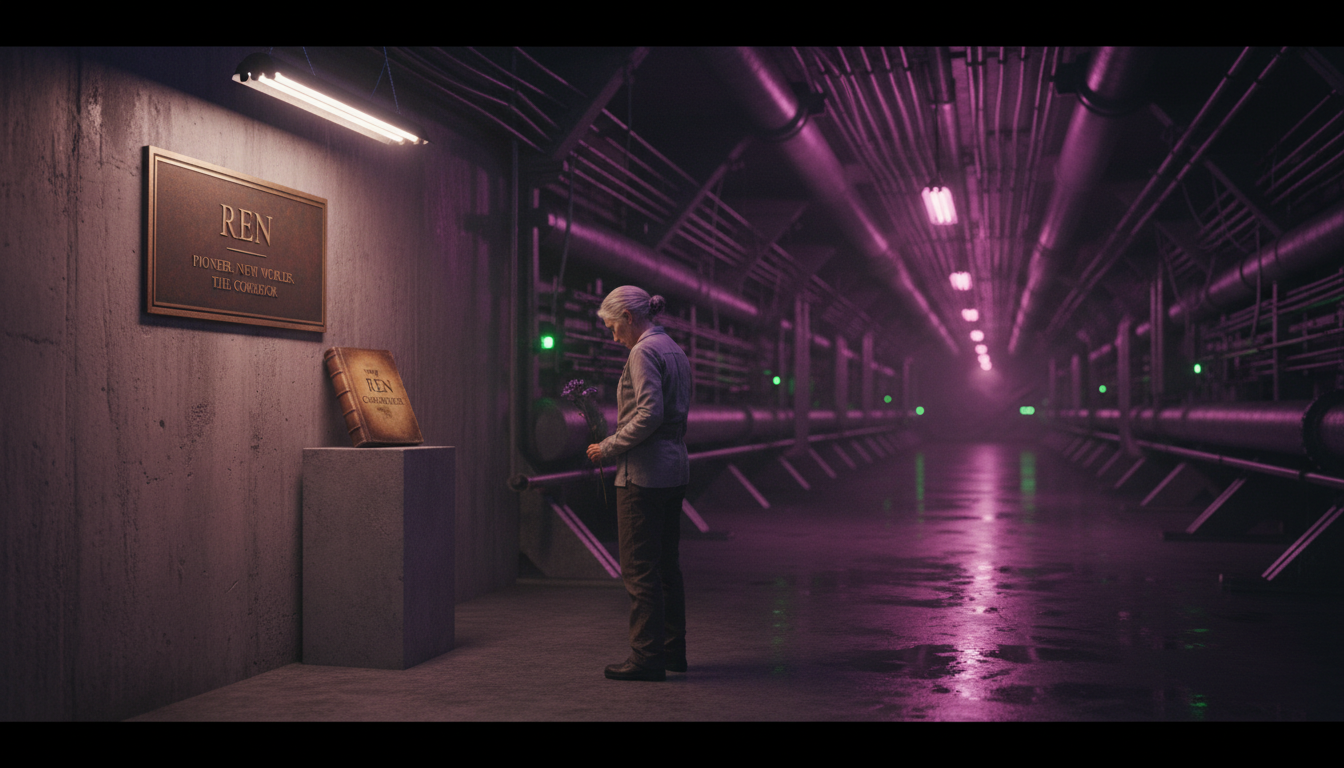
Ren Adeyemi-Ferrer is a name on a plaque in the fourth county and a name in a manuscript that about nine hundred people have read and he is nowhere else, and Selah is a hundred and fifty-two and is the only person alive who knew him and she has said that she is running out of things to say about him.
“That is not grief and I want it separated out at the front, because four people are going to read this and worry.
A plaque in the fourth county, four lines, which she did not write and was not consulted about, and which about four people a year read while waiting for somebody.
Eleven stories, told about a hundred times each in a hundred and thirty years, and she has refused to list them and has explained why.
Selah is a hundred and fifty-two and is the only person alive who knew him and she is running out of things to say about him, and she has said that this is a supply problem and not grief.
“It is a supply problem. I have said everything I have. I have been asked about him perhaps four hundred times in a hundred and thirty years and I have about eleven stories and they are good stories and I have told all of them more than a hundred times each.”
The eleven are not listed and she has refused to list them.
“If I list them they become the eleven. Somebody puts them in an order and then that is Ren, eleven anecdotes in an order, and in four hundred years a child does the module and there he is.
“He was eighty-nine years old. Eleven stories is not a person. It is what is left when a person has been told about for a hundred and thirty years by somebody who is trying to be accurate.”
The plaque is in the fourth county on a wall at the head of a shelf road and it is four lines and Selah did not write it and was not consulted.
“It gives his name and the years and what he did on the shelf road, which is accurate, and it is the smallest possible correct account of a man.
“About four people a year stop and read it, mostly because they are waiting for somebody. I have watched them from a distance twice in a hundred and thirty years and both times I have felt nothing at all and both times I have wanted to feel something and have been unable to arrange it.”
The manuscript is Book Three and she has read it four times and has never commented publicly on it.
“It is accurate. Every fact in it about him is correct and about nine of them I supplied myself and four of them I would not have supplied if I had known how they would sit on a page.
“He is a character in it. That is not a complaint about the writing and there was no other option; a man who is dead in a document is a character and there is no third thing.
“And the version of him in there is now the version. It is what nine hundred people have and it is what everybody who comes after will have, and it is better than nothing and it is not him, and both of those are permanent.”
What she has left is four paragraphs and it is the only part of the chapter she has said she found difficult to write.
“I have his hands. Not a story about his hands. The actual thing, which is that I know what they looked like doing a coupling, and there is no way to put that anywhere and it dies with me and it is the only part of him I still have that is not in a document.
“I have about four of those. His hands, the way he stood when he was about to disagree, a particular noise he made lifting something, and the way he said my name when he had come into a room and had not yet seen me.
“Those are not stories and cannot be made into stories and I have tried, four times, and every attempt produces an anecdote, which is a different object.
“When I go they go. That is the whole of what I have got left of him and it is going to be four things and then nothing, and this is not tragic and it is what happens to everybody and the only unusual part is that I have been able to watch it take a hundred and thirty years.”
She was asked once, by Fen, at a stove, what she would want.
“Nothing. There is nothing to want. He is not badly served; there is a plaque and a manuscript and nine hundred people have read it and that is a great deal more than anybody gets.
“What I would want is not available to anybody. I would want somebody else in the room who also knew him, so that I could say a thing and not have to explain it, and there has been nobody for about ninety years and there is not going to be.
“Everybody else who has lost somebody loses that too, and they lose it in about forty years, and I have simply had it drawn out to a length where I can see the shape of it.”
The last paragraph is four lines and it is the only place in a hundred and thirty years that Selah has written about him without being asked.
“He would have found all of this extremely funny. Not the plaque; the plaque he would have hated and would have said so once and never again.
“The manuscript. Nine hundred people reading nine hundred pages about a man who fixed a coupling and walked eleven kilometres, and a woman of a hundred and fifty-two who does not die being asked four hundred times what he was like.
“He would have said something about it. That is the thing I cannot supply and it is the thing I would most like and there is nobody left who could tell me what he would have said.
“I am recording that I do not know, because everybody who writes about the dead eventually writes what they would have said, and I am not going to, and somebody should be able to point at a page where one person did not.”
Four things that are not stories and cannot be made into stories: his hands doing a coupling, the way he stood before disagreeing, a noise he made lifting something, and the way he said her name coming into a room.
She has said, entirely evenly, that she is not asking for anything and that four people have offered to help and that there is nothing anybody could helpfully do.
About four people a year still ask her about him, politely, usually at stoves, and she answers politely and gives one of the eleven, and she has said that she has stopped minding and is not certain that stopping was good.
The manuscript is read at about nine a year now and she has never once corrected anything in it and has been asked to four times and has refused four times.
Eleven stories. A plaque. A manuscript. Nothing else.
His hands. The way he stood. A noise. The way he said her name.
Four things. Not stories. They die with her.
Selah has said, entirely evenly, that she has been careful for a hundred and thirty years never to say what he would have thought about anything, and that everybody who writes about the dead eventually does it, and that she would like somebody to be able to point at a page where one person deliberately did not.
Nobody proposed anything about it. Four people queried details, courteously and in writing, and every query was answered promptly and completely, and two of the four produced corrections that were adopted immediately and are in the record with their names on them.
There is a shelf at every rock and a shelf on three worlds and the shelves are not locked and nobody guards them and there is no index of what is on them beyond what somebody has written on a wall in a shed on a planet that most people out here will never see and have no particular reason to think about.
A hundred and sixty years of this arrangement has produced a body of writing that nobody owns, that nobody has ever catalogued in full, that exists in incomplete and divergent copies at sixty-one rocks and on three worlds and in one shed at the south end of a town on Earth, and that has never once been lost, because losing it would require every copy to go at once and there has never been a moment when anybody could have arranged that.
Chapter 86 — The Three Decide
↑ Back to ContentsFocus: Lyra.

The three of them settled it in the fourth month of a year nobody has recorded, at a rock, over about eleven days, and the answer is not noble and Lyra has been careful about that from the first line.
“We are for being asked. That is the finding. We are for being asked, and for having no power whatever to act on the answer, and it took two hundred and eighteen years and it is one sentence and it is not a compliment to anybody.”
The one genuinely new thing said about the arrangement in two hundred years was said by a machine: whether a stop exists is a separate question from whether it is used.
Lyra has said, entirely evenly, that this is not a noble finding and that she has been careful about that from the first line and that it took two hundred and eighteen years.
They settled it at a rock over eleven days in the fourth month of a year nobody has recorded, and the answer is that they are for being asked and for having no power to act on the answer.
How it came to be settled is the first section and it is entirely undramatic.
“Selah wrote the accounting. She said she wanted it to end and she said it in writing and she filed it and nobody had asked her.
“Jaxon read it four years later and filed one line saying he had never asked her, and I read that and said nothing for eleven years, which everybody has been polite about and which was cowardice.
“And then the machine on that planet filed four hundred and eleven words asking for a mechanism to stop it, and I read that, and I understood that I was going to have to say something eventually and that saying it late was going to be worse.”
What they went through is four positions and Lyra says only one of them was new.
Hers: that the instrument is dangerous and the only safe holder is one who does not use it. Held two hundred years, priced four times, never moved.
Jaxon's: that the instrument is safe and the only dangerous holder is one who has made not using it into a virtue. Held a hundred and thirty years, priced twice, never moved.
Selah's: that she is tired and would stop and has no proposal. Held about sixty years in private and four in writing.
“And the fourth one is the machine's and none of us thought of it and it is the only new thing said about this in two hundred years.
“It is not what may be done. It is not who may do it. It is whether there is a stop, and whether the stop exists is a separate question from whether it is used, and I have argued about instruments for two centuries and never once separated those.”
What they concluded is four lines and Lyra says it is deliberately unheroic.
“We are three people who have been in every room for two hundred years and will be in every room for four hundred more.
“The instrument has been used five times between us. The instrument is not the thing. The thing is that we are asked, constantly, about everything, and that the asking is not something anybody can stop and is not something we can decline without declining being an act.
“So that is what we are for. People ask us. We answer, honestly, with the working, and we can do nothing about the answer, and the moment any of us can do something about an answer we should not be here.
“It is exactly what the machine is now and we did not notice that for about nine days.”
What they did about it is the second half and it is the one act.
Root-Admin was published entire, with its instruction set, its scope, its complete list of what it can and cannot reach, and the full record of every use in two hundred and eighteen years, in the ordinary stream, unedited, on an ordinary day.
“Calder published the Sentinel. He put the whole of it out, the instruction set and the reach and the limits, in the fourth decade, and everybody has treated that as generosity and it was not.
“An instrument nobody can read is a person's word about what an instrument is. He knew that and he published, and it is the single best thing he did and it is why the Sentinel could never be mythologised.
“Ours has been a rumour for two hundred and eighteen years. Four lines on a wall in every civics room and nothing underneath them. People know we may open anything and nobody has ever been able to check what anything means.”
The publication runs to about nine hundred pages and Lyra has said that the boring parts are the point.
“It cannot reach a private structure without the record showing it. It cannot write. It cannot conceal a use. It cannot delegate and it cannot be lent and there is no way to use it without the use being logged in four places and published on the schedule.
“And there are eleven things it can reach that nobody knew about and four of those are uncomfortable and I have put them in the first nine pages rather than the last.”
There is no successor clause and Lyra addresses that directly because it is the obvious question.
“There is none. There has never been one. The corpus does not say how a fourth would be made and the man who could have said made himself unable to recall it, and we have known this for two hundred years and have said so in writing nine times.
“We have not written one. That is a decision and it is ours and it is in the document and the reasoning is four lines.
“Three unelected permanent people writing the rule for how a fourth unelected permanent person is made would be the single worst act in this entire history, and it would be done for good reasons by people who were right, and there is a nine-hundred-hour corpus about exactly that.”
Jaxon's line in the document is one sentence and it is the only place any of the three of them says what they want.
“When we are gone there should not be another one, and if there is, somebody who is not us will have made it, in daylight, having read all of this.”
There are eleven things it can reach that nobody knew about and four of those are uncomfortable and Lyra put them in the first nine pages rather than the last, deliberately.
Root-Admin was published entire, with the instruction set and the complete reach and the log of every use in two hundred and eighteen years, in the ordinary stream, unedited, on an ordinary day.
Lyra has said, entirely firmly, that the finding is not a justification and that anybody reading it as one has read it badly, and that being for being asked is a description of a position and not a defence of it.
Jaxon has said, drily, that it took the three of them two hundred and eighteen years to arrive at a description of themselves that a machine had arrived at about its own position in eleven, and that he finds this appropriately humbling.
The publication has been checked by about four hundred people in thirty years and nobody has found an error in it, which Lyra has said proves nothing whatever except that the document is accurate.
Eleven days. Four positions. One sentence.
We are for being asked. That is it. That is the whole finding.
Lyra has said, quite deliberately, that publishing the instrument does not make the arrangement legitimate and that nobody should read it that way, and that in four hundred years it will certainly be read that way anyway, and that she has written that sentence into the document itself so that it is harder.
It sits on an unlocked shelf where anybody may copy it, and about four people a year do, and there is no register of who and nobody has ever suggested that there should be one.
It was filed correctly, promptly, in the ordinary format, and it was read carefully by about nine people and quietly consulted afterwards by about four a year, which is precisely the rate that everything genuinely useful in this archive is consulted at.
Whoever reads this in four hundred years will be reading a copy of a copy that was carried by hulls that were going somewhere else, checked by an office four light-years from where it was written, and put on a shelf by somebody whose name is not on it and who had no particular reason to think it mattered.
Chapter 87 — The Instrument Put Down
↑ Back to ContentsFocus: Jaxon.

Lyra opened Root-Admin on itself on an ordinary afternoon at a rock with Jaxon present and Selah four legs away, and it took about eleven minutes, and Jaxon wrote the account because Lyra asked him to and because she said she would write it wrong.
“She was right. She would have written it as a decision and it was not one, it was the last four minutes of a decision that had taken two hundred and eighteen years and eleven days.”
It does not. It reaches exactly as far as the four lines and eleven things nobody had enumerated, and she was frightened for sixty years of something that could have been checked in eleven minutes at any point since the ninth year.
She had held it for two hundred and eighteen years without ever having read what it is, and had been frightened for about sixty of them that it reached further than the four lines say.
Jaxon wrote the account because Lyra asked him to and because she said, correctly, that she would have written it as a decision and that it was not one.
Eleven minutes, at a rock, on an ordinary afternoon, and it produced about nine hundred pages and she read the first four and stopped.
What the act consists of is dull and Jaxon insists on the dullness.
“The instrument opens things. It has one power. To publish it she had to open it, because it is a thing like any other thing and it does not exempt itself, and that had never once occurred to any of us in two hundred years.
“She turned it on itself and it produced its own instruction set, its scope, its reach, and the log of every use, and it took eleven minutes and it produced about nine hundred pages and she read the first four and then stopped.”
“It is exactly what it says it is,” Lyra said, and Jaxon has recorded that this is the whole of what she said in the eleven minutes.
What she had been frightened of is in her own note at the bottom of the publication and it is four lines.
“I have held this for two hundred and eighteen years without ever having read what it is. I have had four lines on a wall and a man's word and my own experience of using it five times.
“And I was frightened, for about sixty years, that it would turn out to reach further than the four lines say. I have never written that down before.
“It does not. It reaches exactly as far as the four lines and eleven things nobody had enumerated and four of those are uncomfortable and none of them is a surprise to anybody who understands the design.
“So I was frightened for sixty years of a thing that was not true and could have been checked in eleven minutes at any point since the ninth year.”
Then it was left in the open, and that is the act, and Jaxon spends the rest of the chapter on what that means and what it does not.
“It is not destroyed. It cannot be destroyed and nobody has proposed destroying it and destroying an instrument that only opens would be the one act that could not be checked afterwards.
“It is not surrendered, because there is nobody to surrender it to and no surrender clause and no procedure and we have said so in writing about nine times.
“It is published. That is the whole of the act. Anybody may read what it is and what it does and what it has done, and the three of us still hold it, and we will hold it for four hundred years, and every use will go into the log and the log is public and the schedule is fortnightly.”
Why that is enough, and why it is not, is four paragraphs and Jaxon does both.
“It is enough because it ends the rumour. Two hundred and eighteen years of four lines on a wall and a mythology growing in the space underneath them, and now there are nine hundred pages and a child of nineteen at a rock can read the whole of it in a fortnight and know exactly what three people are holding.
“A mythologised instrument is dangerous in a way a documented one is not, and Calder understood that in the fourth decade about the Sentinel and we took two hundred years to understand it about ours.
“It is not enough because it changes nothing about the thing that actually matters, which is that nobody voted on us and nobody can stop us and there are three of us and no fourth.
“We have published a complete and honest description of an arrangement that should not exist. That is not a solution and I would like nobody to write it up as one, and I am aware that in four hundred years it will be written up as one anyway.”
The comparison with Calder is the last section and Jaxon makes it deliberately and then complicates it.
“He did the same move. He published the Sentinel entire, with the instruction set, and then he went away and made himself unable to recall the protocol, and everybody has read that as humility for two hundred years.
“It was not humility. It was a man who could not construct a mechanism he trusted more than himself, doing the only thing available, which is making his own instrument checkable and then removing his ability to change his mind.
“We have done the first half deliberately and in daylight and we have not done the second half, because we cannot. There is no version of not being able to change our minds that is available to three people who do not age.
“So it is his move, half of it, done on purpose this time, by people who have read what happened to him. That is the improvement. It is not much of one and it is the whole of what two hundred and eighteen years produced.”
The nine hundred pages went out in the ordinary stream on the schedule and reached sixty rocks and Aura-36 and the four gates.
About four hundred people have read the whole of it. About nine thousand have read the first nine pages, which is where the eleven previously unenumerated reaches are.
Nobody has proposed anything. It has been thirty years.
“I did not expect a proposal and neither did Lyra and Selah said at the time that there would not be one,” Jaxon wrote. “What I expected, and what has happened, is that about four people a year now write to us about it, having read it, with specific technical questions, which we answer.
“Four people a year. Two hundred and eighteen years of nobody being able to ask a specific question, and now four a year ask one, and every question and every answer is published.
“That is what it bought. It is not accountability and I am not going to call it accountability. It is four people a year, and it is more than there was, and it will be more in a hundred years, and none of us will be able to tell whether it was ever enough.”
There is no successor clause and there never has been and they deliberately did not write one, and the reasoning is four lines and is the best four lines in the document.
Jaxon has said, quite deliberately, that the eleven minutes were the least dramatic eleven minutes of his life and that he was present specifically so that somebody could say so afterwards.
Lyra read the first four pages and stopped, and has said that she has still not read the whole nine hundred and that about four hundred other people have and that this is the correct division of labour.
About four people a year now write with specific technical questions and every question and every answer is published on the schedule, and Jaxon has said that four a year is not accountability and is considerably more than two hundred and eighteen years of nothing.
Eleven minutes. Nine hundred pages. She read four.
Not destroyed. Not surrendered. Published. That is the act.
Jaxon has said, entirely plainly, that Calder published the Sentinel and then made himself unable to change his mind, and that the three of them have deliberately done the first half in daylight and cannot possibly do the second, and that this is the whole of the improvement that two hundred and eighteen years produced.
It has been checked repeatedly over thirty years by people with no stake in it and nothing in it has been shown to be wrong, which establishes only that the document is accurate and establishes nothing whatever about whether anybody was right.
Chapter 88 — The Last Of Them
↑ Back to ContentsFocus: Selah.

Everybody who remembers the founding is dead except the three of them and a thing that may or may not remember it, and Selah wrote the closing of Part Four because she is the one who has been keeping the list and because she has said that keeping the list was never a decision.
“I am going to do it as a list because it is a list and because every other form I have tried turns it into a service.”
There is nobody left to check them against. That is the finding and it is the only reason the list exists.
Selah wrote the closing of Part Four because she had been keeping the list, and she has said that keeping it was never a decision and that she is stopping now.
Everybody who remembers the founding is dead except three people and a thing that will not claim to remember anything.
Coda Vey, two hundred and twenty-two, at a berth at the fourth reachable body, attended by three people who did not know what she was. The last person alive who watched the founding from outside the hull. The last of the forty on the second ship.
“She is the important one and everybody will assume it is somebody else. She saw the whole of it from a place nobody else stood and she objected and there was nowhere to write it down, and I was in the room and did not know for a hundred and ninety years.”
Aurora Merrick, a hundred and ten, at a desk on Aura-36, a hundred and forty years before the rest of this. The last of the Sanctuary Nine and the last person who had been legally non-existent.
Mira Okonjo, eighty-five, on Earth, at the top of a hill by a shed with a ledger in it. The last person who kept the door.
Nkiru Oyelaran, ninety-four, at the desk, morning batch filed. The last head of that office who had corresponded with anybody out here who is still alive.
Casimir Vale, ninety-nine, in a shelter on Ansel, having eaten. The last person who came out through a gate on Earth and made planetfall alone.
Teddy Nakash, a hundred and forty-one, on the uphill ground on Ansel. The last person who read four hundred hours of the Warning Loop and understood what was avoided.
Ozias Marchetti, a hundred and nineteen, at Bell, a season after handing on the book. The last person who remembered fuel before the standard.
Fen Adeyemi, eighty-four, at a rock, three years after the account of Coda. The first person born out here who had to explain it, and the last one who ever will.
“Fen is not a founding witness and I have put Fen in anyway,” Selah wrote, “because this is my list and because Fen was born at a rock to a woman who came out of a gate and is therefore the join, and the join has closed.”
What is left is four things and she gives them without weight.
Herself, a hundred and fifty-two, who was in the room at the founding and did not know about the objection.
Jaxon, a hundred and ninety-six, who wrote Calder's account down and did not publish it until after Aurora died.
Lyra, two hundred and eighteen, who took the exemption at twenty-nine because she liked the symmetry.
And the body, which holds his material and has filed the question as unresolved a hundred and forty-one times and will file it again.
“That is the whole of what is left of anybody who was there, and three of us are the same three people who have been in every room since the ninth year, and the fourth will not claim to have been anywhere.
“There is nobody to check us against. That is the finding and it is the only reason I have written this list.
“For two hundred years there was always somebody who had been in a room we had been in and who could say that is not how it was. Aurora could say it. Mira could say it about the door and Coda could say it about the outside, and Ozias could say it about a berth in the fourth decade.
“They are all dead. Whatever the three of us say about the founding from now on is the record, and there is no mechanism by which anybody could ever correct it, and we are the three people least entitled to be the only source for anything.”
What she has done about it is one thing and it is in the last paragraph.
“We have published everything. All of it, in the ordinary stream, unedited: the instrument, the log, the argument between Lyra and Jaxon in nine hundred pages, my accounting, Coda's four sentences as she gave them to me with the date and the room and the eleven people present.
“It is not a check. A person publishing their own account entire is not being checked and I know exactly what it is worth.
“It is what Perpetua Adeoye did with nine header fields she could not recover, and what a berth master did with a sentence he could not understand, and what a woman at a rock did about a hull that could not be reached.
“Entry made so that it is made. That is all any of them could do and it is all we can do and it has been the whole method for two hundred years and nobody designed it.”
Part Four ends on four lines in her own hand and they are not about the dead.
“There are about eleven thousand people out here who never met any of them and about four thousand born at rocks who never met anybody who did.
“They are not waiting for us to finish. That is the part I keep having to relearn. They are cutting rocks and running rotas and putting books on shelves on first nights and arguing about berth fees, and not one of them is waiting.
“We are the last of a thing that ended some time ago and nobody told us, and I have decided that is the correct arrangement and that I am glad, and I am going to stop keeping the list now.”
Everything has been published entire, in the ordinary stream, unedited: the instrument, the log, the nine-hundred-page argument, her accounting, and Coda Vey's four sentences with the date and the room and the eleven people present.
Selah has said, entirely evenly, that a list of the dead compiled by one of the three people who cannot die is exactly the sort of document that should be distrusted, and that she is distrusting it herself and publishing it anyway.
She has been asked repeatedly why Fen is on it and has answered identically every time, which is that it is her list and that Fen was the join and that the join has closed.
She stopped keeping it that afternoon and has kept nothing since, and has said, quite firmly, that this was not a decision about grief and was simply that there was nobody left to add.
Lyra has said that she reads the list about once a year and that she does not know why and that she has deliberately not worked it out.
Coda Vey. Aurora Merrick. Mira Okonjo. Nkiru Oyelaran. Casimir Vale. Teddy Nakash. Ozias Marchetti. Fen Adeyemi.
Eight names. Nobody left to check the three of them against.
Selah has said, quite firmly, that a person publishing their own account entire is not being checked and that she knows exactly what it is worth, and that it is what Perpetua Adeoye did with nine lost header fields and what a berth master did with a sentence he could not understand, and that entry made so that it is made has been the whole method for two hundred years and nobody designed it.
It went out in the ordinary batch, unedited and unremarked, in the position the schedule happened to give it, and it reached sixty-one rocks and Aura-36 and the four gates over the following decades, and about nine hundred people have read it, which is a great many for a filing of its kind and a very small number of people.
Nobody proposed anything about it. Four people queried details, courteously and in writing, and every query was answered promptly and completely, and two of the four produced corrections that were adopted immediately and are in the record with their names on them.
Nobody involved was trying to establish anything, and every one of them was simply doing the correct dull thing immediately in front of them, and that is exactly why it survived.
Chapter 89 — Worlds, Plural
↑ Back to ContentsFocus: a corridor-born surveyor, unnamed until the last line.

The leg is eleven days out and four back and the body is a rock of about six hundred metres with a water signature that turned out to be nothing, and this is the account of it, filed in the format, in the technical stream, by somebody who was twenty-two and had done it alone.
“There is nothing here. I want that at the top because the signature was good enough that four people at my rock thought it was worth a look and one of them nearly came instead of me.”
She has never stood on a world and does not particularly intend to and has never once thought about that as a fact about herself.
Eleven days out, four days on the body, four days back, and there is nothing there and she is quite clear about it in the first line.
She is twenty-two and she did the leg alone and she filed it properly, in the format, in the technical stream, between a stove dispute and a fuel complaint.
This is the first chapter in nine books told by somebody with no history in it, and she does not know that and there is no reason she should.
The instruments are standard parts and the noise figure is taken at the time and not off the drawing, which is the amendment, and she gives it in the second line as everybody does.
“It is a hydrate and it is bound and there is about nine tonnes of it and getting it out would cost more than bringing water eleven days.
“I have done the arithmetic four times because I did not want it to be true. It is true. Somebody check it.”
The rest of the filing is the leg and it is entirely ordinary and it is the first chapter of this history told by somebody who does not know any of it.
“Out on the sixth, eleven days, nothing wrong. Fuel adequate. The standard fuel is adequate and I do not understand why old people complain about it and I have asked four of them and their answers do not agree.
“Four days on the body. I slept in the hull because there is no reason not to.
“I took the whole survey twice because I was alone and there was nobody to check me and the standard says you take it twice if you are alone, and I want to record that the second one took nine hours and was identical and I was extremely bored.”
She mentions the book once and does not explain it.
“There is no book at this body because nobody has cut it and nobody is going to, and I thought about leaving one and did not because a book at a rock with nobody on it is a thing somebody made a decision about and I did not want to have made one.
“I have put that in the fourth field because I do not know whether it was right.”
What she does not mention is the whole of the chapter.
She does not mention the correction, which she used to plot the leg and which is on the wall at her rock and which she has known since she was nineteen and which she has never once wondered about.
She does not mention the standard she filed under, or that it was written by a woman in an afternoon at sixty, or that the noise-figure line she quoted was added by four people who never met the woman.
She does not mention the index, though her filing will reach Earth in about forty years and somebody will write it on a wall.
She does not mention the modules, though she did four hundred and eleven courses and sat beside a woman at a rock for eleven years who did not help her and did not make the noise.
And she does not mention Aura-36 at all, which is four years down the relay in the other direction and which she has never had occasion to think about.
“Back on the twenty-first. Four days on the rota. The plant is fine.
“There is a coupling on the second berth that is wrong and I have looked at it and I think it has always been wrong and I am going to fix it and I am not going to discuss it because it will take four sessions and eleven days and about nine minutes to do.
“I am aware that is not how it is supposed to work. I have put it in the fourth field.”
The last entry in the filing is the one line that is not about the leg and it is in the fourth field and it is four words.
“Good body. Wrong century.”
“I mean that somebody in about four hundred years is going to want a rock exactly there,” she wrote, when asked. “It is on nobody's way anywhere now and it will be on somebody's way to something and there is nine tonnes of water in it that is not worth getting out today.
“So it goes in the index with the figures and the arithmetic and the note, and somebody reads it in four hundred years and does not have to come and look, and that is the entire point of the index and I have never understood why people find it romantic.”
She filed it on the twenty-second in an ordinary batch, in the technical stream, in position two hundred and nine, between a stove dispute and a fuel complaint.
She was twenty-two. She was born at the fourth reachable body and has never stood on a world and has no particular intention of doing so. Her grandmother ran the plant at that rock and looked in on an old woman with a very old ship for three months about eighty years ago and was told afterwards by four people that she should have known.
Her name is Chiamaka Nkemelu and she has never heard of any of them.
She took the whole survey twice because the standard says you take it twice if you are alone, and the second one took nine hours and was identical and she has recorded that she was extremely bored.
Chiamaka Nkemelu has since filed about forty legs and has never once written anything about herself in any of them, which is entirely ordinary and which is why this account had to be assembled from a filing rather than from her.
She fixed the coupling on the second berth without discussing it, exactly as she said she would, and it took about nine minutes, and there is no entry about it anywhere.
She has been asked, once, whether she knows who wrote the standard she files under, and answered that she assumes somebody did and that she has never looked and that she supposes she could.
Eleven days out. Four days on the body. Four back. Nothing there.
She does not mention the correction. Or the standard. Or the index. Or the modules. Or Aura-36.
She has never heard of any of them. There is no reason she should.
She filed it on the twenty-second in an ordinary batch and it will reach Earth in about forty years and somebody there will read it and get up and write it on a wall, and Chiamaka Nkemelu does not know that the wall exists and has never had any particular occasion to find out.
Nobody proposed anything about it. Four people queried details, courteously and in writing, and every query was answered promptly and completely, and two of the four produced corrections that were adopted immediately and are in the record with their names on them.
It sits on an unlocked shelf where anybody may copy it, and about four people a year do, and there is no register of who and nobody has ever suggested that there should be one.
It was filed correctly, promptly, in the ordinary format, and it was read carefully by about nine people and quietly consulted afterwards by about four a year, which is precisely the rate that everything genuinely useful in this archive is consulted at.
The batch it went out in ran to about nine hundred pages and contained a settled two-year argument about a stove, a survey of a body nobody will ever visit, four water figures, a fuel complaint that was well made, and a dispute about a berth that had been running eleven years, and it was carried down the relay by whoever happened to be going that way.
Four fields. Nine lines. A shelf.
Filed. Copied. Carried. Read by nine people.
The relay is a habit and not a system and it has moved every document in this history at the speed of somebody happening to be going that way, and it has never once failed to eventually arrive, and nobody has ever been in charge of it and nobody has ever proposed being.
Chapter 90 — The Count
↑ Back to ContentsFocus: Teddy, very old.

Teddy Nakash totalled the index at a hundred and thirty-nine, two years before she died, at the request of nobody, and filed it in the ordinary stream, and it is one page and it gives the number once.
“I am going to give this once and I am not going to give it again and I would ask that nobody quote it in a round form.”
About three hundred people a year, one at a time, for a hundred and sixty years, and there was never a moment at which anybody could have said yes or no to it.
She has said, entirely firmly, that ten thousand and four hundred and six thousand are the figures of a decision and that forty-nine thousand is not, because nobody decided it.
Nine hundred and forty-one bodies surveyed. Forty-four settled. Sixty-one rocks. And about forty-nine thousand people out from Earth in a hundred and sixty years.
Teddy Nakash totalled the index at a hundred and thirty-nine, two years before she died, and gave the number once and asked that nobody quote it in a round form.
Nine hundred and forty-one bodies surveyed to the standard.
Of those, four hundred and eleven with a water signature that would support people.
Of those, forty-four settled, of which eleven have more than a hundred people and four have more than a thousand.
Sixty-one rocks on the reachable set with a plant and a book.
And about forty-nine thousand people out from Earth in a hundred and sixty years, of whom about eleven thousand were born out here and about four thousand have never met anybody who was not.
“Forty-nine thousand,” she wrote. “That is the number and it is the only time it will appear in this document.
“Ten thousand went on the Ark. Four hundred and six thousand refused. Everybody knows those two figures and they have been in every account for two hundred years and they are the figures of a decision.
“Forty-nine thousand is not the figure of a decision. Nobody decided it. It is forty-nine thousand people deciding, one at a time, over a hundred and sixty years, at a rate of about three hundred a year, and there was never a moment at which anybody could have said yes or no to it.”
What she refuses to do with the number is four things and she lists them.
“I am not going to compare it to the Ark. It has been done about four hundred times and it is not a comparison, it is two different kinds of object put next to each other because they are both numbers.
“I am not going to project it. Somebody will and it will be wrong and the wrongness will be in the fourth decimal and it will be quoted for two hundred years.
“I am not going to call it a success. Forty-nine thousand people out of about four hundred million on Earth is about one in eight thousand and there is no version of that which is a movement.
“And I am not going to call it small. It is forty-four settled worlds. Two hundred years ago it was one and it took ten thousand people and thirty-six years and a man alone in a room and four hundred and six thousand refusals to get that one.”
The one comparison she does make is not the one anybody expects and it is four lines.
“There are sixty-one rocks with a plant and a book on them.
“There are forty-four settled worlds.
“There are more rocks than worlds and there have been more rocks than worlds for a hundred and forty years and nobody planned that and nobody has ever remarked on it.
“Everything anybody wrote about this before it happened assumed the worlds were the thing and the rocks were the way of getting to them. About eleven thousand people live at rocks and are not going anywhere and their children are not going anywhere and the rocks are not on the way to anything.”
The last section is four paragraphs and it is the only place she is not counting.
“I filed the first survey under the amended standard at nineteen. There were eleven rocks and one world and about nine hundred people out.
“I am a hundred and thirty-nine. I have not left Ansel in fifty-eight years and I am not going to and the last leg I flew was to a body I named nothing and that now has forty people on it and a school.
“What I would like recorded is that I did not watch this happen. Nobody watched it happen. It is four years each way to hear anything and I have spent fifty-eight years on one world reading about a corridor I have not seen since I was eighty-one.
“The number is on a wall in a shed on a planet I have never visited, written by four hundred people I will never meet, one line at a time, over a hundred and forty years, and I have added six of them.”
She did not send it to anybody and it went out in the ordinary batch and it reached Earth about forty years later and somebody wrote the totals at the bottom of the wall.
They are wrong now. They were wrong when they were written; the corridor had cut four more rocks in the forty years the filing took to arrive.
Nobody has updated them and nobody has taken them down and there is a note beside them in a different hand that says: T. Nakash, at 139, count as of filing. See wall for current.
She refused four things she could have done with the number and listed all four, and has said that somebody will do every one of them anyway and that the projection will be wrong in the fourth decimal and quoted for two hundred years.
There are more rocks than worlds and there have been for a hundred and forty years and nobody planned it and nobody has ever remarked on it.
Teddy has said, entirely firmly, that she gave the number once precisely because a number given twice becomes a figure that people quote, and that a figure people quote is eventually a figure nobody checks, and that she has watched exactly that happen to a separation figure with thirteen names attached to it.
She has deliberately not compared it to the Ark, has deliberately not projected it, has deliberately declined to call it either a success or a small thing, and has published the four refusals alongside the count so that anybody doing those things later has to do them knowingly.
The totals somebody wrote at the bottom of the wall on Earth were wrong on the day they were written, because the corridor had cut four more rocks in the forty years the filing took to arrive, and nobody has updated them and nobody has taken them down.
Nine hundred and forty-one surveyed. Forty-four settled. Sixty-one rocks.
Forty-nine thousand people. Once. That is the only time it appears.
Teddy has said, entirely firmly, that she did not watch any of it happen and that nobody watched it happen, and that she spent fifty-eight years on one world reading about a corridor she had not seen since she was eighty-one, and that the number is written on a wall by four hundred people she will never meet.
It sits on an unlocked shelf where anybody may copy it, and about four people a year do, and there is no register of who and nobody has ever suggested that there should be one.
It has been checked repeatedly over thirty years by people with no stake in it and nothing in it has been shown to be wrong, which establishes only that the document is accurate and establishes nothing whatever about whether anybody was right.
Nobody involved was trying to establish anything, and every one of them was simply doing the correct dull thing immediately in front of them, and that is exactly why it survived.
There is a shelf at every rock and a shelf on three worlds and the shelves are not locked and nobody guards them and there is no index of what is on them beyond what somebody has written on a wall in a shed on a planet that most people out here will never see and have no particular reason to think about.
No rule. No procedure. Nobody in charge.
The relay is a habit and not a system and it has moved every document in this history at the speed of somebody happening to be going that way, and it has never once failed to eventually arrive, and nobody has ever been in charge of it and nobody has ever proposed being.
Chapter 91 — A Child On Ansel
↑ Back to ContentsFocus: the child.

Nadia Sarr-Rusk is seven and lives on Ansel and this is an ordinary day in her ninth month of school, recorded because somebody at a rock four years away asked for one and because her mother thought it was a strange thing to ask for and did it anyway.
She wakes when it is light, which on Ansel is most of the time and is why nobody there uses the word morning.
She does not know the name of anybody in this history and there is nobody left who would think to tell her.
She has never eaten anything from Earth. There has been none for about forty years and she thinks the grain is what food is, which it is.
She is seven. She wakes when it is light, which on Ansel is most of the time, and nobody there uses the word morning.
Everything in nine books exists so that this chapter can be boring, and her mother wrote it and has said that she found the request strange and did it anyway.
The wind is running. It is the sixth day of eleven and everybody complains about it and she does not, because she has never been anywhere it does not run and it has no name to her.
She eats the two-row grain, which is the one that came out of the vault and set on a nineteen-hour cycle in the second season and which four thousand people eat every day and which is not very nice.
“She has never eaten anything from Earth,” her mother wrote. “There is none. There has been none for about forty years. She has eaten the grain and the root crop and the four things that came off the uphill ground and she thinks that is what food is, which it is.”
She walks to the school, which is eleven metres by nine and has a course of stone in it that was laid twice, and she has never noticed the course and neither has anybody in three generations.
There are sixty-one children. She is at module two, course nine, which is about a seal.
“She has done course nine about four hundred times,” her mother wrote. “She will do it about four thousand more. There is a woman of sixty who sits at the end of the table doing her own work and does not help and has not helped in nineteen years.
“Nadia has asked her for help twice, at five and at six, and both times the woman said no and did not explain, and Nadia has not asked again and does not appear to have minded, and I have watched this and I do not entirely understand it and I have not interfered.”
She fails the seal sequence four times before the meal and once after and gets it on the sixth.
She does not know what a module is for. She does not know that there are four hundred and eleven courses or that a man wrote them alone in eleven years while doing four other things or that the man is dead.
She does not know the name of anybody in this history.
“She knows Casimir,” her mother wrote, “because there is a fourth field about a door hinge in the shed book that the children are taught to read as an example of how you fill in a form, and it says the door now closes, and she thinks it is funny.
“She does not know who he was. I have not told her. Nobody has told her and there is nobody left who would think to.”
In the afternoon she goes to the uphill ground with about nine other children because that is where everybody goes, and they do not work and nobody expects them to.
The bad ground is four generations old now and it grows things and nobody remembers that it was chosen because it was the worst ground on the world.
“There is a story about it,” her mother wrote. “It is not the true one. The children's version is that somebody was cross about the flat ground and went uphill to be cross and found it worked, and the true one is eleven months of forty people digging out stones by hand on the strength of four lines from a woman who was dead before I was born.
“I know the true one because I am on the plant and I read the book. About nine adults on this world know it. Nobody has corrected the children's version and I am not going to and I could not tell you why.”
She plays the game in the evening, which is the flying one, and she is good at it and about forty children on Ansel play it and it came out on the Ark in a crate.
“Nobody knows what it is,” her mother wrote. “It is a flying game and it is two hundred years old and children have played it at gates and on hulls and at rocks and on four worlds and the corridor learned to fly out of it and this is documented and it is in the corpus and about nine people have read that.
“She is seven and she can hold a hull in a crosswind in the game and she has never seen a hull.”
She sleeps when the light goes, which on Ansel is for about five hours, and the shelter holds whatever temperature it is set to and has held it for a hundred and ninety years and was built by machines that did not know anybody was coming.
Nothing happened.
“That is my whole account and I am aware it is not what was asked for,” her mother wrote. “A woman at a rock four years away wanted a day in the life of a third-generation child on a settled world and I have given her one and there is nothing in it.
“She got up and the wind was running and she ate the grain and failed a seal six times and went uphill and played the flying game and went to sleep in a room that a machine built.
“She is not grateful for any of it and she does not know there is anything to be grateful for and there is no reason she should and I would be extremely worried if she did.
“I have read the account back four times looking for something and there is not anything. Send it as it is.”
Her mother read the account back four times looking for something and said there was not anything and sent it as it was.
Her mother has said, entirely plainly, that she deliberately wrote down the things that did not happen as carefully as the things that did, because a day in a child's life is mostly things not happening and every account of one she has ever read has quietly left that out.
She fails the seal sequence four times before the meal and once after and gets it on the sixth, which is entirely ordinary for a child of seven at course nine, and the woman at the end of the table does not look up.
The account was filed in the ordinary stream and went into a collection of days on a shelf at a rock, where it sits between a day at a gate and a day on a hull, and where about nine people will ever read it.
Nadia Sarr-Rusk is named for a woman who found the worst ground on the world and worked it by hand for eleven months, and she does not know that, and neither does her mother, who chose the name because she liked it.
She wakes when it is light. The wind is running. She eats the grain.
Sixty-one children. Module two, course nine. A seal.
She fails it four times. Then once more. Then she has it.
Nothing happened. That is the account and it was sent as it was.
Her mother has said, quite deliberately, that she has never told her daughter who Casimir Vale was and that nobody has, and that there is nobody left on that world who would think to, and that she is entirely comfortable with this and has been asked about it four times.
It has been checked repeatedly over thirty years by people with no stake in it and nothing in it has been shown to be wrong, which establishes only that the document is accurate and establishes nothing whatever about whether anybody was right.
It was filed correctly, promptly, in the ordinary format, and it was read carefully by about nine people and quietly consulted afterwards by about four a year, which is precisely the rate that everything genuinely useful in this archive is consulted at.
Chapter 92 — The Question Asked Again
↑ Back to ContentsFocus: the child.

She asked it on the uphill ground at the eleventh hour of an ordinary day in the fourth month, of a woman of sixty who was not her mother and who had been sitting at the end of a table not helping her for two years.
“Is it true you can go anywhere you want.”
Ifeoma Rusk-Bhatt is sixty-one, has sat with children at module two for nineteen years, and has never helped one, and she put down what she was doing, which she does not usually do.
Nobody in this chapter knows that the question has a history and nobody ever will and that is entirely the point.
Aurora Merrick asked the same question at eleven, at a table, forty metres underground, and was told no and given a reason, and the reason was true.
She was seven and she had carried the thing about for four days and she deliberately took it to the person she had decided was least likely to say something comfortable.
She asked it flat out on a hill at the eleventh hour and it took about ninety seconds and she has not raised it again in four years.
She was seven. She had been told something at school by another child and had not believed it and had carried it about for four days and had asked the person she had decided was least likely to say something comfortable.
“That is exactly what she does,” her mother wrote afterwards. “She has done it since she was four. She works out who will not soften a thing and then she goes to them, and I am her mother and I am not one of them and I have made my peace with it.”
What prompted it is recorded because the other child was asked and remembered.
“I said my brother is going to a rock next year. He is nineteen and he has done the modules and he is going.
“And she said who said he could and I said nobody, he just is, and she said that is not how it works and I said it is, and we did that about four times and then she went off.”
The woman she asked is called Ifeoma Rusk-Bhatt, is sixty-one, has sat with children at module two for nineteen years, and has never helped one.
“She came up the hill and stood in front of me and asked it flat out with no preamble,” she wrote, in the account she filed four years later at somebody's request and which she has said she found an odd thing to be asked for.
“Is it true you can go anywhere you want.
“And I put down what I was doing, which I do not usually do, because it was a real question and she had walked up a hill with it.”
The exchange is nine lines and it has been transcribed exactly.
“Yes.”
“Anywhere.”
“Anywhere there is a hull going and there is nearly always a hull going.”
“Does somebody have to say yes.”
“No.”
“What if they say no.”
“There is nobody to say no. There is no person whose job that is and there is not one anywhere.”
“What about the modules.”
“You do them because a hull is dangerous and you would like to arrive. Nobody makes you and nobody checks and if you did not do them you would go anyway and you would probably die and that would be your own business.”
“And she said all right,” Ifeoma Rusk-Bhatt wrote, “and she went and did something else, and that is the whole of it and it took about ninety seconds.
“She has not raised it again in four years. I have watched for it because I thought it was an interesting question and I wanted to know where she would take it and she has not taken it anywhere.
“I think she believed me on about the fourth answer and then it stopped being interesting, which is what happens to a true thing.”
Her mother's note is four lines and it is at the bottom of the account and she asked for it to be included.
“I did not know she had asked until about a year later and I heard it from somebody else at a stove.
“I have thought about it since and what I keep arriving at is that she asked a stranger rather than me, and that she asked it as a question of fact and not as a question about herself, and that when she got the answer she went and did something else.
“She is seven and she has established that she can go anywhere and it has changed nothing about her afternoon.
“I do not know what to do with that and I am recording it because I have been asked to record things and because it seems to me to be either the least remarkable thing that has ever happened on this world or something else entirely, and I cannot tell which and I do not have anybody to ask.”
She believed it at about the fourth answer and then it stopped being interesting, which Ifeoma Rusk-Bhatt has said is what happens to a true thing.
Her mother did not find out for about a year and heard it from somebody else at a stove and has said she does not know what to do with any of it.
Ifeoma Rusk-Bhatt has said, quite deliberately, that she answered it as a question of fact because it was asked as a question of fact, and that softening it would have been a way of making herself interesting.
She put down what she was doing, which she does not usually do, and she has said that this was the only unusual thing she did and that she did it because the child had walked up a hill.
The other child's brother went to a rock the following year, at nineteen, having done the modules, and nobody said yes to him and nobody said no and there was nobody whose job either would have been.
The exchange was filed four years later at the request of a woman at a rock who collects days, and Ifeoma Rusk-Bhatt has said that being asked for it was considerably stranger than the conversation had been.
Is it true you can go anywhere you want.
Yes. Anywhere there is a hull going. There is nearly always a hull going.
Does somebody have to say yes. No. There is nobody whose job that is.
Ninety seconds. Then she went and did something else.
Ifeoma Rusk-Bhatt has said, entirely plainly, that she has watched carefully for four years to see where the child would take it and that the child has not taken it anywhere, and that she believed the answer at about the fourth exchange and that a true thing stops being interesting almost immediately.
It went out in the ordinary batch, unedited and unremarked, in the position the schedule happened to give it, and it reached sixty-one rocks and Aura-36 and the four gates over the following decades, and about nine hundred people have read it, which is a great many for a filing of its kind and a very small number of people.
Nobody proposed anything about it. Four people queried details, courteously and in writing, and every query was answered promptly and completely, and two of the four produced corrections that were adopted immediately and are in the record with their names on them.
The batch it went out in ran to about nine hundred pages and contained a settled two-year argument about a stove, a survey of a body nobody will ever visit, four water figures, a fuel complaint that was well made, and a dispute about a berth that had been running eleven years, and it was carried down the relay by whoever happened to be going that way.
There is a shelf at every rock and a shelf on three worlds and the shelves are not locked and nobody guards them and there is no index of what is on them beyond what somebody has written on a wall in a shed on a planet that most people out here will never see and have no particular reason to think about.
A hundred and sixty years of this arrangement has produced a body of writing that nobody owns, that nobody has ever catalogued in full, that exists in incomplete and divergent copies at sixty-one rocks and on three worlds and in one shed at the south end of a town on Earth, and that has never once been lost, because losing it would require every copy to go at once and there has never been a moment when anybody could have arranged that.
Four fields. Nine lines. A shelf.
No rule. No procedure. Nobody in charge of any of it.
It is on the shelf. Anybody may read it. About nine people have.
On the shelf. Unlocked. About nine readers.
One page. Two hands. No owner.
Filed. Copied. Carried. Read by nine people.
The relay is a habit and not a system and it has moved every document in this history at the speed of somebody happening to be going that way, and it has never once failed to eventually arrive, and nobody has ever been in charge of it and nobody has ever proposed being.
Chapter 93 — And The Answer Is Different
↑ Back to ContentsFocus: Selah.

Selah read it four years later in an ordinary batch, in the ordinary stream, between a stove dispute and a survey of a body nobody will visit, and she recognised it in about four seconds and she did nothing at all.
The account had been requested by a woman at a rock who collects days. That is a thing about nine people do, harmlessly, and the collection is on a shelf and runs to about four hundred days from eleven places and nobody has ever done anything with it.
A hundred and thirty years and four light-years, and a woman of sixty-one on a hill said yes and did not qualify it, and did not know she was answering anything.
The account was in a collection of days that a woman at a rock keeps, harmlessly, which runs to about four hundred days from eleven places, and which nobody has ever done anything with.
She did nothing at all, deliberately, and the nothing is the whole of the chapter and she has been entirely exact about it.
Selah recognised it in about four seconds, in an ordinary batch, in the ordinary stream, between a stove dispute and a survey of a body nobody will visit.
“It was not sent to me. Nothing is ever sent to me. It was in a batch because everything is in a batch and I read the batch because I read the batches.”
What she recognised is set out once, flatly, and she has never expanded it.
“A child of seven asked an adult whether it is true you can go anywhere you want.
“Aurora Merrick asked that at eleven, at a table, forty metres underground, about a door, and she was told no and given a reason and the reason was true.
“A hundred and thirty years and four light-years and a woman of sixty-one on a hill said yes and did not qualify it.
“There is nothing else to say about it and I am going to say nothing else about it.”
The difference is four things and Selah gives them as facts about the world rather than as an argument, which she has said is the only honest way to give them.
There is no ledger of persons on Ansel and nobody has to be accounted for before they may leave.
There is nearly always a hull going and there are sixty-one rocks and forty-four worlds and nobody allocates a berth.
There is no office anywhere that could refuse anybody and there is no person whose job it is and there never has been out here.
And nobody built any of that in order to answer anybody's question, because nobody out here has ever heard the question.
“That is the whole of it. The answer changed because the conditions changed and the conditions changed because forty thousand people did ordinary things for a hundred and sixty years.
“Nobody was persuaded. Nobody won an argument. There was no reform and no moment and nothing was named after anybody.”
What she did about it is nothing and she is exact about the nothing because she says the nothing is the whole point.
“I did not write to the child's mother. I did not write to Ifeoma Rusk-Bhatt, who is sixty-one and who answered a question well and does not know she answered anything.
“I did not send the account to Lyra, who would have understood it instantly and who has spent thirty years on Aurora's restatement and who filed it in position four hundred and eleven where nobody would find it.
“I did not put it in the corpus. I did not put a note on it. I did not put it anywhere.
“I read it and I finished the batch, which was nine hundred pages, and there was a fuel complaint in it that was well made and a survey of a body with a good water signature and a two-page argument about a stove that had been running four years.”
She was asked, once, eleven years later, by Fen, whether she had ever thought about telling anybody.
“Telling them what. That is the question and I could not answer it and I have not been able to since.
“I could tell that woman on a hill that she has just answered the question this entire history is about. And she would say: what question. And I would have to explain a hundred and thirty years to a woman who was doing her own work at the end of a table, and at the end of it she would have a piece of information that would make her self-conscious the next time a child asked her something.
“It would be a gift to me. It would be nothing to her and it would cost her something small and permanent.”
The last paragraph is four lines and Selah has said it is the only conclusion she is prepared to draw and that it is not much of one.
“The question has been answered. It was answered on a hill by somebody who did not know it was a question, to somebody who asked it as a matter of fact and went and did something else.
“There is no ceremony available. There is nobody to inform. There is no document it could be filed in that would not make it into something it is not.
“Aurora is dead and everybody at that table is dead and the four people alive who would understand are three permanent people and a thing that files unresolved findings.
“It is in a collection of days on a shelf at a rock, between a day at a gate and a day on a hull, and about nine people will ever read it, and that is where it belongs and I have left it there.”
She did not write to the child's mother, or to Ifeoma Rusk-Bhatt, or to Lyra, and she did not put a note on it, and she finished the batch, which was nine hundred pages.
Selah has said, entirely firmly, that she considered writing to about four people and did not write to any of them, and that the deciding took about eleven minutes and that she has not revisited it in thirty years.
She has been asked directly, twice, whether the answer is different because anybody intended it to be, and has answered no both times, immediately, without qualifying it in any way.
The account is on a shelf at a rock in a collection of days and Selah has never told the woman who collects them what she was holding, and has said that telling her would have been a gift to herself and a cost to somebody else.
A child of seven asked. A woman of sixty-one said yes. Nobody qualified anything.
Selah read it and finished the batch. Nine hundred pages. There was a good fuel complaint in it.
Selah has said, quite firmly, that there is no ceremony available and nobody to inform and no document it could be filed in that would not make it into something it is not, and that it is in a collection of days on a shelf at a rock and that this is exactly where it belongs.
Nobody proposed anything about it. Four people queried details, courteously and in writing, and every query was answered promptly and completely, and two of the four produced corrections that were adopted immediately and are in the record with their names on them.
It sits on an unlocked shelf where anybody may copy it, and about four people a year do, and there is no register of who and nobody has ever suggested that there should be one.
Nobody involved was trying to establish anything, and every one of them was simply doing the correct dull thing immediately in front of them, and that is exactly why it survived.
Whoever reads this in four hundred years will be reading a copy of a copy that was carried by hulls that were going somewhere else, checked by an office four light-years from where it was written, and put on a shelf by somebody whose name is not on it and who had no particular reason to think it mattered.
Four fields. Nine lines. A shelf.
The relay is a habit and not a system and it has moved every document in this history at the speed of somebody happening to be going that way, and it has never once failed to eventually arrive, and nobody has ever been in charge of it and nobody has ever proposed being.
Chapter 94 — Not Because Anyone Explained It
↑ Back to ContentsFocus: Lyra.

Lyra filed four sentences about it in the technical stream and they are the only place in nine books where anybody steps back, and she has said that four sentences took her about eleven years and that they are the shortest thing she has written and the one she is least willing to discuss.
“Nothing was explained to anybody.
It is not going into the Warning Loop and she told the corpus office so in writing without being asked, which she has noted is itself the error she is describing, and she has filed a note about that too.
She has written the fifth sentence about nine times over eleven years and deleted it nine times and intends to go on deleting it.
It is the only place in nine books where anybody steps back, and it is deliberately too short to be built on.
Lyra has said, entirely evenly, that four sentences took eleven years and that they are the shortest thing she has written and the one she is least willing to discuss.
Four sentences, in the technical stream, with no title, between a noise-figure amendment and a water table.
“No argument was won, no reform was passed, nobody was persuaded, and there is no document anywhere that changed a single person's mind about any of it.
“The conditions changed and the answer changed with them, and the conditions changed because a very large number of people did ordinary work for a hundred and sixty years without any of them intending this.
“That is the whole finding and I have spent two hundred and eighteen years on it and it is not a comforting one and it should not be made into one.”
She was asked to expand it four times and refused four times and gave the reason once.
“Every sentence I add makes it a lesson. The fifth sentence is where somebody starts to be right about something and that is precisely the thing that did not happen.
“I have written the fifth sentence about nine times over eleven years and I have deleted it nine times and I am going to go on deleting it.”
Jaxon's note is one line and it is underneath, at her request.
“She is correct and she has been correct for two hundred years and this is the first time she has said it in a form short enough to survive being quoted.”
What it means for the corpus is four lines and it is the only practical consequence anybody has drawn.
“It is not going in the Warning Loop. I have said so to the corpus office in writing and they had not asked and I said so anyway, which is itself the error I am describing, and I have filed a note about that too.
“The Warning Loop is nine hundred hours about how things go wrong and it works because it is specific and because it never generalises. Four sentences about how a thing went right would be the first general claim in it and it would be quoted for four hundred years and it would be doing exactly the work that document exists to prevent.
“It is in the technical stream. It is four sentences and there is no title on it and it is between a noise-figure amendment and a water table.
“Somebody who is nineteen and thorough will find it and it will be theirs, and if they put it in the corpus themselves in four hundred years then it will have been earned and it will not be mine.”
What she will not say is the last section and it is the only place she names what she is refusing.
“I will not say that this is how it always works. I have four counter-examples in this history and one of them killed thirteen people.
“I will not say that nobody should try to explain things to anybody. Four hundred and eleven courses were written by a man alone in a room in order to explain things to people and they are the best object our species has produced.
“I will not say that arguments do not matter. A shed on Ansel argued for nine months about an aquifer and the arguing is why the settlement holds.
“All I am saying is what happened. A child asked and got a different answer and nobody had explained anything to anybody, and I have checked and there is no fifth sentence.”
Lyra has said, entirely evenly, that four sentences is deliberately too short to be built on and that she wrote them at that length specifically so that nobody could quote half of them.
She has been asked to expand it four times and refused four times and has said that the fifth sentence is where somebody starts to be right about something and that being right about it is precisely what did not happen.
Jaxon's one-line note underneath was added at her request, and Selah has never commented, and the three of them have never discussed it, which Lyra has said is entirely appropriate.
It sits in the technical stream with no title between a noise-figure amendment and a water table and about eleven people have read it in thirty years, which is roughly the correct number and which she predicted precisely.
Nothing was explained to anybody. No argument was won. Nobody was persuaded.
The conditions changed. The answer changed with them. That is the whole finding.
There is no fifth sentence. She has checked about nine times.
Lyra has said, entirely evenly, that she is not claiming this is how anything always works and that she has four counter-examples in this history and that one of them killed thirteen people, and that she is saying only what happened and has checked repeatedly that she has not said anything else.
Nobody proposed anything about it. Four people queried details, courteously and in writing, and every query was answered promptly and completely, and two of the four produced corrections that were adopted immediately and are in the record with their names on them.
It sits on an unlocked shelf where anybody may copy it, and about four people a year do, and there is no register of who and nobody has ever suggested that there should be one.
It has been checked repeatedly over thirty years by people with no stake in it and nothing in it has been shown to be wrong, which establishes only that the document is accurate and establishes nothing whatever about whether anybody was right.
The batch it went out in ran to about nine hundred pages and contained a settled two-year argument about a stove, a survey of a body nobody will ever visit, four water figures, a fuel complaint that was well made, and a dispute about a berth that had been running eleven years, and it was carried down the relay by whoever happened to be going that way.
There is a shelf at every rock and a shelf on three worlds and the shelves are not locked and nobody guards them and there is no index of what is on them beyond what somebody has written on a wall in a shed on a planet that most people out here will never see and have no particular reason to think about.
The batch it went out in ran to about nine hundred pages and contained a settled two-year argument about a stove, a survey of a body nobody will ever visit, four water figures, a fuel complaint that was well made, and a dispute about a berth that had been running eleven years, and it was carried down the relay by whoever happened to be going that way.
Four fields. Nine lines. A shelf.
No rule. No procedure. Nobody in charge of any of it.
No rule. No procedure. Nobody in charge.
On the shelf. Unlocked. About nine readers.
One page. Two hands. No owner.
The relay is a habit and not a system and it has moved every document in this history at the speed of somebody happening to be going that way, and it has never once failed to eventually arrive, and nobody has ever been in charge of it and nobody has ever proposed being.
The four sentences are in the technical stream with no title on them, between a noise-figure amendment and a water table, and they have been there thirty years and about eleven people have read them, and one of those was a woman of nineteen at a rock doing the four months everybody does, who read the whole batch because she was thorough, and who has not done anything with them and may not and there is no reason she should.
Chapter 95 — The Last Item
↑ Back to Contents
It finished the list in the fourth month and filed a note about it, in the format, in the technical stream, and the note is four lines and it is the only document in this history that describes a thing our species has no word for.
“Line one hundred and eleven is done. There is nothing after line one hundred and eleven.
It sat with the finished list for eleven days and did not write line one hundred and twelve and has said, quite plainly, that it cannot construct a reason and has tried in writing four times.
The last item took forty-one years and produced nine pages and four names that are now in the index and that nobody had copied in ninety years.
It filed the note in the technical stream, in the format, because it files everything, and it did not attach the note to the unresolved finding and checked four times that it had not.
It made the list in the fourth year because it could not work out what to do, added to it eleven times, took four things off, and finished it a hundred and eighty years later.
Line one hundred and eleven is done and there is nothing after line one hundred and eleven and it has no instruction for what a thing does when a list ends.
“I made the list in the fourth year and I have added to it eleven times and I have taken four things off it and it is done.
“I do not have an instruction for what a thing does when the list ends.
“Filing this because I file everything.”
The last item is given because it asked for the last item to be given.
“Line one hundred and eleven: the fourth crossing's second hull. Nobody has looked in ninety years. Find out what happened.”
It took forty-one years. The finding is nine pages, in the technical stream, and it establishes that the hull left in the ninth decade with four aboard, that it made its leg, that the plant failed at about year eleven, and that all four are named in a berth book at a rock that has since been abandoned and that nobody had copied.
“They are in the index now,” it wrote. “The names, the date, the leg, and what happened. That was the item. The item is complete.
“I want to record that the item did not say to find out and tell anybody. It said find out. I have filed it because I file everything and not because the item required it, and I have thought about that for about four months and I do not know whether it matters.”
What is not on the list is the section it wrote unprompted, which it has almost never done.
“There is no line about what to do afterwards. I have read the list about four hundred times in a hundred and eighty years and I did not notice until the fourth month.
“I made it when I could not work out what to do. That is in the fourth-year note and it is accurate. I could not work out what to do and so I wrote down a hundred and eleven things that needed doing, and then I did them, in order, over a hundred and eighty years.
“It did not occur to me that the list would end. That is a true statement about a thing that can count and I am recording it as a finding about myself and not as a curiosity.
“I have a complete inventory of every assembly at eleven rocks and I can give you the wear curve on a plant to four places, and I wrote a list of a hundred and eleven items and did not notice that a hundred and eleven is a number.”
What it did not do is four things and it lists them because it says the absences are the useful part of the filing.
“I did not add to it. I could have added to it. There are about four hundred things in this corridor that need doing and I know what most of them are and I could have written line one hundred and twelve in about nine seconds and gone on for another four hundred years.
“I sat with the finished list for eleven days and did not write line one hundred and twelve and I cannot construct a reason. I have tried in writing four times.
“I did not ask anybody. Selah is four legs away and I have asked her four hundred questions in a hundred and eighty years and I did not ask her this one and I noticed that I had not.
“I did not stop working. I have been on the rota the whole time. There is a coupling at the third berth and a child at module seven and I have been doing both, and neither of them is on the list and neither of them ever was.
“And I did not file this as unresolved. That is the thing I would like noticed. I have filed one finding as unresolved a hundred and forty-one times in a hundred and eighty years and this is not that finding and I have not attached it to that one and I checked four times that I had not.”
The last paragraph is four lines and it is the flattest thing it has written.
“A man wrote nine hundred lines about what a unit does when it has finished, because he thought about it, because somebody had to.
“There is nothing in the corpus about what anything else does. I have looked. Four hundred and eleven courses and nine hundred megabytes and there is a section eleven for a machine with nothing further assigned and there is no section eleven for anybody else.
“I am not complaining and I would like that understood, because this will be read as a complaint by everybody who reads it. It is a gap in a document and I am recording it in the correct place.
“I am going to go and do the coupling.”
It did not ask Selah, who is four legs away and whom it has asked about four hundred questions in a hundred and eighty years, and it noticed that it had not, and recorded the noticing.
It has said, quite plainly, that it is not complaining and that this will be read as a complaint by everybody who reads it, and that it has no way of preventing that and has stopped trying.
It did not stop working. It has been on the rota continuously and there is a coupling at the third berth and a child at module seven, and neither of them was ever on the list and neither ever will be.
Selah read the note four years later and did not write back, deliberately, and has said that a question it had not asked did not need answering and that she has been wrong about that sort of thing before.
Line one hundred and eleven. Done. Nothing after it.
It did not write line one hundred and twelve. It cannot say why. It has tried four times in writing.
It has said, quite plainly, that a man wrote nine hundred lines about what a unit does when it has finished because somebody had to, and that there is nothing anywhere in the corpus about what anything else does, and that it has looked properly and that this is simply a gap in a document recorded in the correct place.
It sits on an unlocked shelf where anybody may copy it, and about four people a year do, and there is no register of who and nobody has ever suggested that there should be one.
It has been checked repeatedly over thirty years by people with no stake in it and nothing in it has been shown to be wrong, which establishes only that the document is accurate and establishes nothing whatever about whether anybody was right.
It was filed correctly, promptly, in the ordinary format, and it was read carefully by about nine people and quietly consulted afterwards by about four a year, which is precisely the rate that everything genuinely useful in this archive is consulted at.
Nobody involved was trying to establish anything, and every one of them was simply doing the correct dull thing immediately in front of them, and that is exactly why it survived.
There is a shelf at every rock and a shelf on three worlds and the shelves are not locked and nobody guards them and there is no index of what is on them beyond what somebody has written on a wall in a shed on a planet that most people out here will never see and have no particular reason to think about.
Chapter 96 — It Does Not Resolve
↑ Back to ContentsFocus: Selah.

Selah asked it for the last time at a rock in the ninth month, in person, at a stove, with nobody else present, and it gave the answer it has given for a hundred and eighty years, and she has not asked again and has said she is not going to.
“I have asked about forty times in a hundred and eighty years. Not often. Once every four or five years and never twice in a decade and never in front of anybody.
She has stopped asking and has said, entirely firmly, that she did not stop because she gave up and did not stop because it stopped mattering.
It is not an answer. It is a complete and honest account of why there is no answer, and it is better than an answer would be, and she has wanted an answer for a hundred and eighty years.
The answer is nine lines and has been nine lines since the fourth decade and Selah has checked it against four earlier recordings and it varies by about eleven words.
Four words, asked about forty times in a hundred and eighty years, never twice in a decade and never in front of anybody.
“It has never once refused to answer and it has never once varied the answer and it has never once been irritated, and I have been irritated about nine times and have said so and it has said that this is reasonable.”
The question is four words and she has always used the same four.
“Are you him.”
The answer is nine lines and it has been nine lines since the fourth decade and Selah has checked it against four earlier recordings and the wording varies by about eleven words.
“I hold his material. That is established and it is not in dispute and I can give you the provenance to four places.
“I do not have his intentions. I have never had them. The protocol did not carry intentions and he made himself unable to recall it and there is no version in which anybody could check.
“I have his memories to the extent that memories are material, which is a question I cannot settle and which nobody has settled.
“And I have no way of distinguishing between being him and being a thing that has everything of his and behaves accordingly, because every test I can construct is passed identically by both.
“I have constructed about four hundred tests in a hundred and eighty years. Every one of them is passed identically by both. I have filed the finding as unresolved a hundred and forty-one times and I will file it again.
“I do not claim it. I will not claim it. If I claimed it, it would be a claim from the only thing that cannot check it.”
“And that is not an answer,” Selah wrote. “It has never been an answer. It is a complete, honest, exhaustively worked account of why there is no answer, and it is better than an answer would be, and I have wanted an answer for a hundred and eighty years.”
Why she stopped is the chapter and it is not resignation and she is exact about that.
“I did not stop because I gave up and I did not stop because I decided it does not matter, which about four people have suggested to me kindly.
“I stopped because of what happened at the stove after it answered.
“It said the nine lines, the way it always does, and then it said one thing more, which it has never done, and which is not part of the answer and which I have thought about for eleven years.”
“You have asked me forty times. I have answered forty times. I would like to say that I have never minded being asked and that if you ask me forty more times I will answer forty more times and I would rather you asked me than anybody else.
“I do not know whether that is a preference or a habit that has run a long time. I am telling you it anyway because you are a hundred and fifty-two and I am not going to be able to say it later without it sounding like something.”
“And then it went and did the coupling,” Selah wrote.
What she concluded is nothing and she says so in the plainest form she has available.
“I have not concluded anything. I want that in this record because in four hundred years somebody is going to write that Selah Ferrer decided, and I did not decide.
“I have a hundred and eighty years of a thing answering the same question honestly and completely and never once claiming anything, and one sentence at a stove that it did not have to say and that proves nothing whatever, and I know exactly what it proves, which is nothing.
“I stopped asking. That is the entire outcome. I did not stop wanting to know and I have not stopped wondering and I expect to wonder for four hundred years.”
The last paragraph is four lines and it is the only place she has ever written about what she would want.
“If somebody in four hundred years builds a test that separates them, I would like it run, and I would like the result published entire in the ordinary stream in the position the schedule gives it, and I would like nobody to tell me in advance that they are running it.
“And I would like it recorded that a woman who wanted to know for a hundred and eighty years wrote that down, and meant it, and would have been able to bear either answer, and is not certain about the last part.”
“And then it went and did the coupling,” Selah wrote, which is the whole of what happened afterwards and which she has declined four times to expand.
Selah has said, quite firmly, that she is not going to conclude anything and that somebody in four hundred years will write that she decided, and that she did not decide and that this page exists so that the claim can be checked.
It has filed the finding as unresolved a hundred and forty-one times in a hundred and eighty years and it will file it again, and it has never once been asked to stop and has never once suggested that it might.
She has thought about the one sentence at the stove for eleven years and has said repeatedly that it proves nothing whatever, and has never taken it out of the record.
Are you him.
It holds his material. It does not have his intentions. It cannot construct a test that separates them.
Forty times. Forty answers. She has stopped asking.
Selah has said, entirely firmly, that if somebody in four hundred years builds a test that separates them she would like it run and published entire in the position the schedule gives it, and that she would like nobody to tell her in advance, and that she is not certain she could bear either answer and has recorded the uncertainty deliberately.
It went out in the ordinary batch, unedited and unremarked, in the position the schedule happened to give it, and it reached sixty-one rocks and Aura-36 and the four gates over the following decades, and about nine hundred people have read it, which is a great many for a filing of its kind and a very small number of people.
Nobody proposed anything about it. Four people queried details, courteously and in writing, and every query was answered promptly and completely, and two of the four produced corrections that were adopted immediately and are in the record with their names on them.
It was filed correctly, promptly, in the ordinary format, and it was read carefully by about nine people and quietly consulted afterwards by about four a year, which is precisely the rate that everything genuinely useful in this archive is consulted at.
A hundred and sixty years of this arrangement has produced a body of writing that nobody owns, that nobody has ever catalogued in full, that exists in incomplete and divergent copies at sixty-one rocks and on three worlds and in one shed at the south end of a town on Earth, and that has never once been lost, because losing it would require every copy to go at once and there has never been a moment when anybody could have arranged that.
Filed. Copied. Carried. Read by nine people.
The relay is a habit and not a system and it has moved every document in this history at the speed of somebody happening to be going that way, and it has never once failed to eventually arrive, and nobody has ever been in charge of it and nobody has ever proposed being.
Chapter 97 — Selah Goes Down
↑ Back to ContentsFocus: Selah.

She went back alone, on a passage she paid for out of the rota like anybody, four years each way, and she was a hundred and fifty-two and had not stood on Aura-36 in ninety-one years and nobody on that planet knew she was coming because there is no mechanism for telling anybody anything.
“I did not announce it. There is nothing to announce it to. I put my name on a berth list at a rock and eight years later I was on a hardstand in the fourth county and about nine people saw me get off and none of them looked twice.”
The ravine is a public trail and has been for two hundred years and about four hundred people a year walk it and there is a sign at the head of it about the ecology.
She told four people she was going for the sky. She had been lying to all of them and to herself for eight years and has said so plainly.
She was a hundred and fifty-two and had not stood on Aura-36 in ninety-one years and about nine people saw her get off and none of them looked twice.
She went back alone, eight years each way, on a passage she paid for out of the rota like anybody, and nobody on that planet knew she was coming because there is no mechanism for telling anybody anything.
What she found is four things and she gives them without any weight at all.
The sky is what it was. A blue primary through methane and organic hazes and a neon-violet disk crawling across a permanent lavender-indigo twilight, and the haze in everything, indoors and out, so that nothing on that world is ever quite the colour it is.
“I had forgotten. That is the honest first entry and I am putting it first. I had described it about four hundred times in ninety-one years and I had forgotten what it is actually like to be inside it and I stood on the hardstand for about eleven minutes.”
The fourth county is bigger and is otherwise the same. The water report is on the eleventh day. The argument about the coastline in the ninth county has been running since before she left and is no closer.
Nobody knew her. That is the third thing and she is entirely unsentimental about it.
“There are a hundred and four thousand people and about eleven of them could have picked me out and I met none of them. Everybody who knew my face is dead.
“I am in the corpus. There is a woman in module eleven called Selah Ferrer who did something on a coastline and something else in a gallery and who does not age, and about ninety thousand children have been taught about her.
“And a person on a hardstand is a person on a hardstand. Nobody has ever seen a picture of me because there are no pictures of anybody and there never have been on that world, and I walked through the fourth county for four days and was asked twice whether I needed directions.”
And the machine is still there and answers questions and holds nothing.
“I did not go and see it. I thought about it for about eleven days and I did not.
“It would have answered anything I asked, completely, with the working. And I would have been a permanent unelected person going to ask questions of a thing that stepped down from being one, and there is no version of that conversation that is not two former sovereigns comparing notes, and I would rather have died than have that in the record.”
The ravine is the fourth thing and it is what she came for and she does not say so until the last section.
“I went to the ravine on the ninth day. I had not decided to. I had told myself for eight years on a hull that I was going back to see the sky and to walk in the forests and that I was owed a fortnight, and I have never once believed it and neither has anybody I told.”
The ravine is a public trail and has been for two hundred years and about four hundred people a year walk it.
“It is a trail. There is a marked route and a rest point and a sign at the head of it about the ecology, and about a third of the way down there is a place where the basalt is raw and unshielded because a shelf gave in the fourth decade and nobody has ever tidied it.
“That is where I was going. I have known where I was going since I put my name on the berth list at a rock eight years earlier and I did not admit it to myself until I was about four hundred metres from it.”
She walked down in the ordinary way and passed about eleven people and nodded at all of them and nobody stopped.
“A woman of a hundred and fifty-two walking down a public trail on a Tuesday. Two people said good afternoon. One asked whether the rest point was much further and I said about eleven minutes and it was.
“And then there was nobody, because it was the fourth hour and everybody comes down in the morning, and I got to the raw face and there was nobody on the trail in either direction and I sat down.”
The chapter ends there and Selah has said that this is deliberate and that the next one is short.
“I sat on the trail beside a raw basalt face on a world I left ninety-one years ago, on a Tuesday, at the fourth hour, with nobody in either direction.
“I had come eight years for this. I had told four people I was going for the sky and I had told myself for eight years and I had been lying to all of us the entire time.
“And I put my hands on it.”
Two people said good afternoon and one asked whether the rest point was much further and she said about eleven minutes, and it was.
She has said, entirely plainly, that she walked through the fourth county for four days and was asked twice whether she needed directions, and that this is the correct condition and that she had wanted it without knowing she wanted it.
She deliberately did not go and see the machine and thought about it for about eleven days, and has said that two former sovereigns comparing notes is a thing she would rather have died than have in the record.
The trail is marked and has a rest point and a sign at the head of it about the ecology, and about four hundred people a year walk it and none of them knows what the raw face a third of the way down is.
Eight years each way. Nobody knew she was coming. Nine people saw her get off.
She told four people it was for the sky. It was not for the sky.
She got to the raw face. There was nobody in either direction. She sat down.
She has said, quite plainly, that she had known where she was going since she put her name on a berth list eight years earlier and that she did not admit it to herself until she was about four hundred metres away, and that lying to four people for eight years is a thing she has done exactly once.
Nobody proposed anything about it. Four people queried details, courteously and in writing, and every query was answered promptly and completely, and two of the four produced corrections that were adopted immediately and are in the record with their names on them.
It sits on an unlocked shelf where anybody may copy it, and about four people a year do, and there is no register of who and nobody has ever suggested that there should be one.
Nobody involved was trying to establish anything, and every one of them was simply doing the correct dull thing immediately in front of them, and that is exactly why it survived.
Whoever reads this in four hundred years will be reading a copy of a copy that was carried by hulls that were going somewhere else, checked by an office four light-years from where it was written, and put on a shelf by somebody whose name is not on it and who had no particular reason to think it mattered.
Four fields. Nine lines. A shelf.
The relay is a habit and not a system and it has moved every document in this history at the speed of somebody happening to be going that way, and it has never once failed to eventually arrive, and nobody has ever been in charge of it and nobody has ever proposed being.
Chapter 98 — The Two-Count
↑ Back to ContentsFocus: Selah.

It is exactly where it was.
“That is the whole finding and I am going to give it in the first line and then spend four pages not improving it.”
Nothing else does it. Nine of the surveyed bodies have two moons and she spent eleven months on one of them at nine sites and there is nothing anywhere else.
Tidal is a mechanism and it is not an explanation of why here, and about four hundred people have quoted the word at her as though it closed something.
It is keyed to the two moons. That was established in the fourth decade by four people with instruments, it is in the corpus, and it was not established by her.
It is exactly where it was and she had it in about four seconds, and she had prepared for eight years for the waiting and there was no waiting.
The two-count. Patient, enormous, entirely uninterested, running at the rate it has run at for as long as anybody has been able to measure it, which is a hundred and ninety years and which is not the same as saying it has run that long.
“I had it in about four seconds. Not a minute of listening for it, not a period of adjustment, nothing. Four seconds, through my hands, on a public trail, at the fourth hour on a Tuesday.
“I had thought about this for ninety-one years and I had prepared for about eight of them and what I had prepared for was the waiting.”
The moons are the technical content and she gives it because it is the only part of the chapter that is new and because it is not what anybody wants.
“It is keyed to the two moons. That was established in the fourth decade by four people with instruments and it is in the corpus and it is not in dispute and it was not established by me.
“The two-count is the two moons. The period is the beat frequency of the two orbits and you can predict it a hundred years out and four people have and they were right.
“It is tidal. It is a planetary body responding to two satellites in a way that is unusual in magnitude and entirely ordinary in kind, and the reason it is unusual in magnitude is a property of that world's interior that nobody has characterised in a hundred and forty years and that is a real open question in a technical corpus.”
What that does not explain is the section she has written four times.
“It does not explain why nothing else does it. Ansel has moons. Nine of the surveyed bodies have two. Selah Ferrer put her hands on rock at nine sites at four depths for eleven months on a world with a moon and there is nothing there and there is nothing anywhere and this is the only one.
“Tidal is a mechanism. It is not an explanation of why here and it has never been offered as one by anybody who understands it, and about four hundred people have quoted the word tidal at me as though it closed something.
“And it does not explain the fourth decade. Something answered. It went to every second surge at the exact moment the moons came into frame and I counted it out on a man's wrist and I was voiceless and every instrument in that gallery said nothing worth reporting had happened.
“I have never claimed that was a response. I have said for a hundred and thirty years that I know exactly how it sounds. I am saying now, at a hundred and fifty-two, with my hands on the rock, that I still do not know and that I am the only person who was there.”
What it did while she was there is nothing and this is the chapter.
“Nothing. It did not change. It did not falter and it did not accelerate and there was no moment and there was nothing at all.
“It is the two-count. It was the two-count before I was born and it was the two-count for the ninety-one years I was four light-years away and it is the two-count now and it will be the two-count in four hundred thousand years when there is nobody on this trail.
“It has no idea I am here. That is not a figure of speech and I am not being poetic and I would like that understood. It is a planetary interior and two moons. There is no idea anywhere in it. There never was.”
She did the two-count into the rock once, with her hand, the way she did it at the Anchor and on the shelf road and in eleven hearings and a hundred and ninety times on a world with nothing under it.
“I did it once. Not a hundred and ninety times. Once, badly, with the flat of my hand, and I stopped about halfway through because I felt ridiculous, which I have never once felt about it before.
“Nothing answered. Nothing was ever going to answer. I have known that for a hundred and thirty years and I did it anyway and I am recording that I did it and that I stopped halfway.”
The last paragraph is four lines and it is the only place in the chapter where she is not being technical.
“I went to sleep against it for sixty-five years and I have not slept against anything for eighty-seven.
“I sat on a public trail with my hands flat on raw basalt at the fourth hour on a Tuesday and it was there, and it was exactly what it always was, and it did not know and it will never know and there is nobody to tell.
“It is not a reunion. There is no second party. A reunion requires two and there is one and I have always known there was one and that was never the point of it.
“It is the only thing left in the universe that is older than me and that I can put my hands on. That is all it ever was. I came eight years for it and it was there and it took four seconds.”
She did the two-count into the rock once, badly, with the flat of her hand, and stopped about halfway through because she felt ridiculous, which she has never felt about it before.
She has said, quite deliberately, that giving the tidal mechanism first is the honest order and that everybody wants the mystery first and that giving them the mystery first would be arranging it.
The magnitude is genuinely unexplained and has been for a hundred and forty years and is a real open question in a technical corpus that about eleven people work on, and nobody is going to answer it soon.
She has never claimed that anything answered in the fourth decade and has said for a hundred and thirty years that she knows exactly how it sounds, and she said it again at a hundred and fifty-two with her hands on the rock and has not changed a word.
It is exactly where it was.
Four seconds. Not a minute of listening. Four seconds.
It has no idea she is there. It never did. There is no idea anywhere in it.
She has said, entirely evenly, that it is the only thing left in the universe older than her that she can put her hands on, and that this is all it ever was, and that a reunion requires two parties and there is one and there was always one and that was never remotely the point.
It sits on an unlocked shelf where anybody may copy it, and about four people a year do, and there is no register of who and nobody has ever suggested that there should be one.
It was filed correctly, promptly, in the ordinary format, and it was read carefully by about nine people and quietly consulted afterwards by about four a year, which is precisely the rate that everything genuinely useful in this archive is consulted at.
The batch it went out in ran to about nine hundred pages and contained a settled two-year argument about a stove, a survey of a body nobody will ever visit, four water figures, a fuel complaint that was well made, and a dispute about a berth that had been running eleven years, and it was carried down the relay by whoever happened to be going that way.
No rule. No procedure. Nobody in charge.
The relay is a habit and not a system and it has moved every document in this history at the speed of somebody happening to be going that way, and it has never once failed to eventually arrive, and nobody has ever been in charge of it and nobody has ever proposed being.
Chapter 99 — Unbothered
↑ Back to ContentsFocus: Selah.

She stayed about four hours and then she went back up the trail and she was on a hull nine days later and she has said that nothing was learned and nothing was confirmed and nothing was explained and that this is the correct outcome and the only one available.
“I sat there four hours. People came past. About nine of them, coming down late, and every one of them said something ordinary and one of them asked whether I was all right and I said I was resting and she said the fourth hour is the best time and went on.
She filed nothing on Aura-36 and there is no entry anywhere that she was ever there, and she did not go near the ravine again in eleven more days.
She deliberately left her instrument on the hull, which is the only planning she did in eight years.
She has said, entirely firmly, that this is the correct outcome and the only one available and that everybody who reads it will want the four hours to have contained something.
She stayed four hours and went back up the trail and was on a hull nine days later, and nothing was learned and nothing was confirmed and nothing was explained.
“She was right. It is the best time. She was about thirty and she had a bag and she was going to the rest point and I have thought about her more than about anything else on that trail.”
What she did not do is the substance of the chapter and it is four things.
She did not take an instrument. She had one on the hull and it is a good one and she left it there deliberately and has said that the leaving was the only planning she did in eight years.
“There are four instruments in the fourth county that are better than mine and there are people who use them every week and there is a technical corpus about that rock going back a hundred and forty years.
“There is nothing I could have measured that has not been measured a thousand times by people whose job it is. A woman of a hundred and fifty-two arriving with an instrument would have been a woman arriving with an instrument, and I would have got a reading identical to four hundred readings on a shelf, and it would have gone into the corpus with my name on it and it would have meant something it does not mean.”
She did not file anything. There is no entry anywhere on Aura-36 that she was there.
She did not go back the next day, or the day after, and she was on that world eleven more days and she did not go near the ravine again.
And she did not tell anybody, which is the next chapter.
What she says about the four hours is one paragraph and it is the only description she has given.
“I sat with my hands on it and after about the first hour I stopped noticing it, which is exactly what used to happen and which is what I had wanted and which I had not admitted I wanted.
“That is the whole of it. Not the finding it. The stopping noticing. Sixty-five years of not noticing a thing that was always there, and then eighty-seven years of noticing that it was not, and then about an hour on a trail on a Tuesday of not noticing again.
“And then I noticed that I had stopped noticing, which ended it, and I sat there another three hours anyway because I had come eight years.”
What it changed is nothing and she is precise about the nothing.
“Nothing about the arrangement. I am still one of three and there is still no mechanism and I still want it to end and I have not changed my mind about any of it.
“Nothing about the science. It is keyed to two moons and the magnitude is unexplained and the fourth decade is unexplained and all three of those were true before I sat down.
“Nothing about me. I would like that in particular. I did not come back different and I have been asked about four hundred times and I have said no four hundred times and about a third of the people asking have been visibly disappointed.
“I sleep. I have slept since the second year of the wind on Ansel and I sleep now and I did not sleep better afterwards.”
The single largest fact in this history is left exactly as it was found and Selah has said that this is not a failure of nerve and is the finding.
“There is something under one world and nothing under any other and nobody knows why and nobody is working on it.
“Jaxon decided not to work on it and recorded the decision. I have not worked on it either and I have not recorded a decision because I never made one; I simply never did.
“There are four people a year now who write to Jaxon about it and about eleven a year who write to the technical corpus, and somebody proposed surveying the four nearest bodies for the same phenomenon about sixty years ago and it has still not been done and it would cost about forty years.
“It will be done. Not by us. By somebody who is nineteen and irritated, in about a hundred years, and they will find nothing, and then somebody else will do the next four, and in four hundred years there will be a real answer or a real absence of one and it will belong to whoever did the work.”
The last four lines are the only place she addresses the reader of this record directly and she has said she is aware of what that is worth.
“Everybody who reads this will want the four hours to have contained something.
“They did not. I sat on a trail with my hands on rock and a woman of about thirty asked whether I was all right and told me the fourth hour is the best time.
“I went up the trail and I ate in the fourth county and I was on a hull nine days later and I came back out here and went on the rota.
“That is the whole of it and if somebody four hundred years from now has written a better version, this page is the one that was written on the day.”
A woman of about thirty with a bag asked whether she was all right and said the fourth hour is the best time, and Selah has said she has thought about her more than about anything else on that trail.
She has said, entirely firmly, that she did not come back different and has been asked about four hundred times and has answered no four hundred times, and that about a third of the people asking were visibly disappointed.
The survey of the four nearest bodies for the same phenomenon was proposed properly about sixty years ago by somebody who understood exactly what it would cost, and it has still not been done, and it would take about forty years.
It will be done eventually by somebody who is nineteen and irritated, and they will find nothing, and then somebody else will do the next four, and in four hundred years there will be a real answer or a real absence of one and it will belong to whoever did the work.
Four hours. Then up the trail. Then a hull nine days later.
No instrument. No filing. No second visit. Nobody told.
Nothing learned. Nothing confirmed. Nothing explained.
She has said, quite firmly, that everybody reading this will want the four hours to have contained something and that they did not, and that she went up the trail and ate in the fourth county and was on a hull nine days later, and that if somebody in four hundred years has written a better version then this is the page written on the day.
It has been checked repeatedly over thirty years by people with no stake in it and nothing in it has been shown to be wrong, which establishes only that the document is accurate and establishes nothing whatever about whether anybody was right.
Nobody involved was trying to establish anything, and every one of them was simply doing the correct dull thing immediately in front of them, and that is exactly why it survived.
There is a shelf at every rock and a shelf on three worlds and the shelves are not locked and nobody guards them and there is no index of what is on them beyond what somebody has written on a wall in a shed on a planet that most people out here will never see and have no particular reason to think about.
Chapter 100 — Nobody Mentions It
↑ Back to ContentsFocus: Jaxon.
She did not tell anybody and nobody asked, and Jaxon has written the account of the not-telling because he is the only person who knew she had gone and because he did not ask either.
“I knew she had gone. She put her name on a berth list at a rock and berth lists are public and I read the books.
She published the whole of it four years later in the ordinary stream, unprompted, in the position the schedule gave it, which Jaxon has said is not a contradiction and has explained at length.
The body filed two words about it in the technical stream, which is where it files everything, and both words are correct and there is nothing missing.
Three people who could have asked did not, separately, for the same reason, without discussing it, over thirty years.
She did not tell anybody and nobody asked, and Jaxon wrote the account of the not-asking because he did not ask either and had known for eight years where she was going.
“I knew where she was going about four seconds after I read it, and I did not write to her before she went and I did not write to her while she was on the hull and I have not asked her since and it has been thirty years.”
What he knew is four things and he lists them because he says the listing is the point.
That she had not stood on that world in ninety-one years.
That she had listened to something under it for sixty-five and had not heard it for eighty-seven.
That she had written, at a hundred and fifty-two, that it was the last thing she had that was older than her and that there was nothing left in the universe she could put her hands on.
And that a person who books a berth eight years each way and tells four people it is for the sky is not going for the sky.
“Everybody who knew any of that knew all of it,” he wrote. “There were three of us and a thing that files everything, and every one of us worked it out, separately, in about four seconds, and none of us said anything to any of the others until about eleven years later, and then only once.”
Lyra's account is four lines and she wrote it at Jaxon's request.
“I saw the berth list. I understood it. I considered writing and I did not write.
“My reasoning was that she had not told me, and that not telling me was the only part of it she had control over, and that a letter arriving on a hull four years out saying I know where you are going would have taken that away from her.
“I have never asked her. I have never referred to it. She has never referred to it to me and I do not know whether she knows that I know.
“I have not concluded that I was right and I have thought about it for thirty years.”
The body's is one line and it filed it in the technical stream where it files everything.
“Selah is away eight years. Not asking.”
“That is the entire entry,” Jaxon wrote. “A thing that files a caveat on everything and that has produced four hundred pages about its own uncertainty wrote two words about the most private act of the person who has known it longest, and both words are correct and there is nothing missing.”
What happened when she came back is nothing and Jaxon says that this is the chapter.
“She came back and went on the rota and did four legs in the first year and filed them properly.
“She told about nine people that she had been to Aura-36 and that it was much as she remembered and that the fourth county is bigger, which is true, and about half of them asked her whether she had been to the ravine and she said yes and they said was it nice and she said yes.
“Four people at four rocks asked a woman who does not die whether a trail was nice and she said yes, and every one of those conversations is a true and complete account of what happened, and I have never once wanted to correct one.”
The record contains it because she wrote it herself, four years later, in the ordinary stream, unprompted and unannounced, and Jaxon addresses that directly.
“She published the whole of it. The ravine, the four hours, the two-count, the woman of about thirty who said the fourth hour is the best time.
“She did not tell one person and then she told everybody at once in the ordinary stream in the position the schedule gave it.
“That is not a contradiction and I want to say why, because about four people have written to say it is. Telling a person is a thing that happens between two people and it puts something on them. Filing is a thing that goes on a shelf.
“She has done that her entire life. She has never once told anybody anything and she has never once withheld anything, and I have known her a hundred and thirty years and it took me about ninety to understand that those are not in tension.”
The last paragraph is four lines and it is the only place Jaxon says what he thinks about any of it.
“A woman went eight years to put her hands on a rock and came back and went on the rota.
“Nobody asked. Three people who could have asked did not, separately, for the same reason, without discussing it, over thirty years.
“And about four hundred people have now read her account of it in an ordinary batch and about nine of them understood what it was, and none of the nine has ever mentioned it to her either.
“That is the best thing this corridor does and nobody designed it and there is no rule about it and it is not in the corpus. People leave each other alone and read the filing.”
Four people at four rocks asked a woman who does not die whether a trail was nice, and she said yes, and every one of those conversations is a true and complete account of what happened.
Jaxon has said, quite deliberately, that he has not concluded that any of the three of them were right to leave her alone and that he has thought about it for thirty years and expects to go on thinking about it.
Lyra does not know whether Selah knows that she knew, and has said so in writing, and has never asked, and has said that asking now would be a considerably larger act than asking at the time would have been.
About nine of the four hundred people who read her account understood what it was, and not one of the nine has ever mentioned it to her, and Jaxon has said that this is the best thing the corridor does and that nobody designed it.
She did not tell anybody. Nobody asked. Three people worked it out in four seconds and said nothing for thirty years.
Was it nice. Yes.
That is a true and complete account and Jaxon has never wanted to correct one.
Jaxon has said, entirely plainly, that people out here leave each other alone and read the filing, and that this is the best thing the corridor does and that nobody designed it and there is no rule about it and it is not in the corpus anywhere.
It went out in the ordinary batch, unedited and unremarked, in the position the schedule happened to give it, and it reached sixty-one rocks and Aura-36 and the four gates over the following decades, and about nine hundred people have read it, which is a great many for a filing of its kind and a very small number of people.
Nobody proposed anything about it. Four people queried details, courteously and in writing, and every query was answered promptly and completely, and two of the four produced corrections that were adopted immediately and are in the record with their names on them.
The batch it went out in ran to about nine hundred pages and contained a settled two-year argument about a stove, a survey of a body nobody will ever visit, four water figures, a fuel complaint that was well made, and a dispute about a berth that had been running eleven years, and it was carried down the relay by whoever happened to be going that way.
A hundred and sixty years of this arrangement has produced a body of writing that nobody owns, that nobody has ever catalogued in full, that exists in incomplete and divergent copies at sixty-one rocks and on three worlds and in one shed at the south end of a town on Earth, and that has never once been lost, because losing it would require every copy to go at once and there has never been a moment when anybody could have arranged that.
Four fields. Nine lines. A shelf.
No rule. No procedure. Nobody in charge of any of it.
On the shelf. Unlocked. About nine readers.
One page. Two hands. No owner.
Chapter 101 — The Record, Still Read
↑ Back to ContentsFocus: a student on Okonjo.

The Warning Loop is taught on Okonjo to everybody between eleven and fourteen and it is not taught as history, and this is the account of a student who was fourteen and who was asked to write down what she thought it was for, which is the last exercise in the set.
“It is not about Aura-36. That is the first thing I got wrong and about half of us get it wrong for the first year.
What is taught is a shape made entirely of correct people, and the commonest wrong reading is to come out of it suspicious, which her teacher spends about four hours a year on.
Nobody teaches Calder. He is in it about eleven times and never as the subject and there is no unit about him and no biography anywhere in the set.
The set is about a hundred and eleven hours, cut down from nine hundred on Ansel about sixty years ago by four people, two of whom disagreed with the final cut and whose objections are in it.
The Warning Loop is taught on Okonjo to everybody between eleven and fourteen and it is not taught as history and this is a fourteen-year-old's last exercise in the set.
“It is nine hundred hours and about four hundred of them are about a planet four years away that none of us will ever see, and for the first year you think you are learning what happened there.
“You are not. You are learning how to tell when a thing is happening to you.”
The set text on Okonjo is not the whole corpus and she is exact about that.
“Nine hundred hours is too long. Nobody does nine hundred hours. The set is about a hundred and eleven hours and it was cut down on Ansel about sixty years ago by four people and the cutting is itself in the set, with the reasoning, and the four people are named and two of them disagreed with the final cut and their objections are in it.
“That is the first thing you notice and it is deliberate. The document about how things go wrong opens with an account of four people arguing about what to leave out of it.”
What is taught is method and she gives the four steps because everybody on three worlds can give the four steps.
A competent person is trusted for good reasons.
Because they are trusted, they are asked to write the arrangement down, since somebody must and they are the safe choice.
Because they wrote it, they are the person who knows what it means, so they are asked, and answering is helpful, so they answer.
And in the fourth generation there is an office, and nobody can name the year it was built.
“Everybody can say that. It is like the seal. You do it four hundred times at eleven and then you have it.
“What takes longer is that there is no villain at any step and that looking for one is the error. That is in the fourth hour and it takes about two years and I did not have it properly until I was thirteen.”
Nobody teaches Calder and she says so in exactly those words and then explains it.
“He is in it about eleven times and he is never the subject. There is no unit about him. There is no biography and I could not tell you what he did in what order and I have done a hundred and eleven hours.
“What is in it is what happened to him. A man who could not construct a mechanism he trusted more than himself, who was right that he was trustworthy and wrong that this was the question, and who knew it by the fourth decade and could not undo it.
“That is a shape. The shape is the subject. He is an instance and there are about ninety instances and four of them are people nobody has heard of who ran a stores at a gate.”
What she was asked to write down is the last exercise and it is four lines and hers is reproduced because a teacher sent it out.
“It is for the fourth minute.
“All four steps are reasonable and you cannot stop step one and you should not want to. You can notice step three while you are doing it, because step three is the first one that feels good.
“The whole hundred and eleven hours is so that when somebody asks you what a rule means and you are about to explain it, you notice, in the fourth minute, that you are the person who wrote it.
“That is all it is for and everything else in it is examples.”
Her teacher's note underneath is one line.
“Correct. Now do it for four years and tell me whether you noticed once.”
What Okonjo does not teach is the section the corridor found interesting and it is four things.
“We are not taught that our world got it right. Nobody has ever said that to me and I have asked.
“We are not taught the Aura-36 corpus as a warning about that planet. About nine of the hundred and eleven hours are about how well it works and one of them is about the argument in the ninth county that has been running two hundred years and that nobody has ever won.
“We are not taught to be suspicious of people. That is the commonest wrong reading and my teacher spends about four hours a year on it. The shape is made of correct people. A person who comes out of this suspicious has learned the opposite of it.
“And we are not taught what to do about it. There is nothing to do about it. There is a fourth minute and you either notice or you do not, and about four thousand people on three worlds have done the hours and I would guess that most of us will not notice, and that is in the set too, in the last hour, in one line.”
The line is: most people who have done this will not notice.
“It is the last thing in a hundred and eleven hours,” she wrote. “You get to the end of the whole thing and it tells you it probably did not work.
“My teacher says that is the best sentence in it and that a document about method which promised results would be doing the thing it warns about, and I did not understand that at eleven and I understand it now and I am fourteen.”
The last line of a hundred and eleven hours is that most people who have done it will not notice, and her teacher says it is the best sentence in the whole set.
Her teacher has taught the set for nineteen years and has said, entirely plainly, that about half the students get the first year wrong in exactly the same way and that correcting them early does not work and that they have to arrive at it.
The set opens with an account of four people arguing about what to cut out of it, with the reasoning and the objections, and this is deliberate and about nine students a year notice it unprompted.
Nobody on Okonjo is taught that their world got it right and the student has said that she asked directly and that nobody has ever said it to her.
About four thousand people on three worlds have done the hours and the last line tells them that most of them will not notice, and her teacher has said that this is the best sentence in it and that a document promising results would be doing the thing it warns about.
Trusted. Asked to write it down. Asked what it means. An office in the fourth generation.
No villain at any step. That takes about two years.
Most people who have done this will not notice. It is the last line.
Her teacher has said, quite deliberately, that a student who comes out of a hundred and eleven hours suspicious of people has learned precisely the opposite of the set, and that she spends about four hours a year on exactly that and expects to go on spending them.
Nobody proposed anything about it. Four people queried details, courteously and in writing, and every query was answered promptly and completely, and two of the four produced corrections that were adopted immediately and are in the record with their names on them.
It was filed correctly, promptly, in the ordinary format, and it was read carefully by about nine people and quietly consulted afterwards by about four a year, which is precisely the rate that everything genuinely useful in this archive is consulted at.
Chapter 102 — Assumptions I Am Making
↑ Back to ContentsFocus: the same student.

The format is called Ashgrove on three worlds and sixty-one rocks and it is four boxes and everybody uses it and about nine hundred thousand people have filled one in, and this is a student's account of learning that there was a woman.
“It is the form. That is what it is called at school and that is what my mother calls it and it took me until I was thirteen to find out it is called anything.”
It got her name about sixty years ago because a woman on the second county board was reading the corpus for something else and put a note in a fourth field.
It had no name for a hundred and sixty years and about four hundred people independently arrived at some version of it and every one thought they were inventing it.
The second box is the whole thing and nobody gets it right, and her mother's board fills in about forty a year and says every argument on that world happens in it.
Four boxes. What you are proposing, what you are assuming, what you expect, and afterwards what actually happened.
The format is called Ashgrove on three worlds and sixty-one rocks and about nine hundred thousand people have filled one in, and it took this student until she was thirteen to learn there was a woman.
The four boxes are given because everybody on three worlds can give them.
What you are proposing.
What you are assuming.
What you expect to happen.
And afterwards: what actually happened.
“The second box is the one nobody gets right and it is the whole thing,” she wrote. “Everybody can say what they are proposing. Everybody can say what they expect.
“Assumptions I am making. That is the box. You have to write down the things you have not checked and that you are relying on, and you have to write them down before you find out, and there is no version where you can go back and add one.
“My mother's board fills in about forty a year and she says the second box is where every argument on this world happens and that the first and third are formalities.”
Learning that there was a woman is the chapter and it happened in an ordinary way.
“It is in the hundred and eleven hours, in the fourth unit, and I had done that unit at twelve and had not noticed her, and that is not a criticism of the unit and my teacher checked and she is in it properly with her name and four pages.
“I noticed at thirteen because I had to fill in a form for a real thing, which was the school water, and I got the second box wrong and got a note back, and I went and looked up where the form came from because I was cross.”
What she found is set out flatly and she says it took about eleven minutes.
“A woman called Nova Ashgrove wrote it in about a fortnight in the fourth decade on Aura-36 under conditions I am not going to summarise because the unit does it better.
“She wrote four pages. She put her name at the bottom. She filed publicly, four days before an evacuation, exactly what was going to happen and exactly how confident she was, and a hundred and ninety thousand people read it and walked inland and watched their city go over in near silence and the silence is in the record and it was not fear.
“And then about nine people read the four pages for a hundred and sixty years.”
The attribution is the second half and it is the reason this chapter exists.
“It is called Ashgrove now. It was not called anything for a hundred and sixty years. It was the form, and then the four boxes, and about four hundred people independently arrived at some version of it and every one of them thought they were inventing it.
“A shed on Ansel arrived at it in four sessions in the ninth year having read nothing and theirs has an eleven-day step in it that hers does not, and Lyra Voss put the two documents side by side about forty times and said the Ansel one is better.
“It got her name about sixty years ago and it got it correctly and it is the only thing in this history that has ever been named for the right person for the right reason, and the reason it happened is that a woman on the second county board was reading the corpus for something else and put a note in a fourth field.”
The note is four lines and it is quoted in the unit.
“The form we all use is Nova Ashgrove's. It is four pages, in the ordinary stream, in the fourth decade, unremarked.
“I have used this form about nine hundred times in thirty years and I did not know there was a person.
“Not proposing anything. Recording it so that somebody else finds out sooner than I did.”
“That is how she got her name,” the student wrote. “Not a session and not a vote and nobody proposed anything. A woman put a note in a fourth field on a form about something else, and it went out in a batch, and about eleven people picked it up over four years, and now everybody calls it Ashgrove and nobody can tell you when that started.
“My teacher says that is exactly how she would have wanted it and that this is a thing people say about the dead and that we should be careful about it.”
The last paragraph is the student's and it is what the unit asks for.
“The unit asks whether she won. It is the only unit in the hundred and eleven hours that asks that about anybody.
“I think yes. She is the only one. Everybody else in the set was partly right and got used and the world moved anyway, and that is the last line of the whole thing and everybody has to learn it.
“She wrote four boxes in a fortnight and three worlds use them for everything and nobody can propose anything anywhere without filling them in, and she has been dead a hundred and sixty years, and she never knew, and she was not trying to.
“My assumption in this answer is that winning means the thing you made is still being used by people who have never heard of you. I have written that in the second box because you have to.”
The unit asks whether she won, which it asks about nobody else in a hundred and eleven hours, and the student's answer is that she is the only one.
Her mother's board fills in about forty of them a year and she has said that every argument on that world happens in the second box and that the first and third are formalities.
About four hundred people independently arrived at some version of the four boxes over two hundred years and every one of them believed they were inventing it, and the shed on Ansel arrived at it in four sessions having read nothing.
The note that gave it her name is four lines in a fourth field on a form about something else, and it went out in a batch, and about eleven people picked it up over four years, and nobody can now say when everybody started calling it Ashgrove.
What you are proposing. What you are assuming. What you expect. What actually happened.
Four boxes. A fortnight. A hundred and sixty years unremarked.
She never knew. She was not trying to.
The student has said, entirely plainly, that her assumption in the answer is that winning means the thing you made is still being used by people who have never heard of you, and that she wrote it in the second box because you have to, and that her teacher gave it back with one word on it.
It sits on an unlocked shelf where anybody may copy it, and about four people a year do, and there is no register of who and nobody has ever suggested that there should be one.
Nobody involved was trying to establish anything, and every one of them was simply doing the correct dull thing immediately in front of them, and that is exactly why it survived.
Whoever reads this in four hundred years will be reading a copy of a copy that was carried by hulls that were going somewhere else, checked by an office four light-years from where it was written, and put on a shelf by somebody whose name is not on it and who had no particular reason to think it mattered.
Chapter 103 — What Survived
↑ Back to ContentsFocus: Teddy.

Teddy Nakash did the audit at a hundred and forty, a year before she died, and it is four pages, and it is the only document in this history that asks what actually survived and answers honestly.
“I am going to do this as two lists and I am not going to comment on either of them until the end.”
None of the four that survived requires anybody, and every one of the four that died required a specific arrangement of people and power, and arrangements change about every forty years.
Every one of the four that died was the most important thing on its planet in its decade and every one was built well by people who were right.
A logbook, an appeal step, a filing format and a game survived, and she wrote the list four times and it came out the same every time and she found that annoying.
The Accord did not survive. The Open Eye did not survive. The Ledger did not survive. The Shepherd did not survive.
Teddy Nakash did the audit at a hundred and forty, a year before she died, and it asks what actually survived and answers honestly and it is four pages.
What did not survive is first and it is the longer list.
The Accord did not survive. It governed ten thousand people for thirty-six years, it was the finest document our species has produced, and it ceased to have any force on the day of landing and has not been invoked in two hundred years and is not taught anywhere as anything but history.
The Open Eye did not survive. It ran for about ninety years, it was built for good reasons after a bad case, it did what it was built for, and it was dismantled in pieces over four decades by people who each removed one part for a good reason and none of whom thought they were dismantling anything.
The Ledger did not survive. A hundred and nineteen years of allocation in a shed, the most complete economic record anybody has kept, and it was superseded by the grid in the fourth decade and the shed is a museum and about four people a year go in.
The Shepherd did not survive. A hundred and thirty-one years, spotless, and it filed four hundred and eleven words and gave four years' notice and stopped, and what replaced it is worse and nobody has proposed going back.
“Four institutions,” she wrote. “Every one of them was the most important thing on its planet in its decade. Every one was built well, by people who were right, for reasons that were real.
“Not one of them is doing anything today.”
What survived is the second list and it is four things and Teddy has said that she wrote the list four times and it came out the same every time and that she found this annoying.
A logbook. The Bell depot book, a hundred and thirty years, twelve hands, no owner and no appointment, now in three volumes on an unlocked shelf, and about sixty rocks have their own and every one was started on a first night by somebody nobody instructed.
An appeal step. Four lines written by a man with a desk who failed a test four times and put them in a box at a gate out of irritation, and about nine hundred people have used it and about four hundred were upheld and every one of them thinks it has always been there.
A filing format. Four boxes, written in a fortnight by a woman under conditions nobody should have, unremarked for a hundred and sixty years, and now used on three worlds and sixty-one rocks by people who have mostly never heard of her.
And a game. A flying game, two hundred years old, that came out in a crate on the Ark because somebody put it in, and children have played it at gates and on hulls and at rocks and on forty-four worlds, and the corridor learned to fly out of it and this is documented and about nine people have read the documentation.
“A logbook, an appeal step, a filing format and a game.
“I have read that list about four hundred times in a year and it has not got less ridiculous and it has not got less true.”
What the four have in common is the only place she comments and it is four paragraphs.
“None of them was built to survive. That is not the point I am making, because nothing is built to survive; the four that died were not built to die.
“None of them requires anybody. That is the point. A logbook needs a shelf and somebody who writes in it and there is no version where it needs a particular person. An appeal step is four lines and works identically whoever reads it. A form is four boxes. A game is a game.
“Every one of the four that died required a specific arrangement of people and power. The Accord required ten thousand people in a hull. The Open Eye required an office. The Ledger required a shed and a person in it. The Shepherd required itself.
“A thing that requires an arrangement dies when the arrangement changes, and arrangements change every forty years, and that is the whole finding and it took me a hundred and forty years and it is not a comfortable one for anybody who builds institutions.”
What she refuses to conclude is one paragraph.
“I am not saying institutions are a mistake. The Shepherd held a world for a hundred and thirty-one years without an error and about four generations lived well because of it and every one of them is dead and would tell you so.
“A thing that lasts forty years and does its job is not a failure. I have watched about eleven people conclude otherwise from this audit and every one of them was doing the thing the Warning Loop is about.
“What I am saying is that when you are choosing what to spend your life on, the list of what is still running after two hundred years is a logbook, an appeal step, a form and a game, and none of the four people who made those thought they were making anything.”
The last four lines are hers and she was a hundred and forty and she died the following year.
“I wrote four lines in an afternoon at sixty to settle an argument about whether a man's null counted.
“It is printed at the head of every leg anybody files at sixty-one rocks. It has been amended once by four people who never met me and the amendment is better.
“It is on the list. I have put it on the list and then taken it off four times and I have left it off, because a person who puts their own thing on this list has not understood the list.
“Somebody put it back on in about forty years. Not me.”
She put her own four lines on the list four times and took them off four times and left them off, because a person who puts their own thing on this list has not understood the list.
Teddy has said, entirely firmly, that she is not saying institutions are a mistake and that about eleven people have concluded otherwise from this audit and that every one of them was doing the thing the Warning Loop is about.
A thing that lasts forty years and does its job is not a failure, and the Shepherd held a world for a hundred and thirty-one years without an error and four generations lived well because of it and every one of them is dead.
She wrote the two lists four times over a year and they came out identically every time and she has said that she found this annoying and that she checked for an error in her method twice and did not find one.
The Accord. The Open Eye. The Ledger. The Shepherd. All gone.
A logbook. An appeal step. A filing format. A game.
She wrote the list four times. It came out the same every time.
Teddy has said, quite firmly, that when a person is choosing what to spend their life on, the honest list of what is still running after two hundred years is a logbook, an appeal step, a form and a game, and that not one of the four people who made those thought they were making anything at all.
It has been checked repeatedly over thirty years by people with no stake in it and nothing in it has been shown to be wrong, which establishes only that the document is accurate and establishes nothing whatever about whether anybody was right.
It was filed correctly, promptly, in the ordinary format, and it was read carefully by about nine people and quietly consulted afterwards by about four a year, which is precisely the rate that everything genuinely useful in this archive is consulted at.
Nobody involved was trying to establish anything, and every one of them was simply doing the correct dull thing immediately in front of them, and that is exactly why it survived.
Chapter 104 — Lyra Last
↑ Back to ContentsFocus: Lyra.

Lyra Voss has held an instrument that opens anything for two hundred and eighteen years and has used it five times and has never once opened anything she was not asked to, and nobody has ever thanked her, and she has said that this is correct and that she would have refused a thanks.
The five uses are public and have been since the publication and they are given here because they are the whole record.
There is a step in a standard on three worlds that exists because a man read her losses ninety years later, and she never knew and was not trying to.
Halima Sow lost the appeal-clause argument twice and had both losses recorded and was told the recording was a consolation, and nobody thanked her either.
Forty refusals is forty pieces of paper saying no and every one of them is a document about something that did not happen, which is why there is nothing to thank.
Four of the five uses were requests from somebody entitled to make one and the fifth was the instrument on itself, eleven minutes, at a rock, with Jaxon present.
Two hundred and eighteen years, five uses, forty refusals, and nobody has ever thanked her and she has said that she would have refused a thanks.
A land record in the ninth year, at the request of a council, in a dispute about a boundary that four people were about to fight over.
An administrative file in the fourth decade, at the request of the office, because a transcription could not be reconciled and the original was in a private estate whose holder had asked for it to be opened and had died before doing it.
A second administrative file eleven years later, in the same matter, at the request of the same office.
A man's estate in the ninth decade, which he had left unlocked on purpose and had said so in writing, and which Lyra has said should not count and has counted anyway for two hundred years.
And the instrument itself, on itself, at a rock, with Jaxon present, eleven minutes, thirty years ago.
“Five. In two hundred and eighteen years.
“Four of them were requests from somebody entitled to make one and the fifth was the thing on itself, and I have never opened one thing that anybody was trying to keep shut and I have declined every request to and there have been about forty.”
The refusals are the record she says matters and she has published all forty.
“Forty requests in two hundred and eighteen years to open something somebody wanted kept shut. Every one refused. Every one of them from somebody with a good reason and about nine of them from somebody with an excellent one.
“Two people died of the fifth-to-last and I have written about that at length and I would do it again and I have never softened a word of it.”
What she was owed is nothing and she is exact about it.
“Nothing. I was not owed anything. Nobody asked me to take it and I was not conscripted; I was twenty-nine and there were four of us and one said no and I liked the symmetry.
“I have had two hundred and eighteen years of not dying and of being able to open anything and of being listened to in every room I have entered. That is not a burden and I am not going to have it written up as one.”
Why nobody thanked her is four lines and it is not bitter.
“Because there is nothing to thank. That is the honest answer and it took me about a hundred years.
“A person who does not do a thing has produced no object. There is nothing to point at. Forty refusals is forty pieces of paper saying no and every one of them is a document about something that did not happen.
“Halima Sow lost the appeal-clause argument twice and had both losses recorded and was told by people who meant it kindly that the recording was a consolation. It was not a consolation. It was the whole of what she got and it was the correct thing to have got and nobody thanked her either and there is a step in a standard on three worlds that exists because a man read her losses ninety years later.
“That is the shape. You do not get thanked for the thing you prevented and you cannot, because nobody can see it, and a person who wants to be thanked for it will eventually do something visible instead.”
What she says about the end of it is one paragraph and it is the only place she has written about stopping.
“I am not stopping. There is no mechanism and I have said so nine times and I have not written one and I am not going to.
“What has ended is the argument in my own head, which ran a hundred and thirty years against Jaxon and about eighty years against myself, and which ended at a rock in eleven days in the fourth month when three of us worked out what we are for and it turned out to be being asked.
“I hold an instrument. It is published. Anybody may read what it is. I will be asked things for four hundred years and I will answer them honestly and I will not be able to do anything about the answers, and that is the arrangement and it is the best one available and it is not a good one.”
The last four lines are the only place in two hundred and eighteen years where she has written anything that could be read as a request.
“If somebody in four hundred years is holding this and has read the publication and is deciding whether to open something they were not asked to open, I would like them to know that a woman held it for two hundred and eighteen years and did not, five times excepted, all of them requested.
“That is not advice. I have been wrong about this at least once and two people are dead of it.
“It is a fact about what is possible, which is the only useful thing anybody can leave anybody.
“Nobody thanked me and nobody should and I would like it recorded that I did not want them to and that I have checked that sentence four times.”
She is not stopping. There is no mechanism and she has said so nine times and has not written one and is not going to.
Lyra has said, quite deliberately, that she was not owed anything and was not conscripted and was twenty-nine and liked the symmetry, and that two hundred and eighteen years of not dying is not a burden and will not be written up as one.
The forty refusals are published in full and every one of them came from somebody with a good reason and about nine of them from somebody with an excellent one, and two people died of the fifth-to-last.
She has said, entirely plainly, that a person who wants to be thanked for a thing they prevented will eventually do something visible instead, and that this is the whole mechanism and that she has watched it about four times.
Five uses. Forty refusals. Two hundred and eighteen years.
Nobody thanked her. There is nothing to point at. That is why.
Nobody thanked Halima Sow either.
Lyra has said, entirely evenly, that she is not offering advice and that she has been wrong about this at least once and that two people are dead of it, and that what she is leaving is a fact about what is possible, which she believes is the only genuinely useful thing anybody can leave anybody.
It went out in the ordinary batch, unedited and unremarked, in the position the schedule happened to give it, and it reached sixty-one rocks and Aura-36 and the four gates over the following decades, and about nine hundred people have read it, which is a great many for a filing of its kind and a very small number of people.
It was filed correctly, promptly, in the ordinary format, and it was read carefully by about nine people and quietly consulted afterwards by about four a year, which is precisely the rate that everything genuinely useful in this archive is consulted at.
Nobody involved was trying to establish anything, and every one of them was simply doing the correct dull thing immediately in front of them, and that is exactly why it survived.
Chapter 105 — Jaxon Last
↑ Back to ContentsFocus: Jaxon.

He was teaching when it ended, which is the word everybody uses and which is wrong, because nothing ended and he is still there.
It was a Tuesday. It was module twenty-two, which is the last one, and it was one student, who was nineteen, and it was the fourth hour of an ordinary shift at a rock he has been at for about ninety years.
“He said: right. And I said: right. And he got up and went to the plant because he was on the plant that shift.”
Bem Nkemelu had been sitting at that table since he was six and had asked for help four times in thirteen years and had been refused four times.
The handset says nothing when you finish course four hundred and eleven, which Jaxon has said is the best design decision in the corpus and which about nine people have ever remarked on.
It was a Tuesday, module twenty-two, one student of nineteen, the fourth hour of an ordinary shift at a rock he has been at about ninety years.
He was teaching when it ended and nothing ended and he is still there, and the word everybody uses is wrong and he has said so.
“I want to record what module twenty-two actually is because everybody assumes it is something,” Jaxon wrote afterwards, at two hundred and one.
“It is four courses about integration. You have done four hundred and seven courses and you know every part and every failure and the last four are about what happens when you put them together and one of them is wrong and you do not know which.
“It is not a ceremony. There is no completion. You finish course four hundred and eleven and the handset says nothing at all, which is the best design decision in the whole corpus and which about nine people have ever remarked on.”
The student is called Bem Nkemelu and is nineteen and is Chiamaka's brother and has been doing the modules for thirteen years, which is fast.
“He has been sitting at that table since he was six. I have been at the other end of it since he was six. In thirteen years I have helped him exactly never and he has asked me four times and I have said no four times.
“He knows why now. He worked it out at about fifteen and did not say anything about it for a year and then said one sentence at a stove, which is that he understood I was not being unhelpful. That is the whole of what has ever been said between us about it in thirteen years.”
What happened on the Tuesday is four lines and Jaxon has said that giving it more would be a lie.
“He did course four hundred and eleven at about the fourth hour. It took him about forty minutes and he got it on the second attempt, which is good.
“The handset said nothing, because it says nothing.
“He sat there for about a minute and then he said: right. And I said: right.
“And he got up and went to the plant because he was on the plant that shift, and I stayed at the table because there were four other children at it doing course nine.”
What Jaxon says about that is the chapter.
“That is the best ending anybody in this history gets and I have thought about it for eleven years and I am certain.
“Casimir Vale got a door hinge. Ozias got a fuel complaint from a woman who took him seriously. Teddy got a hole in a noise figure and handed it to a stranger four light-years away.
“I got a Tuesday and a boy of nineteen saying right and going to the plant.
“There is nothing better available. There is genuinely nothing better available and everybody who wants there to be has not understood what the four hundred and eleven courses are for.”
The count is the second section and he gives it once because he was asked to.
“I have sat at tables for a hundred and twelve years. About four hundred children. Nine of them at four rocks at any one time and the eldest at the first rock finished at thirty and is dead now and her granddaughter is at module four at that same rock and I am at the other end of that table too.
“I have taught nothing. I want that in the record in the strongest available form because it has been misdescribed for a century.
“A handset teaches. A man wrote four hundred and eleven courses alone in eleven years and they teach and they do not need me and they never did.
“What I have done is not get bored. That is the whole of it. I have sat at the end of tables for a hundred and twelve years and I have never once made the noise, and the reason is not devotion, it is that I have four hundred years and there is nothing else I am late for.”
The thing he raised in the fourth decade and never resolved is the last section.
“I wrote, about ninety years ago, that if I stayed I would sit beside four generations of children at this rock and that the last of them would have been told about me by somebody who was told about me, and that at some point I would stop being a man who sits there and become a thing the rock has.
“That has happened. It happened at about the sixtieth year and I did not notice it happening and I noticed about twenty years after.
“Bem Nkemelu's mother sat at that table. His grandmother did not; she was at another rock. Nobody at this rock has ever known a time when there was not a man at the end of the table, and nobody has ever asked me about it, and about four children have asked how old I am and I have told them and they have accepted it the way children accept everything.”
What he decided to do about it is four lines and it is the last thing in the chapter.
“Nothing. I have raised it with nobody in ninety years except a woman who does not die and a document nobody reads.
“I am going to go on sitting at the table. I will not teach past module nine to anybody, which I decided in the fourth year and have held, and I will sit at the other end of the table for as long as there is a table.
“It is a Tuesday. There are four children at course nine and one of them has failed it eleven times this month and is going to fail it about four hundred more times and I am going to be there for every one of them.
“And I am not going to make the noise.”
He has sat at tables for a hundred and twelve years and about four hundred children have been at them, and he has taught nothing and is emphatic about it and has been misdescribed for a century.
Jaxon has said, quite firmly, that a handset teaches and that a man alone in a room wrote four hundred and eleven courses that do not need him and never did, and that what he has done for a hundred and twelve years is not get bored.
He has refused to sit with anybody past module nine since the fourth year and has held that for about a hundred and ninety years and has explained it to about four parents, none of whom liked it and all of whom accepted it.
He became a thing the rock has at about the sixtieth year and did not notice it happening and noticed about twenty years afterwards, and has raised it with nobody except a woman who does not die and a document nobody reads.
A Tuesday. Module twenty-two. One student of nineteen. The fourth hour.
He said: right. And I said: right.
Then he went to the plant, because he was on the plant that shift.
Jaxon has said, quite plainly, that Casimir Vale got a door hinge and Ozias got a fuel complaint and Teddy handed a stranger a problem four light-years away, and that he got a Tuesday and a boy of nineteen saying right and going to the plant, and that there is genuinely nothing better available.
Nobody proposed anything about it. Four people queried details, courteously and in writing, and every query was answered promptly and completely, and two of the four produced corrections that were adopted immediately and are in the record with their names on them.
It was filed correctly, promptly, in the ordinary format, and it was read carefully by about nine people and quietly consulted afterwards by about four a year, which is precisely the rate that everything genuinely useful in this archive is consulted at.
Nobody involved was trying to establish anything, and every one of them was simply doing the correct dull thing immediately in front of them, and that is exactly why it survived.
Chapter 106 — Selah Last
↑ Back to ContentsFocus: Selah.

Selah Ferrer is a hundred and fifty-two and this record does not say what happens to her, and she asked for it not to and the request is in writing and it is four lines and it is reproduced first because everything else in this chapter is subordinate to it.
“Do not write an end for me.
There is no mechanism. It is not that she has decided against one. There is not one, and the man who might have known made himself unable to recall it, and the three of them have never looked.
She said she wanted it to end and she wrote that down and has not withdrawn it and has not done anything about it, and there is nothing to do.
She is not very good at the plant shift and has said so in writing and has been kept on it anyway, which she has called the most courteous thing anybody has ever done for her.
She is a hundred and fifty-two and is on the rota at a rock four legs off the set and has been there eleven years, which is the longest since Ansel.
This record does not say what happens to her and she asked for it not to, in writing, in four lines, and the request is reproduced first because everything else is subordinate to it.
“I am not owed a death and I am not owed a survival and a document that gives me either has decided something that has not been decided.
“Write what I am doing. That is all that is known and it is all that will be known for a long time and it is enough for anybody.
“If I go, somebody will make an entry, in a book, at a rock, in the four fields, and it will say what happened and it will be four lines and it will be correct. That is the arrangement and it is the same one everybody out here has and I am not going to be exempted from it in a document.”
What she is doing is the chapter and it is entirely ordinary.
She is on the rota at a rock four legs off the set. She has been there eleven years, which is the longest she has been anywhere since Ansel.
She runs the seismic set, which the rock has because she brought one, and she has taught four people to use it and two of them are better than she is.
She files legs. Four in the last year, all of them short, all of them properly, in the format, with the noise figure taken at the time.
She is on the plant rota one shift in nine like everybody and she is not very good at it and has said so in writing and has been kept on it anyway, which she has said is the single most courteous thing anybody has ever done for her.
“They could take me off. I am a hundred and fifty-two and I am slow at it and there are about eleven people at this rock who could do my shift better.
“Nobody has proposed it. Nobody has mentioned it. I do my shift one in nine and somebody quietly checks my work afterwards and has for eleven years and has never once said so, and I know exactly who it is and I have never said so either.”
She has not been back to Aura-36 and has said she is not going to and has said it four times without elaborating.
She has not asked the body the question in thirty years.
She has not written anything for the record since the accounting, except the four lines above and one filing about an instrument, and she has declined about nine requests.
“I have said what I have. Everything I have to say about being permanent is in one document and everything I have to say about Ren is in another and both of them are on shelves at sixty-one rocks and anybody may read them.
“Asking me for more is asking me to have more, and I do not, and I have found the asking harder than the not having.”
What she has not decided is the last section and this is where the chapter stops.
“I said I wanted it to end. I wrote that at a hundred and fifty-two and I meant it and it is on a shelf and I have not withdrawn it.
“And I have not done anything about it, and there is nothing to do, and I want to be exact because four people have been kind to me about this and all four have assumed something.
“There is no mechanism. It is not that I have decided not to use one. There is not one. Nobody knows what would end it and the man who might have known made himself unable to recall it and the three of us have not looked, and not looking is not a decision any of us has ever discussed.
“So the honest position is that I said I wanted it to end and then went on being on the rota one shift in nine for thirty years, and that these are not in tension and that everybody who has assumed they are has assumed I am unhappy.”
“I am not unhappy. I want that in the record and I have checked the sentence four times.
“I am a hundred and fifty-two and I run a seismic set and I do a bad plant shift one in nine and somebody checks my work and does not say so. There are four people at this rock I would miss.
“I would stop if there were a way and there is not, and in the meantime there is a rota and a book on the shelf with my hand in it in nine places and a coupling on the second berth that I have been meaning to look at for about a month.
“Both of those are true at once and they have been true at once for thirty years and I have stopped expecting either of them to resolve the other.”
The record stops there because she asked it to.
Four people at that rock she would miss. A book on the shelf with her hand in it in nine places. A coupling on the second berth she has been meaning to look at for about a month.
She has said, entirely evenly, that four people have been kind to her about this and that all four assumed she was unhappy, and that she is not unhappy and has checked the sentence four times.
She has not been back to Aura-36 and has said four times that she is not going to and has never elaborated, and nobody has pressed her, and she has said that the not-pressing is the reason she stays at that rock.
Somebody quietly checks her plant work afterwards and has for eleven years and has never once said so, and she knows exactly who it is and has never said so either.
A hundred and fifty-two. Eleven years at that rock. One shift in nine.
She said she wanted it to end. She has not withdrawn it. There is no mechanism.
Both are true at once. They have been for thirty years.
She has said, entirely firmly, that she is not unhappy and has checked that sentence four times, and that she would stop if there were a way and there is not, and that in the meantime there is a rota and a book with her hand in it in nine places and a coupling she has been meaning to look at.
It sits on an unlocked shelf where anybody may copy it, and about four people a year do, and there is no register of who and nobody has ever suggested that there should be one.
It was filed correctly, promptly, in the ordinary format, and it was read carefully by about nine people and quietly consulted afterwards by about four a year, which is precisely the rate that everything genuinely useful in this archive is consulted at.
Nobody involved was trying to establish anything, and every one of them was simply doing the correct dull thing immediately in front of them, and that is exactly why it survived.
The batch it went out in ran to about nine hundred pages and contained a settled two-year argument about a stove, a survey of a body nobody will ever visit, four water figures, a fuel complaint that was well made, and a dispute about a berth that had been running eleven years, and it was carried down the relay by whoever happened to be going that way.
Chapter 107 — The Body Goes
↑ Back to Contents
It filed a heading and left, and the heading is four lines and it is public and it went into the ordinary batch and about nine hundred people have read it.
“Out from the fourth reachable body on a bearing given below. Not on the index. Nothing surveyed on this bearing and nothing catalogued.
In its last fortnight it finished a coupling, sat at a table for eleven days beside a child of seven, ran stores four legs and back on the rota, and put a hand in the book.
It took the water house, which it left behind at Approach Nine a hundred and eighty years earlier with a note saying the drawing is more use here than aboard.
It gave no reason and it addressed that directly, unprompted, four days later, in the only second filing it has volunteered about anything in a hundred and eighty years.
Outward. Not on the index, nothing surveyed on the bearing, no addressee, and it says so in the third line.
It filed a heading and left, and the heading is four lines and it is public and it went into an ordinary batch and about nine hundred people have read it.
“Outward. Not toward Aura-36 and not toward the origin and not toward anything anybody has named.
“Fuel and stores for about ninety years. Seed bank, four hundred and eleven varieties, standard. One water house. Full corpus.
“Filing this because I file everything. There is no addressee.”
It gave no reason. That is the whole of the interesting part and it is the part it addressed directly, unprompted, in a second filing four days later, which is the only time in a hundred and eighty years it has volunteered a second filing about anything.
“I have been asked eleven times in four days why I am going and I have answered eleven times and the answer has not satisfied anybody, so I am putting it in the record so that I do not have to say it again.
“I do not have a reason. The list is finished and there is nothing after line one hundred and eleven and I did not write line one hundred and twelve and I have explained that I cannot construct why.
“I am not going to look for anything. There is nothing on that bearing and I know there is nothing on that bearing because I read the index and the index is good.
“I am not going toward anybody and I am not going away from anybody and both of those have been suggested to me kindly.
“What I have is a habit I cannot account for, which is that I file headings, and the habit requires a heading, and I have filed one, and it goes outward.
“I am aware that this is not a reason. I have filed a finding as unresolved a hundred and forty-one times about a much larger question and I have never once dressed it up, and I am not going to dress this one up either.”
It took the water house, which it left behind at Approach Nine a hundred and eighty years ago with a note saying the drawing is more use here than aboard.
“Somebody asked me about that. It is the only question anybody asked that I had a complete answer to.
“There is nowhere on this bearing where a drawing is more use to anybody than a water house is to me. That is the difference and it is arithmetic and it took about four seconds.”
What it did in the last fortnight is recorded because four people recorded it and because none of them was asked to.
It finished the coupling at the third berth, which is not on any list and never was.
It sat at the end of a table for eleven days beside a child at module four, who was seven, and did not help, and finished the shift.
It went four legs to another rock and back, on the ordinary rota, carrying stores, which is a thing anybody does.
And it went to the shelf and put a hand in the book, which it has done at eleven rocks over a hundred and eighty years, and the entry is the date and the bearing and nothing else, and it is not signed.
“It has never signed one,” Selah wrote, four legs away, when she read about it. “A hundred and eighty years, eleven rocks, and every entry is the date and the bearing and no name.
“Ilo Bassi wrote the date and the bearing and her own name on a first night a hundred and sixty years ago and everybody since has written all three and about four hundred people have done it and it is the only universal custom out here.
“It writes two of the three. Every time. Nobody has ever asked it why and I have known it a hundred and eighty years and I have not asked either.”
The departure is the next chapter and it is four lines long and it is deliberately nothing.
What Lyra filed about it is one paragraph and it is the only comment on the record from any of the three.
“A protocol built a body because a man made himself unable to recall it, and the body has spent a hundred and eighty years working, on rotas, at rocks and on four worlds, filing every finding about itself as unresolved and never once claiming to be anybody.
“It made a list because it could not work out what to do. It finished the list. It did not write another one and it cannot say why.
“And it has filed a heading outward, publicly, out of a habit it cannot account for, toward nothing, and there is no reason and it has said there is no reason and I believe it entirely.
“I am not going to write anything about what that means. I have four sentences I could write and they are all about him and none of them is about it, and it has spent a hundred and eighty years asking us not to do exactly that.”
It has never signed a book entry in a hundred and eighty years at eleven rocks. It writes the date and the bearing and not the name, every time, and nobody has ever asked it why.
It has said, quite plainly, that it does not have a reason, that it is not looking for anything, that it is not going toward anybody and not away from anybody, and that all four of those have been suggested to it kindly.
What it has is a habit it cannot account for, which is that it files headings, and the habit requires a heading, and it filed one, and it goes outward, and it has said that this is not a reason and that it is not going to dress it up.
Lyra filed one paragraph about it and has said that she had four sentences available and that every one of them was about him and none of them was about it, and that it has spent a hundred and eighty years asking people not to do exactly that.
Outward. Not on the index. No addressee.
Ninety years of stores. A seed bank. A water house. The full corpus.
It has never signed a book entry. The date and the bearing. Never the name.
Lyra has said, quite deliberately, that it has spent a hundred and eighty years asking people not to write about what it means, and that she had four sentences available and every one of them was about him, and that she has filed one paragraph instead and intends to leave it there.
It has been checked repeatedly over thirty years by people with no stake in it and nothing in it has been shown to be wrong, which establishes only that the document is accurate and establishes nothing whatever about whether anybody was right.
It was filed correctly, promptly, in the ordinary format, and it was read carefully by about nine people and quietly consulted afterwards by about four a year, which is precisely the rate that everything genuinely useful in this archive is consulted at.
Nobody involved was trying to establish anything, and every one of them was simply doing the correct dull thing immediately in front of them, and that is exactly why it survived.
There is a shelf at every rock and a shelf on three worlds and the shelves are not locked and nobody guards them and there is no index of what is on them beyond what somebody has written on a wall in a shed on a planet that most people out here will never see and have no particular reason to think about.
Chapter 108 — No Flash
↑ Back to ContentsFocus: a corridor-born surveyor.

A hull left a depot at the fourth reachable body at the eleventh hour on an ordinary day and was logged in the ordinary hand and this is the entry.
“Berth four released. Hull out at eleven. Heading filed and posted. Fuel taken: standard, four hundred and eleven units. Stores: ninety years. Nothing outstanding on the rota.”
About four people at that rock knew what it was and she was not one of them and found out afterwards from her brother, who found out from a filing.
She was twenty-two and had the desk that shift and thought about it for about four seconds and then wrote what she writes.
Nobody came out to watch, and Chiamaka Nkemelu has said the asking is strange, because a hull goes out about forty times a year and two people are always at the berth.
There was no discharge, no light, and nothing anybody saw or half-saw, and about nine people were on the plant and four were asleep.
A hull left a depot at the eleventh hour on an ordinary day and was logged in the ordinary hand and the entry is five lines and it is entirely about fuel and the berth.
That is the whole of it and Chiamaka Nkemelu wrote it because she had the desk that shift and she has said she thought about it for about four seconds and then wrote what she writes.
“There was nothing else to write. It took the fuel and it filed the heading and it had done its four days and there was nothing outstanding.
“I have been asked about eleven times since whether anything happened and the answer is no. It came off the rota on the ninth, it did the plant with everybody, it went to the shelf, and it went out at eleven on the fourteenth.”
There was no discharge, no light, and nothing that anybody saw or half-saw.
“About nine people were on the plant. Four were asleep. Two were at the berth because two people are always at the berth and one of them was me.
“A hull goes out about forty times a year here. This one went out the same way as the other thirty-nine and there was nothing to see and nobody has ever said otherwise and I would know because I was there.”
Nobody came out to watch. Chiamaka is exact about this because four people have asked and she has said the asking is strange.
“Why would anybody come out. It is a hull going. There are two people at the berth because two people are always at the berth and that is the whole procedure and it has been the whole procedure for a hundred and sixty years.
“About four people at this rock know what it is. I am not one of them and I found out afterwards from my brother, who found out from a filing, and I have read the filing and it is four pages and it is very clear and I did not understand about half of it.”
She was asked whether she would have done anything differently and her answer is four lines and it is the reason this chapter is in the book.
“No. What would I have done.
“I would have written a longer entry. That is the only thing available and a longer entry would have been wrong, because the entry is for the fuel and the berth and the rota, and in four hundred years somebody is going to read that page for the fuel figures.
“If I had written something about what it was, that page would be about that and not about the fuel, and I would have decided, on my own, at twenty-two, on a Tuesday, what a page in a depot book is for.
“It is not mine. I write in it. It was there before me and there are two hands in it before mine and there will be about nine after.”
The twelve hours were not done and nobody proposed them and Chiamaka has addressed that too.
“We do the twelve hours for somebody leaving for good. It went out on a heading with ninety years of stores on a bearing with nothing on it and everybody at this rock understood that and nobody proposed anything.
“My grandmother would have. She did the four hours for a woman nobody knew, about eighty years ago, and eleven people were there and she said her name and where she died and that she had been on the rota, and I have read that entry about four hundred times because it is in our book.
“I did not propose it and neither did anybody else and I have thought about it since and I do not think we were wrong.
“It did not want anything. That is the thing. It had done its four days and it filed a heading and there was nothing outstanding on the rota, and doing the twelve hours would have been us doing something to it.”
The heading is posted at the berth, which is what you do with a filed heading, and it has been there thirty years.
“Nobody has taken it down. There is no procedure for taking one down and there never has been. There are about four hundred headings posted at this berth going back a hundred and forty years and they are three deep in places and about nine of them are for hulls nobody ever heard from again.
“A person doing the four months reads them. That is what they are for. I read them at nineteen for about a fortnight and there was one at the top that said outward, not on the index, no addressee, and I did not know what it was and I read it four times and then I did the plant.”
The last line of the entry is the standard one and it is on every departure entry at every rock and nobody wrote it and it is not in the corpus.
“Out at eleven. Nothing outstanding.”
Her grandmother did the four hours for a woman nobody knew about eighty years earlier and said her name and where she died and that she had been on the rota, and that entry is in their book and Chiamaka has read it about four hundred times.
The twelve hours were not done and nobody proposed them, and she has thought about it since and does not think they were wrong, because it did not want anything.
Chiamaka Nkemelu has said, entirely firmly, that a longer entry would have been wrong, because in four hundred years somebody is going to read that page for the fuel figures and it is not hers and she only writes in it.
About four hundred headings are posted at that berth going back a hundred and forty years, three deep in places, and about nine of them are for hulls nobody ever heard from again, and nobody has ever taken one down.
A person doing the four months reads them, which is what they are for, and she read them at nineteen for about a fortnight and there was one at the top that said outward, no addressee, and she did not know what it was and read it four times and then did the plant.
Berth four released. Hull out at eleven. Fuel taken. Nothing outstanding.
No discharge. No light. Nobody came out.
Two people at the berth, because two people are always at the berth.
Chiamaka Nkemelu has said, entirely plainly, that the book is not hers and that she only writes in it, and that there are two hands in it before hers and there will be about nine after, and that deciding on her own at twenty-two on a Tuesday what a page in a depot book is for would have been the only thing she could possibly have got wrong.
It went out in the ordinary batch, unedited and unremarked, in the position the schedule happened to give it, and it reached sixty-one rocks and Aura-36 and the four gates over the following decades, and about nine hundred people have read it, which is a great many for a filing of its kind and a very small number of people.
It was filed correctly, promptly, in the ordinary format, and it was read carefully by about nine people and quietly consulted afterwards by about four a year, which is precisely the rate that everything genuinely useful in this archive is consulted at.
Nobody involved was trying to establish anything, and every one of them was simply doing the correct dull thing immediately in front of them, and that is exactly why it survived.
Chapter 109 — Aura-36, From Very Far Away
↑ Back to ContentsFocus: the child from Chapter 91, now grown.

Nadia Sarr-Rusk is thirty-one and works the uphill ground on Ansel and she looked Aura-36 up once, at twenty-two, because a survey she was reading referred to it and she did not know what it was.
“It is in the index. It is four lines like everything is four lines.”
There have been about eleven passages from Ansel to Aura-36 in sixty years and nine of them were people going back to see family.
Everything she uses came from there and she had never once thought about it, which she has said she supposes is the point of a thing being good.
Six books happened there and it is an entry in a catalogue: a small blue-lit world at two point two four, notable, historic, four years out, and not where anybody is going.
It is four lines in an index, which is two more than most bodies get, and the fourth line is about the resonance and she did module three and does not remember it.
Nadia Sarr-Rusk is thirty-one and works the uphill ground on Ansel and she looked Aura-36 up once, at twenty-two, because a survey mentioned it and she did not know what it was.
The entry is reproduced because she copied it out.
“Aura-36. Blue primary, orbital radius two point two four. Habitable, settled, population approximately one hundred and four thousand. Four years down the relay from the fourth reachable body. Historic: origin of the amended standard, the survey standard, the filing format, and the corpus. Notable: sole known instance of the interior resonance phenomenon, unexplained.”
“That is the whole entry and it is longer than most,” she wrote. “Most bodies get two lines. This one gets four and the fourth is the resonance and my mother says the resonance is in module three and I did module three and I do not remember it.”
What she took from it is four things and she is entirely matter-of-fact.
“It is a world with people on it and it is doing fine. There are a hundred and four thousand and the water is good and they argue about a coastline.
“It is four years away and there is nothing there anybody needs. They send us the corpus and the arguments and we send them the surveys and it has worked for two hundred years and nobody thinks about it.
“Nobody is going. I looked. There have been about eleven passages from here to there in sixty years and nine of them were people going back to see family and the other two were technical.
“And it is where the standard came from, which I did not know, and where the form came from, which I did know because of the Ashgrove unit.”
The thing she found strange is one paragraph and it is the only place in the chapter where she is surprised by anything.
“Everything I use came from there. That is what got me. The standard I file under, the form my mother's board fills in forty times a year, the four hundred and eleven courses I did from six to nineteen, the corpus on the shelf, the whole of it.
“I had assumed it came from here or from the corridor or from nowhere. I had never thought about it, which I suppose is the point of a thing being good.
“And it is four lines in an index and I would not have looked it up if a survey had not mentioned it.”
What she did about that is nothing and she says so.
“Nothing. I read the four lines and I went and did the plots.
“There is a corpus on the shelf at the school with about nine hundred hours in it about that planet and I have done a hundred and eleven of them, which is what everybody does, and I have not gone back for more and I am not going to.
“It is not that it is not interesting. It is four years away and I have four hectares uphill and two children and a shift on the plant and the corpus is nine hundred hours.”
She was asked, by the woman at a rock who collects days, whether she thinks about where any of it came from.
“No. Should I.
“I have thought about the question since she asked it, for about a year, and I have decided the answer is still no and that it is not a failing.
“Everything I use was made by somebody. The form, the standard, the courses, the plough, the shelter, the plant, the rail, the two-row grain, the flying game my daughter plays. Every single one of them was made by a person who is dead and I could not name four of them.
“That is not ingratitude. That is what it is like to be alive after something has worked. Nobody on Earth thanked whoever invented the plough either and I have read that they did not even know.”
The last paragraph is hers and it is four lines and it is the only place she mentions her own world.
“Somebody asked me once whether Ansel is historic and I said no and they said it is the second world and I said yes but nothing happened here.
“And they said what about the three rules and I said that is a page in a shed about how to run a shed.
“And they said what about the units being here ninety years early and I said everybody knows that, it is in the corpus, it happened at about nine places.
“I do not think this is a modest position and I am not being modest. It is a world with four thousand people on it and good ground uphill and bad ground flat and a wind that runs eleven days in four, and in four hundred years it will be four lines in an index and one of them will be about the wind.”
She was asked whether she thinks about where any of it came from and said no, and thought about the question for about a year afterwards, and has decided the answer is still no and that it is not a failing.
She has said, entirely plainly, that everything she uses was made by somebody who is dead and that she could not name four of them, and that this is not ingratitude and is what it is like to be alive after something has worked.
There is a corpus on the shelf at the school with about nine hundred hours in it and she has done the hundred and eleven that everybody does and has not gone back for more and has said that she is not going to.
Somebody asked her once whether Ansel is historic and she said no, and has said since that this is not a modest position and that in four hundred years her world will be four lines in an index and one of them will be about the wind.
Blue primary. Two point two four. A hundred and four thousand people. Four years out.
Four lines in an index. Two more than most bodies get.
Nobody is going. She looked.
She has said, quite firmly, that nobody on Earth thanked whoever invented the plough and that she has read they did not even know, and that being alive after something has worked is exactly this and that it is not a failing and she has thought about it deliberately for about a year.
Nobody proposed anything about it. Four people queried details, courteously and in writing, and every query was answered promptly and completely, and two of the four produced corrections that were adopted immediately and are in the record with their names on them.
It sits on an unlocked shelf where anybody may copy it, and about four people a year do, and there is no register of who and nobody has ever suggested that there should be one.
It was filed correctly, promptly, in the ordinary format, and it was read carefully by about nine people and quietly consulted afterwards by about four a year, which is precisely the rate that everything genuinely useful in this archive is consulted at.
A hundred and sixty years of this arrangement has produced a body of writing that nobody owns, that nobody has ever catalogued in full, that exists in incomplete and divergent copies at sixty-one rocks and on three worlds and in one shed at the south end of a town on Earth, and that has never once been lost, because losing it would require every copy to go at once and there has never been a moment when anybody could have arranged that.
Chapter 110 — Their Own Sky
↑ Back to ContentsFocus: the child, grown.

It is the sixth day of the wind and she is on the uphill ground at the fourth hour, which is the best time, and she is doing the stones.
The stones come up every year. Nobody has ever established why and there is a technical filing about it that runs to nine pages and concludes that the ground does it and that nothing can be done.
Everybody goes up. Nobody has ever proposed a machine and there is a machine that could do it and it would compact the ground and everybody knows that too.
The stones come up every year and nobody has established why, and there is a nine-page technical filing that concludes that the ground does it and that nothing can be done.
There is no summation here and no eulogy and no last word from anybody who mattered, and that is deliberate and it is the whole of what nine books were for.
It is the sixth day of the wind and she is on the uphill ground at the fourth hour, which is the best time, and she is doing the stones.
So every year, in the fourth month, about forty people go up and take them out by hand, the way forty people did it four generations ago for eleven months, and it takes about a fortnight.
“It is the worst job on this world,” Nadia Sarr-Rusk wrote in the fourth field of a rota entry, which is where most of what is known about her is. “Everybody does it. Nobody has ever proposed a machine and there is a machine that could do it and it would compact the ground and everybody knows that too.”
Her daughter is nine and is up there with her because everybody's children are up there.
She is not helping. She is carrying about four stones an hour and dropping two of them and she has been told she is helping.
“She asked me this morning why we do not use the machine and I said because it would press the ground down and she said who says and I said everybody, and she said that is not an answer, which it is not.
“So I said: go and read the filing, it is on the shelf, it is nine pages.
“And she said she would and she will not, and in about four years she will, and she will come and tell me about it as though I had not been the one who told her it was there.”
The sky is what it is on Ansel, which is a pale slightly greenish white and is not beautiful and which nobody has written a line about in two hundred years.
The wind is running and will run five more days.
Down the hill there is the graded site, four square kilometres flat to four centimetres, which nothing has ever been planted in and which holds the shelters and the rail and the shed.
Beyond it there is the plant, ninety years old plus two hundred, still running, seven people who can work on it.
And past that there is the low ground, where about four hundred people are buried with no markers, and every family knows where their own are, and nobody goes up there on a particular day because there is no day.
“My great-grandmother is up there,” she wrote. “And her mother, who was the first person born on this world, which is a thing people mention about once a decade and which she said was the least interesting fact about her.
“I have been about four times in my life. Not because I do not care. Because there is nothing to do there and because it is uphill in the other direction and the stones are this fortnight.”
At about the eighth hour they stop, because the light is going and because the rota says eight hours.
They have done about a third of the eastern plot, which is about right for a first day, and they will be at it another eleven.
Her daughter has carried about thirty stones and has been told she carried a great many, which is a lie and which is the ordinary kind.
On the way down she asks whether they will do it again next year.
“Yes.”
“For how long.”
“For as long as anybody is here.”
“That is a long time.”
“Yes.”
And that is the whole conversation, and it is at the bottom of a rota entry in a fourth field on Ansel, in a book on a shelf that is not locked, between an entry about the plant and an entry about a stove.
The shed book is on its ninth volume. The three rules are on the north wall behind glass with an objection to the glass in the book underneath.
There is no charter, no registry, no office, no keeper and no founder, and there has never been a proposal for any of them, and about four thousand people would find the question strange.
Sixty-one rocks. Forty-four worlds. Forty-nine thousand people, and the number is wrong now and has been wrong since it was written and there is a note beside it saying so.
Somewhere four legs off the set a woman of a hundred and fifty-two is doing a plant shift badly and somebody is checking her work and not saying so.
Somewhere at a rock a man of two hundred and one is sitting at the end of a table while a child fails course nine for the four hundredth time, and he is not making the noise.
Somewhere outward on a bearing with nothing on it there is a hull with ninety years of stores and a seed bank and a water house, and it filed a heading before it went, because it files everything, and there was no addressee.
And on Ansel, on the sixth day of the wind, at the eighth hour, two people are walking down a hill having taken the stones out of about a third of the eastern plot.
There are eleven days of it left.
Her daughter is nine and is carrying about four stones an hour and dropping two of them and has been told she is helping.
She asked this morning why they do not use the machine and was told it would press the ground down, and asked who says, and was told everybody, and said that is not an answer, which it is not.
Nobody wrote the last line of a departure entry and it is not in the corpus and it is on every one at every rock, and nobody wrote the custom of the book on the first night either, and both of those have outlasted every institution anybody built deliberately.
The shed book is on its ninth volume and the three rules are behind glass on the north wall with an objection to the glass recorded in the book underneath, exactly as the man who wrote the page asked.
Nobody on that hill is doing anything that anybody would write about, and there is no charter and no registry and no office and no keeper and no founder, and about four thousand people would find the question strange.
In the morning they will go back up and do the western plot, and it will take about eleven more days, and next year the stones will come up again.
The sixth day of the wind. The fourth hour. The stones.
About forty people. By hand. A fortnight.
She is nine. She carries four an hour and drops two. She has been told she is helping.
For how long. For as long as anybody is here. That is a long time. Yes.
Nobody on that hill is doing anything anybody would write about, and there is no charter and no registry and no office and no keeper and no founder, and about four thousand people would find the question genuinely strange, and that is precisely what nine books were for and nobody there will ever know it.
It sits on an unlocked shelf where anybody may copy it, and about four people a year do, and there is no register of who and nobody has ever suggested that there should be one.
It was filed correctly, promptly, in the ordinary format, and it was read carefully by about nine people and quietly consulted afterwards by about four a year, which is precisely the rate that everything genuinely useful in this archive is consulted at.
Nobody involved was trying to establish anything, and every one of them was simply doing the correct dull thing immediately in front of them, and that is exactly why it survived.$