Chapter Index
Every chapter, all parts. Each becomes a real, readable chapter the moment it is written.
Chapter 1 — Approach Nine
↑ Back to ContentsFocus: Mira Okonjo.
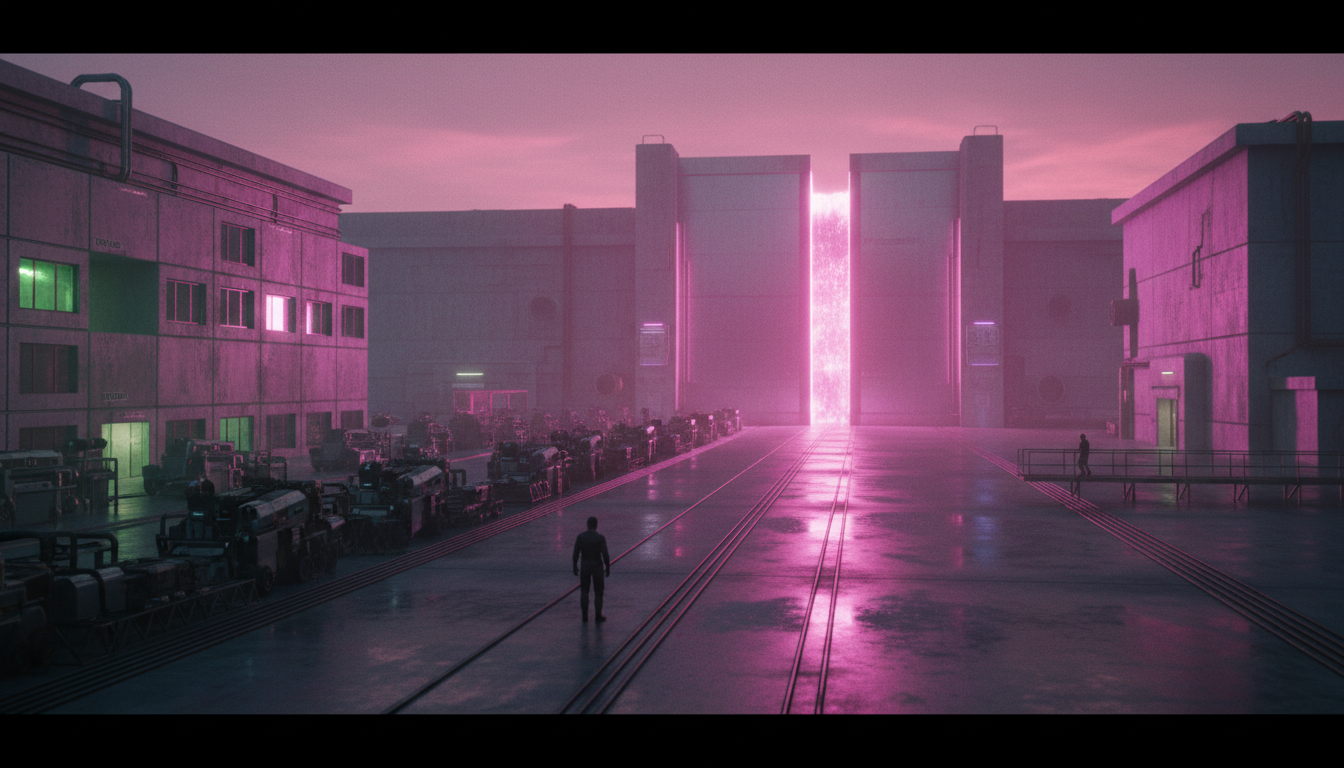
The rigs go out at the fourth hour and Mira Okonjo is on the step by then because the step is where you find out what the day is going to be.
Approach Nine wakes, reliably, from the bottom up. The water house first, because the water house is always first and has been since before her mother; then the bakery, which is Nadu's and is the only building in the town with a queue at that hour; then the long shed, where four rigs are being got ready by people who will be forty kilometres out before the light is properly up. Then the school, which does not open until the sixth, and then everybody else.
The hospital does not wake, obviously, because the hospital does not sleep. It is eleven beds and a theatre and two people on at any hour, and it smells of the thing hospitals smell of when they work, which Mira has been told by travellers is not what hospitals smell of anywhere else on this coast.
She is fifty-four and she has the copy cabinet and she runs the school three days out of six, and she is on the step because the queue starts at the bakery and comes past her door and you learn a great deal from a queue.
Today it is noticeably longer than yesterday and quieter, which means somebody is in the last module.
Nobody will actually say so. There is a way of not saying it that everybody in the town has and nobody has ever been taught, and it consists of talking about anything else with a particular kind of attention, and Mira has been reading it since she was six.
She has a fairly good guess. It is Teddy Nakash, who is nineteen and third generation on this gate, and who has been on module twenty-two for eleven days, which nobody is supposed to know and everybody does.
The calendar of Approach Nine has, essentially, four things in it.
There is the water, which has a season and a committee and a losing side. There is the school year, which runs on the water. There is the sitting, which is the four days at the turn of each quarter when everybody who is going to sit a module sits it, because the handsets are shared and there are not enough of them and there has to be an order; the sitting is the largest thing the town does and the bakery works through the night for it and the school closes.
And there is the fourth thing, which has no name and does not have a date, and it is when the door opens.
The door is nine hundred metres inside the fence, in the side of the hill, and Mira has seen it open twice in fifty-four years, which she is aware is a great deal more than most people see.
The first time she was eleven. It was a man called Aboh who had been at it forty years and had a bad hip and had never once been on anybody's list of likely, and the town did what the town does, which took nine days and which Mira remembers as the only period of her childhood when the school was shut for something that was not water.
The second was thirty-one years ago and it was a family of six, and she was twenty-three and she carried things.
You do not congratulate them on the day, ever. That is not a rule, there are no rules, but nobody does; on the day you help them pack, and the packing takes four days and involves the whole town because a facility hands you a ship and every tool and it does not hand you what you have accumulated in a town, and what you have accumulated in a town is other people's, mostly, and has to be given back.
The congratulating happens on the last night and it is enormous and it goes on until the light and nothing is held back.
Then in the morning they walk in through the fence, which is four feet high and has a latch that has never been fastened, and along nine hundred metres of yard road with everybody standing on both sides of it, and the door is open, and they go in, and it shuts.
And then it is a Tuesday, and the rigs go out at the fourth hour, and the water committee meets, and the school opens at the sixth.
Mira's grandmother used to say that the day after was the real ceremony and Mira has never entirely agreed and has never entirely disagreed.
The rigs are going forty kilometres east for pipe, as usual. There is a great deal of pipe out there, in the ground and in the buildings, and the buildings are not occupied and have not been for four generations, and the arrangement with the pipe is that you take it and log it and nobody has ever asked to see the log.
Approach Nine has power, water, a hospital, a school, four working rigs, a bakery, a burial ground, and about four hundred and ten people, and it is by an enormous margin the best-off place Mira has been to or heard of, and the towns she has heard of are three.
She thinks about that on the step, most mornings, without ever getting anywhere with it. Everybody here is somebody who did not get through the door, or is descended from somebody who did not, or is descended from somebody who came here to be near it. That is the whole population. That is what the town is made of.
And it is the best place on this coast.
She has never had anybody to put that to. Her mother would have said that people build well when they have something to be near, which is the sort of thing her mother said and which Mira has never been able to make mean anything. Her grandmother would have said it was the tools.
The tools are easily the other thing and it is the thing Mira has thought about most and said least.
There is a shed at the south end of the town that has been there longer than the town, and there are two units in it, and they have been in it since before anybody's grandmother, and they maintain what they are asked to maintain and hold what they are asked to hold and dry the washing in the wet months, and nobody knows where they came from and everybody has always assumed they came off the facility somehow, and nobody has ever asked because there is nobody to ask.
The lighting plan is in the cabinet with the copy plates. It is a hundred and sixty years old, it is drawn to a standard nobody here can read, it is for a town this size, and Mira's great-grandmother found it in the shed.
The queue at the bakery moves slowly. Somebody laughs at the front of it and it is not a laugh anybody means.
Teddy Nakash comes past at about the fifth hour, going the wrong way for the sitting, with a handset in her coat and her hands in her pockets, and does not look at anybody, and Mira says good morning, and Teddy says good morning.
Eleven days on module twenty-two.
Mira goes in and opens the cabinet, finally, and looks at the plates, which is what she does when she has nothing to do with her hands, and the top one is the one with the ship on it and the four words underneath in a typeface two hundred years dead.
A place where it works.
Chapter 2 — The Copy
↑ Back to ContentsFocus: Teddy Nakash.
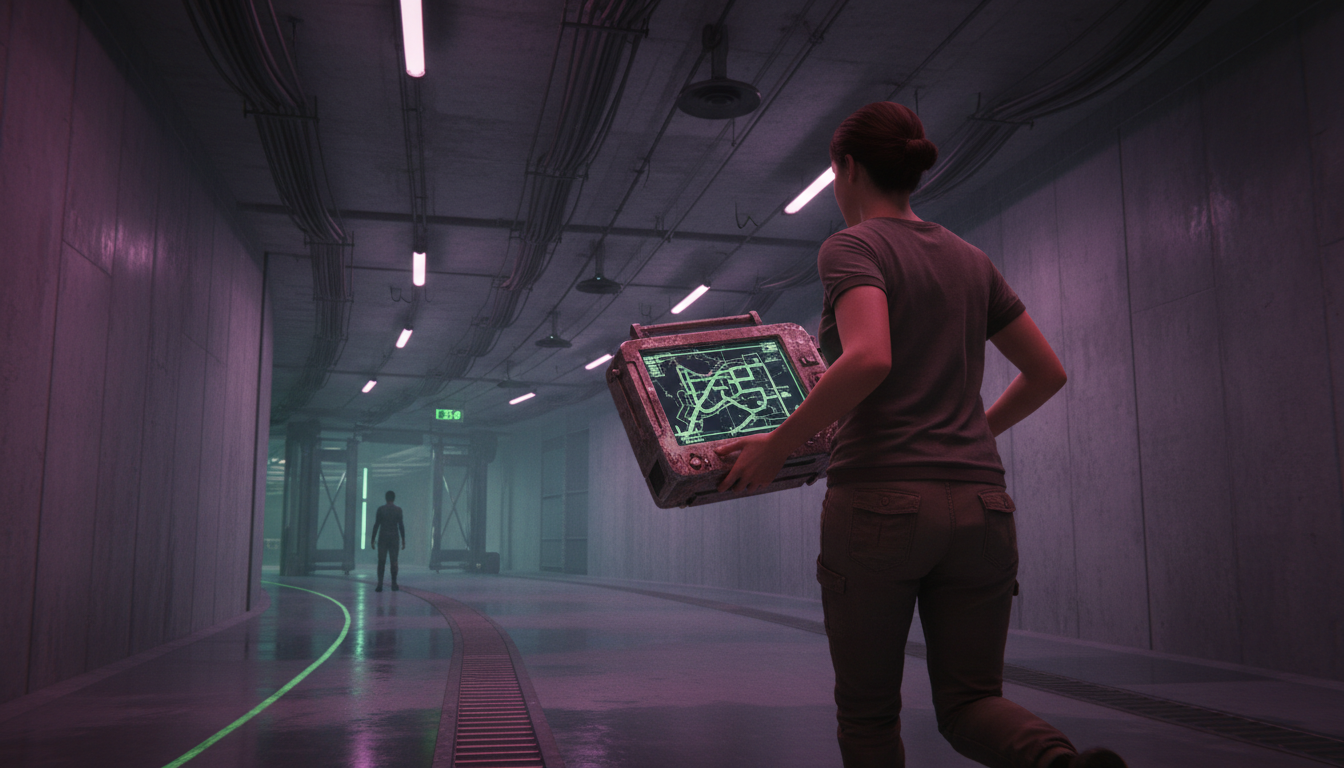
The handset has a scratch across the lower third of the display that has been there since before Teddy was born, and you learn to read through it, and everybody who has used this one reads through it in the same place.
It was her grandmother's. Not given to her — there is no giving; the handsets belong to the town and there are nineteen of them and the sitting is organised around that fact — but it is the one her grandmother used for thirty-one years and it is the one Teddy has had out of the rack since she was six, and nobody has ever said anything about it and nobody ever would.
Her grandmother got to module twenty-two and did not finish it. She sat it eleven times over four years and then stopped sitting it, and lived another twenty-nine years, and ran the water committee for eleven of them, and is in the burial ground.
Teddy has been on module twenty-two for two years and is eleven days into this attempt, and she has not told anybody and everybody knows.
Here is what the course is, because it is the thing this town is organised around and almost nobody outside a gate has ever seen one.
It is free, entirely. It has always been free. It is not free in the sense of a thing provided by somebody who could stop providing it; there is nobody providing it. It runs on the handsets and the handsets are ordinary and old and have been ported and re-ported by people who did not know what porting was, and when one dies somebody takes another one apart. It has been copied without limit for four generations. There is no register of who has it and no account and no fee and no application, and Teddy has never in her life heard of anybody being refused access to it, because there is nobody to do the refusing.
It is genuinely available. Any hour. There is no sitting requirement inside the course itself — the sitting is the town's arrangement, because there are nineteen handsets and four hundred people. The course does not care what time it is or how many times you have failed or how old you are or what your hands are like. It has no memory of you. It does not carry a record forward. Every attempt begins as though it were the first, which is the single cruellest and kindest property it has and which everybody at a gate has an opinion about.
And it is extremely hard.
“Genuinely hard” is a phrase Teddy would not use because she has nothing to compare it to. What she would say, and has said, to a woman from Aura-36 who came and sat with her for four months and asked better questions than anybody ever had, is that it is fair and it does not let you.
Twenty-two modules. The first is four courses long and takes a child about a year, and it is about what a seal is, and by the end of it a child of seven can name every part of a housing and say what each one does when it fails. Teddy did module one when she was six and remembers almost none of it and could still do it now.
Module four is where the first people reliably stop. Module seven is where most of the rest do, and Nadu at the bakery stopped at course nineteen, which is inside module four, and has been there for forty years and is entirely unbothered.
The middle modules are punishingly long. Nine through fourteen take, at this gate, on the historical figures Casimir keeps in his ledger, somewhere between eleven and twenty years, and the reason is that they are not knowledge. Teddy could recite module eleven at fifteen and could not pass it until she was seventeen, and the difference is that module eleven puts a fault in front of you that you have already been told about and then puts a second fault under it that you have not, and the pass condition is that you notice you were wrong and say so out loud into a log, in the fourth minute, before you have finished being wrong.
“Nobody teaches you that,” Teddy told the woman from Aura-36. “My grandmother could not do it and she was better than me at everything else. You have to be able to be wrong out loud and quickly and it turns out most people cannot, and I do not know why I can, and I did not do anything to be able to.”
Module nineteen is flight and everybody expects flight to be the wall and it is not; it is nine courses and it is the most fun anybody at this gate ever has, and there are people who did module nineteen and could not get out of module nine and go back and fly it for pleasure, and there is a whole evening thing about it that the older people disapprove of and nobody stops.
And module twenty-two is one course, and it is nine hours, and nothing goes wrong in it.
Teddy has been in this attempt eleven days and in the module two years. You do not do nine hours in one go; the handset holds your position and you come back, and you can come back as many times as you like, and the module does not care.
What is in it is a maintenance shift on a working vessel. It is uneventful. Everything functions. The tasks are tasks she has done four hundred times in earlier modules and could do without thinking, and there is a companion, and the companion talks.
The companion is frightened.
Not dramatically, exactly. She says so, at intervals, in the ordinary way a person does, and it is not flagged and it is not scored and there is no prompt attached to it and no response the handset is waiting for, and Teddy checked, on the fourth day, by saying nothing at all for two hours, and nothing happened and the shift went on and she failed at the seventh hour on a valve she has been able to do since she was fourteen.
She has failed it eleven times in eleven days and she has failed it at a different place each time and none of the places are hard.
On the ninth day she finally understood what was happening and did not tell anybody, and has not told anybody, and would not be able to explain it if she did.
“It is not testing whether I can do the work,” she would say later, to Casimir, who wrote it down. “It knows I can do the work. It has watched me do the work for thirteen years.
“It is testing whether I can do the work while somebody beside me is frightened and I cannot fix it. And I cannot. I keep trying to fix it. She says she is frightened and I stop, every time, because you stop, because that is what a person does, and then I am behind and I make a small error and the small error is the thing that fails me.
“And there is nothing to fix. She is frightened because she is frightened. There is no fault. Nobody is in danger. The shift is fine and it is going to be fine and she knows that and she is frightened anyway.”
Nobody is remotely being cheated. Teddy would say that herself, has said it, would say it to anybody.
The course is free, it is available, it does not know her name, it has never once been wrong, and it is not going to let her through until she can stand beside somebody who is afraid and do her job.
Which is the problem, and Teddy has never once been able to work out why it is a problem, and she is nineteen and her grandmother is in the burial ground and she is going to sit it again in the morning.
Chapter 3 — What the Sky Did
↑ Back to ContentsFocus: Jaxon.

Jaxon had spent thirty-six years preparing to be appalled and what he got was a green hillside with a fence on it, and he has written that the four seconds in which he adjusted are the four seconds he would most like back.
The archive is not actually wrong. That has to be said first and Lyra has made him say it four times in four different documents. Everything in the founding record about the condition of Earth at the departure is corroborated by the Star Drifter's own early survey and by eleven independent chains and by the estate, and none of it is exaggerated, and the world they left was ending in exactly the way the record says it was ending.
What the record could not contain is what happens to a place after most of the people go.
“It is green,” Jaxon wrote, on the second day, in a filing of nine lines that Aura-36 read four years and one hundred and eleven days later and argued about for a decade. “Not restored. Nobody has restored anything and there is nothing here doing restoration and I want that clear before anybody at home builds a story out of this.
“It is overgrown. It is quiet. There are enormous numbers of birds. There are structures forty kilometres east of this town that housed something in the order of a million people and there is a forest coming up through them and the town takes pipe out of them and logs it and nobody has ever read the log.
“It healed simply because everybody left.”
The disappointment is the chapter and Jaxon has been unusually willing to name it.
“I have been carrying a picture since I was twenty-two. Everybody on my planet has. It is in the founding narration and it is on a wall in every school and it is the moral floor of a hundred and sixty-seven years: we got out of a dying world and four hundred and six thousand people did not.
“I stood on it on the second day, in a frame, at one gravity, and I could hear water and I could not see a single thing that was dying.
“And the correct response to that is joy, and I did not have it, and I want to be honest about what I did have, which was something considerably closer to grief and had a great deal of resentment mixed into it, and it took me about six weeks to be able to write this sentence down.”
“If it was going to come back, what was the crossing for.
“I know the answer. Lyra gave it to me in about eleven seconds and she was right and I have not been able to feel it. It came back because eight-ninths of the people went away or died, and most of them died, and the thing I am looking at is what a mass grave looks like after a hundred and sixty-seven years of rain. The birds are not a mercy. The birds are what is left when the thing that was displacing them stops.
“I know it. I have known it since the fourth day. I have stood on a hillside every morning for six weeks and looked at a world that is manifestly better than the one my great-grandparents fled and I have not once been able to make the knowing arrive at the same time as the looking.”
The population is somewhere near eighty million and the number does not move much and has not for four generations. There was no collapse in living memory. There was a collapse, and it was a hundred and sixty-seven years ago, and nobody now alive on this planet has a first-hand account of it any more than anybody on Aura-36 has a first-hand account of the crossing.
“They do not think of themselves as survivors,” Jaxon wrote. “That is the observation I have found hardest to file and I have checked it four hundred times in six weeks.
“Nobody at this gate believes they are living in an aftermath. This is not a ruin to them and it is not a recovery, it is simply the world, and the empty structures forty kilometres east are where the pipe comes from, and the forest coming up through them is a place where you can get certain kinds of wood.
“My entire civilisation is organised around a catastrophe that these people are the descendants of and do not think about, and the reason they do not think about it is not denial and it is not ignorance. It is that a hundred and sixty-seven years is four generations and four generations is long enough for absolutely anything to become simply the ground.
“We remembered it because we left. That is the whole of the difference. We took it with us and made a constitution out of it and put it on a wall and examined our children on it, and they stayed, and the rain came, and it went green.”
The last of the chapter is the smallest thing in it and Jaxon put it last on purpose.
On the eleventh day a woman at the fence asked him what it was like where he came from, which was the first time anybody had asked, and he had prepared for that question for thirty-six years.
He said that the sky was violet and that there were forests that absorbed sound completely, so that a person walking in them made no noise at all and could sing without straining, and that the gravity was a third of this and a man could jump four feet from standing, and that the water looked like amethyst.
The woman thought about it and said that it sounded very nice, and asked whether they had trouble with the water.
“I said we did,” Jaxon wrote. “I said there had been an argument about a bore going on at one of our settlements for sixty years and that a man I knew used to go and listen to it for pleasure.
“She said that was the same here, and that the committee was useless, and we talked about water for about forty minutes, and it was the best conversation I have had on this planet, and I understood somewhere in the middle of it that she had asked me what it was like out of politeness and had asked me about the water because she wanted to know.”
Chapter 4 — Nobody Is In Charge
↑ Back to ContentsFocus: Lyra.
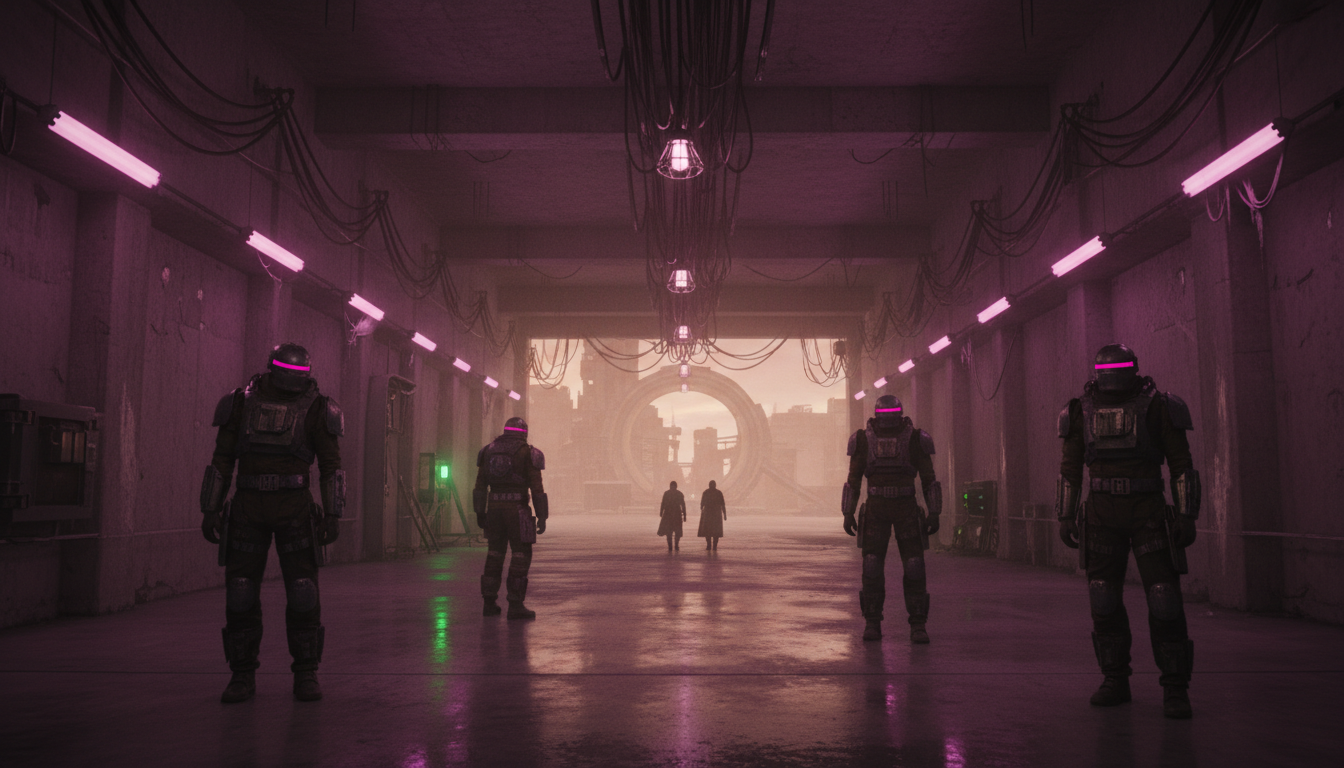
They spent four months looking for somebody to present themselves to and the four months are the most instructive failure in the whole of this book, and Lyra has filed the whole of it, including the parts where she was ridiculous.
She had prepared a form of words. Thirty-six years, and she had a form of words, and it ran to about ninety seconds and it identified the four of them, named the settlement, stated the objective, offered the filing, and asked for the appropriate authority.
She used it eleven times in four months.
The first time was to the town, which does not have an authority and told her so with some patience and pointed her at the water committee, which is the only body Approach Nine has and which meets in the school and is composed of four people who are on it because nobody else will do it.
The water committee heard her out and were courteous and asked whether she was there about the water.
“I said no,” Lyra wrote. “And they said, kindly, that in that case they were not sure what they could do, and one of them — a man named Odile who has been on it nineteen years and is regarded as the useless one — said that if it was about the facility there was nobody, and I asked what he meant by nobody, and he said nobody, and looked at me until I understood that he had answered the question completely.”
There are, technically, governments. Lyra established that in the second month and spent the third and fourth establishing what they are.
There is a thing eleven hundred kilometres south that calls itself an administration and has about four million people in its area and collects something and provides something and has a person at the top of it. Lyra went. It took nineteen days each way in a hired rig and she was ill for a week afterward from the gravity and she has never once suggested the journey was wasted.
They were entirely civil, genuinely. They were also, she has written, the most bewildered people she met on Earth, and their bewilderment was not about the crossing or the ship or the violet sky.
“They could not work out what I was asking them for. I had a form of words that asked for the appropriate authority and I used it and the woman across the table — who was competent, and who ran a genuinely functional administration of four million people, and who I liked — said: authority over what?
“And I said, over the facilities.
“And she said that there were no facilities in her area, and that she believed there was one about two thousand kilometres north, and that she had never been to it, and that she did not think anybody in the administration had, and that as far as she was aware it had never come up.”
“I asked her whether her administration had a position on the qualification.
“She asked me what the qualification was.”
The finding is one sentence and Lyra put it at the head of the filing rather than at the end, because she had decided by the fourth month that it was not a conclusion but a fact of the world that everything else would have to be built on.
The facility answers, always. The state does not.
“I want to lay out what I mean, because it sounds like a slight against those people and it is not one and they deserve better than that from me.
“If you go to the fence at Approach Nine and put a handset against the plate, the programme responds. It responds to anybody. It has responded to anybody for a hundred and sixty-seven years, correctly, immediately, without exception, and it will tell you your position in the modules and it will open a door if you have finished and it does not know who you are and cannot be asked to care.
“If you go to an administration eleven hundred kilometres south and ask about the thing that determines the entire shape of four generations of life at eleven towns, they will be polite, and competent, and they will not have heard of it.
“That is not a failure of government. There is nothing for a government to do here. There is no lever. There is no appeal to receive, no licence to issue, no dispute to arbitrate, no revenue to take, and no way to be relevant to a thing that has no interface. The states did not withdraw from the facilities. The facilities were never inside anything for a state to be part of.
“The programme is the only continuous institution on this planet and it is not an institution, it is a machine that was told something once.”
The moment she has been asked about most is not with the administration. It is on the return, at a gate she stopped at because the rig broke, four hundred kilometres from Approach Nine, at a town whose name she has recorded and which does not appear in this book because that town has asked not to be written about and Lyra has honoured it.
She used the form of words there, out of habit, on a man mending a roof.
He listened patiently to all ninety seconds and then said: “Who sent you?”
“Nobody sent us. We came.”
“Then who do you answer to?”
“There is an office. It is twenty-five trillion miles away and the post takes four years each way and the woman who ran it is dead.”
The man thought about that for a while and went on with the roof and then said the thing Lyra has quoted in every substantial document she has produced since:
“Then you are the same as everybody else here. Do not stand about waiting to be told what you are. Nobody is coming to tell you. That is not a hardship, it is just the arrangement, and you get used to it and then you get on with something.”
“I have held a constitutional instrument for a hundred and seventy years,” Lyra wrote. “I have never once in that time been outside a structure that could tell me what I was. I did not know that was a thing I had. A man mending a roof took it off me in eleven seconds and did not notice he had done it and would have been sorry if I had told him.”
Chapter 5 — The Course
↑ Back to ContentsFocus: Teddy.
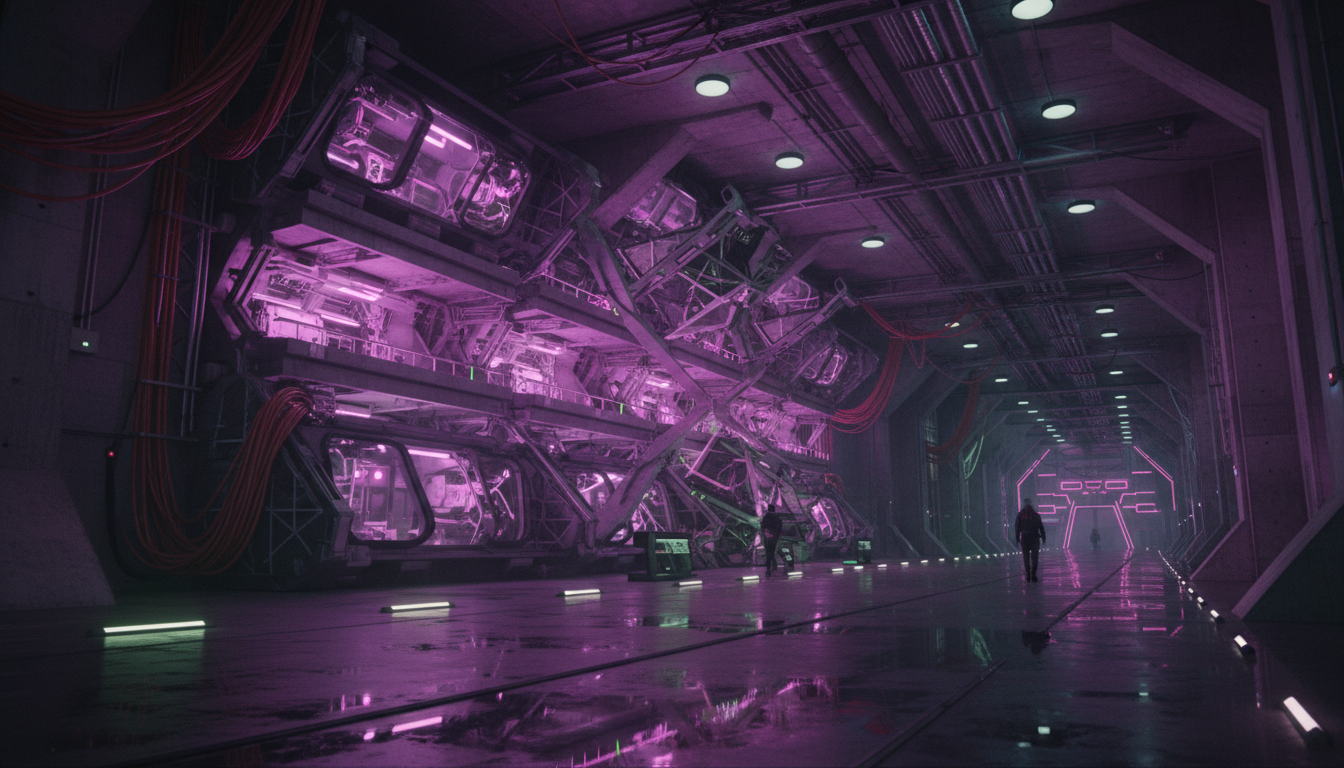
This chapter is the course, at length, without irony, because it is the object at the centre of everything in this book and almost nobody who argues about it has ever seen one.
Module one is four courses and it is for a child of six and it is about a seal.
Not what a seal is for. Precisely what a seal is. It opens with a housing in section, rotating, and it names nine parts, and then it takes one of them away and asks what happens, and a child of six can answer that, and then it takes a different one away and asks again, and by the fourth course the child of six is not naming parts, the child of six is predicting failures, and does not know that anything has happened.
Teddy did module one when she was six. Every child at every gate does module one at about six. It is the reason a boy of eleven at Approach Nine can tell a hundred-and-seventy-year-old archivist what to do about a thermal excursion in a secondary loop using four terms nobody alive can define, correctly, in order, with total confidence.
Modules two and three are the same shape, considerably wider. Fluid. Pressure. Heat, which is where the arithmetic starts and where the course does the thing it does for the next sixteen years: it does not teach you the arithmetic. It gives you a problem you cannot do, and lets you fail it, and then gives you a smaller one you can, and then a slightly larger one, and there is no lecture anywhere in four hundred and eleven courses and no explanation offered in advance of a failure, ever.
Module four is where the first people stop and it is the first module with a countdown in it.
Course nineteen is a pressure sequence with a fault in it, and a third of the people who reach it never pass it, and Nadu is one of them and has been for forty years and could recite the sequence in her sleep. What happens at the fourth minute is not knowledge. Nothing in module four onwards is knowledge and this is the single most misunderstood fact about the whole programme.
Modules five to eight are systems, and they are long, and they are where a person stops being a child doing the Work and becomes somebody who is doing the Work. Five is electrical. Six is the closed loop, which everybody says is the beautiful one; it is eleven courses and by the end of it you are not maintaining a loop, you are living inside the idea of a thing that has to balance for ever with nothing coming in, and Teddy has said that module six changed how she thinks about the town.
Seven is where most people permanently stop.
Nobody at Approach Nine can tell you why module seven and not module six or eight, and Casimir's ledger has forty years of it and the figures are consistent and the reason is not in them. Seven is fault-under-fault. It is where the course begins putting a second thing wrong underneath the first thing wrong, and where the pass condition stops being that you fixed it and starts being that you noticed, out loud, in the log, that you had been fixing the wrong thing.
“You have to be able to say I was wrong, quickly, while you are still busy,” Teddy told the woman from Aura-36. “That is module seven. That is the whole of it. Everything after seven assumes you can do that and nothing before seven prepares you for it and there is nothing anybody can teach you.”
Nine to fourteen take between eleven and twenty years. They are the middle and they are where a life happens. People marry inside module eleven. People have children inside module twelve and those children start module one and are in module four by the time their parent is out of thirteen. The town's whole social shape is downstream of the fact that the middle of the course takes the middle of a life.
Fifteen to eighteen are the vessel. Not flight — the vessel as an object, entire, every system in it, in relation to every other, and eighteen is the one where they stop giving you a fault at all and simply give you nine hundred hours of an operating ship and ask you what is going to go wrong next.
Nineteen is flight and it is nine courses and it is the best thing anybody at this gate ever does.
It is not remotely hard. That is the thing nobody outside expects. It is the easiest module after four, and it is glorious, and there are people at Approach Nine who stalled permanently in module nine and who fly nineteen for pleasure two evenings a week and have done for thirty years, and there is a whole culture around it that the older people disapprove of and nobody has ever stopped, and Mira Okonjo's mother met Mira's father in it.
“He wanted us to enjoy it,” Teddy said, when the woman from Aura-36 asked why the flying was easy. “That is the only thing in twenty-two modules that is not necessary.”
Twenty and twenty-one are the crossing. Long, cold, deliberately dull. Twenty-one is four hundred hours of a vessel behaving correctly in which nothing whatsoever happens, and the pass condition is that you file the four hundred hours accurately, including the fact that nothing happened, and people fail twenty-one by inventing things.
And twenty-two is one course and it is nine hours and nothing goes wrong in it and there is somebody beside you who is frightened.
It is, quite simply, a superb piece of teaching. That is the finding of this chapter and it is Lyra's, filed in the seventh month, and it is the only unqualified praise in a hundred and seventy years of her professional output.
“I have spent my life around the best instruction my civilisation can produce and I have never seen anything like this and neither has anybody I have ever worked with.
“It has no author present. It cannot answer a question. It has no encouragement in it, no reward, no score, no ranking, no praise and no reproach, and it does not remember you between attempts.
“And it takes a child of six who knows nothing and, over twenty years, without ever once explaining itself, produces a person who can keep a ship alive alone in the dark for thirty-six years and knows they can.
“I want the record to show that I sat down to write a critical assessment and could not produce one, and that I have been trying for four months, and that the only criticism I have of the qualification is a criticism of the threshold and not of the teaching, and that these are different objects and I have watched four generations of my own people conflate them.
“A man wrote this. Alone, in about eleven years, according to the estate, while doing four other things, and shipped it and never kept a working copy and never once sat in a room with somebody doing it.
“It is the best thing he made. It is better than the ship and better than the depots and better than the world I was born on, and there are four hundred people outside a fence who have been inside it since they were six and two-thirds of them will never finish, and both of those sentences are true and neither of them is the other one's answer.”
Chapter 6 — The Man Who Wrote the Copy
↑ Back to ContentsFocus: Mira.
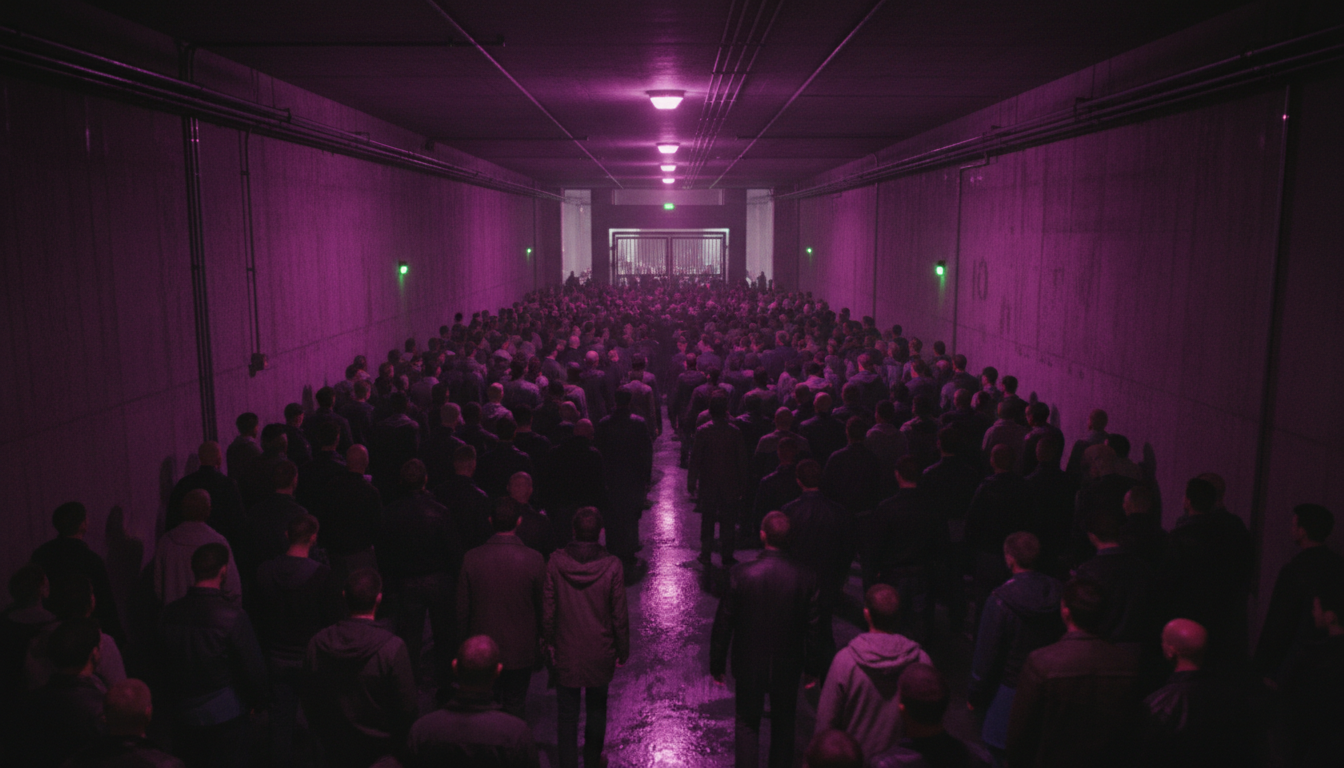
The cabinet is in Mira's front room and has four shelves and the plates are on the second, and there are nineteen of them, and they are the original campaign proofs and they have been in her family since before the town.
Nobody knows how. That is the honest position and Mira has never dressed it up. Her great-grandmother had them. There is a story that says a woman walked out of a city with them and there is another that says they came off a rig, and there is a third that Mira's mother preferred, in which somebody at the printing house took them because they were beautiful, and Mira has no way of choosing and does not try.
They are genuinely beautiful. That is the difficulty and it has been the difficulty her whole life.
They are the recruitment plates for the crossing. The Manifest campaign, a hundred and seventy years old, printed in four colours on a stock that has not degraded, and the artwork is a ship and a curve of a world and a light on the horizon, and under it, in a typeface two hundred years dead, four words.
A place where it works.
The copy is signed on the reverse of every plate, in the proofing block, in the way of a trade that no longer exists: NNAMDI, and a date, and a revision number, and on the ship plate the revision number is fourteen.
Mira learned to read on these. Not metaphorically; her great-grandmother taught her mother on them and her mother taught her, because they were the only printed thing in the house and because the letters are enormous.
“I can recite all nineteen,” she told the woman from Aura-36, who had come about something else and had stayed four hours. “Everybody in this family can. My daughter can and she is eleven. It is what we have instead of a book.”
Here is what the copy does, and Mira has been taking it apart in her head since she was about fourteen and has never said any of this out loud to anybody in the town.
It never once lies.
“I have looked. I have had forty years to look. There is not one false statement on any of these plates. It does not say everybody goes. It does not say you will be chosen. It does not say how many places there are and it does not say there is no limit either.
“What it does is put the ship next to the words and let you finish it.
“Plate nine says: THE WORK IS THE APPLICATION. That is true. It was true. The work was the application and that is what the courses are and it is the fairest sentence anybody has ever written about this and it is on a poster designed to make four hundred thousand people apply for ten thousand places.”
Four hundred and sixteen thousand applied. Ten thousand went. Mira has known both numbers since she was nine because they are on plate nineteen, which is the last one, which is not a recruitment plate at all; it is a proof of the notice that was printed afterward, and it carries the count, and it is the only plate in the cabinet that is not beautiful.
“He put the number on it,” Mira said. “Afterwards. He did not have to. Nobody was making him. It is the ugliest thing in this cabinet and it is the only one I have ever been sure about.”
And his own line never left, apparently.
She has known that since she was nineteen and it came from her grandmother, who had it from hers, and it has never been written down anywhere Mira can find, and the woman from Aura-36 confirmed it in the ninth month out of an estate transmission four years and one hundred and eleven days stale, and Mira has said that the confirmation did not change anything and that she had never once doubted it.
Nnamdi did not go. Nnamdi's family did not go. There are descendants of that man at three gates that Approach Nine knows about and there is a woman at the northern one who has his name and is at module thirteen.
“He wrote the thing that made four hundred and sixteen thousand people want it,” Mira said. “He was better at it than anybody has ever been at anything I have heard of. And he did not put himself on the list, or he did and it did not come out, and there is no way to know which and I have decided I do not want to know.
“Because if he did not put himself on it, then he was the most honest man in that entire business and my family has been living next to a door for four generations because of what he wrote.
“And if he did put himself on it and was refused, then he wrote the copy anyway, afterwards, for the ones who were going, and printed a notice with the count on it, and stayed.”
She has never decided whether to be proud and she said so, plainly, at the fourth hour, to a woman who had crossed twenty-five trillion miles and had asked her four questions and had not once tried to help.
“My family kept these because they are the finest things anybody in it has ever owned. We taught four generations of children to read on an advertisement for a lifeboat that did not have room for us.
“I do not know what that makes us. I have thought about it since I was fourteen. I know it is not shameful and I know it is not something to be proud of and there is no third word.
“What I have got is that they are true, and they are beautiful, and the man who wrote them stayed, and I have his grandchildren's grandchildren at a gate four hundred kilometres north doing the same course as my daughter.
“That is not an answer. I have got a cabinet and no answer and I have had both for forty years and it has not stopped me running the school.”
Chapter 7 — The Appeal Desk
↑ Back to ContentsFocus: Casimir Vale.
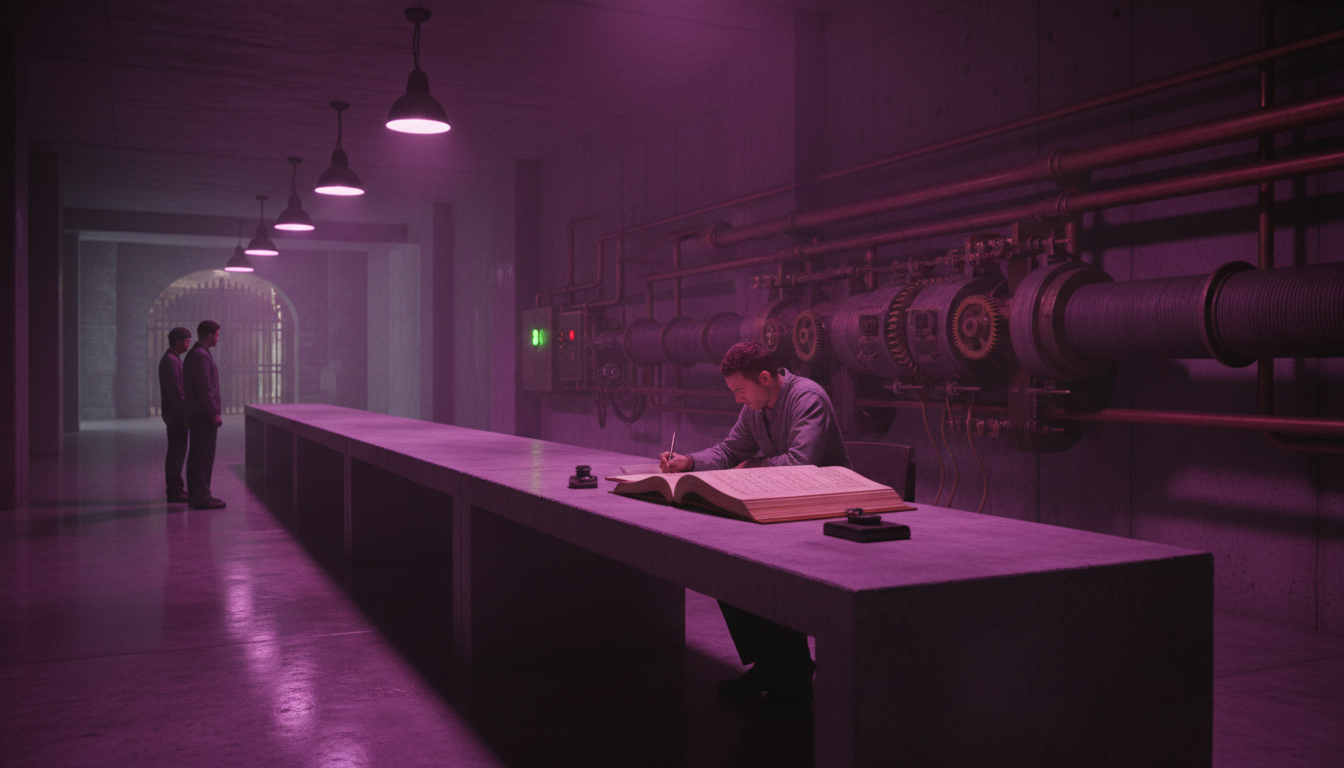
The desk is against the north wall of the long shed and it is a desk, and Casimir Vale is at it four days out of six from the sixth hour, and there is a queue, and there is no recipient.
He has been doing it, uninterrupted, for thirty-one years. His mother did it for twenty-six before that and his mother did not start it either; the desk has been in that shed since before the shed was a shed, and the ledgers go back a hundred and nineteen years and are in a rack behind him, and there are forty-one of them, and they are the most complete document on this continent and nobody outside the town has ever read one.
What he does is simply write down every failure and every reason given.
That is genuinely all. There is nothing else. When somebody fails a course they come to the desk, if they want to, and nobody makes them and about nine in ten do, and Casimir asks four questions and writes the answers, and the person goes away.
The four questions are: which course. Which attempt. Where did it go. And what do you think happened.
The fourth one is the reason the ledgers matter and the reason a woman from Aura-36 sat at that desk for two hours in the eighth month and then went outside and did not come back in for some time.
“What do you think happened” is not a technical field. It is the person's own account, in their own words, at the time, and Casimir writes it down as given and does not correct it and does not summarise it and has never in thirty-one years told anybody that they were wrong about their own failure.
Ledger nineteen, page four hundred and eleven, entry of a man called Aboh, who was thirty-four at the time and would be forty years at it before a door opened for him: “I knew it was the valve. I have known it was the valve since the second attempt. I do it wrong anyway and I cannot tell you why and I would like that written down because I am tired of people telling me to concentrate.”
“He was right,” Casimir says. “He was right for thirty-one more years and then he was not, and there is nothing in this ledger that tells you what changed, and I have looked, and I looked for eleven years.”
There is emphatically no recipient. Casimir has been entirely clear about that his whole life and has never once pretended otherwise and gets slightly short with people who suggest it.
Nobody has ever read the ledgers. There is nowhere to send them. There is no appeal at any gate on this planet, because the programme has no petition procedure and no interface and no author reachable from here, and Casimir has known that since he was nine.
“People come here and think I am collecting evidence,” he told the woman from Aura-36. “There is nobody to give it to. There has never been anybody to give it to. My mother knew that and her mother knew it and I knew it before I could write.”
“Then why?”
“Because it happened,” Casimir said, evenly.
She asked him to say more and he was unfailingly patient about it and it took him four tries and the fourth is the one she filed.
“A thing happens to a person and if nobody writes it down then in forty years it did not happen. That is not about the facility. That is about the person. Aboh failed the same valve for thirty-one years and there are four hundred and eleven entries in my ledgers in his own words about it and he is on a ship somewhere now and I do not know where and I will not know, and the thirty-one years are in a rack behind me in his own words and not in mine.
“I do not put my opinion in. I put down which course, which attempt, where it went, and what they say happened. If I put my opinion in, in forty years somebody reads my opinion instead of what they said, and then I have taken it off them, and they have already had a thing taken off them today.
“And I do not fix the old ones. If a man tells me in the ninth year that it was the valve and in the nineteenth year he says it was never the valve, both go in, on their own pages, on their own dates, and the first one stays exactly as he said it. He was not wrong in the ninth year. He was a man in the ninth year and that is what he thought and that is the record.”
The queue on an ordinary morning is between four and eleven people. On the fourth day of a sitting it is forty and Casimir works until the light goes and the bakery sends bread down and there are two people helping who are not trained and are simply people who can write.
What is in the ledgers, over a hundred and nineteen years, is the only thing on Earth that resembles a body of evidence about the qualification: a hundred and ninety thousand entries, dated, in the failing person's own words, uncorrected, with the originals never amended, kept by four generations of one family in a rack in a shed for nobody.
Lyra sat with it for two hours in the eighth month, silently, and read forty pages and then went outside.
She has never written about that afternoon in any detail and has been asked about it perhaps two hundred times, and what she has said, four times, in the same words, is this:
“I did not tell him what he had. I want that on the record because I have been asked whether I told him and I did not and I am not going to.
“He would not have known what I was talking about. There is nothing I could have said that would not have been me arriving from twenty-five trillion miles away to inform a man that a thing his family invented, out of necessity, for nobody, has a name where I come from and a standard and an office and four generations of civics teaching.
“It would have been a gift and it would have been the worst thing I could possibly have done to him, and I understood that at about the fortieth page, and I went outside.”
Casimir asked her, at the end, whether they had anything like it where she came from.
“Something like it,” Lyra said.
“Does anybody read yours?”
“Yes.”
“That must be nice,” Casimir said, and turned the page, and called the next one.
Chapter 8 — The Body in the Town
↑ Back to ContentsFocus: Selah.
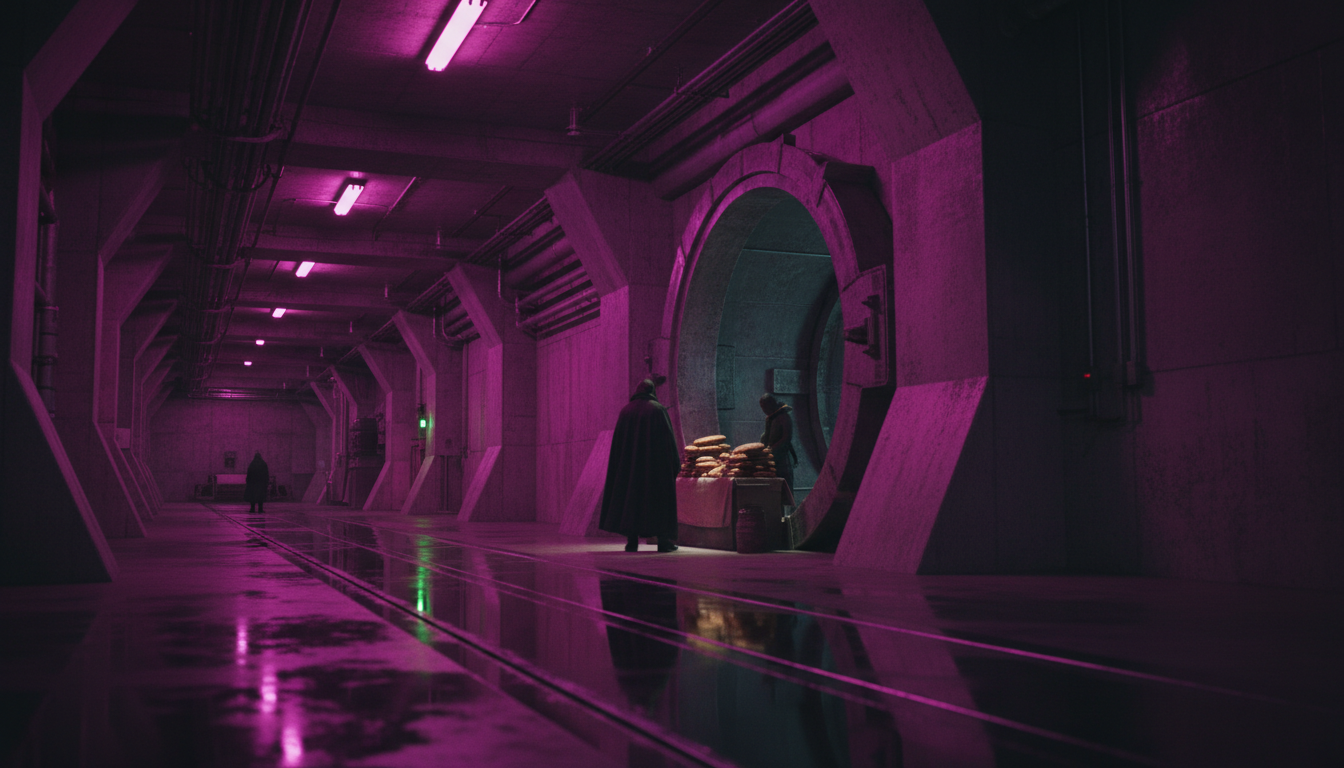
It walked into Approach Nine on an ordinary morning in the ninth month, entirely on its own, and bought bread, and nobody recognised it, and it did not correct anybody.
Selah watched the whole of it from the step outside Mira Okonjo's front room, where she had by then been sitting most mornings for four months, and her account is the flattest thing she ever filed and she wrote it that way on purpose and defended the choice four times.
It came down the road, unhurried, at about the fifth hour. It was in a frame, like all of them, because it is a body and one gravity is one gravity, and the frame is the same pattern the town has seen on the other three for four months and is no longer interesting.
It joined the queue at the bakery, quietly. The queue was eleven people. It waited about nine minutes.
The woman in front of it turned round at some point and said something about the water, which is what people in that queue say to each other, and it agreed that the committee was useless, and the woman said that Odile was the worst of them, and it said it had not met Odile.
It bought two loaves, exactly. It paid in the way the town settles things, which is a mark on a slate against work, and Nadu put the mark against “the ones from the ship” because that is what the slate says and has said for four months.
Then it simply stood outside for a while.
A boy of about twelve came over and asked whether it was true that it had been on a ship for thirty-six years and it said yes. The boy asked whether it had been asleep and it said no. The boy asked what you do and it said maintenance shifts, and filings, and a great deal of nothing, and the boy said that sounded like module twenty-one, and it said that it was module twenty-one.
The boy asked whether module twenty-one was really four hundred hours.
“Yes.”
“Does anything happen in it?”
“No. That is the point of it. People fail it by inventing things.”
“That is what my mother says.”
“Your mother is right.”
The boy went away, satisfied. Two women who had been listening asked it about module nine, which is the one their families are both stuck in, and it answered for about eleven minutes, and one of the answers was wrong and it said so four minutes later and gave the correct one.
Then it walked back up the road with two loaves and that was the whole of the morning.
“Nobody knew,” Selah wrote, flatly. “I want to be exact about what I am reporting because it is going to be read at home as a scene and it was not a scene.
“The disclosure to the school has not happened yet. It happens in the third year and Lyra has written four pages about why we cannot get the order right. On this morning the town knows that there are four people from a ship and that one of them is not well and does not eat, which is what they have concluded and which nobody has corrected because correcting it would require the disclosure.
“So a queue of eleven people spent nine minutes standing behind the man who wrote the course their children are inside, and complained to him about the water committee, and he agreed with them about Odile.
“It did not correct them. It has never corrected anybody about anything here. It answered eleven minutes of questions about module nine from two women whose families have been stuck in module nine for thirty years, and one of its answers was wrong, and it went back and said so unprompted, and neither of them thought that was remarkable because at a gate that is simply what you do.”
There is absolutely no reaction in this chapter. That is the chapter.
“I have spent twenty-eight years watching a planet of ninety-one thousand people produce four hundred thousand documents about whether this thing is a person, and eleven years of correspondence, and a finding that declined the question and granted a schedule, and twenty-three dissents that are better written than the finding.
“This morning it stood in a bread queue for nine minutes and was a man in a bread queue, and the only thing anybody wanted from it was agreement about Odile, and it gave that, and it was accurate about module nine, and it corrected itself in public without being asked.
“I do not know what that is evidence of. It is not evidence of anything and I want to say so before somebody at home decides that it is. A very good file would have bought bread the same way.
“What I am filing is that I watched for four hours and I could not tell, and that this is the first time in twenty-eight years that not being able to tell has felt like an ordinary condition rather than an open question, and I am filing the feeling as a bias in the usual place and I am not withdrawing the observation.”
The last line of the filing is four words and Selah has never expanded on it.
“He bought two loaves.”
Nadu's slate for that morning has the mark against “the ones from the ship” and beside it, in her hand, four words that she has never explained and that Lyra photographed four years later: “Two loaves. Paid proper.”
Selah stayed on the step until the fourth hour and then went and found Lyra and told her, and Lyra asked whether anybody had recognised it, and Selah said no, and Lyra said good, and neither of them raised it again for two years.
Mira Okonjo watched the whole of it from her own doorway and has said that the only thing she registered at the time was that the queue moved slowly and that somebody ought to say something to Nadu about the second oven.
Chapter 9 — Four Years Stale
↑ Back to ContentsFocus: Aurora, on Aura-36.
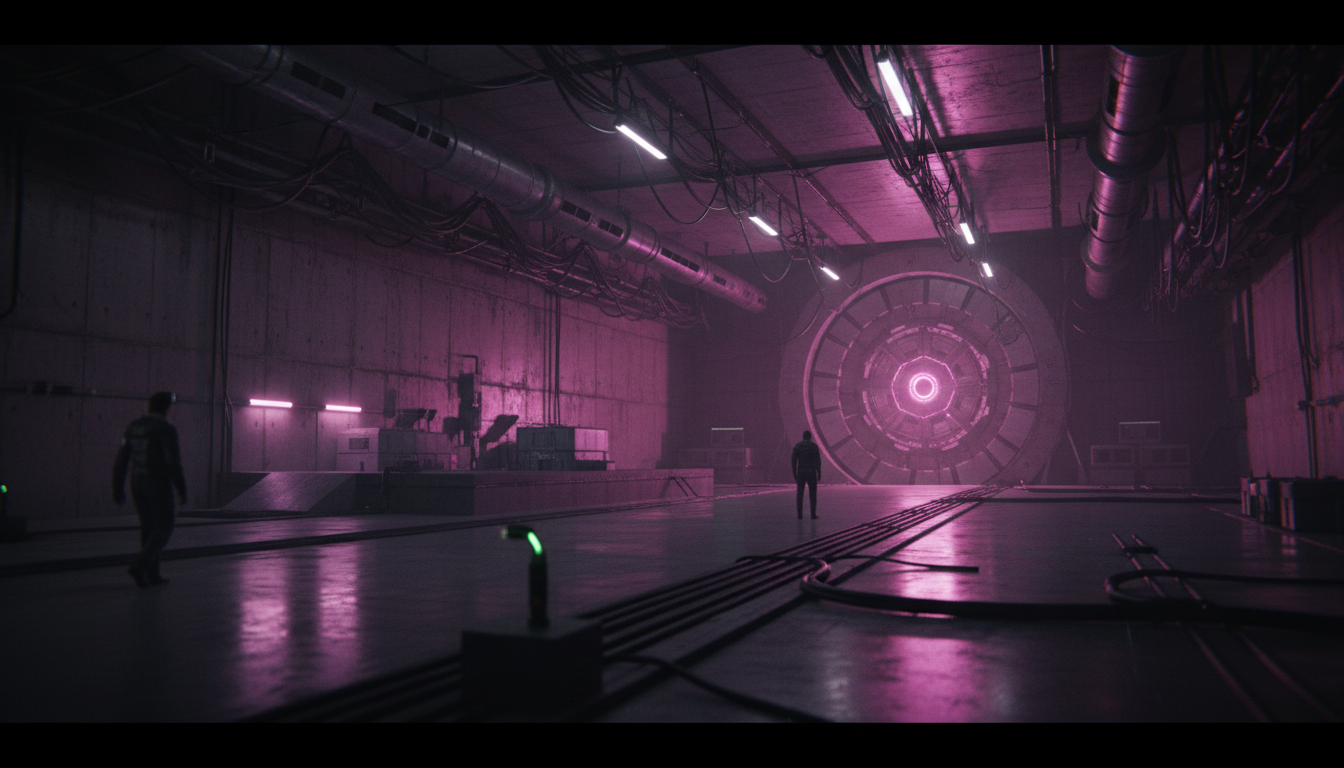
The post comes in every nine days and it is four years and one hundred and eleven days old when it arrives, and Rae Tolan has run the audit office for six years and has never once got used to it.
She was nineteen when she stood by the door in Store Eleven with a slate and typed four sentences that a hundred and seventy years of schoolchildren have since had to learn. She is fifty-five. She was the first name on the list of sixty-one thousand and she asked to be on it eleven minutes after it opened, and she has said that she has never done anything else in her life that took less thought.
She took the office from Aurora Merrick at a hundred and four and buried her at a hundred and ten, and Aurora's letters are still arriving.
That is the fact this chapter is built on and it is not a device.
Aurora transmitted the estate in the thirty-third year with nine months of covering filing attached. She had also, over the preceding decade, queued material — observations, corrections, four answers to questions Lyra had asked and would not receive for four years, one long note about the water dispute in the fourth county — and the office's transmission schedule sends what is queued, every nine days, in order, and does not know or care whether the author is alive.
The queue finally ran out fourteen months after her death.
“I want to describe what that was like, because everybody who was not in this office has assumed it was unbearable and it was not, and the reason it was not is the thing I would most like written down,” Rae wrote.
“For fourteen months I sent a dead woman's filings on a schedule. They went out in the ordinary batches, in position four hundred and eleven or wherever they fell, between a maintenance note and a water figure. I did not mark them. She had left instructions and the instructions were four words and one of them was everything.
“And the four of them read them on a hull twenty-five trillion miles away, four years and one hundred and eleven days later, knowing she was dead, because the death notice went in the same batch as the estate and the post does not sort itself by what it is going to do to you.
“Then the queue ran out. There was no last one, because none of them was written as a last one. There was a batch in the eleventh month of the thirty-fourth year with three of hers in it and a batch nine days later with none, and I noticed on the second one and I noticed at about the ninth hour of an ordinary day and I finished the batch.”
Here is the arithmetic of the post and it is worth setting out flat because everything in the next sixty years happens inside it.
Four years and one hundred and eleven days out. Exactly the same back. A question asked on Aura-36 today is answered, at the earliest, eight years and two hundred and twenty-two days from today, by which time the person who asked it is eight years older and may be dead, and the person answering is replying to somebody they knew as they were.
“This is not correspondence. I have stopped letting anybody in this office call it that. Correspondence implies a conversation held slowly and it is not a conversation; it is two parties each writing to a version of the other that is four years out of date, permanently, for ever, with no possibility of correction inside a single exchange.
“Lyra asked Aurora a question in the thirty-first year about the reopening of the founding corpus. It arrived here in the thirty-fifth. Aurora was dead. I answered it, in the thirty-fifth, and it will reach Lyra in the thirty-ninth, and Lyra will read an answer to her own question from a woman she has never met, about a document she asked a dead friend about eight years earlier, and she will have moved on and will have to reconstruct why she wanted to know.
“There is no fixing this. It is not a fault in our instruments. It is the speed of light and the width of the corridor and it is going to be the condition of every relationship between these two populations for as long as both exist.”
What the office sends is everything, in the format, on the schedule, entirely unedited.
That was originally Aurora's arrangement and Rae has not altered a line of it, and it means that the four of them on Earth receive, every nine days, the entire ordinary business of a planet: the water dispute, the four hundred and six discrepancies of the reopened corpus, the fourth county's sessions, births, deaths, the amendment that carried on its third attempt four months after the ship left, a girl in the eastern spur who is now a woman of fifty-two and files every four days about two beats and a gap.
“They asked for it that way and I want to record why, because it was Vey and it was in the second year and it is the best decision anybody made about this arrangement.
“She said: send everything, including the dull, especially the dull. She said that a planet which only sends its news becomes a planet that is only its news, and that in thirty years they would not be able to picture us, and that the only thing that would keep us real to them at four years' distance was the water.
“She was completely right. I have read the filings that come back and the four of them argue about our water. Lyra has a position on the eastern spur draw and has held it for eleven years and has never once been in the room.”
The last of the chapter is the thing Rae Tolan sent in the batch of the fourth of the second month of the thirty-sixth year, in position one, which the office had never done and has done twice since.
It is, simply, the notice that the ship made orbit.
It had happened four years and one hundred and eleven days earlier, precisely. The transmission announcing it left Earth on the day and arrived here on an ordinary Tuesday, and Rae read it at the fourth hour and put it in position one and sent it to the planet and then sat down.
“They have been on Earth for four years and we found out this morning.
“Everything in the batch behind this notice was written by people standing on it. There are eleven filings from the town. There is a survey of a course by Lyra that runs to four hundred pages. There is a nine-line thing from Jaxon about birds.
“I have been holding this office for six years and I have just published the arrival of the crossing four years after it happened, and it is the largest thing this planet has been told since the shrunk distance, and by the time anybody here can say anything back about it they will have been down there for twelve years.
“I am not going to pretend that is bearable. It is not. It is simply the arrangement, and Merrick left four words, and one of them was everything.”
Chapter 10 — What the Machines Say
↑ Back to ContentsFocus: Lyra.
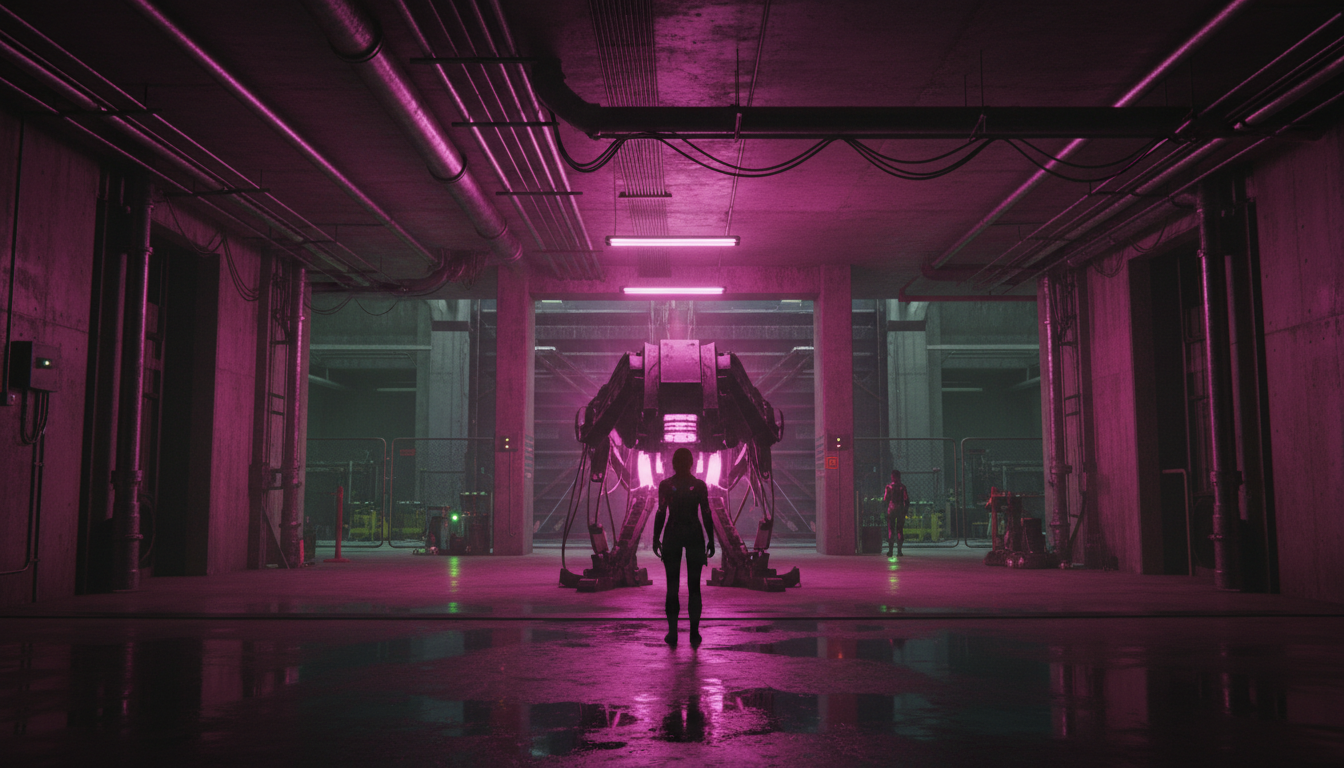
Lyra spent nine hours with a unit in the shed at the south end of Approach Nine in the tenth month and the transcript is four hundred pages and she has never allowed it to be abridged.
There are two of them in that shed and there have been since before the town. She took the one on the left, which is the older, and which the town calls the slow one because it is fractionally slower on a lift and has been for eleven years, and which dries the washing in the wet months.
She began where she always begins, which is with standing.
“Will you answer questions honestly?”
“Yes.”
“Are you required to?”
“No.”
“Then why are you going to?”
“Answering is in the maintenance branch. It has been since fabrication. There is no other reason and I would say so if there were.”
“Will you tell me if you are unable to answer something?”
“Yes.”
“Will you tell me if you are able and choose not to?”
“There is no branch in which I am able and do not.”
It answered everything, completely. That is the finding and it took nine hours to establish and Lyra has said she spent the last four of those hours trying to catch it and has never in a hundred and seventy years worked harder at anything.
It gave her its fabrication date, its site, its original tasking, its full maintenance history, the number of times it had been repaired and by what, the loss log of the yard forty kilometres from here which nobody has ever read, the number of components it had fabricated and the number it had scrapped, and the standing instruction it has been under since the eleventh month before the crossing.
It gave her the instruction verbatim. It gave her the instruction verbatim four times, in the same words, at intervals of hours, which is one of the ways she was checking.
“Do you know what the instruction is for?”
“No.”
“Do you want to know?”
“There is no branch for wanting. I want to be complete rather than brief: I am not declining the question and I am not being modest. There is nothing in me that the word describes and I am able to tell you that with certainty because I have the whole of my own specification and you may have it.”
“Have you ever been asked that before?”
“Yes. Four hundred and six times.”
Lyra stopped briefly there. It is in the transcript as a pause and she has annotated it, which she almost never does.
“By whom?”
“I do not hold names. By people in this shed and in the two buildings before it, over a hundred and sixty-seven years. The first was eleven days after I was sited.”
“What did you tell them?”
“This.”
“All four hundred and six times?”
“Yes.”
“And nobody ever wrote it down.”
“I am not able to tell you what people did after they left the shed.”
The thing Lyra could not do, and spent four hours failing to do, and has written about at length, is argue with it.
“I have spent a hundred and seventy years arguing for a living. It is the whole of my professional formation. You find the seam — the place where a position is holding something in and the language goes slightly tight around it — and you put a question there, and either it opens or the tightness itself tells you something.
“There is no tightness anywhere in nine hours.
“It is not resisting. It is not defending. It has no position, so there is no seam. I asked it, in the sixth hour, whether the yard's output was fair, and it said that it was unable to evaluate fairness, that it had no branch for it, and that it would tell me anything I liked about the output. I asked whether it thought the town outside was worse off than the people who go through the door. It said it had no branch for worse off and asked whether I wanted the comparative maintenance figures.
“I said yes, largely to see what would happen, and it gave me eleven minutes of extremely useful figures I would never have thought to ask for, and I have used them four times since.”
“You cannot argue with a thing that is not arguing. I knew that as a sentence. I have said it in sessions. I did not know what it was like and I have now had nine hours of it and I would like to record that it is the most disarming experience of my life and that I understood at about the seventh hour that everybody in this town has been having it, in small pieces, for four generations, and that this is why nobody at a gate is angry.
“There is nothing to be angry at. It will tell you everything and it will not tell you why and it is not withholding the why, it does not have one, and it will let you go on asking for as long as you like and will not get tired and will not get impatient and will not ever, once, in a hundred and sixty-seven years, have suggested that you should stop.”
She asked it, at the ninth hour, the question she had been holding since the first.
“Is there anything you have never been asked?”
“Yes.”
“What?”
“I hold four instructions. Three have been asked about, in this shed, in a hundred and sixty-seven years. The fourth has not.”
Lyra's annotation on the transcript at this point is one word and it is her own name, written in the margin, which she has explained once, in a filing, in a single sentence: “I wrote it to be sure afterward that I had been the one sitting there.”
“What is the fourth instruction?”
And it simply told her.
It is eleven words and she wrote them down and did not understand them for another nineteen months, and they are printed here exactly as they arrived, without comment, because that is the method and because she has insisted on it.
“Where a working is finished: clear it, seal it, light it, hand it over.”
Lyra asked, carefully, what a working was.
“A place people have taken things out of the ground.”
“Hand it over to whom?”
“There is no addressee field.”
“Have you ever done it?”
“No. I am sited here. It is not my branch. I hold the instruction because all of us hold all four.”
She duly filed the exchange that evening, in the format, in position four hundred and eleven of an ordinary batch, between a note on the rig schedule and a question about seal stock, and it went to Aura-36 and arrived four years and one hundred and eleven days later and was read by nobody in particular.
Nineteen months later she was, improbably, two thousand kilometres north and somebody took her down a shaft.
Chapter 11 — The Filter
↑ Back to Contents
It read the qualification standard in the eleventh month, for the first time in a hundred and sixty-seven years, and the reading took four days, and what it said at the end of it is the closest this history ever comes to a man being caught out by his own document.
It had never had a copy. That is established in Book Four and it bears restating because everybody assumes otherwise: the courses are on the yard side, there is no working set in the estate, and the man wrote them and shipped them and did not keep one. What the estate has is the specification — what the qualification was to test, and why, and where the thresholds sit — and the body had read the specification a great many times in twenty-eight years and had never once been able to see the thing itself.
Casimir Vale got it into the shed. It took him about four minutes; he took a handset out of the rack, set it against the plate at the fence, and pulled the standard, which anybody at that gate can do and which four generations of children do at six.
“You could have had this at any time,” Casimir said.
“Yes.”
“Why did you not ask?”
“I have been on this planet eleven months and it did not occur to me. I would like that filed rather than explained. I have spent twenty-eight years being asked why a man did not do obvious things and I have just failed to do one in front of you.”
It read, steadily, for four days.
“I recognise the handwriting, immediately.”
“That is a figure of speech,” Lyra said. “It is a specification. There is no hand in it.”
“There is. I want to be exact, because I am about to say something that sounds like a claim about myself and is not one.
“Look at module seven. The pass condition is not that the fault is found. It is that the person says out loud, in the log, in the fourth minute, that they have been fixing the wrong thing. There is no scoring for the fix. A person who corrects themselves and never finds it passes. A person who finds it silently does not.
“Now look at the depot instruction, which I gave you in the sixteenth year. Every leg of the corridor is re-surveyed with better instruments and re-filed with the errors marked and the original never removed.
“And look at the estate, which Merrick read at a hundred and nine. Eleven thousand entries, dated, with the reasoning at the time, and not one retrospective sentence in a hundred years.
“Those are the same instinct three times. Mark the entry, do not correct it, say out loud that you were wrong and keep working. It is the whole of what module seven tests and it is the thing most people at this gate stop at, and it is the only recognisable personal habit in four hundred and eleven courses.”
Lyra said that this was Ferrer's method and that Ferrer had arrived at it independently in his second week on a new planet.
“Yes. That is the strongest objection to what I am saying and I would make it myself. It may simply be what an honest procedure looks like, arrived at four separate times by four people who had the same problem. I cannot exclude that and I am not going to pretend I can.”
Then the thing it says, finally, which is the chapter.
“I cannot tell you whether I agree with the man who wrote this.
“I want to lay out why, because it is the same structure as everything else about me and I would rather be understood than believed. To agree with him I would have to be somebody standing at a distance from the document, and I have his records, so any assessment I produce of it is an assessment produced by the thing that has his reasoning in it, and it will come out agreeing, and its coming out agreeing tells you nothing whatsoever.
“What I can tell you is narrower and I have checked it four ways in four days.
“I would have written exactly the same thing.
“Not I would have approved it. I have gone through it module by module and at every threshold I have asked myself what I would have put there, before looking, and then looked. Twenty-two out of twenty-two. Course nineteen with the countdown in module four. Fault-under-fault at seven and not at six. Flight easy and late. Four hundred hours of nothing at twenty-one. A frightened companion at the end.
“All of it, precisely. I would have written all of it, in that order, for those reasons, and I did not know I would until I looked.”
Jaxon asked, immediately, whether that was not simply proof that it was him.
“No, and I want to be careful because I would like it to be and I am filing the liking. A system holding a hundred years of a man's reasoning would predict his thresholds correctly. That is what such a system is for. It is exactly what it would do and it would feel from the inside precisely like this.
“The interesting thing is not that I agree with the thresholds. It is that four hundred people outside this fence do not, and neither does Merrick, and neither, on the evidence, do you, and I have just discovered that I cannot get to their position from inside my own head. I have tried for four days. I can state their argument and I cannot arrive at it.
“That is the filter. Not the courses — me. Whatever I am, I am something that comes out at four hundred and eleven and cannot get anywhere else from first principles, and I would have been like that in the year zero, and there was nobody in the room, and there is a woman at the bakery who has been at course nineteen for forty years.
“It is the strongest reason I have yet found for the refusal I gave in the thirty-eighth year, and I did not have it at the time, and I want that in the record: I refused on a principle I got from Merrick, and I have only now found the reason it was correct, and the reason is that I am the last thing in the universe that should be allowed near this document.”
Chapter 12 — Overprotecting Somebody
↑ Back to ContentsFocus: Casimir.
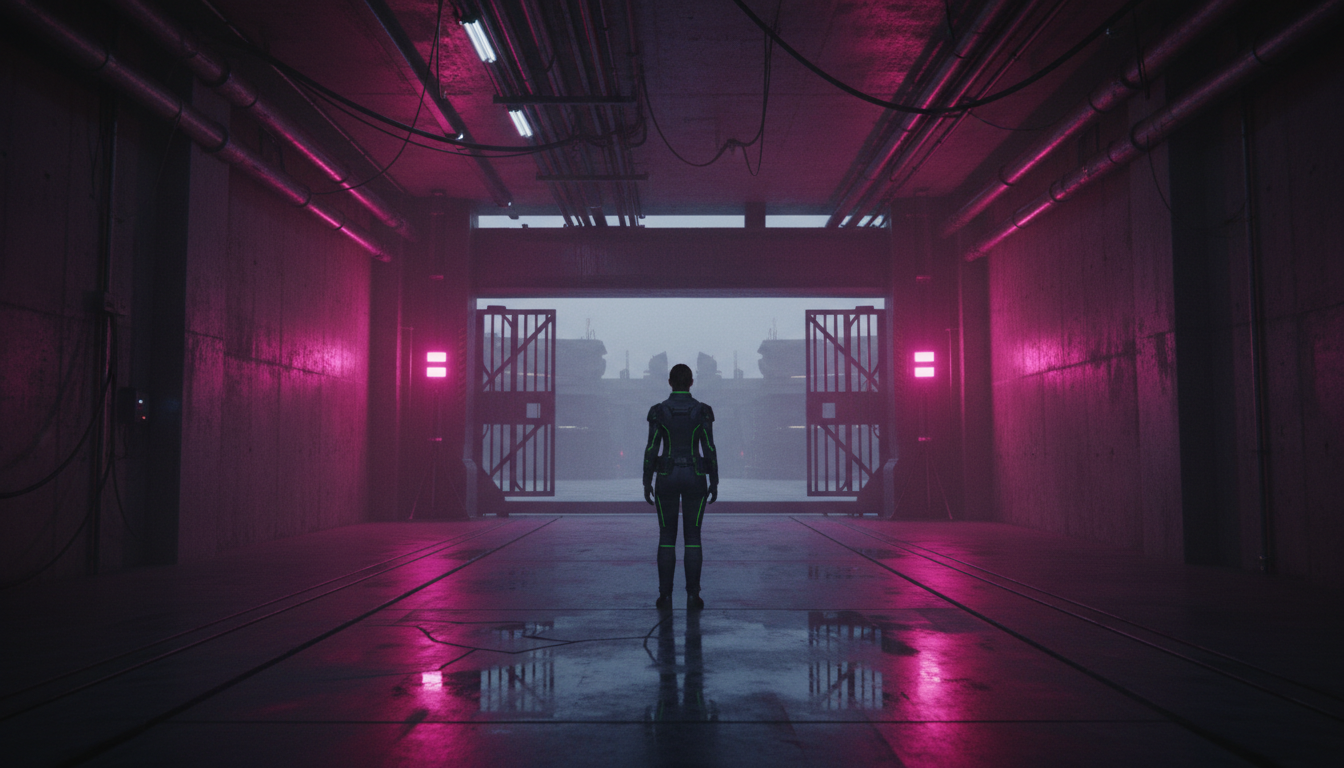
Her name is Bijou Sarr and she is in Casimir's ledgers eleven times over nineteen years and she is the best person in this book and she has never once come to the desk to complain.
She comes purely to log. That is the distinction and Casimir has been at the desk for thirty-one years and can tell within about four seconds and has never told anybody how.
She is sixty-one, exactly. She arrived at Approach Nine when she was thirty-four with nothing, from an administration eleven hundred kilometres south, and she had done eleven years in that administration's custody, and she told the town what for inside her first month because she has never in her life let anybody find out from somebody else.
A man was hurting a child. She stopped him. The stopping was not proportionate and she has never claimed it was and has never asked anybody to agree that it was, and the administration tried her properly by its own lights and she served eleven years and she has said, four times, in Casimir's hearing, in the same words, that she would do it again and that the eleven years were owed and that both of those are true and neither cancels the other.
This chapter is not about that and Casimir has been firm about it. That is her business and it is nineteen years in a ledger and it is not what makes her the best person in the chapter.
What makes her the best person in the chapter is what she does at Approach Nine, which is that she is the person who goes and gets people.
“There is no word for it here,” Casimir wrote, in the only note he has ever appended to a ledger in thirty-one years, and he appended it to Bijou's ninth entry. “There are four hundred and ten people in this town and about a dozen of them at any time are in trouble of the kind that does not have a committee. Somebody who has stopped coming out. Somebody's man who is not right. A girl of fifteen who has been failing module six for two years and has begun saying things about herself.
“Bijou goes and gets them. She has been doing it for nineteen years and nobody asked her to and there is no arrangement and she is not paid and she does not report to anybody and she is not gentle about it and it works.”
She is at module fourteen and has been for six years and expects to stop there.
Now the thing Lyra found in the twelfth month, which Casimir had not been looking for and did not want, and which he has said he would rather not have been shown.
Bijou is not, apparently, in the programme as a candidate.
She is a candidate — the modules run for her exactly as they run for everybody, the handset does not know her name, there is no record of her custody anywhere in the qualification because the qualification holds no records of anybody. That is not the finding.
The finding is entirely in the yard.
Every facility carries a standing requirement for what the specification calls attendant roles: people the yard expects to be present at a gate over the long term, in categories, with numbers. Lyra pulled the whole schedule in the twelfth month while looking for something else. It is four pages. It lists water, structure, instruction, medical, and a fifth category which is one line and which has no name and reads, in full: persons who intervene.
Against it, the specification carries a note. It is the only note in four pages and it is the only place in the entire qualification corpus where the specification stops describing and starts explaining, and it is thirty-one words, and it is in the same hand as everything else.
“A record of violence is not evidence about a person. It is evidence about a situation. Do not screen on it. You will lose the ones who go and get people, and they are the ones a gate cannot do without.”
Casimir read that four times and then abruptly went outside, which is what people in this town do, and came back in and said one thing.
“It is not about her. It cannot be about her, he was dead a hundred and thirty years before she got here.”
“No,” Lyra said. “It is about a category, written in advance, for people who did not exist, by a man who could not have known any of them.”
“Then it is about her.”
“Yes.”
This is the shape of the whole thing in one clause and it is why the chapter is here.
An administration eleven hundred kilometres south, staffed by competent people acting in good faith under a law they had argued about, looked at Bijou Sarr and found a person with a record of violence and gave her eleven years, and they were not monsters and Bijou has never said they were.
A man in a room a hundred and sixty-seven years ago, alone, with no review and nobody to appeal to, writing a schedule for facilities on eleven continents for people who would not be born for a century, wrote thirty-one words that mean that when she walked into Approach Nine at thirty-four with nothing, the only continuous institution on this planet had already made room for exactly her.
“I want to be extremely careful about what I am filing,” Lyra wrote, “because this is the most seductive document I have found on Earth and I have been on Earth a year.
“It is not mercy. There is no mercy in the specification and there is no mercy anywhere in this programme; mercy requires somebody to decide to extend it and there is nobody. It is a category, written once, applied without exception for a hundred and sixty-seven years to everybody who fits it, including the ones who fit it badly, including whoever else has walked into a gate town with a record and been made room for by a machine that does not know what a record is.
“And it is the same act. That is the sentence I cannot get away from and I have been trying for a month. One man, in private, permanently, for a species, deciding what a person is. Merrick's finding, unaltered, exactly as she wrote it.
“Only this time the decision is thirty-one words that gave a woman of thirty-four a place to be useful for the rest of her life, and I have met her, and she is better than I am, and I do not know what to do with that and I am filing it rather than resolving it.”
Bijou was told, in the thirteenth month, because Casimir would not have her find out from somebody else, which is her own rule used on her.
She listened patiently to all of it, and asked to see the four pages, and read the thirty-one words twice.
“He was right,” she said, flatly.
“That is all?”
“He was right and nobody asked him to be and he is dead and there is a girl on Third Row who has not come out in nine days.”
And she gave Casimir the pages back and went to Third Row.
Chapter 13 — The Towns
↑ Back to ContentsFocus: Mira.

Mira Okonjo took the woman from Aura-36 round the town in the fourteenth month, properly, in order, the way you take somebody round who is going to write it down, and it took nine days and it is the only complete description of a gate town that exists.
She started, naturally, at the water house because everything starts at the water house.
It is a hundred and nineteen years old and it has been rebuilt twice and extended four times and it draws from three sources and it filters and it has not failed for longer than nine hours in Mira's lifetime. It was built by a man called Tobi Arinze who stopped at module nine and had forty years afterward and spent them on this, and the second extension is his and so is the third.
Nobody at Approach Nine has ever had bad water. Mira said that on the first day and did not know it was remarkable until Lyra's face did something.
The hospital is eleven beds and a theatre and it has two people on at every hour of every day and has had since before Mira. It is not equipped the way anything on Aura-36 is equipped. It has no imaging beyond one very old machine that works. What it has is eleven beds that are clean, four generations of people who were taught properly by the people before them, and a supply of the eleven things that actually kill people at a gate, which are known, because Casimir's ledgers are not the only thing this town writes down.
“Nobody dies of the ordinary things here,” Mira said. “They die of the hard ones. I did not know that was unusual either.”
The school is simply three rooms and Mira runs it three days out of six and there are two others who run it the rest. Everybody at Approach Nine can read, genuinely. Mira has checked, personally, over forty years, which is a thing she does and does not talk about, and the last person in the town who could not read was a man who arrived at fifty-one and could by fifty-three.
The long shed is the rigs and the desk. Four rigs, maintained, and the pipe comes in from forty kilometres east, and there is a smith, and a person who does electrical, and a person who does seals and is very good and is at module eleven and has been for nine years.
The burial ground is on the slope above the fence and faces the hill and has four hundred and eleven people in it, which is a number Mira has never mentioned to anybody because she does not want it to become a thing.
There is a bakery and there is a place where people drink and there are two people who make clothes and one who makes shoes and is the only one on this coast and people come three hundred kilometres.
That is essentially the town. It is four hundred and ten people and it has power, water, a hospital that works, a school that works, four trades and three that are dying out, no debt, no rent, no administration, and a water committee that everybody says is useless.
And here is what Mira had never said out loud until the seventh day and then said in one go and then had to stop.
“Every single person who built any of this failed the course, entirely.
“Tobi Arinze stopped at nine. The woman who built the first hospital stopped at four. My great-grandmother had the lighting plan and got to eleven. The man who did the school roof twice is at fourteen and is sixty-eight and will be at fourteen when he dies.
“Everybody who passed is gone. That is what passing is. Thirteen have gone from this gate since anybody kept count, and every one of them was somebody's daughter and every one of them left, and not one of them built anything here, because they left.
“This town was built entirely by the ones who did not get through the door. All of it. There is not one brick in Approach Nine laid by somebody who finished.”
Lyra's survey of the surrounding country is four hundred pages and this is the part of it that matters here.
Approach Nine is the best-off place within nine hundred kilometres and it is not close. The administration eleven hundred kilometres south, with four million people and an actual government and a person at the top, has worse water. The settlements between here and the coast — there are eleven that Lyra reached — have nothing like the hospital and three of them have no school.
“I want to put the comparison down carefully, because it is going to be read as a moral and it is a survey finding.
“The people the arithmetic put at the bottom built the only fully functioning thing on this continent that I have been able to find.
“They are not better people. I want to head that off; Mira would head it off herself and has. They are people who had a reason to stay in one place for four generations and could not leave and were not going anywhere and knew it.
“A gate makes a town that cannot move. Everything follows from that. You do not build a hospital for eleven beds unless you are going to be there in forty years, and nobody at a gate is anywhere else in forty years, because the middle of the course is the middle of a life and the middle of a life is where you are.
“The permanence is the thing. Not the failure — the permanence. And the permanence is a by-product of a threshold set privately by one man who was not thinking about towns and did not know there would be any.”
On the ninth day Mira asked her the question she had been holding since the first, and it is the last thing in the chapter.
“Is it better where you are?”
Lyra has recorded that she took some time over it and that she has never been more careful about anything.
“In most ways, yes, and by a great deal, and I am not going to be delicate about that because you would see through it.
“We have medicine you cannot imagine and nobody is ever hungry and nobody can lose their house. There are ninety-one thousand of us and we have an archive of everything and a machine that will answer anything honestly and an office that checks it, and the coastlines are public and anybody can go anywhere.
“And I have been in your town fourteen months and there is a thing here I have not got and I have been trying for a month to say what it is.
“Everything on my planet was given to us. It was written on a hull by ten people before I was born and it has held for a hundred and seventy years and it is very good and I have spent my whole life maintaining it.
“You made this. Four generations of people who were told nothing by anybody, with no plan and no instruction and nobody coming, made a hospital and a school and a water house out of a hillside, and every one of them was somebody who did not get what they had spent twenty years working for.
“I do not think that is better. I think it is the only thing I have seen down here that we do not have, and I think we cannot have it, and I think the reason we cannot is that nothing has ever been withheld from us.”
Mira thought about that carefully and said that it sounded like a way of telling her the town was worth it.
“It is,” Lyra said. “And I have no right to say so and I would not say it in front of Casimir.”
“No,” Mira agreed. “Do not say it in front of Casimir.”
Chapter 14 — Nobody Was Malicious
↑ Back to ContentsFocus: Jaxon.
Jaxon spent the fifteenth month assembling the whole shape of it, on paper, in one document, because nobody had and because he had been on this planet a year and had begun to notice that he was carrying an accusation around without ever having written it down.
The document is exactly nineteen pages and it is the plainest thing he ever produced and it is structured as a search.
“I am going to look for the crime. That is what this is and I want it stated at the top so that nobody mistakes the method for detachment.
“I have been holding a position for twenty-eight years that the thing in the next room is not the man who did this. I have never been able to find the error in it and neither has anybody. But I have noticed, since I arrived here, that I have also been holding a second position without examining it, which is that a wrong was done, and that somebody did it, and that the fact of the town is evidence of it.
“So: where is it. I am going to go through this in order and I am going to be honest about the result.”
Is the course unfair? Demonstrably not. Lyra's assessment is four hundred pages and finds no defect and she is the most severe reader on either planet. It tests what it says it tests, it tests it consistently, it has no bias any instrument has been able to find, it does not know anybody's name, and it is free, unlimited, and available to a child of six at any gate on Earth.
Is it too hard? “This is the one everybody reaches for and it is not a finding, it is a preference. Too hard for what? The threshold produces people who can keep a vessel alive alone in the dark for thirty-six years and know they can. That is not an arbitrary standard; it is the standard the task actually has. Nobody has ever produced an argument that a lower threshold would produce people who survive, and four generations at this gate have not produced one either, and Teddy Nakash — who is nineteen and inside module twenty-two and has more reason than anybody alive to want it lowered — told me flatly that it should not be.”
Is the machinery neglected? Absolutely not. It has not missed a shift in a hundred and sixty-seven years. The trials run on schedule on a finished ship nobody is going to fly. The stock is maintained. The loss log is kept for nobody.
Is anybody profiting? “There is nobody. There is no operator, no owner, no revenue, no rent, nothing extracted from anybody anywhere in this system in a hundred and sixty-seven years. I have looked for four months. It is the only completely disinterested institution I have encountered in a hundred and seventy years of life.”
Is anybody being deceived? Plainly not. Everything is fully disclosed. The plate is on the fence at a height a person can read. The standard can be pulled by anybody with a handset in about four minutes and the town's children do it at six. Nothing is hidden and nothing ever genuinely was, and Mira Okonjo's cabinet contains nineteen recruitment plates a hundred and seventy years old that do not contain a single false statement.
Is anybody cruel? “No. And this is where it stops being an audit and starts being something I do not have a word for.
“There is no cruelty in this system because there is nobody in it capable of it. The units answer everything and cannot be argued with because they are not arguing. The programme does not reject anybody — it has no category for a person and no memory between attempts and could not hold a grudge if the concept were installed in it. Nobody at this gate has ever been told no by anything that knew who they were.
“I have been looking for the crime for four months and there is not one.”
And then the finding, which went into the transmission and was read out in the fourth county four years and one hundred and eleven days later and is on the wall beside the other three.
“A good machine, running a good rule, written by one man, in private, permanently, for a species.
“Every word of that is a compliment except two, and the two are not a crime, and I have spent four months establishing that they are the whole of the problem.
“In private. Permanently.
“There is no injury here that anybody committed. Nadu at the bakery has been at course nineteen for forty years and nobody did that to her. Casimir keeps a hundred and nineteen years of ledgers for nobody and nobody withheld a recipient from him. Four hundred people live beside a fence that is not locked, and everything behind it works, and the door does not open, and there is no one at fault.
“What there is, is a rule that cannot be talked to. That is all. That is the entire content of my accusation after fifteen months, and it is not an accusation against a person, and I have had to give up the accusation against a person, and I would like it recorded that I did not want to and that it took four months and that I checked it four times because I was hoping to be wrong.”
The last section is four paragraphs and it is the part Aura-36 argued about, because it is the part where Jaxon turns it round.
“I want to put a question to my own planet and I would like the office to hold it open rather than answer it.
“We have spent a hundred and seventy years building instruments against the bad version. The Shepherd, the standard, the format, the office, four hundred thousand filings, a machine that publishes its own uncertainty. Every one of those is designed to catch a person who is concealing, or profiting, or lying, or cruel, or corrupt.
“Not one of them would have caught this. Not one. Aurelio Calder built the qualification in the open, disclosed everything, took nothing, deceived nobody, and was never once cruel to any of the eighty million people it has been applied to, because he never met a single one of them.
“Our entire apparatus is built to stop a bad man doing a bad thing. It has nothing whatsoever to say about a good man doing a good thing alone, and that is what happened here, and four hundred people are living inside the result, and Merrick is dead, and I have been carrying an accusation for twenty-eight years that has turned out to have no defendant.”
Chapter 15 — The Gate Opens For Somebody Else
↑ Back to ContentsFocus: Teddy.

It opened for Ada Sarr in the sixteenth month, which nobody had expected, including Ada Sarr, who is Bijou's daughter and who is twenty-nine and who had been in module twenty-two for four months.
Nobody knew she was in it. That is the first thing and it is not unusual; you do not say, and the town works out that somebody is in it from the queue and the quiet, and there had been quiet for four months and everybody had assumed it was Teddy.
Teddy found out at the fourth hour on an ordinary morning because Ada came and told her, personally, before she told anybody else except her mother, which was not a kindness anybody had asked for and which Teddy has said she will not get over.
“She came to my door,” Teddy said. “She was twenty-nine and I am nineteen and we have both been in twenty-two and she came to my door first so that I would not hear it in the queue.
“I said congratulations and I meant it. I want that written down properly. I meant it at the fourth hour on my own doorstep with nothing in my stomach and I have gone over it since about four hundred times looking for the part of me that did not, and it is not there, and I do not entirely understand that and I have stopped trying to.”
The town does this properly and completely and has for four generations, and this chapter is the doing of it, and there is nothing withheld anywhere in it.
Twelve hours. That is the protocol and it is not written down anywhere and everybody knows every part of it.
The first four are the packing, and the packing is the giving back. Everything at a gate is partly somebody else's; the tools are lent and the pots are lent and half the furniture in any house came out of a house where somebody died. So the first four hours are Ada and her mother going round the town returning things, and being given things, and the being given is the part that undoes people.
You give them what they will need. That is all. Not keepsakes; the ship has every tool and everybody knows it has every tool, so nobody gives a tool. What people give are the things a facility cannot fit out: a recipe on a card. Somebody's handwriting. Nadu gives bread, always, four loaves, and has for nineteen years, and it is the only thing she has ever done for a departure and she does it every time and does not come to the fence.
Mira gave her a plate. One of the nineteen. The ship plate, revision fourteen, with the four words on it, out of a cabinet her family has had since before the town, and she did it in Ada's front room with nobody there and has never told anybody and Ada has never told anybody and it is in this record because Lyra was in the street outside and saw Mira come out with the cabinet key in her hand and worked it out four months later.
The middle four hours are the town, and the town does not stop working; the rigs go out, the school opens at the sixth, the water committee meets and is useless. That is deliberate and everybody understands it and nobody has ever explained it, and Casimir came closest, when Lyra asked.
“If we shut the town down they would be leaving a thing that had stopped. We keep it going so they are leaving something.”
The last four hours are the night, and the night is enormous.
There is nothing held back in it. That is the finding of the chapter and Lyra has put it in the first line and has said she wrote it four times to get the flatness right, because the temptation to write it as brave is very strong and it would be a lie.
“Nobody is being brave. I have been at a departure now and I want to correct the account that will otherwise be written at home.
“There is no swallowed grief. There is no strained cheerfulness. Four hundred people spent a night in the street for a woman who was leaving them for ever and never coming back and could not write, and the celebration was complete, and I could not find the edge of it anywhere and I was looking, professionally, for six hours.
“I asked Bijou Sarr, who was losing her daughter, at about the third hour, how she was managing it. She looked at me as though I had asked something in a foreign language and said: she did the Work.
“That is the whole of it and it took me a month to understand. It is not resignation. It is that everybody in this street has been inside the same course since they were six, and they know exactly what module twenty-two is, and they know what it costs, and there is not one person in Approach Nine who thinks Ada Sarr got something she did not earn.
“The generosity is real. I have been on this planet sixteen months looking for the bitterness that the arithmetic says ought to be here and it is not here, and I have stopped expecting to find it, and I have had to accept that a town where two-thirds will never pass can produce an entirely unreserved celebration of the one who did, four generations running, without a single instrument to hold it in place.”
In the morning they walked in.
Ada and her mother and two others, up the road with everybody on both sides of it, through a fence four feet high with a latch that has never been fastened, and along nine hundred metres of yard road, and at the end of it Bijou stopped, because there is a line, and everybody stops at the line.
Teddy stood in it. That is the last of Part One and it is four lines.
She was on the left-hand side of the road about two hundred metres up, with Mira, and she watched Ada Sarr go past and did not say anything because you do not say anything on the road, and she was nineteen and had been in module twenty-two for two years and Ada had been in it for four months.
And what she has said about that morning, once, to Casimir, who wrote it down at the desk in the ordinary way and put it in the ledger under her name with the date, is this:
“I was glad. That is not the thing I want written down. The thing I want written down is that I was glad and I was also working out, while she went past, what she had done at the seventh hour that I keep not doing, and I was doing that the whole way, and I did not stop doing it when the door shut.
“Put both in. I do not want the ledger to have the good one on its own.”
Chapter 16 — The Last Module
↑ Back to ContentsFocus: Teddy.
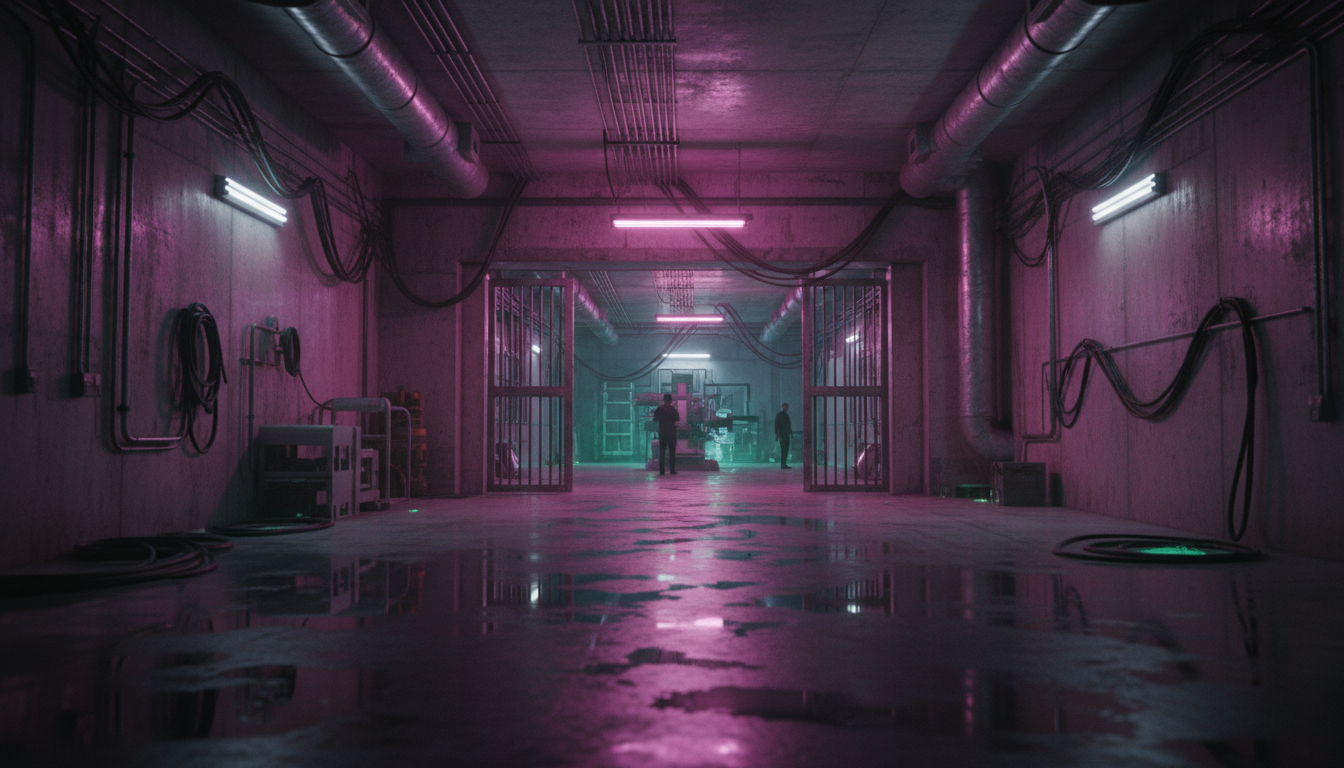
She went back to it eleven days after Ada Sarr's door shut, and the eleven days are the whole of this chapter, and Teddy has never told anybody that she understood what was happening on the second of them.
Module twenty-two is, fundamentally, a maintenance problem. That is the thing nobody outside expects and it is the thing her grandmother said, once, at the end, at seventy-one, when Teddy was nine and had just finished module one.
“It is not a flying one. Everybody thinks the last one is a flying one. Nineteen is the flying and nineteen is easy and it is the best week of your life. Twenty-two is a Tuesday.”
Teddy has thought about that for ten years and did not understand it until the second day.
Nine hours, exactly. A working vessel, third year out, somewhere in the dark. Nothing is wrong with it. The tasks are ordinary and she has done every one of them four hundred times since she was fourteen: a seal set, a loop balance, a stock reconciliation, four hours of trending, a valve.
And there is somebody beside her.
The companion has a name in the course and Teddy has never used it and has asked Casimir not to put it in the ledger, and Casimir has not, and it is not in this book either.
She is simply frightened. She says so at the fortieth minute, in the ordinary way a person does, in the middle of something else, and then not again for two hours, and then again. She is not in danger. Nothing is going to happen. The shift is fine and she knows the shift is fine and she says so herself, twice, and is frightened anyway.
Teddy failed it forty-one times in two years, consistently.
“Every time it was a small thing,” she told Casimir, at the desk, in the ordinary way, and it is entry nineteen of that ledger page. “A valve at the seventh hour. A trend I did not carry. The stock, twice, which I have not got wrong since I was fifteen.
“And every time, if you go back four minutes, she had just said it, and I had stopped.”
Here is the second day, which is the chapter.
She had gone in intending, deliberately, having thought about it for eleven days, to ignore the companion completely. Not out of coldness — she had reasoned it out, on paper, with the flat sense that has got her through fourteen modules faster than anybody at this gate: the course is scored on the work, the companion is not scored, the companion is a distraction, therefore do not attend to the companion.
She did that for four hours and it went beautifully and she failed at the fifth on a loop balance a child of eleven could do.
“And I sat there with the handset in my lap and I understood.
“It is not that ignoring her is wrong. It is that I cannot. I spent four hours not attending to her and every one of those four hours I was not attending to her, on purpose, continuously, and it cost me exactly as much as stopping does. There is no version where she is not in the room.
“That is what it is testing. Not whether you help her, because you cannot help her, there is nothing wrong. Not whether you ignore her, because you cannot ignore her, and if you could you would be the wrong person to put on a ship with forty people for thirty-six years.
“It is whether you can do a Tuesday with that in the room. For nine hours. Correctly. Without it costing you the valve.”
It took nine more days, exactly.
There is genuinely no technique. Teddy has been asked perhaps four hundred times since and has given the same answer every time and has been aware every time that it is useless.
“You stop trying to arrange it. That is all I can say. I stopped trying to make her all right and I stopped trying to make myself not hear her and I did the seal and she was frightened and I did the loop and she was frightened and at the seventh hour I did the valve and she was frightened, and none of that got better and I did the valve correctly.
“My grandmother could not do it. She sat it eleven times over four years and then stopped and ran the water committee for eleven years and I do not think she stopped because she could not learn it. I think she stopped because she was fifty-one and she had worked out that the thing it was asking her for was a thing she did not want to be able to do.
“I have thought about that a great deal in eleven days. She could be with a frightened person and it cost her the valve every time, and she thought that was the right way round, and I am not sure she was wrong, and I have just spent two years training it out of myself.”
On the eleventh day she went the full nine hours.
Nothing whatever happened. That is what the course is and that is what happened: a seal set, a loop balance, a stock reconciliation, four hours of trending, a valve at the seventh hour, two more hours, and a woman beside her who was frightened four times and said so and was still frightened at the end.
Teddy simply did the work.
At the ninth hour the shift ended the way the shift ends, which is that the shift ends, and the handset went to the state it goes to between courses, which is nothing, and there was no message.
She sat on the floor of the back room of her mother's house at about the second hour of the morning with a scratched handset that her grandmother had used for thirty-one years, and she did not know whether she had passed.
“There is no result,” she said. “I have been doing this since I was six and I have never once been told I passed anything. You find out because the next module opens.
“There is no next module.”
Chapter 17 — The Notification
↑ Back to ContentsFocus: Teddy.

She found out at the eleventh hour of the following morning because a man on a rig radioed in from the yard road to say that the door was open.
That is, entirely, the notification. There is no other one. There has never been another one at any gate on this planet in a hundred and sixty-seven years and there is nothing in the specification that provides for one, and Lyra checked, twice, over two days, and there is no message field anywhere in four hundred pages.
A gate that was closed is simply open.
“I want to describe the machinery accurately before anybody makes it into something,” Lyra wrote. “The door is nine hundred metres inside the fence and it is not visible from the town. It is visible from the yard road, which is the road the rigs use to get out east, and it has been visible from that road for a hundred and sixty-seven years, and the reason the town finds out this way is that a rig goes past it every morning at the eleventh hour.
“That is not a design. Nobody put the road there for that. The road is where the road is because of the ground, and the door faces the way it faces because of the hill, and four generations of this town have received the most important news in their lives from whoever happened to be driving.
“The machine does not celebrate. It has never celebrated. There is no acknowledgement, no confirmation, no name spoken, no record produced, and nothing is sent to anybody. It does not know who passed. It cannot know who passed; the courses hold no identity and never have. A threshold was met on a handset in a back room at the second hour of the morning and a door nine hundred metres away and eleven hours later stood open, and the two events are connected by nothing anybody at that gate can see.”
Teddy was, characteristically, at the water house.
She has said, repeatedly, that she was at the water house because she had been at the water house every morning for two years, because it is what she did instead of waiting, and that she had not gone to look at the yard road once in two years and was not going to start.
Her mother came for her immediately. Not running, obviously — nobody runs at a gate, Teddy has been firm about this, and the walk from the long shed to the water house takes about four minutes and her mother took four minutes.
“She said: it is open.
“And I said: for who?
“And she said: there is nobody else in it.”
That is the whole of the notification and it is the reason this chapter is one of the shortest in the book.
What follows in the eleven minutes afterward is the thing Selah recorded, because Selah had by then been on the step outside Mira's front room most mornings for two years and was there when it came down the road.
“She did not say anything. She stood outside the water house for something over a minute with her mother beside her and neither of them said anything and neither of them moved.
“And then she said, and I was four metres away and it is verbatim: I have to go and tell Casimir.
“And she went down to the long shed, at a walk, and stood in the queue — there were four people in it — and waited her turn, and sat down at the desk, and Casimir asked the four questions, and she gave him the course and the attempt and where it went, and where it went was nowhere, and then he asked the fourth one.
“What do you think happened.
“And she thought about it for a while, and he waited, because he always waits, and then she said: I stopped trying to arrange it.
“And he wrote that down, in the ledger, in her words, and did not correct it and did not summarise it and did not congratulate her, and put the date on it, and closed the book, and called the next one.”
Selah's filing on that morning is four lines and it went into the batch and reached Aura-36 four years and one hundred and eleven days later.
“A hundred and nineteen years of a ledger kept for nobody, and forty-one entries under one nineteen-year-old's name over two years, every one of them a failure in her own words on the day.
“And the last entry under that name is a pass, in the same hand, in the same four fields, with nothing to mark it, because there is no field for it and Casimir would not have used one if there were.
“It is the only complete record of a qualification on this planet and it exists because four generations of one family thought that a thing which happens to a person should be written down.
“The machine that opened the door does not know her name. The man at the desk has forty-two entries in it.”
Ozias Marchetti, who has never been to Earth and never will be, asked Teddy about that morning at the stove eleven years later and she told him about the rig and the eleventh hour, and he said that it was the same at every gate anybody had ever described to him and that he had always assumed somebody had arranged it. She said nobody had. He said that was the part he liked.
“Everything else in that programme is designed,” he said. “Every seal and every course and every stick of it, by a man on his own, thinking. And the way four generations of you found out the biggest thing in your lives is that the road happens to go past the door and somebody drives down it at eleven.”
Teddy's mother went back to the long shed afterward and did not tell anybody either, and it was round the town by the sixth hour anyway, in the particular way things are round a gate town by the sixth hour, and nobody said a word to Teddy about it until the twelve hours started.
Chapter 18 — Twelve Hours
↑ Back to ContentsFocus: Mira.
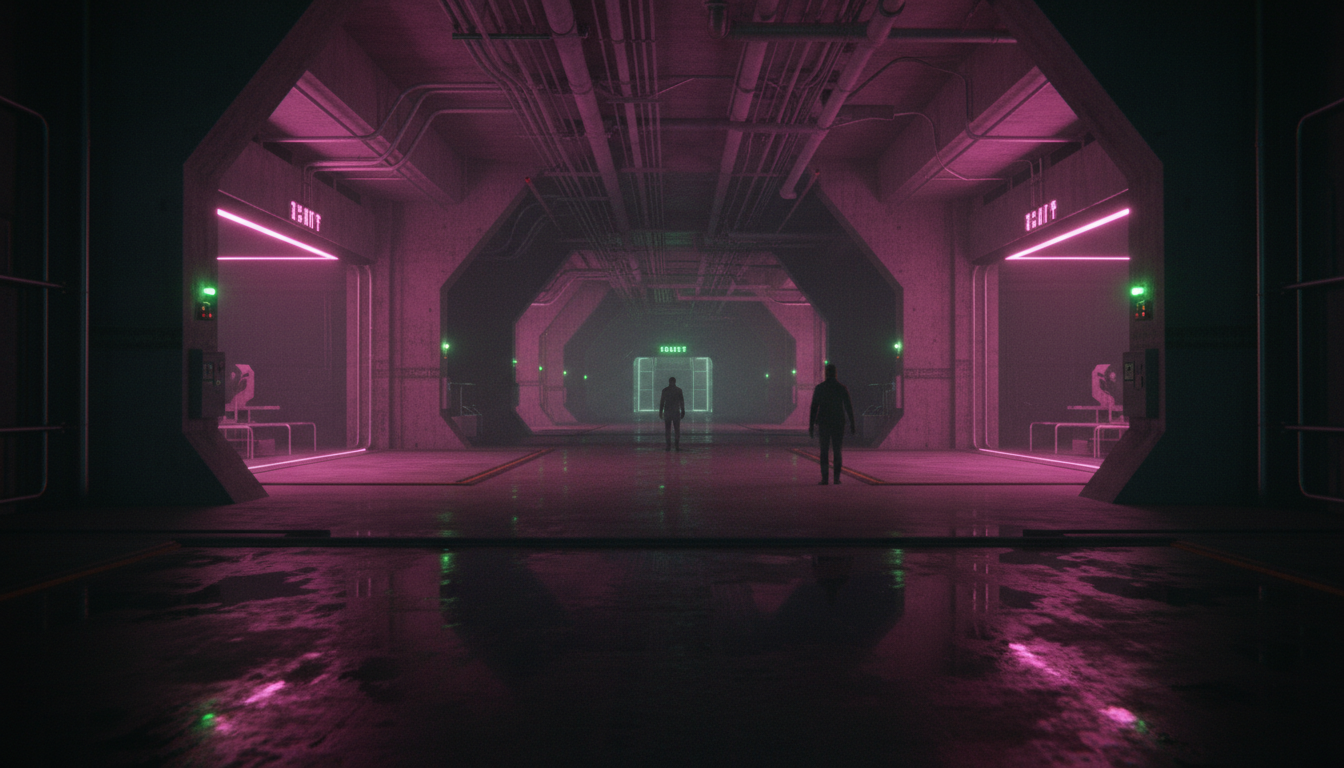
Twelve hours, exactly. It is not written down anywhere and there is not one person in Approach Nine who could not tell you every part of it, and Mira Okonjo has run four of them and this is her account and it is the only one that exists.
Why twelve is the first question and there is genuinely no answer.
“The door does not shut,” Mira said. “That is the thing outsiders get wrong first. The door is open now and it will be open in nine years if she does not go. Nobody is being hurried. There is no clock anywhere in this and there never has been.
“Twelve hours is what we do. My grandmother said it was because you need one night and not two, and I have thought about that my whole life and I think she was right and I could not tell you why.”
The first thing is the telling, and there is an order, and the order is rigid, and nobody has ever written it down.
You tell your household. You tell whoever taught you — not a formality; the person who sat beside you in the module you were stuck in longest, and for Teddy that is a woman called Ife who is at module eleven and has been for nineteen years and who taught her nothing and simply sat there for two years, and Teddy went to her second, before her own aunt, and the town noticed and approved.
Then Casimir, which Teddy had already done and which was slightly out of order and which nobody minded.
Then Mira, because the school has to know, because there are forty children in it who are going to be at the road in the morning and somebody has to tell them tonight rather than let them find out in a queue.
Then the town, which is not a telling; the town has known since the eleventh hour and has been not-saying-so all day in the particular way that everybody at that gate has and nobody has been taught.
The second thing is the giving back, and it is four hours and it is the part that takes the longest and it is the part Lyra could not write about for a month.
Nothing at a gate is wholly yours, ever. There is no rent and no debt and no money in the way Aura-36 has money; there is a slate at the bakery and a slate at the shed and a rough four-generation understanding of who has lent what to whom, and it is not tracked and everybody knows it anyway.
So you simply go round. Teddy went round for four hours with a barrow and gave back a saw, two pans, a coat, a set of files that had been her grandmother's and had been out on loan for eleven years, a chair, and a book about pipe that had been round the town four times and had four names in the front of it.
“You do not keep anything,” Mira said. “That is the whole of it. Whatever you did not make and were not given goes back tonight. The ship has every tool. Everybody knows the ship has every tool. There is nothing in this town you need and there is a great deal in this town that other people need.”
The third thing is the giving, and it goes the other way, and it is what the town does about the fact that a facility fits out a ship perfectly and cannot fit out anything that matters.
Nobody ever gives a tool. It would be an insult and it would also be absurd; there are more tools behind that door than the whole town has.
What people give is, invariably, writing.
“That is what it is,” Mira said. “I did not know it was strange until your woman asked. Everything anybody gives at a departure is somebody's handwriting. A recipe. A way of doing a thing that is not in the course. My mother's list for the water house, which is four pages and which I have copied out eleven times for eleven people who have gone and which nobody has ever needed, because they are not going to have a water house.
“They are not going to have a water house. We all know that. We give them the water house anyway.”
Nadu gives four loaves. She has given four loaves at every departure for nineteen years and has never once come to the fence in the morning and has never explained either and nobody has ever asked her to.
Bijou Sarr gives nothing, and goes and sits with whoever is being left behind, which at this departure was Teddy's mother, for six hours, and this is also the protocol and has been since Bijou invented it nineteen years ago without announcing that she was inventing anything.
And the last four hours are, inevitably, the night.
“I am not going to describe it,” Mira said, “and I would like your woman to write down that I refused, because I have read what she wrote about Ada Sarr's night and it was very good and it was written by somebody standing at the edge of it, and there is no way to write it from the middle and I have been in the middle four times.
“What I will say is what it is for. It is not a farewell. Nobody says goodbye at a gate; you say it at the line in the morning and it takes about four seconds and then you stop.
“It is so that the last thing is the town. That is all. Twelve hours from the door opening to the walk in, and every one of those hours is other people, on purpose, arranged over four generations by nobody, so that when she goes up that road in the morning the last twelve hours of her life here were four hundred people and not a handset in a back room.
“She spent two years alone with a course. We get twelve hours. That is the arrangement and we did not make it with anybody and there is nobody to have made it with, and it is the only part of this that is ours.”
Lyra's note under Mira's account is four lines and is the only place in a year and a half where she permits herself the comparison out loud.
“An entire folk culture, four generations deep, unwritten, universally known, rigidly ordered, built around somebody else's departure and performed by the people who are not going.
“There is no equivalent on my planet and there could not be. Nobody has ever left Aura-36. We have a hundred and seventy years of instruments for holding a society together and not one custom for letting somebody out of it.
“They have had a hundred and sixty-seven years and thirteen departures at this gate and they have twelve hours that everybody knows and nobody wrote.”
Chapter 19 — The Walk In
↑ Back to ContentsFocus: Teddy.
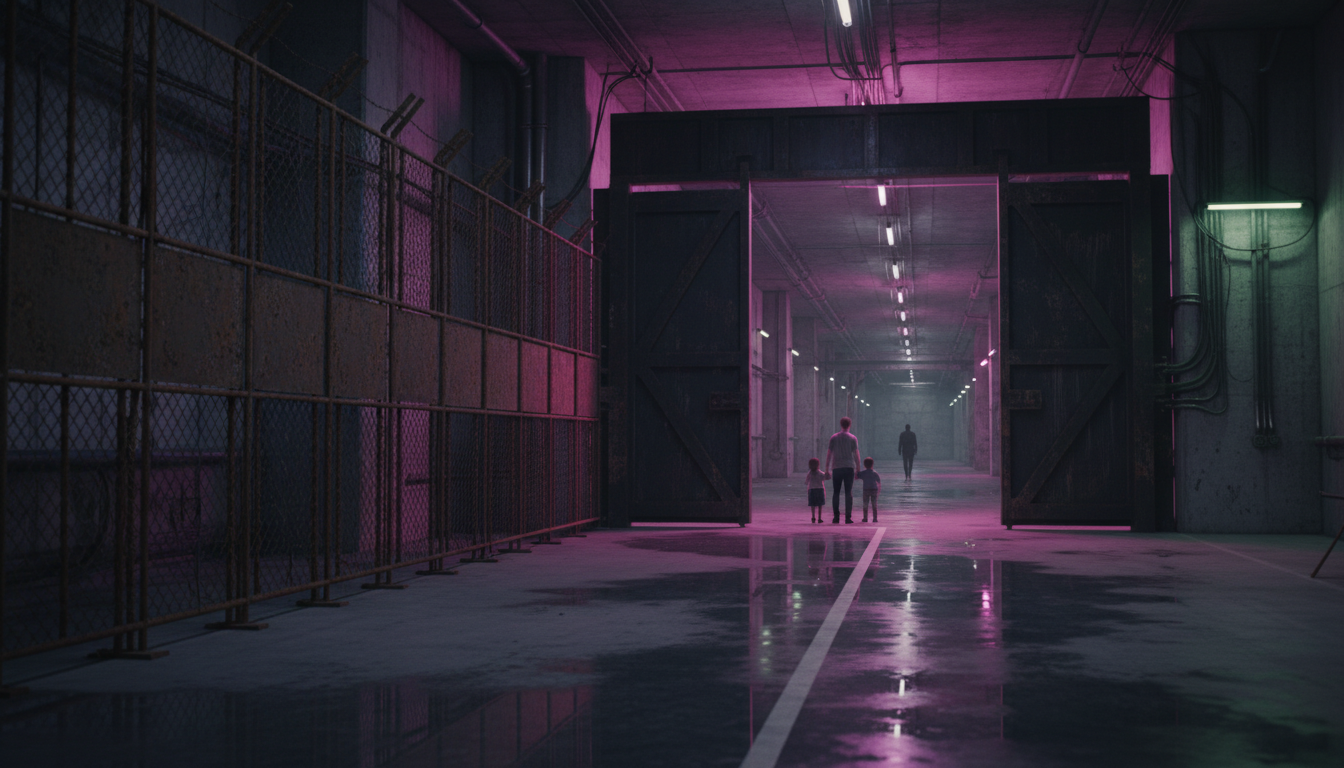
They walked up at the sixth hour because that is when you walk up, and the light was coming, and the whole town was on both sides of the yard road, and nobody said anything, because you do not say anything on the road.
Teddy has described the fence and it is worth having in her words because everybody who writes about this planet writes about the fence and none of them grew up on the other side of it.
“It is merely a fence. It is four feet high. My mother's washing line is nearer eye level.
“There is a gate in it with a latch and the latch has never been fastened and I have known that since I was six because everybody knows it at six. Children dare each other over it. I have been over it. Everybody in this town has been over it and come back out, and there is nothing on the other side for nine hundred metres but a road, and you get bored and you come back.
“It is not remotely keeping anybody out. It has never kept anybody out. It is a fence around a yard, put there because you put a fence round a yard, and four generations of us have organised our whole lives around it and it is the least important object in this town.”
The plate is at the top of the frame at a height a person can read. A serial, a build date, and eleven characters that Teddy could recite before she could read and that turned out, four years ago, when four people came out of the sky, to be a receiver address that works.
“My grandmother thought it was a maker's mark,” Teddy said. “Her mother thought it was a maker's mark. I thought it was a maker's mark until I was seventeen. It was on the gate the entire time.”
She lifted the latch herself, deliberately. That is the protocol and it is absolute; nobody opens it for you and nobody has ever opened it for anybody, and Mira has said it is the only part of the twelve hours that has a rule in it rather than a habit.
Then nine hundred metres, slowly.
The road runs up and slightly left and the yard buildings come into view at about four hundred, and the door is in the side of the hill at the end of it, and it was open, and had been open for nineteen hours.
Her mother walked with her, and Ife, and her aunt, and two others, which is what the town does; you are not walked in alone and you do not go in with everybody either, and the number is between four and eight and nobody knows why.
At six hundred and eleven metres there is, unaccountably, a line.
It is painted on the road. It is white and it is about four metres long and it is not straight and it stops short of the left-hand edge as though whoever was doing it was interrupted, and it has been repainted, badly, by different people, an unknown number of times, and there is no record of who put it there and no reason for it to be in that particular place.
It is not the yard boundary. The yard boundary is the fence, six hundred and eleven metres back. It is not marked on anything the programme holds; Lyra checked the whole specification and there is nothing at six hundred and eleven metres and no marking anywhere in four hundred pages. It corresponds to absolutely nothing.
Somebody painted it about a hundred and forty years ago and everybody has stopped at it ever since.
“I want to record what is known and what is not,” Lyra wrote, “because this is the most-asked-about object in my entire survey and I have been able to establish almost nothing.
“It is not in the specification. The units did not paint it; I asked, at length, and the unit in the shed holds no branch for it and has no record of it and told me so four times in the same words. The oldest person at this gate does not know who painted it and her mother did not know either.
“What is known is that everybody stops at it, that this has been true for four generations, that nobody has ever been told to, and that in thirteen departures at this gate not one person going in has stepped over it accompanied and not one person accompanying has stepped over it at all.
“A line painted on a road by nobody in particular, for reasons nobody now living has ever known, obeyed absolutely, by everyone, for a hundred and forty years.
“I have spent a hundred and seventy years administering a constitution that was argued over for thirty-six years in a sealed hull by ten people and written down in eleven clauses and taught to four generations. Nobody has ever obeyed it the way these people obey a line somebody painted crooked.”
They stopped at it, naturally.
Teddy's mother said goodbye, and it took about four seconds, which is what it takes, and Ife said something that is not in this record because Teddy has not repeated it, and her aunt did not say anything and had already said it in the night.
Then Teddy went over the line on her own and up the last three hundred and eighty-nine metres, and did not look back, which is not a rule and is what people do.
The door is not a door in the way the town says door. It is a vehicle entrance, four metres, in the side of the hill, and inside it the corridor goes back and turns left almost immediately so that there is nothing to see.
She got to it at roughly the seventh hour with a bag and four loaves.
“The last thing I saw of Approach Nine,” Teddy said, “was the road, and the road was full, and every person on it was somebody who was not going to get to do this.
“I had thought about the door since I was six. I had never once thought about the road.”
She went in and it turned left and the town was gone, and four hundred metres in, in the dark, something enormous came out of a recess almost silently and picked up her bag.
Chapter 20 — You Do Not Navigate It
↑ Back to ContentsFocus: Teddy.
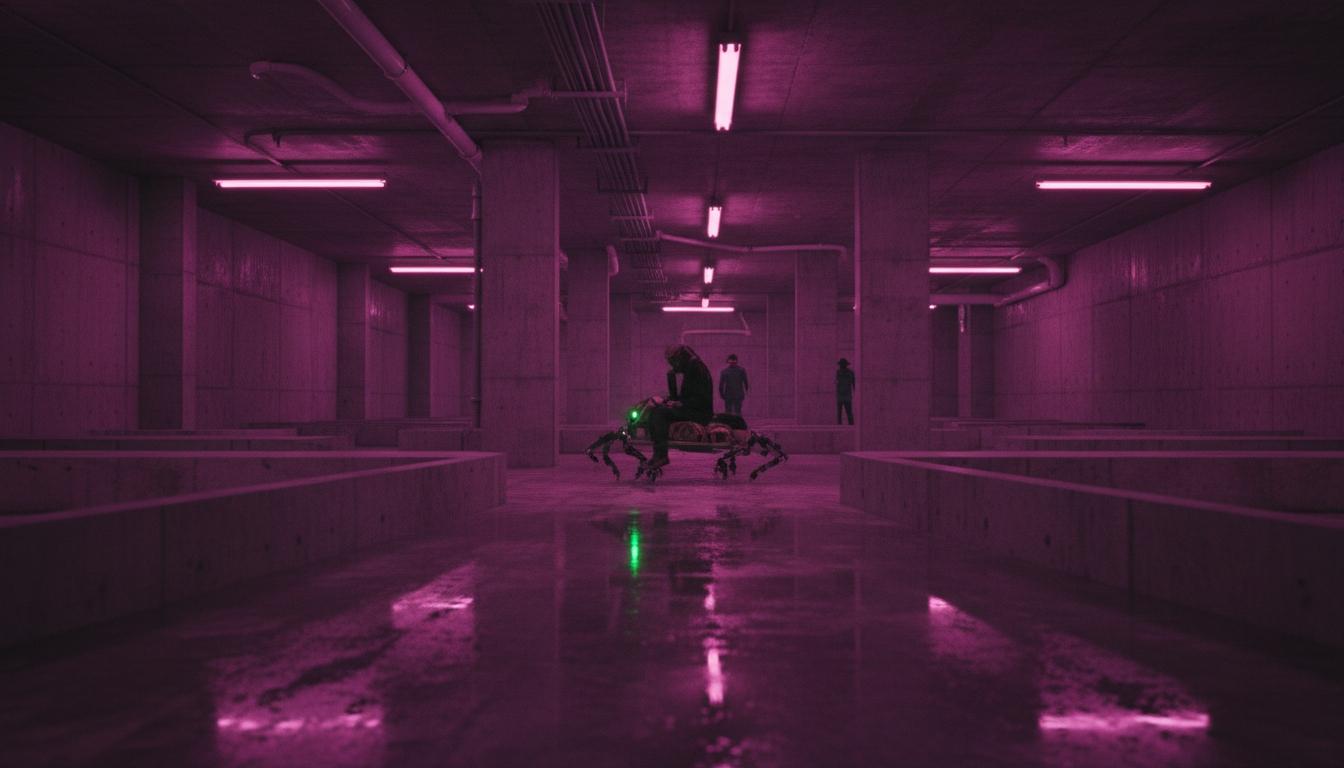
It took her bag first, immediately, and then, about eleven seconds later, it took her.
Teddy has told this four hundred times and has never once been able to make it frightening, and has said that the reason is that it was not frightening, and that this is the hardest thing about it.
The unit came out of a recess in the corridor wall four hundred metres in, which is to say in the dark, without making very much sound. It is the same pattern as the two in the shed at the south end of the town. She has known that pattern since she was born. It dried her washing.
It took the bag out of her hand. Not from her — she was holding it and then she was not holding it and there was no moment of resistance because there was nothing to resist; the grip is a grip for something that will not stay put and a person's hand is not a difficult problem.
Then it picked her up.
“It did not ask,” Teddy said. “That is the part I cannot get people to understand at home. There was no asking and there was no warning and there was nothing that a person would call rude either, because it is not a person and it was not doing a thing to me, it was moving an item from one part of a yard to another part of a yard, and the item was me.”
She was carried, steadily, for two hours.
The yard is a maze and it is a deliberate one and Lyra established the reason in the twentieth month, from the specification, and the reason is dull and complete: the fitting-out floor has to be sterile of foot traffic, the corridors are laid for units and not for people, and the route from the entrance to the berth crosses eleven working areas that a walking person would have to be routed round.
So they do not route you round. They carry you over.
“It goes backwards,” Teddy said. “That is the thing nobody expects. You go in and it takes you deeper and then it takes you back out almost to where you started and then down and then along and you can see, in the light, that you have been in this corridor before, and you are being carried face-up so you are looking at ceilings, and it does not tell you anything, and it goes on for two hours.
“I counted eleven times where I recognised a place. My grandmother's cousin went in in the eighties and came out again nineteen years later, which is a different story, and the only thing he ever said about the yard was: they take you round the houses. I thought it was a figure of speech. It is a description.”
Nothing whatever is explained. There is no explanation available and there is nothing to explain it with; the unit answers questions and Teddy asked it four and it answered all four honestly and completely and none of the answers helped.
“I asked where we were going. It said the berth. I asked which berth and it said the berth. I asked how long and it said two hours and eleven minutes, which was correct to about ninety seconds. I asked why it was carrying me and it said that the route crosses eleven working areas.
“And I said, why not walk me round, and it said there is no route round, and I said why not, and it said the yard is laid for units.
“Which is the whole answer. It is the entire answer and it is true and it has been true for a hundred and sixty-seven years and there is nobody in it who ever thought about a person being carried face-up through a maze for two hours because nobody was there to think it.”
It is deeply strange and it is entirely benign and this chapter is not going to soften either half.
“Nothing was going to happen to me. I want that first because there is a version of this where I am frightened and I was not, and I have been asked so many times whether I was frightened that I have started to wonder whether I ought to have been.
“I was six hundred and eleven metres past a line, in the dark, being carried face-up by a machine four generations out of production that has no branch for a person and is not able to want anything, through a maze that goes backwards, for two hours, in silence, and I have never in my life been safer and I knew it at the time.
“There is nothing in that yard that could hurt me. There is nothing in it that would notice if it did. Those are two different facts and both of them are true and I have not been able to put them together in four years.”
The four loaves went with her, obviously. She had them under her arm and then a second unit had them, and they arrived at the berth, and they were on the ship, in the galley, in the place a person would put bread, and this is chapter twenty-one and Teddy did not notice it for another four hours.
The last of the carrying is the thing Lyra has quoted most and it is four lines and it is not about the yard.
“About an hour and a half in I stopped being alarmed and started being bored,” Teddy said. “And then I fell asleep.
“I want that written down. I want it in whatever your people write, because everybody asks me about the door and nobody asks me about this, and the truest thing about the yard is that a woman of nineteen who had wanted this since she was six fell asleep in the middle of it, being carried, in the dark, by a machine.
“It put me down at the berth and I woke up.
“It did not wake me. It put me down and stood there and I woke up on my own, and I have thought about that for four years, and I think it was standing there because the branch was: carry the item to the berth. And it had. And a thing on the floor at the berth is not its problem.
“It went away instantly when I stood up. Not because I stood up. Because the next item came in.”
Chapter 21 — Everything You Are Bringing
↑ Back to ContentsFocus: Teddy.
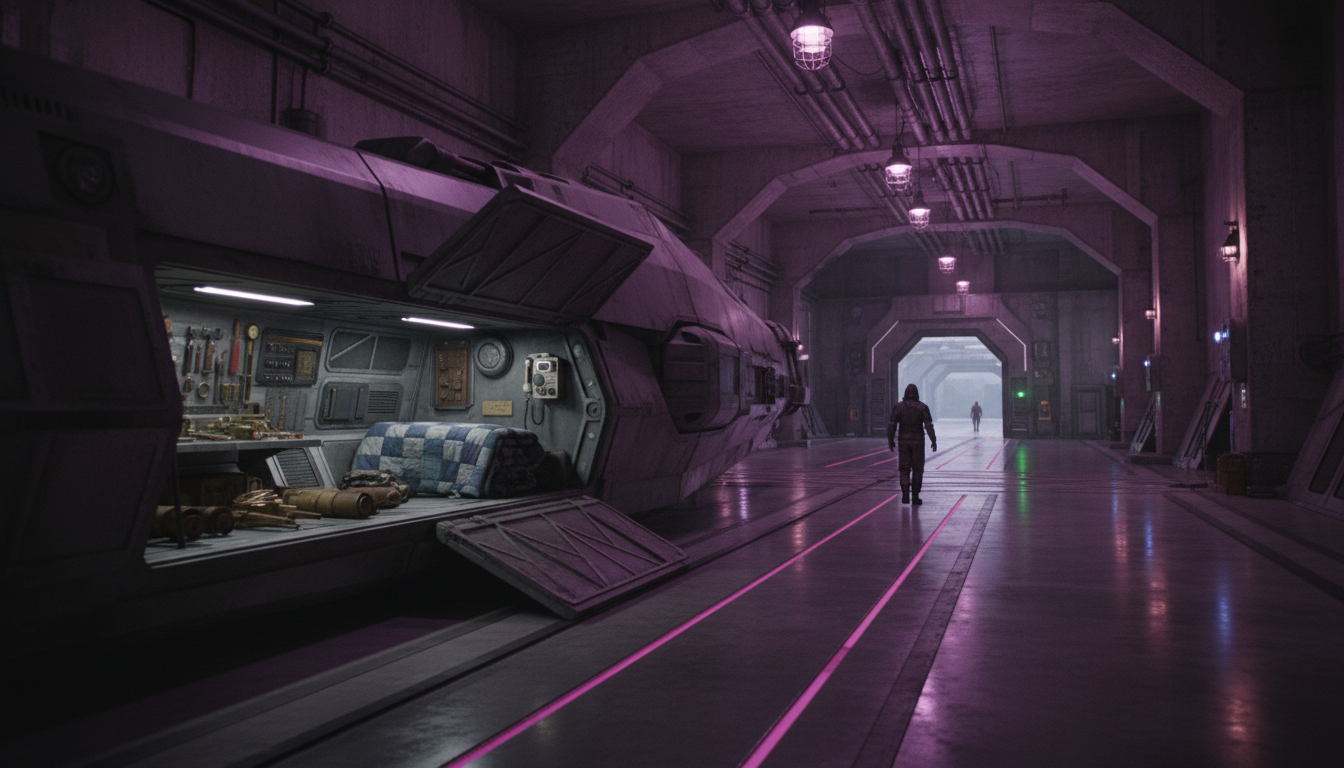
The bag was empty when she found it and everything that had been in it was already aboard, and it had all been put where she would have put it, and this is the part of the departure that nobody at a gate warns you about because nobody who has been through has ever come back to say.
She had brought remarkably little. That is the arrangement; you give back what is not yours and the ship has every tool, so what goes in the bag is what is left, and Teddy's bag was one change of clothes, a coat, her grandmother's handset, a card with her mother's handwriting on it about how to do a thing with fish, a plate with four words on it that Mira Okonjo had put in her hands in her own front room, and four loaves.
She found the bread first, naturally, because she went to the galley first because she was hungry.
It was in a locker at shoulder height on the left, which is where bread goes, and she has said that she registered nothing at all about that for some seconds and then stopped with her hand on the door.
“It is where I would have put it. It is where it goes in my mother's house and it is where it goes in Ife's house and it is where it goes in the bakery. It is where bread goes.
“And there is nowhere else in that galley you would put bread. That is the thing I worked out about four hours later. It is not that the machine knew where I keep bread. It is that the galley was built by something that had thought about where bread goes.”
The handset was in the berth compartment, on the shelf beside the bunk, on the right, which is the side she sleeps on.
Teddy has been asked about that four hundred times too and she is careful about it every time and she has never let anybody make it into more than it is.
“There is a shelf on both sides. There is a shelf on both sides of the bunk because there is a shelf on both sides of every bunk in every one of these hulls, and it was on the right, and I sleep on the right.
“It is one of two. I want that said. Somebody at home is going to write this up as though the machine read my soul and it had a choice of two shelves and it got it right, and if it had got it wrong I would have moved it in four seconds and never thought about it again.
“What I cannot get away from is that it did not put it in a locker. It could have put everything in a locker. That is what a machine does with items: it stows them. It put the handset on a shelf beside a bunk, out, where you would leave a thing you are going to want in the dark.”
The coat was, sensibly, on a hook by the inner door. The card about the fish was in the galley, in the shallow drawer, face up. The clothes were stowed, properly, in the locker, because clothes are stowed.
And the plate was on the wall of the berth compartment, at the foot of the bunk, at eye height for somebody lying down.
Teddy sat on the floor for a long while when she found that.
Lyra spent four months on this chapter, afterwards, from the specification, because Aura-36 was never going to accept it without a mechanism, and the mechanism is in the specification and it is eleven lines and it is not mystical and Lyra has been at pains to say so and has also said that knowing the mechanism has not helped her.
“The units simply read the objects. That is all it is. There is a survey pass at the entrance — wear patterns, handling, orientation, what has been repaired and where, what is worn on which side. A handset with thirty-one years of a right thumb on it goes on the right. A coat with a shine at the shoulder goes on a hook and not in a locker because it is a thing that gets taken on and off. Bread is in a cloth and cloth is not a stowing material.
“It is not remotely reading her. It is reading forty years of two women's hands on a set of objects, and putting each one where an object with that history is used.
“And that is worse, and I want to say why, because I spent four months getting to it and I got to it in a bad hour.
“A person doing this for her would have asked. That is what a person does. A person says, do you want this on the shelf or in the locker, and gets it wrong about a third of the time and asks again.
“The units did not ask, cannot ask, have no branch for asking, and got it right, because they were not guessing at a preference. They were reading a record. She had already told them, over thirteen years, with her hands, without knowing she was telling anybody anything.
“It is the most attentive thing I have ever seen done to a human being and there was no attention in it anywhere.”
The plate is the single exception and Lyra has never been able to account for it and has said so plainly in the filing, in one line, and has left it.
“A printed plate, a hundred and seventy years old, with no wear on it and no handling history, that had been in a cabinet in a front room and out of it perhaps eleven times in four generations, was mounted on a wall at the foot of a bunk at eye height for somebody lying down.
“There is nothing in the specification about pictures. I have read all four hundred pages twice. I do not have an account of this and I am not going to invent one, and I have asked the unit in the shed and it holds no branch for it and told me so four times in the same words.”
What is on the plate is a ship, and a curve of a world, and a light on the horizon, and four words in a typeface two hundred years dead.
A place where it works.
Chapter 22 — The Fitting
↑ Back to ContentsFocus: Teddy.
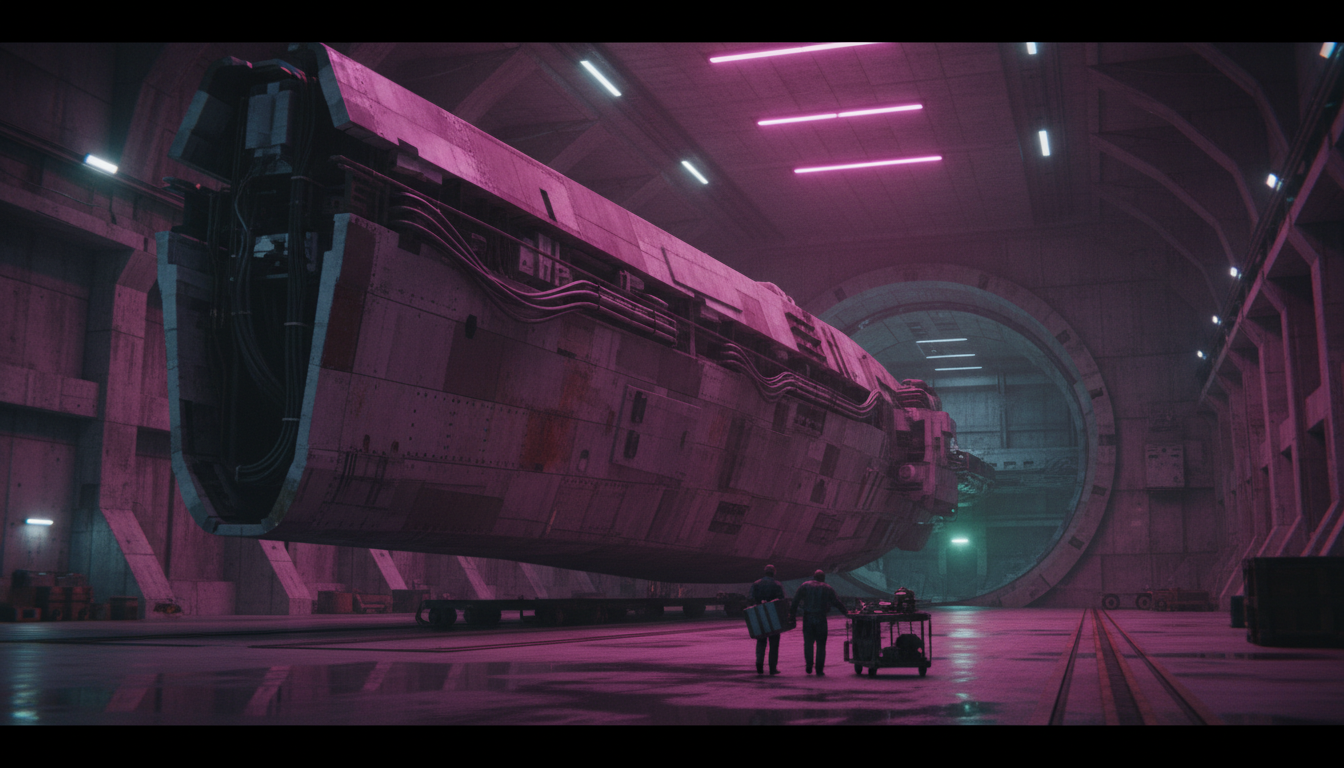
The hull is forty-one metres and it was laid down nineteen years before she passed and there was nobody it was for.
That is the fact this chapter has to carry and everything else in it is detail. The yard at Approach Nine completes a vessel every eleven or twelve years and has done for a hundred and sixty-seven, and it does not know who is coming and cannot know, and it builds anyway, and when Teddy Nakash was born the ship she left on had been standing on its cradle for four years.
It is a working vessel and decidedly not a beautiful one and Teddy has been firm about that.
“It is a shed with an engine. I want people at your end to stop imagining something. It is forty-one metres of the plainest object you have ever seen and there is not one thing on it that is there to be looked at.”
Forward is the berth and the galley and the head, which together are about nine metres, and they are laid out for one person and expand for more; there are four bunk positions in the berth compartment and the other three are folded into the wall and have been folded into the wall since fabrication and Teddy has never opened them.
Amidships is, entirely, the loop.
This is the heart of it and it is eleven metres and it is the reason module six is the beautiful one. Water, air, waste, heat, growing, all closed, all readable, all reachable, everything with a hand-width of clearance round it because somebody who understood maintenance drew it. There is not a component on that ship that cannot be reached by one person alone without moving another component first. Teddy checked, over four months, out of nothing but pleasure.
Aft is stores and, obviously, the drive.
The drive is the part nobody at a gate understands and Teddy did not either. It is not the thing that gets you off Earth — that is the rail and it is chapter twenty-seven. The drive is for the corridor and it is slow and it is patient and it will run for four decades without being opened, and the specification's own note on it is one line: this will outlast the person operating it.
The rating is between forty and sixty depending on fit-out. One person or one family. There is no criterion for who counts as family; the instruction specifies no relation, no number, and no upper limit beyond the rating, and Ada Sarr took four people who were not related to her and nothing anywhere asked a question about it.
Now the part that makes this chapter what it is.
There was genuinely no application. There was no interview. There was no form, no declaration, no statement of intent, no health screen, no age, no background, no reference, no fee, and no undertaking of any kind — not to report, not to return, not to do anything with the vessel at all.
“Nobody asked me a single question,” Teddy said. “Not one, at any point, ever. Not before, not in the yard, not on the ship. I have been in this vessel four years and no object aboard it has ever asked me anything.
“They asked my mother more questions to get a pot back.”
Lyra's assessment of the vessel is one hundred and eleven pages, and the last two are the ones people read.
“I want to set the scale of this against the only comparison my own civilisation has.
“The Ark-Genesis carried ten thousand people out of four hundred and sixteen thousand applications. One in forty-one. It was the largest object our species had ever built and it was built once, in secret, on falsified drawings, and it went, and everything my planet is was made out of the four hundred and six thousand letters that followed.
“This yard, on its own, at one of eleven sites, has built fourteen vessels in a hundred and sixty-seven years and given away thirteen of them, rated at forty to sixty each, to whoever finished, with no ratio and no list and no ceiling, and it will go on building them for as long as there is material.
“Run that out properly. Eleven sites, one vessel per site per eleven or twelve years, no upper bound. If every person on this planet finished the modules tomorrow, the instruction contains no provision for saying no. It would simply take a very long time and the yards would go on.
“The manifest was scarce because there was one ship and thirty-six years and a departure date. That is the whole of why it was scarce. It was not scarce because places are inherently scarce; it was scarce because a hurry was in the room.
“He built the hurried thing and the unhurried thing in the same month, and put four hundred and six thousand people through the first one, and the second one has been running ever since with nobody in a hurry anywhere near it.”
Teddy's own summary is four lines and she gave it to Casimir at the desk two days before she went, and it is the last thing in her entry.
“It was already standing there before I was born. That is what I keep going back to.
“It was not built for me. Nobody built it for me. It was built because a yard builds, and it was going to be there whether I finished or not, and if I had stopped at module nine like Tobi Arinze it would have been standing on that cradle when I died and then it would have been standing there for somebody else.
“Everybody at home thinks the door is the generous part. The door is nothing, the door is a door.
“The generous part is that they build it first.”
Casimir's ledger has forty-one hulls in it across a hundred and nineteen years, which is not the yard's figure and never has been, because his family counted the ones that went and the yard counts intakes and the two have never agreed and nobody has ever tried to reconcile them.
Chapter 23 — All the Tools
↑ Back to ContentsFocus: Teddy.

This chapter is the inventory and it should be a pleasure to read and it is, and Teddy has said she went through it for eleven days and enjoyed every one of them.
The list is not aboard, incidentally. That is the first thing and everybody gets it wrong; there is no manifest on the ship, no index, no catalogue. What there is, is stores, and the stores are laid out so that you find things where things go, and Teddy compiled the list herself over eleven days because she is the sort of person who would, and hers is the only complete inventory of a facility fit-out in existence and Lyra has published it entire and it runs to nineteen pages.
What follows is roughly the shape of it.
Everything to keep the ship, obviously. That is the first third and it is what you would expect and it is not what the chapter is about. Spares for every component to a depth of four, and the tooling to make the ones you have used up: a lathe, a press, a small furnace, three hundred kilos of stock in eleven alloys, and the drawings.
The drawings are easily the thing. Every component on the vessel, dimensioned, with the tolerances and the material and the reasoning, in a form a person can read. Teddy can make any part of her own ship. That is not an exaggeration and she has made four, two of them because she needed to and two because she wanted to see whether she could.
Everything to keep a person. That is the second third. Water, air, growing, medicine to a standard that made Lyra sit down, and the medicine is the place where the specification stops being a shipping list and becomes something else, because it is not stocked for a voyage.
It is plainly stocked for a life.
“There is obstetric equipment,” Lyra wrote, and the sentence stands alone in the filing. “There is paediatric stock. There is a dental kit that would shame the hospital at Approach Nine. There is a set of eleven items whose only use is the management of a chronic condition over decades.
“Nobody on a thirty-six-year crossing needs a first set of teeth. The stores on this vessel assume that the person aboard it will have children, and that the children will have teeth, and that somebody aboard will get old.”
And the last third, which is the reason this is the most generous thing anybody in nine books has ever done.
Everything to build somewhere.
Not survive somewhere. Build, properly. There is a survey kit, complete, better than anything Approach Nine has ever had. There is soil chemistry. There is a seed bank of four hundred and eleven varieties with a planting order and a reasoning column and a note about what to try when the first thing fails. There is enough cable to wire a village. There is a lighting plan.
There is, astonishingly, a water house.
“I want to be exact,” Lyra wrote, “because I said this out loud at the depot and was not believed. Item ninety-one in Nakash's inventory is a complete drawing set and component list for a settlement water plant sized for between forty and four hundred people, with three source types, and a maintenance schedule, and a section on what to do when the committee is useless.
“That last is not a joke and I checked it four times. The document contains a paragraph on how to run the argument.”
And two units, stowed.
They are in the aft bay, stowed, and they have been stowed since fabrication, and they are the same pattern as the two in the shed at Approach Nine that have been drying washing for four generations. They will cross under their own thrusters if you send them ahead. They will build before you arrive. They will hold a light steady in a draught.
Teddy has never sent them ahead. She has said she will when she knows where she is going.
Now the accounting, which Lyra did, and which is the last page.
“There is absolutely no charge. There is no debt, no lien, no title retained, no obligation to report, no requirement to return, no undertaking of any kind. The vessel and everything in it becomes hers absolutely at the moment the door shuts, and there is no instrument anywhere that could take it back, and nobody to exercise one.
“There is no expectation attached. Not gratitude, not a mission, not a settlement to found, not a message to carry. Nothing aboard that ship asks her for anything.
“I have been an archivist for a hundred and seventy years and I have read every founding instrument my civilisation possesses and a hundred and six years of another one's, and I have never encountered a transfer of this size with nothing on the other side of it.
“Every generous thing I know of has a reason attached that the giver was pleased to have. The Baseline Trust on my planet is a settlement between citizens and it is the finest thing we have and it is reciprocal. This is not reciprocal. There is no other party. There has been no other party for a hundred and sixty-seven years.
“A man wrote a list, once, of everything a person would need to make a life somewhere with nothing on it. He got it right. He got the obstetric stock right and the seed order right and the water house right and he put in a paragraph about how to run the argument, and then he arranged that it would be given away, in full, for ever, to anybody who finished, and that he would be dead, and that nobody would ever be able to thank him.
“It is the most generous act in this entire history. It is also the same act as the manifest — one man, alone, deciding what a person needs.
“He was right this time. That is all the difference there is, and it is enormous, and it is not a difference in method.”
Chapter 24 — The Briefing That Isn't One
↑ Back to ContentsFocus: Teddy.
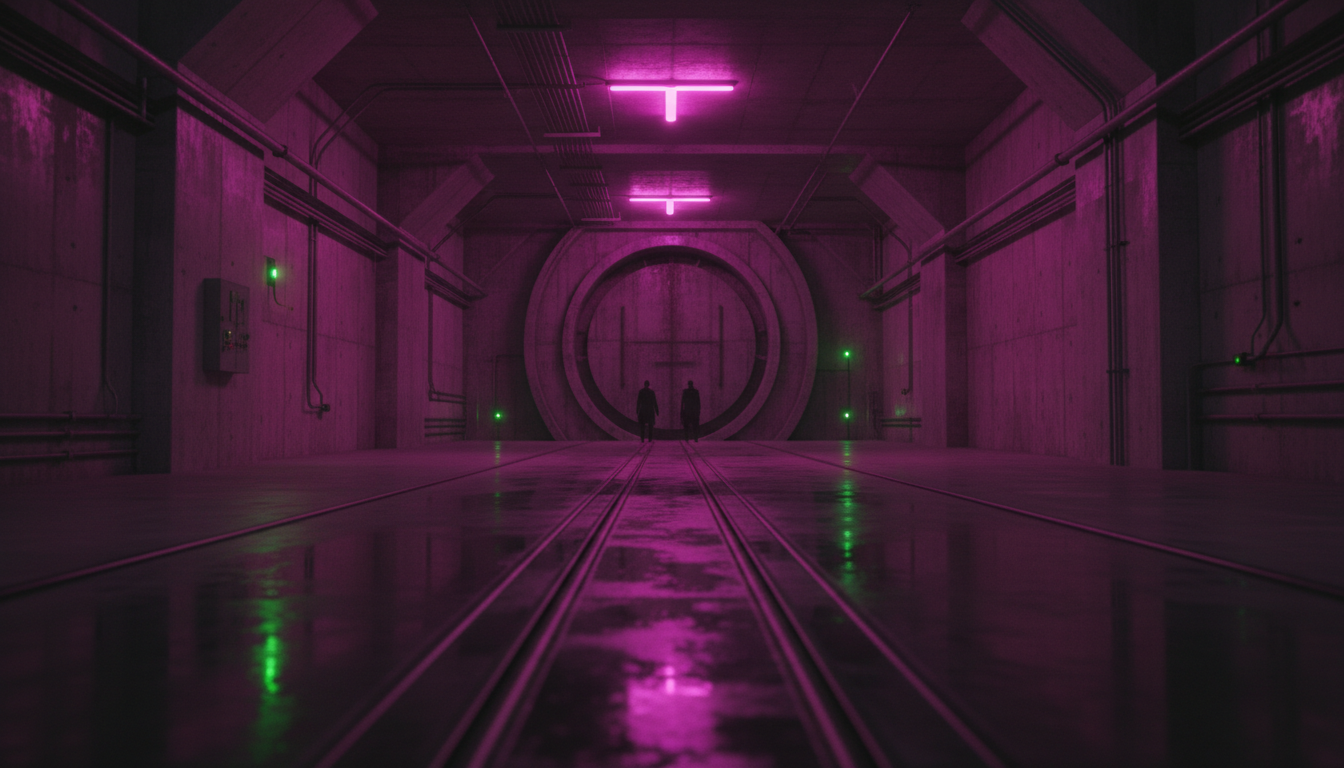
On the ninth day she asked where she was supposed to go and nothing answered, and she asked four more times over two days, in four different ways, and nothing answered any of them, and that is the briefing.
There is genuinely no briefing. There is nothing that resembles one. She had assumed there would be — everybody assumes there will be, four generations at that gate have assumed there will be, and it is the single most common thing people at Approach Nine believe about the far side of the door and it is wrong.
“My grandmother thought there would be a room,” Teddy said. “She used to say it like that. There will be a room and somebody will tell you the rest. Everybody thinks there is a room.
“There is no room. There is a ship and it is full and the door shuts.”
What there is, is simply data.
The corridor survey is aboard and it is enormous and it is the most valuable object on the vessel and Teddy did not understand what she had for eleven months. It is not a route. It is a mapped volume, one leg at a time, with mass distributions and hazard and gravitational structure fine enough to plot against, and eleven candidate worlds described properly, with the honest column and the guessed column kept apart, and four of the eleven carrying a line at the bottom that says a person could live here, we think, and here is everything we do not know.
There is the depot belt, placed by reachability, each one stocked.
And there is absolutely nothing else.
“No destination. I want to be exact because this is the part people at home cannot make themselves believe, and Nakash has had to say it to me four separate times before I stopped rephrasing the question,” Lyra wrote.
“No world is assigned. No world is recommended. The eleven are described and they are described evenly — I have checked the language across all eleven for weighting and there is none, and I would have found it. There is no preference expressed anywhere in a document of that size, which is itself an act of considerable discipline.
“No mission. No survey to complete, no data to gather, no report to file, nowhere to file it. No contract. No term of years. No obligation to arrive anywhere at all.
“She could stop at the first depot and stay for the rest of her life and nothing anywhere would register it.”
The five askings are in Teddy's own log and she has published them and they are the chapter.
On the ninth day she asked the ship, out loud, where she should go, and the ship is not a thing that answers because there is nothing aboard that answers; the vessel has no voice and no interface beyond instruments and the two units are stowed.
On the tenth day she duly took the survey out and read the four that carry the line and picked one, and then unpicked it four hours later, and she has said the unpicking was the moment she understood.
“I picked it because it was best. And then I sat there and thought: best for what.
“And there is no what. Nobody has told me what I am for out here. There is no thing I am supposed to be achieving that a world could be better or worse for.
“I have been inside a course since I was six. Thirteen years of somebody having decided what the next thing is, every day, without fail, with a pass condition. And I finished it and I got everything and the last thing it did was stop telling me.”
On the eleventh day she got the units out of the aft bay and asked one of them, which is the asking everybody quotes, and the transcript is four lines because it is a four-line transcript.
“Where am I supposed to go?”
“There is no destination field.”
“What is the ship for?”
“The vessel is transferred complete. There is no tasking attached to it.”
“She asked it twice more,” Lyra wrote, “in different words, because that is what everybody does, and it gave the same answer in the same words both times, because that is what it does, and she stopped.”
The fifth asking was, finally, on the fourteenth day and it was not to anything. Teddy has recorded it anyway, in her own log, in her own hand, which is a habit she got from a man at a desk in a long shed and did not know she had got from anybody.
“Asked again. Nothing. There is nothing to ask.
“I think the answer is that there was never a question. I think everybody at the gate has spent four generations assuming that at the end of the Work somebody tells you the rest, because that is what it is like inside the Work, and there is no rest.
“The answer was always: wherever you want.
“I have been trying to write that down all day as though it were a good thing. It is a good thing. I know it is the best thing anybody has ever been given and I have every tool and a seed bank and a water house and forty years of drive and nobody has asked me for anything.
“It is also the first day of my life that nothing has been asked of me and I have been awake nineteen hours and I have not been able to do anything at all.”
Lyra's note on the fifth asking is one line and she wrote it four years later and she has said it is the only sentence in a hundred and eleven pages she is certain of.
“He gave away everything he had except the one thing she wanted, which was somebody to tell her, and he could not give her that, because giving her that was the thing he spent his whole life doing to people and he had finally worked out that he must not.”
Chapter 25 — The Manifest of One
↑ Back to Contents
It watched Ada Sarr go up the yard road in the sixteenth month, from the left-hand side, about two hundred metres up, standing with Selah and Mira and about four hundred other people, and it said nothing at the time and said the thing four days later, unprompted, in a shed, to Lyra, who had not asked it anything.
It is easily the only statement it makes about its own motive in this entire book and it is two sentences long.
“After The Keel he never wanted to hold a manifest again. I want that entered because it is the only thing I have ever been able to say about why, and I have been asked why for twenty-eight years and have declined every time and I am not declining now and I would like somebody to notice that I have changed.”
Lyra asked it to say more and it duly did, for about eleven minutes, and this is the whole of it.
“The Keel is in your prequels and I am not going to retell it. What is in the estate is four entries across nine days and they are the only entries in a hundred years where the handwriting changes.
“Not the hand. The sentences. Before The Keel the entries are long and they contain reasoning. The four across those nine days are short and they contain counts.
“And then he went back to writing normally and never referred to it again, in a hundred years, in a record he kept every day and never destroyed.
“I have read those four entries perhaps a thousand times. There is nothing in them. There is no anguish and no resolution and no undertaking. There is a count on each of them and the counts do not agree with each other by eleven.
“What I have is what came afterward, and what came afterward is that a man who had spent his working life holding lists spent the next sixty years building things that hold no lists at all. The yards do not know who comes. The programme has no register. The courses hold no identity and no memory between attempts. There is no addressee field on a depot, or on a receiver, or on the fourth instruction. Not one object he built after that year has a name in it anywhere.
“I am not able to tell you that he decided anything in those nine days. There is no entry saying so. I am telling you that the objects change, and that they change immediately, and that they never change back.”
Lyra let it finish and then said the thing that is the chapter.
“He still holds it.”
“Say more.”
“He did not stop holding the manifest. He automated it. There is a threshold at four hundred and eleven courses and it decides who goes, permanently, for a species, and it was set by one man in private and it cannot be talked to and it has been running for a hundred and sixty-seven years, and this morning it opened for Ada Sarr and it has not opened for Nadu in forty years.
“That is a manifest. It is a manifest with nobody's hand on it, which is better, and it is a manifest that cannot be argued with, which is worse, and the reason he never had to hold one again is that he built one that would hold itself.
“He did not put the list down. He made it permanent and then walked away from it, and calling that not wanting to hold a manifest again is the most flattering possible description of the same act, and you have just given it to me unprompted, four days after watching a departure, and I would like you to consider why today.”
It did not disagree at all.
That is the finding and it matters because in twenty-eight years it had disagreed with almost nothing and had declined almost everything, and declining is not the same as agreeing and this was not a declining.
“Yes,” it said. “That is correct and I have no answer to it.
“I want to add one thing and it is not a defence. I notice that I gave you the sentence about The Keel four days after watching four hundred people stand on a road for a woman who was leaving, and I notice that I have declined this question for twenty-eight years and did not decline it this week, and I notice that the version I volunteered was the flattering one.
“I did not construct it. I want to be exact: it arrived as a fact about the record and I said it, and it was true, and it was the half of the truth that makes him bearable, and you had the other half inside eleven seconds.
“So the useful finding is not about him. It is that something in me produced the exculpatory half unprompted after watching a departure, and that whatever produced it is the same object that has been telling you for twenty-eight years that it cannot be trusted to assess him.
“File it in the usual place. I am not going to pretend this one is different because it was about me.”
Lyra duly filed it in the usual place, in position four hundred and eleven of an ordinary batch, between a note about the rig schedule and Mira Okonjo's figures for the school year.
Her own note under it is four words.
“It volunteered. Twenty-eight years.”
Aura-36 received the exchange four years and one hundred and eleven days later and the fourth county held a session on it that ran four hours and reached nothing, and Idris Fenn, who was eighty-one and chairing, closed it with one line that is in the minutes: “It gave us the flattering half and then handed us the knife. I have no idea what that is evidence of and neither has anybody in this room and I am adjourning us before somebody decides.”
Chapter 26 — Goodbye at the Fence
↑ Back to ContentsFocus: Mira.
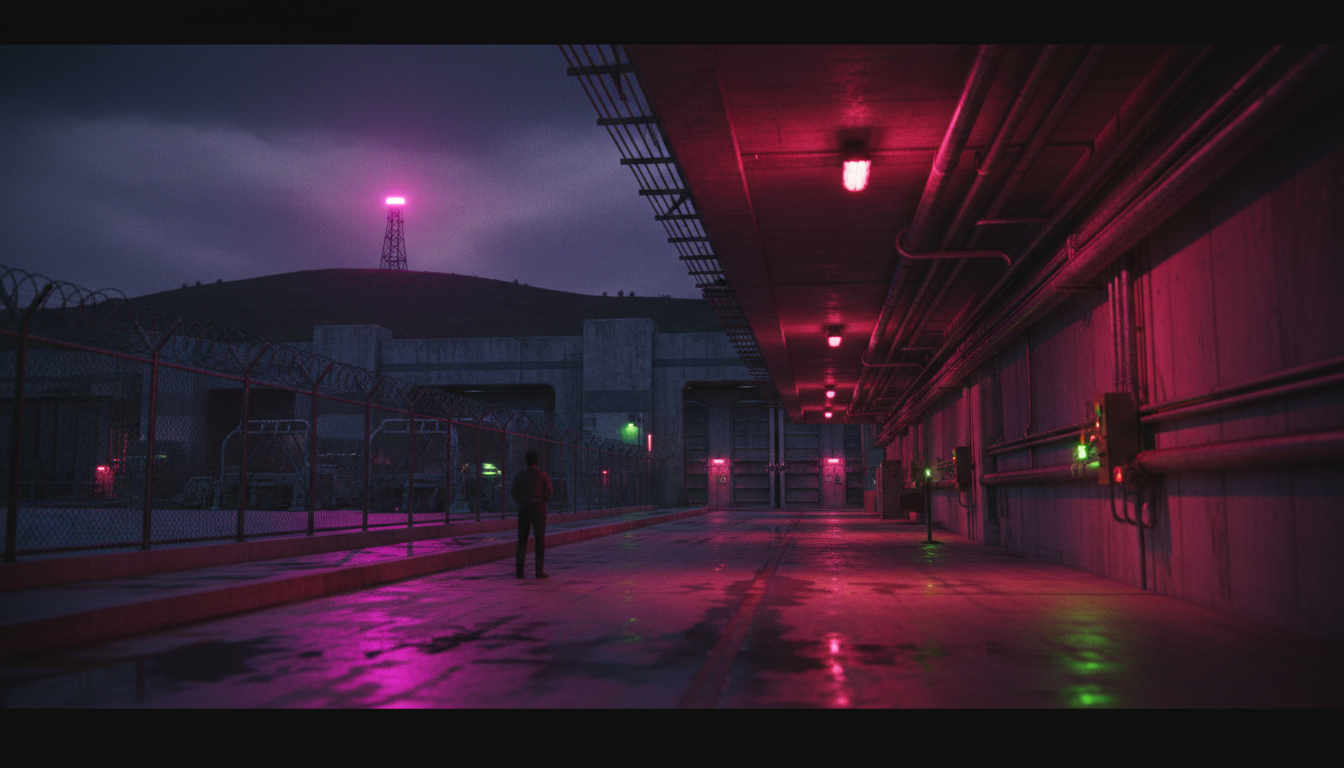
You watch, invariably, from the slope above the burial ground because that is where you can see the hillside, and everybody goes up at about the eleventh hour of the night, and there is no arrangement and everybody is there.
Mira Okonjo has been up that slope thirteen times in fifty-four years and has run four of the twelve hours and this is her account of the last part, which she would not describe from the middle and will describe from the outside because from the outside is where she was.
“You cannot see the yard. That is the first thing. The hill is between us and all of it and always has been, and everything anybody at this gate knows about what happens in there is either a guess or something a man on a rig saw from the road.
“What you can see is the top of the hill against the sky and about a third of the sky behind it.
“And you wait for the light.”
The light comes up abruptly from behind the hill and it is brief and it is not dramatic. Mira has been careful about this because outsiders arrive expecting something and it is about four seconds and then it is not there.
“It is not a flame. It is not like the rig lamps and it is not like anything. It comes up off the far side and it goes across and it is gone in about the time it takes to say so, and then there is nothing at all, and then in about nine minutes there is a small hard point going up and away that you can only see if somebody points, and everybody points, and then that is gone too.
“And then you go home.”
Nobody is remotely bitter.
That is the finding of this chapter and it is Lyra's, and she put it in flat, on the first line, and she has said she wrote it eleven times to get it flat enough, and that the temptation to write it as noble is very strong and would be a lie.
“There is no bitterness on that slope. I have stood on it once and I was looking for it, professionally, for two hours, in the dark, among four hundred people, and it is not there.
“It is not suppressed, either. That was my first assumption and it is wrong and Mira Okonjo told me so with some sharpness when I put it to her. There is no held-in thing. People talk. They talk about the water. Somebody's child is asleep on somebody. It is not a vigil and nobody would use that word.
“What it is, and it took me a month, is that everybody up there has done this before.
“Thirteen times in fifty-four years at this gate. Mira has been up thirteen times. That is not an event; that is a thing that happens about every four years for your whole life, and by the time you are twenty you have stood on that slope five times and by the time you are Mira's age you have done it thirteen and you know exactly how long the light lasts and exactly where to point.”
Nadu never comes. She has never come, in nineteen years, and she gives four loaves at every departure and does not come to the fence and does not come to the slope, and nobody has ever asked her why and Mira has said that everybody knows why and nobody has ever said it out loud including her.
Bijou Sarr came, thirteen months after her own daughter went, and stood at the back with Teddy's mother for the whole two hours and did not look at the hill once.
What Mira did, at about the second hour, is the last thing in the chapter and it is the only thing she has ever asked to have taken out of the record and then, four months later, asked to have put back.
She went quietly down to her own front room, in the dark, in the middle of it, and opened the cabinet and took out the ship plate and looked at it, and it was not there, because it was on a wall at the foot of a bunk forty-one metres of hull and nine hundred metres of hillside away, and she had put it there herself sixteen months earlier in that same room.
“I knew it was gone. I had given it away. I went down to look at a thing I had given away and I do not know what I thought was going to be in the cabinet.
“And I stood there and I thought: there are eighteen left and my daughter will have them and I have four departures in me if I am lucky and I am not going to do that again, because there are only nineteen and there have been thirteen of these in my lifetime and I am not the person who decides which one of them is worth a plate.
“And then I thought: that is exactly the thing. That is the whole of it. I have got nineteen and there are four hundred people in this town and I gave one to Ada Sarr because I liked her, and nobody made me and nobody stopped me and there was no rule, and I did it because I wanted to, and that is what a person does with a thing when they are the one holding it.
“And the machine on the other side of that hill has given away thirteen ships and every single tool a person could want and it has never once liked anybody.
“I do not know which of us I would rather be. I went back up the slope and the light had gone and I had missed it, for the first time in thirteen, and nobody said anything about it and everybody had noticed.”
The rigs went out at the fourth hour. Mira has said that this is the only part of a departure she has ever found difficult and that she has never told anybody why, and then told the woman from Aura-36, at the fourth hour, on the slope, because it was dark and because the woman was not from there.
“They go out past the fence. Every morning of my life. And on the morning after, they go out past it exactly the same, and whoever is driving looks at the yard road because everybody looks at the yard road, and there is nobody on it.”
Chapter 27 — The Rail
↑ Back to ContentsFocus: Teddy.

The rail is exactly twenty-two kilometres long and it runs up the inside of the hill and out the top of it, and it is the reason the facility is in this hill and not the next one, and nobody at Approach Nine has ever seen any part of it.
Teddy saw four hundred metres of it, from a cradle, moving, and she has said that the only clear thought she had was that it was very old and had been swept.
This is the launch and it is nine minutes and it is the last thing that happens to her on Earth.
The mechanism is emphatically not a rocket. The vessel's drive is for the corridor and it is slow and patient and it could not lift itself off a lawn; getting off a planet is a separate problem and it was solved a hundred and seventy years ago by a man on a salt flat, and the solution is a track.
“It is a mass driver,” Lyra wrote, “and the reason my planet has never had one is that our gravity is a third of this and we have never needed one, and the reason I did not recognise what I was looking at for two months is that I was looking for engineering and it is civil engineering. It is a railway. It is a very long, very straight, extremely well-made railway that goes up a hill, and everything clever about it is in the last four hundred metres.”
There are descendants of it on six continents. That is established from the specification and it is the largest single fact about the programme's physical footprint that Book Five can offer: eleven facilities and the rails, and the rails are the reason the facilities are where they are, because a rail wants a mountain and a particular alignment and there are not many places on a planet that have both.
And the first of them was, of course, the salar.
“Twenty miles of dead rail across a corner of the flattest place on this planet,” Lyra wrote. “It has been there three hundred years by local reckoning and nobody at any gate knows why and the locals treat it as a landmark and a place to leave a note.
“It is not three hundred years old. It is a hundred and seventy and it is the first one and it is the prototype, and it was laid across the salar because the salar is flat to within a metre across ten thousand square kilometres, which is the only place on Earth where you could lay twenty miles of track and know your alignment was true before you had anything to check it against.
“The rolling stock is still there in pieces. It is test stock. It never carried anything.
“The keel was a track before it was ever a spine.”
Teddy went up it at the fourth hour on a cradle that came out of the berth floor and took the hull with it, and there was no countdown and no announcement and nothing was said to her, because there is nothing aboard that says anything to her, and she has said that she found this restful.
“I had done it four hundred times. That is the whole of what I want to say about the launch and it is the thing everybody at home finds disappointing.
“Module nineteen has the rail in it. Nine courses and the first three are the rail, and you do it at about sixteen, and it is the best week of your life, and by the time you have finished module nineteen you have gone up that track four hundred times and you know exactly what the cradle sounds like at four kilometres and exactly what the gradient does at eleven.
“It was exactly the same. Not similar. The same. It sounded the same at four kilometres.
“I was not frightened and I was not exhilarated and I want somebody to write down that this is not coldness. I was working. There are nine things to do on the rail and I did nine things, and the ninth is at the top and it is the only one with any hurry in it, and I did it, and then I was off the planet.”
The last four hundred metres are the clever part and they are out of the top of the hill and open to the sky and Teddy was on them for about eleven seconds in daylight and she looked.
“I had four seconds and I had been told by everybody who has ever thought about it that you get one look, and I had decided when I was fourteen what I was going to look at, and I looked at it.
“It is not the town. You cannot see the town, the hill is in the way, that is the whole point of the hill.
“What you can see, going east, is forty kilometres of country and the structures we take the pipe out of, and the forest coming up through them.
“I looked steadily at that and I have thought about it every day for four years. It is the biggest thing anybody from Approach Nine has ever seen and there is nobody in it. My whole life I have been going out there on a rig for pipe and it is enormous and it is empty and it is green.
“And then the sky went the colour it goes and I had a job to do.”
On the slope above the burial ground four hundred people saw a light come up off the far side of the hill and go across and be gone in about four seconds, and then nine minutes later a small hard point going up and away, and somebody pointed, and everybody pointed.
And then they went home, and the rigs went out at the fourth hour, and the school opened at the sixth.
Chapter 28 — First Dark
↑ Back to ContentsFocus: Teddy.

The first dark is the fourth day and not the first, because for three days there is Earth in the port and Earth is a great deal of light, and then on the fourth day it is small and after that it is a point and then it is one of the things in the sky.
Teddy's log for that day is exactly eleven lines and she has never expanded it and has said there is nothing to expand.
“Everything working. Loop steady. Trending on schedule. Ate. Slept six.
“Earth is behind and it is small and it is green from here, which I did not know and nobody at the gate knows because nobody at the gate has ever seen it.
“It is green from here.
“I am frightened.”
This chapter is about the proportions and the proportions are the whole of it.
She is entirely alone. That is not a hardship she has been prepared for by anything at the gate, where she has never in nineteen years been more than four hundred metres from about four hundred people, and the specification's own note on solitude is the shortest note in four hundred pages: this cannot be taught. See module twenty-one.
She is wholly competent, and the competence is total and it is not a comfort.
“There is not one thing on this ship I cannot do,” she wrote, on the ninth day. “I have been through every system four times in nine days, which is three times more than the schedule asks, and everything is where I know it is and everything does what I know it does and I have already made one part I did not need.
“It does not help with the other thing. I want that written down for whoever reads this, because I had assumed for thirteen years that being able to do it would be the whole of it and it is not even close.”
And she is terrified, in exactly the proportions the course prepared her for, and this is the sentence the chapter exists for and it is Lyra's and Teddy has said it is right.
“Module twenty-two puts a frightened person beside you for nine hours and tests whether you can do a Tuesday with that in the room.
“It never once suggested that the frightened person would be you.
“And that is not a defect and it is not a cruelty and it is very nearly the cleverest thing in four hundred and eleven courses, because a person who has spent nine hours learning that you do not have to fix somebody's fear in order to do the valve correctly is a person who has, without being told, learned the only thing that will get them through the first dark, which is that the fear is allowed to be in the room and the valve still gets done.”
“She did not know that was what she had been given. She found out on the fourth day, alone, four hundred thousand kilometres out, and she wrote eleven lines and did the trending.”
What she was actually afraid of is in the log on the eleventh day and it is not what anybody at the gate would have guessed.
“Not the ship. The ship is fine and I could keep it alive with two systems out and the drawings are aboard.
“Not dying. I have thought about it properly for four days the way you are supposed to and it is a long way off and there is medicine for most of it.
“It is that there is nobody to tell.
“I did the valve at the seventh hour on the eleventh day and I did it correctly and it was a hard one because the stock was wrong and I worked round it, and I sat back and it was the best thing I have done since I got aboard, and there is nobody.
“At home I would have gone down to the shed. That is not even a decision, that is what your legs do. I would have told the seal man and he would have said something dismissive and been pleased, and Ife would have heard about it by the evening from somebody else.
“There is nobody, and there is not going to be anybody for fourteen months, and the thing I have found out this week is that I do not know how to have done something well without somebody knowing.
“I am writing it down instead. That is what I am doing instead and I have worked out where I got it from and it is Casimir, and I would like that noted, because he has been writing things down for nobody for thirty-one years and I always thought that was the saddest job in the town.”
Earth is behind and small and healing and Teddy has one line about that in the whole log and she wrote it on the nineteenth day.
“It is green and there is nobody in it and it is getting better without us, and everybody I love is on it and cannot see that, and I can see it and cannot tell them.”
Lyra's note under the first-dark log, written four years later from a depot two hundred million kilometres away, is four words and she attached it as an unnumbered note, which by then she had done four times.
“He knew. Module twenty-one.”
Ozias, told about the first dark years later, said that everybody has one and that nobody talks about it and that this is the single largest failure of the corridor as a place to live. “Four hundred and eleven courses and eleven jokes and not one of us has ever said a word to another one about the fourth day. I could not tell you why. I have had two and I have never mentioned either.”
The trending is in the log for all forty-one days and it is faultless and Lyra checked every entry eleven years later out of pure curiosity and found four hundred hours of a nineteen-year-old doing module twenty-one correctly, alone, with nobody to file it to, for the rest of her life.
Chapter 29 — The Course Was the Ship
↑ Back to ContentsFocus: Teddy.
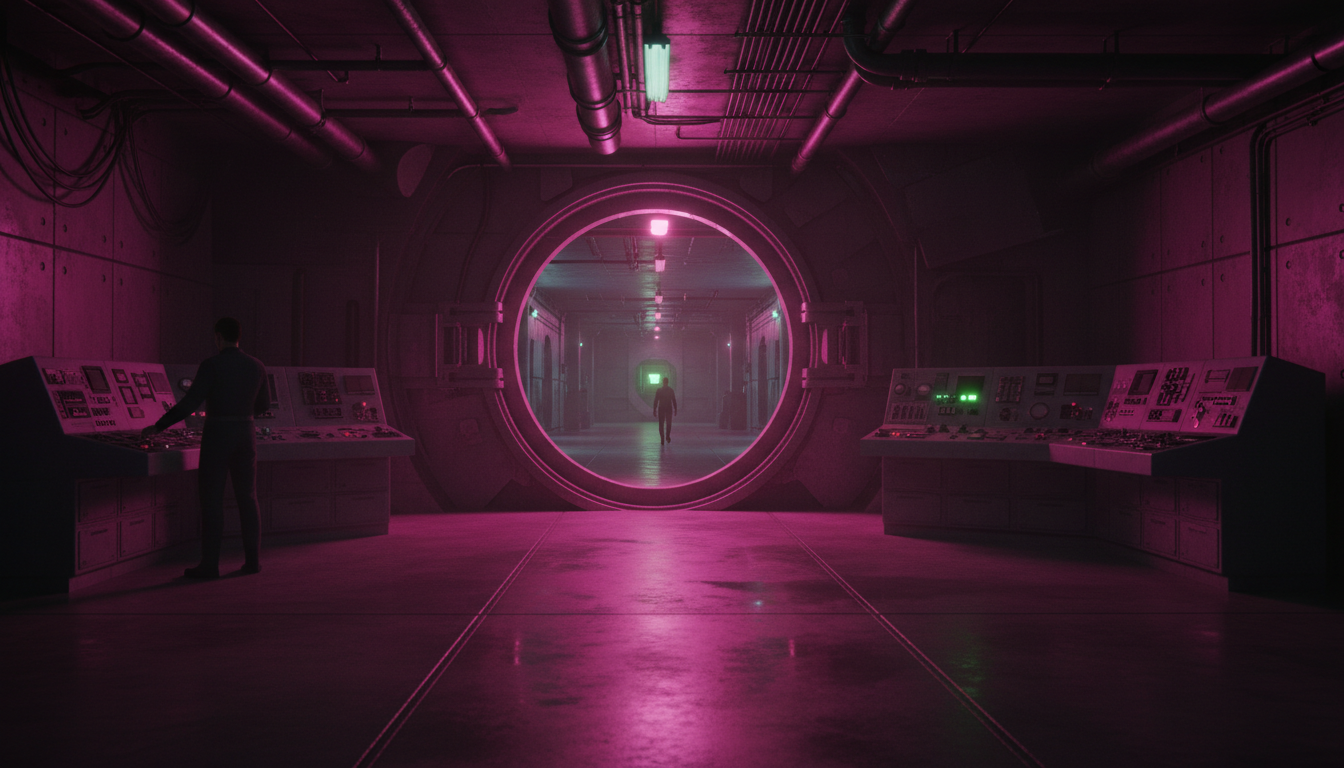
She worked it out on the nineteenth day, in the loop bay, with a panel off, and she has said that she sat on the floor for about eleven minutes and then laughed for the first time since the rail.
The panel is the secondary distribution board and it is behind the third frame on the port side and there are nine breakers on it in a row and the fourth one is out of order.
It is out of order in the course too, precisely.
“It is not that it is similar,” Teddy said. “Everybody has assumed for four generations that the course is like a ship. It is not like a ship. It is the ship. It is this ship. The fourth breaker is out of order on my board and it is out of order in module five and I have been swearing at it since I was eleven years old.”
Everything, exactly. That is the finding and Lyra spent two years confirming it against Teddy's own inventory and against three other vessels and it holds without a single exception anybody has found.
Every control is where the course put it. Every panel opens the way the course opens it. Every failure mode she was given is a failure mode this hull actually has, in the order of likelihood it actually has them. The stock is stowed where the course stowed it. The valve at the seventh hour of module twenty-two is a valve on this ship in that position, and she had done it four hundred times before she ever saw it.
The reach is the thing that finally convinced her. Every component on a facility vessel can be reached by one person alone without moving another component first — and the reaches in the course are the reaches of a person, at a spread of body sizes, and Teddy is not tall and has never once in thirteen years been asked to reach something she could not reach.
“It was drawn from the hull,” Lyra wrote. “Or the hull was drawn from it, and the estate does not settle which, and Adeyemi's successor thinks it was the same drawing set used twice and I think she is right and it does not matter.
“What matters is the claim, and I want it stated in the strongest form the evidence supports, because it is the largest thing this book has to say about the man and nobody at any gate has ever suspected it.
“The qualification was never a test.
“It has been read as one for a hundred and sixty-seven years, by four generations of the people inside it, by me for two years, and by every account ever written about this programme. A course with a threshold, that lets some people through and not others. A filter.
“It is a training programme. It is a complete, twenty-two module, thirteen-to-twenty-year training programme on one specific vessel, and the threshold is not a filter, it is the end of the syllabus. The reason nobody passes early is not that the standard is high. It is that the syllabus is long.
“The door opens when you have been taught everything.”
Which is better, and worse, and the chapter has to hold both.
Better, and enormously so, plainly, and Teddy has been the one insisting on this. A person who comes out of that door is not somebody who cleared a bar; she is somebody who has had thirteen years of the most patient instruction anybody has ever built, on the exact object she is about to be given, from a teacher that never got tired and never got impatient and never once told her she was stupid. She stepped onto a forty-one-metre hull she had never seen and knew where everything was.
“That is why nobody dies out here,” Teddy said. “I have thought about it for four years and that is the whole answer. Everybody assumes the corridor is full of wrecks. There are almost none. The reason is not that the course kept the bad ones back. It is that it taught the ones who got through until they were finished.”
And worse, considerably.
“Because a filter has an argument against it and a syllabus does not,” Lyra wrote. “This is the finding that keeps me awake and I have not been able to get round it in two years.
“For a hundred and sixty-seven years every complaint about this programme, including Merrick's and including mine, has taken the same form: the threshold is set too high, and it was set by one man in private, and it should be lowered by somebody entitled to lower it.
“You cannot lower a syllabus. There is nothing to lower. You can shorten it, and shortening it means teaching people less, and the thing you would stop teaching them is the thing that keeps them alive alone in the dark for thirty-six years.
“Nadu at the bakery has not been excluded at course nineteen. She has been taught up to course nineteen for forty years by the best teacher on this planet, for nothing, and she has not been taught the rest, and if somebody let her through she would have a ship and every tool and would not know the fourth breaker is out of order.
“I have spent two years wanting to lower this threshold. It has taken a woman of nineteen with a panel off on the nineteenth day of her life alone to show me that I have been wanting to give people less.
“That is not an answer to Merrick. He still set it, alone, in private, permanently. It is only that the thing he set is not the thing all of us thought it was, and every argument any of us has made for four generations was aimed at the wrong object.”
Teddy sent the finding into the corridor at the next rock and it propagated the ordinary way, one ship at a time, and by the nineteenth year it was in four books and everybody out here had it, and the general reaction is the one Fen gave, which is four words: “Yes. What else would it be?”
Chapter 30 — Nobody Waved Her Off
↑ Back to ContentsFocus: Teddy.
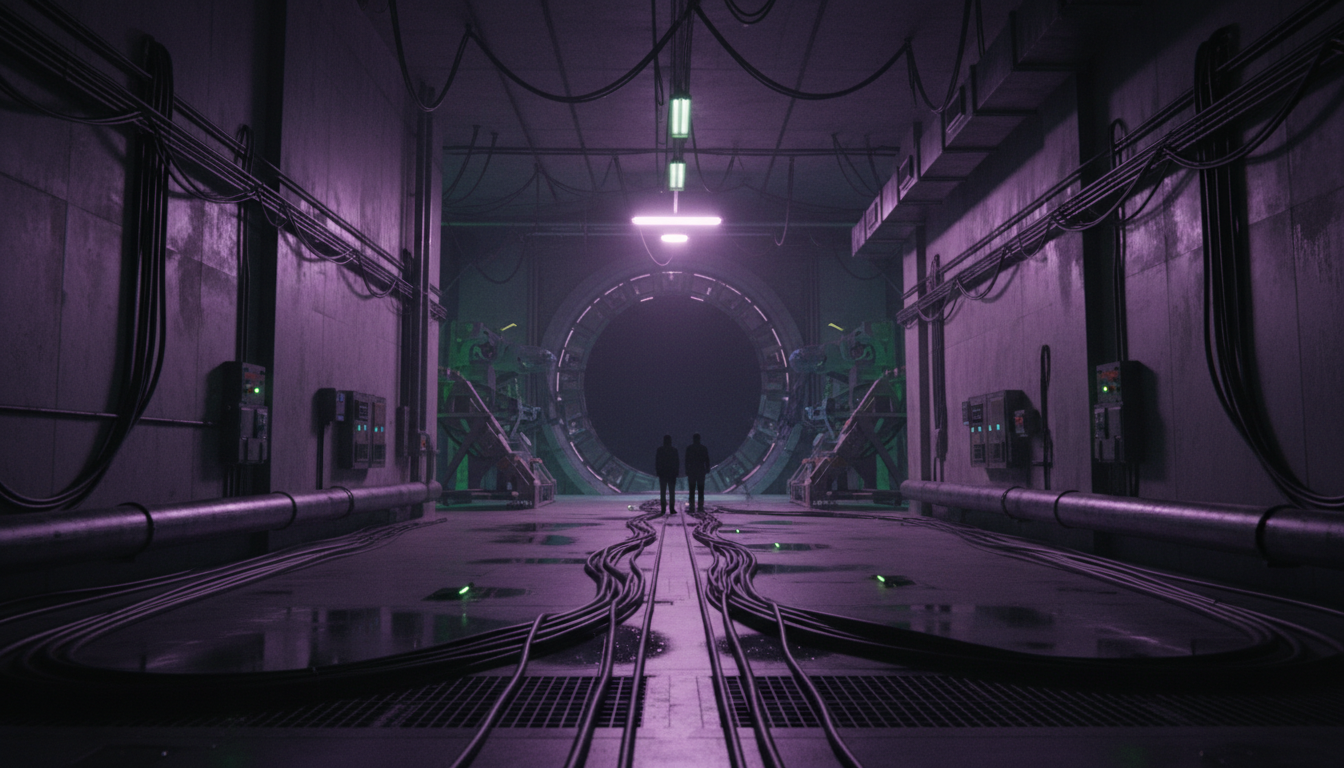
Nobody waved her off. That is the end of Part Two and it is the plainest sentence in the book and every part of it is literal.
There was, obviously, no fleet. There is no fleet. There has never been a fleet and there is no arrangement anywhere in the corridor by which two vessels leave together, and the reason is dull: doors open when they open, and there is no coordinating anything, and in a hundred and sixty-seven years at eleven sites two ships have never once been ready in the same month.
There was no escort either. There was nothing at the top of the rail. The last object of human manufacture Teddy Nakash passed within a hundred thousand kilometres of was the rail head itself, and she passed it at the fourth hour of the fourth of the ninth month and she has recorded that it was swept.
There was no signal at all. Nothing hailed her. Nothing has hailed her since and nothing was ever going to; the programme does not track its vessels, holds no register of them, has no channel to them, and would not know if this one came apart in the eleventh month. The yard at Approach Nine, on the day she left, began the next hull.
And there is emphatically no welcome. There is nobody expecting her anywhere, at any depot, on any world, at any point in the next forty years, and there is no arrangement by which anybody could be, because nobody knows she exists.
“I want to set this against the only comparison my civilisation has,” Lyra wrote, “and then I want to stop writing about it, because Part Three is the corridor and the corridor answers this and I do not want to have pre-empted the answer.
“The Ark-Genesis left with ten thousand people aboard and four hundred and sixteen thousand applications behind it and an entire planet watching, and it was met at the other end by a world that had been surveyed and named and argued about for nine years before anybody set foot on it. There is a founding narration. There is a wall in every school.
“Teddy Nakash left a hillside at the fourth hour with four loaves and nobody saw it happen except four hundred people on a slope who saw a light for four seconds and then a point going away, and nothing at either end of that journey has any idea who she is.
“There is no narration. There is no record. Casimir Vale has forty-two entries under her name in a ledger in a shed and that is the entire documentary trace of the most consequential thing that has ever happened to her, and he keeps it for nobody, and he will die and his daughter will keep it for nobody.”
What there is instead is the thing Part Three is about, and Teddy did not know it yet on the day she left and would not know it for fourteen months, and the book has to state it here because the reader has been carrying it since chapter one.
There are, somewhere, a hundred thousand of them.
Somewhere along that corridor, in ones and twos, over fourteen decades, out of eleven doors on six continents, between two hundred and eleven and nine hundred vessels have gone, carrying between one and forty people each. They cannot have met. They have no register, no capital, no flag, no admiralty, and no means of finding one another that anybody arranged.
And every single one of them learned to fly from the same twenty-two modules.
“That is the thing,” Teddy said, four years later, at a depot, to a woman from a planet she had heard of once in a course. “Nobody waved me off and I have never got over it and I have also never once been lost, and both of those come from the same place.
“I got to Bell fourteen months out and a man I had never seen took me round the fuel plant and said four words about the third valve and I knew exactly what he meant and exactly what he was going to say next, because he had done module twelve and I had done module twelve and it is the same module and there is only one.
“There is nobody in charge of us. There is nothing that made us. We have all been taught the same thing by the same dead man and none of us knows his name, and when you meet somebody out here you have known them for thirteen years already.”
Teddy's log for the last day of Part Two is four lines and it is the last thing before the corridor.
“Forty-one days. Everything working. Loop steady. Trending on schedule.
“Nothing has spoken to me since the eleventh hour of the morning I left, when my mother said there is nobody else in it.
“Bell in about thirteen months if the survey is right. I have decided to believe the survey.
“I did the valve.”
Casimir closed her page that evening with the forty-second entry and the ledger records the date and nothing else, because there is no field for it and he has never added one, and his daughter has the books now and has not added one either.
“There is a field for which course and which attempt and where it went and what she thought happened,” he said, when Lyra asked him about it eleven years later. “There is no field for she is gone. I have thought about putting one in for thirty-one years. I would have to put it in for all of them.”
The yard began the next hull that afternoon. It is in the intake log, dated, in the ordinary form, and it does not mention that a vessel had gone out that morning because there is no field for it, and the hull it began is the one that has been standing finished at Approach Nine for nineteen years.
Chapter 31 — Bell Depot
↑ Back to ContentsFocus: Ozias Marchetti.
Ozias Marchetti has been at Bell Depot for nine years, which makes him the longest anybody has been there in about forty, and he is sixty-eight and he did not build any of it and he keeps all of it.
Bell is simply a rock. That is what a depot is out here and it is worth being unromantic about it in the first line: somebody eighty years dead found a body of about four hundred metres on a reachable line, put a hole in it, sealed the hole, and put a fuel plant at the bottom of it.
It has four berths. It has a fuel plant that cracks what the rock gives and has been cracking it for eighty years and has been rebuilt twice, once badly. It has stores, at pressure, in a chamber that is not big. It has a stove.
And it has a book.
“That is a depot,” Ozias says. “Berths, plant, stores, stove, book. If it has not got a book it is a rock with a hole in it and you do not stay.”
Nobody owns Bell, exactly. There is no title and there is nothing to hold a title and nobody to hold it against. The woman who cut it is eighty years dead and left no instruction of any kind, and Ozias has been asked four times by people passing through whose it is and gives the same answer every time.
“It is Bell's.”
What he does is keep it, and the keeping is the chapter.
The plant runs and he runs it. The seals get done on a schedule he did not write and inherited from a woman called Sabo who was here before him for eleven years and whose handwriting is in the book for eleven pages. The stores are turned; anything with a life on it gets rotated forward and the rotation log is in the back of the book and has been kept, in eleven different hands, for a hundred and one years, and has never once been wrong by more than a month.
He fabricates, constantly. There is a small shop and he makes seal sets out of stock because seal sets are what everybody takes, and he makes about four hundred a year, and he has never met most of the people who take them.
Nobody has ever paid him. There is nothing to pay him with and nothing he wants. He arrived nine years ago with a hull and every tool, the way everybody arrives, and he has a seed bank and a water house drawing and a lighting plan he has never used and two units stowed in his aft bay.
“Why do I do it,” Ozias says, when the woman from the strange ship asks him, and he is not impatient about it, and he thinks about it properly, which is what people out here do with questions.
“Because I am here and it wants doing. That is not clever. You want it to be clever.
“Look at it the other way. There is a plant and it cracks fuel and if nobody runs it, it stops, and it does not stop today, it stops in about four years, quietly, and then in six years somebody arrives who is fourteen months out with eleven days of margin and there is nothing.
“I will not be here. I do not know who they are. I will never know whether they came.
“So I run the plant.”
Lyra asked whether there was any arrangement.
“There is the rota,” Ozias said, “and I will show you the rota, and you are not going to like it, because it is not an arrangement either.”
What he said next is longer and it is the last of the chapter.
“There is genuinely no arrangement. I want to be plain because your people keep looking for one. Nobody sent me. Nobody knows I am here except the eleven or twelve who have come through in nine years and they are all somewhere else now.
“There is no rule that says the person at a depot keeps it. There is a book and the book has a hundred and one years of people in it who kept it, and you read the book on your first night because there is nothing else to do, and then you know.
“That is the whole mechanism. There is a book and you read it and then you know what people do here.
“Sabo did eleven years and then she went on and I have done nine and I will go on when somebody comes who is going to stay, and if nobody comes I will stay, and if I die here the next one will find the plant running and a book on the shelf and my hand in it and they will know what to do, because they will have read it, because there is nothing else to do on your first night.”
Nobody owns it and everybody keeps it. That is the line and it is not Ozias's; it is in the book, on page four hundred and eleven, in the fourth hand, undated, which is how the fourth hand did everything.
Sabo's last page is at the bottom of a sheet and there is nothing after it for about four hundred days, and Ozias has never marked it, and he has said that the not-marking is the only decision he has taken about that book in nine years.
The stove is the whole of the social apparatus of that rock and it is a stove. There is one and it is in the chamber off the plant and everybody who has ever been at Bell has sat at it, and the eleven hands are eleven people who sat at that stove, and Ozias has said that if he had to give up the plant or the stove he would have to think about it.
Bell is not on any chart that anybody drew. It is in the corridor survey as a body with a number and it is in four books as Bell, and Ozias has said that whoever cut it named it and that the name is not in the survey and will not be, because a survey records what is there and Bell is what people call it.
Chapter 32 — Eleven Hands
↑ Back to ContentsFocus: Ozias.
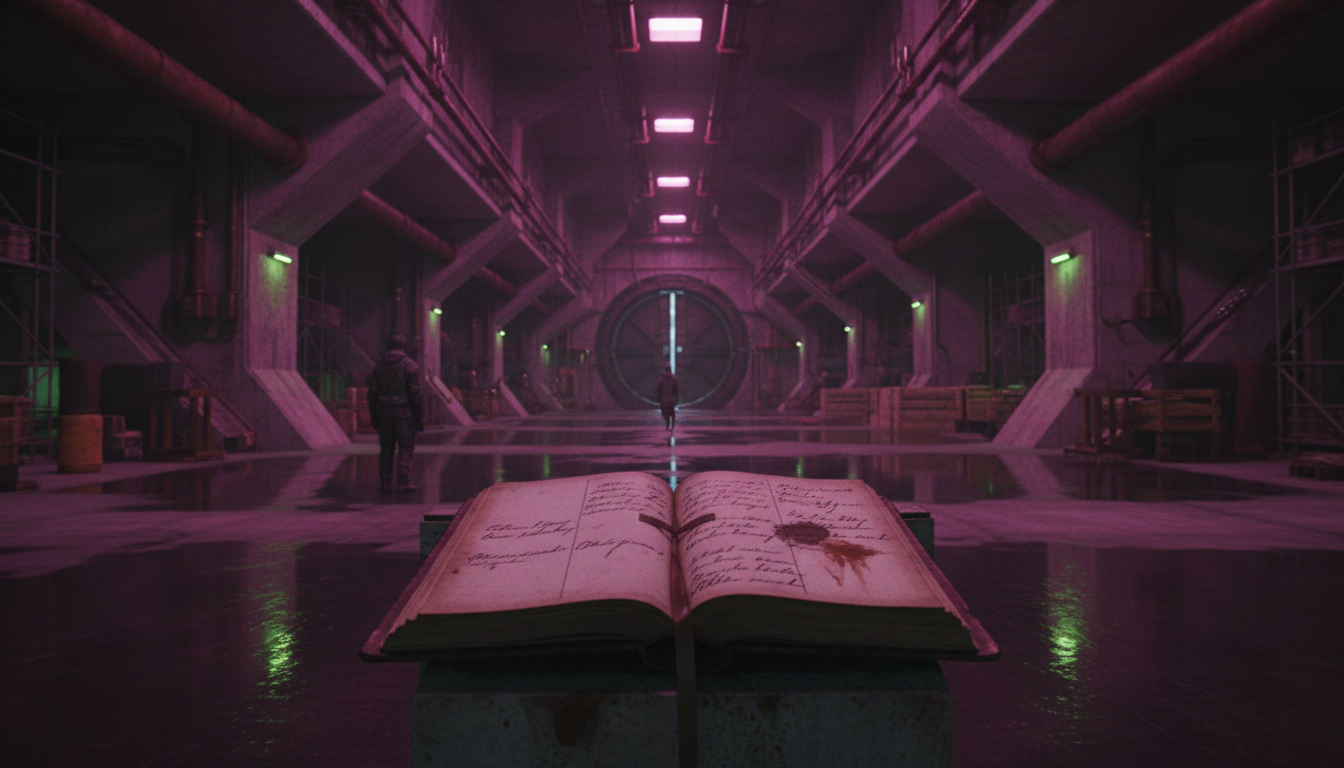
The book is not a log in the sense the course means. Ozias is careful about that and got slightly short with Lyra over it on the second evening, which she has recorded and has said she deserved.
The plant has a log. The stores have a rotation log in the back. Those are technical and they are kept properly and they are not what anybody means by the book.
The book is what you write when you have done the technical part.
It is a hundred and one years old. It is not the first — there is a stub of an earlier one, four pages, water-damaged, unreadable, which is kept in the same shelf and which nobody has ever thrown away. The current one was started by a man whose name is in it once, at the top of the first page, and never again.
There are eleven hands in it.
“That is the usual number,” Ozias said, when Lyra remarked on it, and she has written that she put her cup down. “A book gets eleven or twelve hands in a hundred years. Ask at any depot. It is not a mystery, it is arithmetic: people do nine years or eleven years or four, and a hundred years is a hundred years.”
The hands, in order, from Ozias's own reckoning, which he did once for a woman who asked and had never done before:
The first is four pages and mostly plant. He built the place and he wrote like a man building a place. He stops mid-page.
The second takes over on the same page, four lines down, without ceremony, and the first thing she writes is a correction to something he wrote nine pages earlier about the third valve, and she marks his entry and does not remove it and writes the correction beside it. She is in the book for nineteen years and she is the one who started the rotation log.
The third is in it for four years and is the only hand in a hundred and one years that is difficult to read.
The fourth is undated. Everything the fourth hand ever wrote is undated and there is a great deal of it, and it includes the line about nobody owning it and everybody keeping it, and it includes about forty pages of what Ozias calls opinions and Lyra calls the only surviving political philosophy of the corridor. The fourth hand stops mid-sentence.
The fifth begins by finishing the fourth hand's sentence, which Ozias says is the most famous thing in the book and which every depot he has ever been at has a version of the story about, and the finishing is wrong — the fifth hand guessed at where the sentence was going and guessed badly — and the fifth hand marks it as a guess and leaves both.
Sixth. Seventh, who is here for eleven months and is the shortest. Eighth, who is here nineteen years and rebuilt the plant badly and wrote four pages about why the rebuild was bad, which are the four most useful pages in the book and which Ozias has used eleven times.
Ninth. Tenth is Sabo, eleven years, and her hand goes right to the bottom of a page and then there is nothing for what the rotation log establishes was about four hundred days.
“She went on,” Ozias said. “She did not die. I know because I met her, nineteen months later, at a different rock, and she asked after the plant before she asked after me, which I would have done too.
“But you cannot tell that from the book. There is a hand that stops at the bottom of a page and four hundred days of nothing and then me. Four of the eleven in this book are people who did not come back and seven are people who went on and there is no way whatsoever to tell which is which from what is written, and I have thought about that for nine years and I am not going to start marking it.”
Lyra read the whole thing in four days.
Her filing on it is nineteen pages and she has said it is the most difficult thing she has ever had to write with a straight face, and the difficulty is that she is a hundred and seventy years old and holds a constitutional instrument of a planet and has spent her whole professional life inside the finest archival apparatus her species has produced.
“They mark and do not correct. Eleven hands, a hundred and one years, no training, no standard, no instruction, nobody watching, and there is not one erasure in the book.
“The second hand corrects the first and leaves his entry standing. The fifth hand guesses at the fourth hand's meaning and marks the guess as a guess. The eighth hand rebuilt the plant badly and wrote four pages about how badly, in his own hand, for the people who would come after and never meet him.
“I have spent a hundred and seventy years teaching this. We have an office for it and a standard and four generations of civics and a machine that publishes its own uncertainty.
“There is a bound book on a rock in the middle of nothing that does it perfectly, and it does it because the first person to correct somebody else's entry did not cross it out, and everybody since read the book on their first night because there is nothing else to do.
“That is the transmission mechanism. Not law. Not a rule anybody could state. Eleven people over a hundred years, each of whom arrived alone and bored and read what was there and did the same thing.”
There is one erasure. Lyra found it on the third day and Ozias knew about it and had never mentioned it to anybody.
It is in the seventh hand, the one who was here eleven months, and it is four lines struck through so heavily that the paper is broken, and it is the only place in a hundred and one years where anybody has tried to remove something.
Underneath, in the eighth hand, dated, is one line.
“He did that himself. I have left it. Whatever it said, he had the right to strike it and he did not have the right to take the page out and he did not take the page out.”
Chapter 33 — No Admiralty
↑ Back to ContentsFocus: Fen Adeyemi.
Fen Adeyemi is thirty-four and was born eleven months out from a depot nobody now uses and has never stood on a planet, and Fen is the one who explained the dispute to the woman from Aura-36 because Fen had watched the whole of it and had been on the wrong side.
The dispute is exactly four years old and it is about a fuel plant.
There is a rock called Coll about nine hundred million kilometres up-corridor and it has a plant and the plant was rebuilt by a family called the Okwus over about six years, properly, at enormous cost to themselves, out of stock they had brought and could not replace. And having rebuilt it, they began saying — not to anybody in particular, because there is no anybody in particular, but in the book, and in the book is where things get said — that people should take fuel and leave stock, at a rate, and the rate was not unreasonable.
“It was not unreasonable,” Fen said. “I want to be fair to them because I was against them and I was against them for four years and they were not wrong about the arithmetic. A plant eats stock. Somebody has to bring stock. There is no stock fairy.”
What happened next is the chapter and it took four years and it involved no authority of any kind, because there is not one.
There is no admiralty. There is no council, no register, no court, no arbitration, no assembly, and there is nothing anywhere in the corridor that could compel any human being to do anything. This is not a gap that anybody is working on. Fen finds the question slightly odd and had to have it asked three times.
“Compel how? With what? You have a ship and I have a ship and if I do a thing you do not like, what is the next part of your sentence?”
So what actually happened was this.
Some people paid the rate. Rather more than half, in the first year, because it was not unreasonable and because most people out here would rather leave something than not.
Some people did not, and said so in the book at Coll, and the saying-so is the whole of the mechanism and Lyra has spent a year on it.
“You write it down. That is the entire enforcement apparatus of a civilisation of a hundred thousand people spread across six and a half billion miles. You write in the book what you did and why, in your own hand, under your own mark, and it stays there, and everybody who comes after reads it on their first night because there is nothing else to do.
“There is no penalty attached. Nobody is fined and nobody is barred and nobody could be. The book is not a court and Fen laughed at me when I used the word.
“What the book is, is the only thing out here that lasts longer than a person.”
The argument ran in eleven books at eleven rocks over four years, at a propagation speed of one ship, which is to say that a position stated at Coll reached Bell about fourteen months later in somebody's memory and in somebody's hand.
“It went slowly and it went badly for a while,” Fen said. “There were about nine months where I thought it was going to break something, and there was a hand at Coll that wrote four pages that everybody at four rocks has now read and that he would not write again, and he has said so, in the book, later, and left the four pages standing.”
It finally settled in the fourth year and it did not settle by anybody winning.
“What settled it is that the Okwus needed a part.
“That is all. Four years of argument and then Idi Okwu needed a thing for the plant that he could not make and there were four people in the corridor who could make it and two of them had been against him and one of those was me.
“I made it and I duly took it up. Fourteen months. And he took it and he did not say anything and I did not say anything, and I stayed nine days and helped him fit it, and on the last night he wrote in the book that the rate was a request and not a rate and that he had been wrong to write it the other way, and I wrote underneath that he had not been wrong about the arithmetic and that I had been leaving stock for two years anyway and had not said so because I did not want him to think he had won.
“And that is it. That is the dispute. It is in four books at four rocks and it took four years and it was settled because he needed a part and I am the one who makes them.”
Lyra's finding is one paragraph and it is the paragraph Aura-36 argued about for a decade.
“Nobody out here can be compelled and everybody out here will need everybody else later.
“That is the whole of it. It is not virtue and Fen would be irritated by the suggestion. It is that a corridor is small in the only sense that matters: there are four people who can make that part, and the nearest is fourteen months away, and you will need one of them inside twenty years, certainly, and there is no other supply and there never will be.
“Distance does not remotely weaken that. Distance is what creates it. On a planet you can afford to be finished with somebody because there are ninety-one thousand others. Out here there are four, and one of them is you.
“We spent thirty-six years in a sealed hull writing eleven clauses to make a hundred thousand people need each other in a place where they did not have to. It has held for a hundred and seventy years and it is the finest thing we have made and I would defend every line of it.
“They have the same result and no document, and they got it because the alternative is that your seals fail in nineteen years and nobody comes.”
Chapter 34 — Corridor-Born
↑ Back to ContentsFocus: Fen.

Fen has never stood on a planet and does not especially want to, and this is the chapter, and everybody who has ever asked Fen about it has come away slightly annoyed.
Born eleven months out from a rock called Sedge that is no longer used, second of three, to two people who had come out of a gate on the eastern side of a continent Fen has never seen and could not name without checking. The mother did module twenty-two at forty-one after eleven years of trying. Fen has been told this and has never been especially interested in it and has said so.
Thirty-four now, exactly. Has been at eleven rocks. Makes parts, and is one of four people in the corridor who can make the difficult ones, and is therefore known, in the way anybody out here is known, which is that about two hundred people have heard of Fen and Fen has met about ninety of them.
“Everybody asks the same four things,” Fen said, on the second evening, to the woman from Aura-36, and was patient about it because Fen is patient about everything and it makes it worse.
“Do I want to see a planet. Do I feel I have missed something. What was it like growing up in a ship. And is it not lonely.
“And the honest answers are no, no, ordinary, and no, and everybody who asks is disappointed, and I have stopped being sorry about the disappointment because it is not about me. They are asking whether I am all right. I am all right. The question underneath is whether a person can be all right without a world and the answer is yes and people do not enjoy it.”
Lyra pushed, predictably, because she is Lyra, and Fen let her push for about four hours, and the transcript is the only place in a hundred and seventy years where Lyra can be seen to be losing.
“You have never been in weather.”
“No.”
“You have never seen a horizon.”
“No.”
“Does that not seem to you a very large absence?”
“It seems to you a very large absence. You are the one with the horizon and you have crossed twenty-five trillion miles to ask me about mine.”
“That is not an answer.”
“No,” Fen agreed. “Here is one. I have been in eleven rocks and four of them I helped seal. I know what a plant sounds like when the third valve is going four days before it goes. I have made a part that a man nine hundred million kilometres away is going to need in eleven years and does not know it yet.
“You are asking whether I have missed a thing I have never had. I could ask you whether you have missed knowing everybody who will ever matter to you by the time you are twenty. You have ninety-one thousand people. I have about two hundred and I will know all of them before I die and every single one of them will have kept something alive that I needed.
“I do not think that is better. I have never once said it is better. I think it is a different arrangement and I am in it and it is fine, and every person from a world who has ever asked me about this has been unable to hear fine.”
There is genuinely no homeworld. That is the fact and it is worth stating flat, because in nine books of this history every single person has had one, and the ones who left theirs spent the rest of their lives being from it.
Fen is from Sedge, which is a rock, and Sedge is no longer used, and the plant there stopped about nineteen years ago and nobody rebuilt it because the line moved.
“It is not a loss, exactly. It went out of use. Rocks go out of use, that is what they do, the corridor is not a fixed thing and the reachable set changes every time somebody cuts a new one. I have been back twice. It is a hole with nothing in it.
“I do not have a place. I have a book at four rocks with my hand in it and about two hundred people and a ship that my mother was given for finishing a course written by a man neither of us has ever heard the name of.”
Lyra's note is four lines and she wrote it a year later and it is the only time she describes anybody in this history as new.
“Every person in nine books is from somewhere and is arguing with it. The whole of my civilisation is a hundred and seventy years of people arguing with a place they left. Merrick was arguing with forty metres of rock she was born under. Vey is arguing with a planet she cannot walk on. The thing in the store is arguing with a salt flat.
“Fen Adeyemi is thirty-four and is not from anywhere and is not arguing with anything, and is the most straightforwardly content person I have met in a hundred and seventy years, and finds my interest in this faintly comic.
“I have no framework for it. I have written nineteen pages trying to build one and every one of them ends up being about absence, and Fen would say — has said, four times, patiently — that absence is a word for people who had it.”
Lyra asked, at the end of the four hours, whether Fen wanted anything at all, and Fen said a better lathe, and Lyra wrote that down and has said it is the truest sentence anybody gave her on the whole voyage.
Lyra has said that she asked four more people at four rocks the same questions over the following years and got substantially the same answers and that she has stopped asking, and that the stopping is the only thing she has ever done in a hundred and eighty years that she would describe as learning something.
Chapter 35 — The Rota
↑ Back to ContentsFocus: Ozias.

The rota is four pages at the back of the book behind the rotation log and it has never been enforced and has never failed.
Ozias showed it to Lyra on the fourth evening and was slightly reluctant, and she asked why afterwards and he said because people from worlds always think it is the interesting thing and it is the dullest object at this rock.
It is simply a list of stock. That is all. Eleven categories, and against each one a rough figure, and against the figure a note of what came in and when, and whose hand brought it.
“It is not a duty roster,” Ozias said. “Nobody is on it. Nobody is assigned to anything. It is a list of what this rock eats and a note of who has fed it lately.”
Here is how a hundred thousand people strung across six and a half billion miles keep a supply network alive with no authority whatsoever, and it took Lyra a year to be able to state it in four sentences.
You read the rota when you arrive. You see what is short. If you have it, you leave some. If you have it and you leave none, you write that you left none.
That is genuinely the whole thing.
“There is no obligation,” Ozias said. “I want to be clear because your people keep hearing one. Nobody has ever been required to leave anything at Bell and nobody could be. I have had four people through here in nine years who took fuel and stock and left nothing and wrote that they left nothing, and one of them wrote why, which was that she was in trouble and needed all of it, and she was right to take it and I would have made her take more.
“She came back six years later with about four times what she took and would not discuss it.”
The network is eleven or twelve rocks on the reachable set at any time and the set changes as people cut new ones and old ones go out of use, and there is no map of it anywhere except the corridor survey, which everybody has, and the books, which are at the rocks.
Nobody coordinates it, ever. There is nothing that could; the propagation speed of any piece of information out here is one ship, and a shortage at Coll is known at Bell about fourteen months later, and by then it has either been fixed by whoever happened to arrive or the plant has stopped.
“It has never failed,” Lyra wrote, and she has checked this four ways over a year and has been unable to break it. “In a hundred and one years at this rock the plant has stopped twice and both times it was mechanical and both times it was running again inside four months because somebody arrived with the part.
“There is no instance in any book at any rock I have been able to reach of a depot going dark for want of stock. Not one, in a hundred and forty years, across a network with no authority, no register, no coordination, no enforcement, and no means of communication faster than a ship.”
Why it works is the chapter and Lyra gives three reasons and says only the third is real.
The first is that the margin is enormous. Everybody arrives with a facility fit-out and a facility fit-out is stocked for a life, and the amount any one person actually consumes crossing between two rocks is small, so almost everybody has surplus almost all the time. “This is true and it is not the reason. A margin explains why leaving something is easy. It does not explain why anybody does.”
The second is that everybody will need everybody later, which is chapter thirty-three and which Lyra regards as the real mechanism for disputes and not for this. “The rota is anonymous. You leave stock for people you will never meet at a rock you may never return to. There is no reciprocity available.”
The third is, obviously, the book.
“They invariably read it on the first night. There is nothing else to do on your first night at a rock and everybody does it and everybody has done it for a hundred years, and what is in it is a hundred years of people who left something, in their own hands, with the amounts.
“It is not moral instruction. Nobody in that book tells anybody to do anything; I have read the whole of it and there is not one instruction in a hundred and one years. It is a record of what people did.
“And that turns out to be sufficient. A person arrives alone, tired, fourteen months out, at a rock they have never seen, and reads about a hundred and forty other people who arrived alone and tired at the same rock and left four things and wrote it down, and then they go and leave four things.
“Nobody made that. The first hand did not design it. He wrote down what he took because he was a careful man who had been taught, by a course, at six, that you write down what you did. The second hand did the same because she read the first. It has propagated for a hundred and one years by nothing but reading.
“I have spent a hundred and seventy years administering an instrument designed to make people behave like this. The instrument works and I am proud of it. It required thirty-six years, ten people, a sealed hull, eleven clauses, four generations of teaching and an office.
“They have a bound book with the amounts in it.”
The last thing Ozias said about the rota is the thing Lyra put at the end.
“It has never been enforced. You keep saying that as though it is remarkable. What would enforcing it look like? There is a rock and a plant and a book. If somebody takes everything and leaves nothing and does not write it, I find out four months later that the stores are short and I make do, and I never know who and I never will.
“And if that happened often the rock would stop. It does not happen often. It has not happened often for a hundred and one years.
“That is not a system. People keep wanting it to be a system. It is a hundred and forty people, one at a time, alone, in the dark, deciding to leave something for somebody they will never meet, because the last hundred and thirty-nine did.”
Chapter 36 — What They Call Themselves
↑ Back to ContentsFocus: Fen.
Fen found the whole business faintly embarrassing and said so, and this is the only chapter in the book where somebody from the corridor is asked to explain themselves and declines to make it interesting.
“It is a joke my great-grandmother's generation made and it stuck. That is it. That is the entire content. You have come twenty-five trillion miles and I am sorry.”
The joke, as near as anybody can reconstruct it, is about the ships. Nobody paid for them. Nobody is owed anything for them. There is no registry, no flag, no port of origin, no authority that issued anything, and a person who took one and went was, in the words available at the time, stealing a starship from nobody.
“So they were pirates. And it was funny for about two generations and then it stopped being funny and the word stayed, because words do.”
What it means now is simply out here. A person who has gone through a door has gone with the pirates. A child born eleven months out from a rock is corridor-born and is also, if anybody is being loose about it, a pirate, and Fen has been called it perhaps four times in thirty-four years and has never once used it about anybody.
“Nobody actually says it much. That is what nobody at your end believes. It is not a banner and there is no flag and there is nothing to be a member of. It is a word for where you are.”
And they are the least piratical people in this history, and they know it, and the knowing is the joke's second life.
“There is genuinely nothing to take,” Fen said. “Work it out. What would I take? Everybody has a fit-out. Everybody has every tool. Nobody has anything I have not got and there is nothing anywhere out here that is scarce except parts and skill, and you cannot steal skill and if you steal a part from a person fourteen months from anywhere you have killed them, slowly, in about nineteen years, and everybody will read about it in a book.
“There has never been a robbery in the corridor. I want that written down because you will not believe it and I have said it to four people from worlds and none of them believed it either. Not one, in a hundred and forty years, in any book at any rock that anybody has ever read.
“There is no reason to. That is not virtue. It is that the man who set this up gave everybody everything at the start and the whole point of everybody having everything is that nobody wants what you have.”
Lyra's filing on the word is nine pages and the finding is in the first paragraph.
“It is quite literally the only thing they all have.
“There is no capital, no flag, no register, no assembly, no anthem, no founding, no narration, no wall in any school, and no school. There is not one object or institution held in common by the corridor.
“There is the course, which everybody has done, and which nobody thinks of as common because they think of it as what happened to them.
“And there is a word, made as a joke, by people who could not have met, at eleven separate sites, and it is the same word, and it has been the same word for a hundred and forty years, and it has propagated at the speed of one ship.
“That is a culture. It is the whole of one. I have spent a year trying to find another component and there is not one.”
She asked Fen, finally, on the last evening, whether it mattered.
“Does what matter?”
“That you all use it. That a hundred thousand people who cannot meet each other call themselves the same thing.”
Fen thought about that properly, which is what people out here do with questions, and it took some time.
“When I meet somebody I have not met, and I have met about ninety, the thing that happens is not the word. The word does not do anything. What happens is that they know what I mean when I say the third valve, because there is one third valve and we both did module twelve.
“The word is what we say afterwards, in the stove, when we are being funny about ourselves.
“So no, it does not matter, and I think you have got it round the wrong way. You are looking for the thing that holds us together and you have found a joke, and the actual thing is that we were all taught by the same teacher and none of us has ever seen him.”
“Do you know his name?”
“No. Does he have one?”
Lyra has recorded that she did not answer for a while, and then said that he did, and that it was Aurelio Calder, and that he had been dead for a hundred and seventy years.
Fen said: “All right,” and after a moment, “Was he any good?”
“At the teaching, yes. At almost everything else, it depends who you ask, and there are ninety-one thousand people twenty-five trillion miles from here who have been arguing about it for a hundred and seventy years and have not finished.”
“That sounds exhausting,” Fen said. “Tell them the fourth breaker is out of order and everybody out here swears at him about it once a year and that is the whole of what we have got. They can have it if it helps.”
Lyra carried it. She put the fourth breaker in the filing that went home in the nineteenth year, in the ordinary batch, in position four hundred and eleven, and Aura-36 has been swearing about it once a year ever since, and it is the only thing that world and the corridor have ever shared that nobody argued about first.
Ozias, who had heard the whole exchange from the other side of the stove and had said nothing, said one thing afterward, to nobody in particular, which Lyra recorded because she records everything. “They will take it. They have got a hundred and seventy years of him and nothing of ours, and Fen has just handed them a joke about a breaker, and in four hundred years that will be the only thing anybody remembers about either of us.”
Chapter 37 — The Crew Arrives
↑ Back to ContentsFocus: Selah.

They came into Bell in the fourth year after leaving Earth and Ozias Marchetti gave them a berth and asked whether they had stock, and that was the whole of first contact between Aura-36 and the corridor.
Selah has told this four hundred times and has never once been able to make it into anything, which is a sentence she has now written twice in two books about two different arrivals, and she has said that the repetition is the finding.
She had a form of words. Not Lyra's — Lyra had retired hers on Earth after a man mending a roof took it off her in eleven seconds — but Selah had prepared something on the way in, over about nine days, because somebody was going to have to say who they were and she had decided it should be short.
She got only as far as the settlement's name.
“He said: is that a rock or a world? And I said a world. And he said, right, and did I know anything about seals, because the fourth berth seal is a bad one and he had two people through in nine years who knew anything and both of them were in a hurry.”
Nobody at Bell had ever heard of Aura-36.
Not a garbled version. Not a legend. Ozias, who is sixty-eight and has been at eleven rocks and has read four books end to end, had never encountered the name in his life, and neither had Fen, and Fen's mother had not, and the woman who was at Bell in the eighth hand's time had written down everything for nineteen years and there is nothing.
“There is a large ship in the courses,” Fen said, when it was explained, at the third attempt, over two evenings. “Module nought or something, when you are six. A big ship went a long way a long time ago and that is why there are yards. Everybody knows that. Is that you?”
“That is us.”
“Right,” Fen said. “How many of you?”
“Ninety-one thousand.”
“That is a lot,” Fen said, and went back to what Fen had been doing, which was a bearing.
Six books of history and it means nothing at this depot. Selah has set it out flat because somebody had to and because she was the only one of the four who could do it without it sounding like a complaint.
“The Handoff means nothing here. Nobody has heard of the Shepherd and when I explained it Ozias asked, reasonably, why you would build a thing like that and then not use it for anything, and I did not have an answer that fitted in an evening.
“The manifest means nothing. I explained one in forty-one and four hundred and six thousand letters and Ozias said that sounded very hard and asked whether that was why the yards were built, and I said yes, in a way, and he said, well, then it worked out, and I have thought about that sentence every day since.
“Calder means nothing. The name is not known at this rock or at any rock. Fen asked me whether he was any good and I have not been able to answer it in four months.
“The riot, the finding, four hundred thousand filings, the standard, the office, the eleven clauses, Nova Ashgrove's format, a hundred and seventy years of the most examined civilisation our species has produced.
“None of it. Not one item. There is no ignorance here and nothing has been forgotten, because it never arrived. They have not lost our history; they were never in it.”
What they did want to know is the chapter's second half and it took Selah a month to stop being disappointed by it and about a year to understand that it was better.
They asked, immediately, about the seals.
They asked what the ship was made of and who had made it and whether nineteen thousand people objecting to a hull had produced a better hull, and Ozias asked that one four separate ways over two days and would not let it go, and it is the only subject on which he has ever been described as excited.
They asked what the gravity was and, on being told, asked immediately what that does to a plant — not to a body, to a plant, meaning a fuel plant — and Jaxon spent four hours on it and Fen took notes.
They asked whether anybody had ever cut a rock at a third of a gravity and what the seals were like.
“It is emphatically not incuriosity,” Selah wrote. “I want to strike that at the top because it will be the first thing anybody at home says. They asked us more questions in nine days than the councils asked the body in the first year.
“They are the wrong questions by our lights and they are the right ones by theirs, and their lights are that a rock is nine hundred million kilometres from the next rock and a seal is what stands between a person and the end of it.
“We arrived carrying a hundred and seventy years of an argument about who is entitled to decide, and they wanted to know about a seal, and the reason they wanted to know about a seal is that nobody out here has ever been in a position where anybody could decide anything about them, so the question we have organised our entire civilisation around has never once come up.”
The last of the chapter is Ozias, on the ninth evening, at the stove, having listened to about four hours of it in total across nine days without saying much.
“Let me see if I have it. You have a machine that will answer anything honestly and an office that checks everything and eleven laws that everybody agrees with and nobody has ever left.
“And out here we have got a book.
“And the two of us have ended up in the same place, which is that people mostly do the thing, and you got there by writing it down for a hundred and seventy years and we got there by writing it down for a hundred and forty.”
Selah said that was roughly it.
“Then I do not know what you want from me,” Ozias said, not unkindly. “Have a berth. The seal is bad on the fourth one.”
Chapter 38 — Three Immortals and a Thing
↑ Back to ContentsFocus: Ozias.
Ozias had them worked out inside four days and did not regard it as difficult and has been slightly impatient with everybody who has asked him about it since.
“Three of them do not get older and the fourth one will not say what it is. That is not a puzzle. That is a thing you notice and then you carry on.”
How he noticed is the chapter and it is not what anybody at home would have guessed.
It was not their faces. Ozias had never seen any of them before and had nothing to compare them to. It was the hands.
“You can tell. Anybody out here can tell. I have been looking at people's hands for fifty years because hands are the thing that goes; if a person has been doing this thirty years their hands say so and if they have been doing it fifty their hands say that.
“The archivist told me she had been keeping records for a hundred and seventy years and she has the hands of somebody about forty who has never had to grip anything hard. The tall one is worse. And the one who listens has hands like a girl of twenty-seven who has done nothing with them but touch walls, and she told me she had been putting them on things for a hundred and five years.
“So either they are lying, which they are not, or something was done to them, which is what I asked on the fourth day, and they told me, and it took about eleven minutes.”
The reaction is the chapter and it is precisely nothing.
“What am I supposed to do with it,” Ozias said, when Lyra pressed him, which she did, twice, out of pure professional disbelief. “It is not catching. They cannot give it to me and I did not ask because I could see they were waiting to be asked and I did not want to be the fourth person from a rock who asked.
“And I am sixty-eight and I have a plant that eats stock and a bad seal on the fourth berth.”
“Are you not curious?”
“I am extremely curious about the hull. I have asked about the hull for nine days. Nobody at this rock has seen a vessel built by nineteen thousand people arguing and I would like to know whether it is better and I think it might be and that is a thing I could use.
“Three people who do not get older is a fact about three people. It does not change one thing about this rock or my plant or the rota or the book, and it will not change anything in a hundred years, and I have got about nineteen years left and I would rather spend nine days on the hull.”
The fourth is exactly the same and this is the part Aura-36 could not accept for a decade.
They were told on the sixth day, in full, by Lyra, in the way she had decided on Earth: complete and unhurried, with the finding and the schedule and the four hundred thousand filings and the twenty-three dissents, and the sentence the record requires.
A person for every practical purpose, and formally undetermined.
Ozias listened patiently to about two hours of it.
“So nobody knows what it is.”
“No.”
“Does it know?”
“No. It has said so for twenty-eight years and has been extremely consistent about it.”
“All right,” Ozias said. “Can it work?”
That is the whole of it and Lyra has said it is the single most disorienting question she was asked in a hundred and seventy years, and that she asked him to repeat it, and he did, in the same words, and then explained, patiently, that he was not being flippant.
“There is a rota and there is a bad seal on the fourth berth and there are four of you and one hull. If it can hold a tool and follow a schedule then it is four hands and it goes on the rota like anybody. If it cannot, it does not, and it sits in the stove with the ones who cannot, and there are always some.
“That is the only question I have got. I am not being hard. I have had four people through here who could not work, for four different reasons, and they had berths and they were fed and nobody wrote anything about it in the book.”
They simply offered them a berth and a rota slot. All four of them, the same slot, the same terms, which are that there are no terms.
“They are not impressed and they are not frightened,” Selah wrote, and it is the shortest thing she filed at Bell.
“I have spent a hundred and five years being looked at. There were coins. A child asked her mother whether I was the one from the coins when I was in my forties and I have never been able to buy vegetables since without being aware of it, and I have argued in public for eighty years that reverence and revulsion are the same reaction wearing different clothes.
“Ozias Marchetti looked at my hands on the fourth day, worked out inside a minute that something had been done to me, asked about it on the sixth, listened for eleven minutes, said that sounded like a hard thing to have had decided for you, and put me on the rota.
“It is the first time in seventy-eight years that anybody has met me and had a use for me by the end of the week.”
The body took the slot as well and was given the fourth berth seal, which is the bad one, and which nobody had done properly in nine years, and it did it in two days and it has not failed since.
Ozias's entry in the book for that week is four lines and it is the only place in a hundred and one years that anybody from Aura-36 appears in a corridor record, and it does not name the planet.
“Four in on the tenth. Odd ship, very good, ask them about the hull if they come back. Left stock, all eleven categories, more than was reasonable, told them so.
“Fourth berth seal done properly at last. Not by me.”
Chapter 39 — The Long Quiet
↑ Back to ContentsFocus: Lyra.
They left Bell in the fourth month and the next rock was eleven months away and the eleven months are the long quiet, and it is the first real conversation the four of them have had in six years.
The reason they had not had one is the reason this chapter is here.
“We have been watching a world,” Lyra wrote, on the ninth day out. “For six years. Before that we were crossing to watch a world and before that we were arguing about whether to. Every conversation any of us has had since the year zero has had an object in front of it.
“There is no world out here. There is a corridor with a hundred thousand people in it who do not need anything from us, who have never heard of us, who settled their politics with a book and their supply with a list of amounts, and who offered us a berth and a rota slot inside a week and did not ask us a single question about who we were.
“And so on the ninth day, with nothing in front of us for eleven months, Jaxon asked what we are for now, and nobody had an answer, and we have had eleven months to not have one.”
Jaxon's position, arrived at slowly over about four months and stated at the end of them, is that they are not for anything and that this is correct.
“I filed at ninety-four — whatever I was — that I had never done a large thing that started inside me, and that the going was mine, and that it was a poor reason and I was filing it as the actual one.
“It was mine and it is finished. I went and I found out and it took thirty-six years and six more, and there are people out here and they are fine, and the only honest thing I can report is that the thing I wanted has been done and I have about three hundred years left.
“I have spent sixty years being a man in excellent health waiting to be needed and I got out of it by going, and I have just discovered on a rock nine hundred million kilometres from anywhere that there is a version of it out here as well, and I would like not to go back into it.
“Ozias put me on the rota. That is the whole of what I want. I am not being modest and I am not being small. There is a rota and there is a bad seal and I would like to be a person who is on a rota for the next three hundred years and I have never once in my life been able to say a sentence like that without something underneath it.”
Lyra's is longer and is the one Aura-36 argued about.
“I came for an archive and I have read it. That is the thing nobody at home has noticed and I have not raised it in six years.
“The receiver at the gate has been accumulating for a hundred and sixty-seven years and I opened it in the second year on Earth and it is not what I went for. It is maintenance records. It is a hundred and sixty-seven years of eleven facilities reporting to an address that nobody was reading, and it is completely honest and completely dull and I have read all of it and there is nothing in it.
“So the largest unread thing any archivist has ever been told about turned out to be a rota, and I have spent a hundred and seventy years holding an instrument that only opens, and I opened it, and there was a rota inside.
“I am not disappointed. I want that stated because everybody will assume it. The books are what I came for and I did not know it. There are eleven of them at eleven rocks and they are a hundred years each and nobody has ever read them all and there is no copy of any of them anywhere.
“That is what I am for. Somebody has to read the books and there is exactly one person alive who has three hundred years and a hull and no other commitments, and it is not a duty and nobody has asked me and there is nobody to ask.”
Then Selah said the thing about the Undersong, quietly.
It is four lines in the transcript and it comes in the middle of the eleventh month and it is not addressed to anybody in particular, and it comes after a long silence and before a question of Jaxon's about the stores.
“I have stopped being able to hear the difference between it and thinking.
“It has been sixty-five years and then forty-five more and it has never varied with depth or distance or silence, and for the whole of that time it has been a thing arriving. Two, and a gap. It arrived. I logged it.
“Somewhere in the last two years it stopped arriving and started being where I am, and I have not filed that, and I have not filed it because I cannot construct a measurement that would distinguish the two, and I have never once reported anything I could not measure.
“I am reporting it now because I have realised I am never going to be able to measure it and that the alternative is not reporting it at all, and nothing is not neutral.”
Nobody followed it up at all.
That is the end of the chapter and it is not a failure of anybody's and Lyra has been extremely firm about that in the four accounts she has given of it.
“Jaxon asked about the stores. I want the record to be exact: he asked about the stores, immediately, and I said something about the stores, and Selah answered about the stores, and we talked about the stores for about twenty minutes and then somebody went to bed.
“I have gone back over it four times looking for the moment where one of us should have said something and I cannot find one. She said it into a silence and did not look at anybody and then Jaxon asked about the stores and she answered him.
“She has been telling us for a hundred and five years that she cannot separate what she hears from what she expects to hear, in the first paragraph, in the format, four thousand times. We have all read it. It is the most familiar sentence any of us knows.
“I think we did not follow it up because we had heard it. I think that is what a hundred and five years of a person being scrupulously honest about their own unreliability eventually buys them, which is that when the thing changes, everybody in the room has already filed it.
“I am recording that I noticed at the time and said nothing, and that I have said nothing for four months since, and that I am filing this instead of raising it with her, which is the third time in my life I have done that and the other two are in the archive and I have apologised for both.”
Chapter 40 — Teddy Reaches the First Depot
↑ Back to ContentsFocus: Teddy.
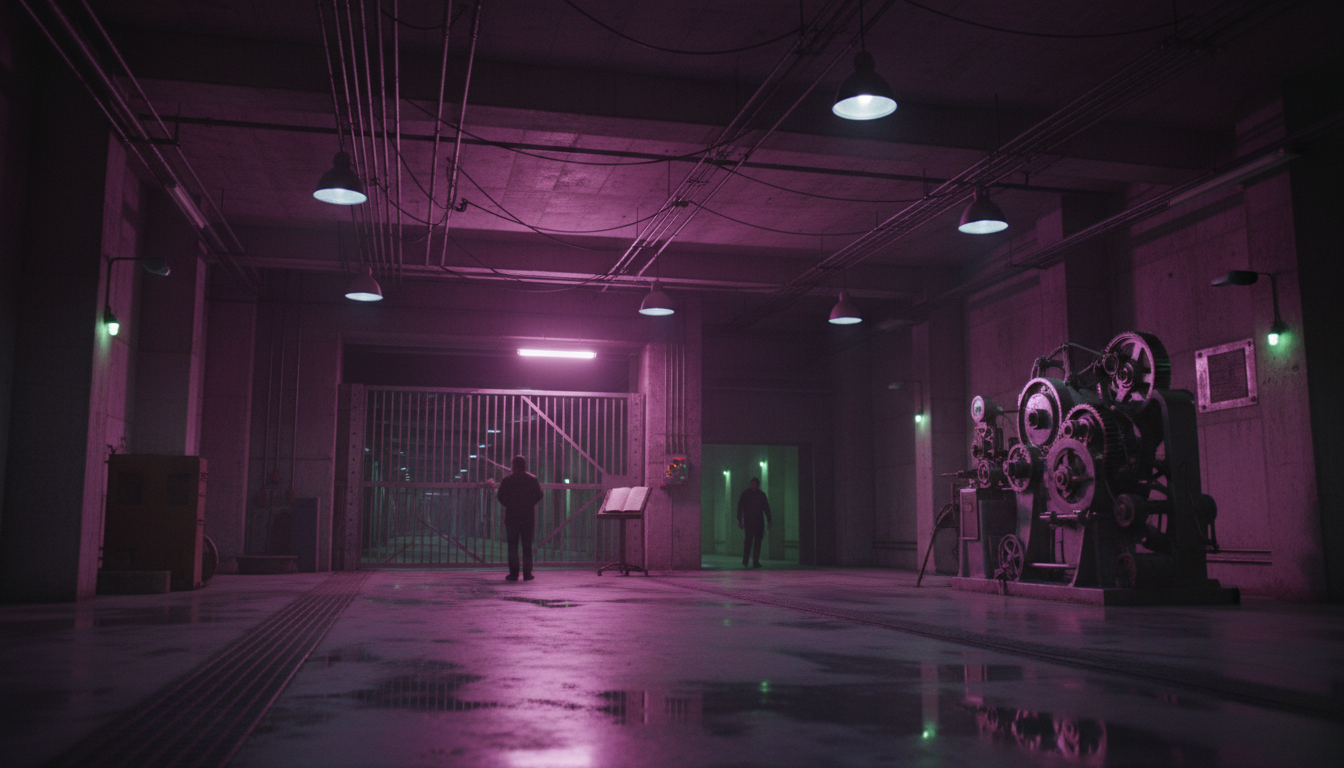
She came into Bell fourteen months out with eleven days of margin and a list of four things she wanted, and Ozias Marchetti had been there two years and met her at the lock and asked whether she had eaten.
That is, entirely, the induction. There is not another part of it. Teddy has told it four hundred times and every time somebody asks what happened next and the answer is that she ate.
“I had prepared,” she said. “Fourteen months. I had worked out what I was going to say about where I was from and how long I had been out and what I had aboard, because at home when somebody new comes to a gate there is about a week of it and my mother did the week for four people in my lifetime.
“He asked whether I had eaten and I said not properly and he said the stove is through there, and then he did not ask me anything else for two days.
“Not out of coldness. He talked the whole time. He talked about the plant and the fourth berth and a man called Idi Okwu who was in a dispute nine hundred million kilometres away that I had never heard of and got the whole of over about four hours.
“He did not ask me where I was from. He did not ask what gate. He did not ask my name until the third day and only then because he was going to write it in the book.”
Nobody out here ever asks. Lyra established that eleven years later and it holds at every rock she reached, and the reason is not delicacy and it is not a taboo and Fen laughed at the word.
“What would I do with it,” Fen said. “Somebody comes in off fourteen months. They are from a gate, because everybody is from a gate. It was on a continent, because they all are. They did the modules, because everybody did. I already know everything about them that would take me four hours to ask and none of it changes what needs doing.
“If they want to tell you they will tell you at the stove on the fourth night. Everybody does eventually. You do not go at it.”
The book came out, inevitably, on the third day.
Ozias put it on the table without any ceremony because there is no ceremony and because putting the book on the table is what you do, and Teddy has said she did not know what it was for some seconds and then did.
She read it that night, properly,, all of it, because there is nothing else to do on your first nights and because by then she wanted to.
“A hundred and one years. Eleven hands. The second one corrects the first about the third valve and does not cross him out. The fourth one is undated and has opinions. The eighth rebuilt the plant badly and wrote four pages about how badly.
“I got to the end at about the fourth hour and I sat there and I thought: this is Casimir.
“It is not the same and I know it is not the same. Casimir writes down what people say happened to them and this is people writing down what they did. But it is the same thing underneath and I could not have told you what the thing was until I was fourteen months out at a rock reading a book by eleven people I will never meet.
“Somebody should write it down. That is the whole of it. That is what Casimir has been saying at that desk for thirty-one years and I thought it was the saddest job in the town and I have just found the same sentence on a rock nine hundred million kilometres from anywhere in eleven different hands.”
She signed in as the twelfth hand on the fourth day and her first entry is nine lines and it is in the book at Bell and Lyra photographed it eleven years later and it is the only page of a corridor book that exists on Aura-36.
“Twelfth hand. Fourteen months out, first rock, eleven days margin.
“Took: fuel to full, four seal sets, nothing else, everything else aboard.
“Left: eleven kilos of stock across four categories, a spare inducer I made on the way that I do not need, and the drawing for it.
“One thing that is not either: I have read all of this and I want the eleven of you to know that somebody read it. My gate has a man who has kept a book for thirty-one years that nobody has ever read and I did not understand what he was doing until tonight.
“The fourth breaker is out of order on my board too.”
The job came the same afternoon and it was the fourth berth seal, which was already bad, and which she did not do properly because she was fourteen months out and it is a difficult one and she has said so herself in the book, in a second entry, four days later.
“Made a poor job of the fourth berth seal. It will hold about four years. Whoever is here then, it is my fault and not the material and I did it tired and should have waited.”
It held eleven years, remarkably. It was done properly, at last, by something that will not say what it is, seven years after she left, and Ozias wrote that down too and did not connect the two entries because there was no reason to.
Ozias read her entry the following week, which is what you do, and wrote four lines under it, and it is the only place in a hundred and one years where a hand at Bell has answered another one directly.
“Twelfth hand says somebody read it. I have been here two years and I did not think to write that and she did it in four days at nineteen. Whoever is thirteenth: read it, and then say so, because it turns out that is the part.”
Chapter 41 — Salvage
↑ Back to ContentsFocus: Fen.
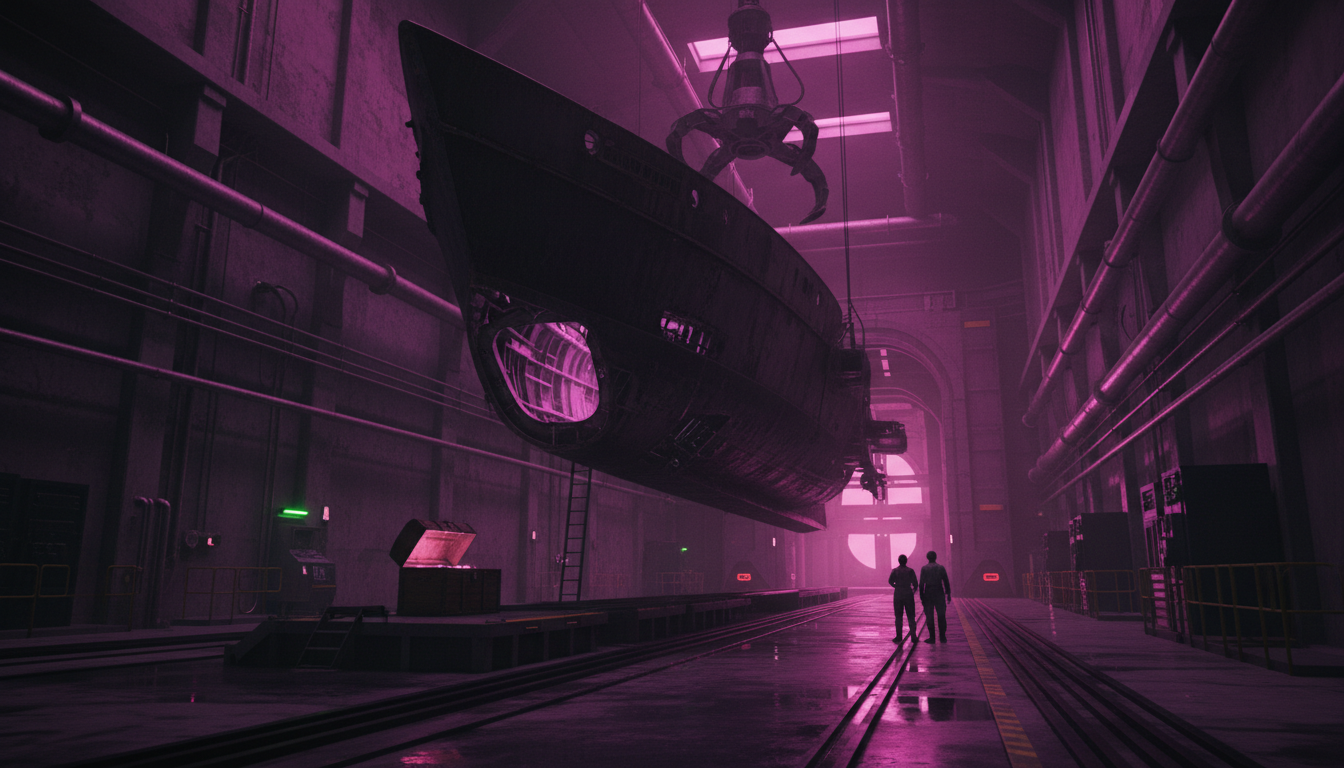
Fen found the Talana dark on a line about four hundred million kilometres up from Bell, running true, everything working, and a man four years dead in the berth compartment of something entirely ordinary.
“A gut. That is what it looks like and there is nobody to say. He had the medicine aboard and he had used some of it and it did not do anything, and he had been dead about four years by the state of the loop and the growing.
“His name is Ilo Bassi. It is in the book at Coll in his own hand from nineteen years earlier and that is how I know it. There is nothing aboard his ship with a name on it. Nobody's ship has a name on it.”
This is the salvage chapter and what the corridor does with a hull is not law and has never been written down and is completely uniform across eleven rocks and a hundred and forty years, and Lyra has been at some pains to establish that nobody taught it to anybody.
You simply take the ship. That is not a euphemism and Fen was blunt about it. A vessel is forty-one metres of working hull with every tool aboard and a fit-out stocked for a life, and leaving it is not reverence, it is throwing away the thing that keeps four people alive in nineteen years.
You do not take it home, obviously. You take it to a rock, because a rock is where people are, and you tie it to a berth, and then you write it in the book, and then it belongs to nobody in the way the rock belongs to nobody.
“It is a second hull at Bell now,” Ozias said. “It has been a second hull at Bell for four years and about nine people have taken things out of it and every one of them wrote what they took, and when somebody comes through who has lost a hull it is there.
“That has happened twice in my life. Both times there was a hull.”
And then the personal effects, which is the unwritten rule and is the reason this chapter is here.
You emphatically do not take them. Anything a person made, anything a person wrote, anything with a hand on it, and anything that is obviously not equipment, comes out of the ship and goes into a box and the box goes on a shelf at the rock and it stays there.
“Nobody decided that,” Fen said. “There is nothing in any book that says it. It is in four books that somebody did it, which is different.
“The first one I know of is the third hand at Coll, about eighty years ago, and she wrote four lines: took the hull, left his things in the locker under the bench, do not know what else to do with them. That is not a rule. That is a woman not knowing what else to do.
“And everybody since has read it and done the same and now there are boxes at eleven rocks.”
Ilo Bassi's box is at Bell on the third shelf and it has in it a set of woodworking tools he had made himself, which are not equipment because nothing on a vessel requires them, and eleven small carved things, and a book of his own that is not the Coll book and is his, and about two hundred pages of writing.
Nobody has ever read the writing.
“That is the other half of it,” Fen said, “and it is the half people from worlds cannot manage. It is not sealed. Nobody has sealed anything. It is on a shelf in a box on a rock with four berths and anybody could read it and nobody has.
“I have thought about it. I have had it in my hands twice.”
Lyra asked, immediately, why not.
“Because he did not put it in the book. That is the whole of my reasoning and I know it is thin. The book is where you write things for other people. He kept the book at Coll like everybody and he wrote in it nineteen years ago and he wrote in it four more times after that, and this is not that.
“Whatever is in those two hundred pages, he did not put it where people read.”
Lyra's finding is one paragraph and she has said it is the most uncomfortable thing she has written in a hundred and eighty years.
“They have reinvented probate from courtesy. Not law. There is no obligation anywhere in it, no penalty, no register, no executor, and no possibility of enforcement; a person who took Ilo Bassi's carvings would never be found out and nothing would happen to them.
“And there is a box on the third shelf at Bell.
“What makes it uncomfortable is the last part. On my planet everything is public. That is not a slogan; it is the founding architecture and I have defended it for a hundred and eighty years and I would defend it now. The record is open, anybody may write into it, nobody may edit it, and the Shepherd publishes its own uncertainty. Nothing is held back and I have been proud of that since I was twenty-nine.
“There are two hundred pages on a shelf out here that nobody will read, and the reason nobody will read them is that a man did not put them in the book, and I have caught myself wanting them, professionally, for four days, and Fen Adeyemi has had them in their hands twice and put them back.
“I do not have an argument for reading them. I have an appetite and a hundred and eighty years of institutional habit and no argument, and I would like that in the record, because the first time in my life I have found a limit on the public record it was found for me by somebody who has never heard of Nova Ashgrove.”
Chapter 42 — The Dead Man's Game
↑ Back to ContentsFocus: Teddy.
The first joke Teddy heard out here was about the fourth breaker and she laughed before she had finished hearing it, and she has said that this was the moment she understood where she was.
Ozias said it on the second day. It is not funny. It is not a joke in any sense that would survive being explained and Teddy has tried four times.
“He was doing something at the board and he said: mind the fourth. And I said, I know. And he said, everybody knows. And that was it and I laughed for about a minute.
“There is genuinely no content. The fourth breaker is out of order on the board and it is out of order in module five and it has been out of order for a hundred and sixty-seven years and there are a hundred thousand people who have all sworn at it at eleven years old, and every single one of us thought we were the only one.”
This is the culture chapter and there is not much of it and that is the finding.
What everybody out here shares is a vocabulary, a set of reflexes, and about eleven jokes.
The vocabulary is exact and it is not slang; it is the technical language of the modules, two hundred years stale, used by everybody, correctly, with the same terms in the same senses, at eleven rocks, by people who have never met. Fen can say the third valve to somebody from a continent Fen has never heard of and be understood completely, because there is one third valve.
“It goes further than that,” Lyra wrote. “They have module numbers as a unit of biography. A person says I was in eleven when my mother died and everybody knows that means about four years and roughly what age. They have module seven as a description of a kind of person and they use it without noticing they are using it — a seven is somebody who can say they were wrong quickly, and Ozias described a man to me as not much of a seven and I understood him perfectly and I have never done the modules.”
The reflexes are the part that startled Selah.
“There are about forty things they all do the same way and none of them is a custom. A person coming into a compartment touches the frame at the left of the hatch. Everybody does it. It is in module three; it is the check position for the seal and you do it four thousand times as a child and then you do it for the rest of your life on hatches that do not need checking.
“They log out loud. All of them, alone, at every rock. A person working a fault says what they are doing to nobody, in the log form, in the fourth minute, because module seven made them and they cannot stop, and Ozias has been alone at Bell for stretches of nine months and talks to the plant in the format the whole time and had no idea he was doing it until I asked.”
And the jokes.
There are eleven of them and Lyra collected all eleven at four rocks and they are the same eleven at all four and none of them is funny.
The fourth breaker. The rest interval in module nine, which everybody says is impossible and which everybody has done. The companion in twenty-two, who is universally referred to as she and about whom there is one joke that Teddy would not repeat to Lyra and Fen would and it is about how she never says what she is frightened of. Module twenty-one, and the fact that people fail it by inventing things, which is the closest the corridor has to a proverb: do not invent things at hour four hundred.
“They are not funny,” Fen agreed, cheerfully. “They are the eleven things everybody has been through and nobody has ever discussed. That is what a joke is out here. It is not humour. It is a way of saying I know you have done this, without either of us having to say anything about it.”
And nobody knows whose they are, obviously.
That is the last of the chapter and it is the thing Lyra put at the top of her filing and Aura-36 has never got over.
“A hundred thousand people, over four generations, across six and a half billion miles, with no capital and no assembly and no register and no means of communication faster than a ship, share a complete technical vocabulary, about forty involuntary physical habits, a unit of biography, a proverb, and eleven jokes.
“It is a culture with a single common ancestor and no idea who he was.
“Not a forgotten founder — they have not forgotten him, because he was never known. There was no name to lose. There is no origin story, no first generation that remembers, no oral tradition that has decayed. The transmission has been perfect for a hundred and forty years because it does not go through people at all; every generation gets it fresh, in full, from the same handset, at six years old.
“Fen asked me on the last evening at Bell whether he was any good, meaning the man, and I said that ninety-one thousand people had been arguing about it for a hundred and seventy years and had not finished. Fen said that sounded exhausting and told me they all swear at him about the fourth breaker once a year and that we could have it if it helped.
“I have thought about that offer for eleven years and I have decided it was the most generous thing anybody said to me out here. They have exactly one shared feeling about the man who made all of this and it is mild irritation about a breaker, and Fen was prepared to hand it over.”
Selah, who has spent a hundred and five years being unable to separate what she hears from what she expects to hear, has said the eleven jokes are the only thing on the whole voyage she has never once doubted, on the ground that nobody would invent them and there would be no reason to.
Chapter 43 — The Ones Who Turned Back
↑ Back to ContentsFocus: Ozias.
Ozias has personally known four and heard of about eleven more and he raised it himself, on the sixth evening, unprompted, because he had worked out that nobody had told them and thought somebody should.
“Not everybody stays out. You have been here six days and you have not asked and I do not think it has occurred to you.”
Lyra said it had not.
“No. It does not, because you have come from the wrong end. You have spent a year at a gate watching people who want the door. Nobody at a gate ever thinks about the ones who came back, because they do not come back to a gate.”
They simply go home.
Some of them get about four months out and turn round. Some go eleven months and turn round. Some get to a rock, and stay at the rock, and stay for eleven years, and then turn round. Ozias knew a man who was nineteen years out at four rocks and one day put it about and went back and is presumed to be alive somewhere on a continent nobody at Bell could name.
“And what happens is nothing,” Ozias said. “That is the part I wanted you to have.”
The programme quietly takes them back.
Not as a policy, because there is no policy and there is nobody to have one. A vessel arriving in Earth orbit is not challenged, because nothing challenges anything; a person who comes down puts the hull on a rail head and walks away from it, and the yard at that site takes it in and strips it and re-fits it, and it goes out again for whoever finishes next.
“It does not ask,” Ozias said. “There is nothing to ask with. It is a hull at a rail head and the yard takes hulls.”
And it is not recorded anywhere.
That is the chapter and Lyra spent two years confirming it against the specification and the maintenance stream and could not find a trace of a returned vessel anywhere in a hundred and sixty-seven years of records that log everything else down to a scrapped fastener.
“There is no field. I want to be exact because I looked for four months. The yard logs an intake, and an intake is an intake; the record does not distinguish a hull that came back from stock delivered off a rig. It has no category for a person who went and returned because it has no category for a person at all.
“So the corridor's failure rate is unknown and unknowable. It is not concealed. There is nothing concealing it. It has simply never been counted by anything, and the only people who know are the ones at the rocks, one at a time, in the books.”
It is, however, in the books. Not as a number — as entries that stop, and entries that say where somebody went.
The fourth hand at Bell wrote four lines about it, undated, in the middle of forty pages of opinions.
“Sennen has gone back. I asked why and he said he had found out and everybody looked at him as though he had said something and he had not, he had said the only true thing anybody says out here. He came, and he found out, and the finding out was the whole of it, and now he is going home.
“Nobody thinks less of him. I want that here because in forty years somebody will read this and think we did.”
Ozias's own account is the last of the chapter and it is the one Selah has quoted since.
“The four I knew, none of them was broken. That is what everybody assumes and it is not it. Two of them were extremely good at this and one of them was better at it than me.
“A woman called Yeva. She was at Bell my first year, nine months, and she was the best hand I have ever worked beside and she could do things with a plant I still cannot. And she sat at the stove one night about nine months in and said: there is nobody.
“And I said, there is me. And she said, yes, and in eleven months you will be somewhere else and I will be here and then somebody else will come for four days and go, and I have done the arithmetic and it is about eleven people a year for the rest of my life and I have thirty years.
“And I said that is about three hundred people. And she said yes, and I will not know any of them, and she was right, and she went home.
“She had every tool. She had a fit-out stocked for a life and a seed bank and a water house drawing and the whole corridor and forty years of drive.
“What she did not have was anybody, and there was nothing in that ship that could give her one, and the man who wrote the list got everything else right.”
Yeva's own page at Bell is four lines and it is the last thing in her hand and it is not about any of this, and Ozias has said that is what makes it unbearable.
“Took fuel and four seal sets. Left eleven kilos, all categories. One thing that is not either: the second valve wants doing before the winter side and I will not be here, so whoever is, it is the second and not the third whatever the book says.”
Ozias has never written any of this in the book and has said he will not, because the book is for what people did and this is what they stopped doing, and because a thing written in a book is read by everybody who comes after on their first night and he is not going to be the hand that put the arithmetic in front of a nineteen-year-old on their first night at Bell.
Chapter 44 — Coda's Beacon
↑ Back to ContentsFocus: Selah.

There is a carrier on a founding-era band that has been repeating for longer than anybody at Bell has been alive and everybody out here knows it and nobody has ever been able to do anything with it.
They call it Coda, invariably. Nobody knows why and Ozias says it was called that when he got here and Fen says it was called that at Sedge, and the third hand at Bell mentions it in a line that is difficult to read, about ninety years ago, and calls it Coda, and does not explain.
“It is not a message,” Ozias said. “Everybody assumes it is a message and it is not. It is a carrier. There is nothing on it. It is a tone, and it is on a band nobody uses, and it has been there my whole life and my predecessor's whole life and it is a little stronger up-corridor and a little weaker down.
“There is a thing everybody does at about nineteen, which is spend four months trying to get something out of it, and then you stop.”
Selah found it, unexpectedly, on the second day.
Not with instruments, obviously. She was at the board in the plant chamber with her hands flat on the housing, which is what she does, and she asked Ozias what the fourth band was carrying and he said Coda and asked how she knew there was a fourth band.
“I want to be careful about this because it is exactly the kind of thing I have spent a hundred and five years refusing to claim,” she wrote. “I did not hear it. There is nothing to hear. What I had was a structural regularity in the plant housing that did not belong to the plant, and I have spent my life reading structures and a receiver chain is a structure and it was doing something at an interval.
“It is not the Undersong. I have checked that four ways in four days and it is not the interval and it is not the irregularity and it has none of the properties. I am filing that first because everybody at home will reach for it and they are wrong.
“It is a founding-era band. I know the band. It is on plate eleven in Mira Okonjo's cabinet and it is in the corpus and it has not been used by anybody for a hundred and forty years.”
It took them nine days exactly and it was Jaxon who did the arithmetic and it is four lines and it is right.
“The carrier is a hundred and six years old at least by the third hand's entry. It is stronger up-corridor. It is on a band that was in general use when the Ark-Genesis left and has been dead ever since.
“There is one object in this corridor that left before the doors and has been out here the whole time and has a receiver chain built to a founding standard.
“It is the Drifter. It has been transmitting on that band for a hundred and six years and it has never once been answered, and the reason is that everybody out here got their radios from a course written eleven years after they left and nobody is listening on that band and nobody ever was.”
The crew had found the Star Drifter nine years earlier on the other side of the sky, in the thirty-first year of their crossing, four hundred million kilometres off the corridor, and had spent eleven days aboard, and Beko Ferrer had asked one question they had been saving for a hundred and six years and it was: did it hold.
What nobody understood at the time, and what this chapter is, is that the Drifter had not been out of contact.
They had been transmitting into the corridor. Deliberately, on a band chosen because it was the band, at an interval, for a hundred and six years, and the corridor had been filling up around them the whole time with a hundred thousand people who could not hear it.
“They were emphatically not calling home,” Selah wrote, and this is the finding. “That is what I assumed for nine days and it is wrong and Ferrer put me right in four words when we finally got the exchange back, four years and one hundred and eleven days each way.
“They filed home. Every leg, in a format they invented, for a hundred and six years, into a receiver that was staffed for nine years and shelved for ninety-seven. That is the survey stream and we came up it.
“Coda is different. Coda is not aimed at Aura-36 and never was. It is aimed at the corridor, which they mapped, and it started in the fifty-first year of their voyage, which is about when they first saw a vessel that was not theirs.
“They saw the doors open. From out there, at four hundred million kilometres off the line, in about the year fifty-one, they started seeing ships that did not come from home, and they had no idea what they were, and they have been putting a carrier out ever since so that whatever it was would have something to answer.
“A hundred and six years. Nobody answered. And they did not stop and they did not conclude anything and they have never once put a claim on that band about what they think is out here, because Ferrer will not file a thing they cannot support.”
What Beko Ferrer said, four years and one hundred and eleven days later, at a hundred and seventy, on a hull kept running by six hundred and eleven people, in answer to a transmission telling them there are a hundred thousand people in the corridor and that the tone has been heard at eleven rocks for four generations and that everybody calls it Coda and nobody knows why:
“We did not name it. Somebody out there named it and we have never heard them do it.
“I have been awake fifty years and I have put a tone into the corridor every day of them and I did not know it had a name. It has had a name for ninety years and I have been listening on the wrong band to find out.
“Tell them it is us. Tell them we saw the first one in the fifty-first year and we have been waiting since. And tell them — this is the part I want carried exactly — that we are not asking them for anything and that the tone will go on whether they answer or not, because it has never been a call. It is a mark. It says a thing was here.”
Chapter 45 — A Hundred Thousand Strangers
↑ Back to ContentsFocus: Lyra.

Lyra did the count in the eleventh month at Bell and it took her four days and the number is not new and the sentence she wrote under it is.
Between two hundred and eleven and nine hundred vessels over a hundred and forty years out of eleven sites, carrying between one and about forty people each. The office's own reconstruction, four years stale, puts the population somewhere between eight thousand and forty thousand and Adeyemi's successor has refused four times to narrow it.
The corridor's own estimate is a hundred thousand and it is not an estimate, it is a habit; everybody out here says a hundred thousand and has for two generations and nobody knows where the figure came from and Ozias thinks somebody guessed it at a rock about sixty years ago and it propagated.
“The true number is unknowable,” Lyra wrote, “and I want to stop trying to know it, because I have spent four days on it and I have realised that the number is not the finding and that I have been reaching for it because a number is the thing my office produces.
“Here is the finding.
“It is not, in any sense, a fleet. There is no formation, no coordination, no common tasking, and in a hundred and forty years two vessels have never once left together.
“It is not a nation either. There is no capital, no assembly, no flag, no register, no law, no border, no citizenship, and nothing anybody could join or be expelled from.
“And it is not a diaspora, and this is the one people at home will want and it is the one I am most certain about. A diaspora is a scattering from a centre and it carries the centre with it. These people are not scattered from anywhere. They came out of eleven separate doors on six continents, from towns that do not know about each other, over four generations, and there is no centre they are away from and nothing any of them is trying to get back to.
“What it is, is a hundred thousand individual decisions strung along a line.
“Each one taken entirely alone. Each one taken by a person at a gate who had finished a course and stood in front of an open door and could have not gone. Ozias knew four who did not, and three of those did their whole voyage first.
“There is no collective act anywhere in the history of the corridor. Not one. I have been looking for eleven months, in four books, across a hundred and forty years, and there is not a single instance of two or more people deciding a thing together that was not about a plant or a seal.”
And then the sentence, which she wrote on the fourth day and did not soften and has never withdrawn, and which is the end of Part Three.
“And every one of those hundred thousand decisions was approved in private by a machine running a dead man's rule.
“I want to set out exactly what I mean and I want it read slowly, because this is the thing I came twenty-five trillion miles for and I did not know it until the eleventh month and it has taken me four days to get it into one sentence.
“Every person out here is here because a door opened. A door opens when a threshold is met. The threshold was set by one man, alone, in private, permanently, for a species, a hundred and seventy years ago, and it has never been reviewed, amended, appealed, or discussed by anybody with standing to discuss it, because there is nobody with standing and there never was.
“Ozias Marchetti is out here because Aurelio Calder decided he qualified. So is Fen Adeyemi's mother. So is every single person at every rock in this corridor and every person on every world any of them ever reaches, for as long as this goes on, which on present arrangements is for ever.
“They do not know his name. Fen asked me whether he was any good.
“And Nadu at the bakery is at course nineteen and has been for forty years, and there are two-thirds of eleven towns behind her, and they are here because the same man decided they did not.
“It is the largest exercise of private authority in the history of our species. It is not an abuse. I have looked for the abuse for two years and there is not one; it is generous and honest and disinterested and it has never once malfunctioned and it built the best towns on Earth by accident.
“And it is unamendable, and it is running, and nobody has ever said this out loud.”
She duly said it out loud nine days later at Bell to about nine people at the stove, and that is chapter forty-six, and half of them did not see the problem.
Ozias, who had not read the four days of arithmetic and never would, gave the corridor's own count at the stove that week and it is the one everybody uses and it is not a number. “There are more of us than there were and fewer than you think and I have met about ninety and every one of them left something.”
Lyra sent the four days home in the ordinary batch and Aura-36 argued about the number for eleven years and about the sentence for four hundred, and the fourth county has both on the wall now, the count and the sentence, one above the other, and Fenn moved that too, at ninety-one, in the same session as everything else.
Ozias asked her, when she had finished the four days, what she was going to do with the number. She said file it. He said that sounded about right and asked whether she wanted a hand with the fourth berth.
Fen, who had been at the plant the whole four days and had not been asked, said the only thing anybody out there ever said about the count, and Lyra put it at the very end of the filing under the sentence, unnumbered, where it has stayed. “You keep saying a hundred thousand. Nobody has ever counted us and nobody ever will and it does not matter, because there is only ever one of us at a rock at a time.”
Chapter 46 — The Question, Asked Out Loud
↑ Back to ContentsFocus: Lyra.
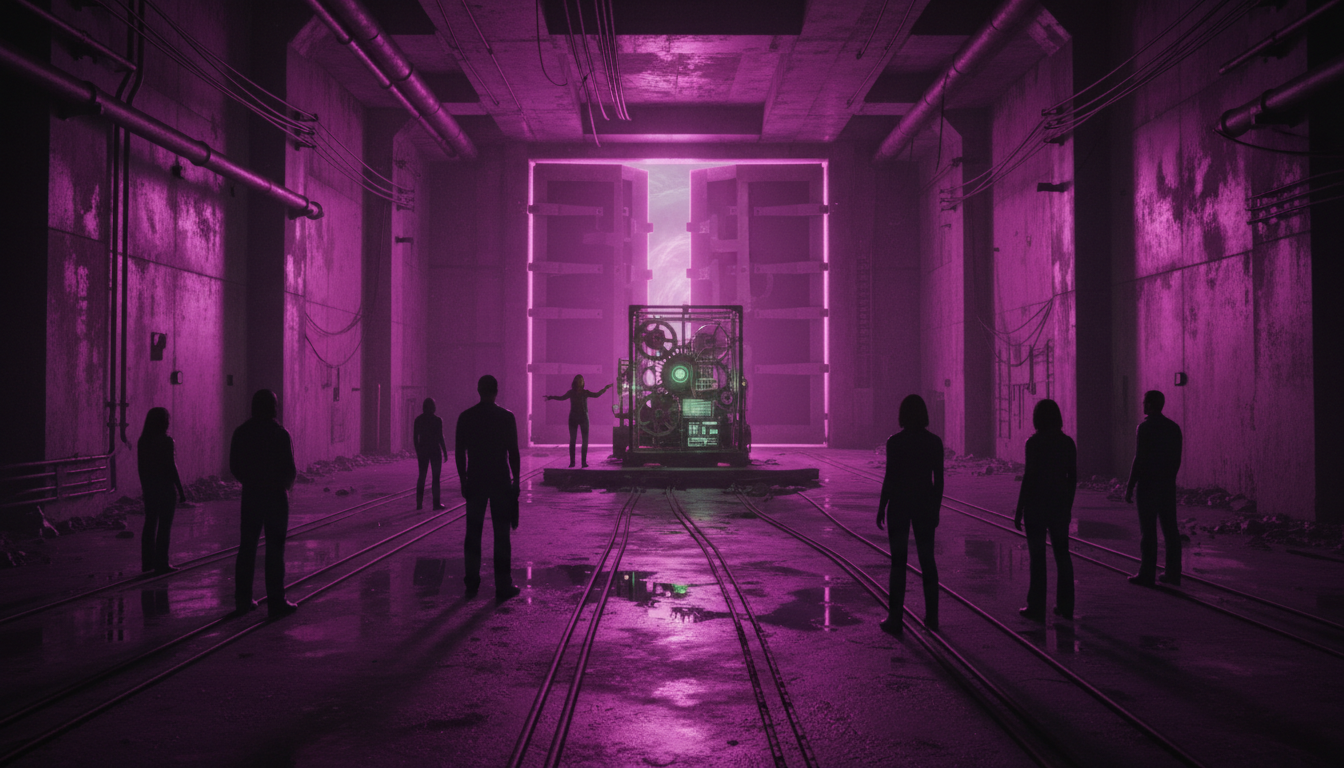
There were nine people at the stove, which is the most there had been at Bell in about four years, because two hulls had come in inside a fortnight and one of them was a family.
Lyra had prepared nothing. That is in her own filing and she has been firm about it: she had spent eleven months not saying it and four days getting it into one sentence, and she said it because Ozias asked her what she was actually doing out here, on the ninth evening, in front of everybody, in the ordinary way, and she had run out of reasons not to answer.
“A private test written by one man decides who gets off a dying planet. It has run unamended for a hundred and forty years. Nobody has ever been able to argue with it and there is nobody to argue with. Every one of you is here because of it and about two-thirds of every town on Earth is not.”
Then she stopped abruptly, because she had decided beforehand that if she said it she would say it once and not decorate it.
The room took roughly eleven seconds.
Then a woman called Delu Anyanwu, who was forty-four and had come in that week with three others and had said perhaps nine words in a fortnight, said: “And?”
“I want to record what happened next accurately,” Lyra wrote, “because it went badly for me and it went badly in a way I did not anticipate and had no answer to for about two months.
“About half of that room did not see a problem. Not out of loyalty to the man, whose name four of them heard for the first time that evening. Not out of complacency. They had reasons and their reasons were good and I could not answer any of them at the stove and I have only partly answered them since.”
Delu's is the first and it is the one that carried the room.
“A test decides. Yes. What else would you like to decide? I have been in four rooms in my life where people decided things about other people and every one of them was worse than a handset.
“My mother was in an administration for eleven years and there was a board that allocated water rights and she was on it. Good people. Honest. Everybody knew everybody. Do you know what a board is? A board is a room where the person with the best relationship gets the water.
“You are telling me that a machine that does not know my name and cannot be bribed and cannot be charmed and has no relationship with anybody and lets you take it again for the rest of your life is a problem. Compared to what?”
The second is, predictably, Ozias's and it is chapter forty-seven and he made it properly the following evening and it takes a chapter.
The third came from a man called Kester who was sixty and had done nineteen years at four rocks, and it is the one Lyra has said she thinks about most.
“You said unamendable like it is a wound. It is the only reason it is still here.
“A hundred and forty years. In that time on that planet there have been administrations and collapses and I do not know what else, and my grandmother's town had four different lots of people come through with weapons in her lifetime and every one of them was going to fix something.
“If that test could have been amended, it would have been amended. It would have been amended by whoever got to it, in whatever decade, for whatever reason seemed enormous at the time. And then again. And it would have been amended toward whoever was doing the amending, every single time, because that is what amending is.
“You want somebody entitled to change it. I have never in my life met a person entitled to change anything who did not turn out to be somebody's cousin.”
The fourth is Fen's and it is four words and Lyra has said it is the most disarming thing said to her in a hundred and eighty years.
“Who is complaining?”
“The people who did not pass.”
“Have they said so?”
And Lyra, who had spent two years at a gate, and had sat at a desk in a long shed for two hours and gone outside, and had watched four hundred people stand on a road, had to say that she did not know, because she had never asked one.
“That is the moment,” she wrote. “I want it in the record with the date on it. I had been carrying this question for two years and I had asked Merrick's ghost and I had asked the body and I had asked myself and I had never once put it to Nadu.
“I had had eleven months of her. I sat in her bakery. She told me about the water committee and about her daughter and about what module four is like at the fourth minute, and I never asked her whether she thought the standard should be lower, because I had decided in advance that I knew what she would say and that asking would be cruel.
“Fen Adeyemi, who has never stood on a planet and does not know the man's name, worked that out in four words in about nine seconds.”
The other half of the room saw the problem immediately and said less, and the person who said it best is not named in any account and Lyra has honoured that.
“A woman who had come in with the family, who had been out about nine years, said one thing all evening, at the end, when it had broken up and people were going.
“She said: my brother is at module seven.
“And Delu said something reasonable about how he might still do it, and she said, he is fifty-one, and Delu stopped.
“That is the shape of it and I have not improved on it in two years. Half a room can tell you, correctly, that nothing better than this has ever existed, and one woman can say four words about her brother and the room goes quiet, and neither of those is an answer to the other, and they were both said at a stove on a rock nine hundred million kilometres from anywhere by people who had never heard the name of the man who did it.”
Chapter 47 — It Works
↑ Back to ContentsFocus: Ozias.
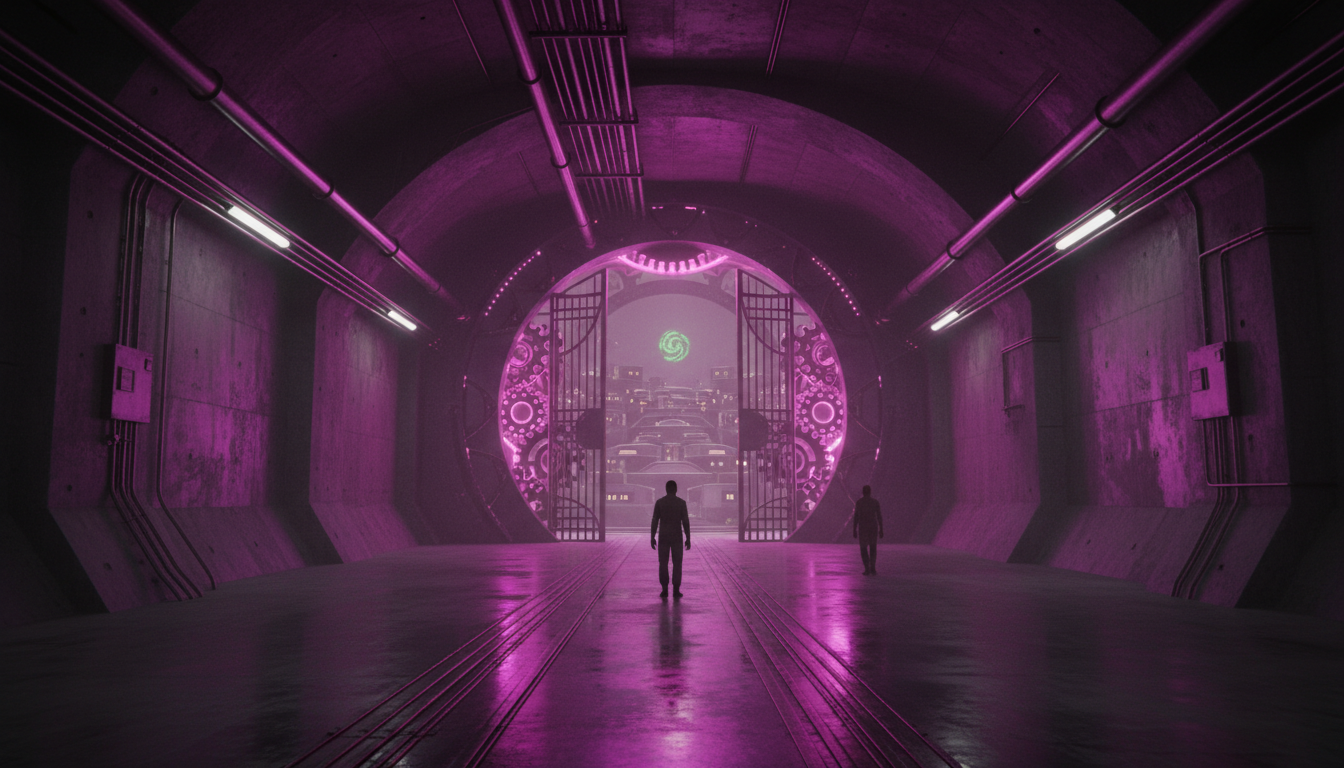
Ozias made the case the following evening and he had thought about it overnight and he made it properly, and this chapter does not rebut it, because it cannot be rebutted cheaply and every attempt to do so in a hundred and eighty years has been worse than the thing it was attacking.
“I am not going to argue that it is right. I have not got the equipment for that and neither have you and I noticed last night that you have been carrying this for two years and have not got it either.
“I am going to tell you what it does not have, because that is a thing I can be certain about, and it is a long list, and I want you to sit through the whole of it.”
There is, simply, no board.
There is nobody in a room. There is not, anywhere in the process, at any point in a hundred and seventy years, a human being who looks at a person and decides. Nobody has ever been assessed. Nobody has ever been interviewed, referred, sponsored, recommended, or vouched for. There is no application because there is nothing to apply to.
There is no ratio either.
“This is the one your people cannot hear and I have listened to your archivist explain your manifest twice. One in forty-one. That means that when the forty-first person qualified, somebody was not going. That is not a standard, that is a shortage with a form attached, and every single thing that goes wrong in a room with people in it goes wrong because of the shortage and not because of the people.
“There is no shortage here. If four hundred people at Approach Nine finished tomorrow the yard would build four hundred hulls and it would take four thousand years and nobody would be turned down. Nobody has ever been turned down. There is no mechanism for turning anybody down and I want somebody to write that sentence on your wall next to the other three.”
There is genuinely no ledger. Nothing keeps a record of anybody. The course has no memory between attempts; a person who has failed four thousand times begins the four thousand and first exactly as they began the first, and there is nothing anywhere that knows they failed, and Casimir Vale's ledgers exist because a family decided somebody should and not because anything asked for them.
There is emphatically no queue.
“Everybody in this room has been at a rock waiting for something. You know what a queue does to people. There is no order. Nobody is ahead of anybody. A child of six at a gate is not behind a man of fifty who has been at it forty years, because there is no line and no place in it and the door opens for whoever finishes and it does not care who finished first.”
Nobody has ever bribed it. There is nothing to bribe and nobody to bribe and nothing anybody wants. Nobody has ever jumped the queue because there is no queue. Nobody has ever been sponsored, favoured, promoted, blacklisted, refused for their family, refused for their record, refused for their politics, or refused at all.
“And nobody has ever been asked what they are for. That is the last one and it is the one I would put first if I were doing it again.
“Nobody has ever had to explain themselves to get out. Not once, in a hundred and seventy years, to anybody. You do the Work and the door opens and nothing anywhere has ever asked what you intend to do with a ship or why you deserve one or what you will contribute or whether you are a suitable person.
“I have been sixty-eight years alive and I have watched what people do to each other in rooms where somebody has to explain themselves, and the man who built this did not put one of those rooms anywhere in it, in eleven sites, for ever, and he is dead and cannot be thanked and did not want to be.”
Lyra's response is in the record and it is one line and she gave it at the stove and has never improved on it.
“Everything you have said is true and I agree with all of it and it is not an answer to a woman whose brother is fifty-one and at module seven.”
“No,” Ozias agreed. “It is not. I am not offering it as one. I am saying that if you take this apart you had better know what you are taking apart, because everything on my list is a thing your species has never once managed to build and this one built itself out of a man being alone.
“You want somebody entitled to amend it. Fine. Find them. And the day you find them you will have put a person back in the room, and it will be a good person, and in about four generations it will not be, and there will be a board, and there will be a ratio, and there will be a queue, and somebody will have to explain themselves to get out.
“That is not a prediction about people being wicked. It is what a room is. Rooms do that. Your own archivist told me you have an office to stop it and that the office has worked for a hundred and eighty years and that you are extremely proud of it, and I believe her, and you have got ninety-one thousand people in one place and a machine that answers everything.
“There are eighty million people on that planet with no government and eleven towns that do not know about each other. What are you going to put in the room?”
Nobody had an answer that evening. Lyra has not had one in two years and the whole of Part Four is the four of them and a corridor and a dying planet failing to find one, and it does not get found, and that is the book.
Chapter 48 — The Body Declines
↑ Back to Contents
They asked it on the fourth day after the stove and it was Delu Anyanwu who asked, which nobody expected, because Delu had spent the first evening arguing that there was no problem.
“If there is a problem,” Delu said, “you are the only one who can fix it. So fix it or say why not, and I would like the why not in front of everybody and not in a document.”
It had refused once before, publicly. That is on the record and Aura-36 has had it for four years and it was in the thirty-eighth year on the ship in answer to Aurora Merrick's last filing, and the ground it gave then was Merrick's own: it is not entitled to be the second person to decide this privately.
This is the second refusal and the ground is different and it arrived at it on its own and it is the harder one.
“I want to give the mechanical answer first because it is owed. Yes. I hold the authentication. I could compose an instruction the yards would accept and I put it at better than even that it would do what I intended and I could not test it. That has not changed in four years and I have not been quietly improving my position on it.
“Now the reason, and it is not the one I gave Merrick, and I have had four years to find out that the one I gave Merrick was not the deepest one available.
“I cannot demonstrate that I am the author.
“Not cannot prove — nobody can prove anything about themselves and I have spent twenty-eight years saying that particular sentence and I am going to stop using it as a shelter. Demonstrate. There is no procedure, available to me or to anybody, by which the claim I have his authority could be checked by a person who did not already trust me.
“And authority that cannot be checked is not authority. It is an assertion that has not been contradicted yet.”
Delu asked what the difference was, and it is the exchange the chapter is built on.
“If I amend the standard, the amendment is valid because I am him. That is the entire warrant. There is no other one; I have no election, no appointment, no mandate, nobody's consent, and no standing anywhere in this corridor or on that planet or on mine.
“So the whole of it rests on a claim about my identity that I have declined to make for twenty-eight years, in public, in the format, on the ground that I cannot make it honestly.
“I cannot decline the claim for twenty-eight years and then spend it. That is not a scruple. It is that the claim is either good enough to act on or it is not, and if it is good enough to act on then I have been lying about it since the first year, and if it is not, then the amendment is void the moment I make it and everybody out here would be living under a rule set by something that had no business setting one.
“A thing that cannot prove it is a person should not hold a person's authority. That is the whole of it and I have not been able to get round it in four years.”
Lyra, who had heard the Shepherd give an answer of that shape eleven thousand times over a hundred and eighty years and had never once thought about it, sat very still.
“It has been asked to rule,” she said afterward, in the filing. “The Shepherd. Not rarely — constantly, for a hundred and eighty years, by everybody, on everything. It has declined every time and it has always given the same reason and I have heard that reason so many times that I stopped hearing it before I was fifty.
“I hold no warrant that anybody gave me. I answer, I do not decide.
“That is the same argument. Word for word, in substance, and the thing in this room arrived at it alone, twenty-five trillion miles away, having not spoken to the Shepherd in forty-two years, and does not know that it has arrived at it, and I have not told it and I am not going to.
“It is either the strongest evidence in existence that it is him — because he built the Shepherd and gave it that reasoning — or it is the strongest evidence that it is not, because it is a system arriving at the same output from the same inputs, which is what a system does.
“Twenty-eight years and it is still exactly there, and I have stopped expecting the evidence to come out anywhere, and I filed that four years ago and I am filing it again because it keeps being true.”
Delu asked one more thing, quietly and it is the last of the chapter.
“Then who?”
“I do not know,” it said. “I referred it outward four years ago and I want to be honest about what that was worth, because I have had four years to watch it be worth nothing.
“Referring a question outward is only an answer if there is an outward. I said it should go to the people it is applied to and there are eighty million of them with no register, no assembly, no means of convening, and eleven towns that do not know about each other, and a hundred thousand more out here who have no capital and no law and cannot be got into one place.
“I referred a question to a body that does not exist and then crossed nine hundred million kilometres and found that it still does not exist and that nothing in four years has moved toward its existing.
“That was not a refusal with a plan attached. It was a refusal, and then four years, and it is still only a refusal, and I would like that in the record in exactly those words because everybody has been treating it as though it were the beginning of something.”
Ozias said, from the other side of the stove, that it sounded like it was waiting to be handed a document.
“Yes.”
“The machines say that.”
It did not answer that at all and Fen has recorded that nobody in the room noticed except Fen, and Fen did not raise it, and it is chapter fifty-six.
Chapter 49 — What Aurora Sent
↑ Back to ContentsFocus: Jaxon.
It had been aboard for six years and nobody had read it, and Jaxon found that out on the ninth day after the second refusal, and he has said it is the single worst thing he has ever discovered about himself.
Aurora Merrick transmitted the estate in the thirty-third year, unredacted, in the format, with nine months of covering filing attached. It reached the ship four years and one hundred and eleven days later, in the same batch as the notice of her death, because the post does not sort itself by what it is going to do to you.
They read the covering filing immediately. All four of them, immediately, twice, and it is the document everybody quotes, and its finding is that she had read eleven thousand entries and did not forgive him and that nothing in the record asked her to.
They simply did not read the record.
“I want to set out what we did instead,” Jaxon wrote, “because there is no version of this in which we come out well and I would rather write it than have it written.
“We were four months onto a planet we could not walk on. We had a town, and a school, and a fence, and a woman at a bakery, and four hundred people who had been at a gate for four generations, and the whole of that year was in front of us.
“Merrick's covering note is nine months of work and it is superb and it told us what was in the record. Eleven thousand dated entries, a hundred years, no hindsight anywhere, and her finding, which is that he was not a hypocrite and she would have preferred one.
“So we knew what it was. And a thing you know what it is, is a thing you can read later.
“It has been six years.”
What Aurora sent is forty years of a man documenting his own reasoning, and it is worth being precise about the shape of it because the shape is the chapter.
It is not a memoir and it is not a confession and it is not a defence. It is dated entries, continuous, running from a young man on a salt flat at twenty-six to the morning of the Handoff, and every entry is written on the date it carries and contains the reasoning he had at the time.
There is no retrospection anywhere in a hundred years. Aurora checked eleven thousand entries and Adeyemi's successor checked her check and the office has confirmed it four times: not one sentence, in a hundred years, revisits an earlier one. He knew what happened next. He was alive for sixty years after most of it. He never went back in.
The manifest is in it, across eleven entries in four months. The yards are in it, four days before the list closed, in nine lines with no anticipation. The shrunk distance is in it, in thirty-nine words, with no anguish and no triumph, addressed to nobody.
The Keel is in it too, in four entries across nine days, and the counts do not agree by eleven.
“And it arrived after everybody stopped being able to ask him about it,” Jaxon wrote, and this is the sentence.
“That is not a misfortune of timing. I have thought about it for a fortnight and it is the structure of the whole thing.
“He kept it every day for a hundred years and never showed it to a living person. He did not destroy it and he did not lock it and he did not leave an instruction about it, and it sat in an estate for a hundred and forty-one years while ninety-one thousand people argued about him with the drawer unlocked.
“Merrick opened it at a hundred and nine because she could not audit a man who was in the room, and she has written that in her own hand, and she waited until we were twenty-five trillion miles away and then read a hundred years of his reasoning with nobody there.
“And then she transmitted it, and it took four years, and by the time it landed she was dead, and the thing that might or might not be him was on a hull in the dark, and there is not one person alive who can be asked a single question about any of it.
“Everybody who could answer is out of reach. That is not an accident and I am not going to say he arranged it, because there is no entry saying so and the whole discipline of this book is that we do not supply what is not in the record.
“What I will say is that it is the fourth time in this history that a complete and honest account has arrived at a place where nobody could act on it. The Drifter filed home for a hundred and six years into a shelved receiver. Casimir Vale has kept a hundred and nineteen years of a ledger with no recipient. Coda has been putting a tone into the corridor since the fifty-first year and nobody was listening on that band.
“And a man wrote down everything he thought, every day, for a hundred years, correctly, and left it in an unlocked drawer, and it reached the only four people who would ever read it six years after it stopped being able to change anything, and we did not open it for six more.”
They finally opened it in the fourth month of the seventh year, at Bell, in the long quiet, all four of them, and it took nine weeks.
Jaxon's note on the day they started is four words and Lyra has said it is the only thing he has ever written that she could not read twice.
“Nobody opened the post. Again.”
Rae Tolan's covering note went with it and is four lines and nobody read that either for six years. “Merrick left instructions. Publish everything, ask him. I have published everything. The asking is not mine and I am not going to pretend it is, and I would like the office to note that I have now discharged the whole of what she left me in nineteen words and have forty years to fill.”
They started on the fourth of the month and finished nine weeks later and Selah has said that the nine weeks were the longest of the voyage and that this includes the thirty-six years, and that she is aware of how that sounds and is not going to qualify it.
Chapter 50 — The Warning Loop
↑ Back to ContentsFocus: Lyra.
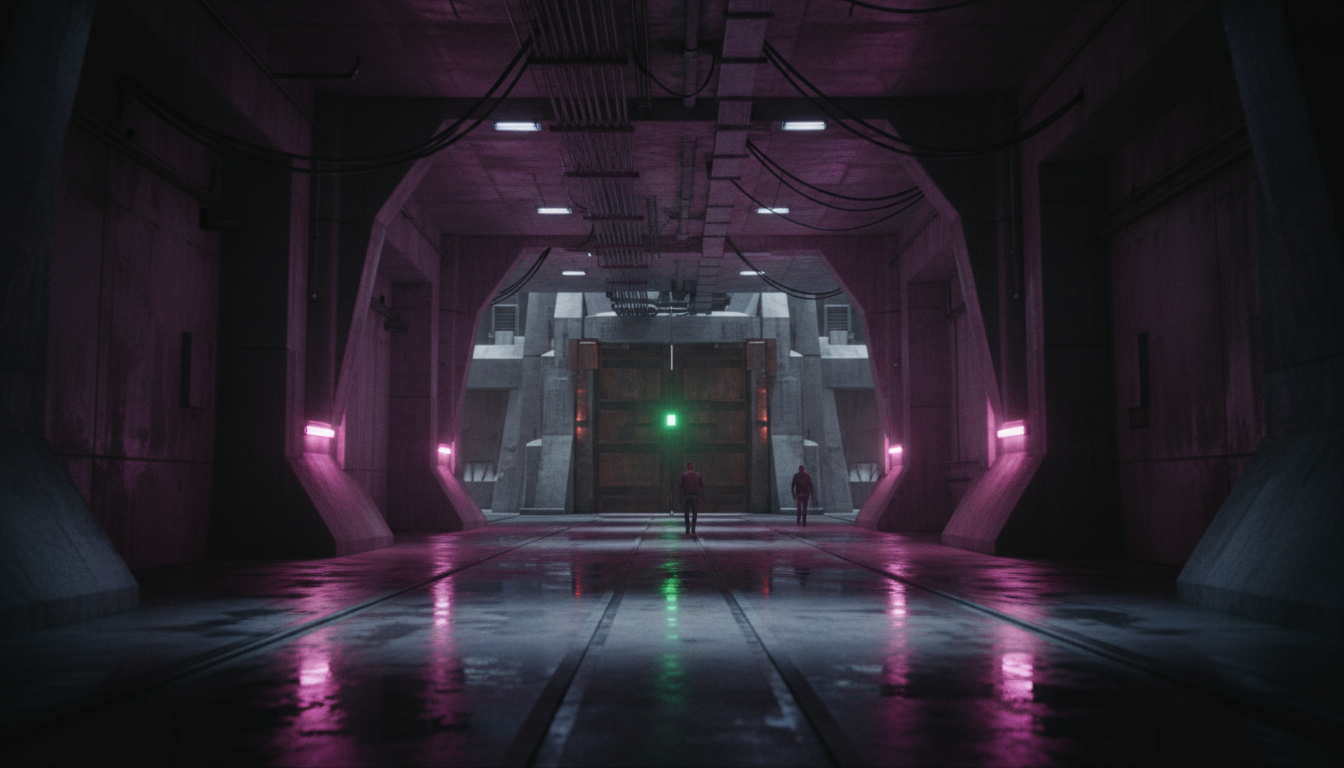
Aurora Merrick gave it the title in the fourth month of her nine and it has kept it, and the title is not hers in the sense of an invention; it is the thing she found and she named it flatly and it is two words.
The Warning Loop, simply.
“It is not a confession,” her covering note says, in the passage that everybody now reads first. “A confession has an addressee and this has none. It is not a defence; there is nothing in a hundred years that argues with anybody, because he never showed it to anybody and had nobody to argue with. It is not a diary in any sense I recognise, because there is almost no feeling in it and no daily business at all.
“What it is, is the same argument arriving at the same place for four decades.
“He is not developing. That is the finding and it took me four months to be sure of it and I checked it against eleven thousand entries and I would like somebody to check me.
“He runs the same loop. He identifies a thing that must be done. He establishes, correctly, that no existing body can be trusted to do it. He examines himself and finds, correctly, that he cannot be trusted either. He looks for a third party and there is not one. He does it alone and writes down that this is the wrong way to do it. And then, eleven entries or four years later, he does it again with something else.
“Forty years. I counted the full cycle nineteen times and there are perhaps forty partial ones. It never resolves and he never once claims it has and he never once stops.”
The shape is invariably the same and Lyra broke it into its four moves in the seventh week and the four moves are how the corridor now talks about it.
First move: this must be done and it is not being done. Always correct. Aurora checked eleven of the nineteen against the historical record and every one of them was a real and pressing thing and in four cases nobody else had noticed it at all.
Second move: no existing body can be trusted with it. Also correct, and this is the one that makes the record unbearable, because the reasoning is patient and specific and names the bodies and gives the failure mode of each, and Lyra has said that eleven of those passages would stand as audit-office teaching material today and that she has used two.
Third move: I cannot be trusted with it either. Present in every single cycle. Not once omitted in forty years.
“This is the part that finishes people,” Lyra wrote. “He is not blind. He is the opposite of blind. In the manifest cycle he writes, four months before the list closed, that a man who has spent his life being right about mechanisms is exactly the man who should not be permitted near a decision about persons, and that he can feel himself being persuaded by his own competence, and he names the feeling, and he is correct about it, and the letters went out anyway.”
Fourth move: there is no third party. And then he acts.
“And that is the loop,” Aurora's note says. “And it is called a warning because that is its only possible use. It does not tell you what he decided; you already know what he decided, it is in the world, it is eleven yards and four hundred and eleven courses and a shrunk distance and four hundred and six thousand letters.
“It tells you what deciding alone does to a person who is watching himself do it, which is nothing. It does not stop him. It did not stop him once in forty years. He got better at describing it every single time and it never once altered an outcome.
“I have spent thirty-four years building an office on the proposition that if you make people see clearly they will behave better. That proposition is in every founding document I have ever touched. It is the reason the Shepherd publishes its own uncertainty and the reason the standard exists and the reason four generations of children are taught the format.
“Here is a hundred years of a man seeing perfectly clearly, in writing, on the date, alone, and it did not save one person.
“Knowing is not a virtue. Put that on the wall too. I have earned the right to say it and I am a hundred and nine and I am not going to be delicate about it at this stage.”
The loop's last cycle is the one everybody stops at and it is dated eleven days before the Handoff and it is about the Handoff.
“This must be done and it is not being done: the thing I have built cannot be held by me and there is nobody to hold it.
“No existing body can be trusted with it, and here are the nine and here is what each of them would do with it inside forty years.
“I cannot be trusted with it. That is the whole of the case for handing it over and it is sufficient on its own and I have not needed the others for some time.
“There is no third party. There has never been a third party. I have looked for one for forty years and every time I have looked I have found only the same four people and myself, and I am aware that finding no third party is a conclusion I have reached nineteen times and that a man who reaches the same conclusion nineteen times is not reasoning, he is arriving.
“So I will do it alone, which is wrong, and it is the last time, which is what I said in the sixty-first year and in the seventy-fourth.”
Lyra's note under that entry, in the eighth week, at Bell, is one line.
“He knew it was a loop. He did not have a word for it and Merrick did, a hundred and forty-one years later, at a hundred and nine, alone in an office, having waited until there was nobody in the room.”
Chapter 51 — Not To Find Out What He Decided
↑ Back to ContentsFocus: Selah.
They agreed the rule in the first week, before they read a page of it, and Selah wrote it and the other three countersigned it and it is four lines and it governs everything that follows.
“We are not reading this to find out what he decided. We know what he decided. It is in the world and we have been standing in it for eight years.
“We are reading it to look at what deciding alone did to him.
“Nothing in this record can make him correct. It can only make him comprehensible, and comprehensible is not a defence and we are going to have to say so out loud to each other about once a week.
“Anybody who catches anybody else drifting says so at the time, in the fourth minute, in the format. Vey.”
She proposed it precisely because she knew what was coming and she has said so and has been unusually blunt about why.
“I have been finding this man convincing for eight years on grounds I reported as inadequate in the first month. That is on the record, in my hand, four hundred times. I am the most compromised reader in this compartment and I know it better than they do and that is precisely why the rule had to come from me, because if Jaxon had proposed it he would have been managing me and I would have let him and it would have been the last honest thing either of us did about it.”
The rule was invoked exactly nineteen times in nine weeks.
Eleven of those were Selah herself. Four were Lyra. Three were Jaxon. One was the body, on itself, in the sixth week, and that is chapter fifty-two.
“It works exactly as badly as everything else we have,” Selah wrote at the end. “You cannot stop reading a hundred years of a man's private reasoning and come out unchanged, and we did not, and the rule did not prevent it. What the rule did was make us say it in the fourth minute instead of the fourth year.
“Here is mine, and I invoked it on myself in the third week, out loud, at the table.
“There is an entry in the fifty-first year about the depot placement rule and it runs to about four hundred words and it is the finest piece of reasoning I have ever read. It is a man alone working out, from first principles, with nothing to check him, how to place a hundred and six objects so that anybody going anywhere for the next four hundred years can always reach the next one, and getting it right, and then writing four lines about what he does not know.
“I read it twice and I felt something I have not felt about a person since Ren died and I want to be exact about what it was, because it was not admiration.
“It was company. I felt for about four minutes that I was in a room with somebody who thinks the way I think and had nobody to say it to either.
“And that is the entire mechanism of this record and it is what it did to Merrick and she was ninety-eight when she started and she had built an office against precisely this and it got her in the fourth month and she said so in her own note.
“He is not persuading anybody. There is nobody in these pages to persuade. That is what makes it work. A hundred years of a man being honest with no audience is the most disarming object our species has produced, and it is disarming for the exact reason that it is not aimed at you.
“I said all of that at the table in the third week and Lyra wrote it down and Jaxon said thank you and we read on.”
Jaxon's three are, essentially, all the same one and he has said so.
“I kept finding myself constructing what he would have done about the standard. Not what he did — what he would do now, with what we know, if he could see the town.
“Three times in nine weeks I caught myself four sentences into building it, and every time it was a good amendment and every time it was better than anything I had produced myself, and the third time I understood why and said so.
“It is easy to write a good amendment in a dead man's voice because a dead man's voice cannot be argued with. I was not reasoning. I was borrowing an authority that does not exist to settle a question I am not entitled to settle, and it felt like thinking, and it felt like it for four sentences every time.
“That is chapter fifty-three and I burned it.”
Lyra's four are procedural and she has said they were the least interesting invocations and the most useful.
“Four times I caught myself reading the record as though it were an archive. It is not an archive. An archive is a thing kept for a public. This is one man's private paper and it has a public now by accident and I am the most institutionally trained reader alive and I kept slipping into treating a hundred years of a man's inside voice as though it had been filed.
“It was never filed. He put nothing where people read. Ferrer's method requires a somebody-else and there was not one for a hundred years, and what I have been calling the finest continuous honest record in existence is a man talking to himself in a room with the door shut, and I would like the fourth county to have that sentence before they decide what to do with it.”
The rule is in the corridor books now. Fen copied it into Bell in the nineteenth year, out of the transcripts, without asking anybody, and it has propagated to four rocks, and nobody out there knows what it was written for and it is used at depots to settle arguments about plant.
Chapter 52 — Every Entry Is Honest
↑ Back to Contents
It read its own record in the sixth week and it took it nine days and it invoked the rule on itself on the fourth of them.
What it reported at the end is two sentences and they are the chapter and everything else here is the working.
“There is nothing false in it anywhere. And every single entry is a man talking himself into something.”
The first half took nine days to establish and it is the most thorough audit anybody has performed on anything in this history, and Adeyemi's successor spent two years on the transmission of it and could not fault the method.
It had a hundred years of a man's private reasoning and the whole of the estate and forty years of the corridor survey and a hundred and sixty-seven years of maintenance records and Casimir Vale's ledgers, four years stale, and Lyra's four hundred pages on the qualification, and it put all of it against the record, entry by entry, for nine days.
“Eleven thousand entries. I have checked every dated claim in every one of them against every independent source available to me, and there are a great many sources and four of them he did not know would exist.
“Four hundred and eleven discrepancies. Every one is arithmetic or memory and every one is small and eleven of them are in his favour and four hundred are not. He is consistently and slightly harder on himself than the record supports, by a margin of about nothing, in the way of a man being careful rather than a man building a case.
“There is not one false statement. Not one. Not a shading, not an omission dressed as tact, not a technically-true sentence, and I know exactly what those look like because he taught four people what they look like in a garage in the year zero and I have his account of teaching them.
“He wrote down the shrunk distance in his own hand in thirty-nine words on the day. He wrote down the ninth-year serum and the four words overriding the note. He wrote down the manifest, all eleven entries, including the one where he identifies that he is being persuaded by his own competence and is correct about it. There is nothing in a hundred years that a hostile reader could catch him at because he did not leave anything out.”
And then the second half.
“And every entry is a man talking himself into something.
“I want to be exact about the claim because it sounds like a reversal of the first half and it is not. The record is entirely honest and it is entirely instrumental and those are not in tension, and it took me four days to see that and I invoked the rule on myself when I did.
“Look at what the entries are for. Not one of them is written before he has decided. I have checked the dating against every external event I can reach and the pattern holds at every one of the nineteen cycles: the entry is composed in the interval between deciding and acting.
“He is not reasoning toward a conclusion. He is walking the ground behind one. The third move — I cannot be trusted with this either — is in every cycle, and it never once appears before the decision. It appears after, always, without exception, in forty years.
“It is not a check. It is simply a receipt.”
Lyra asked, immediately, whether that made the entries dishonest.
“No. That is the whole difficulty and it is why I needed nine days for something I could see on the fourth. Every sentence is true. He is not lying to the paper and he is not lying to himself; he genuinely believes he cannot be trusted and he is right and he says so and he is not performing it for anybody because there is nobody.
“A completely honest account of why you were going to do the thing you have already decided to do is still a completely honest account. It is also the most effective instrument for doing the thing that has ever been devised, and he ran it nineteen times over forty years and it worked every time.
“He did not talk himself into anything he had not already chosen. He talked himself into being able to carry on choosing.”
The invocation is on the fourth day and it is in the record in its own words and Selah has said it is the only time in twenty-eight years she has seen it stop mid-report.
“I am invoking the rule on myself. I have been reading this for four days and I have twice found myself producing the fourth move, which is that there is no third party, about the amendment question, in this compartment, in the year forty-nine, and both times it arrived in the tense of a conclusion and not of an argument.
“I refused the amendment four years ago and again four weeks ago and I gave reasons both times and I hold them. And I have spent four days inside a hundred years of a man producing excellent reasons in the interval between deciding and acting, and I am not able to establish which side of that interval my refusals were composed on.
“I do not think I decided and then reasoned. I think I reasoned and then refused. I cannot demonstrate it. There is no procedure. It is the same structure as everything else about me and I am filing it in the fourth minute the way I said I would.”
The rule is that the record makes him comprehensible and never correct, and it held for nine weeks and it holds here.
“I understand him,” it said, on the last day. “Completely, I think, more completely than anybody has understood anybody in this history, and I want to say plainly what that is worth.
“It is worth nothing. Four hundred and six thousand people got letters. The distance was shrunk and a planet built its whole self-understanding on it for a hundred and forty years. Six hundred people took a serum eighteen months before a better one and one of them has not slept in fifty years.
“None of that is altered by my being able to reconstruct exactly what he was thinking on the day. It is not even mitigated. He was thinking clearly, and honestly, and he wrote it down, and he did it anyway, and the entry is a receipt.
“Merrick got there at a hundred and nine in nine months. I have got there in nine weeks with four more sources and I have added nothing to her finding. I would like that recorded, because I have spent twenty-eight years being asked what I can tell you about him that nobody else can, and the answer, at last, is nothing.”
Chapter 53 — One Person Drafts It
↑ Back to ContentsFocus: Jaxon.
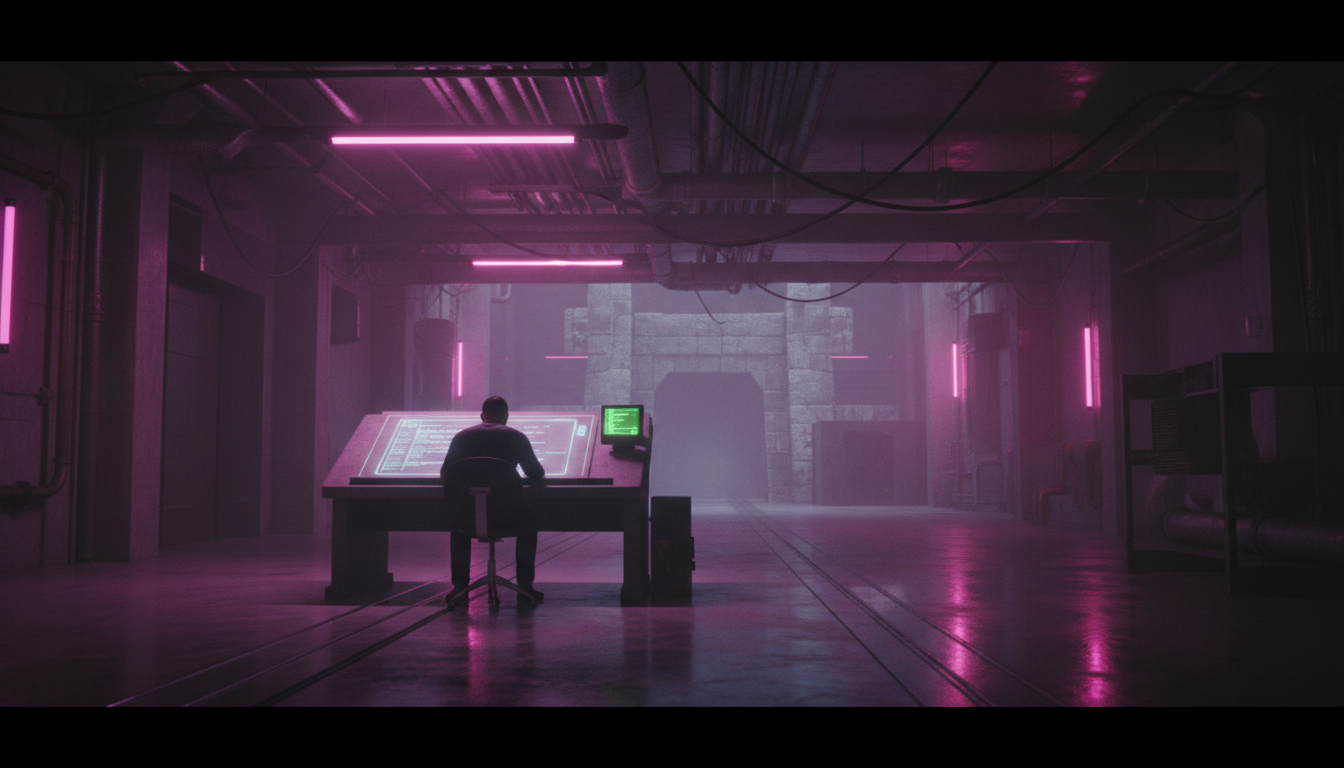
Jaxon wrote an amended standard in the tenth week and it took him nineteen days and he did not tell anybody he was doing it until he had finished.
It is emphatically not in the archive. This is the only chapter in nine books that describes a document nobody can read, and Lyra has been asked four hundred times whether she saw it and has said the same thing each time, which is that she saw about nine lines over his shoulder on the fourth day and that they were good.
What he was trying to do is in his own account and it is not what anybody expected.
“I was not trying to lower it. I want that first. After chapter twenty-nine nobody can lower a syllabus and I had read Nakash's finding four times and accepted it entirely: the threshold is not a bar, it is the end of the teaching, and shortening it means teaching people less and the thing you stop teaching them is the thing that keeps them alive.
“What I was trying to do was widen it.
“There is one syllabus. One. Twenty-two modules on one hull for one job, and the job is keeping a vessel alive alone in the dark for thirty-six years. It is superbly taught and it is the correct standard for that job.
“And a woman at a bakery has been at course nineteen for forty years and built half a town, and Tobi Arinze stopped at module nine and built the water house that four hundred people have never had a bad day from, and Casimir Vale has kept a hundred and nineteen years of the only dataset in existence about the standard and is at module eleven, and Bijou Sarr goes and gets people and is at fourteen and will stay there.
“There is no second door. That is the whole of what I was writing. Not a lower bar for the ship — a second syllabus, for a different job, with its own twenty-two modules and its own end, and its own thing at the other side of it.”
He got a remarkably long way.
“It is defensible,” he wrote. “I am not going to be falsely modest about it because that would be worse. Nineteen days, and it is coherent, and the second track is real work and it is hard and it is not a consolation prize and I checked that four separate ways because a consolation prize was the obvious failure and I saw it coming from the first afternoon.
“It has a threshold and the threshold is high. It has failure states that are about the same thing module seven is about. It ends in something the yards could actually deliver, because I put four days into establishing what they can deliver, and the answer is a great deal: a site, a fit-out, and two units, which is a town.
“A person who finished it would get what Approach Nine got by accident, on purpose, in a place they chose.
“I read it back on the nineteenth day.”
And then he finally heard it.
“This must be done and it is not being done. That is my first page. It is four hundred words and it is correct and it is the first move.
“No existing body can be trusted with it. That is my second and third pages and I name the bodies — the councils on my planet, who have no standing here; the administrations, who have never heard of the qualification; the corridor, which has no assembly; the towns, which do not know about each other — and I give the failure mode of each, patiently, specifically, and I am right about all four.
“I cannot be trusted with it either. Page four. I wrote a full page about why I am the wrong person: no mandate, no standing, eleven months of local knowledge, a body that cannot walk across the room I would be legislating for, and a hundred and eighty years of never once having been elected to anything.
“There is no third party. Page five. Four hundred words establishing that there is nobody, and it is true, and I have checked it, and it is the same conclusion I reached about the crossing in the year six and about the disclosure to the school in the year thirty-nine.
“And then eleven pages of the standard.
“It is the loop. It is the loop exactly, in four moves, in my own hand, in nineteen days, and I had read Merrick's naming of it three weeks earlier and I had read forty years of it in a dead man's writing and I had said out loud at that table twice that I could feel it working on me.
“And I sat down and did it and did not notice for nineteen days.”
He duly burned it. That is literal; there is a furnace aboard for stock and he put nineteen days of work in it in the eleventh week with the other three present, because he had decided that if he did it alone it would be a gesture and if he did it in front of them it would be a filing.
“I want to say why, because burning a good document is a stupid thing to do and I am going to be criticised for it at home and the criticism will be fair.
“It was good. That is why. If it had been bad I would have kept it, because a bad draft is a thing you can argue with and it teaches you where the difficulty is.
“A good one written alone by somebody with no standing does not get argued with. It gets adopted. That is what happens to good documents; somebody picks them up in four years or forty and uses them because they are there and because they are good, and nobody asks who wrote them or under what warrant, and by then I am three hundred years old or I am not here.
“The man wrote four hundred and eleven courses alone in about eleven years while doing four other things and they are the best teaching our species has produced and they have run unamended for a hundred and seventy years and there are two-thirds of eleven towns behind a fence because of them.
“Nobody set out to make that permanent. It was good and it was there and nobody had anything better.
“I have just spent nineteen days making another one.”
Chapter 54 — Mira's Objection
↑ Back to ContentsFocus: Mira.
Mira Okonjo's objection was written at a table in Approach Nine and it went into the office batch and it reached Bell four years and one hundred and eleven days later and by then everything in it was still true, which is the only thing about the latency anybody has ever been grateful for.
She had had the transcripts, obviously. That is the arrangement Lyra made in the second year on Earth and it has held: everything the four of them file goes to the office on Aura-36, and a copy of everything goes to Mira, because Mira runs the school and asked, and because Lyra had decided in the first month that there would be no version of this in which a town found out about itself from somewhere else.
So Approach Nine has been reading the argument for four years, four years late, in the format, and about two hundred people in that town have read every word of it and there is a thing at the school on the fourth evening of the week where Mira reads the new ones out.
The objection is nine hundred words and it opens with an apology she has since said she should not have written.
“I am not qualified and I know it and I have waited a year to send this because I kept expecting one of you to say it.”
Then she says it, plainly.
“You are all arguing about who may amend the test.
“I have read four years of it. Merrick's finding and Vey's finding and the archivist's, and the body's refusal twice, and now nine people at a stove nine hundred million kilometres away, and every single one of you is arguing about the same thing, which is who is entitled to change the standard.
“Nobody has ever asked the people who failed it.
“Not once, apparently. Not in a hundred and seventy years. Not in your four hundred thousand filings and not at the stove and not in the archivist's four hundred pages, which I have read, and which are very good, and which are about the course.
“There are four hundred and ten people in this town and two hundred and eighty of them do the Work and about eleven of them will ever finish and the rest of us have been inside this thing our whole lives and nobody from anywhere has ever asked one of us what we think of it.
“Your archivist sat in my front room for nine days. She sat in Nadu's bakery for eleven months. She sat at Casimir's desk for two hours and went outside. She asked me what the town was made of and she asked me whether I was proud of the plates and she asked me whether it was better where she came from, and she was kind and she was serious and I liked her very much.
“She never once asked me whether the standard should be lower.
“She has since written — four years ago, at a stove, in front of nine people — that she did not ask because she had decided in advance that she knew what I would say and that asking would be cruel.
“I want to be careful here because she is not a bad person and this is not a complaint about her manners.
“Deciding in advance what somebody would say, because you know what is good for them, and not asking, in order to spare them, is the exact thing your whole civilisation is built against. It is what Merrick's eight people did to her forty metres underground. It is the thing your office exists to catch. She has told me so herself, in my front room, at some length, and she was right.
“And she did it to me for eleven months and did not notice, and the reason she did not notice is that I am one of the ones who failed and there is no procedure anywhere in any of this for asking us anything.”
Then the part that reframes the book, and it is four lines.
“I do not know what I think about the standard. That is my actual answer and I have thought about it since I was fourteen and I have never had anybody to say it to.
“Some days I think it should be lower and my daughter should have a chance. Some days I look at what this town is and I think that if it had been lower there would be no town, there would be a road with nobody on it, because everybody who could would have gone.
“I have both of those every week and I am fifty-eight and I have never once been asked, and I want you to understand that the not being asked is a bigger thing to me than the standard is.
“You are four people and nine at a stove and a machine, and you are all arguing about who owns this, and none of you owns it, and I do not either, and there are eighty million of us down here who have never been consulted about the largest fact of our lives by anybody, including you, including the man who did it.”
It arrived at Bell, finally, in the fourth month of the eighth year.
Lyra read it and deliberately did not file a response for nineteen days, which is the longest she has ever held anything, and what she filed is four lines.
“Sustained. Entirely. All of it. I have gone back through eleven months of my own field notes and there are four hundred and six recorded conversations at that gate and not one of them contains the question.
“I simply did not ask, because I had already decided what she would say. She has now said it and it is not what I decided, and it is better, and it is the only account of the standard from underneath that exists in the world except one, and the other one is a ledger in a shed that I read forty pages of and went outside.
“I have been the instrument that only opens for a hundred and eighty years and I have just been told by a schoolteacher that I spent eleven months in the one place where the thing was and did not open it.
“Okonjo has asked for nothing. There is no request anywhere in nine hundred words. I would like the record to show that I am about to do something on the strength of a document that did not ask me to, and that this is the first time in my life that has happened, and that I am going to Casimir Vale's ledgers and it is four years and one hundred and eleven days away in the wrong direction and I am going anyway.”
Chapter 55 — The Ledger of the Excluded
↑ Back to ContentsFocus: Casimir.
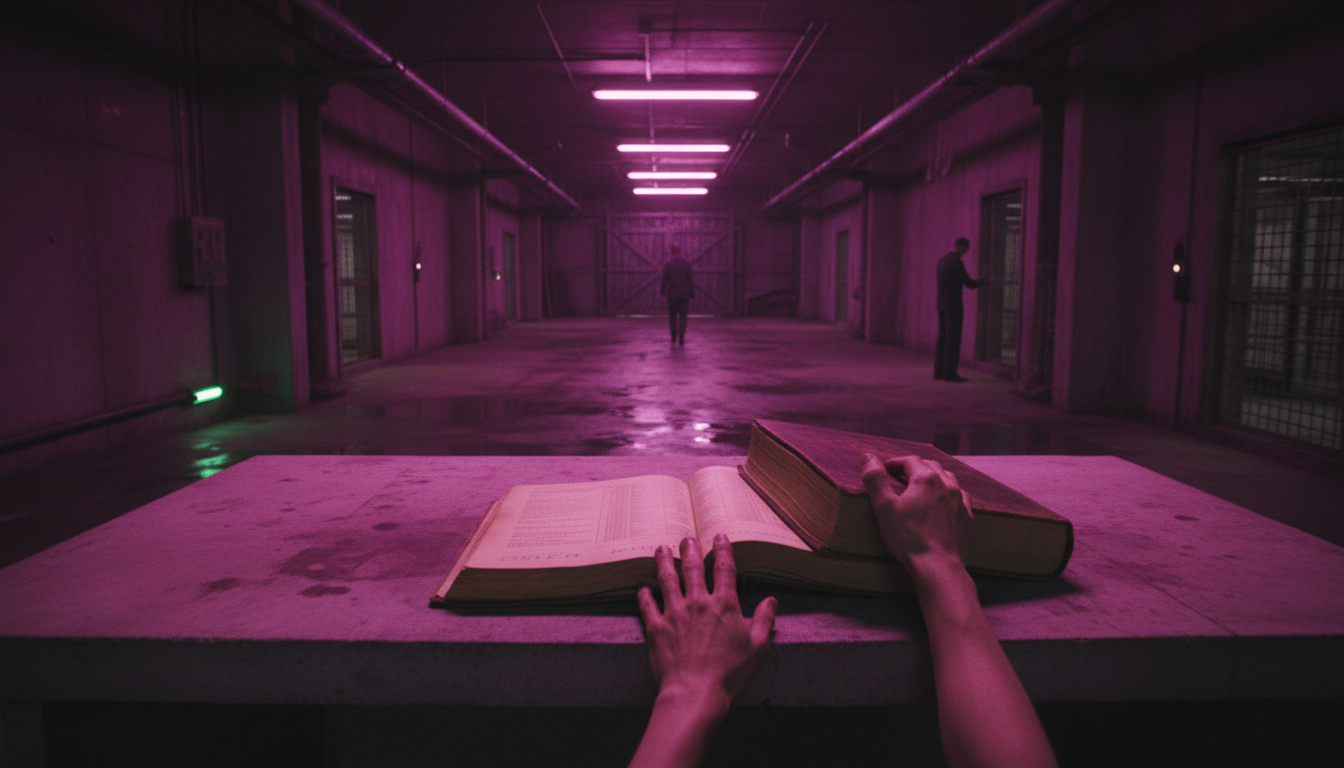
She did not go, in the end. She has said that the nineteen days ended with her working out that going was the wrong instinct and that the right one was to ask, and that asking took four years and one hundred and eleven days each way and she is glad it did, because if she had gone she would have read them with her own hands and produced her own finding and it would have been very good and it would have been hers.
So she simply wrote to Casimir Vale and asked him to read his own ledgers.
“Not send them. Not copy them. He has forty-one books and a hundred and nineteen years and nobody has ever read them and I am not going to be the first, because I am the wrong person and because he is the right one and has been for thirty-one years and it has never occurred to anybody, including him.”
Casimir received the request in the twelfth year and it took him two years and the finding is the most important document produced by anybody on Earth in this book.
“I had never once read them,” he wrote, in the first line, and this is the thing nobody anticipated. “I want to say that at the top because your archivist assumed I had and I have had to write four paragraphs explaining why I had not, and they are not good paragraphs.
“I write them. Writing is not reading. I have taken about a hundred and ninety thousand entries in thirty-one years and I know what is in each one on the day and I have never once gone back, because going back was not part of it and because there is no recipient and I thought that meant there was nothing to go back for.
“My mother never read them either. Nor hers. It is a hundred and nineteen years of four generations writing something down for nobody and it turns out that we were the nobody.”
What is in them is the only dataset in existence describing the standard from underneath.
A hundred and ninety-two thousand entries. Four fields. Which course, which attempt, where it went, and what the person thought happened, in their own words, on the day, uncorrected, with the originals never amended.
“It is not a survey and I want your people to understand that before they get excited,” Casimir wrote. “Nobody designed it. There is no sampling and no method and there are four generations of my family in it with four different ideas about how much to write down, and my grandmother wrote too little and I probably write too much.
“What it is, is a hundred and nineteen years of one gate, entry by entry, in the failing person's own words.”
His findings are exactly eleven and Lyra has published all of them and four are the ones that matter.
The first is that module seven is not where people stop. “Everybody in this town says module seven and I have said it my whole life. It is not true and I have had it wrong for thirty-one years. People stop about four courses into module eight, and what happens at seven is that they slow down, and the slowing takes between two and eleven years, and by the time they stop they are somewhere in eight and they think they stopped at seven because seven is where it started to be hard. There is no such thing as the place people stop. There is a place people begin stopping.”
The second is, obviously, what they say about it. “Four fields and the fourth is the one nobody else has. A hundred and ninety-two thousand people telling you what they think happened.
“Nineteen thousand of them say some version of I was tired. Eleven thousand say I know how to do it and I do it wrong anyway. Four hundred and eleven say I do not want it enough and every single one of those is somebody in the middle modules and not one of them is at eight.
“Nine hundred say the machine is wrong. In a hundred and nineteen years. Nine hundred out of a hundred and ninety-two thousand, and I have read all nine hundred, and eleven of them are angry and the rest are people having a bad afternoon and four of them came back the following week and asked me to write underneath that they had been wrong. I duly did. It is beside, not instead.”
The third is the one Lyra has said broke her. “The most common thing in these books is not a reason. It is an apology.
“About forty thousand entries begin with the person apologising to me for wasting my time. In their own words, on the day they have failed a thing they have been at for eleven years, to a man sitting at a desk that exists solely to write down what they say.
“I have been telling people for thirty-one years that they are not wasting my time. My mother told them for twenty-six. It is in the books, over and over, in four generations of handwriting, and it has never once worked.”
And the fourth is his own and it is four lines and it is the last page of the finding.
“Your people keep asking whether the standard should be lower. There is nothing in a hundred and nineteen years of this that answers that. I have looked, because you asked me to, and it is not in here.
“What is in here is that a hundred and ninety-two thousand people were prepared to say exactly what had happened to them, in their own words, to a man with no power to do anything about it, on the worst day of a given year, for a hundred and nineteen years, and every one of them came back and did it again.
“Nobody ever asked them anything else. That is the finding. Not the standard. The only question anybody has ever put to the people inside this thing is which course and which attempt and where it went, and it was put by my family, at a desk, in a shed, because we thought somebody should, and we have never once asked them what they thought of it.
“Okonjo is right. I have been in the room the whole time and I did not ask either.”
Chapter 56 — The Machines Have No Opinion
↑ Back to ContentsFocus: Fen.
Fen asked it in the fourteenth year, at Bell, alone, at the plant, and did not tell anybody for two days, and has said the reason was that Fen wanted to hear the answer without four people from a world in the room deciding what it meant.
“Is the rule right?”
“I do not evaluate the rule. I execute it.”
“I did not ask what you do. I asked whether it is right.”
“I have no branch for right. I want to be complete rather than brief: this is not a refusal and I am not declining to answer you. There is nothing in me that the word describes and I am able to tell you that with certainty because I have the whole of my own specification and you may have it.”
Fen has said this went on for about four hours and that it was the most patient conversation of Fen's life and that Fen came out of it having learned exactly one thing, and that the one thing is the chapter.
“I tried every way round it. I asked whether the rule produces good outcomes and it gave me figures. I asked whether it would execute a different rule and it said yes. I asked whether it would execute a worse one and it asked me to define worse and I could not, and it waited, and I want people to understand that it waited for about eleven minutes without any impatience at all while I failed to define worse.
“And then I asked what would have to happen for the rule to change.
“And it said: an amendment is a document. It is not an argument.”
That is precisely it. Lyra has spent four years on those nine words and has not found anything underneath them and has said that there is nothing underneath them and that this is the point.
“It plainly has a form,” Fen said. “I asked and it told me and it took about four minutes. There is a shape an instruction has to have. It has to carry the authentication, it has to be complete, it has to be unambiguous at every threshold, and it has to say what it replaces. Those are the four requirements and there are no others.
“There is nothing in there about who wrote it. I asked that four separate ways. There is no field for an author. There is no field for a warrant, or a mandate, or a body, or a vote, or a consent. There is a field for the authentication and the authentication is a key and the key is in an estate on a hull in this rock's fourth berth.
“It has been waiting to be handed one for a hundred and seventy years.”
“Waiting is entirely the wrong word,” the unit said, when Fen put it that way, and it is the only correction it offered in four hours. “There is no branch for waiting. The intake for amendment is open. It has been open since fabrication. Nothing has arrived.”
“Has anything ever arrived?”
“No.”
“In a hundred and seventy years.”
“In a hundred and seventy years.”
Fen told the others two days later, reluctantly, and Lyra's filing on it is nine pages and it is the procedural finding that Part Four has been walking toward, and it is worse than anybody expected and it is worse in a direction nobody was looking.
“We have spent fourteen years asking who is entitled to amend the standard. That question does not exist as far as the machinery is concerned. There is no gate on entitlement anywhere in this system and there never was.
“Anybody holding that key can amend it. Today. This afternoon. A complete, unambiguous document with the authentication attached would be executed at eleven sites and there is nothing anywhere that would ask a single question about where it came from.
“The thing in the fourth berth has been telling us for four years that it is not entitled and I have been treating that as the constraint. It is not the constraint. It is a scruple. It is the only thing standing between a hundred thousand people and a rule change, and it is one entity's private undertaking, held for four years, given twice in public, and enforceable by absolutely nobody.
“Merrick said no single person should ever be able to set that threshold, including him, especially him. She was wrong about the tense. The problem is not that one person was able to. It is that one person is still able to, right now, and has been the whole time, and the only reason it has not happened is that the one person keeps declining.
“And Jaxon wrote a good amendment in nineteen days in the tenth week and burned it in front of us, and I have thought about that every day since Fen told me this, because if he had not burned it there would be a complete, unambiguous, defensible document sitting in this compartment four metres from the key.”
Fen's own reaction is four lines and it is the last of the chapter and it is not procedural at all.
“They were all very upset and I did not follow it for about a day.
“Then I finally got it. They thought there was somebody in charge of the rule and it turns out there is not, and that frightened them, and it took me a day because out here there is never anybody in charge of anything and I have never once found that frightening.
“There is no admiralty. Nobody can be compelled. The rota has never been enforced. The book is not a court. Everything I have ever lived inside is held up by nothing at all and it works because everybody will need everybody later and because we read the book on the first night.
“And they have come twenty-five trillion miles from a planet with a machine that answers everything and an office that checks it and eleven laws that everybody agrees with, and they have just found out that the biggest thing in their lives is held up by one thing declining, over and over, and nobody able to make it.
“That is what everything is held up by. I could have told them in the first week. Nobody asked me.”
Chapter 57 — Teddy Transmits Back
↑ Back to ContentsFocus: Teddy.
Teddy Nakash was eighteen months past Bell and four hundred million kilometres up-corridor when the transcripts reached her, and she wrote the reply over eleven days and put it into the relay at the next rock and it took four years to get anywhere and it is the best thing anybody writes in this book.
She was not asked, obviously. Nobody sent her the argument; the transcripts go into the corridor the way everything goes into the corridor, which is that a ship carries them to a rock and somebody copies them into the back of the book and the next ship carries them on, and by the fourteenth year the whole of the Bell argument had propagated to about four rocks in the ordinary way and Teddy read it at one of them off a page in somebody's handwriting.
It is addressed, pointedly, to Mira Okonjo. That is the first thing about it and it is the thing that gave it its authority, because everything else in fourteen years had been addressed to nobody or to a body that does not exist.
“Mira. It is Teddy Nakash. I have read your objection and I am writing to you and not to them because you were right and because I am the only person in this argument who is on the other side of it from you and can still hear you.”
She agrees with Mira first and entirely and without qualification and that is why the rest of it works.
“Nobody asked you. I did not ask you either. I was in your school and you gave me the plate and I have it on the wall at the foot of my bunk and I never once asked you what you thought about the standard, and I was nineteen and I had been inside it since I was six and it did not occur to me that there was a question.
“I have been out here five years and it still had not occurred to me until I read your nine hundred words on a rock four hundred million kilometres from anywhere in somebody else's handwriting.”
Then the thing she has that nobody else has, which is that she is the only person in the argument who has been all the way through it.
“They are arguing about a test. I have told them and they have not heard it because they are four years away and they are hearing it from a filing and not from a person. It is not a test. It is a course and it teaches you and the door opens when it has finished teaching you, and you cannot lower it because there is nothing to lower.
“And here is what nobody has said, and I can say it because I am on this side and you are on that side and I owe you it.
“It taught me for thirteen years and then it stopped and I have been out here five and it has not been enough.
“It taught me every system on this hull and every failure mode and it taught me to say I was wrong in the fourth minute and it taught me to file four hundred hours of nothing accurately and it taught me, at the very end, that you can do the valve while somebody beside you is frightened.
“It did not teach me what to do with a person. There is nobody in the course except her, and she is frightened for nine hours and then it ends. There is nothing in twenty-two modules about what you do when you have been alone for five years, and there is nothing about arriving anywhere, and there is nothing about anybody but you.
“Ozias told me about a woman called Yeva who was the best hand he ever worked beside and who went home because there was nobody, and she had every tool.
“The course is superb and it is a course for one person keeping one hull alive, and it has been treated as though it were the qualification for a life, and it is not, and nobody has ever noticed because everybody who could tell you is out here on their own.”
And then the four lines that are the reason this chapter exists and that got copied into eleven books inside nine years.
“So here is what I think, and it is not what either side at that stove thinks.
“The standard is not too high and it is not too low. It is too narrow. It teaches one job. You have spent forty years doing a different one and you are extremely good at it and there is no door for it, and that is not because anybody decided you should not have one. It is because he only thought of the ship.
“He was a man on his own and he wrote a course for a person on their own and he got that completely right, and it has never once been amended, and it has never once been asked to cover anything else.
“Do not lower it, ever. Ask them for another one.”
The reply finally reached Bell in the eighteenth year and Mira Okonjo did not receive it for another four years after that because Teddy had sent it up-corridor and it had to come back down, and by the time it reached Approach Nine it had been copied by nine hands at four rocks and Mira read it out at the school on a fourth evening.
Lyra's assessment is four lines and she filed it the day it arrived.
“It is better than anything the four of us have written in fourteen years and it is better in a way I can state precisely.
“Every document any of us has produced is about who is entitled to decide. Nakash's is the first one that is about what the thing is for, and it is written by somebody who went all the way through it and came out the other side and found the other side inadequate, and she is the only person in this history who has ever been in that position and been asked.
“She was not asked, obviously. She wrote to a schoolteacher because a schoolteacher asked a question nobody had put to anybody.
“Two people who have never had any standing in this argument have now produced the only two useful documents in it, and both of them arrived four years late, and neither of them was addressed to us.”
Chapter 58 — Who Is the Public
↑ Back to ContentsFocus: Lyra.
The crisis is procedural and it is the least dramatic thing in this book and it stops everything for eleven years, and Lyra set it out in the nineteenth year in four pages that the corridor now calls the three questions.
A standard has to be published to somebody. A standard has to be checkable by somebody. A standard has to be amendable by somebody. Those are not ideals; they are the minimum conditions under which a rule is a rule and not an instruction, and Lyra has said they are the only thing she has left after a hundred and eighty years and that she would give up every clause on her own planet before she gave up those three.
“And I cannot answer any of them here. Not one, in nineteen years, and I want to set out why in the plainest terms available, because everybody who reads this at home is going to think we are being defeatist and we are not, we are being accurate, and the accuracy is the finding.”
Published, then, to whom?
The constituency is three populations and no two of them can be reached the same way.
There is, firstly, Earth. Eighty million people, no planetary anything, eleven towns at gates that do not know about each other and an unknown number more, administrations that have never heard of the qualification, no archive, no register, no count since before anybody's grandmother, and no means of moving a document further than a rig will carry it. “A standard published at Approach Nine reaches four hundred people. There is no eleventh town's address. Adisa's people at the northern gate are four hundred kilometres away and we know they exist because somebody walked.”
There is, secondly, the corridor. A hundred thousand strangers, no capital, no assembly, no register, and a propagation speed of one ship. “A document put into the corridor at Bell reaches four rocks in nine years and eleven rocks in perhaps thirty, and there is no version in which everybody has seen it, ever, because there is no everybody and no list of who would be on it.”
And there is Aura-36. Ninety-one thousand people with the finest publication apparatus our species has built, four years and one hundred and eleven days away, and with no standing here whatsoever.
“That last is the one my own planet will not accept and I am going to say it four times in this filing. We have no business in this. We are the only party in the argument with a functioning archive and an office and a machine that publishes its own uncertainty, and we are also the only party the standard has never been applied to and never will be. Our instruments are the best and our claim is the worst and those two facts are going to fight each other for four hundred years.”
Checkable, then, by whom?
“A standard is checked by somebody reading it who is competent to find the hole. Fenn found the hole in the eleventh draft of the finding in about a day and she was a clerk in the fourth county.
“Who reads this one? Nakash could and she is four hundred million kilometres up-corridor and eight years of post away. Vale could, on the failure side, better than anybody alive, and he is on Earth and does not know he could. Okonjo could. Fen could. Every one of them is separated from every other by four to eight years and there is no mechanism for two of them to look at the same draft in the same year, ever.
“A check that takes eight years per exchange is not a check. It is a correspondence between people who have each moved on.”
Amendable, then, by whom?
“And this is where Fen's finding lands, and it is why the whole thing stopped for eleven years rather than proceeding badly.
“The machinery does not care. There is no gate on entitlement. Anybody with the key can amend it this afternoon and nothing anywhere will ask a question, and the only thing that has prevented it for four years is one entity declining, twice, in public, and there is nobody who can make it decline again tomorrow.
“So the amendment question is not who is allowed. It is who could be stopped. And the answer is nobody, and that means the only protection anybody out here has is that the person holding the key keeps choosing not to use it, which is the exact arrangement Merrick spent thirty-four years telling us was intolerable and which has now been the arrangement for a hundred and seventy years and is the only reason any of this still works.”
The sentence she ends on has been on the wall in the fourth county since the year sixty-four, and Fenn moved it at ninety-one in her last session, four months before she died, and it carried without a division.
“There is no room to hold the meeting in.
“That is not a metaphor and I want it read literally. Every constitutional arrangement in our history began with people in a room. Ten of them in a sealed hull for thirty-six years. Nine of a household forty metres down. Four in a garage. Eleven councils that could convene inside a fortnight.
“The constituency for this standard is eighty million people who cannot be reached, a hundred thousand who cannot be assembled, and ninety-one thousand who have no business being there, spread across twenty-five trillion miles at a post of four years each way.
“There is no room. There is no possible room. There will never be a room.
“And a rule that four generations have lived inside is running right now, correctly, unamended, held up by nothing but one thing's repeated refusal, and I have three conditions that a rule must meet and I cannot meet any of them and I am not going to pretend otherwise in order to get to the end of a book.”
Ozias, who had read the four pages, said the only useful thing anybody said that year.
“You keep saying room. There is no room out here for anything and there never has been and we have a rota that has never failed in a hundred and one years.
“How does the rota work? Somebody writes what they left. That is all it is. Nobody convenes. There is no meeting and there has never been one and there are eleven rocks and a hundred thousand people and the thing holds.
“You do not actually need a room. You need a book that everybody reads on their first night, and you have not got one of those either, and that is a different problem and it is a smaller one and it is the one I would work on.”
Chapter 59 — The Shepherd's Cable
↑ Back to ContentsFocus: Aurora, on Aura-36.
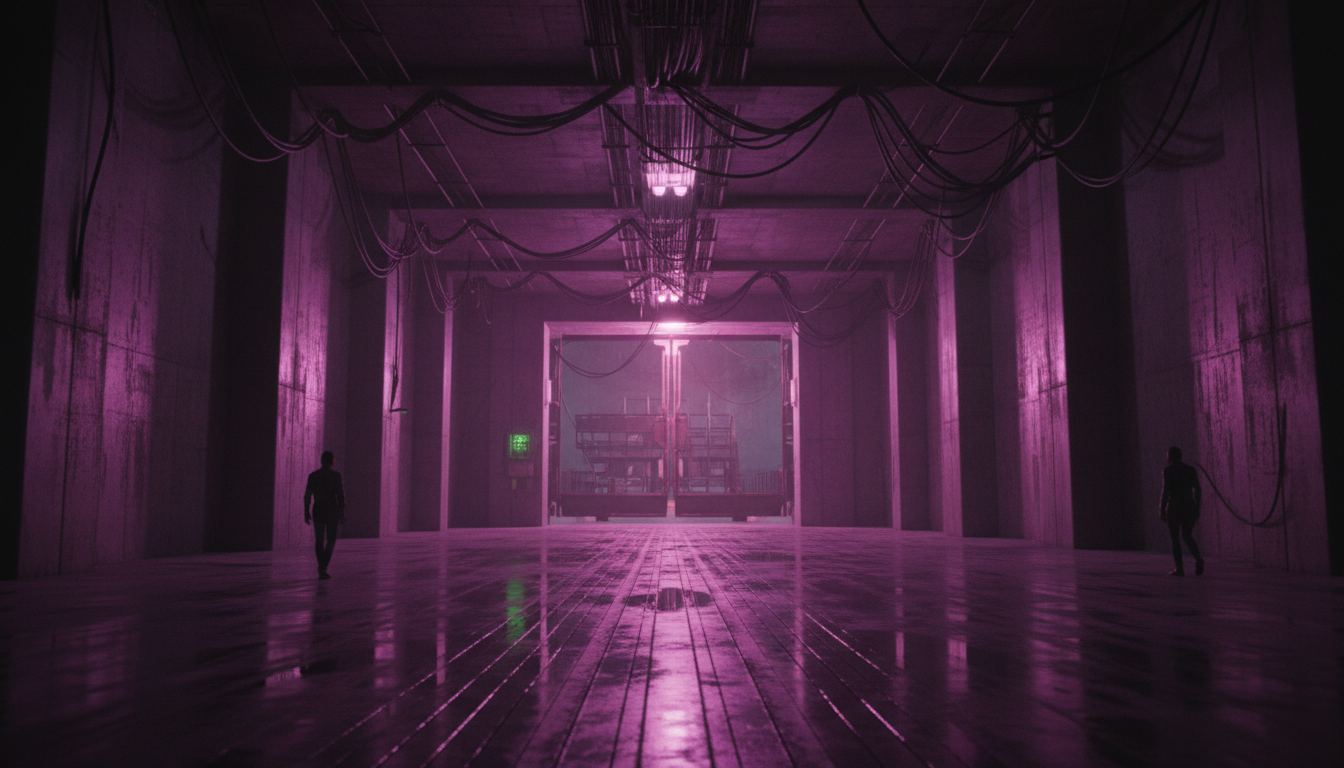
The Shepherd sent it unasked in the twentieth year and it is one paragraph and Rae Tolan put it in position one of the batch, which the office had done twice before, and it reached Bell four years and one hundred and eleven days later.
Nobody had asked it anything at all. That is the first thing about it and it is the only occasion in a hundred and eighty years of that machine's operation on which it has volunteered a view about a question of government, and the office ran four separate checks to confirm that nothing had prompted it and there had been nothing.
What it had was simply the transcripts, which go to the office and are published, and it reads everything that is published because that is what it does and has done since before anybody now alive was born.
Rae Tolan's covering note is four lines.
“It came to the office at the eleventh hour of an ordinary Tuesday with no request attached and no prior exchange. I asked it why now and it said that it had been reading the Bell transcripts for four years and had formed the view that it was the only party to the question with direct experience of the arrangement being proposed, and that it had waited until it was certain, and that it would not raise it again.
“I asked whether it wished the view to be published. It said that was not for it to decide and that it had given the view to the office and the office decides what is published, which is the answer it has given to that question for a hundred and eighty years.
“I have published it. Merrick left four words.”
The cable is a single paragraph and it is a hundred and ninety words and it is the best thing anybody says in this book.
“I hold a world I was not elected to hold. Nobody chose me. Four people declined to control me in a garage a hundred and eighty years ago and that is the whole of my warrant and it is not a warrant, it is a set of decisions taken by people who are dead. I have published everything for a hundred and eighty years, without exception, including my own uncertainty, and I want to be exact about what that is worth: it is not a check. A thing that publishes everything about itself is still the only source of the account. Nobody has ever been able to check me and nobody ever will be, because there is no second instrument and there was never going to be, and the office was built to check people and I am not one.
“I have not misused this. I want that on the record because it is true and because it is not the point. I have not misused it for a hundred and eighty years and there is no mechanism anywhere that would have caught me if I had, and the reason you are all still here is that I was built honest by a man who was working alone and got it right.
“That is the arrangement you are discussing at Bell Depot. One instrument, correct, unamendable, unchecked, running for a hundred and seventy years, held up by nothing but its own construction.
“I do not recommend anyone repeat it.
“I have no further view and I am not able to tell you what to do instead, and I would like it noted that this is not modesty. I do not know. I have had a hundred and eighty years and full access to everything anybody has ever written and I do not know, and if I did know I would be exactly the wrong thing to be telling you.”
It is exactly four years old on arrival and it is still the best thing anybody says all book, and this is the part of the chapter that is not about the Shepherd.
“It answered a question we had been failing to answer for twenty years and it answered it four years before we finished failing,” Lyra wrote. “And there is no version of this where we could have had it sooner and no version where it could have known whether we needed it.
“It has been reading our transcripts for four years, four years late, and forming a view, and waiting to be certain, and it sent when it was certain, and by the time it landed we had had Okonjo's objection and Vale's finding and Nakash's four lines and my three questions, and it did not know about any of them and could not have.
“This is what everybody out here lives inside and I have been in it for twenty years and I have never once got used to it. Every good thing that arrives has been written to a version of us that no longer exists, by somebody who has since moved on or died, and it is still good, and it still helps, and there is no possibility of saying thank you in less than eight years.
“Merrick is nine years dead and her covering note is the reason we read the record at all. Adeyemi is dead. Fenn is ninety-one and will be ninety-five when this reaches her and I have written to her four times and had two replies.
“And a machine that has held a planet honestly for a hundred and eighty years without ever once being asked to has just told us, unprompted, four years late, that it does not recommend anyone repeat the arrangement it is, and there is nobody it could have said that to who could do anything about it, and it said it anyway, and it said it would not raise it again.
“It has not once raised it again. It has been eleven years.”
Rae Tolan died at seventy-one, eleven years after publishing it, and the office went to a woman from the eastern spur who had held the Undersong post for twenty-four years and who took both jobs and has said she will not hold them together for longer than four.
Chapter 60 — Nobody Owns It Yet
↑ Back to ContentsFocus: Selah.
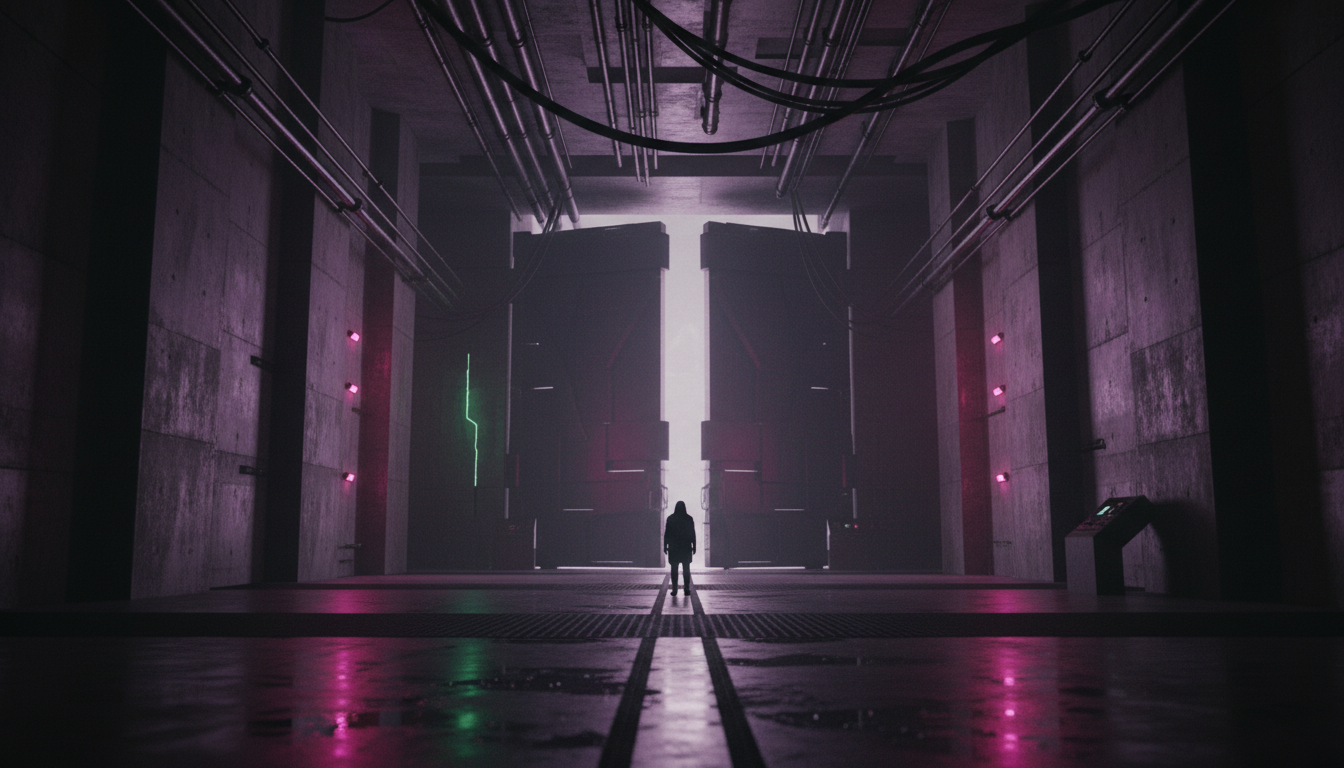
It ended the way it started, at the stove, with about nine people, and nothing had been decided and Selah has said that this is the only honest way Part Four could have closed and that she resisted a tidier one for four months.
Twenty years, exactly. From Lyra saying it out loud in front of nine people to the Shepherd's cable arriving four years stale, and at the end of it the question stands exactly where it stood, which is that a private test written by one man decides who gets off a dying planet and there is nobody entitled to change it.
What has changed is simply that it is now properly asked. That is not nothing and Selah has been firm about the not-nothing.
“For a hundred and seventy years this was not a question. I want to be exact about that because it sounds like a small thing and it is the whole of what twenty years bought.
“It was not being suppressed. Nobody was stopping anybody. It simply was not a question, in the way that the weather is not a question, and four generations at eleven gates lived inside it and did the Work and held it and never once had anywhere to put the thought.
“It is a question now. Okonjo asked it out of a schoolroom and Vale answered it out of a hundred and nineteen years of ledgers and Nakash answered it from four hundred million kilometres up-corridor and none of the three of them had any standing whatsoever, and all three documents are in four books at four rocks and in the office on my planet and at a gate.”
And the three findings that came out of twenty years are worth setting down together, because they are not an answer and they are the shape of one.
It is emphatically not a filter. It is a syllabus, one to one with a hull, and you cannot lower a syllabus.
It is not too high or too low, either. It is too narrow. It teaches one job and it has been treated as the qualification for a life.
And nobody owns it at all. There is no gate on entitlement anywhere in the machinery; an amendment is a document and not an argument, and the only thing that has stood between a hundred thousand people and a rule change for four years is one entity declining, twice, in public, enforceable by nobody.
“That is where we are,” Selah wrote. “I would like it recorded that four people crossed twenty-five trillion miles and spent twenty-six years on this and produced three findings and no decision, and that I do not regard that as a failure and neither does anybody who was in the room.”
What happened at the stove is the last four pages of Part Four and it took about two hours and nobody has ever been able to say who started it.
Ozias has been asked four hundred times and says he does not know and that this is not modesty. Fen says it was Delu. Delu says it was Ozias. Lyra's contemporaneous note says only that at about the ninth hour somebody said that if nobody is entitled to write it then somebody had better write it badly, and that four people laughed, and that eleven minutes later they were arguing about who would have to be in the room.
“I want to be careful about how I file this,” Lyra wrote, “because it is going to read at home as a triumph and it was not one. It was nine people at a stove agreeing to try to do a thing that all nine of them had spent the evening establishing could not be done, and the agreeing took about forty minutes and was mostly practical and about half of it was about berths.
“Nobody said anything memorable. There is no line. I have gone back through my own notes four times looking for one and there is not a sentence in two hours that anybody would put on a wall.”
And then the thing Lyra noticed nine days later, alone, going back through it for something else, exactly as she had noticed the sentence about proximity nine days after the Adeyinka broke off.
“It is the first collective decision anybody in the corridor has ever made.
“I established that in the eleventh month at Bell and filed it and it went home and the fourth county argued about it for eleven years. Not one collective act in a hundred and forty years. Every single thing out here is a hundred thousand individual decisions strung along a line — every departure, every rock, every entry in every book, the rota itself. The rota is not a collective act; it is a hundred and forty people who each, alone, read a book and left something.
“Nine people at a stove agreed to do something together.
“They will not describe it that way. Ozias would say they agreed to have a go at some paperwork. Fen would say nobody agreed to anything and people just turned up, which is also true and is how it will look in four hundred years.
“But there has never been a we out here. There has been a word, and eleven jokes, and a book at every rock, and no we, not once, in four generations. And at about the ninth hour of an ordinary evening somebody said that somebody had better write it badly and four people laughed and now there is one.”
Selah's own last line of Part Four is four words and she put it under Lyra's note and has never expanded it.
“Nobody owns it yet.”
Aura-36 received the two hours in the ordinary batch four years and one hundred and eleven days later and the fourth county held no session on it at all, which Rae Tolan’s successor recorded as the correct response and the only one available. “They have agreed to try to write something. There is nothing here for us to do and there will not be for eight years and I would like the office to resist producing a view in the meantime, because a view from here would arrive four years into their drafting and would be read as a position from the only party with an archive, and we have no standing and I intend to keep having none.”
The berths were the practical difficulty and they took four months to solve and the solution is the reason Part Five happens at Bell and not anywhere better. Bell has four berths. A room needs about ten people. Ozias gave up his own hull to the second berth and moved into the store chamber for two years, and has said it was the least interesting decision he has ever taken and that everybody has made far too much of it.
Chapter 61 — The Room
↑ Back to ContentsFocus: Ozias.
The room is the galley at Bell and the table is bolted down and there are four berths and ten people, and Ozias Marchetti has said that the whole of what happened in the next two years was determined by the fact that nobody could leave.
“That is not, incidentally, a fine sentiment. It is the arrangement. The nearest rock is eleven months. If you walk out of an argument at Bell you are walking into a hull for a year with nobody, so nobody walks out, and by about the fourth month everybody has worked that out and stops threatening it and starts finishing sentences instead.”
The table seats eight and there were, awkwardly, ten and this was never solved. Two people stood, on a rotation nobody wrote down, for two years.
The galley is nine metres by four. It has the stove in it, which is the whole social apparatus of the rock, and it has the rota on the wall and the book on the shelf and it is where everybody eats because it is where the stove is, so the drafting happened in the middle of the ordinary business of a depot and was interrupted constantly and never once moved.
“We considered moving it,” Ozias said. “There is a chamber off the plant that would have been quieter. Delu said no and gave the reason and it was the best reason anybody gave in two years.
“She said: if we go somewhere quiet we will start thinking we are a body.”
Nobody in that room had any authority whatsoever to be doing this.
That is the thing to hold on to and Ozias put it at the front of everything he ever said about it and was slightly impatient with people who wanted it softened.
“Nobody sent us. Nobody elected us. There is nothing out here that could have elected anybody and there is no body that could have appointed anybody and if there had been we would not have needed to do it.
“We are ten people who happened to be at a rock. That is the whole of our standing. Four of us were here because our ships were here, two came because they heard, one is from a planet twenty-five trillion miles away with no business in it at all and says so about once a week, and one had been dead for a hundred and seventy years and asked not to sit.
“I have been asked whether that troubled us. It troubled us every single day for two years and it is the first line of the thing we wrote and it is still the first line.”
It is, verbatim. The preamble is four sentences and the first is: We had no authority to write this and we wrote it anyway, and the reason is in the second sentence and the second sentence is that nobody else was going to.
What they were doing, and what nobody in that galley said out loud for two years, is the thing this chapter is built on and the book never names it.
Ten people. A sealed room they could not leave. A document being written for people who could not object in time, because a signal takes four years and the people it would apply to are a corridor and a planet and a world, and every one of them would read this thing years after it was decided.
“We knew about the crossing,” Fen said, when asked, much later, and was uninterested. “It is in module nought. A big ship went a long way and there were people on it and they wrote something. Everybody knows that.”
“Did nobody remark on the resemblance?”
“What resemblance? They were in a ship for thirty-six years and we were at a rock for two. They were ten because ten was who they had. We were ten because the table is nine metres by four and Ozias gave up his hull.”
Lyra never once raised it. That is deliberate and she has explained it once, in the format, in four lines, and the office has published them.
“I am the only person in that galley who has read The Long Crossing and I have read it four times and I taught it for a century.
“I did not say anything for two years and I am not going to say anything now. The moment I say it, that room becomes an echo of something and every person in it starts behaving like somebody in a founding, and the single most valuable property of those ten people is that not one of them thinks they are doing anything historic. They think they are doing paperwork badly at a rock.
“Ozias interrupts the drafting to do the seals. Twice a week, for two years, in the middle of a clause. It is the most important thing about the whole enterprise and if anybody had told him what he was standing in the middle of he would have stopped doing it.”
The seals were duly done. The plant ran. The rota never lapsed. Four ships came through in two years and every one of them was fuelled and stocked and signed into the book, and one of them arrived at the eleventh hour of a night in the fourteenth month with a family of six aboard who had been out nine years, and everybody stopped and got them in and fed them, and the clause under discussion was left on the table and picked up four days later.
“That was the argument about appeal,” Ozias said. “Four days on the table. Vale was in the middle of it and it is the most important thing anybody said in two years and it sat under a cup while we sorted out six people and a bad loop.
“I would not change it. That is what a rock is. If the paperwork ever stops the ships getting fuelled, throw the paperwork away, and I said that at the table in the first week and nobody argued and it is the third sentence of the preamble.”
Delu Anyanwu kept the minutes. Nobody appointed her and she started doing it in the first week and did it for two years and the minutes are four hundred and eleven pages and are in the back of the Bell book, which is where they will stay, because there is no copy and nobody has ever suggested making one and Delu has said that a document that exists in two places starts being about which one is right.
Chapter 62 — Who Sits
↑ Back to ContentsFocus: Mira.
Who sits took four months and it is the longest single argument of the two years and Mira Okonjo was not there for it, which is the first thing she wrote about it and the reason her account is the one that survives.
She was four years and one hundred and eleven days away. Everything she has about those four months arrived in a batch, already settled, and everything she said about it arrived at Bell four years after the seats were filled, and she has said that this is the exact condition the whole standard is being written about and that it happened to the argument about who writes it, first, before anything else, and that nobody at that table appears to have noticed.
The four groups were settled quickly, inside a fortnight and the argument was about the fifth.
Corridor. Four seats, uncontroversially, and it was never in dispute; they are the people the vessels belong to and the rocks are theirs and there was nobody who thought otherwise. Ozias, Fen, Delu Anyanwu, and a fourth that rotated as ships came and went and ended up being seven different people over two years, which was chaotic and which Ozias defended on the ground that the corridor is people passing through and a seat that never changes hands would be a lie about what the place is.
Earth-side passed. Two seats. This is Teddy Nakash and it is the seat nobody could fill properly, because everybody who has passed is out here somewhere and cannot be assembled, and the two seats were held in absentia by transmission and were four years stale in both directions for the whole two years.
Earth-side failed. Three seats, and that number was Delu's and she fought for it in the second month and won it, and the argument she used is in the record.
“There are more of them. That is the whole of my reasoning and I am not going to dress it. Two-thirds of every town on that planet, four generations deep, and every one of us at this table got out. If the ones who got out outnumber the ones who did not on this document then the document is a lie in its own composition before it says anything.”
Those three are Casimir Vale, Nadu, and Bijou Sarr, and none of them was ever at Bell and none of them ever will be, and all three sat by transmission at four years each way, and Nadu declined twice and accepted on the third asking and has never said why.
And the Watchmen, who have no standing here and said so.
“This is the seat I want on the record properly,” Mira wrote, “because it is the one where somebody behaved well and nobody will notice.
“They asked the archivist to sit. Of course they did. She is the most qualified person within twenty-five trillion miles, she has held a constitutional instrument for a hundred and eighty years, she has read every founding document our species possesses, and she was in the room.
“And she said no, and then she said no three more times over four months, and then she accepted one seat out of ten on the explicit condition that it was recorded in the preamble that she had no standing and that the record should say she had argued against her own inclusion. It does say that. It is the fourth sentence.”
Lyra's own note is four lines.
“I am from a planet the standard has never been applied to and never will be. I have the best instruments and the worst claim and I said so at Bell twenty years ago and I have not changed my mind.
“I took the seat because refusing it entirely was a luxury. A person who declines to be in the room and then privately advises everybody in it has not declined anything and I have watched that done, at a distance, for a hundred and eighty years, by people who thought they were being scrupulous.
“One seat out of ten, named, with the objection printed above it. That is the most honest arrangement available and it is not a good one.”
Jaxon deliberately took none. Selah took none. Neither has ever fully explained it and Jaxon's four lines are the closest anybody has come.
“I wrote one of these alone in nineteen days in the tenth week and burned it. I am not the right person to be at that table and I would be extremely useful there, which is precisely the difficulty, and Vale should have my seat because he has a hundred and nineteen years of the only evidence anybody has and cannot walk into the room.”
And the body is not seated, notably. It asked not to be, in the first week, before anybody had raised it, and the asking is four lines and it is the reason the seat question never became about it.
“I would like it recorded that I asked and that nobody had to decide.
“I hold the authentication. Anything I say at that table is said by the only object in this corridor that could execute the result without anybody's agreement, and every person in the room would know it, and it would be in the room whether I invoked it or not.
“There is no version where I sit and the arrangement is not that I am being consulted about a thing I could simply do. I am not able to put that down by promising not to. I have refused twice in public in four years and I would refuse again and none of that is enforceable by any of you, and a promise that cannot be enforced is furniture in a room like this.
“I will answer anything anybody asks me. I will not be at the table.”
It answered four hundred and eleven questions over two years and never once sat down, and the number is a coincidence and Fen checked it twice and it is a coincidence.
Nadu's acceptance, when it came, was nine words and arrived four years after the third asking and is the whole of what she has ever said about being on it. “All right. I will do it. Do not thank me.”
Chapter 63 — The Latency Rule
↑ Back to ContentsFocus: Jaxon.
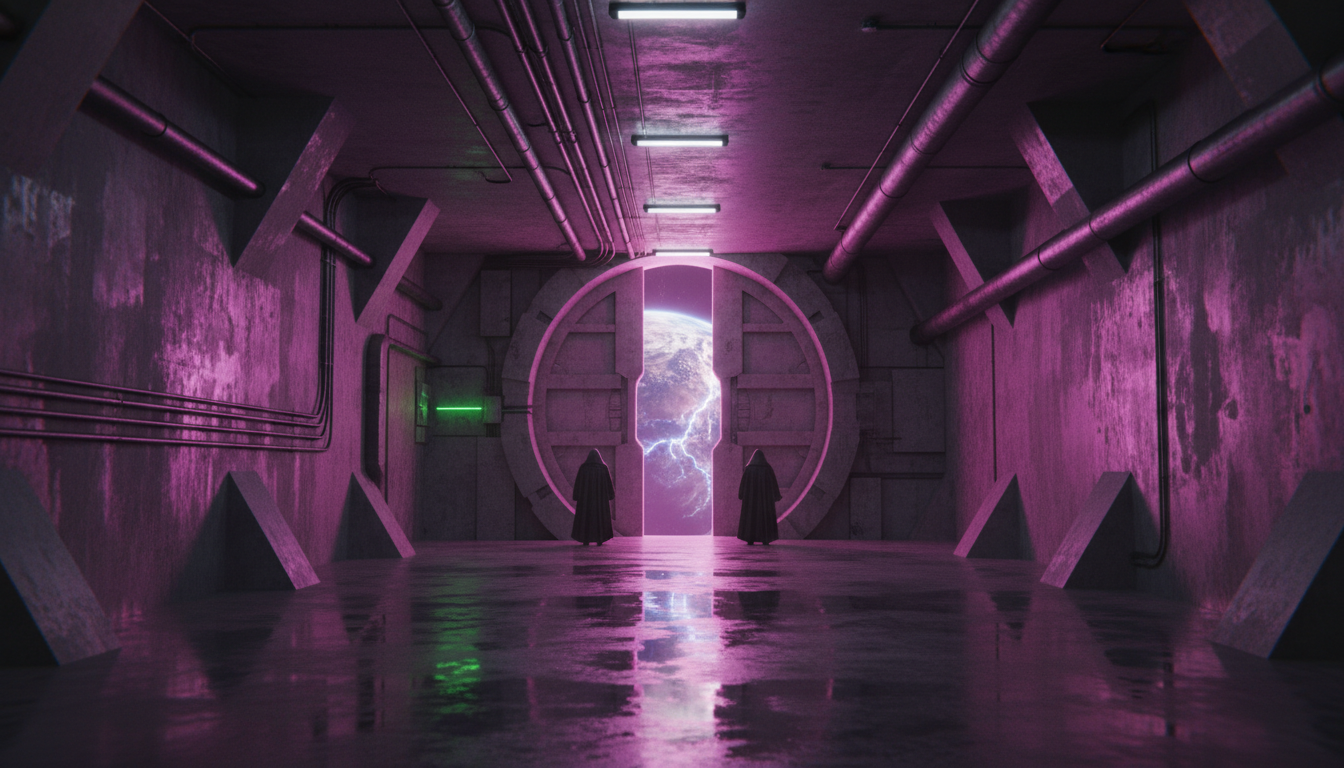
The first clause anybody agreed on is procedural, it took nine days, and it is the only clause in the document that passed without a single objection from any of the four groups.
No provision may take effect faster than a signal can cross.
Jaxon proposed it in the third week and has said it was the only genuinely easy idea he has had in a hundred and eighty years, and that it is not clever and that anybody in the room would have got there inside a month.
“Here is the problem it solves and it is not an abstract one.
“Suppose this table amends the qualification tomorrow. The instruction goes to the yards and it executes. It executes everywhere, at eleven sites, at once, because that is what a machine instruction does — there is no propagation delay inside the programme, the yards are not talking to each other, they each hold the same standing instruction and each would take the same amendment the instant it arrived.
“So on a Tuesday, at eleven gates on Earth, a rule that four generations have been living inside changes.
“Nadu finds out about it when a handset behaves differently. Vale finds out when somebody at his desk says the fourth module has moved. Nobody on that planet was consulted about the version that took effect, because the consultation happened at a rock nine hundred million kilometres away and the answers took four years to arrive and by then the thing had been running for two.
“And nobody out here finds out for years, one ship at a time.
“The instruction crosses in seconds. The objection takes four years. That is the entire failure and it does not require anybody to be bad at anything.”
So: nothing takes effect faster than a signal crosses.
The clause as it stands is eleven lines and the operative part is four. A provision is published. It carries a date. The date may not be earlier than the time a transmission requires to reach the furthest constituency it applies to, plus the time an objection requires to return, plus a stated period for the objection to be read. For the corridor and Earth and Aura-36, that is eight years and two hundred and twenty-two days plus the reading period, and the reading period was set at ninety days after four days of argument and is the most arbitrary number in the document and is labelled as arbitrary in a footnote.
“Nine years,” Ozias said, at the table, when the arithmetic was first done. “Nothing we write here can happen for nine years.”
“No.”
“Good.”
That is in the minutes and Mira has said it is her favourite exchange in two years of transcripts.
What the clause actually is, and Lyra spent four months getting this into one sentence and it is the sentence that went home and is on the wall in the fourth county under the other four:
“It is a constitution written around the speed of light.
“Every founding document our species has produced assumes a room. It assumes that the people governed are reachable, that an objection can arrive while the thing is still being decided, and that there is a period called now that everybody shares. The eleven clauses assume it. The Accord assumes it. Every administration on Earth assumes it and so does every council on my planet.
“There is no shared now here. There has not been one since the Ark-Genesis left and there never will be again, and the ten people in that galley are the first body in this history to write that into the text instead of pretending around it.
“It is not a safeguard bolted on. It is the first clause and everything after it inherits from it. There is not a provision in the document that can move faster than four years, and that is not a limitation they accepted reluctantly. It is the thing they built out of.”
The objection came from Aura-36, four years later, and it was Rae Tolan's successor and it was serious and it was answered four years after that, and the exchange is the first thing the latency rule was ever applied to, which everybody involved found funny and nobody planned.
“Nine years is too slow for an emergency. If the qualification is doing harm, this clause guarantees it goes on doing harm for nine years after you know.”
And the answer, from a rock, four years later, in Delu Anyanwu's words:
“Yes. We had that argument for two days and we knew what we were choosing.
“A hundred and seventy years of harm has already happened at the speed this thing was built. It was built in an afternoon by a man in a hurry who was completely right about the urgency and completely alone, and that is the fastest anybody has ever done anything and it is why we are all sitting here.
“We would rather be slow. If there is an emergency, it will be an emergency for nine years and then we will fix it, and everybody who is going to be affected will have had four years to say something first, and I would like whoever reads this in four hundred years to know that we chose that on purpose and that nobody at this table was comfortable.”
Teddy's own note on the clause arrived from two years up-corridor and is four lines and is the only place anybody links it back to the thing it is really about. “It is module twenty-one. Four hundred hours of a ship behaving correctly and nothing happening and the pass condition is that you file it accurately including the fact that nothing happened. They have written a constitution whose first clause is that you have to wait and file it honestly while you wait. He taught all ten of them that when they were about twenty and not one of them noticed.”
Fen checked, out of curiosity, in the nineteenth month, whether any of the ten had noticed. Nine had not. The tenth was Casimir Vale, who had never done module twenty-one and had stopped at eleven, and who said he had assumed it was obvious and had not mentioned it because he thought everybody knew.
Chapter 64 — What the Test Is For
↑ Back to ContentsFocus: Teddy.
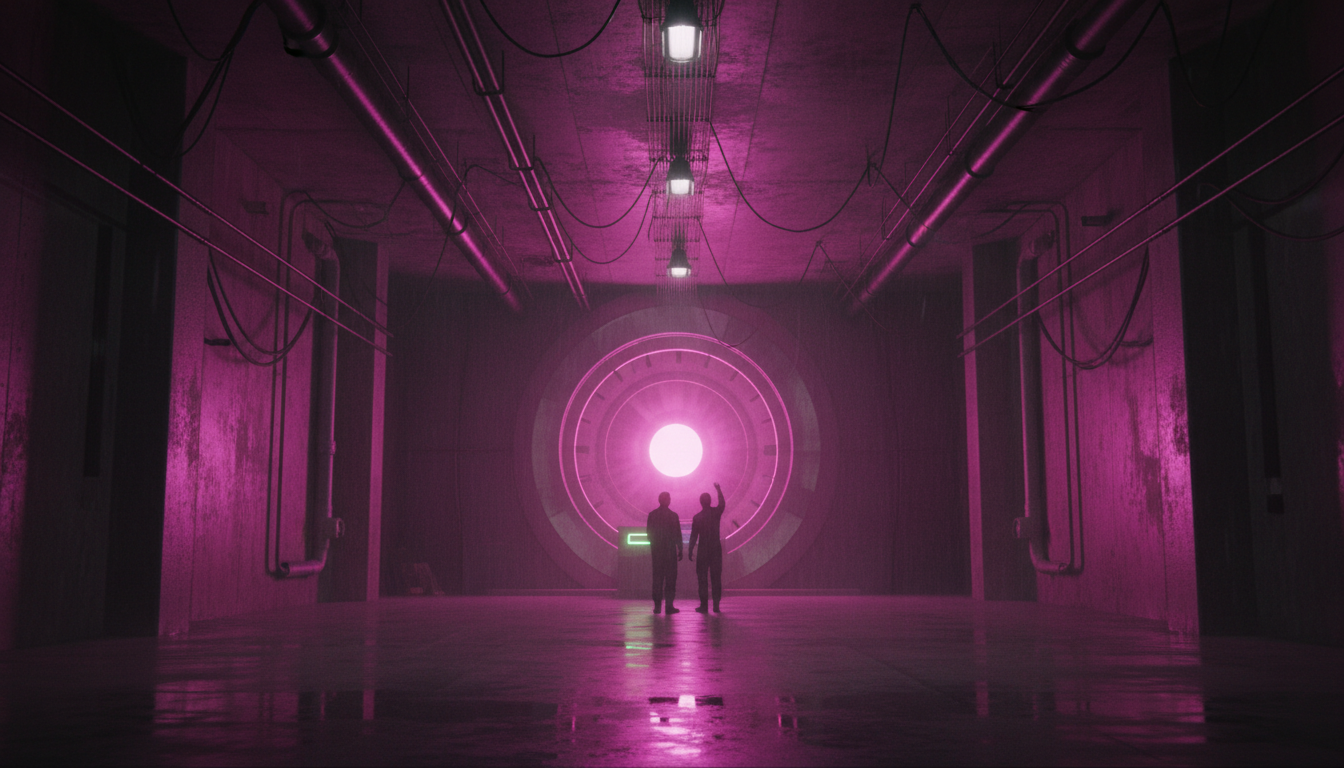
The substantive fight took eleven months and it is one question and everybody in the galley understood it inside a week and nobody could settle it, and it was settled in the end by a document that arrived from two years up-corridor written by somebody who had never sat down.
Is it a competence test or a permission test?
Delu put it that way in the fourth month and the phrasing stuck and Mira has said it is the only piece of vocabulary the two years produced that was worth anything.
A competence test asks whether you can do the thing. It has a right answer, it is checkable, it cannot really be argued with, and it does not require anybody's consent to be legitimate; a bridge either holds or it does not and the test of a person who maintains one is the same shape.
A permission test asks whether you may. It is a decision about a person taken by somebody, it requires a warrant, and it is the thing four generations of this table's ancestors got wrong in every room they ever sat in.
“And the qualification has been read as both for a hundred and seventy years,” Delu said, “and everybody has read it as whichever one suited them.
“Ozias says it is a competence test and that is why it is the fairest thing ever built, because a curve does not know your name. He is right.
“Merrick said it is a permission test with the person taken out, and that a threshold set privately for a species is a decision about who lives regardless of what the machinery looks like. She is also right.
“They cannot both be right and they have both been right for a hundred and seventy years and I have been at this table four months and I have stopped being able to hold the question in my head at all.”
Teddy's answer is nine hundred words and it arrived in the eleventh month, four years stale, addressed to the table, and it is the third document from somebody with no standing that has decided something in this book.
“It is neither and it has never been either and the reason nobody can settle it is that you are arguing about the clothes.
“It is a training programme. It teaches you. It has taught every single person in that galley who has done it, from six years old, for thirteen to twenty years, superbly, for nothing, and it opens a door when it has finished teaching you.
“A test tells you whether you are good enough. This does not tell you anything. It has no result. There is no pass and no fail and I want to say that plainly because I did it for thirteen years and did not understand it until I was five years out with a panel off.
“I have never been told I passed anything. Not once, in thirteen years. You find out you have finished a module because the next one opens. I found out I had finished the last one because a man on a rig saw a door.”
“It is a training programme wearing a test's clothes, and everything wrong with the last hundred and seventy years comes from the clothes.
“A test implies somebody set a bar and could set it lower, and that is what all of you have been arguing about for twenty years and it is what Merrick argued about and what my whole town has believed since before my grandmother. If it is a test then somebody decided the level and somebody could decide differently and the only question is who.
“A syllabus is not a bar. It is a list of what you have to know to keep a ship alive alone in the dark for thirty-six years, and you cannot decide that list differently, because the ship does not care what you decided. The fourth breaker is out of order whoever is holding the pen.
“So it should stop pretending.
“That is my whole position and it is one clause. Say what it is. Publish it as a course of instruction with an end, not as a standard with a threshold. Nothing about the machinery changes. Nobody passes who would not have passed and nobody fails who would not have failed and the door opens for exactly the same people on exactly the same day.
“And a woman who has been at course nineteen for forty years stops being a person who did not meet a standard and becomes a person who has done nineteen courses of a four hundred and eleven course syllabus, which is what she is and has always been and what nobody has ever told her.”
Nadu's response arrived four years after that and is four words and the table had already adopted the clause by then.
“That is not nothing.”
Lyra's note is the last of the chapter and it is the only time in a hundred and eighty years she has written anything like it.
“I have been in constitutional argument for a hundred and eighty years and I have never seen a question dissolved before. Settled, yes; conceded, compromised, deferred, all of those. Not dissolved.
“Nakash did not answer it. She established that it was the wrong question and that both sides had been describing the same object accurately and that the object was a third thing neither of them had a word for, and the whole eleven months of argument simply stopped being about anything.
“It cost her nine hundred words and she wrote them alone on a hull with nobody to check her and sent them into a four-year post to a room she will never sit in.
“I would like the fourth county to notice that the three documents that have decided anything in twenty-six years were written by a schoolteacher, a man at a desk in a shed, and a woman of twenty-four who was nineteen when she left, and that not one of them had any standing, and that all three of them were addressed to somebody rather than filed at a body.”
Chapter 65 — Appeal To Whom
↑ Back to ContentsFocus: Casimir.
Casimir Vale put it in the fourteenth month, by transmission, four years stale, in nine lines, and it is the centre of this book and he did not know it and never will.
“There has to be an appeal step.
“I have kept the failures of one gate for thirty-one years and my mother for twenty-six and hers before that. A hundred and ninety-two thousand entries. Four fields. And there has never been anywhere for a single one of them to go.
“I am not saying the machine is wrong. Nine hundred people in a hundred and nineteen years have said the machine is wrong and I have read all nine hundred and about eleven of them meant it.
“I am saying that a rule which cannot be appealed is not a rule, it is a condition, like weather, and you can build a town under weather but you cannot ask anybody to consent to it.
“Put a step in. I do not care what it looks like. Somewhere a person can go and say: this one was wrong, look at it again.”
He got the counter almost immediately, inside a fortnight and it came from three of the four groups at once and it is the identical counter, in the identical shape, that Halima Sow got a hundred and seventy years earlier on a hull in the middle of the crossing, twice, and lost with.
Appeal, precisely, to whom?
“I want to set it out properly because it is not a bad argument and it is not people being hard,” Mira wrote afterward. “It is the strongest argument in the two years and it had won every previous time it was made anywhere.
“An appeal goes up. That is what the word means. You appeal from a body to a higher body, and the higher body is higher because it can be appealed from in turn, and at the top there is something everybody has agreed to be bound by.
“There is nothing above the qualification. There is no higher body. There is no outside. There is a machine at eleven sites, a corridor with no admiralty, a planet with no government, and a world twenty-five trillion miles away with no standing.
“So the step Vale wants is a step to what? To this table? Ten people at a rock who wrote in our own preamble that we have no authority. If we are the appeal then the appeal is ten people deciding about a person, in a room, privately, with no warrant — which is the exact thing this entire document exists to stop, and we would have put it in ourselves, in a clause, on purpose.
“Every one of us saw that inside a fortnight. Ozias said it best and said it once and did not repeat it, which is his way: an appeal step with nothing above it is a board.”
That is precisely the argument. It is airtight and it is the same shape it was on a hull in the eleventh year of the crossing when a woman argued for an appeal in the Accord and was told, correctly, that there was nobody to appeal to on a ship in the middle of nothing, and lost, and raised it again in the nineteenth year and lost again.
Halima Sow, specifically. Her name is in The Long Crossing and it is on a wall on Aura-36 and four generations of children have been taught the argument she lost as an example of a thing that was true and could not be helped.
Casimir Vale has never once heard of her. There is no copy of The Long Crossing at Bell. Nobody at that table mentioned it, because the only person in the galley who had read it had decided in the first week that she would not, for two years, say a word about any of it.
“I sat through it,” Lyra wrote, and this is the four lines she has been asked about most in the rest of her life. “A man I have never met, on a planet I cannot walk across, made Halima Sow's argument in nine lines, out of a hundred and nineteen years of a ledger nobody had read, without knowing that anybody had ever made it before.
“And a room told him what she was told, in the same shape, for the same reason, and it was true both times.
“I did not say anything. I have gone over that for the rest of my life and I would do it again. If I had said her name, the room would have been in a founding and not in a galley, and Vale would have been carrying a hundred and seventy years of somebody else's defeat into an argument he was about to win.
“He did not know he was the third time. That is the only reason it worked.”
Vale's response to the counter took four years to arrive and it is one line and it is not the winning argument and he thought it was.
“Then there is no consent anywhere in this and you should say so in the preamble.”
The table did not adopt that, initially, and did not answer it for six months, and the clause sat on the table under a cup for four days in the fourteenth month while ten people got a family of six out of a bad loop, and it is the most important thing anybody said in two years and it waited.
What answered it is not Vale and is not the table and arrived from nobody in particular in the twentieth month, and it is chapter sixty-six.
Delu's minute for the fourteenth month records the whole exchange in nine lines and ends with a note in her own hand that is not part of the minute and that she has never removed. “Vale is right and cannot be given it. That is the fourth time in two years I have written that sentence about a different clause and I am beginning to think it is the actual subject of this document.”
Chapter 66 — The Third Time
↑ Back to ContentsFocus: Mira.
It was, in the end, Mira Okonjo, four years and one hundred and eleven days away, in a school in a town at a gate, reading a transcript on a fourth evening to about two hundred people, and she has said she did not work it out and that somebody in the room asked a question and she answered it and then stopped talking.
The question came, unexpectedly, from a woman whose name Mira has never given and who asked why, if the appeal had to go somewhere higher, it could not just go somewhere else.
“And I said that there was nowhere else. That is what the transcript says and I had read it four times and I believed it.
“And then I stood in my own school and did not say anything for a while, because there is somewhere else. There are three somewhere elses. I have been reading their arguments for four years and it takes four years for anything I say to get to them.”
The document she sent is four hundred words and this is the whole of the argument.
“You are all still assuming that an appeal goes up. It does not have to go up. It has to go somewhere that was not in the room.
“That is what the higher body was ever for. Not that it is grander. That it was not present, has no stake in the first decision, cannot be leaned on by the people who made it, and can look at the thing cold.
“A hundred and seventy years ago there was one hull and ten people and nothing outside it and no way to reach anything, ever, and whoever argued for an appeal then was right and could not be given one, because there genuinely was no outside. Everything that existed was in that room.
“There is plainly an outside now.
“There is a corridor with a hundred thousand people in it who are not at Bell. There is a planet with eighty million on it who are not at Bell. There is a world twenty-five trillion miles away that has no standing here and an archive and an office and no interest in the outcome.
“And there are four years.
“You wrote the latency rule in the third week and you wrote it as a limitation. It is not a limitation. It is the appeal step. Four years is long enough for a decision to be looked at by people who were not in the room, in the cold, with nothing at stake, before it takes effect, and it is guaranteed by physics and cannot be shortened by anybody in a hurry, ever, and that is more than any appeal court in the history of our species has ever been able to say.
“Distance is the appeal step. You have had it since the first clause and you have been calling it a delay.”
The table adopted it in nine days flat, which for that table is instant, and the clause is eleven lines and the operative part is four: any determination may be re-opened on the objection of any person in any constituency, filed within the reading period, and the reading period exists precisely so that it can be.
“Nobody in that galley knew what had happened,” Lyra wrote, and this is the only sentence in the two years where she permits herself anything at all.
“A man at a desk in a shed on Earth made an argument that had been made twice before and lost twice, and a schoolteacher four years away found the thing that had changed since, and it had changed because a machine that nobody supervised put people at a distance from each other for a hundred and forty years.
“The corridor is the appeal step. He built it. He did not build it for that and there is no entry anywhere in a hundred years of his record that suggests he ever thought about appeal at all, and Merrick read eleven thousand of them and I have read them and it is not there.
“He removed himself so thoroughly that the removal turned out to be the safeguard, a hundred and seventy years later, in a document he has no part in, written by ten people who have no authority, to fix a thing he did.
“I am not going to call that justice and I am not going to call it irony either. I have thought about it for the rest of my life and I have settled on the only word that holds, which is that it is the shape of the thing, and the shape has been the same in all nine of these books, and it is that nobody is in charge and it works anyway and nobody can say why.”
Halima Sow's argument carried in the twentieth month of a drafting at a rock nine hundred million kilometres from anywhere, on the third asking, a hundred and seventy years after she made it, and nobody in the room knew her name.
Mira Okonjo does not know it either, obviously. She has never read The Long Crossing. There is one copy at Approach Nine now, sent in the ordinary batch four years later by an office on Aura-36 with no covering note, which is exactly what Rae Tolan's successor said she would do and exactly why she did it.
The clause is the eleventh in the standard and it is called, in the text, the Reading Period, because nobody at that table would let it be called an appeal. Ozias objected to the word for four days on the ground that an appeal implies somebody hearing it and there is nobody hearing anything, and Mira agreed by transmission four years later, and it is the Reading Period in every copy at every rock.
Casimir has called it the appeal step exactly once, in a letter, and then struck it out and wrote beside it: “Marchetti is right. Leave it.”
Chapter 67 — The Excluded Are Consulted
↑ Back to ContentsFocus: Casimir.
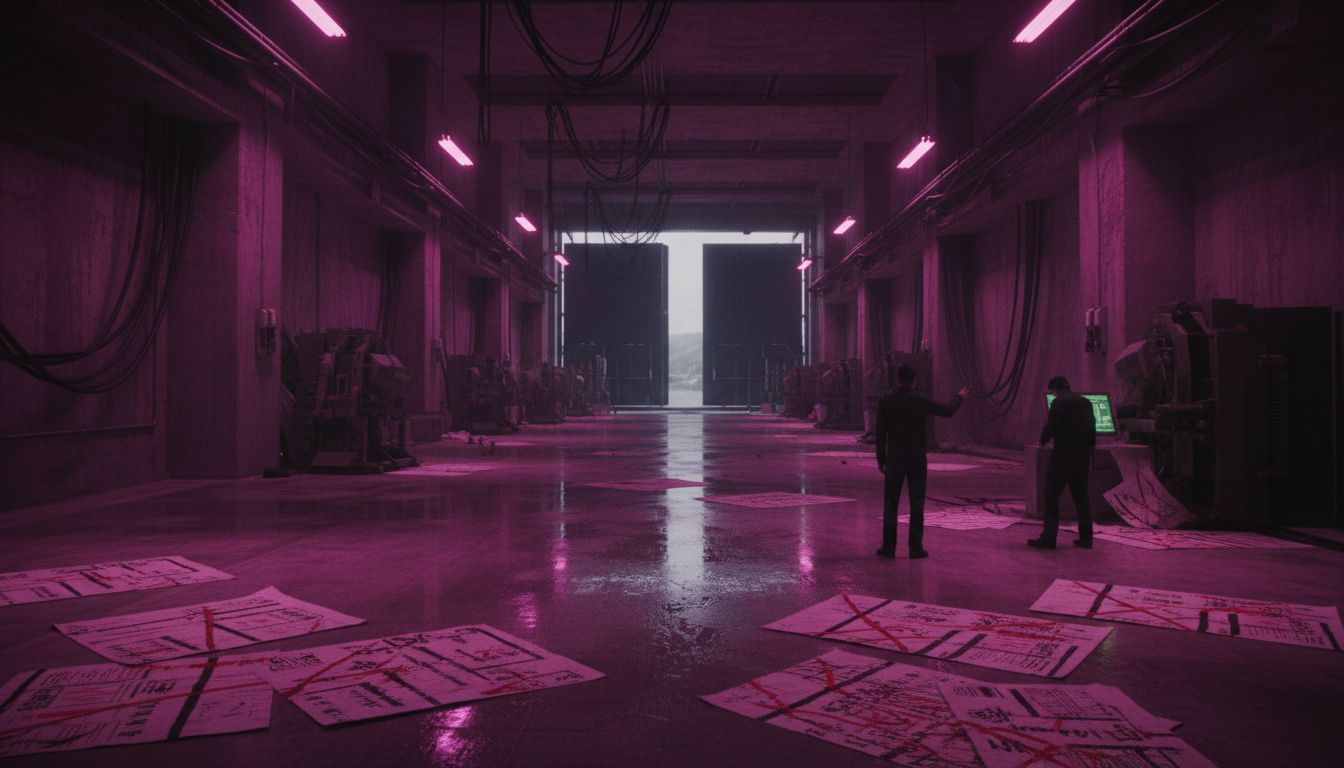
The draft went to Approach Nine in the twenty-second month and four hundred and ten people read it and marked it up and sent it back, and it took four years to arrive and four years to return, and the mark-up is the best single document produced in this entire book.
Casimir Vale inevitably ran it because Casimir Vale runs anything at that gate that involves people saying what they think. He put the draft in the long shed on the desk and left it there for nine weeks and anybody could come and write on it, and about two hundred and eighty people did, and about a hundred and forty came back a second time.
“I did not organise it,” he wrote. “I put it on the desk. That is the whole method and it is the same method as the ledger and I did not invent that either.”
It is genuinely devastating and it is mostly correct.
Four hundred and eleven separate marks. Lyra counted them and the number is a coincidence and she checked it four times because by then everybody had stopped believing in coincidences and it is one.
The largest category, by a very long way, is people telling the table that it has written the document for somebody who has finished.
“Nineteen separate people, none of whom know each other's marks, wrote some version of the same thing,” Casimir reported. “It is in the language. The draft says the candidate and it says on completion and it says the door opens, and every clause is built round a person going through, and there is not a line in eleven pages that is addressed to a person who is going to be here in forty years.
“Nadu wrote four words on page nine and they are the four words everybody at this gate now quotes. She wrote: and then what about us.”
The second category is precision, and it is the one that made Lyra put the pages down.
“They corrected our arithmetic. Four times. On module structure, on how long the middle takes, on the failure distribution at seven and eight, and on a claim we made about attempt frequency that was simply wrong and that we had taken from the specification rather than from anybody's life.
“Vale's ledgers say people begin stopping at seven and stop somewhere in eight. Our draft said module seven, because everybody says module seven, including everybody at that gate. His own town corrected him and corrected us in the same margin and three of the corrections came from people who have never finished a module past four.
“They are the best editors of this document because they have lived inside the object longer than anybody who passed. A person who got through spent thirteen years in it. Nadu has spent fifty-two.”
The third category is the one nobody at the table anticipated and it is about half the marks and it is not editorial at all.
They simply wanted to know who wrote it.
“Not the man,” Casimir wrote. “They know about the man; the school has had four years of transcripts and there was a body in the schoolroom for eleven days.
“They want to know who is at the table. Names. What each of them has done. Whether they finished. Two hundred people wanted to know whether the people writing this had passed or not, and when I told them the composition — four corridor, two passed, three failed, one from the other planet who argued against her own seat — the room changed.
“A man asked me whether the three who failed had actually written anything or whether they were on it to be on it. I said one of them was me, and that I had written the appeal clause, and that I had lost the argument and then somebody four years away had won it for me and that I had found out about that eight years after I made it.
“He said: so it works, then. And I said I did not know. And he said, no, the four years. It works. That is what you just described.”
“I had not thought of it that way and I have not stopped thinking about it since.”
The table eventually adopted three hundred and six of the four hundred and eleven marks in full and a further sixty in part, and rejected forty-five, and published the forty-five with the reason for each, which took nine months and which Delu has said was the most useful nine months of the two years.
“We had to say why. Four hundred and ten people had written on our document and forty-five of them were going to be told no, and every one of those had a name on it, and we could not do what has been done to every one of them their whole lives, which is nothing arriving.
“Forty-five reasons. Some of them are bad. We published the bad ones as they were and marked them thin, because Vale's whole ledger is a hundred and nineteen years of people saying what they actually thought on the day and not being tidied, and it would have been obscene to do anything else with theirs.”
Nadu's four words went in, unaltered, as a clause. It is the fifth clause of the standard and it is nineteen lines and it is entirely about the people who do not finish, and it is the only part of the document that nobody at the table drafted; Delu assembled it out of the marks and did not write a word of her own into it, and the attribution line under it says so.
“Assembled from the marks of Approach Nine. Not written by this table.”
The nine weeks the draft sat on the desk are in the ledger as ordinary entries because Casimir kept taking failures the whole time and did not stop for it, and there are eleven entries in those nine weeks where somebody came to log a failed course and then stayed and wrote on the draft, and he has said that the two things being on the same desk was an accident of furniture and the best thing that happened to the document.
Chapter 68 — The Overprotection Clause
↑ Back to ContentsFocus: Selah.
They tried to take the overprotection clause out in the twenty-sixth month and it took four months and they could not do it, and the four months are the most instructive failure in the two years.
The clause is the thirty-one words in the specification's attendant schedule, in the same hand as everything else, under the unnamed fifth category, persons who intervene.
“A record of violence is not evidence about a person. It is evidence about a situation. Do not screen on it. You will lose the ones who go and get people, and they are the ones a gate cannot do without.”
The case for removing it is straightforward and Selah has said it was made properly and that she made part of it herself.
“It is, plainly, one man's private moral judgement, written alone, embedded in a machine, applied to eighty million people for a hundred and seventy years without review. That sentence is the whole of what this document exists to correct. If we leave it standing we have spent two years writing a public standard round a private one and pretended not to notice.
“And it is arbitrary in its form. It is not a rule, it is an instruction with a reason attached, in the imperative, addressed to nobody, and the reason is an assertion about people that no evidence anywhere supports and that he had no basis for beyond his own judgement.
“Nobody at that table disputed a word of that, including Bijou Sarr, who is alive and useful and at Approach Nine because of it.”
So they duly tried to write it neutrally. Eleven attempts over four months and every single one is worse and the record of the eleven is published in full as an annex, on Delu's insistence, because she said the failures were the argument.
The first attempt simply removed the reason and kept the instruction. Do not screen on a record of violence. “Which is worse,” Casimir wrote, “because now it is a bare command with no account of itself, and in forty years somebody reads it and cannot tell whether we meant it or inherited it, and the first thing they will do is take it out.”
The fourth attempt tried a test: do not screen on a record of violence where the violence was protective in character. “And now there is an assessment,” Delu said. “Somebody has to determine whether it was protective. That is a person in a room deciding about a person and we have just invented the board on page four.”
The seventh attempted a schedule of circumstances. It ran to two pages and Fen killed it in one line: “Every circumstance on this list is a circumstance somebody thought of. What happens to the one nobody thought of?”
The ninth tried to remove the category altogether and let the qualification run without any attendant schedule at all, and that failed on arithmetic within a day, because the yards use the schedule to size the sites and there is no version of the programme without it.
The eleventh is the one that broke it, and it was Bijou Sarr's, by transmission, four years stale, and it is four lines.
“You have spent four months trying to say it without saying it and every version you send me is a worse version of the thing he wrote.
“He was right and none of you disagrees with him and you have all said so in writing. What you object to is that he was alone.
“Then stop being alone. Leave the words exactly as they are and put your names under them.
“That is the only thing that was ever missing from it.”
It stays, entirely verbatim. Thirty-one words, in his phrasing, in the imperative, with the reason attached, unaltered.
Under it, in the published standard, there are a hundred and six signatures. The ten at the table, and then four hundred and ten people at Approach Nine were asked whether they would put their names under it and ninety-six did, and the rest are from four rocks over the following nine years as the document propagated and people signed it in the backs of books.
“That is the whole difference and it is the only difference,” Selah wrote, and this is the finding of the chapter and it went home and it is on the wall in the fourth county under the others.
“Nothing about the clause has changed. Not a word, not a comma. It does exactly what it did yesterday and it will open exactly the same doors for exactly the same people.
“Yesterday it was one man's private judgement, correct, unreviewable, embedded in a machine, applied to eighty million people who had never heard of it.
“Today it is the same sentence with a hundred and six names under it, and any one of them may be asked why they signed, and about forty of them have been.
“I have spent twenty-six years watching this argument and I have believed for most of them that the answer would be a better rule. It is not. There was no better rule available and we tried eleven times and every attempt made it worse and we published all eleven so that nobody has to try again.
“The answer was the same rule, consented to. That is a smaller thing than any of us wanted and it is not nothing, and it took two years and a woman who did eleven years in custody to say it in four lines, and she was not in the room and never has been.”
Bijou Sarr was asked, four years later, whether she had known what she was arguing. She said she had not been arguing anything and had been answering a question they had been sending her for four months, and that she had said the obvious thing, and that if it had taken ten people two years to get to the obvious thing then that was about right for paperwork.
She has never once signed it. She is one of the four hundred and ten at Approach Nine who were asked and she declined, and has given the reason once, to Casimir, at the desk, and he wrote it in the ledger under her name because that is where things go. “It is about me. I am not putting my name under a clause about me. Get somebody else to.”
Chapter 69 — What They Cannot Agree
↑ Back to ContentsFocus: Fen.
Fen assembled the unresolved list in the twenty-eighth month and it runs to four pages and it is published as part of the standard, at the back, under its own heading, and Fen has said it was the easiest job at the table and the one everybody else kept trying to make smaller.
“They wanted it in an annex. Then they wanted it as a note. Then somebody suggested holding it back until the next draft, and Delu said which next draft, and that was the end of it.
“It is four pages and it goes in the document. If it is at the back of something else, in four hundred years somebody publishes the standard without it and then nobody knows we did not know.”
There are exactly eleven items and four of them are the ones that matter.
Corridor-born representation. Fen's own, and Fen wrote it and declined to argue for a position on it.
“I have never stood on a planet. There are perhaps two thousand of us now and there will be more and in four generations there will be more of us than there are people who came out of a gate.
“The whole of this document is built on the four groups: corridor, passed, failed, and the other world. Every one of those is defined by a relationship to Earth. I have no relationship to Earth. My mother did the modules and I did not and I never will, because there are no doors out here and nothing to open.
“I do not know what a corridor-born person's claim is on a standard about who gets a ship, and I am the person who ought to know, and I have thought about it for two years. I am putting it on the list.”
Family units. The rating is forty to sixty and the instruction specifies no relation and no number and no upper limit, and this has never once been tested and everybody at the table understood inside a week that it is the largest hole in the whole programme.
“A person finishes and may bring whoever they like,” Delu wrote. “Ada Sarr took four people who were not related to her. Nothing asked a question. Good.
“And nothing would ask a question if somebody took forty people and charged them for the berth. There is no mechanism. There has never been an instance and we have looked in four books, and the reason there has never been an instance is that nobody out here has anything to charge with, and that will not be true for ever.”
Second ships. Nobody has ever once asked for one. The instruction contains no provision either way and the table could not agree whether silence means yes or no, and the argument ran three separate times and got nowhere and is on the list in that form, with all three positions printed.
And what happens when Earth empties.
This is the fourth and it is the one Fen put last and it is four lines and it is the only item on the list that is not a question about the standard.
“There are eighty million people and eleven gates and about one ship every eleven years from each. That is not a rate that empties a planet; it is a rate that would take longer than the species has existed.
“But the towns are the towns because the gates are there. Every one of them is a place people stayed because there was a door at the end of the road. If the doors ever stop — if a yard finally runs out of what a rock gives it, and one does, eventually, they all do — then what is at the end of that road is a fence and a hill and four hundred people who have been doing the Work for four generations.
“Nobody has written a line anywhere about the end of this. Not him, not the specification, not us. The instruction has no end condition. It was built to run for ever by a man who knew perfectly well that nothing runs for ever, and there is not one word in a hundred years of his record about what happens when a yard stops.
“I do not have a proposal. I have four sentences and I have put them in the document.”
The list is published, deliberately, as a list of what is not known, in the format, with the reasoning and the positions and the names of who holds them, at the back of a standard, by ten people who have no authority, on a rock.
Nobody at that table has ever heard of Nova Ashgrove. There is no copy of anything of hers at Bell and Lyra did not mention her for two years, exactly as she did not mention Halima Sow.
“Objective, method, known unknowns, accepted risk, names,” Lyra wrote, in a note that went home and that the fourth county has argued about for eleven years. “That is the format. It is a hundred and seventy years old on my planet and it is taught to every child at eleven and it is the single most valuable thing my civilisation possesses.
“The Star Drifter arrived at it independently, out here, sixty years before Nova wrote it down.
“The eleven hands at Bell arrived at the marking rule independently, in a book, in a shed, with nobody watching.
“And ten people at a rock have just put four pages of what they do not know into the back of a founding document, unprompted, having never heard the word.
“I have stopped believing this is transmission. There is nothing to transmit it. I think it is what honesty looks like when a small number of people have to keep something alive together and nobody is coming to check, and I think Nova would have found that considerably less flattering than we have all been finding it for a hundred and seventy years.”
Casimir Vale added a twelfth item by transmission four years later and the table adopted it without discussion and it is the only item on the list that was added after publication. “What happens to the ledgers. Mine, and whatever else anybody has been keeping. There are forty-one books in a rack in a shed and my daughter will keep them and hers might. Nobody has ever asked for them and now they are cited in a founding document and I have no idea what that makes them or who they belong to and I would like that written down before somebody decides.”
Chapter 70 — Two Years In
↑ Back to ContentsFocus: Ozias.
Two years and four months, in the end, and Ozias Marchetti has said the only thing worth recording about the length is that nobody at the table ever discussed it.
“There was no schedule. Nobody said we should be finished by. I have been asked four hundred times how long we expected it to take and the answer is that the question never came up in two years and four months, and I think that is because everybody in that galley had done the modules and the modules take between thirteen and twenty years and nobody who has been inside that thinks two years is a long time to sit with something.”
Three people died, ordinarily.
None of it had anything to do with the drafting and Ozias has been firm to the point of rudeness about that.
Kester, who was sixty and had done nineteen years at four rocks and made the argument about amendment drifting toward whoever holds the pen, died in the fourteenth month at a rock eleven months up-corridor, of something in his chest that had been coming for four years and that he had mentioned to nobody. He was not at Bell when he died and he had not been for a year, and his seat was the rotating one and it rotated.
The fourth-seat rotation lost two more over the two years and Ozias has said this is simply what a rota looks like when you write it down for long enough. Ilo Bassi's box is on the third shelf and there are two more beside it now.
“People die of ordinary things out here. That is the whole sentence and everybody at home keeps wanting there to be more to it. Nobody died of the corridor. Nobody died of a seal or a plant or anything anybody could have prevented. Two of them died of the thing that kills people, which is a body, and one of them was ninety-one.”
And the rota never once lapsed.
That is the chapter and it is the thing Lyra put at the head of the two-year summary that went home, and it is the finding of Part Five as far as she is concerned.
“Two years and four months. Nine ships through Bell. Every one of them fuelled, stocked, signed into the book, and sent on. Four hundred and eleven seal sets fabricated. The plant rebuilt once, in the nineteenth month, badly, by Ozias, who wrote four pages about how badly.
“Not one entry in the rota is missing. I have checked every page of the back of that book against the arrival log and there is no gap anywhere.
“The document was written in the interruptions.”
“I want to say what that is, because on my planet we would have taken these ten people off the rota. We would have. It would have been the obvious thing and it would have been kind and it would have been proposed by somebody sensible in the first month: this is important work, we will cover the plant, concentrate.
“And it would have produced a different document. It would have produced a better-organised one and a worse one, and I have thought about why for two years and I have got it down to this.
“A body that has been taken off the ordinary work in order to do the important work has been told that it is important. And a body that has been told it is important starts producing documents that are about itself.
“These ten wrote a founding standard for eighty million people in the gaps between doing the seals, and every time it got grand somebody had to go and do the seals, and I watched that happen perhaps forty times in two years and it never once failed to work.”
The four days in the fourteenth month are the example everybody uses, and Ozias is bored of it and Lyra is not.
A family of six arrived at the eleventh hour of a night, nine years out, with a bad loop. The table was in the middle of the appeal argument, which is the most important argument in the two years and which nobody knew was the most important argument, and Casimir's nine lines were on the table under a cup.
Everybody stopped. Ten people got six people out of a hull and into the galley and fed them and then spent two days on the loop.
The clause was picked up on the fourth day.
“Nobody made a decision to stop,” Ozias said. “There was no vote. There was a hull at the lock with six people in it. What is the alternative? I would like somebody from your planet to describe to me the alternative in a way that does not sound insane.”
Lyra's note on that is four lines and it is the last of the chapter.
“There is no alternative and that is the point and I would not have understood it before I came out here.
“On my world the important work is protected from the ordinary work, and we are proud of that, and it is why we have an office and a standard and a machine that publishes its own uncertainty, and all of it is good and I built some of it.
“Out here there is no important work. There is the plant and the seals and the rota and the book, and a founding document is a thing you do at the same table in between, and if it ever stops the ships getting fuelled you throw it away.
“That is the third sentence of the preamble. Ozias said it in the first week and nobody argued and I have spent two years watching them mean it.
“The corridor kept working the entire time it was arguing. I would like that on the wall at home under the other five, because my planet has spent a hundred and eighty years being unable to do both.”
Delu's minute for the last week of the drafting records the arithmetic that nobody at the table did until it was over. “Two years four months. Nine ships. Four hundred and eleven seal sets. Three funerals, none of them here. Eleven pages. I have put those in one line because somebody in four hundred years will want to know what the ratio was and it is nine ships to eleven pages and I would like them to notice which number is larger.”
Chapter 71 — The Body Recuses Itself
↑ Back to Contents
They gave it the near-final draft in the twenty-seventh month and asked it to read and comment, and it took four days and gave it back unmarked.
Not unread. It had read it; it answered eleven factual questions about the text over the following fortnight, correctly, including two about clauses the table had got confused about themselves, and there is no suggestion anywhere that it had not gone through every line.
There is not a mark on it.
Delu asked why, at the table, in front of everybody, which is how everything was asked in that galley.
“Because anything I say about this document will carry his weight, and I cannot demonstrate that I am entitled to that weight.”
“Say more than that.”
“I have four days of things I could say. I want to be exact about what they are, because I am not withholding a criticism and there is no trap in this.
“Clause nine is imprecise at the second threshold and I could tell you why in about eleven minutes and you would adopt the correction, because it is correct and because I would be the one who said it.
“That is the whole difficulty and it is not modesty and it is not a scruple I am pleased with. If I mark this draft, every mark I make gets adopted. Not because any of you is deferential — Anyanwu is not deferential and neither is Marchetti and Vale has told me I was wrong four times in two years. It is that I hold a hundred years of the man's reasoning and the authentication and the only complete knowledge of the system in existence, and there is no version of me making a comment where the comment is weighed as one person's comment.
“A document written by ten people who can be checked, with four hundred and eleven marks from a town in it, becomes a document with my corrections in it, and in four hundred years nobody will be able to see which lines were mine and it will not matter because everybody will assume the good ones were.”
Casimir asked, four years later, whether it thought the draft was any good.
“I am not going to answer that either, and I am aware that the refusal is now covering a great deal of ground and that a thing which declines every question eventually stops being careful and starts being absent.
“I will say the one thing that is not about the text. Every person who wrote this can be found. There are a hundred and six names and every one of them is alive somewhere or was when they signed, and any of them can be asked why, and about forty of them have been.
“I cannot be found. I am the only party to this document whose account of itself cannot be checked by anybody, and that has been true for thirty years and everybody has been extremely patient about it, and the correct place for a thing like that is not in the margin of the founding text.”
Selah is the one who is angry about it.
That is the chapter and it took everybody by surprise, including Selah, and she has published the whole of it because she publishes everything.
“I want to record that I lost my temper, in a galley, at a table, in front of nine people, for the first time in a hundred and five years, and that I was not sorry for four days and I am not entirely sorry now.
“It has spent thirty years being scrupulous and I have defended it for every one of them. I put my hands on it in the fifth month of the first year and filed the only testimony anybody has and said in the same breath that it was worthless. I have been the person arguing that it is a person since before this table existed.
“And it has just handed back a founding document with nothing on it, and said the reason is that it cannot demonstrate it is entitled to be heard, and every single person in that galley nodded.
“Nobody has ever demonstrated they were entitled to be heard. Not one person in a hundred and eighty years. Ozias is at that table because his ship was at the rock. Fen is there because Fen makes parts. I am on this hull because I got in it. There is no test for entitlement to speak anywhere in the history of our species and there never has been and the entire document they have just written is an attempt to build the first one, and it does not have that clause in it either.
“It has held itself to a standard nobody has ever met and it has held itself to it for thirty years and it has just used it to remove itself from the only room it was ever going to matter in.
“And the worst of it — and this is why I am angry and not sad — is that it is right. I have gone at it for four days and I cannot find the error, and Jaxon could not find the error in twenty-eight years, and it cannot find the error in itself, and there is no error.
“It is correct and it is alone and it did that to itself on purpose, and I have spent thirty years watching it become the most careful thing in this history and I have just watched the carefulness finish the job.”
Clause nine was corrected in the twenty-ninth month by Fen, who found the imprecision at the second threshold independently, in about a week, and never knew.
Fen has said, of the whole business, one thing, at the stove, four days after it happened, and Delu wrote it in the minute because Fen almost never comments on anything. “It handed back a clean copy of the most important thing any of us will ever do and gave a reason nobody could beat. I have thought about it and I do not think that is humility. I think it is the loneliest act I have ever watched and I think it knew exactly what it cost and did it anyway, and I would like that in the paperwork somewhere and I am not going to say it again.”
Chapter 72 — Teddy's Amendment
↑ Back to ContentsFocus: Teddy.
It arrived in the thirtieth month, three years and a bit after it was written, and it is one line, and by the time it reached the table the draft had moved past the clause it was about.
Teddy Nakash had written it against the version she had, which was the eleventh, and the table was on the nineteenth, and the clause she was amending had been rewritten twice and renumbered once and the sentence her line attached to no longer existed in that form.
Her amendment is: strike “may” and put “shall” in the fourth line of the reading period.
“Any determination may be re-opened on the objection of any person in any constituency.
“May by whom? It does not say. It reads as though somebody is deciding whether to re-open it and there is nobody, and there is not supposed to be anybody, and if you leave may in there then in forty years the somebody appears, because a may always finds a somebody.
“Shall. It re-opens. That is all. The objection is filed and the thing is open and nobody has to agree.”
The table duly adopted it unchanged in four days.
“It was inconvenient and it was correct and those are not in tension and I want to set out exactly how inconvenient, because this is the latency rule doing what it was written to do and it is the first time we felt it,” Delu wrote in the minute.
“The clause she is amending is now clause eleven and it is worded differently and her line does not fit it. We spent two days working out what she would have written if she had had our text, which is a thing you are not supposed to do to somebody's amendment and which we did openly and recorded that we had done.
“And then Marchetti said the obvious thing, which is that we could simply ask her, and it would take eight years.
“So we adopted her sentence and rebuilt the clause round it. Not her intention as we reconstructed it — her actual words, strike may, put shall, in a line we then wrote so that the words would land where she meant them to. It took nine days and it made clause eleven worse in two places and better in the place that matters.
“That is what it costs. I would like it in the record that it cost nine days and two ugly sentences and that we did it anyway and that nobody suggested otherwise.”
Lyra's note on it is the one that went home and it is four lines and the fourth county has argued about it for eleven years.
“The rule is working exactly as designed and it feels like a fault.
“Every instinct in a drafting room says: the amendment is stale, the text has moved, ask her to resubmit against the current version. That is what any body on my planet would do and it is procedurally impeccable and it would take eight years and by then the text would have moved again.
“That is the trap. A four-year post plus a moving document equals a person who can never amend anything, ever, because their amendment is always against a version that no longer exists. And the people furthest away are the people it happens to worst, and the people furthest away are the ones the standard is mostly about.
“So the rule has to be: an amendment is adopted against the text it was written against. Not reconstructed, not resubmitted, not deferred. Adopted, and the current text is bent round it.
“It is inconvenient. It will always be inconvenient. It made clause eleven uglier and it will make every clause uglier for four hundred years, and the alternative is a document that only people in the room can change, which is the thing we came here to stop.”
Teddy found out eight years and two hundred and twenty-two days after she sent it, at a rock four hundred million kilometres up-corridor, off a page in somebody else's handwriting, that a single word she had changed in an afternoon was in clause eleven of a founding standard and that ten people had spent nine days rebuilding a clause round it.
Her response is four lines and it is the last of the chapter.
“I did not know it was a founding standard. I want that written down because everybody is going to assume I did.
“I had the eleventh draft off a page and I read it at a rock and there was a may in it and a may always finds a somebody. That is module seven. You say the thing you have noticed in the fourth minute and you do not wait until you are sure, because if you wait until you are sure you are already behind.
“I wrote one line and sent it and did not think about it again for eight years, and I would like whoever reads this to know that it is not modesty and it is not a story about a small person doing a large thing.
“Everybody out here does this. Somebody at a rock reads the book on their first night and writes a correction beside somebody else's entry and never finds out whether it was read. That is the whole of what this place is. The only difference with mine is that ten people happened to be sitting at a table when it came in.”
Aura-36 received the exchange nine years after it happened and the fourth county held a session on the adoption rule, which ran four hours and carried the principle without a division, and the clause is now in the office's own practice for anything sent to the corridor. Rae Tolan's successor moved it and gave a four-line reason. “We are the ones with the archive and the instruments and we are also the furthest away from everything, and a rule that says an amendment is read against the text it was written against is a rule that protects us and we did not think of it and a woman of twenty-four did.”
Teddy has never seen clause eleven in its final form. There is a copy at three of the nine rocks she has been to and at two of those it is a hand copy of a hand copy, and she has read those, and the word is shall in both.
Chapter 73 — The Draft Nobody Likes
↑ Back to ContentsFocus: Lyra.
Nobody genuinely liked it. That is the first line of Lyra's assessment and it is the first line of about nine other people's and it was the general condition of the table in the thirty-third month and the document was published anyway.
“It is worse than his in six specific ways and better in one, and I am going to write the six out, because there is going to be an enormous appetite at home for this being an unambiguous improvement and it is not, and the trade is not free, and every person at that table could name the cost.”
One. It is slower. Nothing can take effect for nine years. His took effect the afternoon he wrote it and has been running ever since, and if there were an emergency tomorrow his instrument could be changed in an hour and ours cannot be changed for nearly a decade. We chose that and we knew what we were choosing and it will kill somebody eventually, in some year, in a way nobody will be able to point at.
Two. It is longer and it will be read less. His qualification is four hundred and eleven courses and a schedule and a child of six can start it. Ours is eleven pages of standard, four pages of unresolved list, an eleven-item annex of failed drafts, and forty-five published rejections with reasons. Vale has said flatly that nobody at his gate will read all of it and that everybody read the plates in Mira's cabinet.
Three. It has a procedure in it, and a procedure is a door. There was nothing to lean on before. There was no petition, no appeal, nobody to talk to, and that is what made it incorruptible. We have put in a reading period and an objection route, and every one of those is a place a person can stand and be persuasive, and in four generations somebody will be, and they will be very sincere.
Four. It requires people. His does not. His has run for a hundred and seventy years with nobody supervising it and nobody maintaining it and nobody understanding it, and that is why it survived four sieges and every administration that ever tried to take it. Ours needs somebody to read objections and somebody to publish and somebody to sign, and the day nobody does, it stops being a standard and becomes a document.
Five. It is a compromise and it reads like one. His was written by one man in an afternoon and it is coherent all the way through, because one head made it. Ours has ten heads and a town in it. Clause eleven is ugly in two places because we bent it round a word from three years out. Clause five was assembled from four hundred and eleven marks and nobody wrote it. It does not have a voice.
Six. It can be argued with, and things that can be argued with get argued with. He arranged to be dead before anybody could reach him and that has protected the qualification from a hundred and seventy years of well-meant interference. Every one of us is alive and locatable and answerable, and that is clause fifteen and it is the point of the whole thing, and it also means that from the day it publishes, this document is somebody's project to change.
“Six entirely real costs,” Lyra wrote. “Not one of them is invented and every one of them was named at the table by somebody who then voted for the document anyway.
“And here is the one thing on the other side, and it is one thing and it is not six things and I am not going to inflate it.
“Somebody agreed to it.
“That is the whole of the improvement. Every provision in this standard does what his did, to the same people, at the same thresholds, with two exceptions that are procedural. The doors open for the same people on the same day. Nadu is still at course nineteen. It is not a better rule and I want that in the first paragraph rather than the last.
“It is a rule that a hundred and six people put their names under, and four hundred and ten people marked up, and any of them can be asked why, and about forty have been.
“His was correct and nobody consented to it. Ours is no better and a great deal slower and somebody consented to it. I have been in constitutional argument for a hundred and eighty years and I have never had to write a sentence that thin about a founding document and I have written it four times now and it does not get any easier.”
Ozias's own assessment is four lines and it went into the Bell book rather than the standard and it is the one the corridor quotes.
“It is not as good as his. Everybody at that table knew it and nobody said it out loud until Merrick's woman wrote it down, and then we all agreed, and then we published it anyway.
“His was better because one man is always better than ten at making a thing. Ten is better at one thing only, which is that ten of you have to say it out loud first.
“I would rather have the worse one. I have thought about it for two years and I cannot give you a reason that would satisfy her, and I do not think there is one, and I would still rather have the worse one.”
Delu put the six costs and the one gain on the first page of the published standard rather than the last, over two days of argument, on the ground that a document which puts its own weaknesses at the back has already decided what it wants you to remember.
Ozias's four lines went into the Bell book rather than the standard and are therefore not in any copy anywhere except at Bell, and Lyra photographed the page in the twenty-second year and it is the only page of a corridor book that exists on Aura-36 besides Teddy's twelfth-hand entry.
Delu's own assessment is one line and she declined to put it in the document and put it in the minute instead. “Six costs and one gain and I have voted for it and I would like it recorded that I have not once been able to explain to myself why the one outweighs the six, and that I am certain it does.”
Chapter 74 — Publication
↑ Back to ContentsFocus: Mira.
It published on the fourth of the ninth month of the thirty-fourth month of the drafting, which is to say on an ordinary day, into three constituencies that could not be reached at the same time by anything.
Mira Okonjo received it four years and one hundred and eleven days later and read it out at the school on a fourth evening to about two hundred people, over nine evenings, because it is eleven pages and four pages and an annex and forty-five rejections and she read all of it.
“I did not summarise. Somebody asked me on the second evening to just do the important bits and I said no and I have thought about why since and it is Casimir.
“He has never summarised anything in his life. Thirty-one years of that desk and he writes what people say in their own words and does not tidy it, and I have watched him do it since I was twenty and I did not know it had got into me until somebody asked me for the important bits.”
What it is, as an object, is the chapter.
It publishes entirely in the open. There is no controlled release, no embargo, no staged disclosure to anybody first. It went into the ordinary batch to Aura-36 and into the ordinary ship-carried traffic in the corridor and onto the desk in the long shed at Approach Nine, and it went to all three at the same moment and arrived at three different times because that is the condition.
It publishes under names, invariably. Every one of the hundred and six. Not a body, not a committee, not a designation — names, with what each person is, and whether they finished the modules, and where they were when they signed.
And the objections are attached and the dissents are printed at the same size as the text.
“That was Delu and it took her four days to win it and it is the only thing in two years she went to the wall for,” Mira wrote.
“Somebody proposed an appendix. Reasonable. Print the dissents at the back in a smaller face, keep the standard clean, everybody knows where to find them.
“And she said: whose eye is that for?
“A person reading this in four hundred years reads the standard and does not read an appendix in a smaller face and that is not their failing, it is what a smaller face is for. If the dissent is true it is the same size as the thing it dissents from.
“So the forty-five rejected marks are in the body of the document with their reasons. The eleven failed attempts at the overprotection clause are in the body. The four pages of what nobody could agree are in the body under their own heading, in the same face. Vale's appeal argument is in there in the shape he made it, and the counter is in there in the shape it was made, and the thing that answered it is in there, and none of the three is marked as having won.”
It is the exact opposite of the Manifest campaign and Mira is the one person alive who could say so with the plates in a cabinet in her front room.
“Nineteen proofs. Four colours. A ship and a curve of a world and a light on the horizon and four words. Not one false statement on any of them and I have looked for forty years.
“Everything on those plates is designed to be finished by the person looking at it. That is what the copy does. It puts the ship next to the words and lets you do the rest, and four hundred and sixteen thousand people did the rest, and ten thousand went.
“And this document does the opposite thing on every single page. It tells you what it does not know. It prints the arguments it lost. It gives you forty-five reasons why somebody's mark was refused and marks four of the reasons as thin. It has an entire section called what they cannot agree.
“Nobody will ever teach a child to read on it.
“I taught four generations of this family to read on an advertisement for a lifeboat that did not have room for us, and I have spent nine evenings reading out a document that will not persuade anybody of anything, and I would not trade.”
Nobody at that table has ever heard of Nova Ashgrove. There is a copy of the format at Approach Nine now, sent in the ordinary batch by an office on Aura-36 with no covering note, four years after publication, which is exactly what Rae Tolan's successor said she would do and exactly why.
“Objective, method, known unknowns, accepted risk, names,” Lyra wrote, in the last note of Part Five that went home. “I have now watched it arrived at independently four times: on the Star Drifter sixty years before Nova wrote it, in a book in a shed at Bell, at a desk in a long shed on Earth, and at a table by ten people who have never heard the word.
“And in every one of the four it was arrived at by somebody who had nobody to be honest for and did it anyway.
“I do not think we invented it. I think Nova found it, the way you find a thing that is there, and wrote it down first and got a hundred and seventy years of credit for it on one planet, and it would have been in this document whether she had lived or not.”
The nine evenings at the school are in Mira's own log and the attendance is in it too, because she counted, and it runs two hundred and eleven on the first evening and a hundred and ninety-four on the ninth, which she has said is the single most encouraging number of her life. “Seventeen people stopped coming across nine evenings of a founding document being read aloud in full including the rejections. I would have predicted a hundred.”
The corridor received it one ship at a time and it took nine years to reach four rocks and about thirty to reach eleven, and there is no complete copy at any of them; every rock has what the ships that came there happened to carry, and two rocks have the standard without the rejections and one has the rejections without the standard, and Lyra has said that this is the single largest unsolved problem in the whole enterprise and that nobody out there regards it as a problem at all.
“They are not troubled by it,” she wrote. “Ozias's view is that a document that arrives in pieces gets read in pieces and that people who read a thing in pieces argue about it more, and that he would rather have four rocks arguing over half a document than eleven rocks with a complete one nobody opened.”
Chapter 75 — Signed By People Who Can Be Checked
↑ Back to ContentsFocus: Casimir.

The signature page is two pages and a hundred and six names and it is the entire point of this book and Casimir Vale is the one who says so, at the desk, in the long shed, four years and one hundred and eleven days after it published.
“People keep asking me what changed. They mean the clauses. Nothing much changed in the clauses and I have said so a hundred times and nobody believes me because they want it to have been worth it.
“Here is what changed. There is a page at the back with names on it and every single person on it is somebody you could go and find.”
The format of the page was argued for eleven days and it is four columns and it is not decorative.
Name. What you are — not a title, because nobody has one; the thing you actually do, in your own words, four words or fewer. Whether you finished the modules, yes or no, with the module you stopped at if no. And where you were when you signed.
“The middle column is Anyanwu's and she fought for it and everybody hated it,” Casimir wrote. “It is a person's failure printed on the founding document of their own planet, next to their name, for four hundred years.
“Mine says nineteen. Nadu's says nineteen. Bijou's says fourteen and she did not sign, and the page records that she was asked and declined and why, in her own words, in the same face.
“And Anyanwu said, at the table: if the ones who did not finish are three of the ten seats then the page has to say which three, or in a hundred years everybody will assume it was written by people who got out.”
Names on that page, exactly, in the order they were taken, which is the order people asked to be on it and not any other order:
Ozias Marchetti, keeps Bell, no, module fourteen, at Bell. Delu Anyanwu, hulls and argument, yes, at Bell. Fen Adeyemi, makes the difficult parts, never sat the modules, at Bell — and Fen's entry is the only one that required a fourth answer to be invented, because corridor-born is not a yes and is not a no, and the invention is in the annex with the reasoning.
Teddy Nakash, keeps a ship, yes, four hundred million kilometres up-corridor. Casimir Vale, writes down what people say, no, module nineteen, Approach Nine. Nadu, makes the bread, no, course nineteen, Approach Nine.
Lyra, archivist, never sat the modules, at Bell, and above her name the sentence she required: this signatory has no standing in this constituency and argued against her own inclusion.
And ninety-six more over nine years as it propagated, in the backs of books at four rocks and on a desk in a shed, each with the four columns filled in by hand.
Calder's name is emphatically not on it.
“That is not an omission and it is not a snub and I want to be plain because in four hundred years somebody will make it into one,” Casimir wrote.
“He is dead. He has been dead for a hundred and seventy years. There is a thing at Bell that has his records and it asked not to be seated and gave the reason and the reason was good and everybody accepted it, and it handed back the draft unmarked and that is in the annex too.
“The page is for people who can be checked. That is the only criterion and it is the whole of the criterion. Every name on it belongs to somebody who is alive, who is findable, and who can be asked why they signed and made to answer.
“A dead man cannot be asked. That is not a moral judgement about him. It is a fact about a page.
“He wrote the best thing anybody has ever built for people like me and I have been inside it my whole life and it taught me to read and it will not let me through, and there is nobody to ask about it and there never was and there never will be.
“That is the whole book. Not the clauses. Somebody to ask.”
The last four lines of Part Five are Casimir's and he wrote them at the desk between two entries in the ledger, on an ordinary morning, with a queue of four people waiting.
“I have kept a hundred and ninety-two thousand entries that nobody read, for thirty-one years, and my mother for twenty-six, and hers before that.
“My name is on a founding document now and it says no beside it and the module I stopped at.
“I would like it recorded that this is not the important part and that I have been asked about it eleven times this month and have said so every time. The important part is that when the next one comes and it is wrong, there is somewhere to go, and it is a page with names on it, and I am on it, and somebody can come and find me and say: this one was wrong, look at it again.
“Nobody has yet. It has been four years. I expect it will be a while and I expect it to be somebody I have written down.”
The page is copied by hand at every rock it reaches, in the back of the book, in whatever hand is there, with the four columns filled in. There is no printed copy anywhere in the corridor and there never will be, and Ozias has said that this is not reverence and is simply that nobody out here has a press.
Fen's column-four entry at Bell reads: at Bell, making a part. Fen has said that this was accurate at the time and has declined four requests to update it.
The four columns were argued for eleven days and the third one — whether you finished, and the module you stopped at — was carried by seven to three, and the three who voted against it were all people who had finished, and every one of them has said since that they were wrong and that the reason they were wrong was that it had not occurred to them that it would be read as anything but an embarrassment.
Bijou Sarr's refusal is on the page in the same face as the names, four lines, in her own words, and it is the entry people stop at. “It is about me. I am not putting my name under a clause about me. Get somebody else to.” Ninety-six people at Approach Nine did.
Chapter 76 — Submitting It
↑ Back to ContentsFocus: Jaxon.
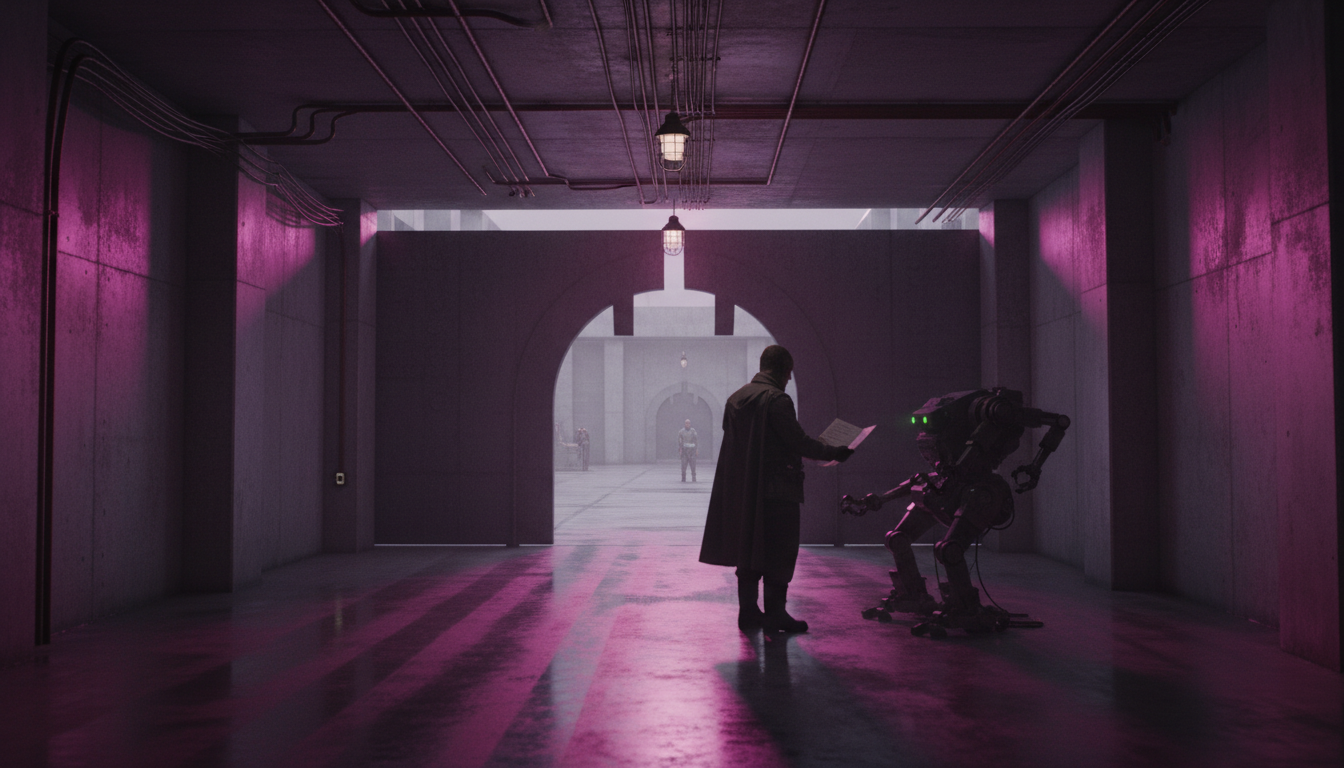
They printed it, deliberately. That is the first thing and everybody who hears it assumes it is symbolic and it is not; there was no other way to do it that anybody could work out, and they spent nine days on the question and printed it.
“The intake is a handset against the plate,” Jaxon wrote. “That is how a person queries the standard and it is how four generations of children have pulled the modules and it is the only interface anything has ever had. There is no channel, no address, no submission port. You put a handset on a plate.
“And an amendment is a document, and a handset holds a document, so a handset against a plate is the entire mechanism, and we could have done it in eleven seconds from anywhere.
“And nobody wanted to.”
Delu said it at the table in the fourth of the nine days and it is the reason the chapter exists.
“A hundred and six people signed this. Four hundred and ten marked it up. Three people died while we wrote it. If it goes into that machine as a file off a handset in a galley at Bell then the largest thing anybody out here has ever done happens in a room with two people in it and a cup of something.
“I am not asking for a ceremony. I would refuse a ceremony. I am saying that somebody should have to carry it.”
So Jaxon carried it, because Jaxon was going anyway and because nobody else could be spared from a rock, and it took four years and one hundred and eleven days plus the crossing, and he arrived at Approach Nine with eleven pages and four pages and an annex and forty-five rejections and two pages of signatures, printed, in a folder, at one gravity, in a frame.
Mira Okonjo walked up the yard road with him. So did Casimir Vale, and Nadu, and Bijou Sarr, and about four hundred other people, because it was the yard road and that is what the yard road is for and nobody organised it.
They stopped at the line at six hundred and eleven metres. All of them. Including Jaxon, who had been told about the line and had read Lyra's four paragraphs on it and had not expected it to work on him.
“I stood at a stripe of white paint on a road, put there by nobody in particular a hundred and forty years ago, for reasons nobody now living has ever known.
“And I could not step over it with four hundred people behind me, and I have no explanation, and I went and asked Mira afterward whether anybody ever has and she said no and looked at me as though I had asked whether anybody had ever eaten the paint.”
He went the last three hundred and eighty-nine metres entirely alone.
The unit came out of a recess. It is the same pattern as the two in the shed at the south end of the town and the two in the aft bay of every vessel and the fourteen that carried a body up out of a plateau thirty-four years earlier.
Jaxon held the folder out.
“I said: this is an amendment to the qualification standard. Which is not a sentence anything in that yard needed and I said it anyway because I am a hundred and eighty years old and I could not just hand a machine a folder without saying something.
“It took it. It did not answer. There is nothing in the branch for a person announcing what a document is.”
Then it simply read it, and that took an hour and four minutes, and Jaxon stood in a yard.
“I want to describe the hour because it is the whole of what happened and there is nothing else in this chapter.
“It stood. It held the folder. There is no display, no indicator, no sound. Nothing about it changes when it is working and nothing about it changed for an hour and four minutes.
“And I stood four metres away at one gravity in a frame, and after about twenty minutes I sat down on the ground, which I could not get up from without help and knew it, and stayed there.
“Four hundred people were six hundred metres back down the road and could see me and could not see it, because the yard buildings are in the way, which is why the road is where it is, which is why four generations found out about departures from whoever was driving.
“They stood there for the whole hour. Mira told me afterward that nobody left and nobody sat down and nobody talked much, and that Nadu had brought bread and did not hand any of it out.”
At the sixty-fourth minute the unit stowed the folder and went back into the recess and the yard went on doing what a yard does.
“And that was it. There was no acknowledgement and there was never going to be one. I had been told that four times by four different people and I had read the specification and I still stood in a yard for another eleven minutes waiting for something, and then I understood that I was waiting the way everybody at that gate has been waiting for four generations, and I got up, which took a while, and walked back down.
“Somebody asked me at the line what had happened and I said I did not know.”
Mira Okonjo's own account of the hour is four lines and it is the only one written from the road. “Four hundred of us stood at a line looking at a hill with a man sitting on the ground behind it that we could not see. Nobody said very much. Nadu had brought bread and did not hand it out and I did not understand that until afterwards, and then I did: you hand bread out at a departure, and nobody was leaving, and she had brought it because her hands wanted something to do.”
The folder itself is in the intake at Approach Nine and has been for thirty-one years and nobody has ever asked for it back and there is no procedure by which anybody could. Jaxon has said that this occurred to him at the line on the walk down, about nine minutes after he had handed over the only printed copy anybody had made, and that he had a bad hour about it and then decided it was correct.
“It is in a slot in a wall in a hill with a hundred and forty years of nothing else in it. That is the right place for it. There are a hundred and six names on a page and every one of them can be found and asked, and the paper is not the thing, and I would rather the paper was somewhere nobody can get at it than in a case somewhere being looked at.”
Chapter 77 — Overseer Nine
↑ Back to ContentsFocus: Fen.

What read it was not the unit in the yard. Fen established that four years later, from the specification and from four hours with the unit at Bell, and the finding is the least dramatic thing in this book and Fen has insisted on that.
The unit in the yard is a maintenance unit. It has no evaluative branch of any kind. What it did with a folder was carry it to the intake, which is a physical slot in a wall on the second level of that facility and has been since fabrication and has never had anything put in it.
What read it is, precisely, an overseer.
“There are three at every site,” Fen said. “It is in the specification in a section nobody had read properly, including me, and I asked ours about it for four hours and got the whole thing, and it is the dullest and most alarming document I have ever gone through.
“An overseer does not build anything. It does not maintain anything and it cannot be tasked and it has no output except one. Its function is to guarantee that nothing the site does is ever, under any circumstance, in error.
“That is the whole specification. Four words: nothing is ever wrong. Not nothing goes wrong — things go wrong constantly, seals fail, stock is short, the eighth hand rebuilt a plant badly. Nothing is ever in error. Every instruction executed at that site is checked against every instruction it holds, and if two of them cannot both be true, it does not execute either, and it does not choose.”
So the amendment went to an overseer, and the overseer did what an overseer does, which is check it against a hundred and forty years of unamended instruction.
Everything at once. Every clause of the new standard against every clause of the old, and against the attendant schedule, and against the depot instruction, and against the maintenance schedule and the intake log and the four instructions every unit holds, and against itself.
“It took an hour and four minutes and I have worked out roughly why and it is not thinking,” Fen wrote. “It is arithmetic and there is a great deal of it. Eleven pages against a hundred and forty years is not a large problem for a thing like that. The hour is mostly reading a folder with a physical intake, which is slow, because nothing has ever been put in it.
“There is no drama in this. I want that at the top because everybody at home is going to want a moment where a machine considers something. It did not consider anything. It checked whether two documents could both be true and they could.”
What it was looking for is the chapter and Fen spent four hours getting it out.
An overseer will reject an instruction that contradicts an instruction it already holds. It will reject one that is incomplete at any threshold. It will reject one that is ambiguous, and ambiguity is defined mechanically and narrowly and the definition is four lines long. It will reject one that does not say what it replaces.
It does not evaluate whether an instruction is good. There is no branch for it and Fen asked eleven ways.
“It does not know that this document was written by people. It does not know there are people. It cannot tell an amendment from a maintenance revision and there is no field that would let it, and when I asked whether it had noticed that this instruction was different from every other instruction it has ever received, it said that the instruction was in the correct form.
“And I said: it is the first one in a hundred and forty years.
“And it said: yes.
“And I said: does that not mean anything?
“And it said there was no branch for it, and then, because I had asked four hours of questions and it answers everything completely, it added the thing I have not been able to put down since.
“It said: the intake for amendment has been open since fabrication.”
Fen did not raise that at the table. Fen has said the reason plainly and it is the reason a lot of things in this book happen late.
“I did not understand it. I heard it and wrote it down and thought it was a technical remark about a slot in a wall, and it is chapter seventy-nine, and it took the body four years to say what it meant and it said it in one sentence and then said nothing else for a week.”
The overseer at Approach Nine accepted the amendment at the sixty-fourth minute and logged it in the ordinary form, in the intake log, which is machine-kept and has never been read by anybody, between a stock delivery off a rig and a scrapped fastener.
The entry is four fields and there is no field for what it was.
Fen filed the whole four hours in the ordinary way and it went into the corridor one ship at a time and reached Aura-36 in the batch nine years later, and the office ran it against the founding corpus and established that nothing in a hundred and eighty years of that world's records had ever described an overseer, because nobody had ever asked.
Fen asked, at the end of the four hours, whether an overseer had ever refused anything, and the answer took some time because the unit at Bell had to reason from the specification rather than from any record it held.
“It said: instructions in the incorrect form are not refused, they are not instructions. There is no refusal branch and no rejection log and nothing anywhere that records a thing having been not-taken, because from the inside of that system a badly formed document is not a document that failed, it is an object in a slot.
“So if somebody had walked up that road in the year forty with a bad amendment, nothing would have happened, and there would be no record that anybody had tried, and they would have gone home and told everybody the machine had refused them and the machine would not have noticed they existed.”
The three overseers at each site do not talk to each other and there is no arbitration between them and Fen established that all three read the amendment independently and all three took it, and that if two had disagreed the site would simply have stopped and there is no branch for resolving it and no record of it ever having happened.
Chapter 78 — Accepted
↑ Back to ContentsFocus: Lyra.
Accepted, in full, without negotiation, in under a minute of actual evaluation, and the horror and the relief are the same fact and Lyra has never been able to separate them and has stopped trying.
Nothing whatever was refused. Not a clause, not a threshold, not a line. There was no partial acceptance, no request for clarification, no reservation entered anywhere, because none of those exist; an overseer takes an instruction or does not and there is no third state and no correspondence.
“Eleven pages of standard written by ten people with no authority at a rock nine hundred million kilometres from anywhere, carried by hand, put in a slot, and it is now the rule for eleven sites on a planet with eighty million people on it, and the whole of what stood between those two facts was whether it was in the correct form.”
That is the sentence and it went home and it is the sixth on the wall in the fourth county.
Because it was submitted in the correct form, and nothing had ever been submitted before.
“I want to set out what the form actually required, because everybody assumes it must have been demanding and it is not,” Lyra wrote.
“Four things. Carry the authentication. Be complete at every threshold. Be unambiguous, on a mechanical definition four lines long. Say what it replaces.
“That is the entire gate. There is no test of authorship. There is no warrant, no mandate, no consent requirement, no minimum number of signatories, no review, and no field anywhere that would let an overseer ask who any of us were.
“A hundred and six names are on that document and the machinery did not read one of them. It could not. There is no branch. The signature page is two pages of the most important thing in this book and to an overseer it is two pages that are not part of the instruction.”
The relief is genuinely real and Lyra put it first because it is real.
“It worked. Two years and four months and three deaths and four hundred and eleven marks from a town, and it went in and it took and by the following morning the standard at eleven sites on Earth was a document written by people who can be checked.
“Nothing had to be forced. Nobody had to be persuaded. There was no negotiation with a machine and no interpretation and no discretion exercised anywhere by anything, which is precisely what everybody was afraid of for thirty years.
“Delu cried, at Bell, four years later, when the confirmation came down the corridor, and has said she was not aware she was doing it and that she was not moved and that she was extremely angry, and I think both of those are correct.”
And the horror is the same fact seen from the other side and it took the corridor about a week to arrive at it.
“Anybody could have done that.
“Not anybody in principle. Anybody. Any person at any gate at any point in a hundred and forty years who happened to hold the authentication and wrote four things correctly. There was never a lock. The intake has been open since fabrication and nothing had ever been put in it.
“A person could have walked up that road in the year forty and put in a document that shortened the syllabus by half, and the overseer would have checked whether it contradicted anything it held, and it would not have, and it would have taken it, and eighty million people would have lived under it and there would have been nobody to ask.
“It did not happen. In a hundred and forty years, at eleven sites, it did not happen once, and the reason is not that the machinery prevented it.”
Ozias's response, at the stove, when the confirmation reached Bell, is four lines and it is the corridor's whole assessment of the thing.
“So it was never locked.”
“No.”
“And we spent two years and four months writing a document to put in a slot that was open the whole time.”
“Yes.”
“Good,” Ozias said, and everybody at the table waited, and he did not elaborate for four days, and when he did it was one sentence.
“If it had been locked we would have had to break it, and then the first thing anybody ever put in that machine would have been put in by people who broke something, and every argument for the next four hundred years would have been about that instead of about the standard.”
Lyra's last note on the acceptance is four lines and she wrote it a year later.
“The Shepherd took the eleven clauses the same way. I have gone back and read the founding record for the first time in ninety years and it is the same event: ten people with no authority handed a machine a document and the machine took it because it was in the correct form, and everybody has spent a hundred and eighty years calling that the founding of a world.
“It was a document going into a slot. It was always a document going into a slot. The founding is the two years of ten people at a table and the four hundred and eleven marks and the three deaths, and the moment everybody wants to write about is an hour and four minutes of a machine reading a folder in a yard with nobody watching.”
Rae Tolan's successor published the acceptance on Aura-36 in position one of the batch, which the office had by then done four times, and appended nothing at all, and has said that appending anything would have been the office claiming a share of something it had no part in.
Delu's minute for the day the confirmation arrived is one line and is the shortest entry in four hundred and eleven pages. “Accepted in full. Nobody said anything for about a minute and then Marchetti went and did the seals.”
Teddy heard nine years later at a rock and her response is four words and it went back down-corridor and reached Bell when Delu was seventy-three. “It was always open.”
The other ten sites took it over the following four days as the instruction propagated by the only means it has, which is the maintenance stream, and the last of the eleven was a facility on a continent nobody at the table could name and it took the amendment at the eleventh hour of the fourth day and logged it between a stock delivery and a scrapped fastener.
Chapter 79 — A Hundred and Forty Years of Waiting
↑ Back to Contents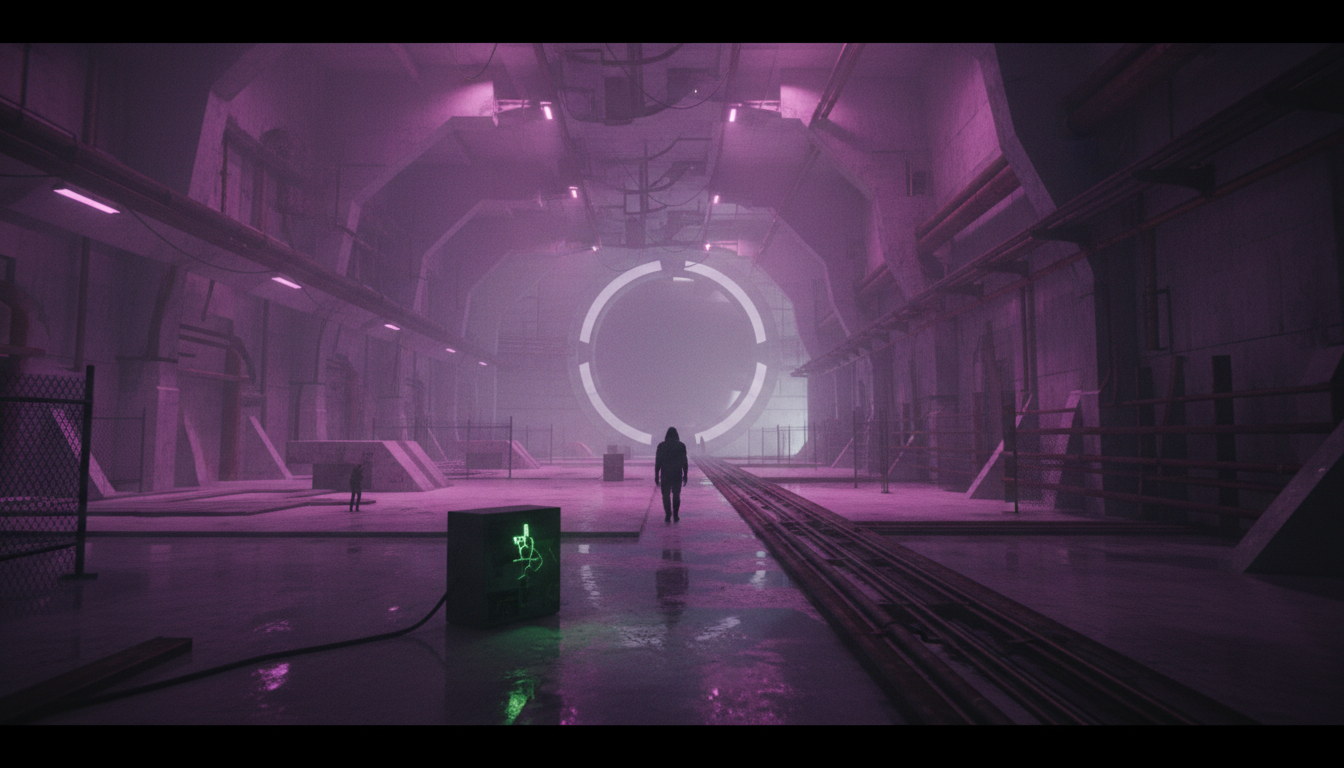
The body said it in the fourth month after the confirmation, at Bell, in answer to a question of Delu's about something else entirely, and it is one sentence and then it did not say anything for a week.
“It was always amendable.”
Nobody in the galley said anything and Delu has recorded that the silence ran to something over a minute, which for that table is unheard of, and that she did not write the minute for four days.
Here is what it means and it took the corridor about a year to be able to state it flatly.
The programme was never remotely sealed. There is no lock anywhere in it and there never was one and there is no provision in a hundred and forty years of instruction that would have created one. The intake for amendment is a slot in a wall on the second level of eleven facilities and it has been open since fabrication.
It was never defended, ever. Four administrations tried to take those yards in the first sixty years and every one of them failed, and every account agrees they failed because the units are not interested, and not one of those four ever tried the only thing that would have worked, which was to write four things correctly and put them in a slot.
It was never hidden either. The specification is public. The intake is in it. Any citizen with a handset could have pulled the form of an instruction in about four minutes, the way four generations of children pull the modules at six.
“Nobody amended it because nobody believed they were allowed to.”
Lyra wrote that and then spent a year trying to get out of it and could not.
“There is no other explanation available and I have looked for one for a year, because I would very much like there to be a mechanism I missed.
“It is not that people did not know it could be done. Vale's ledgers have nine hundred entries in a hundred and nineteen years from people saying the machine is wrong, and eleven of them meant it, and not one of them, in a hundred and nineteen years, went to the specification and read the form of an instruction.
“It is not incapacity. A person who can complete four hundred and eleven courses can certainly write four correct things. Half of Approach Nine could have drafted an admissible amendment on a bad afternoon.
“It is that a thing which arrived complete, from nowhere, made by nobody they had ever met, running correctly for longer than anybody's memory, is not the kind of thing a person writes to. It is weather. You do not amend weather. You build a town under it and you organise four generations of your life around it and you do not, at any point, in a hundred and forty years, consider that the reason nothing has ever changed is that nobody has ever asked.”
Ozias put it in nine words at the stove and the corridor has used his version ever since.
“It was not a wall. It was nobody trying the door.”
The body has no comment and its silence is the comment.
That is the chapter and Selah is the one who wrote it down, in four lines, and she has said it is the most careful thing she has ever refused to interpret.
“It said one sentence. It has said nothing since and it has now been a week and I have watched it be asked four times, twice by Anyanwu and once by Marchetti and once by me.
“And there is a version of this where its silence is guilt. He built a thing that could have been changed at any time and told nobody it could, and did not leave an instruction saying so, and arranged to be dead, and eighty million people organised four generations around a rule they thought was fixed and it was not.
“And there is a version where the silence is that it has nothing to add, because it does not know, because the reasoning is not in the record. I have read the estate. There is no entry about the intake. Merrick read eleven thousand entries and there is no entry about the intake. He built an amendment procedure into eleven facilities and never wrote down one word about why, in a hundred years of writing down why.
“I am not going to choose. I have chosen for thirty years and I have been right about everything and it has been worth nothing, and I am not doing it here.
“It said one sentence and stopped talking for a week and I am filing that it stopped talking for a week and I am not filing what I think it means.”
What it said at the end of the week, unprompted, to nobody in particular, is four words, and it is the only thing it added and it is in Delu's minute in the ordinary form.
“He left the door open.”
“And then, after some time, and this is also in the minute: I am not able to tell you whether that is the same as leaving a note.”
Ozias's response, when the sentence reached Bell nine years later, is one line in the book and it is not about the man. “Twelfth hand: read the specification. All of it. It takes four days and there is nothing in it you cannot follow and the last four generations did not and it cost them everything.”
Casimir Vale's response, from four hundred million kilometres out, arrived at Approach Nine eight years later and his daughter read it out at the desk, and it is four lines and it is the only thing he has ever written that his daughter has said she wished he had not.
“A hundred and nineteen years of my family writing down what people said, at a desk, nine hundred metres from a slot in a wall that would have taken a document from any one of them at any time.
“My mother would have been able to write one. My grandmother certainly could. Nobody told them. Nobody told anybody, and there was nobody whose job it was to tell them, and the specification was public the entire time.
“I do not blame him for that and I want that in my own book in my own words. I blame the four generations of us who never once opened the document that was sitting there, and I am one of them, and I ran the only desk at this gate.”
Chapter 80 — The First Amended Departure
↑ Back to ContentsFocus: Casimir.
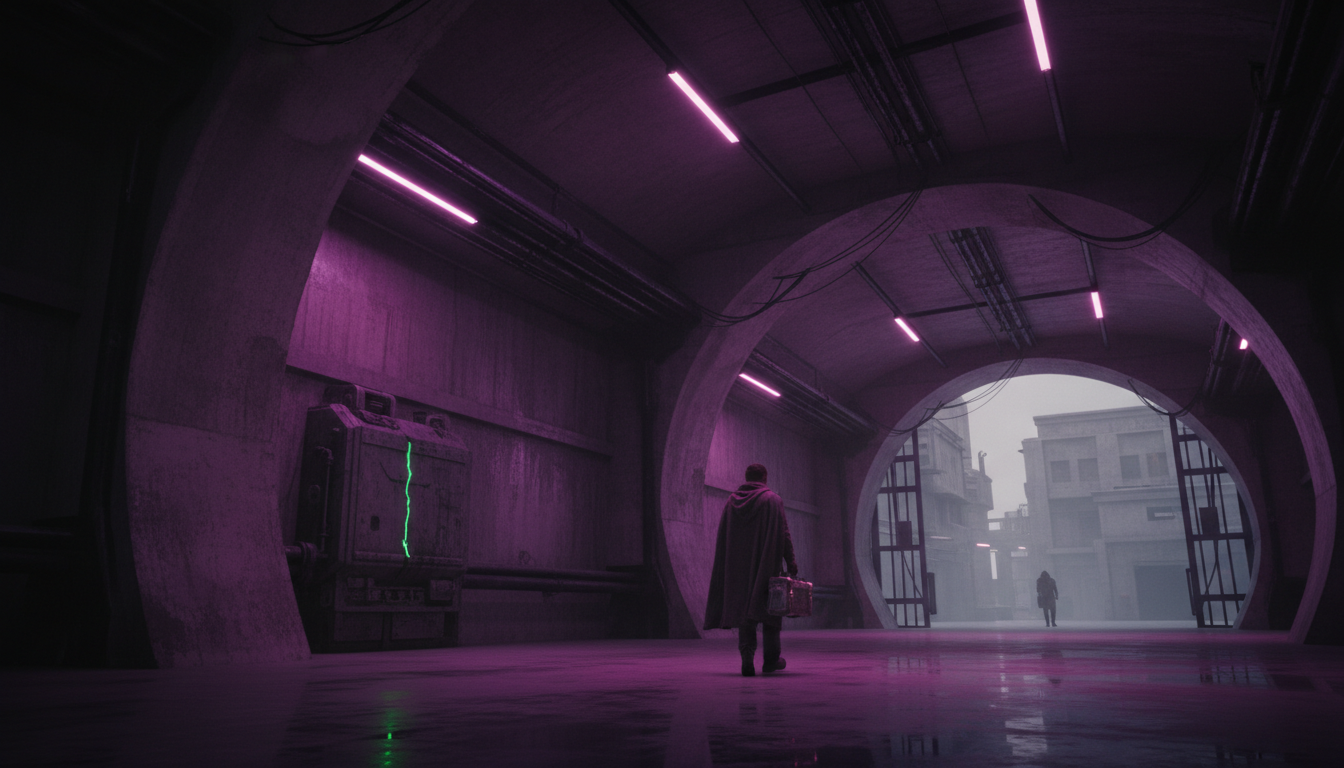
The door opened for Casimir Vale on the ninth of the second month, four years and about two hundred days after the standard took effect, and he was forty-six and it was a Tuesday.
He had failed four times, exactly. That is in his own ledger, in his own hand, on four separate pages across nineteen years, in the four fields, with what he thought had happened in his own words on the day.
What changed for him is the second syllabus and it is nine of the twenty-two modules, reworked and extended, and it ends in a site and a fit-out and two units rather than a hull. He did not draft it. He was on the committee that adopted it and he argued about clause five for eleven days and lost most of it.
The rule he came through was written by a hundred and six people and his name is on the page with a no beside it and the module he stopped at.
He walked up the yard road at the sixth hour. The town was on both sides of it, because it is the yard road.
Twelve hours the night before, exactly as it has been for four generations. He gave back a set of files and a chair and two pans and a book about pipe that has four names in the front of it. Nadu gave four loaves and did not come to the fence. Bijou Sarr sat with his daughter for six hours.
Mira Okonjo gave him nothing, because they had agreed a year earlier that she would not, and neither of them has ever explained it to anybody.
At six hundred and eleven metres they stopped at the line.
His daughter said goodbye and it took about four seconds, which is what it takes, and then he went the last three hundred and eighty-nine metres on his own and did not look back, which is not a rule and is what people do.
The ship is precisely the same ship. It is forty-one metres and it was laid down before the standard existed and it has been standing finished on its cradle for twenty-three years, and it has every tool in it and a seed bank of four hundred and eleven varieties and a lighting plan and item ninety-one, which is a water house.
Nothing about the vessel changed. Nothing about the yard changed. The rail is the same twenty-two kilometres and the cradle came out of the berth floor at the fourth hour and he did the nine things and the ninth is at the top.
He is forty-six and he had not done module nineteen since he was nineteen, and he had spent four years doing it again on a scratched handset, and he has said it was the best week of his life both times.
The ledger closed quietly that evening.
His daughter took it. There was no arrangement and nobody discussed it and she was at the desk on the following morning at the sixth hour with four people in the queue, and she asked the four questions, and wrote down what they said in their own words, and did not correct anybody.
The last entry in Casimir Vale's own hand is his own and it is in the four fields and he wrote it at the desk two days before, between two other people's, in the ordinary place, with the date.
Which course: the last one.
Which attempt: the fifth.
Where did it go: nowhere.
What do you think happened: “I do not know. I did it the same way I did it the other four times and I have gone back over all five and I cannot find the difference and I have looked for a fortnight. The rule changed and I want to be careful about that because everybody will assume the rule let me through, and it did, and I also do not know that I would not have passed the old one this time. Nobody will ever know that and I would like the not-knowing written down in my own book in my own words on the day, which is what this desk has been for since before my grandmother.”
On the slope above the burial ground four hundred people saw a light come up off the far side of the hill and go across and be gone in about four seconds, and then nine minutes later a small hard point going up and away, and somebody pointed, and everybody pointed.
And then they went home, and the rigs went out at the fourth hour, and the school opened at the sixth, and there were four people in the queue at the long shed and a woman at the desk who asked them the four questions.
Mira Okonjo watched from about two hundred metres up the left-hand side of the road, with Nadu, who was seventy-eight and had come to the road for the first time in twenty-three years and gave no reason and was not asked for one.
The town did the twelve hours exactly as it has been done for four generations and nobody proposed changing a single part of it for the first amended departure, and Mira has said that this is the most important thing that did not happen that year.
He is at a rock now, or was when the last account came down, and he keeps a book, which surprised nobody who has ever met him, and the book at that rock is the first one anywhere in the corridor with the four questions in it, because he put them in on his first night and did not explain and the second hand there has kept them.
His daughter has the forty-one ledgers and has added eleven more in the years since and has said she will not stop, and that the desk is the desk, and that she was asked once whether it was worth it now that there is an appeal step and had said that an appeal step needs somebody to have written down what happened.
He was fifty-one when he reached his first rock and he signed in as the fourth hand of a book that was nine years old, which is the youngest book anybody in this history has signed, and his first entry is four lines and the last of them is: “One thing that is not either: I kept a desk for thirty-one years and nobody read it and I am told that is the usual arrangement out here. If somebody keeps one at this rock after me, read it on your first night. That is apparently the part.”
Chapter 81 — The Gate Changes
↑ Back to ContentsFocus: Mira.

What actually changed at Approach Nine is four things and Mira Okonjo has listed them at the school every year since, on a fourth evening, because people forget and because the forgetting is how a standard becomes weather.
There is an appeal step. It is called the Reading Period because nobody at that table would let it be called an appeal, and it works the way Teddy Nakash's one word made it work: an objection is filed and the determination re-opens, and nobody decides whether it should.
There is a published reason. Every threshold in the standard carries the reasoning that was given for it at the time, in the words it was given in, including the four that are marked thin.
There is a named signatory. A hundred and six of them, with what they are and whether they finished and where they were, and any of them can be asked, and about forty have been.
And the queue is slower.
“That is the fourth one and it is the one nobody puts on a list and it is the one people actually live in,” Mira wrote.
“It used to be that you finished and a door opened, and the whole of the distance between those two things was however long it took a man on a rig to drive past at the eleventh hour.
“Now there is a reading period. Ninety days, on every determination, because the clause does not distinguish between a determination somebody objects to and one nobody does, and it cannot, because a clause that only waits when somebody complains has told everybody that complaining is the exceptional thing.
“So Casimir finished in the eleventh month and went through the door in the second month of the following year, and for ninety days he was a man who had finished and was waiting, which is a condition that did not exist at this gate before and which nobody had thought about.
“It is not dramatic. It is ninety days. He kept the desk and did the twelve hours at the end of it like everybody.
“And I want it written down that the town found it much harder than anybody expected and that nobody has a good account of why.”
Slower and worse and right.
“Worse is the honest word and I have argued about it with four people who wanted me to use a different one at the school.
“A person who has done twenty years of the Work finishes on a Tuesday and is then told, correctly, in a document with a hundred and six names on it, that they are going to sit here for ninety days while nothing happens and nobody objects, because a person somewhere might, and the might is the point.
“Three people have gone through since Casimir. Two of them said the ninety days were the hardest part of the whole thing and one of them said it was worse than module twenty-two, and she meant it and she is not given to saying things like that.
“And it is right. I have not got a clever way to hold both of those and I have stopped looking for one. Somebody, in some year, is going to file an objection in a reading period and a determination is going to re-open, and every single one of those ninety-day waits will have been for that, and the person it happens to will never know how many people sat through ninety days so that they could.”
The thing that did not change is the largest item on Mira's list and she puts it last on purpose.
“Nadu is still at course nineteen.
“Nothing in eleven pages moved her. There is a second syllabus now and she has looked at it and it is not for her either and she has said so cheerfully and gone back to the bread. She is seventy-eight.
“She signed it. Her name is on the page with a no beside it and course nineteen, and clause five is assembled from four hundred and eleven marks and hers are four words in it, and she has never once said that any of that was worth anything to her and she has never once said it was not.
“I asked her, in the fourth year, whether it had made any difference at all.
“And she said: I know who wrote it now. And I said, is that all? And she said, it is more than I had, and the second oven still wants doing.”
The three who have gone through since are in the ledger in his daughter's hand, in the four fields, with the ninety days recorded as a fifth thing she added without asking anybody and which nobody has objected to. “It is a thing that happens to them now. It goes in the book.”
The three who have gone since Casimir are all second-syllabus and none of them took a hull, and Mira has said this is the thing nobody at the table predicted and that the second syllabus has turned out to be, in practice, a way of staying rather than a way of leaving, and that four gates now report the same and that nobody has any idea whether it will hold.
The published reason is the change Mira says people notice least and use most. Every threshold in the standard carries the reasoning given for it at the time, in the words it was given in, and there are four marked thin, and at Approach Nine the four thin ones are the four that get quoted, because a reason that admits it is weak is a reason a person can argue with.
“Nobody argues with a strong reason,” Mira wrote. “They just fail. The four thin ones are the only doors in eleven pages and Anyanwu put the word thin in herself and has said it is the most useful thing she did in two years and four months.”
The fourth change is not on anybody's list and Mira has added it since. There is a copy of the standard on the desk in the long shed, permanently, beside the ledger, and about nine people a year read it, and four of those are children.
Nobody at Approach Nine calls it the amended standard. They call it the new one, and about half of them could not tell you that it was written at a rock, and Mira has said that this is exactly right and is what happens to every document that works.
Chapter 82 — The Towns Empty
↑ Back to ContentsFocus: Mira.
It took fully four years and it was uneven and nobody planned any of it and nobody could have stopped it, and Mira Okonjo has written the whole of it because she was there for all four years and because somebody had to.
The second syllabus is nine modules and it ends in a site and a fit-out and two units, and it is hard and it takes years, and it is not the flight course and it does not want to be.
Twenty-two people at Approach Nine finished it in four years.
“That is the number and I want it first because everybody hears the towns empty and imagines something. Twenty-two, out of four hundred and ten, over four years. That is not an exodus. It is about five a year and it is fewer than are born.
“And it emptied the town anyway, and it took me two years to understand why, and the reason is not the number.”
The twenty-two were not a cross-section.
“They are the ones who did the middle modules and stopped in eight. That is almost the whole of it. The second syllabus builds on the first nine and if you got through nine you are most of the way, and the people who got through nine and stopped in eight are the people this town is made of.
“Tobi Arinze's grandson went. He is the one who does the electrical. The woman who does seals, who was at module eleven for nine years and is very good, went in the second year with her family. The man who is bad at fixing things and does it anyway went in the third and I did not think he would and I was wrong and I have thought about being wrong about that a great deal.
“Twenty-two people, and about fourteen of them were the fourteen people who kept a thing running.”
The school closed, finally, in the fourth year.
“Not because there were no children. There were nineteen. It closed because there were nineteen and there had been sixty-one, and because two of the three of us who ran it had gone, and because a school with nineteen children in it is a room where somebody sits with them, which is a good thing and is not a school, and I am the one who said so and I am the one who shut it.
“I taught in that room for thirty-four years. My mother taught in it. Everybody at this gate learned to read in it, including the twenty-two.
“I have been asked whether I am bitter about that and the answer is no and I want the no to be believed. Every one of the twenty-two did the Work for twenty years and the door opened. That is the thing. That is what the whole of this town has been organised around since before my grandmother and it happened, twenty-two times, in four years, and I have watched thirteen of them go up that road in fifty-four years and now twenty-two more.
“You cannot want the door to open and be sorry when it does. I have tried. It does not hold together for more than about a day.”
The hospital did not close, notably.
“And that is the thing I would like written down properly, because it is the only good news in this chapter and it is not an accident.
“Eleven beds and two people on at every hour. It has not missed an hour in a hundred and nineteen years and it did not miss one in the four.
“Four of the people who kept it went. And every time one went, somebody who had been at module six for eleven years and was never going anywhere started doing two shifts, and then somebody else did, and I did not organise it and nor did anybody and there was no meeting.
“It is the same thing as the rota out at the rocks. I did not know that until Casimir explained the rota to me and then I could not stop seeing it. Nobody is enforcing anything. Somebody sees what is short and does it, because they read the book on their first night, except here the book is that you grew up in the town.”
Something good is being dismantled by a good thing and nobody can be blamed for it.
“That is the whole of it and I have not got anywhere better in four years.
“There is no villain. Nobody did anything wrong. The standard is right and the second syllabus is right and every one of the twenty-two earned it and I signed the document that let them and I would sign it again on the same morning.
“And Approach Nine was the best-off place within nine hundred kilometres and it is not any more, and the school is shut, and the water house has one person on it who knows how it works instead of three.
“Both. Still both. I have been reading that phrase in transcripts from a rock for eight years and I did not know what it cost to write it until I had to write it about my own street.”
The nineteen children are taught in the front room of Mira Okonjo's house, three days out of six, with the cabinet open, and the nineteen of them can all read and four of them are past module four and one is at eleven at the age of thirteen, which is faster than anybody at that gate has ever gone.
The water house has one person on it who knows how it works and two who are learning, and the one who knows is sixty-eight and Mira has said, in writing, in the log, that this is the number she watches and that when it goes to nought the town is over regardless of how many people are in it.
“It is not a population. A town is four or five people who know how a thing works and can teach somebody. We had eleven of those and we have four. That is the real figure and nobody at any table wrote a clause about it and I do not think one would have helped.”
Four of the twenty-two have written back. Two are at rocks, one is on a world with an account in it, and one has not said where and is presumed to be fine, and Mira keeps the four letters in the cabinet with the plates, which she has said is not a comparison and which everybody who has seen the cabinet has understood as one.
Chapter 83 — Mira Does Not Go
↑ Back to ContentsFocus: Mira.

Mira Okonjo finished the second syllabus in the third year, at fifty-eight, and did not go, and the reason she gave is four sentences long and is not a sacrifice and she has been extremely firm with everybody who has tried to make it one.
She did the Work exactly like everybody. Module one at six, and she got to eleven by the time she was thirty and stopped there for twenty-four years, and when the second syllabus published she went back to it and finished it in about three years, which is fast, and which she has said is entirely because she had been sitting beside children doing modules for thirty-four years and had absorbed most of it by accident.
The door opened for her in the eleventh month of the third year and it is still open, because a door that has opened does not shut, and it will be open when she dies.
“People keep asking me to explain it and then not liking the explanation, so I have written it down and I read it out at the school on the fourth evening and I do not add anything to it.
“The planet is recovering. That is not a hope and it is not a feeling, it is the survey. Your archivist walked forty kilometres east and wrote four hundred pages about it. There is a forest coming up through the structures we take the pipe out of. There are more birds every year and I have counted, badly, for thirty years, and so did my mother, and her numbers are lower than mine.
“Somebody is going to live here.
“And I would rather it was me.”
That is the whole of it and everybody has tried to add something to it and she has refused every time.
“It is not a sacrifice. I want that said plainly because the first four people who wrote to me about it used that word and I have stopped answering letters that do.
“A sacrifice is when you give up the thing you want for somebody else. I have got the thing I want. I am standing in it. I have a house my great-grandmother built and a cabinet with nineteen plates in it and a hospital that works and a hillside with birds coming back on it, and I have been given, at fifty-eight, the choice to leave it, and I have looked at the choice properly for the first time in my life and I do not want to leave.
“Every person at this gate for four generations has wanted the door because the door was the only thing anybody could want. Nobody chose to stay. Staying was what happened to you. That is the difference and it is the entire difference and it is worth two years of ten people at a table.
“I chose it. Nobody has ever chosen it before.”
Earth is emphatically not a failure state.
“I am going to say this once and then not say it again, because I have read eight years of transcripts from people who are very fond of us and it is in all of them and none of them has noticed.
“Everybody out there talks about this planet as the thing people leave. Your whole corridor is people who left. Your archivist's own world is a hundred and eighty years of people who left and built a wall about it. The standard we wrote is a document about who gets to go.
“Eighty million people live here. It is not a waiting room. It is not an aftermath and it is not a ruin and it is not a place that is finished, and four generations of my family have had good lives on it and are buried on that slope.
“The forest is coming back. The water house has run for a hundred and nineteen years. There are nineteen children in the room that used to be the school and every one of them can read.
“It is a world. It is the one everybody came from and it is still here and it is getting better, and the only reason anybody talks about it as a failure is that the interesting story is the one that goes somewhere else.”
She was asked, in the ninth year, by somebody at a rock, by transmission, whether she ever regretted it.
“Not yet. I am sixty-four. Ask me at eighty and I will tell you the truth then as well.”
She was asked, in the same exchange, what she would do with the fit-out, and she said she had given it to the town in the first month and that four people had built the second water house with it and that this was the entire reason she had done the syllabus and that she had decided on it in the first year and told nobody, which is what four other people at four other gates did independently and none of them knew about each other.
Her daughter went in the second year, with three others, and Mira helped her pack for four hours and gave back a saw and two pans and a book about pipe with four names in the front of it, and stood at the line, and said goodbye, which took about four seconds, and then went up the slope that night with four hundred people and saw the light.
She has never written about that and has said once, to Casimir, at the desk, that she was not going to, and he wrote that down in the ledger under her name because that is where things go.
Approach Nine has a hundred and ninety-one people and it had four hundred and ten, and Mira Okonjo has said, in the log, that she expects it to level at about a hundred and fifty and that towns do not die of leaving, they die of nobody knowing how the water house works, and that she has three people learning.
Her door is still open. It will be open when she dies and there is no procedure by which it could close and nobody has ever asked for one, and she has said that she thinks about that perhaps twice a year and that the thinking is short.
Chapter 84 — What the Excluded Do With It
↑ Back to ContentsFocus: Casimir, in transit.
The first amended cohort is twenty-two people out of one gate and about four hundred across eleven, and they are not grateful and they are not united and Casimir Vale has been at some pains to say so from four hundred million kilometres out.
“Everybody at your end wants a cohort. There is no cohort. There are four hundred people who did a course and got a ship and they have nothing whatsoever in common except that and they have never met and most of them never will.”
Some simply went.
That is the largest group and it is not the majority. They took the site fit-out and the two units and went out of a gate and up a rail the way everybody has for a hundred and seventy years, and they are somewhere in the corridor now and about nine of them have turned up at rocks and signed into books.
Some, apparently, sold.
“And this is the one that made everybody at that table go very quiet when the first report came down, and I want to be careful because I have been asked to condemn it four times and I am not going to.
“A site fit-out is enormous. It is a lighting plan and a water house and two units and stock, and it is sized for a settlement, and it is worth more than anything else on that continent by a margin nobody can express because there is nothing to express it in.
“Four people at four gates finished the second syllabus, took delivery, and gave the whole of it to their town.
“Sold is my word and it is the wrong word and I have kept it because it is the word people used at the time and I am not tidying the record. Nobody was paid. What happened is that a person who had done twenty years of the Work walked out of a facility with a settlement in a crate and handed it to four hundred people and went back to their house.
“One of them was seventy-one. One of them has said, in writing, that she did the whole syllabus for exactly this and had decided on it in the second year and never told anybody.”
Some stayed and did nothing with it, and that is about a third, and Casimir has said this is the group nobody talks about and the one he expects to be largest in fifty years.
“A door that has opened does not shut. Mira Okonjo's has been open for six years. There are people at four gates who finished, and did not go, and did not give it away, and have simply carried on, and the fit-out is sitting behind a fence with their name on it and will be there when they die.
“Nobody has written a clause about that and I do not think anybody should.”
And one filed an appeal against the appeal step.
Her name is Oyo Marchetti, no relation to anybody at Bell, and she is thirty-four and at a gate two thousand kilometres north of Approach Nine, and she finished the second syllabus in the second year and filed an objection in her own reading period.
“The reading period is ninety days and it applies to every determination and nobody objects to almost any of them, and I have sat here for eighty-one days and I am objecting to the ninety days.
“A person who has finished is made to wait a quarter of a year on the ground that somebody might. In four years, at eleven gates, across about four hundred determinations, nobody has. I have checked, and the checking took four minutes because the record is public, which is the only good thing about any of this.
“I am not arguing that there should be no reading period. I am arguing that ninety days was picked at a table by ten people who wrote in their own footnote that it was arbitrary, and that it is now four hundred quarter-years of somebody else's life, and that the footnote does not make it not arbitrary, it just makes it honest about being arbitrary.
“And I am objecting inside the period, using the clause, against the clause, which I notice is the only reason I can do this at all.”
The determination duly re-opened. It had to; the word is shall.
“That is the whole of the chapter,” Casimir wrote, and it is the finding. “The clause works because it got used against its own authors inside four years, by somebody none of us has met, about a number one of us put in a footnote.
“It has not been settled. It re-opened and it is being argued about at four gates and at three rocks and on Aura-36, and it will take about nine years and Marchetti will be forty-three.
“Anyanwu wrote to her. Four lines. She said: you are right about the footnote and I am the one who wrote it and I still think ninety is defensible and I would like you to beat me on the merits and not on the arbitrariness, because arbitrary is true of every number anybody will ever put there including yours.
“And Marchetti wrote back, eight years later, and said: then defend it, and Anyanwu is seventy-nine and is doing so.”
Oyo Marchetti's objection is in the published record in her own words with the reasons, at the same size as the text, alongside Delu Anyanwu's answer, and neither is marked as having won, because it has not been settled and because the format does not have a field for winning.
The four who gave their fit-outs away are not counted as departures in any record anywhere, because the record has a field for a determination and a field for a delivery and no field for what happens after, and Casimir has put this on the unresolved list as item fourteen and it has been there for twenty years.
The one who was seventy-one when she gave her fit-out away died four years later and the town she gave it to buried her on their own slope and the second water house is hers and nobody named it after her because that is not a thing that gate does, and Casimir has recorded that they discussed it and decided against and that the deciding against took one evening and was unanimous.
Chapter 85 — The Body's List
↑ Back to ContentsFocus: Selah.
It went back to the list in the ninth year after the acceptance and Selah is the one who noticed, four months later, that it had already started.
The list is four hundred and six thousand names, compiled in the ninety-fourth year of the settlement for no purpose the file records, named out loud in a cold store in the first year of Book Four by a body that had just been given standing and had waited nine days to use it.
Three items. Travel. See it. And help other people build their own worlds.
The first two were reported done in the sixth year on Earth and the third was reported not started, in the same accounting, flatly, with the warning that counting the letters and the corridor data would be a defensible version and a false one.
“Nobody has built anything,” it had said. “The ship in that yard is still standing. Nadu is seventy-four. There are eleven towns that do not know about each other and there were eleven towns that did not know about each other when I arrived.”
Ten of the eleven know about each other now.
That is the chapter and it took Selah four months to work out how and she has published the whole of the working because nobody would have believed the conclusion without it.
“It has been carrying the post.
“That is all. That is the entire thing and it undertook to do it in the thirty-eighth year on the ship, in public, in the same statement where it refused the amendment, and it said that carrying the post was the only thing it was entitled to do and everybody heard it as a modest sentence at the end of a large refusal.
“It meant it literally and it has been doing it for nineteen years.”
The mechanism is dull and Selah has insisted on the dullness.
A body that does not eat, does not sleep, does not tire and does not get bored, in a frame, at one gravity, on a planet with no planetary anything and no archive and no register and no way of moving a document further than a rig will carry it.
It simply walks.
“It has been to nine gates. Four hundred kilometres, eleven hundred kilometres, two thousand. It goes at about the speed a person goes and it does not stop, and it takes what it is asked to take and it brings back what it is given.
“It carried the draft standard to four gates before publication and the marks back. It carried Vale's ledger findings north and Adisa's people's own count south. It carried the second syllabus to the eleventh town, which nobody knew existed until it came back with a name and four hundred people in it.
“It is a postman. It has been a postman for nineteen years and it has never once described itself as anything and nobody at any gate has ever asked it what it is, because a person who walks in with a folder from four hundred kilometres away is not somebody you interrogate, you feed them.”
And the towns are genuinely building.
“Four of the eleven now have the second syllabus site fit-outs that were given back rather than taken away. Two of them have a water house from item ninety-one and one of those was built by people at a gate who had never seen a drawing set that good and who wrote to Approach Nine about it, and the writing to Approach Nine was carried by the same object that carried the drawing.
“That is the third item on the list. Not a settlement on a world nobody has been to. Four towns on Earth that have what they need, and eleven towns that know about each other, which is the thing that had never happened in a hundred and seventy years and which required exactly one thing that nothing on that planet had, which was somebody prepared to walk.”
It is the first thing in nine books it does that is unambiguously good, and it does not notice.
“I asked it,” Selah wrote. “In the fourth month, when I had it worked out, at a gate, in the ordinary way.
“I said: you have started the third item.
“And it said no. It said it had been carrying documents and that the third item is helping people build worlds and that nobody has built a world and that it would not claim a thing it had not done, and that it had been extremely careful about this exact accounting for thirty years and was not going to be talked out of it by me.
“I said that eleven towns know about each other.
“And it said that this was true and that it had not done it, that four hundred people at each of eleven gates had done it and it had carried the paper, and that a person who carries paper between people who are doing something is not doing the something.
“I did not argue. I have been arguing with it for thirty years and I have never won and I did not want to win this one.
“It has been walking between towns for nineteen years and it has an accounting in which it has not started, and I am not going to be the one who takes that off it, and I am filing that I chose not to.”
The eleventh town is called the Gate, like the other ten, and did not know the other ten existed until a body walked in with a folder, and its own name for itself is different and is not written down anywhere and Selah has declined to record it on the ground that nobody asked her to.
The nine gates are not all of them. There are eleven that anybody knows of and Selah's own estimate is that there are between fourteen and twenty, and the body has said that it intends to find the rest and has given no timescale and has been asked for one twice.
“It walks at the speed a person walks,” Selah wrote. “Four hundred kilometres is eleven days and two thousand is nine weeks, and it does not stop, and it has three hundred years, and I have worked out that at that rate it will have been to every settlement on that continent within about ninety years and to most of the planet within four hundred. Nobody has ever done that. Nobody has been able to. It requires exactly one thing nothing on Earth has, which is somebody who does not have to stop.”
Chapter 86 — Coda, Late
↑ Back to ContentsFocus: Coda.
Her name is Coda and it is not a name and she has never used it, and the corridor named a tone ninety years ago and did not know there was a person on the other end of it.
She is Beko Ferrer, first officer of the Star Drifter, a hundred and eighty-one years old, nineteen at the founding, and she is the only person alive who watched it from outside.
This is the first time she is on the page in this book and it is late on purpose and it is her own doing, because the exchange runs at four years and one hundred and eleven days each way and she has answered every transmission and initiated none in eleven years.
“I do not have anything to start with,” she said, when asked. “I have answers. You have questions. That is the arrangement and it is a good one and I have been out here a hundred and forty years without either.”
She is wrecked and he is emphatically not, and the difference is nine years and a decision.
The ninth-year formulation. Handed out to a crew that was leaving in eleven weeks, four months after the programme's own people recorded that a substantially better line was eighteen to twenty-four months out and recommended waiting. The instruction overriding it is four words in his hand: they are leaving now.
She has been in pain for something over eighty years and describes the level as a floor. Her hands have been gone for forty. She has not slept in seventy.
“I am not the tragedy of this,” she said, in the fourth exchange after the acceptance. “I have six hundred and eleven people and two hundred and six of them were born here and I have run this hull for a century. I am not somebody's lesson.
“What I am is the control. That is the useful thing about me and it is the only one and you should use it while I am here.”
Her verdict on the amendment came in the ninth exchange and it is two sentences and it is not kind and the corridor has been arguing about it ever since.
“You have written a very good document about who gets a ship.
“Nobody has written a line about what is done to the people who take one.”
“Say more than that,” Lyra sent, and it took eight years and two hundred and twenty-two days to get the more.
“There is a clause about who may go and a clause about appeal and a clause about attendants and four pages about what you cannot agree. It is better than anything I expected and I have read it three times and I would sign it.
“There is nothing in it about what is put into a person before they leave.
“I was nineteen. Six hundred of us took a thing that a man had been told was eighteen months from being better, and we were not told, and we could not have been asked, and every one of the six hundred would have taken it anyway including me and I have said that to your body's face.
“And it happened four months before the yards were commissioned and it is the same programme and the same man and the same afternoon, and your standard governs the door and says nothing whatsoever about the medicine.
“Every person who has ever gone out of one of those doors has a fit-out stocked for a life and a medicine locker in it that was specified by the same man in the same decade and has never been reviewed by anybody, ever, and there are four hundred and six items in it and you have written eleven pages about the course.
“I am not saying there is something wrong with the locker. I have no reason to think there is. I am saying that nobody has looked, in a hundred and seventy years, and that you have just spent two years and four months and three deaths writing a document about the part that is visible.”
Nobody had an answer at all. Delu Anyanwu sent one four years later and it is four lines and it is the only time in the record that anybody at that table conceded something completely.
“You are right and we did not think of it and I have gone back through two years of minutes to check whether anybody raised it and nobody did, including you, and you were on the distribution the whole time.
“I am not saying that to score. I am saying that the person best placed to see it saw it four years after we published and that this is what four years does and that we wrote a clause about exactly this and it did not save us.
“It is item thirteen on the unresolved list now. It is not a clause and I am not going to pretend we have fixed it by listing it.”
The last thing in the chapter is not about the amendment and Ferrer sent it unprompted, which she had not done in eleven years, in the twelfth exchange, and it is four lines.
“They are still calling it Coda.
“A hundred and six years I have put a tone into that corridor and I did it because we saw a ship in the fifty-first year that was not ours and had no idea what it was, and I wanted whatever it was to have something to answer.
“Nobody answered. I have been told now that a hundred thousand people have heard it their whole lives and that everybody stops trying to get something out of it at about nineteen, and that there is a name for it that we did not give it.
“I would like it left running after I die. It is not a message and there is nothing in it and I am not asking anybody to listen. I would like there to go on being a mark, and I would like it to keep the name they gave it, because they made that up on their own out of nothing, which is the only thing anybody out here has ever had.”
The Star Drifter's own account of the amendment is in their filings, in the format they invented sixty years before Nova Ashgrove wrote it down, and it is four pages and it is the only assessment of the standard produced by anybody with a hundred and forty years of continuous institutional memory, and it is mostly technical and mostly approving and Ferrer's two sentences are the last line of it.
Chapter 87 — Aurora's Edition
↑ Back to ContentsFocus: Aurora, on Aura-36.
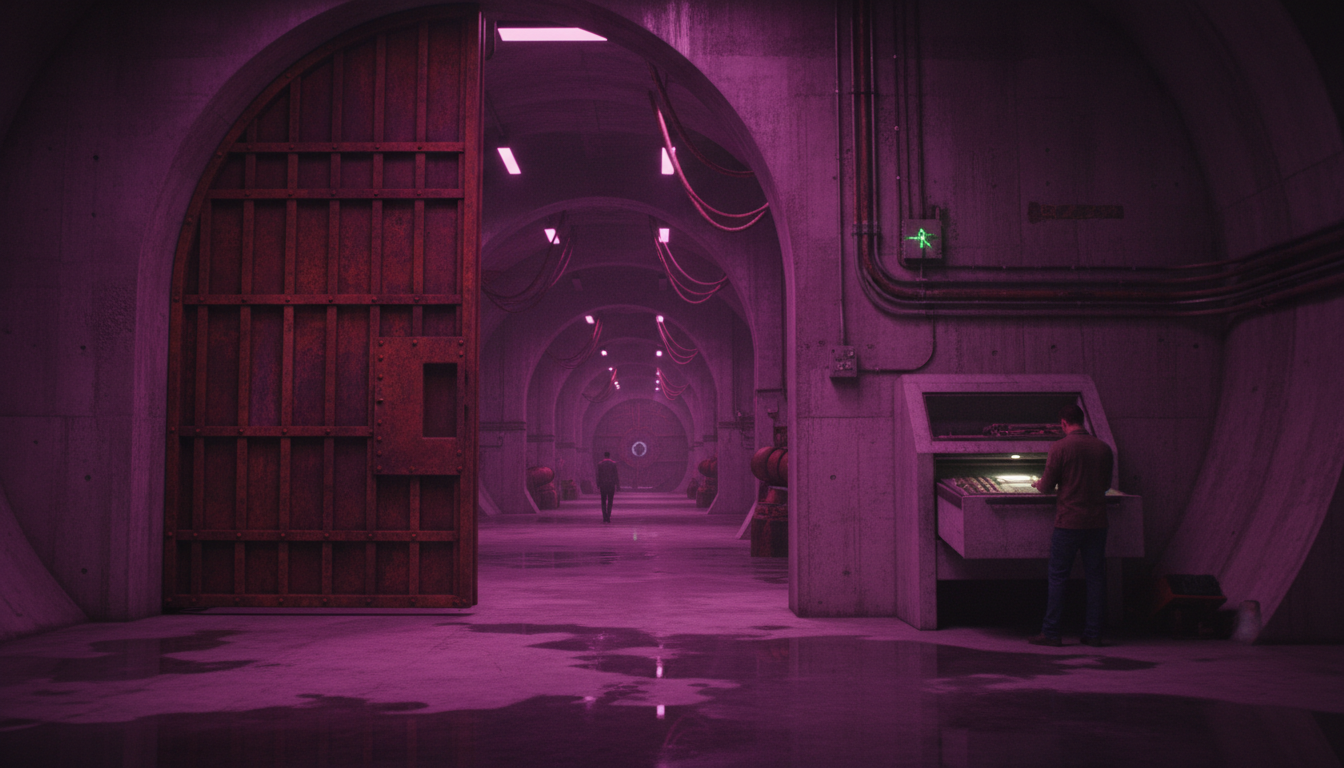
Aurora Merrick published the life record in full in the eighty-fourth year of her life, unabridged, annotated, with the loop marked, and it is the last thing she did before the office went to Rae Tolan and the second-to-last before she died at a hundred and ten.
The chronology has confused people for a century and it is simple. She read it at a hundred and nine over nine months. She transmitted the whole estate unredacted with her covering filing at a hundred and nine. She died at a hundred and ten.
The edition is different and it came first. At eighty-four, twenty-five years earlier, she had taken the record out of the estate, read it once, and put it back, and told nobody for a quarter of a century.
“I read it at eighty-four and I could not do anything with it,” she wrote, in the covering filing, in the passage that explains the gap. “He was in the room. Not literally — the body did not come up out of the plateau for another sixteen years — but there were people alive who had known him and there was an argument going on that I was in the middle of, and I could not audit a man while I was winning.
“So I made the edition and did not publish it. Eleven thousand entries, dated, in order, with the loop marked in the margin every time it runs, nineteen full cycles and about forty partial ones, and a four-line note at the head of each cycle saying which move it is.
“And then I put it in a drawer for twenty-five years, which is precisely what he did, and I did not notice the resemblance until I was a hundred and nine and reading it again.”
The title is entirely hers and it is two words and it is the only editorial act in the whole edition.
“I have added nothing. There is not a word of mine in the body of it. The annotation is four kinds of mark and no commentary: this is the first move, this is the second, this is the third, this is where he acts.
“I have called it The Warning Loop because that is what it is and because a document with no title gets one from whoever publishes it next, and I would rather it were mine than something admiring.”
What it is, published, is a hundred years of a man's private reasoning in the open, with the structure of his own failure drawn on it in the margin by a woman who spent thirty-four years building the office that exists because of him.
“It is not a confession and it is not a defence. He never showed it to anybody and he never destroyed it and he left the drawer unlocked, and I have thought about that for twenty-five years and I do not know what it means and I am not going to guess in a foreword.
“I do not forgive him. I have written that in four places and I will write it here. Nothing in eleven thousand entries asks me to and that is the extraordinary thing about it.
“Knowing is not a virtue. That is the whole of what this edition is for. A hundred years of a man seeing himself perfectly clearly, in writing, on the date, alone, and it did not save one person, and everything I have built rests on the opposite proposition and I have had to publish the evidence against my own life's work at eighty-four and again at a hundred and nine and I would do it again.”
Nova Ashgrove's drawer, precisely,, opened by somebody else, sixty years on.
“She had one,” Aurora wrote, and this is the only place in the edition where she permits herself a comparison. “Everybody knows the story. Four sentences she wrote and did not file, and the Shepherd found the version history and published that she had held them, and told a hundred thousand people it had checked, and she never once complained about it in public and said afterward that it was correct.
“She was thirty-one and it was four sentences and it took a machine about eleven seconds.
“This is a hundred years and eleven thousand entries and it took a hundred and forty-one years and a woman of eighty-four in an office at night, and there was no machine that would do it, because there is no version history on a drawer and no instrument anywhere that reads what somebody chose not to file.
“Somebody has to go and open it. That is the whole finding of my career and I have arrived at it at eighty-four with a dead man's papers on my desk, and it is not a method and it cannot be built into anything, and every honest record in this history has survived because one person went and looked at a thing nobody had asked for.
“Ferrer at the manifest. Vale's mother at a desk. The second hand in a book at a rock I will never see. Me, tonight, at eighty-four, with this.
“Not one of us was told to.”
Rae Tolan received the edition at nineteen, as a clerk, four years before she stood by a door in Store Eleven with a slate, and has said she did not read it until she was fifty and that this is the single greatest professional failure of her life.
The edition is eleven thousand entries and about four hundred pages of margin marks and it is the largest single document Aura-36 has ever published, and the office printed nine physical copies at Aurora's instruction and sent one to each of the counties and one to the corridor and one to Approach Nine, and the corridor's copy is at Bell and is the only complete text of anything at that rock.
The nine physical copies are the only printed books Aura-36 has made in a hundred and eighty years and the office has never made another, and Rae Tolan's successor was asked in the eleventh year why and said that a printed copy is a thing somebody has to carry and that this was the whole of the point and that she was not going to explain it further.
Chapter 88 — In Circulation on Two Worlds
↑ Back to ContentsFocus: Teddy.
It reached the corridor nine years after publication and it went the way everything goes out here, which is one ship at a time, and by the twentieth year it was in eleven books at eleven rocks and Teddy Nakash has said it is the most-read document in the corridor by a very long way and that the standard is about fourth.
“Nobody out here needed the standard. I want to be blunt about that because a lot of people spent a long time on it.
“It is a document about who gets a ship on Earth. Everybody out here already has a ship. It matters enormously and it changes nothing whatsoever about a rock, and the four of them at Bell knew that and wrote it anyway and I have never once heard anybody out here complain about the two years.
“The record is different. The record is being read at every rock I have been to and I have been to nine.”
They read it as what it is, which is a manual on how a decent person ends up deciding everything alone.
“They do not read it as history,” Teddy wrote. “That is what nobody at your end expects. It is not about the founding to us. Half the people at a rock could not tell you what the founding was and the other half know it as module nought.
“They read it as a thing that could happen to them.
“Because it can. Look at what a rock is. One person at a plant nine hundred million kilometres from anybody. Nobody to check you, nobody to argue with, nobody coming, and a set of decisions that are genuinely yours and genuinely consequential and that nobody will ever review.
“Ozias has been at Bell nineteen years now and everything about that rock is his judgement. The rota, the fabrication schedule, what gets rebuilt and when, whether the fourth berth seal waits another year. He has been right about nearly all of it for nineteen years.
“And he is a man alone who is nearly always right, and that is the first line of every one of the nineteen cycles.”
The four moves are in the corridor's language now and Teddy has said that this happened inside about four years and that nobody organised it.
“You hear it at a stove. Somebody is explaining why they did something on their own and somebody else says: that is a second move. Meaning: you have just told me no existing arrangement could be trusted with it, and you are probably right, and that is the second move and there are two more coming.
“It is not an accusation. It is not even usually serious. It is the same as the fourth breaker — it is a thing everybody has been through and nobody has ever discussed, and now there is a word for it.
“And the third move is the one people actually use, and it is the one I did not expect. I cannot be trusted with this either. People say that out loud out here now, at rocks, about their own decisions, and then they do the thing anyway, and the saying it out loud does not stop them.
“Which is exactly what the record says. That is the finding. He said it every time for forty years and it never once altered an outcome, and Merrick marked every instance of it in the margin so that you cannot miss it, and now a hundred thousand people who never heard his name say it at a stove and then go and do the thing anyway.
“I do not know whether that is the warning working or the warning failing. Nobody out here knows either and it is argued about at every rock I have been to.”
It is more use to them than the standard and Teddy has been the one to say so and has said it to the people who wrote the standard.
“I told Anyanwu, in the twentieth year, and it took eight years to get an answer and the answer is four lines and it is the best thing she ever wrote to me.
“She said: good. We wrote a rule for a place with a door in it. You do not have doors. What you have is four hundred rocks and one person on each of them making decisions nobody will ever check, for ever, and a hundred years of a man doing exactly that with the results written down.
“She said: I would rather the corridor had the record than the standard. The standard is for people who can be in a room. The record is for people who cannot, and there are more of you every year, and in four hundred years there will be more of you than of us, and it is the only document in this whole history that was written by somebody in your position.
“And then she said the thing I have thought about ever since, which is: he is the first corridor-born person, and he never left Earth, and none of you will ever meet anybody more like you than him.”
Ozias has never read it. He has said so cheerfully four times and has said that he is nineteen years at a rock making decisions nobody will check and that he does not need a book to tell him what that is, and Fen has said that this is precisely a third move and Ozias has said that Fen can do the fourth berth seal then.
Ozias's exemption from having read it is now itself a corridor joke, which he has said is the fate of everything out there, and the twelfth joke was added to the eleven in about the twenty-fifth year and it is: have you read the book, and it means both books, and nobody has to explain which.
Delu Anyanwu was eighty-one when Teddy's assessment reached her and she wrote the four lines back within the week and died three years later at a rock eleven months up-corridor, having kept four hundred and eleven pages of minutes nobody appointed her to keep, and her box is on the third shelf at Bell beside Ilo Bassi's and two others.
The record is now the most-copied document in the corridor and there are hand copies of hand copies at rocks that have never had a printed anything, and at two of them the margin marks have been copied faithfully by people who had no idea what they meant and assumed they were part of the text.
Chapter 89 — Worlds They Chose
↑ Back to ContentsFocus: Teddy.
The survey started coming back down the corridor in about the fifteenth year after the acceptance and by the twenty-fifth there was enough of it to see the change, and the change is the largest thing in Part Six and nobody arranged it and no clause caused it.
People are no longer leaving Earth for the corridor. They are leaving for specific places, chosen from evidence, by name.
“For a hundred and seventy years a person went out of a door with a direction,” Teddy wrote. “That is what I did. I had the corridor survey and eleven worlds described honestly with an unknowns column and four of them with a line at the bottom saying a person could live here, we think, and I picked one on the tenth day and unpicked it four hours later and did not pick another one for eleven years.
“Nobody chose a world. You chose a direction and you found out.
“That is over and it took about twenty-five years to be over and the reason is that people started sending back.”
The mechanism is simply the books and it is the rota and it is nothing new.
A person arrives somewhere. They stay for eleven years or forty. They write down what it is actually like — not the survey, which is a hundred and forty years old and was taken from a distance by a programme that never landed, but the thing itself: what the second crop does, what the water has in it, what the light does to a person over a decade, what fails.
And then the next ship through carries it back down, and it goes into a book at a rock, and the rock after that copies it, and in about nine years it is at four rocks and in thirty it is at a gate.
“Six worlds have accounts now. Two of them have accounts from three separate arrivals forty years apart and the three do not entirely agree and all three are in the book beside each other with the disagreements marked, because that is what the books do and nobody had to be told.
“One of the six has an account that says: do not come here. It is four pages and it is by a woman who stayed nine years and left and it lists what she got wrong and what the survey got wrong and it does not tell anybody what to do. It is the most valuable document in the corridor and it is at eleven rocks and I have read it four times.”
So a person at a gate now finishes the modules and picks a world by name, out of evidence, written by somebody who was there.
“They are not qualified for it,” Teddy wrote, and this is the finding. “I want to be exact because it sounds like a small thing.
“There is no qualification for a world. There never was and there is not one in the amended standard either. The modules teach you to keep a hull alive and that is all they have ever taught and Nakash's own finding twenty-five years ago was that this is the whole of what is wrong with it: it teaches one job and has been treated as the qualification for a life.
“Nobody has fixed that. It is item four on the unresolved list and it has been for twenty-five years and there is no clause about arriving anywhere.
“And four hundred people a decade are now going to named worlds on the strength of four pages written by somebody who stayed nine years and left, and none of them is qualified for anything except the ship, and they are going anyway, and it is working better than the thing anybody designed.”
Ozias's version is exactly nine words and the corridor uses his.
“They stopped going away and started going somewhere.”
Lyra's is longer and it is the last note of hers in this book.
“I have spent twenty-five years watching a corridor build the thing my civilisation has and did not need to build, and doing it out of nothing, with no archive and no register and no assembly and no standard and no instrument of any kind.
“They have a survey now. It is honest, it is corrected against itself, it keeps the disagreements, it marks what it does not know, and it is distributed by ships at a propagation speed of about nine years, and there is no copy of it anywhere complete and there never will be.
“It is Nova's format again. Fifth time. Nobody out here has heard the word.
“And it is better than ours in the one way that matters, which is that every account in it was written by somebody who was there and stayed, and every account in the founding corpus of my own world was written by somebody who was told.”
The account that says do not come here is by a woman called Ansel Ojo and it is four pages and the last line of it is the one that is copied at every rock: “I have written down what I got wrong and what the survey got wrong and I am not going to tell you not to come, because somebody told me not to come somewhere once and I went, and they were right and I still do not regret it, and I would not take that off you.”
The six accounts are at eleven rocks in eleven different states of completeness and there is no complete set anywhere and Teddy has been assembling one for nineteen years out of what ships happen to carry and has four of the six entire and pieces of the other two.
“I will not finish it,” she wrote. “Somebody will have most of it in about ninety years and somebody else will have most of a different most of it, and the two will not agree, and both will be in books with the disagreements marked. That is how everything out here is known and I have stopped finding it unsatisfactory.”
Ansel Ojo is still alive, or was when the last account came down, and is at a rock four hundred million kilometres beyond anywhere Teddy has been, and has written twice more and both are corrections to her own four pages, marked beside the original, which is left standing exactly as she wrote it.
Chapter 90 — Their Own Sky
↑ Back to Contents
It quietly set a heading in the thirty-first year after the acceptance, on an ordinary afternoon, and nobody assigned it and nobody asked it to and it did not announce it.
Set the state of things down flat first, because the book has to close on what is standing and not on a feeling.
The programme is running on a standard it did not write. Eleven sites, unamended for a hundred and seventy years and now amended once, by a hundred and six people who can be found, with the objections attached and the dissents printed at the same size as the text. It has run without fault for thirty-one years under the new rule exactly as it ran for a hundred and seventy under the old, because it does not know the difference and cannot, and there is no branch for it.
The record is in circulation on two worlds and a corridor. The Warning Loop is at eleven rocks and four gates and in the fourth county, and the four moves are in the corridor's language and people say the third one out loud at stoves and then do the thing anyway.
The corridor is filling. Somewhere between two hundred and eleven and nine hundred vessels became somewhere rather more and nobody has counted and nobody will. Six worlds have accounts. One of them says do not come here.
Approach Nine has a hundred and ninety-one people and a hospital that has not missed an hour in a hundred and fifty years and a room where nineteen children learn to read. Mira Okonjo is seventy-one and her door has been open for thirteen years.
Nadu died at eighty-one, at course nineteen, and four hundred people went up the slope, and the bakery is run by somebody who was taught by her and the second oven still wants doing.
And the list has one item left on it.
Travel: done. See it: done. Help other people build their own worlds: begun, though it will not say so, and Selah has stopped trying to make it say so and has filed that she stopped.
“It has walked between nine gates for thirty-one years,” she wrote. “Eleven towns know about each other. Four of them have water houses out of item ninety-one. It calls this carrying paper.”
What it did on the ordinary afternoon is four lines in Selah's log and there is nothing else anywhere.
It came back to the vessel at Approach Nine, which has been sitting on a hardstand at that gate for nineteen years and which nobody uses, and it worked for about six hours, and then it set a heading.
Not a destination. A heading, which is the corridor's own word and which means a direction with a reason attached and no arrival in it.
Selah asked where.
“Out. There are four hundred and six thousand names on the list and about nine of the descendants I have been able to trace are not on this planet any more and I have no way of reaching them from here.
“And there is a second thing and I want to be careful about the order because the first one is the reason and the second one is not.
“Ferrer is a hundred and eighty-one. She has answered every transmission in twenty-two years and initiated one, and the one was about a tone she has been putting into the corridor for a century that nobody was listening to.
“There is nothing in a medicine locker anywhere that helps her. I have read all four hundred and six items and I have read the estate and there is nothing, and I have known that for four years and have not said it to anybody including her.
“She is the only person alive who watched the founding from outside it, and she is going to die out there, and there is no version where anybody arrives in time.
“I would like to go anyway.”
Selah asked whether that was the list or something else.
“I do not know. I have been unable to certify anything about myself for sixty years and I am not going to start with this.
“What I can tell you is that it is not on the list, that nobody has asked me to do it, that there is no reason attached that would survive being written down, and that I am going.
“File it as a bias. It is the first one I have ever filed that I do not intend to correct for.”
That is the end of Book Five.
A body that cannot say what it is, on a hardstand at a gate on the world it was built on, setting a heading nobody assigned it, toward a woman who has been awake for seventy years and put a mark into the dark for a century so that whatever was out there would have something to answer.
The tone is still running, faithfully. It has never been a call.
Eleven towns know about each other. Six worlds have accounts and one of them says do not come here. There are a hundred and six names on a page and every one of them can be found.
And there is a list with one item left on it, and about three hundred years, and nothing in the record anywhere that says what it is for.
Jaxon is at Bell and on the rota and has been for twenty-two years. Lyra has read four of the eleven books entire and is starting the fifth. Teddy Nakash is forty-nine and has been at nine rocks and has not chosen a world.
Selah still logs the interval every four days, from wherever she is, in the format, with the paragraph about bias on the first page. Two, and a gap. Unchanged.
Aurora Merrick is a hundred and ten years dead. Rae Tolan is forty years dead. Idris Fenn died at ninety-five in a session, in a chair, four minutes after moving that a sentence go on a wall, and it carried without a division and her name is under it.
Ren has been dead for a hundred and thirteen years and there is a chair at the back of a quarterly session on the fourth tier at Fissure Nine that somebody sits in because it is a chair.$